

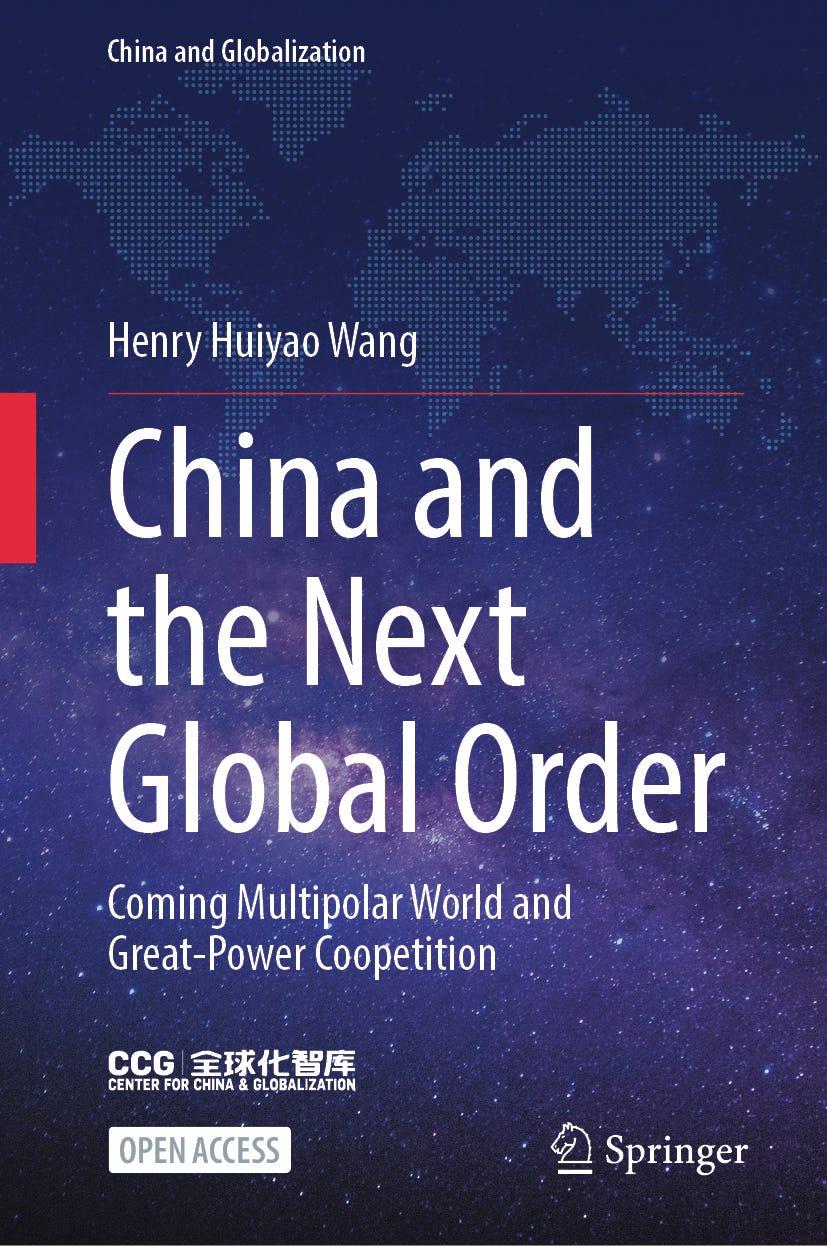
We are pleased to share an excerpt from China and the Next Global Order: Coming Multipolar World and Great-Power Coopetition, the new book by Henry Huiyao Wang, Founder and President of the Center for China and Globalization (CCG). Published by Springer Nature in 2026 as part of the “China and Globalization” series, the book is available as an open-access publication.
The volume brings together Wang’s writings on China’s evolving role in globalisation, global governance, great-power relations, and the emerging multipolar world. The following excerpt, first published by the South China Morning Post on September 12, 2025 and revised for this collection, examines the Shanghai Cooperation Organisation’s expanding role in trade, green and digital development, and conflict dialogue. It argues that the SCO and BRICS do not seek to replace the United Nations, but can reinforce multilateralism and help sustain a more inclusive global order when established institutions are paralysed.
China-Led SCO Is a Critical Salve for the Ailments of the Global Order
As the world faces fragmentation and interstate conflict that has not be seen in decades, the Shanghai Cooperation Organisation is working to drive practical solutions. Neither it nor BRICS seek to replace the United Nations, but amid UN paralysis, organizations that champion regional multilateralism can help sustain global order.
Eighty years after World War II ended, the multilateral system is faltering. The United Nations, once the symbol of post-war peace and cooperation, is increasingly sidelined by unilateral actions and trade wars, amid the marginalization of the Global South in decision-making.
We are at risk of a world where tariffs and sanctions replace negotiation, conflicts multiply, and the very principles of international law are often ignored. If the international community is to avoid drifting further into fragmentation, new governance approaches are urgently needed.
It is in this moment of turbulence that the Shanghai Cooperation Organisation (SCO) gathered in Tianjin, China, for its largest summit ever, underscoring its growing role as a forum for stability, dialogue, and development across Eurasia.
What began over two decades ago as a regional body to manage border security has evolved into a comprehensive institution with economic, cultural, and, increasingly, global faces. The summit delivered not only political dialogue but also set forth new mechanisms of cooperation, including a SCO development bank.
Chinese President Xi Jinping also unveiled his Global Governance Initiative, the latest of proposals that include the Belt and Road Initiative, Global Development Initiative, Global Security Initiative, and Global Civilisation Initiative. The new framework sets out five guiding principles: sovereign equality, adherence to the international rule of law, support for multilateralism under the UN system, people-centered development, and action-oriented cooperation. The SCO embodies the five principles, providing a platform for countries of different cultures, ideologies, and political systems to cooperate. It is a critical salve for the ailings of today’s global system, in which some states raise tariffs and undermine global institutions, while others call for reform but fail to deliver.
Economic and trade issues stood out in Tianjin. Amid mounting protectionism, the SCO committed to keeping regional markets open and inclusive. Europe has moved to tighten rules on imported vehicles and the United States continues to rely on tariffs and sanctions as tools of leverage, but China has gone in the opposite direction. It is removing its tariffs for 53 African countries, opening its market to some of the world’s poorest nations.
The message is simple: as globalization looks to be retreating, there are still major powers willing to promote openness and inclusion. For SCO members and their partners, that example provides confidence that there is a cooperative path forward.
Just as important, the summit placed digital cooperation and green transition at the heart of its agenda. Across the SCO, local champions from fintech to e-commerce are reshaping economies, while China is providing infrastructure, training, and technological expertise. Projects linking renewable energy to computing capacity, as in Xinjiang, offer models of how to combine resource endowments with sustainable innovation.
SCO member states also pledged to expand scholarships, scientific exchanges, and joint research programs, investing in the human capital needed for the next development phase. These steps reflect the action-oriented spirit China emphasized, turning rhetoric about cooperation into measurable outcomes.
But the SCO is not only about economics. In a world where interstate war has returned on a scale unseen in decades, the organization’s convening power is itself a public good. The Tianjin summit saw the leaders of China, India, and Pakistan at the same table—a rare moment given historical tensions in South Asia. Such encounters do not resolve disputes overnight, but they build the habits of dialogue and trust that are indispensable for peace.
Similarly, the SCO provides a forum where discussions on Ukraine, Gaza, and other conflicts can take place without the ideological divisions that often paralyze other bodies. Its capacity to bring diverse actors together, including states with different political systems and security concerns, is becoming an important counterweight to the polarization dominating global affairs.
The SCO is no replacement for the UN, nor does it seek to be. But as the UN grapples with paralysis, regional multilateralism has a growing role to play in sustaining global order. Alongside BRICS, which has expanded its outreach to Africa and Latin America, the SCO shows how the Global South can organize, articulate its interests, and create institutions. Neither of these organizations reject the current global system; rather, they seek to reinforce the principles of the UN Charter through practical initiatives.
China’s role in this evolution is central. As the world’s second-largest economy, it has both the responsibility and resources to support multilateral efforts. By cutting tariffs, financing infrastructure, sharing technology, and convening dialogue, it shows leadership is not only about military power or diplomatic rhetoric, but also ability to generate benefits and confidence. Whether through the Belt and Road Initiative, development banks, or SCO projects in energy and digital transformation, China shows multilateralism can be revitalized through deeds.
The world is in danger of drifting into disorder. Conflicts are rising, global trade rules are under strain, and the legitimacy of international institutions is being questioned. But the lesson of Tianjin is that alternatives exist. By broadening its mission, launching institutions, and embracing inclusiveness, the SCO shows it can be a pillar of multipolar stability. The Global Governance Initiative’s framework provides a philosophical compass, while the SCO and BRICS supply the practical means to steer through turbulence.
If the post-war multilateral system is to be repaired, vision and action are required. The SCO’s evolution suggests that even in an era of fragmentation, models of cooperation are emerging. For the over 3 billion people of its member states and the wider international community, this is an unalloyed good.
Excerpt | Henry Huiyao Wang on Escaping Thucydides’s Trap

We are pleased to share an excerpt from China and the Next Global Order: Coming Multipolar World and Great-Power Coopetition, the new book by Henry Huiyao Wang, Founder and President of the Center for China and Globalization (CCG). Published by Springer Nature in 2026 as part of the “
Excerpt | Henry Huiyao Wang on Navigating the Multipolar Era
We are pleased to share an excerpt from China and the Next Global Order: Coming Multipolar World and Great-Power Coopetition, the new book by Henry Huiyao Wang, Founder and President of the Center for China and Globalization (CCG). Published by Springer Nature in 2026 as part of the “
Excerpt | Henry Huiyao Wang on China’s Green Power Leadership
We are pleased to share an excerpt from China and the Next Global Order: Coming Multipolar World and Great-Power Coopetition, the new book by Henry Huiyao Wang, Founder and President of the Center for China and Globalization (CCG). Published by Springer Nature in 2026 as part of the “
Thank you, Henry. There is hope for a peaceful, safe, green and prosperous future for all humankind. We just need to look east, not west.