

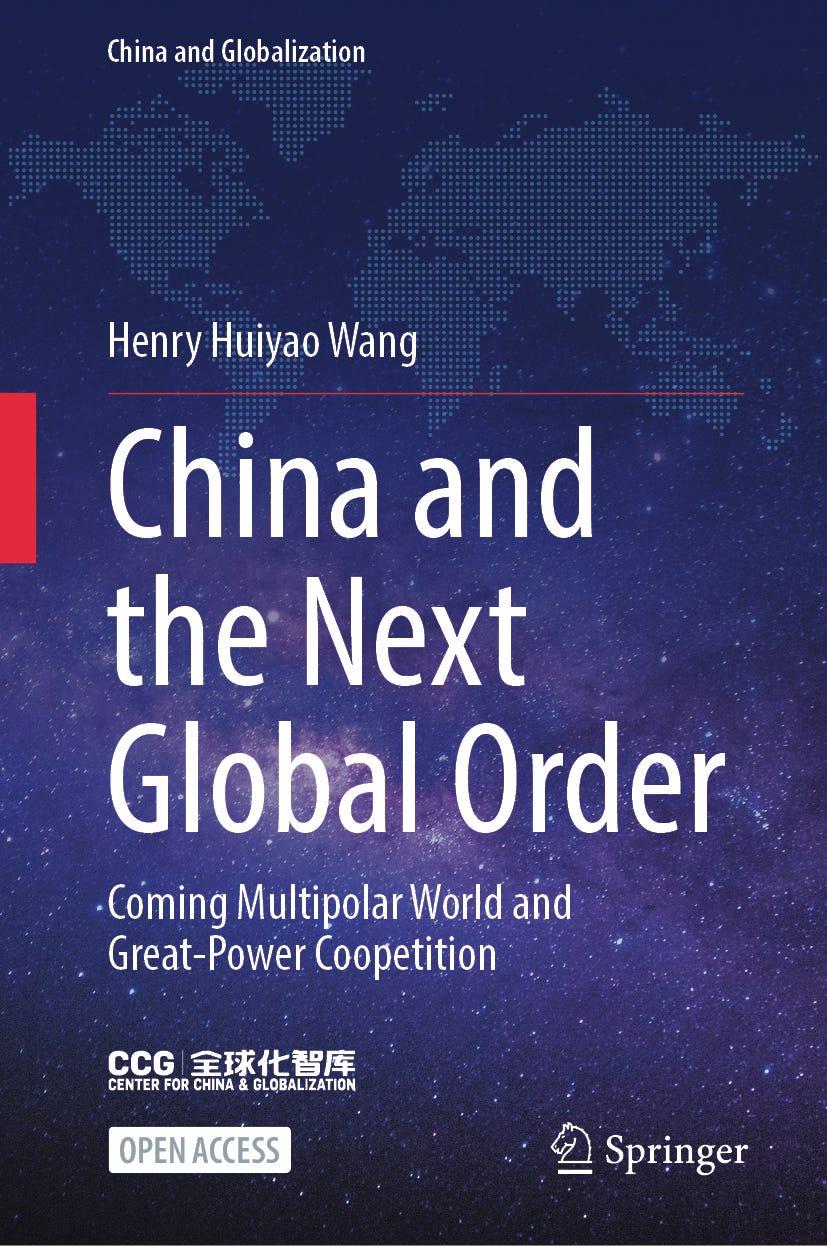
We are pleased to share an excerpt from China and the Next Global Order: Coming Multipolar World and Great-Power Coopetition, the new book by Henry Huiyao Wang, Founder and President of the Center for China and Globalization (CCG). Published by Springer Nature in 2026 as part of the “China and Globalization” series, the book is available as an open-access publication.
The volume brings together Wang’s writings on China’s evolving role in globalisation, global governance, great-power relations, and the emerging multipolar world. The following excerpt, first published by the South China Morning Post on March 16, 2025 and revised for this collection, examines how Donald Trump’s deal-oriented approach could create openings for cooperation on trade, investment, Taiwan, and peace in Ukraine.
The US-China Thucydides Trap Is by no Means a Foregone Conclusion
From helping mediate in Ukraine aligning with the economic and geopolitical goals of the US under Donald Trump, China may yet defy this dangerous historical specter and produce practically positive political and economic outcomes.
The Thucydides Trap–the idea that a rising power and an established hegemon are destined for war–often frames China-US tensions and conflict as inevitable. Yet I believe the outcome is determined not by fate, but by choice.
Harvard professor Graham Allison, who popularised the term with his 2012 Financial Times article, agrees with me on the role of human agency. As he put it during an event for my book, Escaping Thucydides’s Trap: Dialogue with Graham Allison on China-US Relations, held last month on the sidelines of the Munich Security Conference, “Structural forces account for 75-80 per cent of the outcome, but human agency shapes the rest.”
Peace is not an illusion–it’s a viable option if we act decisively.
The Thucydides Trap is based on the competition between Athens and Sparta, a rivalry that ended in war. History offers plenty of similar warnings—rising powers frequently collide with dominant ones. Yet exceptions exist. In the 1890s, Britain and Germany avoided military conflict through economic competition. Allison’s book, Destined for War: Can America and China Escape Thucydides’s Trap?, does not predict doom; it challenges us to rewrite the pattern.
That China’s economy achieved 5 per cent growth last year and is projected to grow by another 5 per cent this year despite US containment efforts underscores the stakes. Over 70,000 American companies generate US$600 billion in sales annually there, with Tesla’s Shanghai operations driving its global success. These connections are not incidental – they’re a foundation for mutual benefit, favouring cooperation over confrontation, much as trade once steadied European power relations.
US President Donald Trump’s return to power introduces a new dynamic. While 80 per cent of Americans view China unfavourably, Trump praised Chinese President Xi Jinping’s leadership during his campaign. His focus on economic outcomes over ideological divides sets him apart from Washington’s norm.
In Munich, Allison predicted that by January 2026, US-China relations would “surprise us on the upside”, citing Trump’s deal-oriented approach and signs of thawing rhetoric. Appointees like former CEO David Perdue and financial expert Scott Bessent suggest a preference for practical engagement over entrenched hostility.
Trump’s emphasis on economic priorities opens avenues for dialogue on trade and technology. China’s 15th Five-Year Plan, set to begin next year, could provide a framework for new agreements – perhaps in infrastructure or investment in the United States—inline with Trump’s stated interests.
On Taiwan, mainland China’s economic incentives, such as deepened economic and tourism exchanges, could help ease tensions and foster coexistence. While a modern communiqué, building on the 1972 Shanghai accord, which marked the normalization of US-China relations might outline mutual commitments to stability and prosperity.
But this extends beyond bilateral ties – it’s a chance to shape global outcomes. Consider Ukraine. Allison argues China could play a pivotal role in resolving that conflict. US Defense Secretary Pete Hegseth has said no American troops would be deployed there, leaving peacekeeping functions to European and non-European forces.
Further, Russia’s concerns of NATO encroachment would likely require broader involvement from unaligned parties, and a substantial deployment of non-European peacekeepers. China is already the largest contributor to UN peacekeeping forces among the five permanent members of the UN Security Council, and, together with other BRICS countries, could help convene peace talks, support a negotiated settlement on the Russia-Ukraine war, and provide the neutral peacekeeping presence and security guarantees necessary to sustain it.”
Trump’s aim to halt that war aligns with this opportunity; his planned visit to China within 100 days of taking office, is a window Beijing, Washington, Brussels, Moscow and Kyiv should seize – we should restore UN credibility and authority and pass a UN Security Council resolution to send UN peacekeeping forces to Ukraine. Negotiations on trade, investment, and even a phase two or phase three agreement could also yield gains in areas Trump values.
Organizing international forums to reframe power transitions as opportunities for collaboration, not just conflict, could shift global perspectives. Success would stabilize regions and show China’s capacity to turn rivalry into partnership.
Trump’s tariff threats unsettle markets, but his preference for deals over doctrine offers China an advantage. Foreign Minister Wang Yi emphasized in Munich that China’s approach rests on respect and mutual benefit–a consistent stance amid uncertainty.
Beijing can propose trade agreements or technology collaborations that appeal to Trump’s advisers, including business leaders drawn to China’s economic weight. It could encourage a practical approach in Washington. On issues like TikTok, an economic deal might reduce friction. Globally, China can leverage forums like the G20 to articulate a clear message of coexistence – not merely a rebuttal of conflict, but a constructive vision for stability through openness.
The Thucydides Trap is not a foregone conclusion–it’s a call to action. President Xi said it well: “There are a thousand reasons to make the China-US relationship a success, and not a single one to harm it.”
From helping to mediate in Ukraine to investing in the US, we can defy historical trends. Deepening ties with American business leaders close to Trump can also reinforce a focus on practical outcomes rather than political posturing. Facilitate peace talks to unite the Global South. Align the 15th Five-Year Plan with US economic goals. Ease tensions through collaboration, not confrontation. Peace requires effort, not chance. The time to act is now.
Excerpt | Henry Huiyao Wang on Navigating the Multipolar Era

We are pleased to share an excerpt from China and the Next Global Order: Coming Multipolar World and Great-Power Coopetition, the new book by Henry Huiyao Wang, Founder and President of the Center for China and Globalization (CCG). Published by Springer Nature in 2026 as part of the “
Excerpt | Henry Huiyao Wang on China’s Green Power Leadership
We are pleased to share an excerpt from China and the Next Global Order: Coming Multipolar World and Great-Power Coopetition, the new book by Henry Huiyao Wang, Founder and President of the Center for China and Globalization (CCG). Published by Springer Nature in 2026 as part of the “
China’s fundamental way to prevent war is to become so strong that the United States can no longer imagine victory, rather than so friendly that it loses the will to fight.
Diplomacy, economic cooperation and crisis management still matter, but their principal function is to reduce miscalculation and manage competition. The underlying variable that determines whether war remains a viable policy option is still the balance of power. Peace ultimately has to be maintained through diplomacy, but it must first be secured by strength.