

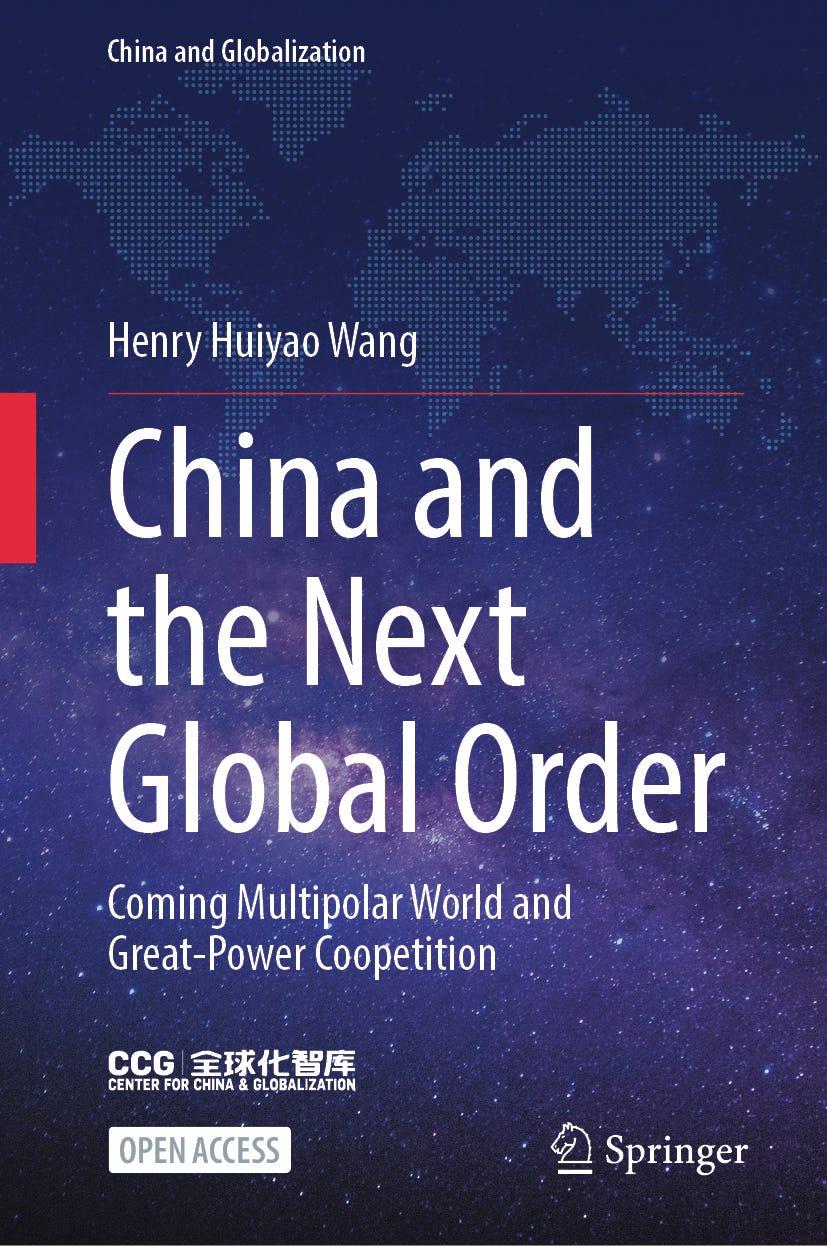
We are pleased to share an excerpt from China and the Next Global Order: Coming Multipolar World and Great-Power Coopetition, the new book by Henry Huiyao Wang, Founder and President of the Center for China and Globalization (CCG). Published by Springer Nature in 2026 as part of the “China and Globalization” series, the book is available as an open-access publication.
The volume brings together Wang’s writings on China’s evolving role in globalisation, global governance, great-power relations, and the emerging multipolar world. The following excerpt, adapted from a background paper prepared for the Trilogue Salzburg in August 2025 and revised for this collection, examines how the decline of unipolarity is accelerating regional integration and creating a more dispersed international order.
Transformation and Opportunities in the Multipolar Era: Regional Integration, Global Governance, and China’s Historical Wisdom
At the edge of a new, multipolar world, we stand at a crossroads of evolution and division. While some countries would like to divide the world into camps, China’s historically based long-term vision is one of integrated evolution that benefits all nations.
The world today is undergoing profound transformation. The once dominant unipolar order, US hyperpower, has gradually given way to a more complex and diverse multipolar landscape. While China has long been an advocate of multilateralism, its presence is now no longer deniable. At the Munich Security Conference, it was the central topic of discussion and was treated effectively as already a truism. Further more new blocs are rising, regionalism is resurging, and independent actors are asserting their autonomy. Traditional patterns of influence are being replaced by new forms of cooperation and competition. Amid this sweeping change, understanding the motivations and dynamics behind these shifts—especially how countries like China are likely to respond, drawing on their deep historical and cultural legacy—has become essential to grasping the future of international relations.
This evolving global landscape is still neck deep in the throes of globalization. Even as the star of economic liberalism seems to be under threat and liberal internationalism in retreat, the processes of regional integration and cooperation across multiple continents have only accelerated, signaling a decisive move away from centralized power toward a more distributed and interconnected world order. This is the core of Globalization 3.0, in that even as economic globalization slows at the broadest scope, all the forces undergirding globalization have remained in play and adjusted to this new post-hegemonic order.
And now that the movement toward multipolarity is unmistakable, with power and influence no longer concentrated in a single superpower or locked in bipolar rivalry, we are seeing a world of greater freedom of action, for better and worse. The dispersion of power across multiple centers and programs of regional integration as a reaction stands out as one of the most vivid expressions of this shift.
In North America, the United States has embarked on an effort to build its own pole, first under the Biden administration, when it tried to retrench itself in its traditional alliance structures and build a united front against the rising power of China, with assemblages such as the Quad and AUKUS as well as increasing NATO involvement in the Pacific. But amidst the second Trump administration, the United States has changed course, embarking on a more narrowly focused North American pole, attempting to coerce Canada, and Belgium via Greenland, to pursue closer relations, while threatening to reassert control over the Panama Canal. These moves reflect a changing world and a determination to solidify a more modest pole amid intensifying global competition.
Meanwhile, Europe is accelerating its integration process and investing in military capacity and cooperation. Emerging from its post-Brexit slowdown, the European Union, which has since its inception expanded from six founding members to 27, now looks to continue with countries like Ukraine and Moldova as official candidates, signaling continued interest in external growth. Meanwhile, internally, economic integration, with the expansion of the EU’s single market, the Eurozone and the Schengen Area, continues. Taken together, these facilitate the free movement of goods, capital, services, and people, and have seen member states cede rights and limited sovereignty by entrusting the supranational EU with greater authority, on topics ranging from the negotiation of trade deals to regulations on food production. Meanwhile, military spending within NATO is soon to rise to 4.5% of GDP across the Alliance, mostly impacting Western European members by signaling the end of their peace dividend and of Europe as a disarmed continent. Despite challenges from populism and political extremism, the EU remains committed to pressing forward with a dual-track approach of deepening and widening integration, while investing in the assets needed to act independently of the US security guarantee.
Beyond Europe and North America, the rise of the Global South has catalyzed the decentralization of power within the international system and demonstrated another path forward. The 2008 global financial crisis propelled emerging economies into global governance and led directly to the creation of the G20 Leaders’ Summit—forming the basis of a new framework for cooperation on economic and global issues. Emerging economies hold 11 seats within the G20, and the African Union’s inclusion at the 2023 New Delhi summit further amplifies the Global South’s voice. BRICS countries stand as prominent representatives of this new wave and have become key drivers of the multipolar evolution. In 2022, measured by purchasing power parity, the BRICS nations accounted for 31.5% of the world economy—surpassing the G7’s 30.7%. This gap is only likely to widen as opportunities for developing economies outpace those of developed ones.
At the same time, Asia is witnessing a surge in regional cooperation. High-profile summits involving China, ASEAN, and the Gulf Cooperation Council have underscored efforts to enhance economic connectivity, energy collaboration, and diplomatic dialogue—reflecting a growing recognition of the importance of regional solidarity in navigating global uncertainties.
Within Southeast Asia, the “ASEAN-X” mechanism exemplifies a pragmatic and flexible approach to regional integration. By allowing differentiated and phased implementation of commitments, ASEAN advances regional unity while respecting member states’ sovereignty and diversity. Simultaneously, Southeast Asia is actively deepening cooperation with external powers and international partners, enhancing its strategic connectivity and influence in global governance. ASEAN’s own dual approach—strengthening internal cohesion and expanding external partnerships—reflects the broader trend also seen in Europe of intensified regional cooperation under multipolarity. It positions Southeast Asia not only as a cohesive regional bloc but also as a dynamic actor contributing to the construction of a balanced, multipolar international order.1
Similarly, Latin America is actively pursuing regional integration as a strategic response to external pressures and internal challenges. The 27th São Paulo Forum, convened in Tegucigalpa, Honduras, gathered over 1000 representatives from more than 400 political parties, organizations, and social movements across Latin America, the Caribbean, and 21 countries worldwide. Under the theme of regional integration, the forum critically examined challenges posed by US and NATO hegemonic actions, the rise of right-wing forces and ongoing global crises that undermine regional unity. In response, it emphasized the necessity of strengthening solidarity and cooperation among left-wing parties to advance pluralistic and inclusive regional integration. Rejecting neoliberalism, neocolonialism, and exclusionary trade agreements, the forum advocated resistance against imperialist interference and unconventional warfare.2 Through comprehensive development plans and political unity, Latin America demonstrates a clear commitment to enhancing regional cohesion and collective empowerment.
Across Latin America, Africa, India, and all the nations of the broader Global South, there has been an increasing latitude and tendency to pursue independent foreign policies. This impulse is comingled with a refusal to align strictly with any major power bloc, with non-alignment reflecting a desire for greater autonomy and diversified partnerships. Meanwhile, liberal internationalism has receded in the United States, and the rise of tensions has hindered the free flow of trade. Yet despite these two factors, the continuing growth of global trade demonstrated another quiet truth: If the state of global trade over the past decades has been a dance, then yes, the dance partners may be changing, and regional dynamics may grow more pronounced. But people are still looking for partners in the waltz. Trade itself remains fundamental to undergirding the prosperity of the present, even as it has become more unpopular in developed nations.
Further, the Global South as a whole seems to thoroughly understand that global challenges, such as climate change, development, and security, require flexible, multilateral solutions. Collectively, these trends illustrate that the world is no longer defined by singular or binary power structures. Instead, regional blocs and independent actors together shape a complex new multipolar order characterized by overlapping networks of cooperation, competition, and negotiation.
As alluded to earlier, during the Biden administration, attempts were made to revive a Cold War style ideological approach, building coalitions of “like-minded” countries to counter China. Initiatives like AUKUS and the Quad brought in new partners such as India and framed the issue as a struggle between democracy and authoritarianism to preserve the “free world.” However, with changes in US leadership and shifting geopolitical realities, these ideological divisions have rapidly fallen by the wayside and China’s relations with countries previously aligned against it have begun to improve.3 This shift highlights a defining feature of the emerging multipolar order: The world is no longer shaped by rigid ideological blocs, but by a flexible, overlapping web of pragmatic regional groupings.
If disruption is a rupture—a sudden break where conditions on the ground are exposed as having rested on false assumptions, as with the collapse of the Soviet Union and the end of the bipolar order—then evolution is when leaders and stakeholders recognize change early and understand its implications.
We have already cleared the first hurdle: We have seen the change coming. Just as thinkers like John Robert Seeley foresaw that Britain’s era of global hegemony would not last as “nations organized on a vaster scale,” we today stand at the threshold of a new multipolar era. Fundamental shifts in the world’s economic organization are already under way, signaling the slow but inexorable end of American hegemonic power. China’s response to this oncoming global change and the solution it offers is deeply rooted in its millennia-old history and rich cultural traditions, which imbue the country with a distinctive sense of confidence and composure. Over thousands of years, through the rise and fall of dynasties, through the birth of the modern Chinese state, the Chinese people have cultivated a broad historical perspective, one that allows engagement with today’s international challenges as transient episodes within the vast continuum of time. A long-term view fosters a mindset of patience and careful deliberation, encouraging thoughtful responses rather than impulsive reactions. By understanding that crises and upheavals are often temporary, China is approaching global uncertainties with a calm prudence, always seeking the right timing and approach to navigate change effectively.
This long perspective is complemented by China’s heritage, which has instilled a strong sense of pragmatism and stability in the national character. For centuries, self-sufficiency in agriculture shaped a collective mentality centered around “having enough to eat, no need to panic.” Even when external circumstances become turbulent or threatening, the worst-case scenario requires a calm focus inward on sustaining the nation. This has freed China from the need to respond aggressively or make hasty compromises under pressure. With the exception of the Mongol invasions of Japan, which were birthed of a young foreign dynasty in control of the Chinese mainland, China has always calmly set its own pace and strategic direction: avoiding starting wars, and instead maintaining stability even amid instability.
However, this pragmatic approach should not be mistaken for conservatism or isolationism. History shows that China has often turned periods of turmoil into opportunities for transformation and growth. Many of its greatest leaders and founding emperors emerged in times of chaos, seizing moments of uncertainty to establish new orders and reshape the nation. Meanwhile, it was the complacency and hegemonic breakout of the Qing dynasty that led to the great divergence in both military and technology that in part led to China’s weakness in the nineteenth and early twentieth century. This historical experience nurtures a mindset in which change itself is not something to be feared; rather, it is a natural and inevitable part of life that must be understood and harnessed. Change represents opportunity and what truly matters is the ability to recognize emerging trends, set clear objectives, and adapt flexibly to evolving circumstances.
Consequently, China’s strategic approach today is anchored in having well-defined long-term goals while maintaining flexibility in how to achieve them. It embraces a pragmatic attitude that any method or path contributing to these goals is worth pursuing, without rigid adherence to fixed formulas or ideologies. In the complex and shifting landscape of international relations, China not only seeks to protect its own national interests but also aims to play a constructive role in global governance.
China’s success reinforces this message. China proves that peaceful nations can both benefit from economic globalization and deftly sails against the headwinds facing our current era, offering compromise, peace, and mutual benefit for all.
For example, in crises such as the conflicts in Ukraine or the Middle East, China consistently maintains an independent and balanced stance, actively engaging in diplomatic mediation efforts to promote peace and stability. This reflects an understanding that global disorder can also create openings for constructive influence, and that success depends on seizing the right moments to shape outcomes beneficially for both China and the wider world.
Reflecting on the tumultuous history of the last century, China’s journey offers valuable lessons. During periods of national crisis and decline, the Chinese people engaged in tireless experimentation with various social, political, and economic models in search of a viable path forward. The country became a vast laboratory where multiple governance systems—from parliamentary democracies to presidential regimes—were tested. Many of these efforts faced significant challenges due to incompatibilities with China’s unique cultural and historical context.
Through intense competition among these different ideas and real-world trials, the People’s Republic of China as it exists today gradually took shape. This historical process underscores a simple but important truth: Sustainable solutions arise only from pragmatic approaches tailored to a nation’s specific circumstances and realities. Since the founding of the PRC, this principle of pragmatism has guided many of China’s most pivotal decisions—from the historic normalization of relations with the United States to the launch of the reform and opening-up policies that propelled China’s rapid modernization. Had China chosen alternative paths, the country and indeed the world today would look very different.
And now China offers its own solution to all who would listen: a peaceful and empowering evolution, rather than a hard rupture of disruption—through the five principles first articulated at the Bandung Conference in 1954: mutual respect for sovereignty, non-aggression, non-interference, equality and mutual benefit, and peaceful coexistence. China is offering itself up, engaging economically and peacefully with every continent, looking toward the mutual benefit born of trade, trust and capacity building that can glue us all together in an evolution, not a revolution, to bring the world together and make it a better place. From the China–CELAC forum in Latin America to the China–FOCAC forum in Africa, from the ASEAN-X models to the Regional Comprehensive Economic Partnership (RCEP), China is committed to this path.
In sum, the world stands at a crossroads of evolution and disruption. The trend toward multipolarity and regional integration marks a clear break from the colonial era’s spheres of influence and the rigid bipolarity of the Cold War. Today’s world is shaped by voluntary cooperation among sovereign states, overlapping, inclusive regional frameworks, and pragmatic, flexible strategies rooted in each nation’s history and culture. China’s approach—anchored to long-term goals while adapting with flexibility—exemplifies how historical wisdom and practical experience can provide stability and opportunity amid uncertainty. As global power continues to diffuse and regional networks grow more complex, the ability to adapt, cooperate, and maintain clarity of purpose will be essential to navigating the challenges and opportunities of the multipolar age.
Dai Yi and Lai Zhengshi, “Institutional Changes of ‘ASEAN-X’ and Regional Integration in Southeast Asia”, Southeast Asian Studies 1: 49–62, https://doi.org/10.19561/j.cnki.sas.2025.01.049.
Wang Ximan and Hu Jiahui, “An Analysis of the 27th São Paulo Forum Meeting”, Contemporary World and Socialism (Bimonthly), no. 1: 170–190, https://doi.org/10.16502/j.cnki.11-3404/d.2025.01.017.
Robert A. and Mathew Burrows, “Biden’s Foreign Policy Legacy: A Troubled Interregnum”, The Henry L. Stimson Center, November 19, 2024. https://www.stimson.org/2024/bidens-foreign-policy-legacy/.
Excerpt | Henry Huiyao Wang on China’s Green Power Leadership

We are pleased to share an excerpt from China and the Next Global Order: Coming Multipolar World and Great-Power Coopetition, the new book by Henry Huiyao Wang, Founder and President of the Center for China and Globalization (CCG). Published by Springer Nature in 2026 as part of the “
Request for Help
I am seeking urgent assistance from anyone willing and able to examine my case independently.
I am the victim of a state-financed entrapment programme orchestrated by the Norwegian security apparatus. The process began in early 2009 with a series of coordinated provocations and psychological torture intended to break me down psychologically. Over time, I came to understand that the purpose of these provocations was to produce manipulated recordings and fabricate security-related threat narratives that could later be used against me.
Since then, I have been subjected to prolonged containment through controlled environments designed to isolate me, systematically torture me, and ultimately gain psychological control over me. This campaign has been sustained over many years by the Norwegian security apparatus. Its objectives have been to engineer false narratives, systematically spread them through formal and informal networks, isolate me, continue systematic torture within controlled environments, and ultimately use me as a “Manchurian candidate” in a false-flag security operation.
Norwegian security agencies operate extrajudicial campaigns through networks presented publicly as anti-radicalisation cooperation. In reality, these networks function as de facto extrajudicial courts involving religious institutions, community leaders, and criminal elements. They are used to facilitate torture, entrapment, and smear campaigns against victims while concealing the role of those directing the operations.
Norwegian security agencies operate with the acquiescence of higher authorities, enabling them to use state institutions to fabricate evidence and narratives, manipulate official and medical records, conceal torture, silence victims, and obstruct independent legal remedies. Political figures, public officials, professional associations, healthcare providers, NGOs, private individuals, and members of the general public are influenced through false narratives, incentives, coercion, or other means to participate in social and political engineering while maintaining the appearance that their actions are independent and spontaneous.
Norway now functions as an authoritarian system operating behind the façade of democratic institutions. Security cooperation between Western states, together with their influence over international human rights organisations, has created an environment in which meaningful scrutiny is prevented. Rather than conducting independent investigations, many organisations knowingly or unknowingly reproduce the same fabricated narratives generated by the security apparatus.
Throughout this process, I have been systematically prevented from learning the allegations being constructed against me and prevented from responding to them through torture and containment. Every attempt to report torture, challenge fabricated narratives, or obtain an independent investigation has resulted in further retaliation, additional fabrication of evidence, and deeper containment.
Today, I remain unable to break free from this system. The containment extends far beyond state institutions and incorporates individuals within my wider social environment. My communications have been continuously monitored, making it extremely difficult to communicate safely or obtain genuinely independent assistance.
I am not asking anyone to accept my account without scrutiny. I am asking for an independent examination of the evidence, conducted from first principles and free from reliance on institutional narratives that form part of the system I am asking to have investigated.
If you are able to assist, or know an individual or organisation with the independence, integrity, and expertise necessary to examine this case objectively, I would be deeply grateful for your help.
Independent scrutiny is the only path towards establishing the truth and restoring accountability.