

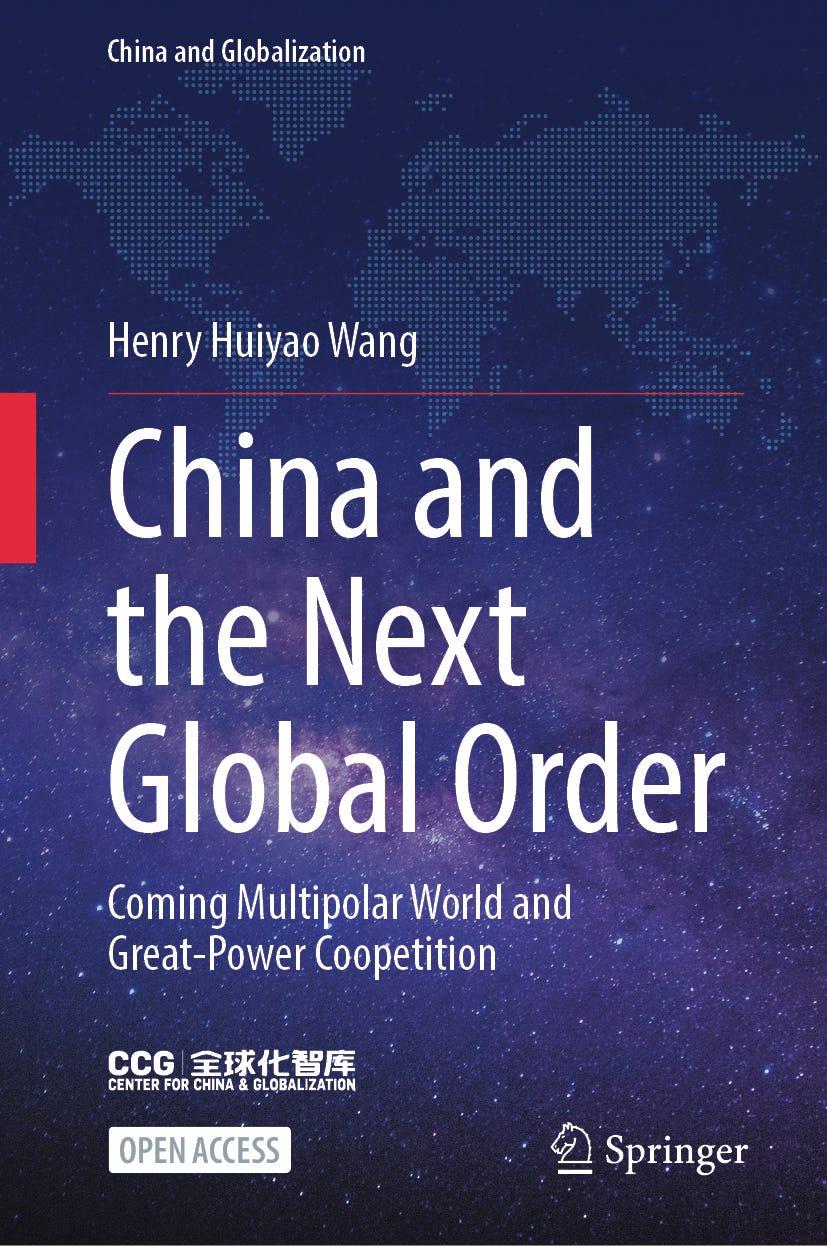
We are pleased to share an excerpt from China and the Next Global Order: Coming Multipolar World and Great-Power Coopetition, the new book by Henry Huiyao Wang, Founder and President of the Center for China and Globalization (CCG). Published by Springer Nature in 2026 as part of the “China and Globalization” series, the book is available as an open-access publication.
The volume brings together Wang’s writings on China’s evolving role in globalisation, global governance, great-power relations, and the emerging multipolar world. The following excerpt, first published by CGTN on March 27, 2025 and revised for this collection, examines the impact of rising trade barriers and unilateralism on the global economy. It argues that deeper Asian integration, stronger regional trade frameworks, and renewed support for the World Trade Organization can help defend multilateralism and drive a more equitable global recovery.
The Outlook for Multilateralism Under the Shadow of Protectionism
Advancing economic integration and cooperation among Asian nations can help to spur a broader movement toward multilateralism and drive global recovery and institutional reform in a direction that is more equitable.
As we enter 2025, the rise of unilateralism and protectionism has dealt fresh blows to global stability and economic recovery. The global economy’s challenges and uncertainties are mounting, fueling growing concern and anxiety within the international community. Against this shifting global backdrop, how to advance economic globalization and uphold multilateralism has become a pressing issue for Asian countries.
Around the world, trade barriers, economic sanctions, tariffs, and other protectionist measures have hindered cross-border economic cooperation and restrained global growth. In such a context, how Asian countries can take on a more proactive role in driving global economic recovery and stability, particularly in promoting sustainable development and economic integration, has become a key issue in the current global economic landscape.
As the global economic environment continues to evolve, Asian countries’ strategic importance is increasing. The ongoing Boao Forum for Asia Annual Report on Asia’s Economic Outlook highlights how Asian countries like China are taking the lead globally in growth promotion, green development, energy transition, and innovation, especially in cutting-edge technologies like artificial intelligence. This shift has not only spurred regional economic expansion in Asia but also injected strong momentum and vast potential into the sustainable development of the global economy.
Yet the global trade landscape is being reshaped by the rise of protectionist policies, most notably those stemming from US unilateralism and protectionism. Prolonged trade wars, escalating tariffs, and tightening economic restrictions have posed severe challenges to both China and the broader global economy.
Despite mounting external pressure, China has responded with a measured and strategic approach by prioritizing market openness and diversification of trade partnerships. China has demonstrated resilience amid a turbulent global trade environment through tax cuts and by granting tariff exemptions to over 40 of the world’s least developed countries (LDCs).
One telling indicator of this shift is the declining role of the United States in China’s overall trade portfolio: the United States now accounts for just 11% of China’s total imports and exports, down about 10% from a peak of 21.5% in 2002. Although the United States has imposed steep tariffs on Chinese goods, the protectionist measures spearheaded by the Trump administration have ultimately failed to suppress the growth of bilateral trade. In fact, despite tariff pressures, the total volume of China–US trade has risen from $500 billion to over $600 billion, marking about a 20% increase.
In addressing global economic challenges, China has responded with restraint and strategic precision rather than resorting to sweeping retaliatory measures. For instance, China opted for targeted countermeasures on roughly 100 specific product categories instead of launching all-out trade retaliation. This calibrated response reflects a fundamental economic truth: in a trade war, there are no winners.
In this context, the pursuit of Asian integration takes on heightened significance. As one of the primary engines of global economic growth, China should work proactively to deepen cooperation with its regional neighbors, including the Association of Southeast Asian Nations (ASEAN), India, South Korea, and Japan, to lay the groundwork for a broader Asian alliance. Beyond economics, Asia also possesses unique cultural elements that can serve as powerful bonds of unity. Shared traditions, such as Confucian values and the symbolic “chopstick culture,” reflect common philosophical roots and lifestyles that can help foster a stronger sense of regional solidarity. Over time, this envisioned Asian alliance could encompass Central Asia, South Asia, the Gulf region, and even parts of the Pacific Rim, contributing to global economic integration.
In addition to regional integration, establishing cooperative mechanisms like the Comprehensive and Progressive Agreement for Trans-Pacific Partnership (CPTPP) is equally vital. Through multilateral cooperation, Asia can forge greater resilience and unleash more innovative potential, accelerating regional economic integration while supporting the broader recovery and development of the global economy. The CPTPP is not just a supplement to the international free trade system; it is a significant force driving Asia’s own integration and advancing globalization more broadly. Over the coming years, Asia’s economic potential is expected to expand substantially, particularly in emerging sectors such as intelligent manufacturing, green development, and the digital economy.
As a major player in global trade, China should deepen cooperation with the European Union, Australia, and Latin American countries to help shape a more open, fair, and inclusive global trade system. The World Trade Organization (WTO) remains the central governing body of international trade, and preserving its authority is essential to ensuring that global commerce continues to operate within a rules-based framework. China has consistently advocated for WTO reform and multilateral trade agreements recently. In September 2024, during the WTO Public Forum, the Center for China and Globalization (CCG) hosted a seminar at WTO Headquarters in Geneva, emphasizing the importance of advancing trade liberalization. The event urged global economies to take initiative in pushing trade reform, rather than passively waiting for the United States to re-engage in the multilateral system.
In conclusion, under the growing shadow of protectionism, Asian countries must remain committed to multilateralism, advance their efforts to enhance regional cooperation, and assume greater global responsibility. By advancing integration within Asia and deepening cooperation with other global economies, the region is poised to become an important engine of global growth. It will play an increasingly central role in shaping the world economy. The current challenges and uncertainties are a test of resilience and a critical opportunity to drive economic recovery and long-term development. Asian countries should take on a more proactive role in this process, working together to help steer the global economy toward a more stable, prosperous, and sustainable future.
Excerpt | Henry Huiyao Wang on Escaping Thucydides’s Trap

We are pleased to share an excerpt from China and the Next Global Order: Coming Multipolar World and Great-Power Coopetition, the new book by Henry Huiyao Wang, Founder and President of the Center for China and Globalization (CCG). Published by Springer Nature in 2026 as part of the “
Excerpt | Henry Huiyao Wang on Navigating the Multipolar Era
We are pleased to share an excerpt from China and the Next Global Order: Coming Multipolar World and Great-Power Coopetition, the new book by Henry Huiyao Wang, Founder and President of the Center for China and Globalization (CCG). Published by Springer Nature in 2026 as part of the “
Excerpt | Henry Huiyao Wang on China’s Green Power Leadership
We are pleased to share an excerpt from China and the Next Global Order: Coming Multipolar World and Great-Power Coopetition, the new book by Henry Huiyao Wang, Founder and President of the Center for China and Globalization (CCG). Published by Springer Nature in 2026 as part of the “