

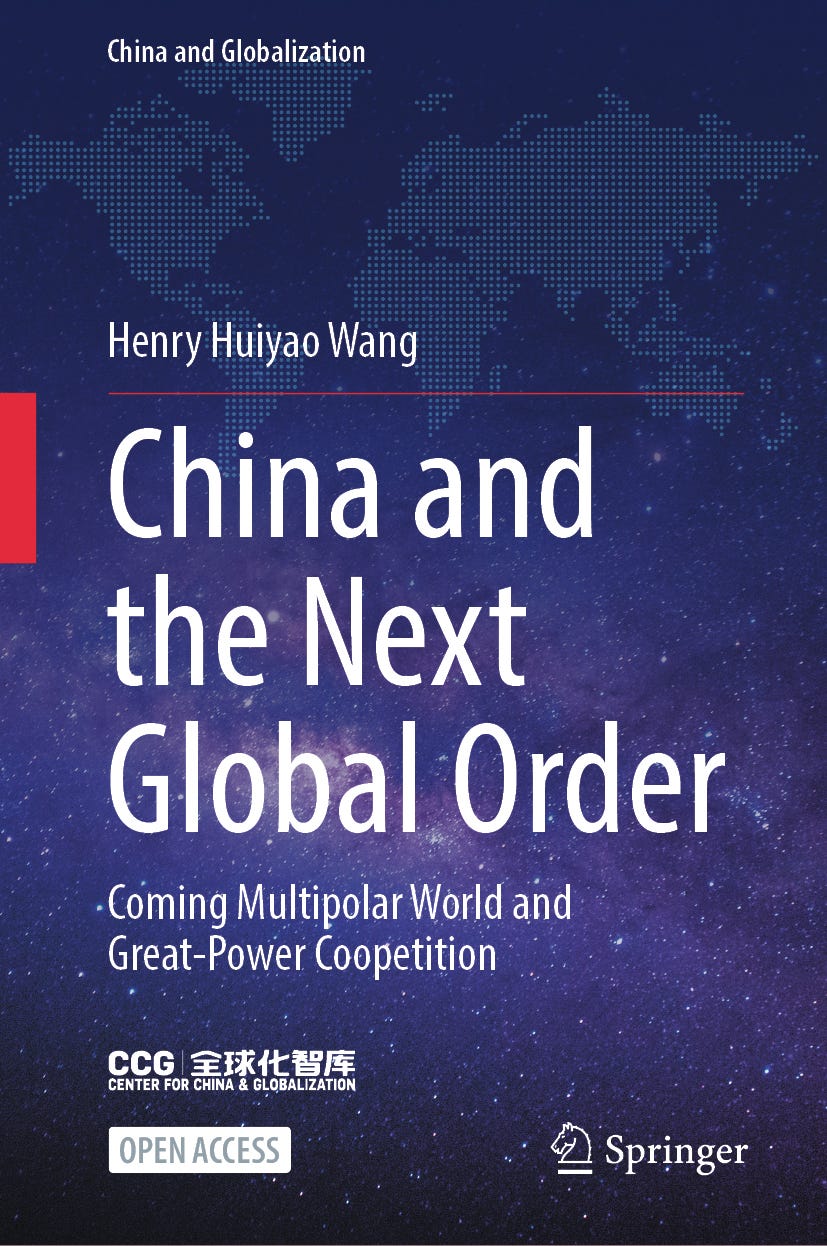
We are pleased to share an excerpt from China and the Next Global Order: Coming Multipolar World and Great-Power Coopetition, the new book by Henry Huiyao Wang, Founder and President of the Center for China and Globalization (CCG). Published by Springer Nature in 2026 as part of the “China and Globalization” series, the book is available as an open-access publication.
The volume brings together Wang’s writings on China’s evolving role in globalisation, global governance, great-power relations, and the emerging multipolar world. The following excerpt, first published by the South China Morning Post on August 22, 2023 and revised for this collection, examines the growing influence and internal diversity of the Global South. It argues that China should support stronger research and dialogue networks, improve relations with India, enhance BRICS cooperation, expand Global South forums, and use its experience with developed and developing economies to promote more effective North–South cooperation.
How China Can Step Up to Its Responsibilities in a Rising Global South
As the rise of the Global South brings opportunities and risks to South–South cooperation, China must boost dialogue, work more with India, and drive North–South cooperation.
The importance of this week’s BRICS summit cannot be understated, especially given the possibility of the expansion of a grouping that already comprises Brazil, Russia, India, China, and South Africa. This moment is also indicative of the wider rise of the Global South.
In February 2023, the Munich Security Conference added a panel discussion on how the Global North can better cooperate with the Global South. At the G7 summit in May, host Japan pushed to strengthen the Group of Seven’s ties with the Global South and specifically invited the leaders of several developing countries to the Hiroshima meeting.
“The Global South is becoming more visible—and influential—in every arena,” said Foreign Policy magazine at the start of the year.
While the Voice of Global South Summit, a virtual meeting hosted by India earlier this year, was attended by more than 100 countries, there is no universally accepted definition of which countries exactly comprise the Global South. There are, for instance, Global South countries in the geographic North, and vice versa.
Yet this flexibility reflects the nature of the Global South, a community where states recognize in one another their similar situations. Economically, the community is developing and looking to improve. Politically, it is a multilateral alliance with diversified values and interests.
Despite the escalation of the Ukraine crisis and global political divisions, most countries have chosen to neither take sides nor join the strategic suppression of Russia. Clearly, Global South countries prefer to keep an independent foreign policy and a non-aligned position.
In recent years, major powers in the Global North have introduced initiatives to strengthen their connection with the Global South, often in hope of obtaining greater geopolitical benefits. These include the US-led Build Back Better World and the EU’s Global Gateway.
Compared to the United States, however, the European Union appears to have a more nuanced interest in the Global South. While safeguarding members’ interests in former colonies, the EU also hopes to enhance its security in energy and food by “derisking.” In essence, the EU sees a third path in a new global order, dominated by neither the United States nor China, and needs to build common interests with the Global South.
At the same time, India and Russia play important roles in Global South countries. India positions itself as a North–South power—deeply intertwined with the Global North in strategic goals and values, while remaining an integral part of the Global South, seeking to become a bridge in leading the community to build a new diplomatic equilibrium.
Russia’s diplomatic focus, meanwhile, has been on former Soviet states, the Asia-Pacific, Middle East, and Africa. Their reliance on energy, food, chemical fertilizers, and other commodities from Russia makes decoupling difficult. Through engagement, Russia has strengthened its position and cooperation with the Global South.
With the rise of the Global South comes opportunities to deepen South–South cooperation. But any hasty moves can bring risks, intensify North–South tensions, and exacerbate confrontations worldwide. China, seen as a pivotal country in the Global South as far back as in 2004, should take on its due responsibilities.
First, it should encourage and support Global South think tanks and institutions, and jointly conduct research with other Global South countries to examine issues such as exchange mechanisms. Western countries have already established several Global South think tanks and research centers.
Second, a new world order aligned with the demands of the Global South should be proposed and promoted. The rise of the Global South may be an unstoppable trend but the process will not be smooth. The looseness, fragility, and diversity of the community means it is less able to sidestep risks and more prone to infighting. To guard against exclusion, China should embrace developing countries, keep close ties with its partners, and work to enhance the cohesion of the Global South.
Third, China must work to improve relations with India and to bolster the inflence and function of BRICS. As a grouping, BRICS’ economy has surpassed the G7 in purchasing parity terms power.
Sino–Indian relations have been stagnant for years but with India having chaired the recent Shanghai Cooperation Organisation summit and set to preside over the G20 summit in December, there is hope that relations will get better. Both China and India are in a position to work with other major developing countries and lead cooperation in the Global South to promote BRICS. Expansion will only enhance the impact of the “BRICS Plus” format in addressing the concerns of the Global South.
Fourth, China should hold more Global South forums to enhance official and non-governmental exchanges. Existing platforms include the Belt and Road Forum for International Cooperation, Forum on China-Africa Cooperation, and China-CELAC Forum with the Latin American and Caribbean states.
China should invite high-level officials and experts from industry and academia to hold more diverse Global South forums. Regularly held, these can facilitate standards for South–South cooperation and establish inclusive and equitable rules for cooperation in areas such as the digital economy, climate change, and sustainable development.
Finally, China should work on stronger, better, coordinated North–South cooperation. For many, China epitomizes the rising Global South. China’s economic and technological cooperation with many countries in the Global South is also greater than that of developed countries.
Given China’s experience in cooperating with developed countries, its role as a go-between might be more appealing to the Global North. In this sense, China should consider enhancing North–South exchanges and cooperation, while avoiding an escalation of tensions.
As a country with both developing and developed elements, China could marry the interests of both communities to promote a more sustainable global development and better global governance.
Excerpt | Henry Huiyao Wang on Escaping Thucydides’s Trap

We are pleased to share an excerpt from China and the Next Global Order: Coming Multipolar World and Great-Power Coopetition, the new book by Henry Huiyao Wang, Founder and President of the Center for China and Globalization (CCG). Published by Springer Nature in 2026 as part of the “
Excerpt | Henry Huiyao Wang on Navigating the Multipolar Era
We are pleased to share an excerpt from China and the Next Global Order: Coming Multipolar World and Great-Power Coopetition, the new book by Henry Huiyao Wang, Founder and President of the Center for China and Globalization (CCG). Published by Springer Nature in 2026 as part of the “
Excerpt | Henry Huiyao Wang on China’s Green Power Leadership
We are pleased to share an excerpt from China and the Next Global Order: Coming Multipolar World and Great-Power Coopetition, the new book by Henry Huiyao Wang, Founder and President of the Center for China and Globalization (CCG). Published by Springer Nature in 2026 as part of the “