

China’s Foreign Ministry was asked Monday whether Iran had sought Beijing’s help in transferring highly enriched uranium to China, after report said Tehran was willing to move such material there as part of efforts to resolve the U.S.-Iran conflict.
Foreign Ministry spokesperson Mao Ning did not directly answer the question.
“Since the outbreak of the U.S.-Israeli war with Iran, China has maintained close communication with all relevant parties, including Iran, and has been making active efforts to promote ceasefire and peace. Guided by the spirit of President Xi Jinping’s four propositions, we will continue playing an active role in restoring peace and tranquility to the Middle East and Gulf region at an early date.” she said.
“On the Iranian nuclear issue, China always supports a peaceful resolution through dialogue and negotiation. We hope relevant parties will seize the opportunity and find a solution that accommodates the legitimate concerns of all sides through negotiation. China will continue playing a constructive role in the political and diplomatic settlement of the Iranian nuclear issue to safeguard the international nuclear non-proliferation regime and promote peace and stability in the Middle East and beyond.”
About a month earlier, on April 26, Mohamed Amersi, a British businessman and founder of the Amersi Foundation, raised the same issue at a dinner during the 12th China and Globalization Forum in Beijing.
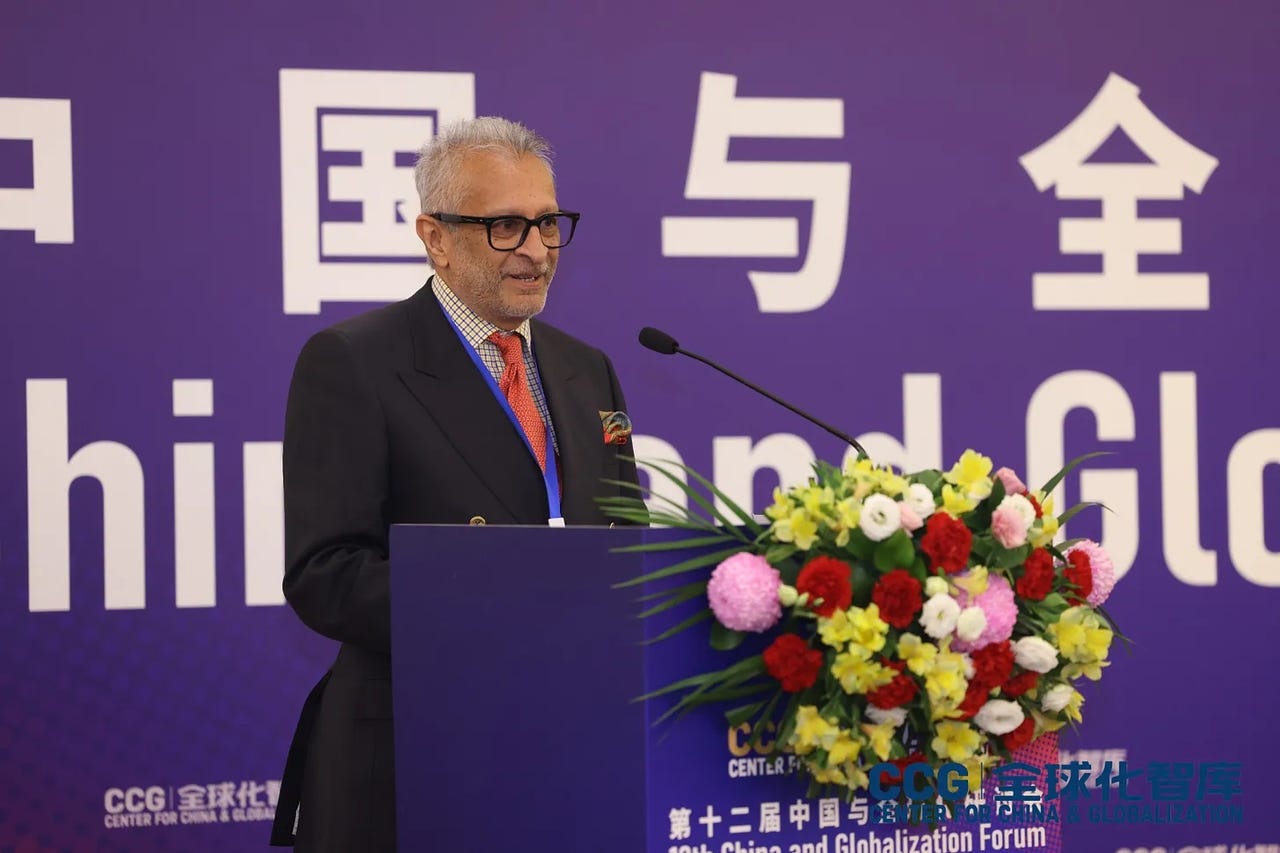
Amersi, who said he knew Iranian Foreign Minister Abbas Araghchi as a friend and had been in contact with Iranian negotiators, argued that China could take custody of Iran’s remaining highly enriched uranium and down-blend it for civilian use.
“The proposal to take and down-blend Iran’s 440 kilograms of highly enriched uranium is the single most concrete step China can and must take right now,” he said, speaking to dozens of Chinese and foreign guests, “It removes the most dangerous element from the equation. It builds Chinese credibility with Washington. And it gives Iran a face-saving mechanism that does not involve surrendering its nuclear material to the United States.”
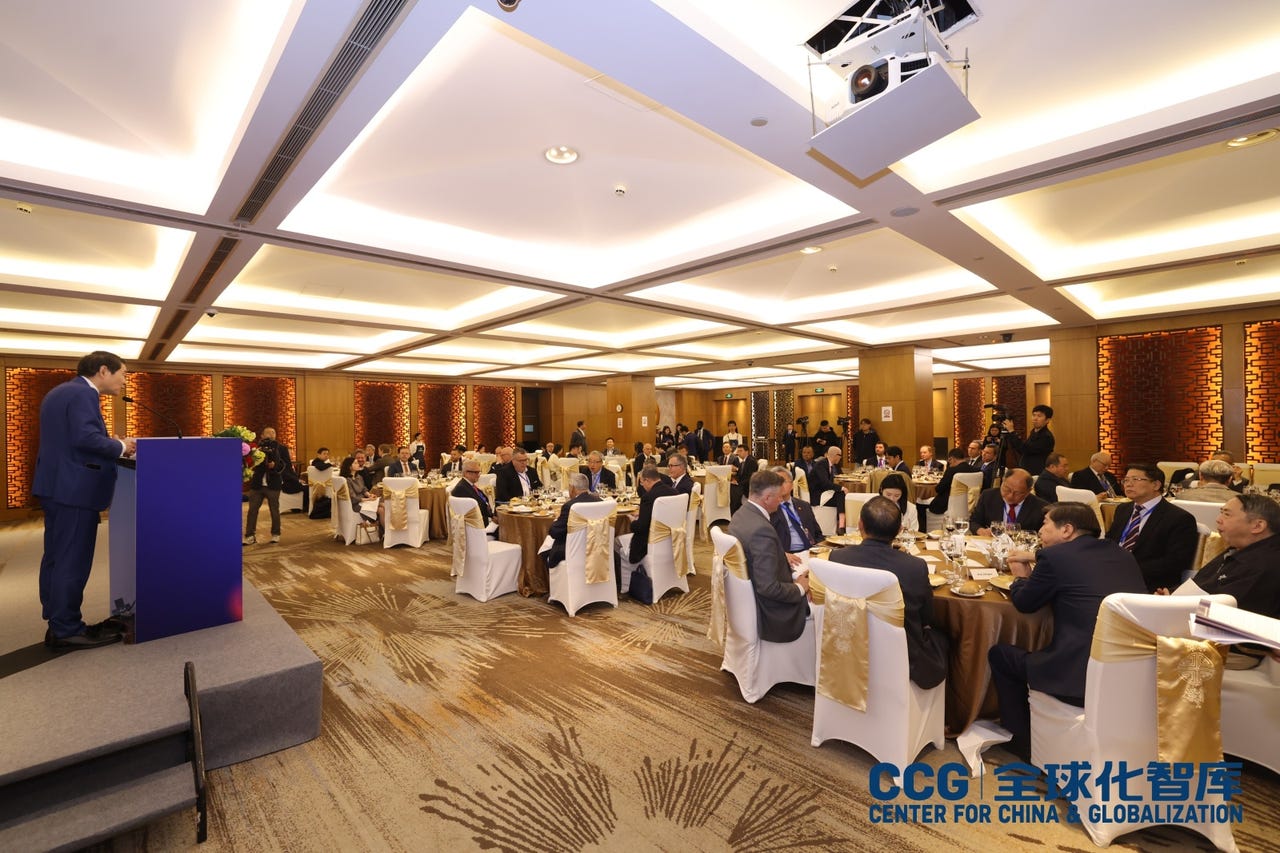
We hereby present the full transcript of the dinner:
Henry Huiyao Wang, Founder and President, CCG
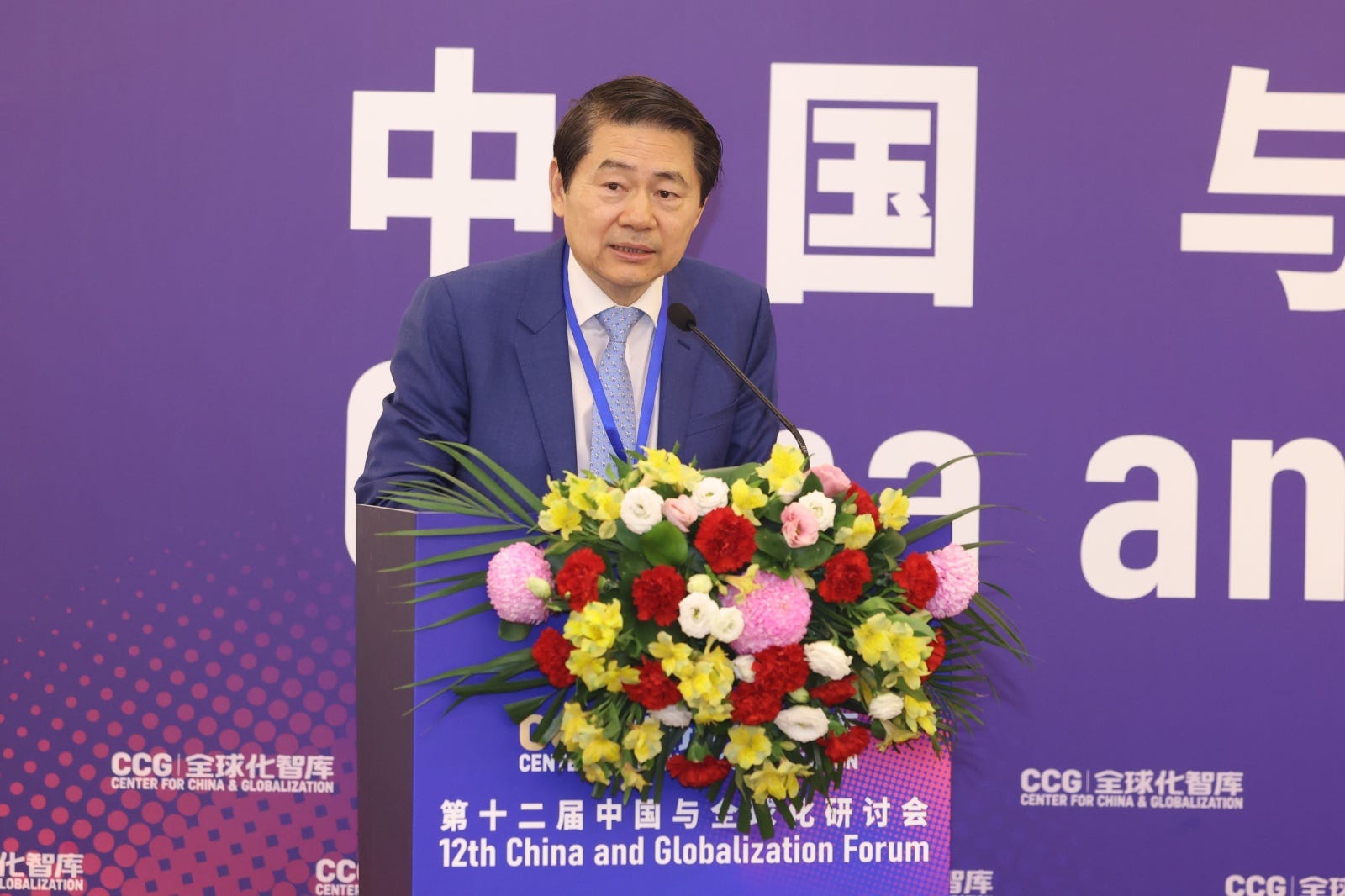
Good evening to all of you. Welcome to the CCG annual conference, the China and Globalization Forum dinner that we are having tonight.
Today, we have had very good discussions. I think we had a very productive day. I just participated in the closed-door session on Ukrainian engagement with China, which was also very constructive. I really think that today we had a great gathering of all of you, and this is well documented. We are going to summarise it and send it to the relevant authorities for internal reference. So this is really productive.
Tonight, we are going to have a dinner focused on the Middle East, which we already talked about today. We talked about global governance. We talked about China-U.S. relations. We talked about China-global youth cooperation. We talked about China-EU relations and China-Global South relations. Of course, we also had a closed-door session on China-European cooperation on Ukraine. There are many subjects, but one of the most urgent things happening around the world now is what is happening in Iran. That really affects all of us.
I heard that flights were cancelled because airlines were affected by the high cost of oil. Lufthansa is cutting 2,000 flights, and Air Canada is cutting hundreds of flights. I am sure this is affecting all of us. In this turmoil, China is really making every effort and making itself readily available to support the peace-making process. I have never seen a Chinese foreign minister in history like Foreign Minister Wang Yi. He has reached out to more than 30 counterparts around the world in just a short period of time, since last Wednesday, when the war broke out. He talked to all the Gulf countries and Arab countries. He talked to all the foreign ministers of the Security Council member states. He talked to the EU foreign minister. Of course, he also invited the Pakistani foreign minister to Beijing to talk about this issue and to support Pakistan in playing a more active mediating role in this conflict.
So we are hoping that by the time President Trump comes, more progress can be made. Tonight, before our dinner, we will have a half-hour to 40-minute discussion on the topic. First, we will invite Mr Mohamed Amersi to give a keynote speech on his perspective on the situation in Iran and the Middle East. Mr Amersi is a well-known businessman, philanthropist, and thought leader. He is based in London, but he is originally from Iran, so this is a good time to hear from someone of Iranian origin who knows Iran very well.
He will give us perhaps a 12-minute talk, and then we will hear some comments from Danny Citrinowicz, Senior Researcher, Iran and the Shi’ite Axis Program, Institute for National Security Studies (INSS). Then we will invite top Chinese experts on the Middle East, including Vice President Niu Xinchun, to join a panel with Daniel Levy and the president of the European Policy Centre. The three of you can have a panel discussion for about half an hour on the issues related to the Middle East and the crisis we are facing there right now. After that, we will have a free discussion if there is more that needs to be discussed.
I will stop here. I hope you can enjoy some of the food. We can probably supply a bit more food. We would also like to hear all your thoughts about the situation we have, what is happening in Iran, and how we can get out of this crisis. I will stop here. I hope you enjoy the dinner tonight. Thank you very much.
Zoon Ahmed Khan, Research Fellow, CCG
Thank you, Dr. Wang. Now let us warmly welcome Mr. Mohamed Amersi, founder and chairman of the Amersi Foundation, for his remarks. Welcome.
Mohamed Amersi, Founder and Chairman, Amersi Foundation
Good evening, distinguished guests, ladies and gentlemen.
Let me start by thanking Henry and Mabel and all of CCG for hosting me here one more time. It’s always a pleasure to come to Beijing and to come to CCG’s events.
My talk tonight, my speech tonight, is entitled “What China Can, and Some Might Say Must, Do to Engage More Meaningfully in the Middle East Crisis.”
For those that may not know me, I am of Iranian origin, and I am in active contact with the Iranian team that is in discussions with Pakistan and other partners in how best to resolve this current crisis. The views that I am expressing are largely my views, but they have been informed by diplomacy and dialogue discussions that span now nearly 12 months.
As we all know, that on February 28 of 2026, the United States and Israel launched Operation Epic Fury, a sustained aerial campaign targeting Iranian nuclear facilities, its regime leadership infrastructure, and, of course, it ended up killing the Supreme Leader, Ali Khamenei.
Tehran retaliated in a way that was largely unexpected. Missiles and drones struck Israel and also Iran’s Gulf neighbours. A diplomatic framework two decades in the making collapsed in a matter of hours.
Since that moment, every actor in the crisis has been asked what they will do. Washington has answered with force. Europe has answered with statements. Tehran has answered with defiance. But there is one power and permanent member of the Security Council, one country with a $400 billion stake in Iranian stability, one nation that buys more than 80 per cent of Iran’s oil exports, that has not yet given its full answer. And this is China.
China, and the answer to this question, will determine whether this crisis ends in a negotiated settlement or in the most consequential regional war of the 21st century.
Let me elucidate my thinking. I will break this up into four or five parts.
Part one: the Iran file is, in my view, China’s file.
Let us be precise about what this actually means, and what’s at stake, and why. Above all, this is a Chinese strategic problem. China imports, as I said, approximately 1.4 million barrels of Iranian oil per day. That represents more than 80 per cent of all Iranian oil exports, and roughly 15 per cent of China’s total oil imports. The Strait of Hormuz, the narrow choke point through which that oil must flow, is also the route for an additional 40 per cent of China’s seaborne energy supplies from the Gulf states. Every day this crisis deepens, that lifeline is at risk.
Then there is the 25-year comprehensive strategic partnership signed between China and Iran in 2021, a framework worth up to $400 billion, covering oil, gas, petrochemicals, transportation, telecommunications, and security cooperation. This is not an abstraction. It is the single largest bilateral investment commitment that China has made in the Middle East. If Iran descends into prolonged conflict, that investment framework collapses with it.
At the centre of this crisis sits the nuclear file. Iran has enriched uranium to 60 per cent purity before the June 2025 air strikes. It is now operating from a degraded, but not destroyed, nuclear infrastructure. The question on every diplomat’s desk in Washington, in Tel Aviv, in Riyadh, and, most urgently, in Beijing, is what happens next with Iran’s nuclear programme. Who holds the uranium? Who verifies the limits? And who underwrites any new deal?
China is not a bystander to these questions. It is structurally the only power that, in my view, can answer these questions.
Part two: what does China bring to this moment?
China’s position in this crisis is, in my view, unlike any other actor’s. It was an original signatory to the 2015 JCPOA. It has remained in contact with Tehran throughout the period of maximum pressure, throughout the collapse of the deal, through the air strikes, and through the current fragile back-channel diplomacy.
It is, as Iranian Foreign Minister and my friend Abbas Araghchi has publicly acknowledged, the country Iran consults before any major round of nuclear talks. Iran has briefed Beijing before the Muscat talks. It has briefed Beijing before the Islamabad round that collapsed in April. And Tehran treats China as its most essential strategic partner.
That gives Beijing something no other country possesses: genuine trust from Iran. Not easy. Not agreement on every point, not influence without limits, but the kind of institutional trust that is built over decades of energy, trade, sanctions, defiance, and strategic solidarity. When Iran needs to send a signal to the world, it goes through Beijing. That is Beijing’s leverage.
And, simultaneously, China shares with the United States, its greatest rival, one critical overlapping interest: neither Washington nor Beijing wants a nuclear-armed Iran.
The two powers are aligned on ends, but are divided on means. Beijing fears a nuclear Iran would trigger a regional arms race that would threaten the NPT framework, destabilise the Gulf energy corridor, and draw the United States more deeply into the Indo-Pacific neighbourhood. A nuclear Iran, until recently, was not in China’s interests, full stop. Has that calibration changed? Time will tell.
And to the proposal now on the table, reported by Newsweek on April 17, that China is open to taking custody of Iran’s remaining 440 kilograms of highly enriched uranium, down-blending it for civilian use as a mechanism to unlock the stalled nuclear negotiations: this is not symbolic. This is China offering to become the custodian of the most sensitive element of any Iran deal. That is not the act of a bystander.
China has the access. China has the trust. China has the shared interest. What remains is the political commitment by China to use all three of these simultaneously.
Part three, and this is important: I call it the failure of managed ambiguity.
And yet, here is the problem. Beijing has so far pursued what we might call managed ambiguity. It speaks the language of de-escalation while quietly deepening its strategic relationship with Tehran. It calls for dialogue while reportedly preparing to supply Iran with MANPADS, according to U.S. intelligence assessments. It presents itself as a neutral mediator, while its energy dependency on Iran gives it every incentive to keep Tehran viable, and none to press Tehran hard.
U.S. President Trump has warned Beijing explicitly: if China sends weapons to Iran, there will be serious consequences. The Chinese Embassy has denied these reports in the United States. But the strategic logic is clear: a China that arms while simultaneously positioning itself as a peace broker will not be seen as a credible mediator. It will be seen as an interested party wearing a neutral’s mask.
And the longer it is perceived that Beijing plays that role, the more it will squander the genuine diplomatic capital that it holds.
The collapse of the talks this month is instructive. The U.S. sought a narrow agreement on maritime security in the Strait of Hormuz. Iran demanded full sanctions relief and international guarantees. There was no bridge.
Beijing rightly criticised the U.S. maximum pressure approach, correctly, but it offered, as of now, no alternative framework. It backed Pakistanis’ mediation efforts to diplomatically find a resolution, but it did not do what only it can do: sit with Iran’s leadership and deliver a credible, private message that the current trajectory may not be in Iran’s and global interest.
Managed ambiguity worked for a China that was rising quietly. But in a regional war, with a nuclear file unresolved and a Trump-Xi summit on the horizon, ambiguity is no longer a strategy. It will be viewed as an abdication.
Part four: what must China do?
So, let me be direct about what China must now try and think of doing, concretely, sequentially, and urgently.
China must communicate directly and clearly to the Iranian leadership that Beijing’s continued political sponsorship, economic investment, and diplomatic cover is conditional on Iran engaging seriously with a negotiated nuclear settlement. Not a public statement; a private, strongly delivered message, delivered at the highest levels, that Iran cannot afford to ignore. Tehran knows that without China, it has no economy. Beijing must be willing to say that.
Secondly, take custody of the enriched uranium. The proposal to take and down-blend Iran’s 440 kilograms of highly enriched uranium is the single most concrete step China can and must take right now. It removes the most dangerous element from the equation. It builds Chinese credibility with Washington. And it gives Iran a face-saving mechanism that does not involve surrendering its nuclear material to the United States.
An alternative that China has proposed in Islamabad is joint custody of this material with Pakistan. I think Iran would be willing to look at this, but will certainly not be willing to transfer this material to Pakistan. Trump has still insisted on U.S. custody, but I am not sure that this will be accepted by Iran.
At a Trump-Xi summit, this point, and the deal on this point, with verification by the IAEA, is, in my view, easily achievable if Beijing makes it a priority at the summit.
Then, moving forward, it is important that China looks at how it can help underwrite a new multilateral nuclear framework. China was a signatory to the JCPOA. It must now take the lead in constructing its successor, not as a junior participant deferring to Washington, but as the lead guarantor of Iranian compliance.
Beijing should convene a working group with the P5 and the EU to draft a revised enrichment ceiling, verification protocol, and sanctions relief pathway. China’s credibility as a guarantor is precisely what Tehran would accept and which Washington cannot provide alone.
Fourth, use the May summit as a strategic pivot. The Trump-Xi meeting expected in mid-May is the most important diplomatic movement of this Iran crisis. Beijing must arrive with a concrete proposal, not platitudes. A joint U.S.-China statement recommitting to nuclear non-proliferation, with a specific reference to the Iran file and a joint call for resumed negotiations, would be a historic deliverable. It would give Trump a win he can sell domestically, and it would give Xi the responsible stakeholder status that he covets globally. And it would give Iran a pathway out of its strategic isolation.
Fifth, condition future economic investment on de-escalation. The 25-year partnership that China has with Iran must be structured as economic leverage, which can and should be truly exercised. Beijing should make it clear again, privately, that the full activation of BRI investment commitments in Iran, including the $280 billion mark for oil and gas infrastructure, is contingent on Iran’s cooperation with a diplomatic settlement. This is not punishment. It is conditionality. Every serious mediator uses it. China has, thus far, not.
Sixth, let’s redefine non-interference. The doctrine of non-interference made sense for a China that was rising quietly. It makes no sense now for the world’s second-largest economy, the largest trading partner of the Middle East, and a permanent member of the Security Council. Non-interference cannot mean indifference. It must be replaced by a principled engagement: involvement that respects sovereignty, does not impose solutions, but does not stand aside while civilians die and regional order collapses.
In closing, ladies and gentlemen, the Iran crisis is not a problem that exists at the periphery of Chinese interests. It sits at the heart of them. Every barrel of Iranian oil, every dollar of the $400 billion partnership, every ship that transits the Strait of Hormuz—all of it depends on a resolution that does not currently exist.
China has something that no other power brings to this table: Iran’s trust, America’s attention, and structural leverage over both. It has a nuclear custody proposal already on the table. It has a summit with the U.S. president weeks away. It has a five-point initiative that calls for exactly the kind of political solution that this movement demands.
What China lacks is not capacity. What China lacks is not opportunity. What China has lacked until now is the political courage to use its leverage on the country it calls its closest strategic partner in service of a settlement that would benefit the entire region, and, most of all, China itself.
The test of a great power is not whether it can project force. It is whether it can project wisdom. China has the capacity to project both force and wisdom. The Middle East does not need another empire. It does not need another lecture. It does not need more weapons delivered with speeches about peace. It needs guarantors of restraint. It needs builders of opportunity. It needs brokers of realism.
China can be one of these actors, if it chooses. The path is clear: use leverage with partners, speak honestly to rivals, invest in reconstruction, support consistent law and order, coordinate with others, choose diplomacy over spectacle.
History will not ask whether China issued statements. History will ask whether China used its power wisely when the region needed it most.
The world is watching. Tehran is watching. Washington is watching. And, for the first time in a long time, all of them are watching Beijing and asking the same question: will China lead?
The answer is due, and I would say it is overdue.
Thank you very much.
I will now ask a dear friend of mine, Danny Citrinowicz, who is an expert on Iran, to speak for two or three minutes and answer the question: in the Israel-Iran relationship, people say there is a dog wagging a tail. Is Israel the dog or is Israel the tail? Conversely, is the U.S. the dog or the tail? Please help us with that.
Danny Citrinowicz, Senior Researcher, Iran and the Shi’ite Axis Program, Institute for National Security Studies (INSS)
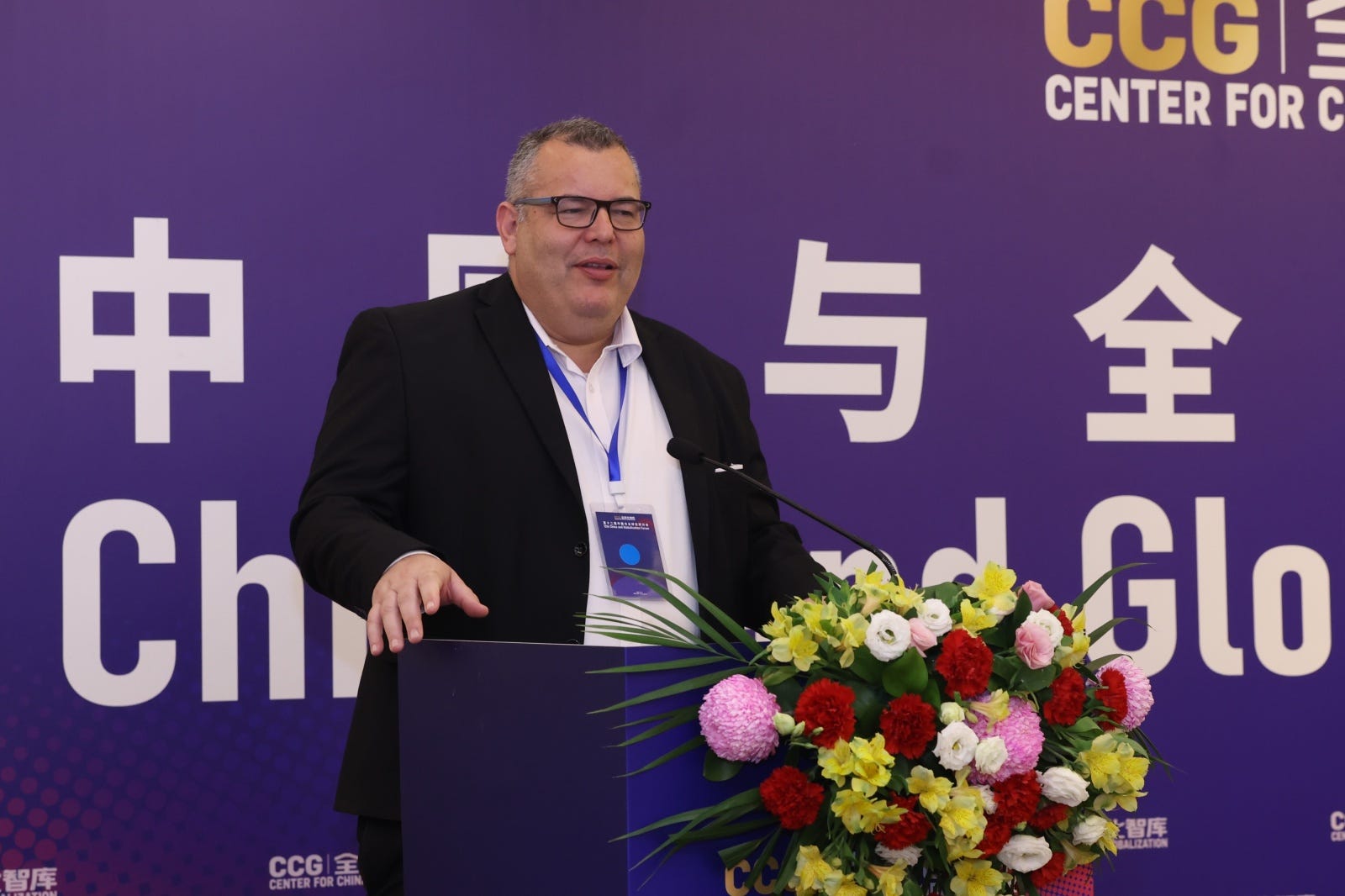
Thank you, Mr Amersi, and thank you for the opportunity to speak a little bit about a country that I am trying to understand in my professional life: Iran.
I think the question is important, and I would say that the answer is actually both, meaning that Israel had an interest, from the beginning of the days, to see the U.S. and Israel acting together against Iran. In order to do so, it was willing to do the utmost. It does not matter whether Israel believed in the fact that there can be regime change or not, or whether they believed that you can put back the son of the Shah, Reza Pahlavi, to control Iran. It was all fair in the game of convincing President Trump to get into the war.
From the American study, it was not that hard. President Trump, after the change of guards in Venezuela, when he managed actually to pull Maduro out and put Delcy Rodriguez in, he thought that he really could make a change. And adding to the fact that he does not want to be seen as Obama or Biden in terms of how he can support the Iranian demonstrators—and remember, the demonstrations started, or intensified, immediately after the Venezuela event. Then when Prime Minister Netanyahu entered the White House on 11 February and offered him the idea of regime change in Iran, it was a very easy sell for President Trump.
So actually, we see that the dog and the tail were equal in a way that both sides wanted to use the opportunity and to change the regime in Iran. The problem, of course, is that they forgot that it takes two to tango. They did not ask the Iranians. And there was a flawed assumption that actually air activity alone, together with the underestimation of the Iranian history and tradition and the strength of the regime itself, would allow the regime to survive even after the decapitation of Ali Khamenei.
So what happened since then is actually, after three or four days, we got into some sort of strategic improvisation because of the fact that nobody actually planned what would happen the day after the regime will survive. Like President Trump told the British prime minister, don’t wait three days; the war will end in three days. Actually, the war did not end in three days.
And of course, the issue of the Strait of Hormuz that touches us all—it was not that the American intelligence that I know well did not think about that opportunity. The problem was that the decision-makers thought that until the Iranians would have the ability to take over the Hormuz Strait, eventually the regime would collapse.
So what we are having since then is a problem that we actually created by deciding to go to war, that it was almost impossible to reach the purposes of the war. The war was never intended to degrade Iran’s capabilities. Israel and the U.S. did that, definitely, in terms of its conventional build-up. But the war was to create a condition to stage a regime change. And actually we got not a regime change, but a change within the regime, much worse than what we had before.
I don’t think that Ali Khamenei, let’s say, was a guy who was easy to deal with. He was a pragmatist, but he was a balancer of the system, who used to balance between the more extreme part, the IRGC, and the more moderate parts from politics and diplomacy. He was a guy that you could do business with, because he was the ultimate decision-maker.
Now what we have—and it is another problem that we cannot reach an agreement, on top of any other problem—is that we have a decentralised regime that is actually controlled by the extreme elements that have the final say in Iran.
So we are back again to square one today, when we have Israel pushing the U.S. to return back to the war; we have the U.S. thinking what to do, whether to continue diplomacy or to return back to war, while having the maritime blockade, knowing that after 40 days, nothing can change in the Iranian calculus, meaning that the same position they presented before the war in Geneva, more or less the same position they are presenting now, adding to it the control of the Hormuz Strait. And we have to remember that the Strait of Hormuz was open before the war itself.
So the bottom line of where we stand right now is a really complex situation, where I think especially Iran and the U.S. prefer to have the political route, but the gaps are so wide, while Israel is pushing behind the U.S. to return back to war, promising that decapitating the civilian infrastructure will do the job.
So now we are in a very tricky situation where, if there is not going to be an agreement—and it would be very hard to reach one—I think that the chances of returning back to escalation are extremely high.
So that’s, in a nutshell, for your important question. Thank you.
Zoon Ahmed Khan, Research Fellow, CCG
Thank you. Thank you, Mr. Amersi, and also Danny, for sharing your perspectives.
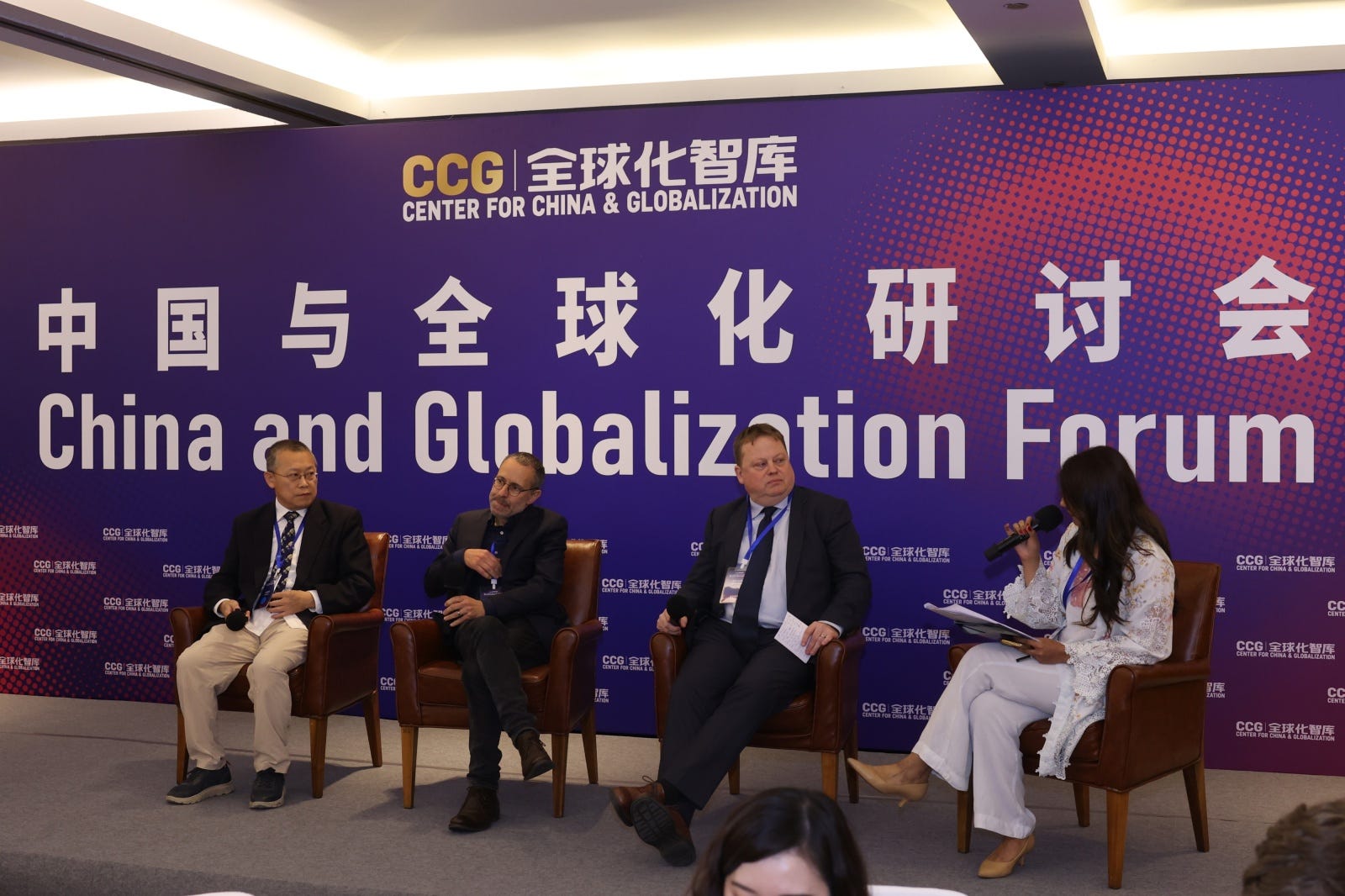
Now we have a panel discussion with three experts who have deep expertise on what is happening in the region, from three regional perspectives as well. So let me first invite Professor Niu Xinchun, who is Academic Vice President of Ningxia University and Executive Dean of the Institute of China-Arab Studies. Welcome.
Let us also invite Daniel Levy, who is President of the U.S./Middle East Project, and Fabian Zuleeg, who is Chief Executive of the European Policy Centre.
Okay. So, as you enjoy the dinner, I think I will just briefly start with one comment. I am from Pakistan, a country that is active in the mediation process and also neighbouring Iran. And I remember, you know, back when whoever was following the election in 2012 would know that the primaries and that entire election campaign made the possibility of an intervention in Iran really real. I mean, at least in the region, we felt that there was one side, especially Mitt Romney, whose election could possibly have led to a military intervention in Iran. And the region was fearful of that possibility, but we thought if that were to happen, the world would react more vehemently.
But today, those interventions have happened, and the world’s reaction seems to be disunited, to say the least. So let us firstly just start with Professor Niu Xinchun: your take on what is happening today. What is this conflict really about? What are the implications, and what can we really, sitting in this room, learn from how things are unfolding? Thank you.
Niu Xinchun, Academic Vice President, Ningxia University; Executive Dean, Institute of China-Arab Studies
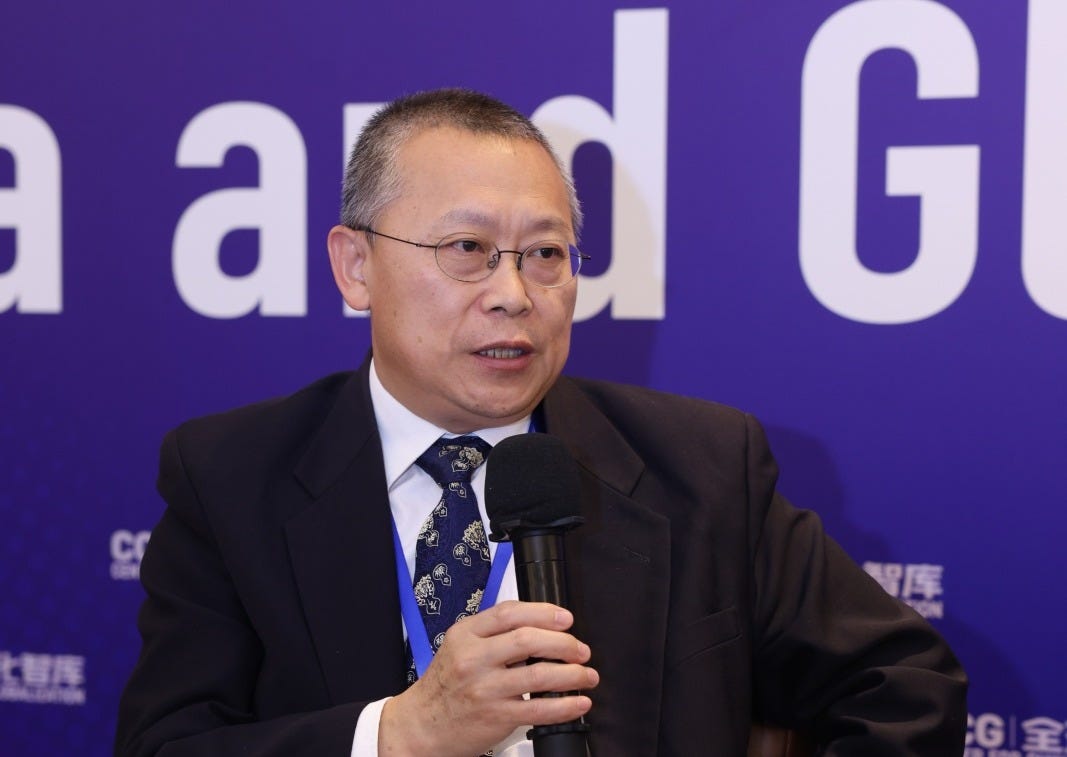
Okay, I would talk a few words about the implications of this war on China. I think China suffered a lot economically from this war. Maybe compared with the United States, China may be the one that suffered the most because, firstly, China is the biggest trade partner with the Middle East. Last year, the trade between China and the Middle East reached more than 500 billion U.S. dollars, but the trade between the United States and the Middle East was just about 140 billion U.S. dollars.
And China is the biggest Middle East oil importer. Last year, China imported Middle East oil at about 4 million barrels per day, and the United States is actually a net oil exporter. Also, China has a huge economic presence in the Middle East. So the war has heavily affected China’s interests.
Of course, in the past two months, China has actively tried to help and facilitate negotiations between Iran and the United States. The Chinese foreign minister has made 26 calls with other countries’ leaders, including the United States, Iran, and Pakistan, and most of the related countries.
But the problem is that the United States and other Western countries and the international community hope China to play a more active, more assertive role in facilitating negotiations. But personally, I do not think China will take that step forward.
The reason is that non-interference is still the basic principle of Chinese foreign policy. We are willing to do everything to facilitate the negotiations between Iran and the United States, but I do not think China will use the economic coercion method to put pressure on Iran. Actually, we never did that. So I think China will continue to play the neutral role, instead of putting economic cooperation as a condition for Iran. So I stop here.
Zoon Ahmed
Thank you for that intervention.
You know, I think that is a principle. A few years ago, a Chinese student I was talking to, said, China does not have an ideology yet that they are pushing to other countries, so that is something lacking in China’s global leadership. And a response to that is that that is exactly what China does not want. You know, China is wary of what is the vast majority of the world’s perspective on interventionism, on exporting ideologies, et cetera. So I think that principle of non-interference is really one of the foundational cornerstones of Chinese foreign policy. That was a very interesting point.
So, Daniel Levy, what is your take on where the situation stands right now? And I also want to add that, at that time, in 2012 or 2013, right, it was Rouhani’s election which sort of also created that space for maybe a shift in leadership with a different perspective. So it created room for the possibility of the nuclear talks and everything. So do you see any such changes in the foreseeable future that can make an exit strategy more palatable?
Daniel Levy, President of the U.S./Middle East Project (USMEP)
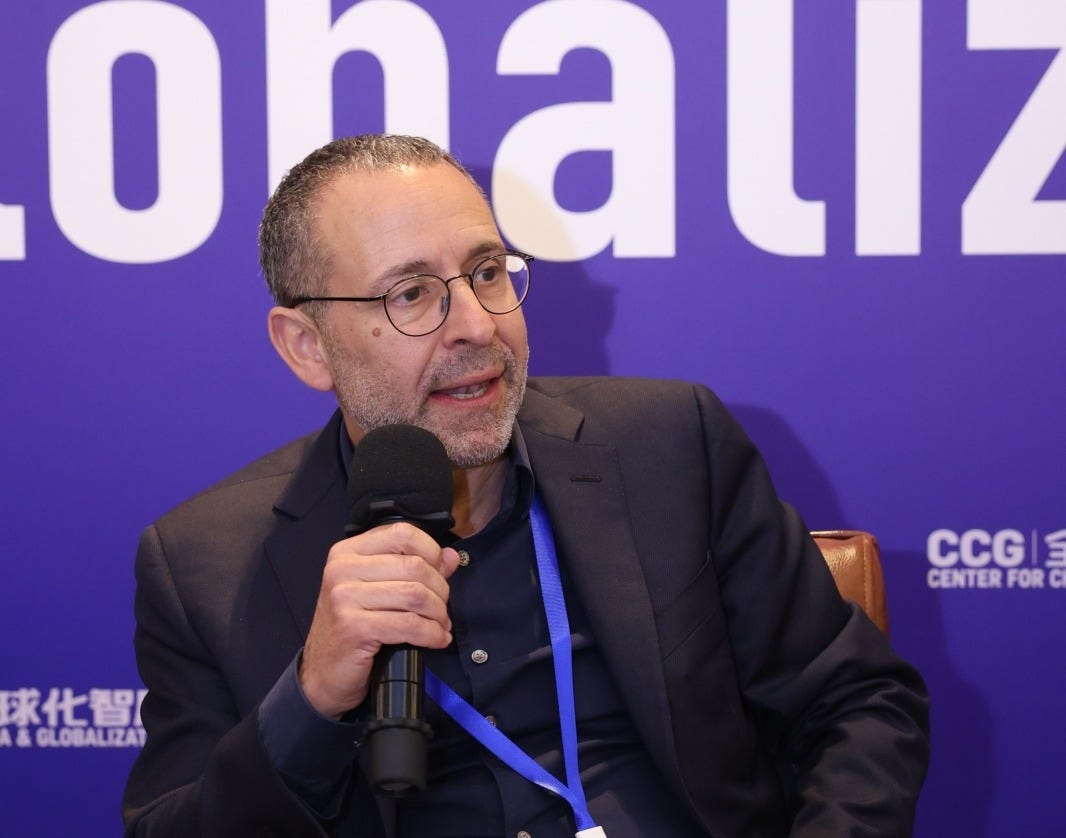
I mean, my first sense is simply one of relief that you have food in front of you. Otherwise, this would have been, by far and away, the most unpopular panel I had ever had the misfortune of speaking on—might still be, but at least it will be because of something we say. At least now we are just background noise to dinner. That is a better place to be.
And I think something that Danny Citrinowicz said, and others have kind of alluded to, is a point of departure for me, which relates back to where we were in 2012, 2013: how much difficult all of this is when you have, in their own different ways, hollowed-out leaderships, hollowed-out decision-making structures. I would argue, in all of the three main protagonists.
The easiest one to assert is the U.S. I mean, as you hinted at it, I think there is a significant degree of accuracy to the reporting that has been put out in the public domain, that the Israeli prime minister was not taking anything spectacularly new to Washington, D.C. What was new was the Washington, D.C. he was taking it to: that you have a hollowed-out agency process; expertise is shunned.
Actually, it was fascinating for me. I do not know if people are familiar with the Stephen Colbert show. It is one of these political comic talk shows, and often you get a greater granularity of seriousness in those shows than you do in what is supposed to be the proper news. Colbert interviewed John Kerry a few days ago, and he asked Kerry the question that would have been obvious for anyone to ask any of those former officials: did Netanyahu come to you with a similar plan? Kerry said yes. And what was your response? Kerry said, we all said no.
But now you have a U.S. decision-making system which, I mean, to call it unpredictable, unstrategic, incoherent, divorced from reality is an understatement on all of those terms.
So you have that on the U.S. side. On the Israeli side, I also think things are somewhat different, which is why the voice we just heard—and I come back to you again, Danny—is a voice that is so out of the mainstream of the decision-making conversation in Israel today. And Israel’s state decision-making capacity is all the more impoverished by that being the case.
And this is a phenomenon of latter-era Netanyahu. By the way, this is a prime minister who was quite risk-averse over his many, many years in office. I disagreed with him on everything, but he was risk-averse, and that was an important part. Today, not only is, let us say, moi, the state really has become his survival and the survival of the state, and being the permanent wartime prime minister, and his court cases—the man sends his lawyers to the court that is hearing his case every week to say, sorry, Benjamin can’t appear this week; he has got some wars to fight, and the elections are coming up.
But also the direction that a new Israeli elite has gone on—these details may not resonate with most people in the room—but you have a newly appointed head of the Mossad, very controversial; a recently appointed head of the internal security agency, Shin Bet, very controversial.
So what I am suggesting is, both in the U.S. and in Israel, you don’t have the kind of inter-agency process that may have prevented you going to a place where not only are we in strategic improvisation, but we are in strategic improvisation led by people who are not very good at it.
And then the third leg of that tripod is who was taken out on the Iranian side, and they were taken out precisely so that you can’t, or it is much more difficult to, deliver a more realist-oriented Iranian decision. And therefore, where does that leave us?
Well, it leaves us where we are stuck, which is, just as the strikes from the air were not going to deliver what perhaps the initiators of this hoped they would, neither will the new thing the President has fallen in love with, which is this naval blockade. You know, they stumbled into this idea, and now you have the double blockade imposed by both Iran and the U.S.
And at the moment, Trump loves it. He loves it because you guys—part of the reason he loves it is China is taking a hit. The rest of the world is taking a hit. He thinks that it is going to escalate the pressure on Iran and that they will not be able to bear it. A happy by-product, as far as he is concerned, is European pain.
But what I think he will again underestimate is that while the U.S. is feeling less pain, the U.S.’s threshold for pain is different, and it is different to that of Iran. And so over time, as it is not the game changer—because it will not be the game changer—the blockade will traverse into a problem for Trump, because as timid as Republican elected are, with each passing week the midterms get closer. Petrol is not getting cheaper at the pump. This is going to cause more problems inside America, and therefore we are back to where we were, which is: can you get a deal? In much more difficult circumstances now, it would be a much narrower deal. Do you escalate? I tend to agree that it is one of the more, if not the most, likely scenarios.
By the way, he will be told something like, you escalate to de-escalate, one more major show of force, and they will see you are serious, and it will be okay. And it is absolute nonsense. After you escalate, you will be back, perhaps in a worse situation, in general, to where you are right now.
Or—and I kind of give this a high percentage, a high-ish percentage chance—Trump simply walks away. He finishes the speech he has given several times already, which is the victory speech: we won. And now he just has to finish it and say, now it is your problem. It is not our problem. We walk away.
One comment on China. As Professor Niu—and I have heard you make variations on this case, and you have invariably been correct—China is not seeking, and does not see it as its interest, in inserting itself in an ownership way on this question. That’s what you have said, and I share that understanding.
I wonder if there is something that falls short of that, but that becomes very relevant at a certain moment, and it is: can China be a certain guarantor of Iranian behaviour at a certain moment, perhaps in particular vis-a-vis the GCC? The GCC is on the horns of a very acute dilemma, the GCC states. Everything they have done with the administration—and even when you have a president who personally went, as his first major visit, to the Gulf, to Saudi, Qatar, to UAE, is very taken by these wealthy, tall, attractive, as he talks about them—it is his language, not mine—Arab leaders, and yet it bought them nothing in terms of ability to have the ear of Washington when their most existential interests were at stake.
So there is a dynamic between unreliable America, an Israel that does have the influence, an Iran that targeted them, as was obvious and predicted, but which clearly is not acceptable, especially as far as they are concerned. China brokered the the Saudi-Iran thing. Is there a role there at some stage?
Zoon Ahmed
Thank you. Thank you, Daniel. I think we will come back to Professor Niu with the questions about China’s potential role. But first, let us come to you. Would you like to respond?
Niu Xinchun
Okay, I have to go.
Zoon Ahmed
Yeah, okay. Would you like to make closing remarks on your...
Niu Xinchun
I will go to CCTV Channel Four for a live interview.
Zoon Ahmed
Can you be back after the interview?
Niu Xinchun
I will be back after ten.
So I just want to give my concluding comments about China’s role. I think Levy mentioned that, firstly, China will continue to insist on its non-intervention policy. And second, I think most of the European countries also agree that Trump has chosen this war. You break it, you own it. So the United States should find a way to fix this problem.
This is not the first time the United States or the international community has turned to China and asked China to help fix the problem. Last time, when the North Korea nuclear problem happened, the United States also asked China to put economic pressure on North Korea to try to make North Korea make concessions. That failed. And in 2022, when the Ukraine crisis happened, the United States also asked China to put economic pressure on Russia.
So this time, the United States did the same thing. Every time they break something they cannot fix, they ask China to pay the price to fix that. I don’t think that China will follow that. So thank you very much.
Zoon Ahmed
Thank you. Thank you. Please, a warm round of applause for Professor Niu. Thank you. Thank you so much.
I will also just briefly add, I mean, it was last year that Iran and Pakistan also had some challenges on the border, and then China intervened to create a space for trilateral dialogue, which really helped build trust again. And again, between Iran and Saudi Arabia, too, it was just recently that China facilitated what we could call a relative detente. So I think China has been proactive, in some sense, to create more understanding diplomatic channels between powers that have challenges in the region.
So now, Fabian, over to you. I mean, a lot of people are talking about Europe’s response to the war, the kind of pressure that Washington is trying to place on Europe. What is your take on the situation right now? And what is it for Europe? What does it mean for Europe?
Fabian Zuleeg
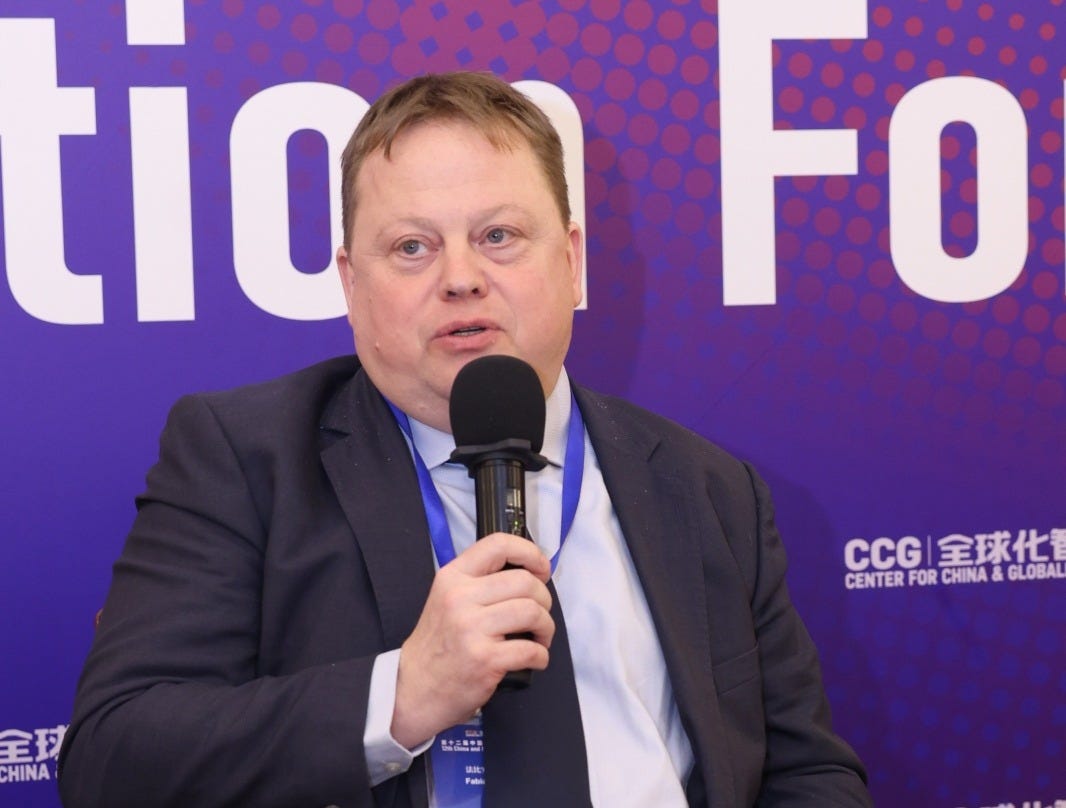
I think firstly, before I get into the response of Europe and the geopolitics and the geo-economics, I think it is important to just recall the human cost of this, and that we are not only talking about what is happening in Iran. We are talking about the whole region. We are talking about what is happening in Lebanon, what continues to happen in Gaza. So we also have a wider stability problem, which unfortunately does not look like it is going to be resolved anytime soon.
What we also have is global repercussions. It has already been mentioned. Maybe some of that is not unintended, but certainly for Europe, this is an energy shock which is already having an impact. I would go further than this: this is a global energy shock. It is a global economic shock, and I think what we are going to see is a global recession. It is very hard to turn that boat around at this moment in time, because companies are already adjusting their expectations. We are seeing flights being cancelled. We are seeing the forward contracts on oil prices going up. So this will already have a negative impact, even if it ends tomorrow. And it does not look like it is going to end tomorrow.
For Europeans, I think there is a unanimous wish in Europe that Iran will not acquire nuclear weapons. But Europeans have also, in the past, disagreed with the U.S. about how best to achieve that. And Europeans, frankly, do not believe in starting a war to achieve these kinds of goals. That is not something which any of the European countries is supporting, whatever they are saying in public.
But the reality is that Europeans do not see this as a potential solution, and it is adding to the distance to Trump. And we have also seen, in those cases where we had European governments making the decision to withhold the rights for U.S. flights to go over their territory, this has led to, I would say, a further distancing, because it was already there, with Trump looking for punishment now.
So the repercussions of this are going to go into the future, and it is going to strain the transatlantic relationship even further than it has up to now.
Unfortunately, even though—and that is maybe a point I would also make to our Chinese colleagues—even though the mess might be created by the U.S., we will have to deal with it. And in particular, I think if there is some form of ceasefire, I would see it inevitable that Europeans are involved in some way in the Strait of Hormuz, including, for example, demining, which is going to be a major issue.
And I would think that this is actually an area where an international coalition would make a lot of sense. That, of course, is not at this moment. At this moment in time, Europeans are not going to get involved in a hot war, but I think it is something which we will have to look at before soon.
And of course, there should also be involvement in the wider region about trying to resolve these issues, trying to find a way of living together peacefully. But I have to say, Europeans, I do not think, have a lot of leverage. Unlike China, maybe, I think there is a limit to what Europeans are able to do, and we have already seen that in previous conflicts.
My final point, and this might sound rather pessimistic, but I think we have to recognise that Trump is at the weakest point in his second presidency, possibly at the weakest point in his political career. He, I think, is at the moment in political life where the population turns against him, and that is across the board. When you see what is happening in domestic politics, which I think is the only thing he really cares about, we are seeing that what he is doing is deeply unpopular.
I think it is almost inevitable that this will have political consequences, including at the midterm elections. Is that something which is positive? Well, I would think anything which hurts his presidency is a good thing, but the reality is that given his character, given the way he looks at the world, given his politics, the chances are that he will lash out, that he will escalate, that he will try to do something even more extreme. So we have to be, I think, globally prepared for what comes next after this, which might be even worse than what we have seen up to now.
Daniel Levy
Yeah, if I can just add to that. And of course, I think you were implying this: that lashing out will not necessarily be in the context of this Iran war. The obvious one that they have been building towards is Cuba. But it could be any of a number of things.
I also just want to pick up on something, because I tend not to agree with Professor Niu. I do not think the Pottery Barn rule, which he was referring to—you break it, you fix it—can apply here, because what has been broken is the global economy. And therefore it is not that everyone else can go, ha ha, now you have got the problem. No, everyone has the problem.
And therefore, whether it is directly with Trump, whether it is trying to up the ante on how this impacts America—so it could be states trying to intervene with the American president. And people may have noticed some of the messaging, for instance, that came out of the Gulf during the last several weeks was, well, there are certain investments that we will not be able to make now. You draw your conclusions.
The fact that they can continue to inflate the American stock market and the S&P 500, which is one thing Trump does pay attention to, makes that more difficult. But I do think others can’t avoid it. I mean, you know, fuel, food, fertiliser, et cetera.
And then my last comment would be, you cannot do this without also thinking about how one reins in an Israel that has just gone off the tracks. And this is, unfortunately, the learned experience of Gaza. It was the impunity around Gaza which I think empowered this, amongst other things. And, you know, whether it is in Lebanon, whether it is—you know, it is not just Trump who may look to cause havoc elsewhere. Israel may be back doing worse things in Gaza.
And so one has to think in those terms. And sometimes, well, I think everyone now is stuck in a place where there is a real paucity of political imagination. We have never faced this situation before, and I shut up.
Zoon Ahmed
Thank you, Daniel, before we become the most unpopular panel of the year. But thank you so much.
And I think I will close with what Fabian mentioned. I mean, the human cost really is what it is first and foremost about, and the global repercussions are in front of us. So let us hope -- I mean, we cannot just be hopeful all the time -- but I think we have enough motivations and incentives as different parts of the world to try to inch towards a real solution and a status quo that allows...
So thank you, both of you. Thank you also to Professor Niu. And we have one comment. Okay.
Mohamed Amersi
Thank you very much. My speech was largely confined to China, but I think it is very, very important that I also shed some light on what our panellists have said here. So some of my prognoses may sound a little bit unrealistic, but they are very, very well informed.
My assessment of the GCC is that it is largely broken. It will be very difficult for it to stay intact after this. I would imagine that Qatar and Oman are largely going to pivot towards Iran. I think the UAE and Bahrain will continue being under the umbrella of the U.S.-Israel relationship. And I think that Saudi Arabia is the unknown, but they are likely not to join either camp, and more likely to continue with their Turkey-Pakistan alliance. So I suspect—I know for sure—that these discussions are actually taking place after my visits to Qatar, Saudi Arabia, and Oman, and I will be going there again after China.
The second point that I would make is that Netanyahu’s strategy is largely to break up Iran. Iran, for those that do not know, there is a central Persia that is about 40 per cent of Iran. And then on the periphery, you have Balochistan, Kurdistan, Turkmenistan, Arabistan, and one or two other provinces. And the CIA tried their best to go into Kurdistan and at least see if there is any appetite to peel that away.
Coming back to the Wesley Clark doctrine, that he wanted seven states to be broken up, Iran is the last on the list. And so this is not a new project in itself. It is a project that is in the making. And finally, they are trying to see if they can realise this.
Within Iran, before the war began, there was some idea that maybe the time is ripe for some sort of rethinking of how Iran works, especially with Reza Pahlavi trying to lead an effort which has largely failed and will fail. But the breakup story is a very, very touchy one within Iran.
The two other points I would make, which we have not touched upon, is what is the future of Israel. There is waning support, as we see now in the United States. If you look at all the think tanks and other people that have sought out opinions within the United States as to whether the U.S. wants to continue backing Israel with a blank cheque forever, I believe that this is highly questionable and will require some major recalibration on the part of Israel if it wants to continue renewing its support.
And finally, on the Strait of Hormuz, I am saying something which I know is in the making, which may not be known publicly. I think that there is a chance that if the United States fails to give Iran reparation for the damage that has been caused to Iran from the illegal strikes, then there will be some appetite in allowing them to charge a toll for the strait.
The question is that Iran controls the northern part of the strait, Oman controls the southern part, and a deal could be struck between the United States, Iran, and Oman for the tolls to be shared between Iran and Oman, and Oman to cater for some U.S. interests as part of its share. Alternatively, lift the sanctions. Alternatively, pay 20 billion dollars of the money that has been blocked. All these ideas are on the table.
The last discussion that was supposed to happen yesterday did not happen because Iran presented maximalist demands to Pakistan, which were conveyed to the U.S. And in those demands were, I am aware of, the conditions that were so difficult for anyone to accept that Trump has called off the visits of Kushner and Witkoff.
In the meanwhile, as you know, Abbas Araghchi was in Oman. He was there to see if Oman can convey messages to the rest of the Gulf and see if some sort of leverage can be put by the Gulf states on the United States to exercise restraint. And then he is in Moscow to see that if the war does break out, what is the appetite for Russia to continue supporting Iran. That is the latest. Thank you.
Zoon Ahmed
Thank you. Thank you so much, Mr Amersi. A round of applause also for our unpopular panel—joking. Thank you. Thank you so much. Let us continue to enjoy the dinner and continue the conversation. Thank you. Thank you so much.
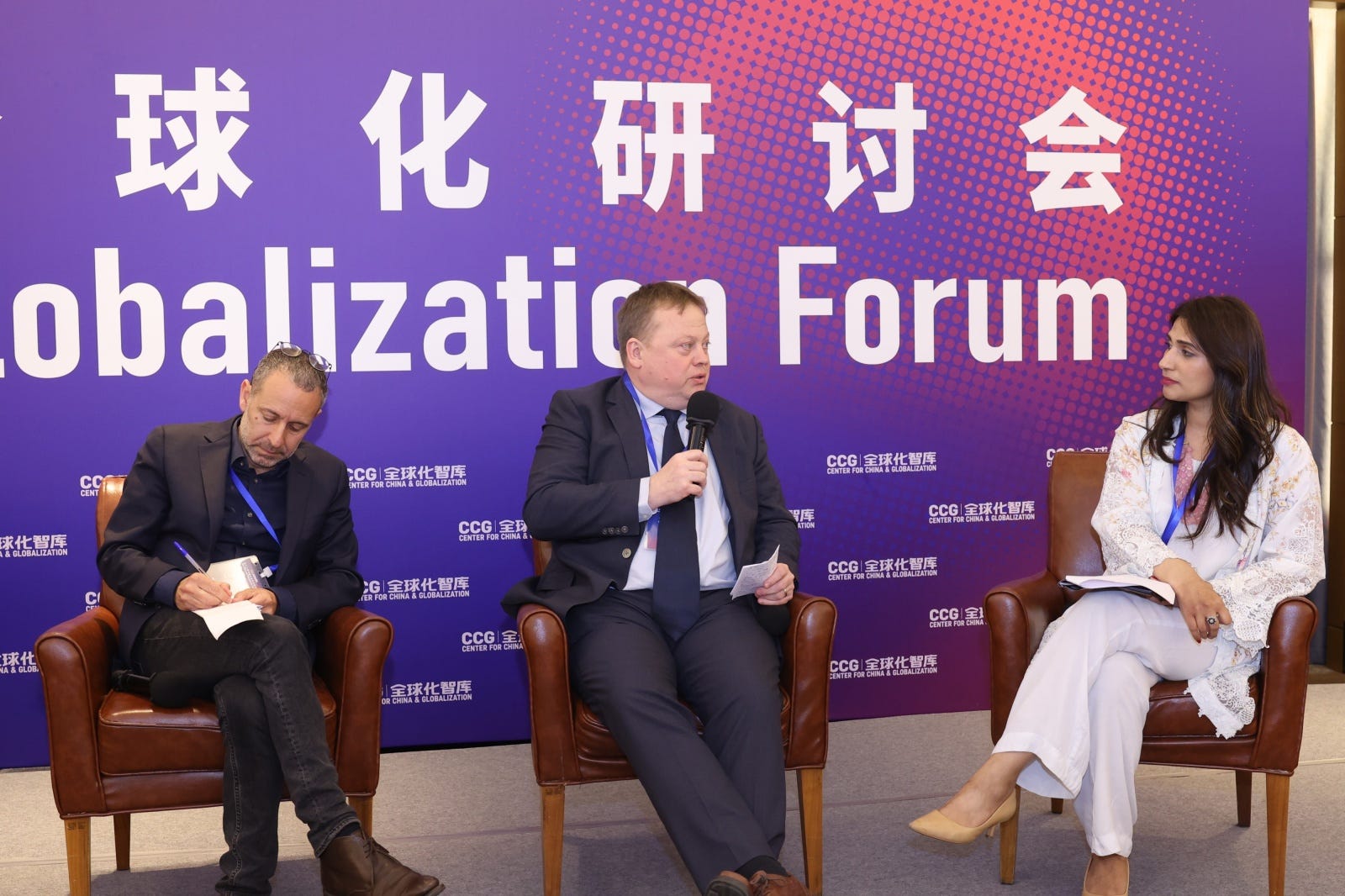
The 12th China and Globalization Forum Held in Beijing

The 12th China and Globalization Forum, hosted by the Center for China and Globalization (CCG), was held in Beijing on Sunday, April 26, 2026.