


Zichen Wang, Deputy Secretary-General of the Center for China and Globalization (CCG), was invited last week to Al Jazeera English’s Counting the Cost, hosted by Scott McLean, on the news that the U.S. Federal Communications Commission (FCC) had banned new Chinese humanoid robots.
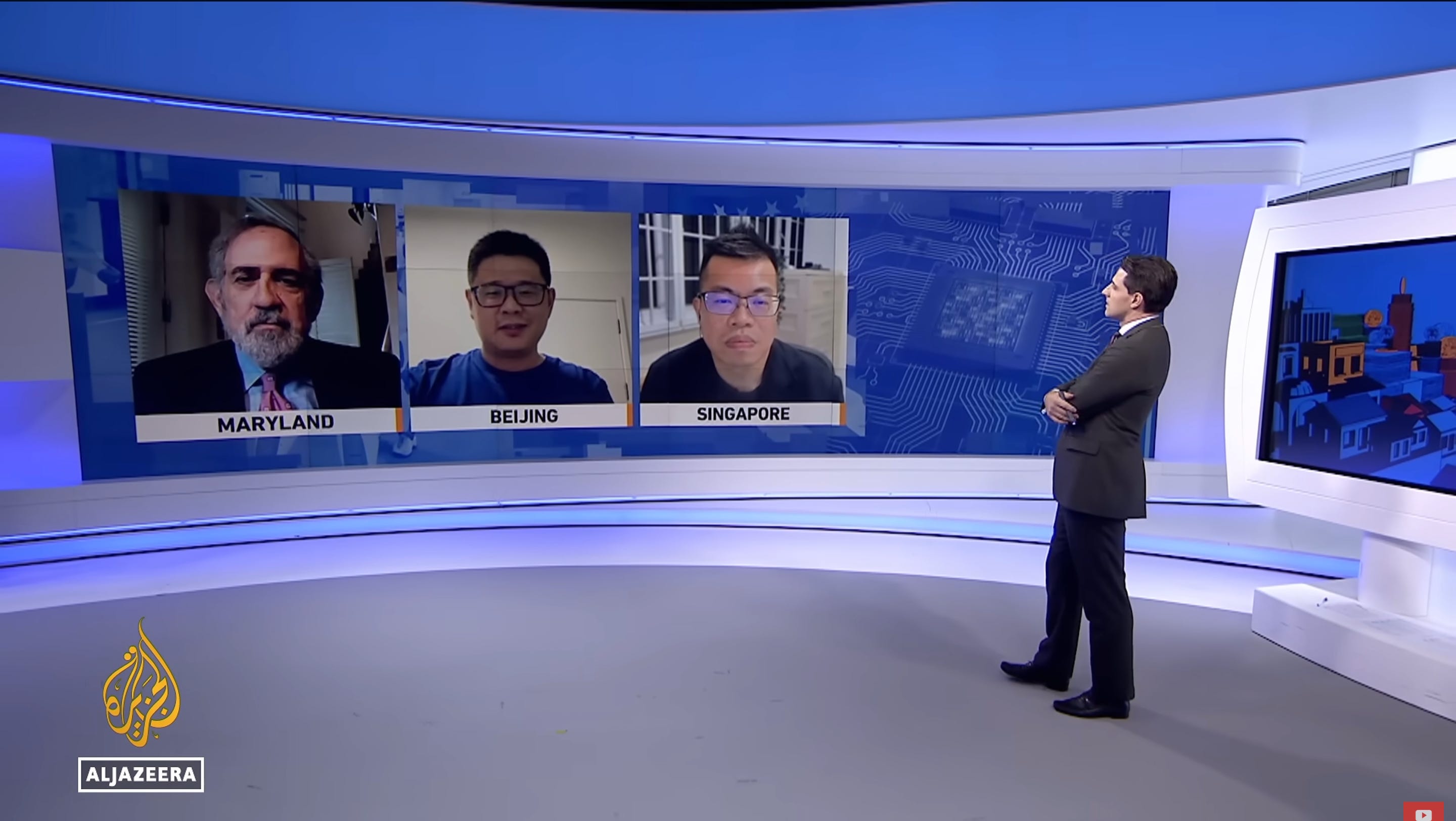
The episode, uploaded to Al Jazeera English’s YouTube channel on 8 August 2026, also featured Alan Tonelson, founder of RealityChek, a blog, and Lian Jye Su, Chief Analyst at Omdia, a consultancy.
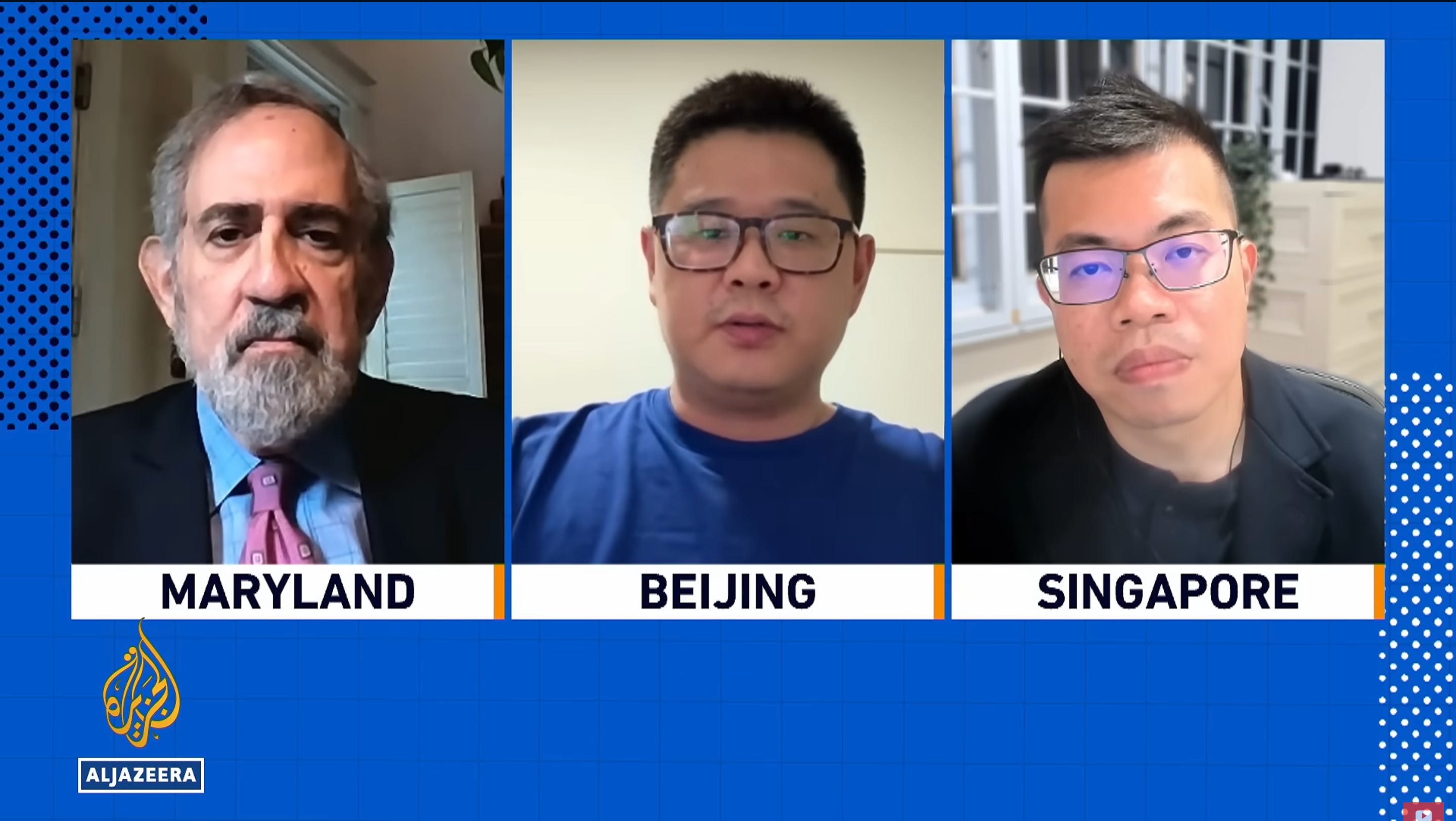
The transcript is based on the programme video and has been lightly edited to remove fillers and repetition. It has not been reviewed by any of the speakers.
Can the US slow China’s robotics and tech rise? | Counting the Cost
Scott McLean
…They do backflips. They direct traffic. They make your coffee. Humanoid robots are no longer a laboratory experiment — they are a growing market. Morgan Stanley estimates the market could hit $5 trillion by 2050, with more than a billion humanoids in use worldwide.
But there’s a problem, particularly for the U.S. Much of the global robot supply chain runs through China. Beijing now makes robot components at a scale and a price that its competitors struggle to match. Washington has banned new imports of foreign-made humanoid robots, citing national security. It also blocked power inverters used in data centres, and solar too. The move is widely seen as part of a broader effort to protect American industry and limit Beijing’s tech rise.
...
This dispute over humanoid robots is part of a much bigger tech rivalry between the U.S. and China. Washington has blocked the sale of cutting-edge semiconductors to China, also on national security grounds. Critics say this is aimed at slowing China’s military development and maintaining America’s lead in artificial intelligence. U.S. Treasury Secretary Scott Bessent has warned that Chinese AI firms may face sanctions over allegations of stealing American intellectual property. There’s also drones, solar panels, electric cars — all of these face steep tariffs aimed at keeping them out of the U.S. market. China has responded with export controls on rare earth minerals. These are vital for a wide range of high-tech products, and China controls most of the global supply.
All right, let’s discuss this further. Joining us from Maryland is Alan Tonelson. He is an economist and founder of RealityChek, a blog which discusses economics, national security, technology, and their intersections.
In Beijing is Zichen Wang. He is the Deputy Secretary General at the Center for China and Globalization, as well as founder and editor of the Pekingnology newsletter.
And finally, in Singapore, is Lian Jye Su, chief analyst at Omdia, a global technology research and advisory firm.
Gentlemen, thank you all so much for being here. I want to ask about the broader humanoid market and also that ban from the United States.
So, last year there were about 13,000 of these humanoid robots shipped around the world — a little bit more than that. You probably haven’t heard of most of these companies, so I’m going to help you out. This one is Chinese. This one’s Chinese. Chinese. Chinese. Chinese. Chinese. You get the idea. The only ones that are American are actually just these three here. So just to make the point here, it’s just literally this slice of the pie right here are the Americans — this is everybody else.
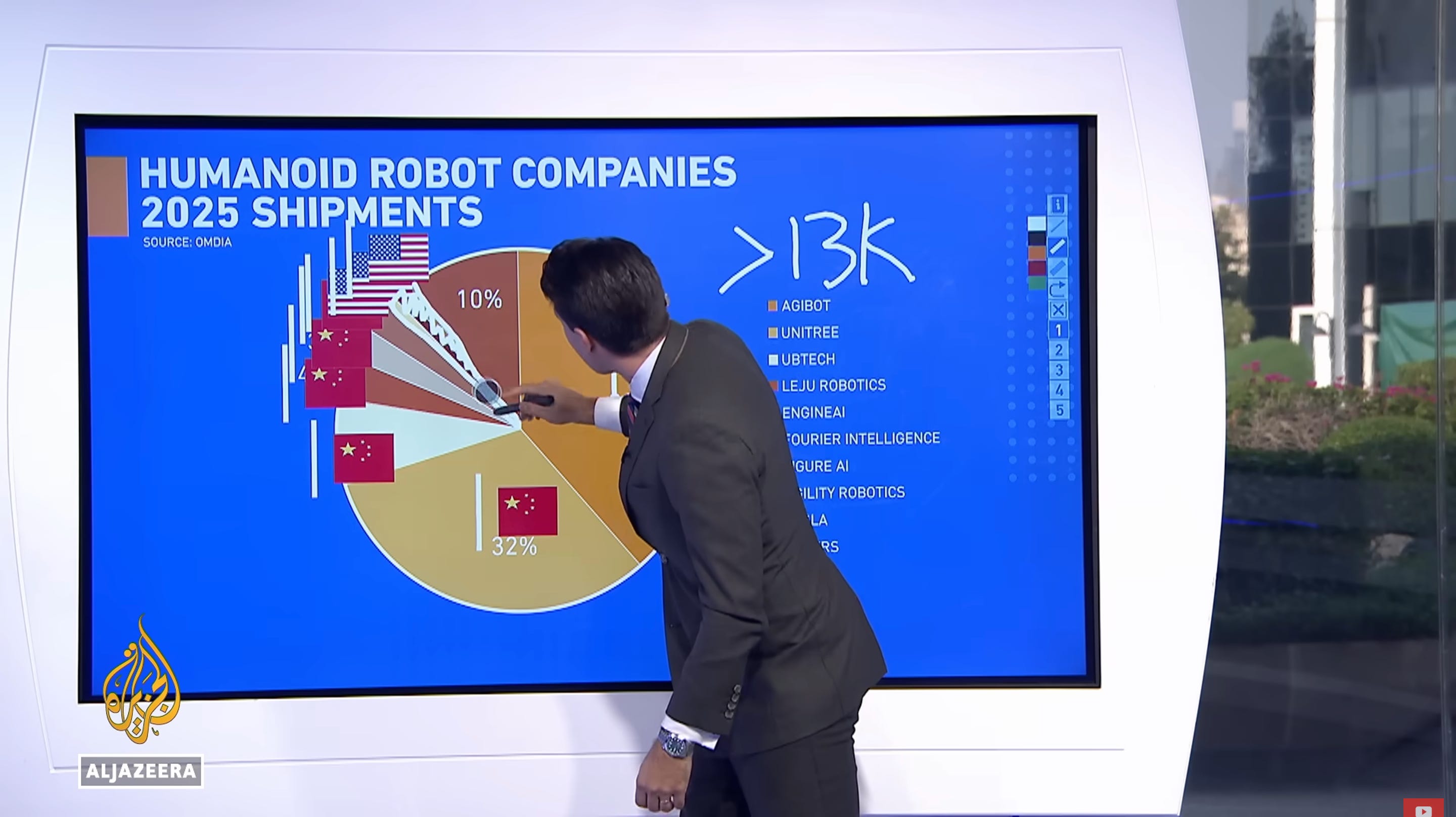
So the FCC says that this is about national security. This is what the FCC chair said recently. Watch.
Brendan Carr, FCC Chairman (voiceover)
These robot dogs, these humanoid robots, these power inverters — all of this is going to be critical to the economy of tomorrow and to our national security, and we’re acting right now to make sure that the U.S. domestic market has a chance to succeed and get investments, so that we don’t become overly dependent on foreign nations.
And it’s great that we’re taking this action now rather than five years from now or 10 years from now, when we realize, whoops, we got too dependent on a critical foreign supply chain. So there’s real national security risks here.
So again, Alan, look at the American market share. It is tiny. Is this truly about national security, or is it about the Americans having a bigger slice of that pie?
Alan Tonelson, Founder of RealityChek
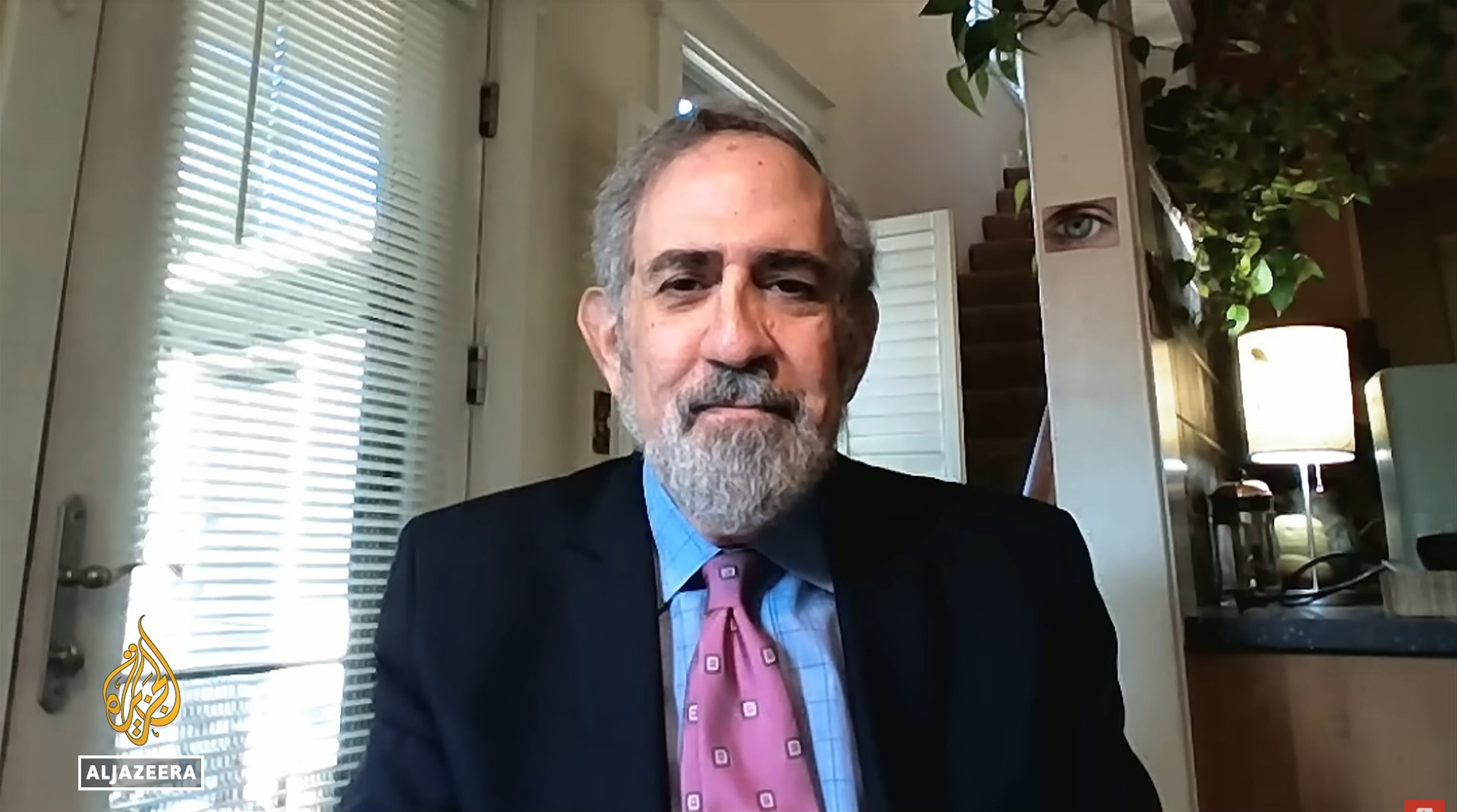
Oh, it is absolutely about national security. In fact, I would argue that at this point, certainly, it is almost exclusively about national security, because every manufactured product that China sends to the United States — from solar cells to power inverters to robots — has got hardware and software that can be bugged. In fact, lots of these products have been found to have electronic surveillance devices in them.
And there can be no question that, given the fact that China is an increasingly hostile dictatorship, the United States cannot allow devices like this to permeate even its entire civilian economy. Not to mention those parts of the American economy that produce the so-called dual-use products that have got major defence applications, also.
Scott McLean
Zichen, does Alan have a point here? Is there a national security risk? I mean, the FCC even says that these devices, these humanoid robots, can even be commandeered by malign actors. Obviously, great for spying. Is that a fair point?
Zichen Wang, Deputy Secretary General at CCG
Well, I have to disagree with Alan. First of all, I think the specific ban put out by the FCC says that only new models will have to be banned, which means the products that have already been certified by the FCC will still be able to be exported to the United States. So if it’s about national security, about all the robots from China, why not ban those that are already covered, that are already certified? So this is a half-baked reason.
I understand the language put out by the FCC chair, but I don’t think it’s the right approach. If he can identify a certain risk within a certain product or within a certain class from a certain company, he should name it. He should put remedies specific to the risks. Instead, what we are seeing is a blanket ban, and this is not a prudent way to measure national security.
Also, I would have to respond to what Alan just said: all these robots, yes, they have cameras, sensors, and communication systems. That’s how you make these robots work. All these products will have something like this, which in itself does not make it a national security challenge to the United States. We have testified —
Alan Tonelson
(interrupting) Given the fact that they come from China, they are a national security challenge. Given the fact that they come from China, they are a national security challenge, by definition.
Zichen Wang
I have to disagree with that, because the U.S. imports a lot of things from China —
Alan Tonelson
(interrupting) I know you don’t agree, but this country can’t afford to take chances. I’m sorry. Plus, the economic and the administrative costs — not to mention the technological challenge of inspecting every single such device that comes into the United States from China — are just totally prohibitive. So, this kind of a blanket ban is the most feasible approach, and once again, essential for U.S. national security. There’d be no serious debate about this, whatever.
Scott McLean
Yeah, and worth mentioning also, there are hundreds of lawsuits for—
Zichen Wang
Would you… ban tablets and iPhones from China?
Scott McLean
That’s a good point. Alan?
Alan Tonelson
You know what? That could be next. That could be next.
Scott McLean
But then you’d have to make those iPhones in the United States, wouldn’t you?
Alan Tonelson
Or you’d have to make them in the various other low-cost East and also South Asian countries to which iPhone manufacturing has been moving very steadily.
Scott McLean
All right, this is a very interesting discussion. I want to ask—
Alan Tonelson
(interrupting) I’m not concerned about iPhones coming in from Vietnam, or frankly from India. I am concerned about them coming in from China. Absolutely.
Scott McLean
Yeah. Also worth noting, there are hundreds of lawsuits out there of Americans alleging intellectual property theft from Chinese companies or Chinese individuals as well. But that’s a slightly different topic.
Lian Jye, I want to ask you: look, there are some 140 companies in China making more than 300 models of these humanoid robots, but they’re finding that the commercial demand is a little bit soft. If these robots are so great at manufacturing, which, we know, China does pretty great, why aren’t they putting them to use?
Lian Jye Su, Chief Analyst at Omdia

There are a few ways to look at it. I think you can look at it from a demand standpoint, where not all factories are ready for digitalisation, which means they are not ready for full-scale automation, which means, obviously, less adoption of humanoid robots. On the other hand, you can also argue that the robot itself is not yet general-purpose enough. They are good at specific tasks. Those may not necessarily be tasks that are associated with manufacturing or with factory floors at this point.
Scott McLean
Gentlemen, I want to ask about a much broader societal topic here. We asked our viewers on YouTube a pretty simple question: could a humanoid robot do your job? 32% of respondents said, “Yeah, it could.” 68% said, “No.”
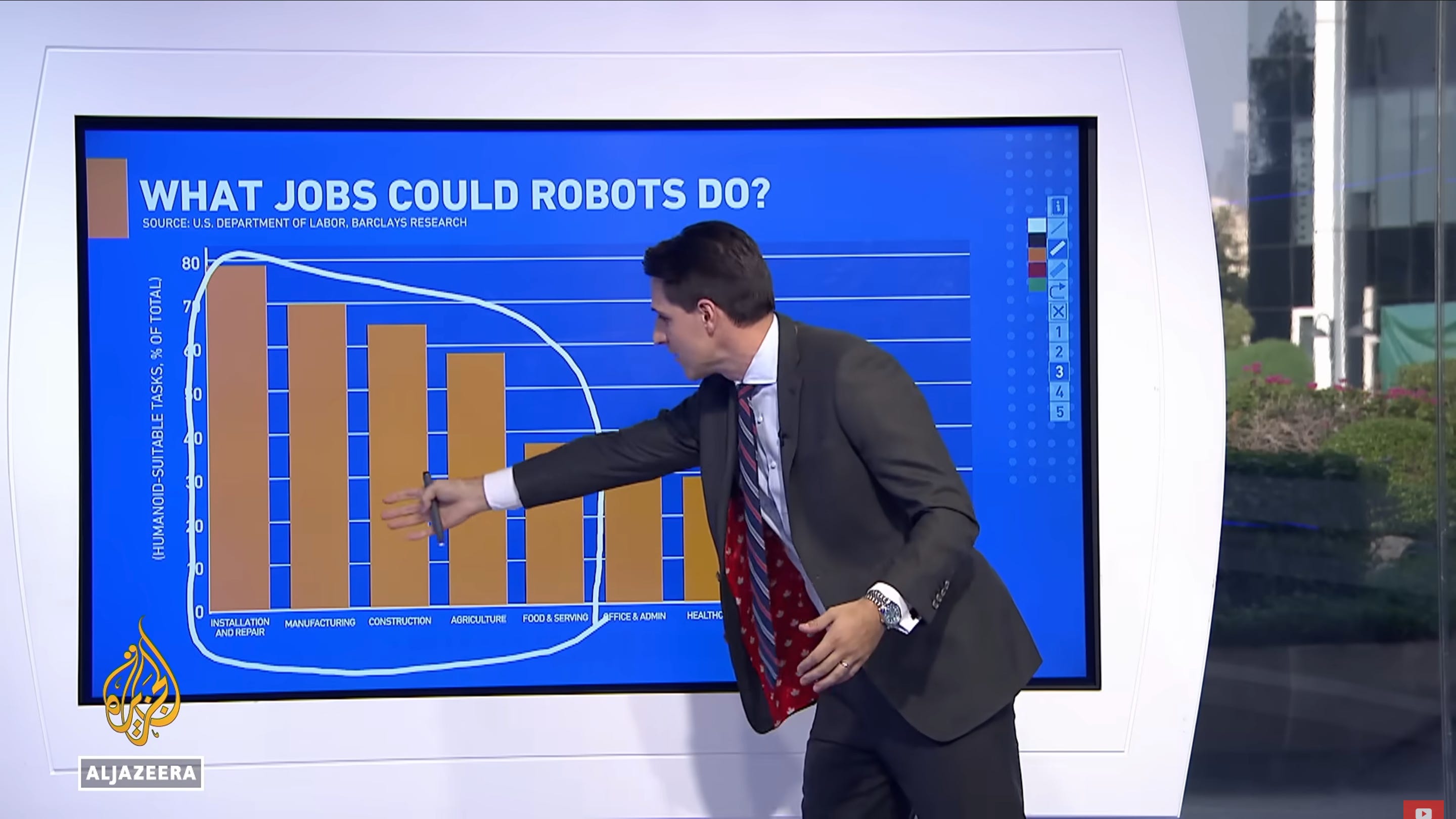
So we thought, okay, what kind of jobs can these humanoid robots actually do? So basically, this is the percentage of each individual industry where jobs could be suitable for these humanoids. Notice a pattern here: all of these are, by and large, jobs that you do with your hands — agriculture, construction, manufacturing, insulation, and repair. These are blue-collar jobs, but even office workers — they’re not spared either.
So, Lian Jye, look — if you care about being able to make a decent middle-class living with your hands, or even any kind of middle-class living, should the alarm bells not be screaming right about now?
Lian Jye Su
Again, I think there are nuances in technology replacing jobs. We’re already seeing that, without the robot, AI is already replacing some of the more mundane and repetitive tasks within a corporate environment. There is going to be a point whereby the robot will be ready to take over certain repetitive or mundane tasks, or even hazardous tasks that no one wants to do at this point.
I think what we do want to look at is whether the robots are ready or not at this juncture. And actually, the answer is not really — most of the robots being deployed right now are deployed for either media and entertainment use cases or on stage for performances. So the type of tasks that they can do really well is still quite limited at this point.
Scott McLean
I want to ask you guys about labour market integration and how far these are going to get into the labor market. Look, this is by 2050 — this is a prediction from Morgan Stanley. Notice a couple of trends here: the United States is going to have the biggest impact on the labour market there, and then you have the Chinese, not far behind.
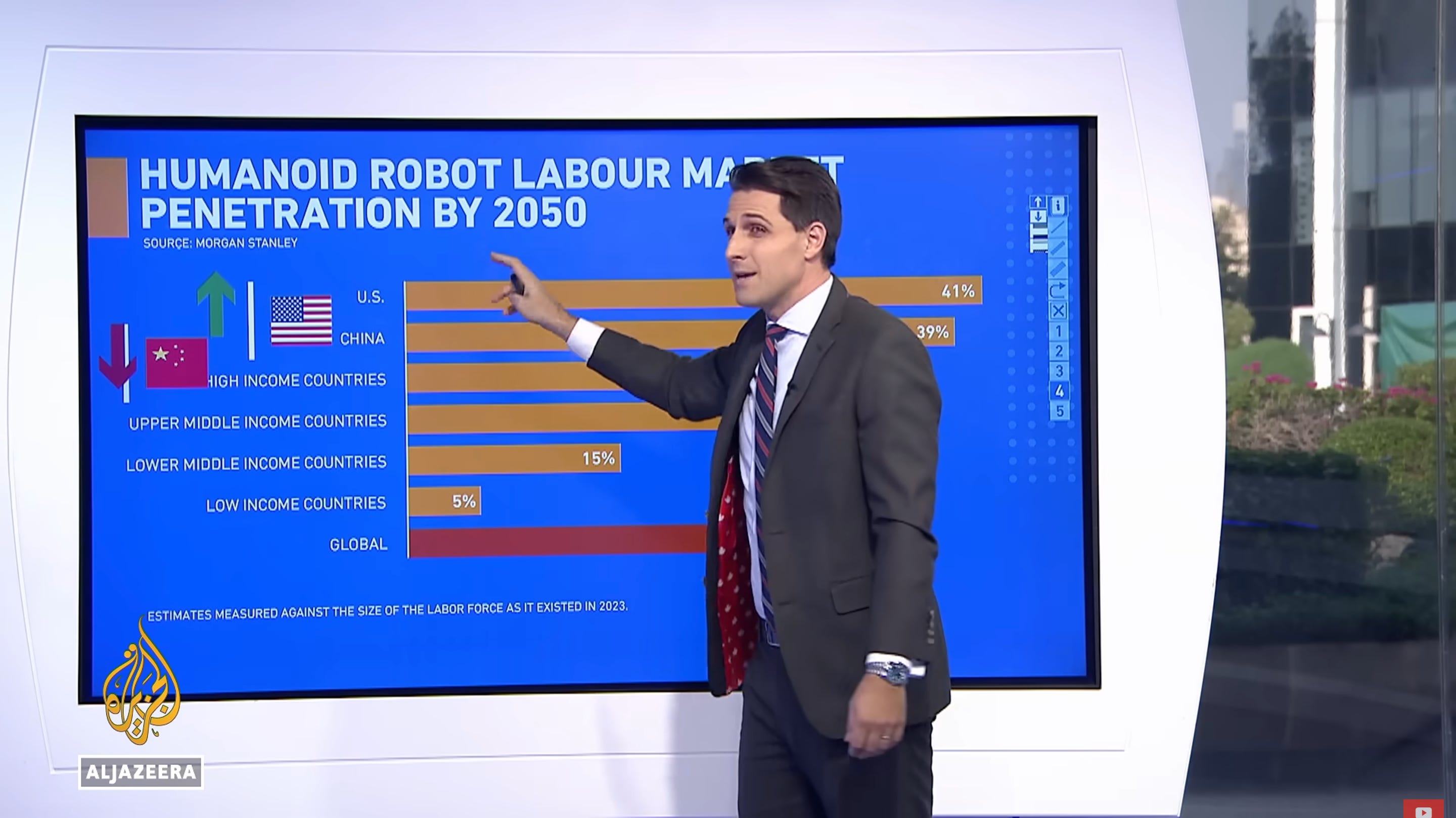
Bigger trend: higher-income countries — this is going to seep into the labour markets more. Lower-income countries, less so. But the Chinese, of course, their population is going down; they’ve had a one-child policy in place for quite a long time. But the Americans, though, due largely to immigration, their population is still rising. So, Alan, if such a huge percentage of the labor market is going to be affected by these humanoid robots, does it really make sense for America to still be importing new people?
Alan Tonelson
Well, that’s a very important question, and there’s a pretty clear relationship — at least one that I found, along with many other economic historians — that, all else equal, which you have to say whenever you’re talking about economics, the more immigrants that you let in, the slower productivity grows, because businesses don’t have the incentive to substitute capital and technology for very cheap labour.
Now, in terms of how the advance of humanoid robots is going to affect U.S. labour markets, obviously a very complicated question, and my crystal ball, frankly, is not incredibly clear on this. But certainly, it’s going to have a rather dramatic impact.
And if, in fact, these robots can substitute for lots of jobs that at present require manual labour, then we’re going to need fewer immigrants. And we can obviously tolerate population stability, which is actually the current U.S. situation. We can tolerate population stability much better.
Scott McLean
Zichen, a huge proportion of the Chinese economy is made up of manual jobs, manufacturing. It is the factory of the world. Should China not be a little bit more worried that these humanoid robots that you guys, by and large, are building are eventually going to take your jobs?
Zichen Wang
Well, first of all, I think Chinese society, the Chinese people, are generally more optimistic about the advancement of science and technology than many other countries. We think that a lot of these technology advancements will prove very beneficial.
For example, there is a very serious ageing problem in China, and also in Europe and in many other countries, but there will not be enough young people to take care of the old people. So all these robots could be of use.
Already, robots have replaced some of the household work — for example, robot vacuum cleaners, which, by the way, is also within the scope of the ban announced by the FCC. So those have already actually contributed to our lives.
And to address this issue of whether robots will replace human labour, I think we can also look at it from other angles. For example, as a country, as a government, as lawmakers, we should think of a universal basic income and other ways to compensate for the lost labour employment, increase benefits to the workforce, and retrain the workforce to make them ready for the challenges brought by this advancement of technology.
Scott McLean
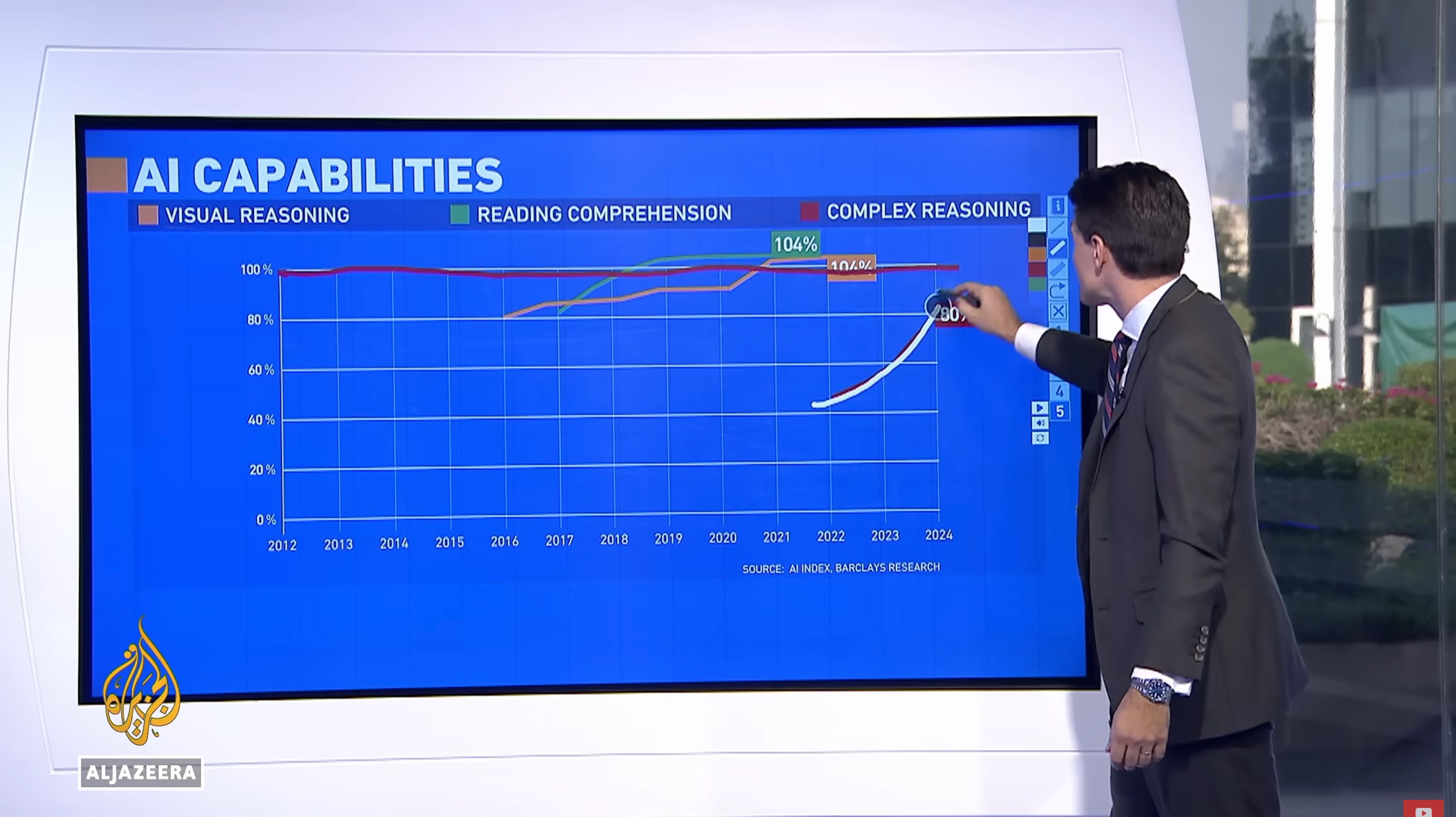
So look, obviously these robots are interesting because they more or less look like humans, but the brain power of these is obviously powered by artificial intelligence. Now, this is a chart showing AI capabilities from AI Index and Barclays Research.
Obviously, this is somewhat subjective, but according to their analysis, this is the baseline here — 100%. This is how well a human can do it. So if the line is above 100%, the robots are doing better than us, or the AI is doing better than us. If it’s below, they’ve got a ways to go.
So when it comes to visual reasoning, just in the last couple of years, AI is better. When it comes to reading comprehension, also better — been that way for a while. But when it comes to complex reasoning, they have a way to go. But look at the trend line — they’re coming for us.
Lian Jye, have we really thought through whether all of this — AI robots — is a good idea, or whether this is something that we really need? Because it seems to me like people also need jobs; they need to show up and do work every day.
Lian Jye Su
It is about having good jobs for good people. The fundamental question is whether AI is good enough for those better jobs that we are preparing for. Are they actually replacing the more repetitive tasks that actually, in some cases, require higher accuracy but really large volume? In those cases, as you have shown there, AI has done a really good job of being able to process those tasks, process those mundane work within a corporate environment.
I think what is more important here, what is more nuanced here within our discussion, is the fact that translating AI from a virtual environment, from a web environment, into a physical environment — hence it’s called physical AI — is no easy task to be able to replicate what a human can do. And then, assuming that if I put AI into a robotics form factor, everything will be good and dandy — it’s not the way to go at this point. We are still very far away from that future.
Scott McLean
All right, gentlemen, I want to ask you about the cost-benefit analysis of these robots, and at what point it becomes worth it.
How far off are we from having a butler — a robotic butler — in every home? Well, in 2024, Morgan Stanley Research estimated that the cost of a humanoid robot in a high-income country at around $200,000. Now, as production increases and the technology gets better, prices are likely to fall to around $150,000 by 2028, and as little as $50,000 by 2050. Now, in countries benefiting from cheaper Chinese supply chains, that could be even lower — possibly around $15,000.
At that point, analysts estimate that one in ten American households could own a humanoid robot. In China, it’d be around 3%. Some basic humanoid models are already becoming more affordable — one Chinese startup has a model for $5,000. Now, it’s not going to do your laundry or walk your dog, but it gives you an idea of where things are going.
So my question to you, Alan, is: how cheap do these robots need to get before they become worth it?
Alan Tonelson
Well, we’re going to have to factor in not only purely economic costs, but the fact that these robots don’t get sick, they won’t go on strike, and they won’t complain. So I have a feeling that this progress is going to be coming a lot faster than even J.P. Morgan thinks.
Scott McLean
Zichen.
Zichen Wang
Well, I think technology is advancing so fast that we may not have a pretty good idea. But I do think Chinese manufacturing strength, its supply chains, its research and development will contribute to lowering the cost of robots that are affordable for most families.
Scott McLean
Lian Jye, at what price or at what point do you think that the robots are worth it to sort of roll out on a big scale?
Liang Jia Su
It will be in two stages, to me. I mean, for the next three to five years, I think you’ll first see them proliferating in industrial, manufacturing, and commercial use cases, as you mentioned just now. For home care robots, that’s at least ten to twelve years away. Even with cheaper pricing, we are lacking severely on the data and AI side of things to handle general-purpose tasks for all these robots.
Scott McLean
Zichen, can I just ask how big of a national priority is the development of these humanoid robots in China right now?
Zichen Wang
Well, it is one of the frontier industries that China has identified, together with AI and commercial airspace, and Chinese companies are already standing at the very edge of this industry, as you showed at the very beginning from the research by my colleague on the panel. So it is very important.
For example, there is a company in Hangzhou called Unitree, which is a leading robot developer. It is on the eve of being publicly traded on the Chinese stock exchange, and everyone is waiting for its debut. So it is indeed in the spotlight in China, and people are quite excited about their development.
Scott McLean
Alan, do you think that the Americans are also treating this as a national priority? I know that you’ve written that the difficulty in the United States is that it would be hard, if not impossible, to get all of the components to build these in the U.S. Doesn’t this open up a broader discussion about deindustrialisation and the fact that globalisation has almost completely hollowed out the manufacturing base in the United States?
Alan Tonelson
Well, that’s certainly been the case in industry after industry, including high-tech industries, and there really can be very little question that Washington has been literally asleep at the switch, if not actively enabling this process, for decades. And it’s going to take quite a long time to basically catch up, and to recognise that promoting high-tech manufacturing at home has got to be a priority for the entire society, for the entire government, for the entire American system. We’ve made progress in recent years, no doubt about that, but we have a very long way to go.
Scott McLean
But doesn’t this ultimately mean you’re going to either have to put tariffs in place or some kind of subsidies, so that you can compete with the very low manufacturing and, particularly, labour costs in places like China and other countries in Asia?
Alan Tonelson
Well, that’s already happening, and I think that’s going to continue happening, no matter who gets elected president, by the way, two years from now.
Scott McLean
Lian Jye, there is talk, obviously, about the applications of these humanoid robots in manufacturing, even in hospitality, and potentially in caring for elderly people. But I just wonder — aren’t there limits to this? I mean, what kind of a grandson would you be if you relied on a robot to take care of your grandma? Do you think a lot of people would really go for that?
Lian Jye Su
I will answer that question slightly differently, in the sense that it’s probably less of a grandson challenge, but more of a me challenge. I do expect that, by the time I become old, there will probably be a healthcare system that is built around automation, that is heavily leaning on robotic solutions, or, in some cases, less robotics but AI-based solutions that utilise not just robots for elderly care or hospital care, but also for diagnosis, for medication, for surgery. We are seeing a lot more adoption of healthcare robots as time passes on, and that trend is not going to stop anytime soon. So there is, I would say, yes, no limit to this. But there is a timescale factor in this — it might take longer than expected. Hence my argument of me being old rather than my grandmother being old.
Scott McLean
Zichen, obviously the Americans are trying to do what they can to limit China’s rise when it comes to technology — when it comes to, obviously, these robots, semiconductors, the list goes on. Are those measures working?
Zichen Wang
Well, I think they are having some impact. For example, stopping Nvidia from selling its flagship chips to China — certainly helped slow down the growth of computing power in China’s leading AI companies. But this is a prime example: the open-weight Chinese AI developers have been able to roll out their near-frontier models at a fraction of the cost, and these are being deployed everywhere, including in Africa, about which the New York Times had a big story yesterday.
So yes, it is slowing China down, but it cannot — it will not — stop Chinese development.
And also, if I may respond a little bit to what Alan said a short while ago: actually, the way to help the United States improve its manufacturing is to let Chinese companies, under U.S. law, under U.S. government supervision, facilitate Chinese R&D and Chinese investment into the United States—
Alan Tonelson
(interrupting) Absolutely unacceptable.
Zichen Wang
There is currently a board of investment being negotiated between the two governments.
Alan Tonelson
Good luck with that, because the last thing that the American — mainly free-market — economy needs is a larger role for Chinese state-controlled actors. That’s not only going to be terrible for U.S. national security, it’s going to be completely awful in terms of maintaining the United States as a largely free-market economy because competition from state-controlled actors is not market competition, and it’s going to badly distort markets. That’s the last thing that this country needs.
Zichen Wang
All the frontier AI companies and robotic companies in China, and EV companies — all of them, the leading players, are private ones, actually.
Scott McLean
All right, gentlemen. I wish we had more time. It is a fascinating — and also a bit of a terrifying — discussion that we have had today. We appreciate the time from all of you. Alan Tonelson, founder of RealityChek; Zichen Wang, Deputy Secretary General at the Center for China and Globalization; and Lian Jye Su, Chief Analyst at Omdia. Thank you all once again.
Zichen Wang: Beijing’s message to the world’s tourists — come here and judge China for yourselves

Zichen Wang, Deputy Secretary-General of the Center for China and Globalization (CCG), and Hao Wu, Assistant Professor at Peking University’s School of International Studies, shared their thoughts in a recent Guardian commentary on what lies behind China’s expansion of visa-free travel. They argue that Beijing is not only seeking to boost inbound touris…