

The US-China Business Council (USCBC) 美中贸易全国委员会, an association of more than 270 American companies that do business in China and one of the most active organizations between the two countries, has published an “expert insights” with Zichen Wang, deputy secretary-general of the Center for China and Globalization (CCG).
The piece, by Ian Driscoll, Vice President of USCBC, follows.
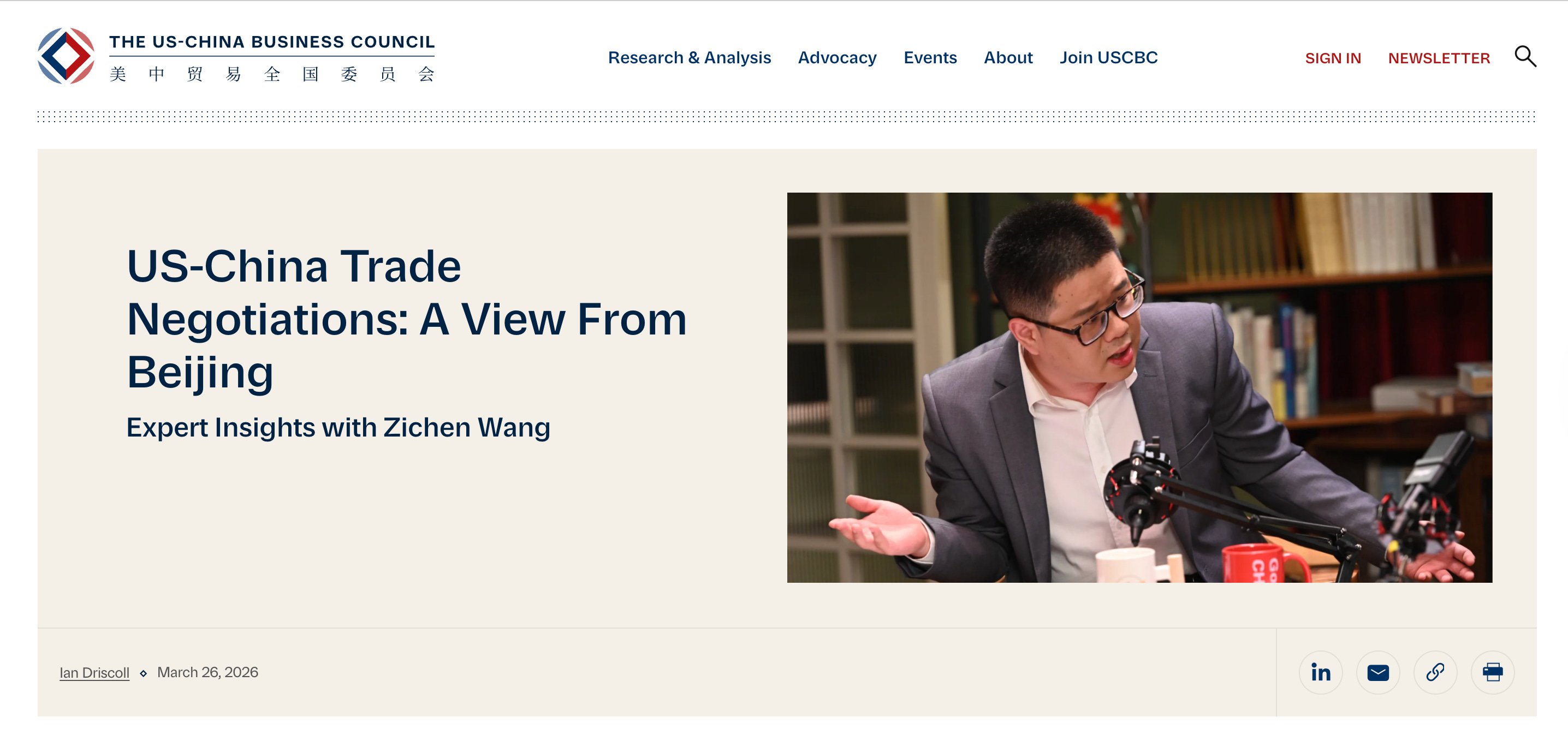
US-China Trade Negotiations: A View From Beijing
Expert Insights with Zichen Wang
Zichen Wang founded and edits Pekingnology and The East is Read, two influential English-language newsletters on China’s current affairs from within China. He is deputy secretary-general at the Center for China and Globalization (CCG), a leading non-governmental think tank in Beijing. Before joining CCG in October 2022, he was a senior journalist at China’s state news agency for over 11 years, including two and a half years in Brussels covering the European Union. His writings have been published in the Financial Times and Foreign Policy, and he has been quoted across international mainstream media. He has also been invited to speak at major think tanks and forums. Zichen holds a Master in Public Policy from the School of Public and International Affairs, Princeton University, where he was Mary L. Deibel ’76 Fellow in Public and International Affairs.
What are the Chinese government’s highest priorities for President Donald Trump’s upcoming visit?
Beijing’s main priority is to keep the overall relationship broadly stable. President Xi Jinping has already publicly signaled the basic tone: the two sides should continue to “steer the giant ship of China-US relations steadily forward through winds and storms” and “accomplish more big things and good things.” The Chinese view is that the United States has its concerns, China has its concerns, and solutions are still possible so long as both sides proceed on the basis of equality, respect, and reciprocity. Beijing also sees 2026 as an important year for both countries. China is beginning the 15th five-year plan period, the United States is approaching the 250th anniversary of its founding, and the two sides will each host major multilateral meetings.
China wants a stable visit, not an overdramatic one.
My own reading is that China wants a stable visit, not an overdramatic one. The priority is to avoid fresh shocks, keep the relationship from veering into another cycle of confrontation, and preserve room for cooperation in trade, investment, education, and people-to-people exchanges. Expectations are not especially high, but there is a clear desire to prevent unnecessary turbulence and to keep moving, step by step, in a constructive direction.
How would you rate each side’s progress on Busan commitments?
I would describe the progress as real. The right standard is not whether the two sides have solved their deeper structural disputes, because they plainly have not. The more useful question is whether they have broadly followed through on the specific understandings reached in Busan. By that standard, the picture appears reasonably positive. US officials have publicly said that China has largely met its commitments under the Busan framework, while Beijing has not made public accusations that Washington has flatly broken the deal.
That said, the relationship is still burdened by distrust, and several sensitive issues, especially those touching national security, continue to limit what either side is prepared to do.
The Trump administration is reportedly more focused on delivering purchase deals than on raising some of the structural issues about which US companies have long complained. Does this match your perception?
Broadly speaking, yes. Purchase deals are visible, quantifiable, and politically easier to advertise. Structural issues are much more difficult to resolve in the space of a single visit.
A visit centered only on purchases may produce headlines, but it would not do much to repair the deeper erosion of economic ballast between the two countries.
That said, I would still hope both sides can be more ambitious. The bilateral economic relationship has suffered serious damage in recent years, and mutual dependence has been declining. That not only reduces the scope for commercial win-win outcomes but also weakens one of the main stabilizing forces in the relationship. A visit centered only on purchases may produce headlines, but it would not do much to repair the deeper erosion of economic ballast between the two countries.
Given that China appears to be doubling down on industrial policy, does China ever intend to address the domestic structural issues, like market access barriers and subsidies, that lead to an uneven playing field for foreign firms?
Some of the challenges long complained about by American companies in China have indeed arisen from the bilateral downturn. As US-China relations have deteriorated, both governments have become more inclined to view the other side’s firms through a security lens. That has made both environments more restrictive and more suspicious.
But many of the problems are broader than the bilateral relationship. They are rooted in China’s unfinished reform as a transition economy to address excessive administrative intervention, local protectionism, and the durable privileges of parts of the state-owned sector. In that sense, many of the obstacles are not unique to foreign firms. Most Chinese private firms face similar constraints. Beijing’s push to build a “unified national market” is, in effect, an acknowledgement of these problems. But progress has been limited, which shows how difficult it is to overcome institutional inertia and vested interests. If that agenda were to make substantial headway, the operating environment for US firms would improve.
In trade negotiations with China, has the Trump administration played a good hand, or has it been less effective than you expected?
The administration has had leverage, but it has not always used it in the most effective way. One crucial step Trump could take would be to carve out a narrow, disciplined lane for Chinese investment into the United States where the risks can be credibly contained. That would be more consistent with the administration’s own stated principle of attracting “constructive foreign investment” while ensuring that such investment does not imperil national security.
On the campaign trail in September 2024, Trump said he wanted to lure factories from abroad, including from China, with low taxes and light regulation. In Detroit in January this year, he was blunter still, saying, “Let China come in.”
America cannot celebrate foreign investment, promise a manufacturing revival, and at the same time treat almost any Chinese role as beyond the pale.
Resistance in Washington is strong, and it is deeply embedded across Congress and much of the policy system. Some of that resistance rests on legitimate concerns. Some of it, however, has become too sweeping. The key question is whether every form of Chinese capital should be treated as inherently unacceptable.
America cannot celebrate foreign investment, promise a manufacturing revival, and at the same time treat almost any Chinese role as beyond the pale. If the administration is serious about reindustrialization, it needs a narrower definition of risk and a clearer distinction between what is genuinely sensitive and what is merely Chinese.
There appears to be bipartisan agreement in the United States that running large trade deficits with China is no longer acceptable. Western Europe and a growing number of Asian nations have expressed similar frustration. Do you think that China’s leadership has sufficiently grasped these concerns?
Donald Trump’s rhetoric has somewhat distorted the basic economics of trade deficits and surpluses, so it is worth starting from first principles. At the macro level, bilateral trade surpluses and deficits are driven more by differences in savings and investment balances than by consumption alone. China’s relatively high savings rate, strong manufacturing base, and export competitiveness, combined with the United States’ relatively low savings rate, strong consumer demand, and capacity to absorb imports, make a Chinese merchandise surplus unsurprising. Goods trade is also, in large part, the result of voluntary decisions by market participants: buyers pay for goods they want, and sellers supply them, which normally indicates a mutually agreed exchange.
That said, I do think China’s leadership understands that very large surpluses can intensify international trade friction. In 2026, Chinese official language has become somewhat more explicit about boosting imports and promoting more balanced trade. But adjustment is a process, not an immediate switch. Most of China’s import and export activities are carried out by firms responding to market incentives, not by direct state command, and neither a sudden surge in imports nor a rapid compression of exports is realistic, even for a powerful government. Some policy moves have already been made, but the effects are unlikely to be immediate. So yes, Beijing grasps the concern, but trade frictions are still likely to persist and may even worsen before they improve.
Where does Beijing see imbalance in US-China trade? How concerned is it about the economy’s goods surplus given its aspirations to move up the value chain and escape the middle-income trap?
From a Chinese perspective, the imbalance is not only in the goods ledger. Beijing would argue that there is also an imbalance in the institutional and policy environment surrounding commerce.
China often sees the relationship as commercially interdependent but institutionally asymmetric.
The United States still wants access to the Chinese market but has become increasingly willing to restrict Chinese access to American technology, investment opportunities, and even commercial space in third countries through an expanding national security framework. In that sense, China often sees the relationship as commercially interdependent but institutionally asymmetric.
As for the goods surplus itself, my sense is that Beijing’s main concern is less that a surplus will directly prevent China from moving up the value chain and more that an exceptionally large and persistent surplus invites international backlash. The risk from Beijing’s point of view is that rising trade and geopolitical friction will make China’s external environment more difficult precisely when it wants stability to upgrade industry, sustain growth, and avoid the middle-income trap.
US and Chinese officials have reportedly discussed reviving reciprocal investment. In what areas do you expect Chinese investment in the United States might be tolerated by Washington, and under what conditions? Do they align with where Chinese companies see the most opportunity?
In sectors such as automobiles, batteries, industrial equipment, and parts of the broader advanced manufacturing supply chain, excluding Chinese know-how does not make industrial realities disappear. It raises costs, slows scale-up, and can make projects less attractive, if not unfinanceable. Washington is entitled to draw hard lines around critical infrastructure, sensitive personal data, software control, and military spillovers. But those lines are credible only if they are precise.
The right test is not whether a Chinese entity appears somewhere in the value chain. It is whether an arrangement gives Chinese actors control over a genuinely critical node, privileged access to sensitive data, or durable operational leverage through software, networks, or remote updates. If the answer is no, then there should at least be room to consider carefully bounded cooperation.
That would mean strict governance safeguards, legal ringfencing, auditable structures, limits on remote access, rigorous compliance review, and a clear link to US-based production and employment. Broadly speaking, those are also the areas where many Chinese companies would see the most opportunity because they align with China’s strongest capabilities in manufacturing, engineering, and supply chain execution.
A draft of the 15th five-year plan indicates that China will invest heavily in emerging strategic industries, including robotics, the low-altitude economy, aviation, and biomedicine, but it also plans greater investment in areas such as brain-computer interfaces and embodied artificial intelligence. How will Beijing reconcile planned investment in industries like AI with the high unemployment levels among China’s youth?
As quite a few people in American industry have observed, China appears more optimistic than the United States about rapid technological advance, especially in AI. Similarly, it seems less anxious, at least in the short term, about some of the side effects, including labor displacement.
Concerns about job displacement are outweighed by the strategic imperative of staying near the technological frontier.
At the same time, Beijing attaches exceptional importance to frontier technology for reasons that go well beyond employment. Historical memory, the premium placed on self-reliance, a deep attachment to industrial strength, and the belief that technological leadership reinforces national security all push policy in the same direction. In practice, that means concerns about job displacement are outweighed by the strategic imperative of staying near the technological frontier. The implicit official bet appears to be that new industries, industrial upgrading, and new forms of demand will eventually absorb a meaningful share of the disruption, even if the transition is uneven.
Trump has said that he wants to extend the one-year trade truce — one potential deliverable for the now-delayed presidential summit. What is necessary to make that happen, and how optimistic or pessimistic are you about US-China economic exchange?
The key requirement is compartmentalization. After the confrontation of 2025, both sides appear to have learned that, in narrowly defined economic domains, each has the capacity to inflict short-term pain on the other at levels that quickly become politically and economically hard to sustain. That has created a rough form of deterrence. The danger is that actions outside the narrow trade lane will spill back into it.
One risk I worry about is the continued expansion of US national security definitions to treat almost any non-military Chinese commercial presence abroad, such as energy trade with third countries or the leasing and operation of civilian ports, as inherently threatening. If that begins materially damaging China’s legitimate commercial interests overseas, Beijing may feel compelled to retaliate. So, I am somewhat more optimistic about the survival of narrowly defined economic exchange than about the wider relationship. The economic track can probably still be stabilized, but only if both governments resist allowing every other dispute to contaminate it.

Zichen in FT: Let Chinese mainland tourists return to Taiwan

Zichen Wang, Deputy Secretary-General of the Center for China and Globalization (CCG), published the following op-ed in the Financial Times on Thursday, February 26, 2026.
Zichen in Foreign Policy: China Won’t Play Security Patron for Iran

Zichen Wang, deputy secretary-general of the Center for China and Globalization (CCG), published the following analysis in Foreign Policy on Friday, March 6, 2026