

A new chapter by CCG Research Fellow Veronica Hong Liu, titled “Individualism and Collectivism: Roots and Realities of U.S. and Chinese Exceptionalism,” will appear in the forthcoming Routledge volume Clash of Exceptionalism in International Relations: Contemporary Dynamics and Impacts of U.S. and Chinese Exceptionalism on Global Affairs, edited by Najimdeen Bakare.
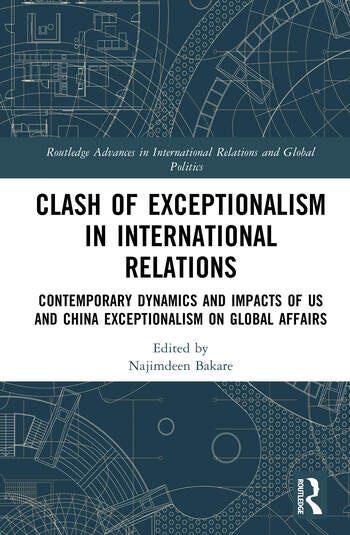
Drawing on historical comparison and discourse analysis, the chapter examines the roots of American exceptionalism in individualism and Chinese exceptionalism in collectivism, and discusses how these contrasting traditions shape the two countries’ domestic systems, international outlooks, and evolving relationship.
We are pleased to share the full text of the chapter here. Readers interested in supporting the full volume may visit the publisher’s official website.

Individualism and Collectivism: Roots and Realities of U.S. and Chinese Exceptionalism
Abstract: Political sociologist Seymour Lipset argues that American exceptionalism is fundamentally rooted in the principle of individualism—a claim that remains highly accurate. Individualism has deeply influenced the American mindset, shaping its political institutions, economic systems, and cultural values. In contrast, Chinese exceptionalism is founded on collectivism, a concept deeply ingrained in China’s historical heritage and still highly influential in modern society. This paper aims to explore and compare the foundations of American and Chinese exceptionalism through the framework of the individualism-collectivism divide. It will examine how these contrasting value systems have informed each nation’s political structures, economic models, and cultural practices. Additionally, the paper will analyze how this divergence shapes the complex bilateral relationship between the United States and China. Finally, it will argue that a growing convergence of individualist and collectivist values within both societies holds the potential to foster greater mutual understanding and cooperation—both domestically and internationally—thereby helping to bridge ideological divides and promote more stable and constructive relations between the two global powers. By drawing on historical comparison and discourse analysis, the paper seeks to explain the divergence of American and Chinese exceptionalism through cultural and identity lenses.
Keywords: American Exceptionalism, Chinese Exceptionalism, Individualism Collectivism
Exceptionalism has long served as a conceptual lens through which nations interpret and justify their perceived unique roles within the international system. Far from being a mere rhetorical flourish, exceptionalism emerges from specific historical trajectories, ideological traditions, and sociopolitical developments that distinguish one nation’s identity and mission from others (Lipset, 1996; Huntington, 1996). It operates simultaneously as a source of national pride, a mechanism for internal cohesion, and a justification for distinctive domestic policies and global ambitions. Exceptionalist narratives often assert that a particular nation possesses a unique historical destiny or civilizational responsibility, positioning itself as a model for others or as a leader in shaping global norms.
In contemporary international relations, the exceptionalist frameworks of the United States and China stand out as two contrasting paradigms—each representing fundamentally different worldviews and approaches to power. American exceptionalism, deeply rooted in Enlightenment liberalism, emphasizes the primacy of the individual as the foundation of liberty, innovation, and democratic legitimacy. This worldview draws strength from historical experiences such as the American Revolution, the expansion of constitutional democracy, and the country’s self-image as a “shining city upon a hill” destined to lead by moral example. It shapes not only domestic institutions, with their emphasis on individual rights and limited government, but also foreign policy, which often frames global leadership as a responsibility to advance democracy, human rights, and market capitalism worldwide.
Conversely, Chinese exceptionalism is grounded in a profoundly different intellectual tradition. It is anchored in the values of social interconnectedness, collective harmony, and hierarchical relational ethics inherited from Confucian philosophy. This worldview emphasizes the subordination of individual interests to the greater good of the community or state, valuing stability, order, and moral cultivation over personal autonomy. These principles guide both China’s domestic governance—centered on the authority of the Chinese Communist Party (CCP)—and its approach to international engagement, which stresses concepts such as harmonious development, multipolar cooperation, and respect for civilizational diversity. American exceptionalism tends to project itself globally, whereas Chinese exceptionalism presents itself as a distinct path of development.
This essay compares the two paradigms by examining their historical and philosophical roots, institutional forms, economic strategies, political structures, and patterns of international behavior. Through historical comparison, it explores their coexistence, potential rivalry, and implications for the future global order.
I. Individualism as the Core of American Exceptionalism
1. Historical and Philosophical Foundations
The intellectual and cultural foundations of American exceptionalism can be traced back to Alexis de Tocqueville’s seminal work Democracy in America (2000). In sharp contrast to the entrenched aristocratic hierarchies and rigid class structures of contemporary Europe, Tocqueville portrayed American individualism not as mere self-interest, but as a moral framework in which citizens pursued personal goals in alignment with civic responsibility. This ethos, he argued, nurtured a dynamic civil society and participatory democracy. Tocqueville also highlighted Americans’ remarkable commitment to equality, individual rights, and decentralized governance.
Seymour Martin Lipset (1996, 5) famously traced the origins of American exceptionalism to a constellation of interrelated cultural and political traits: liberty, egalitarianism, populism, individualism, and laissez-faire economics. Among these, individualism occupies a central place, serving as both the core value and the underlying rationale for the distinctive character of American society. This emphasis on individual autonomy and personal responsibility shapes not only domestic social norms and political practices but also informs the broader national ethos.
John Locke, in his Second Treatise of Government (1689), articulated the doctrine of natural rights to life, liberty, and property, laying the philosophical foundation for American individualism. His social contract theory—that governments derive legitimacy only insofar as they exist to protect these rights—profoundly influenced the ideological underpinnings of the U.S. Constitution and the Bill of Rights (Locke, 1988). Accordingly, the American political system institutionalized the principle that authority rests on the consent of free individuals to limited government, inverting traditional European norms of top-down power. This Lockean framework marked a radical departure from monarchical and aristocratic models, positioning the state primarily as a guarantor of individual autonomy rather than as an enforcer of collective conformity or entrenched hierarchies (Wood, 1991).
America’s constitutional design, with its emphasis on checks and balances, federalism, and the separation of powers, embodied this individualist philosophy (Madison et al., 2003). By constraining centralized authority, it sought to safeguard individual freedoms against potential tyranny. The Bill of Rights, ratified in 1791, further codified these protections, explicitly guaranteeing freedom of speech, religion, and private property—core elements of the nation’s exceptionalist identity (Foner, 2013).
Over time, individual autonomy has evolved into a deeply ingrained political culture, understood as both a right and a civic duty. This individualist tradition is evident in the expansion of suffrage, the civil rights movement, and contemporary debates over privacy and government oversight. It also shapes American foreign policy, framing the United States as a global advocate for liberal democratic principles.
2. Economic Foundations: Capitalism and the Self-Made Ideal
Economically, American exceptionalism has long celebrated individual responsibility, entrepreneurial ambition, and upward mobility. It emphasizes not only material success but also moral virtue, championing hard work, ingenuity, and perseverance. Max Weber’s The Protestant Ethic and the Spirit of Capitalism (1930, 10) famously links the rise of Western capitalism to cultural values rooted in Protestant asceticism—particularly personal discipline, industriousness, and the postponement of immediate gratification. In the American context, these values were secularized into a moral framework in which entrepreneurial initiative and economic achievement are seen as markers of individual merit and, historically, even divine favor.
Within this cultural context, an economic system emerged that prioritizes free markets, competition, and technological innovation. Samuel Huntington (1981, 8) characterizes American political culture as defined by “rugged individualism,” reflecting a deeply ingrained skepticism toward government intervention in the private sphere, particularly in economic affairs. This wariness has repeatedly surfaced in debates over taxation, welfare programs, and regulatory policies.
The doctrine of laissez-faire capitalism has been strongly championed by prominent economists such as Friedrich Hayek (1944) and Milton Friedman (1962). In The Road to Serfdom, Hayek famously warned that government economic intervention risks concentrating excessive power in the state. Likewise, Friedman advocated for minimal regulation and the primacy of free-market mechanisms. Collectively, their ideas reinforced the link between market freedom and personal liberty, leaving a profound imprint on American economic policy throughout the late twentieth century.
This individualist economic ethos is evident in the historical evolution of institutions structured to encourage innovation, entrepreneurial risk-taking, and private enterprise. From the early establishment of robust patent protections to the growth of venture capital networks, American capitalism fostered environments conducive to experimentation and entrepreneurship. Nowhere is this more evident than in the rise of Silicon Valley, described by AnnaLee Saxenian (1994) as an ecosystem uniquely suited for fostering decentralized innovation. The success stories of technological giants like Apple, Google, Microsoft, and Amazon serve as modern embodiments of the self-made ideal, where founders are often mythologized as visionary entrepreneurs who disrupted industries through individual brilliance and bold risk-taking (Florida, 2002).
Moreover, this individualist economic tradition has helped shape powerful narratives of social mobility and meritocracy, encapsulated in the ideal of the “American Dream.” Within this framework, success is presented as universally attainable for those willing to work hard and seize available opportunities, regardless of their socioeconomic starting point (Hochschild, 1995). Historically, this belief has served as a unifying national narrative, inspiring both immigrants and native-born citizens to seek personal advancement through education, innovation, and entrepreneurial endeavor.
However, this narrative is not without tensions and contradictions. Scholars such as Thomas Piketty (2014) have highlighted how rising wealth inequality undermines the meritocratic ideal, pointing out that structural barriers—such as unequal access to education, capital, and social networks—often limit true upward mobility. These contradictions underscore the enduring complexity of American exceptionalism, revealing it as both a guiding national ideal and a contested reality within the country’s economic and social fabric.
3. Political Implications: The Small State Ideal and Decentralization
The primacy of individualism has profoundly shaped American political institutions, legal frameworks, and systems of governance. In the American tradition, the central purpose of government is not to organize society around collective identities or overarching goals, but to safeguard individual liberty. As Robert Dahl (2000, 12) observed, the practice of liberal democracy in the United States rests on limiting state power to protect personal rights. Institutional mechanisms—such as checks and balances, regular elections, and judicial review—function as structural safeguards against the concentration of authority and the risk of tyranny.
Moreover, freedom in the American tradition is understood not merely as a political arrangement but as a moral imperative. Any form of governmental encroachment—no matter how well-intentioned—is regarded with suspicion if it threatens personal autonomy or economic self-determination. Robert Nozick, in Anarchy, State, and Utopia (1974), argued that the state’s legitimate role should be strictly limited to protecting individuals from force, theft, and fraud. From this perspective, redistributive taxation intended to fund social welfare is ethically objectionable, since it entails the coercive transfer of one person’s labor or property to benefit another.
Decentralization reflects this individualist ethos by granting local governments and communities the authority to govern in line with their distinct values, needs, and priorities. As Daniel Elazar (1987) observes, American federalism preserves substantial autonomy for states and municipalities, allowing them to shape policies in areas such as education, taxation, and public health. Federal initiatives frequently encounter resistance when viewed as intrusions into domains traditionally reserved for state or individual authority—illustrating the enduring American preference for governance situated as close to the individual citizen as possible.
American political culture does not disregard civic responsibility. While individuals are free to pursue their own interests, they are also encouraged to participate voluntarily in civic life—whether through voting, joining community organizations, or supporting charitable causes. As Amitai Etzioni (1993) notes, the traditions of volunteerism and grassroots engagement in the United States represent powerful expressions of personal moral responsibility within an individualist framework.
4. Foreign Policy: From Isolationism to Liberal Internationalism
American exceptionalism has profoundly influenced U.S. foreign policy, continually balancing the pursuit of liberty and democracy with considerations of power and national interest. In its formative years, this exceptionalism was expressed through a strong preference for isolationism, as the young republic sought to shield itself from European conflicts and imperial rivalries that might endanger its independence and democratic experiment.
Yet the global balance of power evolved dramatically over the 19th and 20th centuries, reaching a decisive turning point in the aftermath of World War II. The United States emerged as a dominant military and economic power, compelled to assume a more proactive role on the world stage. Embracing the mantle of global leadership, the U.S. helped construct and champion a liberal international order characterized by multilateral institutions, collective security alliances such as NATO, open markets, and the promotion of democratic governance worldwide. This global engagement can be understood as an extension of the American individualist ethos beyond its borders—advocating for freedoms of movement, expression, and trade as universal goods that underpin both peace and prosperity (Ikenberry, 2011, 15). The idea that liberal democracy and free markets are not merely American values but universal ideals to be spread globally has animated successive administrations, even as the means and intensity of such promotion have varied.
John Ikenberry (2011) conceptualizes this postwar system as a “liberal leviathan,” wherein U.S. leadership combines idealistic aspirations of spreading liberal values with the pragmatic necessities of maintaining geopolitical stability and deterring rivals. Within this framework, American exceptionalism functions both as a normative project—advancing democracy and human rights—and as a strategic necessity aimed at preserving an international order favorable to U.S. interests. However, this dual mandate has long carried built-in tensions, as the burdens and repercussions of interventionism have repeatedly fueled contentious debates at home.
In recent years, recurring domestic political movements have questioned the value of global engagement. Isolationist and nationalist perspectives—most prominently reflected in the Trump administration’s “America First” doctrine—have cast doubt on the sustainability of America’s international commitments, contending that such entanglements erode national sovereignty, impose undue burdens on taxpayers, and divert attention from pressing domestic concerns (Judis, 2016).
The “America First” turn thus underscores enduring tensions within American exceptionalism—between its long-standing universalist ambition to lead and reshape the world and a renewed focus on safeguarding national interests while limiting foreign entanglements. As Walter Russell Mead (2001) observes, this recurring struggle between interventionism and restraint remains a defining feature of U.S. foreign policy, deeply embedded in the nation’s self-identity.
II. Collectivism as the Core of Chinese Exceptionalism
1. Historical and Philosophical Origins: Confucianism and Collective Identity
In stark contrast to American individualism, Chinese exceptionalism is fundamentally underpinned by collectivism—a worldview that prioritizes collective harmony, relational ethics, and systemic interconnectedness as core societal values. These foundational ideas trace their intellectual and cultural roots to Confucianism, which has profoundly shaped Chinese civilization, governance, and social organization for over two millennia (Tu, 1999). Rather than viewing individuals as autonomous agents pursuing personal fulfillment, this tradition conceptualizes human beings as inherently embedded within a web of relationships, where responsibilities to family, community, and state are paramount.
Classical Confucian thought, articulated by thinkers such as Confucius (551–479 BCE), Mencius, and Xunzi, places the family and the community at the very center of moral life and social order. The cultivation of ren (benevolence), li (ritual propriety), and xiao (filial piety) is viewed as essential to achieving a harmonious society (Bell, 2008). Individuals are expected to develop personal virtue not solely for self-betterment, but to fulfill their roles within hierarchical yet reciprocal relationships. The Confucian ideal envisions society as an organic whole in which individual interests are subordinate to collective well-being, with personal fulfillment realized through the responsible performance of one’s duties within this interconnected social structure (Yao, 2000).
Political scientist Lucian Pye (1985,21) contrasts this deeply relational worldview with the atomized nature of Western individualism, describing Chinese political culture as fundamentally communitarian—a system that values obligations to others and places relational networks at the heart of social and political life. This focus on social embeddedness extends beyond domestic society to shape China’s approach to international relations. As Yan Xuetong (2011) argues, China’s collective and hierarchical orientation underpins its realist foreign policy, prioritizing order, stability, and relational diplomacy rather than the Western emphasis on individual state sovereignty and formal equality among nations.
In contemporary China, the resurgence of Confucian discourse has been strategically leveraged by the Chinese Communist Party (CCP) to bolster the legitimacy of its governance model and to justify policies designed to maintain social harmony and national cohesion (Bell, 2015). By invoking Confucian principles alongside the rhetoric of “socialism with Chinese characteristics,” Chinese leadership projects a hybrid ideological framework that links ancient philosophical traditions to modern political objectives. This philosophical foundation serves to bolster the CCP’s emphasis on collective interests, disciplined social order, and long-term national planning, positioning China’s developmental path as distinct from, and in many respects opposed to, the liberal individualist models of the West.
2. Economic Structures: Toward Common Prosperity
China’s economic model exemplifies collectivism by integrating market dynamics with robust state control, creating a hybrid system that prioritizes national cohesion, strategic coordination, and collective advancement. Since the initiation of Deng Xiaoping’s market-oriented reforms in 1978, China has pursued the model of “socialism with Chinese characteristics,” blending the efficiency and productivity of market mechanisms with the guiding hand of socialist political oversight (Naughton, 2007). This framework departs from the laissez-faire orientation of Western capitalism by maintaining that market activity should ultimately serve national interests, developmental goals, and the collective good.
A defining feature of this model is the dominant role of State-Owned Enterprises (SOEs) in key sectors such as energy, telecommunications, finance, transportation, and defense (Jakobson, 2013). These enterprises allow the Chinese state to retain control over strategic industries and channel resources toward long-term economic and geopolitical goals. Beyond the pursuit of profit, they function as instruments of national strategy. Through centralized mechanisms such as the Five-Year Plans, the state steers investment, promotes technological innovation, and develops infrastructure in line with broader national objectives.
Among the most notable outcomes of China’s governance and economic model is its unprecedented success in poverty reduction. By 2020, the government announced the eradication of extreme poverty, having lifted nearly 800 million people out of destitution over four decades—an achievement acknowledged by institutions such as the World Bank. This transformation was made possible by the CCP’s capacity for centralized coordination, resource mobilization, and long-term planning, reinforcing its claim that the system can deliver collective prosperity more effectively than market-oriented liberal models. Beyond its domestic significance, this accomplishment also presents a compelling alternative to Western liberal democracy, particularly for developing nations in search of viable paths to modernization.
Launched in 2013, the Belt and Road Initiative (BRI) is the flagship embodiment of China’s connectivity-driven economic vision on the global stage. It seeks to build an expansive network of infrastructure—ports, railways, highways, digital corridors, and energy pipelines—linking Asia, Africa, and Europe to promote economic interdependence and shared growth (Wang, 2016). More than an economic program, the BRI reflects China’s model of globalization centered on infrastructural integration and mutual benefit, offering a contrast to Western approaches often criticized for creating dependency or advancing unilateral advantage (Rolland, 2017; Johnston, 2018).
3. Political Model: Socialism with Chinese Characteristics
China’s political system is defined by centralized governance under the leadership of the Chinese Communist Party (CCP), with an emphasis on meritocratic selection, long-term planning, and social stability (Bell, 2015). As the sole ruling party, the CCP plays a decisive role in directing the country’s political, economic, and social development. In contrast to Western liberal democracies that emphasize individual rights, electoral competition, and multiparty pluralism, China’s model places priority on collective welfare, social cohesion, and sustained developmental objectives.
At its core, the Chinese political model is organized around the principle of serving the fundamental interests of the majority. It emphasizes pragmatic policy-making, technocratic expertise, and strong political control as means to safeguard national cohesion, drive modernization, and advance socioeconomic development (Fewsmith, 2018). By prioritizing the needs of the broader population, the CCP argues that it is better equipped to preserve social harmony, reduce inequality, and foster national unity, while avoiding the paralysis and polarization that can arise in multiparty democratic systems.
The Party further claims its legitimacy through its demonstrated capacity to deliver tangible benefits to the broad population, including unprecedented achievements in poverty alleviation, world-class infrastructure development, and ongoing improvements in education, healthcare, and technological innovation. The CCP’s success in lifting hundreds of millions of people out of poverty, expanding the middle class, and transforming China into the world’s second-largest economy is central to its narrative of effective governance.
The CCP’s ability to implement large-scale developmental goals with efficiency and coordination has been credited with delivering not only rapid economic growth but also transformative social achievements, further solidifying its claim to effective governance and emerging global leadership (Zhao, 2009). For the CCP, political stability guided by a centralized, disciplined ruling party is not just a domestic priority but a foundational principle of China’s rise on the global stage. The model asserts that only through unified leadership representing the interests of the majority can China sustain its momentum toward national rejuvenation, prosperity, and international influence in the 21st century.
III. The Clash of American and Chinese Exceptionalism
The evolving geopolitical rivalry between the United States and China is not solely a contest of power but a confrontation between two competing exceptionalist visions of world order. At its heart lies a deep ideological divide between American individualism—shaped by Enlightenment liberalism—and Chinese collectivism, rooted in Confucian-influenced collectivism. This clash manifests starkly in the contrasting doctrines of U.S. engagement policy and China’s vision of a “Community of Shared Future for Mankind” (命运共同体), each representing divergent understandings of global governance, sovereignty, and the role of the individual within the international system.
1. American Exceptionalism and the Engagement Doctrine
Since the end of World War II, American foreign policy has been underpinned by the notion of American exceptionalism—the belief that the U.S. has a unique mission to spread democracy, liberalism, and market capitalism (Lipset, 1996; Ikenberry, 2011). Particularly after the Cold War, this worldview evolved into engagement policy, a strategy aimed at integrating rising powers like China into the U.S.-led liberal international order.
The Clinton administration’s engagement policy posited that deepening trade, diplomacy, and cultural exchange with China would gradually liberalize its political system and align it with Western democratic norms (Mastanduno, 2002; Shambaugh, 2013). Underlying this approach was the individualist assumption that political and economic liberalization were universal aspirations and inevitable outcomes of modernization (Fukuyama, 1992, 21).
However, this strategy largely failed in its core objective. While China embraced globalization, it did so on its own terms, preserving an authoritarian governance structure while adapting market mechanisms (Naughton, 2021). Critics of engagement argue that the U.S. underestimated the resilience of China’s civilizational identity and overestimated the universal appeal of liberal individualism (Allison, 2017).
2. Chinese Exceptionalism and the “Community of Shared Future for Mankind”
In stark contrast, Chinese exceptionalism derives from China’s self-identification as a civilization-state rather than a nation-state in the Western sense (Jacques, 2012). The CCP’s contemporary foreign policy narrative, particularly articulated by Xi Jinping, revolves around the concept of “a Community of Shared Future for Mankind” (命运共同体), first formally introduced in 2013 and elevated to constitutional status in 2018 (Callahan, 2016; Zhao, 2020).
This concept represents a distinct philosophical orientation: the emphasis is on interdependence, mutual respect for different political systems, and prioritization of collective welfare over individual autonomy (Zhao, 2016). Inspired by ancient Confucian ideals of harmony (he, 和) and the tianxia (all-under-heaven) system, this vision promotes a world of relational obligation rather than adversarial competition (Bell & Wang, 2020).
The practical expression of this worldview is visible in initiatives like the Belt and Road Initiative (BRI), where infrastructure, trade, and technological connectivity are framed as global public goods fostering “win-win cooperation” (Ferdinand, 2016). Here, collectivism contrasts with the U.S.’s individual-centric emphasis on market liberalization, framing development as a shared journey rather than a competition of sovereign equals.
3. Individualism vs. Collectivism: Competing Global Orders
The failure of U.S. engagement to transform China reflects the deeper ideological incompatibility between liberal individualism and Confucian collectivism. For the U.S., global engagement has long been tied to advancing a liberal order predicated on individual rights, free markets, and democratic governance (Ikenberry, 2011). For China, modernization does not require democratization; instead, it requires stability, development, and harmonious relations among diverse political systems (Zhao, 2016).
This divergence has fueled tensions in international organizations and global norms. The U.S. advocates universal human rights frameworks rooted in individual autonomy (Inglehart & Welzel, 2005), while China defends state sovereignty and “developmental rights” as prerequisites for human dignity (Zhao, 2009). While the U.S. emphasizes “rules-based order” defined by liberal norms, China advances “pluralistic global governance” rooted in mutual respect for different development paths (Mahbubani, 2020).
The clash between American exceptionalism and Chinese exceptionalism—individualism versus collectivism—represents not just geopolitical rivalry but a civilizational conflict over the meaning of order, rights, and progress. The U.S. continues to see the global spread of liberal values as both desirable and inevitable. China, in turn, asserts that alternative modernities grounded in relational, collective responsibility are equally legitimate paths to prosperity and stability.
IV. The Convergence and Hybridization of American and Chinese Exceptionalism
1. Emerging Pragmatism: Balancing Ideals with Interests
Despite deep and enduring ideological divides, pragmatism has become an increasingly dominant force in shaping U.S.-China relations. While fundamental differences persist—rooted in contrasting political systems, values, and visions for the international order—both nations have come to recognize the inescapable reality of their mutual dependencies, particularly in the economic domain. Trade, investment, technological supply chains, and financial markets bind the two largest economies in a complex web of interconnection, making decoupling costly and destabilizing for both sides.
This recognition has led to a cautious, often uneasy form of strategic management, wherein both powers seek to advance their national interests without triggering direct conflict. As Graham Allison (2017, 8) warns in his analysis of the “Thucydides Trap,” historical patterns suggest that rising and established powers frequently fall into confrontation; however, conscious efforts at pragmatic engagement represent a deliberate attempt by Washington and Beijing to avoid that fate. This pragmatic approach does not resolve underlying tensions, but it introduces a level of strategic restraint aimed at preserving global stability while managing competition.
2. The Rise of Individualism Within China
Economic liberalization and social transformation in China have fostered increased individualism, particularly among urban youth, the growing middle class, and entrepreneurial communities (Yan, 2010). As market reforms deepened and global cultural influences intensified, personal ambition, consumerism, and self-identity have emerged as defining features of modern Chinese society. This shift has increasingly tested the traditional collectivist values that have long supported narratives of Chinese exceptionalism—values centered on unity, social harmony, and the primacy of the collective over the individual.
Studies indicate a rising demand for personal freedom, privacy, lifestyle choices, and self-expression in China, especially among younger generations (Zhao, 2017). Exposure to social media, international travel, and overseas education has gradually reshaped attitudes, creating subtle tensions between state-promoted traditional values and individuals’ evolving personal aspirations.
In response, the Chinese Communist Party (CCP) promotes the doctrine of “socialism with Chinese characteristics,” which seeks to reconcile rising individual aspirations with the broader collective goal of national rejuvenation (Pei, 2016). Through initiatives such as the “Chinese Dream,” the Party frames personal achievement and upward mobility as integral to the nation’s overall progress, blending traditional collectivist ideals with contemporary individual pursuits.
3. American Collectivism in Global Networks
Conversely, American exceptionalism is itself evolving. Once firmly grounded in ideals of individual liberty, self-reliance, and personal achievement, it is increasingly intersecting with new forms of collective identity. The growth of social media, online communities, and digital platforms has fostered transnational networks and participatory cultures, gradually softening the boundaries between individualism and emerging modes of social connectivity (Castells, 2010).
Although the core ethos of American individualism endures, it is increasingly complemented by a hybridization of values in which personal expression is realized through participation in broader networks of shared interests, beliefs, and activism. This evolving form of collectivism suggests that American exceptionalism is no longer defined solely by isolated individual achievement, but also by the ways individuals connect, collaborate, and co-create meaning across national boundaries.
This shift reflects a broader evolution of American identity in the twenty-first century, revealing both the tension and potential synthesis between the enduring legacy of rugged individualism and the emerging collectivist dynamics shaped by globalization.
4. The Future of Exceptionalism in a Multipolar World
In the face of shared challenges—such as pandemics, climate change, and cyber threats—the key task will be balancing systemic competition with the establishment of effective global governance mechanisms. Both American individualism and Chinese collectivism are expected to continue evolving and hybridizing. Zakaria (2008) argues that U.S. values will remain influential but must coexist with alternative models, while Chinese scholars like Zhao Tingyang (2006) call for integrating national sovereignty with global governance, potentially merging connectivist principles with broader pluralistic frameworks.
Conclusion
In conclusion, American exceptionalism, grounded in individualism, and Chinese exceptionalism, rooted in collectivism, embody two distinct yet comprehensive worldviews. Each is shaped by deep historical trajectories, philosophical traditions, and practical approaches to governance, development, and international engagement. Their interaction not only drives patterns of competition and rivalry in the contemporary geopolitical landscape but also underpins significant interdependence.
A nuanced understanding of these paradigms—both in their historical roots and modern manifestations—is essential. Policymakers, scholars, and global citizens must treat them not as abstract concepts, but as living frameworks that actively shape policy decisions, diplomatic strategies, and international cooperation.
As the global order becomes increasingly complex and multipolar, hybrid models of governance, identity, and international collaboration are likely to emerge. These models could combine the innovation-oriented strengths of individualism with the collective responsibility emphasized by collectivism, offering practical avenues for coexistence. Ultimately, the future will not be determined by the dominance of a single worldview, but by the capacity of global actors to bridge ideological divides, embrace nuanced perspectives, and work together toward shared solutions in an era of profound interdependence.
References
Allison, G. (2017). Destined for War: Can America and China Escape Thucydides’s Trap? Houghton Mifflin Harcourt.
Bell, D. A., & Wang, P. (2020). Just Hierarchy: Why Social Hierarchies Matter in China and the Rest of the World. Princeton University Press.
Betts, R. K. (2012). American Force: Dangers, Delusions, and Dilemmas in National Security. Columbia University Press.
Bremmer, I., & Roubini, N. (2011). The Fat Tail: The Power of Political Knowledge for Strategic Investing. Oxford University Press.
Byman, D. (2016). The Future of the Global Coalition to Defeat ISIS. Survival, 58(6), 121-136.
Callahan, W. A. (2016). China Dreams: 20 Visions of the Future. Oxford University Press.
Castells, M. (2010). The Rise of the Network Society. Wiley-Blackwell.
Creemers, R. (2017). Cyber China: Governance in the Age of the Internet. Journal of Contemporary China, 26(103), 85-100.
Creemers, R. (2018). China’s Social Credit System: An Evolving Practice of Control. SSRN Electronic Journal.
Deibert, R. J. (2019). Reset: Reclaiming the Internet for Civil Society. House of Anansi Press.
Ferdinand, P. (2016). Westward ho—the China dream and “one belt, one road”: Chinese foreign policy under Xi Jinping. International Affairs, 92(4), 941-957.
Fravel, M. T. (2019). Active Defense: China’s Military Strategy Since 1949. Princeton University Press.
Fukuyama, F. (1992). The End of History and the Last Man. Free Press.
Glaser, B. S. (2016). A U.S. Strategy for the South China Sea. Council on Foreign Relations.
Ikenberry, G. J. (2011). Liberal Leviathan: The Origins, Crisis, and Transformation of the American World Order. Princeton University Press.
Inglehart, R., & Welzel, C. (2005). Modernization, Cultural Change, and Democracy: The Human Development Sequence. Cambridge University Press.
Jacques, M. (2012). When China Rules the World: The End of the Western World and the Birth of a New Global Order. Penguin.
Lipset, S. M. (1996). American Exceptionalism: A Double-Edged Sword. W. W. Norton.
MacKinnon, R. (2012). Consent of the Networked: The Worldwide Struggle for Internet Freedom. Basic Books.
Mahbubani, K. (2020). Has China Won? The Chinese Challenge to American Primacy. PublicAffairs.
Mastanduno, M. (2002). Engagement Policies. In Ikenberry, G. J. & Mastanduno, M. (Eds.), International Relations Theory and the Asia-Pacific (pp. 161-190). Columbia University Press.
Medcalf, R. (2020). Indo-Pacific Empire: China, America and the Contest for the World’s Pivotal Region. Manchester University Press.
Naughton, B. (2021). The Rise of China’s Industrial Policy, 1978 to 2020. University of Chicago Press.
Pei, M. (2016). China’s Crony Capitalism: The Dynamics of Regime Decay. Harvard University Press.
Rolland, N. (2017). China’s Eurasian Century? Political and Strategic Implications of the Belt and Road Initiative. National Bureau of Asian Research.
Shambaugh, D. (2013). China Goes Global: The Partial Power. Oxford University Press.
Stokes, E., & Kostka, G. (2016). China’s Social Credit Systems and Public Opinion: Explaining High Levels of Approval. New Media & Society.
Tu, W. M. (1999). Confucianism and Chinese Civilization. State University of New York Press.
Walt, S. M. (2018). The Hell of Good Intentions: America’s Foreign Policy Elite and the Decline of U.S. Primacy. Farrar, Straus and Giroux.
Wu, X. (2019). Entrepreneurship and Innovation in China’s Digital Economy. Journal of Contemporary China, 28(117), 1016-1031.
Yan, Y. (2010). The Individualization of Chinese Society. Berg.
Zhao Tingyang. (2006). Tianxia System: A Political Philosophy and World Politics.
Zhao, S. (2009). The Ideological Foundation of China’s Quest for Soft Power in the International Arena. Asia-Pacific Review, 16(3), 250-270.
Zhao, S. (2017). The China Model: Can It Replace the Western Model of Modernization? Journal of Contemporary China, 18(60), 1-18.
Zhao, S. (2020). Chinese Foreign Policy: Pragmatism and Strategic Behavior. Routledge.
Zhao, T. (2016). The Tianxia System: World Order in a Chinese Utopia. University of California Press.
A brilliant exposition. A framework for understanding change, comprehending difference and the possibility of convergence. Deserves to be widely read. Hopefuly, this document and these concepts will assist policy framers in the US and Europe to understand that their aggression is inappropriate as is their insistince on the the US dollar being the medium for international exchange.