Trump Open to Xi-Putin Summit, Weeks After CCG's Henry Huiyao Wang Raised the Question at Valdai to Putin
Reports of a subsequent Trump-Putin discussion and Washington’s expressions of openness have since brought the prospect of a trilateral meeting at APEC into sharper focus
The prospect of a trilateral summit between Chinese President Xi Jinping, U.S. President Donald Trump, and Russian President Vladimir Putin at next month’s APEC meeting in Shenzhen has gained fresh momentum, with Washington openly expressing interest and Moscow confirming that the possibility has been discussed.
On October 19, Trump said he would be willing to meet with Xi and Putin in China, although he indicated that nuclear weapons and denuclearization, rather than the war in Ukraine, would be his preferred focus. The following day, U.S. Secretary of State Marco Rubio publicly defended the prospect of such a meeting, arguing that it made sense for the leaders of the world’s three most powerful nuclear-armed nations to communicate with one another. Rubio also stressed that engaging in dialogue should not be mistaken for making concessions.
The developments followed an October 19 report in The Wall Street Journal, which said Putin had floated the idea of a trilateral summit during an October 9 telephone conversation with Trump, according to a former Russian intelligence officer briefed on the matter. The proposed meeting, the newspaper reported, could take place on the sidelines of the November 18–19 APEC Economic Leaders’ Meeting in Shenzhen. The Kremlin subsequently acknowledged that the possibility had been raised, while stressing that no concrete proposals or agreements on a meeting or its agenda had been reached.
Beijing, meanwhile, has neither confirmed nor explicitly ruled out such a meeting. China’s Foreign Ministry has repeatedly said it has no information to provide, including in responses on October 3, October 19, October 20, October 21, and most recently October 22. No trilateral summit has been formally announced.
Well before these latest developments, however, Henry Huiyao Wang, Founder and President of the Beijing-based Center for China and Globalization (CCG), publicly raised precisely this possibility with Putin himself.
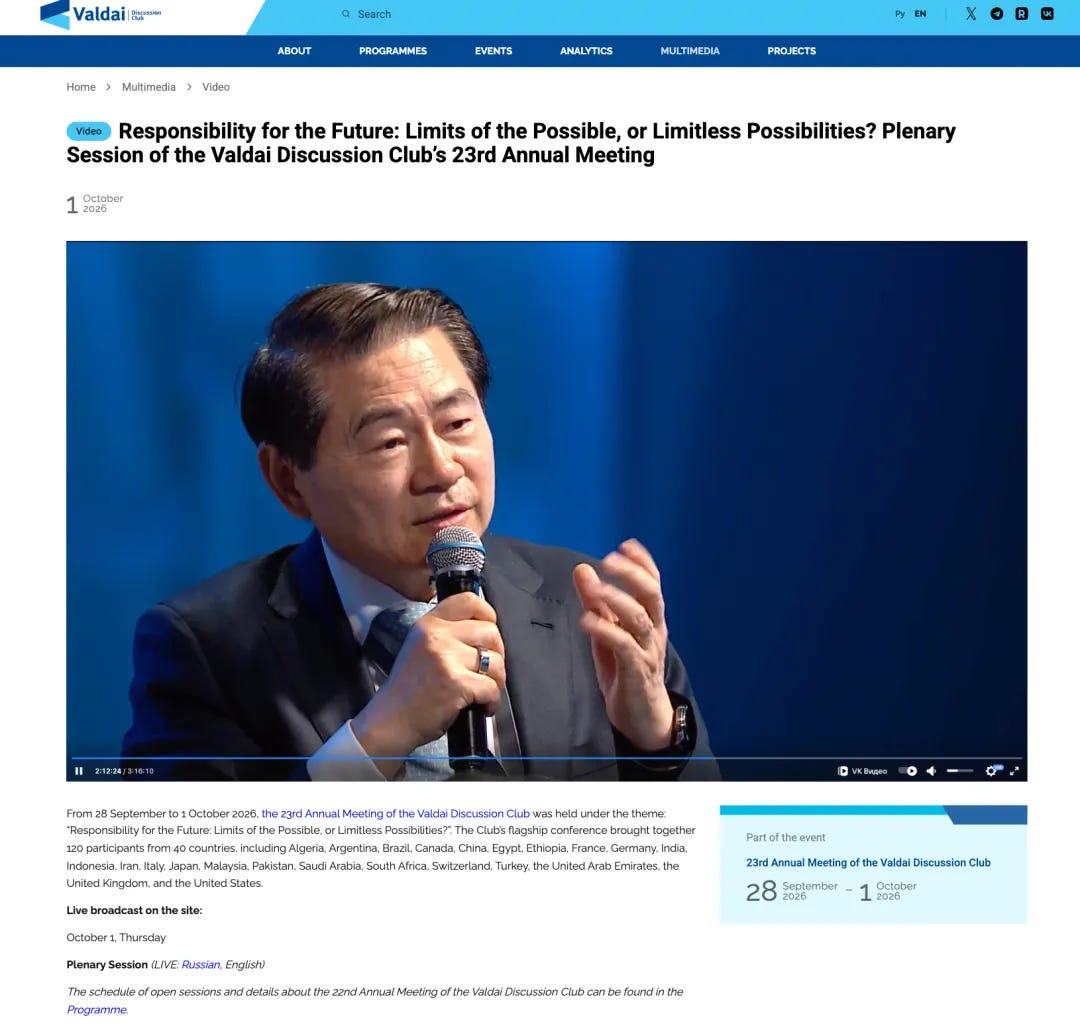
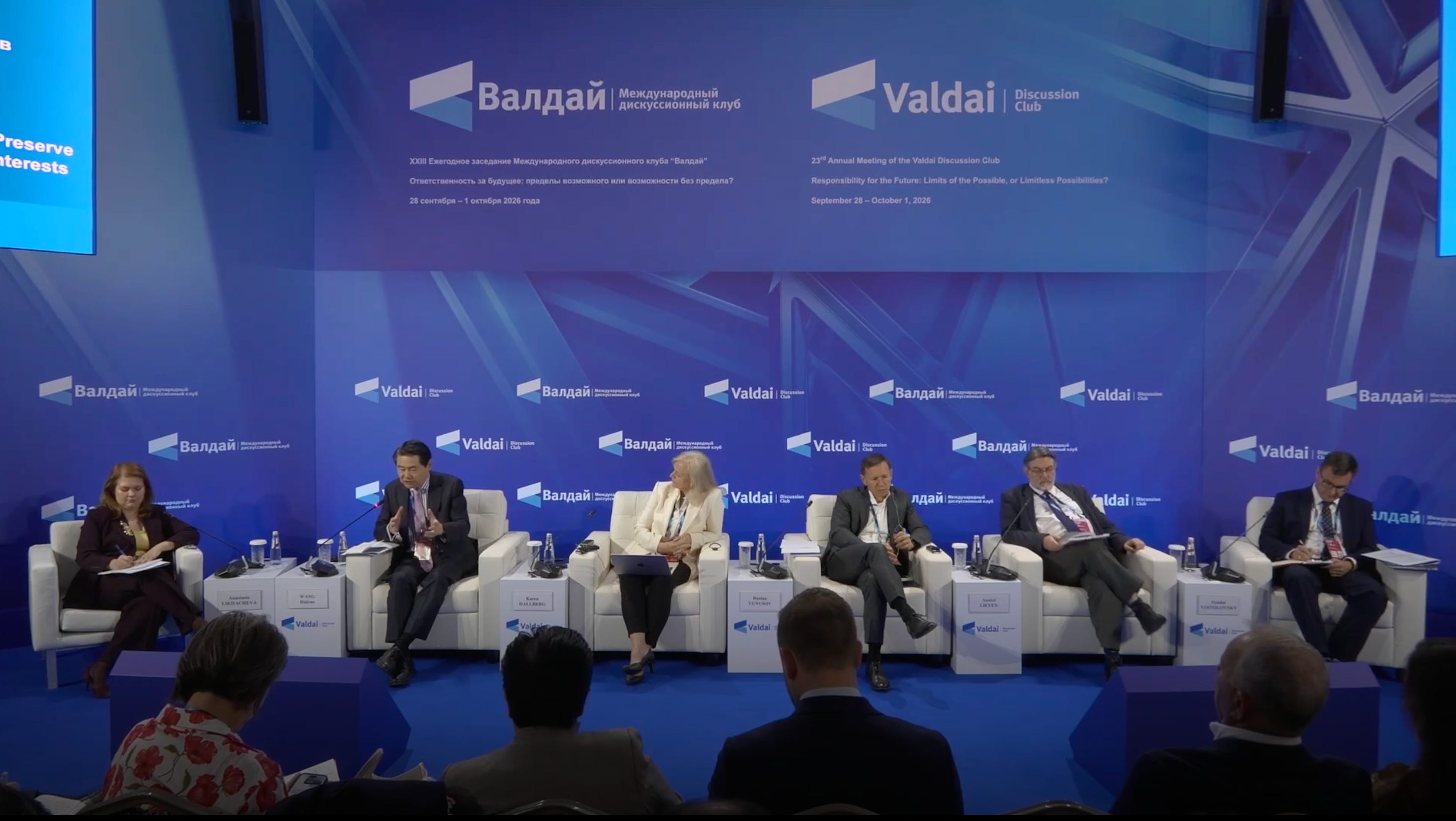
On October 1, during the televised and livestreamed plenary session of the 23rd Annual Meeting of the Valdai Discussion Club in Russia, Wang, a former Counselor to China’s State Council, asked the Russian president about a possible meeting with Xi and Trump at APEC—and whether China could play a larger role in promoting peace.
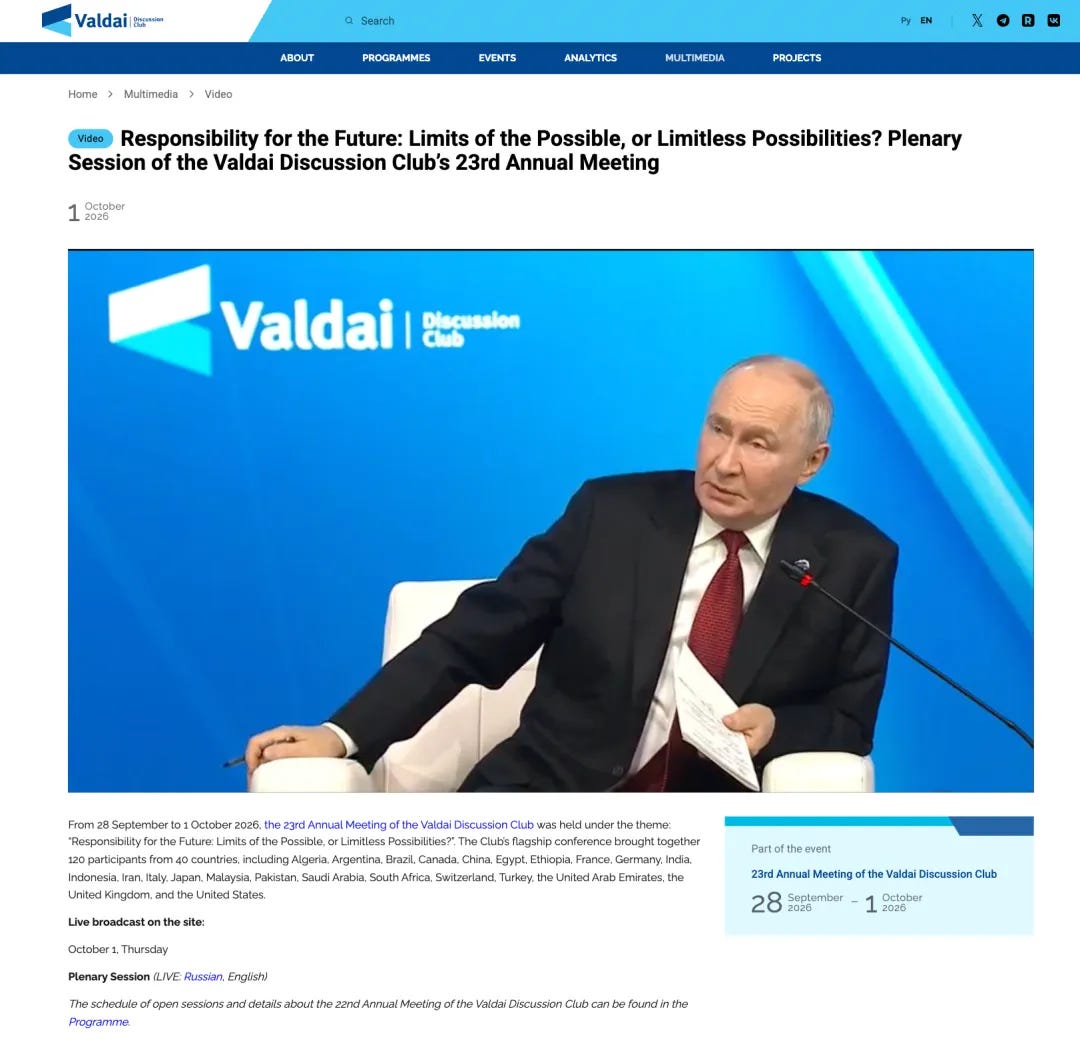
Putin’s answer provided one of his clearest public statements yet on the prospect of a trilateral summit: such a meeting was possible, he said, but its success would depend on agreeing on an agenda and, to a considerable extent, on China as the host.
The exchange took place during the Valdai Discussion Club’s October 1 plenary session. Below is the exchange as rendered in the English interpretation of the session, with minor punctuation edits for readability.
Henry Huiyao Wang
Mr. President. My name is Huiyao Wang, Founder and President of the Center for China and Globalization (CCG).
You mentioned that you’re going to APEC, and we actually saw you had a very successful summit last year with President Trump, and you had a very successful summit with President Xi this year. Of course, President Xi just came back from the United States, also had a very successful summit.
So I’m wondering, when you are at the APEC, this possible trilateral summit. So, what do you expect China can play some more role, for example, in promoting the peace, making peace, or peacekeeping, or guarantor, whatever, so that can really facilitate this summit to be successful? Thank you.
Vladimir Putin
I have no doubt that the summit will be successful.
As for the role of China, well, first and foremost, Chinese philosophy and its political thought has never had an issue of applying pressure or solving issues through military force. Well, it’s not part of Chinese philosophy. China always tries to do that through peaceful means, and we see that in the Chinese policy led by President Xi.
Could China play a role right now? Yes, of course. That is based on its increasing economic and military potential as well, on its strive to expand its zone of free cooperation. The initiative by President Xi, One Belt One Road, is aimed at precisely that. Together with China, we’re developing this initiative as well, as well as the Russian initiative, and we’re coupling them together. For example, the Russian initiative on Eurasian cooperation. We’re working together, and that brings positive results.
As for the trilateral meeting during the APEC summit, it is possible. I guess I have said that it will largely depend on China as host of the APEC summit, but yet again, it’s always useful to me to clear up the positions of each other and so on. But most importantly, we need to find the agenda, the issues that could be part of that trilateral summit. We need to identify the topics for the discussion. Largely, that would depend on the hosts of the event, and hence President Xi.
Interfaxseparately reported Putin’s remarks, quoting him as saying that Russia supported the idea in principle and that a potential meeting at APEC would depend largely on China as the host. It also highlighted his response that China could play a role in promoting peace.
The exchange draws international media attention
The exchange quickly travelled beyond the room.
Reuters reported under the headline “Putin says he’s ready to meet Xi and Trump if agenda is worked out,” based on Putin’s remarks at the Valdai session. The news agency subsequently included the same point in its broader report on Putin’s statements that day, writing that the Russian president was ready for a trilateral meeting if an appropriate agenda could first be agreed. Henry Huiyao Wang’s longstanding advocacy for China’s role in peacemaking
Wang has advocated a greater Chinese role in efforts to end the war in Ukraine since the early stages of the conflict.
In March 2022, he wrote It’s Time to Offer Russia an Offramp. China Can Help With That. in The New York Times. He has repeatedly argued that China’s relationships with Russia, Ukraine, the United States and Europe give Beijing unusual opportunities to contribute to a negotiated settlement.
In subsequent writings and public discussions, including an August 2025 article in Foreign Policy, Wang proposed widening the diplomatic table beyond Moscow, Kyiv and Washington and involving China in efforts to bring the conflict to an end.
As Donald Trump and Vladimir Putin are set to meet on Friday at Joint Base Elmendorf-Richardson in Anchorage, Alaska, Henry Huiyao Wang writes in Foreign Policy on Wednesday, August 13
His appearance at Valdai also reflects his unusually extensive participation in international policy debates for the head of a Chinese nongovernmental think tank.



Good idea to solve the Ukraine situation