


This is the transcript of the fifth and final roundtable of the 10th China Global Think Tank Innovation Forum, held on 20 November 2025. The forum was hosted by the Center for China and Globalization (CCG) and co-organised with the China Association of International Trade (CAIT).
The roundtable, themed “The Rise of the Global South—Is Multipolar World or Divided World in the Making?”, examines how Global South’s growing agency is reshaping global governance, and whether today’s transition points to a more cooperative multipolar order or deeper geopolitical fragmentation.
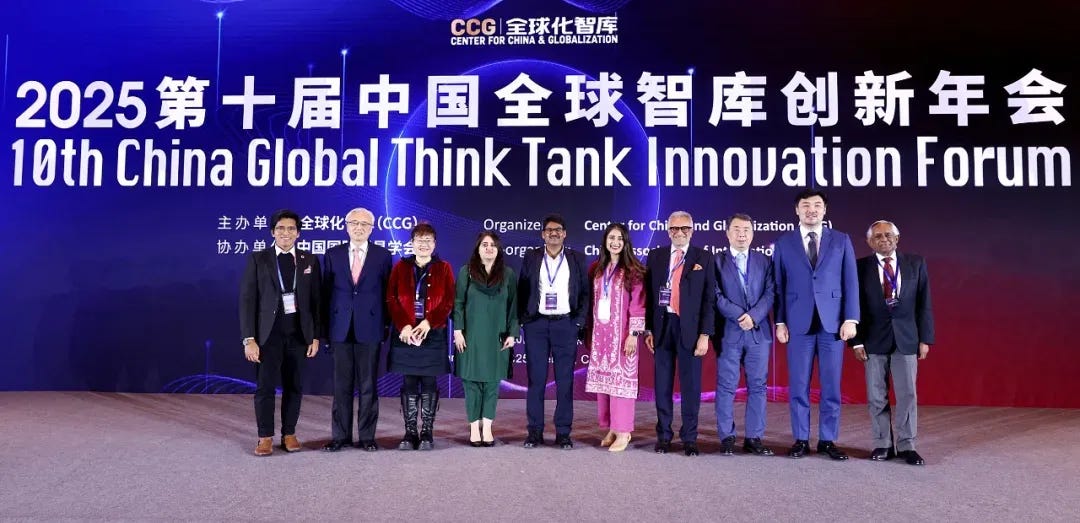
Moderated by Zoon Ahmed Khan, Research Fellow at CCG, the session featured:
Ahmed Aboudouh, Head of the China Studies Unit, Emirates Policy Center
Mohamed Amersi, Founder and Chairman, Amersi Foundation
He Wenping, Researcher, Institute of West Asian and African Studies, Chinese Academy of Social Sciences
Jing Yuhong, Executive Director of Shanghai Zhongyou Information Services Co., Ltd.
Arun Mahizhnan, Special Advisor, Institute of Policy Studies, Lee Kuan Yew School of Public Policy, National University of Singapore
Sougar Munkhtsooj, Founder, Institute for Policy and Leadership
Danial Rahman, CEO, Asian Strategy & Leadership Institute
Krishna Raj, Professor and Head, Institute for Social and Economic Change
Song Yaoming, Senior Fellow, CCG; Former Economic and Commercial Counsellor, Chinese Embassy in Japan
The discussion also included participation from GYLD delegate Rabbia Nasir, First Secretary at the Embassy of Pakistan in China.
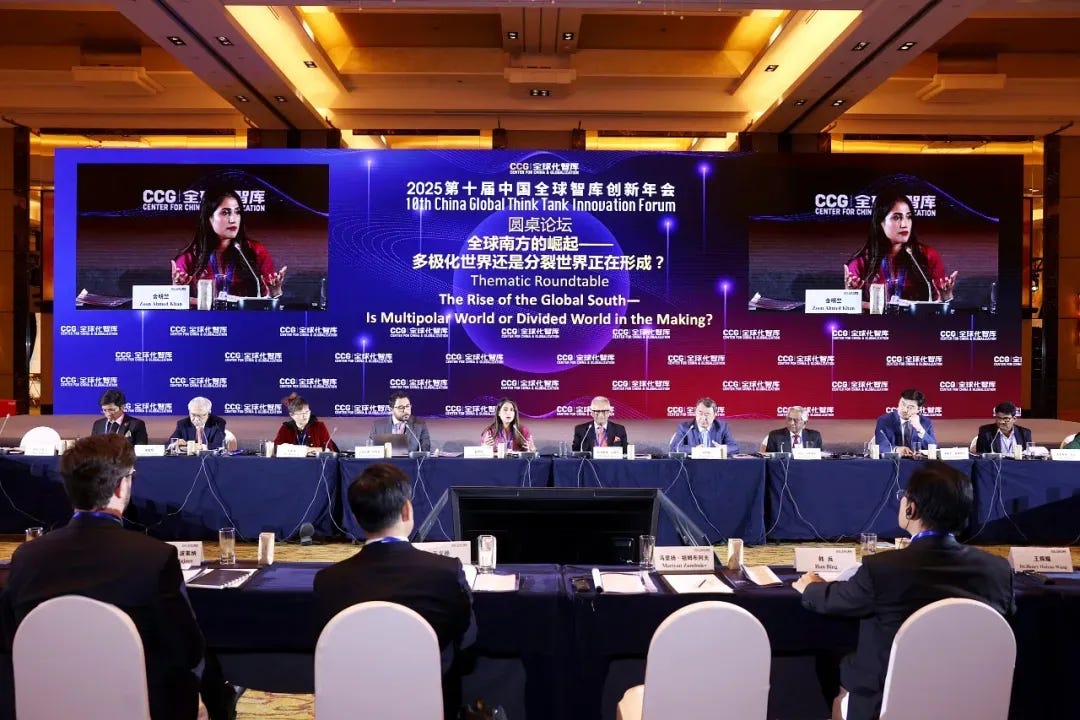
The full video recording of the event is available on CCG’s YouTube channel and official website. For a quicker look, a standalone video of the roundtable has also been uploaded.
CCG has also broadcast the forum on Chinese social media platforms, where it remains accessible.
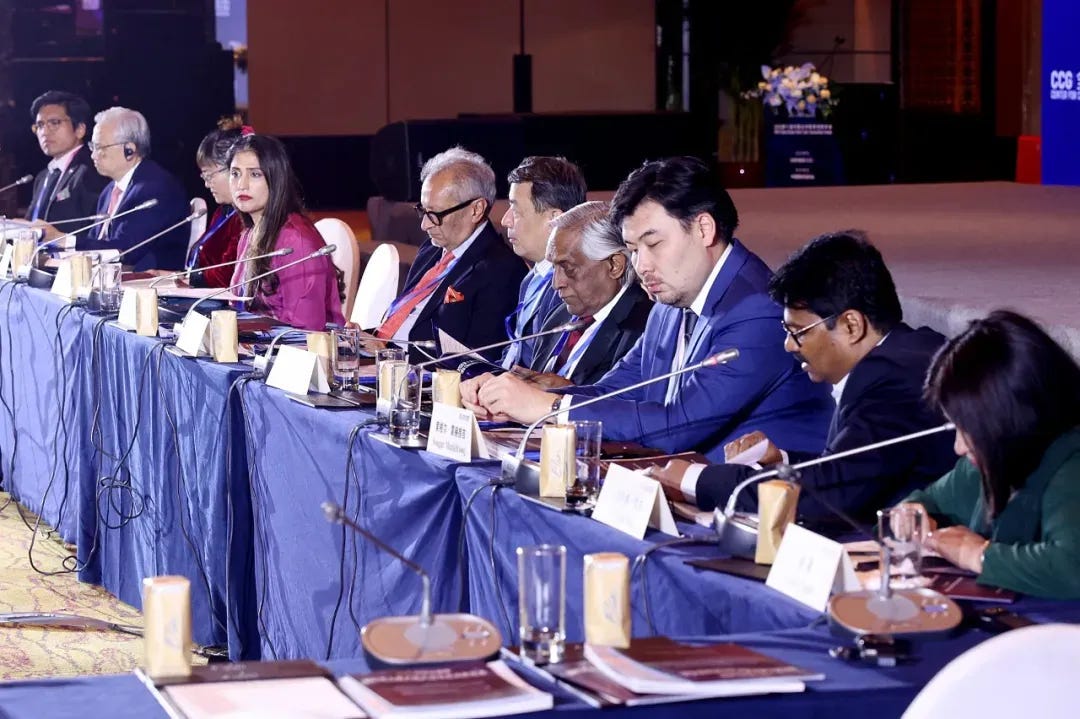
This transcript is based on the video recording and has not been reviewed by any of the speakers.
Zoon Ahmed Khan, Research Fellow, CCG
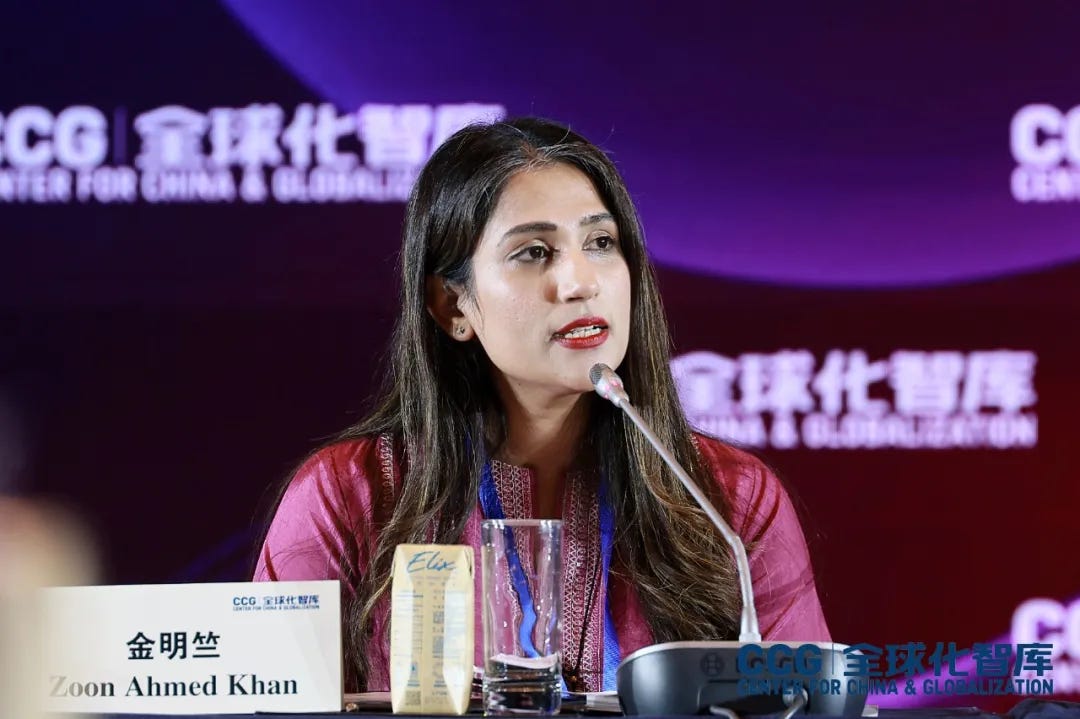
Okay, ladies and gentlemen, we’ll wait another minute or two before we start the final round table for today, which is on the Global South and what direction the international order is heading towards. So, I’ll just wait another one or two minutes to see if the rest of our panellists are here. Yeah, everyone is here. Okay, everyone is here. So, everyone in the coffee break, just bring your coffees in, bring your snacks in. And this is the final roundtable.
My name is Zoon Ahmed Khan. I’m a research fellow at the Center for China and Globalization. And it’s really an honour for me to host this roundtable. And the topic is the rise of the Global South and whether we are heading towards a multipolar world or a divided world. And I think I’ll just give a brief introduction, today the entire day we have talked about how the international order is evolving, how there are new challenges, how there is a Global South and maybe a Global North. Is it an international legal order? Is it a rules-based order? Is it a norms-based order? I think sometimes, even in conversation, it’s hard, or I’ve heard people respond that the Global South is maybe imagined, or what does it really mean?
And while we start this conversation, I think one thing we can all establish is that nobody believes that the Global South is a monolith. It is really a part of the world, the majority of the world, that has had a shared experience. Until not very long ago, the Global South was even referred to as the Third World. It was somehow in the waiting room of history. It was somehow expected to accept domination, and to be told what to do and how to think.
And today, no matter what, whether we are in a multipolar world, whether the world is multipolarising, I think one thing is important to accept: today, this Third World, supposedly, or what is the Global South, does have greater representation. It has a greater degree to exert its agency. We are creating platforms, whether it’s BRICS, SCO, whether it’s regional initiatives, look at ASEAN, the African Union, and so many others that are trying to collectively increase our agency, increase networks, improve our circumstances. And in that, obviously, China has an important role to play.
So today’s conversation is going to be about whether this journey, which is obviously these regions are dynamic, these countries are dynamic, they are building their capacities, but are we going in a direction that will lead to more unity, a world that is multipolar in the sense that we are reaching greater consensus on issues that matter to all of us, or are we going to be more divided? And I think it’s a big question, but we have a brilliant panel to tackle some of these questions about this emerging world order.
We’ll try to stay within five minutes each for now and contribute as much to this very important discussion of an emerging world. So without further ado, I will welcome our first panellist to make their remarks, who is Ahmed Aboudouh, Head of China Studies at the Emirates Policy Center, to try and crack this equation.
Ahmed Aboudouh, Head of the China Studies Unit, Emirates Policy Center
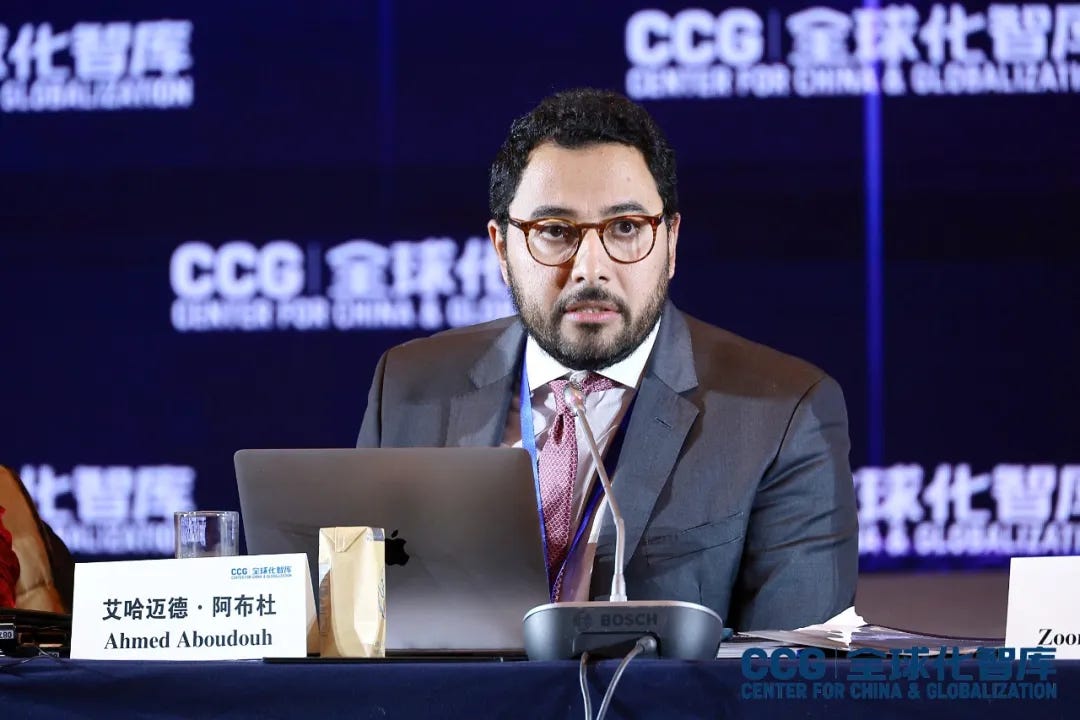
Thank you so much. Thank you so much to CCG for the invitation, and I know this is the last panel, and all of us are half sleepy. So I will make things very light and be very concise. So I want to start by rephrasing and borrowing the famous saying by Alexander Wendt, which basically says the world order is what states and individuals make of it. That means that the world order, in my view, is the total sum of countries’ and individuals’ perceptions and discourse, and what they make of it.
And I would like to share some observations from a Global South country’s perspective on what the world order looks like right now and where it is heading. And because we are in China, I would like to focus on Global South–China relations. I might slightly disagree with the saying that we are living in a fragmented world order. I think we passed this point a long time ago. I think we are in a transitional period from one thing to another, from the liberal rules-based international order to something that nobody is sure about yet. Nobody can predict. It’s too early, and it might take two or three decades to take shape.
And this is because people in the Global South like to think about the world order, from my understanding, differently than the main components that have been discussed this morning, which are peace, development, and human rights. I think the more prevalent perception is based on U.S./West leadership as the main anchor of the global order, multilateral institutions and liberal principles as the glue that brings the world order together, and the rule of law.
However, none of these components is functional now. None of them. You could see the United States withdrawing from its leadership, especially in its relationship with its closest allies. You could see that the liberal principles are being neglected increasingly, especially under the current administration. And also, international law is selectively applied. And this is a very famous perception. And you could hear “double standards” and “hypocrisy” a lot in the Global South. And you could see the liberal component of the rules-based international order disappearing.
So, where does China fit in Global South strategic thinking? And I’m not talking here about the Global South as a single entity. Don’t get me wrong, it is very diversified and dynamic. But at the end of the day, there are things that a lot of countries in the Global South share when they talk about the global order. And the most common thing is that they think of China as a country that can actually balance the United States’ power in the world. That’s why they cling on to their partnerships and relationships with China. They take it very seriously.
And the most interesting thing, and this is my own personal understanding about this power, is not the military power or economic power of China, although they are very, very important in their calculations, but the normative offerings that China is trying to promote in the Global South. For example, the very famous concept of a community of shared future, which is the alternative to the new security concept after the end of the Cold War, and the four global initiatives: security, development, civilisation, and the recently launched Global Governance Initiative.
So people in the Global South, or policymakers and scholars, try to understand what these principles are about. They have never heard anything like that before, and they want to understand how the Chinese are doing things.
The second one is that we are living in an era of decentralisation through power diffusion. And by that I mean we are seeing the rise of middle powers in the Global South, and their aspiration and desire to play an important role in shaping the next global order. And they are doing this by wanting more reliance on Chinese economic and technological prowess through the Belt and Road Initiative and other bilateral cooperation mechanisms, and at the same time, they want the UN to stay in the centre of the global order. But also, they are very interested in multilateral platforms led by China, like the BRICS Plus, SCO, and AIIB.
So where does that leave us? And I will be very, very concise here. It is true that the United States’ power is declining, and this is becoming a consensus now all over the Global South, but at the same time, China is also facing challenges, whether that is economic challenges, security challenges in its peripheries, strategic competition and pressure from the United States, and attempts to suffocate China’s innovation ecosystem. That makes, from a Global South perspective, the global order unstable, because none of these great powers can, or when it comes to China, is willing to achieve primacy over the other.
So what do they do to avoid the implications? I think they do three main things. And ironically, when I go to the Gulf States, for example, built on what the Australian speaker said, they want to learn from Australia’s and Singapore’s model of navigating great power competition.
The first one is diversification of their trade and security, and economic partnerships.
The second one is minilateralism instead of large multilateral groupings. And this creates subsequently more regionalisation of trade and economic cooperation and security, because they see these small groupings, like-minded countries, as a hedge against the ineffectiveness of the classic multilateral platforms. And also, they see it as protection from the rise of nationalism and trade protectionism and anti-globalisation in the West.
And the last one is hedging, which is simply compartmentalising their partnerships: economy and tech with China, and security, many of them, with the United States. And actually, I would stop here and say just a comment that hedging is working. You could see in Saudi Arabia, for example, from a pariah state, now MBS, yesterday, with President Trump signing very strategic agreements in the White House.
But later on, if there is time, I would like to also delve into the challenges that China faces in the Global South. The first one is, I think many people in the Global South think that China needs to clarify whether it wishes to play a greater role in crisis mediation and crisis solving, in other words, balancing and reconciling China’s contribution in mediation and its risk-averse foreign policy.
The second one is they need to clarify and explain these initiatives, these normative offerings, because in fact a lot of these concepts align and resonate with what the Global South are expecting.
The third one is that trade protectionism might create the incentive for these countries to raise trade barriers against some Chinese goods, because they want to protect their own industrial bases.
And the last one is that China needs to do more to learn how to navigate the competition within the Global South, and the differences and the adversaries that are going on in the Global South.
Zoon Ahmed Khan
A masterclass in time management. Thank you. Excellent. I mean, it’s interesting to see how China’s role will evolve, the challenges that a rising power can face. And I also, now as we come to our next panellist, Mr Mohamed Amersi, founder and chairman of the Amersi Foundation, I just want to quickly make a very brief comment because of the paucity of time.
But I’ll say that maybe somehow, the perception that the world is divided may also be created because not very long ago, we used to say this is the silent majority. It was silenced, they weren’t expressing their perspectives, and now increasingly they are looking for ways to move forward. And in that process, I mean, their unique vantage points or their unique desires are becoming more visible, apparent, and even coming into the institutional frameworks, right?
So what do you think, Mr Amersi? First of all, where are we headed, and do you think it’s more of a perception that the world is divided, or is it just because we are less silent than before? Thank you.
Mohamed Amersi, Founder and Chairman, Amersi Foundation
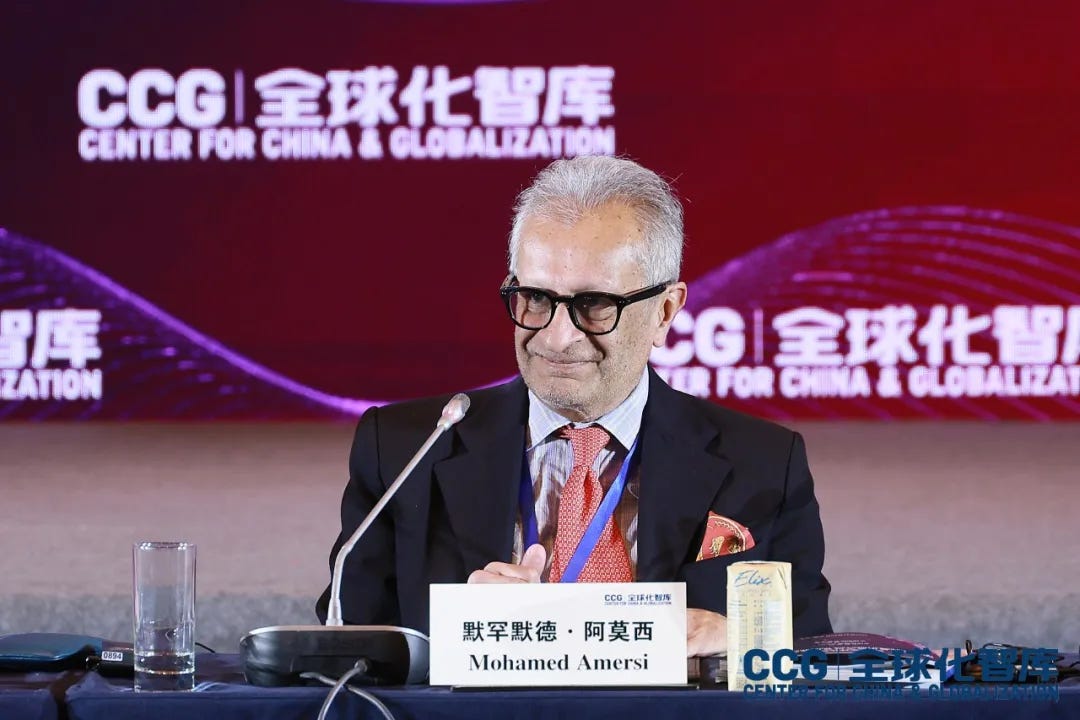
Thank you very much, Zoon, for moderating this panel.
In the past, when I’ve spoken on this topic, I’ve spoken of a multipolar world, a world in which military dominance is in the hands of the United States, economic dominance is in the hands of China, and then there is a technopolar world where the netizens, the people of the net, are all united. And then there are countries that will lead in climate change, countries that will lead in technology.
But having reflected on this for, say, the last few months, I’ve come to the view, at least, that this multipolarity represents wishful thinking. It represents an aspiration, and whether we will see this aspiration become reality or not, I just don’t know.
Today, though, what I would like to talk about is the possibility that we see a stagnant order and we see the end of the rising powers. This is quite provocative in terms of what we might expect, but nonetheless, I think it’s worth having a slightly different point of view so that we can debate this.
In 1898, as the United Kingdom joined other powers in carving up the once mighty Qing Empire, the British Prime Minister, Lord Salisbury, warned a London audience that the world was dividing into living and dying nations. The living were the rising powers of the industrial age, states with growing populations, transformative technologies, and militaries of unprecedented range and firepower. The dying nations were stagnant empires crippled by corruption, clinging to obsolete methods, and sliding towards ruin. Salisbury feared that the ascent of some, colliding with the decline of others, would hurl the world into catastrophic conflict.
The era of rapid power transitions among states, fueled by demographic booms, industrial breakthroughs, and territorial expansion, is ending. No country today is rising quickly enough to disrupt the global balance. China, once seen as the next great challenger, is already, in some people’s view, peaking, while other candidates like Japan, Russia, and the EU started stagnating much earlier. The United States faces its own issues but remains ahead of rivals who are worse off demographically and economically. India may have demographic potential, but it lacks the education and state capacity to convert it into a real global power.
As the engines that powered historical rising powers stall, the world is settling into a closed club of ageing incumbent powers surrounded by less influential middle powers, developing states, and failing nations. They say of history that it is more than the path left by the past: it influences the present, and it can shape the future. But perhaps not this time around.
The emergence of modern rising powers is tied to the industrial revolution, which allowed productivity, population, and military strength to compound for the first time in history. In the pre-industrial era, empires grew only slowly. But from the 19th century onwards, new entrants like the U.S., Germany, and Japan rapidly gained power. The great divergence then set the stage for over a century of disruptive power transitions.
Today’s headwinds suggest that productivity is slowing, populations are peaking or shrinking, and the scope for territorial conquest or economic catch-up has greatly diminished. Significant technological leaps like those that defined earlier eras have become rare, and today’s digital transformations, while substantial, have not delivered the same compounding societal gains. Demographic decline among major countries, including China and most of the West, means loss of power is likely to be permanent, unlike in the past century.
A lot is said about catch-up nations. China, despite its manufacturing progress and scale, relies on a high-capital, low-return growth model, faces severe demographic decline, and remains dependent on foreign technology for critical goods. India’s demographic advantage is undermined by a weak education infrastructure and persistent poverty. Other latecomers are locked out by entrenched incumbents and constrained global trade.
The global consequences of a stagnant order, manifested by the end of the age of ascent, will bring dangerous instability in the short run. Major powers facing stagnation may turn to militarisation or irredentism. State failure is growing among heavily indebted countries with young, unemployed populations. Economic malaise and migration stoke extremism and democratic decline in the West, while autocracies exploit these fissures. Meanwhile, U.S. foreign policy grows more unilateral and global institutions falter, raising the prospects of conflict and disorder.
This reversal carries profound consequences. Over the long run, it may spare the world the ruinous cycle of rising powers, their quests for territory, resources, and status that so often ended in war. In the near term, though, stagnation and demographic shocks are spawning acute dangers. Fragile states are buckling under debt and youth bulges. Struggling powers are turning to militarisation, and economic insecurity is stoking extremism and corroding democracies, while the United States drifts towards thuggish unilateralism.
The age of rising powers is ending, but its immediate aftermath may prove no less violent, with the politics of migration, economic nationalisation, and technological mismatch creating real risks to such a scenario. Thank you.
Zoon Ahmed Khan
Thank you. That’s a very Hobbesian picture, but it could be an unfortunate reality. I think one of the things that we are also trying to address in this panel is how, on some level, when we say we want to seek solutions, we do become aspirational. So, from an aspiration-seeking vantage point, let me ask our next panellist, Mr He Wenping, who is a researcher at the Institute of West Asian and African Studies of the Chinese Academy of Social Sciences, to avoid this potential disaster, this Hobbesian world, from becoming a reality.
What do you think the Global South can do to increase the quality and the level of consensus decisiveness? Another point: when we think of China’s global initiatives, whether it’s development, civilisation, security, and the Global Governance Initiative, which was also mentioned by Ahmed, I think one of the purposes is to create platforms or spaces where consensus can be established. So if you can speak a bit about what the Global South can do, and what China is currently doing, to reduce the chances of complete chaos. Thank you.
He Wenping, Researcher, Institute of West Asian and African Studies, Chinese Academy of Social Sciences
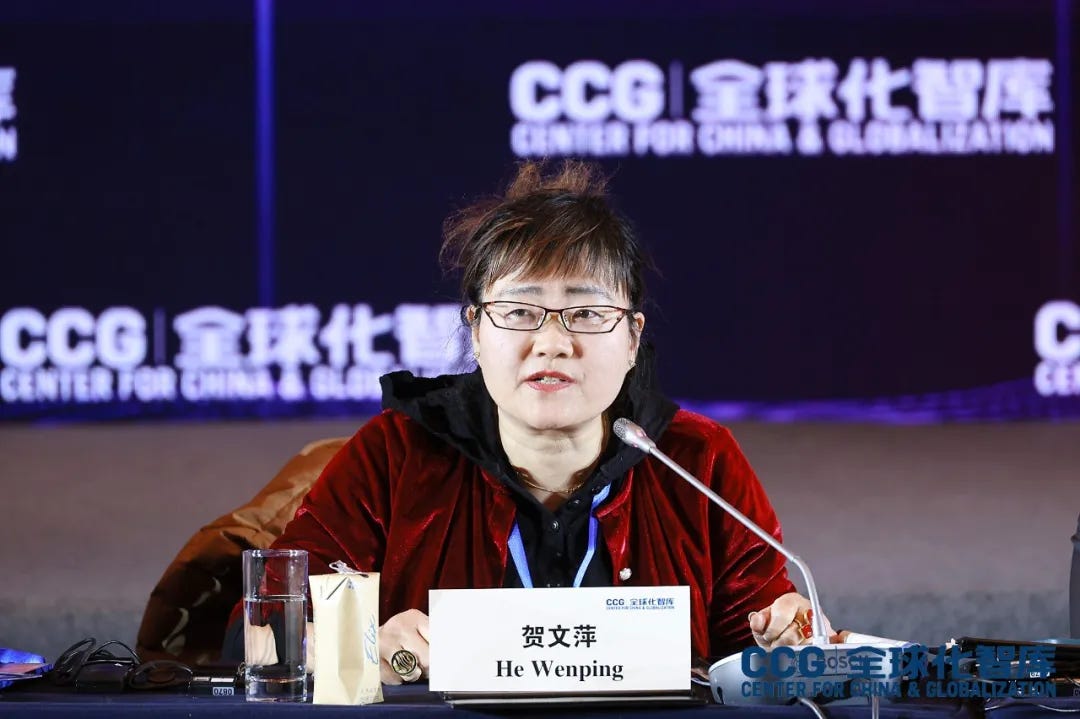
Thank you very much, dear moderator. I think, in order to respond to your question, two keywords may be the solution. One is united. You know, Global South countries cannot be divided. When divided, you have no power at all. This Global South, you unite, and the consolidation of this unity now is a fundamental one. So, almost every day, I have contact with those African seminar groups coming over to China, and then I offer some lectures and some workshops with them, all the time. This is the keyword. They regard China as not a threat at all. It’s an opportunity, an opportunity for reaching this Global South unity, because now, as we discussed, China is now like a big elephant in the room. Well, of course, you need to take more responsibility and make more contributions to reach this unity.
So that is why I go to another question you just addressed, that is: in what kind of platform, and what kind of mechanism, can we make this Global South unity move forward, even consolidated? That is, you see, in Africa we have established what is called the FOCAC, Forum of China-Africa Cooperation. Actually, it has been held every three years, with minister-level meetings, and then, from time to time, upgraded to a summit. For example, last September, the China-Africa summit took place. And it’s not only just lip service, not a talking club: it comes out with lots of action plans, even measured by numbers, how many schools were being built, like 1,000, those small and beautiful projects directly linked with people’s livelihood in African countries. So this is a mechanism, and it is not only just the China-Africa mechanism platform that has been building.
Of course, like BRICS has been expanded. This is also a platform linking all those emerging countries together, and now many more want to be members. And also, just yesterday, our Premier was in Moscow to join that SCO Shanghai Cooperation Organisation. Egypt also wants to be a member of the SCO. Yes, Egypt is already becoming a member of the FOCAC. Now moving to South Africa, where Premier Li Qiang joined the G20 Summit. G20 is also now more inclusive. South Africa used to be a member. Now the African Union is also becoming a member. China also pushed for this entrance of the African Union.
So that is all the mechanisms. Many, like ASEAN recently, these South Asian countries are all together now, and they have already become 11 members. East Timor has joined. But you should notice another big event, that is: this free trade zone has already been upgraded to 3.0 version now. Many green development products, digital economy, are now all getting into this free trade zone. So all those mechanisms: some for international issues to be discussed, some for our economic cooperation, to make your strengths stronger. Like Donald Trump often said, without strength, no peace; peace comes from strength. The Global South is similar. If there is strength, yeah, there’s no talking about the Global South.
By the way, before I wrap up and answer your question, I also want to address one thing. When we talk about the Global South, many workshops have now been organised. But I do think we should have a balanced view about China and also the Global South. One is: we cannot overestimate its role, its position, and its influence. Another: we cannot underestimate it. Sometimes people go to those two extreme directions. When talking about the Global South, people often say, Wow, it seems the Global South is now already at the world’s centre point, influencing all the issues in the world. We should have a clear understanding.
Of course, compared with its own past, its influence has increased. That’s why now G20 is more inclusive. But you will see that the U.S. White House doesn’t want to see this increasing influence, even saying South Africa has no qualification in this group. This is arrogance.
Compared with the past, of course, there is a bigger GDP share and greater involvement in global governance, but it cannot be overestimated. You have to realise, politically speaking, when the Ukraine crisis took place, I remember the South African president also led African leaders to travel to Ukraine and to Russia. Lots of efforts were made, but there was no reporting in the world. If you have done something, but there is still no reporting, it means you are small, your opinion is marginalised, and your role is not put into the global media. In the global media, we also see the BBC, right, so people say, Ah, this is an opinion from this English-speaking programme. And then the majority stays silent, the majority has no access to make its voice heard. So this is the thing.
But of course, the Global South cannot be underestimated as well. Some opinions say, Oh, what is the Global South? I haven’t seen them at all, nowhere. This just seems like talking; it seems so. Those two ways have to have a balanced point of view. That’s why you know where you are, and then know what kind of role can be played in a real sense. Okay. Thank you.
Zoon Ahmed Khan
Okay. Thank you. Thank you. And I think that’s where this point about not overestimating, not underestimating, and having a realistic perspective comes in.
And I think that’s where Mr Amersi’s intervention is also extremely valuable: we need to recognise the realities of where we stand—as individual countries, as regions, and the challenges we face. The mere trajectory of a relatively greater share in global GDP, or education, I mean, all of that on one side, but that may not necessarily lead to greater significance when it comes to global matters, or the kind of multipolar world that we sit in these conferences and talk about. Like you said, all talk—can it necessarily result in that? It might result in something more chaotic unless we utilise our agency and create some synergy.
With that, let me now invite our next panellist, Jing Yuhong, who is Executive Director of Shanghai Zhongyou Information Services Corporation Limited, and former Head of Greater China Operations for Oracle’s global financial division. So, from your perspective, what do you think are the major contributors, potential contributors, to the Global South’s broader share in global affairs? And I think, especially from your work experience, how do you calculate the current situation?
Jing Yuhong, Executive Director of Shanghai Zhongyou Information Services Co., Ltd.
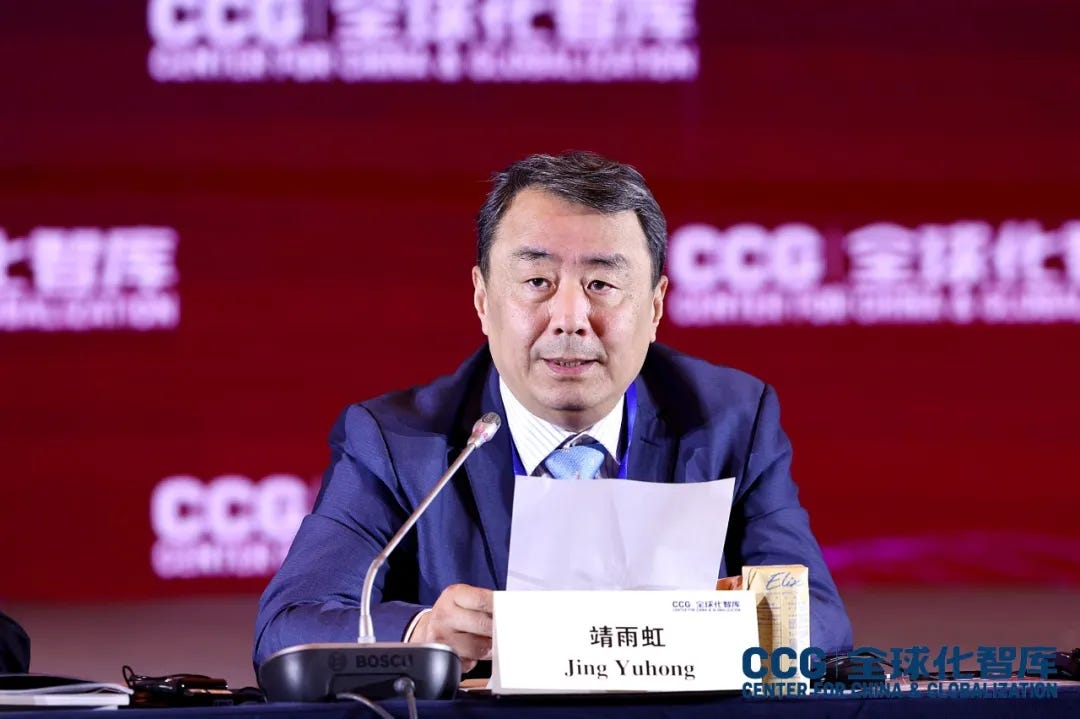
Yeah, okay. It’s a very interesting topic, so thank you for giving me this opportunity. I will talk about all these factors that South-South cooperation has included, both for China and for the Southern countries, and also where to improve in the future.
South-South cooperation is a national policy that China has always adhered to. China has cooperated with numerous Southern countries in government, international organisations, enterprises, and cultural exchanges, and is experiencing rapid development. So why has that happened for so long? China has advantages in administrative governance, funding, technology, and cost, while Southern countries have advantages in labour and resources, rich and diverse ethnic cultures, and huge markets. So China–South cooperation is complementary and mutually beneficial, with broad development potential, specifically in the following areas:
China has enormous capacity and cost advantages. These areas are poverty alleviation, energy conservation and emission reduction, green economy, construction of major infrastructure such as energy and transportation, transfer of manufacturing industry, artificial intelligence, finance, China’s social governance, and corporate capabilities. So in these areas, China can contribute a lot to this South-South cooperation.
At present, Chinese enterprises have entered almost all Southern countries, including both state-owned enterprises of China and also a large number of private enterprises, including numerous AI, IT, and advanced equipment manufacturing enterprises. So these collaborations are greatly promoting the living standards, technological development, and export capabilities of the host countries.
The financial cooperation between China and many Southern countries is also rapidly flourishing. The BRICS Development Bank, the Asian Investment Bank, and major Chinese banks have greatly supported the construction of the Belt and Road countries. China has launched large-scale currency swaps with countries like Argentina, and is also preparing for the overseas issuance of RMB stablecoins in the future.
Many Southern countries also have excellent ideas to exchange with China to be mutually beneficial. They have excellent ideas, diverse cultures, abundant natural resources, and vast markets, all of which benefit China in South-South cooperation. So the rapid progress and development of Southern countries have also provided valuable opportunities for China’s own development. So we both benefit a lot from this kind of development of cooperation.
So, where to improve in the future? From both sides, Chinese overseas enterprises should pay special attention to the policies, regulations, and culture of the host countries. They should not only focus on economic interest but also on social and brand effects, to focus more on the social environment of the host countries. And the southern countries should also get some improvement: they should attach importance to social governance, provide a safe environment, reduce the burden on enterprises, and manage and protect Chinese companies’ compliant operations in accordance with their domestic law.
That’s my presentation. Thank you.
Zoon Ahmed Khan
Thank you. Thank you so much. And I think, for a lot of people, especially when we talk about countries with Belt and Road cooperation, they can see the evolution of the presence of Chinese enterprises in the last 10 years, how to maybe incorporate more social aspects as well, how to see medium-, long-term well-being, all of that. I mean, this is a process of mutual learning and evolution.
Now let’s bring in our next. We do have a slight paucity of time, so I will request everyone to stay within five minutes, if possible. And to our next panellist, Arun Mahizhnan, who is a special adviser, Institute of Policy Studies, Lee Kuan Yew School of Public Policy, National University of Singapore: my question is, we are talking about South-South consensus building for a successful multipolar world, right? If you can also, I mean, apart from the key points, also touch upon—because, as Singapore, you are known to be a platform, to be a country where North-South consensus is also being prioritised—so what do you think is the role and the importance of better North-South consensus in our journey towards a successful world? Thank you.
Arun Mahizhnan, Special Advisor, Institute of Policy Studies, Lee Kuan Yew School of Public Policy, National University of Singapore
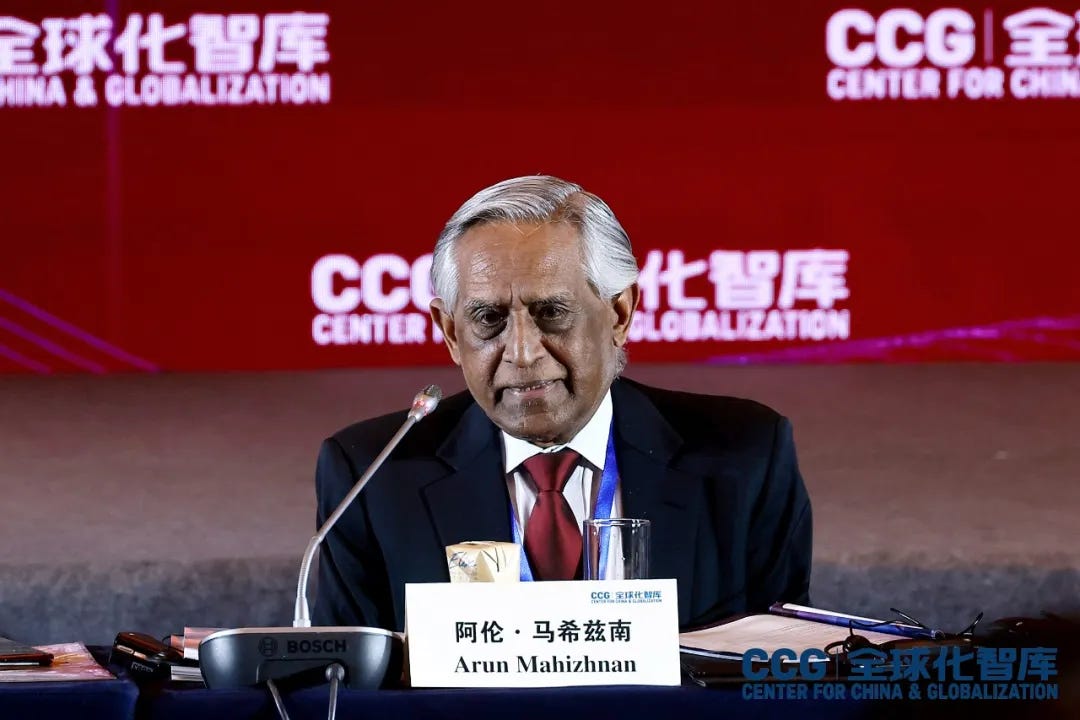
Thank you, Ms Khan. A very good afternoon to everyone. First, I would like to thank CCG for inviting me to speak in this forum. It is a privilege to be among such distinguished people, especially among the young leaders.
Let me first answer the original question: Is a multipolar world or a divided world in the making? And it’s a question not just for the Global South, but I think it’s for the entire planet. I think everyone will agree that every nation, without exception, does, will, and must act in its own interests. However, does it automatically mean that it must act against some other nation’s interests? Not necessarily. It is possible to have collective interests. The idea of the “coalition of the willing” is now well established. Nations can and do come together for common causes and common purposes.
In the traditional concept of world order, we had a bipolar world order, and for a brief moment after the collapse of the USSR, a unipolar world order. But the problem with those world orders was that there was always a hegemon whose own interests subjugated all other interests. Whether it was the U.S. or the USSR, it was the same. Today, everyone agrees that the bipolar and unipolar world orders don’t operate anymore. But is a multipolar world order now in place? I’m not sure.
Here, I would like to borrow heavily from an idea that Professor Amitav Acharya has articulated recently—by the way, he has addressed this forum, and he conveys his greetings to you, Dr Wang. What Professor Acharya is putting forward is a “multiplex” world order in his book The Once and Future World Order.
I think all of you are familiar with the idea of a multiplex cinema, where you can go in, choose the theatre and the movie you want to watch, and you can get out when you finish watching. We are already seeing the beginning of this multiplex world order. Some countries, including China, are in some groupings or another and not in others. Nations choose what mutual interests suit them best. As I mentioned at the start, it is a coalition of the willing.
While some countries or others will try to dominate, as they are used to, we are seeing a strong resistance to hegemonic world orders, which is why the disintegration of the old bipolar and unipolar world orders is really a good thing for the world. On the other hand, a divided world—but which can come together on the basis of mutual interest and mutual respect—can also be a very good thing for the world. In fact, it might be a better arrangement in the long run, as it is dynamic, purposeful, and ultimately mutually beneficial.
Even the United Nations, where all the countries of the world are supposed to be under one system where everyone is equal, we have discovered some are more equal than others. The UN is shaken to the core because, as we have heard earlier today, a few hegemons are still trying to keep the UN as their own tool for dominance rather than an instrument for the good of the world. While I’m not advocating the abolition of the UN, it is my humble view that it’s time for the world to build other world institutions that have common interests and mutual respect. A multiplex world order seems a good idea.
Now, to answer your specific question about what Singapore is doing: of course, we are part of the South, but actually the word “South” is no longer as rigid or as applicable as it used to be, because many nations in the South have become the North of the current and the future world. And I think we have to now look at what the greatest thing that Singapore does: because it is so small, so insignificant, we want to be friends with everyone, as many friends as possible. So our greatest mantra is: be as useful to as many people. And the other part of our life is: we learn a great deal from everyone because we are so small and so young. So I don’t know what others can learn from Singapore, but our survival depends on being alert, being respectful, and then being useful. Thank you.
Zoon Ahmed Khan
Thank you so much. I think that’s very precise: alert, respectful, useful. I think every country, especially developing countries, there’s also a debate right now that a lot of countries that were traditionally Global South are no longer the South; they have become the North. And those that are— I mean, to what extent is it their own agency, their own governance systems, or their own inability to bring required reforms and prioritising development that keeps them in that state? So I think, to learn from Singapore, a lot of countries do. Young people are looking towards Singapore as well, at how well the country has done.
Now, let me bring in our next panellist, Sougar Munkhtsooj—if that’s the correct pronunciation, sorry—founder of the Institute for Policy and Leadership. And I also want to know your thoughts on this topic.
Obviously, whether it’s a multi-polar world, multipolarising, or multiplex, these terms are also hard to conceive on some level. But let’s talk about how the global majority, or the Global South, can be in a position to achieve consensus on the issues of global development—climate change, SDGs—we have the Loss and Damage Fund as an example. So, to what extent do you think, from your perspective, the UN system—the existing system—can be better utilised to achieve some of the goals that belong to the mandate, the common mandate? Thank you.
Sougar Munkhtsooj, Founder, Institute for Policy and Leadership
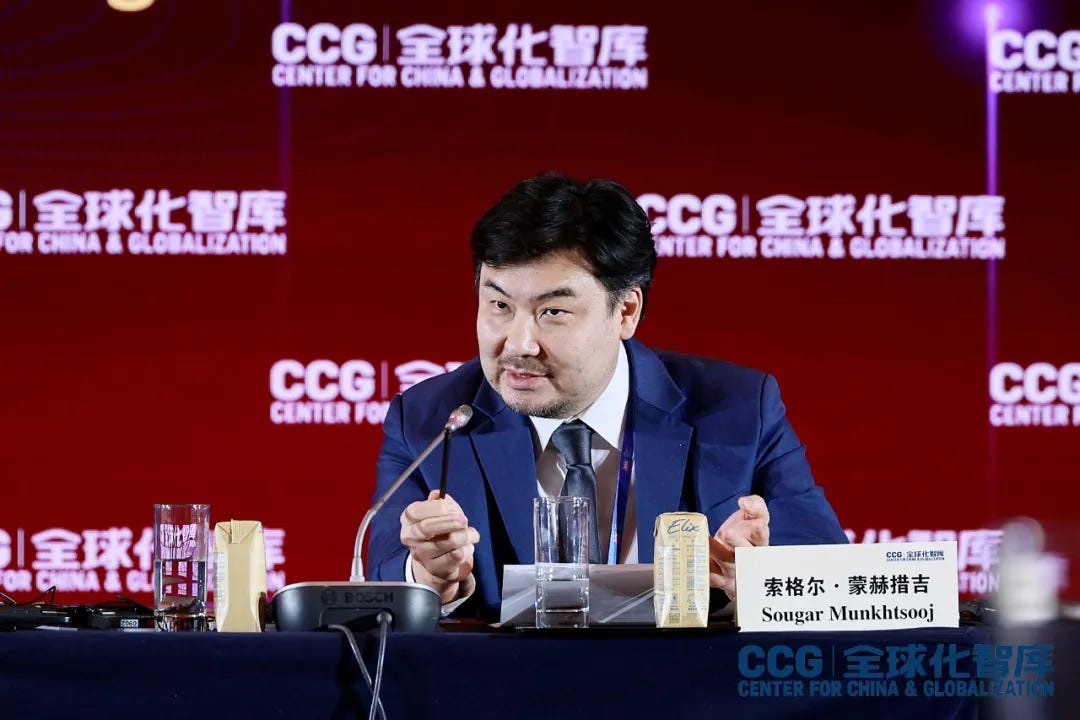
Thank you very much. First of all, I would like to thank CCG for giving me the floor to share my opinions. Today we’ve heard lots of ideas about whether there is a multipolarism, whether it exists, whether it’s a good thing, or whether it already is there, and we’ve heard that it’s, in some ways, aspirational. But I would like to address your question from the perspective of Mongolia, a neighbouring country of China: what does it mean for us, and how can we, as a small country, exercise our agency?
In Chinese calligraphy, the word challenge can also be understood as an opportunity. And this shifting multipolarity: is it an opportunity for us, and how can we make it so? But one thing is certain that today we started our session with Professor Dr Wang, stating that the UN systems are broken, and how we can reset them and how we can make good use of them. It also means that we are living through a period where the global system is shifting, and the new rules are being formed.
And I would like to argue here today that multipolarity does not only mean new power centres. It means multiple approaches to standards, governance, and cooperation. And for many countries in the Global South, this creates uncertainty. When we operate in areas where the rules are not yet clear, whether on trade, technology, or finance, a world without established rules carries risks. And when systems are fragmented, smaller states like Mongolia are going to face higher costs and fewer tools to plan long-term.
So this is why the transition between old and new structures should not last long. The sooner we understand what the emerging rules look like, the more stable our development path becomes. And for countries like mine, the challenge is that there are no longer clear role models to follow. In earlier decades, starting from the 1990s, development pathways were more or less predictable. Today, each country is experimenting, and even large economies are revising their approaches, like the United States leaving the Paris climate agreement for the second time.
What does it mean? It means that we must think independently, identify what genuinely fits our circumstances, and learn from each other’s experience rather than copy any single template.
And climate change is one area where this uncertainty is especially visible. It affects all of us, but in different ways, and the governance structures around, say, for example, carbon markets, adaptation, financing, and land restoration are still evolving. Mongolia’s case shows how these wider system dynamics play out on the ground. Climate change is already shaping our environment and economy, and it’s also starting to affect our neighbours. Sand and dust storms that sometimes engulf Beijing from Mongolia do not stop at borders. You know, they don’t require any visas or permits to enter.
So in Mongolia, we are taking steps to address this through a number of initiatives, such as the 1 Billion Trees initiative. We are going to pass a new climate change law in parliament, and we are working on developing a national carbon market framework. These efforts are still developing, but they offer practical examples of how smaller states can respond even when global frameworks are incomplete yet.
This also creates opportunities for cooperation. And here I would like to single out China, because China has significant experience in desertification control, ecological restoration, and climate monitoring. Working together on early warning systems, rangeland management, and technical capacity building would benefit both sides and offer lessons for other countries in our region, especially in Central Asia.
In this way, climate change becomes an example of how Global South countries can articulate shared priorities, not by waiting for perfect global models, but by finding common problems, sharing practical solutions, and building cooperation step by step. And we’ve talked about the importance of cooperation throughout the day. So thank you very much.
Zoon Ahmed Khan
Thank you so much. I mean, especially the last note, where action, solution-oriented, people-centric—maybe that is a good starting point. And that’s also where the recently announced Global Governance Initiative mentions: to focus on addressing the challenges that we face.
And of course, I mean, then to what extent individual countries can leave aside some of the small misunderstandings, or whatever they have with their neighbours, and think about common issues; think about themselves not as just individual countries, but think from a regional and broader perspective. That’s what we’ve been discussing all day.
Now let’s now invite Daniel Rahman, who is CEO of Asian Strategy & Leadership Institute, for your thoughts on what the Global South really means. What do you think—the multipolar versus divided world—and, most importantly, what can developing, emerging countries do to vocalise and to have a better consensus?
Danial Rahman, CEO, Asian Strategy & Leadership Institute
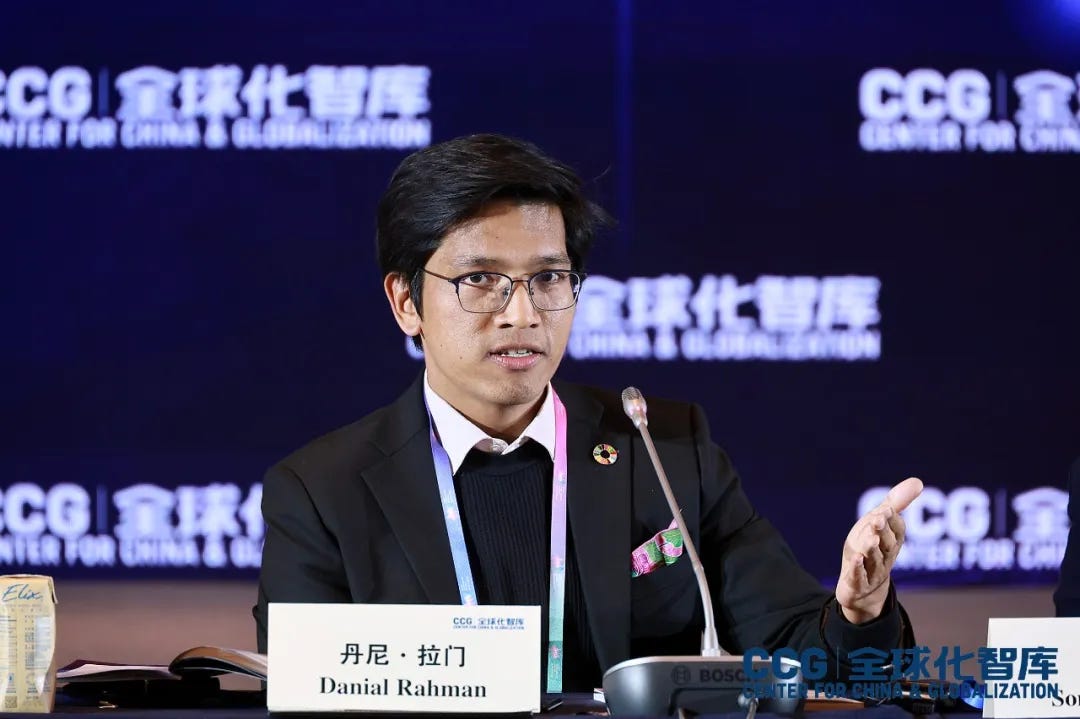
Thank you very much, Madam Chairperson, CCG, for the invite. Distinguished colleagues, ladies and gentlemen, I’ll focus my remarks on the ASEAN experience, which hasn’t been spoken much about this day. I did a quick count. All of you have valiantly sat through 56 speakers prior to me. I’m number 57, and I must say I’ve been enjoying it tremendously.
ASEAN is a vibrant nation: 700 million people, a youthful population. Even for me, I’m a very proud child of a mixed-ethnicity family, very proudly also wearing a Malaysian batik to represent this year under Malaysia’s chairmanship of ASEAN 2025. We have seen many layers of progress and the growth of the Global South from this part of the world.
During the first ASEAN Summit earlier this year, ASEAN-led architecture saw Timor-Leste join. Ms He Wenping mentioned this earlier. There was the first-ever ASEAN-China-GCC Summit. Then there were the Thailand–Cambodia peace accords. A bit shifted in the last few days, but that also signalled to the U.S. for President Trump to come down. And of course, remember earlier, even before that, President Xi was in Malaysia.
In addition to that, as also mentioned earlier, there have been economic upgrades—for example, the ATIGA 3.0, ASEAN as a whole, the ASEAN-China FTA 3.0 upgrade, and within ASEAN, you’ve got the Digital Economy Frameworks Agreement, as well as the ASEAN Power Grid.
So many things are happening, and ASEAN has been accused in the past of being a very sleepy, kind, slow, you know, not yet fulfilled its potential. But what we’ve seen in 2025, in the back of these discussions about multipolarity and unipolarity, is ASEAN stepping to the fore. And as someone who’s been very critical of ASEAN in the past, I’m quite proud of it.
So this brings us to the question: is it multipolarity or division, or, as Mr Amersi has said, is it a stagnant order, which I find quite compelling? I think it’s a little bit of everything, right? In ASEAN, what we see is pragmatic multipolarity, or in my discussions with my Global Young Leaders here representing, they call it poly-alignment. Just now I was talking to Pascal; he talked about relational polarity. So many terms are being thrown about, but the reality is the proof is in the pudding: it’s not about choosing sides. We’re engaging with everybody.
At the ASEAN level, we’ve engaged with China collectively, but as sovereign nations, each country has discussed with America their approach to tariffs and what treatments are needed and what concessions are needed and what can be given back. So you’ve got unity, multipolarity at the ASEAN level and in our expression to the world, but you’ve also got individual sovereignty and agency at the individual ASEAN country level.
Now there is a saying in Malaysia which goes Tak kenal maka tak cinta, which means they who you do not know you cannot love, and that is the basis of how ASEAN has engaged and approached its relationships this year.
Of course, next year, with the Philippines taking over, prickly issues like the South China Sea, the nine-dash line, will all become issues to the fore, but we hope that continuous dialogue can continue to ensure that engagement happens and peace prevails within the region.
Now this statement also has another side to it, which means once you know somebody, and you know them too well, you might go crazy—a bit like an obsessive relationship. Therefore, it’s really important in this future order, whatever it might be, that we do not overcommit, but where strategic engagement does not become strategic dependency.
The last question I’d like to ask is this: how do we define power, or what polarity means, right? And I think that’s what’s been thrown about. Some have said it’s GDP, some have said it’s military power, and some have said it’s diplomatic power. But how about this? Beyond all these discussions, we must remember it is the people on the ground who matter. And I think that’s one part of this conversation we haven’t had, maybe time enough to speak about this today: what does it all mean for the citizens of ASEAN and the Global South?
It should also be about which countries are able to lift others from poverty, to bring about innovation that enriches society, and to ensure that there’s equal wealth distribution. And for me, the power that will lead in this multipolar world will be the nation that’s able to do that and to give that.
The last point is this: how does this come about? And I believe it’s leadership, right? It’s ultimately the leaders who are put into power by the people, who inherit power from the incumbents, that ensure how the future turns out. Whether it’s one of war or one of collective prosperity depends on the kind of leadership that we have.
And for that note, once again, I’m very proud to have been here in this capacity, but also a few days with the young leaders. So on that I yield. Thank you.
Zoon Ahmed Khan
Thank you so much. Thank you for that energetic intervention. I think I’ll also connect this with the GYD panel we were doing yesterday, and I feel one of the differences, or something very encouraging, among the young leaders and the discussions they were having is that they were extremely people-centric. Perhaps one of the reasons for that is also that, in this age of social media, we have access to things that are happening in the world. The have-nots are just much more visible. They might be relatively voiceless, but they are more visible.
I think there is an acute awareness amongst the younger generation of the degree to which we need to be action-oriented- and people-oriented, and I hope that results in more and more empathy. Through empathy, a younger generation of leadership is thinking of impact-oriented careers and how they can improve more people’s lives. So thank you for that.
Now, let’s invite Krishna Raj, professor and head at the Institute for Social and Economic Change in Bengaluru, India, for an Indian perspective. India is now the most populated country in the world, a big country, and obviously, it’s an important perspective to understand where we are heading as the international order. Thank you.
Krishna Raj, Professor and Head, Institute for Social and Economic Change
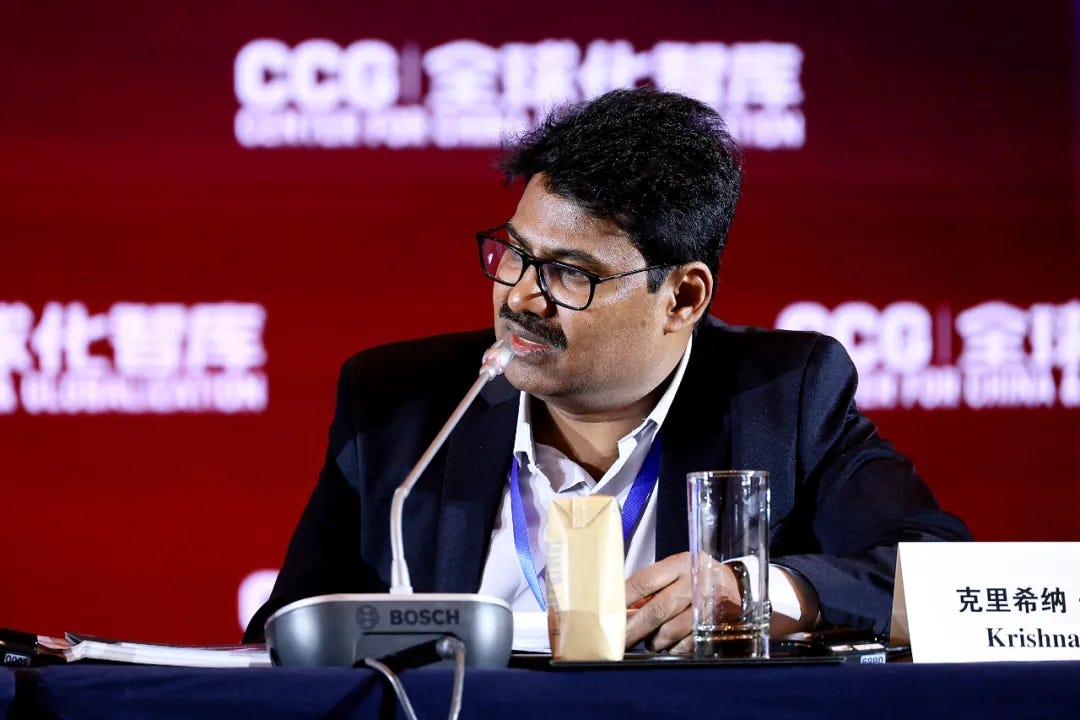
Thank you, Zoon, for your question. I’ll come back to that one later. And I thank the Center for China and Globalization for this initiative, as well as the opportunity to be part of this 10th China Global Think Tank Innovation Forum.
So earlier, we understood that the world and economies are highly fragmented, with the failure of the multilateral organisations, both the IMF, IBRD, and also the United Nations organisations. They have failed collectively to reduce the economic instability and also prevent global conflicts.
When these types of challenges are there, the three initiatives or failures we can identify. One is that the global conflicts are increasing, and unilateral imposition of tariffs is affecting every one of us, and the fiasco of the Paris Climate Agreement is also a cause for concern.
Under these challenges, global conflicts have led to oil supply chain disruptions, causing worldwide inflation, economic slowdown, and imposing high costs on societies. And unilateral imposition of tariffs on China and India, America’s important trading partners, is a major departure from WTO trade policy rules and norms. And fiasco, or withdrawal, of the Paris Agreement endangered especially the growth prospects of the Global South, as climate affects the tropical regions the most.
So, given the global economic and environmental challenges, the Global South can play an important role in global governance, evolving a multilateral institution of its own, not in parallel with the existing multilateral organisations, but more importantly, it can bring governance to the world order. As you know, the Global South commands 85% of the population and 65% of the FDI and 42% of the GDP; they can play an important role in reforming the global institutions.
The challenging task for the Global South is how to bring together Asia, Africa, Latin America, and the Middle East under the umbrella of Global South through credible, predictable, and sustainable economic policies which integrate them together for realising a new world economic order for peace and security, and also economic stability and environmental sustainability.
So I propose three reforms for the global multilateral organisations that can help create a better world. One is the reform of the global governance by including Global South countries, India, Brazil, South Africa, and others, in the Security Council, and China should see an opportunity by reforming the UN with the inclusion of India for a level playing field for the Global South.
The second one is that the Global South should bring institutional reforms in finance and development: not an alternative to the IMF and World Bank, but a Global South bank can be established by integrating all the Asian Development Bank, the African Development Forum, the Latin American development finance, and the Middle East bank altogether.
So, addressing climate change, one of the important issues in the Global South is that the Global South is most affected by the restructuring of economies based on new technology innovations and the transfer of finance. Technology is often described as something that supports future growth. At the same time, fossil fuels were once seen as “new technology” back in the 1960s, and they are also a major cause of greenhouse gas emissions. So technology can be double-edged: it can support growth in the present, but in the future, it may create more problems for the next generation.
Therefore, green technology sometimes needs to be viewed through the lens of how earth materials, including rare earth materials, may be exhausted in the coming years. Therefore, in order to create a world order that integrates both economic and environmental policies in ways that are more sustainable and equitable, only then can we see a multi-polar world that includes reforms in the UN, reforms in financial institutions, and reforms within countries themselves by democratising decision-making in society. Thank you.
And India’s role as an emerging economy, with its demographic dividend, can help shape the global order, especially through what are often called Gandhian ideas of sustainable development, which can create a more peaceful world, rather than a world driven mainly by economic interests pursued through various organisations, including BRICS and others. These organisations are often guided by the self-interest of economic prosperity, not by sustainable development or long-term economic stability. In that sense, Gandhian thought, Sufian thought, and other ideas, such as “small is beautiful”, as advocated by Schumacher and others, have argued for a more peaceful world. Thank you.
Zoon Ahmed Khan
That’s true. Thank you. Thank you so much. Let’s give a warm round of applause.
And actually, because I’ve been Beijing-based for 10 years, I’ll take your last point and connect it with the Global Civilisation Initiative: the broader idea is that we should understand these philosophies and perspectives, and recognise that they have an equal ability to contribute to a peaceful, sustainable, harmonious world. And if nothing else, the fact that we can exchange these ideas can make us more open-minded. The world is diverse, and it will always be diverse.
So thank you so much for your contributions. Now, let’s welcome Song Yaoming, a senior fellow at CCG, for your thoughts. I think we can now come back to the Chinese perspective again. China’s mention of the Global South is something closely related to the BRI and global initiatives, and the way I see it is that China is trying to play an important role in creating platforms to improve consensus, but also to improve the strength and capacity of the international order—the UN-centred order—to deliver tangible outcomes. Your thoughts on this, thank you.
Song Yaoming, Senior Fellow, CCG; Former Economic and Commercial Counsellor, Chinese Embassy in Japan
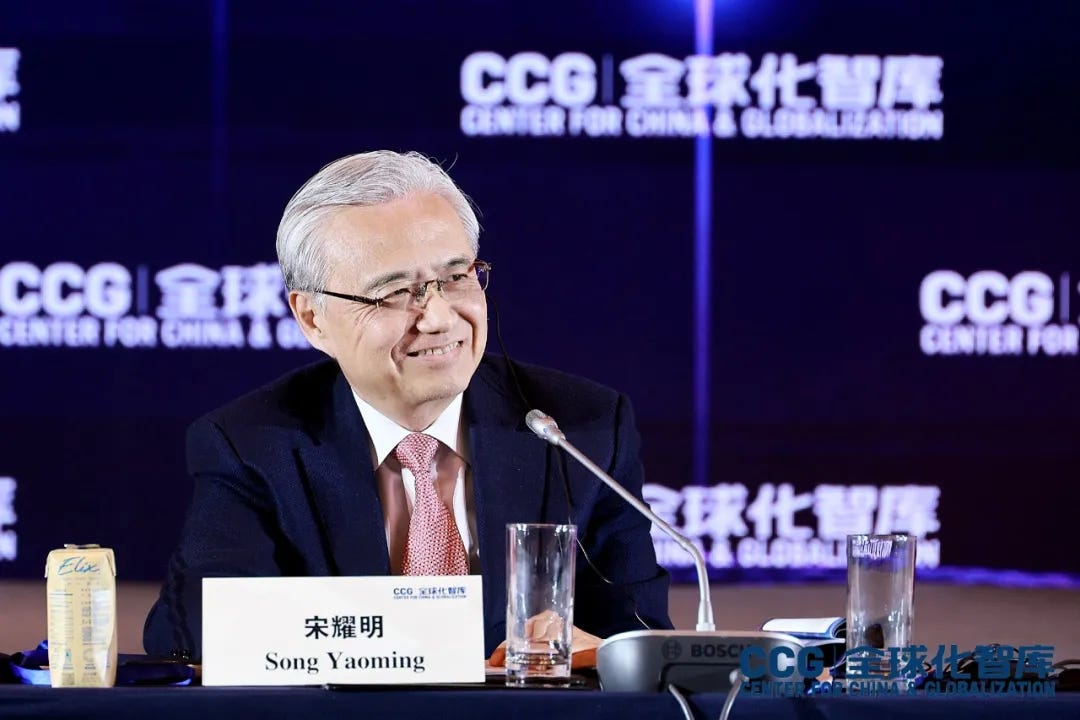
Thank you very much, Zoon. If I may, I’d like to stick to the remarks I have prepared. Thank you very much. Good afternoon to all colleagues here. It’s a real pleasure to be part of this conversation. So let me just gather my thoughts for a second on the Global South.
When we talk about the rise of the Global South, I think what we are seeing is really a convergence of several forces. First of all, politically, it’s an increasing collective push for a more equitable and, frankly, more representative international order—not to overturn the whole system, but to make it work better for everyone.
Secondly, economically, if we look at the numbers, it’s quite clear that many Global South countries have become major engines of global growth. They are not peripheral actors anymore. They are shaping the direction of the global economy in a very real way. And demographically, this is something we sometimes underestimate: their young populations bring enormous energy, creativity, and potential. That vitality is going to influence global trends for decades.
Now, from my own research, I’d like to say this isn’t about dismantling the existing system. Instead, it’s about reshaping global governance so that it is more inclusive, more representative, and reflects the reality of the 21st century. If you look at China, for example, of course, without making any political judgment here, there has been a consistent call to reform institutions like the United Nations to give developing countries a stronger voice. I see that as part of this broader historical trend: a trend where more countries want to be heard, and where global rules work better when they reflect the diversity of the world.
So yes, that’s the general direction I see: a shift not toward confrontation, but toward wider participation. Honestly, we will see moments of tension, because any redistribution of influence comes with negotiation. But I also believe there is a growing recognition that the system simply functions better when it includes more perspectives.
So yes, challenges for sure, but also a great deal of opportunity. I may be repeating myself a little, but let me underline one thing: in my view, the growing influence of the Global South is reshaping the international system in ways that make a more cooperative multipolar order not only possible, but increasingly necessary. And concepts such as the idea of a community with a shared future for mankind, which I have examined in my own research, offer a useful philosophical basis for this kind of cooperative future.
So while tensions remain, the overall trajectory—if we allow it to unfold—leans towards constructive multipolarity rather than deepening geopolitical division. Thank you very much.
Zoon Ahmed Khan
Thank you so much. That precisely also answered the question. You mentioned the philosophical concepts, and I think also the global initiatives contribute to that—the idea of, firstly, moving closer to collectively recognising that we do have a shared future, like the astronaut that was mentioned, and like successful regionalism such as ASEAN and others have demonstrated: seeing beyond interests that are myopic, and realising we have a long-term stake in each other’s well-being as well.
Now, we will invite our Global Young Leaders Dialogue representative, who is also a First Secretary at the Pakistan Embassy, Ms Rabia Nasir. Rabia, if you can share your perspective on the topic we are discussing—we know the Ambassador also earlier gave his remarks—and what do you think: where is the Global South headed? And if you can also raise a very difficult question for our panellists to answer. Thank you.
Rabbia Nasir, First Secretary, Embassy of Pakistan in China
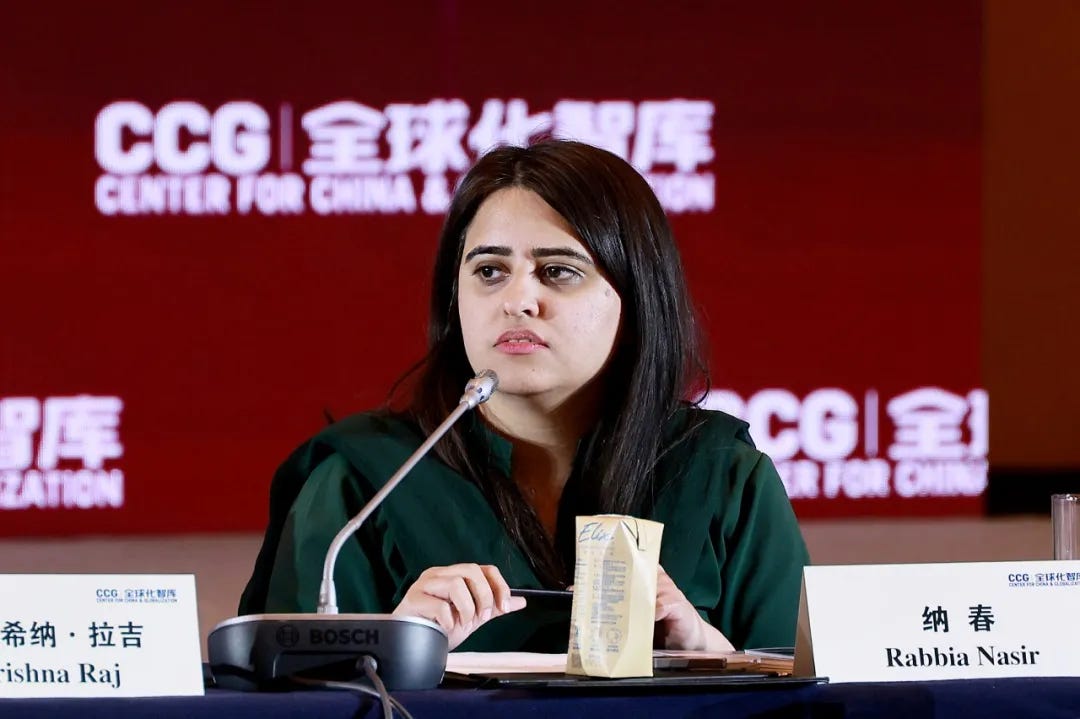
Thank you, Zun. It’s always a pleasure to be at CCG. It’s one of those places where we can have a lot of intellectual and rigorous dialogue. So for the closing part, and also then to round it up with a question, I bring with myself three hats.
The first hat is a professional one: being a diplomat, being a practitioner of statecraft.
The second one is a generational one. For our generation, we’re still not where the boomers are, or where Generation X are, but we are now finding our own voice, still with some way to go. Having spent almost a decade in diplomacy, one of my hats comes from there, of course.
And the third hat is an observational hat. Being a diplomat stationed in China is a very unique experience, because how we view the world and how we view the rise of the Global South comes from aligning it with where we are stationed. And when we look at China, the concept of what we call in Chinese “tianxia” is like the commonality or the convergence of the entire tian, or the universe, or the sky, that reflects itself in how China conducts its diplomacy.
So now coming back to the rise of the Global South: as a practitioner of diplomacy and someone who observes the global rhythm, I can very safely say that whatever I have seen, whatever I have practised, changes, or these rises, don’t announce themselves in very dramatic ways. They build gradually. They build slowly, until we know that the change has happened.
And the same is with the rise of the Global South: it has happened. Countries that were once peripheral are now central to global decision-making. Those voices that were heard very late are now being heard early. They are exerting their voice, their agency.
But the question is—and I will take the liberty to raise a difficult question—where do we go from here? It’s still too early to make a determination. We might like to believe that we are moving to a truly multipolar world, but a lot of this discourse would ring hollow if power competition still goes on, if bloc politics still leads to fragmentation.
From what I’ve seen, from what all of us have seen, many of the positive changes—many of the reforms—come after cataclysmic events. So the goal now is to avoid that and move towards a truly multipolar world rather than a fragmented world.
And here I would like to wrap up this discussion with a question to my fellow panellists: how do we make sure that we do not repeat the nightmares of history, and how—without invoking any sort of cataclysmic happening—do we truly end up in a multipolar world, and not a fragmented world? Thank you.
Zoon Ahmed Khan
Thank you. Thank you for that comment, and that piercing, very pressing question. Who would like to answer first? Mr Amersi, if I may.
Mohamed Amersi
I think that a lot of the discussions here today assume that we live in a very selfless society. Sadly, we live in a world which is extremely selfish, extremely looking for its own interests, and also very aggressive. In this world that we now live in, I find it very difficult to imagine how the transition will shift from those that are in a position of power very gracefully to those that are rising. I find it difficult to understand whether those that are rising powers have enough experience to be able to lead an extremely challenging world.
And this is why I think that the best thing I would hope for is that if, and when, the transition is going to happen and is going to be irreversible, it does not happen with a big bang. Because normally, when these types of transitions happen, there is a collision. There is a war. There is a world war in which the shake-up is designed to take place first, and then a new order emerges.
We never ever see—the only time when the transition was orderly was when my country, the United Kingdom, which was an empire until the Second World War, handed the baton to the United States and said: you now lead the world. You have the bone, you have the muscle; we have the brains. We can collectively lead the world together. That was a smooth transition of power. I cannot see today that power will transition.
The Global South, BRICS, and CRINKS, and all these are lovely acronyms that think tanks like mine and others love to write about. But in reality, what power does the Global South actually have? What power does BRICS actually have? What power do the ASEAN nations have?
If you look at the finance system, it’s largely a dollarised economy led by the Federal Reserve of the United States. If you look at the military situation, at last count, the United States had 746 bases around the world, compared to 47 collectively for Russia, China, the EU, and the United Kingdom. When you look at that disparity in resources, you look at how Silicon Valley dominates the tech world, at least for now. If you look at how Wall Street dominates the financial world, for now. If you look at how Hollywood and all the media companies dominate the social media platforms, and the platforms which are responsible for broadcasting and for print. And when you look at that dominance, then just try to imagine how that is going to shift.
Ask yourself the question: just because the United States and some Western powers are in retreat, is it because they genuinely feel that they are defeated? Or is it that they feel they are weakened? Or do they just say: look, we have been collectively responsible for the world for the last 75 years. What benefit has it actually brought us? It’s been a burden on us. Why should we be the selfless people who champion the rest of the world? What does the rest of the world do for us?
This is the climate which is prevailing in the United States, where the United States leadership is telling its citizens: we are first, we are alone, and we will stay that way, because all this aid—what does it do for us? Nothing. All it does is allow these people to come up and criticise us at the UN and in other world bodies. Why should we be doing this?
If you are in a position of power yourself, and if you did not have philanthropic intentions, why would you want to do this? This is my answer.
Zoon Ahmed Khan
Thank you. Thank you. Does anyone else want to respond to the question? Yes, you do. Please.
Krishna Raj
Already, it is beautifully explained. One of the biggest problems the world is facing today is that multilateral organisations, on the one hand—the IMF, IBRD, and the WTO—promote economic growth, rapid economic growth. On the other hand, the multilateral organisations led by the United Nations—UNDP, IPCC, WHO, and others—advocate for sustainable development. So they do not go together: on the one hand, rapid economic development promoted by the IMF and others; on the other hand, the UN stands for sustainable development. Both do not go together. There is a divergence between economic policies and environmental policies, and convergence is not taking place.
So this is creating more problems for the world. It results in increasing conflicts, and in economic interests being protected rather than the environmental interests of the earth, which belongs to every one of us. So this has created two types of problems. One is growing economic instability and economic inequality. On the other hand, there is environmental degradation, in the form of climate change, which is imposing costs on society.
Therefore, in order to find an answer to these problems, we need to evolve a new economic order or new economic model that sustains the earth’s resources and that gives a durable solution to sustainable development. Thank you.
Zoon Ahmed Khan
Thank you. Thank you so much. Thank you, everyone. Thank you to all of the panellists, our GYLD commentator, GYLD member. To wrap up, I think almost everything has been said, and we may never be on the same page, and that’s really not the point. But I’ll say a few things.
Number one: One of the speakers in a previous panel mentioned that some policies or postures might become self-fulfilling prophecies. And, given the GYLD energy yesterday and today, I do believe that if a younger generation is more aspirational—and this is a generation that has more capacity, and more opportunities to defy ideas or ideologies that make them see the world or other perspectives as wrong—you are able to engage, interact, and realise there are multiple ways to solve problems. And actually, China, and so many other examples, have successful alternative solutions. Their governance systems are also different, and they can work for them.
So I think a younger generation has a greater possibility of taking their empathy, and their access to knowledge and difference—a plural or a diverse world—and turning that into a possible self-fulfilling prophecy, where we may see a generation of leadership that makes real solutions, unity, and consensus possible.
And then I think I want to talk a little bit about: we are thinking of how the Global South can possibly conceive solutions, and we do have some successful examples. And whether the UN system works, whether it needs reform, whether we need alternatives—I think that’ll be a very long discussion.
But I think one thing, since we are at the Global Think Tank Innovation Forum, we can all commit to is that Global South think tanks need to engage with each other. Global South think tanks need to observe the realities on the ground and then create networks to understand how other Global South countries are facing issues, solving them, and expand their perspective.
And I think today we do live in a world where multiple perspectives exist. The authenticity of those perspectives is relatively respected. And I think that is one step towards a world where fewer are silenced, and we can find solutions.
With that, we do not conclude. We can’t conclude. But let’s, for now, close our thematic forum. Thank you to everyone who has contributed; we look forward to more opportunities to exchange. Thank you so much.
Transcript: New Drivers of Globalization: Climate Change, AI, and Supply Chains, 10th China Global Think Tank Innovation Forum

This is the transcript of the fourth roundtable of the 10th China Global Think Tank Innovation Forum, held on 20 November 2025. The forum was hosted by the Center for China and Globalization (CCG) and co-organised with the China Association of International Trade
Transcript: China-EU Relations, 10th China Global Think Tank Innovation Forum

This is the transcript of the third roundtable of the 10th China Global Think Tank Innovation Forum, held on 20 November 2025. The forum was hosted by the Center for China and Globalization (CCG) and co-organised with the China Association of International Trade
Transcript: China–U.S. Relations and Tariff Wars, 10th China Global Think Tank Innovation Forum

This is the transcript of the second roundtable of the 10th China Global Think Tank Innovation Forum, held on 20 November 2025. The forum was hosted by the Center for China and Globalization (CCG) and co-organised with the China Association of International Trade
Transcript: opening ceremony & opening roundtable, 10th China Global Think Tank Innovation Forum

On November 20, 2025, the 10th China Global Think Tank Innovation Forum, hosted by the Center for China and Globalization (CCG) and co-organized with the China Association of International Trade (CAIT), was successfully held in Beijing.
The 10th China Global Think Tank Innovation Forum Held in Beijing
On November 20, 2025, the 10th China Global Think Tank Innovation Forum, hosted by the Center for China and Globalization (CCG) and co-organized with the China Association of International Trade (CAIT), was successfully held in Beijing.