


On December 4, 2025, the Center for China and Globalization (CCG) hosted a keynote and dialogue with Peter Trubowitz, Professor of International Relations and Director of the Phelan United States Centre at the London School of Economics. The event, part of CCG’s Global Dialogues series, also included a live Q&A session with journalists from Bloomberg and Phoenix TV.
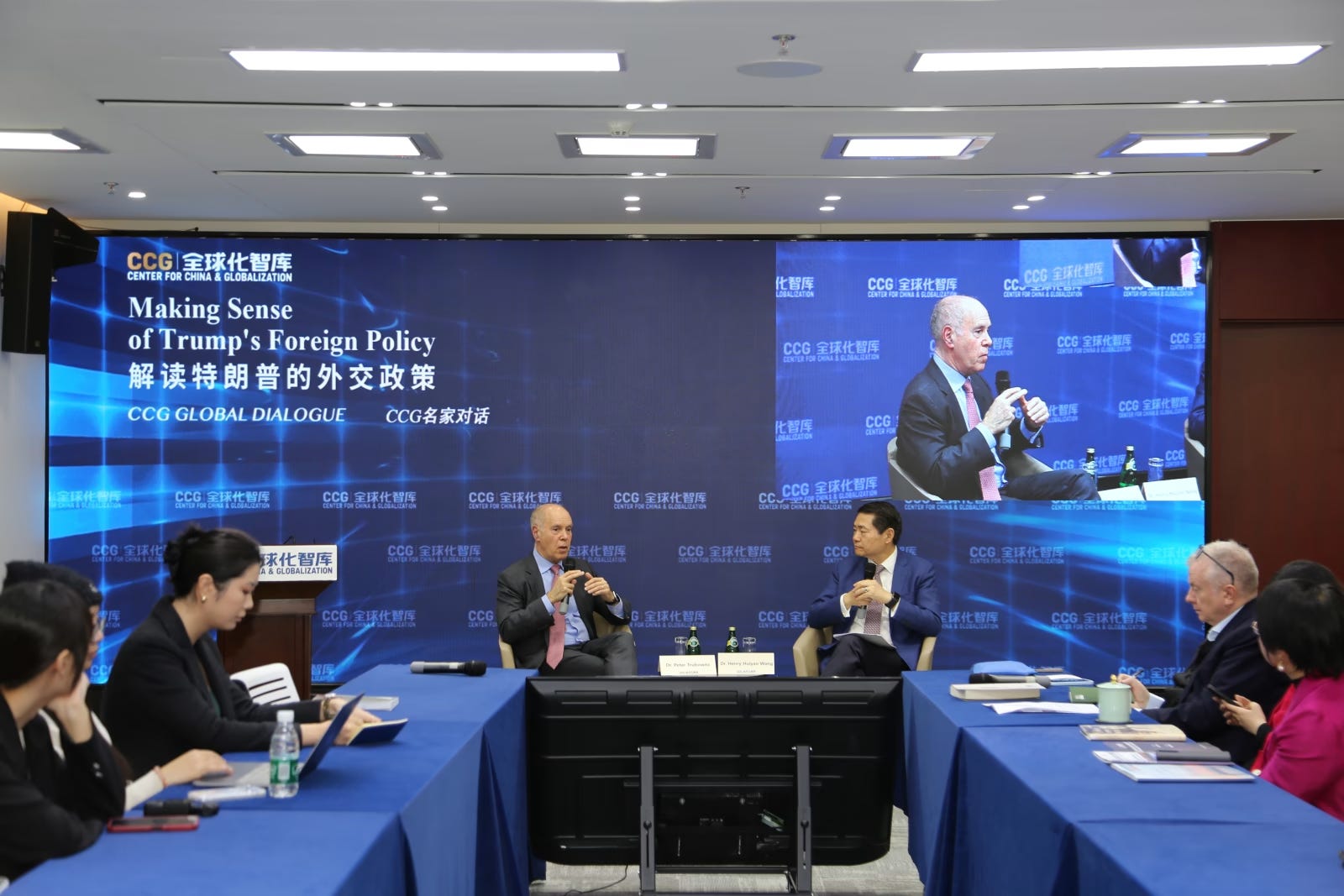
The video recording of the event was broadcast on major Chinese social media platforms. The recording remains available on CCG’s official WeChat blog and YouTube channel.
The following transcript is based on the event video and has not been reviewed by any of the speakers.
Mabel Lu MIAO, Co-Founder and Secretary-General, Center for China and Globalization (CCG)
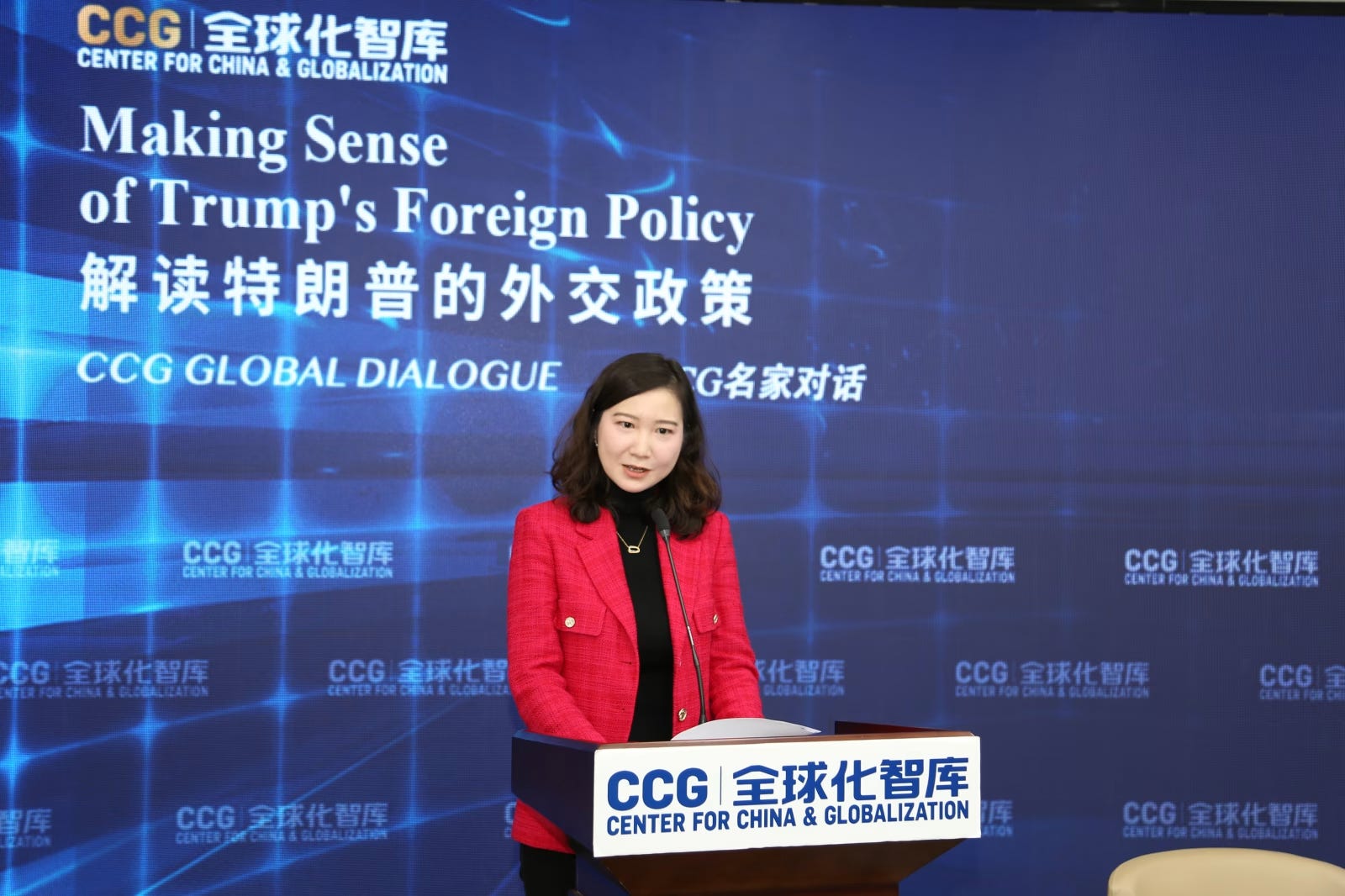
Ladies and gentlemen, good morning, and dear Professor Peter Trubowitz. It’s my great honour to introduce Peter Trubowitz, who is a Professor of International Relations and the Director of the Phelan United States Centre at the London School of Economics and an Associate Fellow at Chatham House. He writes and comments frequently on international affairs and American politics. His published work includes Geopolitics and Democracy: The Western Liberal Order from Foundation to Fracture (with Brian Burgoon), Politics and Strategy: Partisan Ambition and American Statecraft, and Defining the National Interest: Conflict and Change in American Foreign Policy. Before joining LSE, Professor Peter Trubowitz was Professor of Government at the University of Texas at Austin. He has held visiting positions at Harvard, Princeton, Tsinghua, the University of Chile, CIDE (Centro de Investigación y Docencia Económicas) in Mexico City, and Beijing Foreign Studies University, where he was the William Fulbright Distinguished Lecturer in American Foreign Policy.
It’s our great honour to invite Professor here, and this is a part of the CCG Global Dialogue Series. We have invited a lot, a lot of distinguished scholars and think tankers to conduct dialogue with Dr Henry Huiyao Wang. I remember that many distinguished scholars, including like Joseph Nye, Graham Allison, and Larry Summers, a lot of those distinguished people, have joined us. I look forward so much to today’s distinguished panel. And this is a very exciting topic, “Making Sense of Trump’s Foreign Policy.” So all the words are very, very exciting. So I’m so glad to host both of our distinguished speakers. So maybe next we would like to invite Dr Henry Huiyao Wang to say some words to welcome our Professor Peter Trubowitz, thank you.
Henry Huiyao Wang, Founder and President of the Center for China & Globalization (CCG)
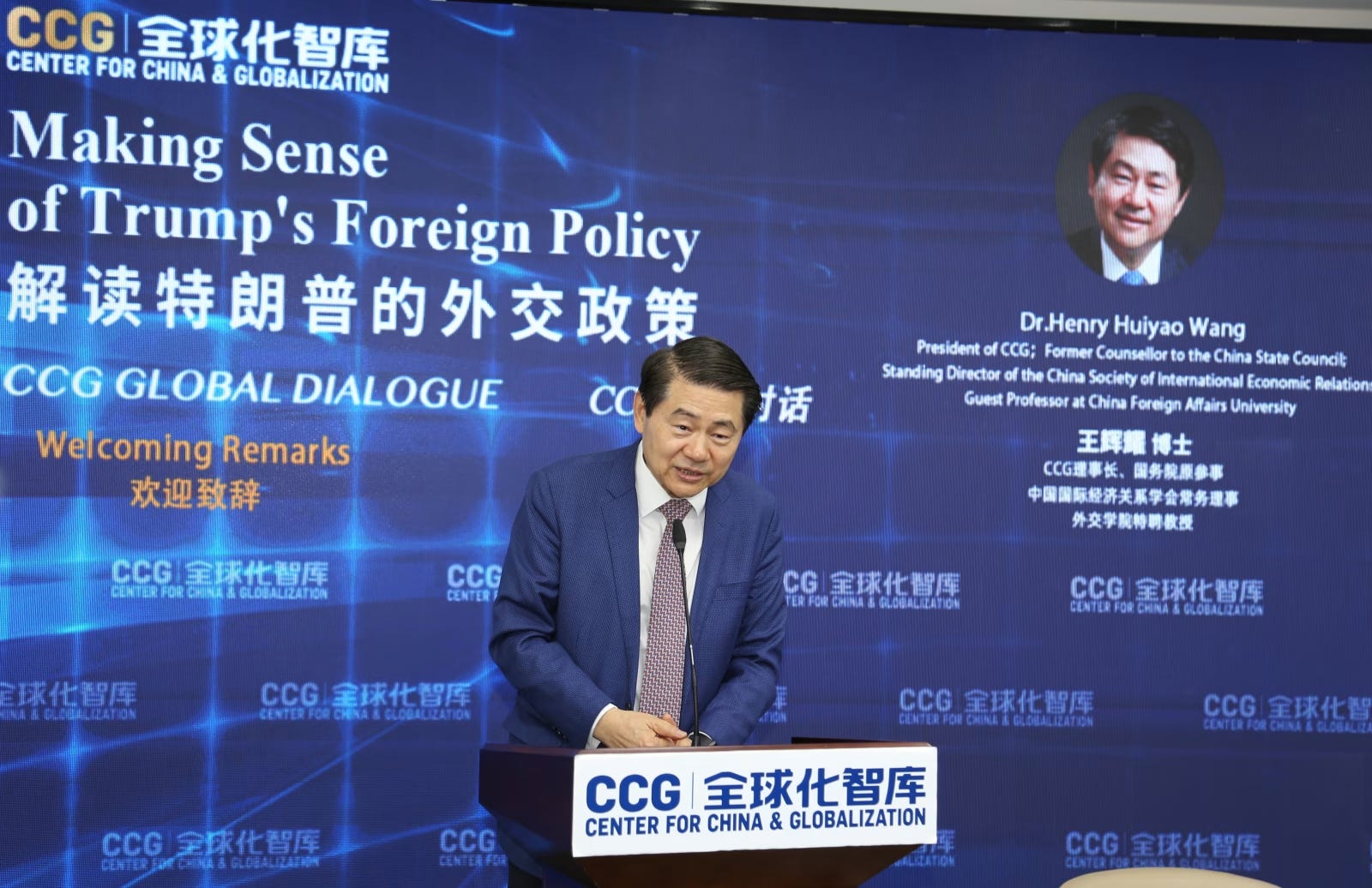
Thank you, Dr Miao. Dear Professor Peter Trubowitz, it is really a great honour to welcome you to CCG, because at CCG, since the pandemic in 2020, for the last five years, we’ve hosted over 100 distinguished speakers. All the famous opinion leaders and academics come to CCG and have a dialogue. And then after the pandemic, for the last two years, we continued that tradition. Today, we are very much honoured that some of our fellows, some media friends, and also colleagues from different think tanks are here. And we are also making this recording to record your leading thinking as well.
Peter and I have actually known each other for a long time, but we really met recently in Istanbul at the TRT World Forum. So he’s a very distinguished scholar. He has vast experience in the United States, Europe, and China, and he has taught at Tsinghua and Beijing Foreign Studies University. And he actually stayed over one year in China during the SARS era, I just found out. So it’s really great to welcome you, and so we look forward to hearing from you. I know you also published a new article in Foreign Affairs not too long ago, so I’m sure Making Sense of Trump’s Foreign Policy is still a big puzzle for many of us, and we would like to hear from you. So, Peter, welcome. Please give us your insights. Thank you.
Peter Trubowitz, Professor of International Relations and Director of the U.S. Centre at the London School of Economics and Political Science
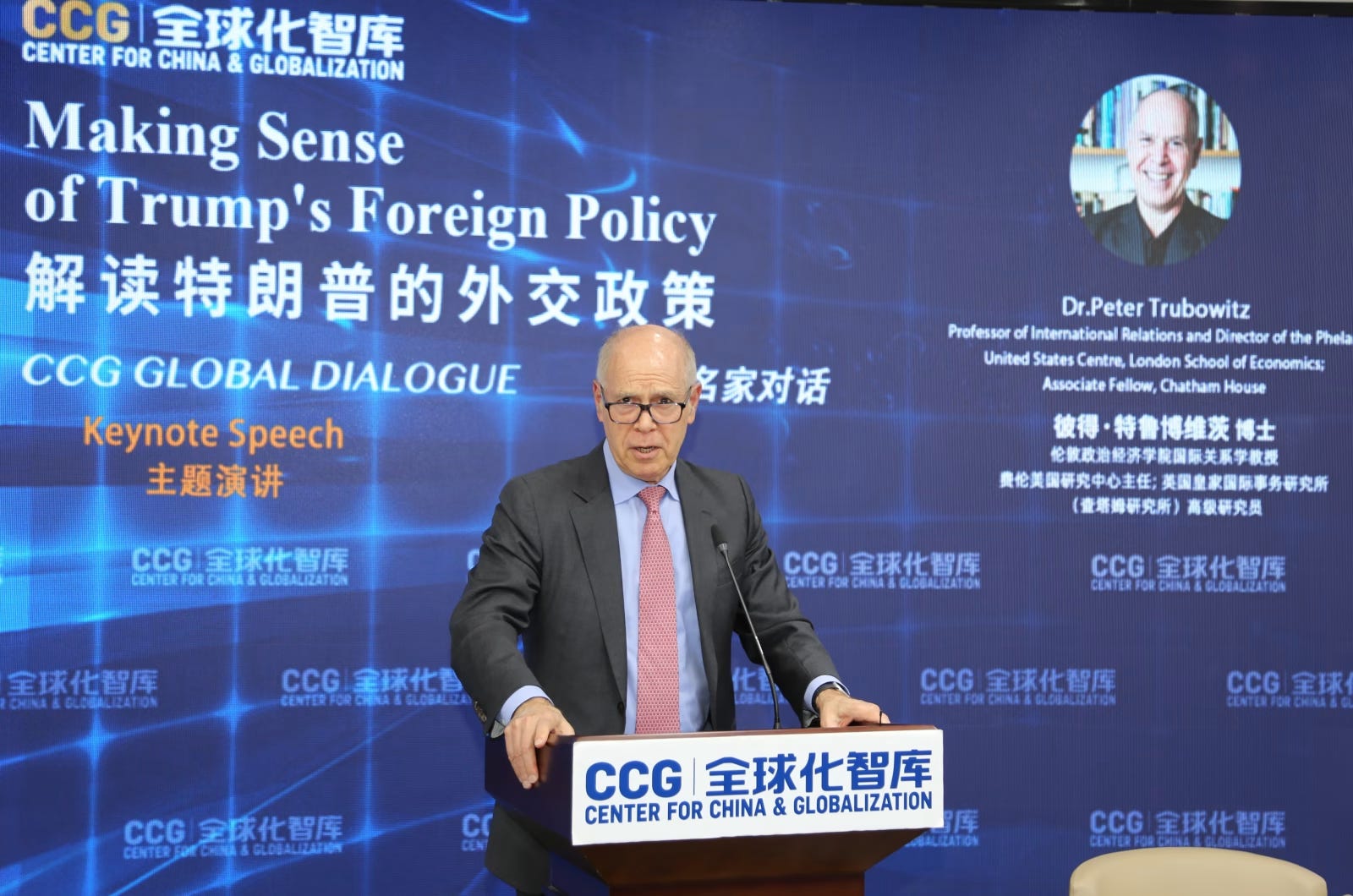
Well, it’s a great honour to be here. I want to thank Henry and Mabel both for inviting me. It’s a real privilege to have an opportunity to talk about Donald Trump’s foreign policy and try to make sense of it. I’m often asked if Trump has an international strategy. In a way, the question is challenging, and it’s challenging not because he doesn’t have one. He has one. What makes it challenging is he has more than one. I’m reminded of something that Fareed Zakaria said in an interview with The New York Times. He said, just when you think you’ve figured out the Trump doctrine, the Trump strategy, Trump goes and says something that’s completely the opposite of the Trump doctrine, and so there’s a second one or a third one or a fourth one.
What I’m going to argue for, and I’m going to try to do this in about 15 minutes, is to lay out what I think are three different Trump strategies that are on offer right now in the administration, or that have been on offer, and that they’ve been experimenting with since the beginning of Trump 2.0 in January. They reflect, I think, different interests within the administration and beyond in the United States, and different conceptions of what the international order should look like going forward. But none of them represent yet, I think, a settled position in the administration. So it is still very much, I think, a work in progress.
So I’m going to sketch these out. And in a way, these have unfolded sequentially. So I’m going to start with the first one that was rolled out very early when Trump took office. And I would describe it as a balancing strategy, or really, more precisely, a rebalancing strategy, the purpose of which is to redefine and reorder the terms under which other nations get access to the American market, and importantly, in the case of allies and friends, get the benefits of America’s security umbrella. And the purpose here, importantly, is not to dismantle the rules-based order. The purpose is to rewire it.
So the strategy is premised on the idea that the existing international order that the United States did so much to create and to sustain has become what the U.S. Trade Representative Jamieson Greer calls “untenable and unsustainable.” Those are his terms, not mine. Untenable because it no longer generates the kind of industrial jobs and economic security for Americans that that order once did, and unsustainable because the United States can no longer afford to underwrite the cost of that order without compromising its own interest—economic, military, and political.
The point here is not that the United States lacks power—hard power, economic, military power. The problem for those inside the administration who subscribe to this view is that the United States has lacked the political will to exercise its power, and that is what the strategy is really designed to renegotiate. It’s that the U.S. will now use its clout, its power, to renegotiate the terms.
This received a lot of attention early in Trump 2.0; it’s still in play, but I would say far less aggressively than it was at the outset. Its principal advocate within the administration is the Treasury Secretary, Scott Bessent. But he’s not alone. Greer shares this view. The Secretary of Commerce, Howard Lutnick, shares this view, and so does the Chair of the Council of Economic Advisers, Stephen Miran, as well. They’ve all pushed this particular view.
And if it sounds familiar, it should, because this is not the first time an American president has tried to rewire the international order. There are a few of you who are old enough here to remember Richard Nixon. This is what Nixon tried to do as well, when he closed the gold window, when he put pressure on America’s allies to pick up a larger share of the collective defence, to pay for it, and when he looked for other countries, including China, to serve a role in maintaining regional security and stability. I think this view is taken, or this approach is basically taken, out of the Nixon playbook.
The problem is that Donald Trump is living in a different world than Richard Nixon lived in. Nixon presided at a time where whatever the United States did, however misguided it was, there was always something, as George Kennan once said, worse than the United States, namely the Soviet Union. Trump doesn’t have that luxury, and it partly explains why the strategy boomeranged in April, when they announced “Liberation Day,” when they really pushed this strategy very hard. To be sure, He scored some victories, Trump, in some of the negotiations with some countries, but it’s come at a very heavy cost—this particular strategy, in terms of international approbation, and I think perhaps more importantly, domestically, in terms of political support. Trump was elected by the American people to turn things around economically in the country, and the problem with this strategy is it has fueled inflation in the United States, and it’s partly because of this strategy that his support, especially among independent voters, has dropped.
This is one strategy that’s out there. It’s not the only one, and it’s not the one we’re going to hear a lot about, I would say, within the next month or two. The second strategy imagines the world in a different way, divided into spheres of influence, regional spheres of influence. And here the basic idea is to replace Washington’s global strategy, the one I just talked about, which is a strategy principally of forward defense, where the U.S. tries to maintain stability and pluralism on the Eurasian land mass, with one that turns the Western Hemisphere into an impregnable, kind of defensive system, and re-establishes America’s maritime power at the third island chain—not the first, not the second, but the third, running from the Aleutians through Hawaii down to New Zealand—to create a platform for American power. And it couples it with a bid using that naval power to blunt China’s bid for influence in the region.
Who are the principal advocates of this position? I would argue they are two: Marco Rubio in State and Pete Hegseth in Defence. But this particular strategy enjoys very strong support within the MAGA coalition. I would say the principal advocate of it outside the government is Steve Bannon, who pushes this argument that, in addition to developing a kind of hemispheric defence capability, the United States needs to deprive China of access to American capital and technology to really decouple. This is not an isolationist strategy, at least that’s not how these architects think about it. They basically see it as an opportunity and a moment for the United States to recalibrate its power for a new, different kind of world, a multipolar world of great power rivalry, and the United States has to get repositioned for it by refortifying the neighborhood, that is, the hemisphere, and binding it more closely to the United States, while developing the region as a kind of platform for the projection of naval power and American dominance that way.
There were fragments of this in Trump 1.0, but this is really new, I would say. Principally, it’s gained a lot of traction in Trump 2.0, and we will see it when the administration finally unveils the National Defence Strategy and the National Security Strategy. This will not be the only thing in it, but it will figure, I think, fairly prominently, if only because Hegseth and Rubio occupy important bureaucratic positions. But it is not the only reason. It reflects something more fundamental, which is kind of the development of advanced technologies, military technologies, in the United States, but not only the kind of transformation of non-nuclear, that is, conventional forces, and the development of satellite sensors, so that the United States can be, in a sense, positioned in the hemisphere and project power from the hemisphere.
This strategy is also not without risks. I think chief among them is a gamble that plurality on the Eurasian landmass can be maintained, even while the United States pushes back. This is a very big change if this becomes the strategy for the United States. Because for 80 years, the United States has adopted the principle, or has abided by the principle under every precedent, whether Republican or Democratic, that no country or group of countries should be allowed to gain control, influence, or dominance on the Eurasian landmass. This is, in effect, pulling back from that and taking a different position, relying almost principally on maritime power.
There’s a third strategy, and that strategy is the idea of a G2 condominium that Trump floated on social media just before meeting Xi Jinping right back at the end of October, at the APEC meeting. This is not a new idea in the United States. It goes back. The first time it was brought up was actually by Fred Bergsten, who used to work at the Brookings Institution. He called it a “Caucus of Two.” This is back in 2005. In the wake of the 2008 financial crash. This idea was also floated by Barack Obama. It was really proposed by Zbigniew Brzezinski, who was a kind of informal advisor to Obama at the time, and Obama pushed it until he concluded that Beijing was not willing to play ball, was not willing to move in this direction.
It is not clear to me exactly who is pushing this in the administration. Scott Bessent has kind of made positive noises about it, but I think by all accounts, Bessent is actually deeply sceptical of China and China’s ability to be a peer of the United States. I think this is principally coming from Donald Trump himself for two reasons. One of the things that Trump has learned since he took office in January, I think—this is speculation on my part—is that China has much more leverage than the United States had thought, and that Xi has no real compunction about using it. And so this has been most clearly demonstrated to the United States through rare earths, through the magnets.
But there’s a second reason, and I don’t think it gets enough attention in the press. Trump is also under pressure from parts of Big Tech in the United States who want him—this is clearest in the case of Nvidia—to ease restrictions on trade and technology, and investment in return for concessions that matter to Beijing. Whatever the reason, I think if Trump pushes the G2 more, he can expect—let’s leave China aside for a second—pushback from America’s allies in the region, Japan, Australia, others, who will view this as the leading edge of a grand bargain that won’t be in their interest. But he will also encounter problems within his own coalition, because they will view the G2 as appeasement of China.
So it’s unclear, really, whether he will push this, and it seems to me it’s pretty obvious that China will not embrace the G2 even if Xi Jinping is happy about it personally, because this is the first time that an American president has really, I think, publicly treated China as an equal. It’s hard for me to think of another one that has done this, but for China to embrace this would cause problems in the Global South and elsewhere. The idea that China, as a partially developing nation, would form a G2 with the United States seems to me, is problematic. So it’s very unclear that this particular path will take hold, it seems to me.
So it’s pretty easy, I think—and this is where I’ll stop—to see why Fareed Zakaria threw up his hands, as so many have, about Donald Trump’s strategy. The issue is not that he doesn’t have a single strategy. He does. He’s got multiple strategies. And the question is, ultimately, where the United States is going to land. And it is not obvious at this moment, it seems to me. The only thing that is obvious is he’s going to keep all of us very busy for the next three years, and I’ll leave it there.
Dialogue
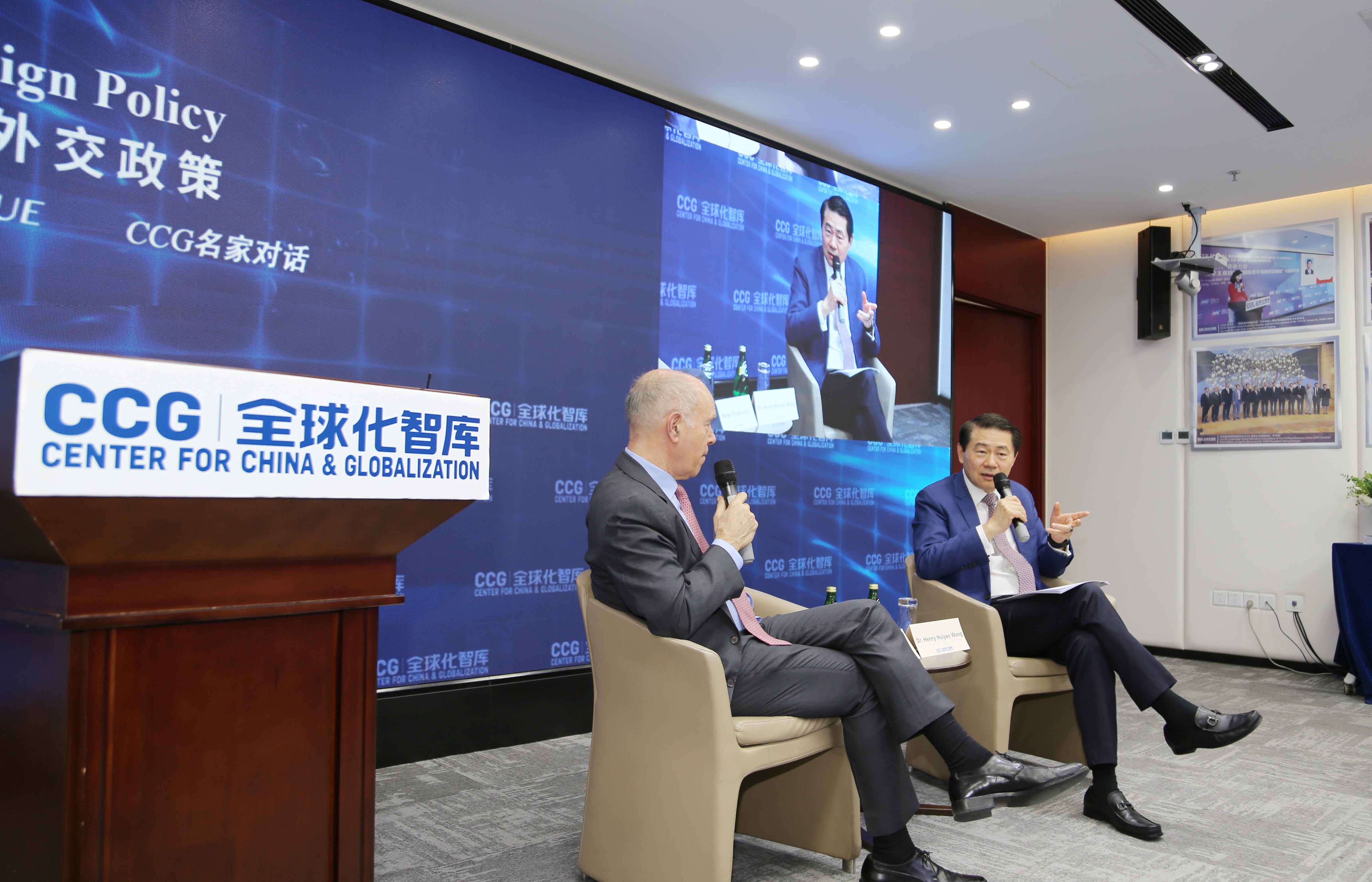
Henry Huiyao Wang
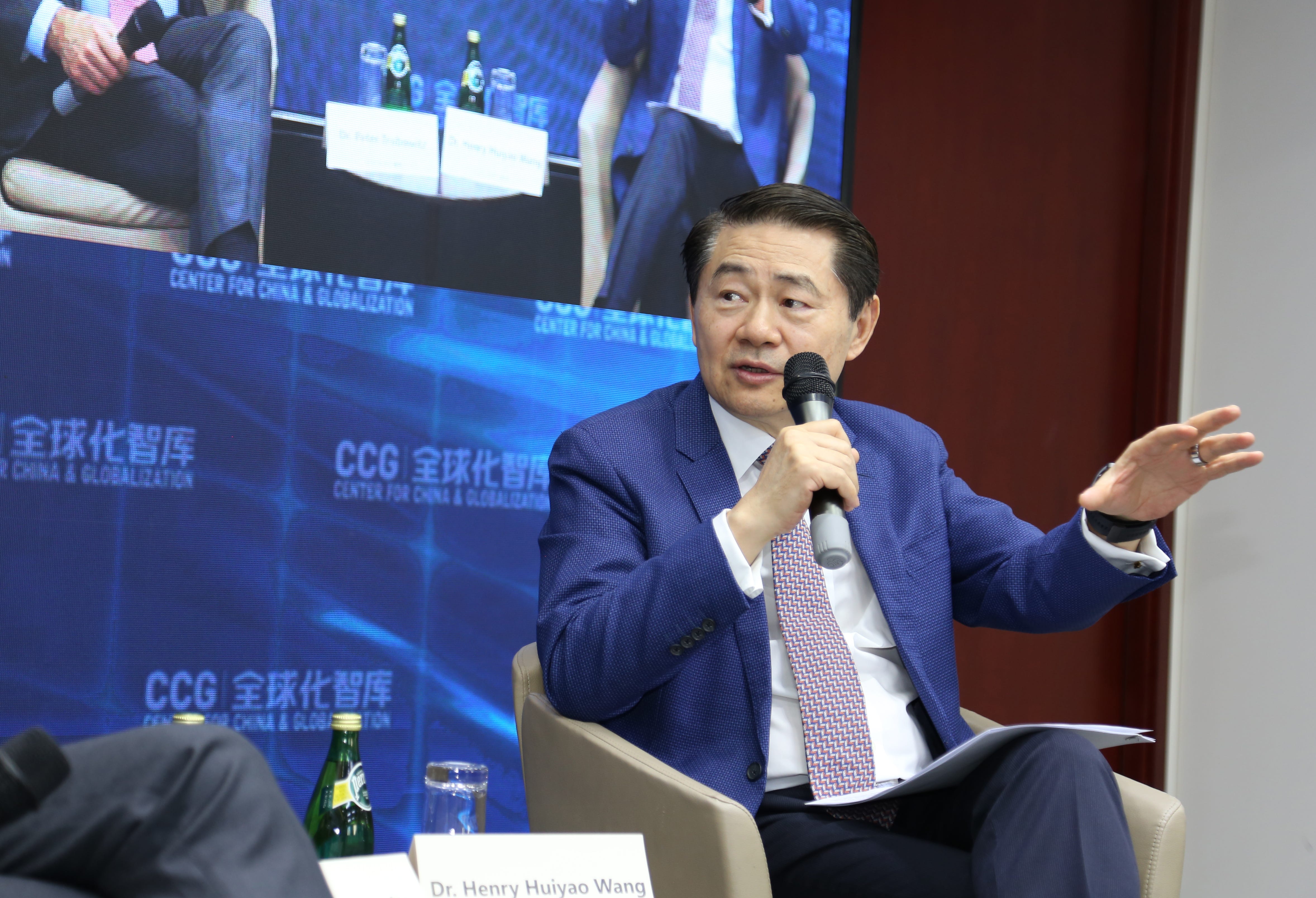
Great. So, Peter, this has been a fascinating discussion. It’s really very stimulating, analytical, and also refreshing. As you know, since Donald Trump took office nearly 10 months ago, he has really shaken up the world—East, West, North, and South. Absolutely, I found that, particularly in the relationship between China and the U.S., he became a central figure, often the talk of the town, and had a huge impact.
I noticed you gave a very good analysis of these three possible strategies, and my personal thinking is that I would suggest a fourth one: the mixed approach. So, this may actually be happening.
But the first question I’d like to ask is, do you also see, as I do, the possibility of the Trump administration consolidating America’s sphere of influence? For example, Rubio’s first visit was to Latin America. And Trump, when he first took office, mentioned Canada potentially becoming the 51st state, and also, you know, “why don’t we acquire Greenland?” His son even visited Greenland as well.
Now, the first strategy they project worldwide is probably struggling. The U.S. has around 800 military facilities overseas, and now they say everyone has to increase their defence budgets. They are no longer willing to fully cover those expenses. The pivot to Asia is also something they may need to retract. So it seems they are trying to consolidate, as you said, their sphere of influence and impact.
So, if that is the case, what do you think Trump is going to do? He’s still very much obsessed with peacemaking, which is something we need. But at the same time, we’re seeing him criticise the governments of Latin American countries, like Honduras and Israel. The Brazilians, for example, have a very negative impression of the U.S., and he also imposed a 50% tariff. I recently came back from the G20 in Johannesburg, South Africa, and once again, he was criticising South Africa. Additionally, he won’t be attending the G20 in Miami next year. So, how do you think that strategy would work if we think the second strategy is quite possible?
Peter Trubowitz
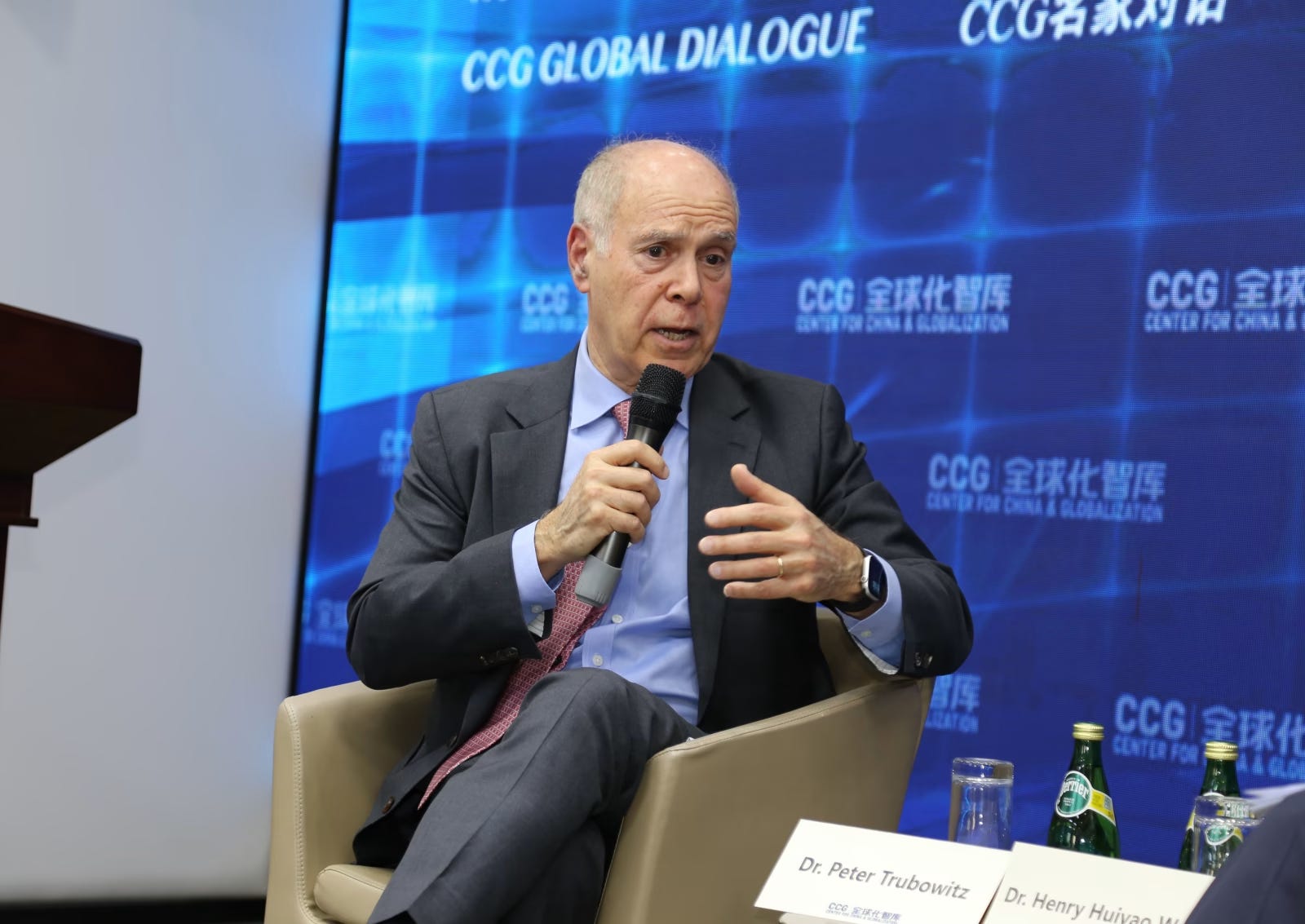
Henry, it’s a great question. And I think I would say, to the extent that the second strategy...So the first thing to say is, you made a very good point. It is quite possible. I don’t think these strategies, they’re different, but it’s possible that they could be combined, and so that we could get some kind of a hybrid of maybe the second and the third, or possibly the first and the third strategy.
I think, with respect to the second one, and if the move is towards...like, if they really push for a kind of a return to what used to be called in the United States a “Quarter Sphere” policy, meaning a Western Hemispheric policy—this is going back like 80, 90 years. There are two potential problems. I mentioned one, which is for the U.S. to pull back from Eurasia, creates the possibility of vacuums and so forth—strategic vacuums, geopolitical vacuums.
But to the extent that the U.S. throws its weight around within the Western Hemisphere, there’s likely to be pushback in the hemisphere. Venezuela is not the issue; Brazil is, Canada is, Mexico is. And so, there’s irony here, because for 30 years, the United States has ignored the hemisphere more or less; now it wants to get very engaged. I think there are countries within the hemisphere that are going to be concerned about the terms of that. I think in some ways, they will welcome the re-engagement, but they’ll also worry about the terms of that. And if what Canada’s experience with the United States is any indication, there’s going to be some pushback. And Brazil has pushed back against the United States as well. So I don’t think the United States can necessarily expect any easier a ride within its region than China could within its own region.
Henry Huiyao Wang
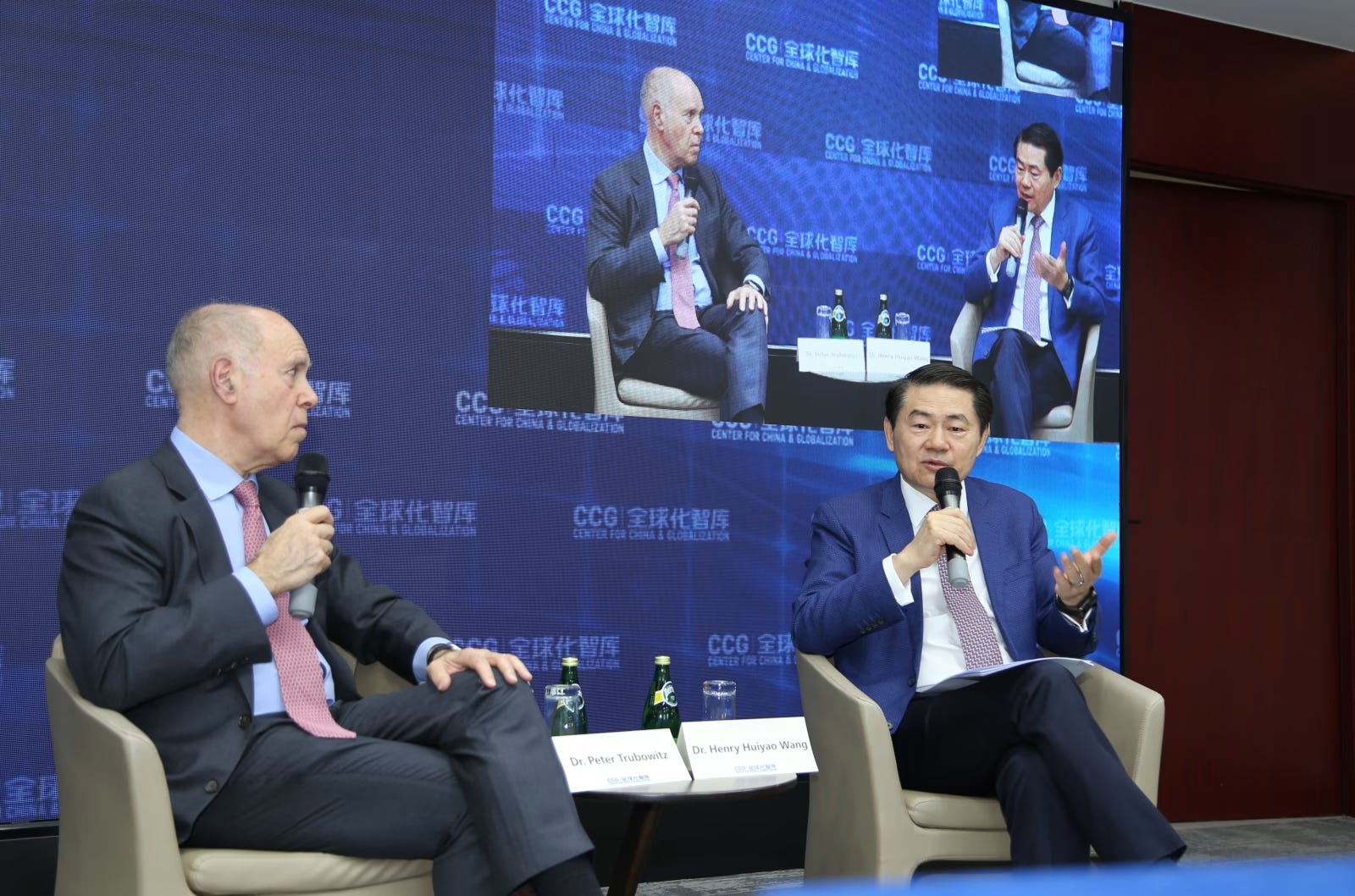
Yeah, that’s possible. I thank you, Peter, for this great analysis. Personally, I agree with you. I think the U.S., after so many years of spreading itself thin across the globe, it’s probably time to come back and focus a bit more. You know, concentrate on your sphere of influence and your neighbours. You really need to take good care of them.
And the public can also make comparisons. For example, look at China. In terms of ASEAN countries, China is doing really well, and ASEAN has become China’s largest trading partner. In contrast, Latin America hasn’t become America’s largest trading partner. In fact, collectively, China is the largest trading partner for Latin America as a whole, countries like Brazil, Argentina, and many others, except for Mexico. For most Latin American countries, China is their largest trading partner. So, I think the U.S. is probably doing the right thing by focusing on their own sphere of influence, allowing them to put a bit less pressure or attention on China. And I think China would welcome that.
The second thing I would like to ask is that Trump actually mentioned “G2,” which aligns with your third strategy. Basically, I agree with you. The Peterson Institute’s Fred Bergsten proposed this years ago, and Niall Ferguson also discussed it, “Chimerica,” right? Yes, exactly—China and America. I met Niall Ferguson just last October, recently. What I think is that, as you said, this is a personal opinion from Trump, but I also believe, on the other hand, it’s a reality now.
You see, particularly in Trump’s second term, he imposed tariffs of 400% or 200%, and China responded with tariffs up to 125%. Then they began escalating sanctions, but soon after, things started to de-escalate. At the recent meeting in Busan, South Korea, President Xi said, Let’s get out of the vicious cycle of sanctioning each other. So, in a sense, I think that’s a reality the U.S. is recognising now.
I also attended a reception for the U.S. Deputy Head of Mission here in Beijing, and he mentioned that during his time here, he’s really been trying to seek strategic stability with China. Rubio also said in an interview with Fox News in July, Both China and the U.S. are so large that we cannot really change each other. We might as well coexist. Let’s seek strategic stability. That’s Rubio’s perspective on “strategic stability.” This stands in sharp contrast to Trump’s first term in 2017, when they introduced the National Security Strategy, labelling China as a strategic rival, even before Russia.
So, it’s not just Trump who is saying this—it’s likely becoming the reality. The world presents so many issues that the U.S. and China have to work together on—war and peace, and other global matters. Even though Trump has voiced this openly, could this also signal a new trend where China and the U.S. collaborate more? I remember the Foreign Ministry spokesperson commenting on the idea of a G2, saying something like, We’re not saying we are a G2; we don’t recognise that, but we do see the possibility of working with the U.S. on those big issues. In a sense, they didn’t say yes, didn’t say no, but essentially, they’re looking to collaborate with the U.S. on global issues such as the UN, WHO, WTO, and so on.
So, in that sense, do you think, even though you said it’s only Trump who recognises this— I know there are a lot of hawks in the U.S. who don’t agree with this—could it be a gradual shift towards this reality because China now also has the ability to counter-sanction the U.S.? If we reach a new equilibrium, maybe at some point, it would force both sides to recognise this reality. Even though Steve Bannon and a few others may not agree, we would have to live with it because we are so intertwined, and so many global issues require the U.S. and China to work together. So, the G2 concept may not sound ideal in terms of naming, but it’s clear that the U.S. and China must collaborate to solve global challenges.
With that kind of scenario in mind, with Trump in office—he’s coming to visit next April—and President Xi expected to attend the G20 next fall or winter, we’re likely to see high-level visits from both sides. Within the next year, we might see one or two more such meetings. In addition, there will be many ministerial meetings in between. Therefore, we can expect some stability between the U.S. and China. In this context, regarding the G2 concept, the U.S. and China will probably have to work very hard together to maintain stability in world affairs while Trump consolidates America’s sphere of influence. What do you think about this reality that is happening now?
Peter Trubowitz
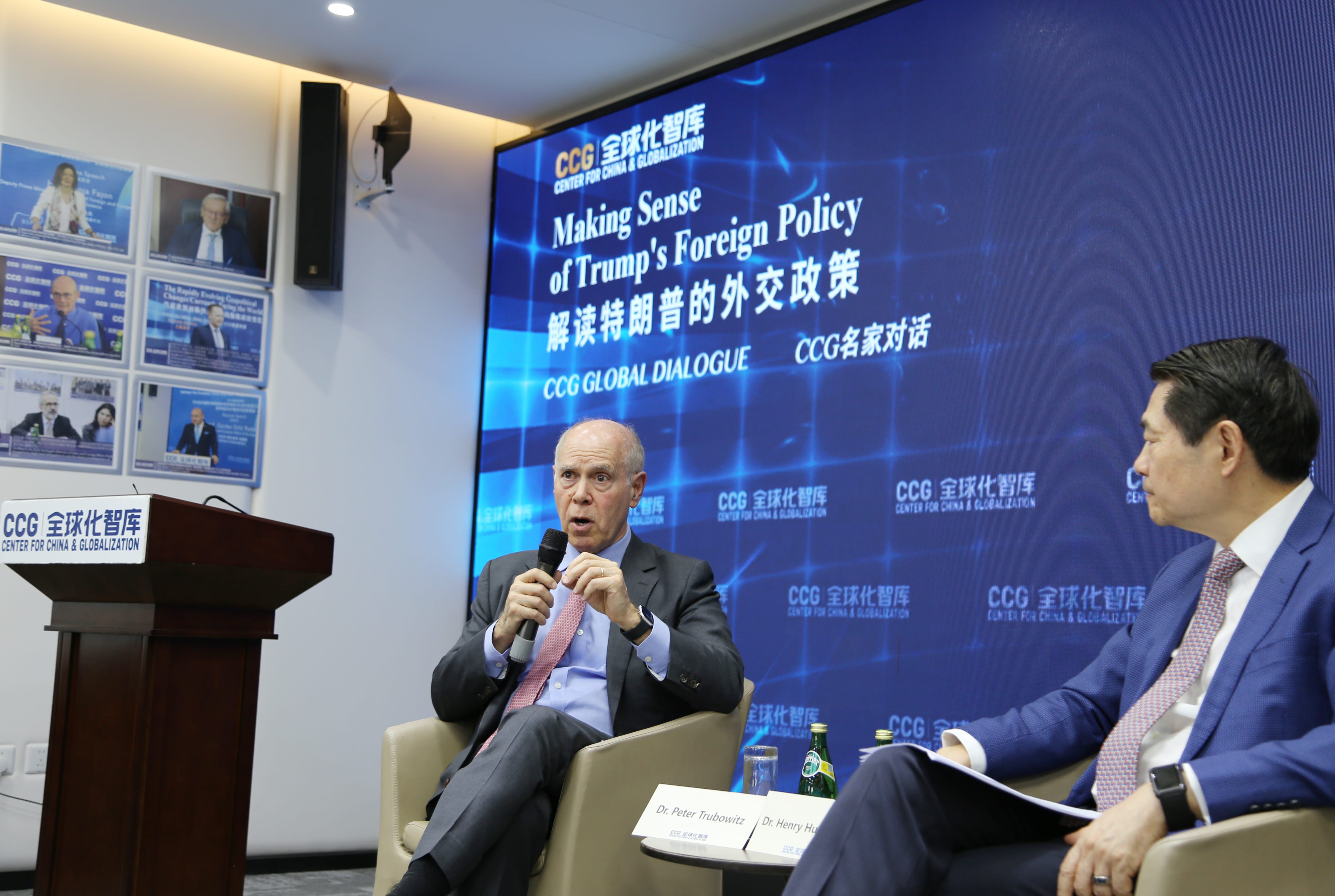
Well, I think it’s true that Trump was, with respect to the G2, responding to facts on the ground, the fact that China pushed back, that China can hurt the United States just like the U.S. can hurt China. I do think the pushback and the use of rare earths, for many in the United States, it was like smelling salts. It was a wake-up call that it wasn’t only the United States that had a weapon that it could play.
I also think the reality for Trump, let’s say, with respect to the tariffs that were imposed on China in April, and then kind of backing away from it, there’s the reality of the bond market in the U.S. and its reaction. And he can see also that, whatever he says about how great the economy is, he can see that his own popularity is declining—not among his base. His base is behind him. It’s solid. It almost doesn’t matter what he does. But if you look at independent voters, his support has dropped considerably. And it’s not, I don’t think, over things that he says and so forth. It’s over the economic realities, and that’s partly the result of the tariffs that have been imposed and so forth. So there’s domestic constraints there as well.
So it’s possible that the U.S. and China have entered a period of—let’s call it like a détente right now—where they will be able to kind of work together to manage the relationship and hopefully, find problems that they can work on together that really do need attention. And I’m thinking about like the dangers of a sea collision in the South China Sea, or that there should be much more attention to alerting each other to missile firings. And there should be much more one-to-one or military-to-military meetings to reduce the risks of something inadvertent happening. I mean, what the U.S. and China don’t need is a Cuban Missile Crisis to be brought to their senses. This needs to be done in advance.
My concerns about the relationship, though, going forward, are twofold. Historically, the only times that the U.S. and China have really been able to cooperate is when two things have been present. The first is a common enemy. So when Richard Nixon and Mao, when there was the opening in the 1970s, there was a common enemy. There was a tacit alliance. And the alliance was against the Soviet Union. The second thing that has allowed cooperation—so that’s allowed cooperation on the military side—the only real time that there’s been cooperation on the economic side is when both sides have coalitions that see huge advantage in international exchange and cooperation, trade, investment, which is what began to take place or unfold in the 1980s and really in the 1990s and into the 2000s.
The problem right now, structurally speaking—this doesn’t mean that there can’t be cooperation, but structurally speaking, there is no common enemy. We could talk about potential common enemies. I don’t mean necessarily geopolitical, like, you know, they could work together on climate and so forth, but there’s no common enemy that is agreed to pull them together. And I think both sides right now, not just the U.S., basically, have nationalist coalitions. What that means is there’s a limit to the amount of economic cooperation that we will see between the two sides going forward. So it’s within those constraints, which I think are structural, that the two sides have to work together to manage the relationship so that it doesn’t go bad. It’s in neither side’s interest to have the relationship go very bad, and it’s certainly not in the world’s interest. So, I support the idea. I mean, I think there’s scope for cooperation, and I think they’ve seen what happens both sides when they start kind of engaging in tit-for-tat exchanges, a kind of zero-sum relationship. It doesn’t work for both sides.
Henry Huiyao Wang
Thank you, Peter. Absolutely, you said it very well. And basically, you know, in the 1970s, when Nixon and Henry Kissinger came here so many times, I mean, they had some common thread probably at that time that drove them together. So that is really true.
I have some new thoughts now because I think we have reached a kind of new equilibrium. You see, China has become so resilient and is still going. We have also built up our deterrence. So, from Mutually Assured Destruction (MAD), can we shift that to “Mutually Assured Construction?” Because so much is so intertwined around the world, global GDP has gone up hundreds of times since the Second World War, and we are so intertwined that we cannot separate from each other. I was talking to Graham Allison quite a few times, and he liked to use the metaphor that China and the U.S. are like conjoined twins. If either twin wants to strangle or break away from the other, it ends with both dead. So, if we don’t have a mutual threat of an enemy, we certainly have a mutual threat to our survival, and that maybe could carry us along as well. This “Mutually Assured Construction” is necessary to survive in this deeply intertwined world.
As you said, business is a complaining, absolutely. When Trump raised tariffs on the $400 billion trade deficit, he immediately granted $100 billion in tax-free exemptions because 80% to 90% of Apple phones are still made in China, 50% of Tesla cars are made here, and 60% of Walmart’s purchases come from China. So, he has to live with that.
But I do think you raised an important question about geopolitical issues like the South China Sea and possibly the Taiwan Strait as well—that could be a sore point between China and the U.S. You talked about a “Grand Bargain.” I remember you published an article in Foreign Affairs some time ago. So, can China and the U.S. reach another Grand Bargain? For example, I was really encouraged to see President Trump, when he met with the Chinese President in Busan, both sides didn’t talk about Taiwan. They seemed to agree that this is not a bilateral issue, nor a multilateral issue, but a domestic issue. So they chose not to discuss it. Furthermore, President Trump vetoed $400 million in weapons sales to Taiwan, and he didn’t allow Lai Ching-te, the DPP leader, to transit through the U.S. to visit Caribbean countries. Those are really great, constructive moves, in my opinion. On the other hand, the KMT just elected a new chairperson. She is very constructive, saying she is Chinese, recognises the 1992 Consensus, and expressed that she would like to meet with Chinese leaders as many times as possible. So, there seems to be a momentum for peacemaking efforts on both sides.
I also attended a meeting at the Great Hall of the People, where Chinese leaders like Wang Huning spoke during the 80th Anniversary of the Restoration of Taiwan. He mentioned that the central government could offer more incentives and create a more integrated economic system. I’ve read from other sources that the government suggested Taiwanese people might not have to pay federal taxes if unification occurs, and Taiwan could have as many consulates as possible. Currently, Taiwan only has a few embassies left, so there would be much more freedom in that regard. Additionally, the Fujian government has opened access to all Taiwanese citizens coming to Fujian, offering free schooling, healthcare, social security, and employment. I really would like to see that policy expanded to the entire country. Just last month, China expanded the port of entry for Taiwanese from 50 to 100, doubling the number. Now, you just land and are welcomed at any time. Economic integration will be there, and if the U.S. allows this to happen, we will likely see progress.
Recently, things have been quite peaceful. There have been no flyovers of the midline, and no military exercises. That is why the Chinese government was so angry about the Japanese Prime Minister’s comments, especially when so many things have been improving and progressing well. While the U.S. is not doing anything, Japan has chosen to make a lot of noise, which I think is not the right thing to do. What I’m asking is whether the U.S. and China could reach a Grand Bargain, where the U.S. focuses more on Latin America and the Western Hemisphere, while China acts constructively in Asia. As President Xi said, the Pacific is big enough to accommodate both the U.S. and China. Do you think, in the long run, this could be possible? Additionally, Taiwan’s TSMC is building semiconductor factories in the U.S., so Taiwan can truly coexist peacefully with this kind of momentum. I would think that if the KMT wins the next election, and as the Chairwoman said, she wants to meet Chinese leaders, we could discuss peaceful unification by 2028 or beyond, which is when the next election will occur. In that scenario, the U.S. would have no excuse to interfere, and we may have a much better relationship. This goes back to your second strategy: we concentrate on our own areas and coexist peacefully. The RAND Corporation recently released a report saying “Stabilising the U.S.-China Rivalry.” Let’s make it more constructive.
So, do you think this kind of scenario is possible? I think the only sore point, the core of the core, is this Taiwan issue. If we can let Taiwan evolve with integration with the mainland and peaceful unification is achieved, then the U.S. probably would be happy, because it looks like Trump does not care too much about ideology. Others were saying, “Oh, Taiwan is a democracy, we have to defend it,” but actually, Taiwan’s economic performance is even poorer than the mainland now; Guangdong Province’s GDP is larger than Taiwan’s. So I would think there are a lot of reasons, a lot of new assessments, and a lot of new thinking with this new equilibrium.
And then we also have so many trouble spots around the world, and the U.S. and China really need to work together. For instance, when the U.S. was not supporting the WHO, China stepped up and said, “Okay, we’ll donate 500 million U.S. dollars to support it.” We have tried to help each other in these situations. So, I think with the world facing various hot spots, we really should not concentrate too much on China’s domestic affairs, like Taiwan. Just imagine if China sailed to Cuba or the Caribbean, or even Hawaii—what would the U.S. think?
If they could reach some kind of new Grand Bargain, as you just called it, that would be ideal. So, what do you think about this new scenario?
Peter Trubowitz
Well, I mean, I think that trying to pursue a grand bargain that in some way, implicitly or explicitly, settles the Taiwan question is likely to boomerang. For the United States. I think it will be that kind of arrangement will end up looking more “Faustian” as a bargain, because it will have such repercussions in the region. It will undermine America’s (credibility); if it were to go down this path, it will raise questions about the credibility of its commitments elsewhere in the region. So you know, you don’t rule it out. Trump has kind of floated this idea periodically, like on TV, in interviews, but I think there are a lot of people around him that would push back.
My own feeling about this is that the smart strategy is, you know, there’s a metaphor in the United States about a baseball metaphor, where you can play two kinds of baseball. You know, you can play what’s called “long ball,” which is you try to hit for a home run, like solve all the problems with one swing of the bat. Or you can play “small ball.” And small ball is you try to get runs slowly, you try to win slowly and incrementally. My advice would be to play “small ball” right now and not go for “long ball.”
I think that the possibilities for cooperation between the two sides exist, but they need to focus on narrower problems that don’t run the risk of a backlash domestically, either in the United States or in China, and that they need to think long-term. So I have a feeling that we are in for a long period of relations between the United States and China that will need to be managed by both sides.
I came here during the golden years, right? We’re not in those years right now. You know, I wear another hat at LSE. I’m the Academic Director of the Summer School at LSE, which is the largest summer school in the world—it has 9,000 students coming there every summer. I spend a lot of my time coming to China to get Chinese students to come to the LSE. Partly, we do it because we need to make money. But my interest in it is not that; it is ensuring that, as we get a lot of American students there, Chinese and American students are meeting. They’re exchanging ideas. They’re networking and developing relationships. I think we have to be thinking about this relationship over an extended period of time, and you actually have to be thinking about the next generation and investing that way.
So well, I mean, I understand the allure of solving the Taiwan—whatever or however we want to refer to this issue. My own inclination is to look elsewhere, because I think were an American president to go down that path, it would be a very rocky road, and it would potentially be destabilising in the region. So I think where it is, where it’s ambiguous, is probably the best place for it to be left in the short term; in the long term, maybe the problem resolves itself.
Henry Huiyao Wang
Yeah, I think with this evolution, the integration in business and people-to-people exchanges, and the opening of more entry ports for Taiwanese, we’re seeing positive trends. There are 2 million Taiwanese working on the mainland, and there are half a million marriages across the Strait. So, eventually, things will probably smooth out. I really think the KMT has a very good chance, because 60% of the parliament in Taiwan is already pro-unification. So that’s quite a possibility. But I do agree with you that we need to pin our hopes on young people. We really need to give them more guidance, and I’m sure young people will come up with even better ideas than we have today for the future.
So now, we’re going to open the floor for Q&A. I know Colum is here, the chief correspondent for Bloomberg in Beijing. So, Colum, why don’t you go ahead?
Colum Murphy, China Government Reporter, Bloomberg
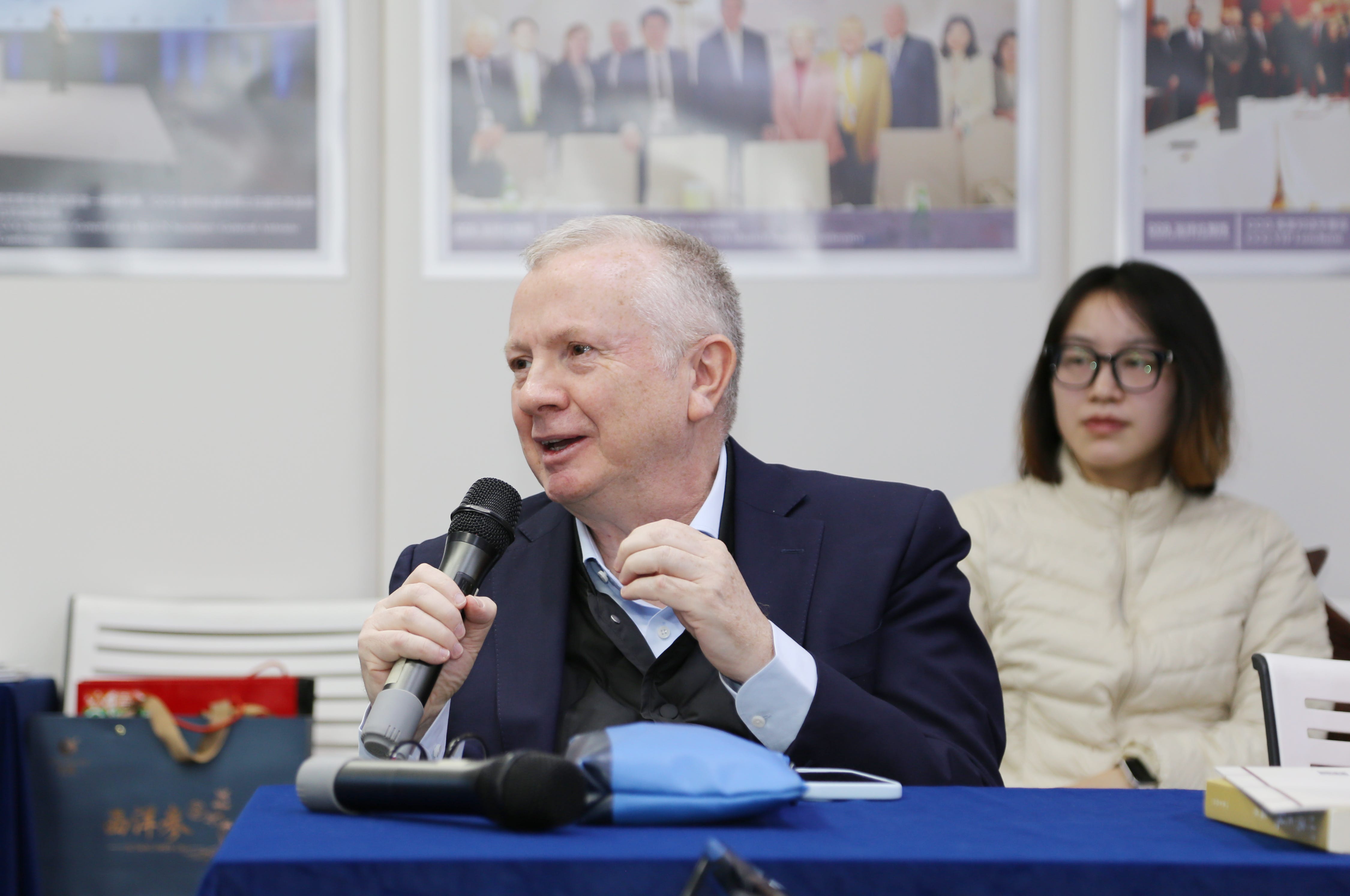
Thank you. I’m sorry I arrived a little bit late. But I am not the chief correspondent, by the way, just to make that clear. I know you’ve appeared on Bloomberg TV quite a bit with our colleagues in Europe. Thank you for that.
I’m just thinking about this Taiwan issue, and I have a sense that there is going to be an “ask,” and don’t ask me where I’m getting this from, okay? It’s just an impression. And we can also see it right now in terms of Takaichi’s comments, whereby China is asking countries like France and the UK, other P5 nations, to offer some sort of word of support. Let’s just say there’s a possibility that there will be an ask. You’re saying, basically, you don’t think that’s a good idea this point in time, right?
Peter Trubowitz
Be careful with the risk. So, because I think it would be very... The ask is not unsettled. If the U.S. sanctions it, I think it could be very unsettling. So you know, and I think domestically in the United States, things have changed in the U.S. too. The Republican Party has changed on this question, but I think any American president that were to go down this path would open themselves up politically, even Donald Trump. I don’t know what the outcome would be. Who does? But it is a kind of red line politically.
And I think American leaders need to be careful also and recognise that the mainland has red lines as well. And so there has to be a recognition on both sides, and I think that was the case. And then I think it started to unravel. I don’t think it started with Pelosi’s visit. I don’t think that helped, you know, but I think it started earlier. So my sense is that things should be dialled back. You have better sources than me, I suspect. And you know, there may be an ask, you know, but in the end, I don’t think it will be what Paris says; it’ll be what Washington says that will matter in the region. France is not a regional power in the Indo-Pacific, you know. I think it doesn’t have extensive commitments in the region. Where the U.S. comes down, I think, really kind of matters on this question.
I mean, what you’re suggesting, it sounds to me, is that China is going to make the ask. It’s going to start not with the United States, but with other countries, and try to build up momentum. And that’s possible.
Henry Huiyao Wang
Yeah, just to briefly answer your question, I think China has made it very, very clear now regarding the One-China principle. China has been very strong in reacting to what the German Foreign Minister or the Japanese Prime Minister have said, because China, I think, has reached a new status. There’s also a new momentum for peaceful unification, and a huge integration is taking place between mainland China and Taiwan.
That’s why I really appreciate Peter’s analysis of the second strategy: that the U.S. will focus more on its own sphere of influence in the Americas, while China will likely focus on its own territory, waters, and areas. Through this process, we can reach a new peaceful coexistence status. Of course, it won’t happen overnight, but as you said, it will proceed step by step, gradually.
Okay, we see another question there. Please go ahead.
Journalist, Phoenix TV
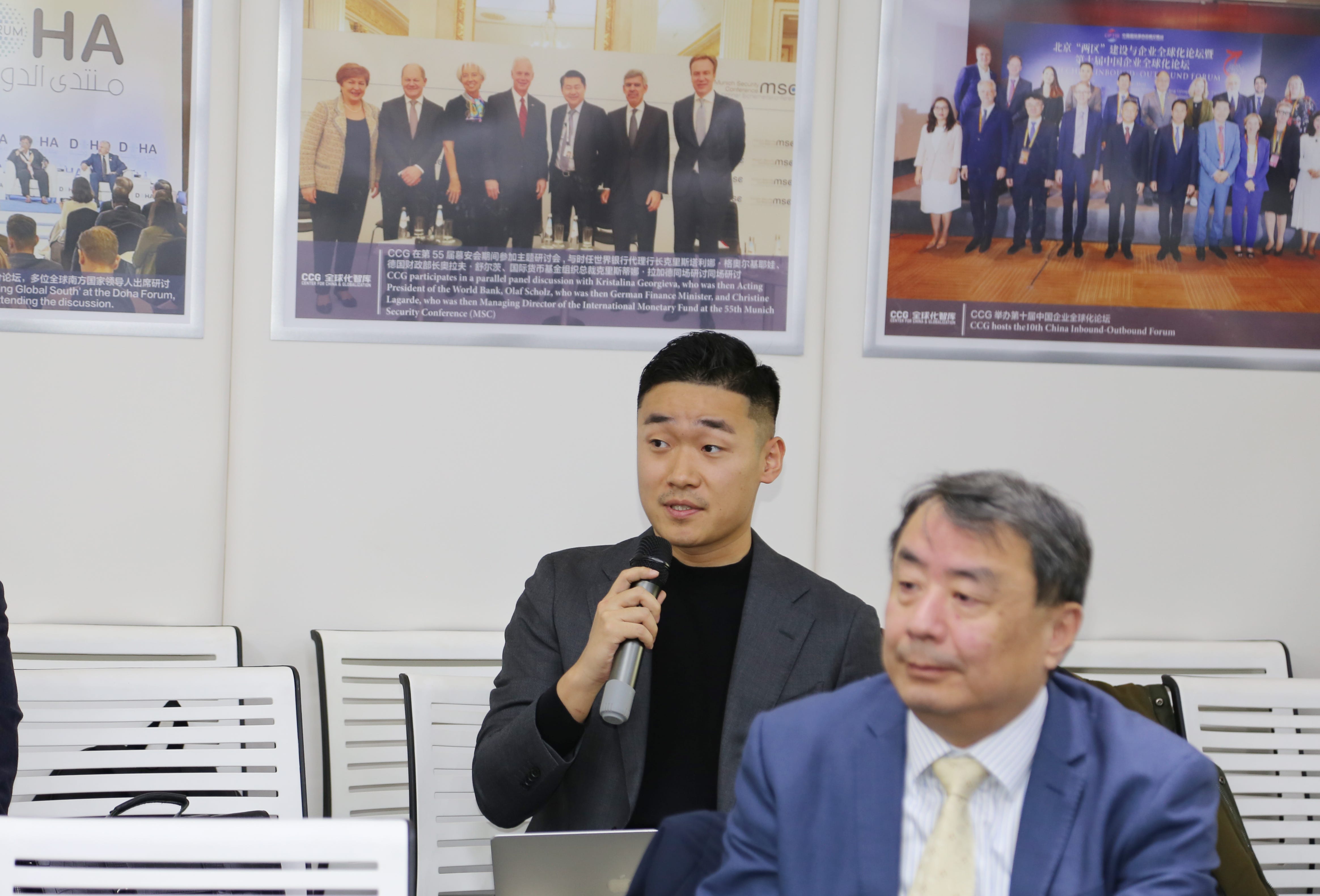
Thank you so much, Professor. I’m a journalist from Hong Kong, Phoenix TV. Just a quick follow-up on Taiwan issues. So my question is more specific: President Donald Trump just signed the Taiwan Assurance Implementation Act, and a lot of analysts think that this action will be the loosening of U.S. self-imposed restriction on non-official engagement with Taiwan. Do you think this Act is going to alter the situation of the Taiwan Strait? And also, do you think this move is more largely symbolic, or do you think this points to a more explicit or tougher policy direction of Trump’s administration on the Taiwan issue? Thank you so much.
Peter Trubowitz
The short answer is, I’m not sure. I mean, Trump could have easily, like, floated the Taiwan thing and question himself, because there’s nothing that holds him back, you know, at his meeting with Xi Jinping. And my sense is that he knows that it’s a bridge too far right now.
My sense is that this is an unsettled position, the way I would put it, maybe. Let’s say, at most, an unsettled position in the administration. But I think the general direction of travel is that the U.S. should approach this very, very carefully. You know, one way to view the call with the Japanese leader is that—I’m not saying this is the way it’s necessarily generally viewed, but I think one way to view it is that they wanted to dial this back, dial it down, the administration. I mean, there’s two readouts from that call, so I don’t know which one is the accurate readout from the call. But that the administration wants, in a sense, the Trump administration, maybe, to have it both ways. And so to me, that’s just kind of wanting the status quo and not trying to change it.
Speaker 2
[Do you think this will] increase the risk of miscalculation on the Taiwan Strait?
Peter Trubowitz
I’m not sure. I don’t think any one single action is going to kind of like tip the balance. I think what will matter here is kind of where the centre of gravity is inside the Republican Party in Congress on this. So, Trump has found himself—I mean, just to switch to a different kind of issue, but I think it kind of underscores, by analogy, the point on Ukraine—he’s had trouble within his own party; when he has tried to push, there’s been pushback. A lot of it has been quiet, but there’s been enough pushback to try to limit and force him to find some space, some kind of arrangement where the Ukrainians could live with the deal. I think it’s a kind of an acknowledgement of the constraints within his own coalition. And I think that still exists on the Taiwan question as well.
Henry Huiyao Wang
Okay, we are running out of time, but I think we’ve had a very stimulating session and discussion, along with a great keynote by Peter. This has truly been a valuable occasion for a think tank like CCG to host such events and enhance understanding and communication. Of course, it also provides an opportunity to explore possibilities and ideas for addressing these issues, as well as to make policy recommendations for relevant government authorities and agencies.
This has been a really insightful discussion. I think Trump’s foreign policy is still evolving, and with China’s resilience and the new equilibrium that has been established, we may see changes, as Trump has mentioned as well. I really agree with Rubio that we need to seek strategic stability and find a way to coexist peacefully, while also addressing the more challenging and complex global issues. In that sense, I think the U.S. and China share a larger responsibility to truly make the world a better place. So, thank you, Peter, for taking the time to join us, and we appreciate it very much.
Peter Trubowitz
Thank you very much. It’s been great to be here. I enjoyed it very much. Thanks to both of you for hosting me, and I hope I’ll be able to host you in London at some point.
Henry Huiyao Wang
Great. So you have a unique position at the London School of Economics and Political Science. You’re American, but you’re heading a U.S. Centre in the UK, and you’re a top expert on China. So you have the best of all worlds. Okay, let’s give him a warm welcome.
Transcript: Suisheng Zhao at CCG

On July 18, Suisheng Zhao, a Professor and Director of the Center for China-US Cooperation at the Josef Korbel School of Global and Public Affairs, University of Denver, visited the Centre for China and Globalisation (CCG) to deliver a keynote address and participate in a discussion with Henry Huiyao Wang, Founder and President of CCG.
Transcript: Adam Tooze at CCG
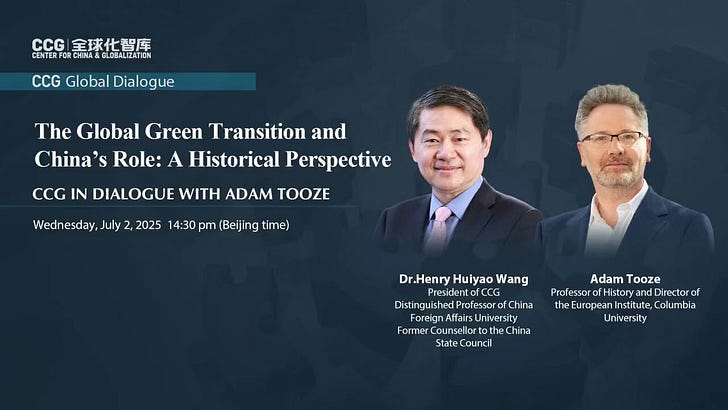
On June 30, 2025, Adam Tooze, Shelby Cullom Davis chair of History at Columbia University, Director of its European Institute, and renowned author of the Chartbook newsletter, visited the Center for China and Globalization (CCG) in Beijing for keynote speech, a dialogue with CCG Founder and President Henry Huiyao Wang, and a Q&A session with a live audi…
Transcript: Ravi Agrawal at CCG

On July 25, Ravi Agrawal, Editor-in-Chief of Foreign Policy, visited the Centre for China and Globalisation (CCG) to deliver a keynote address and participate in a discussion with Henry Huiyao Wang, Founder and President of CCG. Agrawal also fielded questions from a live audience, including Chinese journalists.