

The Center for China and Globalization (CCG) convened the 11th China Global Think Tank Innovation Forum in Beijing on November 21, 2026.
Below is the transcript of the welcome remarks by Mabel Lu Miao, Co-founder and Secretary-General of CCG and Henry Huiyao Wang, Founder and President of CCG, followed by the first panel discussion, “Safeguarding Constructive Strategic Stability: The Future of China–US Relations.”
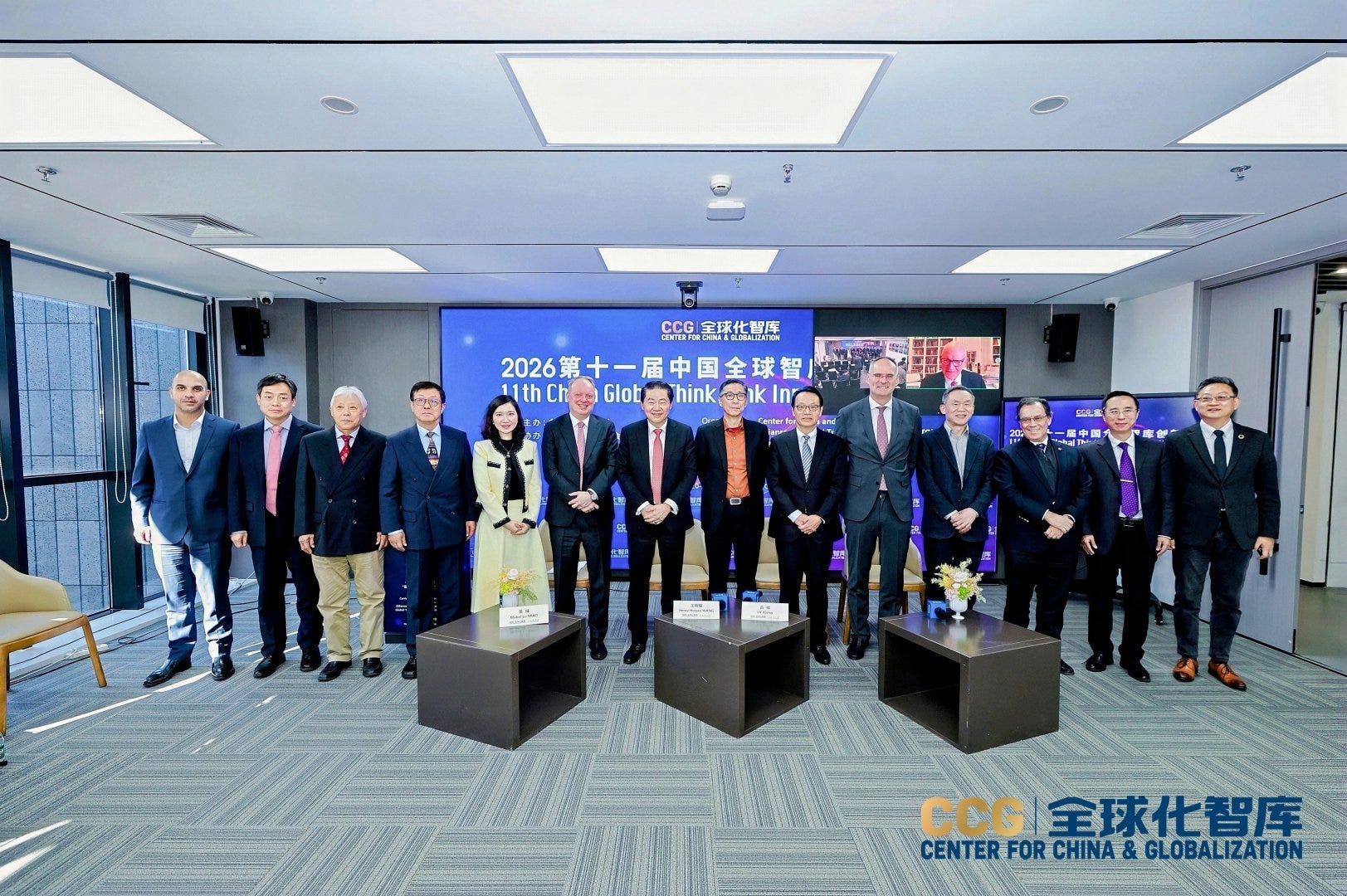
Henry Huiyao Wang moderated the discussion. The panellists, in speaking order, were
David Blair, former Chair of the Department of Economics at the Eisenhower School, National Defense University, Washington, D.C.
LI Cheng, Professor of Political Science and Founding Director of the Centre on Contemporary China and the World, University of Hong Kong
LU Xiang, Non-Resident Senior Fellow, CCG
Michael Pillsbury, Senior Advisor, American Global Strategies, and member of the U.S. Defense Policy Board
REN Xiao, Professor at the Institute of Area and Global Governance, Beijing Foreign Studies University
Denis Simon, Senior Faculty at Schwarzman College, Tsinghua University, and Chairman of the Alliance of Global Talent Organizations
This transcript is based on a recording and has been lightly edited. It has not been reviewed by any of the speakers.
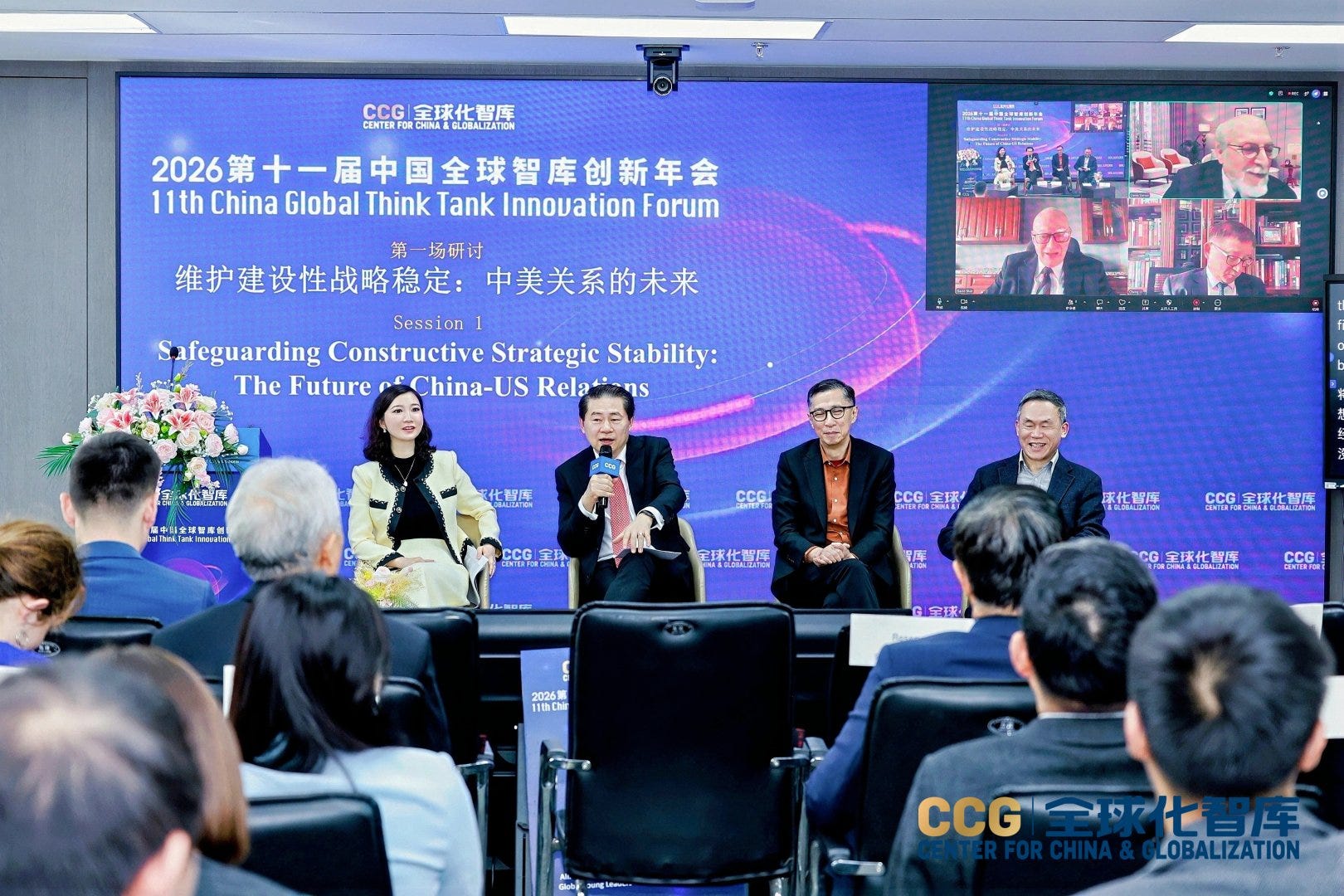
Mabel Lu Miao, Co-founder and Secretary-General, CCG

Your Excellencies, distinguished guests, ladies and gentlemen, good morning. On behalf of the Center for China and Globalization (CCG), welcome to the 11th China Global Think Tank Innovation Forum. It is a pleasure to have you all with us, both here in Beijing and online.
We launched this forum in 2016 to bring together directors and researchers from leading think tanks in China and the world. We wanted a place where we could discuss global challenges, exchange views on China’s relationship with the rest of the world, and learn from one another about the future of think tanks themselves, with innovative ideas and visions to advance the development models and perspectives of think tanks. In this multipolar era, think tanks play an irreplaceable role as track two actors in global governance.
For many of our international colleagues, this forum is also the occasion for their very first visit to China. Now in its 11th year, this is one of CCG’s flagship annual gatherings alongside the China Inbound Outbound Investment Forum and the China and Globalization Forum. Over the years, our guests have included prominent international scholars such as Joseph Nye. Thousands of experts from the world’s top think tanks have participated in this forum. We are grateful to everyone who has helped build this community.
This forum this year focuses on global governance in a multipolar world. Just two days ago in Shenzhen, APEC leaders discussed how the economies of Asia-Pacific can prosper together. Of course, the G3 leaders gathered. It’s a very impressive occasion. Last night, we opened our forum with a dialogue on how countries with different interests can find common ground. Among our speakers were Vuk Jeremić, Former President of UNGA(United Nations General Assembly), Professor Barry Buzan, Professor David Shambaugh, and Professor Kerry Brown.
Let me first welcome today’s distinguished guests, including MA Jianchun, President of the China Society for World Trade Organization Studies and Former Director-General of Foreign Affairs at China’s Ministry of Commerce. We also welcome PENG Gang, who headed the Ministry’s Department of Asian Affairs and served as Former Minister of the Mission of China to the European Union. Joining them are SUN Yongfu, who headed the Ministry’s Department of European Affairs, and HAN Bing, who served as Director-General of that department. With us as well is WANG Qingyuan, who served as Economic and Commercial Ministry Counsellor at China’s Embassy in Brazil, Argentina, and Mexico.
Of course, the guests included Mr. KANG Jincheng, Former Director-General of the International Cooperation Bureau of the Chinese Academy of Engineering. And a warm welcome to the Ambassadors of Austria, Japan, Morocco, Portugal, Spain, Turkey, and the UAE(United Arab Emirates) to China, and the Director-General of the East Asia Department at the Ministry of Foreign Affairs of Hungary. And to all of our colleagues from the diplomatic community in China.
We’re also pleased to welcome SUN Xiansheng, Former Secretary-General of the International Energy Forum. And Timothy P. Stratford, Former Assistant U.S. Trade Representative for China Affairs, Denis Simon, Chairman of AGTO(Alliance of Global Talent Organizations), and Jens Eskelund, President of the European Union Chamber of Commerce in China.
Among our colleagues from think tanks and universities, for example, Professor LI Cheng from Hong Kong University, and Dr. Michael Pillsbury, Senior Advisor at The Heritage Foundation, and Remy Weber, who is the Senior Program Manager of the Global Solutions Initiative. It is a pleasure to have you all with us.
Across the two days, we have six discussions in all following last night’s opening dialogues. Today’s four roundtables will explore China’s relations with the United States and the EU, the priorities of the Global South, and the experience of Chinese companies working with partners overseas. Our young leaders will close the afternoon with the annual exchange of the Global Young Leaders Dialogue (GYLD). I hope you all will join us at this evening’s reception as well. Thank you all for being part of this forum.
Let me now invite Dr. Henry Huiyao Wang, Founder and President of the Center for China and Globalization, to open our first roundtable on the future of China-U.S. Relations. Henry, the floor is yours.
Henry Huiyao Wang, Founder and President of CCG
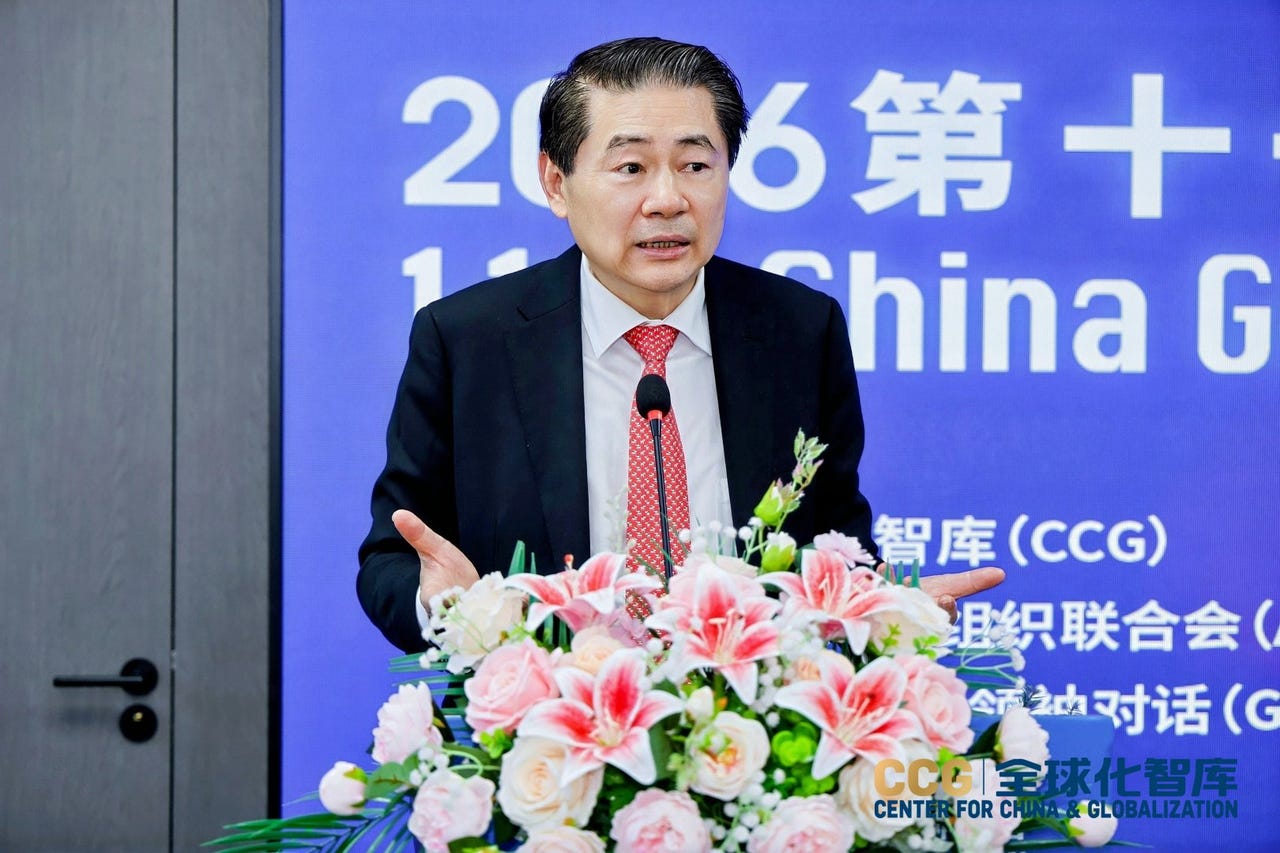
Your Excellencies, distinguished guests, ladies and gentlemen. It’s a great honor to welcome you to the CCG Tongzhou Office. We are having the 11th China Global Think Tank Innovation Forum. This is already the 11th year that we’re hosting this think tank forum, and we’re pleased to see so many ambassadors, so many think tank leaders, chamber heads and of course government officials from all walks of lives that participate. I’m going to be very brief, and we’re going to start our very important opening panel today.
The Think Tank Innovation Forum has been hosted for 11 years; we had Joseph Nye, we had Michael Pillsbury, we had Kishore Mahbubani, and many global academic leaders participated in the past. It’s something that we have kept doing for 11 years. And we will continue, because this has already gotten a lot of recognition. And also, we have friends from Europe flying in to participate in this conference as well.
For think tanks, organizing three big events in a year is a lot of work. We’re going to have our 13th annual China and Globalization Forum in Beijing in 2027. And next October 15th, we’re going to have our 14th China Outbound Forum, and this is the 11th China Global Think Tank Innovation Forum, so we are busy with all those promotional bridge roles between China and the outside world.
I want to say that we are also hosting this right after the APEC (Asia-Pacific Economic Cooperation) summit in Shenzhen. I just got back from Shenzhen, and we saw all the APEC leaders coming, and we also had a significant historical trilateral summit among China, the United States, and Russia. As a matter of fact, on October 1st, I was in Moscow at the Valdai Club, and I proposed this idea to President Putin. He was very favorable to this idea, and he was the first head of state to agree and really wanted to take that in the trilateral format. I think the P3 meeting, permanent members of the UN Security Council meeting, could pave the way for UN reform, peace, nuclear arms, and economic stabilization. We are going to have a G20 summit next month, and hopefully we could have a P5 summit there so that we could really strengthen the UN Security Council, heads-of-state, face-to-face meetings. That would be really great to push peace and prosperity for the world.
Without further ado, I conclude my open remarks for the forum: welcome all of you and appreciate all of you to come. This is a really great occasion to have an event today. We’re fully packed for the whole day, and we hope that we’re going to have a lot of good discussion. And we put this online, and we summarize the report for different departments of the government in China. And we hope that we can also brief our international community on the outcomes and what we have discussed here. So thank you all very, very much. Appreciate that.

Now let’s get to today’s first panel, which we are having — basically, it is “Safeguarding Constructive Strategic Stability: The Future of China-U.S. Relations.” I will be the moderator.
Joining us today is Professor David Blair, Former Chairman of the Economic Department of the Eisenhower School, National Defense University in Washington, D.C., and Professor Cheng LI, Professor of the Department of Politics and Public Administration, Hong Kong University. And also, we have Professor LU Xiang, on U.S. studies, and Director of the International Exchange and Security Studies Division, Center for Hong Kong and Macau Studies, Chinese Academy of Social Sciences. And we also had an old friend, Mr. Michael Pillsbury. He’s the Former Senior Advisor of the Heritage Foundation. But I know that you’ve been taking on a more important role now, so maybe you can introduce that when you speak next time. And we have also Professor REN Xiao, Professor of the Institute of Area and Global Governance, Beijing Foreign Studies University. And of course, we have Denis Simon, Senior Faculty Member, Schwarzman College, Tsinghua University, and Chair of the Alliance of Global Talent Organizations. So we have, so far, so many people online now. And so, we should start.
Basically, we also had a very good discussion last night at another panel related to the conference on global governance. And we’re also talking about China-U.S. relations. So I want to start with China-U.S. relations. From the first term of Trump, it was basically called “strategic rivalry” at that time. And after four years of deep thinking, and also viewing the progress of the bilateral relations, in the second term, I think both governments are very pragmatic, and they talk about the relationship now becoming one of “constructive strategic stability.” And I think during President Xi’s visit in September to Washington, they added “respect, fairness and reciprocity, strategic stability.” So there are a lot of new things being added. With the three summits already held between China and the U.S., we’re going to expect a fourth meeting in Miami next month, as has been mentioned in the statement of the September visit—that we’re going to support each other on both summits.
So my question to our panelist would be: how do you think the U.S.-China relationship is going to evolve in the next five, ten years perhaps, or even 25 years, even longer? Have we established a strategic equilibrium? I call that a strategic equilibrium, because I think both countries have achieved a “mutually assured disruption” now, and that will force us into “mutually assured construction” — from AI, from digital, from many geopolitical aspects. So what do you think about this new strategic equilibrium that has been established? What do you think about this trilateral summit we had in Shenzhen just a day ago?
Let’s get David Blair first. He’s the Former Chair of the Economics Department of the Eisenhower School of the National Defense University in Washington. So David, maybe you can start.
David Blair, Former Chairman of the economics department at the Eisenhower School of National Defense University in Washington, DC
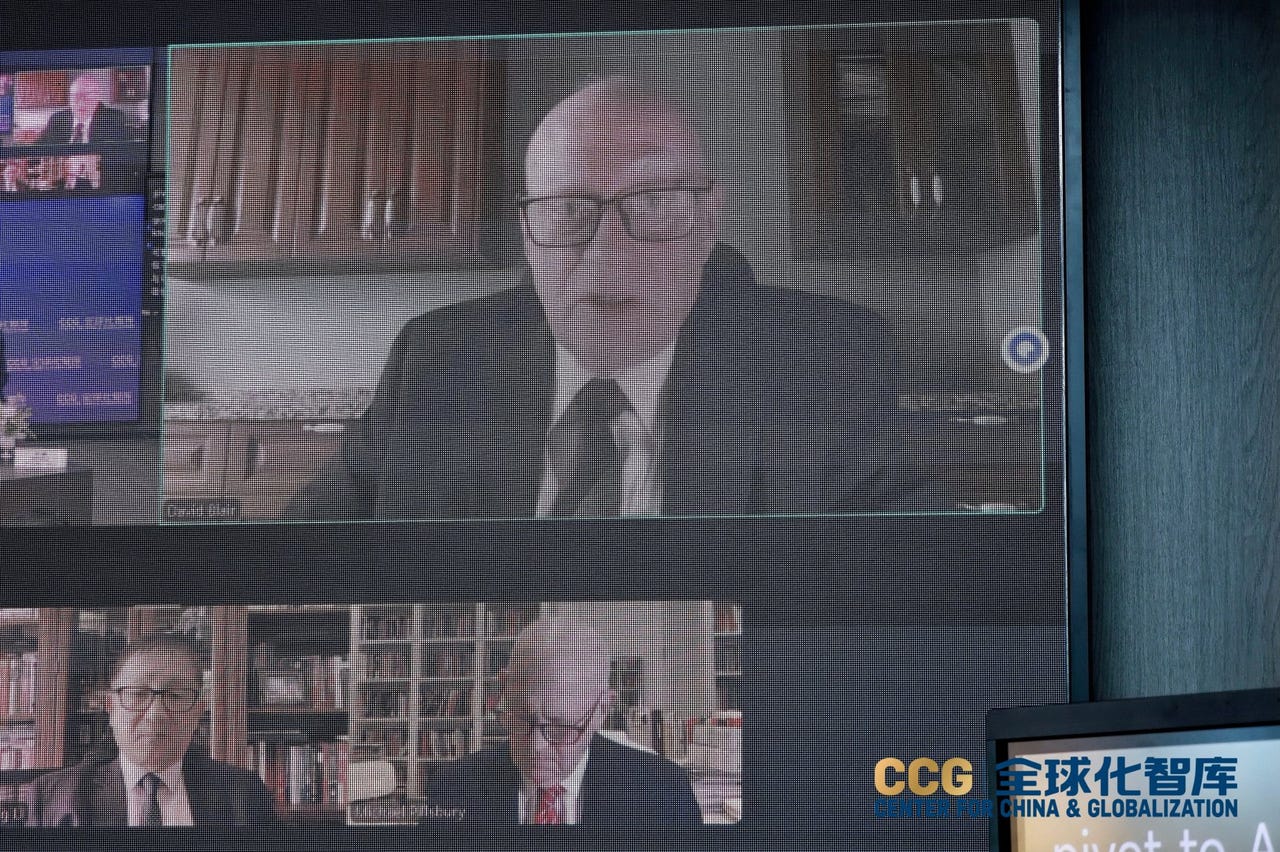
I think the friendship—however friendship is defined and limited—between President Xi and Trump and the trilateral summit in Shenzhen were very good things, although they’re being criticized a lot in the United States, but they are certainly better than the alternative. My reading of Thucydides is very different from Graham Allison’s readings. He thinks it’s a geopolitical balance. If I read Thucydides right, a lot of it was about respect, about face, about relationships. The Spartans’ pride was repeatedly hurt. I think these meetings go a long way to avoid that. That’s not going to solve all the problems, but I think it’s very important. It also helps both the United States and China, in particular, and Russia avoid sort of accidental escalation, which could happen. So I think these are unequivocally good things.
Second, there seems to be a view in China, although not explicitly stated, that the Democratic Party win in the midterms will be a good thing for China. I disagree with that. First of all, the democrats will strongly oppose Trump’s actions in Iran for a variety of reasons. Partly, it’s because there’s been a large rise in antisemitism in the Democratic Party, and some in the Republican Party. So they’ll try to oppose anything that might help Israel. And they also want to humiliate Trump.
But the problem with that for China is that they’ll feel the need to be tough on somebody, and that somebody is likely to be either China or Russia or both. So opposing Trump in the Middle East is likely to lead to something like a pivot to Asia in the Democratic Party, where no one can possibly speak out in favor of having good relations with China. Nobody knows. It’s low probability. But if I had to bet on one person to be the next president, I would guess Marco Rubio, who has a much less favorable view of China than Trump does.
That last point I want to make is, I think, the most important one. If I look at the United States’ economy, we’ve done a number of things that really started in the 1970s but wrapped up in the 1990s. We’ve changed our financial system in a way that, instead of emphasizing banks making loans to the real economy—to sort of bread-and-butter businesses and factories and industry and to housing—we’ve changed the banking system in the so-called reforms in the 1990s to a system that encouraged an emphasis on risky firms that might get monopoly power.
How do you make a system like that work? You do that by repeating injections of monetary stimulus that increase the value of assets. We’ve done that 3 times. Starting in 1995, we created the dot-com boom that crashed in March of 2000. Instead of going back to the old system, they doubled down and created another large monetary stimulus, which led to the housing and global financial crisis in 2008. And then instead of correcting the situation, they more than doubled down and did very large stimulus programs, particularly the second round of quantitative easing in 2010 and 2011, which have caused U.S. asset prices to soar. I can’t show you a chart, but if you look at charts of U.S. stocks and U.S. housing prices since 2012, they have increased at a very steep rate. U.S. housing prices have increased at a steeper rate than they ever increased in China.
I think this is an unsustainable bubble. This is my view, and obviously the market disagrees with me, although I have a hard time understanding where the market would go, even if they believe this.
About 6 months ago, I moved basically all my stocks into near-cash as I could. First of all, because I’m old and I don’t want to risk going down. Second, because I think there’s going to be a crash.
The world now has a 1929 feel to it. There’s a very large asset bubble, I think, in the U.S. Europe is a basket case. China is in the midst of a huge transition. So all three big economies are in difficult positions. Probably China, the least worst of them. And something really bad could happen. If we have anything like another Great Depression in the 2030s, all bets are off in relations with China and in relations with everybody else. So that’s what really frightens me.
One more thing about the U.S. economy. Dr. Pillsbury was saying that President Trump said he had brought the US economy back in his latest press conference. But I’m doubtful about that. Many of our most basic institutions have lost the trust of the population. You look at the polls of “who do you trust in the United States”—there’s almost nobody. And that’s very different than it was 50 years ago. So we’ve become a very low-trust economy. Many of our institutions, our culture, our great universities—many of them, I think, have been seriously damaged.
And so, I think there’s going to be pressure to fix that, including this talk of reindustrialization, which may be too late. The deindustrialization was driven by the financial policy starting in the 1990s. But there’s going to be pressure for that, and that’s going to lead to further conflict with China.
Henry Huiyao Wang
Great, thank you, David. You talked about worrying about bubbles and things like that. I think it’s important for the U.S. and China to really make AI work, because China only spent a fraction of the AI cost, but that has really become more commercialized. To avoid a financial crisis, the U.S. and China have to make AI work with a great, open system, or all those restrictions on each other.
David Blair
I’d like to say one thing about that. The key is wages. U.S. wages have not increased for 50 years.
Henry Huiyao Wang
Let’s do that in the second round, because I want to have other guests join in now. I’m very pleased to have Professor Cheng LI. He’s from Hong Kong, and he’s also a former director of the Brookings China Center, and he’s very knowledgeable on China-U.S. Relations; we heard him mention that many times. And also, he’s doing fabulously in Hong Kong. So, Professor Li, we’d love to hear from you on your assessment, please.
Li Cheng, Professor of Political Science and Founding Director, Centre on Contemporary China and the World (CCCW), University of Hong Kong

Henry, thank you so much for the invitation, and congratulations to you and Mabel Miao Lu, and also CCG, for organizing this forum and many other gatherings. I’m honored to be with these distinguished panelists, both in Beijing and online. It has been a while since I talked with some of you.
Now, I was also in Shenzhen and just got back to Hong Kong. In my view, we witnessed history and remarkable events at the Shenzhen APEC meeting. But today, I want to address three cynicisms about Donald Trump, about the bilateral relations, about the trilateral relations in many parts of the world, including some corners in China. Now, three cynicisms.
The first one is that, in the wake of the Democrats’ control of both chambers of Congress in the midterm election, there’s a view that President Donald Trump’s transition is a transition to a lame-duck presidency. This is also quoted in your program. You may or may not hold such a view.
A lame-duck president—such a term is not new. As we remember, in the last year of Trump’s first term, we heard this. And also, in my view, the challenges or difficult situations for Trump then were far worse than now. So we heard at that time “the end of the Trump era,” but it was certainly not true. I’m also cynical that it’s the beginning of the end of the Trump era. I do not see that. He at least has two more years. And as we know, Trump is a fighter. And the fact that he appointed Steve Miller, a conservative hardliner, to be the Director of the White House Office is a clear indication that he will not compromise much with the Democrats.
Now, if the wars were the reason for the result of the midterm election, as JD Vance said in Munich, that the result of the midterm election was about the Iran war; also, over a year ago, he said about the Russia-Ukraine war. But Trump is now trying to achieve peace, at least from the Shenzhen meeting and from his overall stance in the past few weeks. Now, I think you probably will agree with me that Trump is a symptom, not a cause. He represents at least 40% of American voters. So America is divided. And the Democrats, in my view—I’m actually a Democrat—I don’t think the Democrats do have some fundamental advantages at this moment and in the near future. This is the first cynicism I want to reject. I think, again, Trump is important; Trump is powerful. And it’s far too early to announce the end of the Trump era.
The second cynicism is related to the bilateral relationship. There’s some view—people said there’s not much of achievements, there’s not so many deliverables, and American domestic constraints on Trump, including export controls and AI competition between China and the U.S., will not make a big difference. So, very cynical.
Now, Henry, you framed very well that we should look at the new frame in U.S.-China relations that started in May. I think China proposed that in September, and also just a few days ago. It’s “constructive strategic stability.” Now, the new addition is that this should be grounded in mutual respect, fairness, and reciprocal relations to guide the bilateral relations.
As we know, it’s not easy for the U.S. to accept another country to frame the relationship. During the Obama administration, China proposed “new major-power relations”. But the American side was very cynical, particularly regarding “mutual respect”. They didn’t want to do that with respect to China, an “authoritarian country” in the U.S. view.
Now, why did they more or less accept it—not only Trump, but also even his hawkish team members, whether the Secretary of the Treasury, or Secretary of DOD, or Secretary of State? Now, because “stability” is a good word for the U.S. now, and because the U.S. does not want financial instability, as David just mentioned, there’s a deep worry in the U.S. Certainly, the Secretary wants China to continue to buy U.S. Treasury bonds, so they do not want China to sell. And China, at least in the near term, is not going to challenge the U.S. dollar or challenge the financial system, because it would also hurt China economically and financially.
Now, the other part is that the use of AI in war has really developed very fast, especially regarding possible nuclear wars. So military-to-military relations in this area are the major issue in this meeting. As we know, Trump does not like Biden’s policies, but at least he followed the November meeting in San Francisco in 2023 about the continued human control of nuclear weapons in the era of AI. He has raised the question of why the U.S. now accepts the Chinese framework. I think the most important thing is that the position of strength has changed—China has more leverage. I do not want to go into detail.
Now, another reason why we should not expect the U.S.-China relationship to drastically change, or make a 180-degree change: I agree that American domestic politics is probably still very hostile to China, not like President Donald Trump himself. But the three trips already made this year, and also the next one—if President Xi goes to the U.S.—all these four meetings are not supposed to change direction, but to prevent a free fall. Because over the past nine years, the U.S.-China relationship has really been in a terrible shape. The Consulate General could be closed. Student exchange could end. I don’t want to list a long list of problems. Now, besides the core interest for China—it’s not a secret, it’s the Taiwan issue—Trump, at least in this area, now probably shows more understanding, or even respect, for the Chinese position.
Now, let me go to the third cynicism. It’s about the trilateral relationship. Many would say there’s no trust in this meeting—the wars are still going on. Regarding trust, I believe that Trump and Putin may not trust each other. But in my observation—you may or may not agree with me—I do see there’s a more or less trust between Xi Jinping and both Trump and Putin. Otherwise, there would be no such meeting.
Now, yes, the war is still going on. And the Russia-Ukraine war is now longer than World War One, and if it does not end in the coming months, it will very soon be longer than World War Two. This cannot go on forever. I think it’s good that the three leaders, despite a lot of obstacles, come together to address these various issues.
But the overall themes of this summit—trilateral relations, nuclear non-proliferation, arms control, human control over nuclear weapons—these are extremely important in our era. So I would say: people always talk about this being the first meeting of these three leaders. I hope this will not be the last meeting of this sort. The three top leaders of the three countries should always get together to discuss these issues, although Russia probably is no longer a major economic power, or even a major power in the world, or at least not a superpower. It’s not a Three Kingdoms.
So my last sentence is: if this is the last meeting of this sort, I think we are going to enter a very, very horrible scenario. To say it bluntly, we would probably all be dead in the next few years, because the AI has really caused us a terrible situation. This is far worse than anyone can imagine.
Henry Huiyao Wang
Thank you, Cheng. Excellent analysis. I think your observation is very sharp and also a good reminder as well. I do agree with you. I think we should not underestimate President Trump. The reason for that is that in his first term, he put up the “strategic rivalry” narrative on China.
That Trump doctrine has actually been inherited by the Democrats, by the Biden administration, and made even worse. Now, after some time, he has seen the strength of China. For example, China’s GDP since Trump’s first term has doubled. And now he has become pragmatic, more business-oriented. So that really is a good sign.
So that new Trump doctrine will probably continue to be inherited in the future. We’re seeing some transition here in the long run, and this trilateral summit will probably become a pattern in the future as well.
I’d like to have a Chinese speaker now. I’d like to invite Professor Lu Xiang. He’s been working at the Chinese Academy of Social Sciences for many years, at the U.S. Research Center, and he’s also a non-resident senior fellow at CCG. So, Professor Lu, please give your assessment.
Lu Xiang, Non-Resident Senior Fellow, CCG
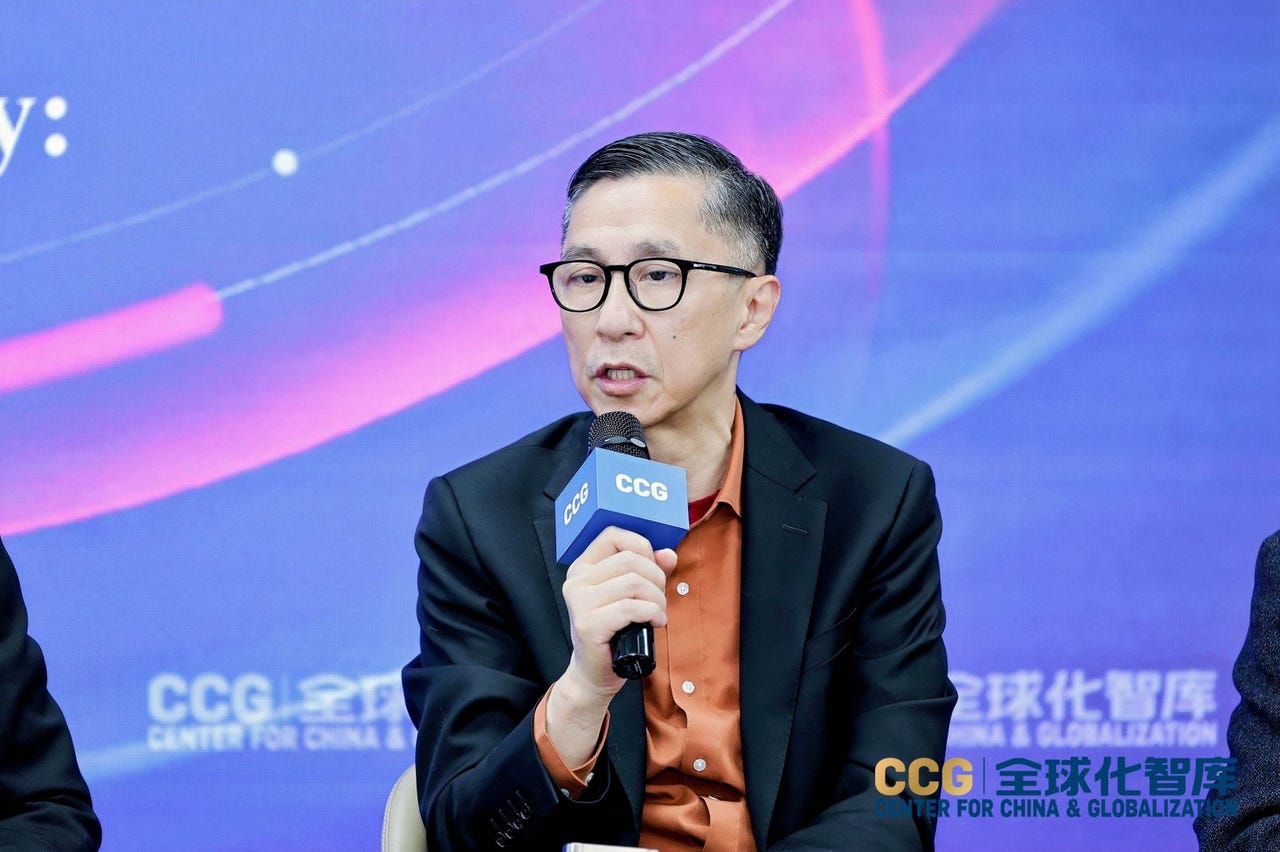
Thank you, Huiyao and Miao Lu, for inviting me to your conference so many times. It’s a rare opportunity for us to speak to our audience here and our distinguished guests online, especially Michael Pillsbury, my old friend. Just a few years ago, a reporter from the South China Morning Post asked me a few questions about Mr. Michael Pillsbury. He asked me, “Mr. Pillsbury is hawkish towards China, isn’t he?” I said, “Yes, but he’s a knowledgeable hawk.” He knows much about Chinese history. He respects Chinese culture. And he has a nice house on O Street in Washington, D.C., with a Chinese red gate. Very impressive.
So, just yesterday, the APEC meeting in Shenzhen finished. I had an interview at CGTN. I thought the CGTN reporters would ask me a few questions about how great the summit was. But to my surprise, they didn’t ask me any questions of this kind. They just asked me very technical questions. The first is about energy: why does the China-Russia-U.S. Heads of State Declaration toward Peace mention this point? The second point of the Declaration is about increasing refined petroleum products and guaranteeing the energy flow. So this is very technical. And CGTN may now be the most open television channel here in China. It’s very open, and it’s very technical. It’s not about the greatness, about how grand the meeting is; it’s about technical questions.
So my answer is: behind so many magnificent things, we are facing a very difficult world—in the energy world, and in a world where non-proliferation is a very hard task. So these situations make a trilateral meeting necessary for the world. Why? Because there are three powers. Previously, many people liked to talk about G2. Actually, at this summit, we see G3. I think it’s reasonable to ask another question: is this G3 enough for the world?
No, definitely not. Because it’s an Asia-Pacific summit and it doesn’t include Europe. And I think the next session here is about Europe. So at least we have to say it’s a G4 world. Beyond that, we have G20; we have a lot of other platforms. But this G4—China, the U.S., Russia, and Europe—are the most important players in this world. And this is the first time we have a trilateral meeting among China, Russia, and the U.S., and they got a declaration toward peace. It’s unprecedented. You can in no way exaggerate its significance and importance.
If we just watch the TV footage, if we just look at the interactions between Chinese President Xi Jinping and U.S. President Donald Trump, do you think it’s a relationship between two strategic competitors? It’s like two countries in Chinese words: brothers and comrades (tongzhi jia xiongdi). So it’s such a beautiful thing. And we hope that these beautiful things could signify a very bright future.
And we have a term now: “constructive strategic stability.” We know that “strategic stability” actually was a Cold War term. It signifies a situation in which two nuclear powers can deter the other side. So that kind of strategic stability firstly means stability based on mutual deterrence. And now our two countries are talking about “constructive strategic stability”. It’s different. “Constructive” means that this stability is not based on deterrence. Maybe deterrence is still there, but it’s not our basis of common interest now. We know that in World War Two, China, Russia, and the U.S. were back-to-back allies, even heart-to-heart. And now we are going to look back at that history. And at this moment, we are looking into the future. So, just a few brief comment. Thank you.
Henry Huiyao Wang
Great, thank you, Professor Lu, for your assessment and analysis. And that strategic stability—probably we have to maintain it, because we are forced to do that, and for the sake of both countries and the world.
Now, I’d like to invite Dr. Michael Pillsbury, a top expert on China in the U.S., but also fluent in Chinese and Chinese history. And you have many well-known books. I know you’ve been advising the Trump administration for many years, and recently you also visited China as well. You are in Washington. We’d like to hear from you. You just saw President Trump's news conference when he got back. And you also previously attended the CCG Global Think Tank Forum—last time was with Joseph Nye, two years ago. So I’d like to hear from you, Michael.
Michael Pillsbury, Senior Advisor, American Global Strategies; Member, Defense Policy Board, U.S. Department of War

OK, well, I’m not at the Heritage Foundation anymore. I left Heritage two months ago and joined another consulting company that mainly has Trump advisors and officials. We’re kind of a pro-Trump think tank. Also, the Pentagon put out a press release about something called the Defense Policy Board, and it named people to be on this Defense Policy Board. So I was named to that, which is a great honor.
I thought I’d begin with some praise for Mabel and Henry and CCG. You have really extraordinary travel every year. I think you hit every major international conference there is, and you have your own conferences as well, which everybody wants to be invited to. But I think the topic that CCG should be working on—that “G” should include security matters, military matters, especially arms control, nuclear risk reduction. Some things that came out of the Declaration of Peace should also be part of CCG’s dipan, territory, because it’s part of the topic that you developed, Henry, in this book you gave me back in September. I’ve been reading it. You do get into security issues in your book, China and the Next Global Order.
To me, and I think to a lot of scholars, global order includes military factors, and it’d be very misleading to forget or to leave out security issues, arms control, very unpleasant topics. CCG is famous around the world for its optimism that U.S.-China relations can get better. But that’s only part of the story. And I’m afraid, when you look at the indicators of the U.S.-China relationship—let’s say there are 20 indicators, and some are green, they’re positive, they’re uplifting—but that doesn’t mean the other indicators aren’t there.
So I think this three-way summit was a huge success. I think it shows, in part, how constructive strategic stability could work. But it’s really quite a challenge that came out of the details that President Trump gave today.
One is that he and Xi Jinping agreed there should be joint guardrails around artificial intelligence, to use the old expression. Cheng LI mentioned that a little earlier, when you combine the accidental risk of a nuclear war—due to accidental misperception—you combine that with what AI or SI (Super Intelligence) is becoming, you can really think about very negative indicators. And part of that is because very few people understand nuclear weapons safety. We and the Soviets—the Russians—developed a huge set of agreements about how to handle nuclear weapons, nuclear accidents, incidents at sea. It’s several hundred pages.
What used to be thought was that the Cold War was so dangerous, but actually there were stability mechanisms created between Moscow and Washington. And they worked. One of them was in 1988. George Shultz went to Moscow, explained the problem of nuclear weapons safety and security. Nuclear weapons, by the way, themselves, have had accidents. So fairly quickly, the Russian side agreed to risk reduction centers—one in the State Department in Washington, one in Moscow—and exchanging ideas; not a hotline that you have to answer, just 24 hours a day, seven days a week, a means to notify the other side: hey, something’s gone wrong, it was an accident, it’s not an attack on you. That was signed at the peak of the Cold War.
Everybody knows there’s no such mechanism now between the U.S. and China. So in September, Henry, over at the Academy of Military Science and the China Institute of Strategic Studies, I presented a quite long paper, with 40 footnotes, on the need to establish a risk reduction center between the U.S. and China. To my delight, the PLA host translated the paper into Chinese. It’s circulating around; I think various Chinese departments of government have looked at it. And you can imagine my delight today, when President Trump said risk reduction involving nuclear weapons is part of the Declaration of Peace. It’s an agreement that also involves the Russian side. So this is a progressive step forward. I count it as a positive indicator, along with quite a few other positive indicators.
But on balance, Henry, if CCG doesn’t expand to include military and arms control issues, I think you’re going to misunderstand the dangers that still exist in the U.S.-China relationship.
And one of those you can check every day on the internet—you type in, in English, but you can also put it in simplified characters: Taiwan Defense Ministry. They’re publishing every day the number of PLA Navy ships, bombers—what we call nuclear-capable bombers—jet fighters, encircling Taiwan every day. Sometimes 20 or 30, sometimes only 10. I was hoping there’d be a reduction just in the past few days, but there has not. In fact, there’s been an increase in these military patrols around Taiwan. Our Pacific commander, last year in congressional testimony, even referred to this as a rehearsal for a blockade or invasion of Taiwan.
So while CCG is being positive—everything’s OK, we’re all going to get along—just think about those bombers, jet fighters, Navy ships encircling Taiwan yesterday. Just think about how China handles its nuclear warhead transfer system. Some of our scholars said China used to keep all of its nuclear warheads in one big cave, for safety, to protect them, to make sure there’s no unauthorized use. More recently, the press reports say China’s nuclear weapons now are dispersed around to various bases, close to the missiles and bombers, and on board the submarines—they go out into the ocean.
So that’s my appeal. I wouldn’t be a good guest speaker on your panel without mentioning Taiwan. What President Trump seems to be saying about Taiwan—he said it several times now in public—is that he listens to Xi Jinping; he lets him talk about it, but then he, President Trump, does not make any reply. To me, that’s a really good idea. Because if you start drilling down into the Taiwan issue—who does Taiwan belong to—China says most of the world has already agreed that Taiwan is a part of China. But when you check with all the countries concerned, including Japan, the UK, our own country, you find that what happened was: each time there was a recognition and negotiations, the non-Chinese side would say, “We take note of your position. We acknowledge your position.” No major country ever said, “We believe Taiwan is a part of China.” So this is a very bad debate to have.
President Trump’s idea is: listen to the Chinese point of view that “this is the red line of red lines”—that’s the phrase: this is the red line of our red lines—and be aware of it. But the U.S. cannot really answer without accusing China of misinterpreting the negotiating record around the world to say that Taiwan is a part of China. Now, China may think that—obviously it does—but there are no other supporters who would say, yes, we recognize legally Taiwan as a part of China. So this is an issue; this is an indicator, which, from my point of view, is best left unchallenged, undiscussed. But then what will think tanks do when they have conferences on U.S.-China relations, and they know the red line of red lines is Taiwan and how it’s treated? It takes away the fun of going to international think tank conferences. But I myself don’t see a way forward in which the Taiwan problem can be solved, other than the kind of tentative approaches that are being taken. And the American side has said it will not negotiate; it will not be involved in the settlement, other than being concerned that it’s peaceful and that the people of Taiwan accept it.
So I’d like to see CCG also discuss the Taiwan recognition issue at various seminars, and when you go around the world, say this is an unresolved issue, and it’s part of my list of indicators of dangers where what is today a constructive, strategically stable relationship could easily veer off into a much more dangerous relationship.
By the way, “constructive strategic stability” has a meaning that’s very different in China than in the Pentagon. In the Pentagon, it meant: don’t give an incentive to the other side to strike first in a crisis. There are many things that you do that reduce the chances of misunderstanding with nuclear weapons. On the Chinese side, apparently, the term means “good relations”—we’ll have stable relations; we won’t have unstable relations. Well, that’s got nothing to do with nuclear security.
So what these five words are, and what they mean, is in itself on the surface a great breakthrough, right? It’s very good news for CCG. On the other hand, it covers up a very dangerous misunderstanding about the word “strategic.” “Strategic” to some people means significant, or important. To others, it means nuclear. I would suggest we don’t have strategic nuclear stability right now. We have China refusing to explain in any way why this massive buildup is taking place. In fact, many Chinese officials denied it at first. Now at least there’s this nodding of heads. No explanation, no cap on weapons, no promise of how high we’re going to go. This is all unstable, Henry. It’s not a good indicator.
So that’s my two ideas for you. Let’s expand the territory of CCG to include arms control and other military issues—number one. Number two, let’s be aware: with all the good news coming in, there’s still some bad indicators out there not to be forgotten. Thank you.
Henry Huiyao Wang
Thank you, Michael. I think I’ll take your first advice on the CCG strengthening, its security studies, absolutely. We need to do that. We would like to expand on that. Also, I agree with you that this peace declaration for the trilaterals in Shenzhen just a day ago. The number four is to talk about three countries the P3, will have more talks on nuclear disarmament and nuclear talks, which is a good sign—China, for the first time, has agreed to talk now — this is good progress.
But I disagree with you on the Taiwan issue because I think Taiwan is already part of China. 184 countries that have established diplomatic ties with China recognize that Taiwan is part of China. We already have this fact, and 184 countries recognize Taiwan as part of China. I do think that China wants a peaceful unification, and you can see a lot of momentum, and the Taiwanese trips made to China have doubled in the last year. There’s more calling for peace and communication. And also, President Trump, just after the APEC summit, said he does not support Taiwan independence. So that’s a strong message to the Taiwanese authorities. So I think if we can really push for economic integration, I’m sure the cross-strait will be unified sooner or later. So that would be my point.
Now I’d like to have Mr. REN Xiao, who is a professor of academic and regional global governance at Beijing Foreign Studies University. So Professor Ren, what’s your assessment?
Ren Xiao, Professor, Institute of Area and Global Governance, Beijing Foreign Studies University

Thank you. I want to thank CCG for bringing us together for an exchange of views, which is a very timely event. This year, 2026, as we say, is a big year for the United States and China. In May, as we all know, the Chinese and American governments agreed to use the term “a constructive relationship of strategic stability” for the relationship. And in September, during President Xi’s state visit to the United States, the two governments added three words to it: a constructive relationship of strategic stability based on respect, fairness, and reciprocity. I think that is an important development in the U.S.-China relationship, because they decided to use such a term for the future or ongoing bilateral relationship.
The question is, what’s in a name? As has already been mentioned, “strategic stability” used to be employed during the Cold War to refer to something between the United States and the Soviet Union during those years, especially for the management of the nuclear arsenals of both the United States and the Soviet Union. And now, many years later, the U.S. and China have decided to adopt such a term, including “strategic stability.”
Obviously, the meaning of strategic stability has been broadened. It has gone beyond just the nuclear relationship, but rather covers the overall U.S.-China relationship. So I think that’s something.
And the three new words: “respect.” For many years, China has emphasized the importance of mutual respect in major-power relationships. And we mean it. For the Chinese side, mutual respect is very important for a great-power relationship. “Reciprocity” is something that Trump 1.0 and Trump 2.0 have been talking about, and President Trump seems to like the word “reciprocal” or “reciprocity.” So that’s something the U.S. side wanted. “Fairness” is acceptable to both sides. So respect, fairness, and reciprocity are mutually acceptable to the great powers.
This time in Shenzhen, it was announced that the Chinese and American governments are formulating an action plan for a constructive relationship of strategic stability, which means that they care about it. If they do not care about it, the term is empty. If the two sides care about it, it’s something, or it is important. So I would suggest that: why don’t we just kick the can down the road for the next two years? I do not want to talk about the next 5 to 10 years—it’s too long for U.S.-China relations. Two years are already very long for U.S.-China relations. Thank you.
Henry Huiyao Wang
OK, great. Absolutely. I think that the three new terms added to strategic stability—respect, fairness, and reciprocity—are great. That has been mentioned again this time. So I think that probably, at least for the next two years, it will still be the guiding principle.
Now I’d like to invite Professor Denis Simon. He’s a Senior Faculty Member at Schwarzman College, Tsinghua University, but also Chair of the Alliance of Global Talent Organizations, AGTO. Denis, your turn, please.
Denis Simon, Senior Faculty, Schwarzman College, Tsinghua University; Chairman, Alliance of Global Talent Organizations (AGTO)

Henry and Mable, thanks again for having me, and always selecting really hot topics for both foreign scholars and Chinese scholars to debate. I hear people offering much more of a sobering assessment of what’s gone on, or what hasn’t happened. I just want to remind people, just to start off with a couple of points.
First, after the first 30, 35 years of Sino-U.S. relations, even though there were some bumps in the road, the reality is that, from the end of Obama, and continuing now on to the beginning of this Trump administration, the bilateral relationship has been largely in free fall. It’s been a downward spiral. And one of the big questions that most people have asked is, how come there’s been no pushback? It just seems that—if you want to call them “China hawks,” or people who were questioning the value of a close Sino-U.S. relationship—they seemed to be in the ascendance.
And there wasn’t much noise from those of us who might be considered to be pro-engagement. And here I’m not talking about panda huggers versus China bashers. Here I’m really talking about people who believe that, through engagement, we have a better chance to secure international economic prosperity, and even, to some degree, a better chance at world peace.
So I think that we ought not to forget that this year, starting with May, and then September, and November, and now December, we really have entered a new period — because things were looking really dire. And I think we all have to admit, dire in a multiplicity of ways. Mike Pillsbury talks about indicators. There are lots of indicators: the decline in science and technology cooperation, the decline in student and scholar exchanges, the reduction in young people in the United States in particular that want to go to China and learn something about China, because they’re afraid that they’re going to doom their job prospects. I mean, a lot of things were going in the wrong direction. And now we have these three meetings, and maybe the fourth one’s coming, and maybe there’s some hope.
So I don’t want to throw the baby out with the bathwater. I have no disagreement with almost anything everyone has said about the problems that still remain unresolved. But we need to take a closer look at what was actually accomplished this year so far, and not understate it because it is critically important when looked at in the context of the last seven or eight years.
Now, again, I go back to this Jake Sullivan concept that China represents an existential threat to the future well-being of the United States and Western democracies, et cetera. And I think we have to look at a catalytic point, and I think I would define that. And I think Jake Sullivan’s concerns stem from not the fact that, on the hardware side of the relationship—in other words, that China can produce these widgets or those widgets that it couldn’t produce before. But what Jake Sullivan was really interested in was the challenge posed by China in terms of norms and values; that the two countries do not share many common norms and values about where the future lies, and that what would happen if an ascending China became so influential that the values and norms that it represents became the dominant paradigm in international affairs.
Now, subsequent to that, people now have been talking about the bifurcation of international relations, where we would end up with two ecosystems, in other words. China would be the leader of the Global South, the BRI countries, and the BRICS countries. And then the United States would still lead Europe and Japan, South Korea, Australia, et cetera. And there would be a few straddlers—India, et cetera. But basically, this idea of bifurcation of the world economy—some people at one point thought that’s just really extreme, that wasn’t gonna happen. But when you throw in the norms and values part of this, I think that that’s a really important element that we need to consider.
…
Right now we’ve evolved into a situation of this high-level strategic diplomacy that’s based on personalities, and two or three principal figures. And we’ve lost something that’s very, very important in the relationship. And that is that the U.S.-China relationship had been characterized by both top-down and bottom-up engagement. And the people-to-people diplomacy part of it, which had been so important in the first three-plus decades, has started to wither away. And unfortunately, we just lost Madam Liu Yandong, as she passed away—but she was a major advocate. And I remember at Columbia University in 2017, right before her retirement, she made a comment. She said, look, let’s be realistic; our two governments may not get along all the time, and we may have some problems, but that doesn’t mean the Chinese people and the American people shouldn’t continue to get along with one another and work together for a better future.
But what we’ve seen now is that this high-level difficulty has now spilled over into the people-to-people side. And even the initiatives offered by Xi Jinping—first the 50,000-student-strong program, and now the more recent 100,000-strong effort to bring more American students there—everyone that I speak to in the U.S. is a bit skittish about this. And I worry that the United States is not going to have a cadre of young people who are going to be well-informed and experienced about China, and then be able to take on the mantle when people like myself, Mike Pillsbury, Li Cheng, and others decide that it’s gonna be more fun to play golf than to pontificate about the future of U.S.-China relations. Now, I told my wife, I don’t think I’m ever gonna retire. Because I don’t think we’re ever going to resolve all the problems, and we’re all going to have a job for a long time to come.
But let me take a more optimistic cut in my final few minutes here. Let me point to a couple of things that have happened that I think are not just necessary, but they are required to move forward. And I think that the speech by Xi Jinping at the APEC meeting was a very, very powerful statement, that said that for those who were uneasy about China’s rise and what it means, President Xi tried to comfort a lot of people—to say, look, China is going to be a force for stability. And I take what Michael Pillsbury has said about the flights over Taiwan and all these other things that have been going on. But I think that Xi Jinping recognized that there is this uneasiness out there, and that it was incumbent upon him to go forward and make some remarks to comfort a number of people going forward.
So let’s realize that the last three meetings, and this next one, really have achieved much more in terms of we were in nowhere land, and now we have a trajectory, almost a pathway, that wasn’t there before a year ago. And I think that’s a very positive sign…I think we need to talk much more about that.
Henry Huiyao Wang
Thank you, Denis. Denis was also the former American Provost for Duke Kunshan University. But I think actually you mentioned about President Xi. President Xi was inviting 100,000 U.S. students to come to China in the next five years. That was very visionary, and those are practical steps to improve bilateral relations.
Now we have only two or three minutes left. So why don’t we have a 30-second summary each? Maybe you can choose three words to describe the future China-U.S. relations. I’ll start first. I think the three words I want to use are “strategic equilibrium established”. The mutually assured disruption is there, and that will force us into mutually assured construction. Those would be my three words. So maybe we have David Blair—your final three words.
David Blair
I’m gonna sound pessimistic. I think the two words I would use are: uncertainty and lack of focus. One of the problems we have with these negotiations is that the U.S. doesn’t know where it’s going, either economically or strategically. We don’t know what our grand strategy will be. We know we can’t continue sort of the 1990s, post-World War, post-Cold War regime. But where do we go? And where do we go economically? We really don’t know what we want, and that makes it very hard to reach agreements.
Li Cheng
Yes. I think that three words, again, I want to talk about hope rather than fear. That’s it.
Henry Huiyao Wang
Okay, great. We still hope to have great hope. And Professor Lu.
Lu Xiang
Actually, mutual deterrence is still here. But this summit is toward peace. I don’t believe anybody at this summit mentioned that deterrence is still there.
Henry Huiyao Wang
Okay, thank you. So hopefully that will keep us in peace. And Professor Ren Xiao, please.
Ren Xiao
Actually, I want to see a stable and constructive U.S.–China relationship in the years ahead. Thank you.
Denis Simon
So my three words are the same three words: education, education, education. I think that building for the future by making sure we have a generation of Chinese and Americans that have more trust, more understanding, and more engagement with one another is the major building block for the future.
Michael Pillsbury
I can put it in five or six words. A big change that has happened is that the forecast that China would surpass America is not heard anymore. Very few people in Washington, DC, I think, believe that China is gonna surpass America even in 5 or 10 years. It used to be that people would say, 2 years, China will surpass America; Americans better get ready. Then it was 5 or 10 years; then it was 20 or 30. Now I can’t find anybody who even says it’s guaranteed by 2050 that China will surpass America. I’m not sure this is good or bad, but it’s a big shift in the way the balance of power is assessed.
Henry Huiyao Wang
We appreciate all the discussion we have today. And we had David Blair, we had Cheng Li, we had Lu Xiang, we had Michael Pillsbury from Washington. We have Denis Simon from the U.S., and we have all of us here at the CCG. Thank you all very much. Also, we have so many ambassadors, so many scholars, and so many businessmen in the audience. So we all enjoyed our discussion. Thank you so much. We conclude this section now. Thank you.