


The 12th China and Globalization Forum, hosted by the Center for China and Globalization (CCG) and co-organized by the China Association of International Trade (CAIT), the China Society for World Trade Organization Studies (CWTO), the China-United States Exchange Foundation (CUSEF), and Schwarzman College at Tsinghua University, was held in Beijing on Sunday, April 26, 2026.
The roundtable, themed “Challenges and Prospects for the Global Governance Order,” was moderated by Henry Huiyao Wang, Founder and President of CCG and former Counsellor of China’s State Council.
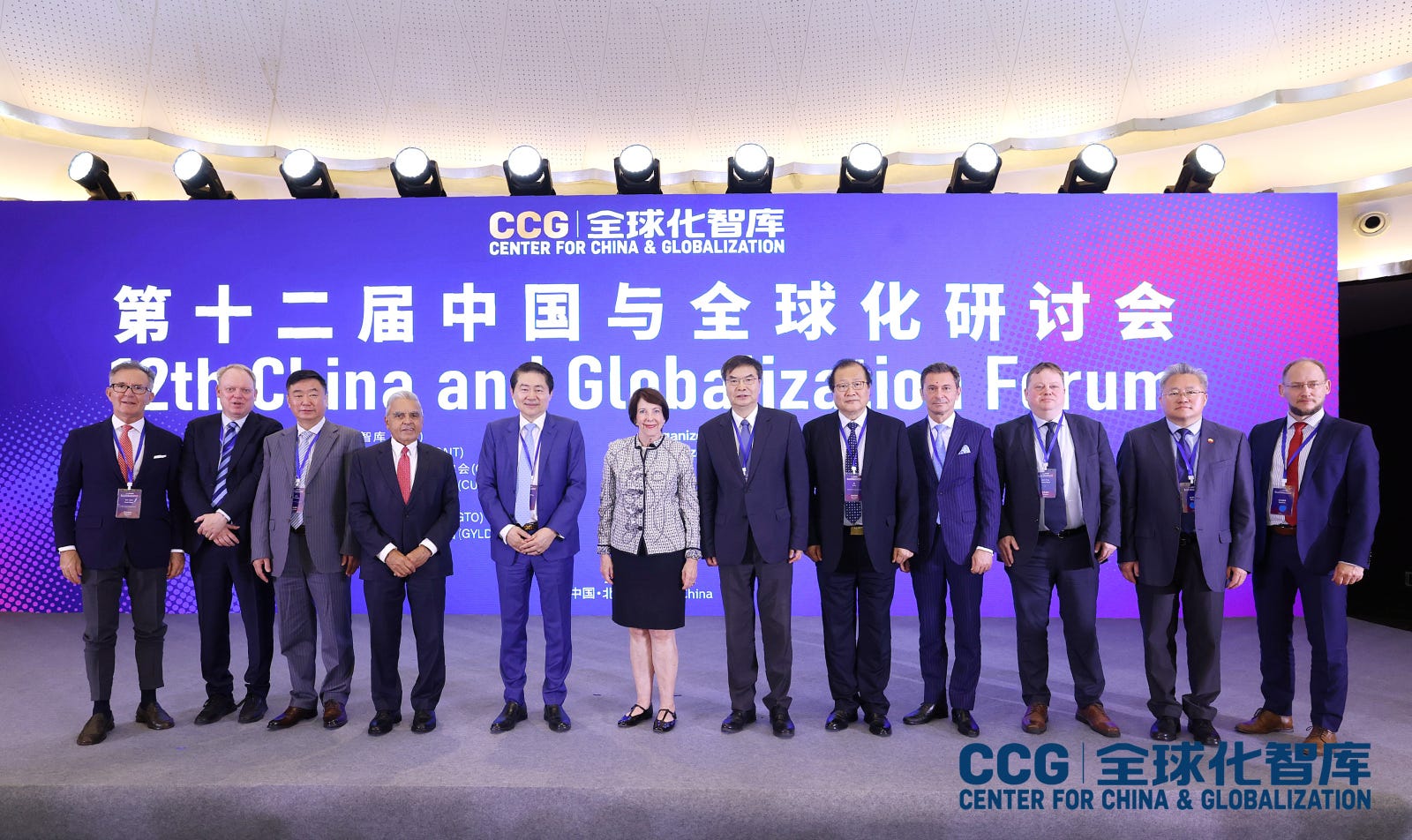
The session then featured keynote speeches from:
Mohamed Amersi, Founder and Chairman of the Amersi Foundation;
Da Wei, Director of the Center for International Security and Strategy (CISS) at Tsinghua University;
Ma Jianchun, President of the China Society for World Trade Organization Studies (CWTO);
Jens Eskelund, President of the European Union Chamber of Commerce in China (EUCCC);
Lu Ruquan, President of the Economics and Technology Research Institute at China National Petroleum Corp (CNPC);
Paolo Magri, President of the Advisory Board of the Italian Institute for International Political Studies (ISPI).
Kishore Mahbubani, Distinguished Fellow at the Asia Research Institute, National University of Singapore and former singaporean ambassador to the United Nations;
Oliver Lutz Radtke, Sinologist, Author and Strategic Advisor;
Susan Shirk, research professor at the UC San Diego School of Global Policy and Strategy, director emeritus of its 21st Century China Center, and former Deputy Assistant Secretary of State in the Bureau of East Asia and Pacific Affair, U.S. Department of State;
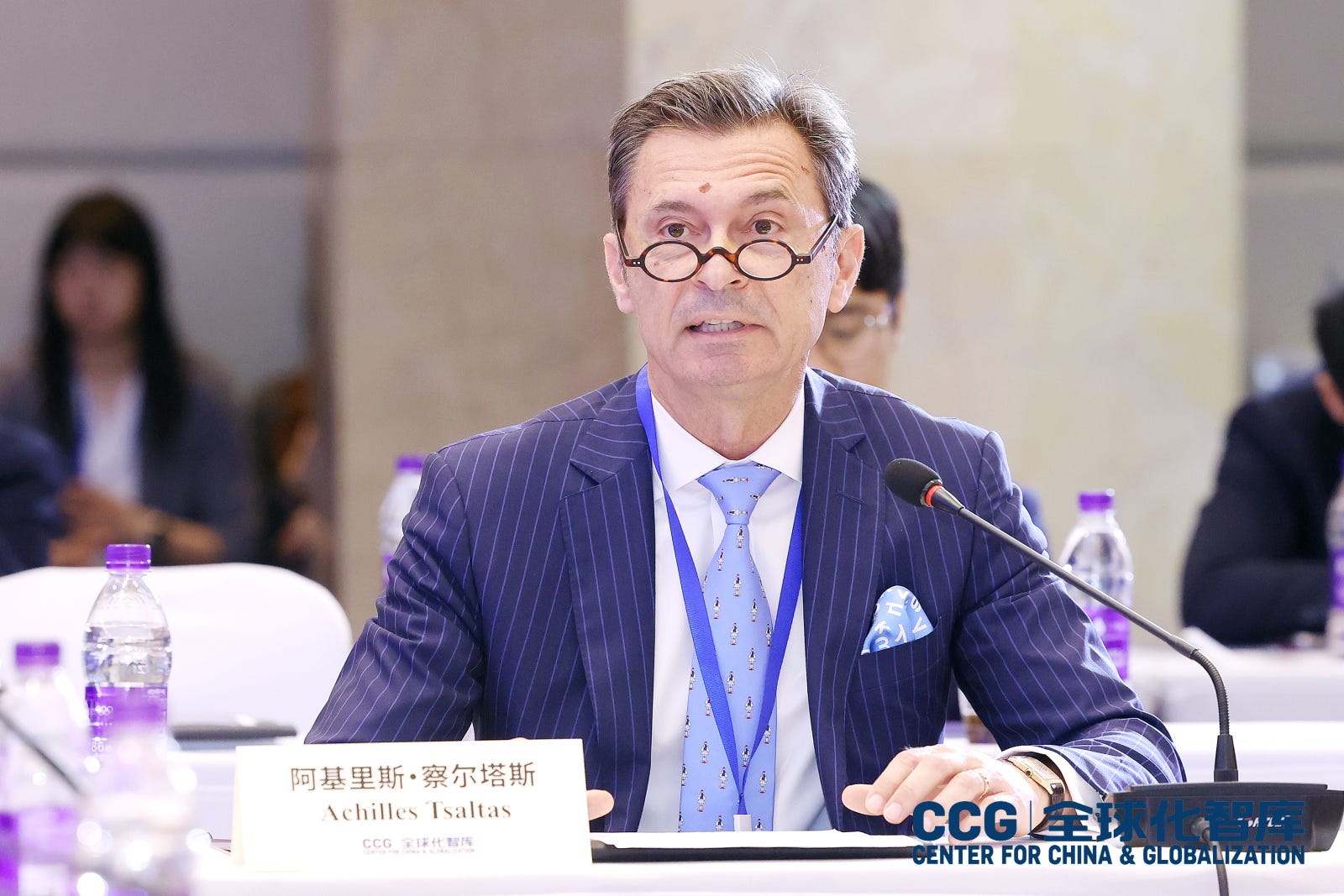
Achilles Tsaltas, President of The Democracy and Culture Foundation, Athens;
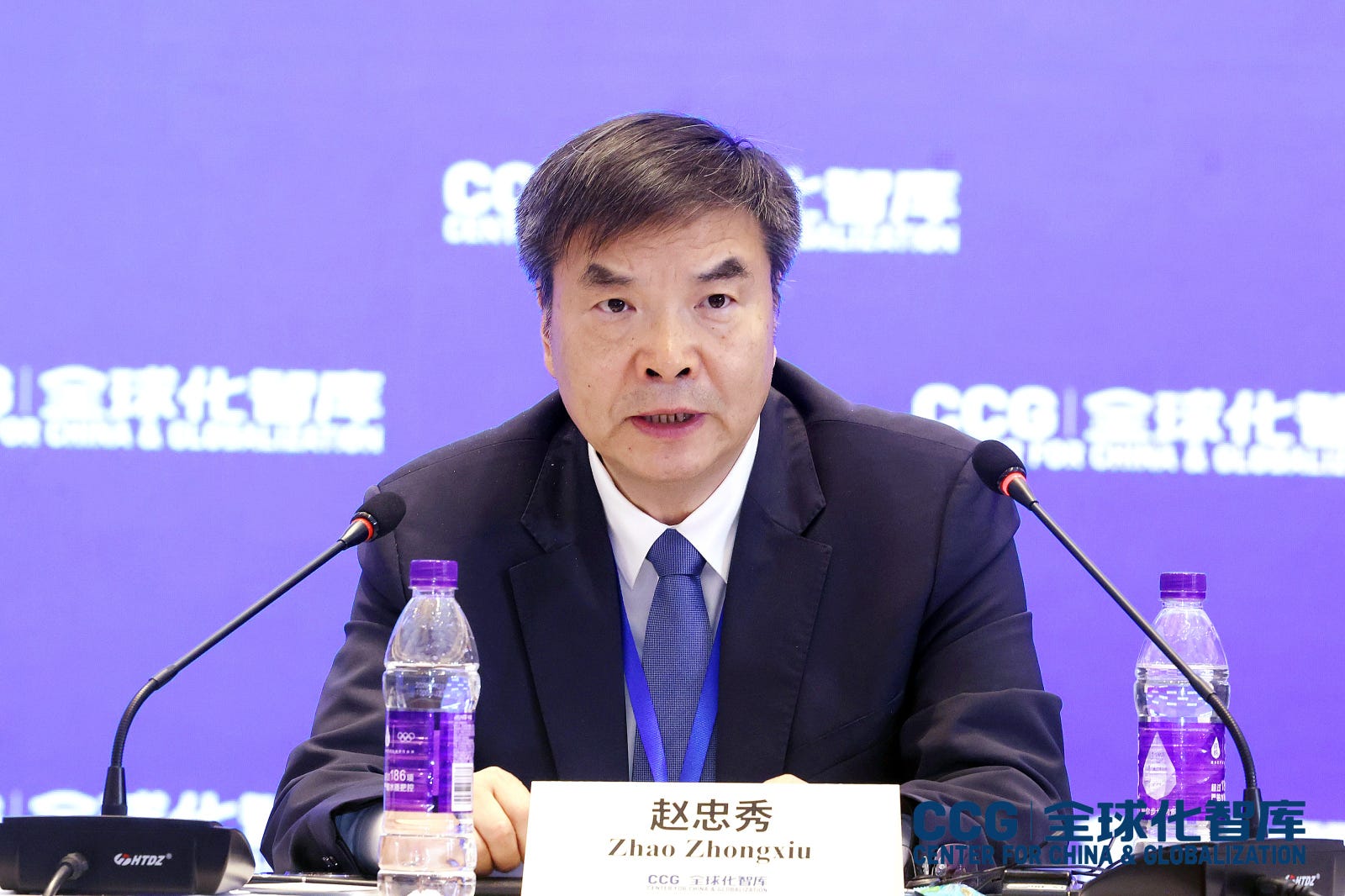
Zhao Zhongxiu, President of the University of International Business and Economics;
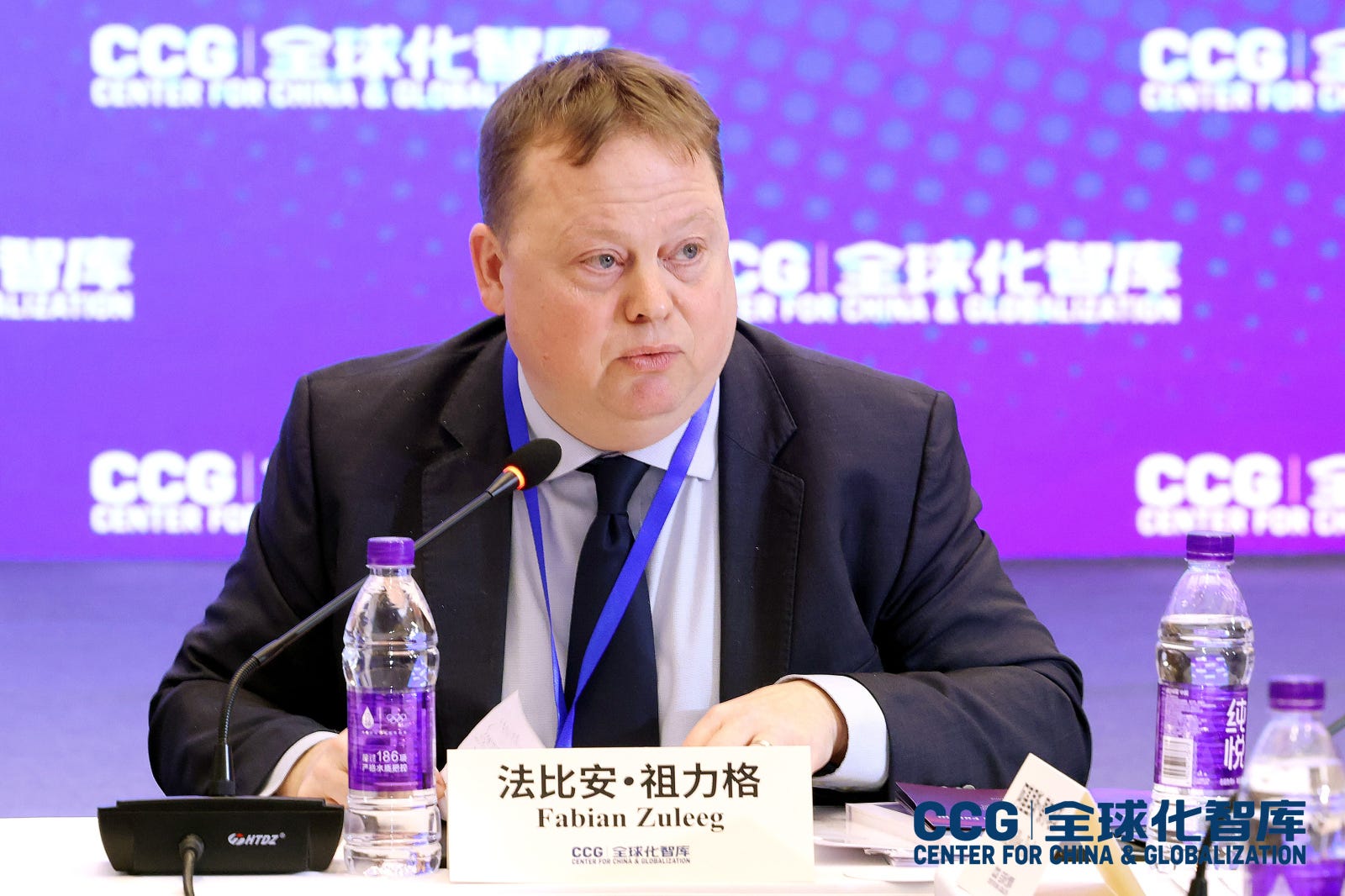
and Fabian Zuleeg, Chief Executive and Chief Economist of the European Policy Centre (EPC).
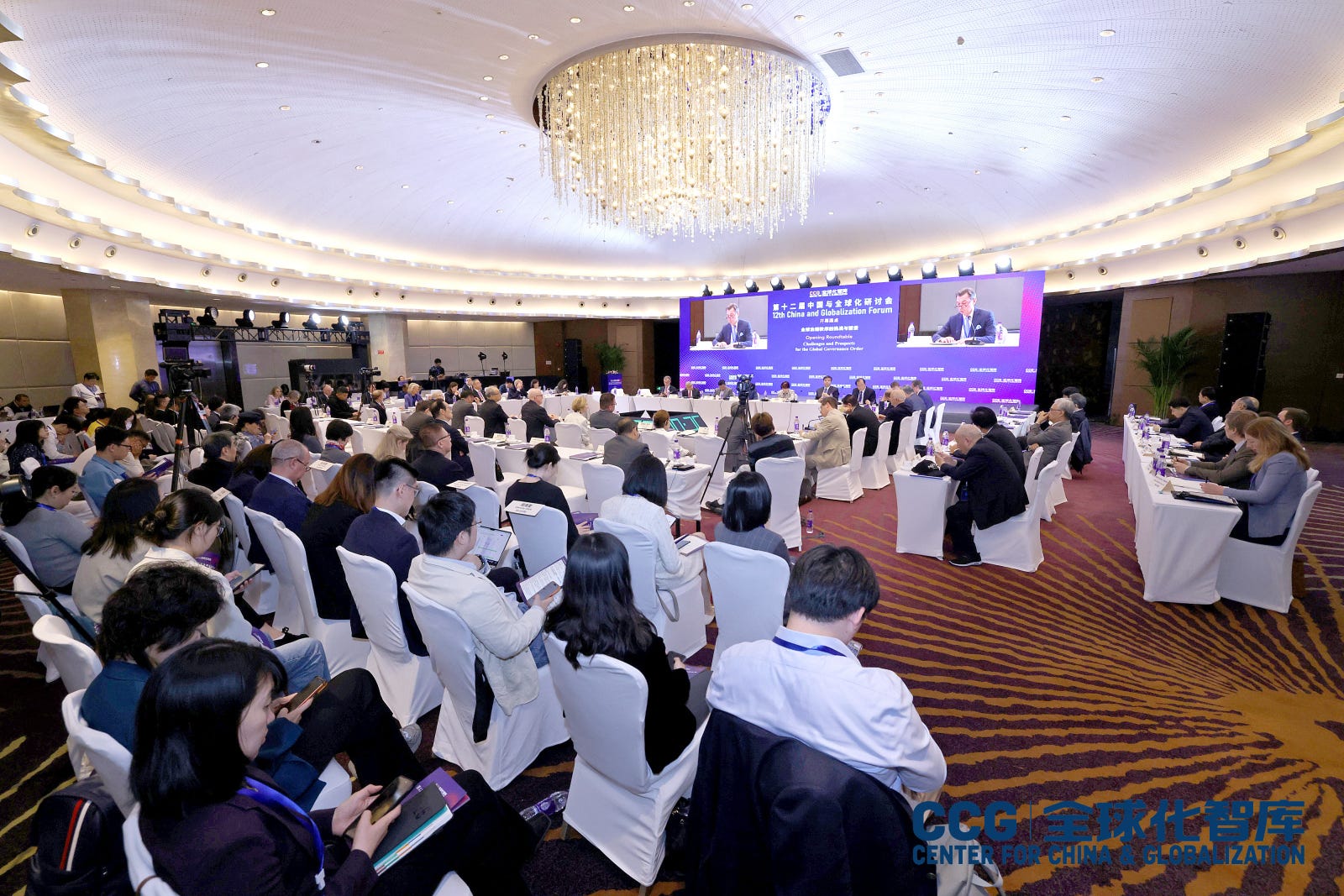
CCG has broadcast the video recording of the opening roundtable on Chinese social media platforms and uploaded it to its official YouTube channel.
This transcript is based on the video recording and has not been reviewed by any of the speakers.
Henry Huiyao Wang, Founder and President, Center for China and Globalization (CCG)
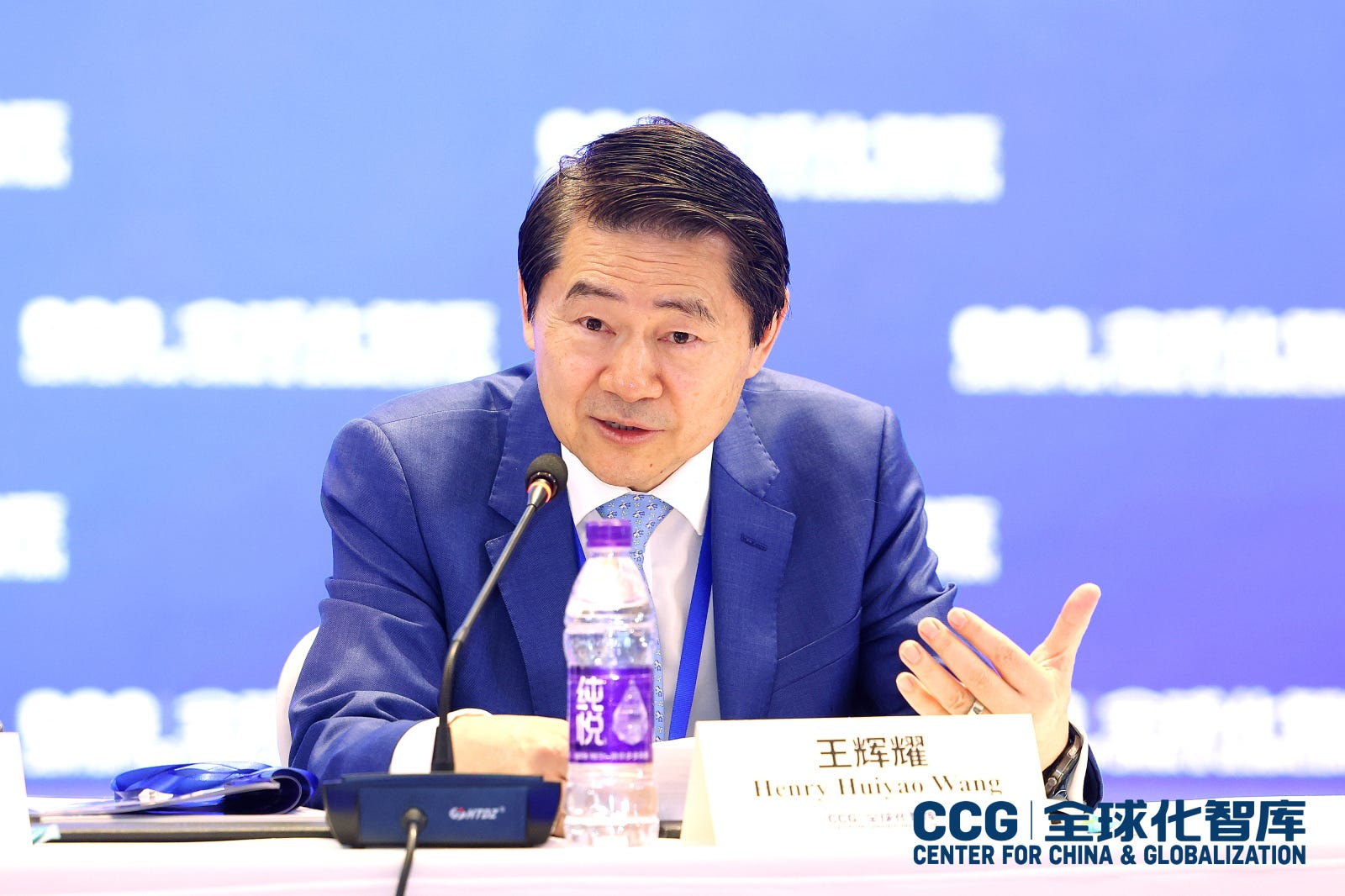
We’re going to start our opening roundtable on challenges and prospects for global governance — which I think is a very timely subject. We have heard from our keynote speakers at the opening this morning. We noticed that it’s really a very challenging world we’re facing. Also, the 80 years of a global governance model that we’ve been getting used to is under a lot of stress now. CCG just went to Washington. We attended the IMF-World Bank Spring Meetings and a number of meetings there and in New York as well. We find that this is a subject often talked about. We also just came back from Greece, the Delphi Forum, where this too was a highly discussed subject.
So our opening roundtable panel will dive deeply into the current status of the international rules-based order, the structure of government relations, and of course the interaction among nations. With hopefully all the robust debate and discussion we gather here, hopefully we can get some constructive recommendations and messages for all the relevant governments and international organizations, particularly the system that we have had for the last 80 years, which the U.S. led and designed. Now we’re going to see how that is going to match the multipolar world that is emerging, where there is no system that is really cohesively working well. So this is the challenge: how to maintain the UN, international agencies, and working relations among governments. This is what we’re going to discuss today.
There are a number of issues we hopefully will discuss: what’s the latest development, the crisis we’re going through that impacts everybody. We have many talking points now. The war is still going on, and how international organizations can actively work on that, and how governments can proactively prevent situations from deteriorating, and how to safeguard the common comeback for the challenges we are facing: climate change, sustainable development, eco-development, lifting poverty, and all those global issues. AI is also another issue — global data challenges. Recently we established a World Data Organization. So how we are going to tackle those newly found challenges is enormously important, and particularly how to get out of this crisis.
We have many issues that we’ve been going through this morning, and I would like to mention the distinguished panelists we have gathered here. Among them we have Da Wei, Director of the Center for International Security and Strategy, Tsinghua University; we have Jens Eskelund, President of the European Union Chamber of Commerce in China; we have Lu Renquan, President of China National Petroleum Corporation Economic and Technology Research Institute, which is one of the largest energy companies in China and also one of the top-ranking think tanks; we have His Excellency Ambassador Ma Jianchun, President of the China Society for World Trade Organization Studies and former Ambassador of China to The Gambia; we have Paolo Magri from the Italian Institute for International Political Studies, a very famous think tank in Europe; and of course Kishore Mahbubani, Distinguished Fellow at the Asia Research Institute, National University of Singapore, former President of the United Nations Security Council, and also advisor to CCG; we have Oliver Radtke, author and strategic advisor at the University of Vienna; and also Professor Susan Shirk, founding Dean of the 21st Century China Center at University of California, San Diego, but also former Deputy Assistant Secretary of State for East Asian and Pacific Affairs, U.S. Department of State; and Mr. Achilles Tsaltas, President of the Democracy and Culture Foundation, based in Athens, Greece, who just arrived from Greece as well. Welcome.
And we have Professor Zhao Zhongxiu, President of the University of International Business and Economics, one of the most famous universities in China for economics and business; and Fabian Zuleeg, Chief Executive of the European Policy Center, one of the most well-known think tanks in Europe, based in Brussels. This is basically the participants we are having. If we have time, we hope that we can also be joined by other participants. Also we are having Mohamed Amersi, who has now arrived ahead of schedule — he is Chairman of the Amersi Foundation, based in the UK. So we have all the active participants at this roundtable.
Now I’d like to open this roundtable with perhaps Mohamed Amersi, because you just came this morning but also you were at the Delphi Forum and you’ve been in other forums. I know you’ve been in a number of forums. Originally you are from Iran but now you live in the UK. So what’s your latest take? Let’s have everyone speak around five minutes and then we start.
Mohamed Amersi, Founder and Chairman, Amersi Foundation
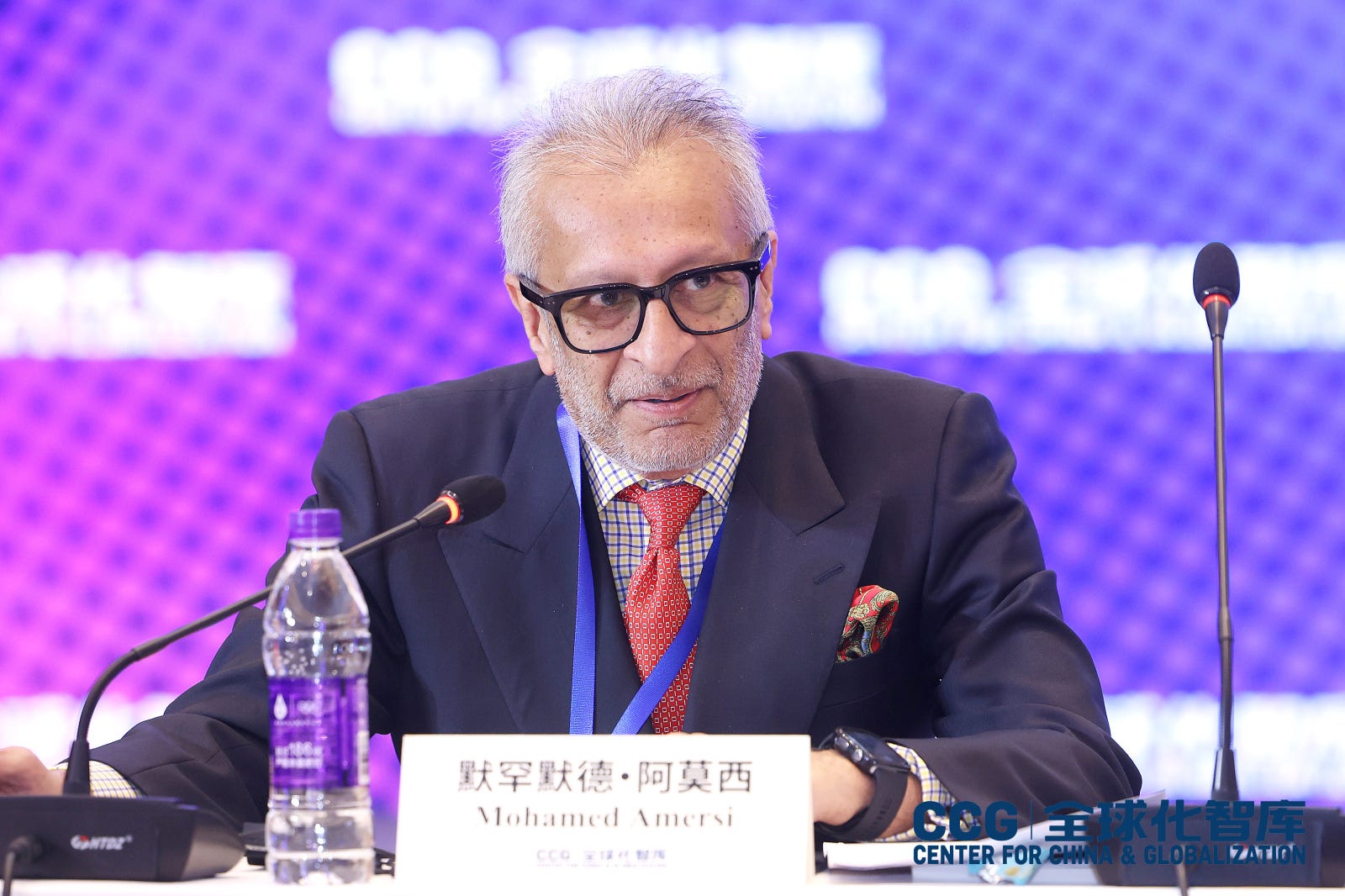
Thank you very much, Henry and Mabel, for having me here. When your surname begins with an A, that’s both a curse as well as a blessing, because you can start first, say what you want, and then others may have to change their speeches. But thank you very much. In my view, the emerging global order — if I can use an analogy — resembles a newborn. Its DNA is already set by technology, demography, and power shifts. But its personality will depend on how it is raised.
Continuing on this analogy, we are witnessing not the collapse of one order alone, but the painful birth of another. This new world order is being born like a child in difficult labor, amid blood, noise, uncertainty, and danger. The old order is dying, but the new one is still an infant. It is weak, unstable, and not yet able to stand on its own. Today’s wars, sanctions, and rivalries are the new contractions of history preceding a new geopolitical birth.
The most likely future is not a single world government or a clean new Cold War. It is a fragmented multipolar transactional order. My seven quick predictions: First, the U.S.-led liberal order will not disappear, but it will shrink. Second, China will not replace America as the sole global hegemon. Third, middle powers will matter more. Fourth, global governance will be more issues-based. Fifth, economics will be weaponized. Sixth, democracy versus autocracy will matter, but interests will matter far more. Seventh, what we see now in the Middle East will become a test case. The bottom line is that the future order will be multipolar in power, fragmented in rules, regionalized in security, digital in control, and transactional in diplomacy. The winners will be states that can hedge, manufacture, innovate, control strategic resources, and avoid becoming battlefields for bigger powers. Thank you very much.
Henry Huiyao Wang
Okay, great. Thank you, Amersi, for your precise seven-point summary of global governance challenges and opportunities. This is really interesting — a good start. So let’s go to Da Wei. He is Director of the Center for International Security and Strategy at Tsinghua University, which is a very active think tank led by Da Wei these days. Please.
Da Wei, Director, Center for International Security and Strategy (CISS), Tsinghua University
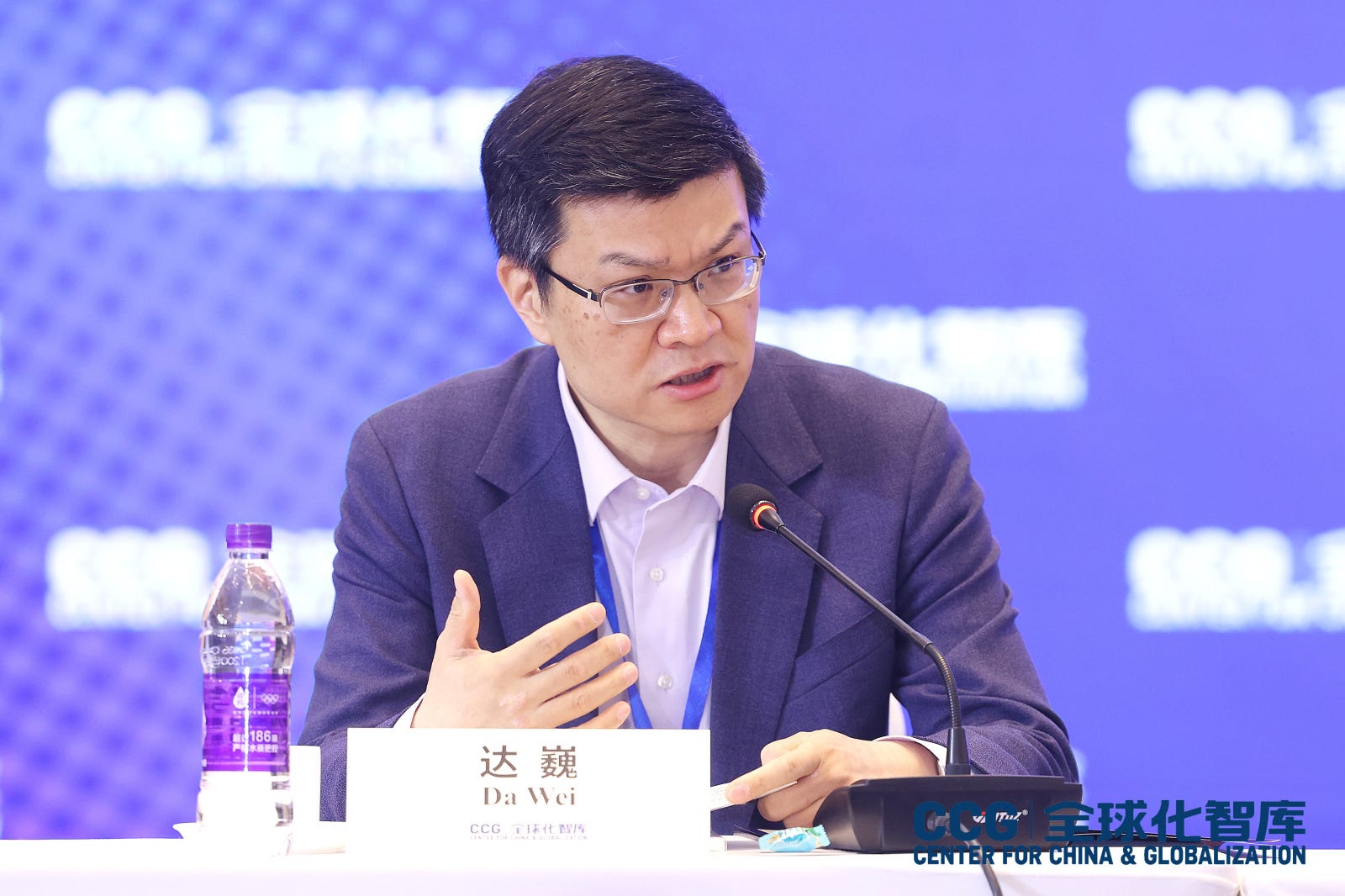
Okay. Thank you, Henry and Mabel, for having me. It’s hard to believe that this is my first time joining this forum. We at Tsinghua — our center actually does very similar work as CCG. As Henry said to me during the break, we share similar values and vision, the two organizations. So I’m very happy to be here. After Mr Amersi’s very brief but enlightening remark, I decided to change what I’m going to say — as you predicted.
On the international order, I think obviously we are now already in a new situation or new order. In China we always say this is a transitional order. I don’t like that judgment — we always say from the 1990s we are in the transitional order. But actually now, when we look back, I think it’s quite clear that after the end of the Cold War, it was an order that — I sometimes use a metaphor — the international global governance order is like a table with one leg. It’s a multilateral platform or table supported by a unipolar structure behind it or beneath it. So now obviously that has ended.
There are many other propositions, many suggestions. Some people say bipolar, some people say G2, some people say middle-power solution. I think all these are kind of impossible. I think we are seeing an emerging order. I think it’s a China-U.S. coordination plus regional and plurilateral organizations. All together, these two poles — which are probably the most powerful, China and the U.S. — on the one hand, whether they can coordinate, whether they can rebalance their relationship; at the same time, the plurilateral and regional organizations are playing their role. So these two things, I think, together are forming a kind of evolving international governance order.
China and the U.S. — we have this potential, we have this possibility to rebalance our bilateral relations, to make the content of our bilateral relations from the one produced during the era of globalization into the one that is workable in the multipolar time of today. President Trump is going to visit China very soon, and the two leaders probably will meet each other multiple times this year. I think this is the best opportunity for the two countries to give up their respective grievances and anger in the past 10 years and try to think how we can make the content of our bilateral relations rebalanced and reach a new equilibrium, no matter on the economic side or on the security side.
At the same time, I think I agree with Mr Amersi: liberalism has of course been shrinking and it’s kind of collapsing, but I think the remains of the liberal principles and many organizations’ actions are still there. So countries need to work together. There are many functional organizations and also regional ones that are still working, and they are going to work in the future. So we should not be too pessimistic about that. With these two countries’ collaboration, coordination, plus more international arrangements, I think we are seeing the emergence of a new order. The old one was kind of a liberal system, but now I think we are having the basic principle that I call “liberalism under the restraint of realism.” With that, I will end my remark. Thank you, Henry. Thank you very much.
Henry Huiyao Wang
Great. Thank you, Da Wei. You’re right. I share some of your optimism as well that global governance still, one way or another, is still going. For example, we see the rise of middle powers too, and we see models like RCEP, CPTPP — they’re taking on the regional front and are still pushing for global governance at the regional level. Those are really good signs. And I think of course now Europe, China, U.S., Global South, India, and all countries that are middle powers — we need to find a way to sustain global governance.
Now I would like to have His Excellency Ambassador Ma Jianchun. He is President of the China Society for World Trade Organization Studies, and the China Society for World Trade Organization Studies is an organization under the Ministry of Commerce and is a pioneer of China’s WTO studies, particularly on global governance. So Ambassador Ma, please.
Ma Jianchun, President, China Society for World Trade Organization Studies
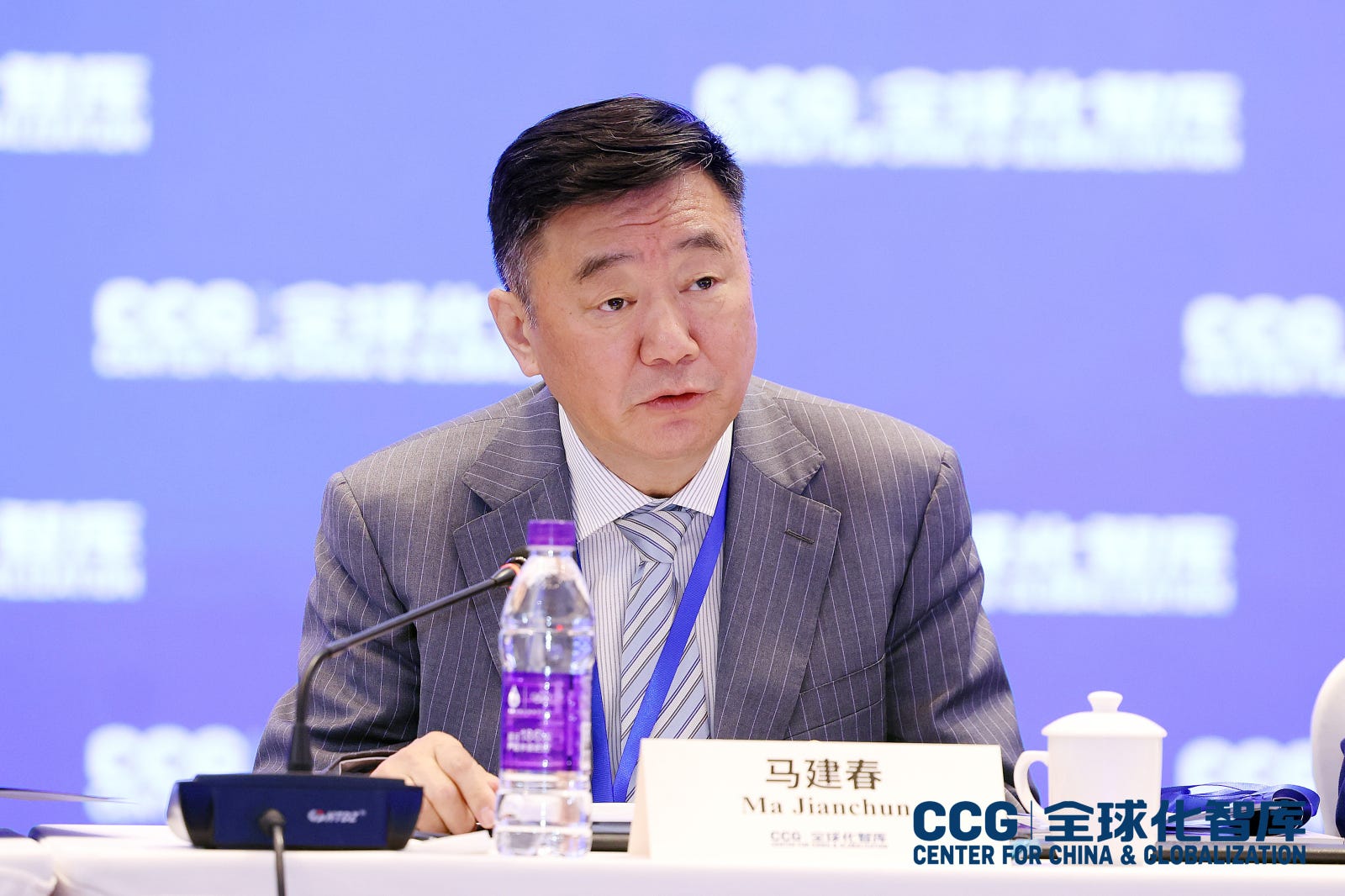
Thank you, Henry. Good morning, everyone. It’s my great pleasure to have this opportunity to participate in this globalization forum today. The topic of the roundtable is challenges and prospects for global governance. I would like to share some views with you. Over the past decades, economic globalization has promoted the global flow of capital, technology, people, and goods, and promoted the unprecedented miracle of global economic growth. Of course, we should also admit that economic globalization in the past few decades has also had some negative effects. That’s why in recent years economic globalization has encountered headwinds and unilateralism and protectionism has risen. Global economic development and international cooperation are facing challenges, and the global governance system is also facing challenges.
I’m from the China Society for WTO Studies — CWTO for short. I would like to talk about some views on global trade development and global trade governance. I believe that despite the challenges of economic globalization, we should still adhere to free trade and the multilateral trading system. Recently, our society organized several workshops and invited experts and professors to discuss issues related to the multilateral trading system after the MC13. We discussed the issue, and we reached consensus on issues such as free trade, fair trade, and managed trade. I would like to introduce some views, some ideas from our discussion.
We believe that we should adhere to the principle of free trade because free trade has both theoretical basis and achievements from the practice of global economic activities. The principle of free trade contributes to the stability of the global trading system and ensures the continuous advancement of economic globalization. The so-called fair trade and managed trade lack theoretical basis and unified rules. It can easily form mutual accusations or even trade wars between different economies.
So how can we ensure the smooth progress of global free trade? We need a mature multilateral trading system that can ensure the smooth progress of global free trade. We should maintain the multilateral trading system with the WTO as its core. The multilateral trading system, from GATT to WTO, is based on free trade. Before GATT, you know, there were different forms of protectionism and trade barriers between different countries, different economies. GATT and later the WTO not only advocated for free trade but also established some rules like MFN and some other rules, thereby reducing global trade tariffs and promoting the development of global trade. We have some statistics — I don’t want to mention here — that just as economic globalization has been questioned, the multilateral trading system now is also being challenged.
In recent years, the development of the WTO has encountered a series of problems, such as the lack of formulation of rules, the lack of management of rules, and the lack of supervision of rule implementations, because some members do not support the WTO. Some trade rules cannot be implemented, and some new trade rules couldn’t be formulated. The main thing is that some members have lost — are losing — their confidence and patience and are seeking rules outside of the WTO.
So, in the next step, we should adhere to multilateralism and support the multilateral trading system. It’s not easy, but we are facing challenges. We should discuss this matter at forums like today. We are here to make this point of view. We hope that we can do something together to support and maintain the multilateral trading system. Thank you very much.
Henry Huiyao Wang
Thank you, Ambassador Ma. Yes. Absolutely. I think free trade for the last 80 years, since the Bretton Woods system, has really changed the world. Trade has gone up several hundred times and GDP several hundred times. Even as trade friction and tariff restrictions are going on, we still see global trade explosively developed, which also helps lift billions of people out of poverty. And I think we have some adjustment, but I hope that the WTO is still going to continue. As we see the 14th Ministerial Conference in Cameroon recently, the liberalization of digital trade, anti-plastic pollution, and quite a few initiatives — plurilateral agreements are still going on. So hopefully we’ll continue that.
Now I would like to invite a business perspective — I saw we have Mohamed Amersi, but let’s have Jens. He is President of the European Union Chamber of Commerce in China and also a businessman representing one of the largest shipping companies in the world. Jens.
Jens Eskelund, President, European Union Chamber of Commerce in China (EUCCC)
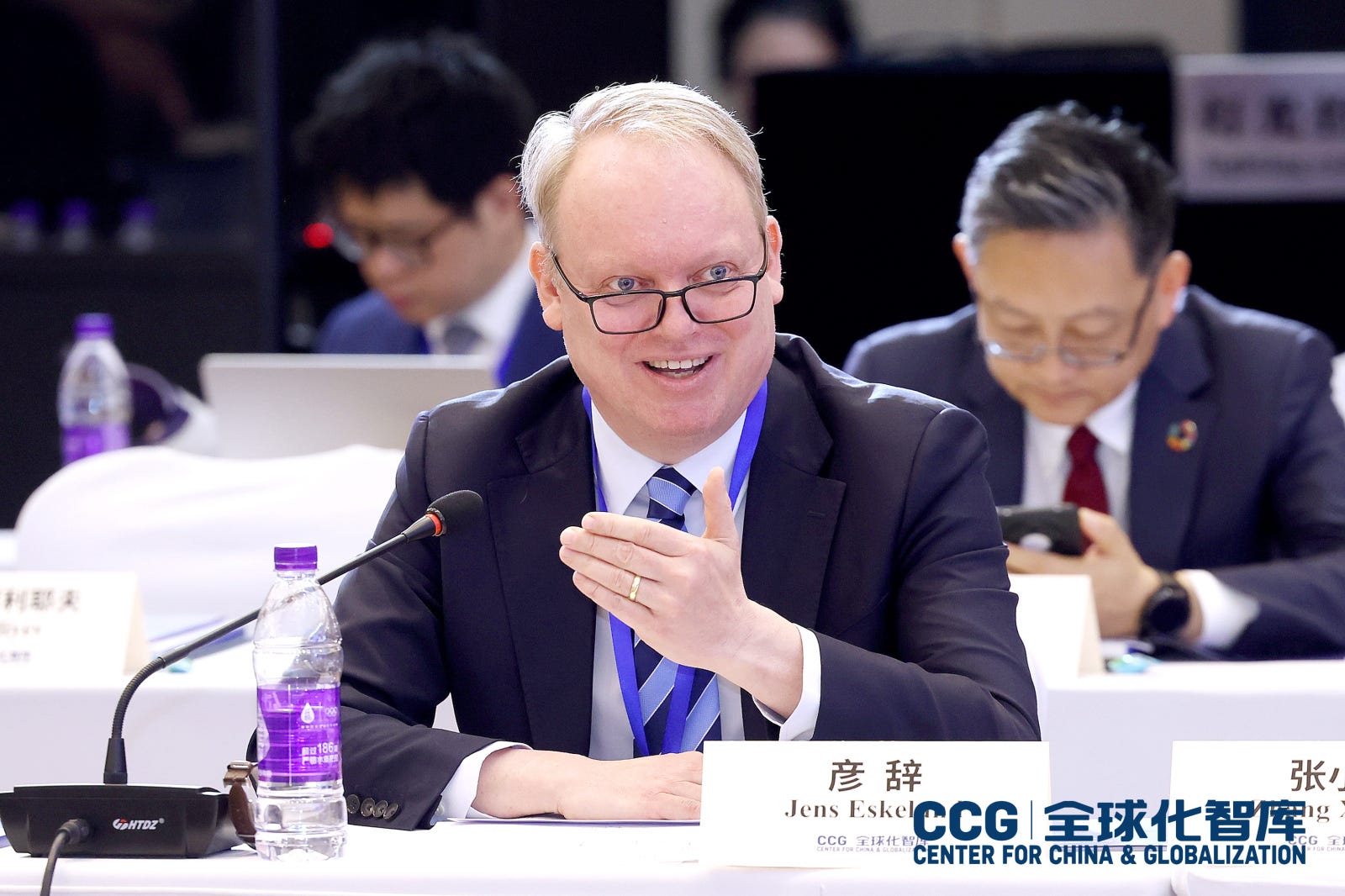
Thank you very much, Henry, and thanks to you and Mabel for this incredible work that you do to enhance dialogue between everyone on a daily basis. I would like first to reflect a little bit on the contribution by Steve Orlins, because I also have a young-person experience from when I just came to China. And I was happy, Mr Ma, that you mentioned WTO, because I think it’s interesting — no one talked about WTO until now. China’s accession to the WTO — we celebrated the 25th anniversary today, on the 12th of December, of China’s accession. That is the single most impactful event in the history of trade in the world. So good, M. Ma, that you brought this up.
But I remember when I came, a very young man, very junior person in Maersk, but somehow I was invited into the MOFTEC [Ministry of Foreign Trade and Economic Cooperation] as it was called at that time. I was sitting way back at the end, and up front, far away, I could see Pascal Lamy, I could see Charlene Barshefsky, and I could see Shi Guangsheng. It was amazingly big problems that they had to resolve, but everyone was so committed to see this through. Everyone wanted this to happen, and the energy in the room and the determination, I think, was one of the biggest experiences that I had in these early years. And I hope, maybe going back to Susan Shirk’s comments about looking for solutions, that maybe this is something that we need to reach back to — that spirit, focusing on that, even though the difficulties are big, then maybe there are actually solutions to be found.
But there’s no doubt about it: it has become more difficult to do business, in particular over the past year. We have had this trade war, tit for tat, and one thing we haven’t talked about today also is the export controls on rare earth and magnets, which have had a very, very significant impact on global businesses. And I think there are many parties responsible here. Of course, we had the U.S. with the Liberation Day tariffs antagonizing much of the world. And you know, I’m from a small country, and the whole Greenland thing did not do much for Denmark-U.S. relations.
But also here in China, I think we have seen that the way that China conducted trade — and I hope, Mr Ma, that the government also listened to your comments about free trade, because sometimes we need more of both free and fair trade — but we have seen now that China is a place that accounts for 37.5% of all containers exported in the world today. Every day, every time China imports one container, it exports 4.5 containers. We have never seen such imbalances in the world before. And I think what is unique this time around is that we have a rising economic power like China that, because it’s very good at manufacturing, has achieved to export much more. But it’s unique in the sense that it basically has not increased its imports. When you look at G20 countries, pretty much every country that exports manufactured goods to China has seen double-digit decreases in its exports over the past five years. And that also has a lot to do with industrial policy in China and the whole thinking about self-reliance in the five-year plans and dual circulation.
But coming from a small country like Denmark, we do feel very exposed. And I think one thing that is beginning to become clear to the rest of the world in the discussions that I hear when I travel outside the U.S. and China is that people are beginning to remind themselves: hang on, wait a minute, 70% of incremental global economic growth in the next five years is going to come from countries outside the U.S. and outside China. It’s a big world out there. And back to what other speakers have mentioned about multipolarity: given the way that all these things are shaping up, with tit-for-tat trade or even worse mercantilist trade practices, countries that are not big countries, that are not the United States and China, are beginning to consider their options.
But that brings me back to where I started: maybe we can reach back to that spirit that we saw back in December 2001. I think we should never let go of the hope that we will find solutions. I think that everyone needs to remind themselves that small countries, medium-sized countries also have legitimate concerns which should be accommodated if possible, and also don’t force the rest of the world to take sides. We prefer not to. Thank you very much.
Henry Huiyao Wang
Thank you, Jens. Absolutely. We don’t need sides taken, particularly for the U.S. and China among other countries. We need to work together, because I think the two largest economies have to really improve what we have done in the past, not topple that, not probably undo things that we’ve been doing successfully. Of course, we need a lot of improvement and adjustment. And you’re right — all the rest of the world, which has a large chunk of global trade, is still flourishing, and we need to support that.
Now I’d like to invite Mr. Lu Renquan. He is President of China National Petroleum Corporation Economics and Technology Research Institute, which is China’s top-ranking energy think tank. And now with the energy crisis going on, we see many airlines cancelling flights, air tickets getting so expensive. Your sharing would be very timely.
Lu Ruquan, President of the Economics and Technology Research Institute at China National Petroleum Corp (CNPC)
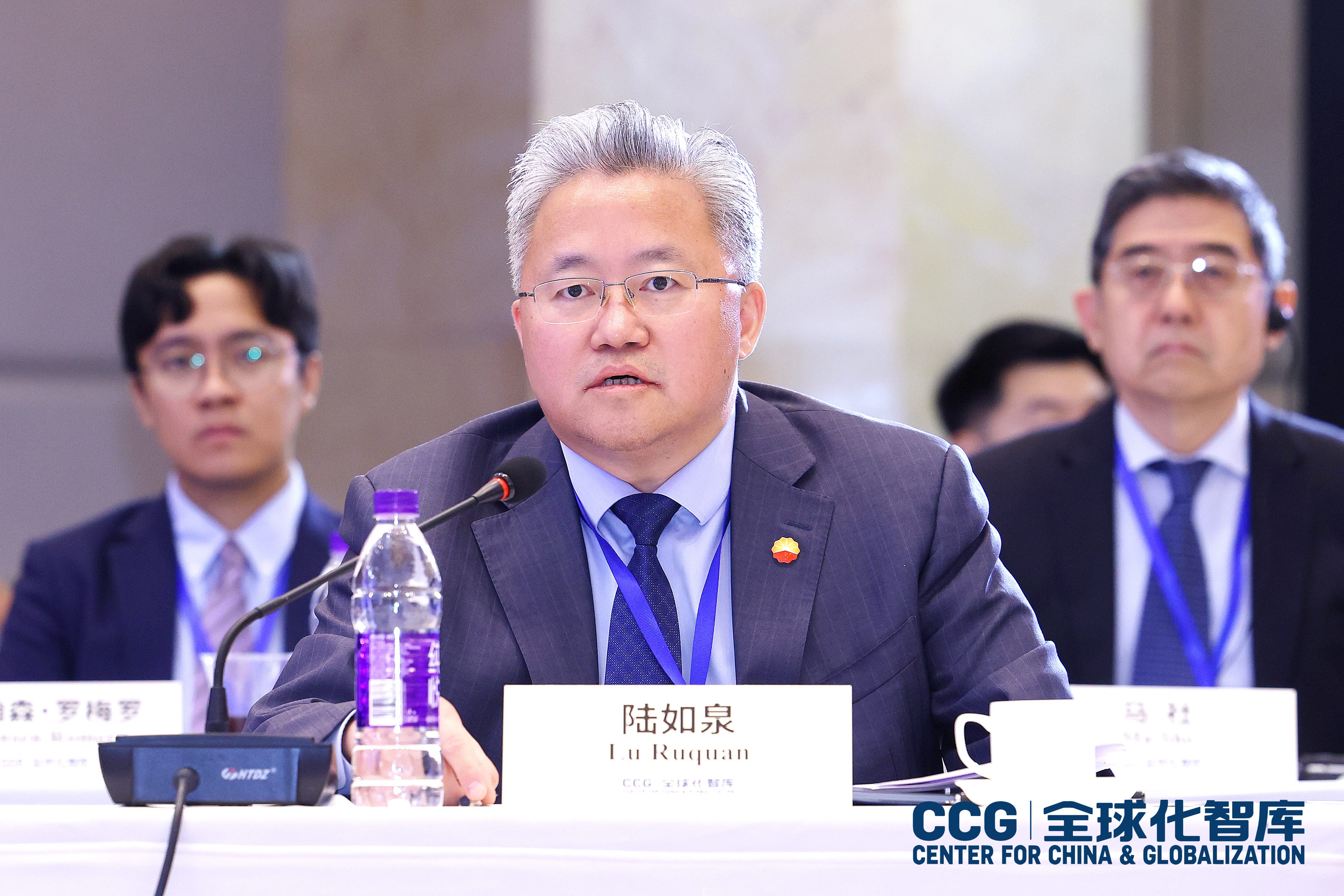
Thank you, Henry. I will talk about global energy governance amid the current big energy crisis happening in the Middle East, and also about the role of China’s planning in the future. I will talk about a few comments or viewpoints.
First, we actually are witnessing the largest energy crisis because of the shutdown of the Hormuz Strait, and also because of the war between the U.S., Israel, and Iran. We found one-third of the crude oil transportation — I mean the maritime — has been blocked. And also, among the one-third of the volume, one-third is toward China and another almost 40% is towards Asian countries. So we will see that Asian countries right now are the epicenter of this largest energy crisis.
The second point is that, from the perspective of international organizations, we have seen that the OECD countries and also, let’s say, on behalf of the IEA, actually the IEA took the initiative to save this market. And the big action is that the IEA issued about 400 million barrels of oil equivalent to save the market. However, it is not enough. It is not enough. Actually, the 400 million barrels is double the volume of the last time, which was four years ago when the Ukraine war happened.
And what about OPEC? We know that OPEC actually in the past was a strong partner in oil and gas pricing, and especially within the last 10 years they have OPEC+ — that is OPEC plus Russia. They actually used to increase production when the price is higher and decrease production when the price is lower, to be a swing producer in the world, playing a good role. However, this time OPEC suffered a lot, especially the Gulf countries, the GCC countries and Iraq, because of the shutdown of the Hormuz Strait. And the upstream production exploration has been shut down as well. So as far as we observed, 80% of the Iraq production was shut down, and almost all the production in Qatar and in Bahrain and in Kuwait was shut down. However, Saudi Arabia is a little bit lucky because it has the pipeline, the east-west pipeline, to hedge the shock of the Hormuz Strait.
So this is what we see of OPEC and the IEA’s performance. What about the main countries? We see the U.S. — they try to improve their domestic production, because the U.S. right now is the largest oil and gas producer and also the largest natural gas exporter. So both the U.S., Canada, and some other Latin American countries, they try to improve their production to meet the gap. But it is not enough, because according to our evaluation, at most about two million barrels per day was put into the market. It is not enough to compensate the about 10 million barrels per day of shortage.
And what about Russia? Russia right now is happy because the oil price is going up, and also Russia’s oil and gas can be put into the oil market to save the market, and can be exempt from the sanctions, because we know that in the past couple of years oil and gas of Russia was sanctioned by Europe and the U.S.
Then what about China? So actually, to most people’s expectation, China is a lucky island amid this crisis. The reason behind that is we have new energies and we have electrical vehicles replacement. And in the month of April, actually the penetration rate of EV has reached about 60%. That is a huge — that is the highest penetration rate in the world. Second, we have strong reserves. And the third, we have diversified, balanced, and hedged importing channels. And then the fourth, China is the sixth-largest oil producer and the fourth-largest natural gas producer. So we have our oil and gas in our hand.
So what about next step? I think China in the global energy governance market should play at least roles below. One is the stabilizer — as a supply stabilizer to cooperate with other partners. The second is connecting bridge — that is, provide a typical platform, especially the BRI, to play the role of interconnection. The third is to be the engine of innovation, especially in new energy, the supplier of electrical vehicles and AI for energy. That’s all for my sharing. Thank you.
Henry Huiyao Wang
Great. Okay. Thank you, Minister Lu. Actually, quite encouraged to hear that China’s EV has penetrated over 60%, which is enormous diversification that China has now engaged in. And also I agree that this energy crisis we need to solve very quickly. And I’m also very glad to see China’s Foreign Minister Wang Yi has spoken with over 30 ministers and counterparts in the last months for this Iranian-Israel-U.S. crisis. And hopefully we see that upcoming visit of President Trump in Beijing, maybe we could see some solution by then.
So thank you again, Mr Lu. Now I’d like to invite Paolo Magri. He is President of the Italian Institute of International Political Studies, a very famous think tank in Europe, and has conducted many activities in Europe. I know that ISPI is based in Milan, a very beautiful city, and so we’re very pleased to welcome you, Mr. Paolo. Please.
Paolo Magri, President of the Advisory Board, Italian Institute for International Political Studies (ISPI)
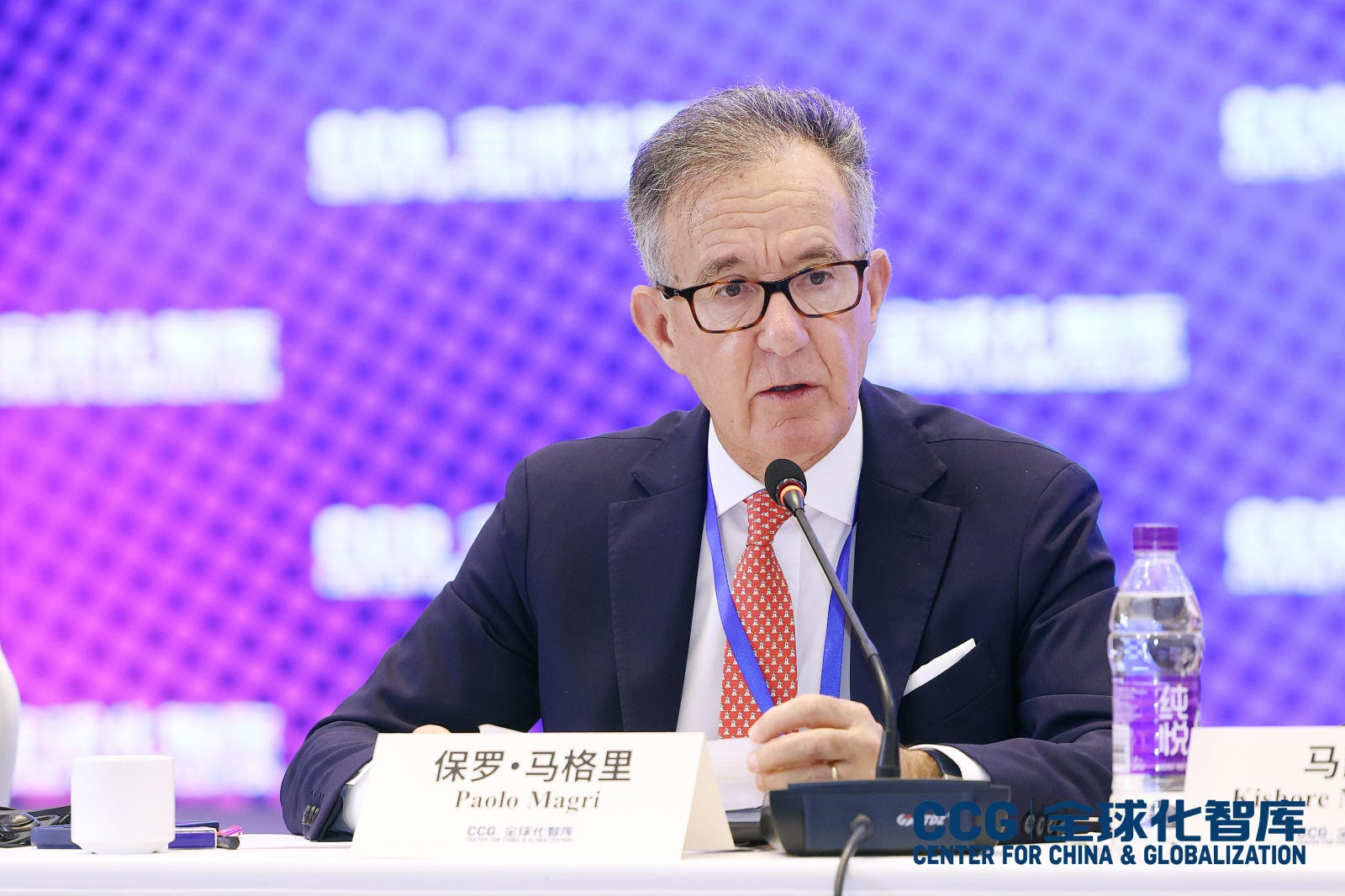
Thank you. Thank you. I’ve been asked to share a few comments on what lessons can be learned from the current crisis: Iran, Ukraine, Gaza, Venezuela — that can inform future approaches to international relations and collective security. I will go immediately to the point. I will have five lessons learned.
First, sanctions without strategy become only strategic noise. Venezuela, Iran, and Russia show that sanctions do not work. And the implication is clear: sanctions must be conditional, reversible, and embedded in diplomatic roadmaps. And this means shifting toward dynamic, reviewable sanction frameworks, and not like the one we have right now.
Second lesson: the age of new mediators has arrived. One of the most important shifts in this crisis is not what is negotiated but who negotiates. Some who were considered troublemakers in the past, are acting now as troubleshooters of the present, with the current troublemakers. And this signals a structural change. Mediation is becoming multipolar and networked, with regional actors being no longer the periphery. The United Nations will need to integrate these actors into hybrid diplomatic architecture rather than compete with them.
Third, the UN is no longer the first respondent in crisis, but it’s not dead. The expectation that the United Nations can lead crisis response in highly polarized conflicts is increasingly unrealistic. But the UN is not dead. Its role is evolving toward legitimate provision, humanitarian coordination, monitoring, and verification.
Fourth, already mentioned by several, there are no solid blocs anymore, but mainly temporary alignments. All alliances today are fragile. Informal alignments — Russia, China, Iran, Venezuela — groupings like BRICS, which lack deep cohesion. Actually, Iran is bombing a few BRICS members. And NATO is facing internal divergencies, with the U.S. threatening your country a few months ago with a possible invasion of Greenland. Collective security must adapt to this reality through flexible, multi-layered cooperation frameworks.
And last one, lesson learned number five: economic and energy warfare is now central, not auxiliary. If Ukraine, Iran, and Venezuela are read together, one lesson is unmistakable: economic and energy are no longer tools of pressure, they are primary instruments of conflict. And this has major implications. States, as someone said already, will increasingly pursue economic resilience as national security. Alliances will need to coordinate not just military but across energy, finance, and supply chains.
To conclude: Venezuela, Iran, and Ukraine don’t just reveal crises but reveal a transformation in international relations and collective security measures. First, the UN will remain in the picture but as a legitimizing and coordinating hub. Second, alliances persist but are more fragile and fluid. Third, new mediators and regional actors are central. Fourth, power itself is shifting from military dominance alone to integrated economic, energy, and political leverage. The challenge is no longer just to prevent war, but to govern competition in a world where conflict is increasingly economic, distributed, and continuous. Thank you.
Henry Huiyao Wang
Okay, great. Thank you, Paolo, for your five-point, very concise and precise, very stimulating and very informative remarks. I think absolutely we still need some new solutions and also we need new players, new mediators, and to strengthen the UN for global governance.
Now I’d like to invite Professor Kishore Mahbubani. I mean, you of course worked in the UN, worked in the multilateral system for a long time, and you probably also have a lot to talk about on these global governance issues. Kishore, please.
Kishore Mahbubani, Distinguished Fellow at the Asia Research Institute, National University of Singapore and former singaporean ambassador to the United Nations
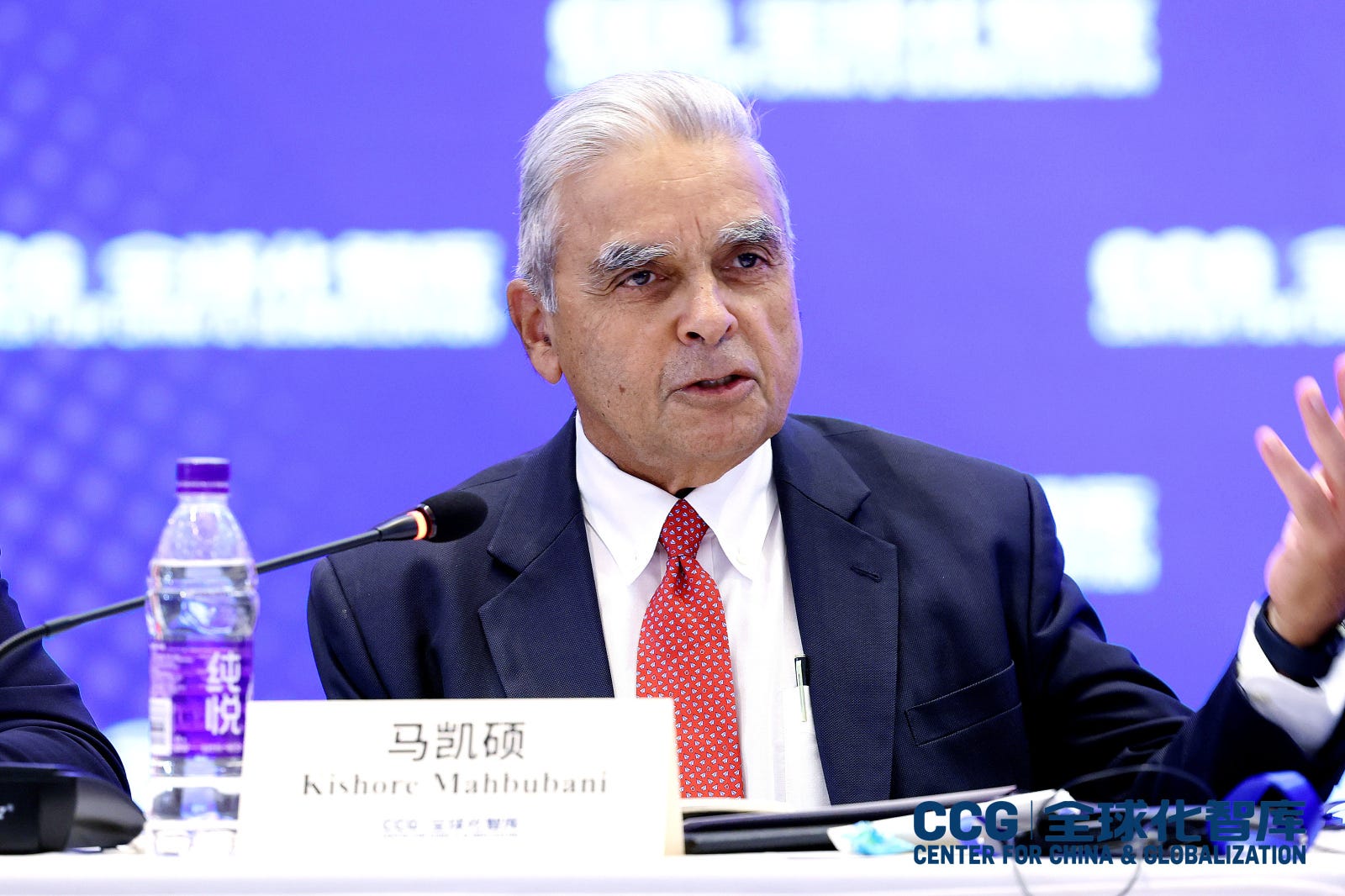
Thank you, Henry. The title of our panel is “Challenges and Prospects for the Global Governance Order”. And if you want to look at the prospects for the global governance order, you have to look at the mother of all global governance institutions, which of course is the United Nations. At the end of the day, what happens to the United Nations is what will determine the future of our global governance order. So for us, the big question we need to ask ourselves today is a very simple question: Is the UN a sunrise or sunset institution? Simple question.
And one can, of course, make the case — especially if you read the Anglo-Saxon media, the Western media, and the way they rubbish the UN — you can make a very persuasive case: yes, it’s a sunset institution. And there are many, of course, sad failings of the UN. And here the first one, for example: I think it’s clear that the world is very disappointed with the performance of the current Secretary-General. He came in with high expectations, but unlike the popes in Rome — Pope Francis and Pope Leo — the voice of the secular pope has been very weak at a time when he should be speaking out more clearly.
At the same time, the UN is facing a financial crisis, serious financial crisis. And as Professor Paolo Magri just mentioned, it’s also failing in its responsibilities in collective security, in preventing wars, and so on and so forth. So one can make a case for why it is a sunset institution.
But I want to make the case for why it is a sunrise institution. And at the end of the day, if we are going to preserve our global governance order, we should recognize why the UN is completely irreplaceable as an institution. And the case for sunrise rests on three points.
First, it’s very clear that we live in a world where the demand and need for stronger institutions of global governance is growing. Why is that so? Because the world has changed. And to explain how the world has changed, I use a very simple boat analogy. Before, when we had 193 countries in the world, as we do, we were living like in 193 separate boats. Each boat had a captain or crew. So each boat was independent. But now the world has shrunk — and this is a literal shrinkage, not a metaphorical shrinkage. The 193 countries are now like 193 cabins on the same boat. And if you are 193 cabins on the same boat, there’s no point taking care of your cabin. Take care of the boat as a whole. And we have to take care of planet Earth. Because you look at every major problem we are facing, whether it’s climate change, whether it’s pandemics, whether it’s global financial crisis, or even now, for example, what’s happening in the Gulf — guess what? Every country in the world is affected. So clearly we need therefore to have stronger global governance institutions to deal with the fact that it’s a new, different world where we are small and interdependent.
And at the same time, this is my second point: if you wanted to create from scratch today a new global governance institution to represent the needs and aspirations of humanity, you cannot create one better than what you have encapsulated already in the Charter of the United Nations. It took a group of remarkably idealistic, seasoned, weathered individuals in 1945 who came together and in a sense that embedded powerful principles of international law into the UN Charter: like respect for territorial integrity, respect for sovereignty, non-interference in internal affairs. And these are the principles that have basically sustained the international order. They’re captured in the UN Charter. And if you throw out the UN Charter, you cannot get anything better. So let’s be very clear why we have to preserve that UN Charter.
And the third and final point I’ll make about why this is a sunrise institution: as you know, if this was a sunset institution, if this boat was sinking, everybody would try to get off the boat and say, “Hey, this boat is sinking. Let me quit. Let me go.” Now, 193 countries in the world — name me one which has quit the UN. Name me one who has left the UN. And not even countries that are censured in the UN. Even Israel hasn’t left the UN. Why? Because the UN, at the end of the day, is indispensable and necessary. Thank you.
Henry Huiyao Wang
Well, thank you, Kishore, for your very concise and powerful argument for a strong multilateral system like the United Nations. Absolutely. I think the United Nations for the last almost 80 years is a remarkable success, and that actually prevented the Third World War, and we hope that will continue. Of course we need to reform the UN. We need to reform the UN Security Council, and also we need to have a new reflection of the Global South into the UN. But absolutely, the UN is the most important institution that mankind has created to safeguard mankind. And I highly agree with you: we are living in a boat of the planet, and we cannot live without each other.
So thank you for that. Now let me invite Oliver Ratke. He is the author and strategic adviser at the University of Vienna to say a few words too. Yes, please, Oliver.
Oliver Radtke, Sinologist, Author & Strategic Advisor, University of Vienna and Shanghai International Studies University
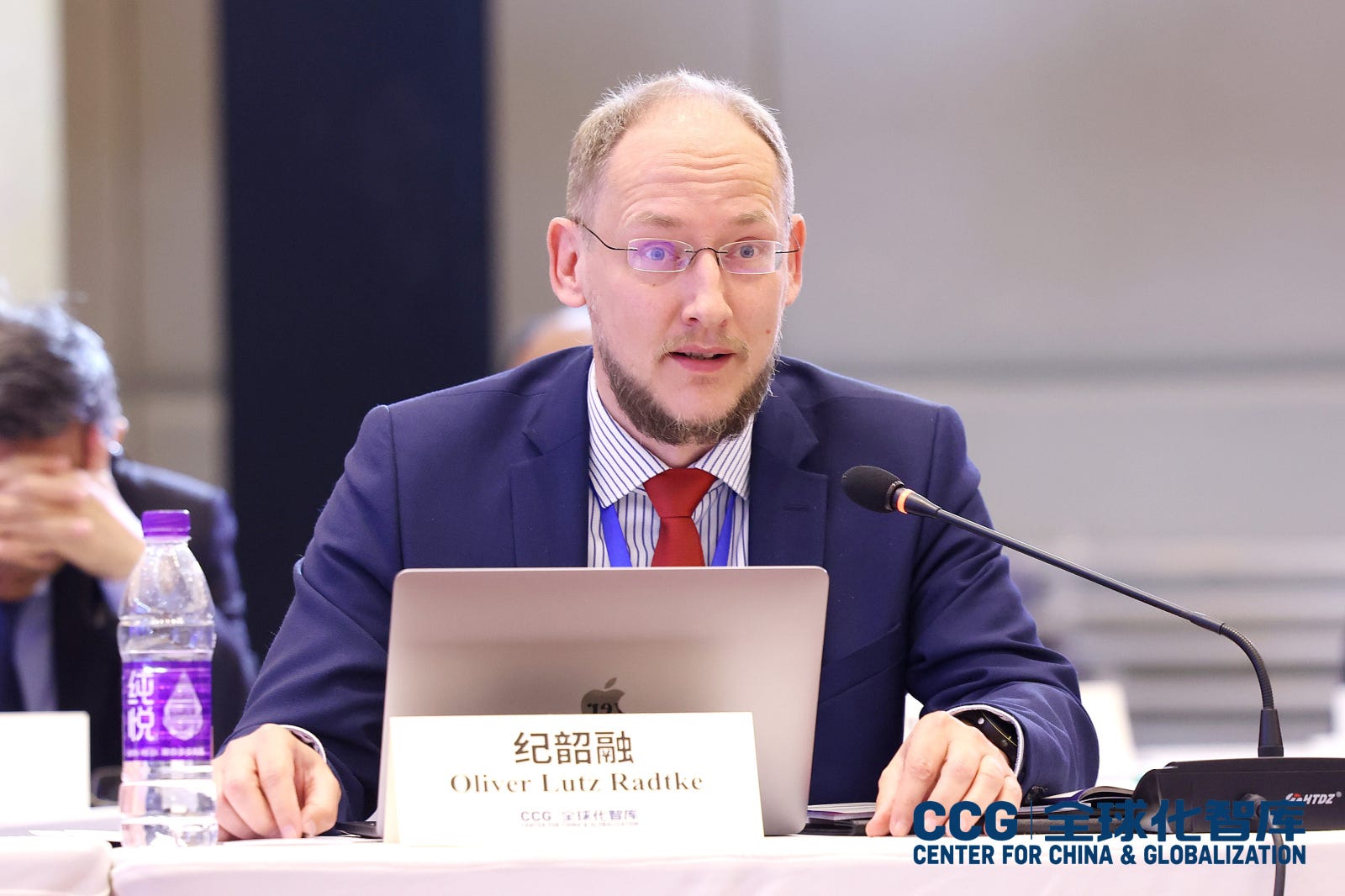
Thank you so much, Henry. And speaking after Ambassador Mahbubani, of course, is not an easy feat, but I highly appreciate speaking after him because he is holding high the ideals of the United Nations and the Charter while grounded in realism and believing in the power of diplomacy. Thank you so much.
So, thank you first by expressing my genuine appreciation to Henry and Mabel for bringing this group together. The composition of this room alone — the range of institutional traditions, regional perspectives, and analytical frameworks represented here — this is itself a statement about what multilateral dialogue can still look like even in difficult times. So thank you for that.
I myself, because Jens mentioned 25 years ago China’s entry into WTO, I’m a product of Chinese soft power, of U.S. soft power, of German soft power. I was educated at Shanghai International Studies University and Beijing Foreign Studies University, and also at USC on the U.S. West Coast, the Center on Public Diplomacy, and then in Germany at Heidelberg University. So a product of Chinese, U.S., and German soft power. And for 25 years I’ve had my feet in academia and in large exchange projects between mainly China and Germany. That’s why I feel very much at home sitting next to Steve and his amazing work on fostering U.S.-China relations.
When we speak of a global governance order, what I think we’re actually witnessing is a collision between multiple ordering logics that no longer share enough common vocabulary to engage effectively. And I’m very grateful to Mr. Amersi with his analogy on the newborn infant, because it also comes without language and it learns a new language very quickly. But you need to teach it, of course, the right one. So this is not only a power problem, it is also, and perhaps more fundamentally, a translation problem.
Through my work juggling different systems as a systems analyst operating between European and Chinese institutional contexts, what strikes me most is that the same concepts that we now use carry fundamentally different operational meanings on either side of this room. So take development, take multilateralism, debt, you name it. For much of the European policy community, of course, development is inseparable from governance, conditionality, transparency, rule of law, civil society. For China, and I think for a major part of the Global South, development means first and foremost material transformation, infrastructure, industrialization, poverty reduction, and so on. These are not shared frameworks with contested content. I feel they are increasingly separate frameworks that happen to use identical words. And that is, in some ways, I feel more dangerous than open disagreement, because it produces the illusion of dialogue while actual mutual understanding quietly recedes.
So the governance challenge of this decade, I think, is not only geopolitical, it is epistemological. Who defines the terms? Whose institutional grammar sets the baseline for what counts as a legitimate argument? So the question, or maybe the suggestion and the hope I put to this room, is: what would it actually take to build a shared diagnostic language? Not agreement on outcomes — that is of course the endgame, if you will, our ambition — but agreement on how to describe the problem together. That is a major challenge, because without that, even the best-intentioned roundtable risks becoming parallel monologues: sophisticated, well-funded, but not quite connecting.
So for me, this is the meta-challenge of this forum, and it is precisely why the convening work that CCG does — Henry and Mabel for so many years, 12th forum here, with this kind of genuine diversity around the table — matters more, not less, in the current moment. And of course, as a German grounded in German idealism, 19th century, growing up with Tübingen and Hölderlin and so on, I want to leave a quote with Hermann Hesse, after we heard from Gramsci: With the newborn, the emerging global order, there’s also “a magic that dwells in the beginning of everything.” So thank you very much.
Henry Huiyao Wang
Thank you, Oliver. For your also very stimulating remarks. Now I’d like to invite Professor Susan Shirk. She is the founding Dean of the 21st Century China Center at University of California, San Diego, but also former Assistant Secretary of State for East Asian and Pacific Affairs, and also one of the most senior China-U.S. experts in the U.S. I know you also gather discussions on China-U.S. relations and have been running one of the most influential China study centers in the U.S. So thank you, Susan.
Susan Shirk, research professor, School of Global Policy and Strategy, UC San Diego; director emeritus, 21st Century China Center; former Deputy Assistant Secretary of State in the Bureau of East Asia and Pacific Affair, U.S. Department of State
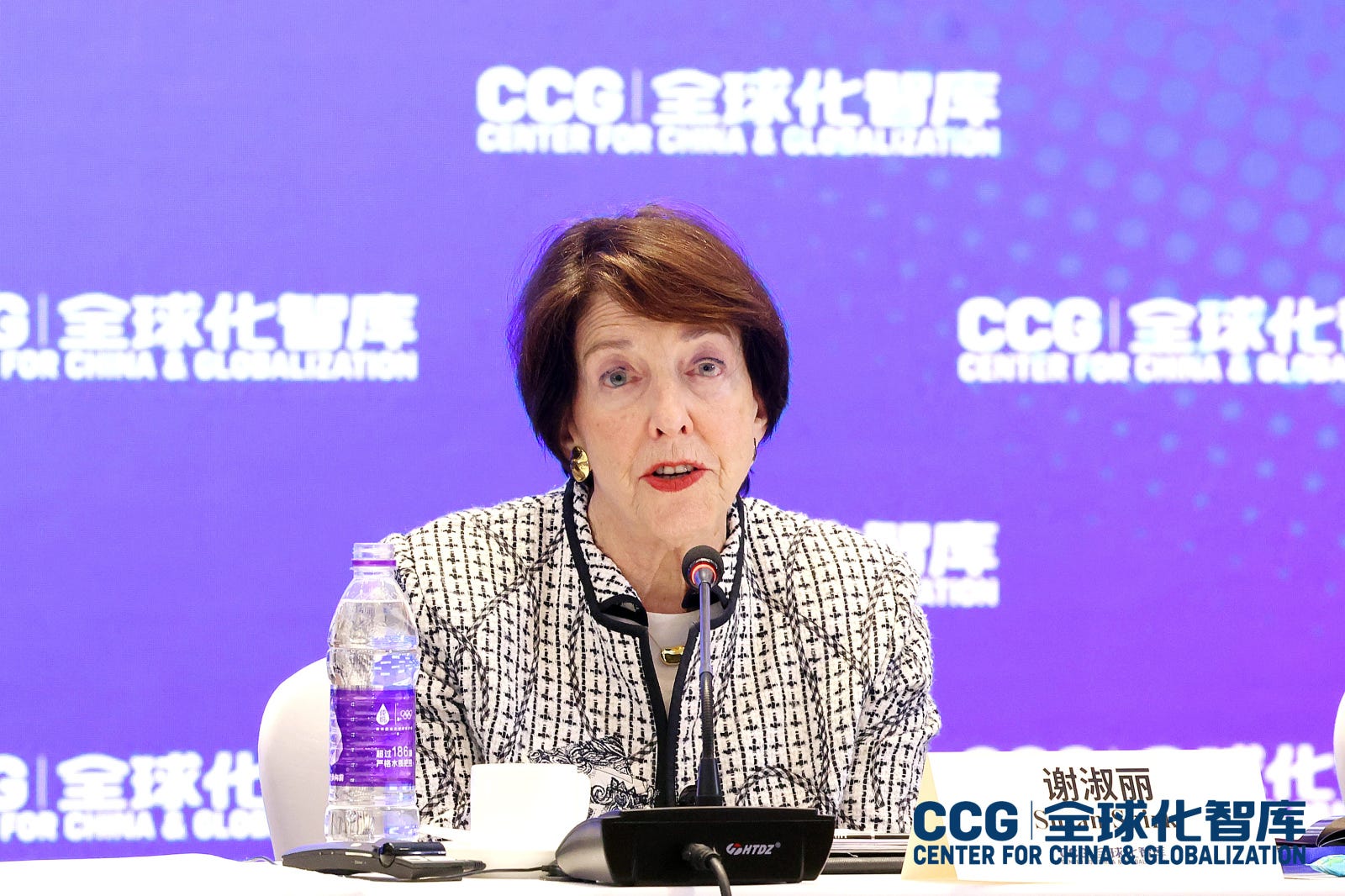
Well, thanks so much. Thank you, Henry and Mabel, for inviting me here. I have to correct my identification. I really appreciate the promotion, but I was the Deputy Assistant Secretary in the East Asia Bureau in the Clinton administration. So I just want to make clear that I’m not taking advantage of your identification to retrospectively gain a promotion.
But it’s wonderful coming after the other speakers who have spoken, especially about the global institutional order, with a focus on WTO and on the United Nations, both of which are absolutely essential, and we need to kind of reinvest our energy in reforming and strengthening those global institutions. And as Kishore said, there’s really nothing better. So let’s not reinvent the wheel, and let’s just try to improve the functioning of these institutions based on the important principles of the UN Charter, free trade, etc.
But the point I’d like to make in my follow-up remarks is the importance of regional multilateral institutions. With the end of the Cold War, the fall of the Soviet Union, there was in Asia a spurt of energy to build regional institutions in the Asia-Pacific: APEC, ASEAN Regional Forum, subsequently the Trans-Pacific Partnership. And these regional institutions, I think, are very important for managing the stresses and strains of relations among neighbors, and giving the United States a continued role in the Asia-Pacific as well.
And my own experience was as the founder of the Northeast Asia Cooperation Dialogue, a Track 1.5 dialogue for Northeast Asia, including Russia, China, Japan, the U.S., North Korea, South Korea. My own aspiration for that dialogue, which I helped create when I was the Director of the Institute on Global Conflict and Cooperation for the University of California, is a kind of de facto concert of powers for the Asia-Pacific, because of including Russia, China, Japan, the U.S. And I remember very well the first conference that China hosted on Asia-Pacific security back in ‘92 or ‘93, chaired by Qian Qichen. And I spoke at that time about the need for a concert of powers in the Asia-Pacific. And it was interesting because, of course, the notion of a concert of powers was not considered very politically correct. And the Chinese participants also were reluctant to describe themselves as a power. So I would say, well, what about “leading country”? Would you accept that? And at the time, China was excessively modest in order not to provoke any backlash from its neighbors.
But working together at the time with Fu Ying, who was one of the main participants in the Northeast Asia Cooperation Dialogue, and with the support of the then Director General of the Asia Department of the Chinese Foreign Ministry Wang Yi — these were people who really had the vision of how China could take advantage of and participate with the United States in building these regional multilateral institutions, could reassure other countries, its neighbors, as well as the United States and other countries, that even as it grew more powerful economically, militarily, and politically, its intentions were benign.
And so, although these regional multilateral institutions and confidence-building based on those institutions won’t solve all our problems, I think it will help. And we need to have a new round, not of creating new institutions, but trying to revive and strengthen the regional institutions to restore the kind of trust, reduce mutual suspicion, and help manage the disputes that still are festering in the Asia-Pacific. Thank you.
Henry Huiyao Wang
Yes. Thank you, Susan, for your wonderful remarks. I think you’ve been doing that, promoting regional cooperation and regional governance — that was the ‘90s, you know, that’s 30-some years ago. So it’s enormous progress, efforts have been taken. But of course we still haven’t — we see some results, but we still could see more. Absolutely, I think particularly for the Asia-Pacific we have RCEP now, and we have CPTPP led by Japan, Australia, and Canada and all those mid-powers. So it’s important — now the UK is part of that. We hope that China can be part of that too. And as those regional — and also I would think RCEP could welcome more partners into RCEP, so that we can strengthen those regional integrations as well. Of course the U.S. is always welcome to come back to CPTPP and even RCEP in the future.
Now I’d also like to invite Mr Achilles Tsaltas. I know you just came from Athens — you are founder and president of the Democracy and Culture Foundation, and also founder of the Athens Democracy Forum, which has been really well established for many years. So I would particularly like to hear from your perspective. You also worked many years in the New York Times, of course also worked in Hong Kong, and now running one of the most effective forums and foundations in Greece. So Achilles, please.
Achilles Tsaltas, President, The Democracy and Culture Foundation, Athens
Thank you, Henry, for that introduction. Thank you for the invitation. And yes, we did arrive yesterday with Mabel and Henry from Delphi, actually. So most of you would be expecting that we bring some wisdom from the Oracle. But I think Henry and Mabel will agree with me when I say that the Oracle sits there a little bit stunned at the moment with what’s happening in our world.
So we often speak today of a crisis in our rules-based international order, but I think we should be perhaps a little bit more honest. I think what we’re witnessing today is not simply a crisis, but it is the loss of authority of a system with rules designed for what was a different world back then. The post-war order was built on clear hierarchies of power, relatively slow economic and technological change, and a shared belief, at least in principle, in multilateral rules. Today that order, that world, no longer exists. So the events in Venezuela, tensions around Iran, and the increasing use of sanctions and interventions outside the traditional UN framework are not anomalies. They are signals for us — signals that the gap between power and legitimacy is widening. And taking from what Kishore was saying earlier, there is a gap within legitimacy that is widening as well.
But there is, I believe, a deeper shift under all this. I think over the last, say, 10-15 years, three foundational drivers of human progress — if we take energy, intelligence, and biology — have entered a new phase, mainly thanks to technology and AI. They are no longer simply resources to be controlled. These resources were scarce in the post-war order. They are becoming systems now that scale, that learn, and they improve with investment, as energy is definitely improving with investment. This is transforming the nature of power itself. And yet our global governance institutions still operate as if we live in a world of scarcity, as opposed to this new world of abundance that we’re getting into.
This mismatch is creating three responses. We’re seeing the hoarders, we’re seeing the managers, and we’re seeing the builders. Some actors are hoarding power, retreating into zero-sum geopolitics, sanctions, and fragmentation. I won’t name names. Others are managing, simply managing the old system, trying to preserve institutions that are increasingly misaligned with reality. And yes, there was a very eloquent speech by Prime Minister Carney with many truths. But I think we need more than eloquence in order to address the problems.
But the third path is emerging, which is a builder approach. And this is something that we see in China and the Gulf. And there’s a model that doesn’t exist yet, what I call “democratic builder states.” And when I talk about democracy — coming from Athens, I talk about the more authentic definition of Athenian democracy, as opposed to the democracy we’re seeing now. So these democratic builder states, I believe, could be a blend of the Europe and China model: a blend of legitimacy and capacity evolving together. But for this, Europe will need to de-enlightenize and China would need to re-Confucianize.
So let’s talk about the builders a little bit more. The builders don’t ask how do we defend the old order. They ask what kind of global system can actually function under today’s conditions. And here I believe is an important opportunity for mutual learning, because different parts of the world are experimenting in different ways. China, for example, has demonstrated extraordinary capacity in long-term planning, infrastructure development, and state coordination at scale. The West, at best, has developed traditions of accountability, pluralism, and institutional self-correction. Neither model on its own is sufficient for the world we are entering. So capacity without legitimacy does not endure. Legitimacy without capacity does not deliver.
So the question is not whether one system will replace the other. The 21st century won’t be decided by the so-called democracy versus authoritarianism. It will be decided by which systems can learn fastest without losing legitimacy. So, as you can see, there’s the need for capacity, legitimacy, and adaptability to come together.
And let me end with a quote. You would expect me to quote Socrates or Aristotle. I’m going to give you a very unexpected quote here from a fashion designer, Alexander McQueen. I was at this exhibition at the V&A, and he said this quote that struck me: “You’ve got to know the rules to break them. That’s why I’m here. To demolish the rules, but to keep the tradition.” And that in many ways is the challenge to us: not to abandon the principles of global cooperation, but to understand them deeply enough so we can redesign them.
So Kishore, you’re looking at me. So yes, keep the UN, but demolish or redesign its rules. And let me leave you with a parting thought: should the Security Council be replaced by the G20? Talking about regional units. Thank you.
Henry Huiyao Wang
Great. Thank you, Achilles. Absolutely. You have very enlightening remarks that injected some fresh thinking into our roundtable. I really appreciate that. I think absolutely we need a builder approach. We are all here building bridges. We are here actually engaging in deep thinking and dialogues and finding better solutions. So absolutely, I think we need to find out how the system may converge rather than divide. That’s probably after hundreds of years or thousands of years of experiment, human beings are finally going to converge, I’m sure that will happen. And so you’re right — we can’t see which is better, which is bad, we really need to, as Deng Xiaoping mentioned: seek truth from facts, let performance speak. So thank you for your very good sharing of your ideas.
Now I’d like to invite Professor Zhao Zhongxiu. He is President of the University of International Business and Economics in Beijing, one of the most famous universities in China, and produced many trade ministers but also hundreds of minister counselors, commercial counselors for China for the outside world. It’s really a great school, a university that President Zhao is leading. So I would like to hear from you.
Zhao Zhongxiu, President, University of International Business and Economics
Thank you, Mr. Chair, and good morning, everybody. It’s a great honor to join this roundtable. We meet at a time when the international environment is becoming more complex and when the foundations of global governance are being tested. Tensions in the Middle East have once again exposed the fragility of energy security. Higher energy costs can quickly translate into higher production costs, higher logistic costs, and inflationary pressure and greater burdens on households and developing economies. At the same time, trade and technology policies are increasingly influenced by security concerns, while climate action remains urgent but uneven in capacity and cost.
A divided world is not in China’s interest, nor is it in the interest of Europe, the United States, and the Global South. What we need is not less engagement but better government engagement. Global value chains provide a useful lens through which to understand this movement. The evidence shows that globalization is not simply retreating. It is being reorganized. Global value chains still account for nearly half of world trade and remain central to production, innovation, employment, and technological diffusion. Yet their structure is changing. Supply chains are becoming more regional, more digital, more policy-shaped, and more sensitive to resilience, energy security, and geopolitical risk.
This reorganization is understandable. Every country has legitimate concerns about security, energy, climate, technology, and development. The question is not whether countries should pursue these goals. The real question is how they can be pursued in ways that preserve openness and trust. If policy responses are fragmented, firms will face greater uncertainty, consumers will bear higher costs, and smaller economies may lose opportunities to participate and upgrade.
A more constructive path is managed reconfiguration. I would emphasize four principles. First, respect. Countries differ in history, institutions, development stages, and strategic concerns. These differences should be recognized and discussed through dialogue, not allowed to become sources of misunderstanding. Second, transparency. Industrial policies, energy measures, carbon rules, technology restrictions, and standards all create cross-border effects. Greater transparency can reduce uncertainty and create conditions for coordination and confidence. Third, coordination. National policy space remains important, especially for energy security, green transition, and technological upgrading. But policy ambitions should be coordinated so that they support fair competition and collective progress rather than subsidy races or regulatory conflict. Fourth, inclusion. Global governance cannot be shaped only by advanced economies. Developing countries, small and medium-sized enterprises, and latecomer industries need better access to finance, digital infrastructure, logistics, skills, and green technology. Participation in globalization is not enough. What matters is the capacity to upgrade, to learn, and to retain value domestically.
Let me conclude with one thought. The global governance order will not be restored itself. It must be renewed through trust, dialogue, and practical cooperation. Interdependence has not disappeared. Our shared task is to govern it more wisely, more fairly, and more cooperatively. Thank you.
Henry Huiyao Wang
Thank you, President Zhao, for your also very systematic discussion on these issues. Absolutely. I think we did a lot of policy issues, and also I know you’ve been really championing this global value chain studies with WTO and many institutions. So we hope that UIBE will make continuous contribution to this new narrative of global trade and global governance.
Now, last but not least, we’d like to invite Professor Fabian Zuleeg. He is Chief Executive of the European Policy Center, which is based in Brussels, a very well-known established think tank. And CCG has been also collaborating with EPC for the last seven years on the European Union’s project, on EU-China Think Tank Exchange Program. So I’m very glad that you come here again and participate in this very timely forum. So Fabian Zuleeg, please.
Fabian Zuleeg, Chief Executive and Chief Economist, European Policy Center (EPC)
Thank you, Henry. Thank you, Mabel, for inviting me to come and speak, and also for the very good cooperation we’ve had over the last years. I want to add a view from Europe, which I’m afraid is going to be a little sober, because I want to talk about disorder and instability. Because I think it is important that we name the challenges openly, because only if we name what the challenges are can we address them. And what we are seeing at the moment is a world in disorder. Clearly, in the wars we are seeing, what is happening in Iran is having global repercussions. We might — are likely to see a global recession.
We are condemned to live in the short term by the destabilizing effect of Donald Trump. And I would not underestimate what he can still destroy. And I very much hope that the U.S.-China relationship is going to be stable. I’m not so sure that is going to be the case. But much broader, globalization is changing. I think we’re seeing an increasing securitization. Security is becoming a precondition for openness. We’re seeing a mercantilist logic which is not just the U.S. — we’re seeing it everywhere. It is increasingly becoming a zero-sum logic: I win you lose, or you win and I lose. It is a big challenge for countries that have depended on openness. And in my view, that challenge is only going to grow, seeing the dissolution of the global system as we know it.
Clearly, what was there would need to have been reformed. It was built for a different era. It had many flaws. It was Western-dominated. And it didn’t work well in many instances. But the absence of a system, the absence of rules, is not order. And I think that when we discuss multipolarity, we have to be aware that multipolarity, yes, is an increasingly accurate description of the world. Although I would say a more accurate description is asymmetric multipolarity, because not all countries are equal and not all poles are equal. But it is not an ordering principle. It is not a set of rules, and it will not define a new set of rules. Multilateralism did define those rules, and I would very much want to hold on to some of the achievements multilateralism embodies.
The collapse of the global order is already having a negative impact on global commons and is going to continue to have a negative impact on global commons. These cannot be addressed in fragmentation. That is the nature of global public goods. Whether it’s peace, stability, open and fair trade and competition, protection of climate and environment, maritime security, technological governance, combating terrorism and organized crime, dealing with global pandemics, sustainable development, and the fight against poverty — all of these require global cooperation. They require a global system.
This disorder which we are seeing is very much affecting Europe. We are seeing it most clearly in Russia’s unnecessary and illegitimate war of aggression against Ukraine, which is breaking the UN Charter, and is an attack on the global order and on Europe as well as Ukraine. But at the same time, Europe’s world is changing. It is obvious to see that we are having a very uneasy relationship with the current U.S. administration. So Europe’s certainties are becoming uncertain. And I think this is also something we’re seeing in the world. It’s a world of instability, of mercantilism, of aggression, of securitization, of the disregard of global commons. It’s not what Europe wants, and I don’t believe it is what most of the world wants.
So we need to work together to address this, with anyone who shares a different vision of the world and who still is committed to some form of multilateralism. In Europe, we’ve learned very painfully that it is necessary to work together, but it’s also possible if we are willing to compromise and if we are willing to commit to common goals. And let’s hope we can do that at the global level, without going through the enormous destruction we inflicted on ourselves in Europe before we learned that lesson. Thank you.
Henry Huiyao Wang
Great. Thank you, Fabian, for your points as well. Very stimulating, and we absolutely need to think about all those negative impacts on the global system and how to correct that — that is really one of the things we’re having today.
So I think for this round we are almost coming to the end, because we have 12 panelists who all shared very wide-ranging but very focused views. I think we have quite a lot of consensus around the table here. We all felt the multilateral system needs to be strengthened, needs to be confirmed, and of course WTO, UN, you know, many institutions that we cannot give up, and we have to improve and reform and enhance.
Second, I think regional multilateralism, is the way, probably in between, when the multipolar world is emerging. We have to also try out all different regional multilateral systems to make things work, at least in a collective way, that’s going to help the global governance.
Thirdly, I think we all felt that peace and security and prosperity is something we all cherish, and we cannot jeopardize that, and we all need to avoid war, and we cannot have this disruption on energy, on those choking points for the world to function. We all realize that is really the wrong practice that we have to correct sooner or later.
Fourth, I think we will all agree that to some extent we are entering a new stage of world governance development, to reflect this multipolar world and also the rise of the middle powers and Global South, and how to really make collective actions, build up consensus among them. And finally, I think all participants at the table agreed that we all value dialogue and exchanges, and roundtables like this are really crucial at all levels, to really promote mutual understanding and better collaboration.
So I think we come to the end of this roundtable, and I want to thank all 12 participant panelists for their excellent, very insightful sharing. And because of the time, we have a very short, maybe five-minute break, and then we’ll come back for the next round. So thank you all very much.
Transcript: Opening Ceremony of the 12th China and Globalization Forum

The 12th China and Globalization Forum, hosted by the Center for China and Globalization (CCG) and co-organized by the China Association of International Trade (CAIT), the China Society for World Trade Organization Studies (CWTO), the China-United States Exchange Foundation
The 12th China and Globalization Forum Held in Beijing
The 12th China and Globalization Forum, hosted by the Center for China and Globalization (CCG), was held in Beijing on Sunday, April 26, 2026.