


On November 20, 2025, the 10th China Global Think Tank Innovation Forum, hosted by the Center for China and Globalization (CCG) and co-organized with the China Association of International Trade (CAIT), was successfully held in Beijing.
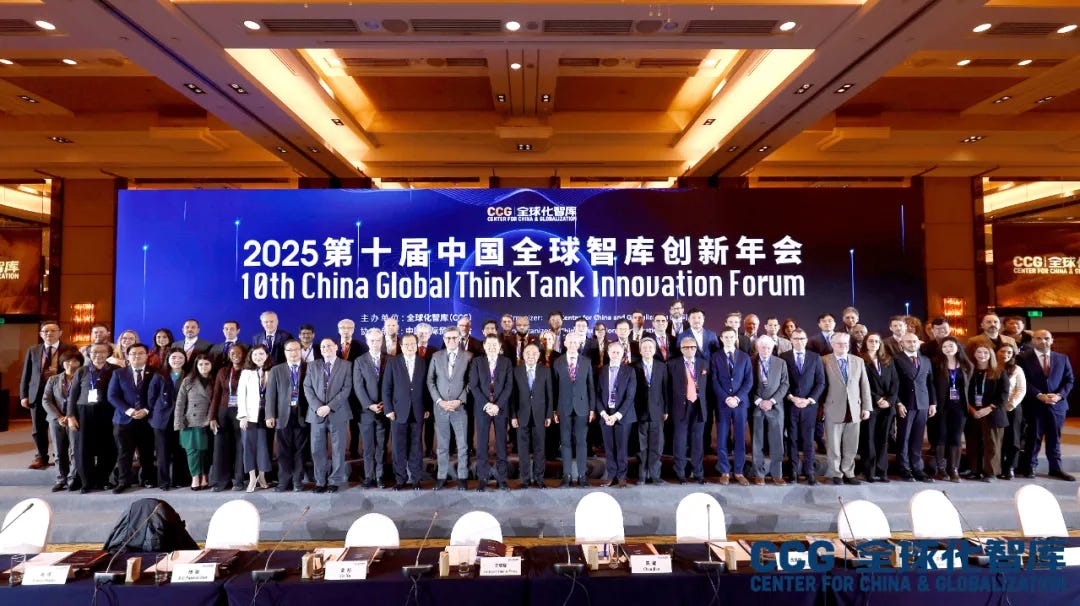
This forum attracted more than 200 participants from nearly 50 countries, including representatives from nearly 70 think tanks worldwide and nearly 30 Global Young Leaders Dialogue (GYLD) program delegates.
In the run-up to the conference, CCG also held a Global Young Leaders Dialogue Annual Forum the previous day.
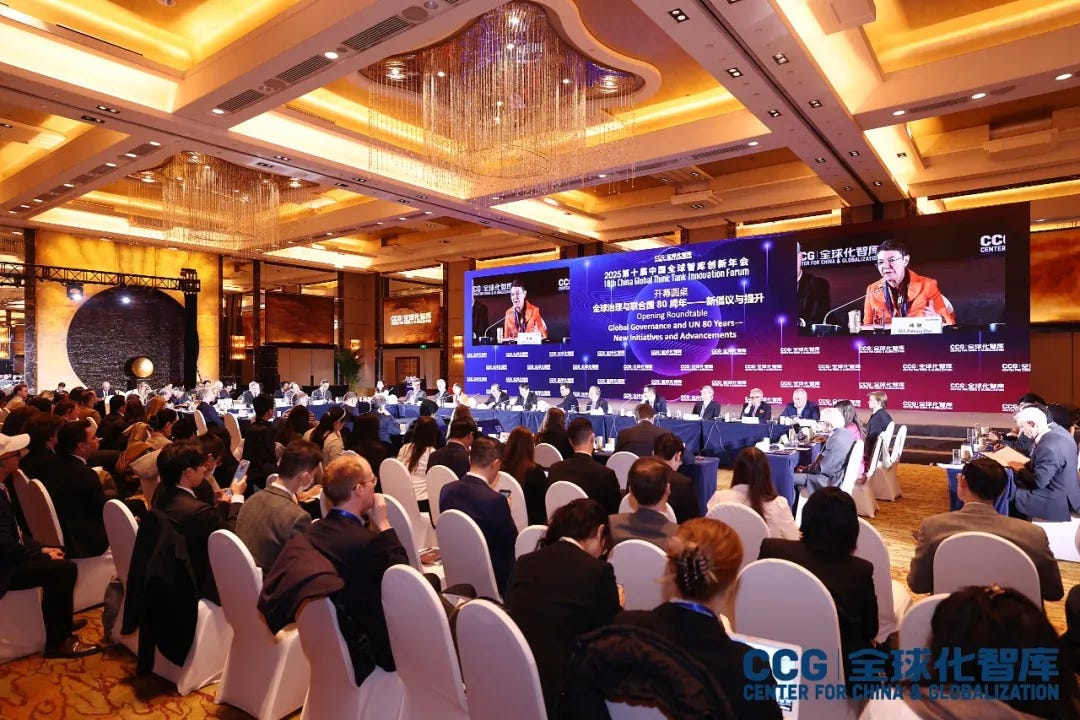
The full video recording of the event is available on CCG’s YouTube channel and official website. For a quicker look, a standalone video of the opening roundtable has also been uploaded.
CCG has also broadcast the forum on Chinese social media platforms, where it remains accessible.
The opening session was moderated by Mabel Lu Miao, Co-founder and Secretary General of CCG.
Welcome remarks were delivered by:
Henry Huiyao Wang, Founder and President, CCG
Chen Jian, Former Vice Minister of Commerce, Member of the Chinese People’s Political Consultative Conference (CPPCC) National Committee
Jin Xu, President, China Association of International Trade (CAIT); Former Deputy Director-Gerneral of America and Oceania Affairs Department, Ministry of Commerce
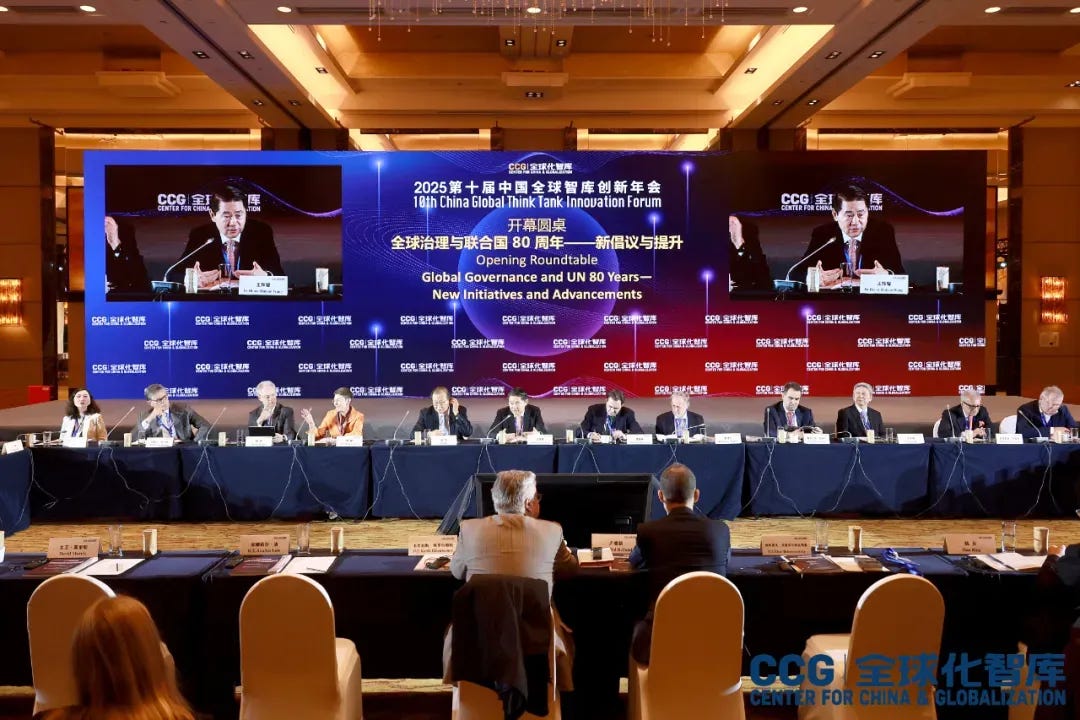
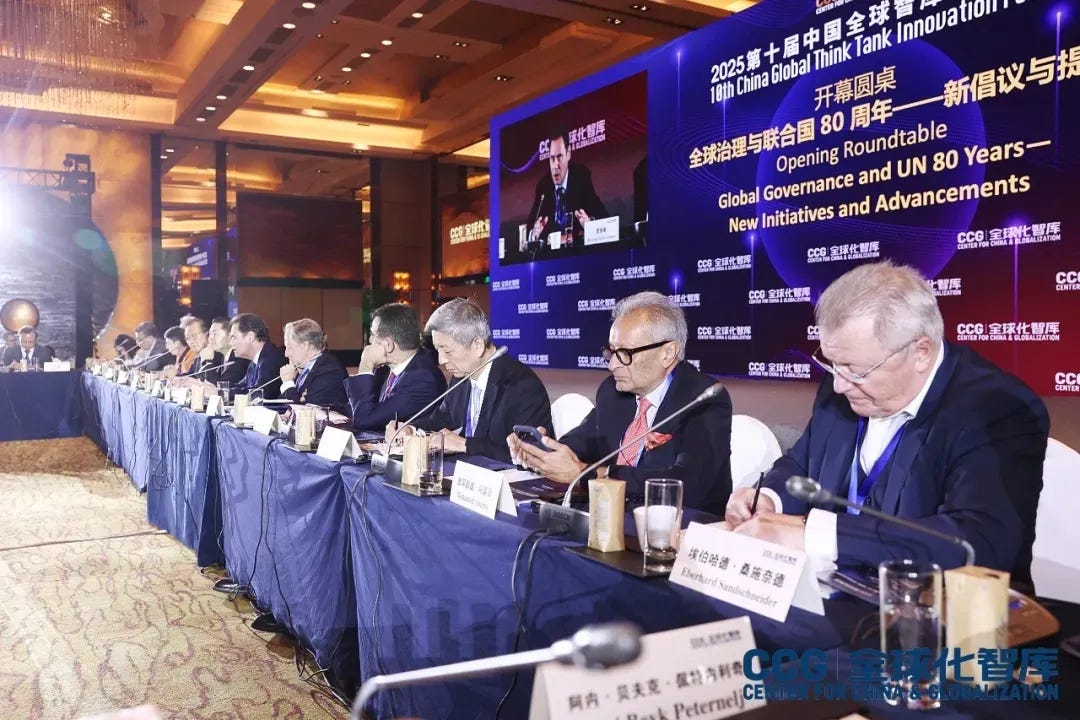
Following the opening, the high-level Opening Roundtable on “Global Governance and UN 80 Years—New Initiatives and Advancements” was moderated by Henry Huiyao Wang.
The session featured:
Jorge Toledo Albiñana, Ambassador of the European Union to China
Mohamed Amersi, Founder and Chairman, Amersi Foundation
Bruno Angelet, Ambassador of Belgium to China
Patricia Flor, Ambassador of Germany to China
Tamas Hajba, Senior Advisor for China, OECD
Khalil Hashmi, Ambassador of Pakistan to China
Jin Xu, President, the China Association of International Trade (CAIT); Former Deputy Director-General, Department of American and Oceanian Affairs, Ministry of Commerce
Selçuk Ünal, Ambassador of Turkey to China
Eberhard Sandschneider, Senior Professor, Freie Universität Berlin; Former Director of the Institute of the German Council on Foreign Relations
Sun Yongfu, Senior Fellow, CCG; Former Director-General, Department of European Affairs, Ministry of Commerce
Wang Yong, Senior Fellow, CCG; Director, American Studies Center, Peking University
The session also featured input from GYLD delegate Anej Bevk Peternelj, Director of the Gajst Institute (Partner of the Young Bled Strategic Forum), who raised questions and shared his perspectives with the panel.
CCG will gradually publish the rest of the written transcripts. This transcript is based on the video recording and has not been reviewed by any of the speakers.
Opening Ceremony
Mabel Lu Miao, Co-founder and Secretary General, CCG
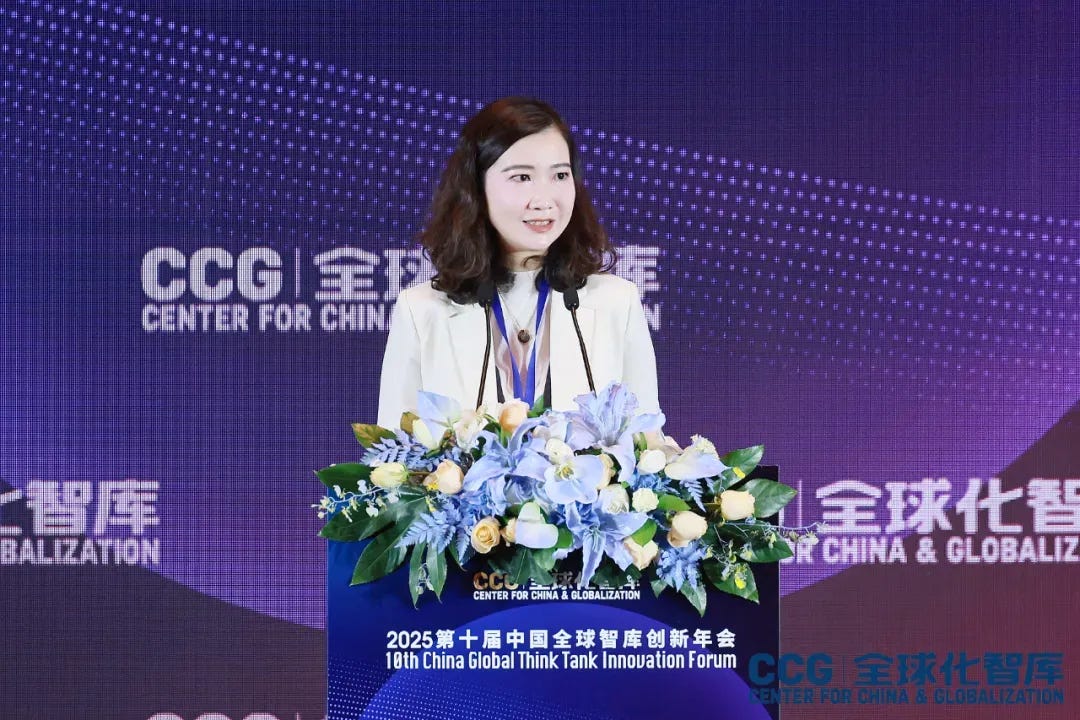
Your Excellencies, Ladies and Gentlemen, Minister Chen Jian, President Jin Xu, and Ambassadors: Good morning. Welcome to the 2025 10th China Global Think Tank Innovation Forum.
I am Mabel Lu Miao, Secretary-General and Co-founder of the Center for China and Globalization (CCG). It is a great honour to have all of you attending this conference. The 10th China Global Think Tank Innovation Forum is hosted by CCG and co-hosted by the China Association of International Trade (CAIT). We have brought together over 200 guests from more than 15 countries, including nearly 70 representatives from international think tanks. Specifically, we have the honour of hosting ambassadors and senior officials, representatives from government agencies, experts from international organisations, executives from renowned domestic and international enterprises, scholars from leading global think tanks and universities, and representatives from major media outlets from both China and abroad.
Yesterday, as one of the key events of the 2025 Wisdom Haidian Talent Week, the 2025 global youth leader annual dialogue was held. We selected nearly 30 young participants from 24 countries from the global young leaders dialogue GLD programme over 300 international youth around the globe.
This year’s conference features five roundtable discussions covering global governance, China-U.S. relations, China-EU relations and the new driver of globalisation and the rise of the Global South. Following the keynote speeches this morning, we will begin with the opening round table focusing on global governance and the 80th anniversary of the United Nations. The next session will examine China-U.S. relations and tariff wars and their implications for the world.
This afternoon, three round tables will happen. We will start with the discussions on China-EU relations beyond the next 15 years. This will be followed by a session on the new drivers of globalisation, exploring emerging global trends through the lens of climate change, artificial intelligence, and supply chains. Finally, we will conclude the day with a roundtable on the rise of the Global South.
Looking ahead, uncertainties and challenges will continue to shape the global landscape. We are truly pleased to have all of you here sharing your wisdom, exchanging perspectives, and bringing valuable insights to our world in confluence. With that, I will conclude my remarks and leave the floor to the distinguished speakers. Thank you all for joining us and contributing your valuable perspectives to the global community.
Now, it’s my great honour and pleasure to invite Dr Huiyao Wang, who is the founder and president of Center for China and Globalization, CCG, and the former counsellor of the State Council, to deliver the opening speech. Welcome.
Henry Huiyao Wang, Founder and President, CCG
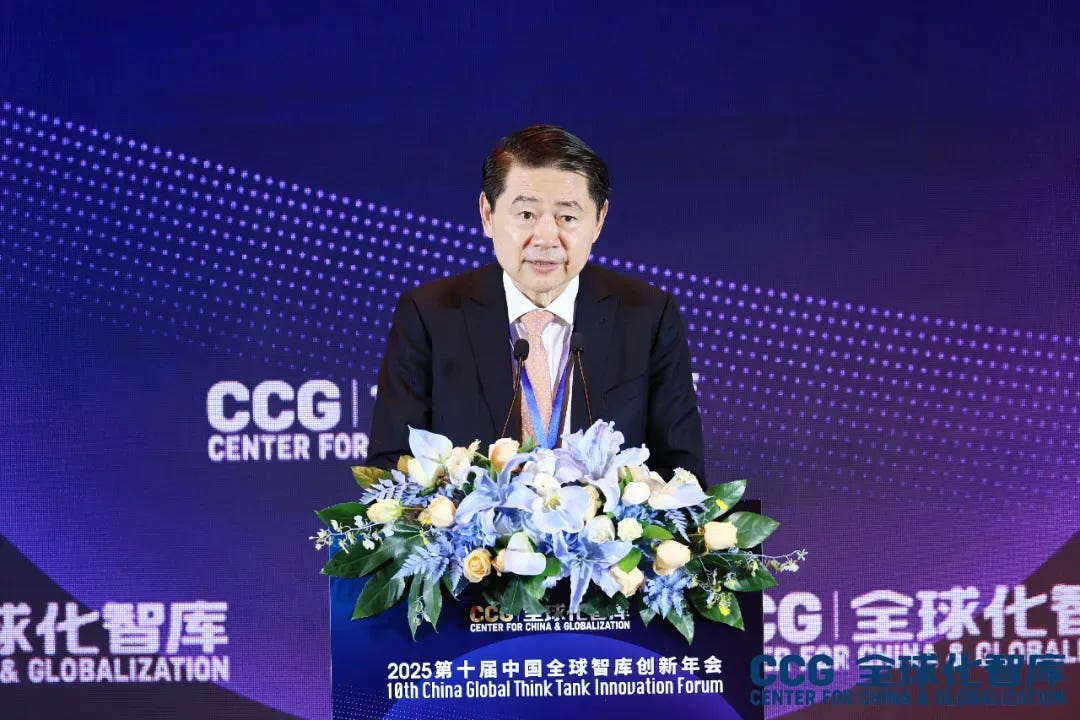
Distinguished Ministers, Presidents, Ladies and Gentlemen: Good morning.
It is a great honour to welcome you all to the 10th annual China Global Think Tank Innovation Forum on behalf of the Center for China and Globalzation (CCG). I am very pleased to extend our warmest welcome and heartfelt appreciation to all of you who have travelled from across China and around the world. We were also joined yesterday by 30 Global Young Leaders for the Global Young Leaders Dialogue, and we are delighted to have them with us again today for this great event.
The world is entering a new era marked by profound uncertainty. The global governance system is undergoing major adjustments, and the long-held consensus underpinning the international order is being disrupted. As we mark the 80th anniversary of the United Nations, the need to rethink and adapt global governance has become more pronounced. Geopolitical tensions, supply chain decoupling, technological shifts such as artificial intelligence, and the accelerated impact of climate change are pushing humanity towards a new historical crossroads.
Global governance has never been a zero-sum game. It is about sharing responsibility and advancing development together. The world requires cooperation among all countries, particularly major powers. It also needs more voices from a broader range of nations, such as the Global South. How to build a fairer, more inclusive, and effective global governance system has therefore become a defining question of our time. As President Xi Jinping emphasised in recent global initiatives, the principles of sovereignty, equality, the rule of law, multilateralism, people-centred development, and action-oriented cooperation offer important guidelines for understanding China’s role in upholding the global governance architecture.
In such a context, constructive dialogue has never been more essential. The recent meeting between President Xi and President Trump in Busan has sent an important and positive signal. Over the past year, communication between the two sides has gradually resumed across multiple levels—from diplomatic and economic exchanges to people-to-people interactions—reflecting a shared recognition that cooperation remains vital for both countries. We sincerely hope that these two major global players will continue to work towards greater stability and predictability, which is vital not only for our two peoples but for the entire world.
Meanwhile, China-EU relations are entering a new stage. This year marks the 50th anniversary of diplomatic relations between China and the European Union. With centuries of shared cultural heritage and longstanding exchanges, China and Europe have deep foundations for cooperation. Both sides have every reason to deepen engagement in trade, investment, and people-to-people exchanges, while jointly upholding multilateralism, free trade, and the fight against climate change. Such efforts can breathe stability and predictability into a world faced with intertwined crises.
At the same time, the rise of the Global South is reshaping global dynamics. From BRICS cooperation to the growing influence of the African Union, Latin America, and other developing regions, emerging economies are playing a more active and constructive role in global affairs. As a member of the Global South, China shares many of the same development aspirations and governance priorities. We see significant opportunities for China and its partners across the Global South to expand collaboration in green development, science, technology, education, and digital capabilities, thereby fostering a more balanced and inclusive international order.
A key strength of China’s development model lies in long-term planning, where each Five-Year Plan builds consecutively upon the last. The recent 15th Five-Year Plan sets out a new blueprint for further modernisation, prioritising new quality productive forces, the green and low-carbon transition, and future-oriented industries. Over successive planning cycles, China has made steady progress, and the next five years are set to chart a new direction for China’s development while expanding opportunities for global cooperation in energy transition, innovation, and AI.
No country can address today’s challenges alone. We believe that globalisation remains essential for development and for addressing shared global problems. The next phase of globalisation must be more inclusive, sustainable, and effective. To achieve this, all stakeholders must deepen dialogue and enhance cooperation.
Against this backdrop, CCG has significantly expanded its international engagement over the past year. In 2025, we carried out 15 overseas missions to 34 cities across 22 countries, setting a new record for international outreach among Chinese think tanks. We hosted major forums and high-level dialogues, and received more than 50 delegations from governments—including several foreign ministers—and key international institutions. We also released research reports and submitted policy recommendations, contributing practical insights for policymakers in China and abroad.
This year marks the 10th anniversary of the China Global Think Tank Innovation Forum. How time flies! When we launched this platform a decade ago, we had a simple aspiration: to create a space for dialogue that transcended borders, cultures, and disciplines. Today, we are encouraged to see this forum grow into one of China’s most open and internationally recognised think tank events, bringing together more than 200 guests from over 50 countries.
Ladies and Gentlemen, we are standing at a critical juncture. The challenges before us are indeed unprecedented, but the opportunities are equally significant. The mission of a think tank is not only to provide answers but to help the world ask better questions.
We look forward to hearing from our eminent speakers, including our keynote speaker, Minister Chen Jian, who was my boss when I worked at the Ministry of Commerce (MOFCOM) many years ago. We hope for a fruitful discussion this morning that will contribute to the global community. Thank you very much.
Chen Jian, Former Vice Minister of Commerce, Member of the Chinese People’s Political Consultative Conference (CPPCC) National Committee
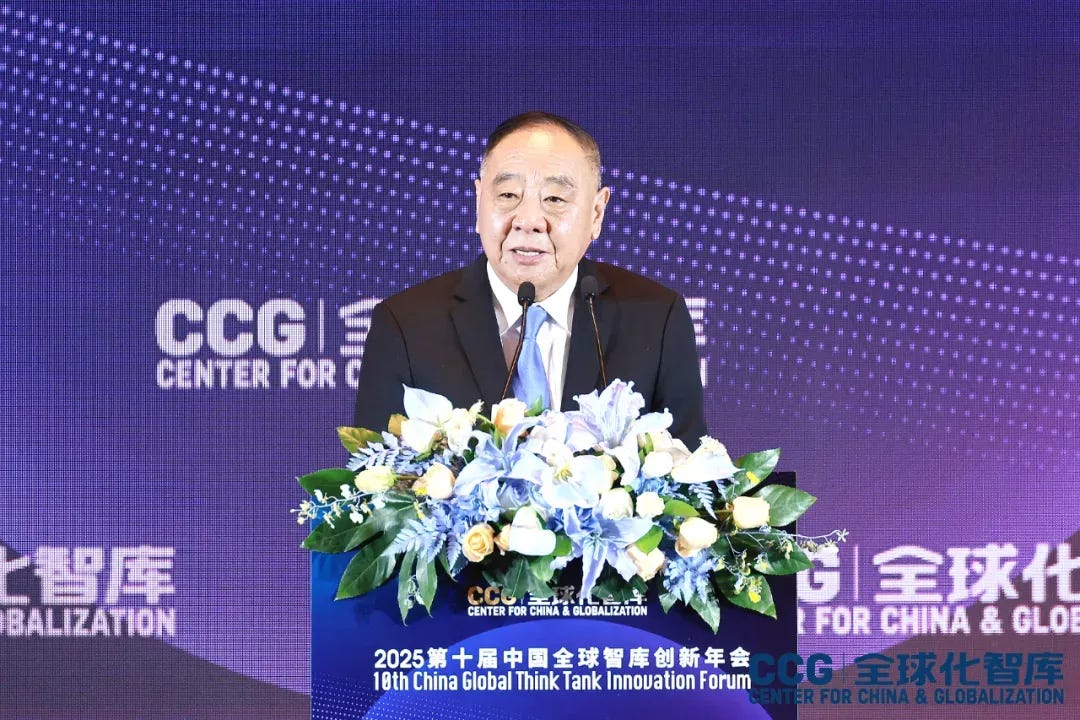
Respected guests, friends, good morning. It is an honour to be invited by CCG to attend the 10th China Global Think Tank Innovation Forum and to discuss with all of you the key topics of multilateralism and global governance challenges in these turbulent times.
I would like to take this opportunity to share with you three main perspectives.
1. Multilateralism is the Only Way to Address Global Challenges
Currently, the world is experiencing profound changes unseen in a century. Unilateralism and protectionism are on the rise. Global issues such as climate change, energy crises, and supply chain disruptions are intertwined. Multilateralism has come under severe pressure, as the world faces deficits in peace, security, governance, and trust.
I believe the primary reason for these profound changes is twofold. First, the global paradigm has shifted. In 1992, the GDP contribution of developing countries was 18%; by 2022, it reached approximately 40%, and I believe it is still on the rise. This has significantly altered the balance of power between nations. Second, the pursuits of different countries vary. While the least developed countries are still fighting poverty and starvation, developing countries as a whole have promoted high economic growth rates.
Simultaneously, we must acknowledge the growth and economic development challenges faced by developed nations. In this century, no single country or bloc can tackle these problems alone. Only by promoting multilateralism—built on the cornerstone of common development—can we tackle these problems together. China remains an unswerving supporter of multilateralism. This is evident through the Belt and Road Initiative (BRI), our promotion of connectivity, our commitment to the Paris Agreement, and our active participation in regional cooperation through RCEP and the Shanghai Cooperation Organisation (SCO). At the UN General Assembly, Premier Li Qiang has advocated for inclusive international cooperation as the right choice for global governance.
2. Global Governance Requires Innovation and Pragmatic Action
The challenges we face are shared and unprecedented; therefore, our actions must also be shared. Despite different ideologies, social systems, and levels of scientific and economic development, we must find a common recognition to reach a consensus on institutional arrangements. To realise common development, I believe we must focus on the following issues:
Confidence in the International Order: We must respect the vision of our predecessors. Eighty years ago, they set forth the Atlantic Charter and the Havana Charter as the basis for a rules-based international order to safeguard the world’s development. Although the global environment has changed substantially, our level of human knowledge and scientific capability has increased, enabling us to find the right guidance to meet today’s challenges.
Inclusivity and Consensus: We should not necessarily set up a brand-new system to replace the current one, but rather make it more inclusive. One group of countries cannot develop by disregarding the opportunities of others.
Addressing the Three Shortfalls: We must focus on the ‘blank spots’ and shortcomings of the current international governance system:
Under-representation of the Global South: This must be addressed through further research and reform.
The Authority of Multilateralism: The principles of the UN Charter are currently not fully respected. Unilateralism and violations of international law are undermining the UN 2030 Agenda for Sustainable Development.
Future Challenges: We need effective preparation for the dividends and risks of AI, digital networks, cyber environments, and outer space governance, which currently lack comprehensive international frameworks.
Our goals for a new order should follow five principles:
Respect for sovereignty and equality.
Honouring international law and norms.
Insisting on multilateralism.
Advocating for a people-centred approach.
Focusing on pragmatic, results-oriented actions.
3. The Indispensable Role of Think Tanks
In these times, think tanks are more important than ever. It is my sincere hope that think tank dialogue can be normalised, institutionalised, and become more pragmatic. I believe there are three key areas where think tanks should focus their efforts:
Forward-looking Research: Think tanks must conduct research in advance to prepare for challenges like AI and climate change, providing forward-looking policy proposals.
Bridging Misunderstandings: They should act as a bridge to reduce misjudgments. For instance, CCG’s ten consecutive years of dialogue between China, the US, and the EU are extremely valuable.
Policy Translation: Academic findings must be translated into pragmatic proposals. Whether it is ‘green standards’ for the BRI or a digital economy compact, research must support decision-making.
China remains committed to global governance through its four major initiatives: the Global Civilisation Initiative (GCI), the Global Development Initiative (GDI), the Global Security Initiative (GSI), and the Global Governance Initiative. These demonstrate China’s propositions and provide solutions to global challenges.
Dear friends, as we celebrate the 80th anniversary of the UN, we stand at a historical crossroads. Decisions made by governments and actions taken by enterprises must converge to unleash the vitality of multilateralism. We will contribute Chinese wisdom to build a more resilient, inclusive, and peaceful future. I wish this conference great success. Thank you.
Jin Xu, President, China Association of International Trade (CAIT); Former Deputy Director-General of America and Oceania Affairs Department, Ministry of Commerce
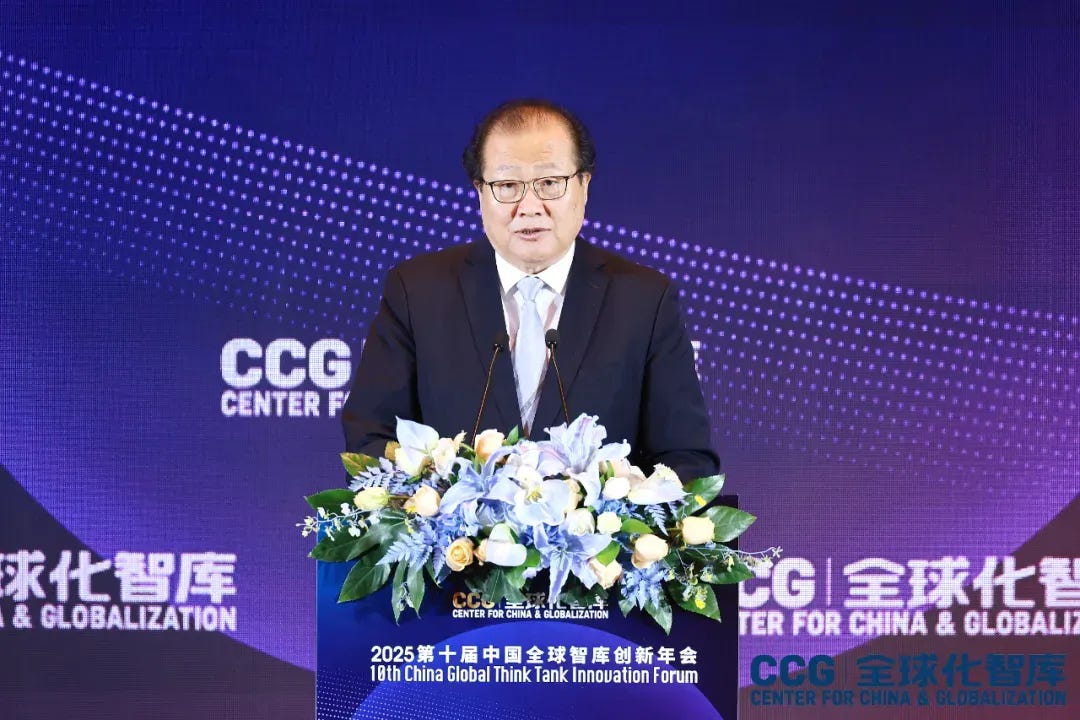
Distinguished Minister Chen, Mr Henry Huiyao Wang, distinguished guests, good morning.
It is my honour to join you here at the 10th China Global Think Tank Innovation Forum as one of the co-organisers to discuss the topic of multilateralism and global governance challenges in the turbulent times with outstanding colleagues here.
We are living in an era of complexity and uncertainty. The evolution of the century-old changes has accelerated, and the global challenges, such as geopolitical tensions, weak economic recovery, intensifying climate change, and widening digital divide, have emerged one after another.
Traditional governance models and multilateralism cooperation mechanisms are under severe pressure, and the countercurrent of unilateralism and protectionism has exacerbated the global trust deficit, development deficit, and peace deficit. In this context, reviewing the fundamental principles of multilateralism and exploring new practical paths is not only related to the common interest of all countries but also to the future of human society. In the face of these challenges, returning to the international system with the United Nations at its core and practising true multilateralism is the only right choice.
This requires us to go beyond the old thinking of zero-sum games and adhere to the concept of global governance of consultation, joint construction, and sharing. Chinese leaders have repeatedly emphasised this position at the United Nations and other occasions recently and put forward the Global Governance Initiative aimed at promoting common development, contributing Chinese wisdom and Chinese solutions to improving the global governance system. This is not to overturn and start over, but to enhance the authority, effectiveness, and inclusiveness of multilateral institutions through reform and innovation so that they can better respond to the needs of the times, especially the concerns of developing countries.
The practice of the Belt and Road Initiative is a vivid footnote to the new type of multilateral cooperation through consultation, co-construction, and sharing. It has transformed planning into tangible cooperation projects, promoted infrastructure connectivity, smooth trade and people-to-people ties in countries and regions along the Belt and Road, and provided a strong boost to the implementation of the United Nations 2030 Agenda for Sustainable Development. This fully proves that international cooperation based on the principles of equality, openness, and pragmatism can effectively pool resources to meet common challenges.
In this process, think tanks, as a source of ideas and a bridge of policy, shoulder a unique and important mission. We should not be only bystanders and commentators of trends, but also proposers of solutions, builders of consensus, and facilitators of communication. Our value lies in, first, providing forward-looking analysis and policy results. We need to deeply analyse the root causes and evolution of global problems, propose actionable governance ideas and innovative solutions, and provide intellectual support for decision-makers, based on evidence and beyond short-term interests.
Second, build a platform for frank dialogue, trust enhancement, and clarification. Just like this annual meeting, think tanks can create a neutral and rational space, allowing experts from different backgrounds and perspectives to communicate frankly, resolve misunderstandings, narrow differences, and create a good atmosphere for official dialogue.
Third, promote knowledge sharing and capacity building, especially in the fields of global development, climate change, and public health. Think tanks can promote the exchange of best practices, help developing countries enhance their ability to participate in global governance, and promote a more equitable and inclusive governance process.
Dear colleagues, the collision of ideas is the starting point of innovation, and the depth of dialogue determines the height of cooperation. In the face of the daunting challenges of global governance, no country can stand alone, and no institution can dominate the world. We need to pool global wisdom, build a closer think tank exchange network and jointly explore the innovative path of multilateralism.
I look forward to hearing your insights in the following discussions. Let us work together to contribute a more constructive think tank strength to effectively respond to global challenges and promote the construction of a community with a shared future for mankind. Thank you very much. Thank you.
Opening Roundtable: Global Governance & UN 80 Years
Henry Huiyao Wang, Founder and President, CCG
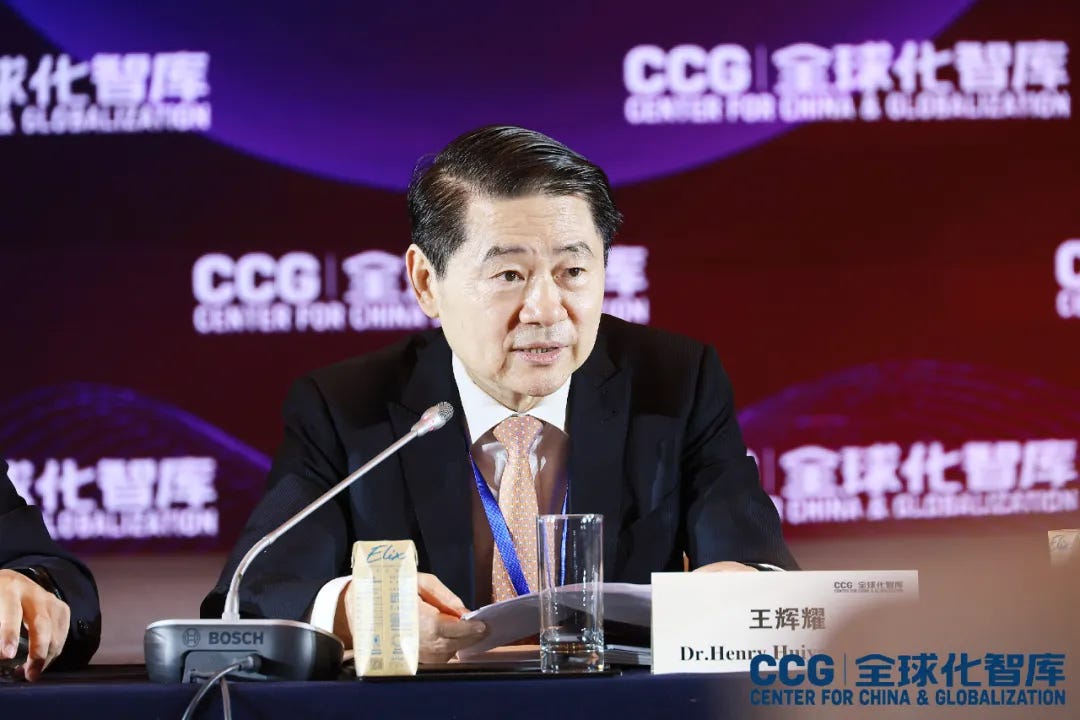
Your Excellencies, distinguished guests, ladies and gentlemen,
It is truly a great honour to convene once again for the China Global Think Tank Innovation Forum. This year marks our 10th annual forum, and we are privileged to host a gathering of such eminent guests. We have with us ambassadors, scholars, think tank experts, business leaders, numerous friends from the media, and also our Global Young Leaders. This is indeed a very important event.
As we are all aware, the United Nations is celebrating its 80th anniversary this year. The international system currently finds itself undergoing profound changes and facing immense challenges. The multilateral order established eight decades ago—underpinned by shared norms, institutions, cooperation, and a collective commitment to peace and development—is now being challenged and is under considerable stress. So, how can we maintain this global order and system, and how do we effectively meet the challenges that we haven’t seen in decades?
Against this backdrop, we have gathered such an excellent group of panellists for this roundtable. We intend to address the issues that are currently facing all of us. As the saying goes, we are all in the same boat—a large boat in a vast ocean—and we must sustain and support one another.
For this session, we will have 11 panellists speaking. We have just concluded the opening of this forum, where we heard from the former Vice Minister of Commerce and the President of the China Association of International Trade. I also provided some opening remarks. We are now moving into a more in-depth discussion.
We would like to raise several key questions. While we may not address all of them, discussing a few would be highly valuable:
First, to what extent does the current structure of global governance reflect the geopolitical and socio-economic realities of the 21st century? How can the UN adapt to these new challenges and configurations?
Second, what are the promising new initiatives regarding climate change—noting we just had COP30 in Brazil—as well as AI, digital governance, and development financing?
Third, how can we strengthen UN mechanisms for conflict prevention, crisis response, and peacebuilding amidst rising geopolitical tensions and strategic competition? The world today feels much less secure and peaceful than what we has been accustomed to.
Furthermore, in what ways can civil society, think tanks, youth movements, academia, and the private sector be more actively involved as multi-stakeholders in global governance to meet these challenges and embrace new opportunities? We are also seeing the rise of the Global South. How can UN member states, particularly those from the Global South, work together to deliver new norms, platforms, and coalitions within the UN system? What opportunities exist for more equitable and resilient multilateral cooperation?
We are truly honoured this morning to have so many distinguished panellists with us. I will now provide a brief introduction for each of them, and then we shall begin our discussion.
I’m very pleased to welcome:
H.E. Jorge Toledo, Ambassador of the European Union to China;
and also Mohamed Amersi, Founder and Chairman, the Amersi Foundation from the UK;
and H.E. Bruno Angelet, Ambassador of Belgium to China;
H.E. Patricia Flor, Ambassador of Germany to China;
and Thomas Habja, Senior Advisor and Representative of the OECD in China;
H.E. Khalil Hashmi, Ambassador of Pakistan to China.
Also Jin Xu, President, the China Association of International Trade (CAIT); Former Deputy Director-General, Department of American and Oceanian Affairs, Ministry of Commerce;
and we also have Eberhard Sandschneider, Senior Professor, Freie Universität Berlin; Former Director of the Institute of the German Council on Foreign Relations;
and we had also Sun Yongfu, Senior Fellow, CCG; Former Director-General, Department of European Affairs, Ministry of Commerce;
And we have H.E. Selçuk Ünal, Ambassador of Türkiye to China;
And of course, we have Wang Yong, Senior Fellow, CCG; Director, American Studies Center, Peking University.
And of course, we have other guests joining us for subsequent roundtables. We also have two Global Young Leaders who will raise questions at the end of this session. Among them is Anej Bevk Peternelj from Slovenia, who is the Director of the Gajst Institute (Partner of the Young Bled Strategic Forum); he will be joining us here for this roundtable as well.
So, Ambassador Toledo, I would like to start with you. Given our schedule, we may have to keep things concise, but as you have participated in our roundtables many times, it is always a pleasure to have your insights. Ambassador Toledo, the floor is yours.
Jorge Toledo Albiñana, Ambassador of the European Union to China
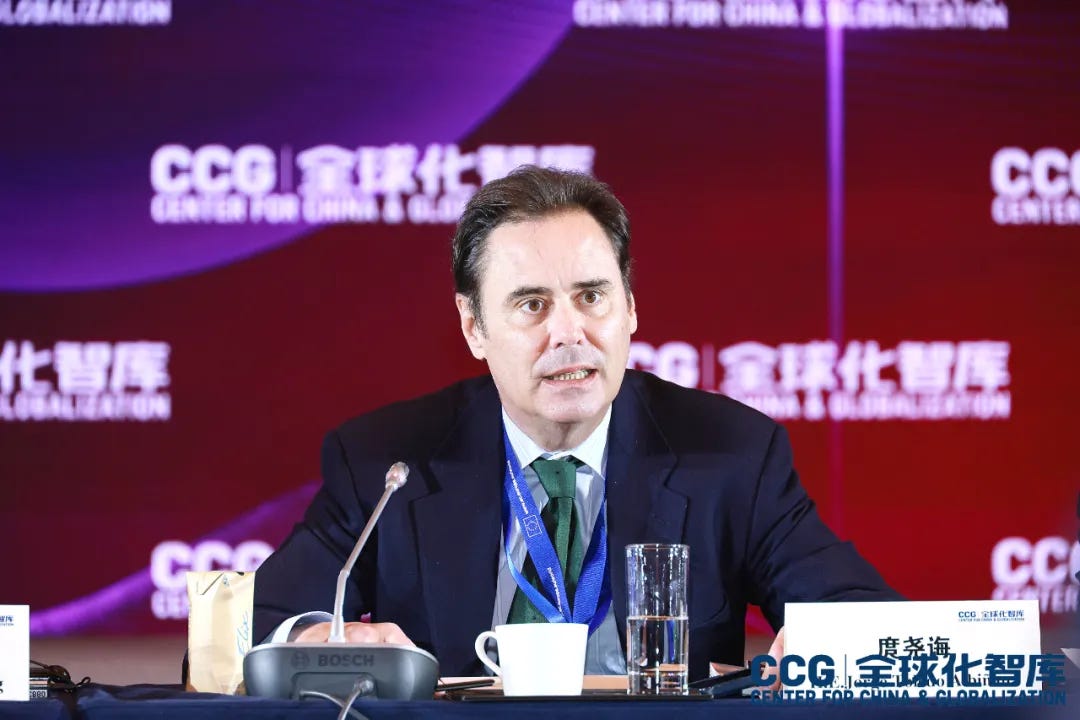
I see that you have used my second last name to follow alphabetical order. This is a characteristic of Spain and Portugal—we have two last names. My primary surname is Toledo, not Albiñana. Anyway, since my second name starts with ‘A,’ that explains why I am first on the list.
Thank you very much for inviting me again. I am always delighted to come to CCG and this forum, where one can express oneself freely and where what we say is truly heard and published. Thank you again.
The theme today is wide, but I will try to be short, given the long list of speakers. I will develop only three main ideas: one on the UN, one on EU-China relations, and one on the EUn.
First of all, regarding the UN, as President Xi has said, these are very turbulent times, the likes of which have not been seen in a century. This is affecting the multilateral system and the UN. The UN is, of course, based on the UN Charter and has three main objectives: peace (the most important one for which it was created), development, and human rights.
All three of these are currently being challenged. Let’s start with development: we have seen a major decrease in development aid because of the withdrawal of one of the largest donors. This is a challenge.
Human rights. We are seeing some narratives about human rights, prioritising the rights to development over other human rights that are not there in the Charter. And we want to defend the universality and the uniqueness of human rights. No human right is superior to others, and we have to defend also civil and political rights.
And finally peace, which is under the biggest challenge because one of the five permanent members of the Security Council started an aggression over three years ago against a smaller country. And this goes against the most basic principles of the UN Charter, especially territorial integrity and non-interference in internal affairs. So this is under challenge. While this is under challenge, I’m afraid it is very difficult to have an effective reform of the UN, which we badly need. The solution to this conflict, which we hope will come soon, could be the basis of a renewed UN system, especially when it comes to peace.
Let me say a word on EU-China. President von der Leyen said on the 24th of July, when she came here for the EU-China Summit with President Costa, that we were at an inflection point. We remain at an inflection point since the Summit. Things have not improved. Things have been difficult because of many factors, but especially when it comes to the supply chains, export controls, etc. So now we have an opportunity because of the recent suspension of the October export controls. This is good news. So let’s build on that to try and make progress. Now things have stabilised. We have one year. Let’s build on that to make progress on the EU-China relations, which are so consequential.
But let me say one last word because I read in the Chinese press a lot of attacks on the EU as something different from the member states. We see everywhere that the China-member states’ bilateral relations are good, but the China-EU relations are not good. Blaming the EU institution for the problems.
Let me explain very briefly that the EU is nothing different from the union of its member states, that if the European Union approves listings of sanctions, it is, and in this case, very clearly, with the unanimity of its member states. We have, in the European Union, no desire for bad relations with China. We have all the desires for partnership, for engagement, and for dialogue. But ignoring that there is a political union, that there is a political will, and that there is a union behind all we do would be risky and would not be conducive to anything.
So let me express my wish, on this basis, on this new stability, start dialogue again and improve all the issues in which we must make progress, as President von der Leyen and President Costa said. Let’s build on the consensus of the summit, and let’s start again to make progress between China and the EU. Thank you very much.
Henry Huiyao Wang
Thank you. Thank you, Ambassador Toledo. You’ve made an excellent point. I think we all truly look forward to strengthening and enhancing China-EU relations.
Recently, we have seen many European leaders, heads of state, and ministers visiting China. Just about two weeks ago, we hosted the visiting Foreign Minister from Estonia, and we also saw the King of Spain visit just a week ago. This frequency of high-level visits is great to see. We hope to continue improving the China-EU relationship.
I was also very pleased to hear that President Macron is expected to visit China, probably in December. I read in the news that he may be inviting President Xi to attend the G7 Summit in France. I am not sure of the exact details yet, but it will be a significant development when it happens. All of these developments are very positive, and I really appreciate the Ambassador’s view that we must build upon the China-EU Summit and move that momentum forward.
We truly appreciate those insights. Now, our second speaker will be Mohamed Amersi, the Founder and Chairman of the Amersi Foundation from the United Kingdom. Mohamed, the floor is yours.
Mohamed Amersi, Founder and Chairman, Amersi Foundation
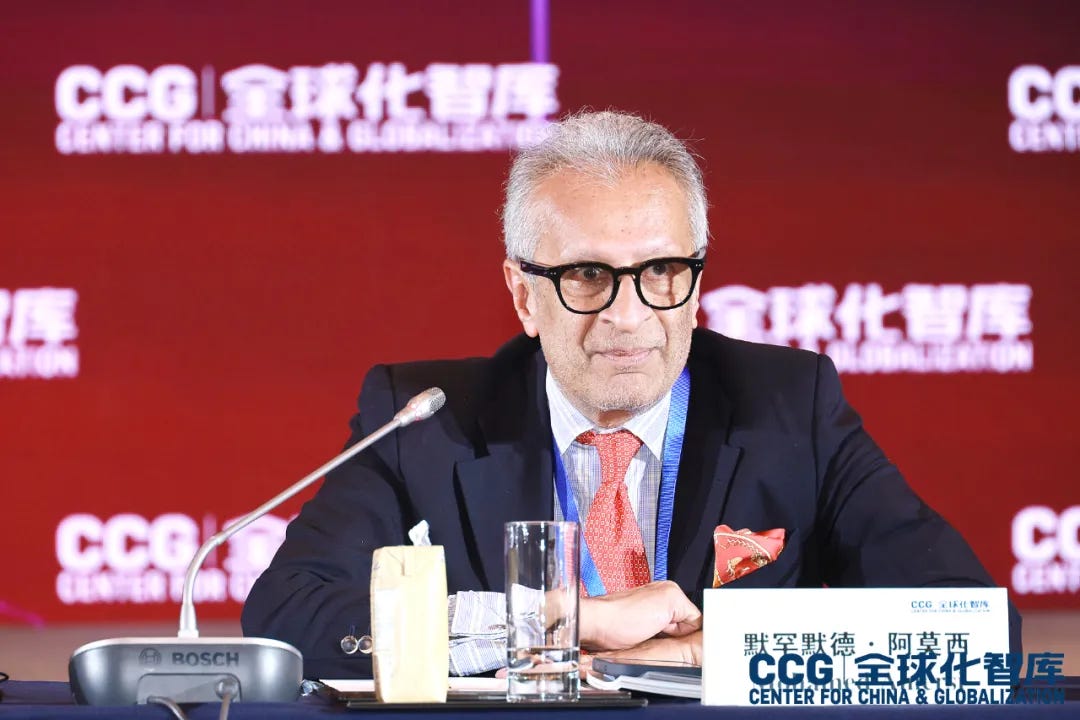
Thank you very much, Henry and Mabel. It’s a pleasure to be here again in Beijing at your very august forum. My remarks today will be on the irrelevance of the United Nations and what, if anything, can be done about it.
As you all know, the United Nations was founded in October of 1945 amid a burst of idealism in the aftermath of the Second World War. Smart leaders understood that their principal power stand from the pulpit. They could publicly shame and scold member states when they were not behaving. It was said that the UN was created not to lead mankind to heaven but to save humanity from hell. But even here it has failed because most of its secretary generals usually dance on eggshells and engage in the masterly art of UN diplomatese. The world now seems no longer to be listening to the UN. The wars raging in Ukraine, in the Middle East, and in Sudan have underlined an impression that the orders enshrined in the UN Charter are in tatters. The UN often appears to be a mere spectator in a world where increasingly might is right.
More than at any other time, I witnessed firsthand at the UNGA this year that there were fundamental question marks as to its relevance and purpose. The UN at 80 is facing two crises at once, within and without. The crisis within stems from 20 years of decaying authority, decaying capability and decaying impact for the poorest and the people in the conflict zones. The crisis without stems from a return to great power conflict and competition and a paralysis in the Security Council not seen in 50 years. This is at a time when a founding member, the most important power in the world, the USA, acts in every way as if the UN is an irrelevance.
Externally, the UN also faces a third challenge, which is posed by emerging would-be competing groups driven by the powerhouses of the Global South, such as BRICS, as well as traditional supporters in Europe. For the UN, this triple crisis is existential. Can it be rescued? Yes. But it’s a matter of will, and it’s not about recreating the UN of the past. It requires a whole different structure and a different approach.
In New York this year, I learned that there were three main areas that needed urgent attention if the UN was to be redeemed. Firstly, efficiency and cost-cutting. At least a 20% reduction in the secretariat’s $3.7 billion budget for 2026 is needed alongside a rationalisation of its workforce. A mandate review: most of us will not know, but today the secretariat has more than 3,600 mandates to focus on, and this is absolutely impossible with the resources that it has at hand. Thirdly, there is a desperate need for structural reconfiguration and the merging of overlapping agencies that are straying in each other’s paths. The drivers are clear: reverse donor fatigue— presently 2.4 billion dollars in arrears, 1.5 billion dollars owed by the U.S. alone, and scepticism about the UN’s relevance in the face of Security Council paralysis.
Much is being said about the reform of the Security Council. I believe this is the one area where, if there is focus, then the UN can be saved. And the main issue here is the question of the veto power and whether the five members that were mandated in 1945 are still the same five today in a changing global order. It’s also true that in order to make a change, the obstacles are formidable. Great powers always resist reforms that dilute their influence. So, how do you persuade France or the United Kingdom to no longer have a veto at the UN?
It is also worth noting that Secretary Gutierrez’s term as Secretary General expires in 2026, limiting his window to effect any transformational change. But this opens the possibility of a major change at the UN. Perhaps a bold visionary leader from the Global South would be such a saviour, given the sweeping growth that is presently flowing from this region.
In conclusion, if it’s business as usual, then the UN will morph into irrelevance. That is its predicament. The dream might live on, but it will only be a dream. A case in point is the ill-fated post-World War precursor of the UN, the League of Nations, which drifted to the international sidelines before perishing into oblivion. Thank you.
Henry Huiyao Wang
Okay. Thank you. Thank you, Mohamed, for your outline of views regarding the global system and your suggestions on how to improve global governance. Thank you.
Next, I would like to invite His Excellency Bruno Angelet, the Belgian Ambassador to China. I know that Belgium is the chair of the Francophone countries this year. In fact, we are going to host a Francophone Ambassadors’ Roundtable with CCG in the next two weeks. We would very much like to hear from you. Ambassador Angelet, please.
Bruno Angelet, Ambassador of Belgium to China
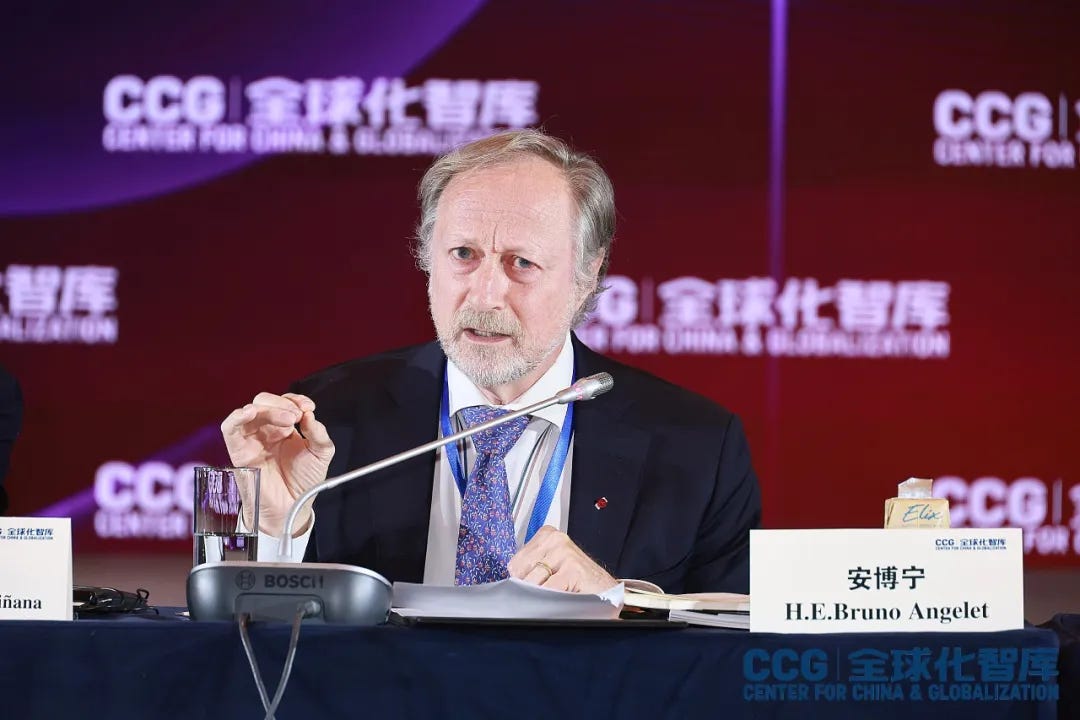
Thank you very much, Henry and CCG. Where Europe failed was to seek unity under empires, and then we switched to a Europe seeking unity by nation-states, and that led to permanent wars over centuries. The founder of Pennsylvania, who was actually a British political refugee, William Penn, called therefore, for a new order in Europe to avoid the big fish could eat the small whenever they liked. And the same applies, I would think, to the international scene today. And he was saying, well, what Europe needs is a supernational authority above the states by creating a European army, a European Parliament, and a European court. He was calling for a federal Europe so that there would be rule above the heads of kings, emperors, and popes. This means that today, if Europe is at peace, it is basically because it has the states have accepted supernational authority. The supernational bodies in Europe today are the European Commission, the European Court of Justice, and the European Central Bank because they have supernational decision-making powers.
If we look at multilateralism today, I would say there are probably a few things that we can take from there and apply them as guiding principles for the world, I think. Because I think a multilateral accepted and legitimate body will not work if states don’t accept to shrink and put limits on national sovereignty. It is interesting to see that there’s a call for more inclusiveness, which is right. We have to accept and create space for the new players, particularly countries from the so-called Global South. But the point is not only a matter of representation and inclusiveness. It’s, at the end of the day, also a matter of equality in decision-making.
And it strikes me that there’s a lot of discussion about how to increase inclusivity and representation, but very little detail about decision-making. And our previous speaker was just talking about veto powers in the United Nations Security Council. It is interesting to see that France and the UK have made proposals to reduce recourse to veto powers, and Secretary General Gutierrez has promoted them. But actually, those who insist on better inclusiveness and representation in the Security Council are exactly those who are not ready to discuss how to reduce recourse to veto powers or how to grant veto powers to newcomers. So I would say representation inclusiveness should also go together with shared decision-making.
And the last little point of an important principle is, I think, acceptance of the rule of law and international ruling because if the big fish should no longer be able to eat a small one, it means that equality for states should be guaranteed by limitation of national sovereignty, but also acceptance of the international rule of law. And there are a few test questions: In how far do states, big or small, accept the ruling of international courts like the International Court of Justice (ICC), the international arbitration court, etc. In how far do they accept the rulings of the WTO? In how far do they apply international sanctions? In how far do they accept safeguards of the IAEA? In how far do they accept to put national troops under the chain of command of the United Nations? It’s a key criterion, I think, to indicate if you are really a genuine multilateralist.
When it comes to reform of the UN, I think Jorge rightly said that the UN is based on three pillars: security, development, and human rights. And I think we should, in discussing how to reform the UN, make sure that the three pillars are properly addressed. Just to indicate, that today the human rights pillar is benefiting only 7% of the regular budget, meaning less than 1% of the total budget. We cannot be serious about reforming of UN if this, in particular, the third pillar, and how to fund it, is seriously addressed. We Belgians believe that we should reduce fragmentation and duplication. There’s a whole discussion now ongoing on UN80 regarding the merging of UN agencies, streamlining decision-making, as I said. I think also when we talk about more inclusiveness and shared responsibilities, it means also a proportionate burden sharing discussion on financial responsibilities.
When it comes to new initiatives, I would like to say that I’m very inspired by Mr. Jin Liqun, the outgoing president of the AIIB, who made excellent statements, I think about the future of multilateralism and who demonstrated himself by creating the AIIB, how a good new multilateral organisation could be organised. And he always said, I learned a lot from my years at the World Bank because the true multilateralism was established in the World Bank. Yet the World Bank was created by the grandfathers of basically Western people, and the new organisation should be created for our grandchildren of all of the world. But he’s basically saying that the body of legacy and principles, and governance of the World Bank, should still serve and be adopted for the future.
A last little point on the risk, I think, of big power diplomacy. And it goes back to what I said. I think that when big powers would like to fix the rules for the future, I bet a good Belgian beer that they will not accept limitations of national sovereignty, as we should do in a multilateral system. I am afraid they will not accept limits to national sovereignty, and that, in the end, will mean that international rule of law will apply for the small member states and much less for the big. They will accept when it’s in their interest and they will not when it’s not. So basically, I’m afraid that having the big powers ruling only or having the lead in the discussions on reforming the multilateral order will actually erode equality amongst states and erode the real rule of law.
To conclude. I think the real line of division is not between the Global South and the so-called Global North. Frankly, I don’t know what they mean. But I think in reality, as in the history of Europe, it has been demonstrated that the real division line is between small powers and big powers. Big powers use power in their interest. Small powers cannot. And the only way to survive, as Belgians did by building the European Union, is to make sure that you’re protected by equality in shared institutions and by a supernational authority who are the only real guarantee of equality in the application of international law. Thank you very much.
Henry Huiyao Wang
Thank you, Ambassador Bruno. That was a very good point. You also mentioned the AIIB. Of course, we need to strengthen these new emerging multilateral institutions and be more innovative. Thank you.
I also recall that just a few days ago, we attended your King’s Day celebration. It was a very large and impressive gathering at your residence. I noticed the Vice Minister Hua Chunying was also there; it was a truly great event.
Next, I would like to invite Her Excellency Patricia Flor, the Ambassador of Germany to China. I know that Germany and China have had many exchanges recently. Ambassador Flor, you recently accompanied Vice Chancellor Lars Klingbeil during his visit to China. We also know that business exchanges between Germany and China remain very strong. In the first half of last year, the investment in China reached 7.3 billion euros.
So, from your point of view, we would like to hear your insights. Ambassador Flor, please.
Patricia Flor, Ambassador of Germany to China
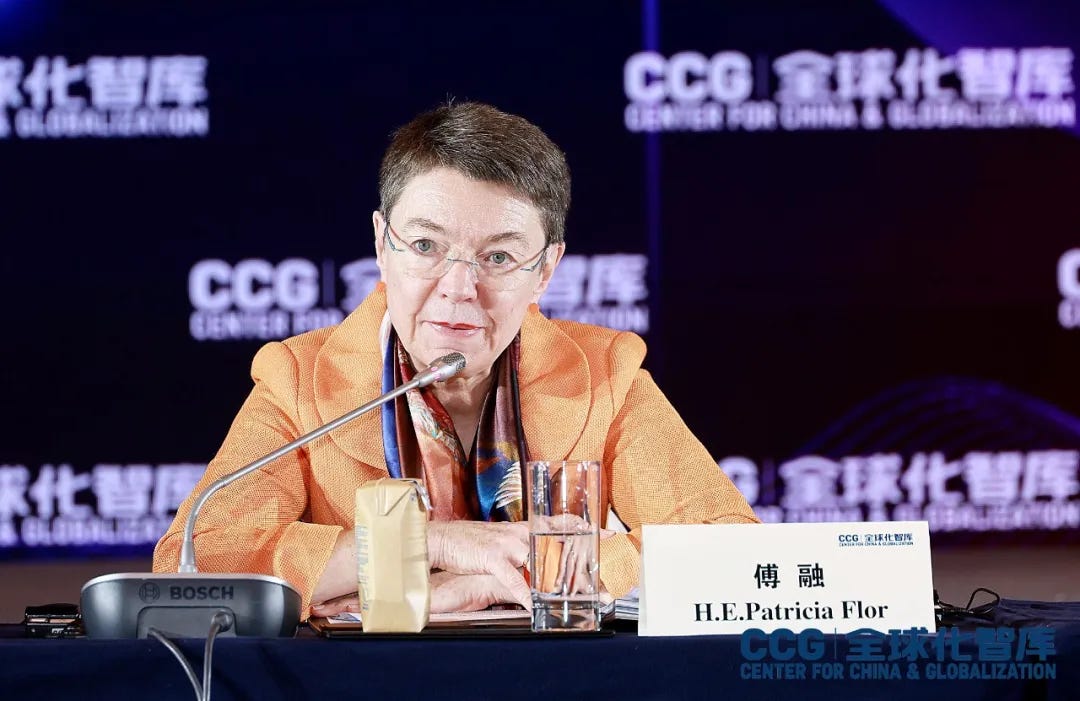
Thank you. Yes, it’s indeed that German relations with China are on a good basis at this moment. At the same time, let me say that personally, I am also strongly linked to the UN, having chaired the UN Commission on the Status of Women in the late 90s. So, let me focus on international governance today. First, I would like to make three points.
First, just to say that it’s very clear that Germany, the EU, and I would say, everyone around the world has benefited massively from the existence of the United Nations and the UN system over the last 80 years, because the fundamentals of the UN Charter really are the basic common denominators today, and they still are the same. It’s the sovereign equality of states, and it’s the prohibition of the use of force, and that holds even if today we see that a permanent member of the Security Council, namely Russia, has invaded a neighbouring country.
The UN Charter also forms the basis of our understanding of how international relations between states should be governed. On top of that, if I look at the SDGs, the Paris Agreement, the Pact for the Future—actually, however, would you want to achieve a consensus on how to fight climate change or how to move forward on fighting poverty and bringing education to everyone if you didn’t have the platform of the United Nations? And then, of course, you have the humanitarian assistance, UNHCR, OCHA and many others, and all of the countries around the world have benefited from them.
So, ask yourself the question: if you were to draft the structure and the charter of such an organisation today, would it really be so different in any of the fundamentals if you want to achieve equal decision-making and a betterment of the conditions of life for everyone on this planet? I would argue probably not.
Now, Germany is the second-largest contributor, also in voluntary contributions today, and we are committed to staying with the UN for the future.
Second point: none of the principles of the United Nations Charter, nor the Universal Declaration of Human Rights, nor the Convention on the Law of the Sea, nor the International Criminal Court have lost anything of its original significance. However, and here I would agree, it is absolutely true that the structures created in 1945 do not reflect the world of today. It’s as simple as that, and that means that reform of the different UN institutions is urgently required. It does mean that all of us should focus on how we address the reform needs, and I agree that the next Secretary-General of the United Nations will play a key role in this—has to play a key role. And let me say that—you won’t be surprised—it’s high time, after 80 years, that finally we have a female Secretary-General at the helm of the organisation. Just to remind everyone that women are half of the population of the world. So if we want equal and fair representation, it also applies to that particular element.
So the question is: How do we preserve the founding principles—inclusion and consensus-oriented decision-making—while strengthening regional representation, for instance, of Africans, and the system’s efficiency? For example, the Security Council—yes, absolutely it needs to be reformed, and Germany certainly is a strong advocate, including reforming the veto rights, because, as we see currently, it leads to paralysis of the institution, and therefore the UN cannot deliver on its mandate when we have blockades in the Security Council because of the veto right.
My third point, therefore: if we all want reform, then let’s not be blindsided by the fact that veto powers can actually bar the institution from progress in the Security Council, because the General Assembly—all the 193 states in the General Assembly—actually can come together and can try to find the consensus or the majority to actually move the system forward. It’s entirely possible, and I would argue it’s a question of political will, and it’s a question of not looking at North versus South or small versus large, but coming together in order to define where our main objectives are. Once we have a large majority behind that, that will put a lot of pressure on those who actually are not willing to reform.
Therefore, if you have some—and yes, I agree, some of the big powers—not willing to strengthen the UN and to move ahead, the majority of all of us should actually put our strength together in order to get it done. Germany is running for the Security Council once again. I hope that all of you will support us, and certainly we will remain a voice for reform and a pro-UN voice for the future to come. Thank you very much.
Henry Huiyao Wang
Thank you. Thank you, Ambassador Flor, for your very comprehensive remarks regarding the UN—specifically on its principles, the Charter, and how to both maintain and reform the organisation. These are excellent and highly relevant ideas.
I actually wrote an op-ed published in Foreign Policy during the UN General Assembly this September on the subject of Security Council reform. In it, I discussed how Russia and the U.S. have been abusing their veto power—over a hundred times—whereas other countries have used it very minimally. I do believe that in cases of significant unilateral abuse, we should seriously examine how to reform that mechanism. So, thank you again for raising these points.
Now, on the topic of multilateral institutions, we have a representative here with us. I would like to introduce Tamas Hajba, Senior Advisor for the OECD in China. He is also a top expert on global governance. Tamas, the floor is yours.
Tamas Hajba, Senior Advisor for China, OECD
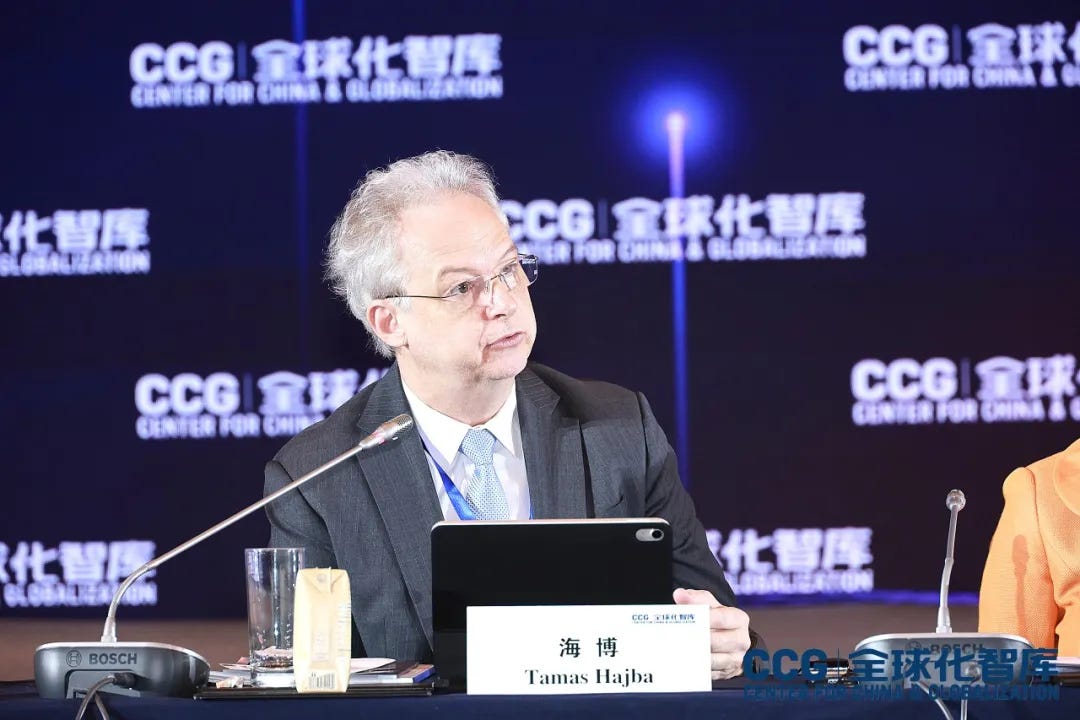
Thank you very much, and thank you for the invitation to join this important discussion on global governance. As it has already been said, we are indeed navigating a complex global environment, heightened uncertainties, and geopolitical tensions. And even though we, as an economic organisation, see resilience in the global economy, the challenges are still there: weaker business and consumer confidence, rising trade barriers, and not to mention, of course, we need to boost growth, we need to face, and we need to conduct more reforms, tackle the green transition, digital transition. And the reason why I’m saying this is because across all these challenges, we need multilateral dialogue and cooperation, and this is indispensable. But we also need to face the realities that not all forms of multilateralism have delivered to the needs of people, and the system that we inherited is under strain because of geopolitical dynamics, because of the representation of emerging economies. Technology is advancing faster than our rules, and climate change is also testing the environment and our institutions.
So again, what we need is a more inclusive cooperation between countries, as I would say, at different stages of development, and at these times of polarisation, we need platforms that enable technical exchanges among all types of countries. And this is becoming even more vital. So we, as an intergovernmental organisation, the OECD, are contributing to this process, to multilateralism. And since we are talking about the UN at 80, I’d like to mention that we work very closely with the United Nations on taxation. For instance, we’ve been running a project, the Tax Inspectors Without Borders, for 10 years with the UNDP, which is helping build capacity for developing countries. The PARIS21 initiative, through which we are supporting low and middle-income countries in building robust statistical systems for the SDGs. And we also have a mechanism monitoring transparency of global trade and investment with UNCTAD and the WTO. But of course, but of course, we also use multilateral platforms, and I think we should not necessarily reinvent new platforms, but we have to make them better—G20, APEC as a pointed case—and through these platforms we are also helping members build consensus and share evidence.
Well, the organisation that I have represented over the past 60 years of its history has also transformed into a major platform for policy dialogue. We turn evidence into standards, and we build consensus rather than imposing rules. So we kind of act as a bridge between advanced, emerging, and developing economies. And of course, we are focusing on global challenges, climate challenges, where global cooperation is obviously most urgently needed. So we have a new project, which is called the Inclusive Forum on Carbon Mitigation Approaches (IFCMA), and this is practical multilateralism. We bring together developing and developed countries to assess what truly works in reducing emissions.
Again, we are not imposing any rules. We are not prescribing models; we just compare the effectiveness of different policies using consistent data. Development cooperation is another pillar which is very important for the whole international community, and the OECD ensures that aid is transparent, effective, and aligned with the SDGs. But of course the development landscape is changing, with South-South and triangular cooperation, blended finance, and private philanthropy is now gaining more prominence; and the OECD supports this evolution through the Global Partnership for Effective Development Co-operation, not to mention our new statistical system, which is the Total Official Support for Sustainable Development (TOSSD) that captures private finance and public finance mobilised for the SDGs.
Now, let me get to my last point, which is building trust. I think this is what we need in the international system, and what we do is build trust through evidence and standard-setting. Standards are kind of a common denominator and common language that we can build on in our cooperation. When it comes, for instance, to the OECD, we set standards for artificial intelligence, data governance, multinational enterprises, corporate behaviour and, of course, taxation.
So we need to strengthen trust—trust between governments and citizens, trust between science and policy—and we try to be an honest broker in this process. And my very last point: since we are here in China—China, the second-largest economy and a key actor in climate, development, and innovation, China’s choices have a global significance, and the international community looks to China as a contributor to more inclusive, rules-based multilateralism. And we hope that the OECD-China platform and cooperation for mutual learning can contribute to reducing fragmentation and strengthening the rules-based order. Thank you.
Henry Huiyao Wang
Good. Thank you. Thank you, Tamas. Absolutely. You spoke about the multilateral system and the need to strengthen all multilateral institutions, including, of course, the OECD. You also mentioned the G20 and APEC. I would add that we have newly emerging platforms as well, such as the BRICS Summit and the SCO.
We really need to increase the activities and exchanges across all these regional and multilateral platforms so that we can build more trust, as you rightly pointed out. To achieve that, we must have more face-to-face meetings. We have the G20 Summit coming up this weekend in Johannesburg—I will be attending that as well. I truly hope we can see more of these exchanges, even among think tanks.
Next, I would like to invite His Excellency Khalil Hashmi, the Ambassador of Pakistan to China, who is also a great friend. Ambassador Hashmi, please, the floor is yours.
Khalil Hashmi, Ambassador of Pakistan to China
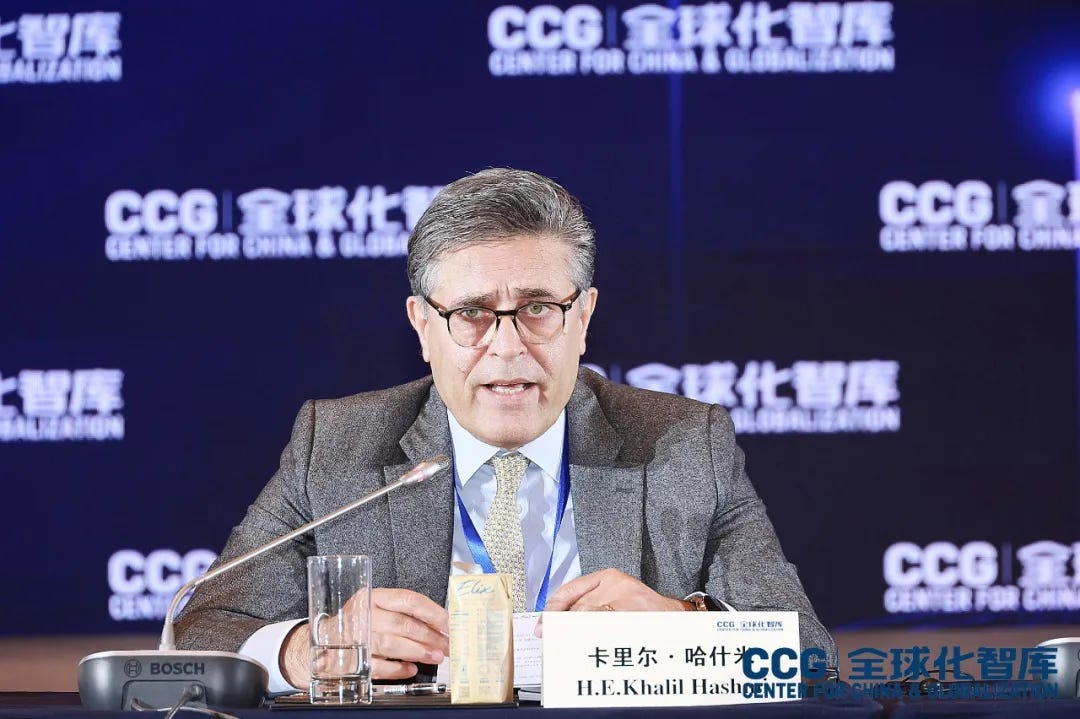
Thank you very much, Dr Henry. Thanks to CCG for hosting us and for this opportunity. Just a couple of very quick things. First, although I’m participating as the Ambassador of Pakistan to China, what I’m going to say is a disclaimer: these are my personal views. So, I want to be very candid because I spent more than half my career at the United Nations in different capacities, and I have probably seen it up close. So, I want to be very frank.
Secondly, I think it’s really hard to, you know, squeeze such a vast subject into five minutes. So, I don’t have any solutions. What I’ll do is I’ll make several comments on how the system is, because frankly, I don’t see that we are at an inflection point where—of course, much is changing, much has changed in terms of the power equation on the climate change side and technology elsewhere, but I think the fundamentals of the international order—it would take probably several years, if not decades, for a new configuration to emerge which, by and large, satisfies the countries from the Global South and also from the Global North.
First and foremost, I agree there are three or four pillars to the international order underpinned by the United Nations: peace, security, development, and human rights. My first argument is that the multilateral order or the international system has been—while a lot of contribution was made by the major powers, but my argument is that the most damage to this structure has also been done by the major powers, whether it is on the norms side, and we have seen it in recent conflicts. We have seen how the Ambassador of Belgium mentioned that many countries may not be ready to subordinate their national sovereignty to a larger, you know, either United Nations.
I would also argue that many countries are not prepared because of their national interest to hold some of the major powers to account when they go astray or not abide by the UN Charter, international law and norms, because we have seen many times countries’ national interest prevailing over what needs to happen in terms of upholding the sanctity of international law and norms. I have spent four years—I can talk maybe three hours on what needs to happen on human rights—and I have seen the duplicity and double standards on human rights and the debates about what needs to be prioritised in terms of the civil or political rights or economic, social, and cultural rights. But I won’t go there because that would probably need a three-hour session in itself. But suffice to say that I think there are a lot of young leaders here, and you can do a survey as to the upholders of those who claim to uphold human rights. You can have a survey as to who is upholding and whose track record speaks for itself.
The UN Security Council represents one of the major structures where geopolitics is reflected, and I would argue that I think—and my main argument is that it is the major powers which are responsible for damaging the very system that we are talking about. This is reflected in many ways in terms of holding the United Nations, or the system, hostage because of the way the budget is allocated to the United Nations.
But also in the Security Council, I think my argument is that there are two issues. One is on having new members, and I would argue that there is absolutely no need to have more members because we have seen the track record of the existing members—that while they claim to be acting on behalf of the entire membership, their exercise of veto and other ways they have behaved in the Security Council doesn’t lend any confidence that the new members or claimants who want to come to the Security Council as new members would behave differently. So what is required is, if they want a privilege, that privilege should come with accountability, and that accountability can only come with rotating seats, not being there for the entire life. So that goes against the very idea of having a democratic oversight.
Secondly, the issue of veto, and of course, that speaks for itself, and it has been at the centre of many of the ills that we see.
Very quickly on the socioeconomic realities—of course, I think the UN system was structured, it took care of probably the geopolitics for the most part, but it didn’t take care of the socioeconomic side very well, and we saw the emergence of Bretton Woods. I think the debates about development on the economic and financial decision-making, which have mostly taken place at the World Bank, IMF, and others, and what we have seen now, is not entirely what many developing countries are facing in terms of the debt crisis or the huge debt burdens.
Yes, many of their acts of commission and omission, but there is a lot that has happened because of the way the international economic system is structured. The same goes for climate change. Many developing countries are facing the brunt of the actions that they did not participate in. But when it comes to dealing with these new structural problems of climate change or debt burdens, pandemics, I think we see there is a lot of foot-dragging in terms of making up for the financing for development. And we have seen, I think, if the reform has to take place within the UN system, then I would argue that the Economic and Social Council (ECOSOC) of the United Nations needs to be empowered and the United Nations General Assembly needs to be revitalised. But we have seen these debates for over 30 years going nowhere because ultimately it is the power structure that defines and shapes the geopolitical realities and the socioeconomic realities.
My last word is on BRICS, of course. BRICS or AIIB, New Development Bank—these are some of the manifestations of the new structures that are emerging. But here too, I think the change would take time because—just a comment on BRICS, for example—there are many countries which have come on board and we’ll see how it goes in terms of aspirations, but there are several issues, and one is the issue of legitimacy itself.
And I would say, for example, Pakistan is the fourth-largest developing country in the world in terms of population, and yet it is being prevented from being a member of BRICS, so much so that it speaks for its legitimacy and inclusivity claims. So we know what is happening. It is the power structure. It is the people who are inside, and then they would invoke the principle of consensus to block, and here we see also a veto being exercised in the BRICS to prevent the fourth-largest developing country from getting into BRICS as a member.
So, last word is, as I said initially, it’s probably not a very rosy picture, but that’s what the reality is as I see it very up close, having served almost 16, 18 years in that system. So going forward, I don’t see much happening in terms of the geopolitical realities changing by themselves or the international governance structure getting itself improved, because it is the big guys’ problem.
Henry Huiyao Wang
Thank you, Ambassador of Pakistan. You mentioned many, many fronts and from a very special, unique perspective, and also reflect a lot of Global South voices there. So thank you. Next, I would like to invite Mr Jin Xu, the President of the China Association of International Trade (CAIT), former Trade Minister at the Chinese Embassy in London, and also former DDG of the Department of American and Oceanian Affairs at MOFCOM. Please.
Jin Xu, President, the China Association of International Trade (CAIT); Former Deputy Director-General, Department of American and Oceanian Affairs, Ministry of Commerce
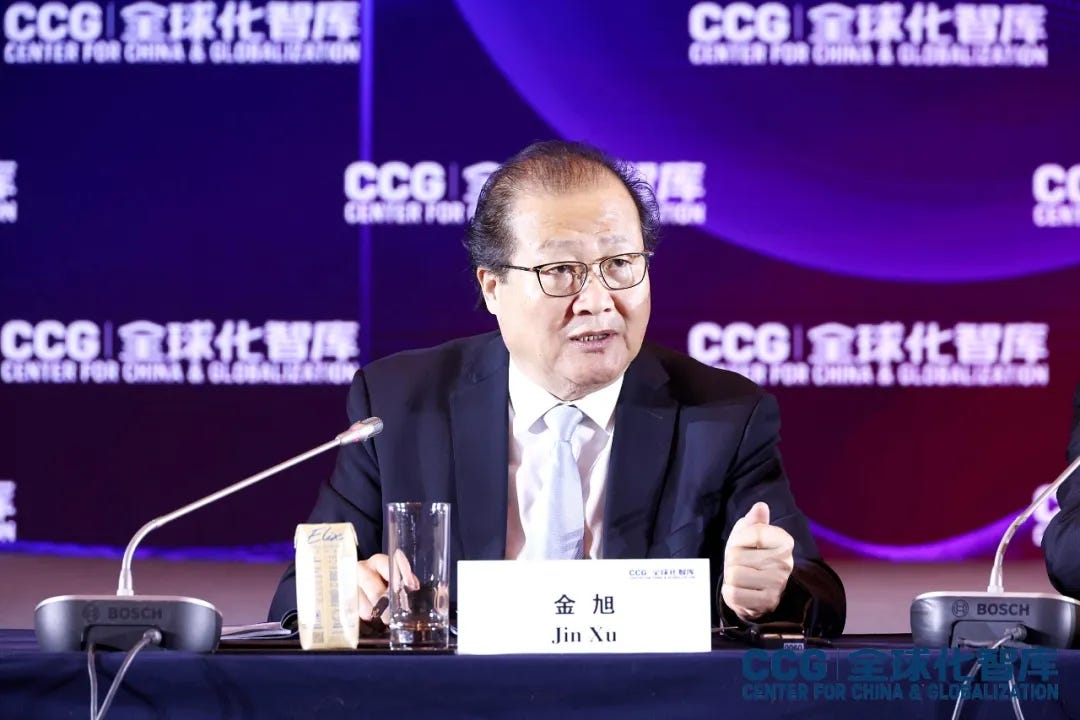
Thank you for giving me five more minutes to think. However, I still feel it’s too short. I would need at least 50 more minutes to truly elaborate on this issue. This year marks the 80th anniversary of the United Nations, built from the ashes of the Second World War. The United Nations has been dedicated to creating a better life for everyone across the globe. People in every country have benefited significantly from its efforts, but there are still areas where improvement is needed. Now more than ever, we all need the United Nations to play a bigger role.
I have three suggestions. First, the United Nations needs to be more visionary. Second, it needs to be more inclusive. And third, it needs to be more effective.
Regarding vision, every year, based on information we receive from the media, the United Nations has been reacting to crises like a firefighter—responding wherever there’s a fire. While this is important, the United Nations needs to be more proactive and forward-thinking. A significant challenge here is the bureaucracy. I hope that countries around the world can find common ground on these issues. As some of you have mentioned, the minority often follows the majority, and important proposals are sometimes cancelled due to bureaucratic arrangements.
Of course, it’s important to respect the sovereignty of every country, but at this point, to be truly inclusive, we need to place equal importance on economic development. Transnational companies, NGOs, and think tanks must all participate in global governance and play bigger roles. It’s essential to ensure that our rules are applicable and realistic.
Next, the United Nations needs to be more effective. While we’ve reached many agreements for a better future, we need stronger, more tangible actions. We can’t afford to be giants in words but dwarfs in action. We are witnessing transformative changes in the global order, with many of you mentioning issues like polarisation, delayed contributions, and unilateralism. We need to do more to promote multilateralism.
In the face of these challenges, it’s crucial to strengthen the effectiveness of the United Nations. Every institution must have a voice and maximise its impact, allowing the United Nations to truly fulfil its role and commitments from the beginning. With our collective efforts, I believe the United Nations will be able to devise proper governance plans to promote world peace and development, and together, we can build a better life for everyone.
Henry Huiyao Wang
Well, thank you, Mr Jin Xu. You mentioned a lot of practical points; for example, regarding the UN—indeed, many resolutions and suggested objectives have been made, but the key is implementation. I think, as President Xi mentioned at the Global Governance Initiative, we need results-driven and performance-driven activities to truly strengthen multilateral objectives. So, thank you for highlighting that.
Next, I understand that our Ambassador from Türkiye has to leave a bit early, so I would like to call upon His Excellency Selçuk Ünal, Ambassador of Türkiye to China, to speak at this time. Thank you.
Selçuk Ünal, Ambassador of Türkiye to China
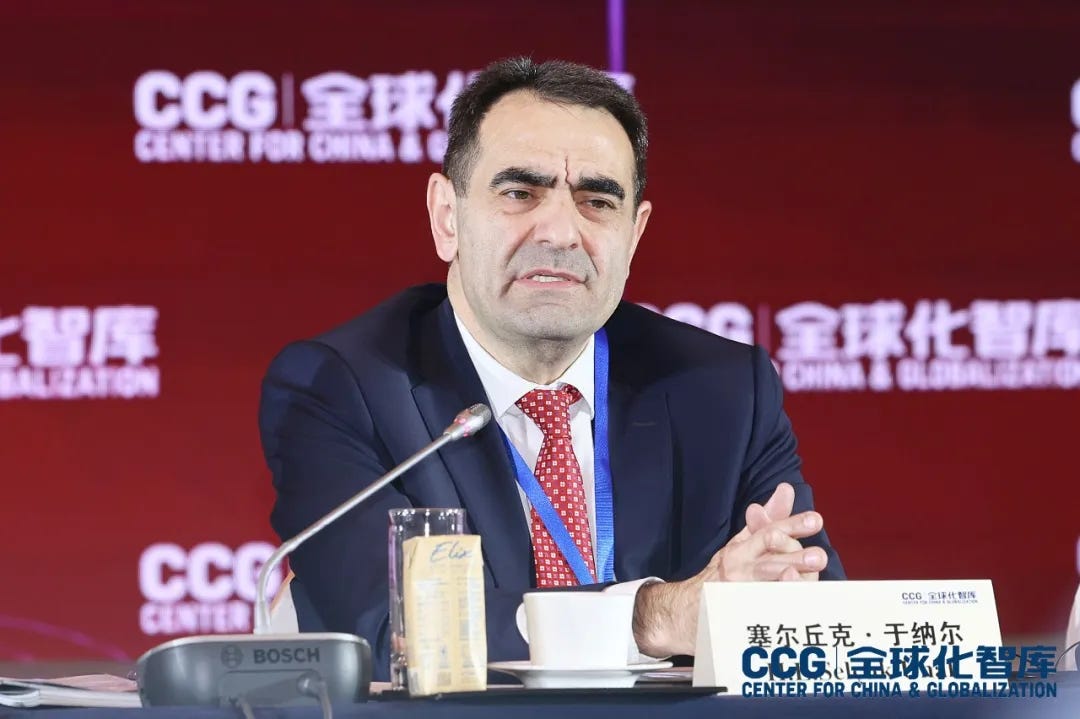
Thank you. Thank you. Well, thank you also for the understanding. But I’ll try to stay as much as possible, of course. Thank you. I just wanted to offer my remarks in two avenues.
The first one is, of course, the necessity of reform in the UN. Despite every criticism, I think the United Nations is still the key organisation, and we, as Türkiye, support multilateralism, and we should all support it, because, for the UN, I think at the end of the day, it’s the member states who make an organisation, who make this organisation. But there is an obvious necessity for reform of the UN Security Council, and that’s why our President Erdoğan has always been underlining this with a motto: “The World is bigger than five.” It’s not a criticism of those five countries, but of the system and the malfunctioning of the system, of course. And with a broader and more representative Security Council, we believe things could be better. With a rotational system—I will not enter into our ideas on that—but there are other countries, many other countries supporting this kind of reform. Why? Because the system is not working, unfortunately. And again, I repeat, it’s the UN member states who would be instrumental at the end of the day.
The second that I’d like to share is what we are doing. I mean, I’m responsible for Türkiye, and Türkiye is—we don’t want trouble. Who wants it? It’s been in our foreign policy DNA, and that’s why it’s been underlined by Mustafa Kemal Atatürk, the founder of the country: “Peace at home, peace in the world.” That is still the motto. But because there are so many other instabilities and problems around our neighbourhood, we are just trying to pursue a preventive diplomacy with constructive dialogue. That’s why—just to give a few examples from last year’s—we have started processes between Ethiopia and Somaliland, including Somalia; of course, I need to say, regarding the war between Russia and Ukraine; Syria, recently Palestine, most recently between two friendly countries and nations, Afghanistan and Pakistan. Why are we doing it? Because we don’t want trouble in the neighbourhood, in the far neighbourhood.
And that’s why Türkiye is, I think, the only country in three international organisations co-chairing the Group of Friends of Mediation: in the UN, in the OSCE, and the OIC. And recently we co-chaired with Finland again in the UN General Assembly last month. But why are we doing it is just to prevent further crises, because whenever we talk to any of these countries that I mentioned, the only complaint that we are hearing—everybody is hearing—is that all the countries, all the members of the United Nations, including the major powers, they are not paying attention to anything unless it touches their interests. But there have been so many things, unfortunately, bad things, going on against the territorial integrity of those countries, and this is something, I think, we must prevent.
Of course, just to conclude, we are in China. On all the United Nations principles, including multilateralism, just a few words on China. China, I think, is doing an important job in development issues. Secondly, there are several initiatives on multilateralism in recent years, which I think must be looked into. And of course, China is an observer in this UN Security Council reform. This is also an interesting point. So with these, I just like to say thanks.
Henry Huiyao Wang
Thank you. Thank you, Ambassador Ünal. And absolutely, Türkiye plays a very active role in global activities. We see, you know, it’s the only place that Russia and Ukraine have met a few times. I’m sure Zelenskyy is going to visit Türkiye now, and we hope that there will be more roles to be played there. So, thank you for your contribution.
Now I’d like to go back to Professor Eberhard Sandschneider. He’s the Senior Professor at the Freie Universität Berlin and former Director of the Research Institute of the German Council on Foreign Relations (DGAP). He also made a special trip to come to this conference. Professor Eberhard.
Eberhard Sandschneider, Senior Professor, Freie Universität Berlin; Former Director of the Institute of the German Council on Foreign Relations
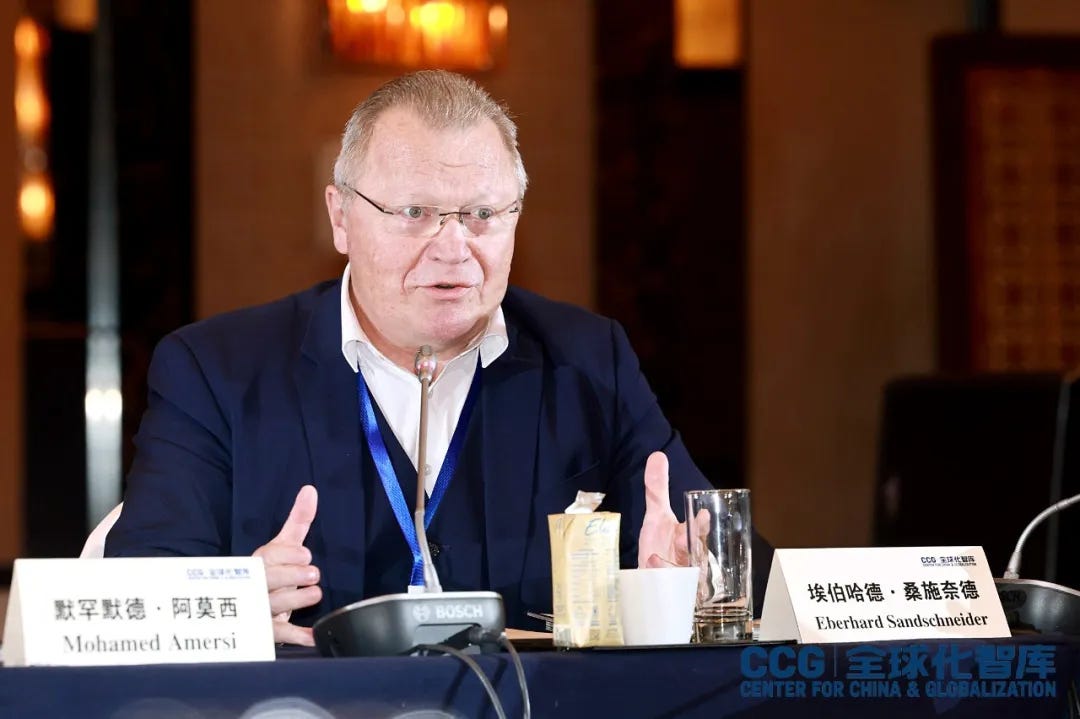
Professor Wang, thank you so much and my apologies for my complicated, long German name. So thanks for the invitation and for the opportunity to share a few thoughts on the United Nations with you.
Perhaps we all agree that if you look at the world as it is, we are living in a time of crisis of multilateralism due to many ongoing geopolitical upheavals and changes. But this is a challenge, and we have a broad spectrum of opinions on the table this morning here, starting with my neighbour who described the United Nations as morphing into irrelevance, and then you have added all these ideas on reform and the future of the United Nations.
The debate on the United Nations over the years—and basically these debates about reforming the UN have started from the first year of the existence of the United Nations; it is not new. But it is always characterised by a stark contrast between admonitions on what the United Nations should be or will be or would better be, and admonitions on the one hand, and observations of realities out there which do not fit with all these theoretical ideas about the future of the United Nations.
So Professor Wang, your first question: Does the current nature of the United Nations fit the actual situation? That’s the only question which is to be answered in a very simple way; the answer is no. It does reflect the year 1945 but not the year 2025, and that is perhaps the core problem of the United Nations as such. But the balance sheet from my perspective—well, I would describe it as successfully failing ever since its foundation.
Without the United Nations, this world would certainly look different, but also certainly not better. The United Nations has built an institutional network without which the world really would look worse than it is today. And the deeper you go into this institutional network, the more successful the United Nations becomes in so many different aspects. If we didn’t have it, we would wish to have it. The problem is the top level, and you have several times already this morning mentioned the Security Council; the role of individual member states who do not want to compromise—France and Britain have been mentioned as not willing to give up their seat to the European Union and so on.
The United Nations, therefore, will continue to exist. If you have an institutional network of that size and importance, it does not go away. It will continue to exist. But we will also have two options. And both options have been on the table already this morning. Reforming the United Nations from inside—allow me to say then I agree with Mr Amersi—that’s close to irrelevance; that won’t happen, quite obviously. But the other alternative, of course, is putting pressure from outside, creating alternatives, helping the United Nations to become a little bit more efficient.
And let me just offer you two ideas which might be worth debating among think tanks all over the world. And one is: if you have an institution which is not working and you can’t get rid of it, you have to create other institutions, and we call that alternative institution building. And we have seen this alternative institution-building already going on. You have mentioned the Shanghai Cooperation Organisation, BRICS Plus, and many other institutions still in creation. So, having the United Nations as an overall framework plus alternative institutions which might help to become more efficient in global problem solution—that could be an option. And the second option, of course, is what we usually describe as “coalitions of the willing” within the UN system. Let those act who are willing to act.
So after all, after 80 years of the history of the United Nations, the balance sheet is not simple to describe, but again I would say it was a process of successful failing, and it will go on over the years ahead in the same way, unless we find ways to replace those elements where the United Nations is failing with elements where other institutions might be successful. Thank you so much.
Henry Huiyao Wang
Thank you. Thank you, Professor Eberhard. And so you made a lot of suggestions there; great to see that. But as I also mentioned, we need a lot more gatherings—whether multilateral or plurilateral—just to make sure we stay in dialogue and build up the trust, so it’s very important.
Now let’s invite Mr Sun Yongfu. He’s a Senior Fellow at the Center for China and Globalization (CCG) and the former Director-General of the Department of European Affairs at the Ministry of Commerce (MOFCOM). And he participated in many China-European negotiations, including the CAI. He was probably one of the longest-serving DGs at the European Affairs Department of the Ministry of Commerce. Mr Sun, please
Sun Yongfu, Senior Fellow, CCG; Former Director-General, Department of European Affairs, Ministry of Commerce
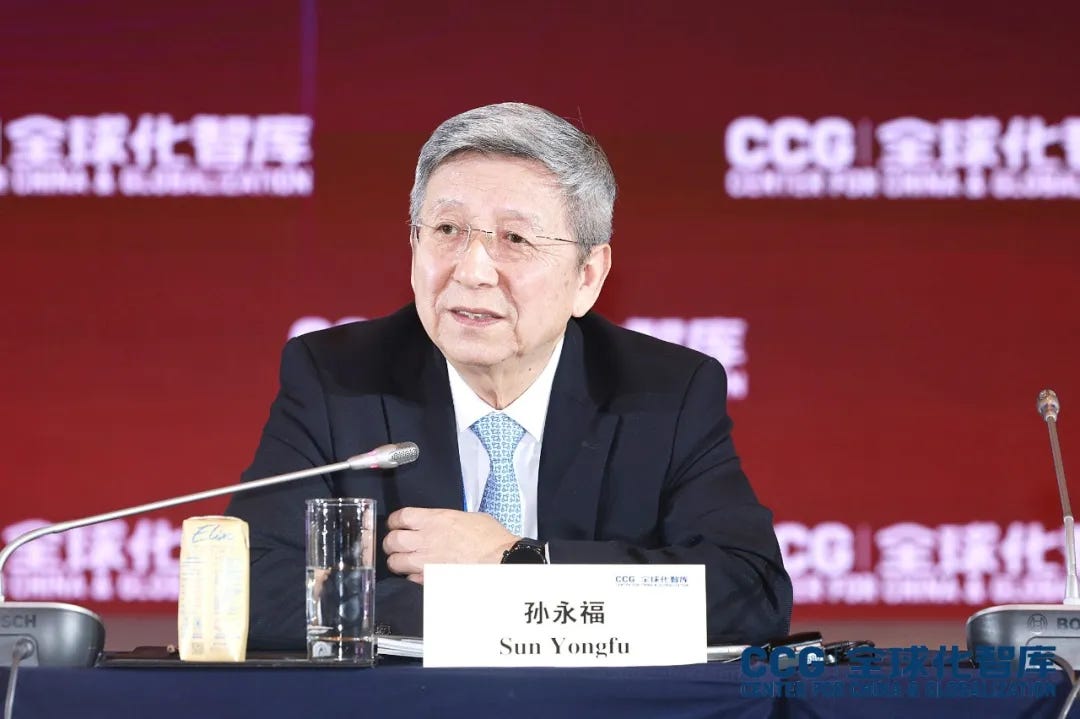
Thank you. Thank you very much for your introduction. I’m very honoured to be here in this dialogue. As you mentioned, I was the DG for the European Department for 12 years plus. But before that, I was working in the International Department in the same ministry, dealing with different UN organisations: UNDP, UNIDO, UNICEF, UNFPA.
So in this discussion, I would recall that the UN, especially those UN specialised agencies, make quite a difference in the development of China. Somebody already mentioned China is already the second-largest economy in the world, but when we got along with the UN, I think starting from the late 70s and early 80s, at that time, the Chinese economy was very backward, actually; there’s no comparison with the present situation. And I should say UN and UN specialised agencies, UNDP, UNIDO made a great difference in the early age of the Chinese economic development, followed by some developed countries’ bilateral contributions to the Chinese economy—not only economically but also in social development, poverty eradication, the environment, and a lot of things, and thr UN has been very much involved.
I have something like 20 years’ experience working with the UN. I think right now the UN is facing problems, as many people mentioned, especially because the financial means are not adequate to fill the needs of their target: security, peace, and development. And some big countries, developed countries, cannot meet their target as members of the UN. So I really think it is still very valid if the contribution can make a difference, and the UN and also their specialised agencies should continue work for those developing countries, and they can make a difference as they have, like in China and in Southeast Asia, for example, and also especially the African countries.
Another point I should make is that security, peace, and development should still be the main causes of the UN and its specialised agencies. I can recall, and by reading some news from those returned astronauts, they see the little Earth we are living on now is a kind of tiny ash from the moon, from the sky. And after returning to the homeland, they think that it’s ridiculous to fight each other because from the sky, you don’t see any boundaries of the countries which they are fighting for. So we need to work together instead of fighting together, not to spend so much on weapons, but to concentrate on peace and development. So they changed their mind. I hope those leaders who are still fighting should follow the idea of those astronauts and try to concentrate their financing for peace and development. Of course, the other point is that the UN and specialised agencies need to be reformed in order to fulfil efficiency and meet the needs of the new requirements. I don’t have the time to explore the details. Thank you very much.
Henry Huiyao Wang
Thank you. Thank you, Director Sun. Actually, that’s a great idea. You know, when you look at Earth from outer space, you realise how tiny we are, and we are all in the same boat. So, we really need to work together. I agree with you that the UN system has played an important role in China, through organisations like UNDP, UNIDO, UNICEF, and many others. I still remember back in the ‘80s when I was working with Director Sun at MOFCOM. We had many exchanges, seminars, and workshops with the World Bank and various United Nations agencies. Their contributions to China’s development have been tremendous, so it’s great that you mentioned that.
Now, the final roundtable panellist is Professor Wang Yong. He’s the Director of the Center for American Studies at the School of International Relations at Peking University, and he is also a Senior Fellow at CCG. Professor Wang, please.
Wang Yong, Senior Fellow, CCG; Director, American Studies Center, Peking University
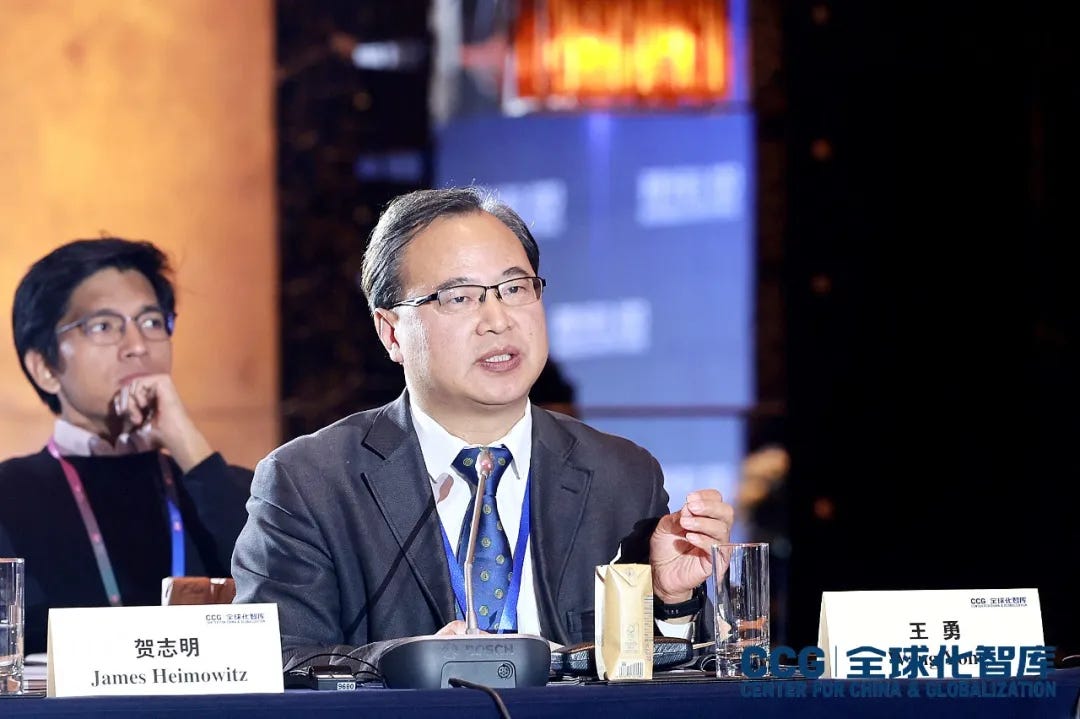
Thank you very much, Dr Wang. I appreciate the opportunity to attend this very important dialogue. I echo the great relevance of the United Nations in today’s world. I have been teaching international relations at Peking University for over 40 years, and I’ve noticed a very interesting phenomenon: the link between the classroom, academia, practice, and the real world.
I think we’ve had a lot of discussions today, and one thing that must be recognised is this: scholars of international relations have led wrong assumptions about international relations. They assume that we are in a world of anarchy, which is a key concept in the theory of power politics and realism. I believe a lot of people here were taught this assumption by your professors when you were at university. I think that assumption is very wrong, driving people and leaders crazy. They have been obsessed, okay, with the so-called “survival of the fittest.” They are obsessed with power, the building of power, and so-called great power rivalry.
So, why do countries and leaders worry about this? It’s because they have a very deep sense of insecurity and a very deep mistrust of one another. I think that is something we must recognise—these wrong assumptions and how they influence political decision-makers. There is a process through which scholars, decision-makers, and public opinion leaders influence each other, strengthening each other’s views about the world.
The second point I would like to argue is that we are in the 21st century. We are not in a state of anarchy. We have international laws. We have the United Nations. We have the United Nations Charter, the WTO, etc. That is something that came from the painful lessons of the two great world wars, the loss of millions of lives. That is the joint effort by all the great nations building for the principles and the foundations of the United Nations. So I think the United Nations still takes the central place in this world. We should not avoid it or play a destructive role. We should work together to promote the reforms of the United Nations and related institutions, and to ensure these institutions, these norms, these principles match today’s world.
The last point is that the key to peace and prosperity of the 21st century lies in the United Nations, especially the special responsibility of the two great powers: the United States and China. China is open. China has a strong endorsement of multilateralism. China is open to discussions on the reforms of initiatives. China has set the four global initiatives on the table, waiting for the echoes, discussions, and feedback from all the countries.
I think this newly concluded meeting between the two leaders of the United States and China in South Korea seems to project some new hope for us. Even if some people dislike the concept of G2, my understanding is that the two countries, the two largest economies, should take special responsibility. Not try to seek power or try to take advantage of the institutions; that is something to serve. So I hope those are the positive evaluations of the meetings, and they give us hope for reform in our nations and give us new hope for multilateralism. Thank you very much.
Henry Huiyao Wang
Thank you. Thank you, Professor Wang. Yes, absolutely. I think the greater powers, great economies, should have more responsibility and more work to do to maintain the global order we are now to improve, enhance, and enlarge.
Now, we have finished the panel round, but I have a Global Young Leader here in the presence. We actually invited 30 Global Young Leaders from 25 countries yesterday. We already had a whole-day event for the Global Young Leaders, which is in its fifth year now that we’re doing that. President Xi actually wrote a letter to our Global Young Leader programme. We’re very pleased to have a young leader here at this roundtable to raise a question. He’s from Slovenia, he’s the Director of the Gajst Institute, which is involved with the Bled Strategic Forum; so, Anej Bevk Peternelj, please raise your question.
Anej Bevk Peternelj, Director of the Gajst Institute
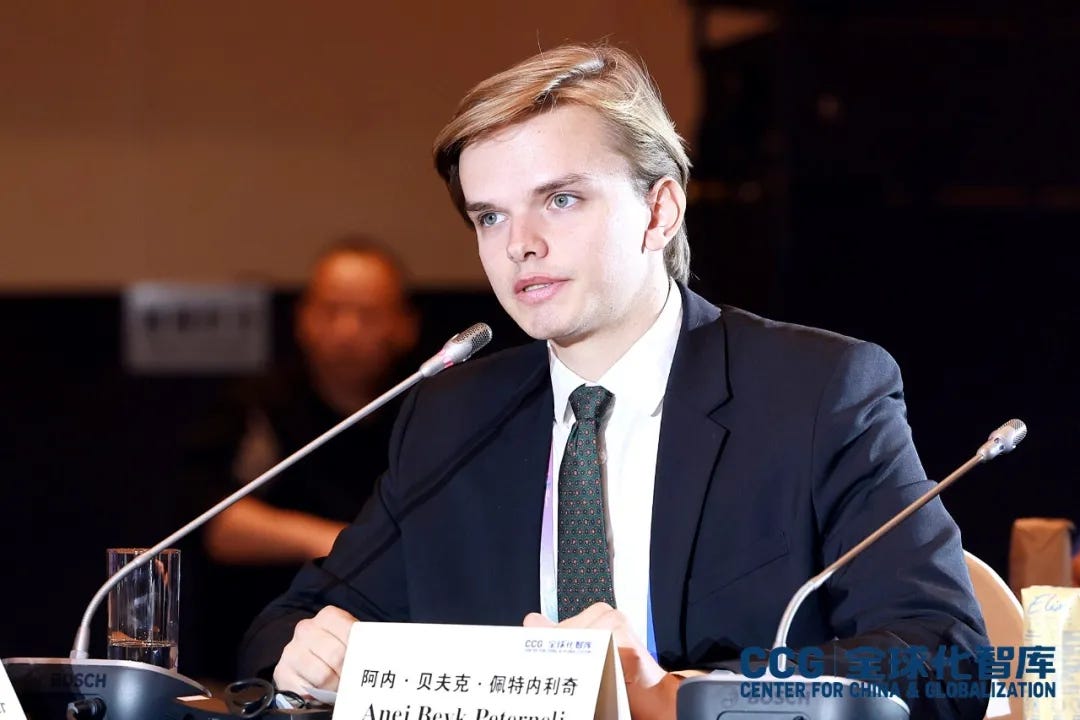
Thank you for the floor. Excellencies, distinguished speakers, ladies and gentlemen. Thank you first of all for your inputs and thoughts. I’m quite certain I’m the youngest person present at this table. Therefore, my honour to have the opportunity to speak to you today.
Speaking on global governance, the UN and its institutions, I’ll be very blunt. Young people are losing faith in this system rapidly, and we are not buying its peace, rights and cooperation pitch anymore. Wars, climate chaos, and sluggish institutions have eroded trust. And they have left a void which is now being filled by extremist and populist voices and powers.
This is not only my opinion. I see it among my friends, my peers and colleagues. We live in a world where a single tweet and Instagram post from the right person can have more influence than entire governments. According to Eurobiometrics, as many as 40% of young people get their information on social media. Political communication with the use of AI is the new space where narratives are shaped and elections are won. The social media landscape is becoming or has become the battleground of politics.
However, we can’t control this space. It’s so vast. It’s so big. So, what can we do? We can educate young people on the importance of foreign policy, international relations, and diplomacy, and ultimately include that in the school curriculum to equip the young people today to be able to come to their own conclusions and understand why the UN, its principles, its values, and rights are so important to uphold.
This is what we’re trying to achieve with Gajst, a Slovenian diplomatic education institute which is a partner of the Young Bled Strategic Forum and a proud partner of the global young leaders dialogue. We try to achieve our goal with workshops, political communication, but most importantly, to speak the language of the youth. That is how you reach them. We young people want to believe in this system, but we need to be given an opportunity to also shape it.
Therefore, my question, dear distinguished scholars, excellencies, how can we, in planning this global shifting narrative, include and adapt to this new geopolitical landscape? And how can we include the youth, especially in the dynamic of social media, which is shaping global politics? This question goes out to you, distinguished ambassadors and speakers. I would be very grateful for an answer. Xie xie.
Henry Huiyao Wang
Okay, good. Thank you. Thank you for your comments and question. I think, given the consideration of the time we have already reached the time limit, but maybe I’ll have Ambassador Toledo just briefly comment. He was asking about social media and what kind of narrative, and also, Mr Jin, maybe you could say a few words just on behalf of both China and the outside world. Thank you.
Jorge Toledo
Well, I must say I’m not a big fan of social media. But at the same time, I know, we all know, we are all aware that, especially among the youth, that’s the main media. But it is extremely important to be able to distinguish the truth from the fake. I’m afraid social media in general doesn’t help for that. So it’s a big challenge for all societies, being democratic or not, to be able to have some, let’s say, reliable sources of communication. This is paramount. This is very consequential.
We are trying in the European Union with regulation, but regulation is not enough. Regulation is not fast enough. And this is one of the biggest challenges we face. I would only like to wish that youth, like the example we have here, are well informed to be able to take reasonable decisions and not to be drawn by waves of populism or radicalism that populate so much the social media. That’s all I want to say. Thank you.
Henry Huiyao Wang
Thank you. Thank you, Ambassador. So, Mr Jin, your comment, please.
Jin Xu
I highly respect your opinion as a young leader. Now on social media, a lot of respect is given to political giants or figures. But for global young leaders, from their personal life or career and their role in the United Nations, I believe they could play a bigger role, and they are the future. So if they are not involved today, when they really mature, their role will be limited or compromised even. And I am confident that global young leaders from all countries must forge stronger ties in their communication, and also must play bigger roles.
Henry Huiyao Wang
I think, given the time, we will have to conclude here. But I believe we’ve had an excellent opening roundtable this morning, focusing on global governance, the United Nations’ 80th anniversary, and the new initiatives and advancements, as our title suggested. It has been a great discussion. We’ve heard from ambassadors representing different countries, as well as experts, government officials, and everyone else. It’s truly been a remarkable occasion, and we’ve received many valuable suggestions. We’ll take the time to digest these, compile them, and then make recommendations and publicise them.
It’s also worth mentioning that we had young leaders participating, along with members of the business and media communities.
So, on behalf of CCG, I’d like to express my gratitude to all the Excellencies, as well as our experts and officials, for participating in this lively dialogue. We will continue this tradition. This is our 10th anniversary, and we will keep fostering dialogue and communication to promote better understanding for our shared prosperity and development.
Once again, thank you all very much. We would also like to invite the roundtable speakers to take a photo to commemorate the event. With that, we will conclude this session. Thank you.
The 10th China Global Think Tank Innovation Forum Held in Beijing

On November 20, 2025, the 10th China Global Think Tank Innovation Forum, hosted by the Center for China and Globalization (CCG) and co-organized with the China Association of International Trade (CAIT), was successfully held in Beijing.
Global Young Leaders Dialogue Annual Forum 2025 Held in Haidian, Beijing

The Global Young Leaders Dialogue (GYLD) Annual Forum 2025 was successfully held in Haidian District, Beijing, on 19 November 2025. The event was organized by the Center for China and Globalization (CCG), with support from the Bureau of Human Resources and the Foreign Affairs Office of Haidian District People’s Government of Beijing Municipality.
Love this overview! It’s fascinating to see so many global leaders and young minds converging on global governance. I wonder how these diverse insights will practically influence new initiatives, especialy from a tech or AI perspective. You always bring such clear reporting on crucial dialogues.