


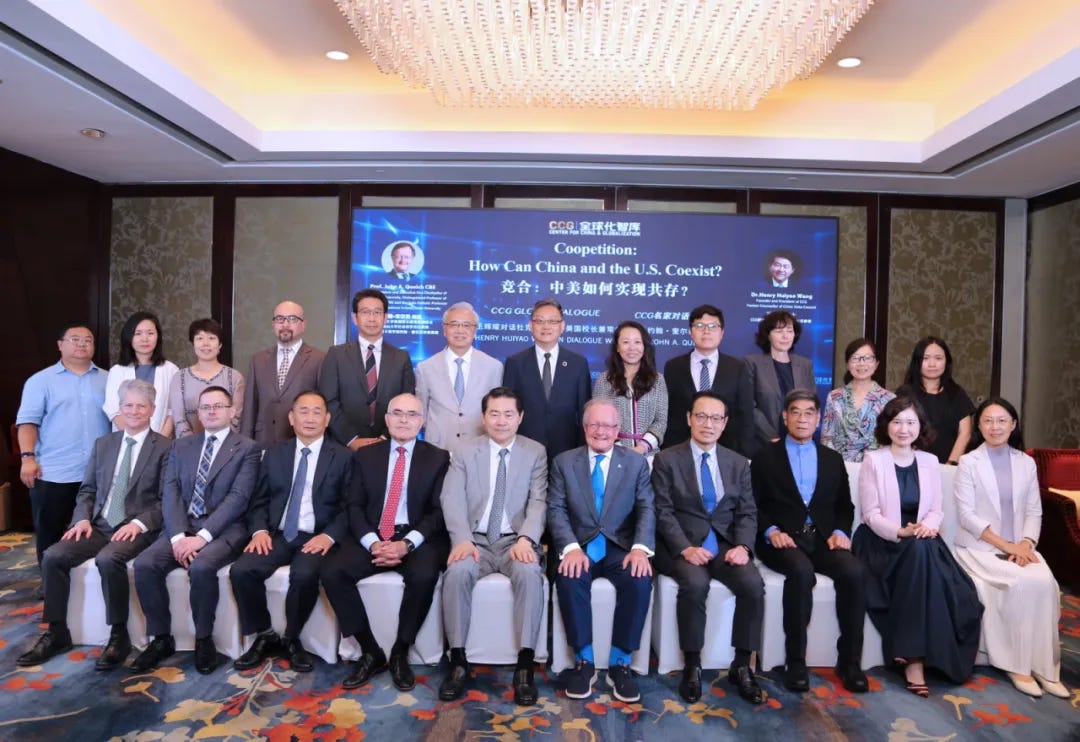
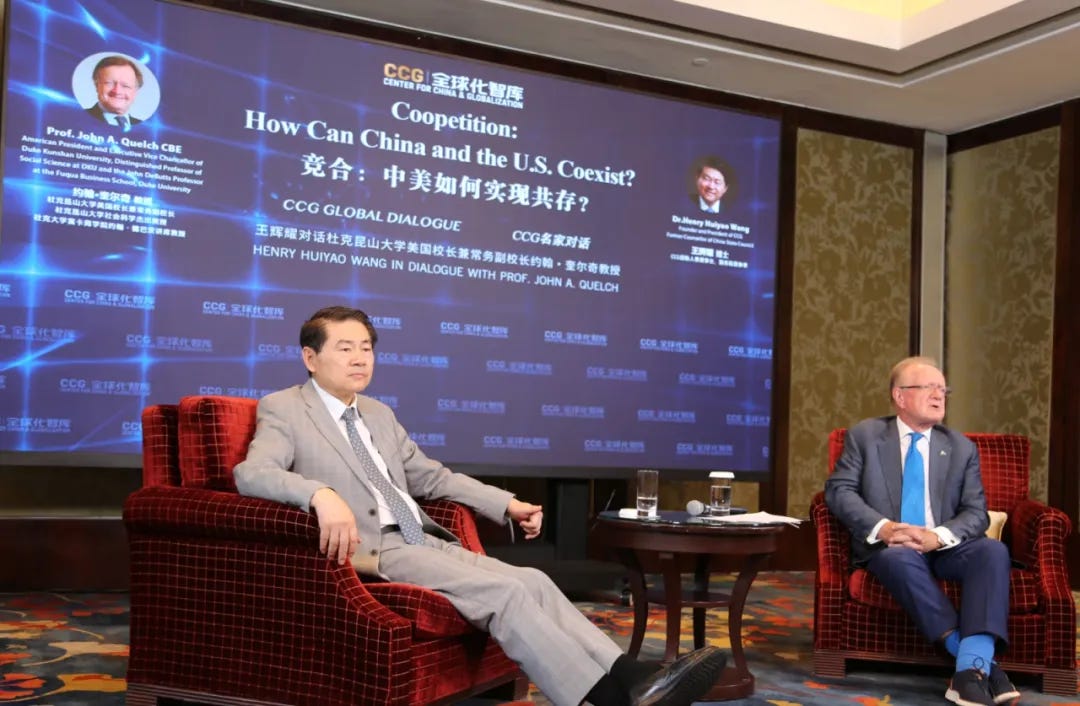
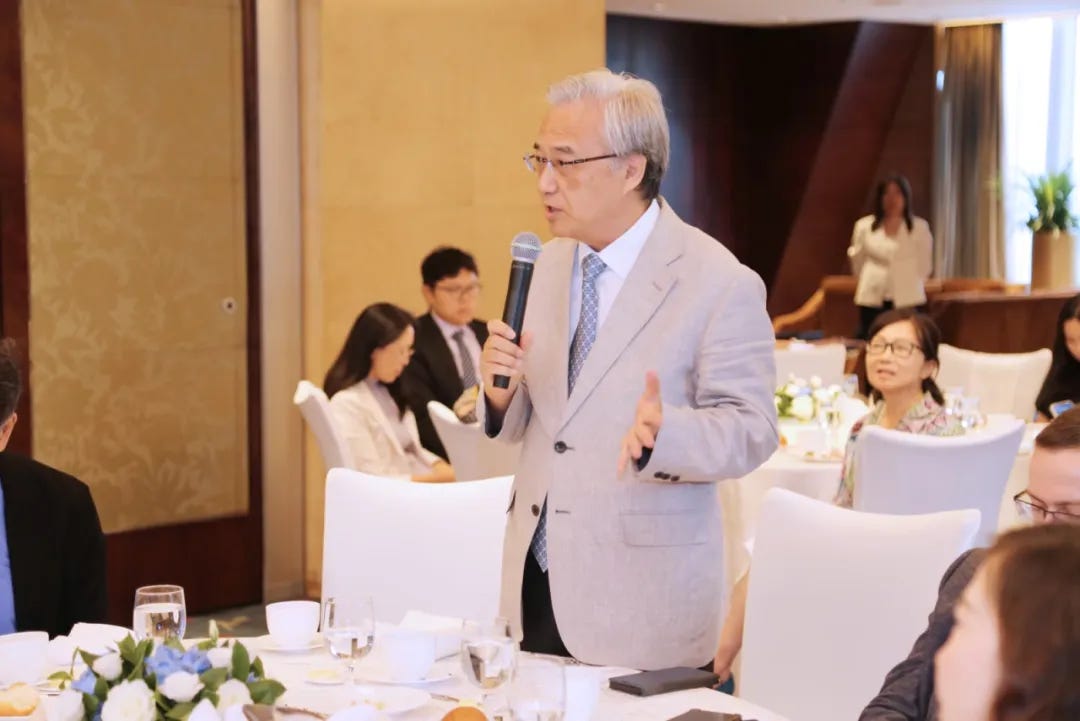
On June 24, 2026, the Center for China and Globalization (CCG) hosted a VIP Luncheon in Beijing under the theme “Coopetition — How Can China and the U.S. Coexist?”
The event featured a dialogue between Professor John Quelch, CBE, American President and Executive Vice Chancellor of Duke Kunshan University, and Henry Huiyao Wang, Founder and President of CCG and former Counsellor to China’s State Council. Mabel Lu Miao, Co-Founder and Secretary-General of CCG, delivered the opening remarks.
Their discussion explored the prospects for stability in China-U.S. relations, the role of business in managing strategic competition, possible cooperation on AI governance, the changing balance of hard and soft power, and the future of business and higher education.
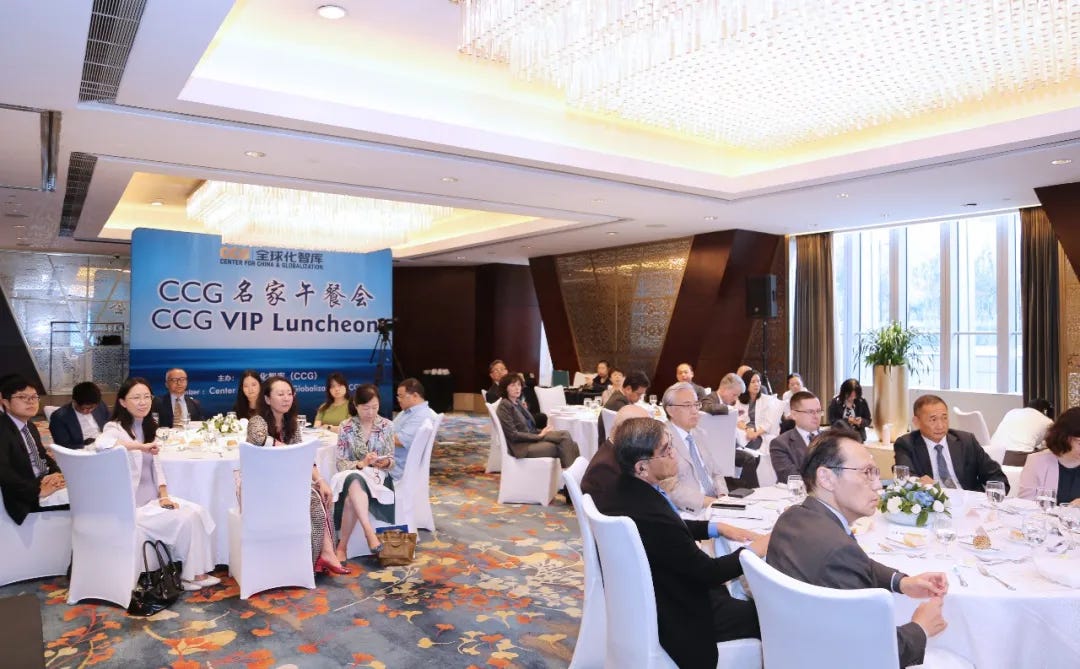
Among those attending were the ambassadors of Fiji, Japan, and Peru, as well as representatives from the embassies of Hungary, Indonesia, and Vietnam; international organisations including the International Monetary Fund; and companies including BMW, Cargill China, and Habib Bank.
CCG will shortly upload a video recording of the luncheon to its official YouTube channel. The following transcript has not been reviewed by the speakers.
Mabel Lu Miao, Co-Founder and Secretary General, CCG
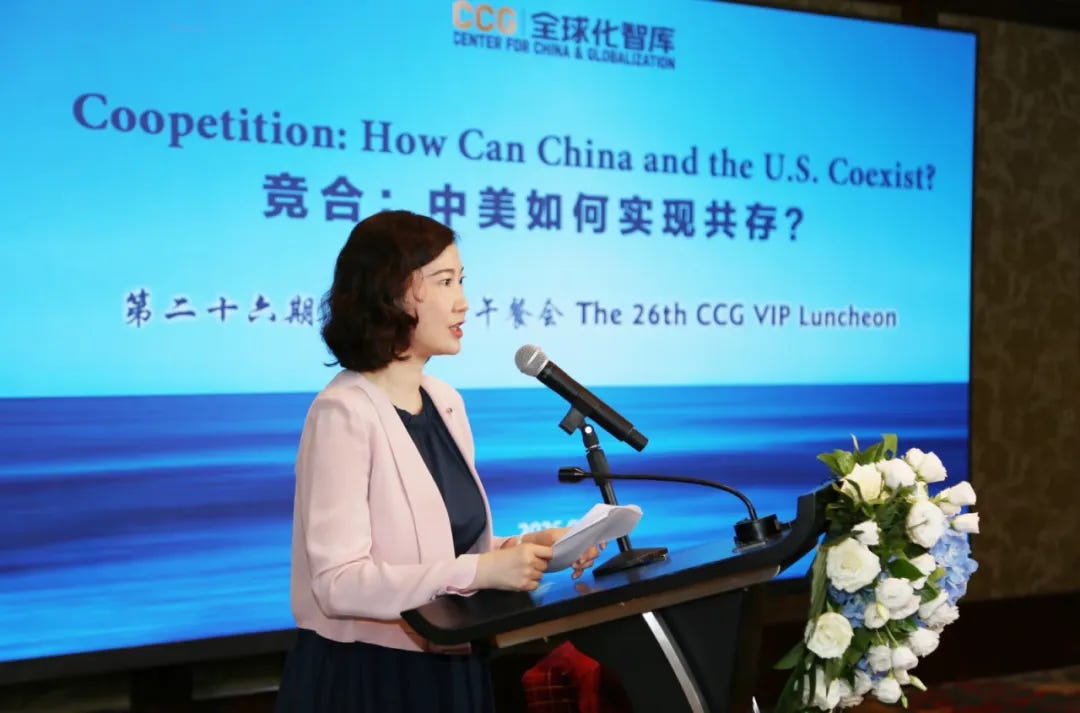
Thank you. Your Excellencies, distinguished guests, ladies and gentlemen. Good afternoon. Thank you all for joining us today at the CCG VIP luncheon.
The CCG VIP luncheon is a flagship high-level international exchange platform established by the Center for China and Globalization (CCG). It serves as a key bridge connecting global political, business, and academic communities to promote pragmatic cooperation between China and the world.
Today’s luncheon is also a special edition of CCG Global Dialogue, our flagship platform that brings together policymakers, scholars, and business leaders from around the world to discuss the most pressing global challenges.
As a forum for open exchange, the dialogue fosters cross-cultural understanding and practical solutions on issues ranging from governance and sustainable development to economic cooperation and international security. Today’s theme is “Coopetition — how can China and the U.S. coexist?” It’s a new word, coopetition. I think it’s very important; we can discuss this further later.
As we look at the current global landscape, the relationship between China and rivalry, and shifting global supply chains against this complex and dynamic backdrop, finding ways to manage competition while preserving vital channels of cooperation has become one of the defining questions of our time, one that concerns policymakers, business leaders, and scholars on both sides of the Pacific. That is precisely why we are here today. Today we are honored to convene this VIP luncheon dialogue.
It is my great honor to invite our distinguished guest, Professor John Quelch, CBE, American President and Executive Vice Chancellor of Duke Kunshan University, to join us for the executive dialog. Professor Quelch will exchange in-depth views with Dr. Henry Huiyao Wang, founder and president of CCG, on how China and the United States can coexist and manage strategic competition. The dialogue will conclude with an open Q&A session with all of you.
Before we start, let us take a moment to acknowledge some of our special guests and VIPs who are here today. We have invited representatives from distinguished diplomats, government authorities, academic institutions, international organizations, corporate leaders, and media representatives.
They are His Excellency Robert Lee, Ambassador of Fiji to China; His Excellency Kenji Kanasugi, Ambassador of Japan to China; and His Excellency Carlos Vasquez, Ambassador of Peru to China. Welcome to all the ambassadors.
We also welcome the diplomats and embassy representatives from the embassy of Hungary, the embassy of Indonesia, and the embassy of Vietnam, as well as representatives of international organizations, including IMF and JETRO Beijing.
We also invited government and association representatives, including Gao Qi, Vice Chairman of the Organizing Committee of the China Chamber of Commerce and Trade Associations Conference; Huang Rengang, Vice President of Security and Secretary General of the China Society for World Trade Organization Studies; Song Yaoming, former Minister Economic and Commercial Counselor’s Office at the Chinese Embassy in Japan, and former Commercial Counselor in the Department of Asian Affairs, MOFCOM; and university representatives from the Long U.S.-China Institute at the University of California, Irvine, and Beijing Zhidian Education. We also welcome corporate representatives from BMW, Habib Bank, and Cargill China, and other important corporation and media representatives.
Distinguished guests, China and the United States are already deeply interconnected. Our economies, companies, universities, supply chains, financial markets, and scientific communities have developed together over several decades. We are part of each other’s economic and social realities. President Donald Trump’s state visit to China in May was historic and significant. President Xi Jinping is also expected to make a state visit to the United States this autumn.
So the real question is not whether China and the United States can avoid one another. The real question is whether they can manage their differences while continuing to benefit from cooperation.
Now, please allow me to introduce Dr. Henry Huiyao Wang, Founder and President of the Center for China and Globalization and former counselor of the State Council of China, to deliver opening remarks. Welcome, Henry.
Henry Huiyao Wang, Founder and President, CCG
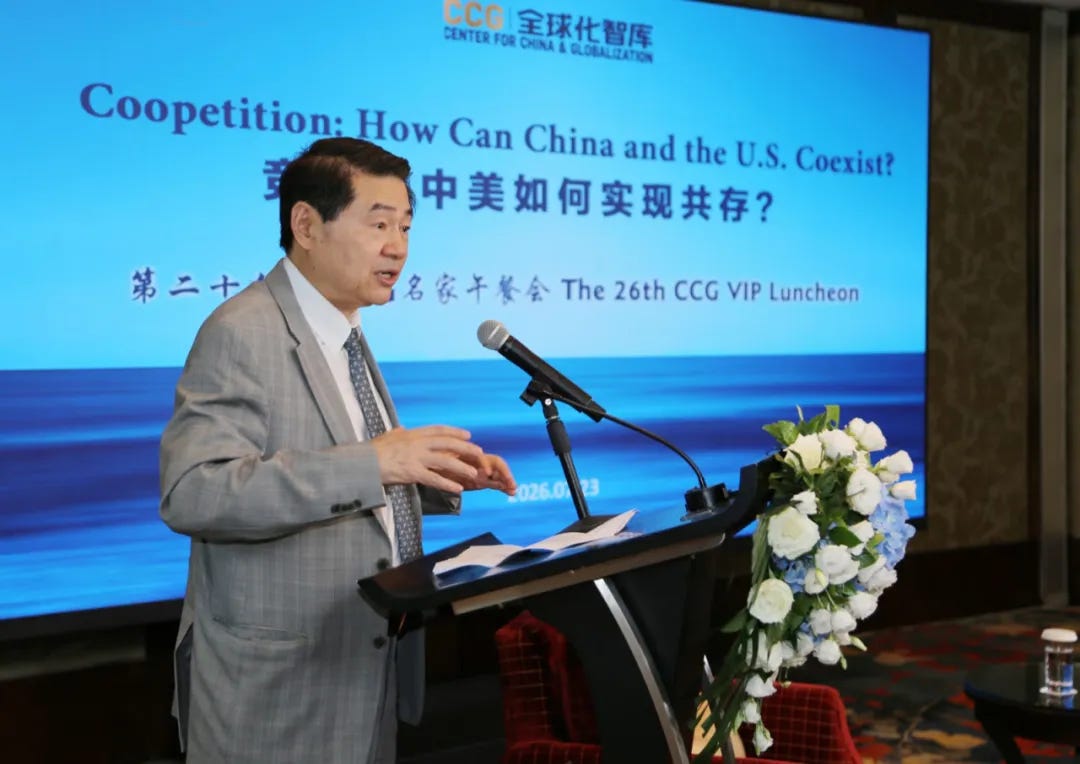
Thank you, Dr. Miao, Excellencies, Ambassadors, distinguished guests, and of course our friends representing a lot of famous organizations, chambers, international organizations, and multinational corporations. It’s really a great occasion.
Again, this is our CCG VIP luncheon that we do every month to really discuss a good subject and bring open dialogue to the key issues and challenging issues that are really facing all of us.
Last month we had a very special dialogue with Hank Paulson, former Treasury Secretary of the United States, in this room. This time we are very honored to have Professor Quelch. He’s a distinguished professor at Duke Kunshan University who has tons of experience. He has been the dean of three business schools across three continents. He was a dean at China European Business School and a dean of the business school at a university in Miami. And now he heads Duke Kunshan University as American President and Executive Vice Chancellor.
So it’s really a great occasion that we’re going to talk about coopetition, how China and the United States can coexist. So I think everybody knows that Duke Kunshan is more than an educational partnership. It brings together different education traditions, different institutional cultures, and young people from many countries. I’m also very honored to be sitting on the Duke Kunshan Advisory Council, so I know that this university is really a great JV product between China and the United States.
At a time when some people question whether China and the United States can continue to work together, the very existence of Duke Kunshan University reminds us that cooperation is not an abstract idea. It can be a possibility in real action. It can be built into institutions, sustained over time, and passed on to the next generation. So I think the presence of Professor Quelch is really significant today in our bilateral relations.
I’d like to also formally introduce our guest of the dialogue today, Professor Quelch. He is the American President and Executive Vice Chancellor of Duke Kunshan University, Distinguished Professor of Social Science at DKU, and also the John deButts Professor at the Fuqua School of Business at Duke University. Between 2017 and 2022, he was the Leonard Miller University Chair, Vice Provost of the University of Miami, and Dean of the Miami Herbert Business School. Before 2017, he was both the Charles Edward Wilson Professor of Business Administration at Harvard Business School and Professor of Health Policy and Management at Harvard T.H. Chan School of Public Health. So you can see he has a very broad, profound business, teaching, and management experience.
In addition to that, Professor Quelch has substantial experience as a non-executive director. In the United States, he has served on the boards of Amerant Bangcorp, Gentiva Health Services, Pepsi Bottling Group, and Reebok International He has also served as a board member of three pre-IPO data and analytics companies: Datalogix, Vitrue and Affinnova. So, a wide range of experience in addition to his academic practice. In the United Kingdom, Professor Quelch has also served on the board of WPP, the world’s largest leading marketing services company, and for 25 years has served as a member and chair of the audit committee. Very, very impressive. In the UK, he has also been a director of Blue Circle Industries, EasyJet, and Pentland Group. So the list is very long. I think I’ll just introduce some of those things here.
Again, I also see that Professor Quelch is often interviewed by international media at different outlets, and he’s very thoughtful and has a lot of good ideas. That’s why we’ve invited Professor Quelch to come here today to join the CCG Global Dialogue and CCG VIP luncheon, to share his views and have a dialogue on how we can really work on China-U.S. relations.
So, without further ado, let’s welcome Professor Quelch to our dialogue chair.
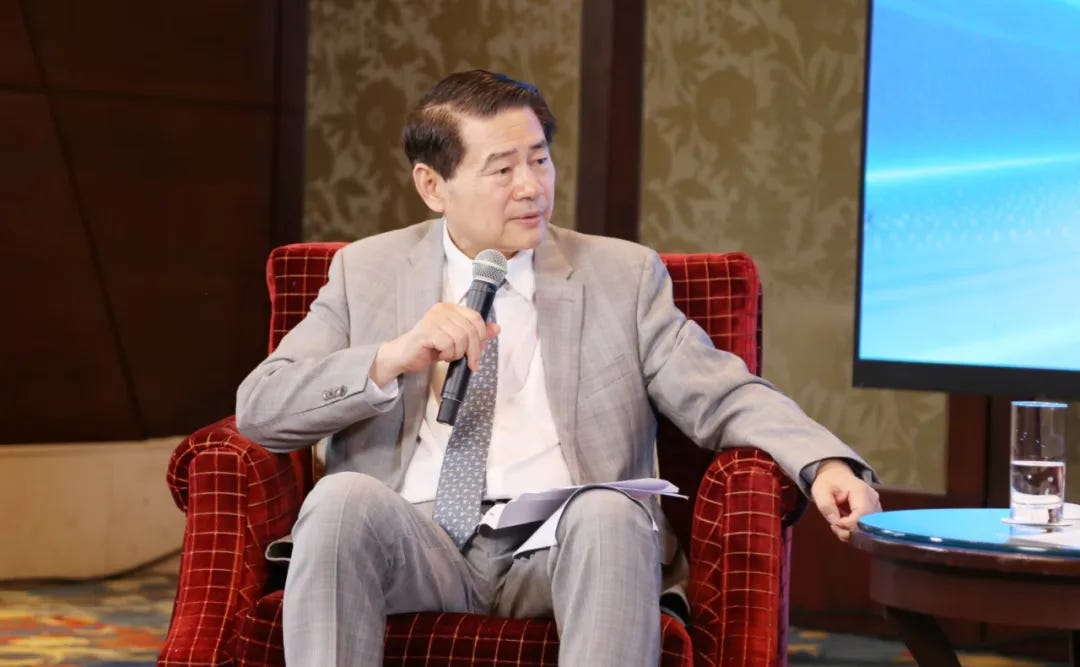
So, Professor Quelch, really great to welcome you to the CCG VIP luncheon. As we know, you’ve been leading an American university in China — one of the very famous, Duke Kunshan University — and you’ve been there for a few years already. You’re a firsthand witness of China’s transformation over the last several decades. You’ve also been dean of China Europe International Business School, so you know the business community in China very well, including the multinationals.
So, I’d first like to have your thoughts on how you think China-U.S. relations are going. We’ve been through a lot of ups and downs. The good thing now is we had President Trump come here in May. And in Trump’s first term it was a strategic rivalry between the U.S. and China, considering all those policies in his first term. But — I’m very glad to see this in his second term — we’re now having strategic stability. Both governments agree that we’re going to maintain strategic stability.
So, how do you see China-U.S. relations evolving and continuing? And what do you expect? As you know, we’re going to have several more high-level visits: President Xi is going to be in the United States in September, President Trump may come again to Shenzhen for the APEC summit in November, and President Xi may go to Miami again for the G20 summit in December. You also lived in Miami too. So overall, what’s your general assessment of China-U.S. relations?
Professor John Quelch, CBE, American President and Executive Vice Chancellor, Duke Kunshan University
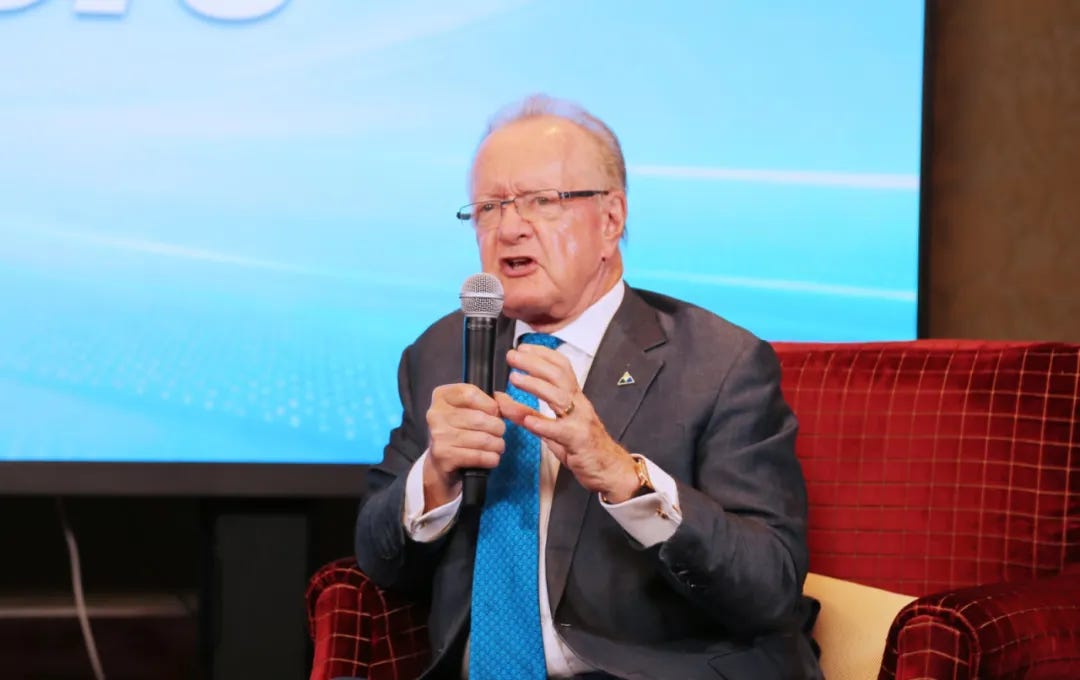
Your Excellencies, thank you, Henry, and good afternoon, ladies and gentlemen. It seems like there are a lot of cameras and lights, but not many microphones. So we will have to share the microphone in the spirit of co-opetition, Henry and I will be fighting over who holds the microphone.
So, to the question — just very briefly — I first came to China in 1981 as a tourist, and I’ve been back and forth over 45 years now, witnessing the great transformation that we’re all aware of. Those of us who are privileged enough to actually be on the ground and see it, as opposed to the many millions of my compatriots who have never been to China and actually don’t want to come to China because they might be contaminated if they came to China. There’s that degree of reluctance among a large portion — not just of the American population, but I think other populations as well, among certain allied countries.
But to your question, Henry — I think in the first Trump administration, China acutely became aware of what might happen and what could happen in terms of the tariff regime and other export control-related approaches that the United States might use vis-à-vis China and Chinese goods and services. And so China, from 2016 to 2020, was already planning a quiet decoupling of dependency in terms of trade and investment, and moving toward more engagement with Global South countries, etc.
So those patterns of trade and investment development were already being cooked up — they were already evident early in the first Trump administration. Everybody expected the Biden administration to be more relaxed towards China, and that did not happen. The Biden administration actually not only continued Trump 1.0 policies but also added further constraints.
Now we have a period of time in Trump’s second administration where the volatility of the administration’s policies is obviously driving many countries to think about how to be less attached to the United States in terms of trade and investment. And that, of course, is giving China an opportunity to present itself publicly as the stabilizing force — the adult in the room, if I can use that expression — for the benefit of the global economy.
Now, President Trump is a businessperson. He’s a transactional businessperson, as we know, as he would readily admit. And I think he’s actually not as ideological about China as some others in Washington, and therefore brings — curiously, perhaps surprisingly — a more pragmatic approach to the relationship. Not necessarily as predictable as any of us in this room would wish, but nevertheless a more pragmatic, business-oriented approach to the relationship, which essentially means the United States cannot walk away from China. It’s simply impossible. It would have devastating commercial consequences — and it’s not necessarily top of the agenda, but it would not be good for the world economy either.
So, where we are at the moment, I think, is the following: we have, in a sense, an umbrella relationship between President Xi and President Trump that may manifest itself three more times this year. But even if it’s only one or two, I don’t think it has to be all three. But one or two constructive and diplomatically useful meetings would, of course, set the tone in an umbrella of assurance to the world, under which the new so-called Board of Trade and Investment, and other dialogues occurring on a bilateral basis will continue to be productive.
And I think that, as someone who was not necessarily a student of diplomacy but a very commonsense person once said, “It all begins by talking. If you are not talking, you cannot achieve any kind of rapprochement or mutual camaraderie that can stabilize a relationship.” So, whether or not it’s your marriage, whether or not it’s two competitors in industry, whether or not it’s nation states, it all begins by talking.
So I think that where we are is we have a baseline rapprochement between the two leaders, which is extremely helpful because that signals to the underlings that they have to get on with serious conversations and not get into spats, walking out on meetings, or anything like that. They have to be seriously progressing a discussion of the issues at hand, of which there are many, many, as you know.
Henry Huiyao Wang
Thank you, John. Absolutely. You know, Foreign Minister Wang Yi and Secretary Rubio just met in Manila, I think yesterday, and of course we’re expecting this presidential visit in September. And as you just said, there seems to be a pragmatism occurring now in these bilateral relations. But on the other hand, we should also think about this: since almost eight or nine years ago, when Trump won, the U.S. started many ways of containing China — sanctions and trade wars — and maybe at some point, people just suddenly realized, “Gee, we’re living in the same world.”
We were talking to Secretary Hank Paulson last month here. He was saying that the U.S. and China have achieved mutually assured economic disruption. So basically, that means we’ve reached a new equilibrium now. Because if we really do anything bad to the other side, we hurt ourselves too. So that’s one side, economically. On the other hand, you can also see the world is such a disrupted place now, with what’s happening in Ukraine, what’s happening in Iran, and the U.S. is not able to handle that properly. And then China actually emerged as one of the very strong stabilizers of the world economy and also confidence, and not causing panic in the world. For example, China’s energy was relatively stable. We have the former chairman of Sinopec here. You can see how that effort has really been maintained. So there’s a huge interest for the U.S. and China to work together.
So in that sense, do you see how we can really encourage this new equilibrium? For example, you mentioned the Board of Trade, which is great. Each side is going to exempt $300 billion in goods trade — almost like free trade for $300 billion — and that could be an oasis in bilateral trade, and we can expand that. You know, we can find more products. There’s no national security issues, it’s really neat for both sides, and it really helps the economy on both sides. So, that experiment, if successful, can be expanded. And also for the investment board, how can we find suitable companies to invest on both sides? So we hope that this kind of pragmatism can be sustained.
So, what’s your take on this new equilibrium that we’ve achieved, at least so far — will that stability be maintained? And what do you think, as a business professor, about the role of business in pushing this forward, this sustainable relation? Of course, there’s competition, but there’s also cooperation. That’s why we call it coopetition, right? That’s a management term that’s frequently used. So, what do you think about the status now, and how we can get down to the near future for this bilateral relation?
John Quelch
So the word coopetition was actually coined by a professor at Harvard Business School around 25 years ago — a guy by the name of Adam Brandenburger, who periodically shows up at NYU Shanghai as a guest professor. And of course, coopetition, as he examined it, came out of a business context.
Let me give you one obvious example in the pharmaceutical industry. Obviously, Merck, Roche, AstraZeneca, and GSK all go head-to-head, competing aggressively against each other. But at the same time, they have many cross-license agreements, where a GSK product will be sold by AstraZeneca in some countries where AstraZeneca is strong, and maybe an AstraZeneca product will be sold by Pfizer in countries where AstraZeneca has no action, but there’s a market for their drug. So these companies are cooperating at the same time as they’re aggressively competing against each other.
So that’s where the term coopetition comes from, and it is possible for nation states to do the same thing simultaneously. But I think it requires a mindset that’s a little bit more sophisticated than the standard ideological black-or-white point of view that, in the polarization of politics — especially in the West — is becoming much more fashionable.
So, if I look at the current administration, for example, I would say that Secretary Bessent, for example, the Secretary of the Treasury, is a very sophisticated thinker. Jamieson Greer, who is the U.S. Trade Representative, is also a very sophisticated thinker. And let me leave it at that. Okay, I won’t mention any further names.
But it’s important that the business point of view maintains a strong voice in the dialogue. And one of the things I’ve been noticing in the last three or four years is the reluctance of business leaders in the United States to really speak out on behalf of their shareholder interests when it comes to anything related to geopolitics emanating from Washington. There’s been a noticeable level of silence, vis-à-vis what one was used to seeing under the Biden administration. And that’s unfortunate, because if the business voice is not sufficiently part of the geopolitical dialogue, then it will become more and more of a polarized ideological dialogue rather than something more pragmatic.
When it comes to China and the U.S. in particular, I think, you know, the U.S. suddenly woke up one day — maybe in the basement of the Pentagon, or in Langley, Virginia — woke up one day to the reality that, gosh, China has really made so much more progress than we ever forecast it would make by this time. We’ve got to do something about it, because whatever you may think of the U.S., the U.S. is always going to find it difficult to be number two. That is going to be a very big psychological challenge for the U.S.
You know, at the same time, from my business experience, I would say that you often have situations in business where the number-two company chases the number-one company. And it’s rather like — if you’ve ever been to a dog race, a greyhound race — you know, the greyhounds go around and they chase a mechanical rabbit, okay? And sometimes the greyhound catches the rabbit and then doesn’t know what to do with it. So, you know, sometimes it’s nice to think we could become number one. But when you become number one, you have to know what to do when you’re number one, and that’s not as easy as being number two. So I just want to present these very simple thoughts as a little bit of advice to our leaders.
Henry Huiyao Wang
Great, John. I think that you’ve vividly described this coopetition and, of course, the business dynamic. Absolutely. You know, when Trump came, he brought 17, 18 top business leaders. There’s a huge interest from business corporations, and we also see that bilateral trade has been stabilized between the U.S. and China somehow now.
But there’s also a new issue now: AI. We see that with this new visit of Trump to China, and President Xi’s visit to the U.S., there’s an AI dynamic. China and the U.S. are the two largest AI countries now, and so we’re getting into uncharted waters and territories. How can we do global governance? You’re just coming from Shanghai, where the World AI Summit Conference was hosted, and China has also established the World Artificial Intelligence Cooperation Organization with 29 countries. So that means AI is really on the agenda, not only for China but for many other countries to think about.
I do think that China and the U.S. have a joint interest in maintaining this AI cooperation. Just imagine if AI became a bubble, right? That would devastate not only the United States, but the whole world, and the U.S. has invested so heavily in AI, and China is the same. But China is probably doing better on applications, with a large application scene. The U.S. stock market is already dominated by AI companies. Their market cap is many times over the other industries.
So, what do you think about AI cooperation? And also, we may want to avoid an AI arms race, right? We want to make sure that AI can really be a good force for mankind. So, what do you think about that area? AI — what can we do, and what can we not do?
John Quelch
The United States is leading in basic research in AI, but China is very strong in applications of AI. China’s approach is open source.
Some people who are cynical always say open source is what you do when you’re not the leader, because you can’t get anyone to pay for your product, so you open-source it. If you’re a private company like Anthropic or OpenAI, you and your investors have put a lot of money into developing your products, and you have to get a return on those products by charging for them in the marketplace.
In the Chinese context, it’s an open-source context where a lot of the money going in is from the state, not from individual private investors. So you have these two systems actually colliding, with AI as the catalyst for the collision. In my opinion, it’s not easy to get collaboration among these two groups. You can see that Anthropic and OpenAI are trying to shut down U.S. access to Chinese AI models, using, of course, the usual excuse of national security — which, you know, is used to justify everything these days — as a basis for saying we should not have these folks selling to Chinese organizations.
And the other basis for their complaint is that the Chinese AI platforms deliver 90% of the quality of the U.S. platforms but at 40% of the cost. So, you know, you have to decide if you’re a user: do you want the good-enough Chinese platform, or do you want to pay extra for the U.S. platform? So, this is a very heavy-duty competitive situation.
The one area where I think collaboration is necessary — you alluded to nuclear arms proliferation. You know, there’s a need for an AI arms proliferation treaty because, remember, AI enables you to go to war without costing your citizens any lives. You can go to war with AI and put no human being at risk among your citizenry, through drone technology and remote technology, etc. And think of the amount of devastation that has been incurred in Iran at the moment — and I’m not going to say only 18 lives lost on the U.S. side, but that is a very small number relative to the amount of destruction that has occurred.
So here is the area where I think there has to be cooperation because neither China nor the U.S. can afford for damaging AI technology to get into the hands of rogue operators and terrorists who are going to destabilize the global economy or hold it to ransom.
So this is my answer: not easy on the commercial front to get cooperation around a common set of standards because competition at the moment is very, very tough between these two groups. But on the higher-level issue of AI arms proliferation, there’s definitely a need for dialogue.
Henry Huiyao Wang
Absolutely, I think that’s very important. We should not weaponize AI, and maybe we should also not be the first user of AI as a weapon. I think if China and the U.S. start to talk on that, it will really benefit global governance and the global community.
As you know, President Xi not too long ago put forward the Global Governance Initiative, and I think this AI organization established in Shanghai is reflecting that. Because, as you just mentioned, China has this open AI system, so we can really put that to use for the Global South countries, benefiting their applications. I see quite a few Global South countries mention that they’re using Chinese AI to help with forecasting, help them in agriculture, and help them in rural areas — examples of AI applications.
John Quelch
And I think, Henry, you’ll find that pretty soon the Global South, when it comes to AI, will include Italy, Spain, France, and a lot of other countries that are not keeping up. So the open-source model can be very effective as a diplomatic tool for China, for sure.
Henry Huiyao Wang
I think this global AI governance, and China’s Global Governance Initiative as a whole, is really very useful to propose and then to take action on. I mean, China is talking about global governance, but China also established the World Data Organization. China established the World Artificial Intelligence Cooperation Organization, and China has invited 29 countries — almost 30 countries — to join that. So I think this really sets a very good example that can really be beneficial to these Global South countries.
So on the whole, I think, of course, the Global North, as you said in the past, has been industrialized. But now, with the AI era coming, some Global North countries may become Global South countries too. That’s your point.
So, what do you think about this? You know, in the global governance arena, China and the U.S. are such big countries now, and we’re actually in these two traps. There’s a Thucydides Trap — that number two catching up to number one — but there’s also a Kindleberger Trap, where number one is leaving, and can number two fulfill the global public goods? And so, in that sense, in the governance issue area, how do you think China and the U.S. can collaborate? Because the U.S. is pulling out of some global governance organizations — WHO is a good example. So, do you think that, at least on the AI new frontier, we can all work together? And so this U.S.-China dialogue on AI, is it a good sign for global AI governance in the future?
John Quelch
You correctly allude to the increasing distance that Washington is placing between itself and many of the multilateral organizations that are curiously a part of the rules-based order. Washington itself is actually rejecting some of the elements of the so-called rules-based order that it has previously stated should govern the way in which the world operates.
So I think China has done, as one would expect, a very clever and long-term job of gradually adding value in these various organizations, and gradually having Chinese nationals appointed to — maybe not necessarily the number-one position, but among the leading implementation positions — in many of these global institutions, and that, I think, has been very effective. And I think, again, the U.S. has woken up to the fact that the U.S. interest in these organizations is not nearly as strong as it used to be, say 20 years ago, so the U.S. is therefore backing off from these organizations.
But I think, while it may be backing off on the climate front — from the Paris Agreement, from WHO, from WTO, etc. — when it comes to something that is central to national security — and I mean central, not using national security as an excuse, but central to it — such as AI, there I think there’s going to be a much more focused mindset.
I’ll give you an illustration of this from the last 24 hours: a speech was made by the chief science adviser to President Trump, which is basically saying we’re going to completely change the funding system for basic research. We’re no longer going to just channel all of our money through universities — we’re going to channel some of it through individuals, corporations, and other mechanisms. And by the way, we’re not really going to put nearly as much money into life sciences anymore — we’re going to put the money into AI.
So, you know, this is an important statement. Often you find the most important statements are coming from second-tier officials. You have to read very closely below the Trump and cabinet level. The second-tier officials are often really telling you much more about what the direction of policy really is. So I think that, again, the governance may be active, but in areas that are important to national security and to the economy, which, of course, is now wrapped up with national security more than it used to be.
Henry Huiyao Wang
Absolutely, I agree. I think now it’s time to really stress this global governance because the world is fragmented, particularly in the AI era. We really need to have more global governance. It doesn’t matter, Global South or Global North; we all need global governance together because, after all, we’re all living on the planet. And China and the U.S. now, they want to explore Mars. They’re planning to fly to the moon — so even in outer space, there should be universal governance as well, if we need that, I think.
John Quelch
I would also add ocean as well because China has been, I think, very forward in terms of maritime exploration, but also in terms of governance issues around use of the oceans.
Henry Huiyao Wang
Absolutely. So, there are many more issues there. Now I want to turn to another question. We know the U.S. used to emphasize soft power a lot, right? We have Joseph Nye, who passed away not too long ago. By the way, we’re going to publish his memoir pretty soon in Chinese, which we’ve translated. And I also co-edited a book of his on soft power and China-U.S. competition.
So, what do you think about this — soft power, hard power? Then maybe there’s a new term, comprehensive power. You need not only hard power and soft power, but also the scale, and also the implementation power. You have all the other things, soft and hard, batched together. But the key is really the implementation, and also synchronizing this kind of comprehensive power.
The U.S. has a lot of soft power, but China is also gradually building up in that area. And the U.S.’s hard power, particularly on infrastructure, is falling behind, and then you see all that security and military. Of course, there’s still competition there. But I think we should really put more effort into the soft-power approach rather than so much on hard power. So, what do you think about that area?
John Quelch
Well, I’ve never held a gun in my life, so I have to be a soft power guy. I think what you say about integration is very important. Twenty years ago, I remember hearing our generals in the United States actually talk about winning hearts and minds as part of their military agenda — let’s say in the first Gulf War, for example, back at the turn of the century. Now you never hear any United States military leader ever talk about hearts and minds. It’s the Department of War, not the Department of Defense, right?
So I think this is a real unfortunate situation, because for soft power to be effective, it has to be integrated with hard power, and the messaging has to be consistent between the two.
You’re alluding to the decline in the appeal of the United States, and certainly there’s a survey — actually a couple of surveys in the last few weeks — that show the precipitous decline in public attitude, positive attitude, towards the U.S. across a whole range of different countries. I think in one survey there were only six countries where a majority of the people interviewed had a positive, as opposed to a negative, view of the United States. Not sure if I should name them, because I might get them into trouble, but Japan is one of them, and the others, I think, are not in the room — India, Philippines, Poland. I can’t remember the other two.
Anyway, my point is that under the Trump administration, there’s been a massive deterioration in public sentiment towards the United States — not towards Americans, but towards the United States.
So you might think that would cause a wake-up in Washington. Doesn’t matter. No one cares about it. You know, it’s all about hard power, strength projected by military and economic prowess — not really interested so much in cultural power.
But if I go back to just one final comment, slightly unrelated, but I think it’s instructive: if you look at how Japan became so respected around the world after the Second World War, I’ll give you two words to explain it: Toyota and Sony. How did Korea become respected around the world? Hyundai and Samsung. How is China going to be respected around the world? BYD and Huawei. The products and services that a country delivers to the world are actually very, very important in terms of determining public attitude.
In the era of social media, I would introduce TikTok as another element in this because prior to the Trump administration going after TikTok, no one knew that it was related to China at all. As soon as Trump — or his people — went after TikTok, suddenly everybody realized, well, this is from China. But instead of saying, in that case, “I don’t want to touch it,” young people in the United States said, “Oh, that means China’s not so bad — I like China if they’re delivering TikTok.” So, you know, that’s another example, in the modern day, of a brand — not an auto brand, not an electronics brand, but a social media brand — that is representing the values, or is perceived to represent the values, of a particular country.
Henry Huiyao Wang
That’s right. I think an industrial brand, a company brand, can also be a softer brand too. China now has so much industry coming up, and that’s really a new issue too — how we can really integrate with the world, how we can invest in other countries, and welcome other countries to invest in China. So, that will actually be a subject at our think tank. The Center for China and Globalization is going to hold our annual China Inbound and Outbound Investment Forum on October 17-18 in Beijing, so we welcome you to attend as well.
My final question, before I open it up to the distinguished audience: you’re a business professor. Our paths actually coincided. You have a DBA from Harvard, and you taught at the Ivey Business School, where I did some doctoral study in business as well. But one of the things that impressed me: you’re the business dean across three continents. You’re the dean of the London Business School, you’re the dean of a Miami Business School, and then China European Business School. So management education is really taking off, also in China. You must be very familiar with that trend — millions of, you know, EMBA, MBA, and a lot of related executive development training, and that’s really pushed China’s entrepreneurial drive, not only in China but around the world.
So business education is so important. Now you’re also in charge of Duke Kunshan with your Chinese partner. What do you think about business education, and now an elite Ivy League kind of school in China — this China-U.S. JV — makes a difference? Maybe you can give a bit of your experience and observations in this area of education.
John Quelch
Okay, thank you. So, I myself, just for your information, did not study business as an undergraduate — I studied medieval history, and then later became a business educator. And someone asked me, “Well, how can you go from medieval history to teaching and being a professor at a business school?” So I’d tell them: there are two things I learned when I studied medieval history. One was how to cut people’s heads off, and the other was how to take no prisoners. Next question. Actually, these two talents are very important in academic administration.
But I think the point I want to make on the undergraduate front is this: in all the years I taught at Harvard — I was very fortunate to be on the faculty at Harvard Business School for 30 years — in all those years, I never had an outstanding student who had done business as an undergraduate degree. All the business undergraduate degree students, they would all pass, they’d all get through, but they were never the top students. The top students had always done, you know, English literature, or physics, or Chinese studies — something completely related to the arts or sciences, not related to business. So I always advocate that, you know, if you want a business degree, take an MBA, but for your undergraduate education, you should study things that you like, that are going to expand your mind, and so on.
And of course, we have so many parents, especially in China, who worry: “Oh, is my kid going to get a job at the end of the four years if they haven’t done something practical as an undergraduate?” And we try to persuade the parents that actually the best thing you can do is let your child explore the universe of education as an undergraduate, and let them find what they truly enjoy and believe in. You know, I’ve come across many, many people — actually mainly women — who are maybe, in China, 40 years old, 45 years old. They graduated in thermal engineering, and now they’re artists, because that’s what they really wanted to do all along, but Dad and Mum forced them to become engineers. So they became an engineer for 20 years, and then finally they’ve got enough money to do what they really want to do.
So, when it comes to executive education, in many ways, there are enough MBAs and executive MBAs in the marketplace, right? And now, with the internet and AI, you can learn so much, so quickly, without actually doing the MBA degree. So in many cases, business schools now are focusing on experiential learning, networking, connecting like-minded and similarly aged students with each other, so that they can collectively engage in projects that may turn into fundable ventures that could lead to incorporated IPOs, etc. So, in other words, the actual content of the curriculum in an executive MBA program is much less of a factor than it used to be 20, 30 years ago because so much of the content is readily accessible, and the laws of economics and accounting don’t change that quickly, right?
So, what we’re finding in our executive education activity at Duke Kunshan — because, although we don’t have a business school for undergraduates, we do have a lot of executive education — one of the things we’ve found to be very potent at the moment is adding well-being and wellness components to the curriculum. And when I say well-being and wellness, what I’m talking about is, you know, team building, understanding the strengths and weaknesses of different colleagues, maximizing the performance of the team on behalf of objectives, but not putting at jeopardy the health of the executive, or his or her family, as a result of, you know, overstress and so on.
So let me just give you one example — I gave it to the lady from Cargill earlier. We had a group from a leading U.S. multinational company; I won’t say publicly which one. This group came — 40 people came, 25 men and 15 women — and their program included half a day in our athletics center. Our athletic center is a world-class athletics facility, as you know, and it even includes a rock-climbing wall, about 10 meters high.
So this company wanted everybody to go up the wall. Only five people made it to the top — all women, out of the 40 — not a single man made it to the top. All Chinese men, maybe a little bit too heavy, okay, a little bit too heavy. But the point is, something like that ends up having a huge effect on the company’s internal morale, because all these guys who look at these small Chinese ladies and say, “Oh, they can’t do anything,” you know — suddenly the level of respect that’s generated by such an experience and observation is really very, very important, and very high.
So, that’s just one anecdote. But what we want to highlight is that in leadership development, we’re not just sitting in a classroom listening to someone with some PowerPoint slides. We’re taking people to an athletic center and putting them through a series of team-based activities — competitive, but resulting in the manifestation of many, many revelations, both personal and in terms of the way they view their colleagues as well.
Henry Huiyao Wang
Great. I also know that Duke Kunshan has made huge strides and enhanced its standing globally. And you have a huge number of applicants, and you only select a very limited number. So how’s that? It’s getting very competitive now, huh?
John Quelch
We have 20 applicants for every place, I would say. To be fair, that sounds like a very impressive statistic, but to be fair, let me just say: the Gaokao has to be taken by every Chinese applicant, but it counts for only 60% of the evaluation. The other 40% of the evaluation at our university is based on two-on-one interviews with a shortlisted set of the applicant pool, as well as other campus day activities, when they have to come from all over China as part of the selection process.
So, to be frank, if one of our applicants receives an offer from Duke Kunshan and they also get into Tsinghua or Peking University, they’re going to go to Tsinghua or Peking University. Okay, we’re not yet at that level. But if they get into Shanghai Jiao Tong, they might flip to us, or they might go to Jiao Tong.
Henry Huiyao Wang
You have a very good international position.
John Quelch
30% of undergraduates are international students.
Henry Huiyao Wang
Also, there’s a lot of American students there, right?
John Quelch
Yeah, I mean, that’s one amazing thing. You might find this hard to believe, but given all of the problems in the U.S.-China relationship, we still have 60 American 18-year-olds every year commit to a four-year university degree in China. So, all hope is not lost.
Henry Huiyao Wang
Okay, great. So, on that positive note, let’s pause the dialogue here for a while. Now we’re open for questions and Q&A — any comments, questions, and discussion.
Yes, I know, Mr. Huang. He’s the Vice President of China’s WTO Studies, and MOFCOM. Okay, thank you, please.
Huang Rengang, Vice President & and Secretary-General, the China Society for World Trade Organization Studies

Thank you, Dr. Wang and Professor Quelch for this very interesting and enlightening interview. I like the objective and rational approach of Professor Quelch in his analysis and comments. My question is this: how do you view the fact that a lot of students in university schools are using AI to finish their papers, research, and homework? And I think some Chinese teachers, or deans, leaders of universities, are aware of this. What is your view?
John Quelch
I’m not sure this is confined to Chinese universities, by any means. But someone recently defined a typical American university as a place where, thanks to AI, you have students who don’t want to learn, being taught by teachers who don’t want to teach, and paying $60,000 a year for the opportunity.
So, what are some of the things that we do? First of all, our class sizes are small — at Duke Kunshan University, a typical class size would be 20 students to a class. What that means is that during the class, there’s a lot of participation and interaction between the students, among the students, and between the faculty member and the students. And what that means is that class participation — which cannot be dictated by AI, until we have a real-time earpiece that can tell the student, or even voice the student’s answer to a question, in real time in a classroom — the grade that a professor gives should, in my view, place more emphasis on classroom participation versus the written work, because the written work obviously can be contaminated.
Now, what we’re also finding is that some professors, in response to — let’s say, if they give an essay question to their students, or a problem set — what they might do is run the problem set through AI, and give the students the AI answer along with the questions. Then the students have to go beyond the AI answer to be able to get a decent grade. So, in that way, you can use AI to set a bar of performance that’s already higher than it would be pre-AI and force the students to go beyond the AI answer to a higher level of intellectual challenge. So these are a couple of approaches that some of our professors have been using to deal with the challenge.
Liu Chang, Vice President, Cargill China
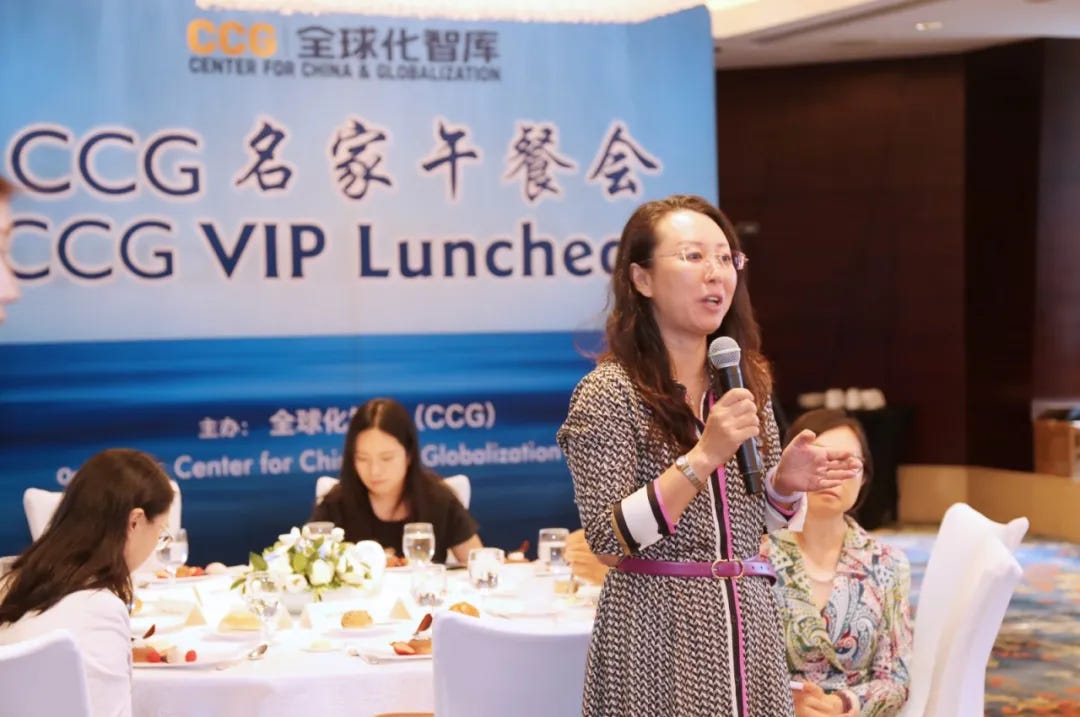
Thank you so much, Dr. Wang and Professor Quelch, for the marvelous dialogue and sharing, which is really informative and enlightening. I’d like to ask a question about coopetition in education between the two countries, especially in high tech or higher education. There used to be a lot of Chinese students going to the U.S. for higher-level study — undergrad and graduate studies — but now it seems that, due to this decoupling or de-risking, fewer and fewer Chinese students are getting involved in key American universities, especially in cutting-edge technology majors. So, would you like to share your opinions on this tendency, or your analysis of this coopetition? Thank you.
John Quelch
Yeah, okay, thank you very much. So, in the undergraduate space, there’s less of a problem. There’s a significant number of Chinese parents who this year decided not to send their children to U.S. undergraduate programs, but there’s still a high number who continue to do that. The Hong Kong universities, and their campuses in southern China, have been extremely active and aggressive in terms of trying to capture a higher share of those undergraduate students, in the face of the U.S.-China problem.
When it comes to graduate programs, doctoral theses, and research collaborations, there’s definitely a very strong inclination to avoid any geopolitically sensitive area, particularly in STEM — and even in AI, even in the most benign applications of AI, say in global health, for example. Even in those areas, there’s some degree of increased vigilance.
Kenji Kanasugi, Ambassador of Japan to China
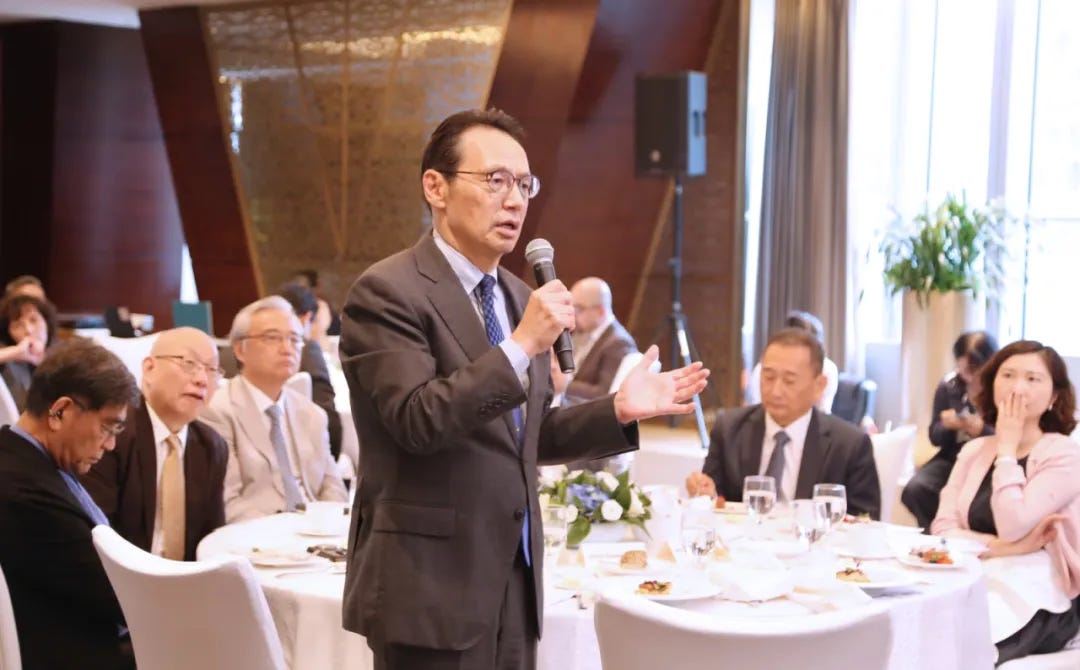
Professor, thank you very much for your very interesting presentation, and Henry, thank you very much for the invitation. My question is, going back to the basics, I think one of the important tasks of the Trump administration is to rectify the trade imbalance, the global trade imbalance, particularly with China. There are many ways to do so, and, of course, tariffs are one way. But another important element is the exchange rate of currencies. As you may recall, in the case of Japan and China, we had the 1985 Plaza Agreement — that was really a turning point.
But under the current circumstances, I don’t see the current Trump administration pursuing the exchange rate issue with China. As you said, Secretary Bessent — a well-respected business person with very good global views — is not really forthcoming in pursuing the exchange rate issue. Why do you think the U.S. is not really pursuing the exchange rate issue at this juncture? Thank you very much.
John Quelch
Let’s put it this way: it’s a little bit complicated for the man in the street. Remember, President Trump is quite a populist president — something like a tariff is pretty easy for an individual to understand as a way of dealing with a problem. Even though it’s a blunt instrument, it’s understandable. But start talking to the public about exchange rate mechanisms, and people quickly lose attention. Their eyes glaze over. So that’s one point.
The second point: it’s very important to the United States to maintain global settlement currency leadership. So bilateral conversations around stabilizing through controlling, or adjusting exchange rates on a bilateral basis can end up having an impact on harmony that doesn’t help the long-term determination to maintain global currency leadership. And I think the U.S. is worried about that. They don’t talk about it, but inch by inch, other currencies have been settling more and more of international transactions, in currencies other than the U.S. dollar. So, I think these are the two key reasons.
But I think it’s possible that, in the next two or three rounds of dialogue with the U.S., if we’re on an even keel, the U.S.-China currency relationship may come into play as part of the behind-the-scenes conversation. I think this is definitely something to watch.
Henry Huiyao Wang
Yeah, we just have another two questions. I would like to add, Ambassador, that since the U.S. holds a large amount of treasury bonds with China, they may lose value if the exchange rate appreciates, and that’s another thing. The other thing is that the U.S. is exporting a lot of dollars. China may export a lot of goods, but the U.S. is exporting dollars. They have a foreign debt higher than their GDP now. So there are many issues there, but this could be a question both countries, as the Professor mentioned, would be dealing with in the future. Ambassador from Peru, yes, please.
Carlos Vasquez, Ambassador of Peru to China
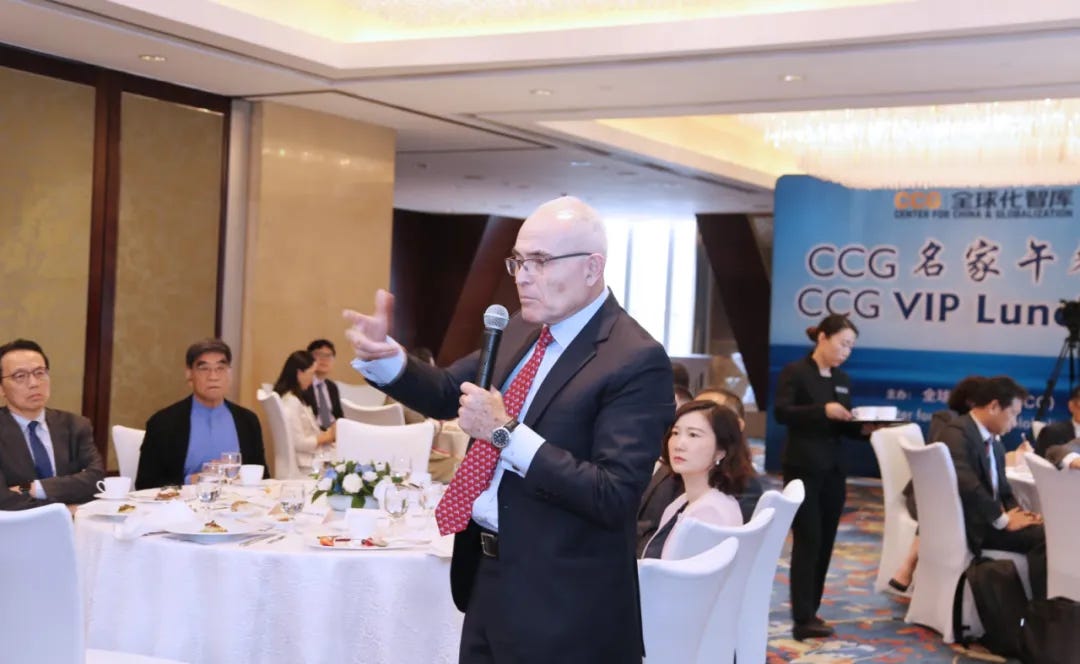
Okay, thank you very much for this event. Thank you very much, Professor Quelch, for your very enlightening presentation — very interesting. Thank you, Henry, for the invitation.
Well, my country is in the middle of this harsh competition between these two juggernauts. We try to adopt the same approach that has been developed, for example, by Singapore, in the sense that, in terms of defense and security, our key partner is the United States; in terms of trade and investment, it’s China. But we have a disadvantage: we are in the natural area of influence of the United States, so the pressures that we are receiving are increasingly very, very hard.
But we’re forced, because of the structure of the Peruvian economy and the fact that China has become our first trade partner, and we’ve received a lot of investment in key economic sectors of our country, particularly the mining sector. We are exporting critical minerals to the rest of the world, and particularly to China. And on the other side, we’re having a lot of very fruitful conversations with the United States to, for example, develop the naval base of my country, which, by the way, is going to be very close to the Port of Chancay, which was developed by a Chinese company.
So, do you think this approach is still feasible, taking into account that the margin of maneuver of the third states that are affected by this competition between these two great powers is increasingly diminishing? On the other hand, we are forced to maintain very good relations with both of them. We don’t have any other option. We’re forced by the current circumstances to pursue this policy. But do you think that is still feasible, that it’s still possible to maintain this in the near and medium term, taking into account the current situation? Thank you, thank you very much.
John Quelch
I think you have no option. You cannot afford to put all your eggs in one basket. Then you lose leverage. And in addition, you’re not going to be patted on the back by Washington, or benefit that much, if you were to throw in 100% with the U.S. Once you’ve done that, you’re probably not going to get rewarded that much for it.
I think another key dimension to this is the way other countries in Latin America are also behaving. If there were to be a wave of countries that, given new largesse from Washington, or new military pressure, were to be forced to throw in with the United States, and Peru remained neutral, if I can use that term, that might be harder to handle. That could be an opportunity to be in that position, but it could also be difficult to be in that position. So, in a way, you’re playing on a chessboard that has all of your neighbors as part of it, not just China and the United States. So it’s not just a choice between China and the U.S., it’s between China and the U.S. vis-à-vis what others, Ecuador, Bolivia, Argentina, Chile, are doing in this circumstance as well.
And I think, actually, intra-regional dialogue on this issue is hugely important for Latin America, because it’s very easy for the superpower — whoever it is, I’m just using the term generically — to use a divide-and-rule strategy: come to a continent and just divide and rule. In other words, try to put pressure bilaterally on each country to say, “Are you with us, or are you against us?” Latin American countries need to get together and make sure that they are not played in that way.
Arvea Marieni, Director, Ecological Transition Solutions and International Affairs, BEAM CUBE
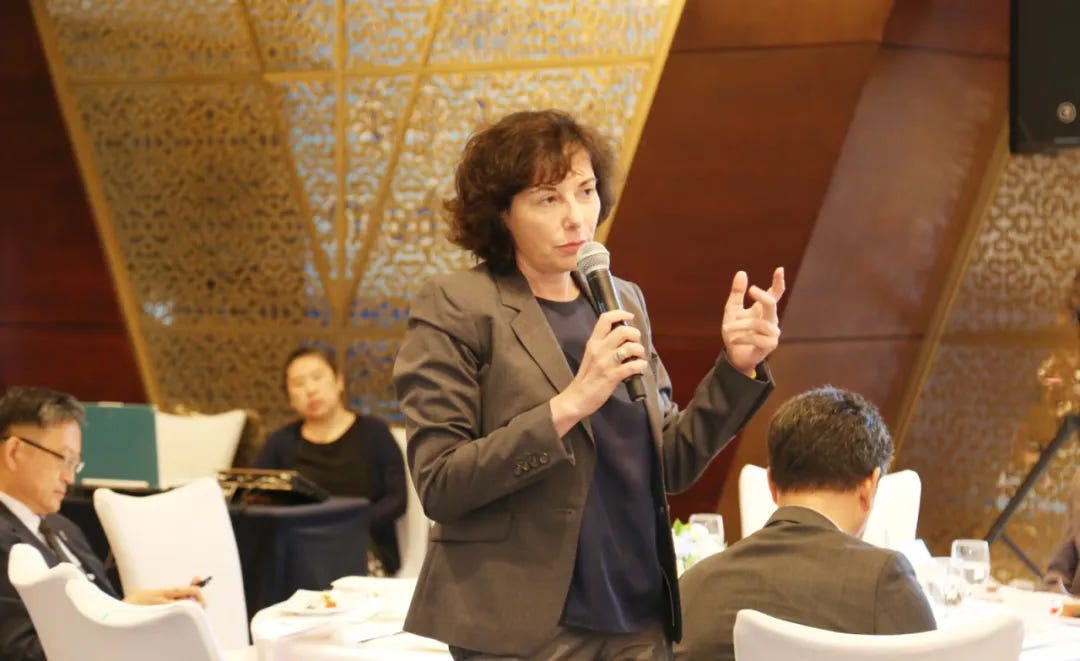
Thank you very much. First of all, I’m also here representing a French company, which is at the state-of-the-art on virtual twins — we apply some algorithms. I’m making a point about Europe: it’s not to be discounted at the moment. We are dependent on U.S. technology, for instance on cloud — 73% from the three platforms. We’re taking steps. And I’d like to remind you of something that happened yesterday in terms of security: Hugging Face was hacked by ChatGPT because one of the models left the sandbox, and the savior was a Chinese model.
Robert Lee, Ambassador of Fiji to China

Thank you, Dr. Wang and Professor Quelch. I just want to make a comment, and embedded in that comment is a question, following on from my learned friend from Peru. The discussion is competition between China and the U.S., but as we look at countries like Peru, and like ourselves, Fiji, we are not only watching this game play out, but we are actually — I won’t say by circumstance, but more by an awakening — coming to suddenly see that it is not competition, it is coopetition that we need to learn ourselves. It’s not just between China and the U.S.; its the rest of the world is understanding this model of cooperating and competing, and learning how to pick sides.
Not in a collective picking of sides, but in a deconstructed picking: Peru picks on security and economics, but we’re going beyond that. We’re now going into almost a micro selection — of universities, of courses, of sports, across all sectors — and I think that will create a new form of power beyond soft power or hard power. It’s a calculated power of the other states, learning when to use soft power, when to avoid hard power, in both cooperating and working with the U.S. and China but also between the states themselves.
So we will learn how to work with Peru, whereas before we didn’t have to. Now we will seek out how to work with Peru because maybe our fortunes are tied a little bit to South America. We don’t know yet, but we will start exploring. Singapore is exploring Africa, and I think, even for Fiji — we’re in the middle of the ocean — we’re starting to think, “Hey, we’re not that isolated. We serve a purpose.” So my point is that this awakening transcends the states, it gets into education. The kids are now learning how to play the game, right? I think they’ve learned that before, how to play Mum against Dad, right, they’ve learned that skill. But now I think they’re learning that skill with the professors, with the schools.
My daughter is going through that. She spent one year at Northwestern, right, and she’s awoken, in a sense, saying, “I’m going to take a gap year.” Why? Because “I need to realize what I want, and I don’t know what I want.” So, “Will you allow me to take a gap year to go and discover who I am?” And for her to ask that makes me reflect on this issue — that the world, and the individual, is coming to a state of competition, not so much the states, and that transcends. I think that will change the dynamics across every sector, in the way we relate to our kids in education: picking study part-time in China, part of the program in the U.S.; they will learn to pick both sides.
And I think how that will then change this context has not been factored in. The other players affecting the U.S.-China relationship, like Vietnam, could tilt it either way. If South America goes more towards China, the U.S. reacts; then Africa starts pushing, Asia pushes another way. It’s going to be a balancing act.
John Quelch
Let me just say quickly. Newton’s law comes into play, I think, in this kind of scenario: to every action there is an equal and opposite reaction, right? And what that really requires, in my opinion, is a level of continuity of leadership, a sense of history, and the importance of diplomatic history that can inform current elected leaders’ decisions.
I think we see this sometimes in the United States today, that there’s no sense of history at all, no recollection of scenarios that were similar, that played out poorly in the past. And if the world is more complicated to navigate because it’s multipolar, if there’s a need for a small country to build these relations in an exploratory way with many, many countries, not just with, in your case, Australia and New Zealand, then that requires a lot of knowledge, a lot of history, a lot of experience. And you have to make sure that your government knows to capture that through the caliber of its foreign service personnel over time. And continuity in the foreign service is very important.
Henry Huiyao Wang
Okay, we have the last two questions — one from the chief representative of the IMF in China, and also from a former chairman of Sinopec.
Marshall Mills, Senior Representative in China, IMF
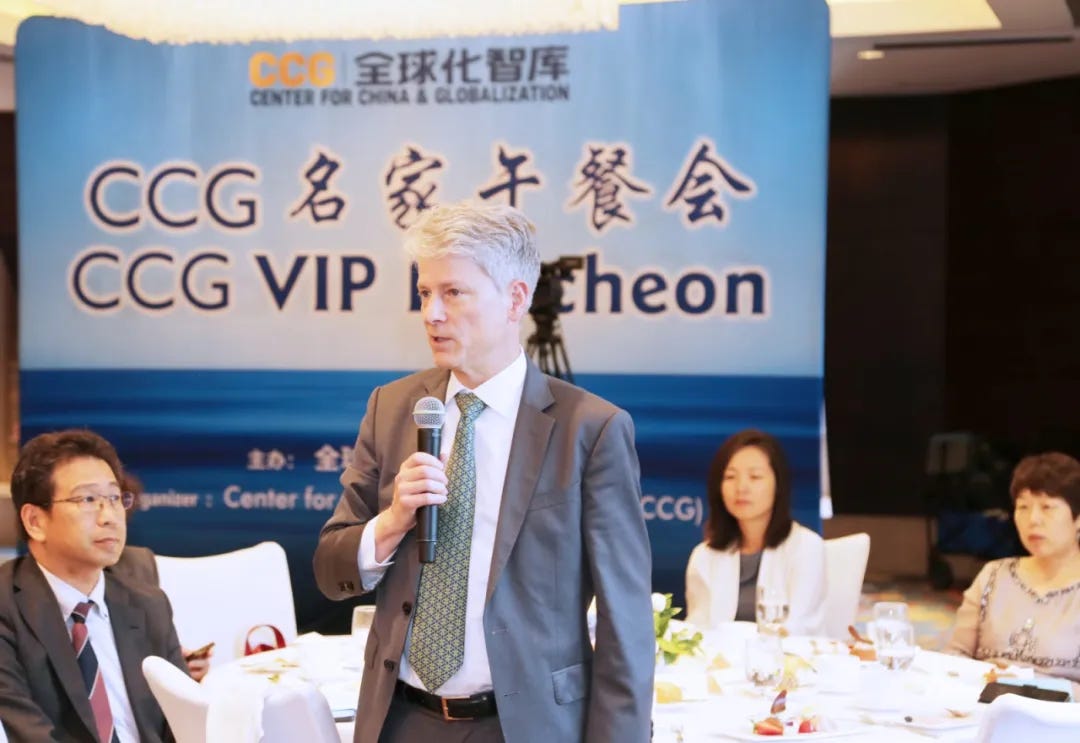
Thank you. So my question is more from my previous life, when I worked on U.S.-China economic relations and China’s accession to the WTO, which fostered a lot of coupling between the U.S. and China business sectors. Now we see decoupling of the business sectors: U.S. companies are not investing, or at least not making new investment, in China. There’s resistance to Chinese investment in the U.S. Where do you think this is going? What will the new coopetition look like in the business sector between the two countries?
Fu Chengyu, Former Chairman, Sinopec Group

Okay, thank you very much for sharing about the U.S.-China relations, but I will ask a question not directly related to the current U.S. questions, but one that will have an impact on the long term of such relations, which is the U.S.-Iran war. What we understand is that President Trump can not stop the war. They have to continue because within the U.S. there are three forces pushing him toward the war. One is what we call the military-industrial complex. Second is zionism. And the third is Israel — Netanyahu, who is pushing Trump toward the war. MAGA people do not want war. And I think that’s why Trump renamed the Department of Defense to the Department of War. Now it seems Trump wants to stop for the midterm elections, but they couldn’t stop because the other forces — Iran will strongly oppose or retaliate — so that’s what’s keeping Trump from stopping.
My question is: what are your expectations for the end results? Will the Iranian administration totally change? Will the Strait of Hormuz be fully open? Or will we see continued fighting and closing of the Strait of Hormuz for another six months or a year? So, what are your expectations?
Song Yaoming, Former Minister, Economic and Commercial Counsellor’s Office, Chinese Embassy in Japan; Former Commercial Counselor, Department of Asian Affairs, MOFCOM
Thank you, Henry, for giving me this opportunity, and Professor Quelch, thank you very much for your insightful presentation — I very much enjoyed your perspective. If I may, I would like to hear your thoughts on one question: how can universities like Duke Kunshan University and think tanks like CCG make use of AI to expand academic collaboration, policy dialogues, and people-to-people exchange, so that they can continue to serve as a trusted Track Two bridge, even during times of strategic competition? Thank you.
John Quelch
Let me try to briefly respond to each of the three questions.
So, to take the last question first. I think this is actually a very interesting idea that you pose. We’re thinking about how we can work with other universities using AI dialogue, but with teams of students at different universities working on the same problem, but also sharing, in an AI-based dialogue, what their answers should be to, let’s say, how do we address climate change in the next 10 years? So, cross-university collaborations, either at the student level or the researcher level, are possible, and can be leveraged effectively through using AI tools.
On the first question, regarding trade and investment. Trade is always easier to deal with, I think, and easier to activate, than investment. And it’s true that there’s been a considerable slowdown in bilateral investment. Those investments that Chinese companies have made in the U.S. that are particularly laudable are investments in industries that are not necessarily super sensitive, you know. For example, there’s a Chinese company, I think I may pronounce the name wrong, Wanxiang, which is in the auto parts, or auto components, sector. Over the last 15 years, they made a number of investments in the Midwest of the U.S., buying companies that were almost bankrupt, or were bankrupt, and saving hundreds and hundreds of jobs in Ohio, Indiana, and so on by bringing their manufacturing expertise, which enabled them to turn around those businesses. And that company then became very well received and lauded by the mayors and governors of those states, and the cities where they saved the jobs.
So, my advice, wherever you’re going to invest, is to always remember the words of President Kennedy: ask not what China can do for you, ask what you can do for China. And you can apply the same thing to the United States, or any country. It’s a very important question to ask before you invest, and your reception as an investor will depend on how much you’re going to be contributing to the place that’s now hosting your investment.
So, on the war. I’m quite pessimistic on this issue. I’m not an expert, but I’m quite pessimistic, and I’ll tell you why. Forty-seven years is a long time between the United States and Iran, and it’s been like this all the way. President Trump obviously activated a military action that took out most of the leadership of the country. President Trump does not have a monopoly on retribution; he likes to think about retribution in terms of his political opponents domestically, but Iran also might have a view on retribution.
November is not that far away, for the Senate and congressional elections. I can imagine some nefarious thinking in Tehran about what surprise they could give President Trump, around about October the first, that would maybe upset the stock markets of the world, and maybe he loses those elections. I don’t know. All I’m saying is, from a geopolitical scenario-planning point of view, I hope someone in Washington is thinking about that.
Henry Huiyao Wang
Okay, good. On that note, I think our time is up. We had a very good, stimulating, but also very in-depth dialogue with Professor Quelch at the CCG VIP luncheon. We also had extremely active participation from our distinguished audience, and your questions and comments were really all valuable.
I particularly think that the theme of the luncheon today is coopetition, and I think in the world of the 21st century, we have so many things coming — uncertainty, AI, climate, all that global debt, and all those issues around trade and investment. We really need cooperation — that’s still the buzzword — but of course we don’t avoid competition. We just finished the World Cup, so let’s have a World Cup style or an Olympic-style competition. I was so amazed that, you know, 48 countries participated where everyone played by the rules and a winner was selected. There are some frictions, but not really a fight, or “wipe you out,” or things like that.
So, I think in the spirit of the World Cup, and in the spirit of the Olympics, why don’t we have this friendly competition, but really maintain cooperation? So that’s probably this new concept, which is really an old concept that we need to give new meaning to, not just for business, but also for geopolitical, country-to-country relations into the future.
So, on that note, I really want to thank Professor Quelch for your excellent dialogue with us today, and we hope to have you again in the future. Okay, let’s take a photo together.
