


This is the transcript of the fourth roundtable of the 10th China Global Think Tank Innovation Forum, held on 20 November 2025. The forum was hosted by the Center for China and Globalization (CCG) and co-organised with the China Association of International Trade (CAIT).
The roundtable, themed “New Drivers of Globalization: Climate Change, AI, and Supply Chains”, focuses on how the green transition, emerging AI governance, and the shift from efficiency to resilience in global supply chains are reshaping international cooperation, trade, and global governance.
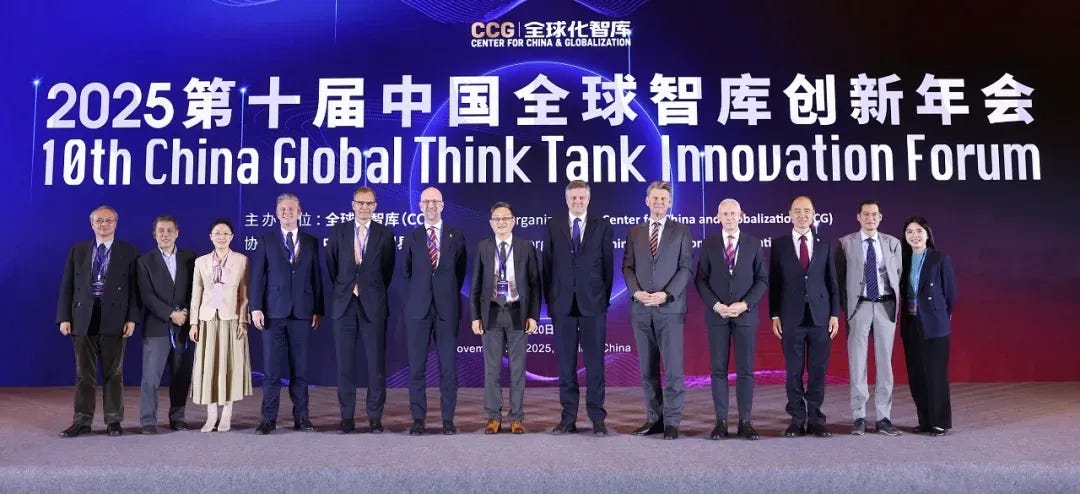
Moderated by Zhang Wei, Deputy Secretary-General, Senior Research Fellow, and Director of Partnerships Department at CCG, the session featured:
Craig Burchell, Chairman, “Digital Maritime Silk Road 2030”, International Chamber of Commerce UK
Michael Starbæk Christensen, Ambassador of Denmark to China
Vebjørn Dysvik, Ambassador of Norway to China
André Haspels, Ambassador of the Netherlands to China
Thorir Ibsen, Ambassador of Iceland to China
Ma Jun, Director, Institute of Public and Environmental Affairs
Andy Mok, Professor, Beijing Foreign Studies University; Senior Research fellow, CCG
David Morris, CEO, Australia China Business Council (Tasmania)
Ravindra Ngo, Founder, the Asian Network
Su Hao, Professor in the Department of Diplomacy and Founding Director, Strategic and Peace Research Center, China Foreign Affairs University
Wu Yanyan, Vice President of Corporate Communications and Government Affairs, BMW Group Region China
The discussion also featured contributions from GYLD delegate Michelle Wing Sze Ng from Hong Kong SAR, China, Ng Teng Fong Charitable Foundation Associate Fellow at Savantas Policy Institute and Yenching Scholar at Peking University.
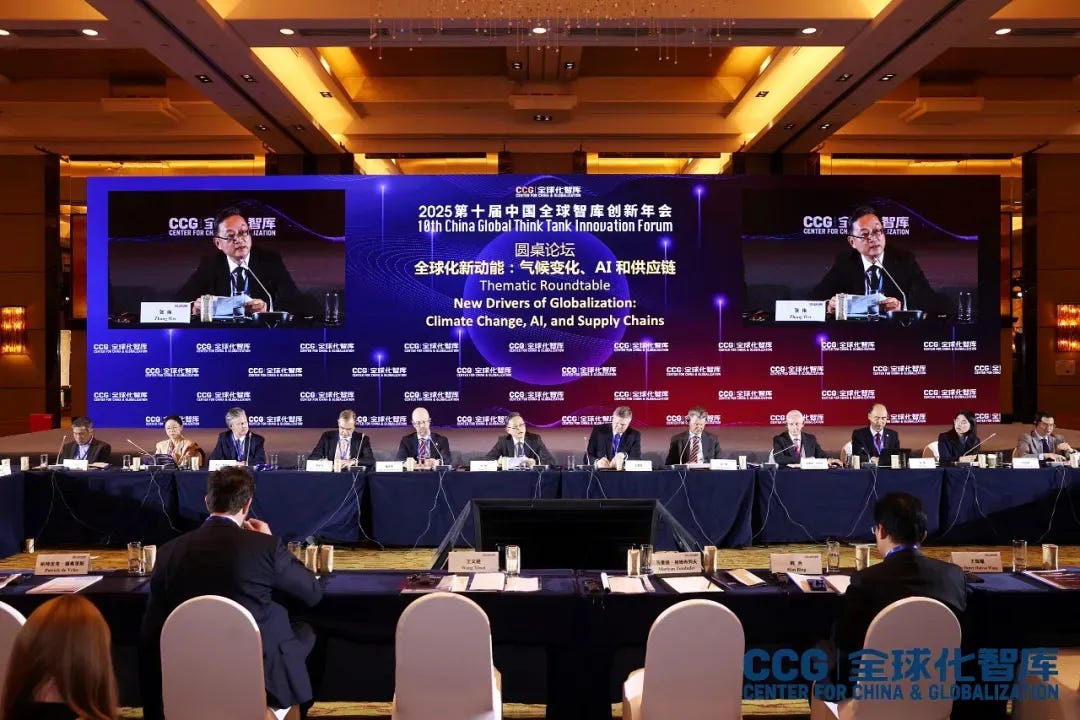
The full video recording of the event is available on CCG’s YouTube channel and official website. For a quicker look, a standalone video of the roundtable has also been uploaded.
CCG has also broadcast the forum on Chinese social media platforms, where it remains accessible.
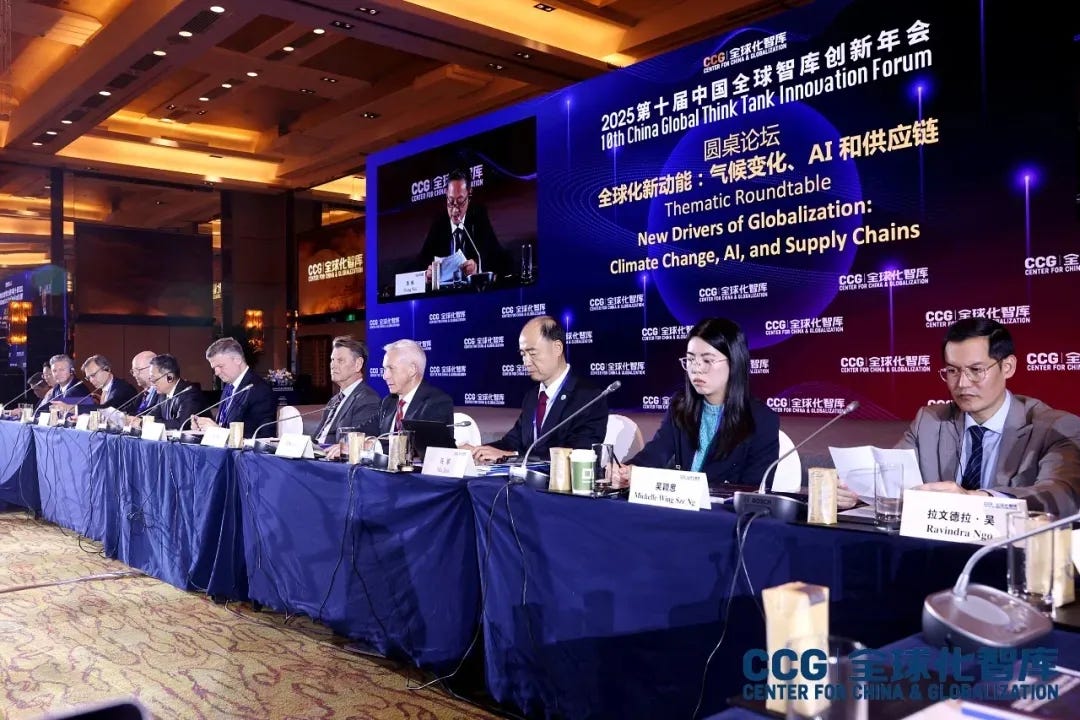
This transcript is based on the video recording and has not been reviewed by any of the speakers.
Zhang Wei, Deputy Secretary-General, Senior Research Fellow, and Director of Partnerships Department, CCG
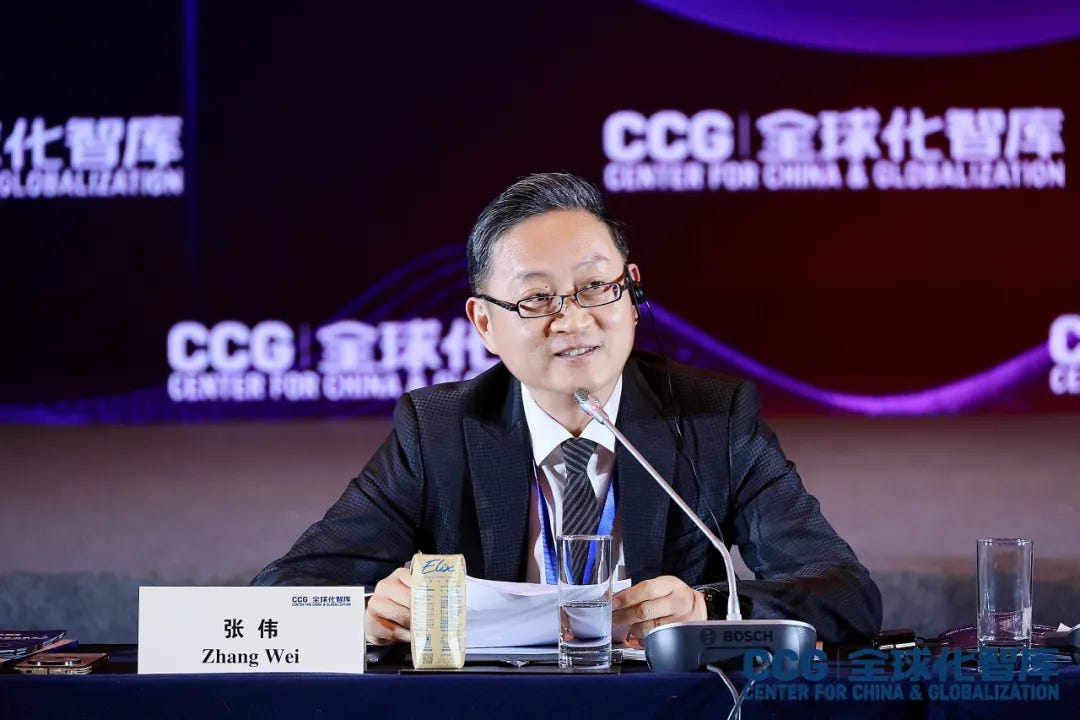
Distinguished ambassadors, industrial leaders, ladies and gentlemen, good afternoon. Welcome aboard this “ship of ideas” as we explore the new drivers of globalisation—climate action, AI, and supply chains. Today’s panellists come from diplomacy, industry, business, academia, and beyond. I will serve as the moderator of this roundtable and, for today, the captain of our ship.
Let’s take a look at where we are in this ocean of globalisation, which is undergoing profound change—from market opening and trade expansion to technology and connectivity. As ties deepen, rising powers are reshaping the relationships among nations and businesses. AI, supply chains, and other technologies are becoming key forces driving both cooperation and competition. They are reshaping the global economy, reconfiguring parts of the international order, shifting industrial capacity, and influencing geopolitical balances—and, at times, conflict. Meanwhile, the low-carbon transition and the rise of the green economy are adding another layer of complexity to the global landscape.
Alongside new opportunities, AI is also raising difficult ethical questions. And global supply chains are being redesigned, with resilience increasingly taking priority over pure efficiency.
Amid these challenges, there are also real opportunities—in clean energy, sustainability, and more stable supply chains. Done well, these efforts can help counter fragmentation and reduce other pressing risks. This forum brings together leaders from across key stakeholder groups. Through open dialogue, it can help surface practical solutions and identify the next set of drivers for globalisation.
A few guiding questions for this session:
First, how can global green trade be redefined, and how is it reshaping the global order?
Second, what kind of AI governance model can best support globalisation while mitigating ethical risks?
Third, as supply chains are reshaped, how do different strategies influence global markets and regional economies?
Fourth, in areas such as climate transition and digital governance, where is the greatest potential for global cooperation, and what outcomes can such cooperation deliver?
Fifth, how can developed countries play a more constructive role in the next phase of globalisation to protect equity, fairness, and broadly shared gains?
Now, let me turn to our panellists. This roundtable was originally scheduled to have 12 panellists, but Lu Ruquan had to leave earlier due to other commitments. We now have 11 panellists. Each panellist will have five minutes to share perspectives.
Without further ado, let me give the floor to Craig Burchell, Chair, “Digital Maritime Silk Road 2030,” International Chamber of Commerce UK.
Craig Burchell, Chairman, “Digital Maritime Silk Road 2030”, International Chamber of Commerce UK
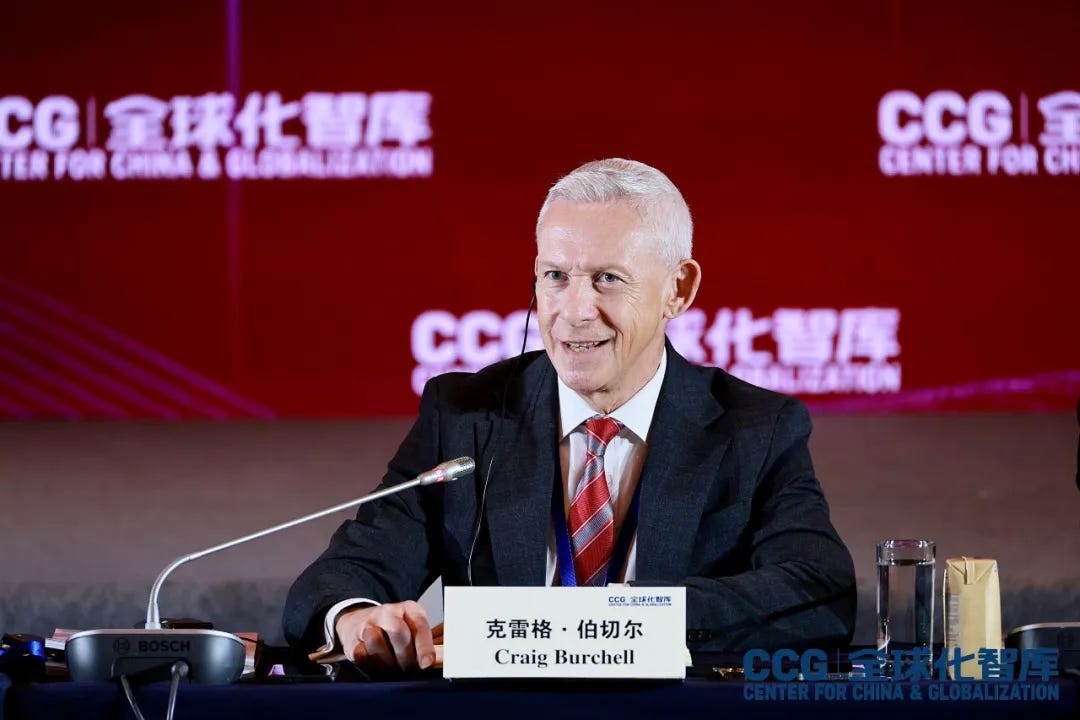
Thank you. I’m very glad to be back in Beijing. I’ve been working at Huawei in Shenzhen for four years.
First, a warning: I’m a lawyer, and I’m from the business sector. We tend to have a pragmatic, business-oriented, and practical mindset. I’ve witnessed the power of globalisation to create prosperity. I’ve spent 30 years working in globalisation: 20 years as Global Head of Trade at Philips Electronics, five years living in China, and four years at Huawei as an SVP, dealing with American sanctions as one of my topics.
I’m proud that I’ve been part of the free trade agreements, including the Information Technology Agreement. This liberalisation over the last 30 to 40 years has given smartphones to billions of people around the world. It’s a success. Globalisation can bring prosperity.
But other forces—greed, profit-taking, and concentration of wealth—have also produced inequality and unhappiness. That balance has been disrupted by political storms and by COVID. So there is a paradigm shift away from the efficiencies we built before, and towards more resilience. Are we decoupling? I’ve always said no. Building more resilience, yes: there is more space and slack in supply chains. But multilateralism is definitely under threat.
Over the last couple of years, I’ve been talking with friends and colleagues from China, India, the Emirates, London, the United Kingdom, and Europe—a digital trade network of contacts. We have been thinking about how to create new forms of multilateral cooperation. What we have come up with is what we now call the Catalyst Project.
The Catalyst Project is business-led, government-supported, and organisationally founded within the multilateral system. We focus on the Europe–Gulf–Asia–China trade corridor. This project is all about the digitalisation of supply chains. Digitalisation of supply chains has been tried many times before. Previous attempts have all failed because they confront limitations in commercial interests, profit incentives, trust issues, and politics. Our project is designed differently. It is designed for buyers and sellers. It is designed to be extremely practical.
We focus on the Europe–Gulf–China trade corridor because it is the most significant trade corridor in the whole world. It doesn’t matter what you call it—the Belt and Road Initiative, the Silk Road, the Global Gateway—call it whatever you want. But this corridor is the single most important artery of trade between East and West. We want to digitalise it, and we want to create what’s called public digital infrastructure. This means interoperability between systems that work for all companies in all regions—within regions, and between hubs.
Our approach is unique because it focuses on one corridor. It focuses on major hubs—some of the largest financial and logistics centres in the world: Rotterdam, London, Dubai, Mumbai, Singapore, Beijing, and Shanghai. What does this mean for buyers and sellers? It means transaction costs reduced by 80%, cross-border time reduced by 70%, no courier costs, zero paper, and 100% digital, trusted exchange of data—instantaneously. After some years, we will embed finance into it, so that trade becomes faster, cheaper, and more efficient, bringing benefits directly to small and medium-sized enterprises.
I’ve been asked to chair this project on behalf of the International Chamber of Commerce, and we are building support. That’s why I’m here for a month in China, talking with Chinese government representatives about international digitalisation. I return to Europe via India next week. We are already active in the Emirates, and ICC United Kingdom is leading this initiative.
This is a new form of cooperation. It’s unique because it focuses on one trade corridor linking five hubs, and linking all the experts, so this chain becomes fully interoperable and all the systems speak the same digital language. That is interoperability. Our goal is a public digital infrastructure. We believe that by focusing on one corridor, getting it right, and learning from our mistakes as we go along, this can be replicated across every single trade route and corridor across the world.
But we have to start somewhere. We have to be pragmatic. We’re business people. That’s why we want to start with Eurasia, and start by creating a Digital Maritime Silk Road. Thank you very much for inviting me to present it.
Zhang Wei
Thank you, Craig. Connecting East and West through a public digital trade corridor is a compelling idea. Public digital infrastructure is vital, but it calls for standardisation to facilitate logistics. This also matters for green transformation. Thank you for sharing.
Now, let me give the floor to our guest from Northern Europe: His Excellency Michael Starbæk Christensen, Ambassador of Denmark.
Michael Starbæk Christensen, Ambassador of Denmark to China
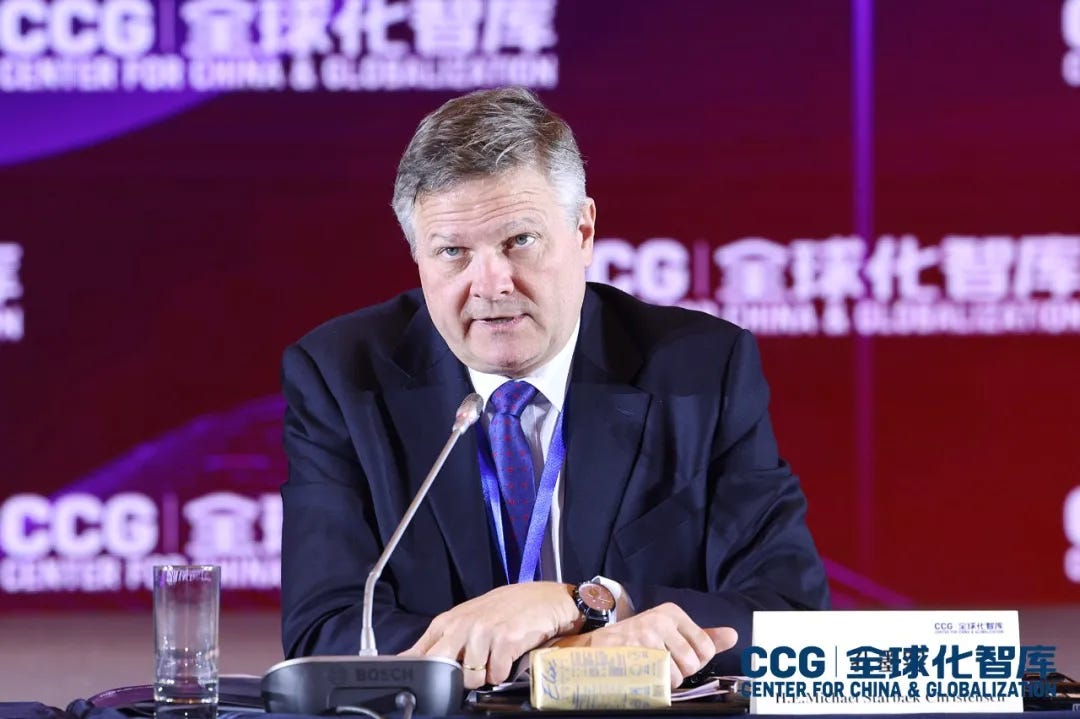
Thank you very much, Mr Zhang Wei. I am very happy to be able to speak. It is good to see northern European representatives, because I think we represent some of the countries that have chosen to go in a new green transition, green energy direction, which is a direction that sets a model for other parts of the world. And I think what we have seen is that the climate goals we set and the green industrial strategies we produce have meant that, from being a part of the economy in the periphery, it is now centre stage and reshaping how we trade, how we invest, and how we develop our countries.
Right now, in Belém, Brazil, the UN climate conference is taking place, and it is entering into last few days. I’m sure in Belém there will be a lot of talk about guilt, responsibility, obligation, the usual negative discussions we often see at these multilateral conferences, but actually it should be about opportunity.
Last year, more than $1.8 trillion was the investment we reached in global clean energy, and we outpaced investment in fossil energy. So now we see that there is more investment going to renewables, and that it benefits those countries that make that a priority in their energy plans and consumption. We see a shift in global value chains because some of the fastest-growing traded products today are solar PV, wind equipment, heat pumps, batteries, and electric vehicles. So we see a shift in consumer habits, government policies, and I think these energy-transition technologies have really become a backbone in our development models. The International Energy Agency estimates that by 2030, clean tech exports will represent over one-third of all growth in global goods trade. Also, for emerging economies, the green value chains become the entry point to industrial upgrading. So there is really a shift on the way.
In Denmark, we also use some tools. One we call GreenREFORM, which is a macroeconomic model, and I’m a big fan of using economic models that prove the usefulness and the benefits of policymaking. So it’s not just a policy debate, but it has actually proven how it can change things. This macroeconomic model we use will allow policymakers to assess the economic and fiscal impact of climate policies and make sure that new regulations benefit both industry and investors, and create a predictable environment for sustainable growth. So I think that kind of model, actually developed by our Ministry of Finance, helps political discussion and public support because it proves the beneficial elements of the green transition.
We also do modelling work with China in a bilateral cooperation where we each year publish the China Energy Transformation Outlook. It has just been presented in Belém at the climate conference, and it is a cooperation between China’s Energy Research Institute and the Danish Energy Agency, where we map out pathways for China to reach its own climate targets and bridge the gap between vision and action. These reports are solidly based on academic and technical evidence, and therefore also show how it is possible to reach the targets that are set in the Chinese energy five-year plan. So I think those kinds of tools we can develop are extremely important for proof that we’re actually moving in the right direction.
Let me finally mention something that has been a bit criticised in China: the EU’s Carbon Border Adjustment Mechanism, CBAM. But again, I don’t see it as a barrier to trade. I see it as an incentive for low-carbon production and to accelerate decarbonisation in the global supply chains. So I think we also need political and regulatory instruments that push the transition in the right way, and we shouldn’t call them barriers but incentives for greener development. I think they play a vital role as well. Thank you very much.
Zhang Wei
Thank you, Ambassador. Just now you shared some very useful reflections—on green technology and the clean energy transition; on how digital development is reshaping the whole chain, from production to consumption and decision-making; on industrial upgrading; and on China–Denmark cooperation at the policy level, especially around green development and policymaking.
I have also taken part in similar discussions—for example, on the EU’s CBAM and the broader question of whether greener trade rules can help accelerate the transition. What stands out is that European methodologies and frameworks are highly developed, particularly in setting standards, aligning different actors, and keeping everyone moving at the same pace. There is also a strong emphasis on integrating the efforts of the four key stakeholder groups.
Looking ahead over the next few years, there is clearly still room for further joint work and practical progress. Thank you again for sharing. And with that, I’d like to move on to another Nordic country. I’d like to invite the Norwegian Ambassador to China, His Excellency Vebjørn Dysvik.
Vebjørn Dysvik, Ambassador of Norway to China
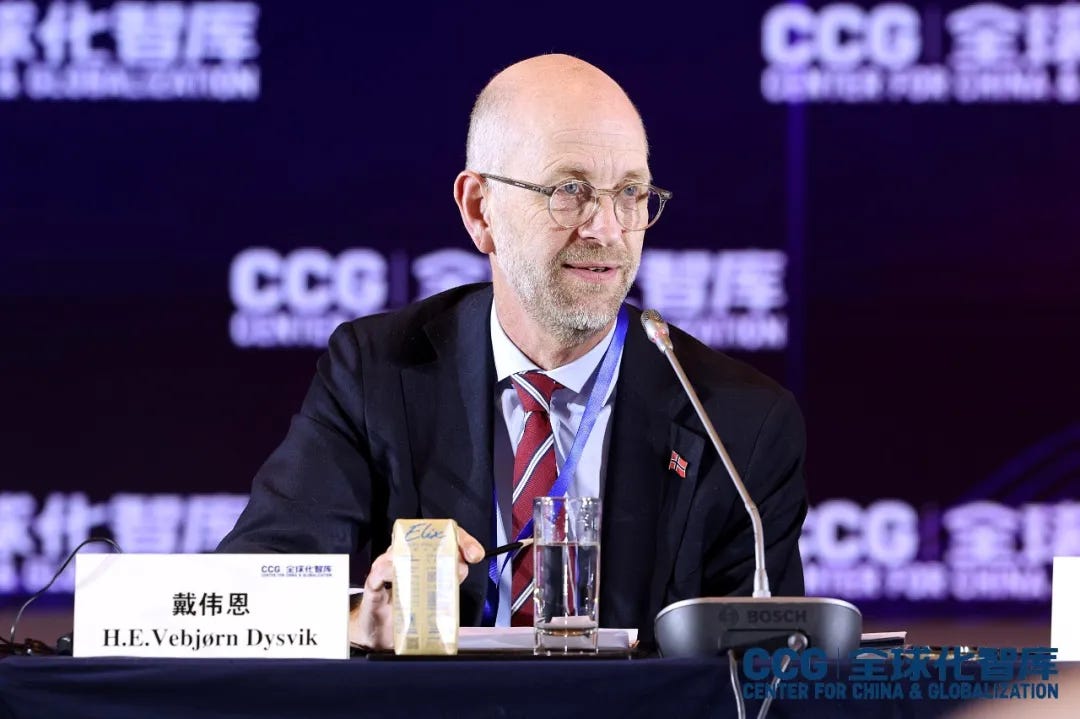
Mr Zhang, it’s an honour for me to be on such a distinguished panel. I’m very happy to have several of my Northern European colleagues with me, and I don’t think it’s a coincidence that you have so many Northern Europeans here because this concern about the drivers of globalisation, and these drivers in particular, are very high on the agenda for different reasons in different areas in the Northern European countries.
I also like what you said in your opening, that we are moving from efficiencies to resilience, and I would like to agree and disagree with that. I mean, partially, of course, we cannot move away from efficiencies because efficiencies are extremely important to us. The reason why we have had a development in the world where we’ve seen hundreds of millions and even billions of people move out of poverty has been because we have been able to exploit those efficiencies. And so, in maintaining those efficiencies lies a lot of welfare for a lot of people. But then it also turns out that it’s been going too far.
I think a combining theme of the three drivers that are sort of the basis of this session: two of the challenges are manifest, and one of the challenges is potential. I think Michael made a very good case for the positive story around climate change. Necessity is the mother of invention, and I think we have been finding a lot of opportunities in the green economy, and we continue to do so. Also, Norwegian companies are working here in China with Chinese companies.
And then, of course, at the same time, climate change is one of the consequences of globalisation, and one of the great dangers to globalisation, because the resilience of our economies and the resilience of our societies are being fundamentally challenged.
Supply chains are very much on vogue these days. Lots of people are concerned. This is also an example of us being able to drive efficiencies to a point where we have become maybe too efficient, or maybe too fragile. Right now, it is, of course, a discussion between countries, and who sells what to whom, and who protects themselves from who. But it’s also a question of us collectively putting ourselves in a position where we are, at any given point, not just one political decision away from a problem, but one storm away from a problem, one pandemic away from a problem, one earthquake away from a problem, because when we have so many things that are made maybe in just one place in the world, and that one place (sources from) many different places in the world for many different inputs, the whole system as such becomes too fragile.
So these are manifest challenges. And then you have the future challenge of AI. I am a political scientist. I don’t know the ins and outs of it. My son is a computer scientist, and he tries to explain it to me almost on a weekly basis, and he usually fails. But I’m hearing a lot of very intelligent people that know a lot about AI saying that this is the salvation for the future of mankind, and then another group that knows a lot about it saying that this is the possible doom of mankind, and then we should prepare for both possibilities, also when we consider that this will become fundamental to the world economy.
As for so many other times, I think we will find a lot of the solutions in international cooperation. We see a lot of it in the climate now in Belém. I think CBAM is going to be a very interesting solution, a way to find collective solutions to the dilemmas of climate. I think we also have to find collective solutions for the supply chains.
And then on AI, it is important that we, sooner rather than later—and in our case, we want a UN-centred approach to that—try to find common governance structures so that we don’t release something onto the world that we don’t know how to control, and where it will take us.
So, for the world to be as efficient as possible, but as resilient as necessary.
Zhang Wei
Thank you, Ambassador. Yes, indeed. As you mentioned, in the face of these challenges, it is essential to join hands and pool our efforts—especially to strengthen supply-chain resilience, which is fragile and under intense pressure right now.
I agree with your earthquake analogy. When an earthquake strikes, the question is how to limit the systemic damage that cascades through interconnected parts of the system. The priority is to contain the impact quickly, so initial shocks do not trigger further aftershocks.
That is also the kind of consensus needed for the green transition. The EU and CBAM have been discussed a great deal, and they do offer valuable options and lessons. The EU has put in significant effort and carried out meaningful trials. Some countries, including the U.S., have also adopted their own green deals, and China has its own policies to drive the transition.
My view is that it takes collective action to push this transition forward because much of the work ultimately needs to happen in developing countries, and the costs can be very high. That is why stronger supply-chain resilience matters: it can help bring down costs for industries and countries, and also for households, where the financial pressure can be especially heavy.
We also need sustained momentum and robust mechanisms—through policy design, practical approaches, and decision-making processes. Different countries can learn from one another, share references, and coordinate where possible.
On supply-chain resilience specifically, the minimum goal should be to reduce the stress created by vulnerabilities that disrupt business operations. There is still plenty of room to explore practical solutions in this area.
Thank you, Ambassador. And yes—Nordic countries. It is no coincidence that we are gathered here. It is necessary, and the work you are doing is truly valuable. With that, I would like to invite the Ambassador of the Netherlands to China, His Excellency André Haspels.
André Haspels, Ambassador of the Netherlands to China
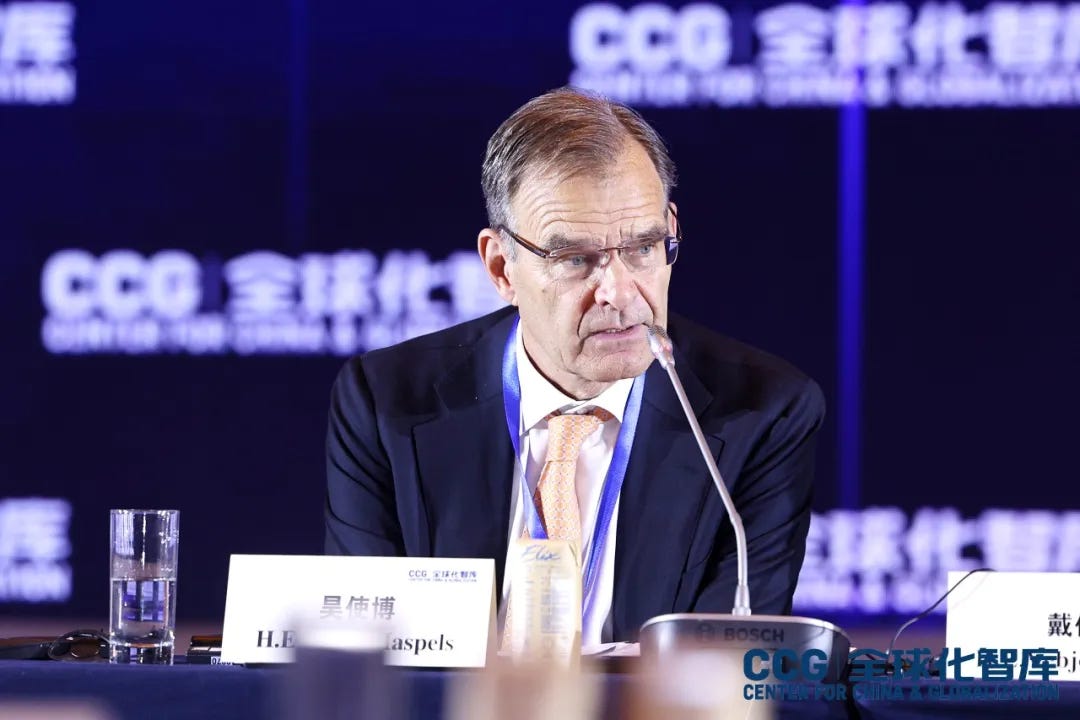
Thank you very much, Mr Chair, for inviting me. It’s a pleasure to be here, and obviously, I guess nobody here would be interested today what I tell about Nexperia, but the Nexperia case gives me the opportunity to say something about supply chains and supply resilience, which I’m happy to do.
First of all, the Netherlands is a country that strongly believes in free trade in a rule-based system, with fair and equal rights and obligations for every country. About one-third of our GDP relies on foreign trade, and over the past few decades, we have seen supply chains become increasingly global in nature, which has led to large gains in efficiency and innovation, and we have all benefited from that. Many countries, including China and the Netherlands, have been able to develop their economies because of the benefits of international trade.
Yet the world has also shown, and come to realisation, that these developments have impacted our economic resilience. All these global and complex supply chains make certain supply chains very vulnerable. Let me provide you with three examples.
The first one is the COVID crisis. I think this period showed Europe our enormous dependence on other countries for vaccines, for face masks, and suddenly, we had to grapple with shortages. And it made us realise that sometimes, in order to be resilient, it is important to build in a certain slack into our system.
Second, I would like to mention as an example our energy dependence on Russia. When Russia’s war of aggression against Ukraine started, we were hugely dependent on Russia for oil and gas, and not wanting to fund Russia’s war machine, and to comply with the sanctions against Russia, we suddenly needed to rapidly decrease our energy imports from Russia, and this came at a huge cost for business and for our society. So the lesson there was also: we do not need to be dependent on one single country.
And thirdly, I would like to mention China’s dominance in the production and refining of critical raw materials, and the export controls that China has implemented on critical raw materials have led to an upheaval for European businesses. And it’s just another example of how being dependent on another country can make supply chains vulnerable.
And to be more resilient to such events, we just need to de-risk our value chains that are strategic in nature, for example, by diversifying our supply chain, by stimulating innovation, and by strengthening our European ecosystem. And I would like to stress that these efforts are not, I repeat, not focused against China. It is a broad-based effort to avoid strategic dependencies on one single country.
Other countries are making similar efforts. In fact, China already started to integrate economic resilience in its policies at least 10 years before the EU did, and of course, China keeps ongoing this course. If you look at the proposals for China’s next five-year plan, technological self-reliance will continue to be a key goal for China, and we respect that. But it also influences our thinking.
Whereas mutual dependencies can help promote peace and stability, one-sided dependencies do not. But we want to, and we need to, keep working together. We have far more interests in common than we have our differences, and we continue to see many opportunities to work with China, in line with our continued commitment to free trade and multilateralism. I can mention a number of examples of cooperation. In the interest of time, I will leave that out. But believe me, there are more than enough.
Let me go back and end with where I started, and that is the Nexperia case. The Dutch government found it necessary to intervene in Nexperia due to serious governance issues that posed an acute threat to the continuity of production capacity of Nexperia within Europe. And the measure that the Dutch government took was again not aimed against China, but rather an intervention to safeguard our security, our supply, and our value chain.
Yesterday, as some of you might know, the Minister of Economic Affairs from the Netherlands has decided to suspend the order based on the Goods Availability Act, in close cooperation with our European and international allies. And we also agreed with MOFCOM on the importance of restoring the supply chain in the interest of both our countries.
So, in this specific case, discussions between China and the Netherlands will continue, and we will continue to engage in a constructive dialogue with the Chinese authorities. Thank you very much.
Zhang Wei
Thank you, Ambassador. As you noted, China and the Netherlands need to take a higher-level view of both bilateral and global cooperation, so that we can address challenges in energy and other areas together—and avoid overreliance on any single source of energy. China has been exploring its own pathways in response to these pressures, particularly around energy security. In global governance, regulatory frameworks are also improving. Some rules are legacies of the past, and they need to be updated—or better aligned with the realities of today.
That is why it is so important to move in the same direction. And in a way, challenges can be constructive: they bring us together to exchange views and develop solutions, whether bilaterally or through multilateral mechanisms.
China is now working on its 15th Five-Year Plan and has been mapping out a more specific development pathway. That process will create new opportunities in the Chinese market—and, in turn, open up opportunities for partners from other countries as well.
Meanwhile, the European Union remains committed to its green transition and to facilitating trade and investment. These are clear areas for cooperation, because in today’s world, no country—and no national supply chain—can operate in isolation. Thank you.
Last but not least, I would like to give the floor to His Excellency Thorir Ibsen from Iceland.
Thorir Ibsen, Ambassador of Iceland to China
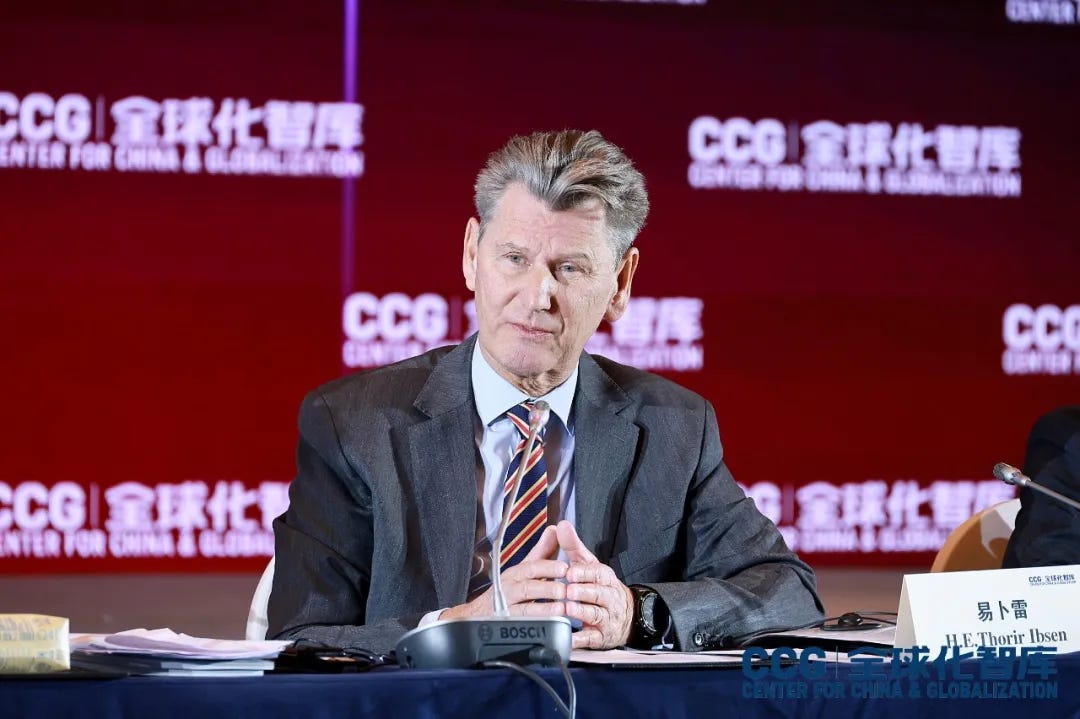
Thank you very much, Mr Zhang. I would like to address the issue of drivers of globalisation in the general context of global governance via three observations.
The first one concerns the different implications of the various drivers that we’re dealing with today in the global system. When we look at the background analysis provided by the CCG, it distinguishes between traditional drivers and new forces of international relations and change. I found this interesting analysis that merits consideration, and I would certainly agree that market liberalisation, trade expansion, and technological connectivity have been important drivers of multilateralism. These drivers create both interdependence and common challenges. And in situations of stability and mutual trust, these drivers tend to encourage the world community to manage international relations and to resolve shared problems through negotiations and cooperation.
I would also argue that environmental challenges, including climate change, have also been major drivers of multilateralism. While they’re a problem, they have pushed states, businesses, and civil society onto the path of the green transition to the betterment of humanity. I’m more concerned, on the other hand, about artificial intelligence and evolving supply chain structures. These two are different in nature, and they are more aligned with the aspirations of powerful industries and states to acquire global power and dominance. And these forces, if they’re not properly managed, are likely to contribute to more geopolitical confrontation and deeper inequalities.
The second point I want to make around these drivers is: how do we successfully manage them? Do we do it with more multilateralism, or do we move towards multipolarity? And here, of course, there’s certainly concern in the world community that we are facing change and the international system is at a crossroads, but the question is which path are we going to choose out of this crossroads?
My answer is quite evident: the answer is multilateralism and not multipolarity, because history tells us that an effective and responsive multilateral system, underpinned by respect of the United Nations Charter and international law, is the best possible guarantee for our security. And for the large and the powerful that do see an opportunity in gaining more influence and even dominance in the multilateral world, that favour multipolarity, we should heed the warnings of the Secretary-General Guterres, which has reminded us of the experience of Europe of the multipolarity that led to the disaster of the World War I, with the disaster for Europe that we all know.
So my third point then, and the final observation: if we favour multilateralism or multipolarity, what do we have to do to reform the system? Now, I have made the point that the UN should be the core of that reform, but the UN has to be made fit for purpose. There have been many achievements of the United Nations system and multilateral institutions of the post-Second World War period, but trust is dwindling in these institutions, and many inefficiencies and ineffectiveness of the institutions have been pointed out.
Second, though, we have to keep in mind that the most important element of effective international systems is inclusiveness and the full participation of all states, and therefore, if we are going to reform the international system, we have to do it together on the basis of the same premise. And this is why it’s very important, I think, that the world community follows carefully and participates actively in the Secretary-General’s UN80 reform process in updating the UN system, and avoid getting sidetracked by alternative proposals, because fundamental to the UN80 Initiative is the recommitment to the rule of law and to all the three pillars of the UN Charter, notably peace and security, human rights, and development. These three are intertwined and inseparable. Peace and security cannot be sustainable without human rights and development, and development and human rights will not be possible without peace and security.
The UN Charter is a charter belonging to the people of the world. It is not just the property of governments. Individuals and people are also granted rights to fundamental freedoms by international law. This is why respect for human rights, one of the three pillars of the UN Charter, must also be an integral part of the reform of the multilateral system for it to prevail. Thank you very much.
Zhang Wei
Thank you very much. I fully agree with your points. The future of globalisation is inseparable from the future of multilateralism. Many countries, including China, oppose unilateralism. China has consistently supported multilateralism because it is only by working together that countries can find solutions to shared challenges.
On reform of the United Nations and the Security Council, China—together with many European countries—has called for reform so that global governance becomes more inclusive, including on human rights, security, and development. China has also put forward initiatives that it says are consistent with the UN Charter, including the Global Security Initiative (GSI), the Global Development Initiative (GDI), and the Global Civilisation Initiative (GCI). These reflect China’s stated aim of promoting a more inclusive approach to building a better global governance system. This is not simply a question of big or small countries, or of different cultural backgrounds. All countries should be able to share development opportunities on an equal basis. Of course, developed countries can play a leading role in North–South cooperation—but it needs to be multilateral, and that aligns closely with China’s global initiatives.
Thank you again for sharing. Now, let’s shift from Northern European perspectives to a Chinese perspective. In China, many people are actively engaged in environmental protection and climate action. The blue skies we see today are the result of sustained efforts, and some desert areas have been transformed into sites for animal husbandry and wind-power generation.
With that, let me introduce our next panellist: Ma Jun from the Institute of Public and Environmental Affairs.
Ma Jun, Director, Institute of Public and Environmental Affairs
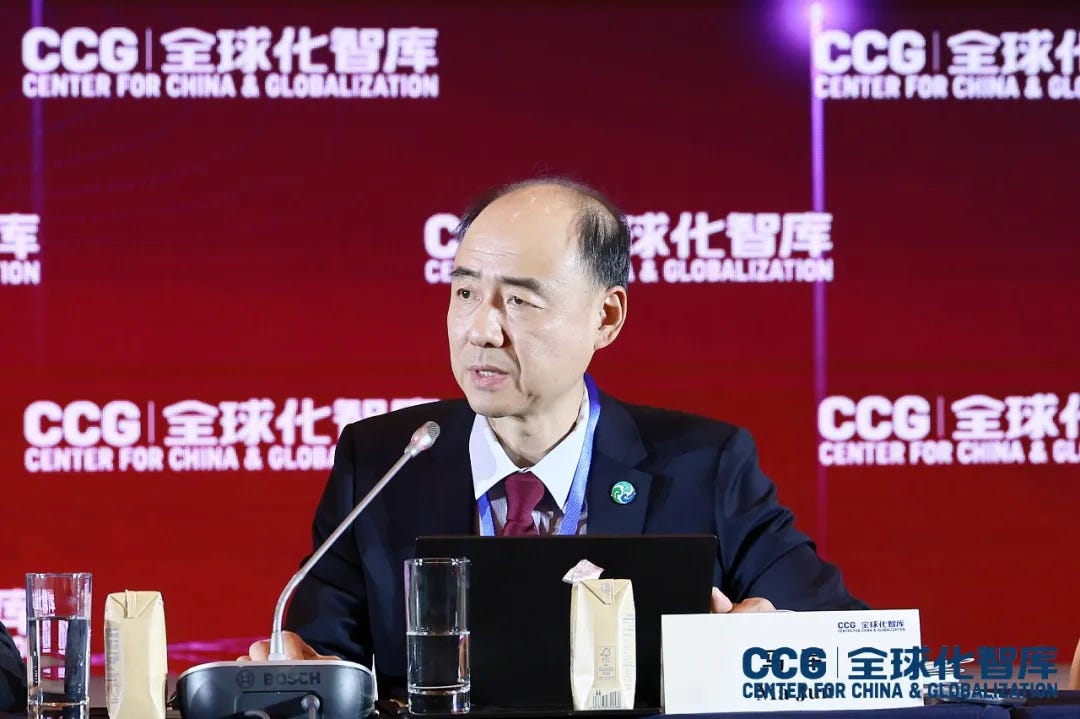
Thank you for inviting me to this forum. I just came back from the UN climate conference, COP 30. This year marks the 10-year anniversary of the Paris Agreement. Major progress has been made through collaborative efforts, as Mr Ambassador Ibsen noted, but an enormous gap still remains globally. We are falling short of the climate targets. Meanwhile, growing fragmentation in global governance threatens to divert attention from the climate crisis, as well as international cooperation on the Sustainable Development Goals. In this challenging landscape, doing more with less is no longer optional. It is imperative.
As a member of the UNFCCC Synergy Expert Committee, I was invited to speak at COP 30 on China’s experience in integrating climate action, economic growth, and social progress into a unified strategy. Over the past 12 years, as Mr Zhang noted, aggressive clean air policies reduced sulphur dioxide from 20 million tonnes to just 2.44 million, while Beijing’s PM2.5 levels dropped from nearly 90 micrograms to 30. Yet today, traditional end-of-pipe solutions have reached their limits. Further progress demands a more fundamental transformation.
This is where the Beautiful China Initiative came in, a strategic framework aligning pollution control, green expansion, and high-quality growth. At its core is the energy transition, which has already delivered remarkable results. China hit its 2030 renewable target six years earlier and continues to lead the world in solar and wind deployment. Meanwhile, the economy is electrifying nine times faster than the rest of the world, with EVs making up nearly 50% of new car sales. Critically, this low-carbon transition is also driving economic growth and resilience, proving that sustainability, security, and development can reinforce each other.
I also want to note that China’s clean air and water action began with massive monitoring and disclosure, which not only helped empower public oversight and strengthen government enforcement, but also enabled market-based solutions like green supply chains and green finance.
Last month, we released the 12th annual report on the Green Supply Chain Corporate Index. The findings show that companies have tapped into the data to motivate tens of thousands of suppliers to enhance performance. Major European companies like Adidas, Puma, Marks & Spencer, Apple, and Dell ranked on top, but a whole group of Chinese companies have also entered the global top 50, led by those in the new energy industry.
The corporate data carbon disclosure we collected topped 5 billion tonnes, and China is dividing the country into 44,000 eco-function zones, including 3 million square kilometres of red-line zones, with the belief that synergy also needs to start from monitoring and transparency.
At COP 30, we also published the Global City Green and Low Carbon Transparency Index. In the initial assessment results, developed cities like New York, London, Sydney, Paris, Hong Kong, and Tokyo came out on top, but Beijing also made the top five, and Shanghai and Shenzhen are quickly catching up. A whole group of cities in Asia, Africa, and Latin America still lag behind. There is huge potential for cities to share best practices on transparency, which we believe will not only enhance their own efficiency and effectiveness in dealing with climate change and local pollution, and motivate more global transparency progress on the SDGs, but also help bridge the gap of distrust globally, which is much needed in today’s world. Thank you.
Zhang Wei
Thank you, Director Ma. You mentioned China’s practices and experience, as well as its international cooperation. You also noted that cities can serve as key drivers—indeed, key platforms—for the green transition. There is a great deal that China can do, and cities in Europe, China, and other regions have already tried many innovative approaches. In that sense, a city-centred approach to the energy transition is a very promising model for international cooperation. Thank you.
With that, I would like to bring in an academic perspective. Let me invite Andy Mok, Senior Research Fellow at CCG, Professor at Beijing Foreign Studies University, and also a well-known media commentator.
Andy Mok, Professor, Beijing Foreign Studies University; Senior Research Fellow, CCG
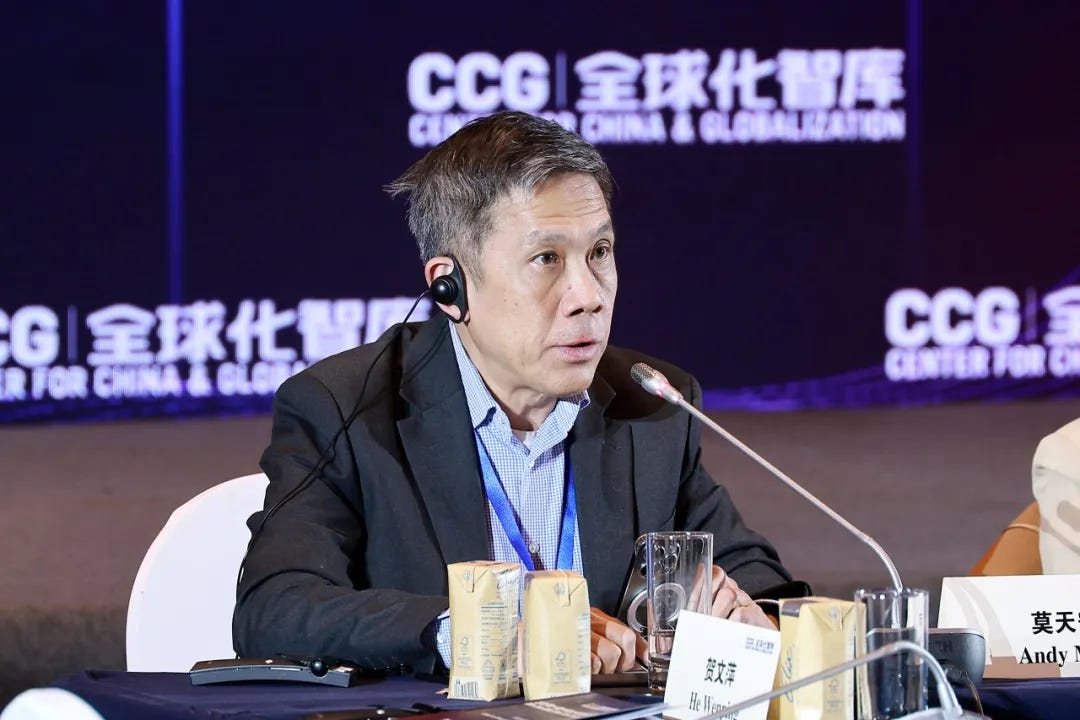
Thank you, distinguished guests, ladies and gentlemen. It’s been several months since the last China International Supply Chain Expo, but I want to suggest that the significance of that event is still rippling outward, and not for the reasons people usually notice. Most commentary focused on numbers: trade deals signed, countries represented, Fortune 500 firms attending. But beneath those headlines lies something far more interesting: a shift in worldview.
Let me put it this way. For most of human history, we looked at the night sky and saw scattered stars. Only later did we realise they formed galaxies—structured, dynamic systems, not random points of light. That recognition wasn’t just scientific. It was ontological. We began to understand reality differently. And this is what I think China is doing now with supply chains.
In the West, the term supply chain is still mostly a metaphor, something said to describe a sequence of steps. It’s shorthand, useful but vague. China, by contrast, is treating the supply chain as a real thing, an object that can be measured, governed, and defended. A system with structure, vulnerability, and sovereignty. And it’s building institutions around that idea: chain chiefs, physical expos, digital twins, contingency drills, and cross-border simulations.
This isn’t just good policy. It’s a different ontology. Why does this matter? Because once you start treating supply chains like galaxies, structured, interconnected, observable, you unlock entirely new capabilities. You can map them the way astronomers chart constellations. You can fortify them the way engineers reinforce infrastructure. You can even broker trust around them the way airspace or maritime routes are managed collectively, except now the object in question is the flow of semiconductors, rare earths, EV batteries, and food staples.
In short, by recognising the supply chain as an object, China has created a platform for action across borders, industries, and ideologies. Now, some may dismiss this as technocratic theatre, but I’d argue the opposite. In a world of rising complexity and geopolitical friction, those who can see structure where others see chaos, those who recognise new entities before others do, will have a strategic edge.
This is what ontological vision gives you: not just new tools, but new terrain to operate on. And whether we agree with China’s methods or not, this ontological move deserves close attention, because the next great competition may not be just about control of physical resources or digital platforms, but over what kinds of things we treat as real, governable, and worth protecting.
So no, this isn’t just about a trade fair in Beijing. It’s about something deeper: the ability to recognise structure where others see only flow, the decision to treat supply chains as systems worth governing, not just reacting to, and the quiet shift in world view that may define who adapts and who lags as global complexity deepens. Thank you.
Zhang Wei
Thank you, Andy. Coming back from this expo, and reflecting on what you just shared—after seeing so many products and visions of the future, and thinking about supply chains through the lens of human development—it really does spark new ideas about how humanity might navigate the road ahead.
Looking beyond any single country, it is entirely possible that the future of supply chains and global governance will not revolve around one centre, but around many distributed “nodes”. In other words, we may see a new constellation of governance take shape. And as history often shows, new “species” of solutions can emerge from uncharted waters. That possibility is worth keeping in mind—and it will take joint efforts to turn those possibilities into reality. Thank you.
With that, I would like to invite the CEO of the Tasmania branch of the Australia China Business Council, Mr David Morris.
David Morris, CEO, Australia China Business Council (Tasmania)
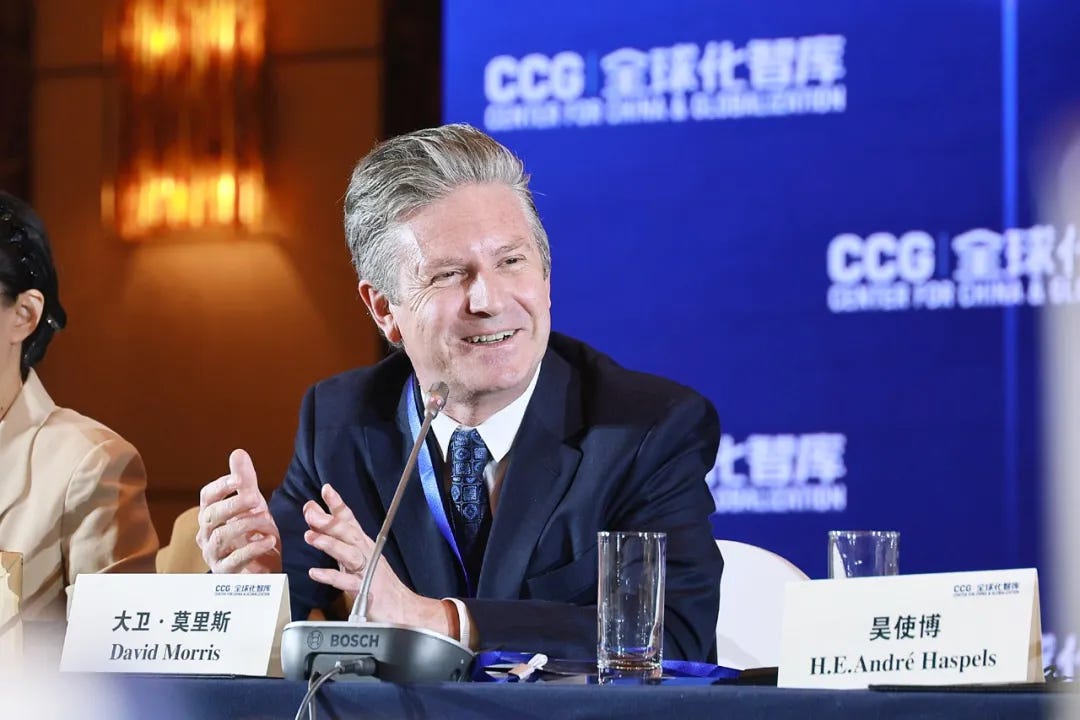
Well, thank you, Mr Zhang. Now, I’m sorry to say to those who fear multipolarity, but it’s arrived. You only have to walk out the door to see it. We are now living in a multipolar world. I think we all understand why Europeans have a deep concern about multipolarity. We understand European history and European colonial history, and we understand that multipolarity has led to disaster in the European case. We also understand, I think, why the United States views multipolarity (the way it does), because the United States identifies itself as the leader of the world, and so it naturally prefers unipolarity.
But here in the Asia-Pacific, we see the world differently. This is the thing: when you travel, you realise that lived experience is different in different places. In the Asia-Pacific, our history in this part of the world for thousands of years has been that multipolarity is actually more stable than hegemony, than competition between two major powers or one hegemon. Members of the Asia-Pacific community do not want one hegemon, and they do not want bipolarity either, where two hegemons are fighting it out and asking us to choose.
I’ve just come from Malaysia, where I was speaking at the Global Chinese Economic & Technology Summit, and I can tell you that every speaker at that summit in Kuala Lumpur yesterday was making this very point: that we do not want to choose. We do not want to be asked to choose.
And I say this as someone who represents the business community in Australia: we do not want to be asked to choose. Our economic prosperity is tied up with this country here, with China. Our economic future is tied up with this country. But also, of course, we equally want to have strong, resilient, ongoing relationships with the United States, with Europe, and with other parts of the world. So we are going to have to come to terms with a new multipolar world.
Now, what does this mean? What it means for supply chains, what it means for governing technologies, and what it means for the climate is that we need to deepen our multilateral cooperation. Multipolarity is going to need multilateralism to work. The very reason multilateralism is not working at the moment is the resistance: the resistance by some to multipolarity. It is the resistance towards compromise, towards sitting down and having dialogue like we’re doing here. It is the resistance to actually finding common ground where we can work together.
In the case of technology, it is this fear that we must enter a binary world where one form of technology is the “good” and “trusted” one, and another form we can demonise as “untrustworthy”. This is not the way engineers see technology. This is not the way any technology expert I’ve ever interviewed for my research sees it. I’ve just written a book about this, A New Era of Risk, published by Ethics Press. Experts in cybersecurity say that risks come from everywhere. They don’t just come from one country or one state. They can come from teenagers in their bedrooms. They can come from all kinds of non-state actors.
So, actually, we need to be using multilateralism more rather than less in a multipolar world. And we need to agree on rules around how we regulate technology so that it is safe for humans. How do we address the climate crisis, which absolutely requires multilateralism?
I’ve changed what I was going to say today in response to this concern about multipolarity. But what I want to make the point that multipolarity and multilateralism have to go hand in hand because this is now the world we’re in. This is the real world of the 21st century. And so the only way we’re going to address the securitisation of supply chains, the unwinding of our action on climate change, the only way to address this is actually to deepen our multilateral cooperation.
And that’s going to require compromise. It’s going to require dialogue. It’s going to require building trust. And we’re only going to build trust once we see some successful models. And we’ve got a long way to go, I think. I think we’re still spiralling downwards at the moment. But we’ve got to drop the fear, I think, about a new multipolar world and actually embrace it because in this part of the world, in the Asia-Pacific, multipolarity is a good thing and free trade without protectionist barriers and without fake political risks and without fake geopolitical risks. Actual factual-based evidence-based risk management is what we’re going to require more of in the future. Thank you.
Zhang Wei
Well, thank you, Mr Morris. Yes, as you said, many countries do not want to see a unipolar world—though there are also concerns about what a multipolar world might bring. Still, multilateralism and a more multipolar order do appear to be the general direction, and China has put forward a number of initiatives in that spirit.
From a Chinese perspective, the idea is not framed in zero-sum terms—either black or white, win or lose. That is not the underlying logic of Chinese thinking. In China, there is an appreciation for different forms of “beauty” and an acceptance that it is possible to agree to disagree. In that sense, Darwinism or a zero-sum mindset has not been—and should not be—part of the way forward. The aim, instead, is to pursue the greater good and shared prosperity. And that is also why a unipolar world is not what China seeks. Thank you, Mr Morris. Having lived in China for many years, you clearly have a deep understanding of China and the Chinese people. Thank you.
Now that we have heard perspectives from Australia and Europe, let me give the floor to Ravindra Ngo, founder of the Asian Network. Please, you have the floor, sir.
Ravindra Ngo, Founder, the Asian Network
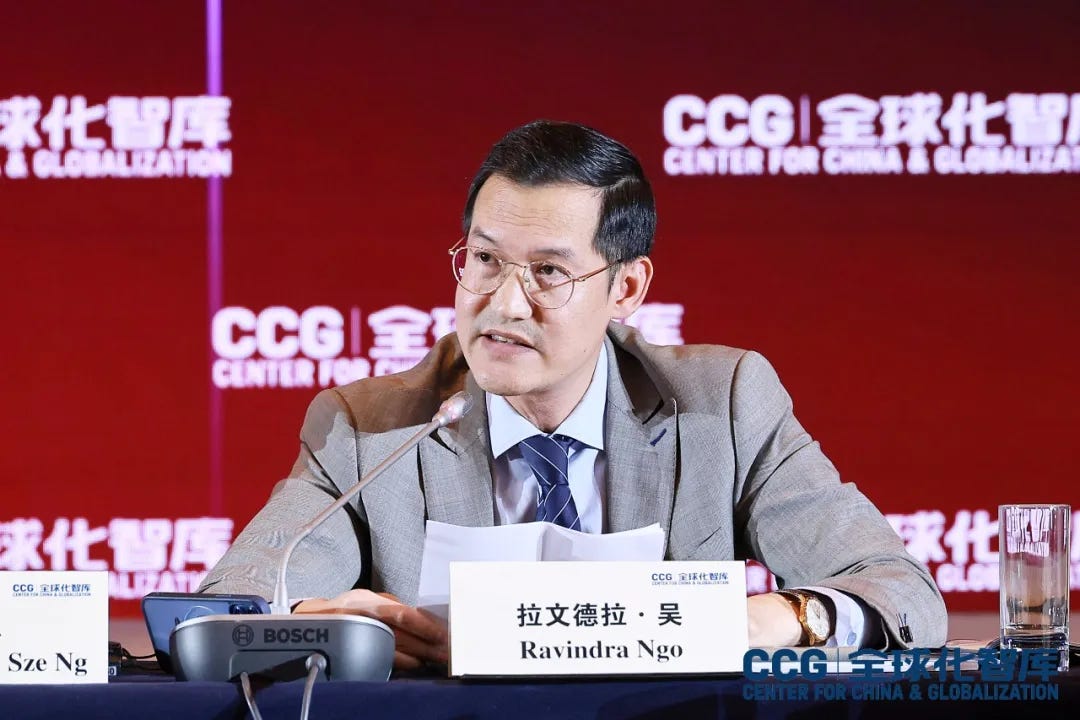
Thanks to CCG and Dr Henry Wang for inviting me to this important conference, and I’m very happy to speak among distinguished panellists. So I will try to be brief and concise, especially at this time of day. My intervention will be divided into three parts. The first will be on geopolitics and geoeconomics from the Global South, with a focus on Asia. The second will be key challenges for the Global South to address, and finally, some alternatives and solutions.
So first, we notice that the Global South is a significant economic and demographic force. Almost two-thirds of the world’s working-age population lives in the Global South. More than 40% of the world’s energy-transition metals are produced there. But also, I want to underline the importance of China in the Global South, and, as mentioned by our previous panellists, in a multipolar world. China is the largest trading partner for the Global South. The U.S. remains the more important investment partner, but China is also leading the Belt and Road Initiative, signing with 120 countries. Initiatives like RCEP are also a driving force for the BRICS, and recently, the SCO summit, engaging with Central Asia and the Middle East.
On our previous panel, we got some German representatives, so I’m happy to share a Deutsche Bank Research Institute publication, which, in May 2024, shared very important key takeaways from this report. Among five key metrics for all the 120 countries in the Global South, they analysed five dimensions: working-age population, manufacturing, financial, military spending, and energy resources. So the result is very interesting. Four of 10 ASEAN economies are in the top 15: Indonesia, the Philippines, Vietnam, and Malaysia. So what does it show? Global growth will be from South and Southeast Asia. This is a new centre of gravity.
So my second part will be more on key challenges. That’s why we’re here to discuss. The first is, of course, the shift in supply chains. Regardless of where tariffs end up, companies currently manufacturing in China and serving U.S. consumers will likely reconsider production choices, given new uncertainties.
Number two is the movement of people. We note that 125% of the world population growth until 2040 is projected to be driven by the Global South. But also migration is connected with climate extreme conditions and, of course, insecurity flashpoints in Asia such as the Taiwan Strait, the South China Sea, the Myanmar crisis, and just recently with the border with Cambodia and Thailand. And last, sustainability efforts to push climate action, in particular. The Global South is the bloc most at risk and has made the least progress in the last 20 years. China could emerge as a global leader in climate efforts for the Global South to follow.
Now, let me end with five potential alternatives and solutions. The first one is that developing economies should invest more in AI literacy, regional data centres, and, of course, provide frameworks to relevant local realities.
Number two, countries like Vietnam, Indonesia, Morocco, Kenya, and Brazil could be the hubs for renewable manufacturing, carbon markets, and climate-resilient agriculture.
Number three, ASEAN, the African Union, and Mercosur can act as collective voices to rebalance global decision-making. Very important point: the significant role of middle powers. They should promote peaceful conflict resolution, contribute to global stability, and also advance agreement on issues like climate change and peacekeeping. And finally, we should shift our mindset from centralised top-down supernational governance to a decentralised power composed of minilateralism: most flexible, action-oriented, and smaller.
But now let me end this intervention with a concept of polycrisis from a very famous French philosopher, Edgar Morin, in 1993, who talked about polycrisis, which is a situation in which multiple distinct crises occur simultaneously and interact in ways that amplify each other. So I think for the next decade we need urgently to prioritise cooperation over conflict and, of course, connection over confrontation. I thank you all.
Zhang Wei
Thank you, Mr Ngo. Yes, indeed, the world is now feeling the negative impact of trade wars and intensifying competition in technology. In this context, the Global South needs a stronger voice and a larger role to play. It is also important to shift from a top-down approach to a more bottom-up one, so that countries and communities at the regional and local levels can put forward solutions that are more workable and grounded in reality.
In many ways, the last wave of globalisation was driven primarily by business. In this new phase, the science and technology revolution is dispersing that driving force, empowering far more actors—including individuals—than before. That is why we look forward to deeper, more substantive sharing.
With that, let me give the floor to our next panellist, a prominent figure bridging academia and diplomacy: Mr Su Hao, a renowned Research Fellow at CCG and at the Strategic Peace Research Centre of China Foreign Affairs University. Microphone, please.
Su Hao, Professor at the Department of Diplomacy and Founding Director, Strategic and Peace Research Center, China Foreign Affairs University
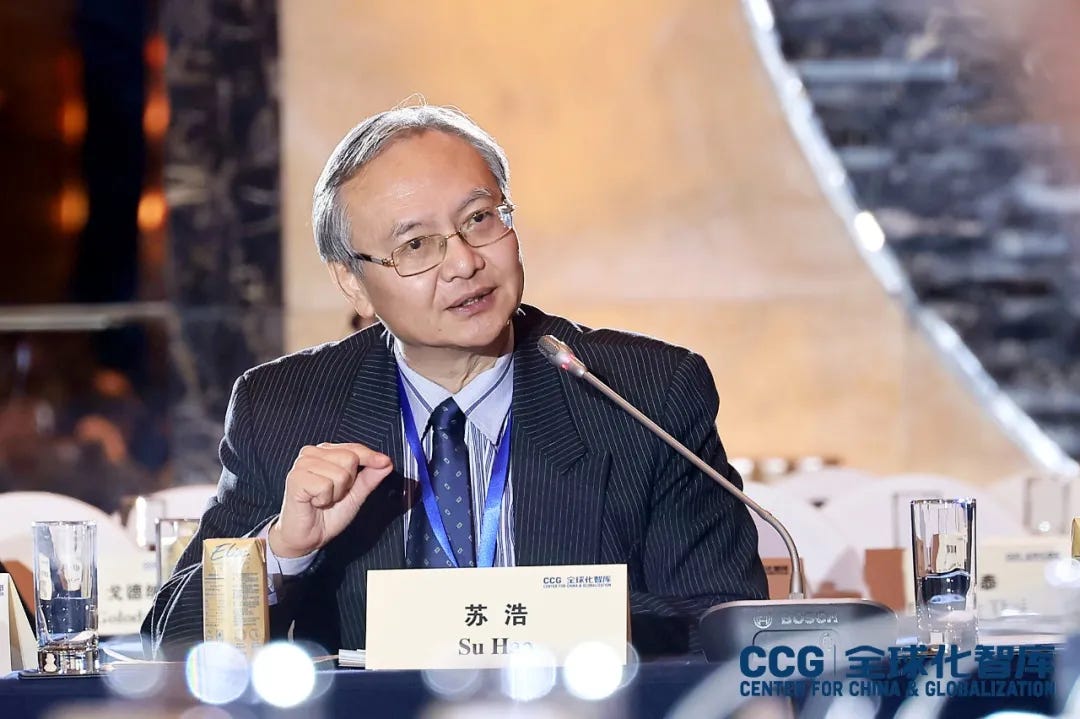
The name tag is on the wrong table, and without the microphone. Well, it seemed that maybe I would not be the mainstream in the panellists. All right. Thank you to CCG for inviting me to this event. Maybe I would like to try my best to make something new in my presentation. I would like to push the three “Ws” in my remarks. That means the three “what” of questionnaires in my presentations.
First, what is globalisation? The theme of the panellists talking about their globalisation, the new drivers of globalisation. But what is globalisation? Actually, somehow I would like to criticise the traditional globalisation.
We remember 20 years ago there was a quite famous book, or a bestseller book, titled The World Is Flat. I remember at that time there was quite a discussion about globalisation led by the Western economy, including the United States and Europe, right? So the world is flat. In this way, the Western economy expanded its economic capacity all over the world, including this part of the world, East Asia. So that means the Western economies have the dominant power over globalisation in that way. So the reason why the Davos Economic Forum is talking about the industry, “Industry 4.0”, but this is much focused on the industrial orientation dominated by the West since modern times.
But at the moment, I would say that globalisation always moved ahead into the new format, so the Chinese would like to use the word new globalisation. I would say that this globalisation will be put into the new format with the three-dimensional or multi-dimensional globalisation. That means the globe has already made it into the kind of multi-dimensional format, not only dominated by the West in the flat world.
So in this way I would say that multi-dimensional globalisation is not only supported by the West, but supported by the East or by the Global South—in particular, newly emerging economies, including China or other countries in the Global South, in Africa, in Latin America, or even in southern Asia of India. So I would say globalisation will be supported by the multi-polar, multi-economic polar. So this is my point first. So this is the multi-dimensional globalisation.
The second: what is the driving force in a new globalisation? In this panel’s title, called was the climate change, AI, the supply chain, or the production chain. I would say that when we redefine globalisation with the new primary force, first we have the new science and technology.
Second, we have the new supply chains or production chains. Third, we have the new market, the global market. So the new science and technology, we’re talking about climate change, right? So many newly emerging economies already have the new driving force, influenced by or supported by renewable energy, like China, right? We have some kind of advantages for that, right? Or many other new economies. So this new primary force.
And also, we know that the AI, to make these new industries, could be spread out to the whole of the world. So China and, of course, the United States are the leading primary force for this AI industry, of course, plus European power, together. So that means making the new industries to reshape their primary force, supporting the new globalisation. So it’s kind of the new science and technology, the new primary force of the industry, and then we have the new market.
So China not only has the primary production, but also we have one of the biggest markets in the world. So welcome European economy to invest into China and sell your products into China. So this is the new market outside the world. So obviously, with this kind of new marketing patterns in the world, we should have more space for our cooperation with each other.
And the third: what is the role of China in this new globalisation? I would say that regarding the geographic location of China in the world, on one hand, we are in the east, the so-called far east of the Eurasian continent. So this is a continental economy. And on the other hand, we are on the west side of the Pacific. So China is also a maritime economy, in the framework of the APEC, to enhance our cooperation with the United States. This morning we discussed this.
So I would say that China could be the hub or the bridge between the Eurasian continental economic pattern on one hand, and on the other, we are the maritime economies on the ocean of Pacific Ocean to have our special relation with the United States and other North and South American economies. So by this way, China could be the hub between the two sides to make China have a special role for us to be a major platform for the new globalisation. Okay, that’s my point. Thank you. Thank you so much.
Zhang Wei
Thank you, Director. I agree with you. We used to say “the world is flat”, but perhaps it has since been folded into different shapes and patterns. In any case, we are still on the journey—not yet at the final destination—and there is still much more to explore and contribute.
Although we are geographically far from Europe, distance matters less in an era of connectivity. In many ways, space can be “folded”, and China can play a bridging role—as a hub that connects different regions as we work together to tackle future challenges.
Thank you, Director Su. With that, I would like to give the floor to an industry perspective: Vice President Yen from BMW.
Wu Yanyan, Vice President of Corporate Communications and Government Affairs, BMW Group Region China
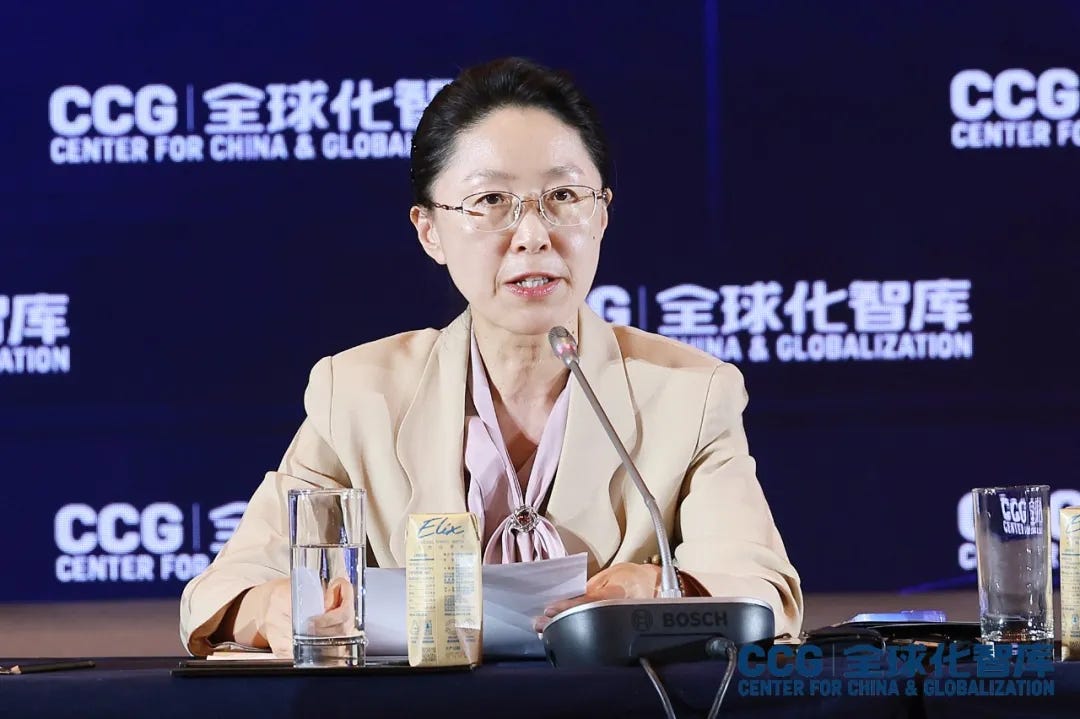
Thank you for inviting me. I’m glad to be here to share some thoughts and ideas from a business perspective. So my name is Wu Yanyan, and I’m from BMW Group.
As you may know, BMW is a global automotive company with more than 100 years of history. We operate in 14 countries, have more than 30 production bases, and we service customers in over 140 countries. So it’s a true global company. It is this global positioning that has enabled us through the challenges of the past century. However, recent years have witnessed the threat and challenges related to global decoupling. So we saw tariffs, we saw export control, we saw global supply chain disruptions. So, in this context, discussing supply chain resilience is more significant than ever in today’s challenging environment.
I believe that globalisation has contributed significantly to global prosperity over the past decades. On the contrary, the decoupling and fragmentation have inevitably posed substantial risks and threats to the stability and resilience of the global supply chain, leading to production shutdowns, increasing costs, and ultimately diminishing competitiveness, while undermining the foundation for innovation. So, at home in China, with China’s speed strategy, BMW has taken China not just as BMW’s largest single market but also an indispensable innovation hub that drives our global transformation.
Over the past three decades, BMW has grown together with our partners. We generally experienced three stages in supply chain strategy: from global to local, local for local, and local for global. Cooperation with CATL is a very good example. Through joint innovation, we have achieved breakthroughs that directly benefit not only our customers but also have a wider impact. Given that CATL has now grown into the world’s largest power battery producer with around 40% global market share, the above three-step supply chain strategy has proved to be very successful in the past decade.
However, faced with a new decoupling trend, shall we continue the previous strategy package or make adjustments based on specific new dynamics? Many recent export control cases, including rare earths and also next-generation chips, have pushed us to rethink our strategy. Although there is no perfect answer yet, a local for local approach seems a more suitable strategy for today’s BANI world. BANI is the mirror reflecting the new reality: Brittle systems, Anxious people, Non-linear outcomes, and Incomprehensible complexity.
Looking ahead, the green transformation is fundamentally driving the new industrial revolution, where a powerful convergence of clean energy, big data, and AI is unlocking unprecedented potential for sustainable industry development. So, under this framework, local for global is playing an essential role, where local green capabilities and innovations contribute to global goals envisioned in the Paris Agreement.
On one hand, we welcome the formation of international harmonisation and mutual recognition of carbon-related trade rules and automotive industry standards under WTO regulations. On the other hand, we are initiating and promoting international digital tools like Catena-X to facilitate this mutual recognition. Catena-X serves as an IT platform and rule book committed to building an open collaboration framework that connects the global automotive industry chain. It unites automakers, suppliers, and service providers through unified standards to create a trustworthy, collaborative, and open data space.
In this local for global approach, green electricity and renewable materials to major carbon reduction measures can be traced, certified, and have their carbon footprint calculated. This ensures that global efforts contribute effectively to global sustainability targets. So, in conclusion, we take a flexible and pragmatic approach, no matter a local for local strategy for a resilient supply chain or a local for global strategy for global sustainability targets. I believe such kind of flexibility will accelerate the deployment of green technologies, foster fair competition, and ensure that sustainable industry development truly advances human progress while building prosperity for all. Thank you.
Zhang Wei
Thank you, Madam Wu. You just highlighted the idea of “local to local”, and “local serving the global”, as well as the importance of synergy among different forces, and how multinationals can work with local companies in China. I also think that external turbulence and uncertainty naturally prompt deeper reflection on how to stabilise and strengthen domestic development. Thank you for sharing.
I have been listening closely to the views of all 11 panellists—ideas coming from different corners, and even from uncharted waters. Thank you all for your insights and contributions; they have been genuinely inspiring. Ultimately, the future direction of globalisation will be shaped by young people, and it is an honour to welcome one of those future navigators: Ms Michelle Ng, Associate Fellow at the Ng Teng Fong Charitable Foundation and the Savantas Policy Institute, and a Yenching Scholar at Peking University.
Michelle Wing Sze Ng, Ng Teng Fong Charitable Foundation Associate Fellow, Savantas Policy Institute; Yenching Scholar, Peking University
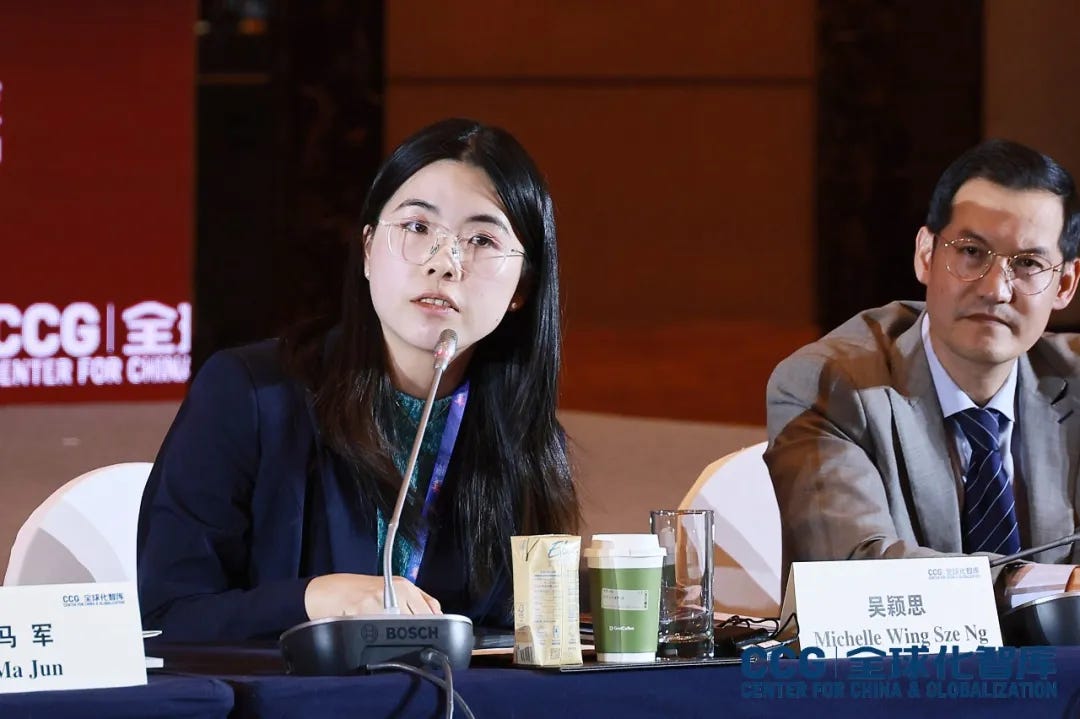
Thank you for inviting me to take part in this year’s GYLD and to be here at the panel today. My name is Michelle, and I am an Ng Teng Fong Fellow at Savantas Policy Institute, which is a think tank in Hong Kong founded by a veteran politician, Mrs Regina Ip.
The work we do focuses on promoting Track-II dialogue and also leveraging Hong Kong’s strength to act as a bridge between the Chinese mainland and the rest of the world. Hong Kong has long been a firm believer and upholder of the multilateral trading system. Since its transformation from a fishing village to the international financial centre it is today, we have kept our ports and borders open to the rest of the world. Even when the U.S. government unleashed tariffs this April across the entire world, Hong Kong chose not to retaliate and instead continued its policy of imposing zero customs tariffs on goods from the U.S. or from anywhere else in the world.
Nevertheless, in this era of deglobalisation and pan-securitisation, we are seeing barriers put up even against technologies that were created for the benefit of all mankind. So, in the wake of common challenges, we need joint efforts to address rising concerns, including AI, climate change, and even the peaceful use of outer space, and decisions have to be made in a multilateral manner.
So this morning and during today’s panel, we’ve had extensive discussions regarding the UN’s role in global governance and how it needs to be reformed. And today, during this panel, we heard a lot regarding climate change and how countries can work together, maybe leveraging each other’s strengths and borrowing each other’s experiences, to push that forward.
And so I think one of the main questions, or sort of ideas, I was floating around was what happens now to the rules-based multilateral trading order. Where do we go from here? And I think Hong Kong does have a lot of experience to share because we prospered from globalisation, and we continue to be a driver of globalisation. It was very insightful to hear from all the speakers today. So thank you for sharing, and I hope that we can continue to be a force for globalisation.
Zhang Wei
Michelle, thank you. And thank you all. Over the past hour or so, we have generated a wealth of ideas, and this journey of navigation truly requires everyone to join hands.
A wide range of themes has come up—climate change, AI, supply chains, and new “blue oceans” of opportunity. I believe that we should reaffirm that our goals are shared, and that cooperation, collaboration, and communication are the means to build a community with a shared future for all humanity. Only through that can we ride out the waves in these uncharted waters.
As the “first mate” of this forum on this still-unnavigated journey, it has been a great honour to be here with all of you, our captains today. With that, I will conclude this roundtable. Captains, please come up to the stage on the deck.
Transcript: China-EU Relations, 10th China Global Think Tank Innovation Forum

This is the transcript of the third roundtable of the 10th China Global Think Tank Innovation Forum, held on 20 November 2025. The forum was hosted by the Center for China and Globalization (CCG) and co-organised with the China Association of International Trade
Transcript: China–U.S. Relations and Tariff Wars, 10th China Global Think Tank Innovation Forum

This is the transcript of the second roundtable of the 10th China Global Think Tank Innovation Forum, held on 20 November 2025. The forum was hosted by the Center for China and Globalization (CCG) and co-organised with the China Association of International Trade
Transcript: opening ceremony & opening roundtable, 10th China Global Think Tank Innovation Forum

On November 20, 2025, the 10th China Global Think Tank Innovation Forum, hosted by the Center for China and Globalization (CCG) and co-organized with the China Association of International Trade (CAIT), was successfully held in Beijing.
The 10th China Global Think Tank Innovation Forum Held in Beijing
On November 20, 2025, the 10th China Global Think Tank Innovation Forum, hosted by the Center for China and Globalization (CCG) and co-organized with the China Association of International Trade (CAIT), was successfully held in Beijing.