

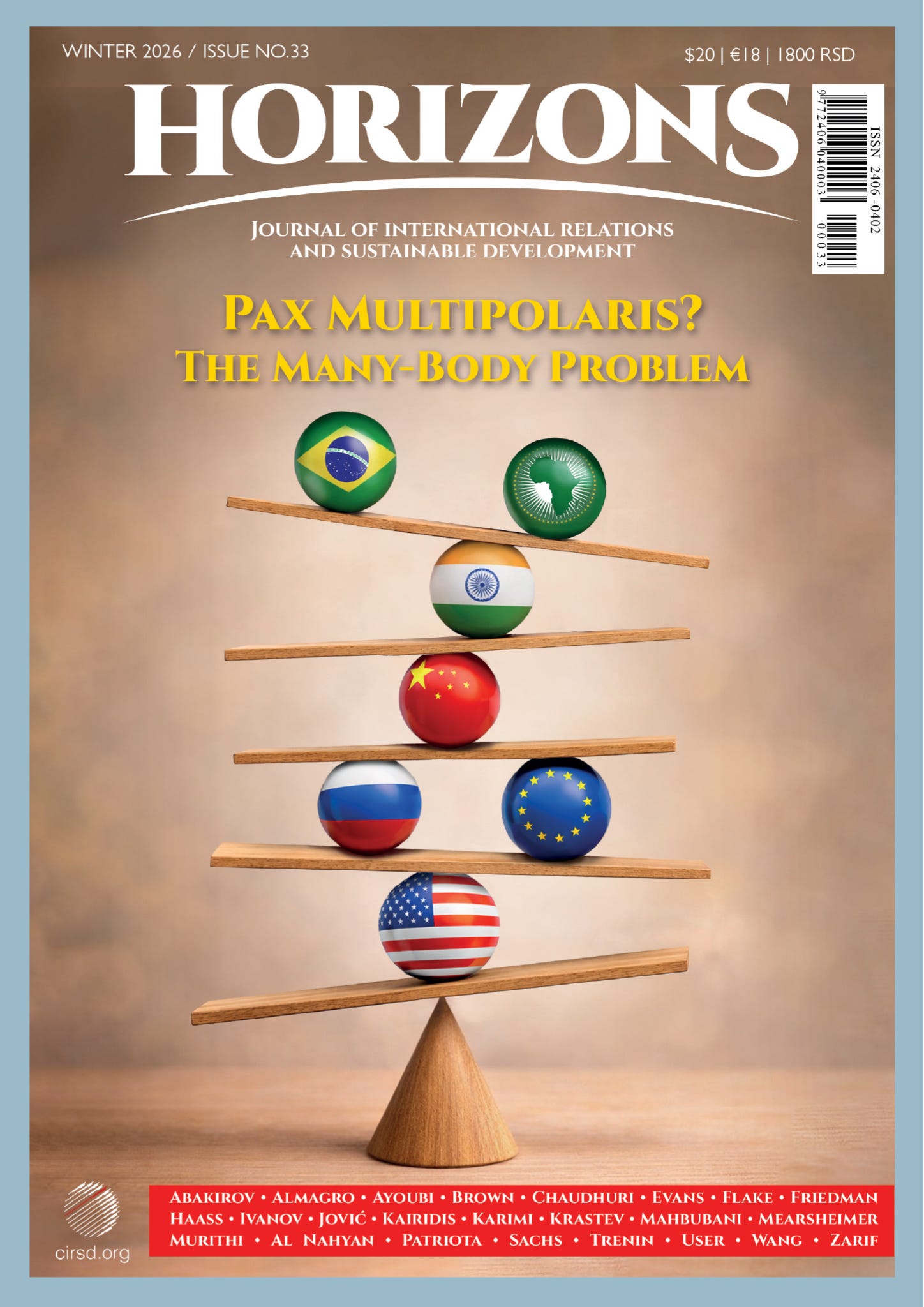
On 20 March, 2026, the Center for China and Globalization (CCG), in collaboration with Horizons, the flagship publication of the Center for International Relations and Sustainable Development (CIRSD), hosted a “CCG Global Dialogue” and launched the latest issue of Horizons, titled “Pax Multipolaris? The Many-Body Problem.”
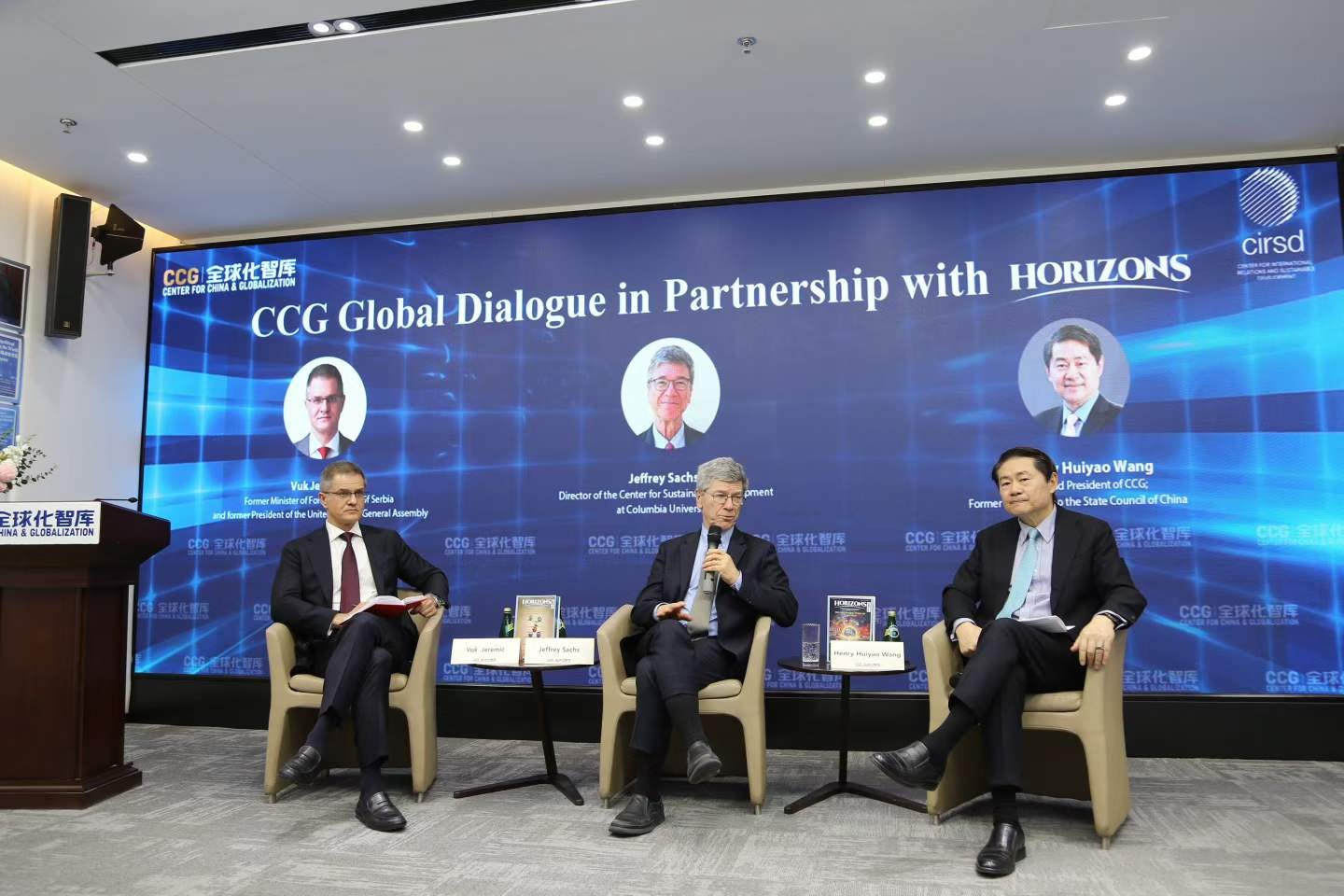
Jeffrey Sachs, Professor and Director of the Center for Sustainable Development at Columbia University; Vuk Jeremić, President of CIRSD, Editor-in-Chief of Horizons, former Foreign Minister of Serbia, and President of the 67th session of the United Nations General Assembly; and Henry Huiyao Wang, Founder and President of CCG, participated in the dialogue.
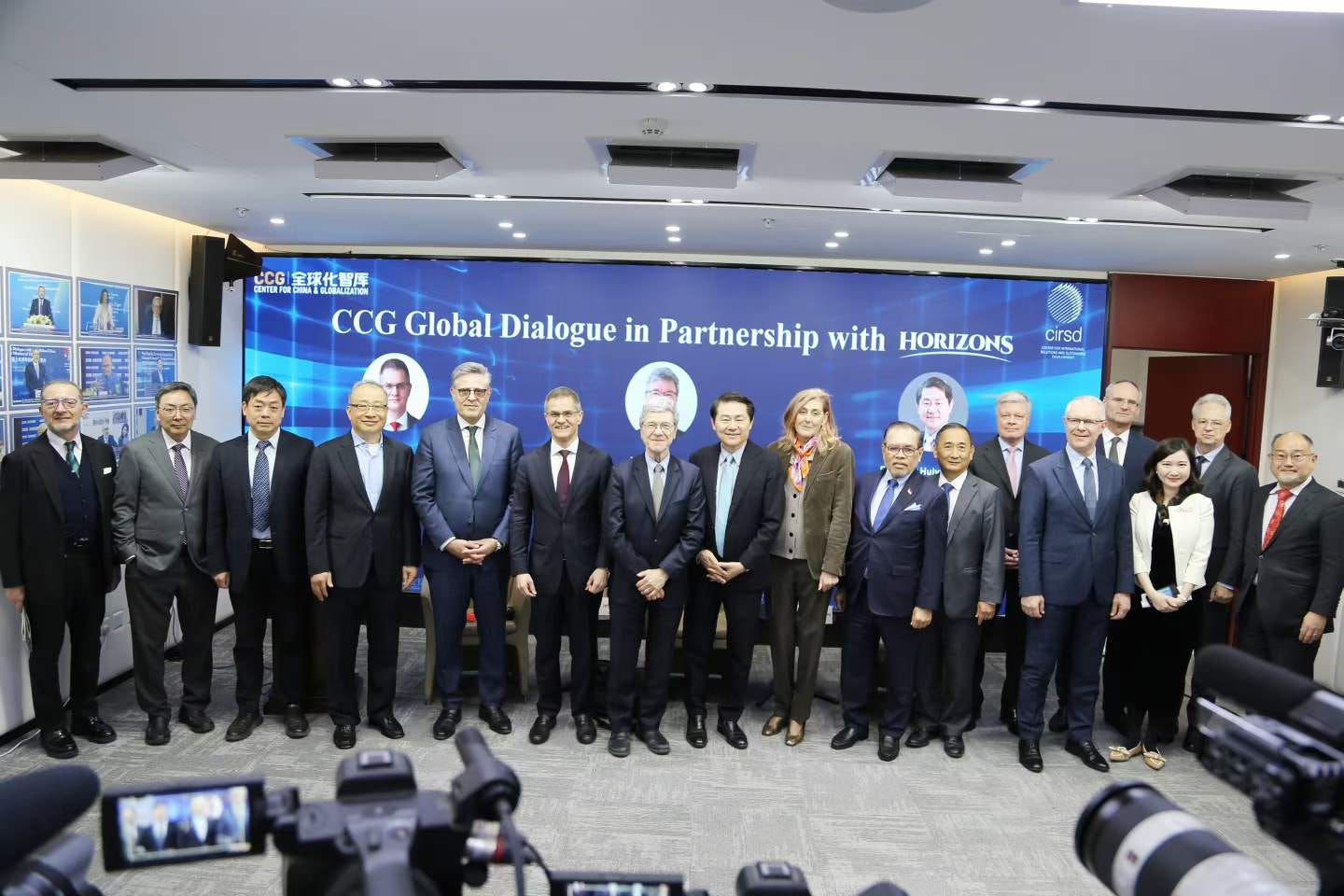
The event was moderated by Mabel Lu Miao, Secretary General of CCG. Ambassadors and diplomats in Beijing, representatives of international organisations, experts and scholars, and members of the media also attended.
This transcript is based on a recording and has not been reviewed by any of the speakers.
Mabel Lu Miao, Secretary-General, CCG
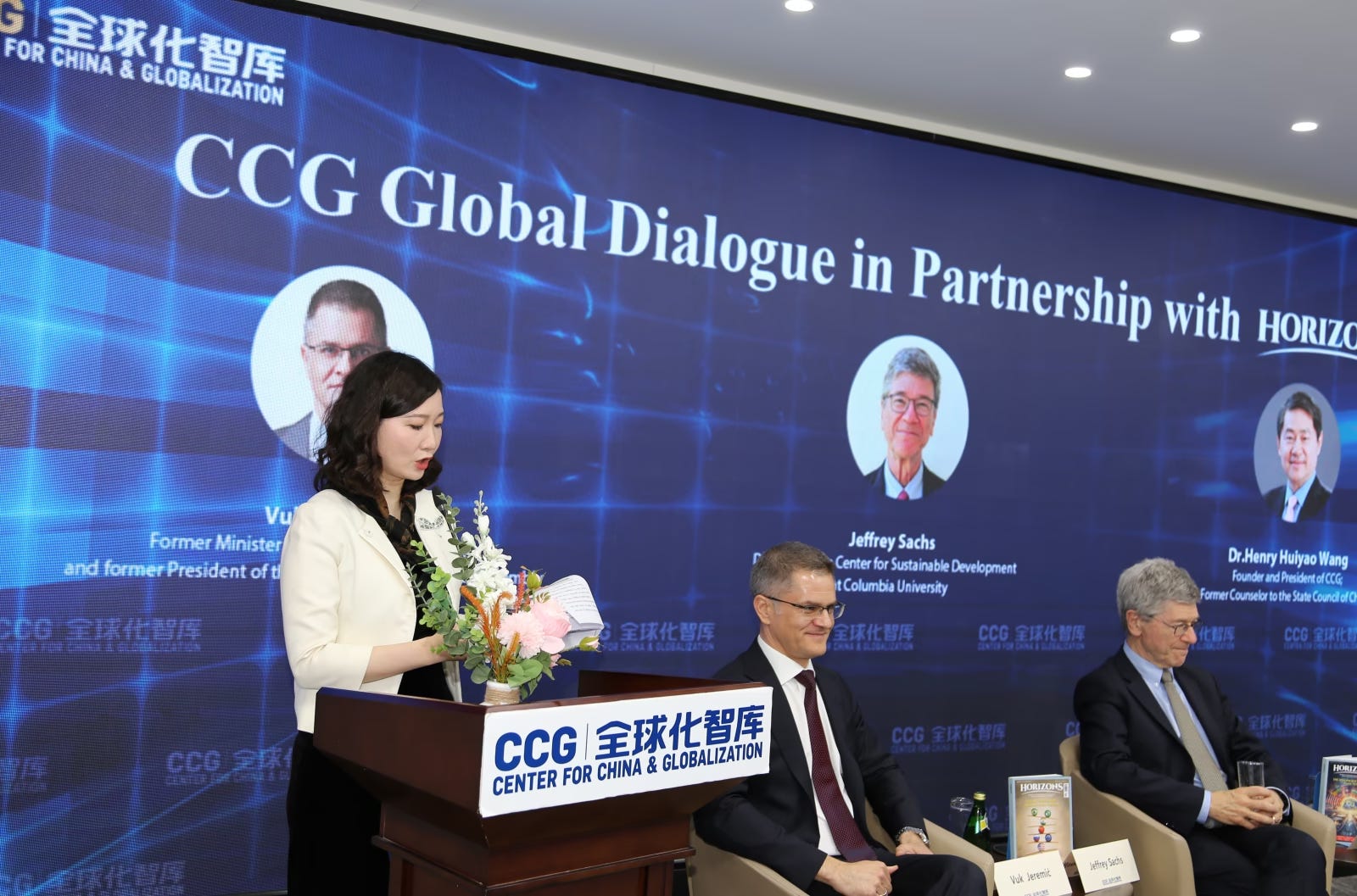
Distinguished guests, ambassadors, ladies and gentlemen, good afternoon. Thank you all for joining us today at the Center for China and Globalization.
Welcome to the CCG Global Dialogue, hosted by the Center for China and Globalization, in partnership with Horizons of CIRSD. CCG Global Dialogue is our flagship international exchange series. It convenes global policymakers, academic leaders, and business elites to foster cross-cultural understanding, drive knowledge-sharing, and address key global challenges, from governance reform to sustainable development.
Over the past five years, we have held dialogues with distinguished figures such as Graham Allison, Joseph Nye, Hank Paulson, Richard Haass, Ray Dalio, and Martin Wolf, just to name a few.
Today’s dialogue focuses on the pivotal theme of multipolarity, a topic of rising strategic importance amid today’s complex geopolitical, economic, and global security challenges. We aim to provide an inclusive platform to explore how multipolarity can help build a more interconnected, equitable, and resilient global order.
Alongside this dialogue, we are also marking the official launch of the latest issue of Horizons, the flagship quarterly publication of Belgrade-based CIRSD, which offers incisive insights into global affairs. The new issue of Horizons, titled “Pax Multipolaris? The Many-Body Problem”, examines the implications of a world in which power, influence, and responsibility are increasingly distributed among multiple actors.
Before we start, let us take a moment to acknowledge some of our special guests and VIPs who are here today.
We have invited Jovanka Porsche, Founder and Chairwoman of Global Neighbours. Welcome.
We have diplomats from 15 countries, including seven ambassadors, along with representatives from international organisations, government authorities, multinational enterprises, academic institutions, think tanks, and leading global and domestic media outlets.
They include Wolf Dietrich Heim, Ambassador of Austria to China; Hannes Hanso, Ambassador of Estonia to China; Robert Lee, Ambassador of Fiji to China; Mikko Kinnunen, Ambassador of Finland to China; Djauhari Oratmangun, Ambassador of Indonesia to China; Khalil Ur Rahman Hashmi, Ambassador of Pakistan to China; and Marta Betanzos Roig, Ambassador of Spain to China. Welcome.
We also have distinguished guests from international organisations, including Osamu Onodera, Chief Representative of JETRO and Tamas Hajba, Senior Advisor to China of the OECD.
Also joining us are former senior officials, including Chai Xiaolin, former Director-General of the Department of WTO Affairs of the Ministry of Commerce, and Zhu Hong, former Minister for Commercial Affairs at the Embassy of the People’s Republic of China in Washington, D.C.
We have also invited representatives from other leading think tanks and foundations, including Mr Huang Yanzhong from the Council on Foreign Relations, Professor Wang Yiwei from Renmin University of China, and Mr Johann Fuhrmann from the Konrad Adenauer Foundation in China.
We also have representatives from domestic and international enterprises, and from the media, including Beijing Daily, CCTV, CGTN, China.com, China Daily, People’s Daily, Phoenix TV, Reuters, South China Morning Post, NBC, Swiss TV, Xinhua News Agency, and so on.
Please allow me to introduce our speakers for today, all three of whom are already on the stage.
Professor Jeffrey Sachs, Director of Columbia University’s Center for Sustainable Development and Special Advisor to the UN Secretary-General, is a world-leading economist. He has advised over 100 countries on the UN SDGs and helped shape international policy on multipolar economic governance and climate finance.
Vuk Jeremić, former President of the UN General Assembly and former Minister of Foreign Affairs of Serbia, is a prominent voice in global diplomacy. He champions multilateral governance reform for multipolar realities and leads efforts to strengthen Eurasian connectivity through policy exchanges.
And of course, Henry Huiyao Wang, Founder and President of CCG and former Counsellor to China’s State Council, is a pioneer and thinker in China’s global engagement. He built CCG into a world-renowned think tank, driving high-level Sino-global dialogues like today’s and advancing thinking on globalisation and development policy. He is also the chief editor of Springer Nature’s China and Globalization book series.
Let us welcome the three speakers with a warm round of applause. Welcome, all of you.
I now hand over to Henry.
Henry Huiyao Wang, Founder & President, CCG
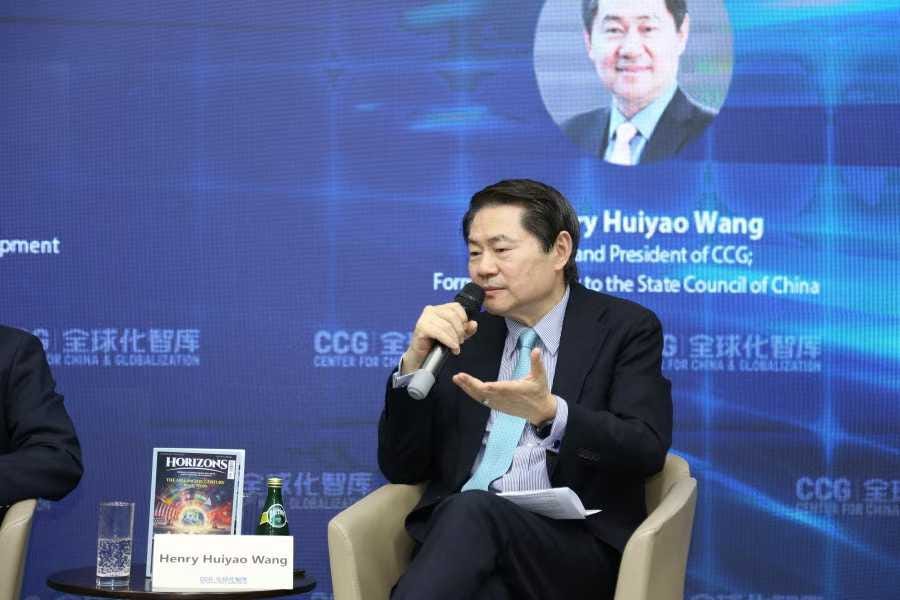
Thank you, Mabel, Jeff, Vuk, and also ambassadors, representatives from policy circles, think tanks, the business community, the media, and old friends. Welcome again to CCG.
Today is actually a special edition of the CCG Global Dialogue with Horizons, which is a very renowned international foreign affairs magazine, and its chief editor, Vuk, is here. We are celebrating the launch of its 33rd volume here at CCG as well.
I think today’s dialogue very much reflects what has been happening around the world, particularly what has happened in the Middle East, Iran, and the latest developments, which are changing very fast. So basically, we have many themes to cover, and of course, we will leave a little time for Q&A at the end.
I was also struck when attending the Munich Security Conference last year—I was one of the speakers there. They launched a report, “Multipolarity”, which Vuk has also identified as the theme for this latest volume. But the multilateral system is not really catching up with multipolarity. This year, however, the Munich Security Conference report is titled “Under Destruction”, and we see a big elephant coming into a big China shop. That really is what is happening now.
So there are many issues we want to talk about: the emergence of a multipolar world, relations among the major powers, regional conflicts, and global security. Those are probably the things that are most immediately happening now. Of course, we also see political challenges in many countries, particularly in the West, and the role and prospects of the Global South. And we are also going to look at future trends, particularly for 2026. We have great minds here, and we are going to discuss that.
So, probably I will invite Vuk to say something first as well, to introduce Horizons and to help set the theme for our dialogue with Jeff. Jeff is a globally renowned thinker and thought leader. I see you being welcomed everywhere, so it is great that we are having you here again. I remember last time Jeff spoke at a think tank conference a few months ago, so it is great to welcome you again at this critical moment.
So, Vuk, please.
Vuk Jeremić, President, CIRSD; Editor-in-Chief, Horizons; President of the 67th UN General Assembly; Former Minister of Foreign Affairs of Serbia
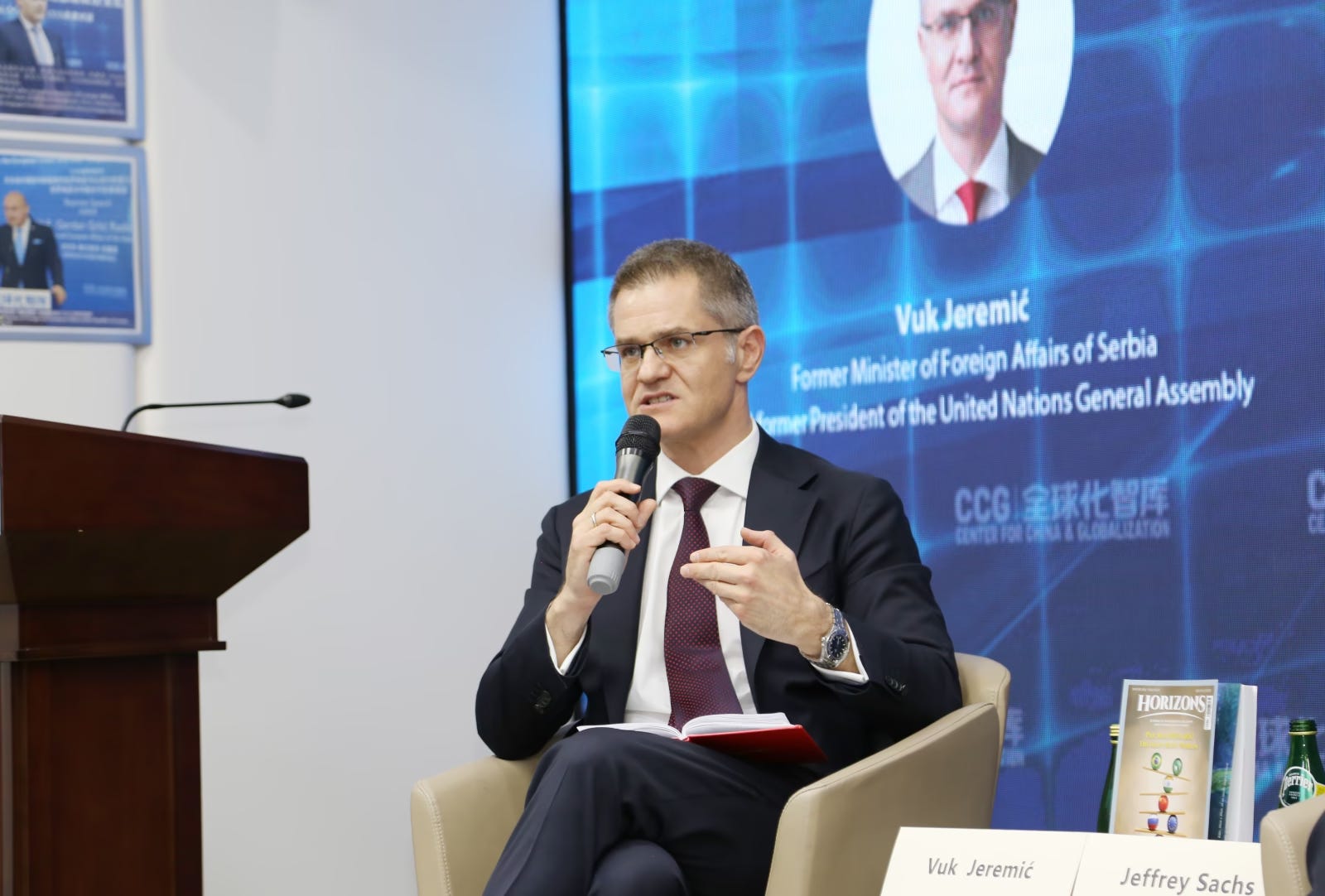
Thank you very much, Henry, for this kind introduction, and thank you, Mabel. That was too kind an introduction.
Thank you for giving me this opportunity to engage with such a high-level and distinguished audience here in Beijing, in the presence of my mentor from Harvard. I was privileged to have Jeff as an adviser at Harvard, and also later on in various things that I have done in the UN and afterwards.
Jeff is also one of the founding members of the editorial board of Horizons, the journal that is now, 33 volumes later, still a quarterly journal. This is the 33rd volume, and has multipolarity as its main theme. It has a range of authors giving very different perspectives on this global reality, starting with Professor Mearsheimer, but also Kishore Mahbubani, Richard Haass, Javad Zarif, all in one issue, together with H.E. Sheikh Abdullah from the UAE, and Jeff, of course, amongst many others. We are trying to present various perspectives and have them in one place. Not too many publications in the world these days are giving you different perspectives on things.
We are proud to have partners in Global Neighbours, and thank you, Madam Porsche, for joining us at just about the best possible moment.
To talk about multipolarity, I think there are a decreasing number of people who would refuse to acknowledge this as very much the reality of today. The world is multipolar, but the multipolar world order, I think, does not exist. We can perhaps talk about what it could look like. Are we going to have it at all?
The way we titled the journal, “Pax Multipolaris”, as in a multipolar peace, we decided to give it the subtitle “The Many-Body Problem”. And of course, for the audience here in China, The Three-Body Problem is something you can probably relate to. It is a very popular book by a famous Chinese author. We all know that in The Three-Body Problem, we are talking about a civilisation trapped by the unforgiving interruptions of three suns, in a way subjected to recurrent destruction imposed by celestial order, or disorder.
I think the world of today, which is multipolar, does in a way present us with a many-body problem that could very, very easily lead to utmost destruction. And obviously, what has been going on, especially in the past few weeks in the Gulf, is a very worrying sign of how things can go wrong.
I think that the second-order effects of what is currently going on in the Gulf are yet to be seen. The first-order effects, visible to everybody, are worrying enough. But the second-order effects remind me a bit of the beginning of a pandemic, when very few people could tell or foretell what the secondary effects of the phenomenon were going to be.
I believe that right now the old order is rapidly fading away. We can debate whether the old order was good, just, or fair, but there was some kind of order. Now it is rapidly fading away, and I don’t think it is immediately obvious what can come in its stead.
I come from the UN, in a way. My background is in the UN. I am a big supporter of multilateral cooperation and multilateral organisations. But it is not a secret that it has hardly been functioning very well for quite a while, and particularly not of late. The rules of the UN are perhaps no longer reflecting the current realities and the division of power in the multipolar world.
So what do you do when the rules of the road no longer reflect the realities of the traffic on the road, like what we have today? I believe there are three things you can do.
One is to reform the organisation so that it better reflects today’s realities and delivers global public goods better than what we currently have.
The second thing is to build new organisations, or to engage in alternative organisations that are not necessarily global but regional, to do the things you need to do and get the things that are important for your country done.
And the third thing you can do is to go unilateral, to do what you must and not care too much about what others are going to say.
I think that all three are playing out and will continue to play out concurrently. There will be attempts at reform. There will be much more cooperation through alternative regional organisations. And unfortunately, I do not think we have seen the last example of unilateral action taking place in the world.
Those three and the relationship among those three will determine whether we live in times of war or in times of peace globally.
I will stop there, and I will give the mic to Jeff.
Henry Huiyao Wang
Okay, thank you both.
Now we are turning to the theme of our discussion. Jeff, you have been travelling around the world extensively, and of course, you are also watching what is happening. This year, 2026, marks the second quarter of this century. Yet we are only at the beginning of it, and already we have had a big surprise. We saw what happened in Venezuela, and then we saw a president being hijacked, and then, around Chinese New Year time, we saw war going on in Iran, and it is still ongoing now.
So are we now approaching World War Three? I know this worries a lot of people, because this is a larger regional war. Then there is the possible blockage of Hormuz, and of course, the Arab states and the whole Middle East are in turmoil, which is bound to affect the world.
There are a lot of symptoms of the problem, but what are the roots of the problem? People say Hormuz, but that is a symptom. What is the root of the problem? I would really like to hear from you on that big, urgent question.
Jeffrey Sachs, Director, Center for Sustainable Development, Columbia University
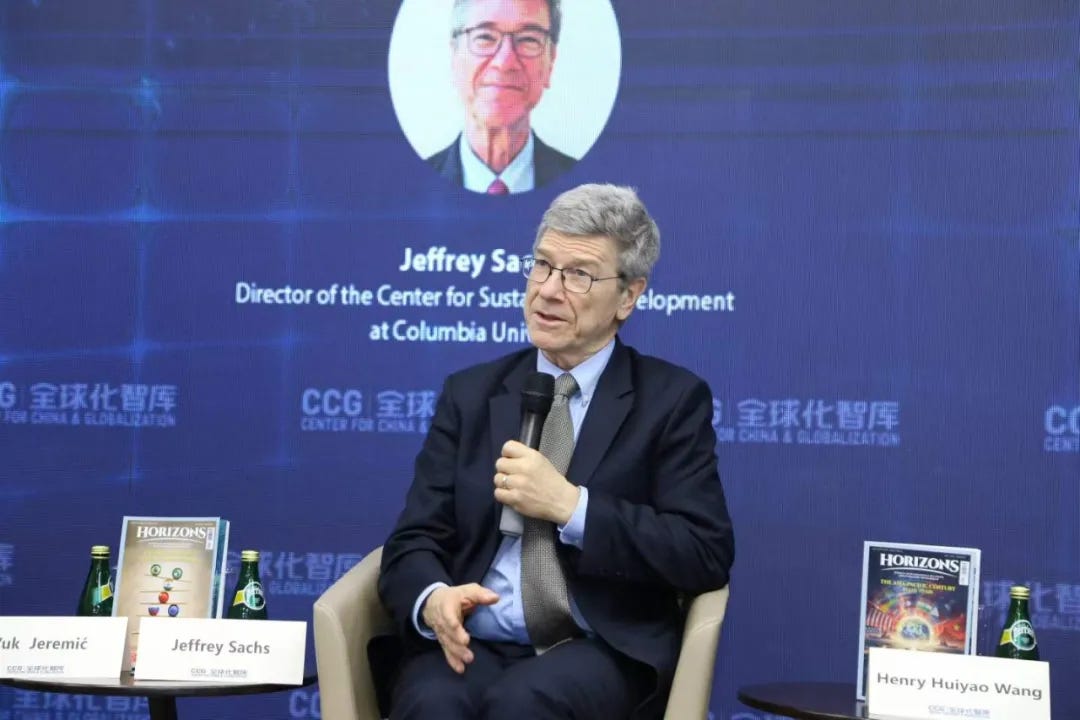
Henry and Vuk, thank you. It is great to be with such a distinguished group and so many friends here. Thank you very much.
Trying to understand what is happening right now is, I think, our challenge minute to minute, day to day, and I will try to give you my interpretation.
We are in a period of dramatic instability. The question is why. I think that we are facing disruptions of a number of kinds that are all hitting a high amplitude simultaneously.
One long-term change that has really come to the forefront, of course, is geopolitical change. We did arrive at a world in which the old world leader, the United States, has been matched and, in many ways, overtaken by China. This by itself is a fundamental disruption of the global order.
In many ways, the United States cannot compete with China, certainly on manufacturing production across a wide range of industries. It can’t compete with China in a wide range of diplomatic areas. This is very disruptive. It would probably be intrinsically disruptive because this is a change of power and a change of international order. I think we all feel that this is not a temporary phenomenon, but really the end of U.S.-led geopolitics, and even more fundamentally, the end of Western-led geopolitics.
So I would say that Europe, and the West, if we want to call it that, had been ascendant in world politics roughly from 1750 onward until, I think, the beginning of this century. That is over because of China’s rise and the rise of Asia more generally, not only China, but many dimensions of Asia’s economic, technological, and demographic weight in the world.
So part of what we are experiencing is that. And we see U.S. reactions in a number of ways, in ways, for instance, that Graham Allison was wisely and presciently speaking about many years ago. This is playing out. That is one part of what we are seeing.
We are also quite advanced in the ecological crisis, which only makes the headlines when there is a flood, a disaster, or an extreme storm. But these are quite frequent and very disruptive to societies. And they are beyond the control of politicians, who can barely handle this anyway. These events are coming quite frequently. If we have a strong El Niño later this year, as is now considered a significant possibility, believe me, this will add to the sense of very deep crisis that we are living through, because we will start seeing a lot of major ecological disruptions in the event of a major El Niño as well. So that is, again, a slow-developing but very serious crisis. We have been talking about it since the 1972 Stockholm Conference. We have not done much about it—not nothing, but nothing commensurate with the underlying reality—and it is hitting now in a very serious way.
The third disruption, of course, is technology. I don’t know about you, but I cannot even figure out my devices from hour to hour anymore. If I am desperate, I have to call my granddaughters and get them to help me turn my phone back on or get my website working or do something. But quite seriously, this pace of technological disruption is unprecedented, extremely deep, changing every dimension of the economy, disrupting labour markets everywhere, and changing structures of power, influence, and money in very dramatic ways.
We have the highest concentration of wealth in human history in a few hands. Ten tech figures in the United States have $2.6 trillion of wealth. Elon Musk, by himself, has a net worth of $700 billion. This is weird, disruptive, and completely unprecedented. We have this one guy who does the space shots for the Pentagon, determines which armies in the field have real-time internet, has very weird AI on site doing all sorts of social disruption. And he is a very strange guy personally. If you add it all up, this is extremely disruptive by itself.
I think there is a fourth aspect, which is that our governments, in most places—with the exception of China, from my perception—are not able to govern right now. The United States is probably the most incapacitated government of any major government. We have no systems. One of the things, as we discuss the Iran war, for example, is that there is no process. Normally, you would say, well, the CIA is doing an operation, or this is a war that Congress has called for. You understand what this is. But it actually rolls out on Truth Social.
We have got a nut as president, just to be blunt about it. I would like to be blunt because there are very few opportunities for adult conversation, which we need. We just need real understanding.
So we have a president who is out of control, really, but we don’t really understand how the U.S. government works right now. I am a close observer of the U.S. government and have been for 50 years, but I am not on the inside, thank God. So I cannot tell you how decisions are being made right now. I could tell you five years ago about how decisions are being made. But I actually do not understand whether it is Trump making decisions, or Ratcliffe making decisions, or Hegseth making decisions. None of these people seems completely remotely capable of ordering mass armadas, launching wars, fighting wars, or doing diplomacy.
Everyone I know who interacts with Trump says that he has an attention span of a few seconds, basically, and is a complete ignoramus. And this is in the middle of a war that we’re in. So I do not understand who is actually doing what and how. I would put this under the category that our governments are not working well, period.
The U.S. is an extreme case, which is not the best news, because it would be better if a small country were the extreme case. But the U.S. is the extreme case right now. Nobody knows how to deal with the United States because no one knows what is really going on or what the relations are. It is all the more unnerving because we have to fake everything as if we are in a normal situation. So no matter how weird it gets, everyone says, “Oh yes, this is very interesting. We are going to continue our diplomacy,” even though it is a madhouse and there is no process at all right now.
By the way, part of the degeneration of politics is that every day there is an upheaval, but it’s followed by the next upheaval, so you do not even remember the last upheaval. You might remember that last year we had trade wars based on reciprocal tariffs. Then they were declared illegal. And then what? Well, that was last week. This week it’s the Iran war. Next week, it’s the overthrow of Cuba. Who knows?
So this is a really terribly destabilising process. And maybe because it is a madhouse, nobody reacts in ways that I regard as sensible or meaningful, with the exception of China. China is, in my view, the most stable governance process of a major country in the world, by far. You know when the Two Sessions will come. You know that the 15th Five-Year Plan will be issued on a particular day. You know that it will be carried out. It seems to be a very stable order right now.
Almost the opposite is true in the United States and Europe. Europe does not function. I must say, with our esteemed European ambassadors here, the Commission seems to be flailing about. There is no consensus within Europe on anything anymore. It is a cacophony. That may be okay, but it’s also almost a rupture between government processes and the public, because approval ratings are near zero for most of the major governments as well.
And we have a governance crisis that is quite pervasive. For any small or medium-sized country, no matter how brilliantly it is governed, this is chaos. What do you do? How do you react? What are you supposed to do the next day? Who do you talk to?
Our international institutions are paralysed because of this. The UN can’t turn on the lights. The budget does not function. Nobody pays. Again, the U.S. has instigated many of these crises individually, but nobody has really replaced the U.S. in making sure that these international institutions continue to function.
So that’s not really a diagnosis. It’s mainly a description of a very chaotic environment.
If I could try, for just one minute, to give a little bit of a diagnosis and a prescription, I would say that the breakdown of U.S. governance, the loss of U.S. power, and the mindset reaction in the U.S. are the main drivers of chaos in the world right now. In other words, we are having a temper tantrum from a nuclear superpower. And the temper tantrum is that the U.S. insists that it’s still running the world, and it’s going to prove it. It’s going to take over Latin America as it wants to. It’s going to take over the Gulf and West Asia as it wants to. It’s going to have its showdown with China as it wants to. It’s going to keep Europe in thrall as it wants to. None of these things is going to happen that way, but that is what the U.S. is trying to do.
None of it adds up to anything meaningful except danger and a spread of war. I do not even know whether they can de-escalate anymore, because they are so crazy that the unpredictability of events is overwhelming. This is not some planned craziness. This is not the madman theory. This is just mad men, and the tantrum that comes with it.
So I put all of this as a great danger.
What is the answer? The answer would be for the rest of the world to act like grown-ups and insist that we get back to a sensible system. That’s not happening right now. Europe, with the exception of President Sánchez, does not speak like adults anywhere. Europe only says things to appease Mr Trump or to try to keep him quiet, or out of Russophobia, which is equally confused and misguided. So there is a kind of panic in Europe as well that, to my mind, makes no sense. So we don’t have reactions in Europe.
I will give you one quick example. I do not want to hog the mic, but I was in the strangest—it wasn’t the strangest, because the next week was even stranger—but I was in a very strange UN Security Council session about three weeks ago, when Israel and the United States attacked Iran on the first day, and an emergency session was called. I was asked to testify by several delegations. The British blocked me from testifying, and the Americans blocked me from testifying. So that was, for me, the start of a normal day: let’s not have real discussion anywhere; let’s make sure the narrative is controlled. Because the British were chairing the Security Council that day.
But then the entire session started with the Bahrainis, who said, “We are here because of an unprovoked attack by Iran.” They didn’t mention that Iran had been attacked by Israel and the United States, only that Iran had attacked the Fifth Fleet in response. This is the start of surrealism: that you have a session on the day that the U.S. and Israel attack Iran, and the first statement out of the box is an unprovoked war by Iran.
I thought, well, that is a little crazy. But I understand Bahrain is a wholly owned subsidiary of the United States, so let’s go on.
Then came the French, same thing. They didn’t mention that Iran had been attacked. Then came the Latvian, didn’t mention that Iran had been attacked. This went around the room for the first eight or so people. Then I realised every one of them has American military bases on their soil, so we could not have an honest discussion.
Not one of them could say, for example, I thought the Bahraini might have said, ‘Well, we have been attacked unprovoked because we did not do anything, but the attack on Iran was the reason this started.” But that sentence, that would tell you that you are in a real world and not a surreal world, was not uttered by anybody.
So all in all, it was completely disheartening. Kaja Kallas tweeted, “Iran is an evil country that must be brought to bear” the day it was attacked by the U.S. and Israel. Again, nobody dared speak the truth at all about this unbelievable war of aggression without any cause that day, the day before the next round of negotiations was due to take place, after the Omani mediator had said publicly that Iran had made major concessions to the American position.
Nobody speaks the truth right now. So this is a very deep governance crisis on top of everything else.
My prescription is that we behave like grown-ups again and talk about true things. It means that people say, “Mr Trump, that is not right.” Practise that sentence, please: “Mr Trump, you can’t do that. That’s a danger to the whole world.” I would like all heads of state to practise that sentence. It might save the world to really be able to speak directly, so that we do not reach a cataclysm, which is absolutely possible right now.
By the way, Netanyahu is even more than that. He is a real psychopath, without question. They are completely out of control, and they have one side backing the other one. So it’s very important that we speak right now logically, in reality, and in a direct way, to try to tamp things down before they get completely out of control.
And if we were all behaving with rationality and responsibility, we would find out: God, the world is complicated for all the deep reasons. In other words, there is nothing simple about the challenges. But we will never solve them through mad Truth Social quotes of bigly wins and exclamation points, and “we will kill them all”, and bombing by Israel of South Pars and destruction in Qatar as if it’s all a video game, all normalised by the lack of public discussion in a serious way about any issue.
I don’t mean to be presumptuous, and I don’t mean to be obnoxious, but for the ambassadors, please, the only thing—if you want to say, “What did Mr Sachs say?”—is that governments should talk truthfully about the situation so that we have a chance to actually address what is the most serious crisis of global governance since World War Two.
Henry Huiyao Wang
Thank you. Thank you, Jeff. You have really given a very good analysis of four or five phenomena that are changing the world: geopolitics, climate, technology, government, and many more.
Maybe just to follow up with a question and perhaps a comment, and later, maybe Vuk can also comment as well.
I understand that this war is really serious. Even in the U.S., I see many congressmen, even many Republicans, saying there was no imminent threat from Iran, because they had just bombed Iran last June and said everything was destroyed. So I think the reason wasn’t really strong.
You are saying that no leaders are really standing up. But I did see the Spanish Prime Minister say a few things. And China, of course, at the first Security Council meeting, condemned the invasion and emphasised that sovereignty and territorial integrity are really the bedrock of UN principles.
So what do you think? Of course, every country has to speak, but this is jeopardising everything. The U.S. is probably the biggest security provider to the Middle East, but now there is no security anymore. China is the biggest economic provider, because China has the largest trade with almost all the Middle Eastern countries, and this has now been disrupted. So this is really a big surprise to everybody.
And as you said, China’s Five-Year Plan has already been organised. So what else can China do? China’s companies are also very active around the world—Huawei, CATL, BYD, Tencent, DeepSeek, and others. So, can we still really pursue economic globalisation rather than securitisation and overemphasis on security concerns? How can we stabilise things? What can China do more? And how can other countries really help?
As Vuk said in the new Horizons volume, multipolarity is there, but what are the driving forces or stabilisers for multipolarity and a multilateral system? You are really a kind of global glue on these subjects, so perhaps you can give us some additional thoughts on that.
Jeffrey Sachs
My first comment is that we can’t have economics if we don’t have peace. War disrupts everything. It disrupts resource flows, budgets, attention spans, political capital, and global trust.
The wars have to stop. And the wars that we have are either completely reckless and useless, or they have reasons that need to be addressed to end these wars. This is the highest priority for the UN. The core purpose of the UN, above all, is to end the scourge of war. All the rest—development and sustainability—come after that, because without ending the scourge of war, we do not get anywhere.
We need, if we can, to adhere to the UN principle—which is actually a very good principle—that no country can threaten or use force against another sovereign country, or threaten its territorial integrity or sovereignty. Article 2, paragraph 4 of the Charter. We should find the language and should have found the language long ago.
Now, I believe the United States is the worst abuser of Article 2, Section 4 in the whole world, because we are constantly trying to overthrow governments all over the world, sometimes covertly, many times overtly. In the last 20 years, the United States has invaded more countries, has used the CIA to overthrow governments, and has launched many colour revolutions. Most of American allies don’t call out the United States for this at all.
So we end up with a normalised system of violence.
On a per capita basis, Israel is way ahead of the United States in being the most lawless regime in the world, because Israel believes, perhaps as a matter of state survival, that it can launch wars anywhere it wants, at any time, even genocides. Of course, I find this completely abhorrent and ultimately suicidal for Israel, because I don’t think the state will survive with the behaviour it has right now, which is egregious.
But I can tell you there is no honest reflection of these issues. All of it is normalised. And where did the Syrian war come from? It came from a presidential order by Obama to overthrow Assad. Is that discussed? Hardly at all. Do people know it? I assume it is universally known.
Where did Yanukovych get overthrown? Sorry, that was by my colleague Victoria Nuland. Have no doubt about it. I was not quite there, but I was there soon afterward. That was a U.S. operation. Of course, it had some indigenous roots, but it was a U.S. operation.
So was it called out? No. It was denied, and politely, no one wanted to talk about it. I know that European ambassadors don’t like to hear about this, but this is our reality right now. This is really the problem. We don’t like to have discussion. We don’t want to debate these issues. So we think power ultimately will settle these problems, that international law ultimately isn’t effective, and then we prove that this is self-fulfilling.
And now we have reached an absurd state of affairs, completely absurd.
What is this Iran war about? They can’t even tell a false narrative, and even the false narrative changes day by day. The only one who told the truth about this is Netanyahu. On the day it started, he said, “This is my dream come true for 40 years.” Well, that means it wasn’t about the negotiations of the past week, that’s for sure. It could not have been about the negotiations of the past week, because it took two months to get all the U.S. armadas into position for this war. So this was something that was decided weeks and weeks ago.
Why? Why this war? Actually, I cannot tell you. I know that Netanyahu has wanted this forever, but why did they do this? It’s a catastrophe. It’s blowing up the energy system of the world before our eyes. Trump says, “I didn’t know they were going to attack South Pars.” Then immediately, another part of the U.S. government and Israel said, “Yeah, we knew.”
We are reaching an absurdity. This is not chess, checkers, or even tic-tac-toe. This is absurdity, and we need real adult discussion about it. How are we going to get this back under control? By having some rules, some guidelines, some objectivity, some principles, some response, some accountability—the way that you would control a system. And this system is highly complex.
That’s what the three-body problem is about in physics: even three bodies can’t stay in a stable orbit. A small perturbation throws everything off. That means you need controllability of the system. But you can’t control a system that you can’t even talk about honestly.
And by the way, today the FBI is investigating the guy that resigned two days ago, because obviously, if you tell the truth, there needs to be retribution against you as well.
So the only way we are going to do this is through honesty and discussion. Every other approach is going to fail. The war approach is going to fail. The “bomb Iran to smithereens” is going to fail. All of it is going to be a disaster.
The only other point I would add, Henry, is that the UN idea was that individual countries didn’t have to bear all the burden of speaking the truth; you could do it collectively. I have advocated in recent days that the BRICS speak the truth, because BRICS is half the world’s population. It’s heavily impacted by what is going on right now. It is not the party to what’s going on, except that Iran is on the receiving end of what’s going on. But even there, India is resistant to speaking the truth about it, because it gets its military equipment and intelligence from Israel.
So we are really trapped right now in a great difficulty to confront these challenges in an honest way.
Henry Huiyao Wang
Okay, we have to break that impasse, as you suggest. I think China is going to host the APEC summit, as well as the China-Arab summit this year, and we will also have a BRICS summit. I think the international community and the public will realise what is most important to them, and they have to speak. So what is your take, Vuk?
Vuk Jeremić
First, it’s a privilege to be here and to listen to Jeff. I have heard probably hundreds of Jeff’s lectures in school, and had hundreds of conversations with Jeff, and every single time I have the impression that I have heard the best one so far. It is difficult to speak after Jeff.
But Henry mentioned one of the key questions: what can China do under the current circumstances? China is a superpower. It is the second or perhaps the first largest economy, and a superior technological power. What can China do?
Well, it is very difficult to do something decisive today, right now. To make an analogy, if there is a high inflammation in one of the body’s organs, it is difficult to go in and perform surgery. You first have to find a way of cooling it down before proceeding with the surgery.
So China is not acting boldly, and I completely understand why China is watching very tentatively. It said what it had to say in the Security Council. Unlike the majority in the Council, China did speak the truth. I watched that Security Council session.
You know, Napoleon once famously said: “Do not interrupt your adversary at the moment he is committing a mistake.” I think what is currently happening in the Gulf, and globally, is going to serve as a great accelerator, to the point where there are going to be discussions under different and more or less universally accepted realities that there has to be a rebalancing and a change in the global order. I hope that happens before somebody shoots a nuclear weapon at somebody, which is, of course, a distinct danger.
China’s long-term vision when it comes to global relations is in many ways addressed through the Global Governance Initiative, which is a very interesting and, I would say, convincing document. You would have to read them several times to understand all aspects of them.
When I said there are three things one can do about the situation, and the first is to try to reform international organisations, I think that a lot of answers as to how this reform should be thought through and carried out can be found in the Global Governance Initiative.
But initiating reform processes and starting them off is exceptionally difficult under the current circumstances.
There is a process currently going on, and it is timed in weeks and months rather than years, which I think is going to be quite important, and that is the election of the next Secretary-General of the United Nations.
Maybe one can say, well, who cares? The UN Secretary-General is just a bureaucrat who can give speeches and nothing else. Well, not necessarily true. Because of the process of electing the Secretary-General, that is taking place in the Security Council, I think that China can have a very important role in that election process.
In the past, this has usually been an exercise like a chess game between Russia and the United States, or the Soviet Union and the United States. Theoretically, we have five permanent members of the Security Council, but in reality, until today, it has really just been a game of chess between the two. The other three were around and played some role, but not a decisive role.
In 2016, when I had the privilege of learning about this process from the inside, being one of the candidates for Secretary-General, I remember that in the final round, it was the United States and Russia that played a decisive role. I think this time around it could be different. And I think the expectation of the world is that China is going to play a very important role in this process, to make sure that we talk about realities and to see what candidates have to say with regards to how to speak truth to the world, and to make sure that they do not end up being diplomatically rounded up and shot by others in the Security Council who also have the proverbial gun, namely the veto power.
It’s going to be an exceptionally complicated game to play. But this is actually why one of the previous issues of Horizons, to which Henry kindly contributed, was titled “Ready to Go”, because the game of Go is what China is very good at. If this election of the Secretary-General ends up being a game of Go, requiring patience and determination, I am absolutely sure that China is capable of playing a good game of Go.
That could be a starter. I do not think that overnight the world’s governments and leaders are going to be able to sit together and say, “Okay, let’s make sure that all of us at the same time speak the truth to Mr Trump or whoever else.” But with a new Secretary-General and a new administration in the UN, it could be a beginning of the process.
The long-term vision—look at the Global Governance Initiative and other Chinese documents, and also documents from other parts of the world—could help us think about what global governance should look like. But there has to be a beginning, and maybe this could be the beginning. If China does not play a key role, I don’t think anybody else will.
Henry Huiyao Wang
Great, great. Vuk, you talk from experience. As you said, in 2016, you were probably second to Guterres from becoming UN Secretary-General that year.
Vuk Jeremić
But I got a veto. Okay, guess by whom?
Henry Huiyao Wang
Yes, of course.
So your advice is very much appreciated. That brings me to probably the final question I will ask before opening up for one or two questions from the audience.
Jeff, you are a top UN expert. I remember we were speaking last year at the UN Security Council for a special meeting in April during the trade war, right? You and I were the only two experts speaking there. I remember how important the UN is as a body. As you said, a lot of small countries want to express their voices not individually, but collectively through the UN.
So, how do you think we can deal with this issue: multipolarity is here, but the multilateral system is not. The UN is the only thing left, and we are seeing its destruction. So how do we reform the UN, or improve and enlarge it, including the Security Council? That is the article Vuk has accepted. I have actually just published something in the last issue, “Beyond 1945 | Preparing the UN Security Council for Today’s Challenges”. So, what is your answer for improving the UN?
Jeffrey Sachs
I am excited to read the article because I’ll give a better answer after I do. But I think the main point is that we had better save the UN, not simply describe its death.
The League of Nations died in the 1930s, and the UN came after another catastrophic war. We can’t afford the next death of international law and order and then wait for another war, because there will never be anything following that. So we had better make this work.
And it’s not working right now for a number of reasons. But I think the first point is intentionality: that it has to be made to work, and that it’s truly important.
There again, China is absolutely central to this. China will be the lead country over the next 20 years. It’s not going to be a global hegemon—there will be no global hegemon—but China will be the lead economy and the lead country providing solutions for sustainable development, because the United States, at best, will not obstruct it, but it will not lead it. So, in this sense, the responsibility is very great.
One not-so-hard proposal that I have is for China to establish a major UN operation in Beijing. I say that as a, I hope, very serious proposal.
The whole UN apparatus is now either at UN headquarters or in a few cities in Europe, with the one exception of two smaller units in Nairobi. There are no Asian centres of the UN at all. There is ESCAP, which is the regional office in Bangkok. There are country UN offices. But there is no major operation of the UN of any kind in Asia—no agency, no process.
So my practical proposal is for China to offer to host a major UN campus on sustainable development here, because China’s speciality is not the war-and-peace issue, though the advice is very good and China doesn’t want to be the global peacekeeper. It can advise on that. But China is going to be the only country that can help lead the sustainable development agenda, just because of its industrial capacity to do so. It will lead on all the green technologies for the next quarter century.
So I would like to propose a major UN operation here that would bring representation from all over the world, that would bring governments from all over the world working on this very real, critical issue, and becoming very operational, because if China hosts something, it will be operational rather than simply talk. And I think that would make a huge contribution.
I don’t think we should stop there, because I would also like to see a major UN operation in Delhi and a major UN operation in some other very important places in the world, so that this is truly a global body; it doesn’t go down with the U.S. petulant reaction, which is taking place right now.
On very practical issues, just without hogging the mic too long, the core budget of the UN is a nothing. It is a pittance. It is $3.5 billion a year. It’s chump change for Elon Musk alone. It’s being cut right now by the U.S. Nobody has dared to say, “We will make up the difference.”
With the next Secretary-General, someone should step up and say: if the United States does not pay, fine, you lose your voting rights. We are going to cover the costs of this and more.
The New York City budget is $118 billion. The UN budget is $3.5 billion. Come on.
So a group of countries needs to say: We’ll cover that, and stop fighting about it. The way Secretary-General Guterres went, I would not have recommended, which was: “Okay, we’ve got fat, we have to get lean, we have to be efficient, we’ll cut the budgets, we’ll live within the budgets.” This is not the right message to the world. The right message is: we are indispensable to the survival of the world. We are vital. Right now, it’s 40 cents per person in the world for 8 billion people. It’s the bargain of the world.
So don’t talk about cost-cutting. We can talk about doing more with even modest increases in the budget. But that’s not what was said. What was told to the world was: “Oh, this is a bloated bureaucracy, and it has to be cut.” We need to save the organisation as a real structure that can actually do things, implement things, and carry out the vital work that needs to be carried out.
Let me end with one recommendation, which will be very controversial, but I believe in it, so I just want to say it. I believe that China should, after some discussion and negotiation, support India as the sixth permanent member of the Security Council.
The reason is that India has 1.5 billion people. It is a superpower. It is economically becoming more and more important. China and India will, in fact, be the number one and two economies in the world by mid-century. The United States will be third.
China’s real interest is not competition with India. China’s real interest is true, stable multipolarity.
The thing I most dislike about India’s foreign policy is that it’s part of this Quad business, which is an absurdity. India is siding with the United States against China. Come on. India needs to recognise that this is a U.S. game that is of no interest to India at all and inconceivable to be helpful to India.
I would like India to play its role as a stabiliser in the world, as a country of nearly 20% of the world’s population, alongside China—the two giants of Asia—stable, telling the United States: you can participate too, but stop wrecking the show just because you are not in control, and to have a good relationship.
So my idea is that India and China settle this border thing, which is another useless remnant of the British Empire. It goes back to a line that was drawn on a map in the Himalayas by McMahon in 1914—and I should say, because the guy never went to the Himalayas—in an arbitrary way. How could this continue to inflame divides between China and India a century later, when there is so much more important work to do in the world than this?
I want the two Asian giants to settle the old British score and recognise that they have a great commonality of interest in saying: We are two stabilisers of the whole world system. We are not against each other. We are not going to be played by the United States. And we both have a central role in a global security system, and therefore a central role in the Security Council.
Vuk Jeremić
Can I add to this? Because Jeff has now driven us into this direction of talking about controversial ideas, and Security Council reform is probably one of the most difficult questions, which is basically the one holding back the entire UN reform process.
Obviously, the most screaming aspect of the inadequacy of the composition of the Security Council is the fact that India is not there as a permanent member of the Security Council. The most important reason is that back in 1945, during the San Francisco Conference, India wasn’t around, because there was no India at that time.
So the British do have something to do with this, as they do with the drawing of the boundaries not just between India and China, but also between India and Pakistan, and then later Bangladesh, all informed by old maps and so on.
But how about Britain showing the way and leading in geopolitics this time in the 21st century in a very positive and truly enlightening way, by basically inviting India into the Security Council and perhaps calling it the Commonwealth seat, so that it can be more easily massaged and done?
Similarly, the French can also play a very important role. In the French case, it’s easier, because the big thing they would have to do is say: Let’s have the European Union as a permanent member of the Security Council. Very few people would say no to having the European Union there.
France could lead the way by saying: We do the right thing. I think Britain and France, who are, if you will, the biggest signals that the composition is too old, could actually lead the way and then, together with China, work together to have a new composition.
Henry Huiyao Wang
Yes, a lot of good suggestions. I particularly like Jeff’s idea that we could set up a UN Sustainable Development Centre in Beijing, and maybe more than one, because China now contributes 20% of the UN budget. China can probably support a UN sustainable development university or centre in China, which would be great.
And on UN reform, that is right, my article also talks about UN Security Council reform. I was suggesting that the permanent five members would remain permanent, but that the other G20 members could become some kind of associate members. Then every month we could have a kind of G20 UN, and other non-rotating members could also have a stronger role through the General Assembly, with a two-thirds mechanism to really air their opinions and express themselves. That could be another interesting option.
Anyway, I think we have had a very good discussion. We are probably running over time, but I would like to have two questions from the audience before we close.
Okay, we will have the Ambassador of Austria first. Yes.
Wolf Dietrich Heim, Ambassador of Austria to China
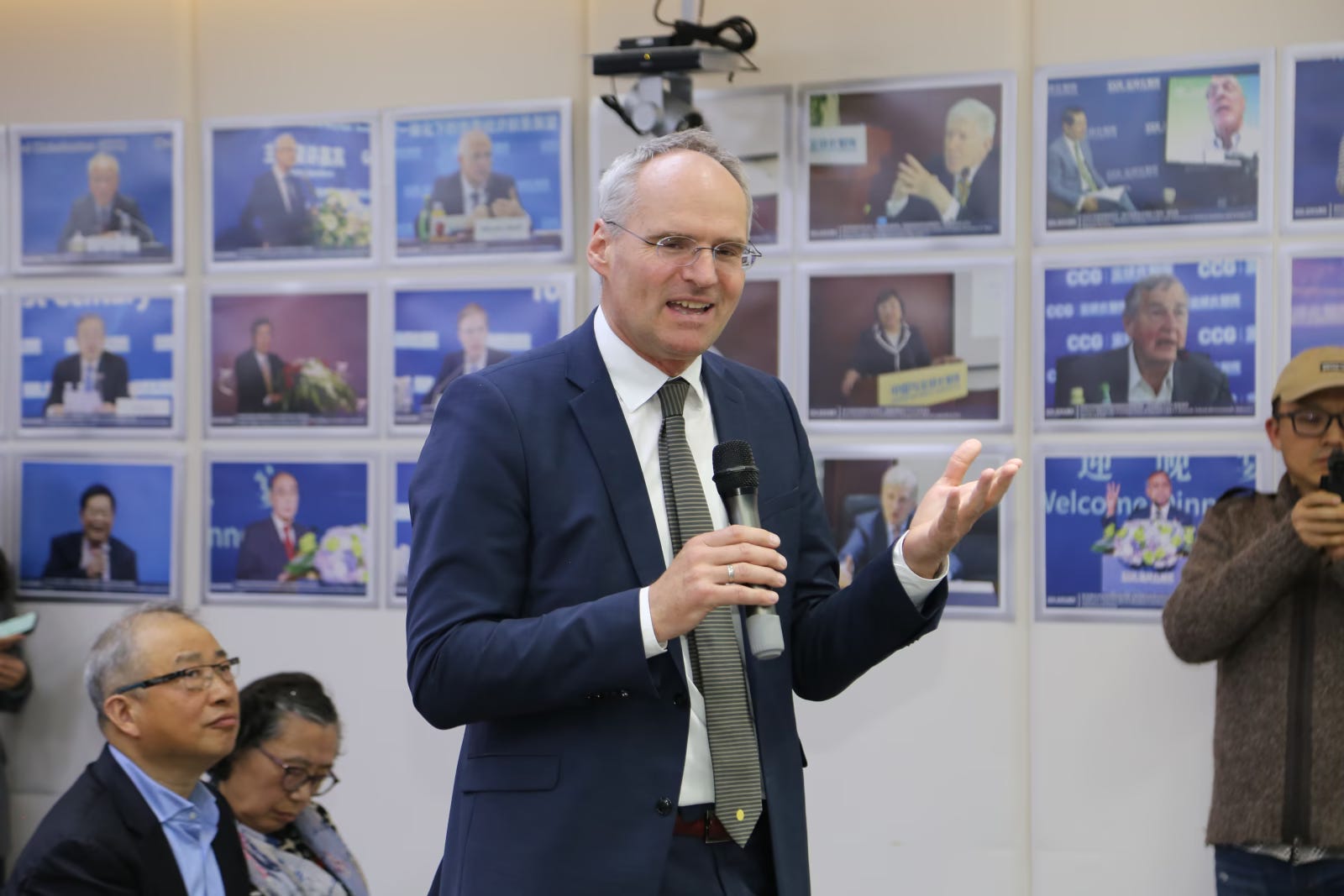
Thank you very much. I enjoyed a great part of your words, and I wouldn’t want to elaborate on too many things. But I don’t quite agree with the way you mentioned Ukraine.
I was happy to serve as Austrian Ambassador to Ukraine from 2010 until 2015, and I remember this history somewhat differently. Now, I don’t expect us to cover the whole world in an hour, but I don’t remember you speaking a lot about Russia.
So if I have a question, I would say that the situation we now see in Ukraine, after four years of an unprovoked attack by Russia, is not Victoria Nuland and her two visits to Ukraine in 2013 and 2014.
I was also happy to serve in Iran over the last four years—I arrived here in August—until June, when we sort of left after the first and then the more recent intervention. I would also say that there’s a lot to discuss about Iran, and of course, its difficult history with the Western powers and the United States. But I was also very sorry to witness the Iranian approach to the truthful efforts of the U.S. government to renew the JCPOA, which were undertaken in Vienna in 2021 and 2022. My impression was that Iran made a very deliberate choice by the summer of 2022 not to renew the JCPOA, which was on the table as an improved offer. There may be reasons that explain that behaviour, but with hindsight, it was not a very clever move.
So there are many things one could go into in detail. But on Russia, I would be happy to get a bit more from you, because I think it is relevant. Some of the colleagues may have walked out when you said this. Also, I think the way some European governments approach the U.S. president and the U.S. government has a lot to do with the situation in Ukraine, and I think that is also quite—
Henry Huiyao Wang
Okay, thank you, Ambassador.
Maybe one final question. Yes. We have one from the South China Morning Post.
Wendy Wu, China Editor, South China Morning Post
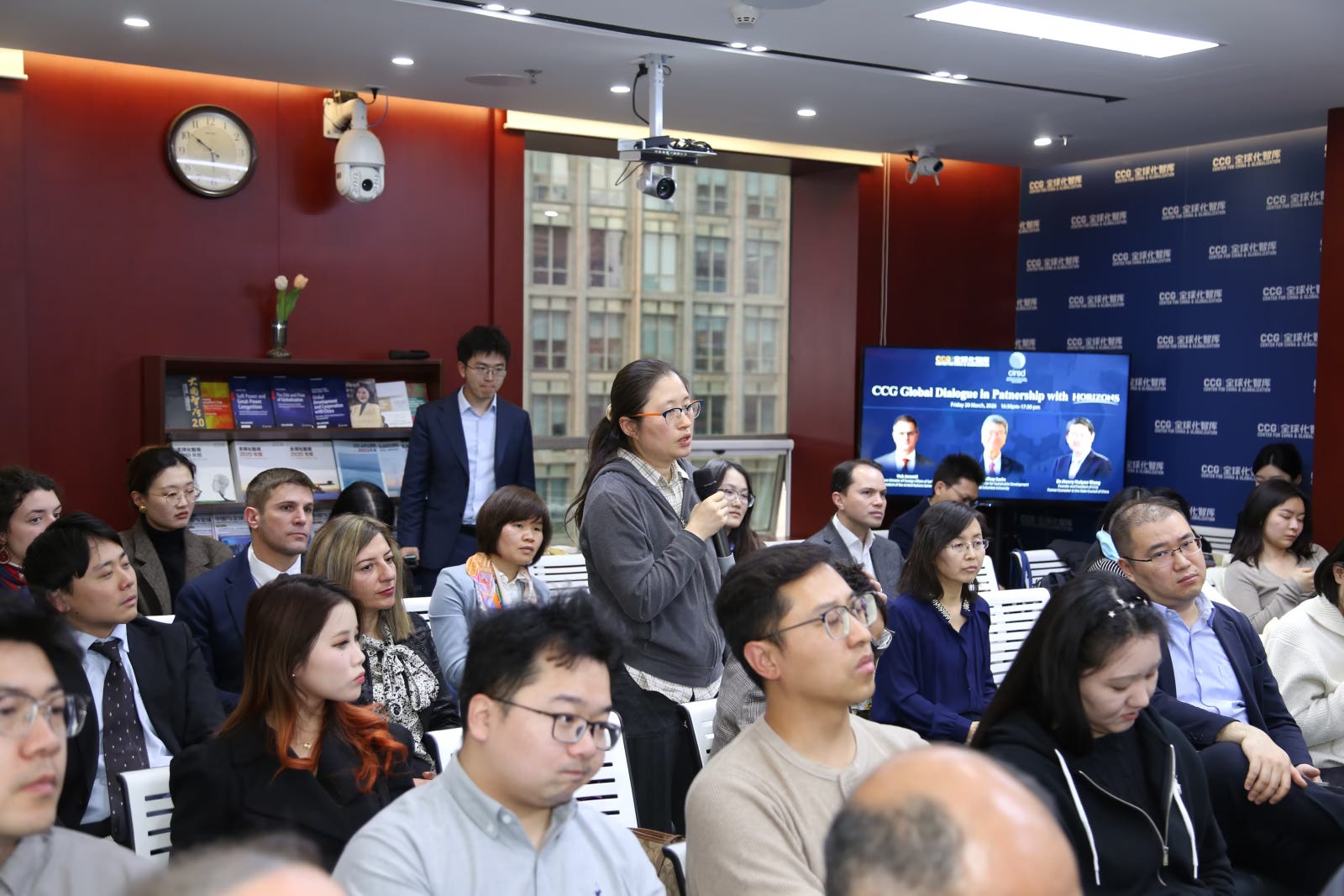
Thank you. It’s nice to see you here, Mr Sachs.
I have two questions. One is about this Iranian crisis: what do you think the U.S. economy will be affected if the war drags on, and how is it going to affect China’s economy as well?
You also mentioned Trump, who seems unstoppable. Do you think China is becoming more confident in handling Donald Trump in his second term?
And also, about your UN suggestions, please allow me to ask: Have you raised those proposals with the Chinese government, and what’s the possible reaction? Thank you.
Jeffrey Sachs
Thank you very much, Ambassador.
My model of European peace, in my conception, is based on Austria’s experience. Austrian neutrality in 1955 was a wonderful initiative of your country, and it led to generations of prosperity, peace, and stability. As far as I know, the Soviet Union, and then Russia, never bothered you again.
The idea was that the Soviet Union, back in 1955 and actually after 1945, was looking for safety. After having been invaded by Hitler, after having been invaded during the Russian Revolution, after having been invaded by Germany in World War I, and after having been invaded by Napoleon, Russia’s basic idea, in my opinion, is that it wants space protection. It did not want NATO in Ukraine. It did not want NATO in Austria. It did not want NATO in the Federal Republic of Germany after 1949.
So in Austria in 1955, which was still an occupied country, Austria declared neutrality. The Soviet Union went home, and not only did Austria live happily ever after, it became one of the world’s thriving leading countries, and in our happiness reports near the top of the world.
So I always regarded that as wonderful diplomacy. It was also meant, in 1955, to say to the United States: Do the same in Germany, and we can end the division of Europe. Our wise leading diplomat at the time, George Kennan, said this is a bargain we need to take. But the Eisenhower administration—John Foster Dulles, who was a very rigid man in his thinking—said no. And so Europe remained divided ever since.
The reason I mention the Austrian case is that this was the role model for Ukraine. Ukraine was crazy to try to join NATO. Just crazy. Anyone should know that. In fact, almost everyone did know that. Many European leaders said to me in 2008, after the Bucharest Summit, “What is your president doing, pushing NATO to Ukraine and Georgia?” And I said: he is trying to be Lord Palmerston. He wants to fight the Second Crimean War. He wants to surround Russia. Read Brzezinski; he will explain what they are doing. And what Brzezinski said was: we will make Russia a third-rate country by taking Ukraine into our side.
So, to my mind, Ambassador, this is the essence of this issue.
I had a long conversation with Jake Sullivan in December 2021 after President Putin put his propositions on the table. I called up Sullivan, and I said, “Jake, take the deal, because this way you avoid war. Just announce that NATO is not going to go to Ukraine.” And he said to me, “Jeff, NATO is not going to Ukraine. That’s not going to happen.” I said, “Jake, you are going to have a war over something that’s not even going to happen?” And he said, “No, no, no, we are going to handle this diplomatically. There’s going to be no war.”
What do I make of that five years later? I make of it a profound miscalculation, that they didn’t know what they were doing, and they didn’t understand what they were provoking. I don’t believe that Biden wanted to bring Putin into an attack, but I think that they failed diplomatically, completely, from 2008 onward, to understand how neuralgic this issue is—of the U.S. military sitting on Russia’s border.
If the Russians ever tried this, we’d have World War Three immediately. And we did almost have World War Three in Cuba in 1962 when the Soviets did try this. We came within a second of nuclear disaster.
So, to my mind, this is failed American diplomacy, and it disgusts me how badly they handled this. Two superpowers should not provoke each other. That is my bottom line. They should recognise red lines.
Similarly, the United States should simply not sell arms to Taiwan, no matter what. Are we crazy? What are we inviting? Enough.
China and Russia should stay out of the U.S. neighbourhood with their military, and the United States should do the same in Ukraine and should do the same in Taiwan. And then we can have peace, because we are just giving each other a little space, because nuclear superpowers should give each other a little space.
So that’s my view. And I understand, I think, the Baltic reaction and so on. I have the highest civilian award from the government of Estonia because I helped set up its central bank in 1992. I am not an enemy of Central Europe. I was the adviser to Poland. I was the adviser to Leonid Kuchma in Ukraine. It is just that one superpower should not provoke another superpower by getting right to its face this way.
And that’s what the Ukraine situation is about. It was a U.S. game that Brzezinski and his friends cooked up in the 1990s because they thought that Russia was so weak, so dependent, could do nothing. So let’s take all the spaces on the board.
Kissinger said so. “Neutral. That’s neutralism,” he said in 1994. He was asked, “Should NATO expand?” He said, Yes. “Why? Is Russia a threat?” “No, no, no, Russia is not a threat,” he said. “Well, won’t it get Russia mad?” “Yes, it will get Russia mad.” “So why would you do it, Mr Kissinger?” And he said: “Well, if you can’t provoke them when they are weak, what are you going to do when they are strong?”
What kind of logic is that? That is the realist logic that will get us all killed.
So this is my reaction to this, which is, this war never should have happened. It could have stopped at any moment that a President of the United States said clearly: This is going to be a neutral country. Europe failed so many times. I am sorry to say that even the Minsk Agreement was an off-ramp. I know that Chancellor Merkel wanted the Minsk Agreement to work, because it’s based on Bolzano, on South Tyrol, on her idea of what neutrality or autonomy can mean. So it’s actually got a role model in Austrian-Italian history.
But the U.S. said, You don’t have to do Minsk II. And the Ukrainians said, We don’t want to do Minsk II, and the United States said, That’s fine; you don’t have to do it. So Germany and France went along with that.
So to my mind, Ambassador, it’s just a huge mistake, a tragic mistake that we’re making. Do not play with superpowers. Do not provoke them. Do not get in their face.
If we keep a little distance—I call this not spheres of influence, I call it spheres of security—just give a little space around each nuclear superpower, we can actually stop from blowing each other up. But if you get too close, there will absolutely be a reaction. That’s, I believe, what we are observing right now.
On the question of the war and the economy, if this war continues, the whole world will be in a deep economic crisis. And what’s happening is worse than closing the Strait of Hormuz. If this goes on, they are going to blow up all the oil and gas fields. And don’t blame Iran for that—blame the United States and Israel for this.
By the way, even Trump couldn’t defend the attack on Iran’s oil fields. It’s so crazy. And I am telling you, the Israelis are out of control. I’m sure the U.S. knew about it, but they are out of control because nobody dares to tell them: stop, go home, live within your borders, and stop all this. That really is what should be heard.
But the U.S. has no immunity to the economic crisis that’s going to come, and it’s going to be a big crisis. Because if you lose a lot of your oil supply in the world, it’s actually going to have many compound effects. I wrote my PhD dissertation on this topic 46 years ago, on the oil shocks of the 1970s. I won’t go into all the detailed modelling, except to say that this makes no sense at all.
And finally, on the UN proposal: I have suggested it very informally in a number of ways to Chinese leaders, and I hope they consider it as something real and interesting, because I think it would contribute massively to the world.
Henry Huiyao Wang
So I think on that note, we have to conclude our session now.
We have had this fabulous dialogue with Jeffrey Sachs and Vuk Jeremić. This CCG Global Dialogue, together with Horizons, has really been a great opportunity. We have so many ambassadors and so many international representatives here. We have Madam Porsche from Global Neighbours and many other great friends here with us at CCG.
So we want to thank all of you very much, and we hope that we will continue the CCG Global Dialogue in the future to really bridge gaps, enhance understanding, and promote peace and prosperity.
So thank you all very much. Thank Professor Jeff, and thank Vuk.
CCG Breakfast Roundtable with Graham Allison
The Center for China and Globalization (CCG) is honored to host a private, closed-door, breakfast roundtable with Graham Allison, founding Dean of the Harvard Kennedy School, who coined the term “Thucydides Trap”.
Business Lunch with the Ambassador of Peru to China: Investment and Market Entry Opportunities in Peru

On Monday, 30 March 2026, CCG, in partnership with the Embassy of Peru in China, will host a Peru-focused Business and Investment Lunch in the China World Trade area of Beijing.