

This is a transcript of Henry Huiyao Wang’s live interview on Bloomberg Television on 2 March 2026, with anchors Yvonne Man and David Ingles.
Wang says the U.S.-Israeli strikes on Iran have pushed the world into a “law of the jungle” era. He argues that the attack has opened a Pandora’s box that exposes all countries to new risks and uncertainty. Wang also warns that Beijing will not limit itself to verbal responses if the conflict escalates and threatens China’s national interests.
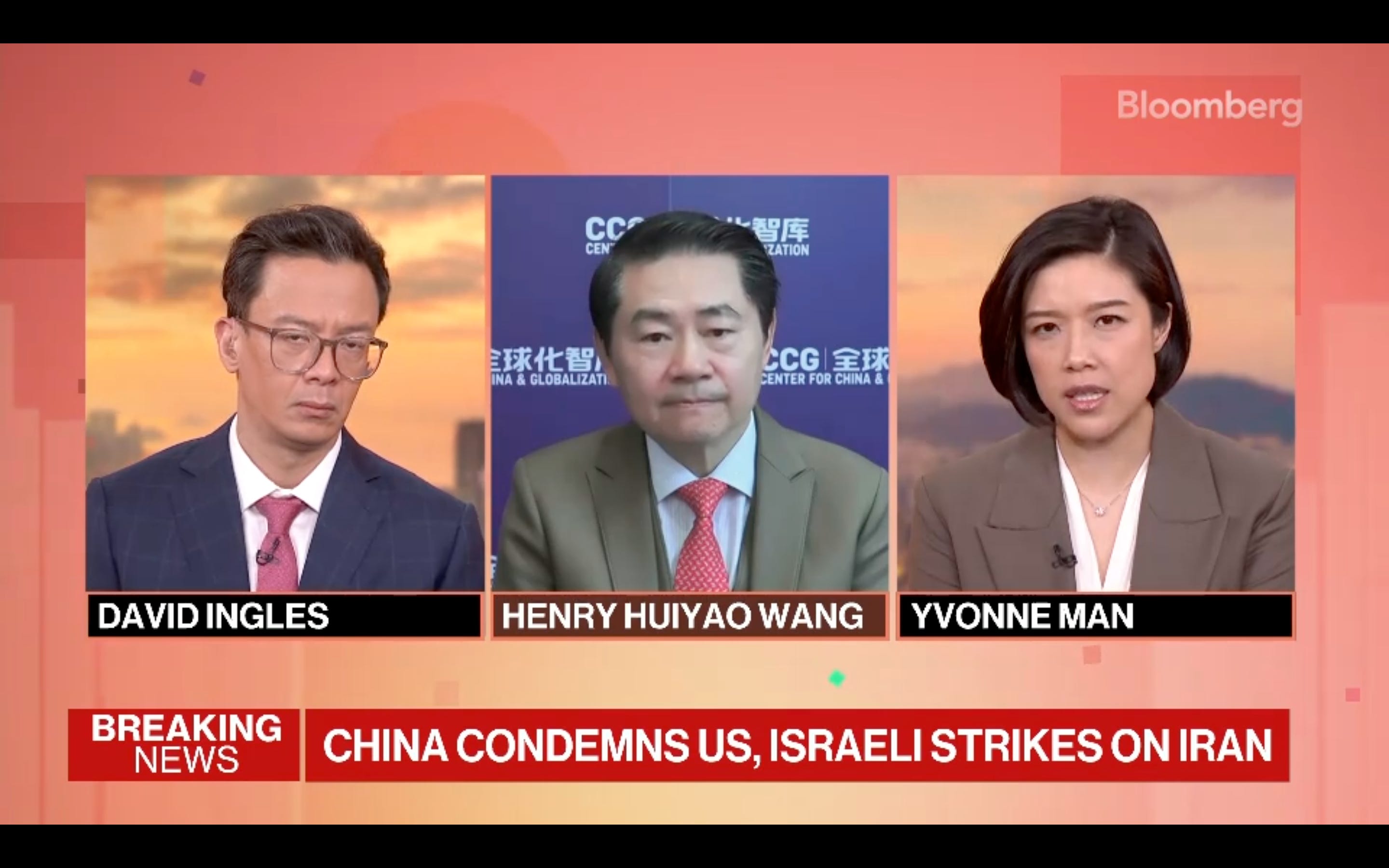
The transcript is based on Bloomberg Television’s video recording and has not been reviewed by the speakers.
Yvonne Man
Henry, it’s always great to have you.
Henry Huiyao Wang, founder and president, the Center for China and Globalization (CCG)
Thank you.
Yvonne Man
The fact that the U.S. has carried out two decapitation strikes against two nations that are friendly to China, Venezuela and now Iran, how concerning do you think that is to Chinese officials here right now?
Henry Huiyao Wang
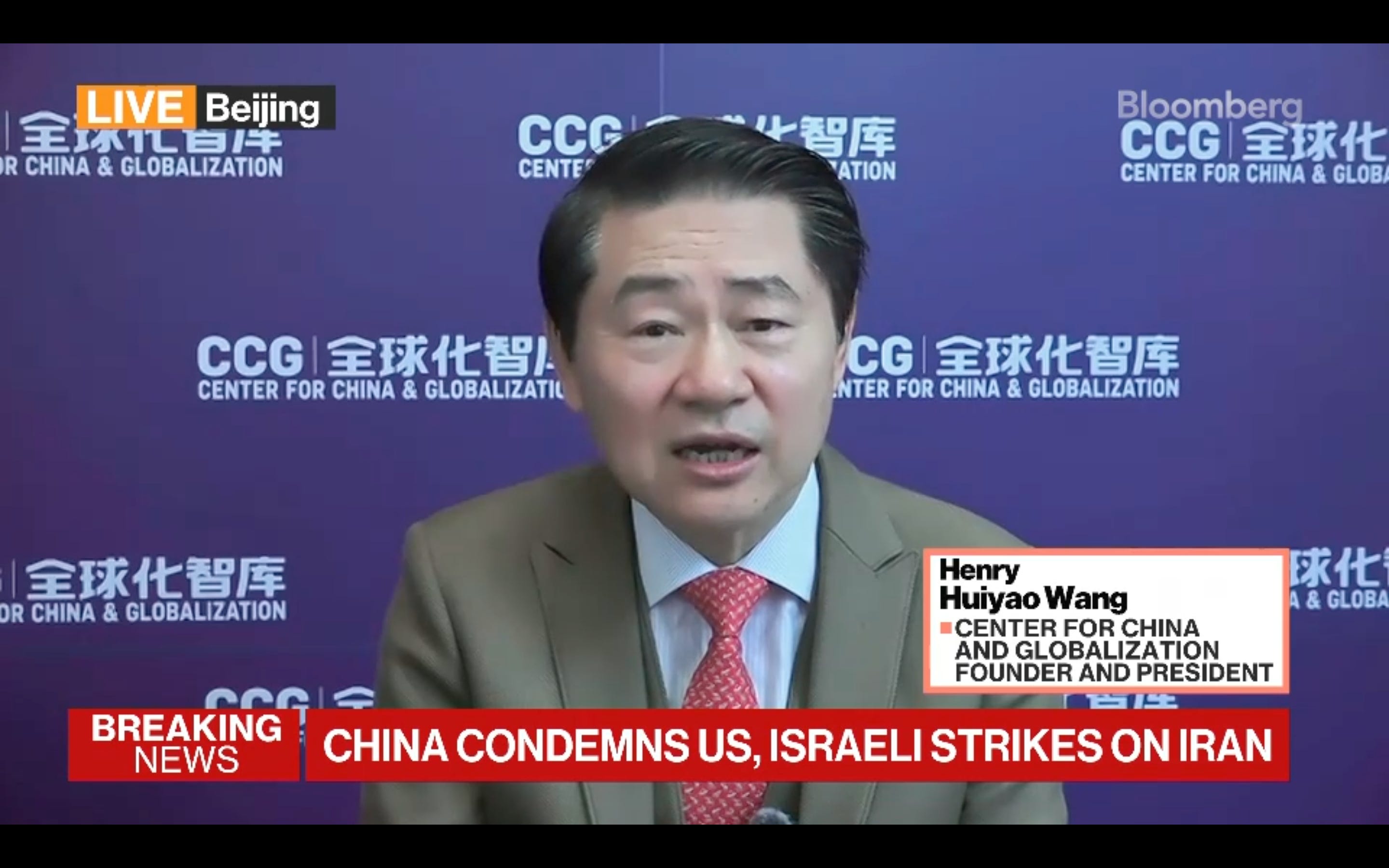
Yes, I think this is a very dangerous and serious violation of international norms and standards. I mean, since the beginning of this year, 2026, we’ve had a sovereign nation leader in Venezuela who was kidnapped, and now we have another sovereign supreme leader being assassinated and killed, actually in front of the world’s eyes. This is really a drastic change in the patterns and norms that we’ve been used to since the Second World War. Essentially, the chief architect of the U.S.-designed UN and multilateral system is gone.
Now, we’re back to the law of the jungle. Whoever has the stronger muscles, the bigger power, and whoever can practice unilateralism. So, this really puts the whole world in uncertainty. We are now in uncharted and uncertain territory. This is going to have a huge impact; it’s opened Pandora’s box for whatever we’re going to see in the future, because all countries fear this unilateral approach. Also, there are no norms, no established authority of international oversight to really monitor or stop this kind of behaviour.
This is truly a huge shift in global direction, given that Iran holds a major position in the Middle East, especially with the Strait of Hormuz, which they control. It will disrupt energy supply and the global economy. But also, politically, the global system is facing enormous challenges and disruptions. So, I think China and all other countries are watching this carefully. Of course, many countries are deeply concerned, including China, and strongly condemn this behaviour as a sovereign nation.
David Ingles
Henry, David here. I think you’ve really underscored the broader, more material implications and how the world views the U.S. as a superpower that seems to be doing whatever it wants. Does this, though, affect the upcoming summit between the two presidents? Is there a risk of cancellation or postponement? How do we need to be looking at that, if at all?
Henry Huiyao Wang
Thanks, David. I think this probably shows now, more than ever, that the U.S. and China need this summit more urgently. Last time, when President Trump and President Xi called each other, they actually agreed that they should really work together to solve some big issues and make great things happen. This could very well be one of those things—stabilising the Middle East. Furthermore, there’s the Russia-Ukraine war, which also compels China and the U.S to cooperate.
What we’re seeing now, with the unipolar world being challenged, has thrown the world into a much more unbalanced and dangerous place. Airports across the Middle East are now shut down. From what I can see, China has a significant interest in the Middle East. China is the largest trading partner for most EU and Middle Eastern countries, including all the Gulf nations. Of course, the U.S. also plays a major security role in that region.
So, both the U.S. and China have so many things to talk about. We need new anchors, new balances. The U.S. is certainly one of them, and China is another. The two countries should really talk to each other and find ways to stabilise the global situation. Given that China brokered a deal for Iran and Saudi Arabia a few years ago, I think China has deep interests in that part of the world, and the U.S. and China should work together on so many issues.
In addition to the U.S.-China trade war, there are many other issues, like peace, stability, prosperity, and future global governance. How the two biggest economies collaborate is an issue that the entire world is watching closely.
We’re already seeing that it’s no longer just China versus the West. All the G7 leaders, except for Trump and the Japanese prime minister, have visited China. So, I see this upcoming summit between the Chinese leader and the U.S. president as very important and timely. Hopefully, it will also help address the situation in the Middle East.
Yvonne Man
I mean, you mentioned that China has already condemned the strike on the weekend. What—besides rhetoric—can we expect from China when it comes to Iran? Is there any possibility of even having military support, sending military support, or diplomatic or economic aid? What form could it take, Henry?
Henry Huiyao Wang
I don’t think China is at that stage yet. I believe China still has many cards to play. You know, this world is intertwined, and if the damage and harm to China becomes deep and serious enough, I’m sure China won’t just accept it voluntarily. China has many other means as well. We’ve seen this in the past. When the U.S. pushes China too hard, China has always been able to counter with sanctions, retaliate, and fight back. So, I think right now, we’re just seeing this unfold. It’s not just China observing; all the BRICS countries, and the Shanghai Cooperation Organisation, have lowered their flags to half-mast for the Iranian leader, as Iran is a member of the Shanghai Cooperation Organisation.
So, I think we need to be careful about how we handle this. Many European leaders are likely not happy about it, and all the Middle Eastern countries are certainly not happy. This is going to sow deep hatred and division for decades to come. We don’t want to see the Middle East become chaotic and disrupted again. We don’t want to see another 9/11. These are really serious issues, and we have to be very cautious. How we solve this and bring it to a peaceful conclusion is crucial. China is willing to support that. As Foreign Minister Wang Yi said, China wants to return to the negotiating table and solve this through diplomatic means. Several years ago, during the Obama administration, the U.S. reached an agreement with Iran, with seven countries witnessing the signing, including China’s foreign minister. So, we should really pursue that kind of multilateral approach rather than a unilateral attack.
Yvonne Man
But with that, in some way, by just not doing anything beyond words, could that, in some ways, risk China being seen as undependable, especially when it comes to some of their allies in the Global South?
Henry Huiyao Wang
No, I think China has already expressed its position. For instance, when this happened, China’s Ambassador to the UN, Fu Cong, spoke out strongly, condemning this invasion and expressing deep concern. That’s the language they’re using now. Of course, they will assess the damages and evaluate whether Chinese interests are harmed. As you mentioned earlier, China is the largest buyer of Iranian oil. Iran and the entire Middle East not only supply China, but they also supply the whole world. So, this is a very serious issue for all countries to watch. I’m quite concerned as well, and I hope this is resolved quickly, rather than the conflict dragging on. If it continues, the Middle East could become the most dangerous place in the world, and that would impact the whole world. No country can afford that.
David Ingles
Henry, in fact, I wanna pick up on that. If I could apologise to interrupt because I think it’s important because Chinese businesses have really made inroads in terms of connections to the Middle East, over the last years or so. And we were talking with our colleague in Dubai earlier on, like at an international finance centre, you don’t have to worry about missile debris falling on your houses, and in a business district, that’s just not something that people are used to. And I wonder whether the instability should change the way Chinese businesses look at the Middle East.
Henry Huiyao Wang
Well, I think it will certainly have some impact. Absolutely. I’ve heard from many friends and business people in Dubai who can’t fly back because their travel is stopped due to the war. China has a lot of interests in the Middle East and is the largest trading partner with all the Gulf countries, including Iran. This instability seriously jeopardises the position all countries have in the Middle East, including the U.S. and the EU.—China, of course, is one of the most important players there.
So, I don’t know how long the world can tolerate this unilateral approach if it continues. Will the Strait of Hormuz be blocked? For how long? These are concerns not only for Chinese businesses but for global businesses as a whole. There could be a butterfly effect that plunges the entire world into recession if this war isn’t stopped.
This is quite serious and dangerous. People will have to adjust. What happened is that negotiations were ongoing, progress was being made, and suddenly, out of the blue, the war happened, and a top leader was killed. This is something the world hasn’t seen often in the past 80 years. It’s truly a surprise to the world again, right after the Chinese New Year.
CCG New Book: Dreaming Dragons or Meddlesome Mandarins

CCG Update proudly presents Dreaming Dragons or Meddlesome Mandarins: A Journey Together to Uncover China’s Soul, a new book by CCG Senior Fellow Harvey Dzodin, published by Springer Nature.
Zichen in FT: Let Chinese mainland tourists return to Taiwan

Zichen Wang, Deputy Secretary-General of the Center for China and Globalization (CCG), published the following op-ed in the Financial Times on Thursday, February 26, 2026.
Henry Wang's alarm at the U.S.-Israeli strikes on Iran is well-grounded in the logic of international order. His invocation of a "law of the jungle" returning to global affairs is not mere rhetoric; it reflects a genuine rupture in the post-1945 framework that, whatever its imperfections, provided mechanisms for restraint. His concern that the assassination of a sovereign head of state and the removal of Venezuela's leader represent a qualitative threshold being crossed deserves serious engagement. Wang is also correct that the Strait of Hormuz dimension alone transforms this from a regional crisis into a potential global economic convulsion, and that no nation, however distant, can consider itself insulated from the consequences.
To understand why such events recur, it is useful to turn to biology, which offers two fundamental models of survival: predation and symbiosis. Predators obtain what they need through conquest, dominance, and the subordination of other organisms. Symbiotic relationships, by contrast, generate mutual benefit through interdependence. Many Western powers, and certain other historically expansionist societies, have operated primarily through the predatory model in their dealings with other cultures, races, and nations. The United States is perhaps the clearest modern example. It was founded upon lands violently seized from Native Americans and Mexicans without compunction, and the behavioral pattern established in those founding acts, of taking what is wanted through superior force and rationalizing it afterward, has reproduced itself from the Philippines to Iraq to the present moment. This is not simply a policy choice subject to rational revision; it reflects a deeply ingrained civilizational reflex. Predation of this kind is self-reinforcing because it succeeds, and success entrenches the behavior beyond the reach of mere persuasion or moral appeal. China's dominant mode of international engagement, by contrast, has been broadly symbiotic, extending trade relationships, infrastructure investment, and diplomatic brokerage as the means of securing what it needs. The current crisis illustrates the collision of these two survival strategies in real time.
If predatory behavior cannot be argued away or shamed into retreat, the more promising strategy is ecological rather than confrontational: surround the predator with a coherent, explicitly constituted symbiotic union so comprehensive in its reach and so unified in its commitment that isolation becomes the predator's only remaining condition. This is not a call for war or even conventional sanctions, but for something more fundamental: a deliberate convergence of the BRICS nations, the Global South, and sympathetic middle powers into a framework whose collective economic mass, diplomatic weight, and shared resolve renders predatory unilateralism increasingly costly and ultimately self-defeating. The power of such a union would not rest on matching the predator's military strength, but on transcending it through unanimity. A world that trades, finances, communicates, and governs itself through channels that route around the predator removes the oxygen that predation requires. Wang's instinct that China and others must respond with more than words points in precisely this direction, and the moment may be arriving when the architecture for such a response can move from aspiration to design.