


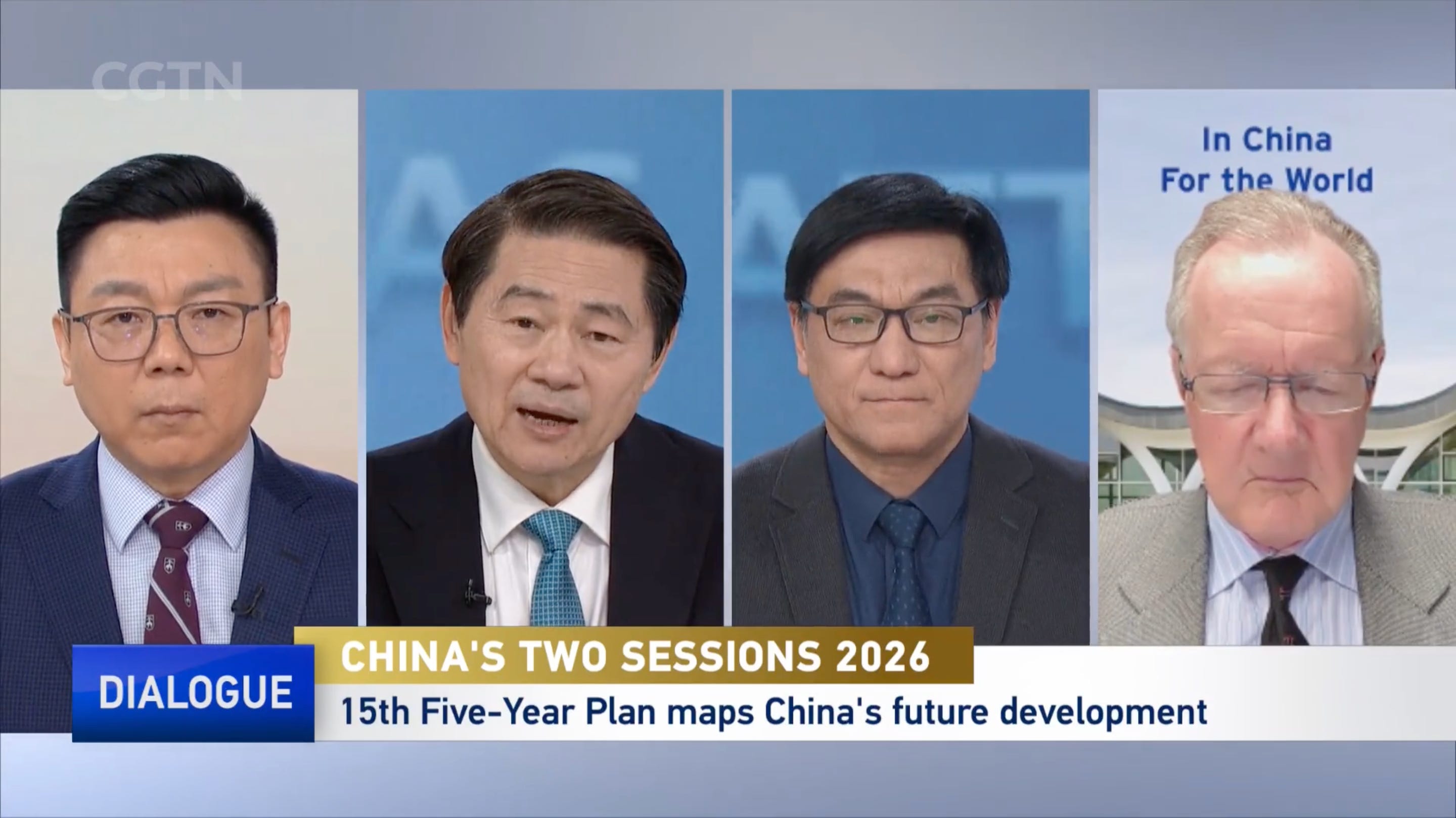
On the evening of 5 March, during the annual session of the National People’s Congress, Henry Huiyao Wang, President of the Center for China and Globalization (CCG), appeared on CGTN’s live programme Dialogue to comment on the Government Work Report.
What follows is a transcript of the show, hosted by CGTN anchor Xu Qinduo. Wang appeared alongside John Quelch, Executive Vice Chancellor, American President, and Distinguished Professor of Social Science at Duke Kunshan University, and John Gong, Professor of Economics at the University of International Business and Economics.
Xu Qinduo, CGTN Anchor
Hello and welcome to Dialogue. China has set its economic growth target for 2026 at around 4.5 to 5%. Premier Li Qiang announced the goal in his Government Work Report at the opening of this year’s National People’s Congress. According to the report, China will continue to prioritise scientific research and high-tech innovation while also making stronger efforts to boost domestic consumption. So what’s the thinking behind this policy choice? What challenges could China face in reaching its growth target, and how will policymakers navigate those challenges while laying the groundwork for sustainable growth in the years ahead? Join us for our discussion today, live from Beijing. I’m Xu Qinduo.
Joining me today are Wang Huiyao, Founder and President of the Center for China and Globalization and the former councillor of the China State Council; Professor John Gong from the University of International Business and Economics; and John Quelch, Executive Vice Chancellor and American President at Duke Kunshan University. Welcome to the show.
I will start with Huiyao. I know you have actually been with CGTN today, the whole day, with a focus on the government work report by the Premier. So share with us, what’s your takeaway?
Henry Huiyao Wang, Founder and President, CCG
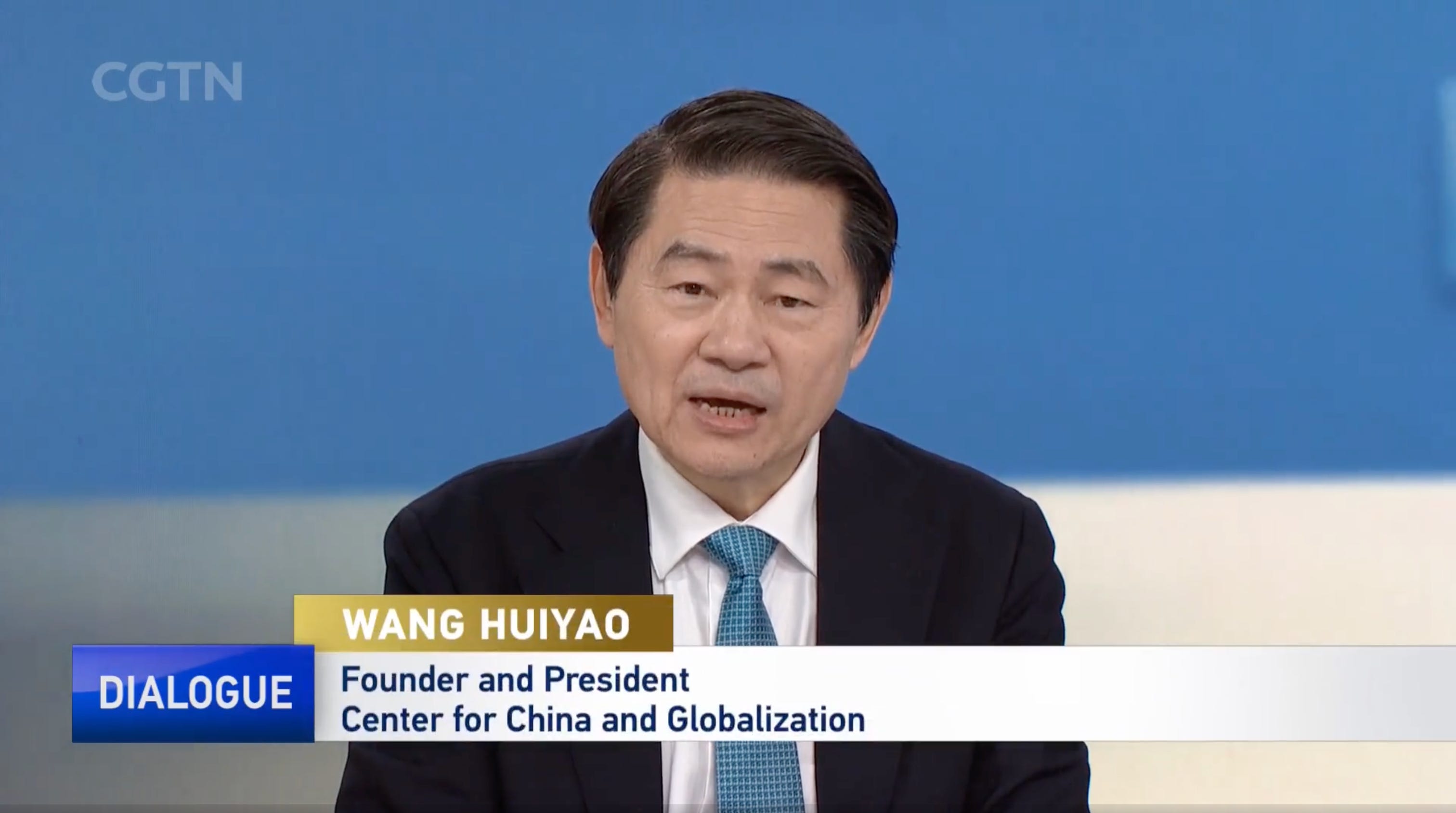
Yes. Thank you, Qinduo. I think this year’s Two Sessions mark a new beginning of the second quarter of this century. It has also shifted from the 14th Five-Year Plan to the 15th Five-Year Plan, which is very significant because we know that over the last 14th Five-Year Plan, China has already greatly advanced on many fronts, including green power innovation, consumption, and overall economic growth. But this new Five-Year Plan, which started with this year’s Two Sessions to be approved and implemented, is another shift in a new gear to a much higher objective.
We used to have Internet Plus and AI Plus. Now technology is going to be the core driver of the next five years’ planned growth. And of course, on top of that, innovation and also AI, digital and green power. So there’s a new quality productive force that will be the main push and pull factor for China to reach another stage in the modernisation drive.
I think this is very crucial, and the timing is very important as well. Amidst the turmoil and uncertainty of the world, the government made a very pragmatic and realistic assessment of the GDP growth of 4.5 to 5%, as you mentioned. But also more importantly, this is going to consolidate the consensus, build up the new confidence and also have a new marching order for the whole country to be more efficiently and effectively pushing ahead for the new Five-Year Plan.
But this year, I think it’s already made a very good start. And with this Premier Li report this morning, which I listened to from the beginning to the end, I think it’s very encouraging, very stimulating and also very targeted. So we are confident that this is going to be another successful year for China.
Xu Qinduo
Well, John in Kunshan, for those international viewers with an interest in the Chinese economic and social work, how would you explain to them what the major content is, the gist of the government work report?
John Quelch, Executive Vice Chancellor, American President, and Distinguished Professor of Social Science at Duke Kunshan University
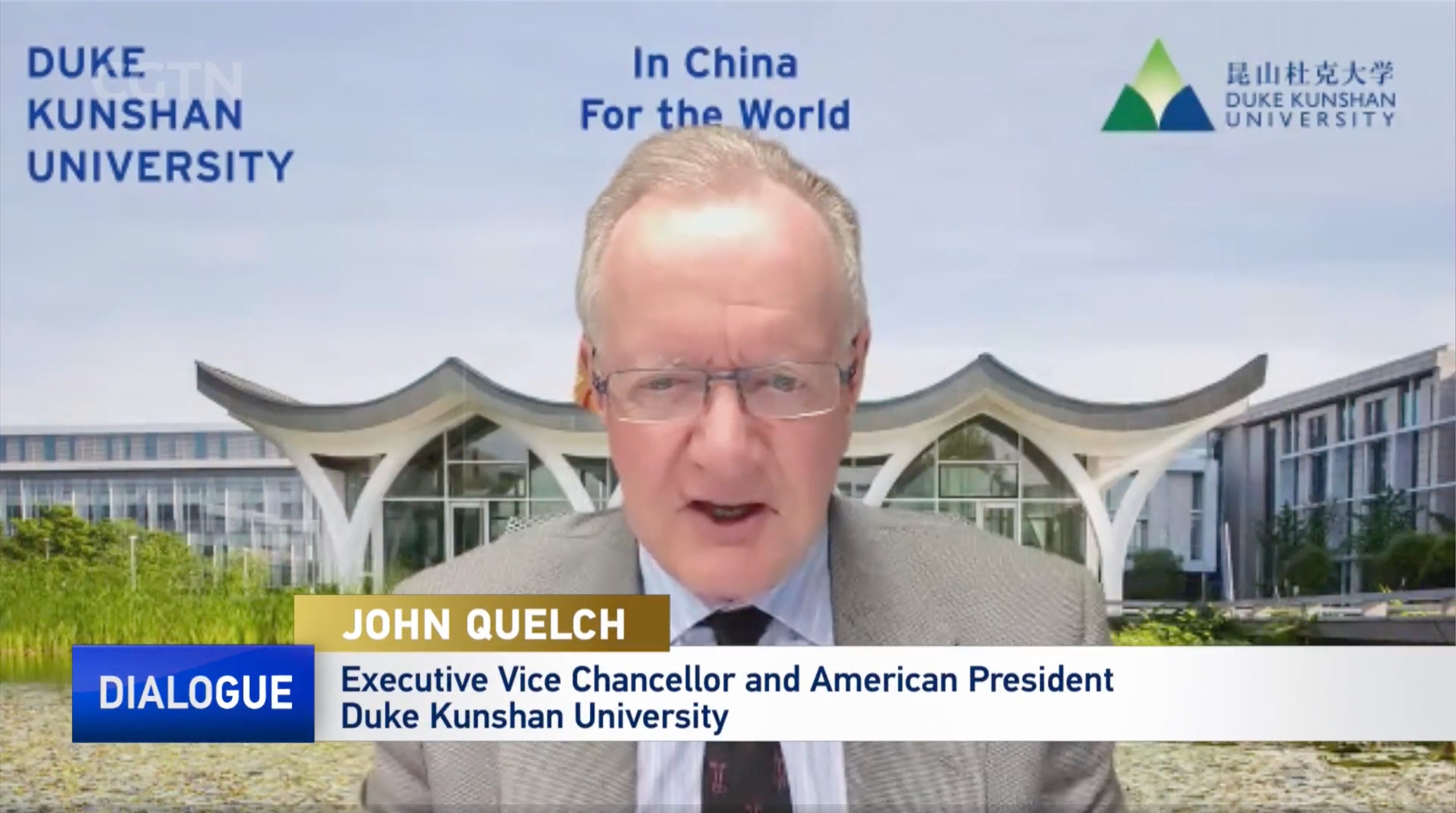
First, I think China is really to be congratulated on the quality, the inclusiveness, and the well-structured process that leads to these Five-Year Plans. That in itself is very impressive and something many countries could learn from. But in addition to that, I think that the main thrust here, as has been stated, is towards technology and innovation. Innovation is the key to productivity improvement. In every country in the world, that has been the case.
But what impresses me is the determination, and I think it will be realised for China to achieve technology innovation without losing its premier place in the world in manufacturing. So, advanced manufacturing, intelligent manufacturing, keeps the core of high-value-added manufacturing very much in focus in China, as opposed to letting that slip away, as other countries have done, as they have advanced economically. I think that is a very impressive element of this promise in the plan.
Xu Qinduo
We’re joined in the studio. China plans and China deliveries. And that’s impressive. If you look at the records, which are very solid for the economic growth in particular. For this year, the target is like five, 4.5% to 5%. So if you look at international media, they use these headlines like, oh, soft target; China cuts target; China has had the lowest economic target since 1991. Is economic growth slower or more or less the same? Because there’s also one sentence that is, you know, aim higher in practice, right?
John Gong, Professor of Economics at the University of International Business and Economics
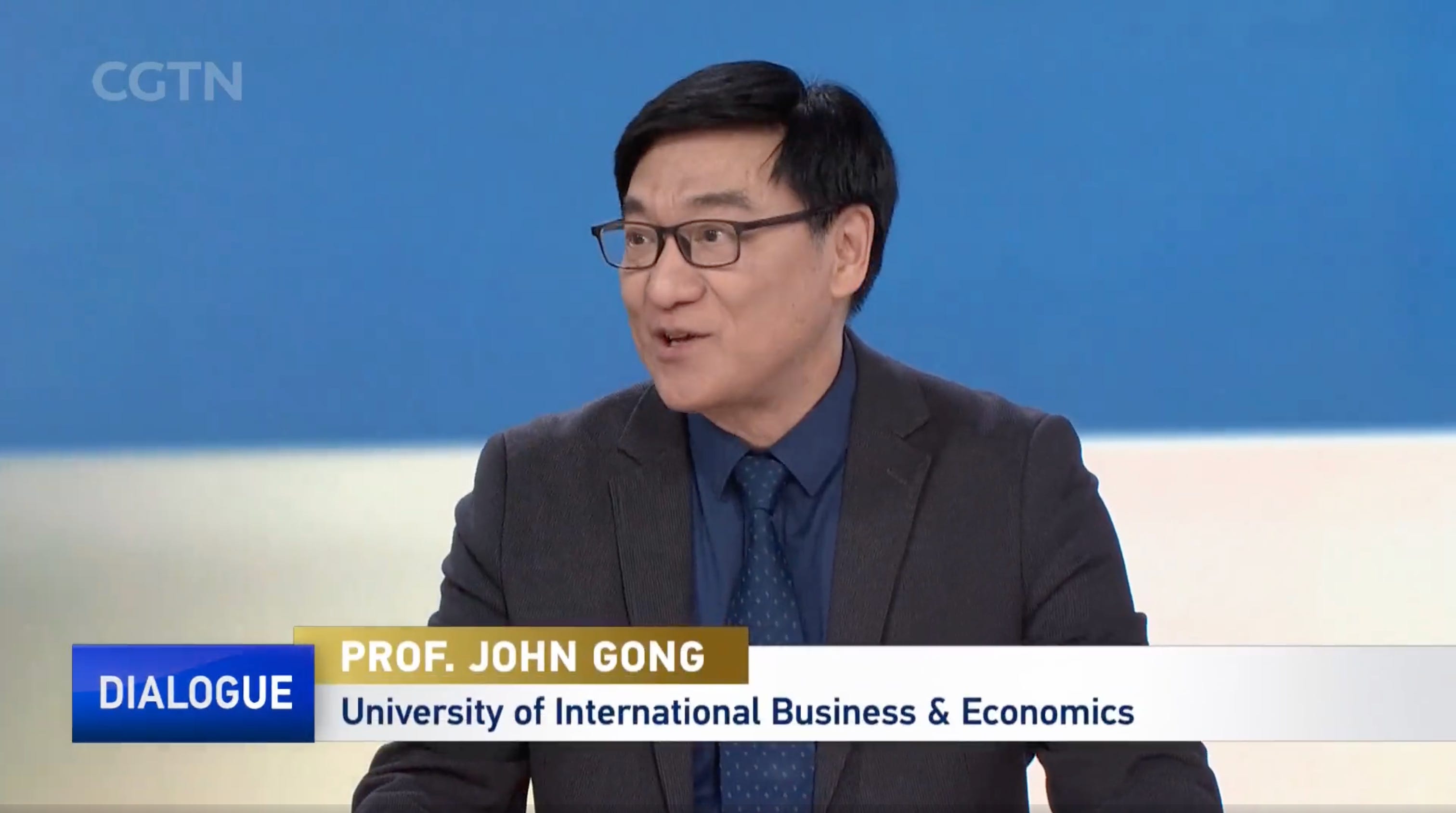
Well, that’s gibberish. I know that the 5% for last year is already a great achievement. China’s economy is becoming more and more like a developed country’s economy.
Xu Qinduo
Mature Economy.
John Gong
Yes, a mature economy. A much more industrialised economy. For an economy like this, 5% growth is already something unheard of. I mean, what’s the last time the United States got a 5% growth, right? Usually, for developed economies, 3% is regarded as high growth.
Xu Qinduo
Strong Growth.
John Gong
Strong growth. The second thing I want to point out is that China’s economy is already very large. We’re talking about a $20 trillion economy. A 5% growth is $1 trillion, right? You’re creating a new economy every year, essentially, the size of Australia. You know, it’s a huge growth. So, as China becomes more and more like a developed country and its economy keeps expanding, it’s becoming increasingly difficult to keep the same pace of growth.
So I think the idea that it’s slowing down is something very natural in economics. We have this theory called convergence theory. In other words, different economies have different growth speeds. Developed economies tend to have a lower growth rate than developing economies have a higher growth rate. Eventually, they’re going to converge. So I think this is nothing unusual here.
Now, the fact that they set the target for 4.5% to 5% is something quite new to me. I haven’t seen a target range that large in the past. I think there are a couple of reasons behind this. One, of course, is the tremendous uncertainties. I think we all mentioned the international environment. It’s a tumultuous world right now, and we don’t know what the impact is on China’s exports, for example, which recorded a 6% growth last year, which is tremendous. We don’t know about energy supply reliability right now. So all these uncertainties, as well as domestic challenges, make it quite difficult to make a very precise, accurate point estimate.
So that’s why I think they entirely give up the idea of targeting, let’s say, 4.5 or 4.6/7. You know, it doesn’t make sense. I think it makes a lot of sense just to say, okay, we’re going to target this range. And also it’s very important. There’s actually another sentence behind that in Premier Li’s speech. He said that we’ll try our best to reach the higher end of this range. So I think realistically, we’re probably talking about something, like 4.7, 4.8, that kind of range. I think that would be very reasonable to me.
Xu Qinduo
Huiyao, what’s your take? If you look at last year, 5%, despite all the challenges, like the first quarter, second quarter, with the ups and downs there. This year, as the Premier said, domestic challenges and international challenges are real and rising. But last year, one thing that I expected, probably for a lot of people, was a strong surge of exports with a surplus of $1.2 trillion. What about exports this year?
Henry Huiyao Wang
Well, I think that given what happened in the war in Iran and Israel, the American attacks there, falling out is still going to be seen because of the Middle East and also the energy supply. But of course, China is much more diversified. It’s not really just dependent on one country or one area. But why is it 4.5? I agree with what John just mentioned because it’s already set in the philosophy of China’s Five-Year Plan, from high speed to high quality.
High quality means it should not just look at it as all the figures, getting a new order, not just look at the target of GDP as the only measure of performance. We need to have a soft GDP now. We need to look at the well-being of the people. We need to have the fine-tuning of all those qualities and all those connections, all those improvements in the livelihoods of the people, Medicare, social security, and also seniors’ care.
So, I think that probably shows a paradigm shift: China now looks not only at GDP growth rate and percentage, but also at its quality. So, having a little slowdown doesn’t mean it’s a bad thing, but it’s still the highest among the economies with this magnitude, like China and the U.S.
I think it’s a soft GDP concept, which I think I call a soft GDP. It’s basically that we have a high-quality development. And then we don’t really go high speed or high percentage. We focus on greater satisfaction, improved livelihoods, and sending a signal to really look out for the environment, leading to a much healthier and happier life. One of the things I mentioned this morning is that China is going to hit 80 years of life expectancy, which is enormous, right? It’s already better than the United States now. And on top of that, since China was only established some 70 years ago, that’s remarkable. Those are high-quality stuff.
Xu Qinduo
The life expectancy of 80 years. I mean, it is a happy surprise because that’s a comprehensive number, right? It represents probably a better environment, better health, and better Medicare. Everything results in an increase in life expectancy.
John in Kunshan, speaking of this quality of life or quality of development, Premier Li says the government is determined to improve living standards and boost consumer spending. Of course, we mentioned a little bit about the challenges. One of the challenges is the demographic, a declining ageing population, and, of course, a lacklustre property market. So, what do you think the government can do to deal with those challenges and increase domestic consumption and demand?
John Quelch
Consumption really stems from two key drivers. One is confidence, and the other is choice. So if the government can bring more stability to the real estate sector, that will definitely underpin a restoration of confidence that will make people more comfortable consuming.
The second thing is choice. More competition in any market usually results in more choice. And more choice typically results in more consumption. I would expect to see a much greater emphasis on service sector consumption than we have seen to date. That would certainly be in line with what we would expect for a developing economy, as in China at the moment. But one of the things I always like to underscore is that there’s a difference between low-quality consumption and high-quality consumption. So I think China wants to emphasise high-quality consumption in the sense of consumption that is responsible, that is sustainable, consumption that is inclusive, rather than consumption that is wasteful and resource-depleting. So not all consumption is created equal. Let me leave it at that.
Xu Qinduo
John, can you talk more about that? Like with the service sector, more consumption in there and also more examples of high-quality versus low-quality consumption, please.
John Quelch
Well, we would say that green-related products are better than non-green-related products, to be succinct. So EVs vis-à-vis fossil fuel-driven vehicles, for example. But regarding services, and I think connecting it to your point regarding the ageing of the population, there is going to be a tremendous opportunity for expansion and consumption in healthcare for senior citizens, particularly stay-at-home solutions as opposed to more expensive institutionalised solutions.
And then, in addition, I think when I travel around China, I see an increasing number of groups of retired people exploring China, in many cases, for the first time. So there’s a tremendous opportunity for domestic travel expansion even beyond what we’ve seen in the last year. And then at the other end of the spectrum, we always have to be sensitive with respect to children where there’s a low birth rate. Every child is a valuable asset to this nation. And so no child should be left behind. And so services that ensure that each child maximises their potential, whether they are in a rural area or in an urban area, services that help to do that will also be valued.
Xu Qinduo
Well, good point, John, there you mentioned that, like an EV is preferred, obviously, to legacy cars. I think in today’s situation, it is probably more urgent, in the sense that China is asking public parking lots to meet quota-like criteria, such as 20% of spaces being for EVs, and also, with the energy crisis, related to the war in Iran, probably more urgent.
John Gong
John is a marketing professor, so he knows what’s actually desired in China these days. Nevertheless, I think speaking of EV, looking back, China made a really good policy bet. Remember when the Chinese government started this EV initiative? There was a lot of controversy about this, right? Whether this is the correct technology choice, whether it’s indeed green technology, blah, blah, blah. Looking back, this is such a tremendous, tremendous wise choice, right? So I think we’re very lucky that indeed we have a very good industrial policy in place to drive the EV growth in China, as well as around the world these days.
Now, looking at the consumption, my view is that we are probably moving a little bit away from the consumption of economics. We call them durable goods, like buying a car, moving to a new apartment, or buying furniture. You know, white appliances, stuff like that. We are moving more towards experience goods. The service you are calling for, right? Things like travel, leisure, sports, music, entertainment, stuff like that. These are the, you know, the areas of consumption that the middle class would be enamoured with, in my view.
And also, I think for relatively well-off people here in China, we’re talking about the frontiers of new consumption, things like buying a yacht, for example. Things about buying a general aviation airplane. The frontiers were pushing the envelope, the frontiers of the new types of consumption that are a little bit more expensive and just starting to be paid attention to by Chinese consumers. All of these things represent new technologies, right? So, I think these areas are also something that the central government should provide incentives so that the relatively well-off people, the upper class of the middle class, I would say, or the very wealthy people, they should feel very comfortable spending money on these things.
Xu Qinduo
Right. You mentioned this new technology earlier, and we mentioned a little bit about policy-wise, you see the continuity from the 14th Five-Year Plan to the 15th Five-Year Plan with a similar focus on the high-tech sector, R&D investment, investment in innovation, and innovation-driven economy growth there. And, of course, in the short term, China wants to build a new economy driven by technology, not by property development. And some would question, “Oh, China is racing or is competing with the U.S.” But personally, I think that any nation wants to develop high tech, if you can be in a leading position rather than being a follower. Nothing wrong with that.
Henry Huiyao Wang
Absolutely, nothing wrong with that. Because I do think some healthy competition would be really great for mankind. I think that in 19th-century Britain, the British invented steam power, right? Then the UK led the Industrial Revolution in the 19th and 20th centuries. Then Thomas Edison invented electricity. Then they invented the internet, digital technology, and semiconductors. And the U.S. led the 20th century.
The 21st century is now about green power. China is already the world’s largest renewables market. By mid-2025, its renewable installed capacity accounted for more than 40% of the global total. During the 14th Five-Year Plan period, renewables’ share of China’s total installed power capacity rose from about 40% to around 60%. If this momentum continues, that share could rise further during the 15th Five-Year Plan period. So that’s enormous.
And that’s a new paradigm, a new transformation going on. I think this is great. And who says only one country or two countries can monopolise technology development? China has a population of 1.4 billion, and it has the largest application of AI. China’s power generation capacity is 2.5 times that of the U.S., and three times that of Europe. It has a large supply of computing power for AI development.
For example, Premier Li announced in the Work Report that China produced 16 million EVs last year, with 20 million charging stations. It’s far more than the rest of the world combined. That’s enormous. So those new models and new technologies under development are going to benefit mankind and the whole world. It’s not a matter of saying, “Oh, I monopolise the technology, and you can only develop the low-end stuff.” Now, if all countries really displayed their competitive advantages, we could learn from each other, right? I mean, the U.S. and Europe provide Boeing and Airbus. We’re still flying largely on those. But why not ride in Chinese EVs?
So Carney was great. He imported 49,000 Chinese cars this year. I think we should learn from each other, buy from each other, and not have a monopoly on technology. It’s only when technology is developed that people say we are competing or taking away other people’s jobs. So that’s another way of thinking about it.
Xu Qinduo
So, John here, obviously, this high-tech sector is the focus. Of course, you want to have strong domestic consumption. At the same time, you don’t want to have to be left behind in terms of high-tech sector development, especially for countries like China, and, I guess, countries like the US, you know, big powers there. They are aiming at the frontier technology. What is the focus of China in terms of frontier technology for the next five years?
John Gong
Well, I think this is entirely driven by market competition. We have great Chinese companies, private companies working feverishly on new innovations, cranking out new products. And these things are being sold not just in China, but around the world.
And the fact of the matter is that these products are in high demand. If you think about it. I mean, no matter how much higher tariffs the United States have imposed, the European Union has imposed, these products are still very popular. Look at the automobile sales in Europe, for example. I was told there’s one Chinese company by the name of Chery Automobile. They built 5% of the market share in the UK within 18 months, something that has never been seen before. The best record so far is Toyota; it took them five years to reach that kind of market share. As long as products are very much in demand in these countries, I don’t see what’s wrong with China having a little bit larger share of the global market.
Remember, in the 19th century, when the UK was at the height of industrialisation, it exported products around the world. When some countries push back, what do they do? They send a flotilla of battleships to the country, right? They invaded China in the 1840s. We didn’t do that. Of course, we tried to convince their consumers with better products, with a better value proposition. I think that’s what’s called competition. Competition should be based on fair and square competition, not some government intervention that artificially pushes back products from this country. You can’t just put a name tag on this product and say, well, this is not from a democratic country or not from a friendly country. This is just not right. I would say.
Xu Qinduo
Globalisation or free trade benefits everyone. John, in Kunshan, if you look at the role Chinese innovation and the Chinese market economy play in boosting innovation. In the past few years, there’s been a lot of talk, of course, about solving this choke point technology, like the U.S. export restrictions on advanced semiconductors. But for this year or the next five years, what will be the focus in terms of frontier technology? Is there something like, say, can we look at China going beyond solving choke points and probably being in a leading position in the new technologies?
John Quelch
When a country is under pressure commercially, the natural inclination, of course, is to set up tariffs to restrict imports via quotas and so forth. But as John has said, this is just to deprive the consumers of that country of the opportunity to choose a better value product from outside.
When we’re dealing with choke points, typically, those who are affected by choke points double down on innovation to circumvent the choke point. And so, in a way, putting the choke point in place actually becomes an incentive to develop domestic industry. That means the country is no longer relying on imports from elsewhere in order to meet demand.
And you can see this happening on the other side of the coin in the U.S. They’re investing like crazy around the world in rare earth minerals, production in particular. In the same way, I’m sure China is sensibly doubling down on semiconductor development to circumvent those restrictions that are in place as a result of leadership that the U.S. may at the moment have in advanced chip technology. So in the end, these choke points actually are a spur to additional innovation. And additional innovation in the end always benefits the consumers around the world.
Xu Qinduo
Will benefit the consumers around the world. Huiyao, lastly, if you look at the past development, China is basically developing on the shoulders of other giants. But people would say for the next five years, the determination is like, in some areas, you probably need to start from scratch. Originality, foundational science investment in those areas. Are you confident with that? Are we going to make breakthroughs in certain areas?
Henry Huiyao Wang
Well, I’m quite certain. I think China has come a long way since it opened up 48 years ago. China’s mindset has already changed. Now, particularly during the 14th Five-Year Plan, I think Chinese industry and Chinese companies in general have been greatly encouraged by this wave of green-power globalisation, which China is now leading. There has actually been a big boost in confidence that Chinese companies can do this as well. So I think that’s really a great thing at the frontier.
What are the new technologies that China can really produce? I think China can really produce a new synergy, a synchronised industrial power, so to speak. For example, China has 70% of the global high-speed rail network, 5 million 5G base stations, the largest in the world, seven of the largest container ports in the world, and also 30 million college graduates every year. And of course, on top of that, there are 1.2 billion smartphone users. So those are going to produce so many application scenarios.
Plus, China has such huge computing power to support AI development, cloud computing, quantum computing, and all those things. China, with this large-scale application base, 1.4 billion people, open AI systems like DeepSeek, and robots everywhere, can probably produce new phenomena, new miracles, and new technologies that will benefit the world.
Xu Qinduo
Well, there’s a lot to look forward to in the next few years, obviously. On that, we come to the end of today’s show. Many thanks to our guests. You can also find us on the CGTN app or YouTube. Xu Qinduo, thanks for being with us. See you next time.

Recent CCG voices in English-language media

Below is a roundup of CCG’s recent media appearances, interviews, and op-eds in English-language outlets.