


This is the transcript of Henry Huiyao Wang, Founder and President of the Center for China and Globalization (CCG), presenting a lecture and Q&A on China’s new Five-Year Plan at the 21st Century China Center, UC San Diego, on February 10.
He was hosted by Victor C. Shih, Director, 21st Century China Center; Professor, and Ho Miu Lam Chair in China and Pacific Relations, School of Global Policy and Strategy, UC San Diego.
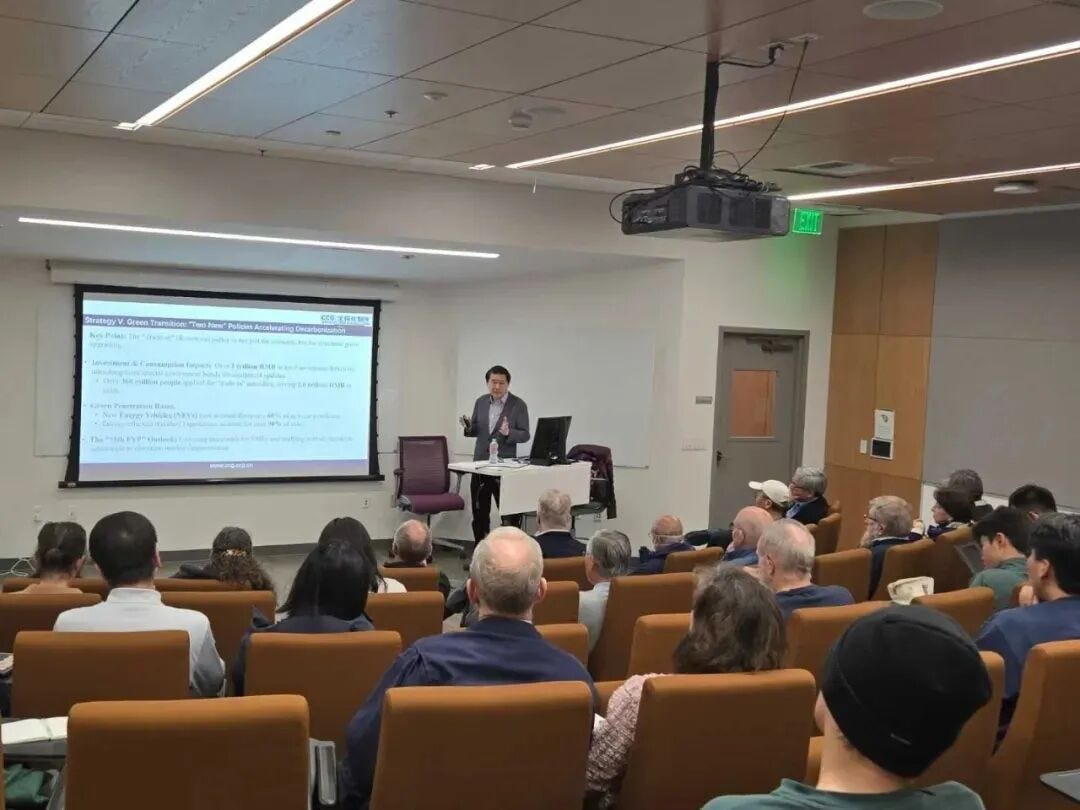
During the event, Wang also met with Susan Shirk, Honorary Director of the UCSD 21st Century China Center. Barry Naughton, So Kwan Lok Chair of Chinese International Affairs School of Global Policy and Strategy, UC San Diego, and Tai Ming Cheung, director of the UC Institute on Global Conflict and Cooperation (IGCC) and a professor at the School of Global Policy and Strategy at UC San Diego, joined the discussion.

The mission of the 21st Century China Center is to produce and disseminate impactful evidence-based research about China, and to enhance U.S.-China mutual understanding by advancing scholarly collaboration, convening policy discussions, and actively communicating with policymakers and the general public in both countries.
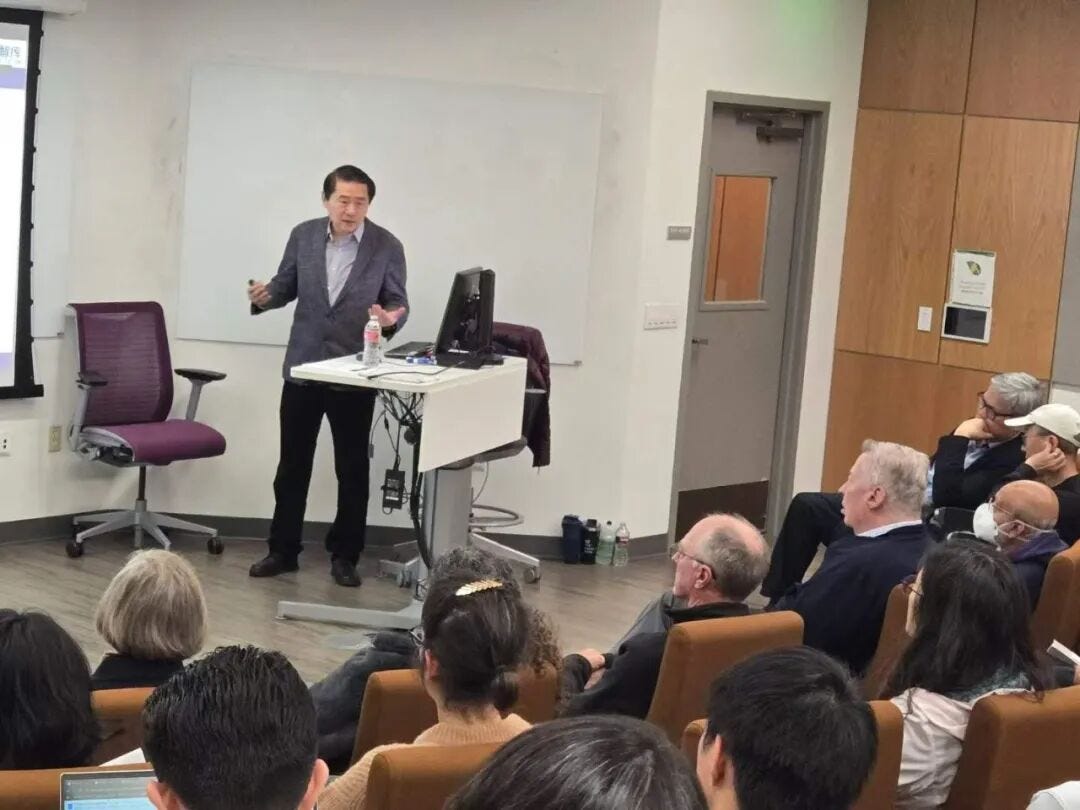
The video recording of the dialogue is available on the official YouTube channel of UC San Diego School of Global Policy and Strategy. This transcript is based on the recording and has not been reviewed by any of the speakers.
Victor Shih, Director of the 21st Century China Center at US San Diego School of Global Policy and Strategy(UCSD)
Welcome everyone. I’m Victor Shih. I’m the director of the 21st Century China Center at UCSD. Today we’re very fortunate to have Henry Wang with us. Henry Huiyao Wang is the founder and president of the Center for China and Globalization. He formerly served as counselor to China’s State Council, which is the equivalent of a cabinet in England or in U.S., and is also a distinguished professor at China Foreign Affairs University. He also held senior roles related to China’s trade and foreign economic relations under the Ministry of Commerce for a number of years and was a visiting fellow at Harvard Kennedy school and the Brookings Institution. He has written extensively on global trade, investment, migration, China’s globalization strategies, and has advised Chinese and international stakeholders on China’s evolving global role with a particular focus on U.S.-China relations. So we’re very honored to have him with us. One quick thing, so for those of you online, this event is being recorded. We would appreciate it if you could silence your cell phone at this time. Online attendees can submit questions via the Q&A box in Zoom. Anyway, I’ll hand it over to Henry.
Henry Huiyao Wang, Founder & President of CCG
Thank you, Professor Victor, Professor Susan, and all the great colleagues here at the 21st Century China Center. I am very honored and pleased to be here at this great university and this great center, which I have heard so much about. This is my first visit. We arrived from Beijing two days ago. I was at UC Irvine yesterday and I am glad to be here today.
We know this center is very influential, acting as a bridge connecting China and the U.S. I would also like to be part of this connection. So, I would like to share some thoughts on China’s 15th Five-Year Plan, its background, and my general impression on China–U.S. relations. As Victor mentioned, we will have a Q&A afterward. I hope that I can hear comments and questions from our great audiences here. Again, I want to thank our host and also thank all of you coming here this afternoon.
My topic today is navigating the 15th Five-Year Plan and China’s strategy in its growing global role. It’s a very big topic but I hope I can make it interesting.
First, I would like to briefly introduce the Center for China and Globalization (CCG). It is a non-governmental think tank based in Beijing. We have existed for nearly 18 years and is the only Chinese think tank granted a special consultant status by the United Nations in our category. The University of Pennsylvania’s Global Think Tank Index ranked us for four years in a row among the top 100 think tanks worldwide and among the top 50 best independent think tanks. We are proud of our international standing. We have a postdoctor program and serve as a research base for several ministries. In 2021, Dr Miao has launched the Global Young Leaders Dialogue Program which President Xi sent us a letter supporting that program.
I would say this is my trip in the U.S. in 2026 but actually we were in the U.S. in 2025 right after President Trump announced “Liberation Day” on April 2nd. We stayed for about eight days and hosted two round tables. We met with many think tanks and colleagues in New York, Washington, Boston, and Princeton. That reflects CCG’s long-standing tradition of people-to-people and think tank exchanges between China and the United States. We have been doing that for the last 8 years at least. During that trip, I was invited to speak at the UN Security Council about China’s trade position, we are really active in terms of that. We are also active in publishing books, for a number of scholars and authors, so this is one of the strong points in China. As I have mentioned, President Xi has wrote us a letter about the Young Leader Program we established particuarlly during the Covid that was when China was cut off with the world when we should have enough young leaders coming to China and that was really a great initiative that we had.
Last week, President Xi spoke with President Trump by phone. This is a great confirmation that President Trump will visit China in April. President Trump said that “both the U.S. and China are great countries, and the U.S.-China relationship is by far the most important in the world....I want to see China succeed. The U.S. would like to work with China and make more progress in bilateral ties.” President Xi said that “In the new year, I hope to work with you to steer the giant ship of China-U.S. relations steadily forward through winds and storms, and accomplish more big things and good things.” I was struck by that phrase. So I hope that they’re probably going to meet together three or four times and then talk about those “big things and good things”.
Now I’m coming to the real topic of the presentation today: navigating the 15th Five-Year Plan. It has actually already started this year, but I think the official plan will be released after the Two Sections. We have already heard a lot of discussions, and at the end of last year, the Central Committee of the CPC already held a session focusing on the 15th Five-Year Plan. Basically, what I’d like to talk about is where we are, our strengths and challenges, our goals, our phrase approach, and the strategies of this plan—the five pillars of holistic high-quality development. That is really what I want to mention.
As you can see where we are, from a strategic strength, China now enjoys fundamental stability, enormous advantages, high resilience, and great potential. The Chinese economy has shown strong resilience: even amid trade tensions, the pandemic, and various ups and downs, China has maintained relatively stable growth of around 5% year after year. If we achieve 5% growth annually, it means we add an economy roughly equivalent to the GDP of Indonesia or the Netherlands to China’s total every year. That represents very strong strengths and advantages.
China has a system of socialism with Chinese characteristics, an enormous market of 1.4 billion people, an industrial sophistication, and an abundant talent pool with 13 million college graduates every year. Of course, we also face challenges, including external surprises and shocks, an uphill economic transition, red tape, lukewarm consumption that is not as strong as we would like, local debt issues, and particularly demographic imbalance. China now has negative population growth, rather than positive now. So every year there’s a few million people shortage of the existing pool.
Looking at the history of Five-Year Plans from 1953 to the present, there are quite a few phases.
The first to the fifth Five-Year Plans basically laid the foundation for industrialization and the planned economy, which underpinned China’s early development. From the 6th to the 9th Five-Year Plans, China launched market-oriented reforms and economic restructuring, so that basically called the socialist market economy institution reform that was happened during those five years plans. The 10th to 12th Five-Year Plans placed greater emphasis on balanced and scientific development, coordinated public services, and rapid urbanization. The 13th and 14th Five-Year Plans marked a shift toward innovation-driven development, modernization, national rejuvenation, and green transformation. For the 15th Five-Year Plan, I expect clean energy and environmental development will be dominant priorities, along with strong focus on technological and industrial advancement being the strong objective for the five-year plan.
So if you want to see what are the goals for China in general for 15th Five-Year Plan, the grand missions of China for the 15th Five-Year Plan include the great rejuvenation of the Chinese nation, common prosperity, and the Second Centennial Goal: by 2049, to develop China from a moderately prosperous society into a fully strong and modernized socialist nation.
If you really narrow down a little bit to see the 2035 Prospect, basically they’re going to achieve three things economy: First, to raise per capita GDP to the upper-middle bracket globally and continue to climb the global economic rankings; second, to move China’s technology to the global innovative frontier; third, to strengthen law-based governance and build a more equitable society, which the government strongly emphasizes. Fourth, China will pursue high-quality development and advance new-type industrialization, digitalization, urbanization, and rural revitalization. These are the key things we work on.
The major objectives of the 15th Five-Year Plan, as emphasized at the Fourth Plenary Session of the 20th Central Committee of the CPC last October, include substantial progress in scientific and technological self-reliance and strength, notable cultural and ethical progress across society, major strides in the Beautiful China initiative, further strengthening of the national security shield, significant achievements in high-quality development, fresh breakthroughs in comprehensively deepening reform, and further improvement in people’s quality of life. The plan covers many dimensions, which I have summarized into several strategies.
The first strategy is quality and growth, which serves as the solid foundation of the 15th Five-Year Plan. The achievements of the 14th Five-Year Plan have laid the groundwork for high-level opening-up in 2026. In the past, China emphasized high-speed growth, but now the focus has shifted to high-quality development. Infrastructure and hardware are already well-established, and greater attention is being paid to software and fine-tuning for higher quality. China’s GDP reached a new threshold of 140 trillion RMB in 2025, roughly 20 trillion U.S. dollars. As I mentioned earlier, a 5% annual growth adds an economy the size of Indonesia or the Netherlands to China’s total, representing enormous incremental growth.
The permanent urbanization rate reached about 68% by the end of 2025, and China still has 300 million migrant workers. China aims to further tap into this group to stimulate consumption. These 300 million migrant workers hold household land in rural areas, and China still has policy tools at its disposal, such as prioritize their rural households or give them certificates for them to transact or sell, which could greatly stimulate the economy. China is also launching and implementing the strategic plan for expanding domestic demand to boost consumption and foster a more consumption-led growth model.
The second strategy is strategic self-reliance, but my personal interpretation is that it is not much different from what we have called self-reliance in the past. This means that if you are sanctioned and cannot access resources from outside China, you really have to depend on your own capabilities. You have to become more self-reliant. However, the focus now is really on new quality productive forces as the engine of growth. This term, “new quality productive forces,” is what they are calling it now. What exactly are the new quality productive forces?
Basically, the key point is that technology is no longer an add-on but has now become a core engine of growth. In the past, you would have traditional manufacturing, and then you’d add “internet plus” or “technology plus.” But now, technology itself is becoming the core engine. China is shifting from an imitative model to a leading innovative model, which is a key point of the 15th Five-Year Plan. China will continue to build itself into a digital powerhouse. Its digital economy is projected to reach nearly 50 trillion RMB by early 2026, accounting for about 35% of GDP, which is a very high proportion.
Globally, China is home to 24 of the world’s top 100 innovation clusters, and the Shenzhen-Hong Kong-Guangzhou Greater Bay Area ranks first globally. The “AI Plus” initiative will transform AI applications from the digital sector into physical operations in high-end manufacturing. China’s new energy storage installed capacity will exceed 100 million kilowatts, accounting for over 40% of the global total. China already accounts for 60% to 70% of the global renewable energy market, and these sectors will receive strong support under the 15th Five-Year Plan. The government is also providing capital support, including establishing a national M&A fund to accelerate the transition of innovations from labs to markets. The NDRC has recently set up a pioneering startup and entrepreneurship fund to support these efforts as well.
The third strategy is breaking bottlenecks and deepening the unified national market. China has 31 provinces, which used to face problems of fragmentation and local barriers that hindered the free flow of goods and factors. Now China is shifting from vicious competition and low-price wars to value optimization, implementing unified market regulations and shortening the negative list regarding investment, taxation, and evaluation. A good example is Hainan Free Trade Port, the largest free trade port in China, with nearly 90% of goods enjoying zero tariffs. Sectoral breakthroughs will focus on four key areas: power, transportation, technology, and data. The private sector also received strong support with the newly adopted Private Economy Promotion Law. That sector is still greatly emphasized.
The fourth strategy is advancing high-level opening-up, attracting foreign investment through a rules-based institutional system, transitioning from policy-driven opening to institution-driven opening up. China’s trade has shown strong resilience: last year, China’s total imports and exports reached a record high, with exports increasing by 6.1%, and over 90% of China’s trade is with non-U.S. markets. China’s imports reached nearly 18.5 trillion RMB, accounting for 10% of the global share. That’s the import. China is now the primary export destination for 79 countries and regions. China is actively aligning with high-standard international economic and trade rules such as the CPTPP and DEPA. In short, China will continue to uphold the multilateral trading system and the WTO, and remain committed to opening up. The China International Import Expo, which we organize annually, is the world’s largest import-themed fair.
On the international front related to the 15th Five-Year Plan, the external environment is marked by uncertainty, with strategic opportunities coexisting with rising risks and challenges. China will maintain strategic focus, balanced development and security, openness and self-reliance, and cooperation and competition. Its key priority is neighborhood. Last year, China held a central CPC conference on neighboring countries, and the President paid visits to ASEAN countries, Central Asia, and the Republic of Korea, all focusing on neighboring regions. China will advance a community with a shared future with neighboring countries through connectivity, industrial cooperation, and security coordination.
China also prioritizes stable major-country relations. It will promote stable China-US relations, deepen China-Russia strategic coordination, advance China-EU cooperation, and strengthen South-South cooperation. China will continue to work with Africa, Arab states, and Latin America to expand economic ties with developing countries. In global governance, China upholds multilateralism, promotes cooperation within the BRICS and SCO cooperation, and contributes to rule-making in emerging fields. China now contributes 20% of the UN regular budget and recently donated 500 million U.S. dollars to the WHO. China will continue to advance the Belt and Road Initiative, with greater emphasis on people-to-people exchanges, green and digital cooperation, and high-level opening-up. I think they’re going to engage with G20 and APEC. China will host the APEC summit this year, continue to advance rules-based opening-up, and safeguard the multilateral trading system. China will also strengthen the protection of overseas interests, improve legal risk prevention, and establish protection mechanisms for Chinese citizens and enterprises overseas.
Finally, I want to talk about the green transition that China achieved enormously during the 14th Five-Year Plan and will continue to emphasize in the 15th Five-Year Plan. For example, a recent trade-in subsidy policy received applications from over 360 million people and drove 2.6 trillion RMB in sales. Nevertheless, more efforts are needed to strengthen the social safety net and stabilize the real estate sector. Particularly mentioned, the penetration rate of new energy vehicles accounts for nearly 60% of new car purchases; in Beijing, about 60% of cars on the road are electric vehicles. Ten to fifteen years ago, Beijing suffered from heavy pollution, with the U.S. Embassy monitoring and publishing PM2.5 data daily. Municipal authorities later recognized the problem, and research showed that 60% of Beijing’s air pollution came from vehicle emissions. Today, with 60% electric vehicles, Beijing has become much cleaner and greener, this is really a remarkable turnaround.
In short, the 15th Five-Year Plan will lower market access thresholds for SMEs and unify national standards to eliminate market fragmentation. China will continue to lead the world in solar energy, electric vehicles, wind turbines, and related sectors. I have long reflected on the next phase of globalization, and I believe green globalization will be the next move. The UK led industrial globalization with steam engines in the 19th century, the U.S. led digital and technological globalization in the 20th century, and in the 21st century, I envision a green globalization, in which China will play a transformative role. Tesla produces 50% of its electric vehicles in China, and 40% of EVs made in China are from multinational brands including BMW and Mercedes-Benz, not just domestic brands like BYD. This demonstrates the value of global collaboration. To remain competitive globally, companies must be present in the Chinese market. China has become a state-of-the-art leader in green technology.
Finally, a few words about CCG as a global research and dialogue platform. We collaborate with leading scholars and have published three influential books: one with Graham Allison on Escaping Thucydides’s Trap, one with Joseph Nye on soft power and great-power competition, and one with Kishore Mahbubani on The Asian 21st century. These books have received millions of downloads worldwide in English. We are also releasing a new book, China and the Next Global Order, which I have been writing for the past two years, exploring future goals and sustainable cooperation between China and other countries and will be published in the next few months.
CCG has constantly engaged with global dialogue. Last year, I held dialogues with Graham Allison at the Munich Security Conference about our new book, and with Joseph Nye. We will publish the Chinese edition of his memoir, The American Century, for which he granted us the Chinese copyright. We have published books based on dialogues with global opinion leaders and will soon release another new book collecting dialogues with 50 renowned global leaders, policymakers, and business leaders, covering geopolitics, the global economy, global issues, and global governance. This book will be a collection published by Springer Nature and available open access for free download online.
I have also written a number of op-eds. Over the past five years, I have written for the South China Morning Post on governance, strategic consistency, the talent dividend, adaptive resilience, and key lessons for China over the past 25 years. Recently, I wrote for Foreign Policy on reforming the UN Security Council and on how China can help promote peace in the Ukraine conflict. Just today, Foreign Policy published my op-ed “Beyond Blocs” ahead of the Munich Security Conference. I am glad to see these pieces published.
In a nutshell, that is what we are doing and my interpretation of China’s 15th Five-Year Plan. I know many of you are experts, and I am very pleased to have a dialogue with you as Victor mentioned. I will stop here. Thank you so much.
Victor Shih
Henry, thank you for this very rich and comprehensive presentation. I learned a lot from it. Of course, here at UCSD, as soon as the decision on the 15th Five-Year Plan came down, we were reading it overnight, trying to absorb as much of it as possible.
It seems like, from everything described, there is one contradiction that I see, which is that China wants to dominate in a lot of different supply chains, and that’s very clear, right? Because it’s important, China wants autonomy by having supply chains that are domiciled within China. But then, China also wants to help developing countries.
So, there’s been some research recently to at least suggest that because China produces almost everything, it has led to de-industrialization—not just in the US. In a sense, it doesn’t matter if the US de-industrializes along the coast, so it doesn’t really matter. But, uh, the issue of de-industrialization or the difficulty in attracting industrial investment in developing countries is a problem. China can produce so much cheaper in many of these goods categories and can export to a lot of developing countries. The solution to that, which I think the Chinese government realized a few years ago, was to encourage Chinese firms to invest in a lot of developing countries.
But I heard that there was so much of it a few years ago that the Chinese government told them to slow down. And I don’t understand why—China is trying to help other countries by encouraging Chinese companies, with the know-how, very efficient technology, and management, to invest in a lot of different developing countries to help them develop. Why try to stop it? I don’t know if you have any insight on that.
Henry Huiyao Wang
You have a very great observation there. I do think that a few years ago, there was some uncertainty in China’s economy. We’ve seen the boom and the curve of China’s outbound investment. Certainly, before the pandemic, there was one year when China’s outbound investment even surpassed inbound investment, as Susan rightly mentioned.
But I think the situation you described is probably more related to the period after COVID. There was a lot of uncertainty around China’s economy, foreign exchange reserves, and so on. While those reserves have still been enough to keep the domestic economy stable, we also have very tight geopolitical relations. We have the U.S., EU, QUAD, AUKUS, Camp David, and many others surrounding China. So, there was a time when China’s overseas investment slowed down a bit. However, I believe that trend has really changed now.
Particularly over the last year, going outbound has become so fashionable. Every businessman I meet is thinking about where they should go—whether it’s ASEAN, the Middle East, or elsewhere. One thing I’ve noticed is that if we have good, stable relations, it greatly improves investment. For example, 40% of China’s investment in Europe goes to Hungary, because Hungary has a good relationship with China. The Spanish Prime Minister has visited China three times in the last three years, and if you include the Spanish King, that’s four high-level visits. This has accelerated investment in Spain, with a $1 billion investment in 2024 alone.
So, what I see is that President Trump is coming, and he wants to welcome Chinese investment. Just at this CES (Consumer Electronics Show) in Las Vegas, there were recently 3,000 Chinese businessmen attending. I don’t worry about China’s outbound investment. I think it’s the way to go because, as you rightly said, China can’t absorb everything within its borders. China has built up its supply chain, supporting network, and growing opportunities for investment that benefit the world.
If we have stable relations, which I really like what Secretary Rubio said about seeking strategic stability with China, that would be great. We’re likely to see four summits in 2026. President Trump has confirmed to visit in April, with a possible return visit. Then we have APAC and G20 meetings, so there will be four summits. We hope this will help stabilize the political situation.
One good example of progress is the parade of Western leaders visiting China now. You have the French President, the Canadian Prime Minister, and the Chancellor of Germany, among others. Essentially, out of the G7, almost everyone has come, and Italy has already visited. I envision a more stabilized future, especially after a decade of sanctions, trade wars, and mutual punishment. We’ve realized that we cannot live without each other, and we must really work together to find a way to coexist peacefully, despite our competition.
So, in that sense, I believe China’s outbound investment will be the big trend in the next 5 to 15 years.
Victor Shih
Yeah, let’s hope everyone will work together. Another question I have is that I noticed in the decision on the 15-year plan actually talked about national security quite a bit, which was a little surprising to me, but there’s a focus on jointly considering security and development.
Is that correct? I mean, my reading of it, and then later on there’s something about consolidating, whatever the blockage or something like that. My reading is that there’s a recognition that the concern for security went a little too far in the 2022-2023 period. Is that a correct understanding of it, and how would you interpret these kinds of passages?
Henry Huiyao Wang
Yeah, I think you’re right. I think we are living in a world where wars and military conflicts are accelerating, and all countries are increasing their military budgets. NATO, for example, is going to have to meet its 2% defense spending threshold. And the U.S., as I said, has a few blocks around China, like Korea, Japan, and Camp David, and so on. In that context, China probably has to be a bit more assertive on defense and security, but not just in response to the situation it finds itself in. I think these factors reinforce each other. We’ve seen what happened in the U.S. as well—beefing up security and defense spending to record highs. So I think, particularly with the summits in 2025 and now 2026, if we have more leader meetings, we could see questions like, why should we spend so much on military and weaponry, and not on bread and butter, right? So there has to be a limit. But even with that, China’s military budget is still about one-third of the U.S.’s.
But the overall situation relates to China’s sensitivity on these matters, and I’m very glad to see China and the US entering some sort of normalcy. We could potentially see another Nixon moment, where President Trump has this new narrative of making deals. If the U.S. wants to make a deal, who else could be a better dealmaker than China?
Victor Shih
Do you think China would ever be open to some kind of limitation on defense spending, or certain kinds of defense spending? I just have never seen anything in official statements from China about that.
Henry Huiyao Wang
I think you’re right. They’re not really openly saying anything like that, but I think it really corresponds to the environment you’re living in. Basically, if you have aircraft or navy ships regularly sailing through the Taiwan Strait, South China Sea, or nearby seas, but we don’t see Chinese ships sailing through the Caribbean, Florida, or Hawaii, China is certainly worried. So, I would think that we really have to calm down collectively. And if we do that, I’m sure China would prefer to spend more money on bread and butter, on high-quality development, rather than all on weaponry, which is merely for defense purposes.
Victor Shih
I will now open it up to Q&A. Barry?
Barry Naughton, Professor and So Kwan Lok Chair of Chinese International Affairs School of Global Policy and Strategy, UC San Diego
Yeah, so I came here really interested to know what you thought about the 15th Five-Year Plan, and I’m still waiting to hear what you think about the 15th Five-Year Plan because, basically, you told us about five strategies, only one of which was actually in the the recommendations to the 15th Five-Year Plan—and that was to build a self-sufficient, technologically advanced industrial base.
But, as Victor just pointed out, building a self-sufficient industrial base is tightly correlated with security. So, you’ve got to anticipate that other countries will interpret that as a focus on something threatening. You also must know that within China, there’s this intensive debate about whether the development strategy should shift to increase demand, to increase consumption, to lower this huge surplus. China had a $1.2 trillion export surplus last year. Okay? And so, there was all this debate about whether the 15th Five-Year Plan should address any of these issues. In the end, there are a couple of sentences in there that are significant. But, in the end, I think we all agree, and it’s somewhat implicit in your commentary—it didn’t. It said, “Double down. Push harder on technological competition. Push harder on self-sufficiency.” How is this anything other than a massive failure?
Henry Huiyao Wang
I know you, you very often ask this question, but I think one of the fundamental changes in the 15th Five-Year Plan is that they want high-quality development, and they want it to be consumption-driven as well. So, consumption will really be a big focus. For example, the government already gave out coupons to buy vehicles and reduce taxes.
Barry Naughton
Those coupons were given last year, but they’ve expired now. Now we’re in the 15th Five-Year Plan.
Henry Huiyao Wang
They’re introducing new coupons again, just so you know. I don’t think China wants to totally become self-reliant.
Barry Naughton
It says self-reliance in the plan.
Henry Huiyao Wang
They mention that because they were deprived of buying chips from the world market, especially from the U.S. They’ve had 1,500 Chinese companies on the American entity list, like Huawei, for example. Even the TikTok deal was just concluded, but many Chinese companies are still on that list.
Barry Naughton
But this is different now, right? You’re saying, “Well, China was forced to do this,” and therefore, we’re not responsible because we were forced to.
But before we get to question two, question one is: Is China doing this? Is it true that the focus of the 15th Five-Year Plan is not to increase consumption, not to increase aggregate demand but push high-quality growth which is defined as pouring resources into high technology industry so you can compete with the United States?
Henry Huiyao Wang
No, not really. What I’m saying is that high consumption is certainly a key focus in the 15th Five-Year Plan, but another key area is that China has tasted the benefits of developed technology. For example, everywhere you go, China is well connected. China has 12.5 billion smartphone users, and AI systems like DeepSeek are widely used. China has developed its own lower space drones, and so on. These technologies are mainly for civilian use, and they have really helped the Chinese economy. China has 70% of the world’s high-speed rail, and out of the ten largest container ports, seven are in China. There is also a very well-trained talent pool. For example, with 30 million graduates, what else are they going to do? They need to go into technology-related jobs, so that’s a natural progression.
But doesn’t that mean they’re going to have jobs that could be applied to military purposes, or to something threatening? I don’t think so. China has developed technology like this because, as I said, for example, China’s green globalization. Seventy percent of global green products are made in China. It’s benefiting not only China, but the entire world.
So, I think this is the area where China has tasted the benefits. Like I said, it was heavily polluted a decade ago, but now it’s much cleaner. That’s why China feels, Okay, we can develop technology and scientific advancements that will benefit the livelihood of our people and contribute to the world. I don’t think China’s technological development is aimed at the U.S. That’s not the purpose.
Tai Ming Cheung, Director, the UC Institute on Global Conflict and Cooperation (IGCC); Professor at the School of Global Policy and Strategy, UC San Diego
So I have two unrelated questions. First, you mentioned the number of leaders who have come to China last year, and two of the most prominent were the leaders from Russia and North Korea. Could you tell me a little bit about the economic and geostrategic relations between Russia and North Korea? The second unrelated question is, we’re now talking about the the 15th Five-Year Plan, so what is your assessment and scorecard of the 14th Five-Year Plan? Was it successful, or was it very mixed, and can they build upon that as they already move on to the new plan?
Henry Huiyao Wang
First question, I think China has been really open to all countries and strives to maintain friendly relations with them. Of course, North Korea and Russia are close neighbors, and they have a lot of shared history and experiences, like the Korean War where they worked together. Russia and China share a 4,000-kilometer border, the longest in the world. So, I think they want to maintain good, normal relations with them. But on the other hand, China also wants stable relations with the U.S., the EU, and every country.
However, because of this narrative of autocracy versus democracy, and the blocs being built up to contain China, China has naturally responded by welcoming other countries, whoever they may be. It doesn’t mean China has a very special or different relationship with any country. It’s just that if other countries don’t get along with China, China has to get along with someone. So that’s basically how it is. But now, I see things changing. More and more countries are coming, and even President Trump is coming. I envision China and the U.S. working together—like President Xi said—there are big, good things that can happen. Hopefully, that includes resolving the Ukraine-Russia conflict and the situation in the Middle East.
Tai Ming Cheung
And how about with North Korea? Can China still engage with them as before?
Henry Huiyao Wang
Yeah, I’ve proposed before many times that we should renew efforts on the Panmunjom ceasefire agreement. Why not have four-party talks to upgrade it to a peace agreement between the U.S., China, and both Koreas? Even though the US would represent a number of countries at that time, I do think that a four-party talk could be a way to stabilize the Korean Peninsula.
Now, regarding the 14th Five-Year Plan, I can tell you that three years of COVID didn’t really help. But I was really pleased to see that after COVID, for example, China raised its green capacity from 40% to 60% during the 14th Five-Year Plan—an enormous leap forward. Overall, most of the targets have been met. The only area that might not be satisfactory is real estate, which remains flat. But with the confidence coming back and the emphasis on consumption, people feel more secure, so they’re investing more in real estate. The stock markets are also coming back quite strongly. So, I do think the 14th Five-Year Plan turned out better than people expected, especially after the three years of COVID and the trade wars between China and the U.S., as well as China and Europe. It’s turned out to be quite good.
Audience 1
What do you think the biggest difference is between the 14th or 13th Five-Year Plan and the 15th? What’s the biggest difference in terms of narrative or goals, or do you think it’s more of a continuation of past roles?
Henry Huiyao Wang
Well, certainly, there’s continuity. I think one of the key success factors for China is that they have a grand plan—one five-year plan after another. There’s continuity for sure. No one government comes in and vetoes all previous plans. You see that in all their plans. One thing I really think about with these five-year plans is that they set a target, then they create a great narrative and a great process for it. It’s a top-down approach, and every county, municipality, and province follows this plan, and they usually achieve it. For example, in the 14th Five-Year Plan, starting from the 13th, they said, Okay, we have to go green. That was a top command, and the chain of command was really effective. As a result, China is much greener now, and in fact, China will reach carbon neutrality and peak carbon much ahead of schedule. So that’s the continuity.
As for the difference, I think the biggest difference is the focus on high quality. In the 15th Five-Year Plan, high-quality development, high consumption, and the development of new quality productive forces are key areas. China aims to build world-class hardware, but they also need to raise the software. They need to increase consumption levels and take advantage of new productive forces, like AI, which is now powering China’s next phase of growth. And you know, if you need AI power, you need a lot of electricity. China’s electricity output is 2.5 times that of the U.S. and three times that of Europe. So, there’s enough power to fuel China’s AI industry and lift its industrial development in the 15th Five-Year Plan.
Audience 2
Thank you. I was just wondering, the previous five-year plan, in terms of Taiwan, [inaudible]. What does it say in the 15th Five-Year Plan?
Henry Huiyao Wang
No, I haven’t read anything specific on that, but I think there’s been quite a bit of movement on the Taiwan issue recently. I was at the Great Hall of the People on October 25, where China marked the 80th anniversary of Taiwan Restoration Day. And Wang Huning made a speech there.
Basically, I see the Chinese mainland and Taiwan are now getting closer. The newly elected KMT chairwoman, Madam Cheng, said she’s Chinese and wants to meet President Xi 100 times. We also just concluded the KMT-CPC think tank summit in Beijing about a week ago, and they’ve already recognized that we should really find a way to peacefully unite.
One thing I do think is that if the US isn’t really making statements, for example, like they used to say ‘We’re going to defend Taiwan,’ peaceful momentum could build up on both sides. For example, last year, 5 million trips were made across the Taiwan Strait, with 4 million of those made by Taiwanese to the mainland. The Chinese government has also announced that Taiwanese people in Fujian Province can enjoy free schooling, medicare, job opportunities, and social security. I hope this policy can expand to the whole country. They’re also reviving tourism. Before the DPP was in charge of Taiwan, there were 6 million mainland tourists flooding Taiwan and spending money.
So, I think the mainland could really buy Taiwan out if they continue to send money. If that keeps happening, I don’t see why Taiwan would want independence. If there’s no foreign interference, I think the Chinese mainland and Taiwan will eventually unite peacefully through economic connections and exchanges. There are almost 2 million Taiwanese working on the mainland, and half a million marriages across the Strait. I don’t see how they would separate. Eventually, they’re going to merge together.
Audience 3
I’m not familiar with the 14th Five-Year Plan or the 15th Five-Year Plan, but I do agree with you when you mentioned that China’s relationship with the U.S. would focus on establishing relations and deepening the relationship with Russia, and advancing relationships with the EU and a lot of partnerships in Latin America, the Arab world, and so on.
On the other hand, you mentioned earlier that the top priority is neighborhood first. I’m wondering, since you left out the neighborhood when discussing deepening and balancing relationships, does that have anything to do invading other countries like Taiwan, the Philippines, and so on? Could you elaborate on neighborhood first?
Henry Huiyao Wang
No, I think you’ve misinterpreted that. There are two main aspects: the Global South countries, which include all the neighboring countries, and they are certainly deepening ties with China. China has always maintained good relations with its neighboring countries, and they continue to do so. Of course, other countries also want to maintain good relations with China, as always. So, I don’t see any contradiction there.
Audience 3
So, what specifically are you doing in neighboring countries as a priority?
Henry Huiyao Wang
For example, China has built a high-speed railway in Indonesia, connecting Jakarta to Bandung, reducing the 4-hour trip to just 40 minutes. This has been an enormous benefit to the local residents. I was in Indonesia and saw how popular the railway was. China is also planning to build another railway for Vietnam, another for Malaysia and Thailand, and they already have one in Laos. So, in the future, neighboring countries will be super-connected with these advanced technologies from China. I think China will bring a lot of benefits there.
China is already ASEAN’s largest trading partner, and ASEAN has started the Regional Comprehensive Economic Partnership (RCEP), with China as part of it. RCEP has become the largest free trade agreement in the world now. So, I believe the benefits of the integration between China, ASEAN, and neighboring countries are enormous. Additionally, trade with Central Asia has surpassed $100 billion last year. It’s all positive, and I don’t see any problems there.
Recent CCG visit to the U.S.

From 9 to 11 February 2026, Henry Huiyao Wang, Founder and President of the Center for China and Globalization (CCG), and Mabel Lu Miao, Co-founder and Secretary-General, visited the United States.