

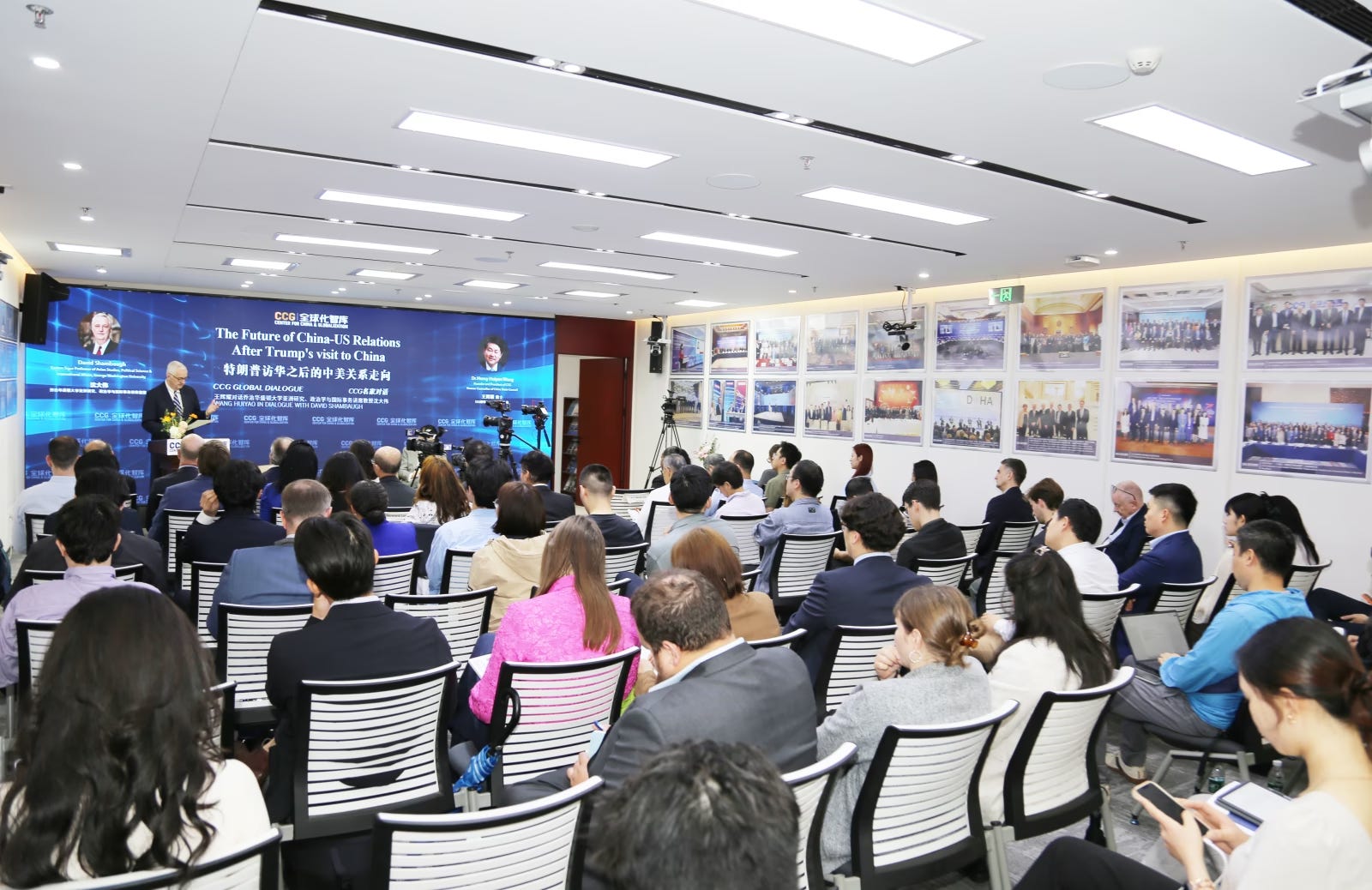
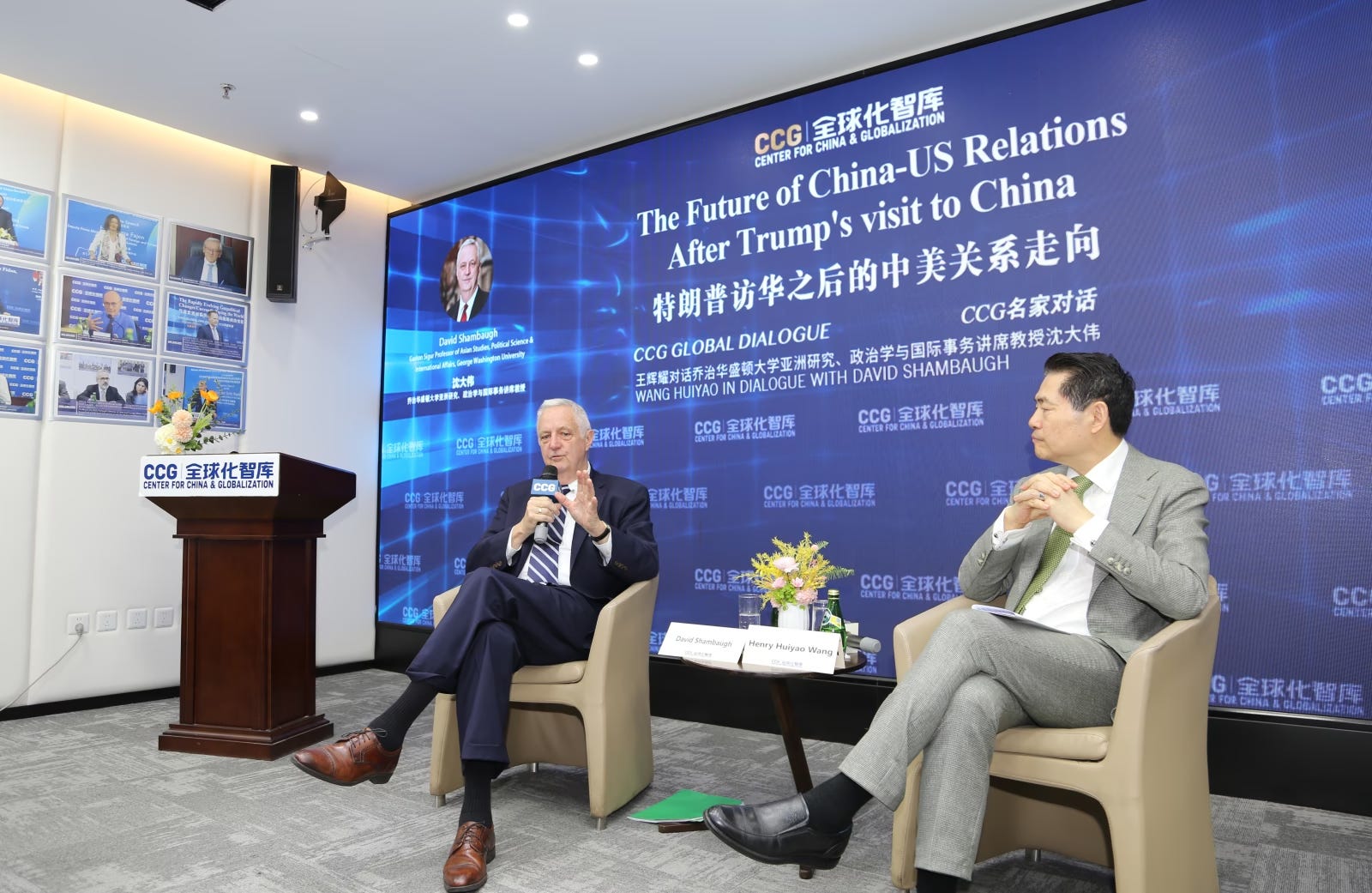
On Monday, May 25, David Shambaugh, Gaston Sigur Professor of Asian Studies, Political Science, and International Affairs at George Washington University and Director of its China Policy Program, joined the latest session of CCG Global Dialogues, delivering a keynote speech and engaging in a discussion with Henry Huiyao Wang, Founder and President of the Center for China and Globalization (CCG), before answering questions from the live audience.
The session focused on the trajectory of China-U.S. relations after the Xi-Trump meeting, the prospects for managing strategic competition, and the implications of “a constructive bilateral relationship of strategic stability”.
The event was moderated by Mabel Lu Miao, Co-founder and Secretary-General of CCG, and drew diplomats, scholars, journalists, and representatives from international organisations, think tanks, and the business community.
During the Q&A session, Vebjørn Dysvik, Norwegian Ambassador to China; Marcelo Suárez Salvia, Argentine Ambassador to China; Colum Murphy, Senior China Economy and Government Reporter at Bloomberg News; Zhuorui Fu, Associate Economic Officer, UN ESCWA; Shi Yinhong, retired Professor at the School of International Studies, Renmin University of China; and Zhao Shengchuan, Professor at Josai International University, raised questions and exchanged views with Shambaugh and Wang.
This transcript is based on the event recording and has not been reviewed by any speaker.
Mabel Lu Miao, Co-founder & Secretary-General, CCG
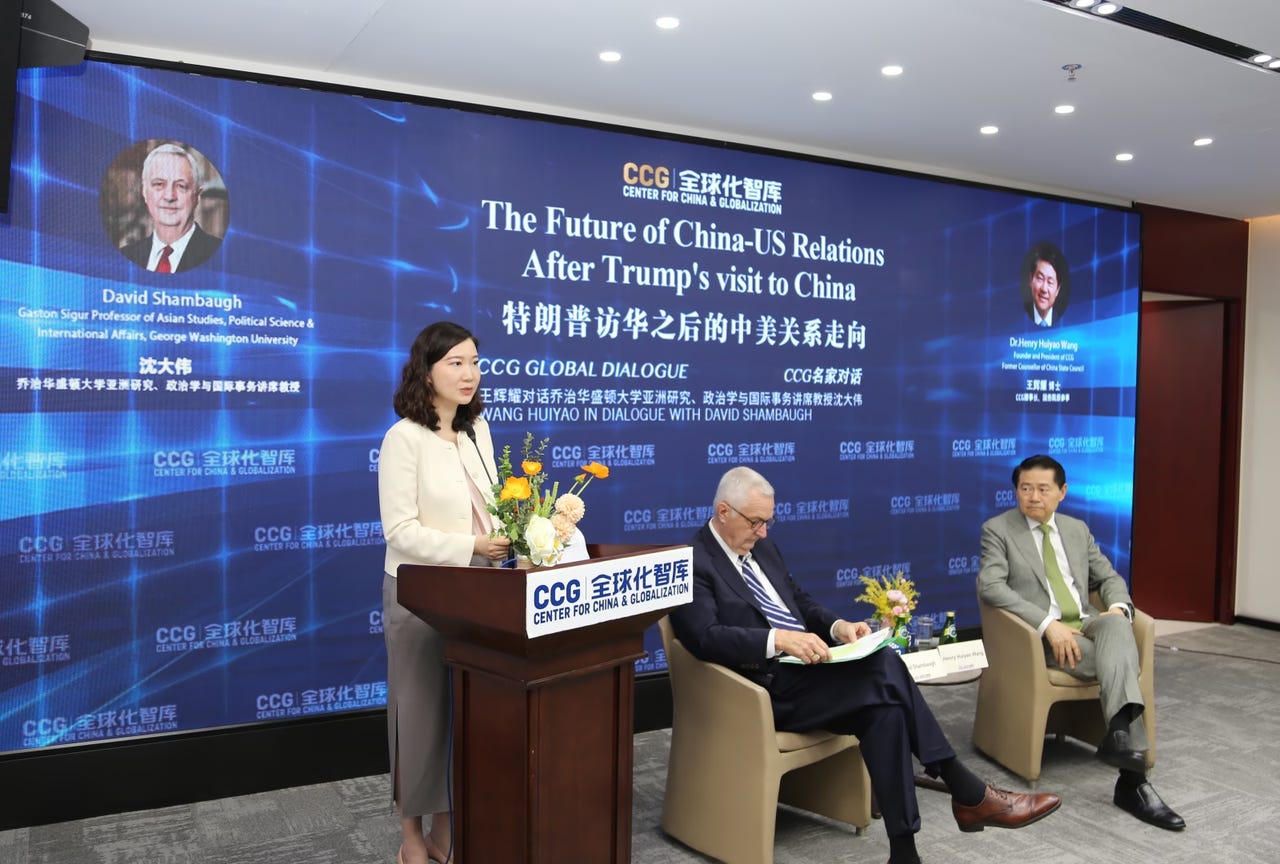
Your Excellencies, ladies and gentlemen, friends and colleagues, good afternoon. A very warm welcome to the Center for China and Globalization, and to this special edition of our CCG Global Dialogues series.
My name is Mabel Lu Miao, Co-founder and Secretary-General of the Center for China and Globalization. First of all, I thank you all for your presence as we gather to explore one of the most consequential relationships of our time: the future of U.S.-China relations.
We meet at a pivotal moment. The dynamics between the United States and China are shaping not only the bilateral landscape, but also the very architecture of global stability, trade, and innovation. Following the recent high-level summit between President Xi and President Trump, we find ourselves at what many call a critical crossroads. The consensus to build a constructive relationship of strategic stability offers a new framework, a diplomatic anchor in turbulent seas. Yet the fundamental forces of strategic rivalry and deep economic interdependence continue to coexist, defining a relationship that is as complex as it is crucial.
The question before us today is not merely academic; it is urgent and profoundly practical in an era of persistent contestation: How can these two great powers stabilise their interaction? Where are the realistic avenues to expand cooperation on global challenges, from climate change to public health? And perhaps most pressingly, how can both sides effectively manage risks and prevent miscalculation amid inevitable competition?
These are the questions that today’s dialogue seeks to address. To guide us, we are honoured to welcome a scholar whose work has illuminated the U.S.-China relationship for decades. It is my great pleasure to introduce our distinguished keynote speaker, Professor David Shambaugh.
David Shambaugh is Gaston Sigur Professor of Asian Studies, Political Science, and International Affairs at George Washington University’s Elliott School of International Affairs. He is also a distinguished visiting fellow of the Hoover Institution. Professor Shambaugh is an internationally renowned scholar on contemporary China, Asian affairs, and, of course, U.S.-China relations, with a career spanning academia, policy analysis, and extensive field research. He brings a rare blend of theoretical depth and practical insight. His perspectives have informed policymakers, business leaders, and scholars across the globe.
We are privileged to have him with us today to set the stage for our discussion. Following his keynote, Professor Shambaugh will be joined for an in-depth dialogue with Henry Huiyao Wang, Founder and President of the Center for China and Globalization, former Counsellor of the China State Council, and a professor at China Foreign Affairs University. Henry Huiyao Wang has dedicated his career to fostering international exchange and think tank diplomacy, engaging in profound dialogues with world leaders and thinkers. His unique global perspective will help bridge theory and practice, ensuring our discussion is both grounded and forward-looking.
Our agenda today is designed for substance and interaction. After the dialogue segment, we will open the floor for your questions, because the insights from this distinguished audience, comprising policymakers, senior scholars, business leaders, and journalists, are an essential part of this global conversation.
Before we begin, I would like to extend my sincere welcome to our distinguished guests, including His Excellency Marcelo Suárez Salvia, Ambassador of Argentina to China. Welcome, Your Excellency. His Excellency Vebjørn Dysvik, Ambassador of Norway to China. Welcome. Also, Ms. Amakobe Sande, UNICEF Representative to China and Professor Shi Yinhong from Renmin University. We also warmly welcome scholars, diplomatic officials from various embassies, business delegates, and media friends. Thank you all for your presence.
Let us begin this important conversation now. Please join me in giving a warm welcome to our keynote speaker, Professor David Shambaugh. Welcome.
David Shambaugh, Gaston Sigur Professor of Asian Studies, Political Science, and International Affairs, George Washington University; Distinguished Visiting Fellow, Hoover Institution
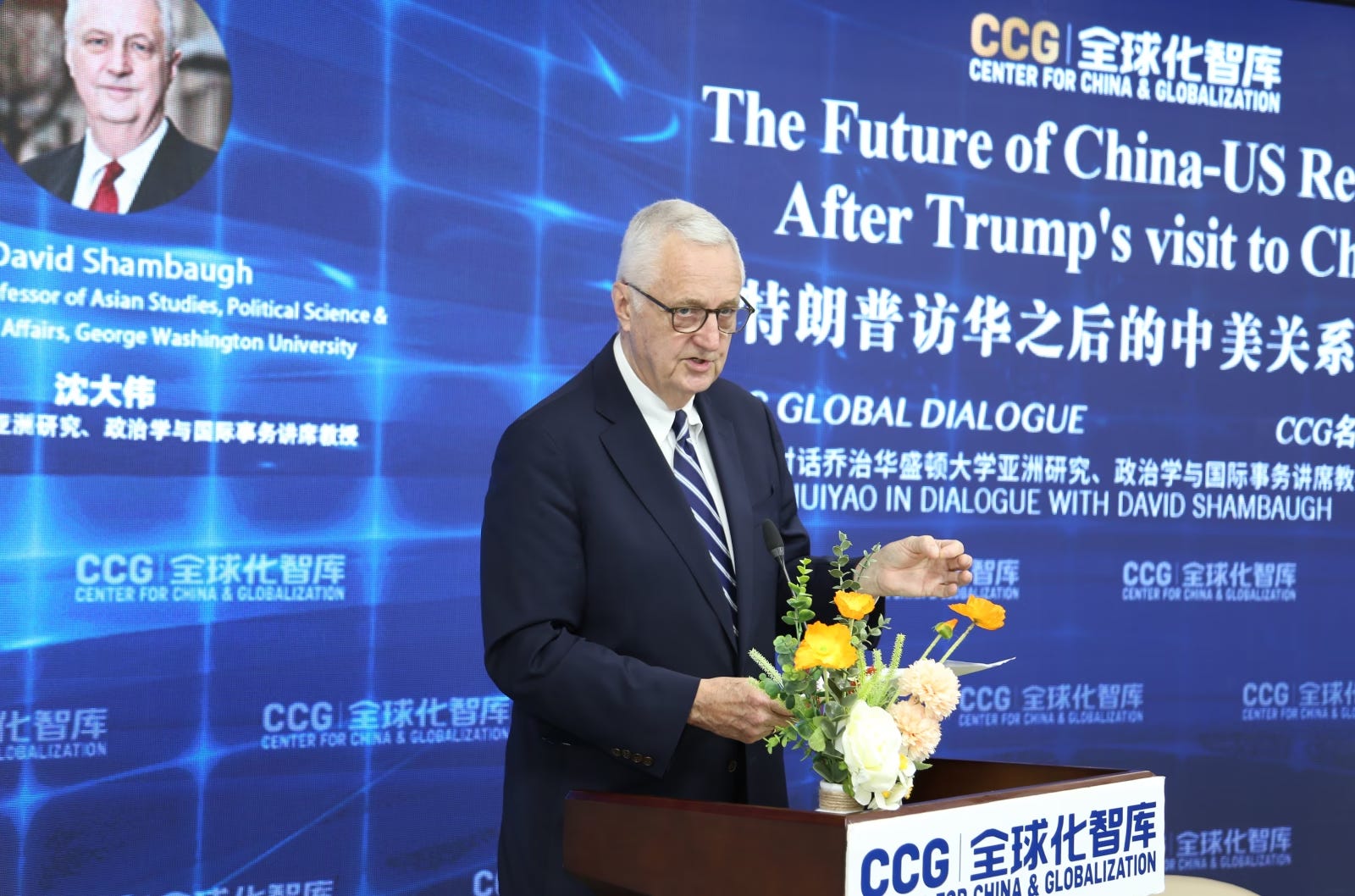
Henry and Mabel, colleagues and friends, 各位观众, distinguished members of the diplomatic corps here in Beijing, I am very honoured, actually, that all of you came out on a rainy day in Beijing. But thank you for making the effort. I know getting around Beijing is not the easiest thing with the traffic, although I think traffic has improved slightly from the last time I was here. The air has also improved considerably.
Thank you for coming. It is truly a great pleasure for me, and that is an understatement, to return to Beijing, a city I first visited in 1979 when I was a student, and have lived in myself for six years altogether. This is indeed another home of mine, I might say. But for reasons I am not going to go into, this is only my second visit in the past 11 years. Therefore, I am sincerely grateful to Henry, to Mabel, and to CCG for the invitation to return and for making this visit possible.
I truly hope that my long absence is now firmly in the past, and that I can look forward, hopefully, to many more visits in the future, resuming my longstanding relationships with the many institutions and friends here in Beijing and in China, and making new friends, particularly with the younger generation.
I have been coming to China every year from 1979 to 2015. That is a long time. I have studied at three different Chinese universities as a student. I have been a visiting scholar at six different institutes of the Chinese Academy of Social Sciences, and other universities and think tanks. We have a long and good past. It is wonderful to be back, and I am really very grateful.
I would also like to begin by paying tribute to CCG, in all sincerity, for the extremely important role that you have played for the past 18 years since your establishment in providing multifaceted forums for dialogue between China and the world, both inside China and, of course, around the world. I think Henry and Mabel live on airplanes. I do not know how you travel as much as you do. I receive your CCG activity emails in my inbox, as I am sure many of you do. One day they are in Latin America, the next day they are in Europe, the next day they are in Southeast Asia, then they are back in Beijing, and then they are off to some other place. I do not know how you do it.
But in all sincerity, I want to congratulate you on the forum that you established 18 years ago, and on how it has grown into what it is today. In fact, just this morning over breakfast, I was reading your annual report, which, by the way, is here on the table. If any of you need copies, I commend you to pick one up on your way out. It is very impressive in its range of activities. As they say in Chinese, 加油 keep it up. You really deserve congratulations for what you have created, established, and developed. People-to-people exchanges among thought leaders and other elements of societies are really more critical than ever before in today’s very turbulent world.
I am going to speak for about 20 minutes, I am told, about a very big subject: U.S.-China relations, the state and future of the relationship following the very recent summit meeting here in Beijing between our two presidents. So, let me say a little bit about how I view the results of the summit and the possible evolution of the relationship going forward. Then Henry and I are going to have a constructive, strategic, and stable dialogue.
中美建设性战略稳定关系 is the new 提法 (tifa). We have a new tifa. For those of you who speak Chinese, tifa means narrative. There is a new narrative to define the U.S.-China relationship, an official narrative, which is very important because policies derive from narratives. Narratives are like a grand strategy, 大战略 in Chinese. We have a new tifa coming out of this last summit: to build a constructive, strategic, and stable U.S.-China relationship. It is the first time those terms have been used in these narratives.
First, before I talk a little bit about the narrative and unpack it, let me give you my bottom-line takeaways and evaluations. Let me talk a little bit about the summit, because I am sure you have all been following it and digesting the tsunami of information that came forth during and susequent to the summit. It actually takes a number of days, oftentimes weeks, before you really get to understand what happened and what came out of a summit. We are beginning, day by day, to learn more. It occurred just a week ago, so I do not think we have heard everything yet. I have no inside 消息, no inside knowledge.
There were relatively few concrete and specific deliverables, as Americans call them, that came out of the summit. There was no joint communique, no joint agreements, and very little tangible that one could identify in the immediate aftermath of the summit. Day by day, we are learning a little more. But that is not the most important thing.
In Washington, where I live, there has been some criticism of the summit because it did not achieve so-called concrete deliverables. Americans are very concrete. They like specifics; they do not like abstract phrases. They want concrete deliverables. This summit did not produce concrete deliverables, so there has been a bit of criticism and frustration in D.C. I have to be honest with you.
But for me, the greatest value and the most important outcome was that the summit occurred at all. It is absolutely crucial that our two governments and top leaders meet, and do so with some frequency. This is just the first of four meetings this year. They have three more to go. There will be a return state visit by President Xi, General Secretary Xi, to the United States in September, a meeting in Shenzhen, and a meeting in Miami. So this is really important.
This particular summit succeeded in putting a floor, I think, under a very fluctuating, rocky, and troubled relationship. It has not been in free fall; I would not say that. A few years ago, in the second year of the Biden administration, it was in free fall. So the Biden administration tried to put a floor under it and arrest the deterioration. This time we needed a floor to be relaid, you might say, and that is the major accomplishment to my mind. A floor was relaid, as well as establishing some guardrails and boundaries, both of which will serve to stabilise relations and, I hope, begin to re-establish a more lasting framework to manage the competition.
“Manage the competition” is a particular American phrase. The Chinese side does not like that phrase and does not use that phrase specifically. But the summit allows us, I think, to have a new framework to restrain and limit points of friction and keep the elements of contention, including the all-important issue of Taiwan, within manageable boundaries, hopefully.
So I view this summit as having been quite successful. Let me be very clear about that. I am not disappointed by it, because I think the signals that were sent, both the optics of the summit as well as what we have learned about the substance. So I think it might hopefully be a turning point in the relationship. I have been studying U.S.-China relations long enough to know that there is never any real turning point. We never get around the corner and stay there in a stable place. But this is a new attempt, and it is the best attempt in about 10 years, I think. Let us hope it endures.
The United States and China are not going to stop competing and having points of friction, many points of friction. But I think it is important to understand what competition means. Let me digress a little onto that subject.
What I have found most instructive recently in terms of understanding competition is the May 17 press conference and media briefing by State Councillor and Foreign Minister Wang Yi. He gave a very extensive readout on the summit. You should all read it. It is four or five pages long. On the subject of competition specifically, let me quote briefly what State Councillor and Foreign Minister Wang had to say, because I think it is very useful and instructive.
For the last six years, the Chinese side has refused to even engage with the Americans over the term competition. They thought it was some sort of negative, hostile conflict. You only compete with adversaries. But now the Chinese side seems to have come around to not viewing competition as an adversarial phenomenon, which is not.
Foreign Minister Wang said, and I quote, competition should be healthy and stable, “where competition is kept within proper limits and is not turned into a zero-sum game.” “Major-country competition is nothing new,” he said. “When competition does happen, it must be a healthy one where we learn from each other, pursue excellence together, and compete fairly in compliance with rules.” “The purpose of competition,” Foreign Minister Wang said, “should be to outdo oneself, so that both sides become better.” That is a positive-sum definition of competition.
Then he concluded that “it should be constant stability where differences are manageable, and the relationship should not be like a roller coaster”. Notice the word “manage”, 管理. We Americans have been working on the Chinese side with this concept of managed competition for six years. It seems to have finally sunk in a little bit.
I completely agree with Foreign Minister Wang’s characterisation, and I commend him on it. The entire press conference is worth reading. I just read a little bit. Competition is an entirely natural 自然的 part of life in many domains: in commerce and economics, in sports, in the realm of ideas and even ideologies, and in geostrategic affairs. So there is nothing abnormal about competition. Quite to the contrary, as Foreign Minister Wang said, it can spur one to improve themselves and to compete with others, and that in itself is a positive-sum phenomenon. Now, to effectively manage competition necessitates direct exchanges at many levels and candid dialogues. So I think that was a very useful contribution by Foreign Minister Wang.
He also said that President Xi raised with President Trump the topic of the Thucydides Trap. That is interesting. It is not clear to me that President Trump has read Graham Allison’s book and even understands the notion of a Thucydides Trap, but obviously President Xi has, and has had personal discussions with Professor Allison.
This is important, I think, because his book, which had a very bad title, Destined for War—believe me, I know about bad titles. Publishers sometimes give articles and books very provocative, inappropriate titles with which the author does not share. Believe me, that has happened to me personally. Personally, that is one of the reasons I have not been here for 10 years. The Wall Street Journal gave a very inappropriate title to an article I wrote 10 years ago.
Professor Allison’s book looks at, I think, 16 historical cases of rising powers and established powers, going back to Athens and Sparta. He found historically, 14 of the 16 cases resulted in conflict, usually because the established power was feeling threatened. Sometimes the rising power attacked the established power early because they thought they had an opportunity. Sometimes the established power attacked the rising power to keep it from parity and from becoming a peer competitor. Anyway, in 14 of 16 historical cases, the historical record is pretty clear and very dangerous.
I think it was very appropriate that President Xi raised this with President Trump. But the point here is that nothing is structurally predetermined in international affairs. In political science, in what I do, we call this the agent-structure paradigm. Leaders possess agency, and the exercise of human will can ameliorate and overcome structural dynamics that produce tensions in a relationship. So nothing is predetermined, and I hope President Trump took that away from his discussions.
The last thing that Wang Yi said I found very useful was that he reported, among the other topics discussed, people-to-people exchanges should be increased. Indeed, they do need to be increased. These have atrophied badly between the United States and China during and since Covid, and we need to rebuild people-to-people exchanges on a reciprocal basis.
Cutting off dialogues, or worse yet, banning people from the other country, is not helpful. In fact, it is harmful. We need to be more tolerant and open to various perspectives. Again, this is what CCG, Henry, and Mabel do so well.
People-to-people dialogue needs to be rebuilt. And I hope that includes not just tourists and students. Students are very important. President Xi reiterated his invitation to 50,000 American students to come to China over a five-year period. That is a very nice aspirational number, but it is going to be very hard to achieve, especially given that today, as we sit here, there are only 1,200 American students in this entire country. Ten years ago, there were 20,000 American students in this country. There are, by contrast, 270,000 Chinese students in the United States this academic year, including in my classrooms. We have got to work on that.
But I would also like to suggest that we need to work on improving scholarly exchange, not just student exchange—scholars who already have their PhDs and are already researching different topics. There are so many interesting things going on here in China that the international China studies community, not just the American China studies community, is very anxious and curious about. We all want to come here. We want to do research in archives, libraries, factories, laboratories, and travel in the countryside. I hope that when the two governments get around to implementing the people-to-people component, that they really pay attention to the scholarly component.
I am relatively positive about the recent summit. It was very businesslike and obviously very formal. It was a state visit, and the Chinese side puts on such ceremony like hardly any other country in the world so well. It was a very respectful and polite summit, and there was even personal warmth between the two leaders. It was very obvious and good to watch.
We have this new framework to constructively stabilise and develop a strategically stable relationship. Foreign Minister Wang—I am not going to go into it—also identified eight specific areas. So, again, I commend you to look at his May 17 press conference. The United States and China, according to him, are going to improve exchanges on foreign policy, military-to-military relations (hugely important), the economy and trade, public health, agriculture, tourism, people-to-people ties, and law enforcement. Those are the eight priorities. I think those are the right priorities.
Let us move back to the new tifa, the new narrative, and unpack that a little bit. I will be very interested to hear Henry’s observations on this new phraseology. Both governments have officially committed themselves to this as the guiding framework for the relationship.
I personally am not the biggest fan of slogans and narratives in international relations to define relationships, but I think they can be very useful at certain times. I see the utility in them because they serve as a kind of compass to guide a relationship, even a road map, you might say, to keep it more or less going in the same general direction, what the Chinese call the 主要方向, so you do not get off the road and have an accident or run out of petrol. But if you have a Chinese EV, you will not run out of petrol.
I think this new phrase is better than previous phrases. I was not a particular fan of the 新型大国关系 [new type of major-country relations] that was announced between President Xi and President Obama many years ago. But we have a new one now, so let us talk about this.
Given the extreme complexity and the various systemic elements of the U.S.-China competition, stability is indeed a very worthy and appropriate goal for the two sides to work towards. Nonetheless, as in economics, equilibriums are hard to sustain. True stability is very difficult to maintain.
And I recall, in this context, my good friends and colleagues Professor Wang Jisi of Peking University and Kenneth Lieberthal of the University of Michigan, who was one of my mentors, and Jisi is one of my mentors and friends. They wrote an article about 10 years ago for the Brookings Institution in which they used the term “dynamic stability”. [Transriber’s note: The speaker appears to be referring to Lieberthal and Wang Jisi’s 2012 Brookings monograph, although the term “dynamic stability” does not appear in that work.]
In other words, you should not think of stability as something static and fixed. That is not the way to think of stability. It is unrealistic, not something where you achieve stasis, right? Life, all of us in our relationships, personal and between countries, evolves. Relationships are affected by all kinds of factors all the time. The question is how to create a framework that permits evolution, you might say, while working to achieve basic equilibrium. I think that is the first thing I would say about the 稳定 stability factor. Stability is not stasis. You have to think of it as a more fluid concept.
What about the term constructive, 建设性? That is an interesting term. When it first came out, it made me think about the history of the People’s Republic of China. There is a certain period of the 1950s known as the 建设时期, the build-the-country period. But that is not what they have in mind here.
I think “constructive”, first of all, is different from “cooperative”. Do not equate constructive with cooperation. They are two different concepts. Constructiveness indicates intention, and the intention to act and speak constructively indicates a kind of positive intention towards another party. Even criticism—in English, we have a common saying, “constructive criticism”. You all have heard that term. That means you can criticise someone if it is intended constructively for them to sort of self-reflect a little bit on whatever, and to maybe alter their thinking. That is an important point. Not all people or societies take criticism constructively. Some are reflexive; they just cannot take any criticism. I am not identifying anybody in this context. The point is to have an open mind and take criticism constructively, because it is positively intended.
I have spent my entire professional career studying the role of mutual perceptions in U.S.-China relations, beginning when I was a graduate student here at Peking University from 1983 to 1985. That is a long time ago, folks. I researched and wrote my PhD dissertation here. I was in fact the first foreign, not just American, student permitted by the Ministry of Education to study in an international relations department in China in 1983. They opened the door, and I was the first one to walk through that door. Many more have walked through the door subsequently. It was a wonderful experience, two years in the 国政系. I also played for two years on the Beida [Peking University] basketball team, and we had a lot of success. We won two city championships. I played in the Chinese national basketball tournament for two years. I had great experiences. I have wonderful memories of Beida, and previously Nankai University and Fudan University.
The reason I am telling you this, sorry about the tangent, is because I was researching a dissertation on China’s America specialists and their perceptions of America, 中国的美国问题专家看美国知觉. I am an American China specialist, so I wanted to look at my counterparts: What about China’s America specialists? What are they thinking about the United States? How do they understand the United States? That was my doctoral dissertation almost 40 years ago, and it turned into a book titled Beautiful Imperialist, 美帝 (mei di)—mei for America, di for imperialism—because Chinese views of America at that time were ambivalent. On the one hand, America was to be emulated, studied, and learned from. On the other hand, America was imperialist and should be rejected and criticised. So there is this ambivalent tension Chinese views of America for a long time. It goes back even earlier than the 1980s.
The reason I raise this is that if I have learned nothing more in my decades of study of perceptions in the U.S.-China relationship, it is that it is actually THE most important factor, much more important than the trade balance or other functional dimensions of the relationship. We need to understand each other better. And language means different things to different people. One should never assume that others understand your language and see things the way you do.
This is precisely why sustained dialogue between our two societies, and all societies, is crucially important. All of you representing other countries here in China, I know, have the same view. Here again, I wish to pay real tribute to Henry, Mabel, and CCG for what you provide in China’s dialogue with the world. There is no institution like this in China other than CCG. Very impressive. Keep up the good work.
Last point, and then I should stop and we should have our dialogue. What about the term strategic? Constructive, strategic, stability: those are the three operative adjectives and nouns in this new tifa. Strategic is interesting because there are differences of definition that need to be further explored through dialogue. For Americans, I can tell you, the term strategic usually, if not always, refers to the security and military domain. Full stop. Security, military equals strategic for Americans. That is how we think. Not for others.
The Chinese—and I have been reading these articles in the last week after the summit—many Chinese scholars are writing very interestingly that, oh no, 战略 strategic is a kind of comprehensive, elastic term that encompasses all dimensions of a relationship, and therefore it’s strategic; all dimensions equal strategic. Well, that is a big difference in the way Americans and Chinese think about that term. I think we need to have some dialogues to unpack our thinking about “strategic” and about “competition”.
We are making progress on competition. As I said, I think Foreign Minister Wang’s statements this week, and even at the Munich Security Conference, show a lot of evolution in Chinese thinking. I am not going to say progress, but it is just evolution. So it is good.
So, Henry, keep it up. We need to have more of these kinds of dialogues. I have gone on long enough, but those are my general impressions of the summit and the state of the relationship. Henry, you and I can now sit down and have a constructive, strategic, and stable dialogue. Thank you very much.
Henry Huiyao Wang, Founder & President, CCG
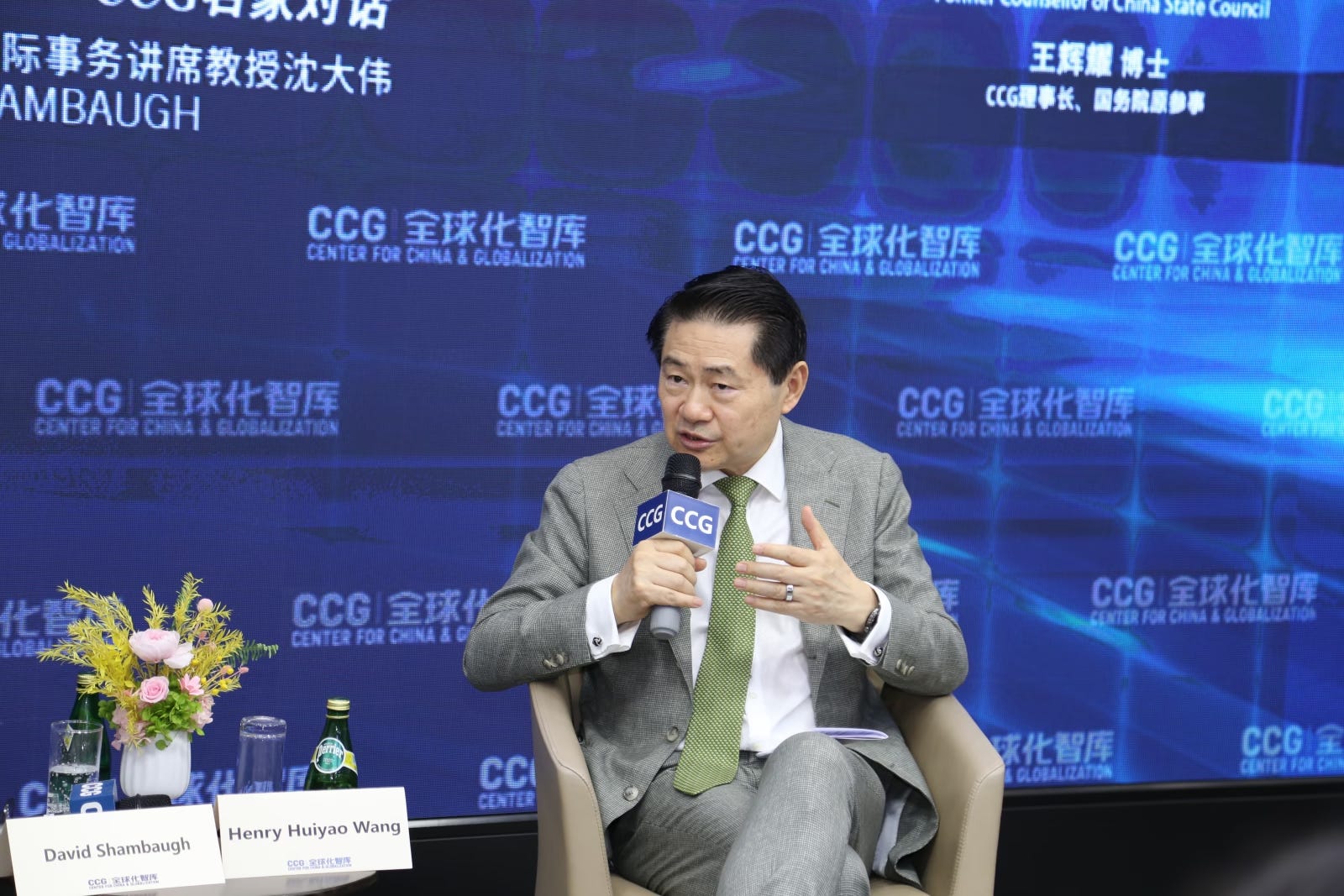
Great. Thank you, David, for your very comprehensive, forward-looking, and very good recap of the summit we just recently had between China and the U.S.
As we all know, as Mabel just introduced, David is a very famous and renowned China expert in the U.S. As you said, you studied in China for so many years and did all those studies. Of course, you went back to the U.S., and you were also the chief editor of The China Quarterly for almost a decade. That was really a very prestigious China research journal, a top journal in the world, while you were in the UK for 10 years. You have also published many books.
I know you came to Beijing two years ago with a Central Party School Track II dialogue, where I was also participating. I am glad to see you come back again, and, as you put it, to promote better dialogue and understanding.
I am very glad to have you join us for CCG Global Dialogue. We have had almost 100 dialogues, including with a few dozen top American scholars, such as Joseph Nye, Graham Allison, Tom Friedman, Jeffrey Sachs, and many more. Now we are adding you to this long list of well-known strategic global dialogues.
Your timing is very significant. You came just one week after the summit. My first question and comment to you is that this visit, I personally feel, is very significant. It is almost a decade—nine years—since Trump’s last visit. This is his second visit. You can see that President Trump used much more positive terms with the Chinese side. He basically praised what China has done and expressed many good gestures towards China. I think that has been appreciated.
At the same time, as a Chinese person, I feel China is now getting a lot of international attention. Since the beginning of this year, we have had almost all G7 leaders come, except Japan. At the end of last year we had President Macron, and at the beginning of this year, Mark Carney, then Starmer, then Merz, and almost all of them. Then after that, Putin. You see those big powers all coming, and that really shows that China has become a focal point, an internationally attractive assembly place where world leaders come to compare notes and build consensus.
How do you think China has reached this kind of influence and impact in the world, with almost all G7 leaders and other global leaders coming? Also, we are in a much more turbulent world now. We still have a war going on in Ukraine. We have a terrible war going on in Iran. The whole world has these choking points. What do you think about this? This is the first U.S. state visit in nine years. During the four years of Biden, as you rightly said, we never saw a U.S. official visit China, which is unthinkable for the two largest economies in the world. There was no dialogue or exchange.
Now this high-level exchange has resumed. We are going to see another President Xi visit in September, another APEC summit in Shenzhen, and the G20 summit in Miami. Could 2026 be a turning point, as you just mentioned, between China and the U.S., and perhaps another turning point for China, the West, and the world as well? Maybe you can give some of your thinking on how special 2026 can be, or what China has done right.
David Shambaugh
Thank you, Henry. There were a number of elements in there, and I will see if I can unpack them. But your main point about foreign heads of state and dignitaries increasingly coming to China is a very well-taken point. That is not necessarily a new development. China’s diplomacy, in quantitative terms, is really unparalleled, both here in Beijing and in travel by President Xi. President Xi is not travelling as much in recent years as he used to, but I was reading the other day that he has made 71 trips abroad to 112 countries during the time he has been in office.
Anyway, I think Beijing and China are becoming more of a destination point for various heads of state. Part of that is the result of the Trump factor. We know what has been happening within Europe in particular: very unfortunate transatlantic policies and verbiage. So, several European heads of state have beaten a path here to Beijing. Canadian Prime Minister Mark Carney came here and delivered a very significant address in Davos about middle powers.
So China is reaping some of the benefit of the alienation that American allies and others are feeling about the United States under President Trump. There is a kind of, you might call it, a bump or an effect—the Trump bump. How is that for a phrase?
Nonetheless, even without Trump, other countries are hedging. I just published an article in Foreign Affairs last week about how the whole world is hedging against both America and China. Countries around the world do not trust either power. They do not trust China, they do not trust America, and they certainly do not trust Russia. Everybody is hedging, and part of hedging is in fact engagement.
You just had President Putin here last week. I think China is playing its diplomatic role very effectively at the moment, and will continue to. That is important. For the rest of 2026, there are going to be these multilateral meetings. I will give President Xi and China real credit here in the realm of global governance. China has really stepped up its game in the global governance domain under President Xi.
I teach about this in my Chinese foreign policy classes. Up until President Xi became the leader of China, China was very ambivalent about multilateralism. Verbally, they were supportive, but in practice not. There has been a much greater convergence of China’s behaviour and participation with the verbiage and language, which has always been supportive of multipolarism.
Ladies and gentlemen, multipolarism and multilateralism are not the same thing. International relations specialists will tell you that polarism has to do with poles, with powers. Powers attract other countries to them like magnets. That is what a power is. Multilateralism is institutional: the United Nations and all these other IGOs in the world.
China is now playing a much more central role—the new Global Governance Initiative that China just published three or four months ago. I was along with Xi Jinping’s Global Civilisation Initiative, Global Security Initiative, and Global Development Initiative. Now we have a Global Governance Initiative. These are all indications of China’s increased activism—not just centrality, but activism in world affairs. This is very positive. Very positive. So I think we can anticipate that, going into the end of 2026 and into next year, that that trend will continue.
Henry Huiyao Wang
Thank you. Yes, David, absolutely. You see China becoming more active, particularly in turbulent times, making many proposals and initiatives, particularly for global governance, where we are actually embracing a multipolar world. Global governance is really at the heart of the issue. This centrality that you mentioned is gaining some momentum now.
Again, you mentioned during your speech that I was quite delighted to hear that the U.S. and China, as President Xi put it, have reached constructive stability and strategic stability. I know the U.S. added “on a reciprocal basis”. But I remember that in 2017, when the first national security strategy report came out under the first Trump administration, strategic rivalry was really the buzzword. Strategic rivalry was even before Russia. So this turnaround, from Trump 1.0 strategic rivalry to Trump 2.0 strategic stability, is really a big shift over the last decade.
The first Trump term started with a trade war, a tariff war, and sanctions. Even today, there are about 2,000 Chinese companies on the American entity and sanctions lists. But that profile does not really work that effectively. As a matter of fact, I had a dialogue with the late Joseph Nye about a year or two ago. He told me that there is a cycle in U.S.-China relations roughly every 20 years. China and the U.S. were at war in the Korean War, that was the lowest point. Twenty years later, the Nixon moment came, and then there was a revival, followed by another downturn.
Are we now seeing the bottom? Are we starting to realise that we cannot really decouple? One of the things I noticed when I went to the United States last month for a world economy summit with 500 CEOs was that I never heard anybody talk about decoupling with China. Even senior U.S. officials were saying that the U.S. does not seek decoupling now.
In that sense, are we achieving this kind of realisation because we have achieved mutually assured disruption? From MAD, mutually assured deterrence, and mutually assured disruption, to what you just said: mutually assured construction. By that kind of realisation, after nine years, we figure out that as wars are going on and the world is in a different chaotic place, the U.S. and China have to work together. We have to, as President Trump put it properly, recognise a G2 or near-peer status.
What we get from strategic stability, or what you have called for many years managed competition, is that we have to recognise reality. We cannot go on fighting each other or sanctioning each other. We have to find a way to coexist peacefully. Even though strategic stability may not be that concrete, as you said, in the Chinese narrative, if you have a guiding narrative, then everything else follows through and can be much easier. That is how Chinese people approach things: it is a long-term objective.
What do you think about this paradigm shift, from the first term’s strategic rivalry to the second term’s strategic stability? I hope we are going to bottom out and maybe keep managed competition, as you mentioned. Minister Wang mentioned Olympic-style competition. Maybe we could seek a more stable world as time goes on. What do you think about this paradigm shift, or this move from strategic rivalry, which the Trump administration no longer emphasises? I have not heard any official talk about strategic rivalry. On the contrary, I still hear Europeans talk about systemic rivalry, which probably was inspired by the first Trump term. But the U.S. is not mentioning strategic rivalry; now it talks about strategic stability. It adds some modifiers at the end, but it is still strategic stability. What is your take on that?
David Shambaugh
Again, these phrases and narratives are important for us to consider, but we should not put too much stock in them. Just because you declare something does not make something that way in reality. We can declare that the U.S.-China relationship is a strategically stable relationship, but in fact, that is aspirational, I would argue.
Henry Huiyao Wang
Could this also be a recognition of reality?
David Shambaugh
The reality is comprehensive competition, comprehensive across all domains and every region of the world.
Henry Huiyao Wang
But it has to be managed.
David Shambaugh
But it has to be managed, exactly. I was the first one to use the term “managed competition” about 12 years ago, Henry. That is interesting; you knew that. I also coined the term “competitive coexistence” six or seven years ago. That is what I think we should try and achieve in the U.S.-China relationship.
The U.S. and China are going to be competing across every domain and every region of the world as far as the eye can see. We need to recognise that reality. We should not deny it, but you have to learn how to manage it. There are different mechanisms for management, beginning with dialogue, but there are other institutional mechanisms for managing strategic rivalry, in the military domain, for example.
Let us be clear about why the narratives are important, because they set the general direction, the 主要方向, and they produce guardrails and a road map. That is all very positive. We did not have guardrails and a road map before last week. Throughout the Biden administration, they tried a little bit, but the Biden administration did not succeed very well. Now at least we have a framework, a floor under the relationship, and we have guardrails around it to a much better extent.
But look, these are the two big powers in the world. If you take International Relations 101, you start with Athens and Sparta, and you move on through late 19th-century Europe, into the 20th century in the Cold War, and into the 21st century. These two powers are competitive. They are intrinsically competitive in every domain. But that goes back to what I was saying earlier, that competition is not a negative concept. It is not a zero-sum phenomenon. It can be a positive-sum, constructive element in a relationship. So I guess that is how I would respond.
Henry Huiyao Wang
Great. You mentioned the Thucydides Trap. Actually, President Xi talked to President Trump during the meeting, saying that this trap does not have to happen and we do not have to follow that old path. I remember we had a dialogue with Graham Allison a few times. I even wrote a book on how to escape the Thucydides Trap, summarising our dialogues. Basically, I think the title of his first book is very frightening: Destined for War. We want to avoid that.
But peace in the whole world is in danger now. You see what happened in the Russia-Ukraine war, and what happened in Iran with the U.S. and Israel. Larger peace and the stability of the world are in jeopardy, while China is the largest trading partner with every one of them. That is why I understand why President Trump and Putin came to China, and also why the Pakistani prime minister is coming, and why the Iranian foreign minister was here not long ago. They all want to know where China stands.
If China says, for example, that the Strait of Hormuz has to be open, that war should not continue, and that dialogue must be sought, that is an enormous message China can give. I think Trump has gained some consensus from China on that as well.
On the other hand, Trump also said that the U.S. does not want to see Taiwan become independent and does not want to send soldiers 9,500 miles away. Do you think that, since the U.S. president wants to be a peace president, as he said in his inaugural speech, and now he is involved in wars and wants to calm them down, he is looking for a larger peace? China is looking for peace across the Taiwan Strait, so perhaps they now have a lot of common understanding on peace.
Trump can better understand China’s position, because for China, to take Taiwan would be very easy. You can see what Iran did by blocking Hormuz. If China were going to block the Taiwan Strait, Taiwan probably would not have to be fought; it could get into real difficulties. I think the separatist movement has no future. Is that also why President Trump recognises reality, and also China’s support for peace in the Middle East and eventually maybe in the Russia-Ukraine war?
Do you think there are many exchanges on these greater global peace and security issues, including peace across the Taiwan Strait, that both China and the U.S. want? Many people interpret Trump’s visit to China as seeking China’s consensus on some of those peace issues and global conflicts. China did make a very strong statement to make sure peace is maintained in the Middle East, and they also talked about Iran. That was in Wang Yi’s statement on the bilateral talks between President Xi and President Trump.
What do you think about the future, and Trump’s position on Taiwan, which is also quite positive, I think? He does not support Taiwan independence, and he does not want to fight 9,500 miles away.
David Shambaugh
Thank you, Henry. I neglected to answer your previous question about the first Trump administration’s National Security Strategy references to China and the second Trump administration’s National Security Strategy references to China. They are very different, obviously.
So what has changed between Trump 1.0 and Trump 2.0? That is, I think, President Trump himself is less encumbered by the bureaucracy, who sees China across the American bureaucracy as a peer competitor. Trump does not have that view of China. Trump does not think in global strategic terms. He is a businessperson. He does have some intuitive sense, though, about great powers, and he understands China in that context. He wants a major commercial relationship with China in both directions: Chinese investment into the United States, and an improved climate for American business here in China, which has had difficulties for a number of years.
It is again an example of this agent-structure paradigm that we call in political science. The agent is the president: he is the leader, and he is imposing his personality and his own views about China, and Russia by the way, onto the bureaucracy. It is affecting American support for Ukraine, and it is affecting the China relationship and Taiwan.
So I will answer your question with regard to Taiwan, but here we have a classic example of a leader who is really imposing his vision. Indeed, in China, the leader is imposing his vision. I am sure the bureaucracy here...I know the bureaucracy here sees the United States in adversarial, competitive terms. But the two leaders met last week, and they have created this new environment. It is not a G2. It never will be a G2. People who argue in that direction, I think, are dreaming. But it is now a managed competitive situation.
Now, with regard to Taiwan, I haven’t been privy to previous discussions at that level about Taiwan between previous American presidents and Chinese leaders, but this time there was some significant. But that is the significant outcome of the summit that I saw. Two things: number one, going into the summit, we were all expecting that the Chinese side would somehow get President Trump to say that he opposes Taiwan independence instead of saying that he does not support Taiwan independence. That did not happen. He did not use that language. There were fears that Trump was going to say he supports the peaceful reunification of Taiwan and China, but Trump did not fall into that trap and did not say that.
When it comes to Taiwan arms sales, Xi Jinping directly asked him—I saw the footage—“Are you going to militarily intervene in Taiwan?” And Trump replied, “I do not discuss that.” That is continuity of the strategic ambiguity principle that the United States has followed with respect to possibly intervening in a Taiwan situation. Possibly. The United States has never, by law or policy, been committed to intervening. Americans have always said it will depend on the situation. The Taiwan Relations Act simply stipulates that the United States shall give Taiwan adequate articles of self-defence, I think is the language.
So, Trump dodged three traps on Taiwan: the “oppose independence” trap, the “peaceful reunification” trap, and the commitment not to sell weapons to Taiwan. That was when he was here in Beijing. Then he gets on the airplane, leaves, goes back, and is very provocative. He says to the media journalists on Air Force One, “I need to talk to the person”—he called him the person; he did not call him the leader or president—“in Taiwan concerning this.”
Well, that is what we are all waiting for now, right? A telephone call between Trump and Lai Ching-te. I do not know if it is going to happen, ladies and gentlemen. If it did, it would be highly provocative. It would violate every principle that the United States has had since 1979. The United States does not talk to the president and the government on Taiwan or the authorities. We do not call it a government; we call it the authorities. But in his first administration, Trump did receive a phone call of congratulations on his election.
So we have to wait to see whether the $14 billion arms sales package is going to go through. I do not know. But last point: if you read Wang Yi’s speech, I think one of the most significant parts of it is that Wang Yi says President Xi really got through to Trump about China’s perspective on the Taiwan question and its historical dimensions. I think this is registered with Trump in a way that it did not previously, and perhaps did not with other previous American presidents. So progress was made in that regard. We will have to wait and stay tuned. But there are three actors here: Beijing, Washington, and Taipei.
Henry Huiyao Wang
I see. I noticed that the Ministry of Foreign Affairs spokesperson mentioned that China opposes any official ties with Taiwan, and any discussion of a possible call. I think the MFA spokesperson strongly condemned that. It is also interesting to hear that, because the U.S. has used up its arsenals and military supplies in the Ukraine war, it may delay or cancel arms sales to Taiwan. That was also in the news.
I do see some positive signs from this visit. At least Trump is saying that they do not want to send soldiers 9,500 miles away. I am sure there will still be another three summits. I hope this is recognised as China’s core interest. Of course, the U.S. has many core interests everywhere now: in Latin America, the Middle East, and Europe. They all need China’s support and understanding, or maybe some consensus there. If we can have a better understanding of each other, maybe we can solve these things much more easily.
Let us come to another subject, perhaps our final two questions. One question is that we saw Trump bring 17 top CEOs, the biggest companies in the U.S., to China. That was really impressive. President Trump said many CEOs still wanted to come, and they only allowed the number ones to come; other senior executives were not able to come. There was a big coverage of those major CEO visits.
The business ties between China and the United States are still pretty strong. To see how eager all those big CEOs were to come shows the interest. The U.S. Chamber of Commerce has also indicated that American interest in China is still very strong. Of course, they also set up two boards, one on trade and one on investment, specifically to increase trade and explore categories of goods that can be exempted from tariffs, as well as investment and what non-sensitive, non-security areas can be invested in.
I think, also, people-to-people exchanges and students are important. Maybe next time, China could announce visa-free entry for Americans. The U.S. is the only G7 country that has not received visa-free treatment. Maybe we can reopen the consulates shut down in Houston and Chengdu. There are many low-hanging fruits that we could pursue.
One of the things we need to get rid of is this over-security issue. Too much of everything is treated as security. There are about 2,000 Chinese companies on the U.S. sanctions list, whereas only about 20 U.S. companies are on the Chinese sanctions list, mainly for selling weapons to Taiwan. With these two boards on trade and investment, maybe we can lower this hype of securitisation, which is everywhere: people-to-people exchanges, students, professors, academics, think tanks, and experts. Over-securitisation is probably something we need to overcome. What do you think we should do to increase business and people-to-people exchanges?
David Shambaugh
Henry, I could not agree with you more. In fact, last night, we were discussing this over dinner. I too feel that the relationship has become over-securitised on both sides towards the other, and there is collateral damage being done to the business community, to the academic community, and to others who should be interacting normally between our two societies.
Both sides have prioritised national security. Xi Jinping has made it the number one national goal. China’s number one national goal is no longer development. 不是发展,现在第一是国家安全, right? That is a change; that is a narrative change. The same is true for the United States. The American side has over-securitised various activities of Chinese entities, not just companies on the entity list in the United States.
I think both sides have to step back and remove these impediments to normal people-to-people interaction. It is going to be very hard to build the framework relationship that they have just stated they are trying to do until they can unwind and dismantle some of these impediments that both sides are putting on. That is the responsibility of each country to define their own national security: What is real national security and what is not necessarily.
So I just wanted to say one last point on the Taiwan arms sales question. Whether the new $14 billion package is approved or not, there is already a six-year backlog of weapons that have not been delivered to Taiwan. So far as the Taiwanese are concerned, it is not the current package they want; it is the six years that are sitting somewhere in the pipeline. The types of weapons that have been moved from Northeast Asia to the Persian Gulf to attack Iran are not the types of weapons that the Taiwanese would be receiving from the United States. Taiwan is not going to get Tomahawk missiles, ladies and gentlemen, and those sorts of munitions.
Henry Huiyao Wang
David, on the securitisation issue, maybe I have somewhat different views from yours. China did not put the U.S. as a strategic rival. China did not sanction thousands of U.S. companies. It was actually the opposite. When China faced the U.S. national security strategy, where China was described as the number one rival, even before Russia, and with 2,000 Chinese companies on American lists, of course China had to put security as a top priority because China felt threatened. There is quite a bit of reinforcement of China’s position, to some extent.
But I do think President Trump’s visit to China is a great way forward. A good example is that under President Trump, we have solved the TikTok issue. It has been solved pretty well and is now operating smoothly.
Maybe we should take advantage of the fact that 17 CEOs came. Next time, when President Xi visits the United States from September 24 to 26—President Trump announced those dates—perhaps China could bring 18 or maybe 20 Chinese CEOs. Let us even have a China-U.S. CEO summit, alternating between the two countries every year. That would be really great. Maybe we can gradually build up some trust.
As you said, we have put a floor at the bottom. I hope now is the bottom, and we can gradually rise up. Of course, we have structural problems. As the two largest economies, there is bound to be some competition, and particular things will happen. But let us not get into conflict. As I discussed with Graham Allison, if we end up in a fight, possibly a nuclear fight, we are going to return to the Stone Age. It would devastate the whole world, and that is not an option. When that option is mutually deterred, the only option left is that we work together. Let us conquer Mars together. Let us fly to the moon together. Let us tackle climate change.
I give high credit to President Trump’s visit this time, and I am sure 2026 will be a good stabiliser for China-U.S. relations.
David Shambaugh
I certainly hope so. And I like very much your suggestion of a CEO summit, which maybe they could do under this new Board of Investment, because we need more Chinese investment into the United States in certain industries. We have national security concerns too, but there is a large variety of sectors in which there are no national security concerns, and Chinese companies should be welcomed into the U.S., and vice versa: American companies here. So we need to improve that dimension.
The last point I would make is: What do we need to be careful about going forward? I would say we need to be more careful about over-securitisation. That is the first thing. I completely agree with you, Henry.
The second thing we need to be careful about is not over-institutionalising the relationship. There is a temptation to go back—this is what governments do: “Let us set up working groups, then we will turn a working group into a vice-ministerial dialogue, turn a vice-ministerial dialogue into a ministerial dialogue, and then we will go up to even higher.” During the Obama administration, there were no fewer than 98, basically 100, bilateral U.S.-China dialogues at the government-to-government level. Trump came in 2017 and cut them to under five. Good. It was a waste of airplane fuel, flying these delegations back and forth, preparations going into these meetings, and then they would produce some communique, perhaps at the end, and then the communique would not be implemented.
Many countries, not just the United States, including European countries and others, developed what they called “dialogue fatigue”. China loves dialogues, and dialogue is intrinsic to diplomacy. But I think there is a temptation, now that we are to put a floor under the relationship, to reconstruct the architecture of dialogues and ministerial interactions. I believe in working groups. Small is beautiful. You do not need this big edifice, because it is never implemented. So I think we have to be careful not to go there.
Henry Huiyao Wang
I have a different view on that, because China is very highly centralised. There is always a top-down approach. Government bureaucrats have to work through these things, and then they can trickle down to business. Different countries may start differently. For the U.S., a smaller government is better and fewer meetings are better. But in China, it is really about building consensus through collectivism, and then trickling down. I still think we need high-level summits, like what happened just last week, and also high-level meetings. I think eventually they will promote better relations. Maybe at the Obama time there were too many, but now there are too few. We need a good balance.
David Shambaugh
Wang Yi identified eight specific areas in his press conference that the two sides agreed to. This is critical. The American administration, after the summit, did not say anything about those eight areas. It is the Chinese side that said eight specific areas. So I would imagine and hope that they can establish working groups in all eight areas: public health, and all eight. That is the first step. My suggestion is that I do not want it to become too large. I want it to be efficient, focused, and professional.
Henry Huiyao Wang
Great. On that note, we will open to our distinguished audience and experts for comments and questions. We have the ambassador from Norway. I saw you raise your hand. Yes, and the ambassador from Argentina too. One represents Europe, one represents Latin America. Good.
Vebjørn Dysvik, Ambassador of Norway to China

Thank you very much for the invitation and the introduction. It was very useful. You have not been picked up by the Trump administration yet, Professor, but if you were, what kind of advice would you give to Trump about what to do next, the next step after the summit? That is one question. The second question is: What do you think he or his administration will actually do?
David Shambaugh
I can tell you that the current Trump administration has not contacted me at all since they came into office. The first Trump administration did. I had a number of interactions with them, as I have had with every American administration, Democrat and Republican, going back to Jimmy Carter, for whom I worked on the National Security Council and at the State Department during the Carter administration, at the time of normalisation of relations. I have advised every administration since, until this current one.
This current administration, first of all, does not believe in experts. They do not want experts in their administration, and they do not want to consult experts outside their administration. I was saying to somebody over lunch that they are very opposed to expertise. So I do not expect to be getting any phone calls from the Trump administration any time soon.
If they did, I would give the advice I just gave: Do not over-institutionalise the relationship. The Chinese are going to come at you, is what I would anticipate, because that is what China does. I would say: do not fall for it. Start small working groups, as I just said, manageable and focused. That is one piece of advice.
And just keep the momentum. Fortunately, we have three more heads-of-state meetings this calendar year alone. That sets the calendar. There is not a lot of time between these meetings, and it takes a lot of preparation. It should take a lot of preparation. Unfortunately, prior to this most recent summit, the American side was not prepared. I will be very honest about this. The Chinese side was very critical of the American government. The Chinese side was reaching out and wanting to have very detailed conversations to arrange every aspect of the visit, not just the optics and photo ops—the president stands here, the president goes there—but the content. This Trump administration operates very differently.
If they contacted me, I suppose I would talk to them. But I would tell them: be wary of over-institutionalisation and over-securitisation. That is what I would tell them.
Marcelo Suárez Salvia, Ambassador of the Argentine Republic to China
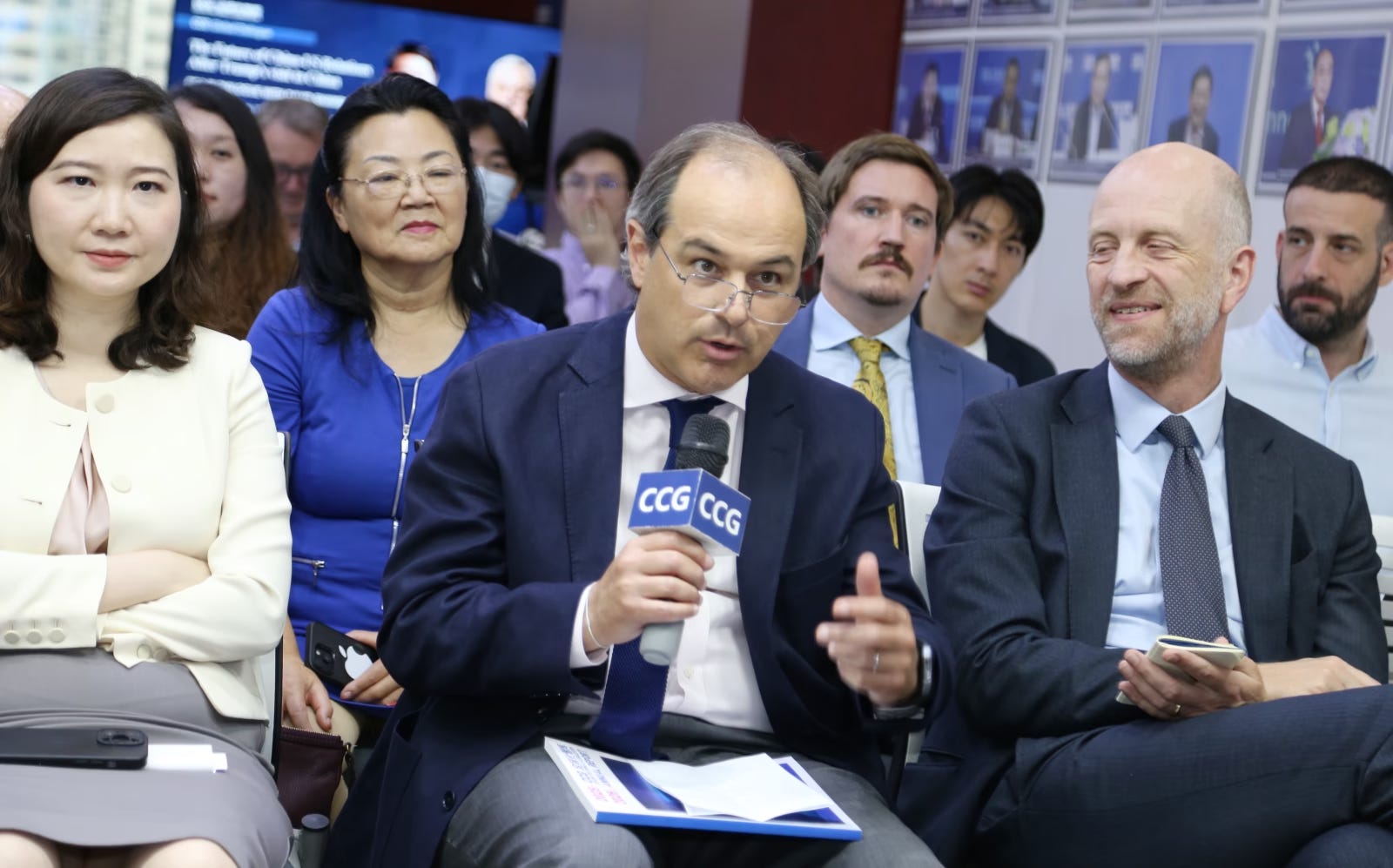
Thank you very much, Henry and Mabel, and all your CCG team, for organising this. Professor, thank you very much for your very informative input. Maybe you kind of responded to one of the questions I had, but I will still pose it again.
In the absence of outcomes and deliverables from this summit, why do you think, according to your experience in bilaterals at the highest level, that the U.S. delegation did not want to mirror, for instance, a readout or something like that, so that we could check whether whatever has been said on the Chinese side has been fully agreed by the U.S. side? That is one question.
When we talk about managed competition, may that also mean there might have been some conversations about how to regionalise the world in terms of where to compete and how? Because during a briefing made by the Ministry of Foreign Affairs—I could not attend, by the way, so this is hearsay—one of my colleagues asked if there had been any mention of Latin America during the summit, and their response was negative. So might regionalisation be part of this managed competition? Thank you.
David Shambaugh
I am afraid I have already forgotten your first question. But they did not do a tour of the world in their dialogue, although the White House readout three days ago or so mentioned the Middle East and Iran. They discussed those separately, somehow, and North Korea. The most interesting thing in that statement is that the White House said both leaders agreed to the denuclearisation of North Korea. That jumped out at me. Neither the United States nor China has made that statement. The Chinese side has not made that statement in at least a decade.
So, if indeed the Chinese side is in favour of denuclearising North Korea, which now has between 40 and 60 nuclear warheads, ladies and gentlemen, that is an interesting potential area of strategic cooperation.
But they did not talk about the whole world. Usually, when American and Chinese presidents get together, they do march around the world. Latin America, I hate to say it, is usually not included in that discussion. It should be. Latin America, as you probably know, is the Trump administration’s number one priority in the new National Security Strategy, more than the Indo-Pacific region. China is deeply embedded in and involved in Latin America. I have done a lot of research on that subject in your country, and in Chile, Brazil, and Peru, so I am aware of the role that China plays in the Western Hemisphere.
But no, as I understand it, the two presidents did not go into that.
But your first question—Why was there no joint statement? Good question. First of all, that is not the way President Trump operates. If you are going to have a joint statement, it has to be negotiated well in advance and agreed to, and then issued as soon as the meeting is over. That is not the way Trump does diplomacy. That is my guess.
The Chinese side maybe thought, “What about a joint statement?” to the U.S., and the Trump administration, I am just guessing here, said, “No, thank you,” because Trump is too spontaneous. You do not want to be boxed in by anything like a pre-prepared joint statement. That would be my anticipation.
I am not against joint statements, except that they are excessively long. I was living here in 2009 and 2010 when President Obama came, and they issued a joint statement that had 144 items on it. And I am sure they are going to implement that. That is what I mean by over-institutionalisation.
We did not have a joint statement. That is okay. That is not the significance of this summit. It is not the so-called deliverables in a joint statement. The significance of this summit is, as we have been discussing today, just that it took place. The relationship has now got a framework, it’s more stable, and moving forward.
Henry Huiyao Wang
But we do see some concrete outcomes, such as Boeing, and the 170 billion U.S. dollars every year, and also exchanges on both sides, with many further economic activities. So it does provide some—
David Shambaugh
Yes, a good framework. Contracts were signed.
Henry Huiyao Wang
Yes. Okay, Colum. From Bloomberg.
Colum Murphy, Senior China Economy and Government Reporter, Bloomberg News
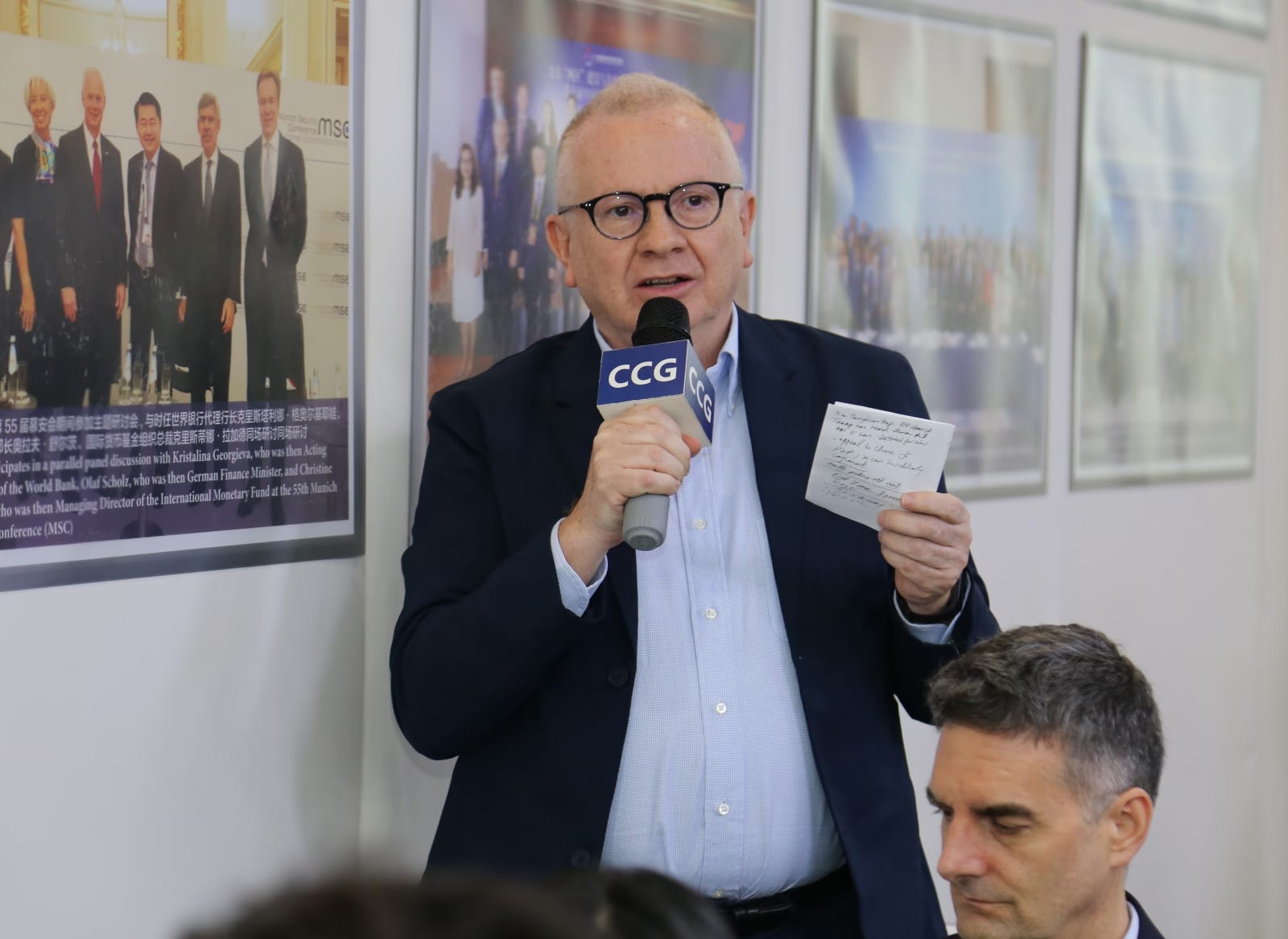
Thank you very much. Just very quickly, is the Board of Investment an example of over-institutionalisation? Is that something that we should be worried about?
And secondly, on the issue of all of these leaders coming to Beijing, and as you say, China’s diplomacy, quantitatively, is on the uptick for sure. We’ve seen more visitors coming. But is China really grasping that opportunity? I think that is one of the arguments that you made in your recent piece. And if so, why not?
One possibility, in my view, is perhaps an inability to oversee, or to get over, bilateral considerations. Now, specifically, I’m talking about, on our doorstep, the two biggest economies in the world, China and Japan, and yet we can’t seem to figure out a solution to that. So I guess my question is: in terms of the diplomatic opportunity for Xi Jinping and China, it seems to be present, but what are some of the factors that might explain why China is not fully grasping that opportunity?
David Shambaugh
Okay, thank you. Let me see if I can retain your two questions in my head.
On the first question—a very good and valid question—is the new Board of Investment and Board of Trade an example of over-institutionalisation? Answer: yes. First of all, the whole notion of managed trade is inconsistent with the WTO and with the rules we are all supposed to operate by. Similarly for investment—you know, mutually agreed investment.
So it’s unclear what these two boards are supposed to do. They weren’t defined at all. They were just announced. If the investment board is a forum for just informing the other side of possible investment opportunities, then it is a dialogue mechanism, then that is worthwhile. But there is no way a bilateral board is going to regulate flows of FDI between the two societies. A Board of Trade can’t do that either.
So I suspect—check back in three months and see if either of these two new boards even exists. My guess is they won’t, and they shouldn’t.
And your second question about my Foreign Affairs article. What I would suggest is: read the Foreign Affairs article. I make the argument there that all countries in the world are hedging between America, China, and Russia. Europe is caught between three predatory powers: China, Russia, and America now. Europe is in a very difficult strategic position. But every other hemisphere—
The question is: can China take advantage of Trump’s bullying and coercion, and the inexcusable behaviour—and I say this as an American—that has come out of this administration towards friends, allies, neutral countries, the Global South, the Global North, everybody? He is handing Xi Jinping a golden platter for strategic advancement on the global stage.
The question is: can China take advantage? The answer, I argue in this recent Foreign Affairs article, is that so far, not. It is still early days. It takes a long time to take advantage. But the reason is that all these regions of the world—Latin America, Europe, the Middle East, Africa even, and the Indo-Pacific region—and individual countries all have problems with China. They have their own problems that predate Trump, and those problems are not going to just disappear.
So we’re in a different kind of world now. It’s not a bipolar world. It is certainly not a G2 world. Nor is it a bipolar world. It is a much more diffuse world. So I don’t know. That’s what I would say.
Henry Huiyao Wang
Well, I do think China’s attractiveness has increased. For example, China recently announced that from May 1, goods from 53 African countries coming to China will be exempted from tariffs, with zero tariffs. That is going to encourage a lot of European companies to set up shops in Africa and re-export to China with zero tariffs. So we do see a lot of good gestures out of that.
Maybe we’ll invite a lady to raise a question.
Zhuorui Fu, Associate Economic Officer, UN ESCWA
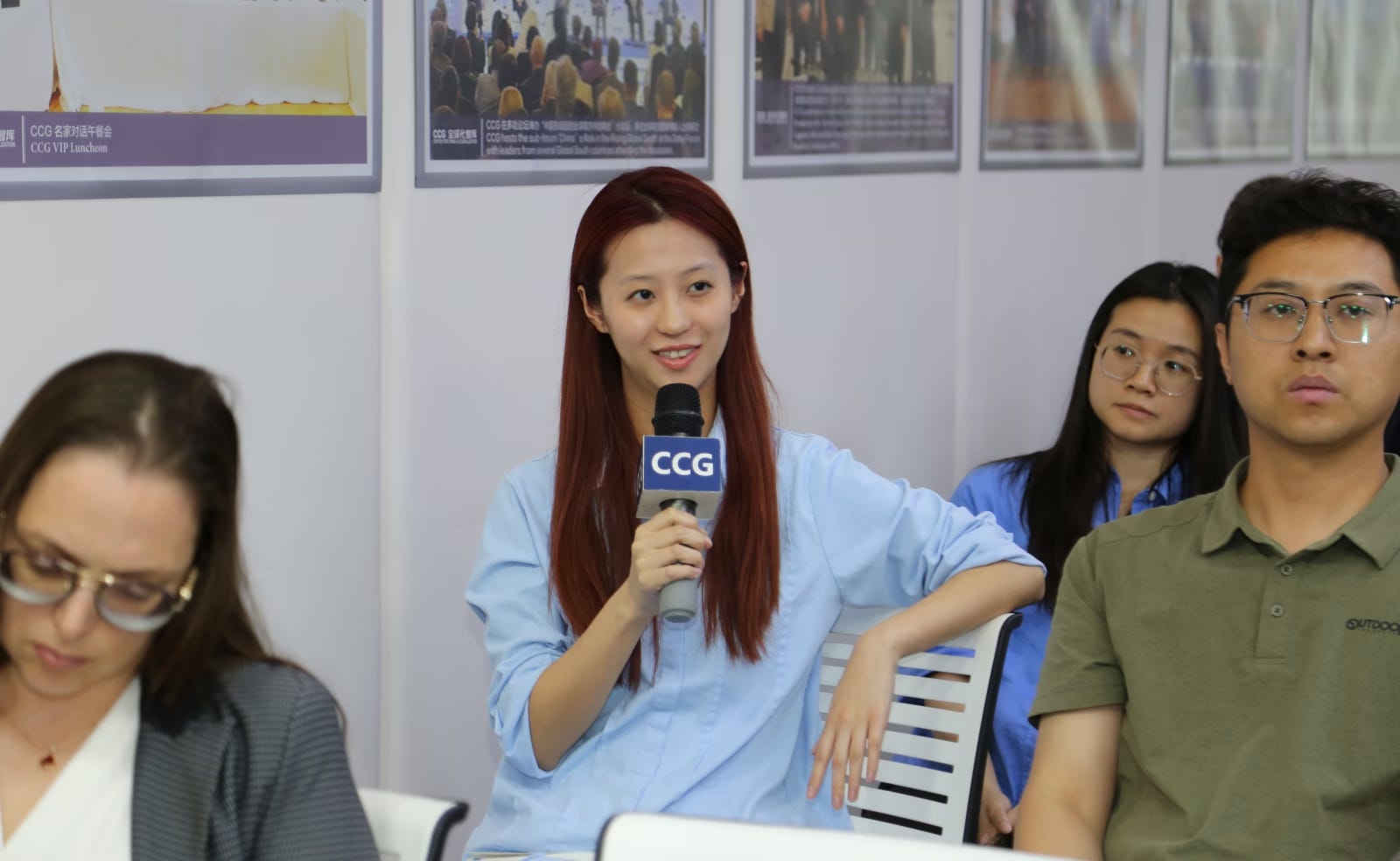
I want to ask about managed competition in the field of AI—
David Shambaugh
Can you identify yourself, please?
Zhuorui Fu
Sure. I work at the UN, and I spent nine years in the Middle East, seven years of which were in Iran. AI, and especially AI compute, is the new oil. It occupies the same strategic weight as rare earths, oil, and others. Saudi Arabia is building data centres of five gigawatts, which is pretty big, but the biggest are still China’s and the U.S.’s. Nobody competes with them.
Jensen Huang came to China just now, and people realised that the chip embargo on China did not kill the Chinese AI industry. Actually, China is quickly finding AI substitutes.
So my two questions are short and sweet. In the AI domain, do you think it is a zero-sum game between China and the U.S.? That’s number one. And number two, regarding managed competition in AI, do you think it is a better way of saying: actually, we failed to kill you, or we failed to subdue your industry, so let’s find a way to coexist?
David Shambaugh
Okay, thank you. I was trying to follow. I’m the last person that you should ask about AI. But it doesn’t take a rocket scientist to recognise the importance of this in today’s world, the potentialities of it we have not yet discovered or seen. That’s the one thing I was hoping would come out of this summit. That is the one working group that we really need, that is not among Wang Yi’s eight working groups: an AI working group between the U.S. and China.
First, it is not a zero-sum game, to answer your question. Not at all. These are the two leading countries in AI. But there is so much synergy between Silicon Valley and Zhongguancun, and China in general. Both countries are innovation superpowers. It is not zero-sum. Innovation is a positive-sum, competitive thing. So actually, competition in AI is a good thing for both sides.
So I hope that answers that part of your question. But we need to have such a dialogue, because it is entering the military domain. Both the Pentagon and the People’s Liberation Army are already deploying AI systems.
Henry Huiyao Wang
I think actually this summit touched upon AI, and they agreed that they are going to have some kind of mechanism on that. So this is good.
Professor Shi from Renmin University.
Shi Yinhong, retired professor, School of International Studies, Renmin University of China
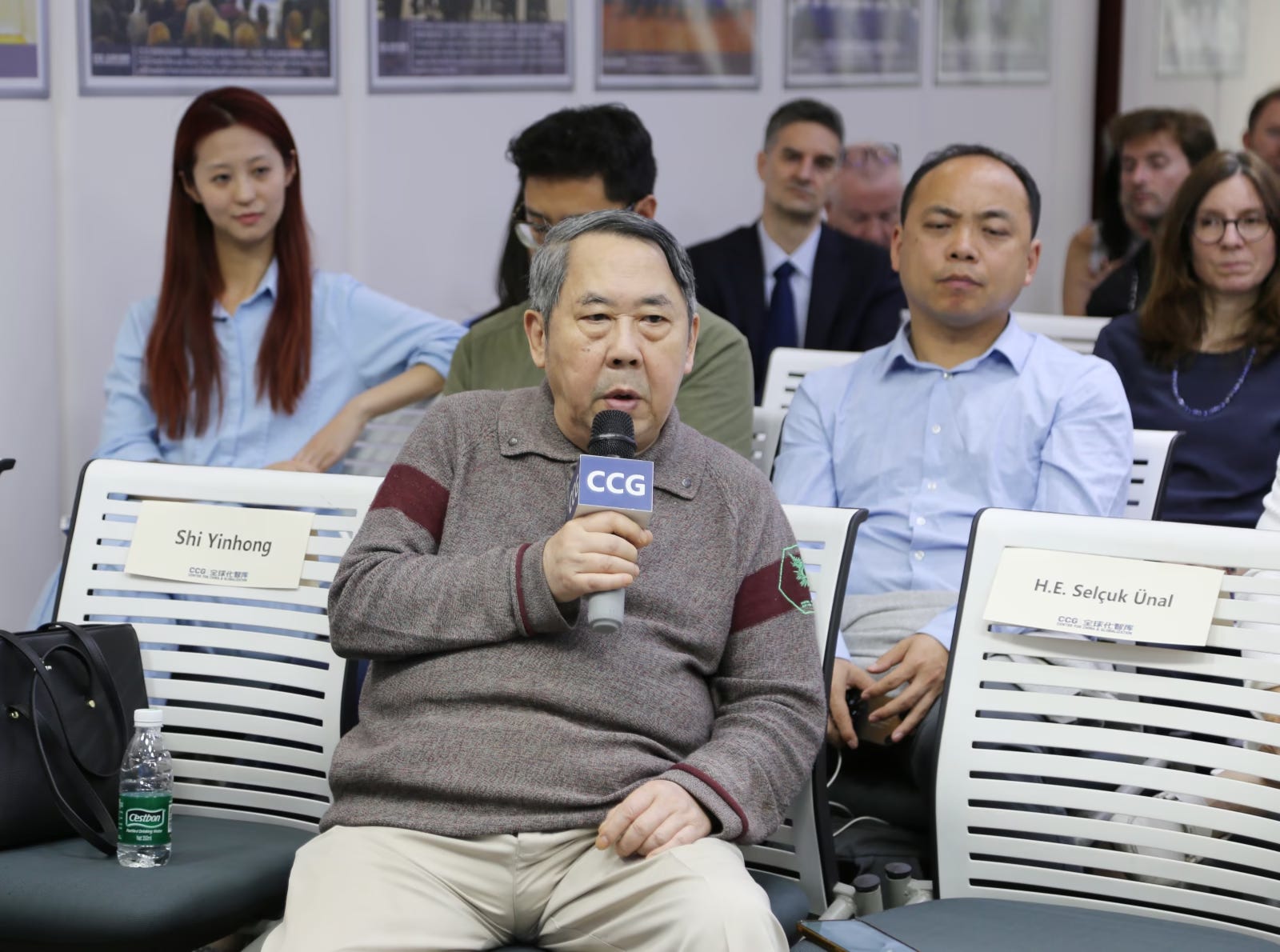
Thanks, Dr Henry Wang. I have taken full consideration of the positive meanings and significance of Professor David Shambaugh coming here. I suppose that if you speak in Washington, your tone would naturally be somewhat different.
For this tifa, I have great doubts, because three questions have not been answered. The first question: where does this competition, or rivalry, come from? Second, which are structural, situational, and idiosyncratic? Third, what kind of mutual concessions are required for managing them?
Without answers, it will remain a rhetoric. And unfortunately, I think you have paid a little too much attention to scholastic language analysis. I always pay much more weight to concrete things.
The conclusion is that the rhetoric seems to be bought by China through American material trade gains worth tens of billions. Beijing’s priority before the summit, I think, must be not extorted too much trade demand by Trump, too much to surpass the real domestic economic demand at home. But this bottom line seems to have been broken.
The Chinese government agreed to buy at least 17 billion U.S. dollars’ worth of American soybeans and other agricultural products annually through 2028. This is a threefold increase compared with its commitment made last October in Busan. So the bottom line of real demand at home has again been broken.
According to Washington’s declaration and Beijing’s confirmation, China will approve the purchase of 200 American-made Boeing aircraft for Chinese airlines.
I remember again and again that during the Labour Day holidays in China, airlines kept their so cheap as to be incredible. Still, so few people bought air tickets, and even fewer people took high-speed rail. And 绿皮火车, slow railway trains became more popular than ever before.
I think that the Chinese economy and its financial capability—for example, our influence on other continents, Africa for example, and our foreign-aid capability—are correspondingly going down. This is the most fundamental basic fact for China, just like the inability to win the war in Europe is the most important defining fact for Russia.
I think China’s economic and financial capability, and for example, its influence on other continents such as Africa, and its capacity for foreign aid, will correspondingly go down. This is the most fundamental basis for China, just as the inability to win the war in Europe is the most important defining fact for Russia.
So I think, of course, we can declare a lot of things. But other people on other continents are realistic just like us. Maybe if we promise in rhetoric too much, this will in turn hurt us even more, because finally we cannot deliver. We have to deliver first of all to the Chinese people.
Zhao Shengchuan, Professor, Josai International University
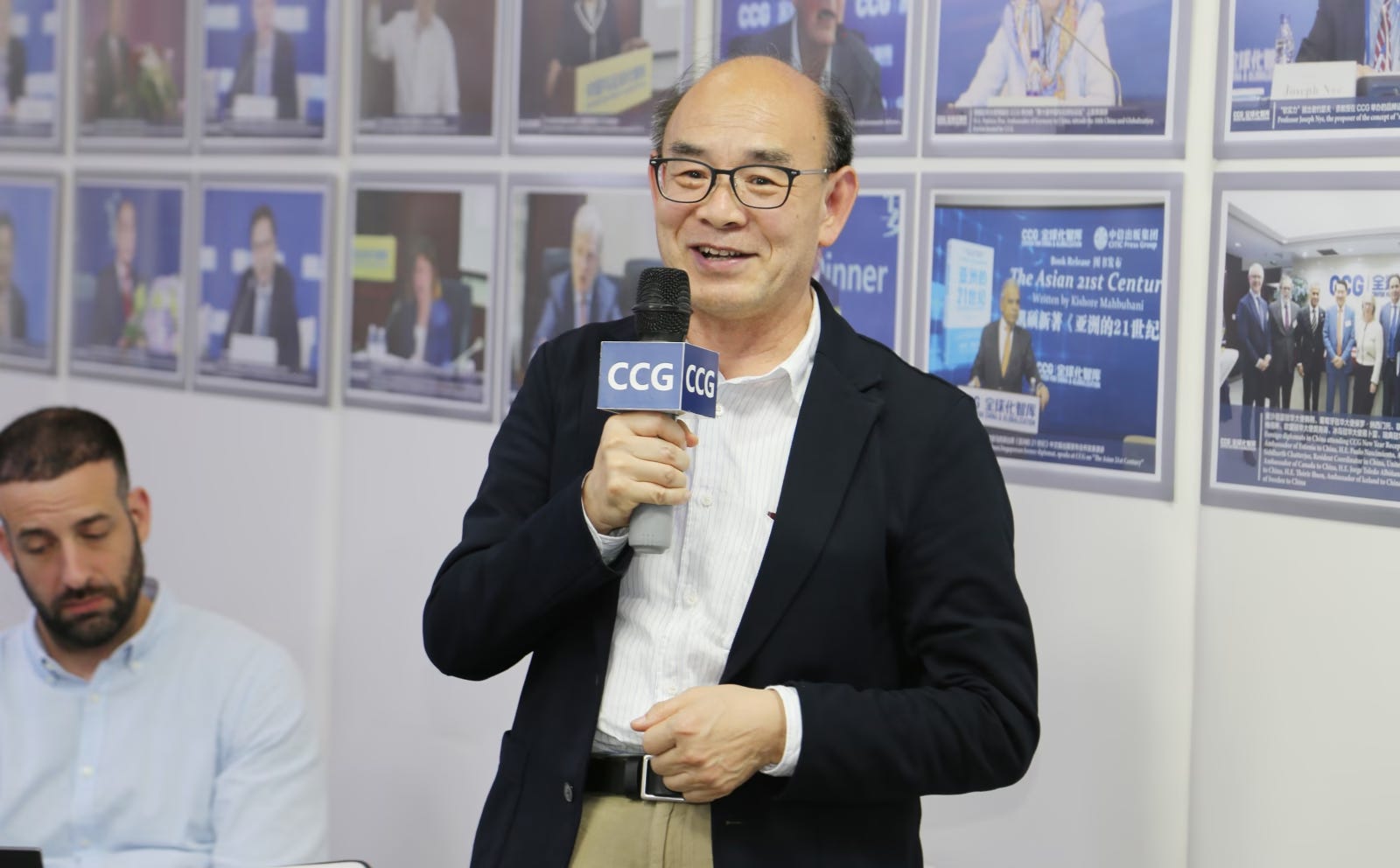
Thank you very much for the invitation and for your insightful thoughts. I am a professor teaching in Tokyo. I am Chinese, so I think it is natural for me to ask you a question regarding relations with Japan.
What is your viewpoint about Japan’s role in affecting the U.S.-China relationship, as China’s neighbour or as a partner nation of the U.S.? Is Japan something, or nothing, in affecting the U.S.-China relationship? What are your thoughts on that? I want to know. Thank you.
David Shambaugh
Well, thank you for the question. I do not wish to interfere in the internal affairs of Japan. However, Japan is America’s leading No. 1 or No. 2 ally in the world. That’s simple. Together with the United Kingdom, this is an unbreakable, unshakable alliance. Very deep.
And it is not going to change, in my expectation. So it is just a fact of life, a fact of strategic life, and a fact of diplomatic life. I understand what is probably underlying your question, but I am not going to go there with regard to recent statements by the Japanese prime minister. If that is what you are fishing for, sorry, I am not going to go there.
Geography doesn’t change. Japan is where it is. Japan is an American ally, and the United States is Japan’s important ally. So it is a fact of strategic and diplomatic life. Other countries in the region and in the world need to understand and accept that.
As for Professor Shi, for those of you who don’t know, he is one of China’s leading—truly leading—historians and international relations scholars. He is an old friend of four decades, and it is wonderful to see you again.
You asked again a number of very insightful questions. I had a hard time remembering them all. You mentioned high-speed rail at one point. That is something that we in America definitely need and should welcome from China and from Japan—the Shinkansen. So we can start with the investment in high-speed rail.
You also asked about several other items. Competition—where does the competition come from? I think that was your initial question. Well, I think of the competition like a soccer match with no extra time and no referee. It is continual. Competition is like dynamic stability, it is evolutionary. It is fluid. It is constant. You have to manage it with referee and rules. But we live in a world today where there is no referee. The United Nations is not the referee. The World Trade Organisation is not the referee.
So there have to be normative restraints on countries, even if international law is not sufficient to restrain countries. Competition between great powers goes back to Athens and Sparta. For us not to acknowledge competition between the United States and China is simply not recognising reality.
So I think once you recognise it, then you can talk about it, and you can unpack it, and then you can maybe work on it and try to narrow differences and ameliorate competition. Again, ladies and gentlemen, if you leave here with one thing today, competition is not inherently negative or zero-sum. So it is a good thing. Competition helps us all.
Henry Huiyao Wang
Okay, I think given the time, we will probably end here. I agree with David that infrastructure would be a good area to start. It is less sensitive, and I think the U.S. is at a time when it needs a very advanced high-speed railway system, and China certainly can offer a lot of help. The high-speed rail that was supposed to be built in California has not really moved much. So we hope that many more areas can be identified as positive for both sides.
Today, we had a very good and constructive dialogue, I would say, and very frank discussions. Of course, we have different views, but that does not prevent us from engaging in deep dialogue and promoting better understanding.
I do think that since the summit between President Trump and President Xi over the past week, U.S.-China relations have probably entered some kind of new normal. At least we are engaging in more dialogues, more discussions, and more exchanges. I hope that momentum continues with another three visits. And maybe, as our leader just said, we should really put the U.S.-China relationship into a constructive strategic stability.
On that note, I want to thank all of you very much, and again thank Professor David Shambaugh for coming to CCG this afternoon to engage in this CCG Global Dialogue. Thank you. Welcome.
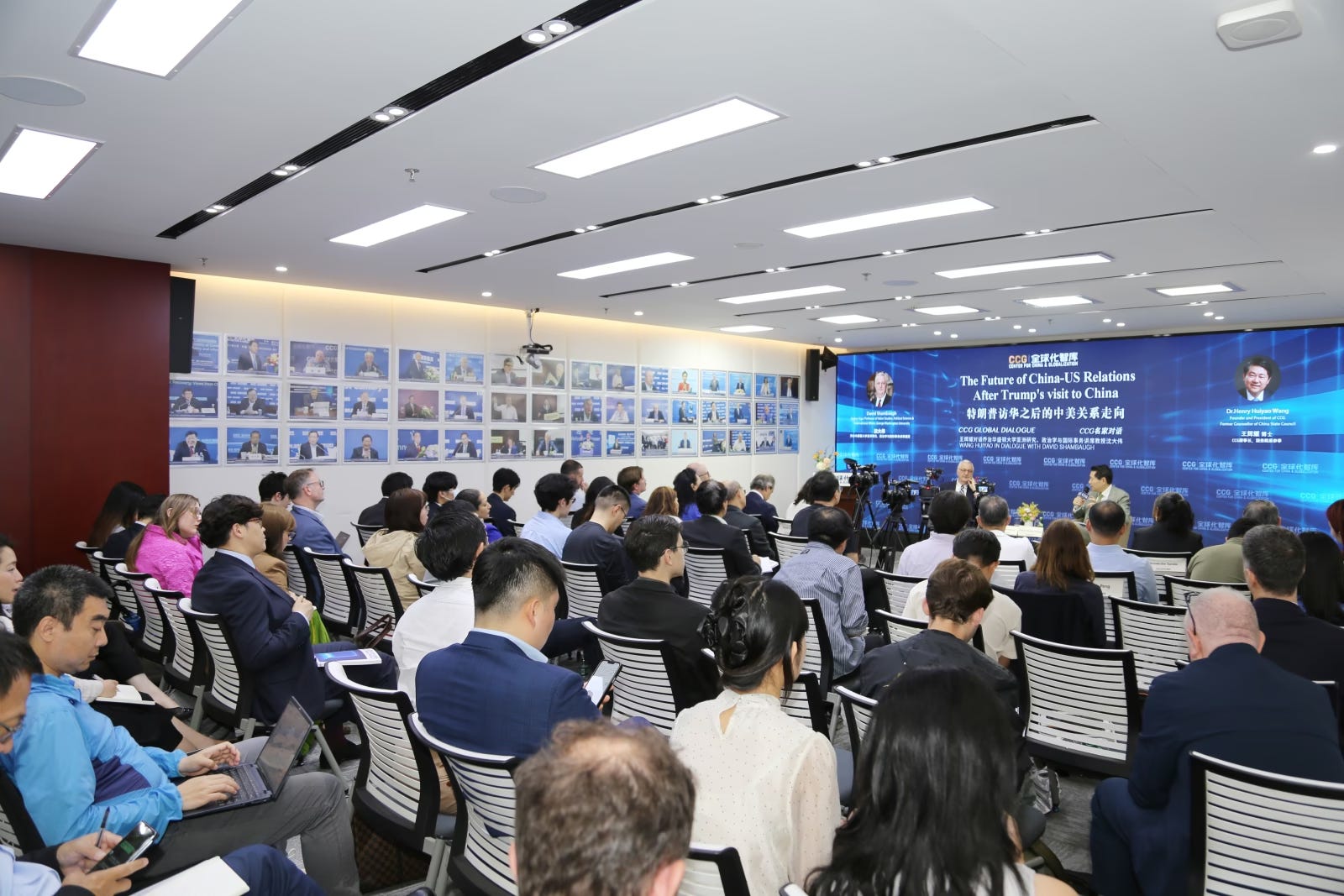
The most revealing moment in David Shambaugh's CCG dialogue may be the least examined: his offhand description of being "the first foreign student permitted to study in an international relations department in China in 1983," a door through which, he notes with evident satisfaction, "many more have walked subsequently." Edward Said observed that to possess knowledge of another civilization in the Orientalist tradition "is to dominate it, to have authority over it," and Shambaugh's framing of his own intellectual biography, entering China's knowledge institutions before Chinese scholars had reciprocal access to American ones, then producing frameworks that China's own diplomats now partially adopt, enacts precisely this dynamic without apparently registering it. The concept of "managed competition," which Shambaugh twice asserts he coined "twelve years ago," has now migrated into Chinese diplomatic language, with Foreign Minister Wang Yi's press conference essentially endorsing it. Shambaugh notes this evolution with visible satisfaction: "it seems to have finally sunk in a little bit." That phrase - sunk in - is not a neutral observation. It is the language of a teacher whose lesson has finally been absorbed by a slow student, a structure of epistemic authority that Said identified as the core mechanism of Orientalism: the systematic positioning of Eastern cultures as requiring Western frameworks to understand themselves, with "the efforts to encourage Easterners to judge themselves by Western criteria and to work for achieving Western goals." The thread running from Shambaugh's 2015 Wall Street Journal article, which declared that "the endgame of Chinese communist rule has now begun" and predicted Xi Jinping might be "deposed in a power struggle or coup d'état", to his 2026 Beijing appearance is not a thread of intellectual revision but of positional continuity. In 2015, the authoritative Western expert pronounced China's system terminal; a decade later, with that prediction spectacularly falsified by events, the same expert returns to Beijing not to reckon with what his analytical framework missed, but to offer a new framework, "constructive strategic stability", whose conceptual architecture remains entirely Western in origin and American in strategic purpose.
Arif Dirlik charged that Western scholarship on China had long "perpetuated Eurocentric knowledge even as it sought alternatives to Eurocentric explanations," and Shambaugh's dialogue demonstrates this mechanism at work in real time. His entire analytical vocabulary, managed competition, guardrails, deliverables, the agent-structure paradigm, Thucydides Trap, arrives pre-packaged from American political science and Washington policy culture. When he encounters concepts that don't fit this framework, he either domesticates them or dismisses them. His treatment of the new Chinese tifa is illustrative: he unpacks "constructive," "strategic," and "stability" through American definitional lenses, notes where Chinese usage diverges, and frames this divergence as a problem requiring further dialogue, more dialogue of the kind CCG provides, more exchange in which Western conceptual categories serve as the implicit standard against which Chinese formulations are measured. Wang Hui has described this imbalance with precision: "China is viewed from abroad as through a dense fog that doesn't allow one to discern contours and reference points," while from China, "the gaze directed at Europe and the entire world can be very sharp, able to focus on a wide array of themes and issues", an asymmetry that reflects "a Western eye deformed by a superstitious view of China," encountering a Chinese intellectual tradition "trained by at least a century and a half of critical knowledge of the West." Shambaugh's dialogue embodies this asymmetry structurally: he arrives as the authoritative outside assessor, generously granting that Chinese thinking on competition has shown "a lot of evolution", not progress, he carefully notes, "just evolution", while his own analytical premises go entirely unexamined. Most tellingly, when the question of Japan's strategic autonomy arises, Shambaugh's response abandons the careful scholarly register he maintains throughout and becomes almost aggressive in its brevity: "Japan is America's leading No. 1 or No. 2 ally in the world. That's simple... Geography doesn't change... Other countries in the region and in the world need to understand and accept that." The repetition of accept, directed at a Chinese audience, in Beijing, is not analysis. It is a boundary marker, and the sharpness with which it is drawn reveals where the genuine limit of Shambaugh's managed pluralism lies.
What makes this pattern significant beyond the individual case is that it reflects what Dirlik identified in his 1972 essay "Harvard on China" as the "apologetics of imperialism" embedded within American China studies as an institutional formation, not through deliberate bad faith, but through the structural conditions of knowledge production in which area studies programs exist to serve strategic purposes, generating expertise that flows from Washington policy needs outward, rather than from genuine curiosity about civilizational difference inward. Shambaugh's biography makes this formation unusually visible: his career spans the Carter National Security Council, every subsequent American administration, George Washington University's China Policy Program, and now a return to Beijing in the role of constructive interlocutor at a moment when Washington has decided engagement is strategically preferable to confrontation. Said wrote that "critical thought does not submit to state power or to commands to join in the ranks marching against one or another approved enemy" and called instead for attention to "the slow working together of cultures that overlap, borrow from each other, and live together in far more interesting ways than any abridged or inauthentic mode of understanding can allow." The tragedy of this dialogue, viewed from that perspective, is not that Shambaugh is malicious, he is clearly not, but that the institutional and conceptual structures through which he works make genuine reciprocity nearly impossible. He can learn Chinese, live in Beijing, play basketball at Beida, and spend four decades studying Chinese perceptions of America, and still return in 2026 carrying frameworks whose authority derives entirely from their origin in the dominant power, unable finally to imagine a world in which China's analytical categories might evaluate his, rather than the reverse. That inability is not personal. It is structural, and the structure has a name.
Thank you for the transcript. Reading it slowly, on a quiet morning here, one feels the weight of what was not said as much as what was.
Shambaugh is generous, and his reading of the new tifa is careful work. Constructive. Strategic. Stable. Three words asked to carry a great deal. He is right that Americans and Chinese fill the word strategic with different cargo — one packs warships, the other packs everything. Until that gap is named, the floor he describes is laid on a translation, not a foundation.
But it was Shi Yinhong who walked into the room carrying the lamp. The empty cabins during the Labor Day holiday. The 绿皮火车 fuller than the high-speed rail. Seventeen billion dollars a year in agricultural purchases through 2028, layered on top of the Busan soybean commitments. Two hundred Boeing aircraft. A bottom line broken not in Washington but at home. He was saying, quietly and without drama, that rhetoric has a price, and the price has been paid in advance, and the till from which it was paid is not as full as the speeches suggest.
There is an older pattern in this. Great powers in difficulty often buy time with promises their economies cannot finally honor. The promises arrive first as relief, then as obligation, then as the next quarrel. The Underwriters' War — the slow re-pricing of risk that began with Hormuz and is still working its way through the global insurance and food systems — is the backdrop against which these commitments will have to be delivered. Capacity is not what it was even two years ago.
So I read this exchange less as a turning point than as a held breath. A floor, yes, but on softening ground. Three more summits will probably keep the framework intact through this year. The real test comes in 2027 and 2028, when the bills come due and the arithmetic asks its own questions.
Grateful, as always, for the work you do bringing these conversations across.
Nazem Alkudsi