


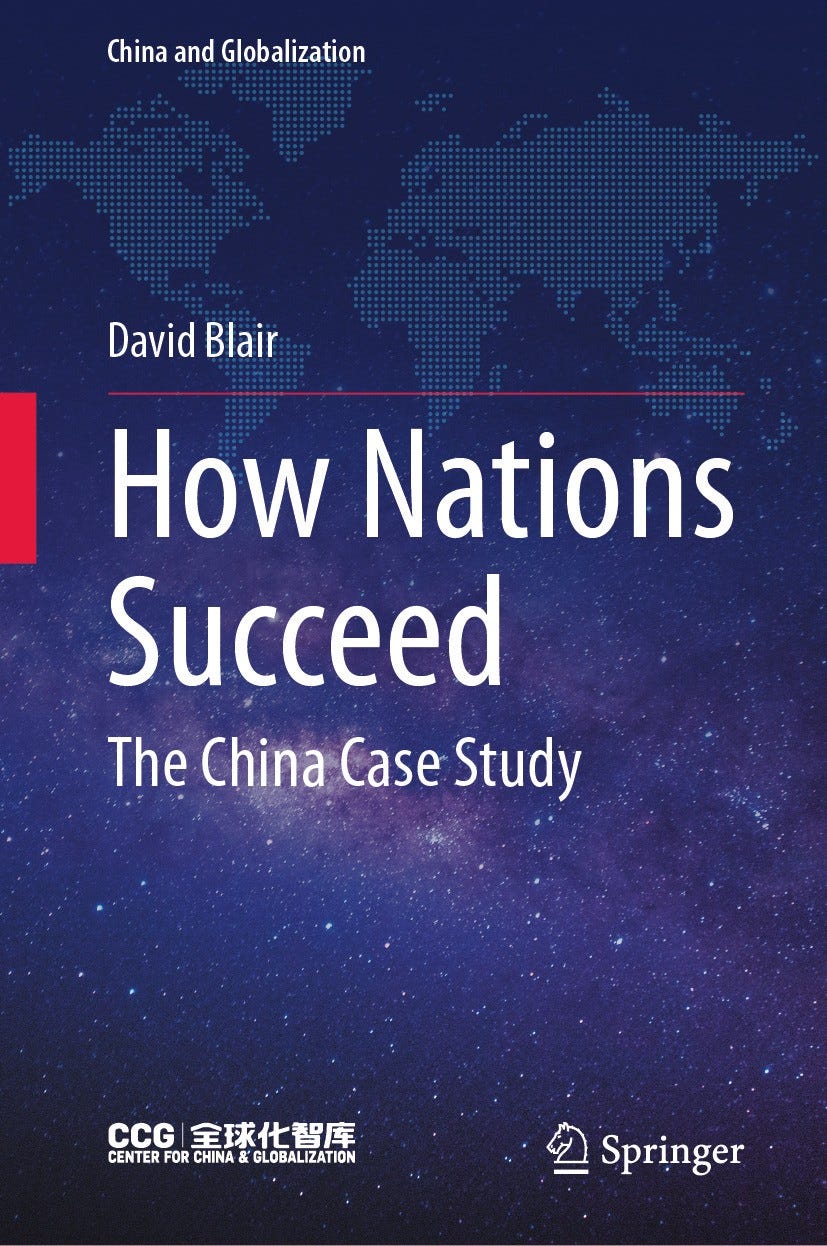
On October 13, 2026, the Center for China and Globalization (CCG) and Springer Nature jointly held a book launch and seminar at CCG headquarters in Beijing for How Nations Succeed: The China Case Study, a new book by David Blair, Vice President of CCG and former Chairman of the Economics Department at the Eisenhower School, National Defense University.
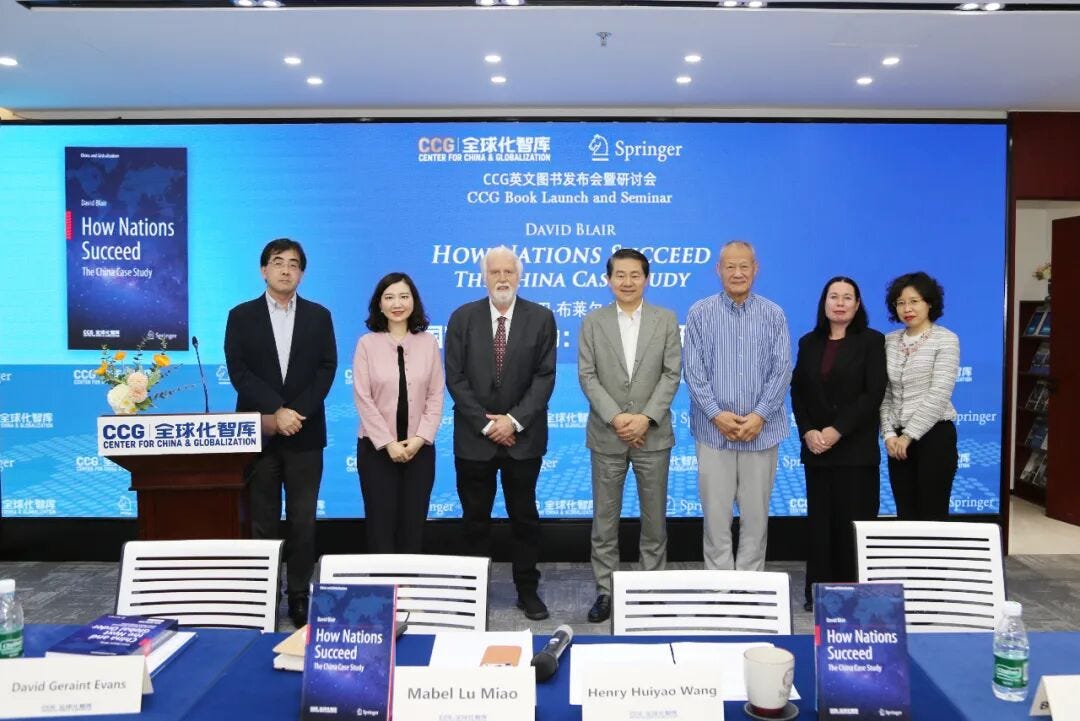
This book, part of the China and Globalization series, offers a comprehensive analysis of China’s economic governance model—its astonishing success in improving the lives of average people and its future challenges. Beginning with a comparative history of the Chinese and US economies from 1979 to 2025, the discussion analyzes the distinct historical phases of China’s transformation. The author stresses that the details of a nation’s financial system determine whether a sustainable fundamental transformation is possible.
The event featured welcoming remarks by Mabel Lu Miao, Co-founder and Secretary-General of CCG, and opening remarks by Emily Zhang, Senior Editor for Business, Economics and Political Science at Springer Nature.
The subsequent seminar was moderated by Henry Huiyao Wang, Founder and President of CCG, and brought together the author, David Blair; David G. Evans, Director of the Science Popularization Experiment Center at Beijing University of Chemical Technology; Frank Xiaowei Fang, Founder of the Center for Institutional and Economic Research in Chicago; Wang Zhi, Professor and Founding Director of the Global Value Chain Research Institute at the University of International Business and Economics and Non-resident Senior Fellow at CCG; and Takamoto Suzuki, Head of Economic Research Team at Marubeni China Co., Ltd.
CCG has uploaded the event video to its official YouTube channel.
This transcript is based on a recording and has not been reviewed by any of the speakers.
Mabel Lu Miao, Co-founder and Secretary-General, CCG
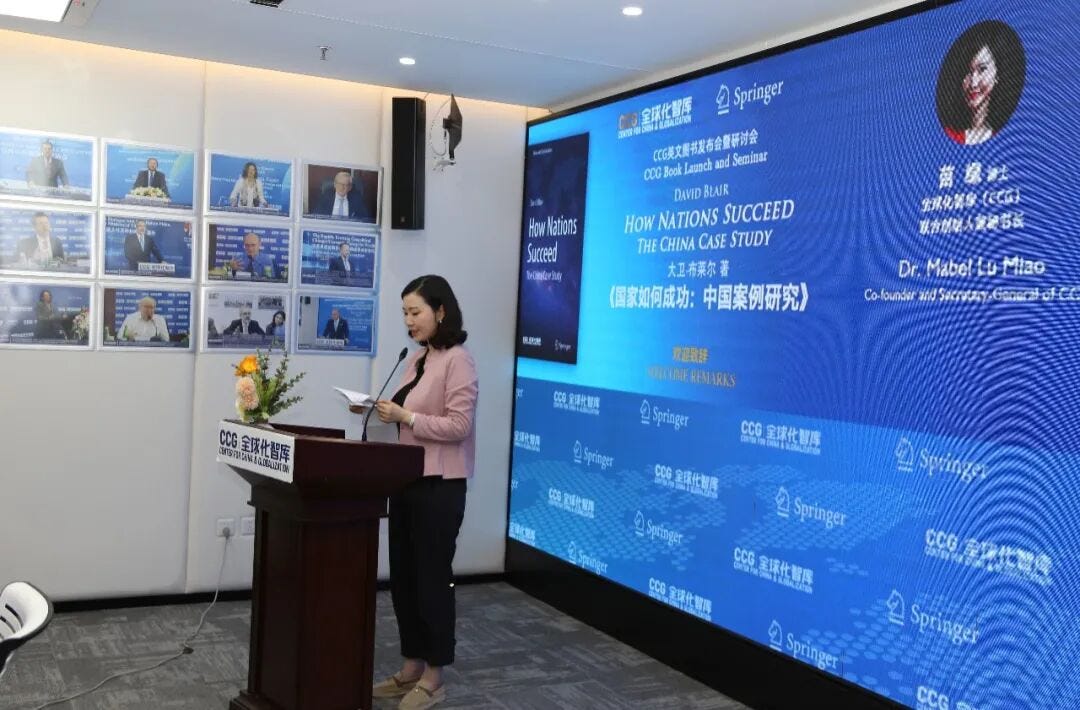
Distinguished guests, ladies and gentlemen, good afternoon. I’m Mabel Lu Miao, Secretary General of the Center for China and Globalization. It is my great pleasure to welcome you to this book launch and seminar celebrating the release of Dr. David Blair’s new book, How Nations Succeed: The China Case Study.
Before we begin, allow me to briefly introduce our distinguished author. Dr. Blair is the Vice President of CCG, the Center for China and Globalization. He is an economist specializing in macroeconomics, monetary policy and entrepreneurship. He has also held numerous positions related to foreign policy. He retired in 2016 as Professor of Economics and Finance from the Eisenhower School of National Defense University in Washington, DC, where he also served as chairman of the economics department. After retiring, he served as a senior columnist at China Daily. He holds a PhD in economics from UCLA and was a MacArthur Foundation Avoiding Nuclear War Fellow at Harvard University. He has led projects and consulted in Italy, Pakistan, India, Bulgaria, and Ethiopia.
This event is co-hosted by CCG and Springer Nature. We are honored to be joined by the author, Dr. Blair welcome along with senior scholars, business leaders, and journalists. Welcome, all of you.
How Nations Succeed: The China Case Study offers a comprehensive analysis of China’s economic governance model, its astonishing success in improving the lives of average people, and its future challenges. Together, we will mark the release of this important book and explore the topics in it.
First, let me introduce our distinguished guests.
Henry Huiyao Wang, President of the Center for China and Globalization and former Counselor to China’s State Council
David Blair, Vice President of CCG, former chairman of the economics department at the Eisenhower School of National Defense University in Washington, DC, and author of our book, How Nations Succeed: The China Case Study
David G. Evans, Director of the Science Popularization Experiment Center of Beijing University of Chemical Technology
Frank Xiaowei Fang, founder of the Center for Institutional and Economic Research in Chicago
Wang Zhi, professor and founding director of the Global Value Chain Research Institute of the University of International Business and Economics
Min Sun, former Deputy Secretary-General of the China International Council for the Promotion of Multinational Corporations and former project director at the UN Industrial Development Organization Investment and Technology Promotion Office in Beijing
We are also joined by our distinguished guests from the publisher, including Emily Zhang, Senior Editor for Business, Economics and Political Science at Springer Nature Group.
How Nations Succeed: The China Case Study is one of the 16 books in the China and Globalization series published by Springer Nature and co-edited by Dr. Huiyao Wang and me. This series is designed to present a wide range of global views on issues related to China and globalization, the opportunities and challenges of China’s rise in the world, and China’s role in global governance, the global economy, global development, and global security.
As the first of its kind to publish the works of contributors internationally, this book series seeks to create a balanced global perspective by gathering the views of highly influential global opinion leaders, former statesmen, ambassadors, well-known academics and think tank experts, multinational CEOs, and foreign champions of commerce with China from around the world. Currently, the series boasts over 300 contributors internationally, including Graham Allison, Kishore Mahbubani, Joseph Nye, and the Nobel laureate Edmund Phelps, to name just a few.
I would like to express my sincere gratitude to Springer Nature for their ongoing partnership. Their support has been invaluable in publishing this book series. A warm welcome to all our distinguished guests today. We greatly appreciate your presence and look forward to an enriching and insightful discussion. Thank you all.
Emily Zhang, Senior Editor for Business, Economics, and Political Science, Springer Nature
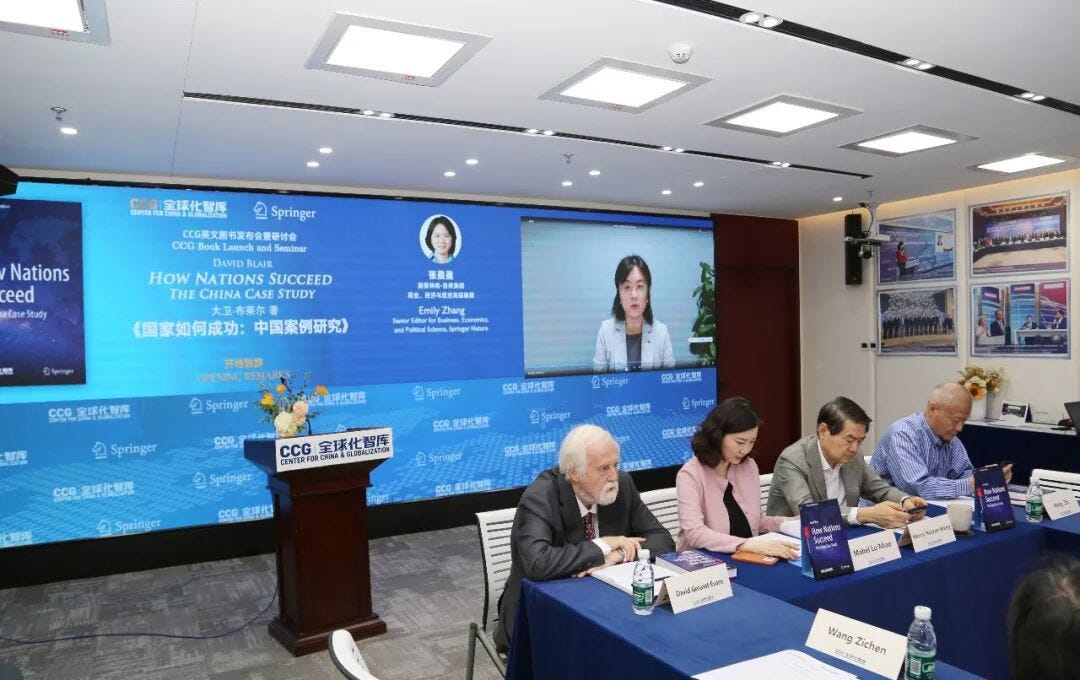
Dear friends, ladies and gentlemen, good afternoon. My name is Emily Zhang, Senior Book Editor, based in Springer Nature’s Beijing office. It’s my great pleasure to congratulate David Blair on his book’s publication on behalf of Springer Nature: How Nations Succeed: The China Case Study. I thank CCG and our series editors, Henry Huiyao Wang and Mabel Lu Miao, for their continued collaboration with Springer Nature. The book is published in our China and Globalization series, which provides an international platform for diverse perspectives on China and its relationship with the world.
The book begins with an ambitious question, but what I find especially interesting is that David does not simply ask why some economies grow faster than others. Instead, he asks something more fundamental: what does economic development actually mean for the lives of ordinary people?
Throughout the book, David explores the relationships among competition, investment, real wages, infrastructure, entrepreneurship, and quality of life. He compares China’s experience with that of the United States and other East Asian economies, while examining everything from rural development and city life to industrial clusters and technological innovation.
This is not purely an abstract economic analysis. David draws extensively on his own experience of living in China for many years, both in Beijing and in Yuxi, Yunnan. Large economic questions therefore come back again and again to everyday observations about housing, transportation, public spaces, villages, small businesses, and communities. This makes the book highly personal, but also deliberately thought-provoking, and the questions David raises extend well beyond China. What makes economic growth sustainable? What is the right relationship between markets and public investment? How can competition, entrepreneurship, and technological innovation contribute to development? And above all, how can economic progress translate into genuinely better lives for people? These are questions facing societies around the world.
So today we are celebrating not only the publication of a new book, but also an invitation to discussion. On behalf of Springer Nature, I would like to congratulate David Blair and thank CCG for our partnership, and thank everyone here today for joining us. I hope How Nations Succeed: The China Case Study will reach readers around the world, stimulate thoughtful debate, and contribute to a deeper international understanding of China’s development experience. Congratulations, David, and thank you very much.
David Blair, Vice President, CCG; Former Chairman of the Economics Department, Eisenhower School, National Defense University
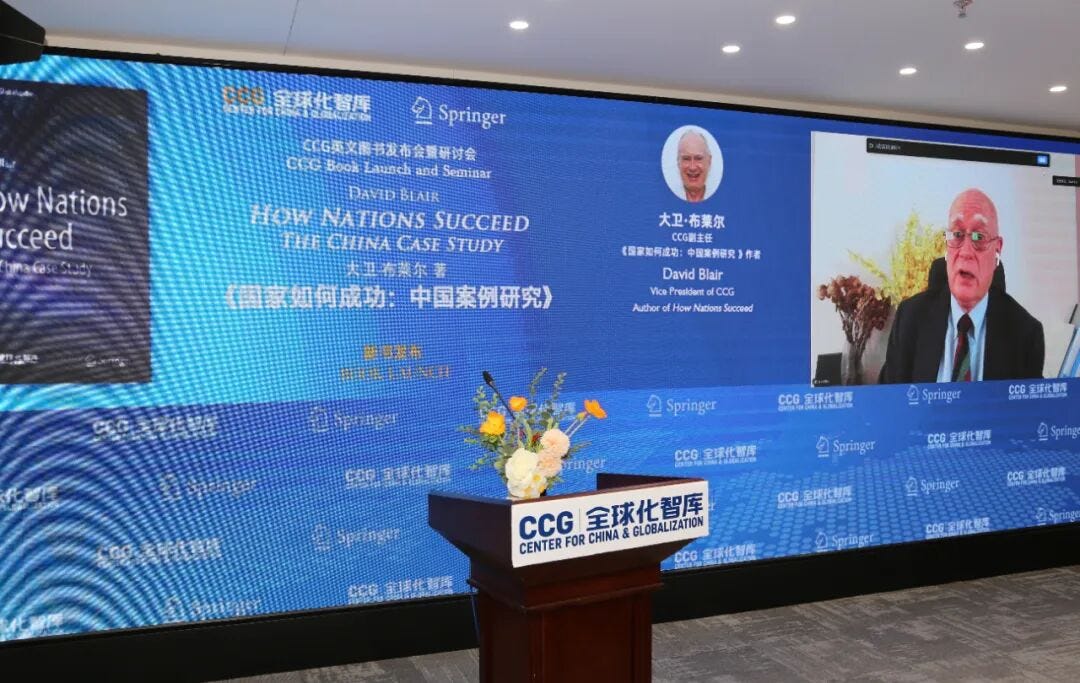
Hello, everybody. Thank you for coming. I thought I’d spend a few minutes talking about some of the more theoretical points from the book, the more generalizable ones that I think are important, which in part I’ve learned from China. I started working on some of these ideas before I came to China, but I really didn’t have a good comparison. I think it’s very useful to compare general views of Western economies with what’s happened in China, and to compare how the governance differs, but also how the pattern of development differs. So I’m going to just list some of the major theoretical points that I think are crucial going forward.
The first thing that I stress throughout the book is that real wages are key to sustainable economic development. If there were one number that I would look at to say whether a country or an economy is successful or unsuccessful, I would look at real wages. And I think that’s almost never done.
If you look at the data, it’s kind of shocking. China’s real wages have gone up 23 times since 1979. That’s a transformative change in the living standards of Chinese people. US real wages, and the data starts in 1979, so that’s the earliest data I have, but I think the stagnation happened sometime in the early to mid-70s, US wages have not gone up at all, zero, since 1979. Family incomes have gone up some because a large cohort of women came into the workforce, so you had two wage earners in the family instead of one. But median real wages have not gone up at all. They have gone up in some of the higher income categories, but for the median, again, that’s the people exactly in the middle, 50% above and 50% below, there’s been no increase in real wages. In the last two or three years there has been some, but it’s little, and it tends to be very variable over time.
Essentially, the main theory in the book is that real wage increases are a critical part of a benevolent cycle that makes development sustainable and possible. The argument is this: you can have large expenditures on capital creation, either factories or infrastructure. Well, many countries have tried that, and very few have succeeded. The only ones that have succeeded are what I call the East Asian Development Model economies: Japan, South Korea, the Taiwanese economy, and China. There’s no other success story in the world that has tried this sort of capital-intensive development.
What made it work in these countries? What made it work is that during their high GDP growth periods, they also had very high real wage growth, higher than the rate of growth of GDP. You create a cycle where increasing capital leads to increasing real wages. The real wage increases force companies to increase their level of production, their technology, their sophistication, which in turn makes more production available for an increase in capital, and you go through that cycle.
Real wage increases are also the only sustainable way to increase demand. You hear a lot about how we need to increase demand in China by giving people money or something. Now, that’s not sustainable, or lending, which is even worse, if you make consumer loans possible. That has to stop eventually. But if you increase people’s wages, it can continue. So that’s the main point.
This benevolent cycle is unique to China and a few other East Asian economies, and it stopped sooner in those other economies than it has in China. I go through this in the book, I won’t give you the numbers now, you can look at the book, but Japan had a large increase in real wages during its high GDP growth period. Then real wages stopped growing, and a couple of years later Japan’s sustainable real growth stopped. Now, Japan had about a decade of growth after that, but it was caused by a monetary policy boom, which I’m going to talk about in a minute. The same thing happened in South Korea, a little bit less sharply than in Japan, and a little bit less sharply still in Taiwan, with less dramatic growth and a less dramatic fall.
Okay, there are two kinds of booms that I want to talk about. One is productive, technology-driven booms, and the other is unproductive, fiscal- or monetary-stimulus-driven booms. The first kind are called Schumpeterian booms, after Joseph Schumpeter: a new technology comes online, a lot of capital flows into that market, developing products and new technologies, and that creates a boom. That’s productive. It causes lots of problems, which I’m going to talk about, but it’s productive.
The other kind of boom is where the government says, “Well, we’re stagnating. What do we do about it?” And they start pumping money into the system, either through fiscal spending or through monetary creation of new money. Well, what happens there? It causes asset prices to increase, mostly stock market or housing prices. In the United States, I think we’re at the tail end of a very long boom, and the problem with those kinds of booms is that they crash.
If you look at the recent history of the United States, Alan Greenspan, who I think was the worst Federal Reserve chairman in history, created a boom by pumping money into the system in 1995. It was partly productive because it created the dot-com boom. But it also went into increasing the value of all stocks, and then it crashed in March of 2000. Instead of saying, “Well, let’s focus more on creating real productivity,” they did the same thing again. They pumped money into the housing market, creating all sorts of new types of financial instruments, which previously had been illegal. That caused the boom up to 2008, and we all know that crashed. Instead of fixing the problem, the Biden administration and the Fed decided to double down again, and by creating the second wave of quantitative easing, they created the current boom, where the stock market and housing prices have soared to unprecedented levels.
What’s the effect of that? It stops people from investing in the real economy, and it dramatically increases wealth inequality. People who already own assets are made richer; people who don’t own assets are cut out of the system.
Now, in China today there’s a lot of talk about involution. The term is used a lot, and I think it’s considered to be a bad thing. Most people think, “Well, we’ve got to do something about it.” But this is the natural way a productivity-driven boom works. People go into opportunities in new markets. Capital flows in there. Some of that capital is going to be wasted in any market system, but it creates new capabilities. This is much better than a fiscal- or monetary-policy-driven boom, which creates no new capabilities; it just increases asset prices. So I think what we’re seeing in China is a good thing, because it lowers the price of goods, it creates new capabilities, and it’s the way the market works. For 100 years there’s been a lot of talk about wasteful competition. That’s mostly from people who want to limit competition against themselves so they can get higher profits.
Another point I’m making is that the very structure of the financial system is important. Under President Roosevelt in the 1930s, the US financial system was created, which was very regulated, very safe, and focused primarily on providing capital for factories and for houses. In the 1990s that whole financial system was reformed, I would say destroyed and a much riskier financial system was created that focused on risky investments and on consumer debt.
I met one time with a president of Bank of America, and one of the first things he said was, “I don’t really want people like you as customers.” That’s because the customer he wants is the person who can pay their debts but almost runs out of money at the end of each month. They run up very high credit card debts at 29% interest, and they get charged all sorts of fees for bouncing checks. That’s his favorite customer. That’s the kind of financial system we created in the 1990s.
We also allowed the investment banks, which had previously been partnerships, the partners risked their own money to become corporations, so they had none of their own money at risk, and we saw the results of that. I think discussion of the details of how a financial system is structured is critical for thinking about the future progress of an economy.
A couple more points, quickly. I want to say that capitalism is not equal to free markets. Capitalism, as the term implies, means a system where we’re trying to maximize the returns to capital. A competitive free market means the return to capital gets bid down to a competitive level. Those are not the same thing. And China, I think, has done a good job by having a very active antitrust policy that has created very competitive markets in the country. If you look at almost every sector in China, there are twice as many competitors as there are in the equivalent sector in the United States.
The other thing that impresses me about the Chinese system, I came to understand this especially living in Yuxi, is that affordability, doing things to make life affordable for average people, is critical. In the United States, we’ve created a very high-cost system, and when you have a high-cost system, you still have people who have to be taken care of, who can’t or won’t take care of themselves. What do we do? We give them welfare programs and that kind of thing, which creates a culture of dependency. China, on the other hand, has made life very affordable: you can live on 3,000, 4,000, 5,000 RMB a month, which would be terrible pay in the United States. You can live well on that in most parts of China, and that means people aren’t so dependent on handout programs.
The final thing is culture. Economists tend to dismiss culture, but I think the culture of a high-trust economy is essential for making the system work. I think in most areas of life China is a very high-trust culture. I have never once feared that I would be robbed on the street anywhere in China. That’s not true in any Western country.
Anyway, let me make a couple more points. Obviously, the title of my book, How Nations Succeed, is a riposte to the famous book by Acemoglu and Johnson called Why Nations Fail. Essentially, they’re arguing that if you do all these market things so as not to fail, then you will succeed. I’m arguing that’s not enough. You might have to do some of those things, although not in the financial sector, but that’s not enough to succeed. You need programs to increase the amount of capital in the system.
Another point is that we’ve seen that development is an industrial learning process. I’m very impressed by the cluster-based industrial system in China, where we have lots of small companies in the same area working on the same products, which become hyper-efficient and hyper-innovative. China has been very successful. I think the question going forward is whether the country can maintain these advantages over the next decades. Okay, thank you very much.
Henry Huiyao Wang, Founder and President, CCG

Okay, great. First of all, I’d like to congratulate David Blair on his latest book, which is very timely: How Nations Succeed: The China Case Study. David is a very old friend of CCG. He is also a senior fellow and Vice President of CCG, and has been with CCG for many years.
What I would like to say is that David is an American scholar and an American expert who lives in China. That gives him a very unique way of seeing China differently. And he’s not just living in Beijing; as he said, he lives in Yunnan province, in Yuxi, which is not a big city. So that’s a really interesting vantage point for observation. He has also traveled extensively in China before that.
I remember quite a few years ago I had a dialogue with David. Because he was really researching China’s reforms, I said, maybe why don’t you try to summarize some of the key successful reforms? And as a matter of fact, David turned out to be very responsive and produced this great book that we have now.
So it’s very, very interesting. I read it, and as you said, David, there’s the bestselling book by Nobel laureates Daron Acemoglu and James Robinson called Why Nations Fail. Basically, it centers on the idea that inclusive systems lead to prosperity while extractive systems result in decline, and China is classified as the latter, an extractive system. That book was published in 2012, and 12 years later, in 2024, the authors received the Nobel Prize in economics for their theory of institutions.
Of course, at that time China was just coming out of COVID and was a bit slow. This Nobel theory probably didn’t really coincide with what happened in China, because in the last few years China has been doing very well, to some extent. And I think, basically, this Nobel theory clashes with David’s findings. So I’m very interested in that.
So, David, maybe I’ll start with that. Recently, I’ve been traveling very extensively in the last several months. I just got back from Italy, and I was in India, Russia, the Middle East, Latin America, the US, you name it, ASEAN and all those countries. And there’s gradually more and more talk about why China has become stable, and probably one of the most predictable countries in the world now, because you have one five-year plan after another. China has been changing the world, contributing over 35% of global GDP growth for many years, and its manufacturing now also accounts for about 35% of the world’s. And of course it’s the largest trading partner of 130 to 140 countries, and it’s doing so well on many fronts.
So I think we’re going to have a very interesting discussion. We have invited quite a few top experts. What I’ll do is let David answer this question, and then we’ll start the discussion with our invited experts.
So how do you see this increasing international focus on China? In particular, people want to find out what the key success factors are, what China has done right, not only from a cultural perspective, but things like long-termism, how China can really mobilize resources, and its dedicated efforts in launching one five-year plan after another. Now there’s a plan for 2035 and a plan for 2049 — so very dedicated, with stability, predictability and stable leadership. How has that made China work well? So before we open up to our experts, David, maybe you can give another round of your take on how nations succeed, with China as a case study. David, please.
David Blair
Yeah. I’m not sure how well the Chinese system travels. It’s going to be very difficult for many countries to follow the path that China has followed. As I say throughout the book, there are only four successful cases that have followed this path, and for the other three, the success ended. Most countries that have tried to follow this sort of government-directed, essentially pushed-capital system have been mired in corruption, waste and fraud.
So I think they can learn from China, but it requires correcting fundamentals in government systems. Many countries have very deep problems in their government systems, especially corruption and elites that really don’t care about working people. And it’s going to be very difficult for them to change. So I’m not too hopeful that other countries can just read this book and say, yeah, this is what we should do.
I think quality of governance and quality of leadership are really important. I’ve read about US leadership during World War II, and it was kind of amazing how they found highly capable people who made the fight against Nazi Germany and Japan successful. It could easily have gone the other way if we’d had poor leadership, or if Britain had had poor leadership.
Unfortunately, the US, and I think Europe is probably worse, has had bad leadership for at least the last 30 years. The Clinton administration made, I think, terrible decisions. They doubled down on what’s ordinarily called neoliberalism, but I think that’s a misnomer. There’s a phrase I like that I use somewhere in the book: the Clinton administration gave the banks everything they wanted. The Bush administration gave the military-industrial-intelligence complex everything they wanted. And then the Obama administration gave the banks, the military-industrial complex, and the Silicon Valley oligarchs everything they wanted. And that’s how we got where we are. So I think good leadership is called for, but how do we get good leadership? That’s a very difficult question.
Henry Huiyao Wang
Okay. Good. That’s what I like to think too. You said something interesting there: strong leadership and also great coordination capability, that’s very important. I think that’s exactly what this roundtable is about. We’re going to talk about how we can put things together.
From my point of view, recently I’ve also been researching this area, particularly long-termism and the hybrid economy. I think that’s something China can probably introduce as well. China has about a 60% private sector, another 20% SOEs, and another 20% multinationals. That is a very stable, trilateral economy: the private sector is innovative enough; the SOE sector is stable enough to keep things from getting out of control and to provide basic public goods; and the multinationals account for 40% of China’s imports and exports and also 40 million jobs. I don’t see that model, private, SOE and multinational foreign investment, anywhere else in the world. So that could be an interesting thing to summarize in the future as well.
Anyway, I’d like to open up the floor now. I’d like to invite Professor David G. Evans. He’s also been a foreign observer in China for many years. He’s a scientist who promotes popular science, technology and knowledge in China. He’s also a recipient of China’s Friendship Award, if I’m correct. So I’d like to hear from you, David.
David Blair
By the way, can I mention that David and I used to walk our dogs together in the Yuan Dynasty City Wall Park?
David G. Evans, Director, Science Popularization Experiment Center, Beijing University of Chemical Technology

Yes, David. It’s a great pleasure to see you again. But judging by your co-star in your presentation just now, you’ve become a cat person rather than a dog person — or is there still a dog off-screen? I’ve still got both.
Great, great. So it’s a great pleasure not just to see David again after so many years, but, as a humble scientist, to be invited to join so many eminent economists in today’s discussion.
I’ve been observing science and technology in China for nearly 40 years, since my first trip in 1987, and I’ve been working at Beijing University of Chemical Technology, Beihuada, since 1996—so 30 years this year. I don’t know whether China was on economists’ radar in 1996, David, but it certainly wasn’t on scientists’ radar. When I told my colleagues in the UK I was moving to China, the more polite ones said, “You’re very brave,” and the less polite ones said, “You’re crazy. What science can you do in China?”
But since I’d seen how China was beginning to develop with each visit from 1987 to ‘96, I could predict that it was really going to take off. So I was able to say to my colleagues with a great deal of confidence, “Maybe I can’t do much science now, but come and see me in a few years’ time and you’ll know why I want to be in China.” Hopefully fewer scientists think I’m crazy to be in China now, and you can see so many well-known professors from America and Europe now moving to China, not just ethnic Chinese returning, but non-Chinese as well. Maybe the most notable example is last year’s Nobel Prize winner in chemistry, Omar Yaghi, who’s now a full professor at Tsinghua, and he’s only, I think, 60 or 61, so he moved in his prime.
So, David, as a scientist looking from the inside, I think your thesis about how the interplay between government central planning and a vibrant market promotes development is certainly very relevant to how Chinese science and technology has made such great strides over the past decade.
One of the great advantages I see over my colleagues in Europe and the US is, first, in terms of funding for basic science in the lab, we have long-term fixed funding. In the top labs, like our State Key Laboratory, we have a tranche of fixed funding, and then of course we apply for competitive grants as well. Most of our counterparts in the US and Europe are scrabbling from one grant to the next, spending most of their time chasing the next grant; they don’t have the support of continuing, long-term, sustained funding.
But then, of course, there’s also a need to take innovation from the lab, from the test tube, out into full-scale production. It’s often described as a two-stage process, “zero to one” and “one to a hundred.” But I think really it’s generally a three-stage process: you’ve got the innovation, and then you need to do the proof of concept, the initial small-scale scale-up. That’s the first hurdle. Then you’ve got the second hurdle when you go to full-scale production of your product.
In many countries, certainly in my country, the UK, it’s a total disaster. Last year the UK House of Lords Science and Technology Committee had a very critical report saying that UK innovation is a disaster area because you’ve got these two valleys of death. You’ve got your innovation, and you can’t get through the valley to the proof of concept, and even in the very small number of cases where you find some way, you can’t get through the second valley of death into full-scale production.
But in China, the government provides initial funding to start the scale-up, and that then brings in state-owned industries and also venture capital and vibrant private industries. So we’re actually able, together, to build the bridge and get from the first stage to the second stage, and then from the second stage to the third stage. So we’re able to bring innovations from the lab to products in the market on a much shorter timescale than is generally possible.
I remember the long-time head of BASF [says something in Mandarin], often saying, “I just don’t know how our Chinese competitors are doing it. It takes us so long at BASF in Germany to get from innovation to product. In China, it just seems to happen,” not quite overnight, but almost, compared to German speed. So that interplay moves innovation to product in a very efficient way, but it does require what David describes: the interplay between central planning and a vibrant market.
I think David also mentions Confucian values and social capital. Perhaps initially, when research started developing in China, there was a misuse of Confucian ideas, where you show respect for your elders, so most of the funding went to the top people in the field and it was very difficult for a young person to get started. But now there’s a big move to actually fund the brightest and best young people. So China’s moving away from the short-term “How can we win a Nobel Prize tomorrow? How can we become number one in every field tomorrow?” to saying, “Well, let’s think about how to get Nobel Prizes in 10 or 20 years’ time and become number one in 10 or 20 years’ time.”
Of course, there’s a Confucian idea for this as well: qīng chū yú lán ér shèng yú lán. The indigo blue dye is a much darker color than the plant it comes from. So the students can surpass the teacher, but of course they need to be given the support. That support is now happening. Again, it’s not just short-term: the most outstanding young scientists are now being funded for 15 years, so it’s possible to get long-term funding.
The other big innovation is the move away from easily measured metrics, which generally become counterproductive or almost useless, such as how many papers you’ve published, how many times they’ve been cited, etc. toward longer-term, more sustainable goals. This is also very important. People can actually concentrate on doing ambitious long-term research rather than worrying, “Oh, I must get that paper out now.”
So I think the system is working, but there’s no complacency. It’s not, “Well, it’s working, so let’s carry on.” There’s constant innovation, constant updating, with input from central government, from venture capital, and from vibrant companies as well. So it’s constantly moving, and I think it’s moving in the right direction. So I think David is certainly right that we can see how China succeeded, and it’s certainly true in my area of science and technology. Okay. Thank you.
Henry Huiyao Wang
Great, thank you, David, also the other David, for your great comments. I think that is really highly relevant, and it shows the perspective of another long-term observer of China, which is also very valuable and adds to the interest of this discussion.
Next, I’d like to invite a China expert, Professor Frank Xiaowei Fang. You are the founder of the Center for Institutional and Economic Research in Chicago. I know you’ve been doing research in the US for some time, and you also worked with the Chinese Academy of Social Sciences Press. Most interestingly, I noticed you recently published a book in Chinese called Why Nations Succeed. So I think it’s very interesting, and I wanted you to participate and share your view. I’m very glad, Frank, that you’re joining us on this interesting subject. Please.
Frank Xiaowei Fang, Founder, Center for Institutional and Economic Research, Chicago

Thank you. I’m very delighted to join this meeting, and I congratulate Dr. Blair on your new book, How Nations Succeed. It happens that I recently published a book with almost the same title, called Why Nations Succeed, and it directly targets Dr. Acemoglu’s Why Nations Fail.
In my book, I argue strongly that institutions alone are never going to make a nation succeed, because we have so many exceptions, a lot of countries have inclusive institutions, they are democracies, but they fail. You cannot look at just institutions. You have to look at institutional performance. And when you look at performance, you need to look at something new. In my book, I argue it is going to be government endowment. So I argue strongly that it’s government endowment that makes a nation succeed. You cannot look only at the factors of production. You cannot look only at natural endowments. You have to look at government endowment.
In my book, I go into detail on the different historical experiences of nations, mainly Britain, the US, and China. It is a somewhat ambitious project, trying to explain the economic success of nations all over the world throughout history. So thank you for the chance to talk a little bit about my book.
Henry Huiyao Wang
Great, thank you. Now, Professor Wang, I know you have also been a frequent traveler between China, the US, and Western countries. Of course, you’ve also lived in Beijing for a long time, and last year you also became the founding director of the Global Value Chain Research Institute at the University of International Business and Economics. You’re also a CCG non-resident senior fellow, and you’ve been visiting many places. I know you’ve made presentations at the WTO and on Capitol Hill in the US, and in all those places. So from your perspective, you’ve heard the two introductions, one book in Chinese and one in English, and also David’s presentation, what’s your take on this new book?
Wang Zhi, Professor and Founding Director, Global Value Chain Research Institute, University of International Business and Economics; Non-resident Senior Fellow, CCG

Thank you very much, and thanks to Springer Nature for organizing this timely book launch. It is my great pleasure to join you. Let me begin by congratulating David on his important and engaging book.
This book addresses a question that is both academically important and highly relevant to policy: how has China achieved such a large-scale transformation in a relatively short period of time, and what conditions are necessary to sustain such a transformation?
What I find particularly valuable, from my perspective, is David’s refusal to explain China’s success through a simple doctrine. State versus market, that’s a long debate in history, okay? Instead, he emphasizes the interaction of state-facilitated finance, highly competitive markets, social capital, and industrial upgrading. I believe this is the right place to start.
China’s development experience was neither wholesale market liberalization nor state planning. It was an evolving institutional environment in which the state helped build infrastructure, finance investment and support industrial upgrading. That’s very important.
You see, Europeans criticize China’s EV industry, but they don’t know that in 1992 Professor Qian Xuesen wrote a letter to then–Vice Premier Zou Jiahua urging China to develop EVs. That was so long ago, you see, and that eventually put China in the top place in the world. They just blame subsidies, but subsidies are only a small part of the story, a very small part of the story.
So I think the summary is very brief and very clear: it was an evolving institutional environment in which the state helped build infrastructure, finance investment and support industrial upgrading, with very intense competition among firms, among provinces, and even among local governments. Because of the competition in China, just like David said, in every industry, apart from some upstream utilities or infrastructure industries, it’s a very highly competitive economy, even for inputs.
From my own research on global supply chains, I would add another dimension. China did not industrialize in isolation. Its upgrading was shaped by foreign-invested firms, by multinationals, by imports into the market, and, over time, by the development of dense domestic supply chain networks. That’s supply chain learning by doing, okay? China initially was at a very low level in the supply chain, but right now, in many aspects, it has moved to the top, from a follower to an organizer of the global supply chain. So China’s transformation, for example, combined domestic institutional capacity with global production opportunities.
This perspective also helps us understand the next step. The challenge for China now is no longer simply how to mobilize capital and labor into manufacturing. That was the initial stage in the ‘80s, ‘90s and early 2000s. From now on, we have to move from importing technology to indigenous innovation, and from participation in global value chains to leadership in select global supply chains. Industrial clusters, local entrepreneurship and competition will remain very important. But the external environment has now become much more difficult because of political tensions, technology restrictions and supply chain restructuring.
I also appreciate David’s emphasis on real wages, the first point in his presentation, and on broad-based improvement in living standards. I was in the countryside in the late ‘60s and early ‘70s, a very important time in China. Even in the ‘80s, when I went to the United States to study in 1987, China was very poor. But you see, right now the living standards of ordinary people in China have improved significantly. A lot of my classmates in Henan, you see, live in very good conditions they could never have dreamed of.
So development should also be measured by whether growth improves the lives of ordinary people, and whether technological progress can translate into shared prosperity. This is particularly important as China faces population aging, real estate adjustment, local government debt, and the shift toward a more consumption- and innovation-driven growth model.
When I moved to the United States in the ‘80s, I greatly admired American institutions. At that time, I especially remember Clinton and Bush debating on television. I saw all of that, and to us Americans were really admirable; I had never seen anything like it. But after living in the United States for 37 years, I’ve become disappointed. I believe the current American model is not the future of humanity.
Because what governs the American economy’s operation is financial capital. Everything is for the bonuses, for the financial capitalists. You see, every company is looking for profit to benefit its shareholders. Only 25% of American people can really participate in the capital market. A lot of Americans, especially blue-collar workers, can never access the stock market. That means that as technology progresses, the gap between the rich and the poor grows more and more. So this approach cannot resolve the long-standing debate in economics between efficiency and equity. Equity is a big question. That means people are starting to look at other models.
But I don’t believe China’s model is perfect. China has a lot of other problems, different problems. So I think it’s wonderful that both of them, as foreign observers, can speak from their own experience. When you’ve really observed things as Americans, you have more credibility, you see. It’s like my experience: when I explain to my friends how the American system works, I have some credibility with them, “Oh, you really lived in America.”
So I think in the future the two nations have to find a way to live together, to learn from each other, and then try to create a culture combining the East and the West. That’s maybe the future, but maybe too [audio unclear].
Okay, I also noticed that Frank has published a Chinese-language book with a similar title, as was mentioned. The comparison will be interesting. David emphasizes how China generated growth through state-facilitated finance, competition, social capital, and industrial upgrading, while Frank asks what underlying government capabilities make such a transformation possible. I think that’s a very important question. David says there are at least these key components to make the transformation, but what kind of government capability makes such a transformation possible? That’s the deepest question to ask. Unfortunately, Frank, I haven’t had time to read your Chinese book yet, but I will read it carefully. Okay, good.
Let me make my final points. From a global value chain perspective, I’m adding another layer. The first layer is what David said: the four important components that made the transformation. Then Frank asks what kind of capability made the transformation possible. Then I would add another dimension: China’s domestic capabilities were greatly amplified by integration into global production networks, by introducing foreign direct investment.
You see, when I lived in Washington, DC, for 25 years and participated in conferences, the political scientists always depicted China as an authoritarian regime, saying that China could not rise peacefully. Then I would argue with them: why can China rise peacefully? A peaceful rise is possible because China allowed its development to be shared with other countries, because we invited foreign capital to come to China to enjoy the benefits of China’s growth. That’s the important economic foundation. Japan had very little foreign direct investment. China is fully open to foreign direct investment. For example, Tesla is a wholly foreign-owned company. This kind of foundation supports China’s development, which benefits not only the Chinese people but the whole world. So that’s the foundation, I believe, of the peaceful rise of China.
So my question for David is this: how should we understand the relationship between state capacity and market competition? Is China’s success mainly the result of a capable state creating the conditions for competition? Or did competition discipline state-led investment and industrial policy? Or is it a mutually reinforcing relationship between the two? That’s my question for David, and I think Frank may also have some ideas on this question. Thank you very much. I’ll stop here.
Henry Huiyao Wang
Thank you. I think we’ll maybe finish this round of expert comments before David and Frank say some final words. I don’t know if any other expert would like to share some views.
Takamoto Suzuki, Head of Economic Research Team, Marubeni China Co., Ltd.

My name is Takamoto Suzuki, Marubeni Corporation economist. I’ve been staying in Beijing for 10 years. Before coming here, I worked for the American think tank CSIS. Just one question for Dr. Wang Zhi.
I wonder whether the American economic system is better: the 401(k) pension fund and immigration, these two factors increased American assets and population. On the other hand, China’s high savings and industrialization have brought Chinese people a very happy situation. China probably has a huge distortion in its economy, but many people enjoy good goods and services. Which is better? But I don’t know how sustainable this condition is, because America has borrowed huge amounts of money, while China has lent huge amounts of money.
So in these two or three years, the US and China, or the EU and China, have been discussing this kind of thing. China has accumulated a lot of stock. Yes, China’s long-term efforts are a very, very good thing. But who can buy China’s huge amount of goods, especially now? The trade deficits in the US and EU have expanded too much. So I don’t know how to sustain this kind of thing, or which is really better. But how to control this, I think, is a problem. Thank you.
Wang Zhi
I think you raise a big question. Many, many people really ask this question, because China is saving too much and America is spending too much. That’s the imbalance in the world right now. I think you said it’s a macro signal. Actually, I wrote an internal report to the State Council, because a one-trillion-dollar trade surplus is not a good thing for China. Not a good thing for China, okay? The reason is that a country’s export aggregate should be within 2% of GDP. Below 2 in surplus or deficit is acceptable; it’s okay. But last year China was above that, around 5%, maybe even more, okay? So the surplus side should do something about it. I gave some suggestions, but I won’t go into detail here.
But in terms of what you said, prices in China are really low, much, much lower. In terms of purchasing power, one dollar is almost equal to one renminbi in many, many sectors, though in some sectors it’s not. So in China, just as Blair mentioned, people can have very low earnings, just 5,000 RMB, but they can live a very comfortable life. That’s something some people cannot understand, especially in rich countries, you see? I went to the countryside during my high school years, and I have many classmates there. When I went back in August, I saw that everyone’s situation is very happy. So that’s the situation you have to understand, you see?
I believe the Chinese government has adopted a very wise policy. It’s open; it waived visa requirements. They encourage people to come here and see with their own eyes. But I don’t deny China has a lot of issues right now that need to be solved, a lot of issues. The Chinese system has Chinese-style problems, and the American system has American problems. So we should try to solve them, try our best, and then try to combine the strengths of the two systems. I think that’s the ideal right now. And I hope the relationship gets better that they can really live peacefully for the next century. That’s good. Thank you, thank you.
Henry Huiyao Wang
Okay, great. Thank you to our Japanese expert for a great question. I’ll try to comment a bit on that as well. I would think America has its immigration system and its 401(k) system, and that’s great, particularly its immigration system. They harvest talent from around the world; something like 40% of AI talent is from China. So they’re pretty good at that. But as far as the pension system goes, I don’t know if it has enough coverage of the whole working class, so that could be a problem. Whereas China lifted 800 million people out of extreme poverty, so at least there’s some basic livelihood guarantee there. And everywhere you go in China now, you don’t see any homeless people, whereas in the US you still see that.
On exports, I have a slightly different view. International trade has always gone up. Since the Second World War, or since GATT, global GDP has gone up about five times, but global trade has gone up about 50 times. The problem is that people all blame China for exporting too much while the US has a huge deficit. But don’t forget, the US is a large exporter of US dollars. They have a huge surplus in US dollars, while China has a huge surplus in the sale of goods. So it’s more beneficial to the US. That’s one thing. That’s why I don’t think that model is going to be sustained, but it’s still being sustained. They already have over 40 trillion, bigger than GDP, probably already close to twice, and it’s still there.
The other thing is China’s trade with the EU, and even with Japan, maybe we need to look into it, but Japan is okay. China exports about 500 or 600 billion to the EU, and the EU has a deficit of 300-some billion with China. But most of China’s exports to the EU are semi-finished products, intermediate products, and the EU’s trade with the rest of the world is in surplus. They have a deficit with China, but they have a surplus with the rest of the world; without the deficit with China, they could not have a surplus with the world. Nobody is really giving that picture, so that’s something very interesting to look at.
Of course, we Chinese need to stimulate domestic consumption. I would say that’s a big change. For example, there are 300 million migrant workers. Because of the hukou system, they rent apartments in the city and cannot go back, yet their household land in the rural areas is vacant. So the government should allow them, just as it allowed city residents to privatize their housing or apartments, so that we can create another 300 million middle class. So I think we need to do that to stimulate domestic consumption. That’s a good suggestion, yeah.
Wang Zhi
I think I forgot to answer your question. The 401(k) is a popular thing in the United States, but I forgot the number. There are statistics showing that, basically, the percentage of people with more than $100,000 in it is very low. I forgot the percentage, but if you look at it, you’ll see the percentage is very low.
So the American financial system is very, very efficient, but it just makes rich people richer, because they use money to earn money. Working people, especially if you look at median wages, median wealth, have very little in financial resources. For some people, their house is their main asset; besides the house, they really have few other financial assets. But I forgot the number, I’m sorry.
David Blair
I have quite a few points. On this question about 401(k)s: I’ve been very fortunate in when I retired, and when I was born, I’ve seen a huge rise, close to three times, in my 401(k) equivalent since 2010. And that’s not sustainable. That’s a return of, well, you calculate the percentage, but it’s a very large percentage increase in asset prices, and it doesn’t reflect anything in the real world. It doesn’t mean productivity has gone up that much, it doesn’t mean the capital stock has gone up that much, it doesn’t mean the labor force has gone up that much. It just means that we’re in the middle of a large monetary-driven boom that was created by the second quantitative easing program in 2011 and 2012. That’s not going to happen again. People who are retiring now, or retiring 10 years from now, are not going to see that same kind of increase in stock prices.
The worst part of that is housing prices. Housing prices in the United States are now the least affordable they’ve ever been. Every time I go back, I see little houses that, in my mind, should cost $50,000; well, they’re $400,000 in small towns. I think it’s probably worse in the UK. And that’s driven purely by monetary policy. It’s not driven by any underlying fundamentals. It’s certainly not driven by, I mean, people talk about immigration being a benefit. Well, some immigration is a benefit, and some of it is a great deficit, so that’s a bigger question.
But one of the main points of the book is that only technology- and productivity-driven booms are sustainable. This kind of monetary- and fiscal-policy-driven boom is just a transfer of wealth, a transfer of wealth from average people to rich people. I happen to have been born at the right time, so I benefited from it. But for young people going into the market now, going into life now, it’s very difficult.
On China: China has had a very successful run over the last 30 years, but it’s been driven by investment into a system that needed a lot more capital, in particular, it needed infrastructure spending. China doesn’t need any more infrastructure spending. China has got the best infrastructure in the world now. Additional spending on infrastructure may have some benefits, but nothing like what it’s had in the past. I mean, there are two highways leading from where I am in Yuxi to Kunming, the capital city of the province. The first one is very busy. The second one is new, the tolls are high, and almost nobody’s on it. The second investment was worth almost nothing. That driver of growth is over, in my opinion.
China has also partly been driven by exports to foreign countries. That’s also over as a growth driver. Even if it weren’t for politics, China is already a huge portion of world exports. If you start out as a small portion, you can grow fast, but if you’re most of it, you can’t grow fast, just by mathematics. You’re not going to take over all the exports in the world. So those two growth drivers have been very successful up to now, but they’re not going to be sustainable in the future.
One of the things I argue in the book, I spent a lot of time on it; it’s a long chapter on agriculture. I’m very impressed by people in the hinterland of China. They’re very entrepreneurial. They’re very hardworking. A typical farmer’s house is very nice. It’s typically 400 to 500 square meters, four to six stories tall, and almost always there’s some kind of small business on the ground floor.
I think that is the future of both demand growth and innovation in China. We don’t really have a good word for this in English. “Entrepreneur” is a French term, and it has come to mean somebody who participates in finance, who largely depends on the financial markets. But there’s an older term, I had to go to German again, Unternehmer, which means “I signed for this; my name is on this.” That was the typical German Mittelstand company. Now the German model is failing, but because of German government policies, not because of anything China did.
So I think the driver of real income increases, of innovation applicable to the real world, and of purchasing the products of China’s hyper-efficient factories is in fact the hinterland of China. I believe in this dual circulation argument, but the foreign circulation is not going to be growing nearly as fast as Chinese domestic consumption has to grow. I think that is the hopeful sign for the future. If it’s used correctly, it could be a great 10 years for China. If it’s not used correctly, it might not be a good 10 years for China.
China is exporting some to non-US, non-EU markets, but that’s a pretty small market. And essentially what China is doing is taking over markets from the EU. If you look at cars, Chinese cars are now better and cheaper, and they’re pushing German cars out of Third World markets. So China is at a difficult transition, but it has gotten through a lot of difficult transitions in the past.
We talked a bit earlier about leadership. My book is called How Nations Succeed, not Why. I’m not trying to get at the fundamental political structures underneath it. I think that’s a worthwhile thing to do, looking at it politically. But leadership mattered in China. China had Deng Xiaoping. Without Deng Xiaoping, I don’t think any of this would have happened. The United States, unfortunately, has had terrible leadership since Reagan, and it’s caused a lot of damage to working people in the United States.
As for getting at state capacity, it’s hard to specify what state capacity means in a way that avoids very detailed decisions. I think the start of the US downhill trend was the so-called financial reforms in the 1990s. There were series [of events] they’re detailed in the book, but I won’t talk about them here. They fundamentally changed the financial system. Nobody was paying much attention except the bankers. This was not a topic of general discussion. I’m pretty sure President Clinton did not understand what was going on. So it’s not some sort of deep state capacity; it’s the details of the structures created. I commend works that try to get at the underlying politics of it, but it’s a difficult thing to do, and it depends on the detailed decisions.
If you look at Singapore, without Lee Kuan Yew, who knows what would have happened to Singapore? It’s hard to say it would have turned out nearly as successful. A lot depends on being lucky and having the right person making the right decisions at the right time. The right person has to want to make the right decisions, not just be trying to protect his ethnic group, or protect the bribes he’s getting, or anything like that, but he also has to know what the right decisions are. It’s very lucky when you find that sort of combination. Europe had it for a while. Germany was very lucky to get Konrad Adenauer after the war, but Angela Merkel unwound all the benefits created by that system.
I think China has the potential for a great 10 years ahead. If it has another 10 years of real growth, then China is going to be a fantastic place for average people to live. But the ability to carry this system over to other nations is something I’m doubtful about.
Henry Huiyao Wang
Okay, great. David, I think we’re running out of time, but again I want to congratulate David Blair on this book, not why, but How Nations Succeed. That’s important: particularly how we can make things happen. That’s also very important. I think we had a very good discussion, and a lot of ideas emerged from it.
And I think it’s also true that it’s time for China now, not only to do things, to find its problems and meet its challenges, but also, along the way, to summarize what it has done right and what it has done wrong. That’s very important, and I think this is what we intend to do. That is also part of CCG’s mission: to continually explore the advantages and disadvantages of any system in the world and of course, there has been too much negative perception of China’s system. Now we can use the facts, the data, and substantive evidence to really show the successes and the improvements China needs. So I think this was a great discussion, and maybe I’ll give the final word to Dr. Miao for her closing remarks as well.
Mabel Lu Miao
Okay, thank you, Dr. Wang. And congratulations again on the new book by Dr. David Blair. After all the great words and experiences ranging from our distinguished guests today, I’m very privileged to say some words to end those points.
I really highly appreciate what David Blair is doing in China. You’ve written so many articles and columns explaining China’s economic policies to the rest of the world, and what is happening in China. And we know Professor Fang’s book in Chinese is Why Nations Succeed, and your book is How Nations Succeed. I think yours is a more practical, implementation-oriented approach, explaining how to do it. I don’t think there’s a single model that can be universally implemented by any country in the world, but I really appreciate that, as Dr. Wang mentioned, we should have mutual learning. It’s possible for human beings. That’s why it was so interesting to help this book get printed and published. This is a mutual learning process, I would like to emphasize again.
I just came back from Italy. Henry and I travel around the world, and we hear a lot of new voices around the world: more and more voices would like to hear what China is doing, and how China managed to lift 800 million people, such a huge number of people out of extreme poverty. How can China still thrive while the US treats it as its number one national strategic rival? How can China still be a leading party among Global South countries and still play a significant role in a multipolar world? So there are a lot of those questions. Recently I’ve heard more and more humble voices, even from Western countries, asking whether it is possible for those countries to learn from China. I think they are very humble, but I still believe it’s possible.
I told them China learned a lot from Western countries in history. Over five decades of opening up and reform, it was possible for China to learn from Western countries. That’s why we imported the market economy. And right now, China still believes the market plays the decisive role in Chinese development. But in addition, China believes in a people-centered economy. We do everything for common prosperity, and we don’t leave any individual behind. So this is the core value. It’s a well-balanced economy like Henry mentioned, the multi-layered economy, where state-owned, private and foreign investment can coexist in China peacefully and prosperously.
So I think this is a very, very important process and experience that we can draw from what China is doing, has done, and will do, and to encourage more of this in Western circles, which I think are already doing more. I want to thank everyone again for your opinions today. I think in the future, this is a learning journey for CCG as well, and also a journey for us to accumulate all the good experience from human beings, either West or East. Thank you all.
Henry Huiyao Wang
Okay, good. So once again, thank you to David Blair, our main figure of the day, for your successful new book. But also thanks to our experts: David G. Evans, Professor Wang Zhi, our Japanese economist, our embassy official from Ireland, and of course all the other experts and media. Thank you very, very much. And of course Frank Fang, who is also the author of a similar book, but in Chinese. A very interesting discussion. So thank you, David. Would you like to say a few words?
David Blair
Yeah, okay. I’d like to thank everybody. CCG has my contact information, so if you’d like to correspond with me with any comments or criticisms or anything like that, I’d very much appreciate it. So thank you all.
Henry Huiyao Wang
That’s great. Thank you. And thanks also to Emily and the publisher, Springer Nature, and to our team here as well. Thank you all very, very much.
How Nations Succeed: CCG's David Blair Examines China's Economic Rise in New Book

David Blair, vice president and senior economist at the Center for China and Globalization (CCG), has published a new book, How Nations Succeed: The China Case Study, with Springer Nature. Released in August 2026 as part of the China and Globalization