


This is the transcript of the second roundtable of the 10th China Global Think Tank Innovation Forum, held on 20 November 2025. The forum was hosted by the Center for China and Globalization (CCG) and co-organised with the China Association of International Trade (CAIT).
The roundtable, themed “China–the U.S. Relations and Tariff Wars—What Are the Impacts for the World?”, explores the evolving China–U.S. relationship with a focus on spillovers for global stability, supply chains, and market confidence.
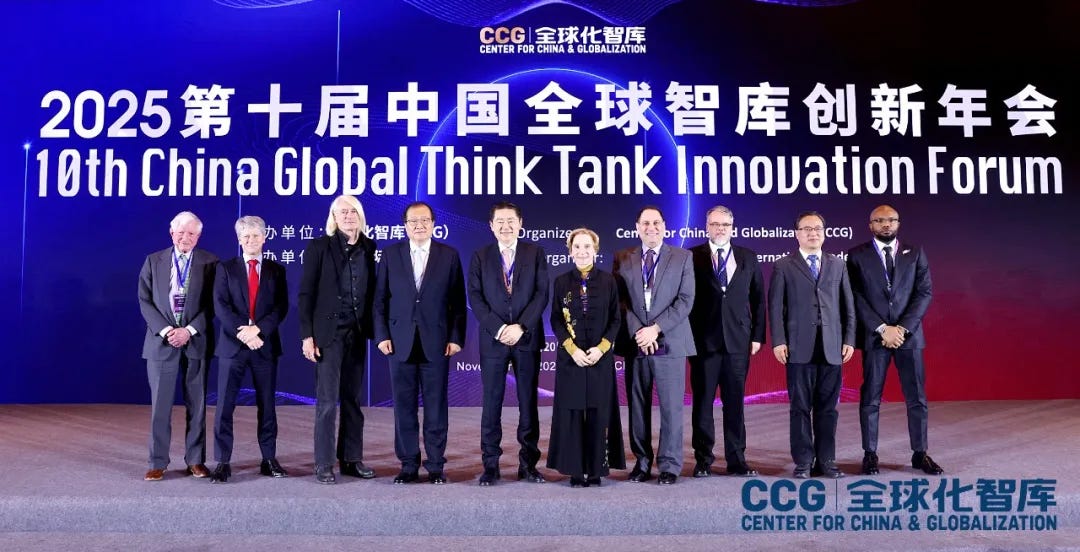
Moderated by Henry Huiyao Wang, Founder and President of CCG, the session featured:
Laurence J. Brahms, Writer, Director, Producer, Shambhala Studio
James Heimowitz, Senior Advisor, South China Morning Post; Former President, China Institute in America
Jin Xu, President of the China Association of International Trade (CAIT); Former Deputy Director-General, Department of American and Oceanian Affairs, Ministry of Commerce
Cameron Johnson, Senior Partner, Tidalwave Solutions; Former Professor at NYU Shanghai
Roberta Lipson, Honorary Chair of the American Chamber of Commerce in China; Founder of United Family Healthcare
Marshall Mills, Senior Resident Representative in China, International Monetary Fund
Jeffrey D. Sachs, Professor and Director, Center for Sustainable Development, Earth Institute, Columbia University (Online participation)
Peter Walker, Co-chair of Board of Trustees, China Institute in America
Wang Yong, Senior Fellow, CCG; Director, American Studies Center, Peking University
The discussion also included contributions from GYLD delegate Vincent Ibonye, Research Fellow and Deputy Head of the China Centre at Nigerian Institute of International Affairs (NIIA) and a PhD Candidate at Tsinghua University.
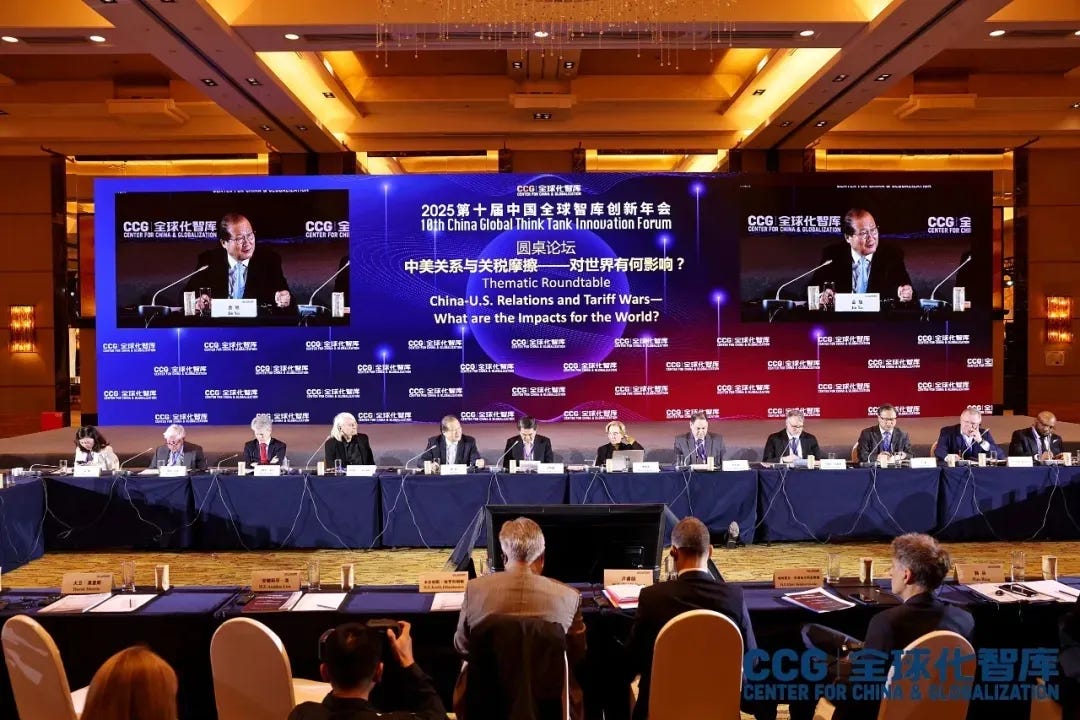
The full video recording of the event is available on CCG’s YouTube channel and official website. For a quicker look, a standalone video of the roundtable has also been uploaded.
CCG has also broadcast the forum on Chinese social media platforms, where it remains accessible.
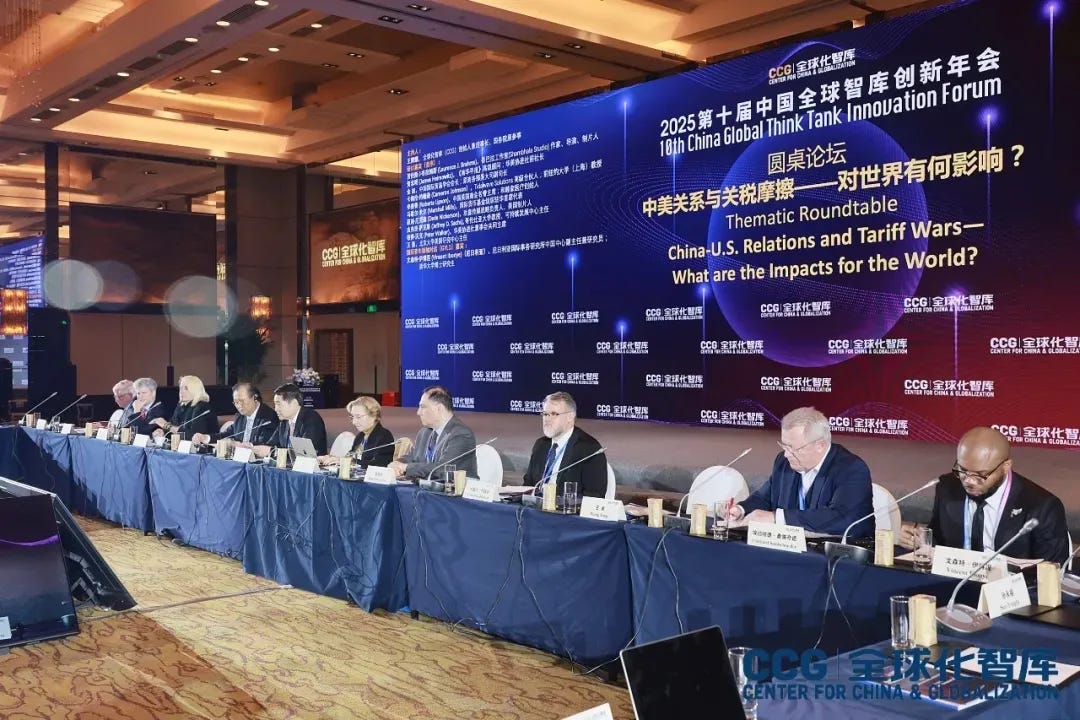
This transcript is based on the video recording and has not been reviewed by any of the speakers.
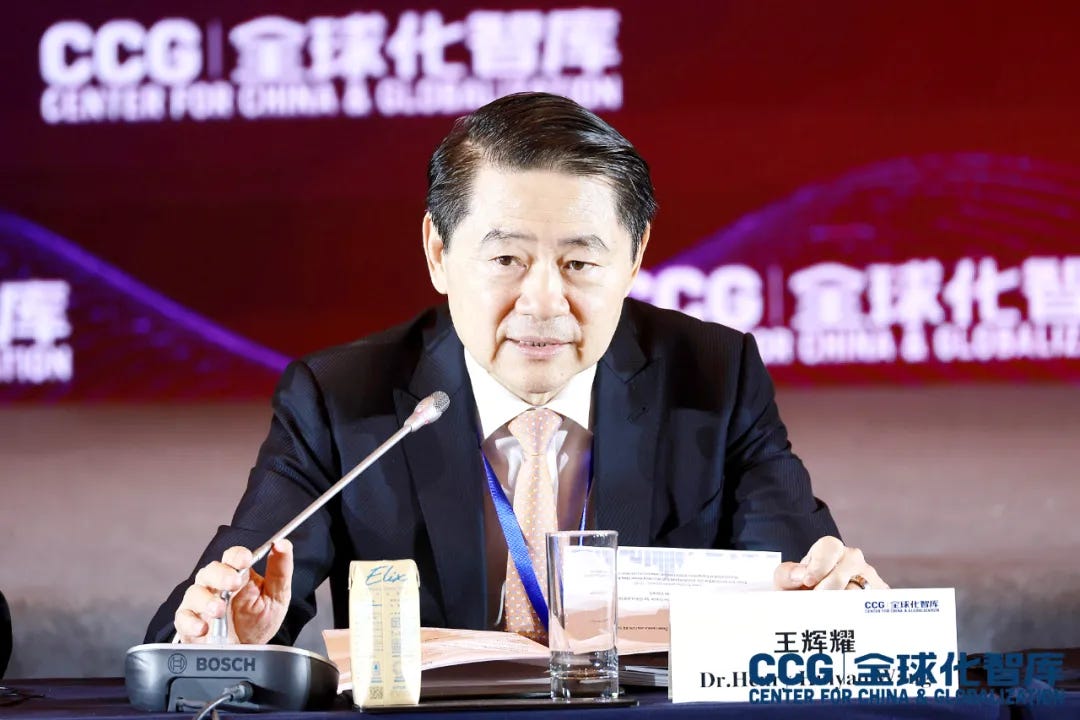
Henry Huiyao Wang, Founder and President, CCG
Okay, we’ll start, I think, because we have a lot going on, we still need time to work on this very important panel, which is Section Two on China–U.S. relations. China–U.S. relations, of course, remain one of the most important and consequential bilateral relationships, shaping global stability and geopolitical dynamics. In recent years—probably since President Trump’s first term, to be exact, since 2017—the U.S. has published its National Security Strategy and defined China as a strategic rival. Since then, the bilateral relationship has seen ups and downs, and most of the time it has been in a downturn.
We’re very pleased to see that the recent summit between President Xi and President Trump in Busan, South Korea, has really stabilised this most important bilateral relationship. President Trump said, on a scale of 1 to 10, he would give 12 for this historic meeting. It was also very important that the meeting basically set the tone for next year. President Trump is going to visit China in April, and probably President Xi will visit the US in the fall. That sets a very good trajectory for next year’s development in China–US relations.
So, the question is how to maintain this “new normal,” basically. I was very pleased to attend a U.S. Embassy reception welcoming the Deputy Head of Mission, where he said that there is a need to seek more strategic stability between the U.S. and China. As a matter of fact, I realised that wasn’t just his wording—it actually came from Secretary Rubio. In July, in an interview with Fox, he said that China and the U.S. need to maintain strategic stability. That’s a very good signal. Strategic stability is much better than strategic rivalry. I also noticed that the RAND Corporation recently published a report titled “Stabilising the Rivalry.” So, great—let’s maintain stability, which is the most important thing.
In this section, we’ve assembled a very impressive panel as well. We’re going to discuss some of these aspects. To what extent are the current tariff measures—and the retaliations between China and the United States—driven by economic priorities versus strategic competition? President Xi actually said during the meeting with President Trump that the two sides have to get out of this vicious cycle of retaliating against each other.
So how can things really move forward? Second, what are the short- and long-term impacts of tariff escalation on global supply chains, trade flows, and market stability? Which sectors and regions are most affected? This China–U.S. issue is not just between the U.S. and China; it is also affecting other countries. We’ve also seen narratives of decoupling and de-risking influencing policymaking, business planning, and public perception. But can the two sides really separate? I’ve had many discussions with Graham Allison, the former Dean of the Harvard Kennedy School, and he said China and the U.S. are really conjoined. That’s a very good metaphor for this important relationship.
And third, how can third-party actors—including the EU, ASEAN, the African Union, BRICS countries, and many Global South countries—maintain their relations with both sides during these trade frictions? Do they have to take a side, or is it really hurting all of them? Is there room for a diplomatic framework that China and the U.S. can set that benefits both sides and improves China–U.S. relations?
I’m very pleased to be joined this morning by very distinguished panellists. We have Mr Laurence Brahm, writer, director, and producer at Shambhala Studio. We also have James Heimowitz, Senior Advisor at the South China Morning Post—he’s really been a great bridge between China and the US. We have Mr Jin Xu, President of the China Association of International Trade. We have Cameron Johnson, Senior Partner at Tidal Wave Solutions, and a former professor at NYU Shanghai. We have Ms Roberta Lipson, Honorary Chairwoman of the American Chamber of Commerce in China and Founder of United Family Healthcare. We have Marshall Mills, Senior Resident Representative in China of the International Monetary Fund. We also have Peter Walker, Co-Chair of the Board of Trustees of the China Institute in America. And we have Wang Yong, of course, Director of the Center for American Studies at Peking University.
I hope I’ve mentioned everyone here. Let’s start this discussion. We’re also going to have Jeffrey Sachs. He’s currently in South Africa—it’s very early morning there—but he will join a bit later for this China–U.S. roundtable.
I’d like to start with Laurence Brahms. You’ve been living in China for many years and know China–U.S. relations very well. You wrote a book that Premier Zhu Rongji highly recommended. So we’d like to hear from you first.
Laurence J. Brahms, Writer, Director, Producer, Shambhala Studio
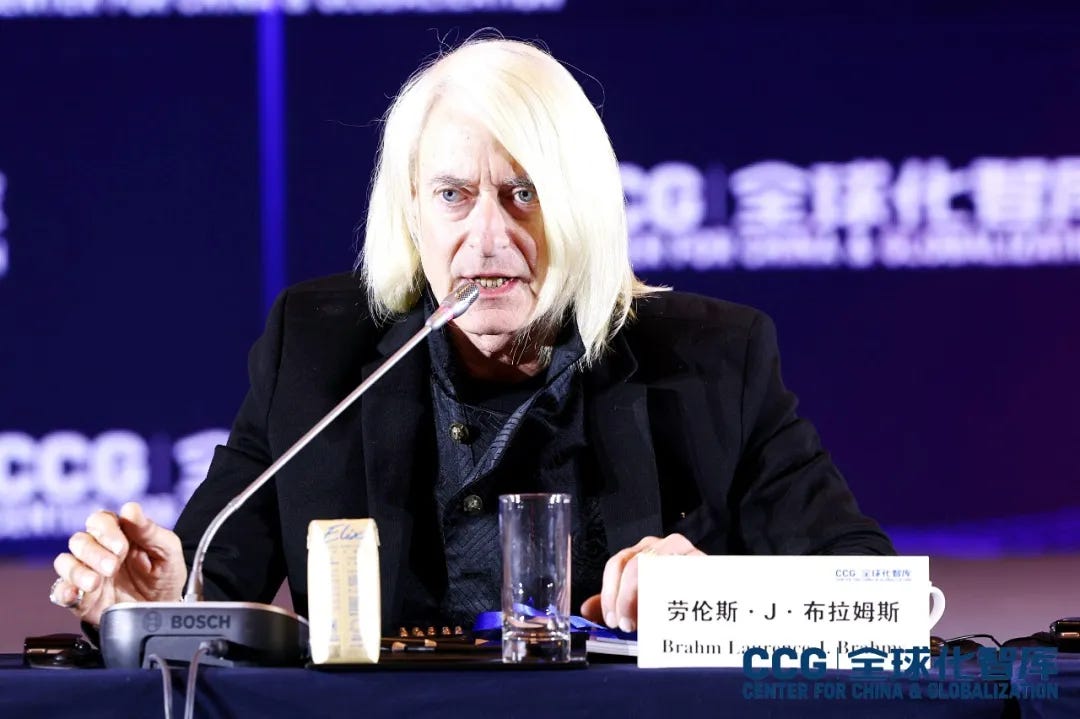
Thank you. Henry, thank you very much. I was very touched just now to hear the statement one of the earlier speakers made about an American astronaut who said if the leaders of the world could see the tiny planet Earth from space, they would stop their bickering. Actually, that astronaut was Edgar Mitchell, and he was a very close personal friend of mine. I spent a lot of time with him before he passed away, and he was certainly probably one of the greatest astrophysicists at NASA and an American hero, being the sixth man to land on the moon.
But he influenced me a lot, because I’ve been making many documentary films about the Lotusborn Master, Padmasambhava, the father of Tibetan Buddhism, and asking whether he is the father of quantum physics. It was Edgar Mitchell who inspired me to move on and make science fiction films. To put this tiny planet in perspective, one of our films will be released at the end of this year, “Lotusborn Master: The Algorithm of Karma”. Just to give you a picture, it opens with the abandoned subway at 42nd Street in New York, where a tour guide is bringing diaspora students from all over the world—Europe, Africa, the Middle East, and America—who have got lost on a tour, and explaining how archaeologists study the graffiti on the walls and, after the blast, use it to try to decipher why an ancient civilisation suddenly disappeared.
If we can look at this tiny planet from a broader picture, I’m going to give you a kind of heads-up on the script of the film that we’re actually working on right now. That film is called “Lotusborn Master: Punksters and Magicians”. The most important scene in the movie takes place when the heads of state of the key powerful nations of the world are meeting at the Insecurity Council of the United Nations, bickering among themselves over the most petty stuff. When finally, the Secretary of Generalities comes into the room and says, We have a much bigger problem.
A tech mogul named Ego Must has now accumulated three trillion in his own personal net worth, which means he can technically buy any single one of your countries. However, being a smart businessman, he knows that you’re all riddled with debt. And he’s not going to do something dumb like that. So, he’s going to do what we call in investment banking, a hostile takeover. So now he’s relocated his platform XYZ to Mars where because of his superior DNA, at least he thinks he has superior DNA, he’s having Emperor Tiberius orgies with sex bots in order to be able to pass his DNA into the robots so that AI can have a better enhancement and AI can have consciousness of its own so that the army of robots that he’s preparing to invade Earth will actually be operating without human control. So they’re outside all of the international covenants on human rights and war crimes and everything because, of course, his ultimate goal is the house of white, where the president of the empire is currently trying to renovate it to look like a Hermitage in St. Petersburg, based on other people he admires.
Based on that picture of the future, I think we have to sit back and say if we can just take the perspective that Edgar Mitchell, the sixth astronaut on the moon, had, and look at this tiny planet. It’s just a spaceship. And if the astronauts are fighting among each other, they’re going to crash it because we are just a speck out there. So I hope as we move forward with U.S.-China trade relations and tariffs and all of these little details that are actually frustrating people, I hope we can think bigger. And by the way, one of the great things about doing science fiction movies is, of course, everything’s fiction. It’s totally unrelated to any reality that’s taking place right now. So if anybody feels that this is actually connected to what’s happening or gets particularly offended, well, my apologies. It’s just a projection of their own imagination or their own personal insecurities and fears. Thank you very much. Thank you, Henry. It’s always a pleasure to be at CCG.
Henry Huiyao Wang
Okay. Great. Thank you. Always great to hear from a writer, a thinker. I know you’ve also been practising martial arts in China, so you know the history and culture here quite well, and good to hear from you. Now, the second panellist I would like to hear from is James Heimowitz. You are a senior advisor for the South China Morning Post, and you’ve also been travelling back and forth to China many times. So I’d like to hear from you as well. James, please.
James Heimowitz, Senior Advisor, South China Morning Post; Former President, China Institute in America
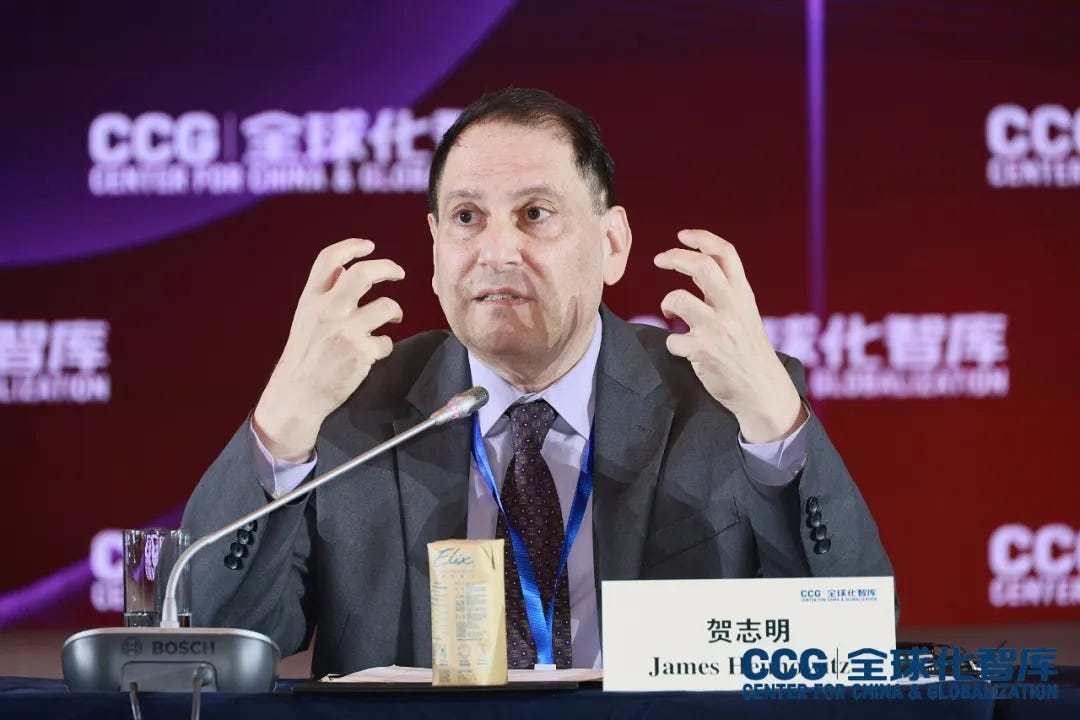
Thank you so much for that. I want to start off first by recognising CCG, recognising the important role that you play in facilitating. The content is interesting, the content is important, but the fact that we have a structure and a framework in place that can bring us together and really engage in a dialogue. I was just saying, the content that’s being delivered is, of course, important, but ringing us all together, whether it’s by the coffee station or over a meal or just interacting with your neighbour, for me, is equally important. So, I just wanted to take a moment out to say thank you again to both you and to Mabel and to all the staff here that have brought us together because events like this don’t happen—they’re really orchestrated.
Back to the question at hand about tariffs and bilateral relations. Clearly, the U.S. and China are the most important bilateral relationship on the planet. How the U.S. and China engage with each other is going to shape the way the rest of the planet lives. That may be an uncomfortable statement, but in fact I think it’s really true and I think most of us recognise that.
If we look at tariffs, in my view, tariffs are not really the core issue. Tariffs are, in my view, a byproduct of the dysfunctional nature of engagement. This dysfunctionality has popped its ugly head across lots and lots of places. In the present form now, yes, it’s about tariffs as one of those examples, but I kind of trace it back to COVID. Roots go way, way back, but COVID was sort of like an earthquake that brought about and laid bare some of our most basic, some of our most animalistic instincts. I think we’re still suffering the aftershocks and dealing with how that has created a realignment of what’s going on. During COVID and post-COVID, what we see is really a redefinition of our own humanity, of civil society, how we talk to each other, how emotions take control over intellect.
And the results are populism. They are societies and civilisations that become protective, become inward-looking and where the protective instinct takes over and takes charge of everything around us. It’s really worrisome to me. One of the results that I’ve talked about a lot here, both in the U.S. and in China, is what I call the phenomenon of parallel development. When you come to China, you can immediately sense a newfound sense of accomplishment and pride among Chinese people. I understand this. I relate to it. Not many countries on this planet have developed an infrastructure and ecosystem—whether it’s transportation, communications, payment systems—that is leading the way globally. Rightfully, Chinese people feel a sense of pride and accomplishment around this and also a desire to share those accomplishments with other places, societies, cultures, and countries.
The concern I have is how they are growing separately. If you land in China today, you enter a world not only of gleaming high-speed railways and a very comfortable lifestyle, you also exist in a world of WeChat payment systems that are unique to China and that are developing without too much involvement or consideration coming from other places, particularly the United States. So what we have is the United States doing one thing and growing in its own way, and China growing in its own way.
What I hope that conferences like this can help us to accomplish or at least move along the way is thinking about how we work with each other so that we don’t just have things standing and developing in parallel, but the accomplishments and advances made in a place like China find a place to be more accepted and more welcome and other places can take advantage of those achievements. So, if we come back to the tariffs—the root cause of what’s bringing out policies like this in the United States is what we need to address. If we begin to address some of those discomforts—the word trust has been coming up over and over in discussion—if we begin to address some of those root causes and get at some of the trust issues, I think we will see the byproducts and the kind of things, such as tariffs, will start to melt away. Thank you.
Henry Huiyao Wang
Great. Thank you, James. James is also the vice chair of the Alliance of Global Talent Organizations, which is very actively involved in talent education and exchanges. Absolutely, China-U.S. relation has to be seen from both the Chinese and Americans. So I think it’s very good to have so much American participation in this round table. We also have very honour to have Professor Jeffrey Sachs join us, but he was so early in South Africa, which is very early morning. We’ll let him warm up, and we’ll invite him to talk a bit later. Next, I would like to invite Mr Jin Xu, the president of the China Association for International Trade, former deputy director general of the Department of American and Oceanian Affairs, Ministry of Commerce. Mr Jin, please.
Jin Xu, President of the China Association of International Trade (CAIT); Former Deputy Director-General, Department of American and Oceanian Affairs, Ministry of Commerce
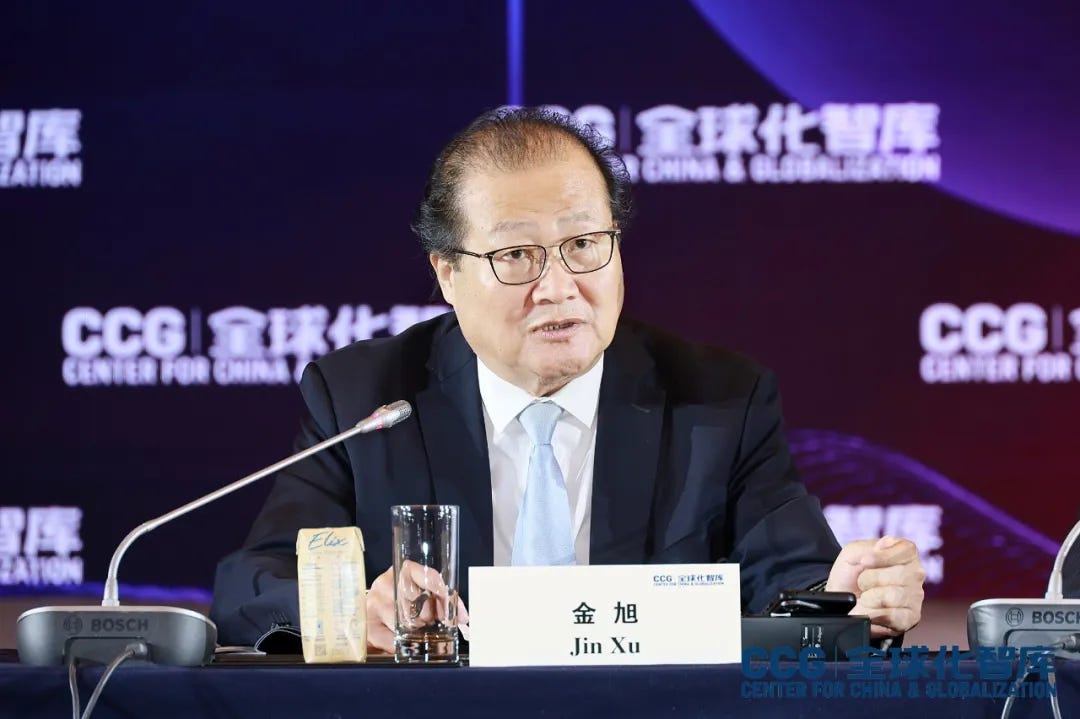
Well, I’m very pleased to join you here for this roundtable focusing on China-U.S. relations. Ever since the start of the 21st century, I have been engaged in efforts dealing with China-U.S. relations, and I once worked in the Ministry of Commerce as the deputy director general of the Department of American and Oceanian affairs. I have been learning a lot in the past years. As for my witness of the China-U.S. relations in the past years, there are a lot of things that I really didn’t understand. The leadership from the two countries once had a highlight moment many years ago, but right now, one of the consensuses among all stakeholders is that China-U.S. relations have now come to a crossroads.
Whether it is about the bilateral relations or about tariffs, these are not just issues between the two countries because they are all very complicated issues. Jeffrey Sachs is not here, but many of his opinions have now been very influential on the internet. Some of the opinions from him I myself really agree with; he really has some wonderful ideas about China-U.S. relations.
These are the worst of the times; these are also the best of the times. Now, some people try to sit in between, seeing how things play out between China and the U.S., and how the relations will impact the world economy. If the conflict between the two countries continues, then nobody can benefit from that. First of all, China-U.S. relations if not good, it would not just exert influence on the two countries themselves but also on the overall global economy and stability, and that would bring some really negative impact on the global supply chain. In the short term, the global economy is now slowing down, and we’re now seeing rising inflation. International organisations like the IMF and others are now doing their best to address those issues. I believe there are connections between these issues and China-U.S. relations.
China and the U.S. are the largest trading partners with each other, and 50% of China’s imports are from U.S.-operated companies in China. Actually, the competencies of the Chinese businesses are really high in the global market, and the Chinese businesses are now having global citizens to reduce their cost of living. For multinational companies to average citizens in the U.S., we’re now seeing that the cost of living is rising, and now we have the presence of young global leaders here witnessing these dynamics. I heard from some of the global young leaders saying that they are now paying 20 or 30, or even 50% more tariffs or taxes, given the rising tariffs between China and the US. Also, the current status is not somewhere the global institutions like the IMF or the WTO can kick in. Personally, I want to see a bigger role for the WTO and other institutions.
The reshaping of the global order calls for efforts from all countries, not just one single country like China, the U.S., or the European Union. We couldn’t afford to waste our resources. So we really need to go beyond this so-called zero-sum game. We really need to see that everyone can go beyond the zero-sum game and can control our differences at an acceptable level, and that calls for our common joint efforts and also for bigger roles from each and every one. Thank you.
Henry Huiyao Wang
Really, to say that the China-U.S. relationship is not really a zero-sum game, that’s very important. I know Professor Jeffrey is online, but we’re warming up, and we’ll invite you to speak to us. Next, I have Professor Cameron Johnson. He’s the senior partner at Tidal Wave Solutions and also a former professor at NYU Shanghai. Cameron, please.
Cameron Johnson, Senior Partner, Tidal Wave Solutions; Former Professor at NYU Shanghai
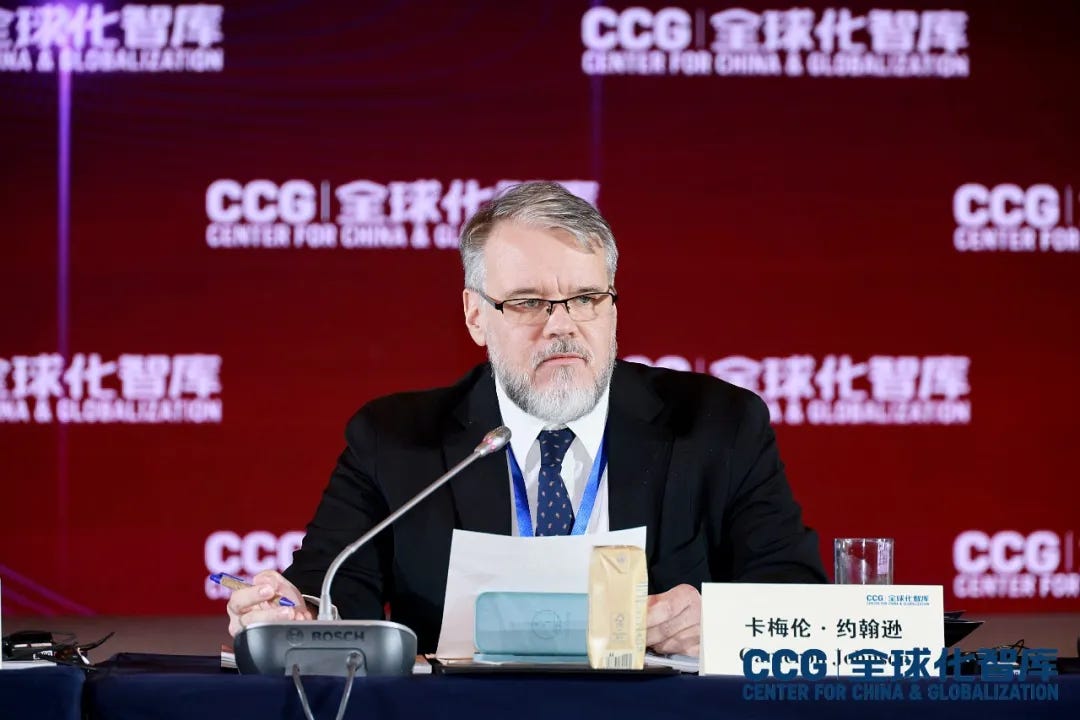
Thank you, and thank you, CCG, for inviting me today. What I’d like to talk about is a few themes that we’ve seen particularly in business and supply chains in this new era that we’re in. The first is that the old world order is now definitely dead. It’s being rolled up, and a new one rolled out in its stead. To your point about the trust, there simply is no trust—not only in business deals, in trade agreements, but also just between countries or businesses. This has been broken down.
The second is disruption. It’s now with us at least until we find a new global equilibrium. This has actually been very challenging for businesses, industries around the world. It’s no longer just a U.S.-China issue; it is now a global issue. The next is really what we’re seeing now from this is reduced U.S. influence around the world and particularly when you look at how supply chains develop. You need investment, you need talent, you need regulatory alignment, and as U.S. firms are now retrenching back to the North American, particularly the U.S. market, that is taking a key pillar of the last 50 years of what was U.S. diplomatic and commercial success and influence from around the world. When you add on top of that, the U.S. agreements, particularly with countries like Japan, Germany, where they are forcing investment into the United States and not into just supply chain development, you’re also seeing resources being withdrawn from around the world and focus simply on a U.S. or North American area, which is affecting development around the world.
The next theme is really, “How do I protect myself now?” as an individual, as a company, as an industry, and as a country. These are questions that, until just a few years ago, were not really being asked, especially not everywhere in the world. This is part of the challenge we are facing now.
Finally, one of the absolute things that has happened is as supply chains are being realigned, this is effectively forced a realignment now of the economic and political order around the world. The prime example is trade war 1.0, which was launched in 2018. What happened was that it forced firms in the “ABC” (Anywhere But China) supply chain infrastructure to essentially move to Southeast Asia. The consequences of that are now Chinese influence, Chinese business practices, Chinese supply chains, Chinese products, Chinese talent, and Chinese raw materials now dominate that region and will likely never not dominate it moving forward.
The consequence of trade war 2.0 is very much similar, or the potential could be similar, but on a global scale, where Chinese supply chains, raw materials, talent, and technology, as we’re seeing with the diffusion of DeepSeek and similar-minded programs around the world. This is something that we have not seen at least since the post-World War II order.
All of these factors are themes that are now running into reality. And to your point, Henry, about the Busan agreement or discussions—the thing that I took away from that which was most interesting is that now both sides, because of the tariffs, have critical points in each other’s infrastructure and economies that they could use to hurt the other. That also has changed the global order as we know it. So we’ll have to see how we move forward. But the good thing is we can learn from the past and develop a new structure and framework that may be more equitable, but also can address some of these challenges of the future. Thank you.
Henry Huiyao Wang
Thank you, Cameron, for your perspectives. Now I’d like to invite Miss Roberta Lipson. She’s the honorary chairwoman of the American Chamber of Commerce in China and the founder of the United Family Healthcare, which is one of the most successful healthcare hospitals in China. You’ve been travelling back and forth—I saw you some time ago with the AmCham delegation meeting Chinese leaders, but also knocking on doors in Washington. So you’ve been knowing both places. Roberta, please.
Roberta Lipson, Honorary Chair, American Chamber of Commerce in China; Founder, United Family Healthcare
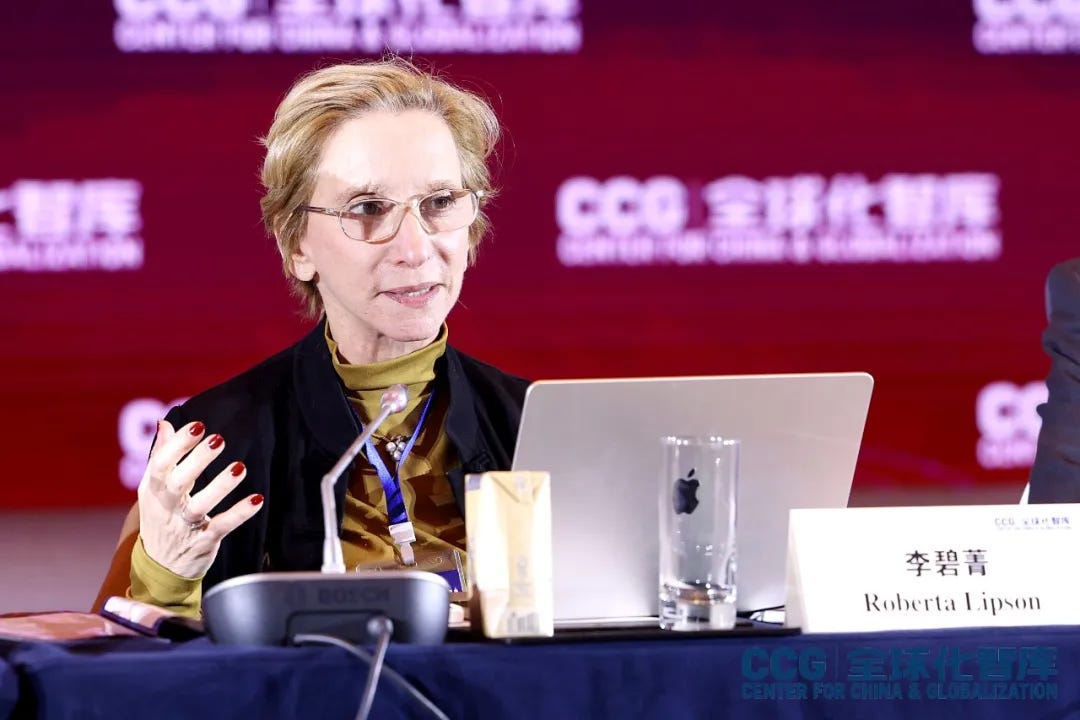
Thank you so much, Henry, and thank you, CCG, for putting this forum together. Granted, Cameron, that we’ve been through a really tough time, but I suppose it’s incumbent on me to report the other side of things. Really, I think in the business community we’ve seen a recent shift in tone and a renewed sense of optimism following the presidential meetings in Busan. Tariffs and policy remain volatile, but the channels of communication are open at the highest levels, and we’re talking about practical issues, and both governments are recognising the need to stabilise this important bilateral relationship. Admittedly, possibly fragile, but there is a sense of elation which has been continually reinforced by constructive messages from our ambassador, Purdue.
I’ve been at a bunch of meetings, both in the U.S. and China, on the relationship lately, and the tone is really changing. I think we’ve seen, actually, through the year, a subtle improvement in business sentiment as well. We have in the business community three major surveys: the AmCham China survey, which happened earliest in the year, the Shanghai AmCham survey, which happened mid-year, and the U.S. China Business Council survey, which happened in the late summer. And we see in each of these surveys continually improved sentiment, whether it relates to companies’ revenues, profitability, looking toward the future, intention to increase investment, or intention to continue to de-risk their supply chain by moving out. Each time we see a more positive response from businesses.
I’d like to say the reason most American businesses need to be in China and remain in China is that even at a 4% per year growth, the potential of this market—just on the margin of the increase—is more important to companies than many countries’ whole potential in their total economy size. So it’s an opportunity that American companies can’t ignore.
The reason they’re here is not only the potential for today’s business in China, but also it’s essential for all companies to understand the leading edge of technology that’s coming out of China and to understand how to compete with the companies out of China that will be their future competitors in the rest of the world. So while companies are building “China Plus One” supply chains, de-risking, and managing tariff risks, they’re also reaffirming their long-term commitment to operate, learn, and grow in China.
And what does that mean for the rest of the world? I think, despite this period of intense rivalry that we’ve just been through, ultimately, the global economy is going to gain by a relationship between the U.S. and China that’s characterised both by competition and collaboration.
Let’s talk about where we have to absolutely prioritise collaboration. Number one, the clear example, is pandemic preparedness and global health security. No matter what happens with trade disputes, export controls. Or political rhetoric, we can’t afford a world in which the U.S. and China stop sharing data on emerging pathogens or block cross-border scientific cooperation. But the barriers to collaboration are actually increasing, including restrictions on data flows, limits on genetic material sharing, and conflicting security frameworks around biomedical information. The next cure for cancer is probably going to come out of China, the U.S., or a collaboration between the two of them. Neither of us nor the rest of the world can afford those cures to be blocked by these kinds of restrictions and limitations. So it’s so important that we all continue this positive momentum post-Busan and look at a world where we can continue to sit, talk to each other, collaborate and yes, compete for the benefit of the rest of the world. Thank you.
Henry Huiyao Wang
Great. Thank you, Roberta. I do think that President Trump is a businessman. He knows the business needs, and we hope that at least this business trade truce can be maintained, so that eventually we’ll find out that we cannot separate from each other. Before I go to Jeffrey Sachs, I have one more panellist to speak. Mr Marshall Mills, senior resident representative in China, International Monetary Fund. He has been an active participant in CCG’s monthly ambassadors’ luncheons and other events. Marshall, your turn, please.
Marshall Mills, Senior Resident Representative in China, International Monetary Fund
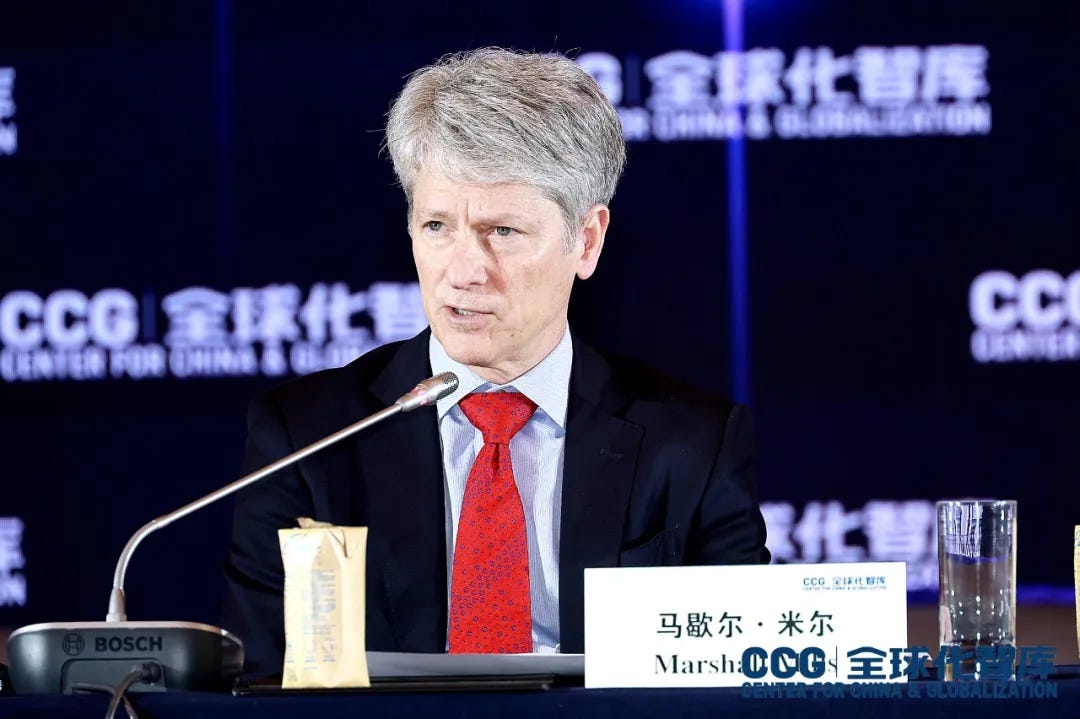
Thank you, Henry, and thank you for this opportunity to contribute to this dialogue. I’m going to focus my remarks on the global economic effects of recent trade policy shifts. And I apologise in advance if I’m not as colourful as my neighbour here.
As we explained in our recent World Economic Outlook, we see that global growth is slowing only slightly this year and next and considerably less than expected in April. And I think this is an encouraging sign, building on the previous speaker. We now project global growth at 3.2% this year, while growth in the Asia-Pacific region is expected to reach 4.5% this year.
For China, economic growth is currently forecast to reach 4.8% this year, bolstered by redirected exports to Asia and Europe and fiscal support, not much less than last year’s performance. And we see that global trade has not decreased. The ratio of trade-to-GDP or global economic activity has been more or less constant this year. So all signs point to a world economy that has so far generally withstood the acute strains from multiple shocks, including on trade policy.
How do we explain this resilience? We point to four main reasons. First, improved policy; two, supportive financial conditions; three, private sector adaptability; and fourth, less severe tariff outcomes than we had initially feared, at least for now. On the third reason, we see that private companies are rapidly reorganising their supply chains, particularly in Asia. On the fourth reason, the tariff shock has not been as large as initially announced. The U.S. trade-weighted tariff rate globally has fallen from 23% in April to 17.5% now, still higher than before. This U.S. effective rate is now above the rest of the world, which has held relatively steady this year, with very few cases of retaliation, fortunately.
Nevertheless, we believe that on tariffs, the full effect is still to unfold. In the U.S., margin compression could give way to more price pass-through, raising inflation with implications for monetary policy and growth. Also, for now, most of the world’s trade is still following the rules. We at the IMF urge the world’s policymakers to please keep it this way and to preserve trade as an engine of growth. However, these recent shocks have led to exceptionally high uncertainty, and our managing directors advised countries to buckle up.
So, what can we do about the uncertainty? In response, we have proposed three medium-term policy goals for global policymakers. First, act to achieve durably high growth. Second, repair government finances over time. And third, address excessive economic imbalances, both domestic and external, so they do not emerge as a spoiler going forward. As we have seen, these imbalances can trigger a protectionist backlash and, being mirrored by capital flows, can fuel financial stability risks. We at the IMF will keep advising all key economies on policy correctives to address these balances.
For Asia, we advise them to deepen internal trade to produce more final goods and more services within the region and press forward with reforms to strengthen the service sector and access to finance. Our analysis suggests that a push for more regional integration could raise GDP by 1.8% in the long run in the region.
And since we’re in China, on China specifically, private savings are chronically high and domestic demand is held back by protracted real estate adjustment and inflationary pressures. So, we are urging transitional fiscal support for now. China also needs a fiscal structural package to boost private consumption, transition to a new growth model, and reflate its economy. Among other items, this package should include more spending on social safety nets and a cleanup of the property sector while scaling back industrial policy, which we estimate has high costs. These measures will help overcome the deflationary pressures and ensure continued high growth in China, as well as help address the rising external imbalances.
So with these recommendations, let me conclude. Thank you.
Henry Huiyao Wang
Okay, great. Thank you. Thank you, Marshall. So, the IMF is very important. I’m glad that you have been projecting a bit more positively than before, that, you know, your professional advice and guidance are also very influential to many countries.
Now I’d really like to invite my old friend, Professor Jeffrey Sachs. I apologise—Professor Sachs is really early. It’s really 6 a.m., early morning in Johannesburg. He’s attending the G20 meeting there, and I had the honour in the past year, twice, to have the occasion to speak together with Jeff. One time, we were at the Athens Democracy Forum, and Jeff was Aristotle; I was acting as Confucius. We had a dialogue there. That was very interesting. And in April this year, while President Trump launched Liberation Day, we had the event at the UN Security Council, where 80 country representatives participated. Professor Jeffrey Sachs and I each gave a 15-minute so-called expert talk, before all the UN delegation representatives talked about how we should avoid trade wars. So it’s really a great honour. I know Professor Jeff Sachs is so busy. We actually invited you to have an opening keynote, but it’s too early for you. So we’ll give you a bit more time to really seize your early-morning moment. Professor Jeffrey Sachs is still very influential at Columbia University and a director at the Center for Sustainable Development for the UN. Jeff, your turn, please. Welcome.
Jeffrey D. Sachs, Professor and Director, Center for Sustainable Development, Earth Institute, Columbia University (Online participation)
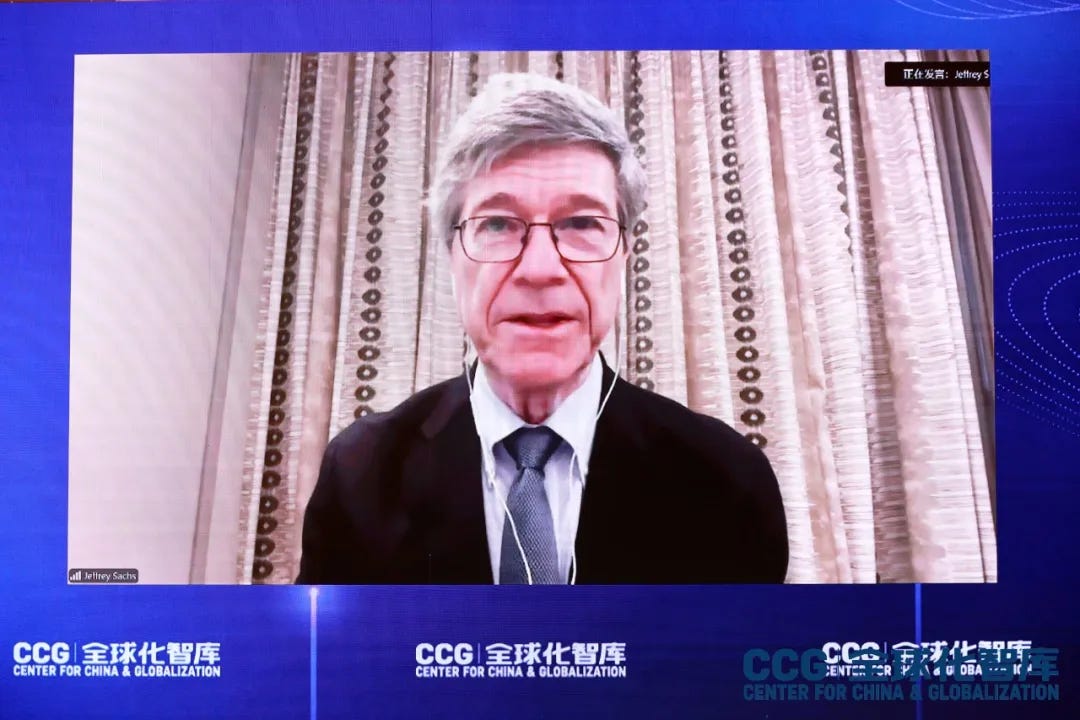
Thank you very much, and greetings to everybody from Johannesburg. It’s wonderful to be with you. I would like to take a step back to ask how we got to where we are, and then to look forward, and also to comment specifically on what Marshall just said about the IMF advice, with which I do not agree, and I’ll try to explain why that is.
We’re not in a trade war between the U.S. and China. We’re in a trade war of the U.S. against China. This was started by the U.S.; it continues by the U.S., and we should understand it. The clearest way to understand it is to read a very good paper by Robert Blackwill and Ashley Tellis from March 2015, of the Council on Foreign Relations. It’s good because it’s clear. It explains exactly what’s going on, what U.S. policy is, why it is that policy, and how it came about. It’s bad in that, in my view, it’s completely wrong in what it recommended. But let me just mention a few points to quote from it.
It says, “Since its founding, the United States has consistently pursued a grand strategy focused on acquiring and maintaining preeminent power over various rivals, first on the North American continent, then in the Western hemisphere, and finally globally.”
“Because the American effort to ‘integrate’ China into the liberal international order has now generated new threats to U.S. primacy in Asia—and could eventually result in a consequential challenge to American power globally—Washington needs a new grand strategy toward China that centers on balancing the rise of Chinese power rather than continuing to assist its ascendancy.”
“The meteoric growth of the Chinese economy, even as China’s per capita income remains behind that of the United States in the near future, has already provided Beijing with the resources necessary to challenge the security of both its Asian neighbours and Washington’s influence in Asia, with dangerous consequences.”
“Of all nations—and in most conceivable scenarios—China is and will remain the most significant competitor to the United States for decades to come.6 China’s rise thus far has already bred geopolitical, military, economic, and ideological challenges to U.S. power, U.S. allies, and the U.S.-dominated international order. Its continued, even if uneven, success in the future would further undermine U.S. national interests.”
This is very important, ladies and gentlemen. The United States’ policy shifted a decade ago to contain China. This is absolutely a U.S.-led effort, not because of what China did, but because of the U.S. grand strategy of global dominance. Well, the U.S. is 4% of the world population. China’s 18%. But 4% of the world cannot dominate the whole world, despite that being the U.S. grand strategy. And China’s rise is not a threat to the United States, but it is a threat to the U.S. self-conception of dominance of the world. So, as Blackwill and Tellis explained a decade ago very clearly, U.S. policy shifted to, quote, “contain China”.
In that article, they list nine measures that the United States should undertake. All of them are in operation. They began with Obama, with the TPP—the extraordinarily weird idea of creating a trading system for the Asia-Pacific that would exclude China. This is remarkable. China is every country’s main trading partner, and yet the TPP was explicitly designed to exclude China. The rest of the list includes export barriers on technology, building up the military on the rimland, using protectionist policies more generally, and using diplomatic means and multilateral institutions to contain China.
So this is the policy that has been underway for 10 years. It started with Obama, not with Trump One. Trump then introduced a raft of sanctions, export controls, and the tariffs in the first round, that did not contain China. In the Biden period, all of this was continued, and in many ways increased, under Jake Sullivan’s policy of “high walls, small yards”, whatever that meant, and then it has continued and escalated with Trump. This is American deep-state policy. It does not depend on the party or the administration. It doesn’t even depend on the President. This is Obama, Trump One, Biden, Trump Two. It’s a failure. It’s based on a premise that is bizarre, which is that China’s rise is a threat to the United States. It is nothing of the sort.
China is rising peacefully. It is rising cooperatively. It is rising as part of the multilateral system. It is not a threat to anybody, except to the U.S. ego and the U.S. desire to be number one in an unchallenged way. Why does there seem to be a modest moment of retrenchment, as Roberta said? Because the United States cannot win this war that it started. This is clear. When the United States imposed these absurdly high tariffs earlier this year, China immediately matched them. When the United States put on export controls, China put on controls on rare-earth magnets, and, within two days, the United States backed down, because the U.S. cannot manage an economy—not its military sector, not its automotive sector—without rare-earth magnets. It is not the U.S. that has the choke points; it’s China that has the choke points.
Of course, I’m against all of this. I think it’s childish and juvenile. Economics is correct. Trade is a win-win proposition. It is not a win-lose proposition. It is not in the U.S. interest. It is unimaginably not in the U.S. interest to try to contain a highly successful, peaceful country. And yet that is what the U.S. is doing. Are we at the end of this story? Absolutely not. This remains deep-state policy of the U.S. This is the security view. It infects the entire U.S. policy-making.
This morning, the South China Morning Post carried a story that Democratic Congressman Raja Krishnamoorthi has called on the Commerce Department to make an investigation against Nexperia—to investigate its supply to four Chinese semiconductor firms—on the absolutely absurd grounds that the Congressman is worried about the safety and reliability of the components of these chips in American and European automobiles. I’m sorry—this does not even rise to the level of high school cliques. This is such nonsense, such utter protectionism, such an utter war on China masquerading as an inquiry into the safety and reliability of components in cars.
So, we’re not at the end of this story. It’s not just Trump. It is, again, basically our military-industrial-digital complex. And it’s deep, and it’s now in its 10th year. It doesn’t work. China is not being contained. China is actually soaring. Technologically, China is in the lead in most sectors. Yesterday, another ranking showed that China has come to the lead in biomedical research in terms of articles, and the ranking of those articles in terms of citations, and so forth. And so this is a highly successful innovation-based economy that is making a major contribution to the world’s needs, especially in areas of green and digital technological advances.
I would say the United States has no choke points at all, which is good. I don’t believe in them. I don’t believe in economic warfare to figure out who’s number one on somebody’s political scientists’ list, because it’s meaningless, in my view. What is important is peace, rising living standards, and a sane environmental policy so that we don’t wreck the planet. And on that score, unfortunately, the United States has retreated completely from the environmental agenda, even pulling out of COP30, pulling out of the Paris climate agreement, calling climate change a hoax—“drill, baby, drill” as its energy sector mantra—whereas China is the world leader in green technologies, exactly the technologies that the world needs.
So let me say that I hope that this war ends, but it is not that the two sides get together and understand each other. It’s that the United States drops, what Robert Blackwill calls, its ancient desire for global domination. This is what is wrong in this world. We don’t need a global hegemon. It’s not possible. Countries should take care of themselves, be peaceful, and be cooperative, and ignore the political scientists’ lists of who’s number one and who’s number two, because these are rather meaningless categories. What counts is our well-being, our peaceful cooperation, our technological innovations, and our attention to true global crises, such as human-induced climate change.
I wanted to end by taking a different point of view from what Marshall Mills expressed, which is an American point of view, in my way of understanding this. We need saving in this world, because we need investment in this world rather urgently. We need investment to build infrastructure. We need investment in human skills. We need investment in green technologies. We need investment in innovation. The fact that the United States barely saves—that our saving rate, net of depreciation, is nearly zero—is not a reason to advise China to reduce its saving. Nothing is wrong with China’s high saving rate. In fact, it’s what the world needs, because it provides the means for capital investment that creates the basis for long-term growth in China and internationally.
We should not be urging China to reduce high saving rates. We should be urging countries to increase their investments in green technologies and in the education of their populations, and using China’s savings to help them boost their living standards, and to repay those finances from China—whether it’s equity or debt financing—in the future, as the dividend to growth for future generations. In other words, China should maintain high saving. It should maintain high exports, and it should finance development in the emerging and developing countries around the world, who can receive foreign direct investment from China, or can take renminbi-denominated loans from China to build their own infrastructure.
Let me give a specific example. China’s solar power production is about 1,300 gigawatts of solar modules per year. This is what the world needs to be on a trajectory for decarbonisation by mid-century. In fact, the actual uptake of solar power right now is about half of China’s capacity. It’s about 600 to 700 gigawatts of solar module installation per year. If the United States or the IMF's advice to scale back industrial production to boost private consumption were followed, then there would be a reduction of capacity in this sector. The U.S. calls this overcapacity, but it’s not overcapacity. That extra 600 gigawatts of solar module production should be installed across Africa, Central Asia, and other sunny places on the planet to speed the decarbonisation of the world’s energy system. The Belt and Road Initiative should be expanded to help finance this process.
And so what’s called an imbalance isn’t actually an imbalance. High Chinese saving and industrial production can be the basis for the rapid growth and transformation of the world economy. High consumption is not a basis for fast growth. High consumption is a basis for slow growth. The U.S. doesn’t want China to have that success—I know that—but the world needs China’s capacity in green technologies.
So I think we’re just a little bit too quick to say that China is suffering from deflation, that these are imbalances that need to be ended, and that consumption needs to be raised and saving needs to be lowered. We ought to take a different point of view, which is that we would like fast growth in the world. Fast growth in the world depends on high investment rates in infrastructure, human capital, and business development. That high investment depends on high savings, and we should be encouraging high savings wherever it occurs. But we should be championing China for its forward-looking high-saving propensity, and also championing China’s capacity to provide the world with green and digital technologies, with electric vehicles, with utility-scale batteries, and with the other technological means to make precisely the energy transformation that we need for global well-being, and to avoid reaching mid-century in a climate disaster.
So I’d really like the IMF to reconsider this from a global perspective, because I think that the advice is wrong. I think the United States has given this advice, calling China an overcapacity country—which is an economic concept I find absurd, by the way—because we need China’s capacity, in partnership financially, and through Belt and Road and other means, to help the world make the energy transformation.
So all of this, in conclusion, is to say: we ought to stop the war on China, which was initiated by the United States 10 years ago. We ought to drop the concept of containing China. We ought to drop the illusion that China is a threat, because it is not a threat, except to America’s ego. And we ought to look, at a global scale, at the transformations that we need to achieve sustainable development, and to understand China’s critical, positive role in that transformation. So thank you very much for letting me share these thoughts with you this morning.
Henry Huiyao Wang
Okay, great. Thank you. Thank you, Professor Jeffrey. That’s an excellent point, and you have actually tackled some of the roots of the problem in China–the U.S. relations. You’re also talking about China’s investment and savings, and the role they play in development, which I think is also one of the key success factors. China has built some of the best infrastructure in the world, and also, through the Belt and Road, partnered with other developing countries. So that’s really a great way to lift 800 million people out of poverty, and that probably has some significance for Global South countries.
So we’re very happy that you shared your views with us from Johannesburg, where you are attending the G20. Actually, this year our forum brought together over 200 participants from around 50 countries, including representatives from nearly 70 think tanks. We also had 30 Global Young Leaders participating, and many ambassadors—almost 20 ambassadors—attending throughout the day. We even have officials from the U.S. Embassy here at the roundtable. So thank you again from Johannesburg. We appreciate your participation at such an early hour to join us. Thank you so much.
Now I’d like to invite Peter Walker. He’s the Co-Chair of the Board of Trustees of the China Institute in America. As we all know, the China Institute is an almost 100-year-old institute, originally set up by Dr Hu and Professor Dewey, and many, many more. I also know that Peter was a very senior partner at McKinsey for many years and an author of quite a few books. So, Peter, your turn, please.
Peter Walker, Co-chair of the Board of Trustees, China Institute in America
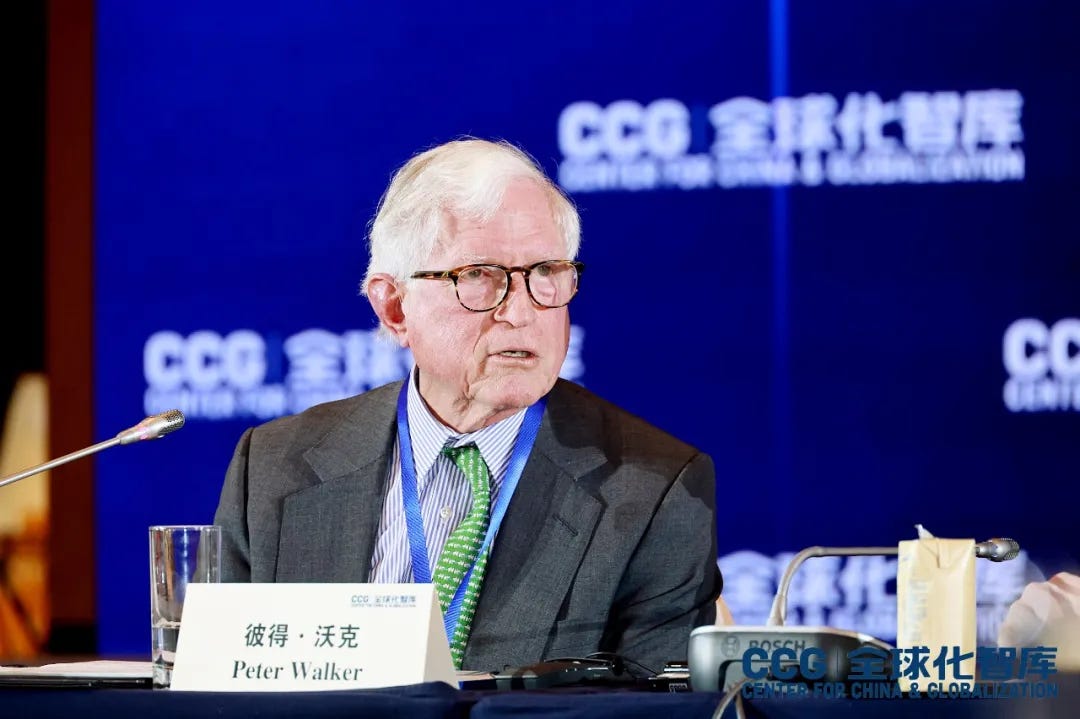
Thank you, Henry, for the invitation. I’ll start out by saying that following Jeffrey Sachs is a high bar. But I’m a big fan of a lot of what he has to say.
So, the three ideas that I’d like to leave you with: one is that if you look at the underlying assumptions behind the U.S. trade war, most of them were pretty fundamentally flawed, and I’ll kind of go through them. So we should not be surprised where we are. The second thing is, I think when history looks back, it will look at what the U.S. initiated as one of the most destructive things we’ve done, non-militarily, in terms of its impact globally. And third—and here’s the bright note—I think the problems of the trade war are gradually starting to unravel. I hope it’s quick, but I’m encouraged that people are waking up in the U.S. to what’s really happening.
So, the fundamental flaws are, number one, that free trade is a bad idea. Free trade has been the backbone of the global economy for many years, on the simple idea that whoever produces the highest-quality product for the best price ought to make that as broadly available as possible, and everyone benefits from that.
The second one is the ridiculous notion that trade deficits are bad. The U.S. has a trade deficit because it’s not a strong manufacturing country, and therefore, consumers simply buy the best products for the lowest price, and they’re not made in the U.S.
The third underlying notion is that trade wars can stimulate the economy, as opposed to what they really are, which is a tax increase on consumers. The fourth underlying idea—which I still hear repeated coming out of Washington—is that foreign countries pay tariffs, which is a ridiculous idea. Tariffs are paid by importers in the U.S. or passed on to consumers in the U.S. It has nothing to do with taking money away from foreigners.
And finally, to repeat what Jeffrey said, China cannot be contained. It’s a ridiculous idea. And not only is it ridiculous, but it’s just so counterproductive in terms of the mindset. Because one of the things Jeffrey said, I completely agree with: China is basically doing what it always says it will do. It’s acting in its own best interest, and the best interest of its people, and expects other countries to do the same. So if you start out with those flawed ideas, it’s not a surprise that this is not playing out well for anyone.
The other flaw was in the process: a process that starts with 4% of the world’s population dictating to the rest of the world what the tariffs are going to be, and then not providing any guiding principles other than personal grievances and totally random judgments of who’s a good country and who’s a bad country. So Switzerland gets added to the list of bad countries, for who can imagine why. I can’t think of a more peaceful, effective, productive country. So they get their tariffs set at, I think it was, like 45% or 50%. And then they kind of push back and say, “Well, that’s really totally irrational.” So the next day, they’re 15%.
But the problem with the lack of having any guiding principles is: how does a country, and how does a company, invest for the long term when you have that volatility that’s not based on anything other than whims?
So we start with flawed assumptions, and we start with a flawed process. On the notion that this has been one of the more destructive things—and clearly history has not played out yet—but one of the most fundamental issues that we raise is that we have destroyed decades of allies-based, trust-based relationships around the world. And the idea that, well, we didn’t really mean it, because the transactional mindset would say, well, we can do a different transaction whenever we want—we all know that’s not the way humanity works, especially if you’re the good neighbours of Canada and Mexico, who are our biggest trading partners, and we’ve gone at them in a very full-bore way.
Obviously, the decline in global growth and U.S. growth is not a surprise, but it’s the opposite of what was originally pitched. Inflation is up in the U.S. I don’t know what many of you saw in the announcement coming out of Washington, but they declared, among other things, that the cost of a turkey dinner—Thanksgiving dinner—is going down. You know why it went down? Because Walmart shrank the size of the dinner. They didn’t reduce the price per pound of anything. But there’s a cynicism there about what you can do with the American consumer that’s fundamentally flawed. So when we take the position that affordability is not an issue, you can take that position on a lot of issues, but for people who go to the grocery store every week and tally up what it costs to fill your wagon, uh, it’s obvious that the numbers are moving in the wrong direction.
So the final thing is, or the reason I guess, I have some optimism. One is that tariff rates are coming down. Uh, obviously, you know, consumers say the cost of bananas and coffee is going way up, but the underlying notion that we can do anything about that when we don’t grow either is kind of ridiculous. So I think that being among the most indefensible positions, and there will be more, and we’re going to see a continued response from a backpedalling Washington on tariffs that make no sense to people.
The second thing that gives me encouragement is that maybe the Supreme Court will finally have a backbone, and it’s taking on the issue of whether the President has the right to impose tariffs, as opposed to the legislative branch, which is clearly what the Constitution says. We can all hope that that decision is made the right way, and that will start to unravel, hopefully, a lot of the centralised power-grabbing that we’ve seen over the last couple of years.
The other reason for hope is that, in the most recent election that we had in Virginia and in New Jersey, the Republicans took a bad beating. They took a bad beating on the proposition in California for redistricting and gerrymandering, which I don’t support at all, but it was in response to what was done originally in Texas.
And finally, the underlying notion that by keeping out others’ manufactured goods, manufacturing will come back in the U.S. is also a ridiculous idea. When you listen to manufacturers talk, they basically say: taking UAW employees who were used to getting $40 to $50 an hour, and asking them to assemble iPhones in Texas for $12 an hour—nobody’s going to take that up. So the idea that we can rebuild manufacturing simply by depriving Americans of foreign goods is not a sound idea.
But those were the points that I wanted to get across, and I do hope that if we were to do this a year from now, we will see a further retrenchment of what, from day one, was just a very bad idea.
Henry Huiyao Wang
Great. Okay. Thank you. Thank you, Peter, for your perspective. We’ll see what the Supreme Court decides on that. But it does not seem really very traditional, or the norm in U.S. practice, to impose all those unilateral taxes.
Now I’d like to have Professor Wang Yong, the Director of the Center for American Studies at the School of International Relations at Peking University, speaking as the final panellist, please.
Wang Yong, Senior Fellow, CCG; Director, American Studies Center, Peking University
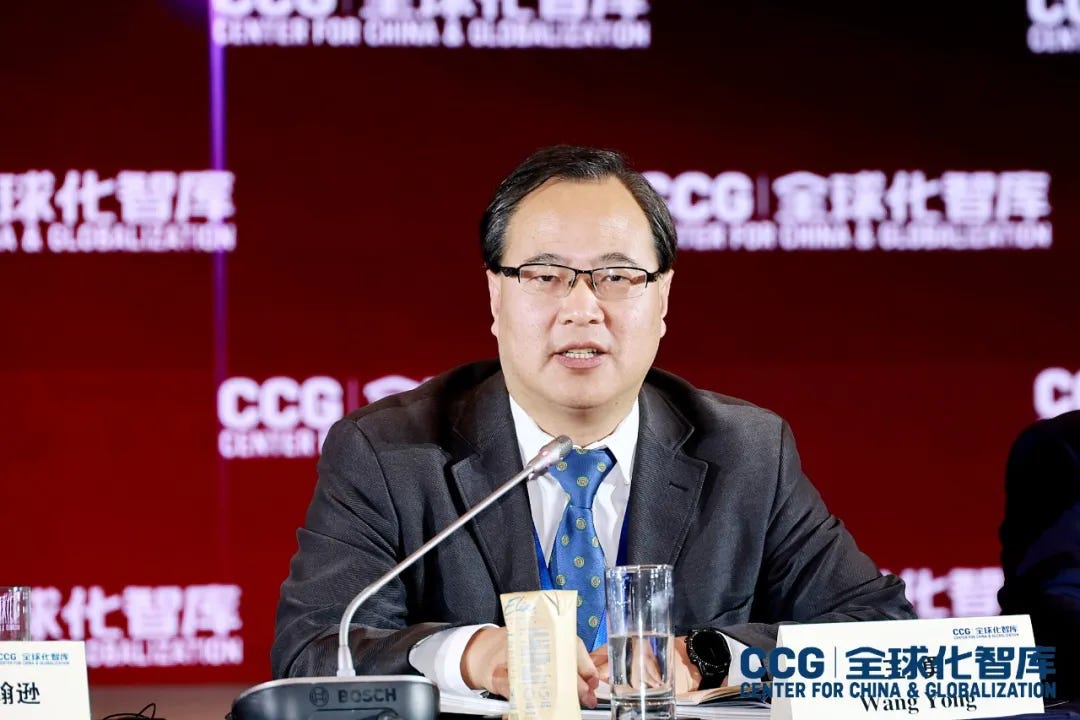
Thank you very much, Professor Wang, and thank you to CCG for setting up this very timely forum on what is probably the most important topic in today’s world. It echoes a lot of good opinions on this panel, including those of Professor Sachs. But I’m not a hawkish scholar, and I would just maybe take a step beyond these points. I think I’m simply speaking the truth. Now it is a good time to look at the influence and implications of the tariff conflict between the U.S. and China. I use three “news” to describe the new situation.
One is a new tipping point—a new tipping point in the balance of strength among nations, especially between the U.S. and China. The U.S. has, it seems, begun to recognise the power position, the strength position, of China. China has become the largest economy in the world, especially in terms of PPP. I think that standard makes more sense than market value.
China can be regarded as the only manufacturing superpower, accounting for 35% of the world’s manufacturing output, equivalent to the next nine countries combined. China has also become an innovation superpower. We can see this in AI, robotics, green development, and so on, not to mention its growing military power. Some people argue that 60% of the weaponry displayed on September 3 is not the same, right? So I think this gives a very clear picture of changes in the world. I call it a tipping point. I think it has become realistic and rational for the United States, and especially for the West as a whole, to recognise this, think about its implications, and think about ways to work together with China.
The second “new” is a window of new opportunities. I already said we see new momentum gaining after the leaders’ meeting between China and the U.S. in South Korea. We now have a new and great opportunity. I’m happy to say President Trump seems to be in the process of adjusting his mindset about China and about the relationship, based on his close observation of the tariff conflict and the hard negotiations between the two parties. I’m happy to see that there is simply good chemistry between the two leaders of the two great countries, and we have a great opportunity to turn negative competition, ugly competition, into a more positive one—more stabilising, more focused on common interests, and to work for the common interest and the common welfare of the world.
The last point is new confidence. I think this is very important for people in the United States to know the real thinking in China about the world and about the United States. I have studied this relationship for many years. I lead the Center for American Studies at Peking University. To my knowledge, and to be very honest, China has this attitude about the U.S.: China respects the U.S. as a great power. China never forgets that, at the time of the two countries fighting together in World War II against aggression, China well remembered the United States, the West, and their contribution to China’s reform and opening up, and economic modernisation. And also, as a person like myself, I’m grateful for the pressure imposed by the U.S., because that pressure turned into an internal driving force for reform, development, and innovation.
So, the last point I would like to say, as my suggestion, is about the media. In U.S.–China relations, the media is so important, right? Whether we have a good relationship, peace, or war, the media matters. I see a lot of media here. You take a big responsibility for the future of the relationship. So, I think you are here, you can tell the story, and we should be careful about the influence of the so-called military-industrial complex and warmongers. We see driving forces that oppose a shift in the mood of U.S.–China relations, especially in the United States.
And the last point is that we should listen more carefully to the voices of younger generations. We have a lot of young leaders and members here. I appreciate that you are represented here and your contribution to the relationship. Thank you very much.
Henry Huiyao Wang
Thank you, Professor Wang. Great to hear your views. You are an expert on China–U.S. relations.
Speaking of young leaders, we have Vincent Ibonye. He’s a Research Fellow and the Deputy Head of the China Centre at the Nigeria Institute for International Affairs, and also a PhD candidate at Tsinghua University. Maybe you can briefly comment or raise a question.
Vincent Ibonye, Research Fellow and Deputy Head, China Centre at Nigerian Institute of International Affairs (NIIA); PhD Candidate, Tsinghua University
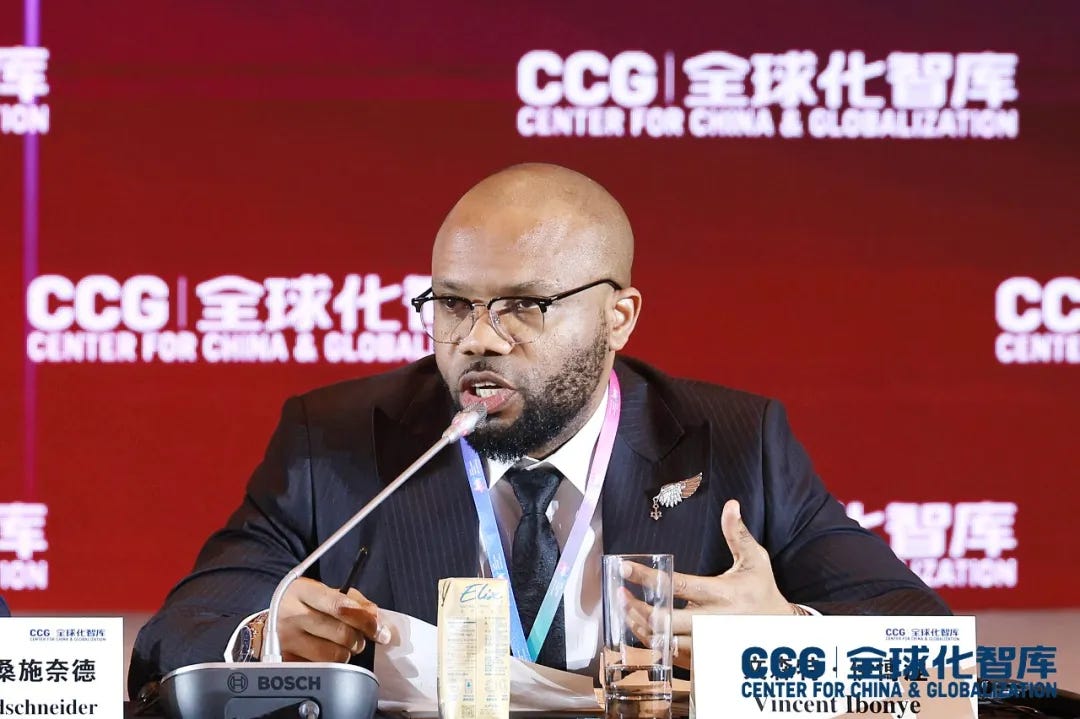
Thank you very much. Thank you to CCG for this opportunity. Good afternoon, Your Excellencies, distinguished guests, ladies and gentlemen. It is my distinct honour to share my views, and I will be grateful for your responses.
I will be picking up from where Professor Wang left off, speaking about the positives that have emerged from this trade conflict. I tend to see a catalytic quality to it. Take Europe’s strategic dilemma, for instance, and the 10% baseline tariffs. This is forging resilience and European strategic autonomy, leveraging the EU’s market power and elevating Europe as an indispensable “third pole” in the current dynamics.
When it comes to the Global South, we face a paradox of vulnerability and agency. This dual policy has seen a heightened embrace of the developing pluralistic global system, where Global South countries simultaneously call on all sides to negotiate from a position of collective leverage.
Regarding Africa, the IMF has predicted a 0.6% reduction in GDP growth next year. However, structures like the AfCFTA (African Continental Free Trade Area) have received a heightened push to harness combined market power in negotiations.
In light of these dynamics, can we say this is merely a wake-up call, or does it signal the end of the era of a single integrated global economy and possibly the rise of a multipolar one? Thank you very much.
Henry Huiyao Wang
Okay, great. Thank you. We must now conclude, as we have already overrun our time, but this has been a truly stimulating and fascinating roundtable dialogue.
Finally, on a personal note, I think that while President Trump has referred to the “G2,” this is perhaps the first time the U.S. has placed China on an equal footing within a new equilibrium. This has a huge impact on the relationship. We are no longer just talking about containment; we must treat each other as equals.
That is why I am very pleased to see the latest RAND Corporation report, which discusses the need to get along with China and perhaps even promote peaceful unification between the Mainland and Taiwan. I am also very encouraged to see that President Trump reportedly did not allow a DPP leader to transit through the U.S. for a visit, and also vetoed a $400 million arms sale to Taiwan. I believe these are very good signals. Furthermore, they reportedly did not discuss Taiwan at length during the Busan summit, regarding it more as a domestic issue rather than a bilateral or multilateral one, which represents great progress.
In Taiwan, the KMT has also elected a new chairperson who is very much in favour of dialogue and has affirmed her identity as Chinese. We see great momentum there. This is why, when the Japanese Prime Minister mentions that Japan would act differently if there were a problem in Taiwan, the timing is not ideal. We haven’t seen any recent tension across the Strait, thanks to the mutual understanding between China and the U.S.
I truly hope we can stabilise our bilateral relations and make them more productive. Of course, we face structural challenges and difficulties, but we must be responsible stakeholders for the sake of the world. I hope the U.S.-China relationship will stabilise, as Secretary Rubio suggested when he spoke of seeking ‘strategic stability.’ This is most important for the time to come.
I would like to thank our panellists very much this morning for this stimulating and productive dialogue. We will conclude this section now. Thank you all for listening. We will take a group photo now, and then move to lunch. Thank you. Thank you very much.
Transcript: opening ceremony & opening roundtable, 10th China Global Think Tank Innovation Forum

On November 20, 2025, the 10th China Global Think Tank Innovation Forum, hosted by the Center for China and Globalization (CCG) and co-organized with the China Association of International Trade (CAIT), was successfully held in Beijing.
The 10th China Global Think Tank Innovation Forum Held in Beijing
On November 20, 2025, the 10th China Global Think Tank Innovation Forum, hosted by the Center for China and Globalization (CCG) and co-organized with the China Association of International Trade (CAIT), was successfully held in Beijing.
What a wonderful session with lots of important points. Very productive set of perspectives represented by the various speakers. Only suggestion is to allow more time for dialogue among the speakers and to provide an opportunity for audience Q&A. Usually, the Q&A can be very interesting and service as a vehicle to open up additional perspectives. Otherwise, a very valuable array of ideas and viewpoints.