

The 12th China and Globalization Forum, hosted by the Center for China and Globalization (CCG) and co-organized by the China Association of International Trade (CAIT), the China Society for World Trade Organization Studies (CWTO), the China-United States Exchange Foundation (CUSEF), and Schwarzman College at Tsinghua University, was held in Beijing on Sunday, April 26, 2026.
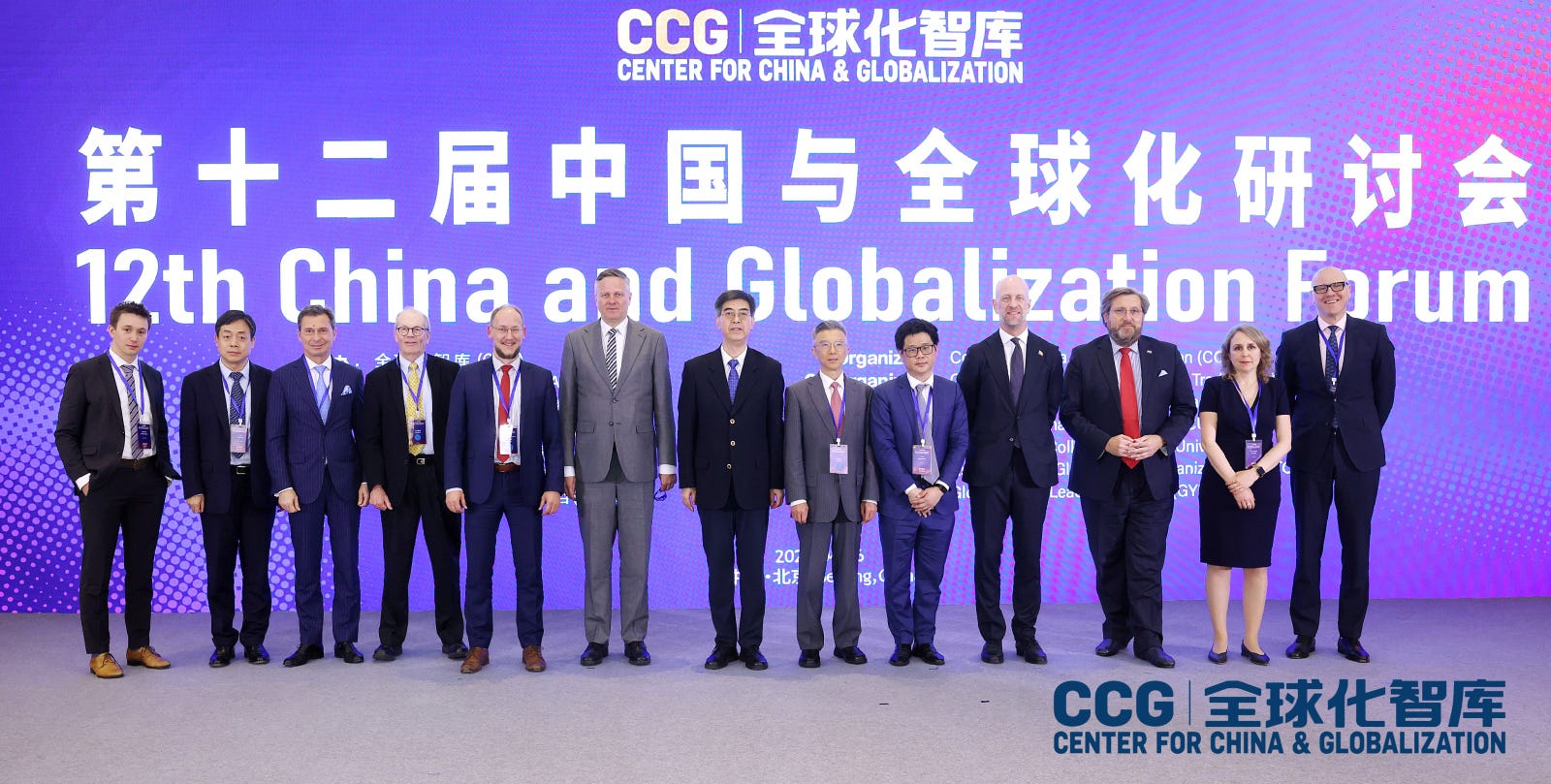
The session titled “Between Headwinds and Openings: Europe and the Next Chapter of China–Europe Relations” was moderated by Zichen Wang, Deputy Secretary General of CCG.
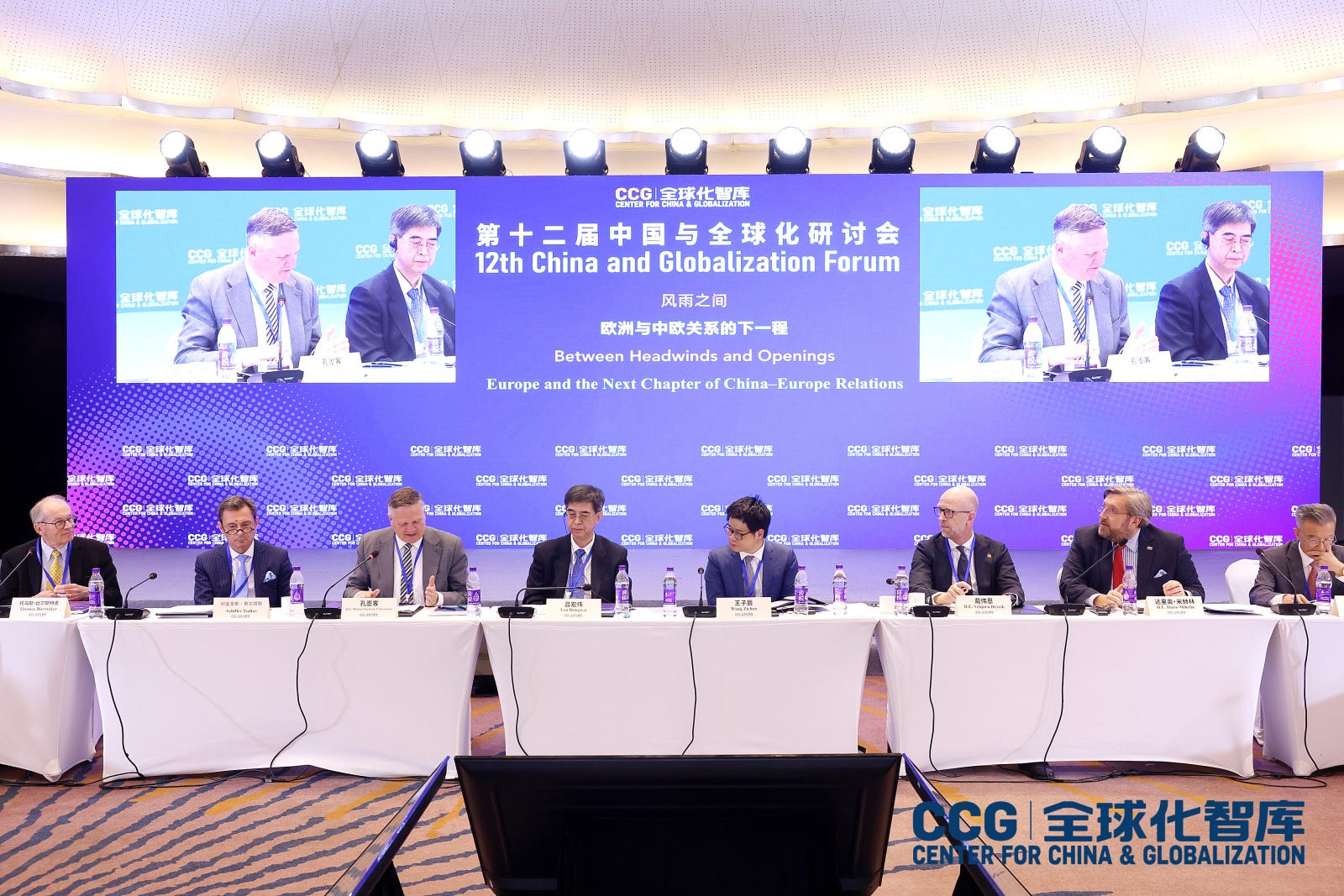
Speakers included
Thomas Biersteker, Professor Honoraire at the Graduate Institute, Geneva;
Michael Starbæk Christensen, Ambassador of Denmark to China;
Vebjørn Dysvik, Ambassador of Norway to China;
Jonathan Lehrer, Project Manager for International Affairs at Körber-Stiftung;
Lu Hongwei, Director-General, Department of Eurasian Affairs, Chinese People’s Association for Friendship with Foreign Countries (CPAFFC);
Dario Mihelin, Ambassador of Croatia to China;
Peng Gang, former Minister at the Mission of China to the European Union;
Oliver Lutz Radtke, Sinologist, Author and Strategic Advisor;
Sebastian Schwark, CEO of SEC Newgate Germany and Senior Advisor at the Global Solutions Initiative;
Ilke Toygür, Director of the Global Policy Center and Professor of Practice of European Politics at IE University;
Achilles Tsaltas, President of The Democracy and Culture Foundation, Athens;
and Wang Yiwei, Jean Monnet Chair Professor and Director of Institute of International Affairs at Renmin University of China.
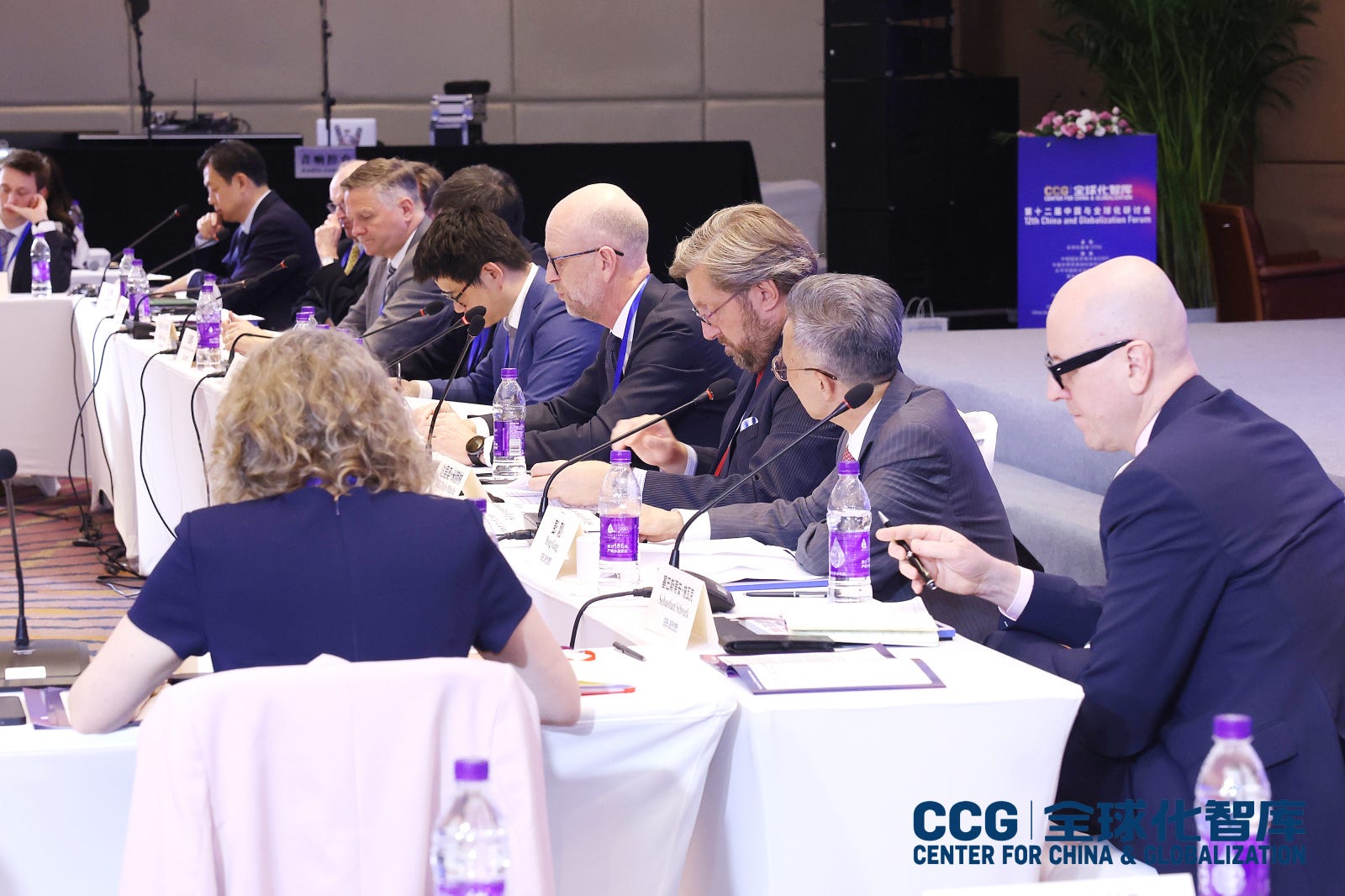
CCG has broadcast the video recording of this roundtable on Chinese social media platforms and uploaded it to its official YouTube channel.
This transcript is based on the video recording and has not been reviewed by any of the speakers.
Zichen Wang, Deputy Secretary General, CCG
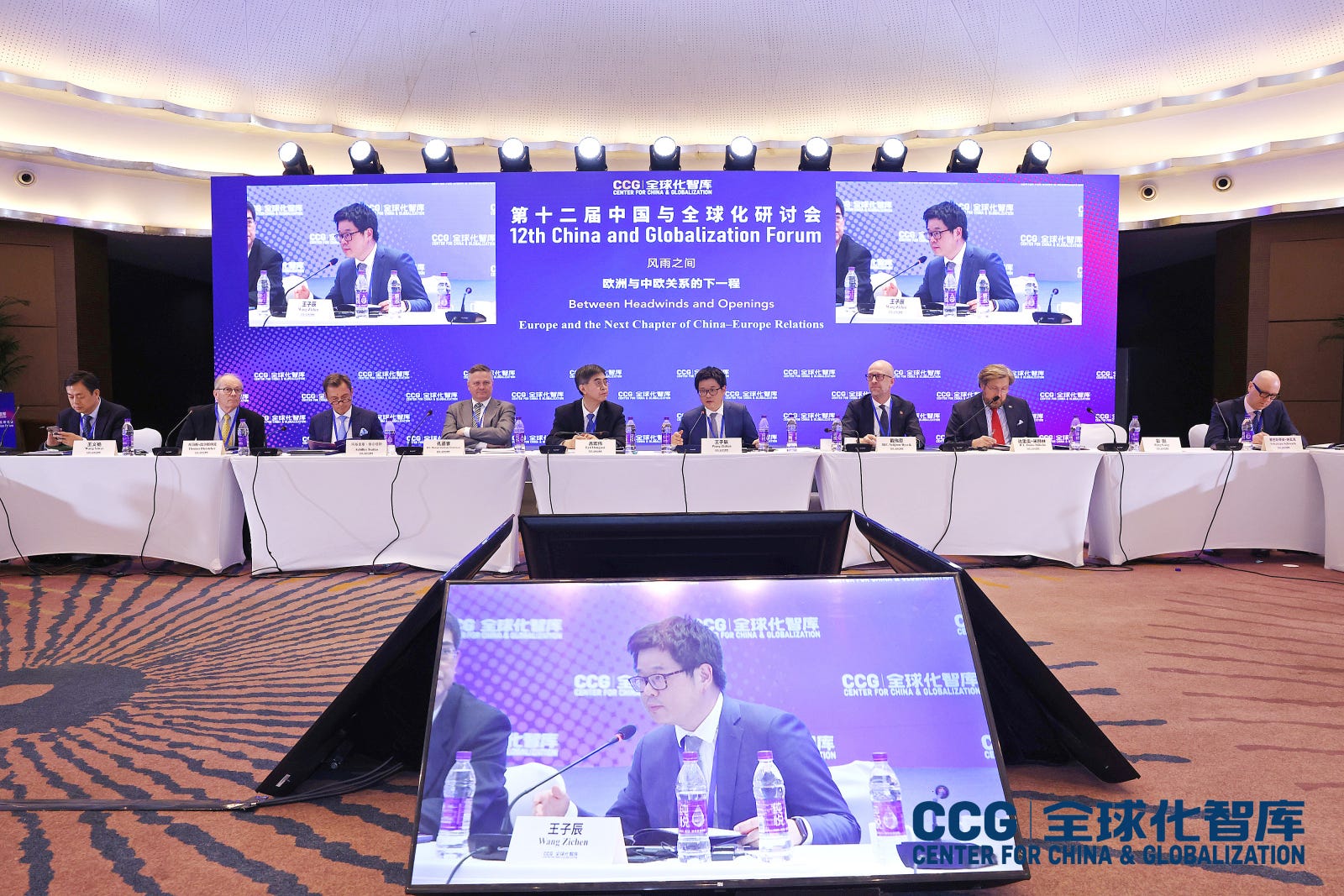
Good afternoon, ladies and gentlemen.
Thank you for staying with us and joining this panel, which I have named “Between Headwinds and Openings: Europe and the Next Chapter of China–Europe Relations.”
We heard discussions about global governance and China-U.S. relations in the morning, and then we had a vibrant discussion about U.S.-China exchanges among youth, with the example of Schwarzman College at Tsinghua University. So it is time to move on to a subject that many of our friends care about.
On this panel, which I will be moderating, we actually have, I think, three ambassadors from EU member states, as well as practitioners and Chinese association officials. Allow me to introduce them to you in alphabetical order.
First of all, we have Professor Thomas Biersteker, Professor Honoraire at the Graduate Institute of International and Development Studies in Geneva. He is also a Senior Fellow with the UN University Centre for Policy Research.
Then we have H.E. Ambassador Michael Starbæk Christensen, Ambassador of Denmark to China. We have H.E. Ambassador Vebjørn Dysvik from Norway. And we have Mr. Jonathan Lehrer from Körber-Stiftung in Berlin, Germany. He is Project Manager for International Affairs, as well as a China watcher who has spent significant time in China.
Beside me, we have Mr Lu Hongwei, Director-General of the Department of Eurasian Affairs, Chinese People’s Association for Friendship with Foreign Countries.
One of our scheduled speakers, Mr Paulo Magri, has already spoken in the morning. He understands that our schedule is a bit tight, so he has very generously allowed more time for the rest of the panellists. He will not be speaking on this panel.
Then we have another ambassador from Croatia, H.E. Ambassador Dario Mihelin. Welcome to join us as well.
We also have Mr Peng Gang, formerly Minister for Commerce in Brussels at the Mission of China to the European Union.
We have Mr Oliver Lutz Radtke, who is a sinologist and author. He was formerly CEO of an Austrian think tank and, before that, represented German political foundations in China. He also happens to be the most fluent Chinese speaker I have ever met as a foreigner.
We also have Mr Sebastian Schwark, whom I had the privilege of meeting in Berlin. He is the CEO of SEC Newgate Germany and also Senior Adviser at the Global Solutions Initiative, a very important organisation in Berlin and a long-time partner of CCG. The Global Solutions Initiative organises the Global Solutions Summit every June in Berlin.
We also have Professor Ilke Toygür, Director of the IE Global Policy Center and Professor of Practice of European Politics at the School of Politics, Economics and Global Affairs at IE University in Madrid, Spain.
We have Mr Achilles Tsaltas, President of the Democracy and Culture Foundation in Athens. We already heard from him this morning, and we are happy to hear from him again on Europe and China-Europe relations.
Finally, last but not least, we have Professor Wang Yiwei, who is a long-time friend of the Center for China and Globalization. He is also a senior fellow here, Professor of International Relations, and Director of the Institute of International Affairs at Renmin University of China in Beijing.
So, a warm welcome to all of you here.
Let us get right into our discussion. As we are a little bit late, let me just say that I will cut you short if you speak for too long. We have actually 13 or 14 speakers here, and it is going to be a little bit tricky. But I am sure you already have the experience and the wisdom to summarise and deliver your wisdom, informed by your experience, by your observations from your interactions, as well as your observations here in China and back home in Europe, and between China and Europe.
So let us start again in alphabetical order. Let us welcome Professor Thomas Biersteker, please.
Thomas Biersteker, Professor Honoraire, Graduate Institute, Geneva
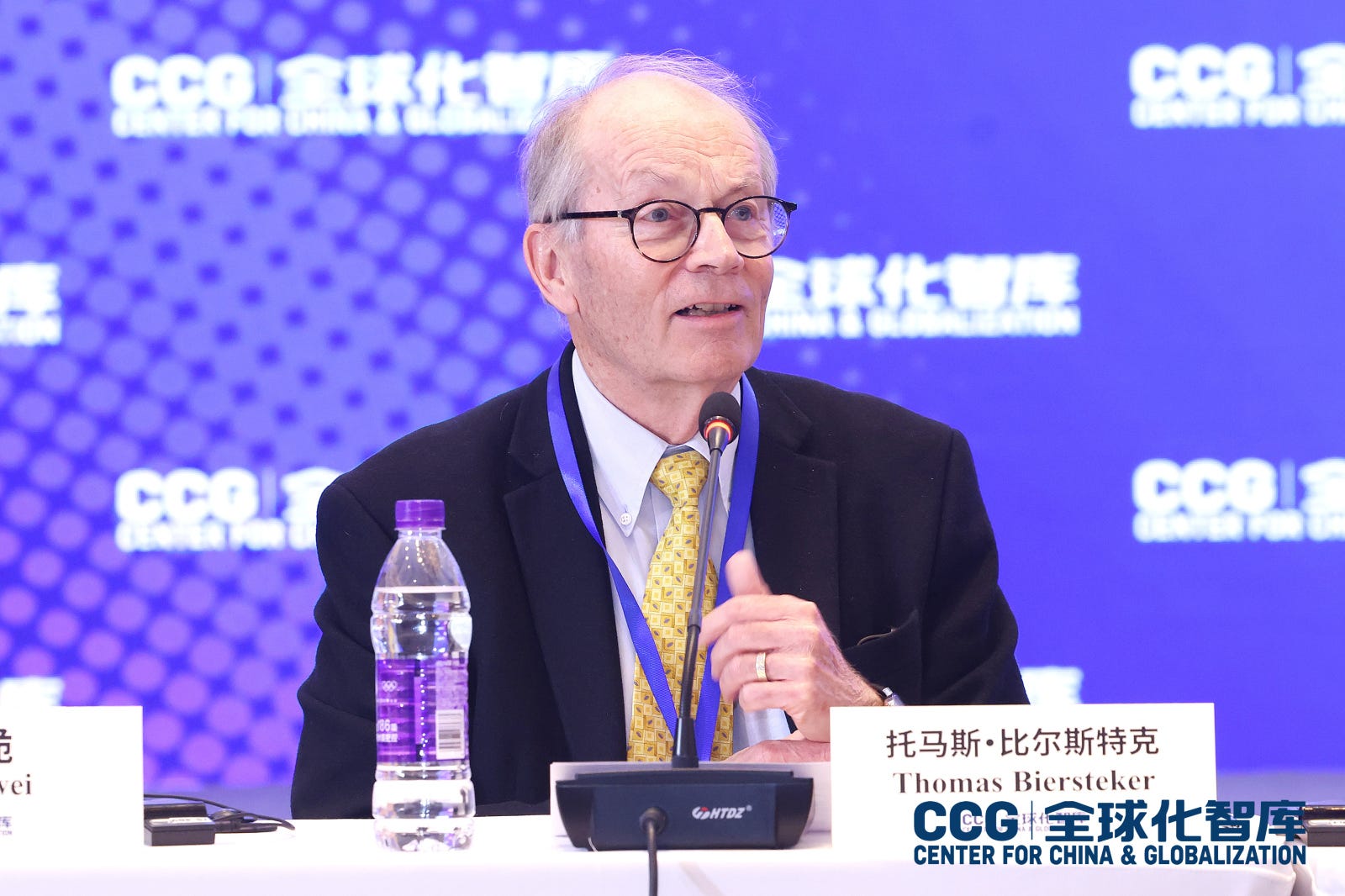
All right. Thank you very much.
Since I am a professor, it is hard to limit myself to five minutes. Do not worry, I will try to stick to your schedule.
I should mention my affiliation also, since it is a Schwarzman College day. I am currently teaching a course on global governance at Schwarzman College this year at Tsinghua. I should have worn my purple tie, but I did not today.
Now, based on my accent, you might wonder why I am on this panel. I have an American accent. I was born and raised in the U.S. I taught for many years in the U.S., but I have been in Switzerland at the Graduate Institute now for nearly 20 years. A lot of my research, particularly my research on the policy of international sanctions, is supported by the Swiss Foreign Ministry, and I regularly consult for the EU and the UK.
So what you will get is perhaps an American frank perspective on Europe, and a commentary on its strategic predicament, its position in the world economy, and the potential for European cooperation with China.
Let me first start with some observations about strategic perspectives from Europe. I think we have reached the point where Europe no longer trusts the United States as an ally. The Trump administration treats allies and adversaries in the same dismissive, insulting, and transactional manner.
Europe can no longer be confident that the U.S. will abide by its NATO commitments and come to its mutual defence if attacked by Russia. This is more than a rupture. This is actually a profound change in perception.
First, it was the tariffs. Then it was J.D. Vance’s insulting speech at the Munich Security Conference. Next came wavering support for Ukraine, a summit with Putin that marginalised Europe, followed by threats to Greenland and the civilisational criticism of Europe in the U.S. national security doctrine.
More recently, attacking Iran without consulting Europe, and then blaming Europe for not coming to support the U.S. effort, could be the proverbial last straw.
Europe has tried to accommodate Trump with flattery and special appeals from sympathetic leaders, but there is growing realisation that obsequious rhetoric and humiliating behaviour have largely failed.
Europe’s effort to accommodate has now turned, I think, to a growing realisation that a bully needs to be confronted, not accommodated—something that China demonstrated last year in its response to high tariff threats from the U.S.
In Iran, the U.S. has impulsively and irresponsibly created a huge problem for Europe, but also for the rest of the world, as we have heard in other sessions earlier today, and now wants NATO allies to come to its aid to fix a problem that it created.
So, to quote Steve Walt, the U.S. has increasingly become a rogue state, and Europe has been forced to confront the real possibility of NATO without the U.S.
I will just make a couple of quotes from Ben Steil from the Council on Foreign Relations, when he says Europe’s least bad option may well be to go its own way.
Earlier this spring, Ursula von der Leyen argued that Article 42.7 of the EU treaties on mutual defence should be brought to life. Just two days ago, Polish Prime Minister Donald Tusk reiterated the need for the activation of Article 42.7.
Just to start by framing it in terms of the strategic predicament, let me turn second to geo-economic considerations. Europe, of course, has a large population, a large prosperous population, an increasingly integrated economy, and by some measures the second, certainly the third, largest economy in the world.
At the same time, Europe has increasingly been disappointed by the lack of reciprocity from China when it comes to trade, investment, and financial flows. Both Europe and China are committed to the expansion of international trade, but the terms of their trade have been unbalanced.
There are, I think, legitimate concerns in Europe about the lack of reciprocity, but the paradox is that Europe needs Chinese technology and Chinese goods in order to achieve its environmental goals.
Another quote here from Rana Foroohar from the Financial Times just last week, when she said: “I was amazed that Beijing did not grab the low-hanging fruit left by Trump after the announcement of his Liberation Day tariffs last year and decide to work with the Europeans to come up with a solution to the problem of Chinese goods dumping. That could have been the germ of a new trade paradigm, and it would have been the perfect moment for the Chinese to present some ideas, however half-formed or imperfect, to Brussels as a show of good faith.”
That is the end of the quote. I am saying Europe is not viable on its own. It lacks the political, legal, and institutional architecture to pursue things on its own. This is why I think it is important to consider new alliances and new thinking.
So let me conclude. I am already 10 seconds over, but I will finish.
While the U.S. is in the process of abdicating its historic leadership role, it has not destroyed multilateralism. I am taking issue with some of the presentations earlier today. I do not believe that multilateralism can be destroyed unilaterally by one country acting alone, even if it is the U.S.
If others do not follow the U.S., and if they continue to interact and strengthen core elements of the international rule of law and international institutions, accompanied by reform, multilateralism can be reoriented and cease being dependent on U.S. underwriting and hegemony.
So there is a potential, in my view, for stronger ties between Europe and China based on a negotiated commonality of interest, not zero-sum competition, because I find that U.S. policy practices are not actually being replicated across the rest of the world. They are being answered with new trade arrangements at the regional level. Another theme earlier today: not imitative initiation of new tariffs in the pursuit of self-interested neo-mercantilism.
So perhaps the so-called rupture is an occasion for fundamental rethinking of multilateralism, not its abandonment. Thanks for your attention.
Zichen Wang
Thank you for your very good summary and also high expectations for China-Europe relations.
Let us hear from Ambassador Michael Christensen. What is your take as the Danish Ambassador here in China?
Michael Starbæk Christensen, Ambassador of Denmark to China
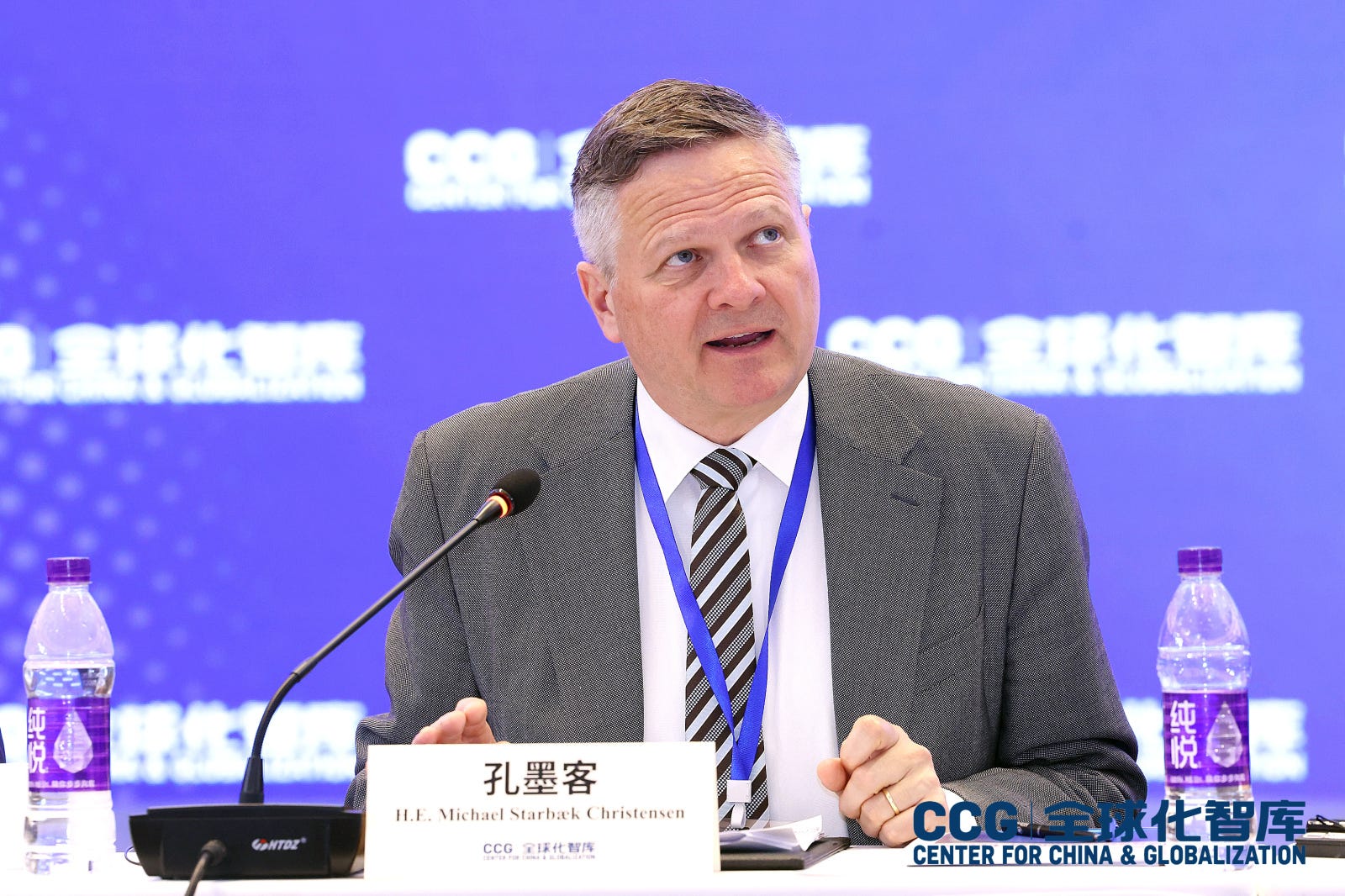
Thank you very much.
I read the title of this panel: “Is there a dawn for Europe’s future?” And I am not sure I agree, because in Europe, there are always ups and downs. So there is never really a dawn or a downside.
Europe spends a lot of its energy to organise itself, because it is a complicated structure, with 27 individual countries trying to regulate matters and present a common approach together. So I think we have to understand that this is what Europe is.
Europe has also proven to be extremely good at crisis management. We saw it during COVID. We have seen it during the energy crisis, where Europe surprisingly quickly went off from dependency on Russian oil and gas.
So I think Europe is sort of an eternal dawn, you could say, because there is always some struggle, but we always find a way. I am a big believer in this thing we have created that has its ups and downs but is always floating and never drowning.
Trump is a special character, and we have had our issues with the Americans over Greenland. But I always say it is not a fight with the United States of America. It is actually with a Trump administration that sometimes derails from what is sound thinking. We have broad support in the U.S. Congress for our stand, as well as among European countries.
So we sometimes have to be careful to talk about the United States, as if Trump is defining the country as a whole. Sometimes we also need to tackle problems from where they arise, rather than blaming a full nation.
For Europe and China at the moment, I think we focus too much on the constraints and too little on the opportunities.
We are not doing so well in the political dialogue, but I think in the economic and trade relations, things are going well, tipping towards China at the moment, but before, probably more tipping towards Europe. We always have to find balances.
I think it is okay for Europe to introduce the Industrial Accelerator Act and the Cybersecurity Act. Rather than focusing on them as something anti-Chinese, I think we should say Europe is doing some homework that has been requested for a long time. It will not mean the end of trade relations at all. It is just something that Europe needs to do in the kind of world we live in, to make sure that there is also independence and economic security in Europe.
So I think maybe that can relate to 10% of trade, perhaps, and 90% is still fine. So let us look at the opportunities rather than dig down into the constraints, which I still think are a very small part of the relations.
I heard the end of the youth panel, and it is always encouraging to hear young people believe in international dialogue and cooperation. For sure, we need that. But we also need to respect each other’s policy space. That is why I mentioned the Industrial Accelerator Act and the Cybersecurity Act as something that there is no need to talk about as what will define the relationship in the future. I think there is very much a lot we can still do together.
And now, with the elections in Hungary, it turned out that the Trump administration is no longer welcome at national elections, because it was the kiss of death from J.D. Vance. So I do not think he will be invited again.
It just proves that Europe is again floating despite ups and downs. The people of Europe spoke very clearly in Hungary, and I think it makes a European like myself very proud.
So I will end here. Thank you.
Zichen Wang
Thank you very much.
I think Beijing has some issues with the Industrial Accelerator Act and the Cybersecurity Act, but China has always been very consistent in supporting a unified and strong Europe, especially the European Union as an institution.
So let us move on to Ambassador Dysvik from Norway. Thank you.
Vebjørn Dysvik, Ambassador of Norway to China
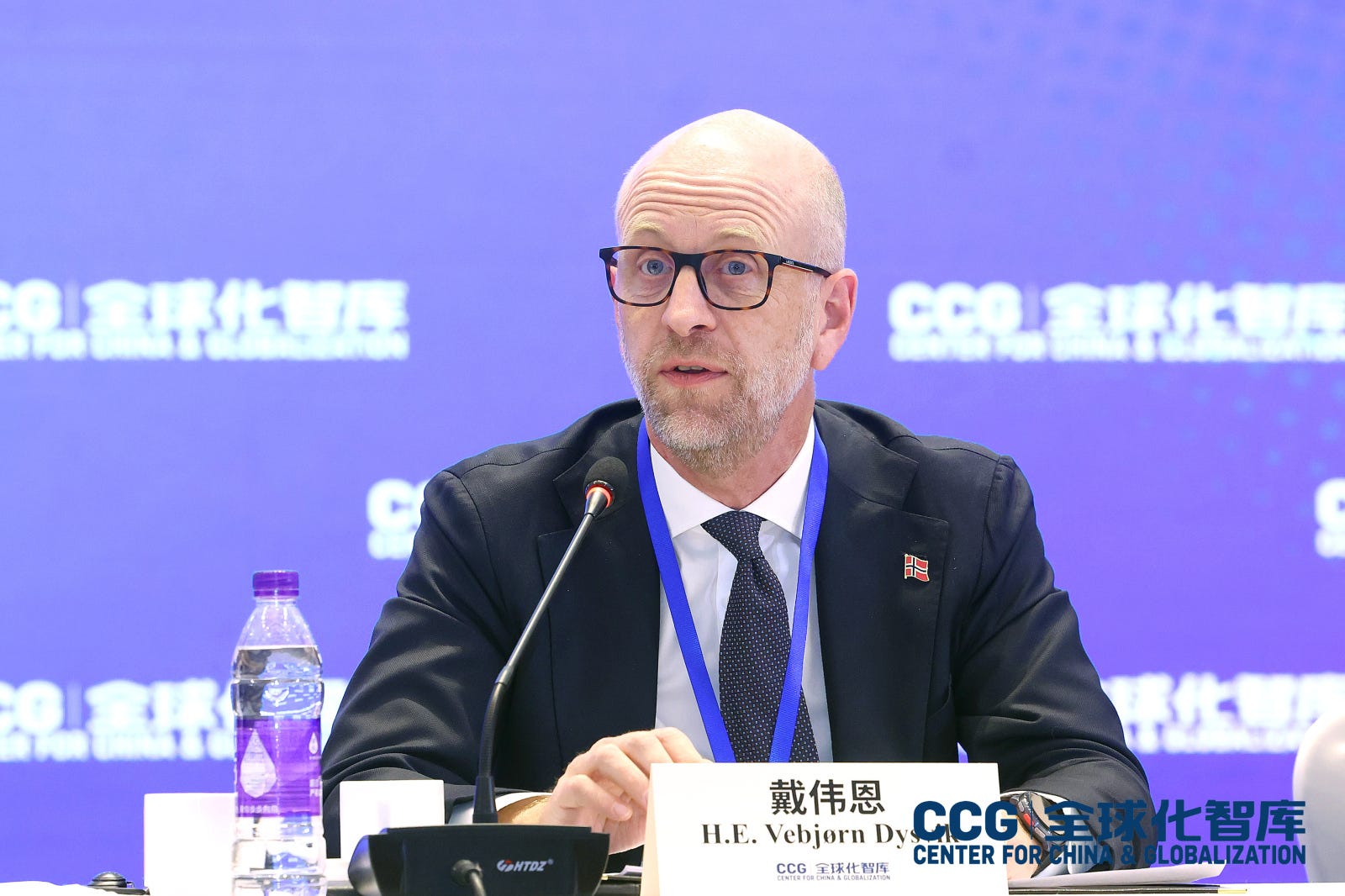
Thank you very much, Excellencies, colleagues, friends.
First of all, thank you for inviting me to attend the 12th China and Globalization Forum and to speak at this roundtable session on the next chapter of China-Europe relations.
We are indeed facing a challenging environment, with wars on several continents and a world economy that is now in crisis because of these wars, and also severely fragile and unbalanced. The situation is concerning, to say the least. But concern cannot be our foreign policy strategy.
I would like to use this opportunity to present two parts of our strategy that can be employed by both Europe and China to move things in a positive direction.
First of all, when we find it difficult to find our way, we need a compass. For Norway, that compass is international law and the UN Charter. This determines our way forward.
When it comes to Russia’s illegal invasion of Ukraine, Norway values territorial integrity, national sovereignty, and every nation’s right to determine its own future. These are the principles that are at stake in Ukraine, and this is why so many countries in Europe are supporting Ukraine’s fight for its independence.
But equally, as we question those who do not take a clear position on Ukraine, it is valid to ask European countries to be equally concerned about international law in the Middle East, in Africa, in Latin America, and in Asia.
This is, of course, easy for me to say, as Norway has a good track record, but the point still stands. If you are going to move in the right direction, you need something to guide you. For us, that something is international law.
The second part I would like to highlight today is the need to support and protect our multilateral instruments of trade. Norway is an open economy. We have benefited greatly from globalisation. We share common values and interests with the Nordics and the EU, and Norway is part of the EU’s internal market through the EEA.
We have shared interests with both the EU and China in preserving the rules-based multilateral trading system and in making it work.
The 14th Ministerial Conference in Yaoundé in March was widely framed in advance as a make-or-break moment for the organisation, and we were very disappointed that consensus could not be secured and that it ended without agreement.
Still, the work continues in Geneva, and the stakes are high, because we need to create a more level playing field. This is in the interest both of advanced economies and developing countries.
This will include looking at subsidies, industrial policy, and state-owned enterprises. And, of course, it also includes looking at security measures to make sure that they are really about security.
In the time ahead, it will be important to preserve the system, while at the same time focusing on how to modernise the organisation. We need rules that cover new issues and challenges, and we need new and revised commitments from members.
We must continue to reaffirm our collective commitment to the WTO’s core values and to a revitalised WTO that can deliver results.
We share a mutual interest in standing together to preserve the rules-based multilateral trading system. Addressing today’s global challenges ultimately requires collective solutions. A stable world depends upon respect for international law and organisations operating with common rules that are implemented and respected. We believe this is also essential for the next chapter of China-Europe relations.
Thank you.
Zichen Wang
Thank you, Ambassador.
Now we are going to hear from Jonathan from Körber-Stiftung in Germany. He is probably one of the youngest speakers at this table, but I am sure you have brought a lot of new perspectives. The floor is yours.
Jonathan Lehrer, Project Manager for International Affairs, Körber-Stiftung
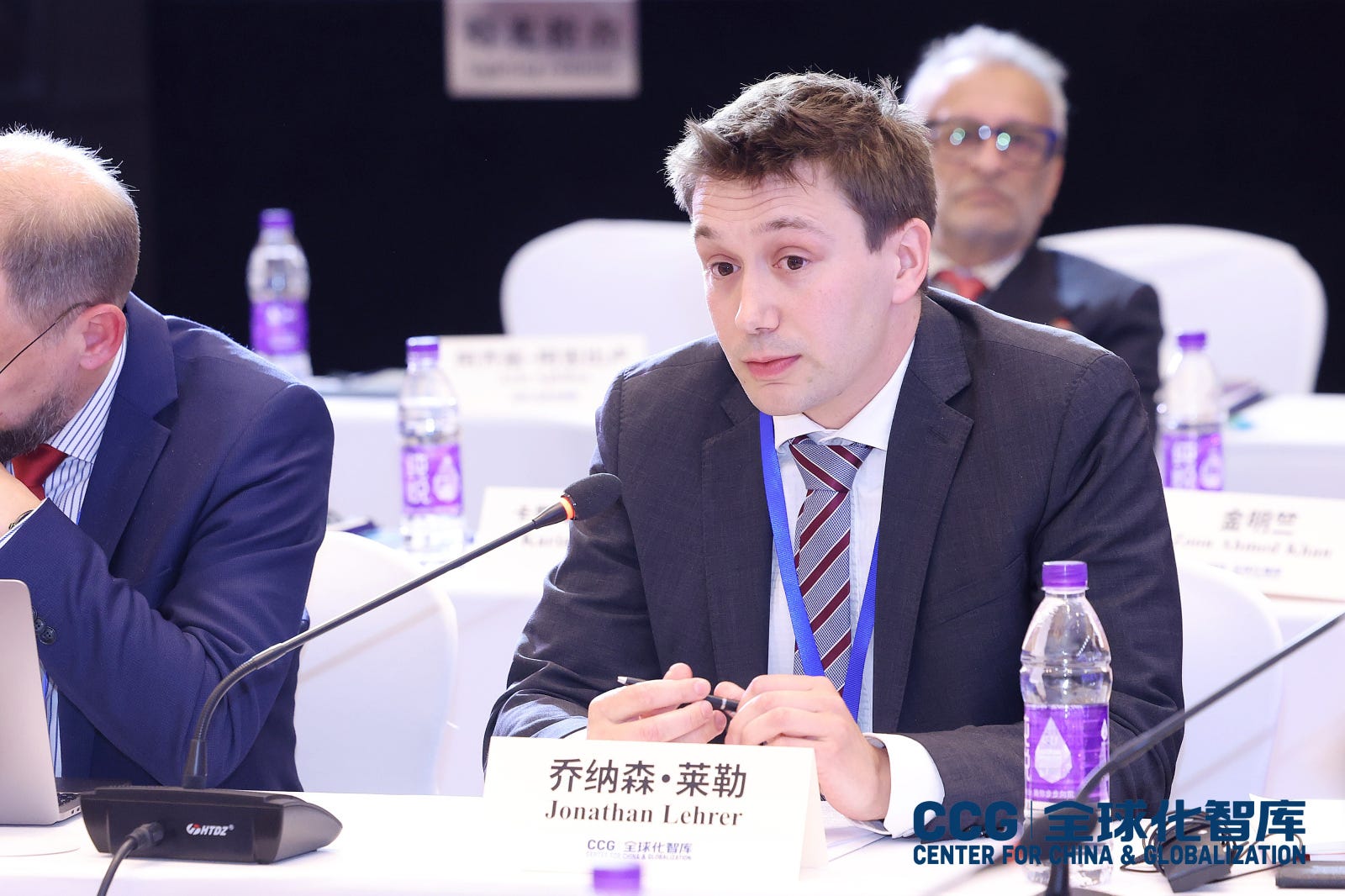
Thank you, Zichen. It is a pleasure to be here. It is also a pleasure to be representing a foundation that works at the intersection between civil society and foreign policy.
You asked me to speak about European resilience, which I find a pretty difficult task, Zichen. It is not so easy.
But to be honest, I think Europe is in a pretty tough spot. I work for a German foundation. Europe is in a pretty tough spot, and it got there pretty quickly. It is our own fault, and we should not complain about it.
I think there are four geopolitical arenas that show that Europe needs to be more self-resilient, more self-reliant.
Ukraine is the starting point. The war has shown that we need to be less dependent security-wise. That is clear to everyone.
The new U.S. administration has also shown us that our democracies have to be more self-reliant, because the U.S. is interfering in our own member states’ elections. That is a big problem.
The third arena, I think, is the competition with China. It is tough competition, and it shows that our industrial bases have to be more self-resilient. That is also very important when we talk about what people need in our countries.
And yhe war in Iran has shown that we have to maintain a clear course on decarbonisation.
So I think the immediate reality is pretty concerning, because it is really hard to realise the benefits of reform, for example, at the moment in Germany, when they are immediately being undermined by high energy prices, because we are now again in an energy crisis just four years after the last major energy crisis. That is a pretty tough situation to be in.
But I think the long-term outlook for Europe is brighter, because Europe is investing heavily in defence. Germany is investing heavily in defence. Ukraine is one of the most capable armies in the world. It is very innovative. It is very adaptive. It will make NATO stronger. It will make the European Union stronger.
Besides the sometimes geopolitical differences we have with other countries in the world, I think Europe is very attractive for middle powers to trade with, but also to negotiate with, for UN Security Council reforms. There are many topics where Germany and Europe are pretty attractive partners. There are differences, but we can manage them and we can talk about them in a respectful manner.
Ukraine has taught us that one-sided dependency is dangerous, but also that breaking those dependencies is costly. It comes with a price. It comes with a price for people. You can ask people to contribute. You can ask the public also to pay a price, but you need to prioritise and you have to explain well what you are doing.
I think Germany is going in a pretty interesting direction, with defence expenditure of around 5% of GDP. That is a lot, but 30% of those 5% of GDP is also going into infrastructure. That is interesting because infrastructure is an investment for the military, because the military needs infrastructure, but it is also an investment in people, and it is also very good for the economy. I think there is no need to explain the beauty of infrastructure in China. We all know the benefit of infrastructure.
So the core lesson, I think here, is that cutting extensive dependencies is smart, but it is also pricey. You also need to offer something to your own people when you are doing it, and you cannot cut those dependencies everywhere at the same time. It is not possible.
In the long term, I think Europe is moving towards becoming more self-reliant and more resilient, becoming a more sovereign Europe, but not a nationalistic one. I think that is a really important point, and this is also really attractive.
Let me end—and I did not expect to do it—with a quote from our Vice Chancellor. He said action in Germany alone is only part of the solution, but a reformed and stronger Germany is a precondition for a strong Europe.
Thank you.
Zichen Wang
Thank you for walking us through the thinking, the reflections, and also the undertakings that are happening in Germany and, I believe, also across Europe to meet the challenges of this age.
We are now moving to Mr. Lu Hongwei, Director-General of the Department of Eurasian Affairs, Chinese People’s Association for Friendship with Foreign Countries. Mr. Lu.
Lu Hongwei, Director-General, Department of Eurasian Affairs, Chinese People’s Association for Friendship with Foreign Countries
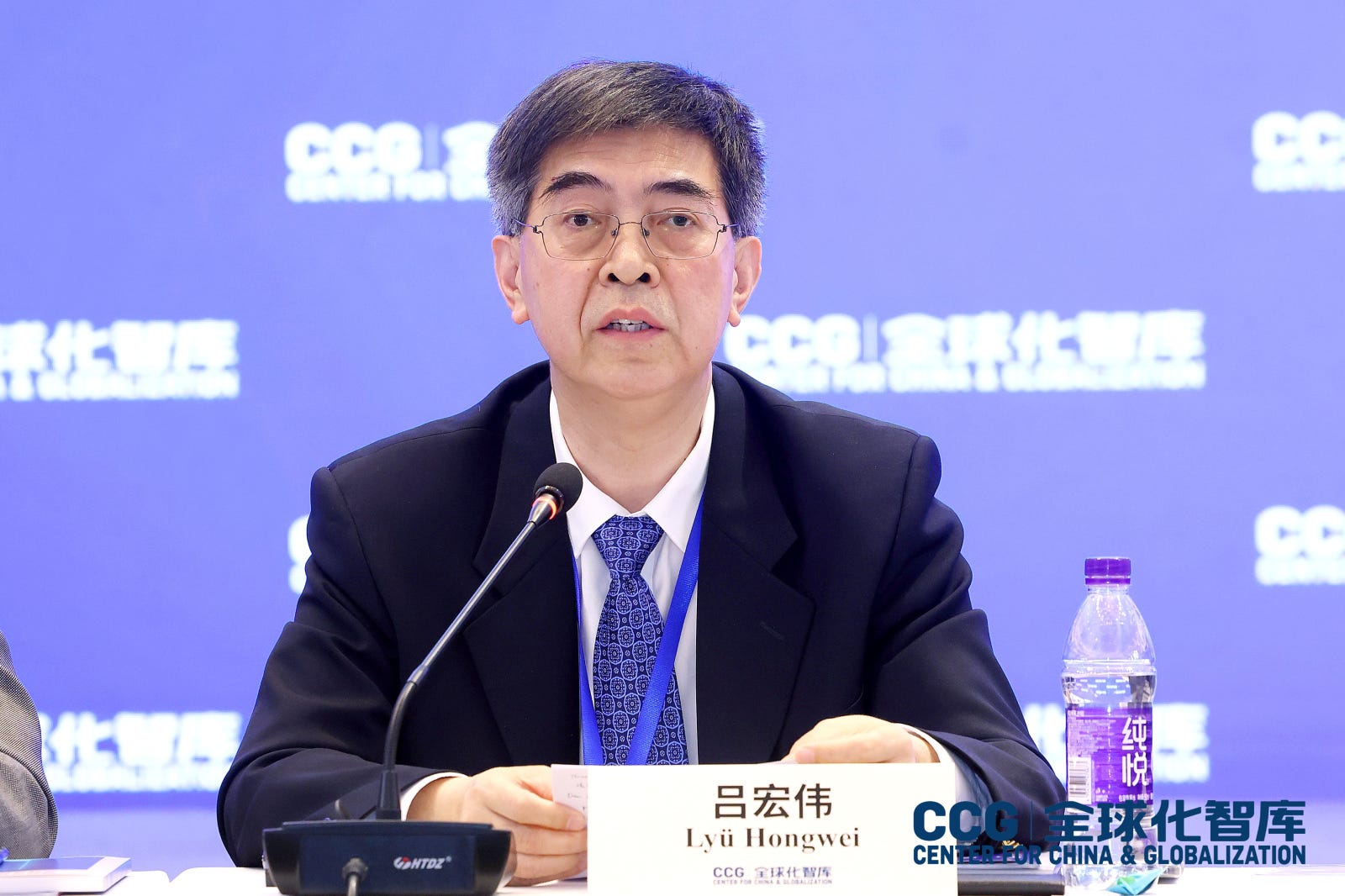
Secretary-General Miao, President Wang, distinguished guests, good afternoon.
I must say I feel somewhat humbled to take the floor, but I will keep to the time limit and share some of my first-hand impressions with you.
I have just returned from Italy, and immediately after that, I accompanied a delegation from Styria, Austria. The delegation included the state governor, the deputy governor, the speaker of the state parliament, the president of the chamber of commerce, and more than a dozen entrepreneurs.
Last October, at the invitation of the Konrad Adenauer Foundation in Germany, I also made a special research visit to Berlin. Within 48 hours—including sleeping time—I held 11 meetings. Some of the discussions even took place over meals, while people were still chewing their food. My meeting with Jonathan Lehrer of Körber-Stiftung was one of those 11 meetings.
I have several impressions to share, mainly from the perspective of the resilience of the European economy.
First, energy security: the painful shift from passive supply disruption to active restructuring.
The primary challenge for the European economy now may be the rigid rise in energy costs. Take Germany as an example. As the engine of the European economy, Germany has seen a notable economic downturn in the past two years. Its economy contracted by 0.3 per cent in 2023 and by 0.2 per cent in 2024, before registering a slight increase of 0.2 per cent in 2025. Energy has been an important factor behind this. The pressure is, in effect, a hard switch in energy sources.
To break away from dependence on Russian energy, the EU has reduced the share of Russian natural gas imports from 40 per cent before the Russia-Ukraine conflict to 18 per cent now. In fact, energy is not only a basic input for economic activity and production. It is also an important raw material for industries such as chemicals. This is why the European economy is now under considerable pressure.
Second, Europe is now trying to find a balance in its digital transformation between ethical regulation and innovative vitality.
Europe does not lack basic research and development. It is also a very open society. But what it may lack now is the speed of market conversion. The EU’s Artificial Intelligence Act is the world’s first comprehensive AI regulatory framework. Yet some of its relatively strict compliance requirements may become a brake on AI development.
For example, we have seen 45 companies, including giants such as ASML in the Netherlands and Airbus, jointly call for a delay in the implementation of some provisions, because they worry that excessive regulation may force investment to flow to the U.S. and Chinese markets. The Center for Data Innovation, a European think tank, has also estimated that the Act could bring 31 billion euros in compliance costs to the European economy.
So, to improve the resilience of the European economy, Europe may need, in the development of AI and the digital economy, to find a more flexible balance between development, ethics, and regulation. Rules should be improved through practice, rather than being used too early to constrain development.
Another point is that, while Europe pays attention to economic development data, it may also need to pay more attention to the improvement of its own labour productivity.
I found some figures. From 2019 to 2025, the average annual growth rate of labour productivity in Europe was 0.5 per cent. Over the same period, it was 1.9 per cent in the United States and nearly 6 per cent in China. Economic growth is, to some extent, built on the growth of labour productivity.
In today’s AI world, there may be some inaccurate or fake news. But about two months ago, I saw a report about German Chancellor Friedrich Merz. He reportedly said that Germans take 14.8 days of leave a year and asked whether that was too much. If this report is true, then perhaps Europeans should think carefully about this issue.
Finally, I would say that cooperation with China should still be one of the main directions for Europe’s development. China’s market is continuing to grow. As people’s living standards improve, there is strong demand for high-quality foreign products. So I think Europe should develop better in these areas.
I have been engaged in exchanges with Europe for more than 30 years, and I have deep feelings for Europe. In the early years of China’s reform and opening up, Europe gave China significant support. We fully recognise this and are sincerely grateful for it.
I personally firmly believe that a prosperous, united, and open Europe is in the interest of the whole world.
Thank you.
Zichen Wang
Thank you, Mr Lu. I will just briefly summarise that. He reviewed the pressure faced by Europe on the energy front. There has already been quite some discussion about digital regulation in Europe, which many believe is probably a little bit too much, and then the rise of labour productivity in Europe.
He mentioned the speech given by the German Chancellor after he visited China. I believe that is real news, because we have video footage of that—basically saying that maybe the German people could afford a few fewer holidays.
Mr Lu also talked about his over 30 years of engaging with Europeans, where he has a lot of personal feelings about Europe. China is actually very grateful for the economic engagement and the collaboration between China and Europe since China’s reform and opening up. There is a lot of potential for the two sides to enhance their collaboration.
Thank you very much.
We will move on to Ambassador Dario Mihelin of Croatia. Ambassador Mihelin is heading to the airport, I believe, no later than 10 minutes past five, so you still have time.
I would also like to note that the Foreign Minister of Croatia paid a visit to China not long ago and spoke at the Center for China and Globalization. We are always very grateful for our collaboration with you and with your Foreign Ministry. Thank you very much.
Dario Mihelin, Ambassador of Croatia to China
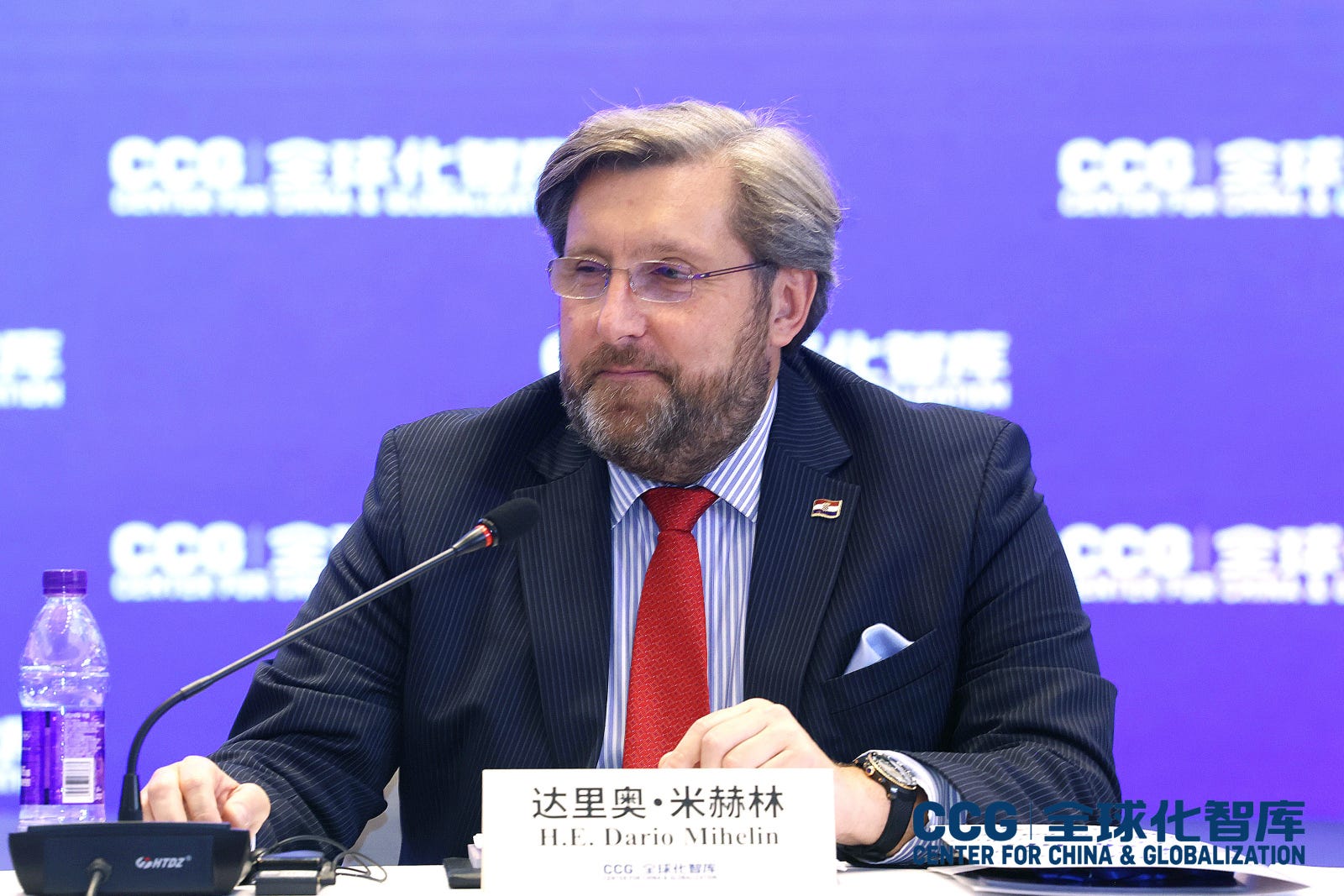
Thank you.
Colleagues, members of academia, let me start by congratulating Henry, Mabel, and the whole CCG team on organising this valuable forum again.
I was really inspired by the previous title of this panel in the draft programme, and I will reflect more on that and then on the elements of the latest panel title as it is today.
It cannot be denied that the centre of the global economy is shifting from the Atlantic towards the Indo-Pacific, and with it political influence and weight. From the outside, Europe is sometimes perceived as a continent in relative decline, an ageing power defined by its past achievements rather than its future trajectory, raising the question: Is there a dawn for Europe’s future?
This does not imply that Europe is deteriorating, I would say. Rather, it reflects the fact that others are converging with more advanced economies, a development that is in itself positive for the global economy and for humanity as a whole.
Europe is surely not in decline in that sense. It is, for the most part, a highly developed and settled continent. In general, Europeans enjoy some of the highest living standards in the world. Europe consistently ranks at the top of global indices measuring human development, quality of life, and social well-being.
Europe also enjoys high levels of both internal and external stability and security, something that cannot be taken for granted in many parts of the world, and something that is perhaps more important now than ever.
War has become unthinkable among countries that started many wars against each other in past centuries—an achievement to cherish in our ever more turbulent and violent world, even to the east of the core of Europe.
This makes Europe conducive to long-term competitiveness, sustainable growth, and economic resilience. And this is precisely why Europe continues to attract people and capital from across the globe. It continues to be a destination for global talent, business, investment, art, and so much more.
In a world marked by uncertainty, Europe’s levels of prosperity, stability, and social well-being remain its greatest assets. Yes, Europe may no longer be able to match the growth of the world economy, nor the sheer scale of hard power of the United States and China, be it industrial, military, or technological. But we should also ask: what even is the ultimate purpose of development and, moreover, of nations themselves? Is it to dominate others, to rule the world, to accumulate power for its own sake? Or is it to improve the well-being of societies and the quality of life of citizens?
In regard to the latter, Europe has already achieved what many countries and regions in the world are still striving to reach.
Though Europe is not a continent in decline, we must be honest about where we can improve. It could be said that our own success has lulled us into complacency, and even into outsourcing our security and development elsewhere, from which we must break free.
In a world where threats move at lightning speed, our current mechanisms sometimes fall short in coordination. It is no longer enough simply to react. We must become more proactive.
Europe is certainly redefining its place in a world marked by growing uncertainty, strategic competition, and weakening global norms. The real question today is not whether Europe should be a global actor, but what kind of global actor it will choose to be.
Strategic autonomy has become more important than ever, as Europe faces pressures from geopolitical shifts, the war in Ukraine, the war in the Middle East, and changing transatlantic dynamics that demand greater European responsibility and capacity to act.
Europe must turn strategic autonomy from concept into concrete action, investing in innovation, defence, and sustainable energy to secure our freedom of manoeuvre.
For Croatia, the transatlantic relationship has always been foundational, but strong partnerships evolve. A more capable and cohesive Europe does not weaken the transatlantic bond. It makes it more balanced and therefore more resilient.
Allies expect Europe not only to align rhetorically, but to deliver politically and operationally. This means a Europe that contributes more to collective security, acts with greater coherence, and takes responsibility in its own neighbourhood.
When Europe upholds international law, defends territorial integrity, and invests in its own capabilities, it reinforces the transatlantic partnership rather than competes with it. Strategic autonomy understood this way becomes a contribution to shared security.
The geopolitical and economic situation demands nothing less than a comprehensive strategy that integrates trade policy, industrial policy, technology policy, and international market policy into a coherent approach to economic security.
The path forward requires us to reduce critical dependencies through supply-chain diversification, to use trade policy strategically, to build resilient networks, to invest in technological sovereignty, to strengthen our internal market, and to ensure coherence between our policies — many things China has already achieved itself.
Investment in research and development is not a cost. It is the foundation of future competitiveness and strategic autonomy.
Just look at Chinese achievements in this regard. Countries and regions that lead in innovation will set standards, capture economic value, and possess strategic options that followers lack. The EU must be among the leaders in critical and emerging technologies.
So, is there a dawn for Europe’s future? Well, ladies and gentlemen, the sun still shines in Europe and will continue to shine. So do not write off Europe just yet.
Thank you.
Zichen Wang
Thank you. We are definitely not writing off Europe.
I think I have to make a little clarification here. An early draft of the agenda actually titled the panel discussion “Is there dawn for Europe?” I have since decided that is not fair to Europe.
We all believe that Europe is still a very important pole of this world. Its GDP per capita is actually vastly higher than that of the Chinese mainland. As we have heard from you and your colleagues here, it still enjoys a lot of advantages.
One thing you said actually struck me a little bit. You said, especially in this environment of superpower competition, people talk about whether the U.S. wants to dominate the world or whether China wants to become the next hegemon. But you asked: What is the goal of development?
I think the Chinese leader would actually agree with you, because he has said many times on Chinese domestic occasions that the aim of Chinese development and of the ruling Communist Party of China is to raise the well-being and happiness of the Chinese people.
So I think there is consensus over that. That is the reason for all these policies, and for China-EU relations, and relations between China and the various European capitals.
Thank you very much. Let us move on to Mr Peng, who is a former minister in charge of commerce in Brussels at the Chinese Mission to the European Union.
Peng Gang, former Minister, Mission of China to the European Union
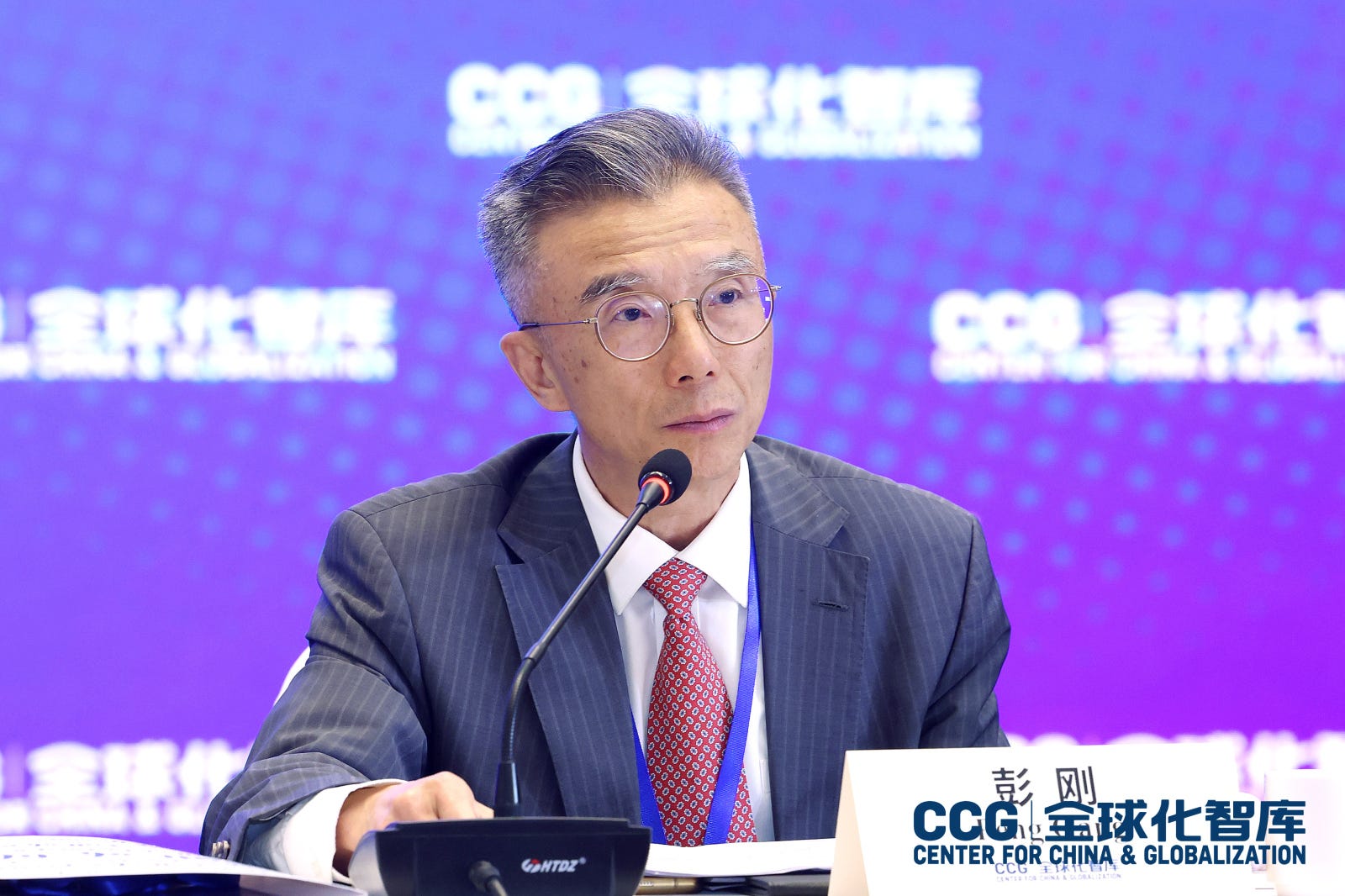
Thank you, Mr. Chair. And also thanks to CCG for offering me this great honour.
Talking about the future of Europe and China-Europe relations, first of all, let me just share the view of Ambassador Dario just now about the advantages of Europe and the EU overall.
I would like to stress that Europe, as a key pole in the world’s multipolar landscape, holds a position and plays a role that cannot be overlooked.
Europe boasts a profound historical heritage, advanced scientific and technological capabilities, a mature market economy, and strong cultural influence. Whether it comes to addressing global challenges, upholding multilateralism, or promoting reform of the global governance system, Europe plays an indispensable and vital role.
Secondly, talking about today’s challenges, most of our earlier speakers and panellists have all mentioned challenges today. We must also be soberly aware that Europe is currently facing unprecedented internal and external challenges.
Internally, the economy is struggling to recover, and problems such as high energy prices, inflation, supply-chain disruptions, and insufficient innovation capacity continue to plague Europe’s economy. Our earlier panellists also mentioned these kinds of problems.
Externally, geopolitical conflicts are protracted. Hegemonism, unilateralism, and protectionism are on the rise, and transatlantic relations—which are very important to Europe—are experiencing extreme volatility.
All of this has introduced significant uncertainty into both European and global development.
At the same time, the collective rise of emerging markets and developing countries, and the deepening of a new round of scientific and technological revolution and industrial transformation, are reshaping the global economic structure and competitive landscape.
However, no matter how complex and changeable the international situation may be, world multipolarisation is an irreversible trend of the times, and economic globalisation is an objective requirement for the development of social productive forces and an inevitable result of scientific and technological progress.
As an important global force, Europe can play a more active and constructive role in international affairs, to promote economic globalisation towards a more open, inclusive, balanced, and win-win direction.
More importantly, it is necessary to recognise that China’s development is an opportunity for the world. As the world’s second-largest economy, China’s sustained and stable growth brings stability and certainty to both European and global economies.
Moreover, China’s 15th Five-Year Plan—and I think a lot of earlier speakers mentioned our 15th Five-Year Plan—brings Europe and the world even greater opportunities for joint development.
China’s development is not a threat at all, but an opportunity; not a challenge, but a contribution. It is hoped that Europe can set aside ideological biases and adopt an objective, rational, and positive attitude towards China’s development and the enhancement of its corporate competitiveness, viewing China as a partner rather than a systemic rival.
So let us use fewer negative terms such as decoupling and de-risking, and so on and so forth, and instead, like China, embrace more positive words and actions, such as increasing, enhancing, or enlarging our bilateral cooperation.
Finally, due to time, let me emphasise once again: for Europe to revive itself, it must face up to its own vulnerabilities. The real threat to Europe is not the so-called overcapacity of China, but the serious lack of competitiveness caused by its own lack of innovation and closed markets.
The Chinese and European economies are highly complementary. China can provide cost-effective industrial products and complete supply chains, while Europe can provide advanced technologies, design expertise, and brand management.
Only by strengthening cooperation between the two sides can we achieve mutual benefit, win-win results, and common development.
Thank you.
Zichen Wang
Thank you, Minister Peng.
Let us hear from this side of the table. Oliver Radtke, thank you.
Oliver Lutz Radtke, Sinologist, Author and Strategic Advisor
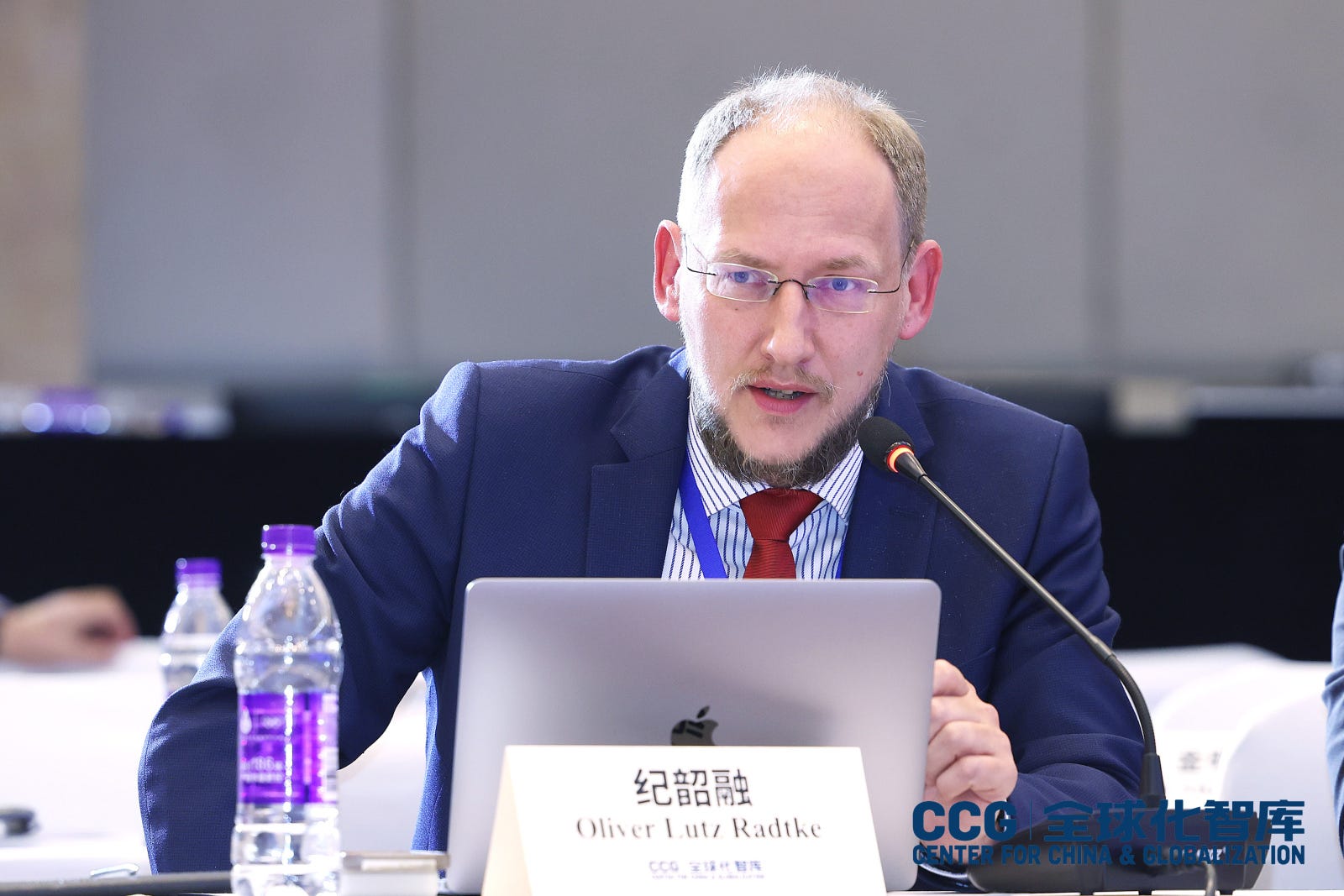
Thank you. Good afternoon. I want to build on what I have said earlier today and offer three observations.
I was invited to speak in the morning already, and what I have to offer is drawn partly from my research, which I presented at East China Normal University earlier this week in Shanghai, but also partly from watching European capitals and how they are responding to a world that is clearly moving faster than their China policy frameworks were designed to handle.
First, Europe, in many cases, is being informed, not consulted. The Strait of Hormuz situation is instructive, and I say this with all the Excellencies in the room very much in mind, because this is ultimately an observation about structural position, not about intent or goodwill.
When tensions in the Hormuz corridor escalate, Europe’s energy security—and this is a major issue, as we all know—shipping lanes, insurance markets, and the Indo-Pacific relationship as a whole are all directly affected.
And yet the strategic decisions that determine the trajectory of that situation are being made in Washington, in Tehran, in Riyadh, or not, as we learned yesterday evening, and increasingly in Beijing.
Europe is briefed. Europe issues statements. Europe sometimes is consulted in the margins. But Europe is not at the table where the core decisions are taken.
This is not a criticism of any single actor by any means. It is a structural description of where Europe finds itself. That has direct implications for the EU-China relationship, because China is one of the very few interlocutors with genuine leverage across the landscape.
I will come to Ukraine and Russia in a second.
The EU has been and will always be a complex actor, not by accident or incompetence, but by design. Heads of state at the European Council change, for example, every two and a half months. I want to echo what Ambassador Christensen has been saying here. It is, of course, very much worth engaging, but dealing with the EU will always be a lengthy and complex but worthwhile process.
The question is whether the current political atmosphere allows these conversations to happen with sufficient depth, regularity, and a sense of urgency.
Second, Europe’s China debate is often not really about China. I come to offer a little bit of a more internal perspective on the EU.
What I frequently observe is that much of the European discourse on China is often an internal European argument about sovereignty, strategic autonomy, and identity, using China as its object.
European actors are frequently not responding really to what China does, but responding to what China represents in a domestic or intra-European political contestation.
This matters practically, of course. If you want to engage European China policy constructively, you need to understand that changing European perceptions of China may not be sufficient, because the driver is often not perception, but internal political configuration—again, every two and a half months, major changes at the level of heads of state.
That is a message I would offer to Chinese interlocutors, but also to European ones.
And let us also not forget China’s relationship with Russia in year four of the ongoing war against Ukraine. That is a major factor in the ongoing securitisation of the EU-China relationship in many aspects.
Third, the conceptual vocabulary is due for renewal. I think that the partner-competitor-systemic rival trifecta introduced in 2019 was analytically honest at the time of its inception, but it has aged. It has become less of a strategic framework and more of a political permission structure, allowing every actor to select the framing that fits their preference.
Of course, it is a very complex strategy. Just imagine a cocktail with three layers, and then you give it to the customer. You have to shake it first. But then what is what? What layer constitutes what? What are you drinking? Who are you talking to?
So six years on, I think Europe needs a more operational framework, one that distinguishes between sectors, between time scales, between the China that directly affects European interests, and the China that figures in European political perception.
Coming to the end, I would suggest that the next chapter of EU-China relations depends more on whether both sides can build a kind of working-level institutional patience in think tanks, universities, business councils, and diplomatic channels to stay structurally engaged across what will certainly be, in the coming years, very turbulent years of Europe’s internal reconfiguration.
But I also want to highlight a sense of urgency in terms of AI governance. We have AGI around the corner, and we are still talking about whether we can use certain chatbot functions or whether we can increase efficiency in administrations, and so on.
Pandemic prevention: the next pandemic is around the corner. Mental health, if you take a look at the statistics. And especially because it has not been mentioned enough today, I think climate change. We need innovative collaboration, and we need urgent action.
Thank you so much.
Zichen Wang
Thank you, Oliver, for your in-depth observation.
I do agree with you that climate change has not been mentioned enough. It is my personal observation that it is no longer as high a priority within the European context as it was, for obvious reasons, when it comes to energy and other issues. Mr Sebastian Schwark.
Sebastian Schwark, CEO, SEC Newgate Germany; Senior Adviser, Global Solutions Initiative
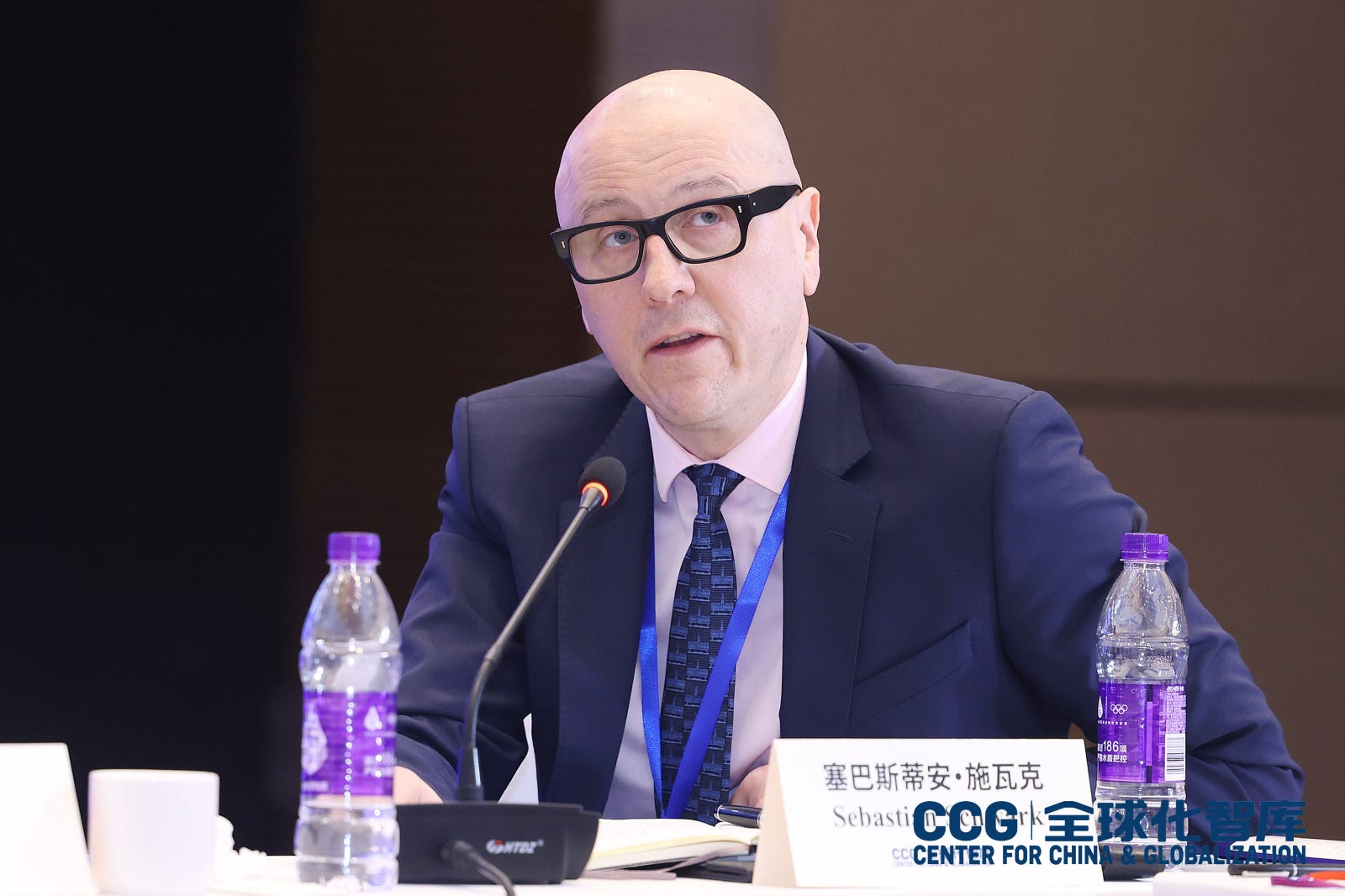
Thank you very much. Thank you for the invitation and the possibility to speak here. I am going to be quick, because a lot of what has already been said I do not need to repeat.
We see Europe today in a world that is increasingly reminiscent of Carl Schmitt’s theory of Großraume that are competing against each other in a multipolar world. That is, of course, against European interests, really, and against the European vision of the world, which is more built on collaboration and multilateralism. And I think the EU-China relationship is increasingly a victim of this emerging geopolitical order, which is so polarised.
On the face of it, as I see it, the EU-China relationship is primarily a very important trade relationship. I agree with everything that has been said about the mutual beneficiality of it, if it is done right. But I think we also need to face the fact that this trade relationship is increasingly overshadowed by this geopolitical polarisation that we are seeing, and that we see a resulting lack of trust on both sides.
From a European perspective, that is, of course, as has already been mentioned, the war in Ukraine and Russia’s aggression, and what is perceived in Europe at least as Chinese support for Russia’s position—a main issue. That is an integral issue for European security, and I think that has been underestimated in China.
Secondly, I think we have seen in the past a weaponisation of supply chains. That is also a problem, of course, for Europe, particularly since Europe is so much for open trade.
Then there is also the perceived striving towards regional hegemony. All of those policies are undermining trust, I think, and need to be addressed head-on, hence the naming of them.
I think it is also true now, though, that China is a technology leader, and that Europe can learn a lot from China. The relationship has also changed in the sense that China is now in a much stronger position than, let us say, 20 years ago, and certainly also 10 years ago.
Maybe China is also a policy leader, in the sense that its industrial policy seems to have been betting on the right industries of the future, and hence the technology leadership today. So I think Europe could learn from that as well.
To come to a close, I think it is really important to rebuild trust, because the trade relationship is so important for both sides. I think we would all benefit from trade that is fair, open, and mutually beneficial.
Because of the geopolitical situation that I have sketched out, and that other speakers have also mentioned, it is important that Europe and China work together towards certain political global benefits, such as combating climate change, but also the solution of regional conflicts, global health, et cetera.
Thank you.
Zichen Wang
Thank you, Sebastian. You mentioned Chinese industrial policies, and I think actually the Beijing Auto Show is ongoing in Beijing. I have not had the opportunity to go there, but press reports say there is an amazing number of new vehicles, especially Chinese-made EVs, on display over there.
So, if you have a day or two, or maybe a few hours, grab a ticket and head north. I have heard it is just amazing and very refreshing, and a lot of Chinese EV companies have a lot to offer these days.
Let us continue to Professor Toygür. Thank you.
Ilke Toygür, Director, Global Policy Center; Professor of Practice of European Politics, IE University
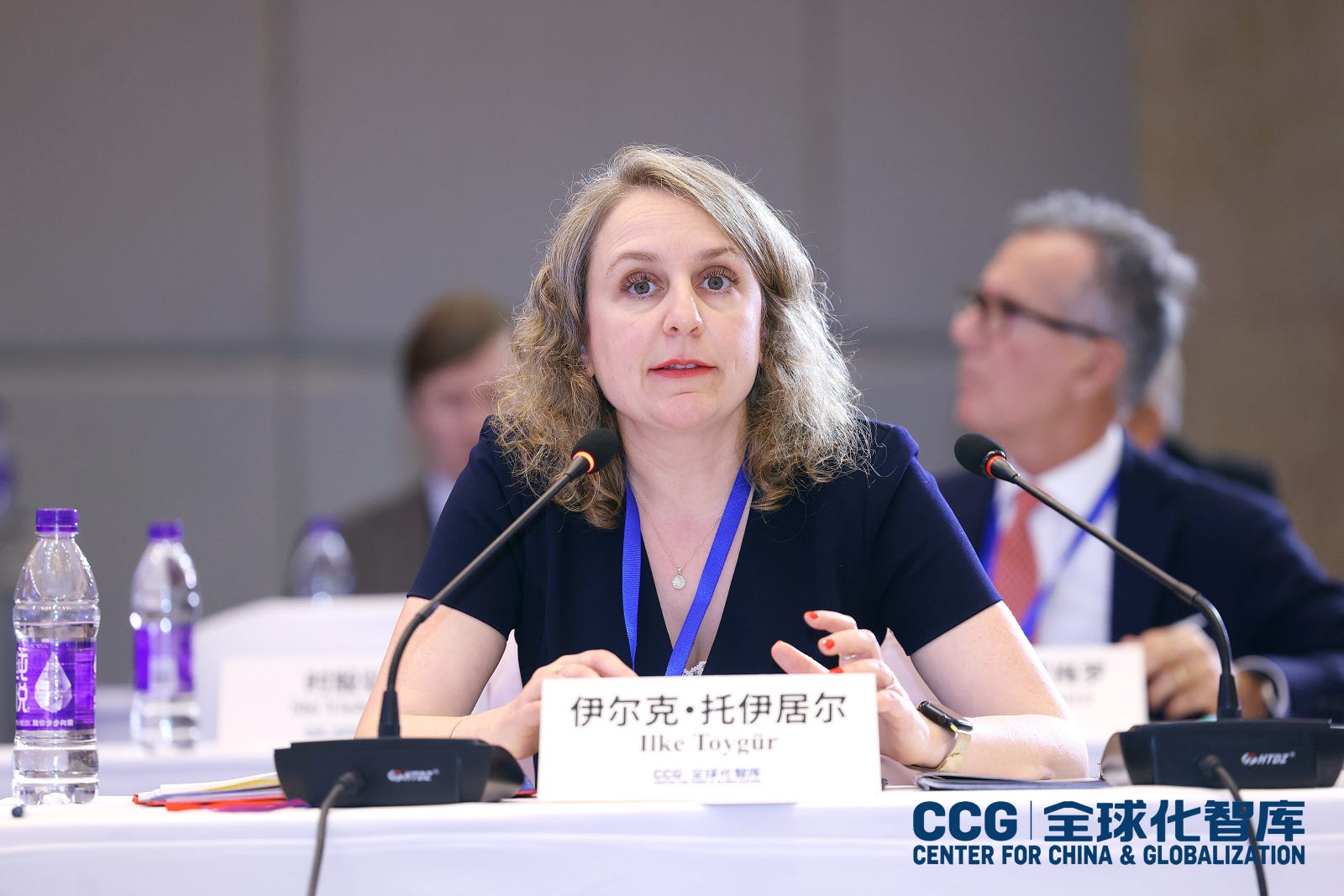
Good afternoon, everyone. I was also asked to speak on the EU security strategy and if there is a dawn for Europe. So my remarks were also centred on that front. But I will very happily come to EU-China relations also at the end.
I think it is really important to underline that it is no secret that the European project was designed for a world of positive interdependencies, cooperation, and openness. The power-politics environment of today is not necessarily the ideal setup for a supranational institution that works on compromise and pooling sovereignty.
I think it is really important to underline that the EU is very different from the U.S. and China, consisting of 27 sovereign states. For me, it is miraculous every day that we are managing to align strategies from Estonia to Spain on different fronts that require Europe’s attention.
But from a historical perspective, I really wanted to start from here: that the EU has always adapted. It might be slow. It might be messy. But throughout the eight decades that it has existed, it has found a way to adapt to the necessities of the age.
There is one concrete reason for that: because the European Union, as a supranational institution, is a provider of security and prosperity to its citizens. To fulfil that aim—as the Ambassador also mentioned in his intervention—it has to adapt to the times.
So to answer the question that I was asked, I think the European Union is working on its own security. It has an economic realm, which is very connected to the security of these times, and a security realm.
On the economic realm, there are so many components, but actually I wanted to focus on the single market integration dimension, because I personally think it is the key to Europe keeping up with its economic performance in the years to come.
This includes deeper integration in finance, energy, and telecoms; streamlined regulation; creating a defence market, which will also link to security in the second forum; and economic security related to supply chains and clearly the energy security dimension.
So this is the economic realm that I care the most about, and I personally think that will lead to an improved situation when it comes to the European economy.
On the security realm, in addition to working on national defence industries and rather quietly discussing how to make the European pillar in NATO work, or, in case of need, take over enablers, command systems, and work only with European partners—and Canada and Norway, of course, included—there is already an existing strategy.
But I wanted to underline one more, and this will let me connect to China. There is a major partnership strategy functioning at the EU level right now.
I am not just talking about the trade deals that the EU has signed with India, Mercosur, Australia, and many others, but also the security and defence partnerships that were created for this age and signed with Ukraine, but also South Korea, Japan, and others, to fulfil the aim of providing prosperity and security to European citizens.
For me, the partnership strategy is as integral as the completion of the single market. Maybe I can use my last minute on EU-China relations, because I personally think the partnership map cannot be completed without strategic clarity on China. This is, for me, a really, really important point.
I think we all know there is a desire to improve EU-China relations. But from the European perspective, there are three core reasons why the conversation is not moving forward. I am sure there are different reasons from the Chinese perspective, and I am really happy to discuss them if there is time.
The record level of trade imbalances with China threatens Europe’s economic model and prosperity. This is not a side issue. Let me give you an example. I think this is really important. For a country like Spain, which has been named very China-friendly in recent years. Seventy per cent of all trade deficit is with China, and this is really crucial.
The second point is, of course, the weaponisation of strategic interdependencies with export restrictions and critical raw materials that have an impact on European industries. But I want to underline one industry: the defence industry that Europe is trying to develop the most needs critical raw material supplies from China.
Thirdly and lastly, I am finishing, is of course China’s position on and support for Russia’s invasion of Ukraine.
Let me end on one point. Even if there are many divisions between member states on how to deal with China, there is consensus on two fronts.
One is risk management in security and security buildup in Europe. Without economic growth, without innovation, and without job opportunities, it is going to be impossible. China plays a very important role in innovation, investment, and economic growth in European countries.
Secondly, for providing public goods in the world, including the fight against climate change, reforming global governance, and also keeping an open trading system in the world, the European Union needs China.
So these two areas, regardless of the problems between member states, are sources of consensus. I personally hope there will be work done in the upcoming years, both by the Europeans and by the Chinese, to bring strategic clarity to the relationship.
Thank you.
Zichen Wang
Thank you very much, Professor Toygür.
Now let us welcome Mr. Achilles Tsaltas from Athens. He is the President of the Democracy and Culture Foundation.
Thank you.
Achilles Tsaltas, President, Democracy and Culture Foundation
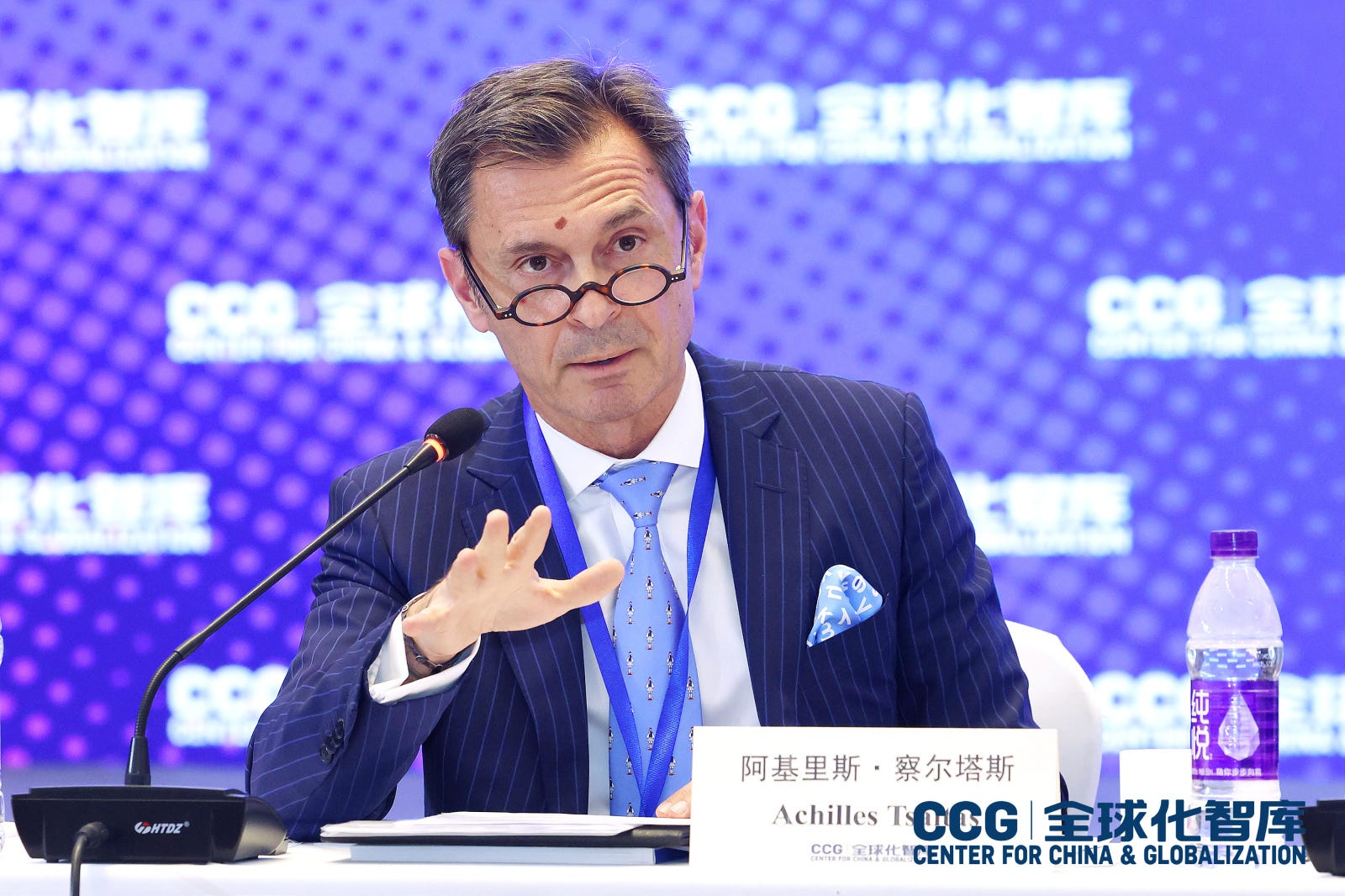
Thank you. Talking about democracy, I agree with Ilke about Europe’s adaptability, and probably one main reason is because of its democratic system, which is self-correcting in itself.
But Europe is not simply choosing between paths. I think it is searching for its compass at the moment, because Europe today faces more than just a security crisis. It is a crisis of orientation—strategic, economic, and democratic.
For decades, Europe’s stability has rested on a fragile equilibrium of American security, Russian energy, and global market integration. That equilibrium seems to be broken.
So the debate that we are having about NATO—some call it the brain death of NATO—strategic autonomy and new alliances is necessary, but it is not sufficient, because the world is changing at a deeper level.
This morning, I mentioned the three foundational drivers of human progress: energy, intelligence, and biology that have entered a new phase. They are no longer scarce. We are entering that phase of abundance.
In this new context, in this brave new world, we can observe the three responses that I mentioned this morning: hoarders, managers, and builders.
Europe historically has been a manager. China has been a builder. Maybe there is an opportunity here for Europe to go towards that fourth one that I mentioned this morning, which was a democratic builder state.
Europe is exceptionally good at rules, standards, coordination, and institutional balance. China, and increasingly parts of the Gulf, have demonstrated the capacity for the builder approach: long-term planning, rapid deployment, and the ability to act at scale.
But here is the point: neither approach on its own is sufficient for the world ahead.
This is where Europe’s deeper traditions matter, because Europe is not just a geopolitical entity. It is the heir to two powerful ideas coming from ancient Athens: the democratic experiment and the moral and intellectual legacy of the Enlightenment.
In Athens, democracy was not passive. It was participatory, deliberative, and grounded in civic responsibility. Citizens did not just vote. They engaged.
But today, unfortunately, that spirit seems to have weakened. In many parts of the West, democracy begins to resemble a form of oligarchy.
So Europe’s renewal is not only about defence or strategy. It is also about democratic legitimacy, and perhaps rethinking what democracy must become in the age of AI, exponential capital, and deep economic inequality.
At the Athens Democracy Forum that we run, we explore all this through a session that we call the Socrates-Confucius Dialogue, because the future of governance may not lie in choosing between systems, but in learning from them.
From Athens, yes, we learn deliberation, accountability, and participation. From Confucian thought, we learn duty, responsibility, and moral leadership.
At this point, let me say that Confucianism is not anti-democratic by definition. It is anti-chaotic. It is anti-egoic.
So Confucianism and democracy are not opposites, but rather incomplete halves. Democracy in Europe probably needs to accept part of this enlightened hierarchy and duty.
Again, going back to the builder systems, capacity, speed, and long-term thinking are the characteristics. The challenge and the opportunity is to bring all of these things together.
This has strategic implications. For too long, Europe has relied heavily on the United States. The time has come, respectfully, to rebalance it, to cut the umbilical cord, to move from dependence to partnership, and to engage more actively with a broader set of actors in a multipolar world.
We talked a little bit about Mark Carney this morning and the middle powers. He mentioned Australia and Canada. An alliance between Europe, Australia, and Canada, sitting opposite China, could be very interesting.
Why do I mention this? I bring it to a final point: if Europe is to combine legitimacy with capacity, it must also address the question of economic trust.
In an age where capital scales faster than labour, democracy must evolve not simply through redistribution, but through shared ownership, and what we can learn even from a small country like Australia: public wealth funds, citizen participation in capital, what we might call universal basic capital, which is not an ideology. It is system design.
So, in ending, I am going to do again the Alexander McQueen quote. It is my favourite quote. Maybe very unexpected, but: “You have got to know the rules to break them. That is why I am here, to demolish the rules, but to keep the tradition.”
Europe does know the tradition. The question is whether it has the courage to build on that.
Zichen Wang
Thank you. That was very educational, at least for me personally.
Let us move on to our final speaker, last but not least, Professor Wang Yiwei. At least in his previous public remarks, he also talks about the effect of Chinese traditional values on today’s situations and their implications for Chinese policymaking.
Professor Wang is a well-known figure in China-Europe relations. He is Professor of International Relations and Director of the Institute of International Affairs at Renmin University of China.
Thank you.
Wang Yiwei, Jean Monnet Chair Professor; Director, Institute of International Affairs, Renmin University of China
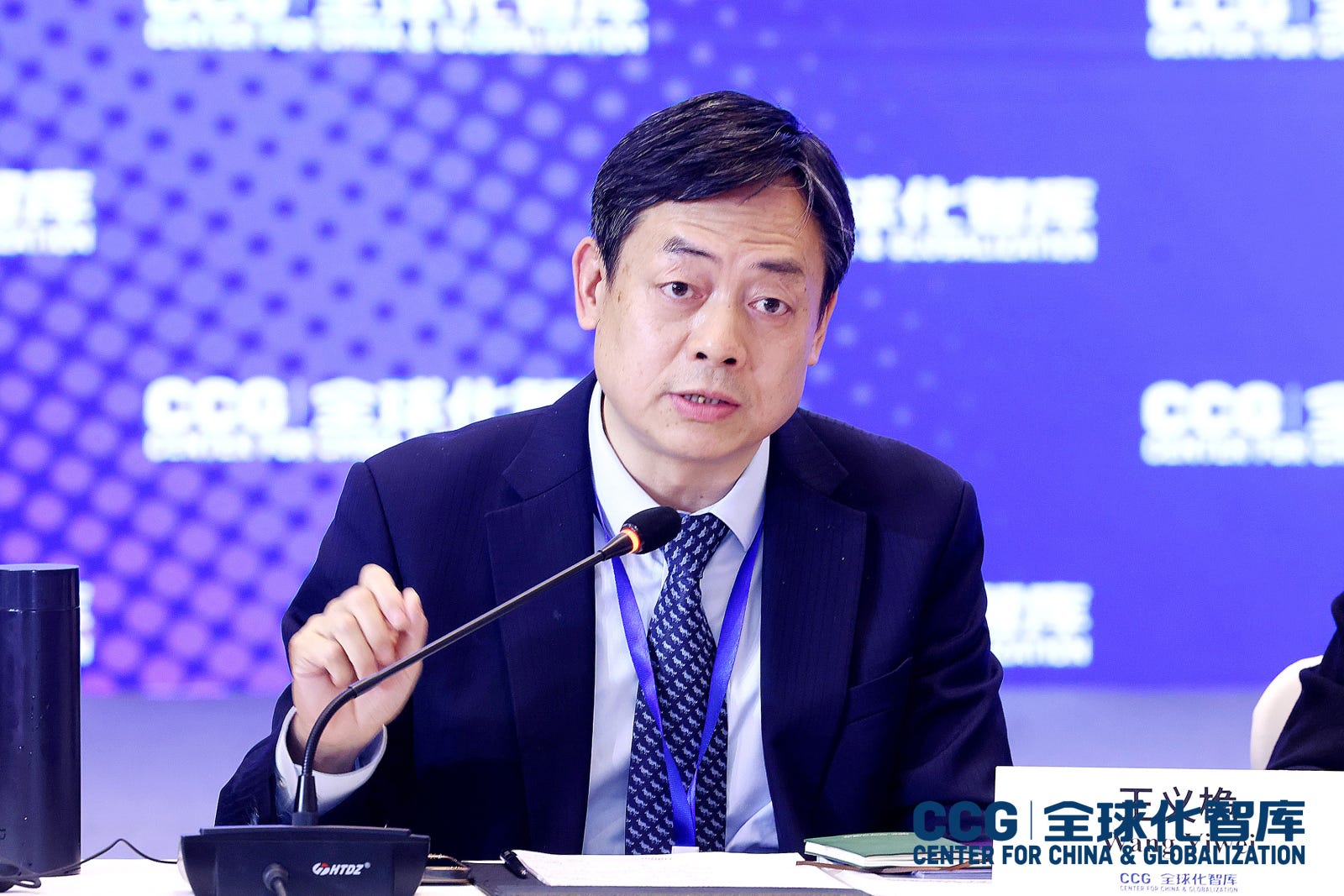
My presentation title is “A Paradigm Shift of China-Europe Relations in the 15th Five-Year Plan Period.”
The 15th Five-Year Plan is a turning point. With high-quality development, maybe after the 16th Five-Year Plan, China will cross the middle-income trap. This is also very crucial for the European Union, whether it can cross the so-called middle- and high-technology trap.
I am an advisory member for Beijing and Tianjin’s 15th Five-Year Plan, so I know the process. If you read the 15th Five-Year Plan, there are more than 50 mentions of 引领, leadership—not following. So to understand China, from the rise of China to the great rejuvenation of the Chinese nation as a civilisation-state, it is necessary to read the I Ching, classical Chinese.
For instance, at the Two Sessions, we passed two laws. One is the Ecological Civilisation Code. It is not just the law. The law forbids you to do something, but a code encourages and guides you to do what you should do. So this is high-quality development guiding China to go beyond the European so-called green transition. We understand this as ecological civilisation.
The second law is about ethnic unity and the promotion of that law. Pay attention to this: we use unity. Europeans use solidarity.
We learned from Europeans about the Westphalian system. We learned from the Soviet Union about the definition of ethnic groups, but it misguided us, because it focused more on diversity, not unity.
So when the KMT president met the Party Secretary General Xi Jinping, they never mentioned “one country, two systems”. Never. They only mentioned the Chinese nation.
If you read the law, it never mentions Han Chinese. Never. It only mentions the Chinese nation. So the greatest solidarity—if you translate it, it means the greatest unity of the world’s people. That is, I think, China becoming more like China. It is more unity, not just diversity.
So what is the meaning for China-Europe relations? In the era of globalisation, the U.S. was an innovation power, Europe was a normative power, and China was a market power. So they were complementary and cooperated quite well.
But this globalisation has come to an end. China benefited, of course, from this globalisation—so-called science in the West, technology in China—because science is free, without borders. China learned from science and practised it in China, and produced engineering.
Every year, we produce 12 million students from universities, one-third of whom are engineers. My background is also in engineering. So that is the reason we need to talk more, because science is not just in the West, science is in the U.S., science is in Europe, and science is also in China. Technology is localised.
So we need a new deal on how to benefit both sides.
There are four suggestions.
Number one: we need to change our mindset. Before, we said China opened the market for technology transfer from Europe. Now, Europe opens the market for China to transfer technology from China. In EVs, it is not losing face. It is normal.
Second, from the Brussels effect to the Brussels-Beijing effect. You cannot make the Brussels effect alone, because in EVs, AI, and many other areas, you do not have the leading high technology in the world. So only through cooperation with China can the Brussels effect perhaps work, for instance in EVs.
Number three: how China crosses the middle-income trap, and how Europe crosses the middle- and high-technology trap, is very crucial for our relationship. I think the key area where we need to cooperate is the defence market. Working together with China on defence is the most efficient way and will save energy and time for reindustrialisation and remilitarisation. The closer Europe is to the U.S., the more marginalised it becomes. The U.S. is not reliable, to be frank.
Last but not least, it is about AI. If you look at the Supreme Court of the United States, Confucianism is in the middle. It is about ascetic morality. The right side is more religious law, and the left side is Solon, which is civil law.
So in AI governance, China is still Confucian, taking the middle way. The U.S. is more to the right, more religious, and more military in its use of AI—attacking Iran, blah blah blah. Europe is more civil, still Solonian.
So we need a new kind of model for AI governance. The U.S. is “winner takes all”. It is more laissez-faire. It is more military use. Europeans are more civil. China is the middle way. It is not that, as Europeans say, China and the U.S. are two superpowers and, as President Macron says, “we are dependent on the third way”. No. China is not the U.S. We do not seek hegemony.
So I think this is about the harmonious coexistence of morality, development, and security. That is the future. Otherwise, civilisation is in more danger for human beings.
Thank you.
Zichen Wang
I am touched by Professor Wang’s ambition and his call for security cooperation between China and European Union countries. I am comforted by the fact that he did refer to various Chinese traditional literature and wisdom, which may be helpful to guide future thinking, including in geopolitics. I am also comforted that we are able to conclude the panel right at 15 minutes past 5 PM.
So thank you very much. Let us have a group photo on the stage. I want to thank every one of the panellists.
As with the tradition of CCG, actually, we try to make this conversation go beyond this room. It is videotaped. It will go to YouTube. It will go on Chinese social media. We will also transcribe these conversations and put them out via our English-language newsletters, so more people have access to our discussions today.
Thank you very much.
The 12th China and Globalization Forum Held in Beijing

The 12th China and Globalization Forum, hosted by the Center for China and Globalization (CCG), was held in Beijing on Sunday, April 26, 2026.
Transcript: Opening Ceremony of the 12th China and Globalization Forum
The 12th China and Globalization Forum, hosted by the Center for China and Globalization (CCG) and co-organized by the China Association of International Trade (CAIT), the China Society for World Trade Organization Studies (CWTO), the China-United States Exchange Foundation
Transcript: Opening Roundtable of the 12th China and Globalization Forum

The 12th China and Globalization Forum, hosted by the Center for China and Globalization (CCG) and co-organized by the China Association of International Trade (CAIT), the China Society for World Trade Organization Studies (CWTO), the China-United States Exchange Foundation
Transcript: China-U.S. Roundtable of the 12th China and Globalization Forum

The 12th China and Globalization Forum, hosted by the Center for China and Globalization (CCG) and co-organized by the China Association of International Trade (CAIT), the China Society for World Trade Organization Studies (CWTO), the China-United States Exchange Foundation
Transcript: China–U.S. Youth Roundtable: A Model for China–U.S. Youth Exchanges

The 12th China and Globalization Forum, hosted by the Center for China and Globalization (CCG) and co-organized by the China Association of International Trade (CAIT), the China Society for World Trade Organization Studies (CWTO), the China-United States Exchange Foundation