


The 12th China and Globalization Forum, hosted by the Center for China and Globalization (CCG) and co-organized by the China Association of International Trade (CAIT), the China Society for World Trade Organization Studies (CWTO), the China-United States Exchange Foundation (CUSEF), and Schwarzman College at Tsinghua University, was held in Beijing on Sunday, April 26, 2026.
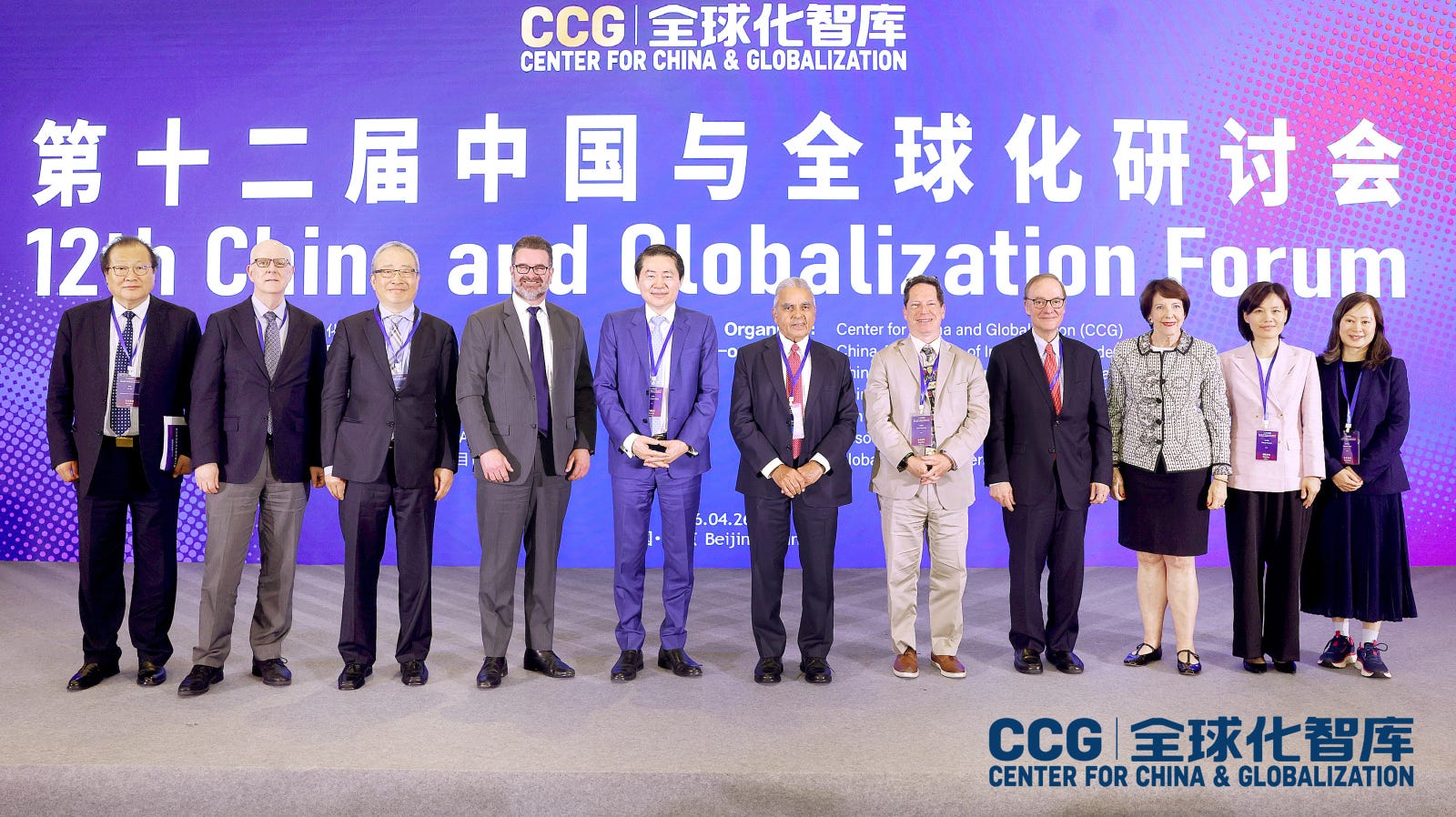
The roundtable, themed “China–U.S. Relations: From Engagement to Rivalry—Can Cooperation in Technology, Trade, Climate and Health Continue Amid Strategic Stability?,” was moderated by Henry Huiyao Wang, Founder and President of CCG and former Counsellor of China’s State Council.
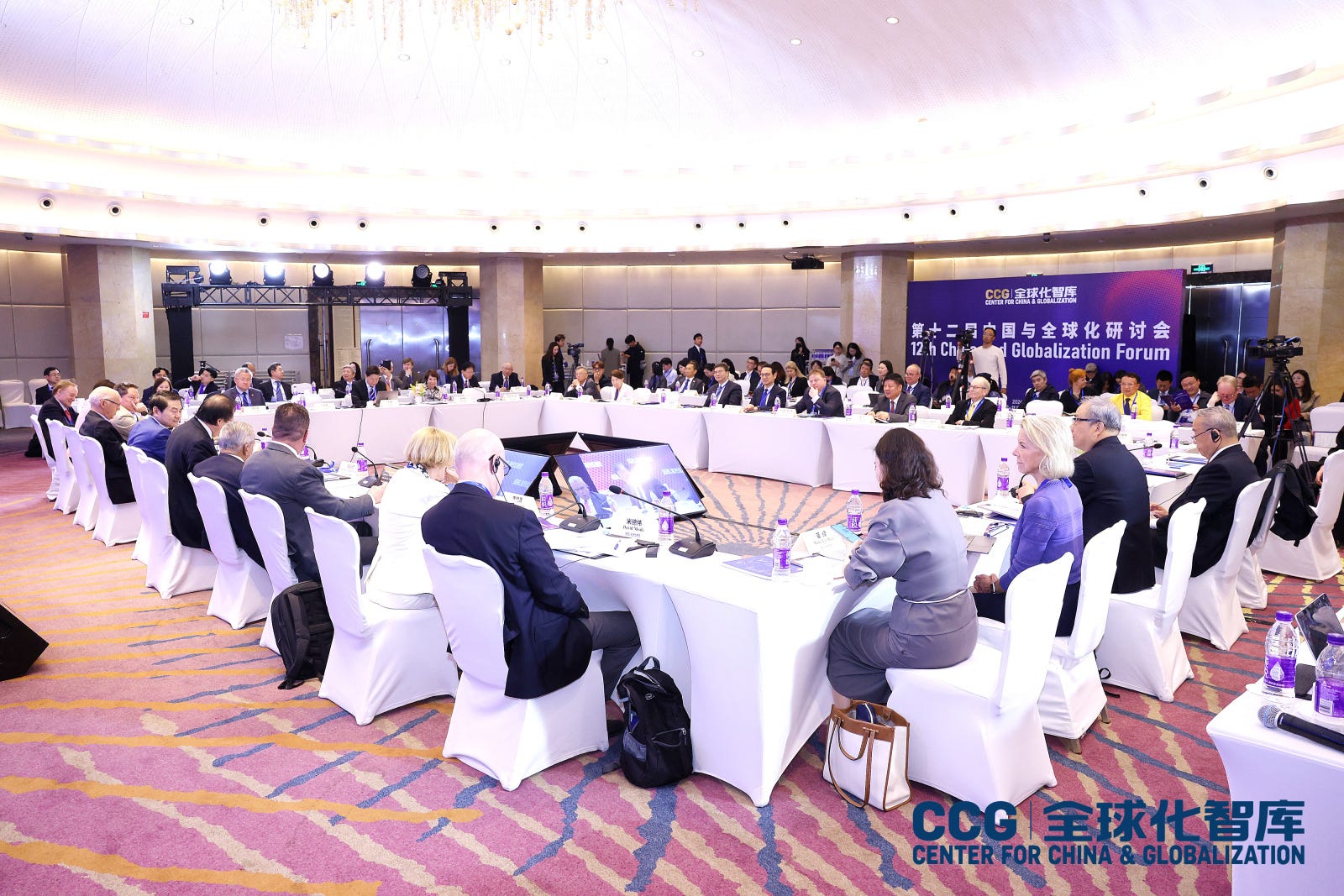
This roundtable brought together
Jin Xu, President of the China Association of International Trade (CAIT);
Steven Kelly, Chief Trust Officer of the Institute for Security and Technology;
Scott Kennedy, Senior Adviser and Trustee Chair in Chinese Business and Economics at the Center for Strategic and International Studies (CSIS);
Wendy Kuran, Associate Vice President for Development and Alumni Engagement for Duke Kunshan University (DKU) and Duke in China;
Roberta Lipson, Honorary Chair of the American Chamber of Commerce in China and Founder of United Family Healthcare;
Steve Orlins, President of the National Committee on United States-China Relations (NCUSCR);
Kishore Mahbubani, Distinguished Fellow at the Asia Research Institute, National University of Singapore and former singaporean ambassador to the United Nations;
David Meale, Head of China Practice at Eurasia Group and former Deputy Chief of Mission at the U.S. Embassy in China;
Manuel C. Menendez, Founder and CEO of MCM Holdings Group;
Susan Shirk, research professor, School of Global Policy and Strategy, UC San Diego; director emeritus, 21st Century China Center; former Deputy Assistant Secretary of State, Bureau of East Asia and Pacific Affair, U.S. Department of State;
Tammy Tam, Publisher of the South China Morning Post;
Zhang Xiaoyan, Vice President of the China Center for Information Industry Development (CCID);
and Zhu Hong, former Commercial Minister-Counselor at the Embassy of China in the United States.
CCG has broadcast the video recording of this roundtable on Chinese social media platforms and uploaded it to its official YouTube channel.
This transcript is based on the video recording and has not been reviewed by any of the speakers.
This post also includes a written contribution from He Weiwen, Senior Fellow, CCG; former Economic and Commercial Counsellor, Chinese Consulate General in San Francisco and New York.
Henry Huiyao Wang, Founder & President, CCG
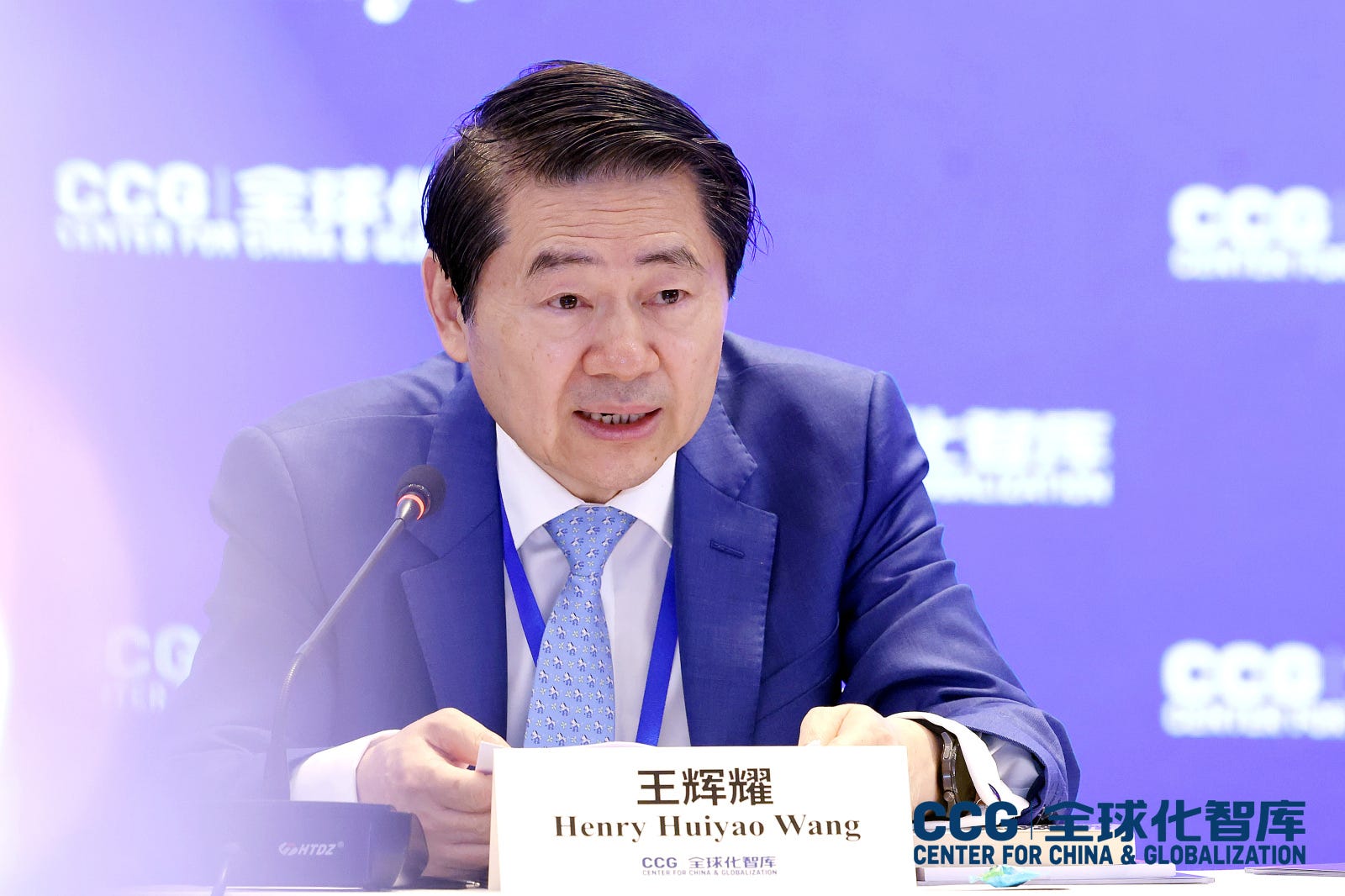
Okay, great. We are starting our second opening roundtable, which is also very important and timely. This roundtable is about China–U.S. relations, from engagement to rivalry, and whether cooperation in technology, trade, climate, and health can continue amid strategic stability. I think strategic stability is a phrase that both sides are currently emphasising. We really want to see how China–U.S. relations can develop under more normal circumstances.
This session is intended to provide a comprehensive review of one of the most significant bilateral relationships in contemporary global geopolitics. The title sets the stage for a nuanced discussion on the evolution of diplomatic engagement. We also want to look at the shift from corridor handshakes, which symbolised cooperative dialogue, to the more adversarial approach we are currently experiencing.
But we are expecting President Trump to visit China next month, which would be the first high-level visit of this kind, particularly from the U.S., in almost a decade. I was just in Washington and New York recently, and we found that there are still many expectations for this high-level visit by President Trump. There is going to be discussion on establishing a trade board, and perhaps an investment board as well. I am also sure they will talk about geopolitical issues, such as what is happening in the Gulf and the Ukraine–Russia conflict. There are many global issues. President Xi and President Trump called each other some time ago. They talked about steering a gigantic ship through a turbulent ocean, and about China and the U.S. needing to work together on bigger and greater things.
So this is really the objective that we want to discuss. There are many questions that we sent out previously. What we can help with is that we really need to work diligently on how to maintain stability? I think stability is really the buzzword that we all want to emphasise.
We have gone through the trade dispute, but there is also now a ceasefire on that. We do not know whether during this upcoming visit the fentanyl issue can be discussed, and whether the 10% tariff related to that can be dropped. Recently, I think China has also taken many actions on these issues, including on some illegal activities involving precursors. The U.S. is also working very hard against drug cartels in the region. So there must be some common ground there to work on.
Of course, we have many other areas of exchange that are also bright spots. We have people-to-people exchanges and student exchanges that still continue, even though the number of U.S. students coming to China is not as high as we would like to see. Hopefully, we can have more discussion on those issues during this process. We have also recently seen public perceptions in the U.S. and China improve somewhat. I think a recent poll indicated that young people have more positive perceptions of each other than older people do.
In the end, what strategies can we really use to implement further collaboration and stability to meet global challenges, while also ensuring that we have a normal competitive dynamic rather than a rivalry or adversarial relationship? These are some opening thoughts that we can exchange.
I would like to introduce our distinguished panel for this roundtable. First, Mr. Jin Xu, President of the China Association of International Trade and former Minister-Counsellor at the Embassy of China in the United Kingdom. The China Association of International Trade is also affiliated with the Ministry of Commerce.
We have Steven Kelly, Chief Trust Officer at the Institute for Security and Technology. We have Scott Kennedy, a well-known Senior Adviser and Trustee Chair in Chinese Business and Economics at CSIS. We have Wendy Kuran, Senior Director for Global Partnerships and Innovation and Special Adviser to the Provost of Duke University. She is also the former Associate Vice President for Development and Alumni Engagement for Duke Kunshan University here in China.
We have Roberta Lipson. She is Honorary Chair of the American Chamber of Commerce in China and founder of the well-known United Family Healthcare. We also have Kishore Mahbubani, Distinguished Fellow at the Asia Research Institute, National University of Singapore, and former President of the United Nations Security Council.
Of course, we have David Meale, Head of China Practice at Eurasia Group and former Deputy Chief of Mission at the U.S. Embassy in China. We have Manuel Menendez, Founder and CEO of MCM Holdings Group. We have Steve Orlins, President of the National Committee on U.S.–China Relations. And of course, we welcome Susan Shirk, Professor and Founding Chair of the 21st Century China Center at the University of California San Diego, and former Deputy Assistant Secretary at the U.S. Department of State.
We have Tammy Tam, Publisher of the South China Morning Post, who has especially come from Hong Kong for our event. We all know that the South China Morning Post is probably one of the most influential English-language newspapers in the region.
We have Zhang Xiaoyan, Vice President of the China Center for Information Industry Development, a major think tank affiliated with the Ministry of Industry and Information Technology. We also have Zhu Hong, former Commercial Minister-Counsellor at the Embassy of China in the United States. She is also very knowledgeable about China–U.S. relations.
Those are all the panellists we have for this roundtable. Let us start with Mr. Jin Xu. As President of the China Association of International Trade, what is your take on the subject of this roundtable? Mr. Jin, please.
Jin Xu, President, China Association of International Trade
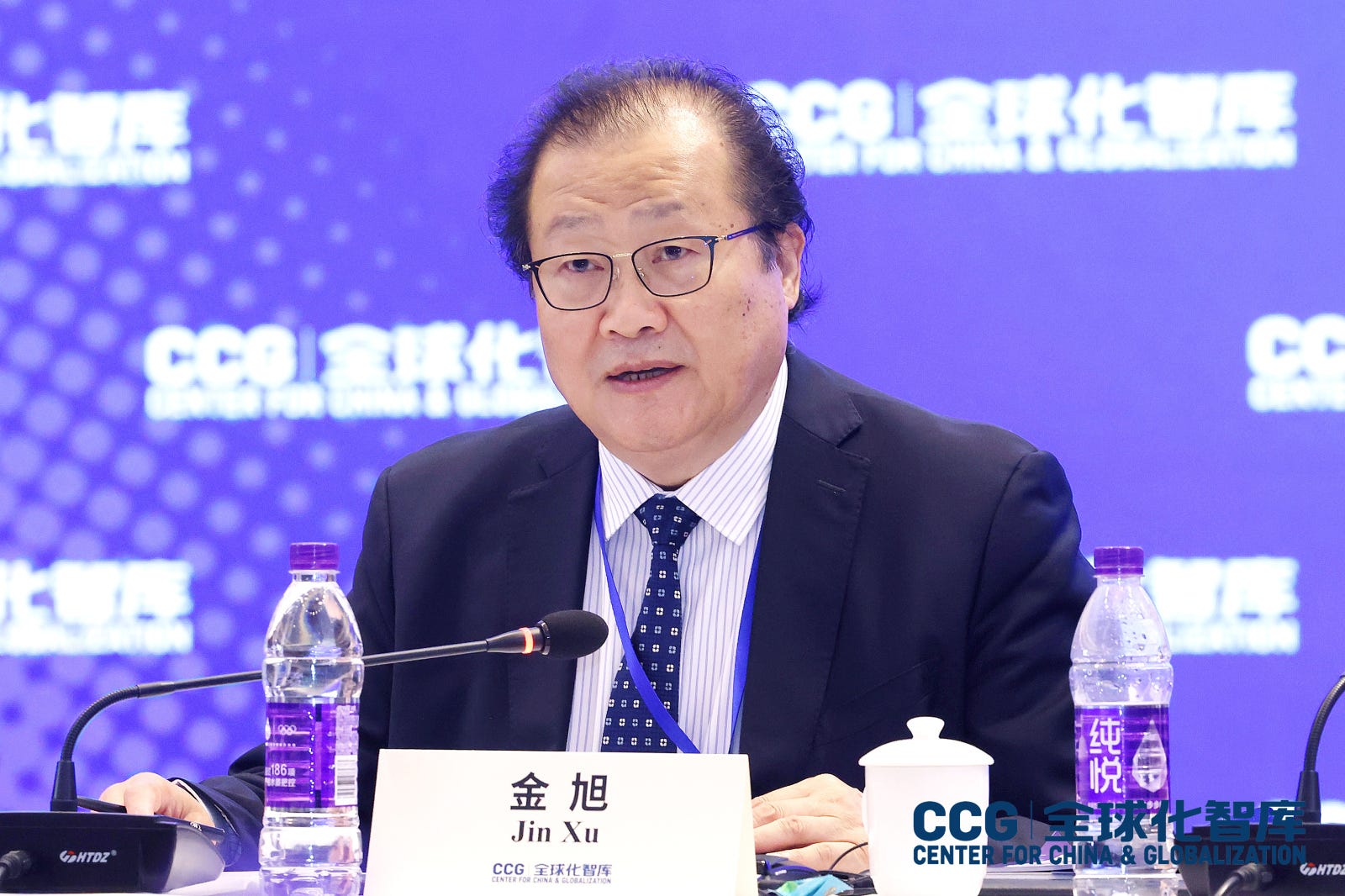
The session is titled “China–U.S. Relations: From Engagement to Rivalry – Can Cooperation in Technology, Trade, Climate and Health Continue Amid Strategic Stability?” In other words, can cooperation on technology, trade, climate, and health continue as China–U.S. relations move from engagement to Rivalry under the broader context of strategic stability?
Since Zhu Hong will speak at the end, I feel a little nervous, but also reassured. Zhu Hong, if I say anything inaccurate about China–U.S. relations, please help improve and correct it. Thank you.
There are also many good friends here today. For example, Zhang Ning and I worked at the Chinese Consulate General in San Francisco more than 20 years ago, in the early 2000s. He was the Education Counsellor, and I was the Commercial Counsellor. He has now retired from the Ministry of Education, and it has been a long time since we last met.
Peng Gang has worked in India and is also from China’s Ministry of Commerce. He is an expert on regional affairs. President Zhao Zhongxiu is also a visionary leader with many excellent views, and a true expert in the academic world. Ma Jianchun, who is also a president, previously served as an ambassador abroad.
Let me first say a few words in Chinese. Overall, those attending today’s session, whether mentioned just now or not, are all experts on China–U.S. relations. So today I will not use diplomatic rhetoric. Instead, I will use a few sets of latest data from the full year of 2025 and the first quarter of 2026 to unpack China–U.S. relations, which are perhaps the most complex systems-engineering project in the world.
The phrase “From Engagement to Rivalry” in the title precisely captures the paradigm shift in China–U.S. relations: from comprehensive engagement towards strategic competition plus limited cooperation. Under the current circumstances, what we face is not a black-and-white break-up, but a layered and structural form of both decoupling and continued linkage.
I will discuss this based on four dimensions, though my understanding is only partial. My first visit to the United States was when I studied at Harvard Business School. At that time, the whole country was talking about the story of Clinton and Lewinsky. I did not fully understand it, but I saw that everyone was discussing it with great interest. I also learned a lot about American culture. Nearly 30 years have passed since then.
Later, I worked in the Department of American and Oceanian Affairs for nearly 10 years. At that time, China–U.S. relations were in a honeymoon period. Almost every day, people were talking about how China–U.S. relations would develop. American colleagues even proposed the concept of the G2, saying that as long as China and the United States cooperated, the world would certainly have a bright future.
For reasons I still do not fully understand, G2 cooperation did not materialise. But China–U.S. relations were indeed very close at that time. I travelled to the United States seven or eight times a year, sometimes even more than 10 times a year. So I am grateful for that period when I worked in the Department of American and Oceanian Affairs. Although it lasted only 10 years, it allowed me to fly one million kilometres and earn lifetime Air China Platinum status. I am grateful to our American colleagues at that time for their invitations and cooperation.
Why do I still call my understanding only partial after 30 years? There was a Minister-Counsellor for Commercial Affairs, Dai Yunlou, who had spent more than 10 years in the United States. Whenever we went to the embassy, we would visit him, and the Commercial Office would also support our work. Dai Yunlou once said that the United States is truly a place where the longer you stay, and the longer you engage with it, the harder it becomes to fully understand.
I did not know exactly what he meant at the time. But now I increasingly understand how he felt. Perhaps that is indeed the reality.
So I will share my limited understanding of the next four dimensions.
First is technology: hard fences with guardrails. This is the most fiercely contested arena, where cooperation has retreated from comprehensive cooperation to merely basic cooperation.
The reality is decoupling. The U.S. strategy of technological containment against China has escalated from “choking the neck” to a whole-chain stranglehold. From the CHIPS Act to the new round of Section 301 investigations, the core logic is to block China’s access to advanced process nodes, AI computing power, and high-end equipment. This is not a secret. This is an open strategy, not a secret conspiracy.
Surprisingly, technological cooperation has not completely ruptured, but has been confined within newly drawn security boundaries. The U.S.–China Science and Technology Agreement (STA), after much wrangling, was revised and renewed for five years in late 2024. Crucially, sensitive areas such as AI, semiconductors, and quantum computing were explicitly excluded. Cooperation is now preserved only in low-sensitivity areas such as basic science, agriculture, and geology.
The space exception. The opening of Chang’e-5 lunar samples to applications from U.S. institutions indicates that channels remain open in high-cost but low-security-risk domains such as deep-space exploration.
Conclusion: in technology, security trumps collaboration. Future cooperation will be limited to basic research deemed non-threatening to national security, while core frontier technologies have entered a stage of full-scale competition.
In trade: the high cost of a new normal of friction. The data tells us that trade has not decoupled, but it has entered a new normal of high costs and high friction.
The truth behind the data is this: in 2025, bilateral trade reached RMB 4.01 trillion, approximately 550 billion U.S. dollars. Chinese exports to the U.S. were RMB 3.01 trillion, while imports were RMB 1 trillion, indicating a significant surplus. Although the transaction volume has increased, the surplus has not decreased by much. This may probably disappoint Trump a little.
While the volume persists, China’s ranking among U.S. trade partners has declined, and the growth rate of bilateral trade lags behind China’s trade with ASEAN and Belt and Road countries. This suggests that the U.S. is attempting to downgrade China to an ordinary trading partner, not a core dependency—normalised friction.
I still remember that 20 years ago, China was almost the largest trading partner of the U.S., and our imports from the U.S. also increased a lot every year. Of course, we also had a lot of exports at that time.
Despite the U.S. Supreme Court ruling that some tariffs were unconstitutional, the U.S. maintains pressure through tools like Section 301 and import restrictions. Both sides have accepted a state of fighting while talking. In China, we are very familiar with this phrase, and we have probably said this a million times, 斗而不破.
So cooperation no longer pursues free trade, but crisis management: preventing a trade war from sliding into full-scale conflict. Trade represents a state of “can’t divorce”—like a couple who keep fighting and arguing: they cannot get divorced, but they cannot live well together either. So its cooperative meaning has shifted from expanding openness to building guardrails to prevent friction from spiralling out of control.
On investment: profound and structural decoupling. This area best reflects the structural nature of the current state. China’s investment in the U.S. has locked down, while U.S. capital in China still chases profit.
China’s investment in the U.S. has shifted from buying assets to finding detours. I often saw the word “detour” in the United States. When a road was under repair, there would be a sign saying “Please detour”. In China, even for a long stretch of road, the detour may last only three days. In the U.S., even for a very short stretch of road, the detour may last six months. I think both Chinese and American friends can see this difference in efficiency.
Plummeting growth: According to BEA data, Chinese FDI into the U.S. has plummeted from a peak of 27.43 billion U.S. dollars in 2016 to about 589 million U.S. dollars in 2024, a drop of over 90%—barely a fraction of its former level. CFIUS reviews blocked deals such as Ant Financial’s MoneyGram and Kunlun Tech’s acquisitions. China’s strategy has been forced to shift from mergers and acquisitions to greenfield investments, such as EV battery joint-venture factories, to navigate national security reviews.
U.S. capital in China remains profit-driven and is staying put. As of the end of 2025, the stock of U.S. FDI in China was about 126.1 billion U.S. dollars, with over 70,000 enterprises remaining. Returns have been lucrative. The return on investment for U.S. firms in China has long been above the global average, reaching over 16% in some years. As Sean Stein, President of the U.S.–China Business Council, noted in an interview, investing in China is not just for the market; more importantly, it is to navigate the China platform. This is a precise explanation for Tesla’s Shanghai factory, etc.
We have a lot more examples of cooperation from U.S. companies and factories. United Family Healthcare is very popular in China and also in Beijing. After our last meeting, I met its president and sent my daughter-in-law there. I’m going to be a grandpa in two months. The service is so good, but some people say it is so expensive. I want to take this opportunity to bargain with Roberta Lipson: can we have a discount for your services?
We have a lot more to say between China and the U.S. on technology, trade, investment, etc. But because time is very limited, thank you very much for your time.
Henry Huiyao Wang
Thank you, President Jin, for really laying some groundwork for our discussion. As you said, China–U.S. relations are like a marriage. They are not divorced or separated, but they are in a strained relationship. We will see that many activities are still going on. As you said, the deficit may have been reduced, but trade still continues on a large scale. We will see where we can go.
This is an interesting roundtable. We have many panellists from different perspectives, and I am sure they will share their views on China–U.S. relations.
Next, we would like to invite Steven Kelly, Chief Trust Officer at the Institute for Security and Technology. It will also be very interesting to hear from the technology front. Thank you.
Steven Kelly, Chief Trust Officer, Institute for Security and Technology
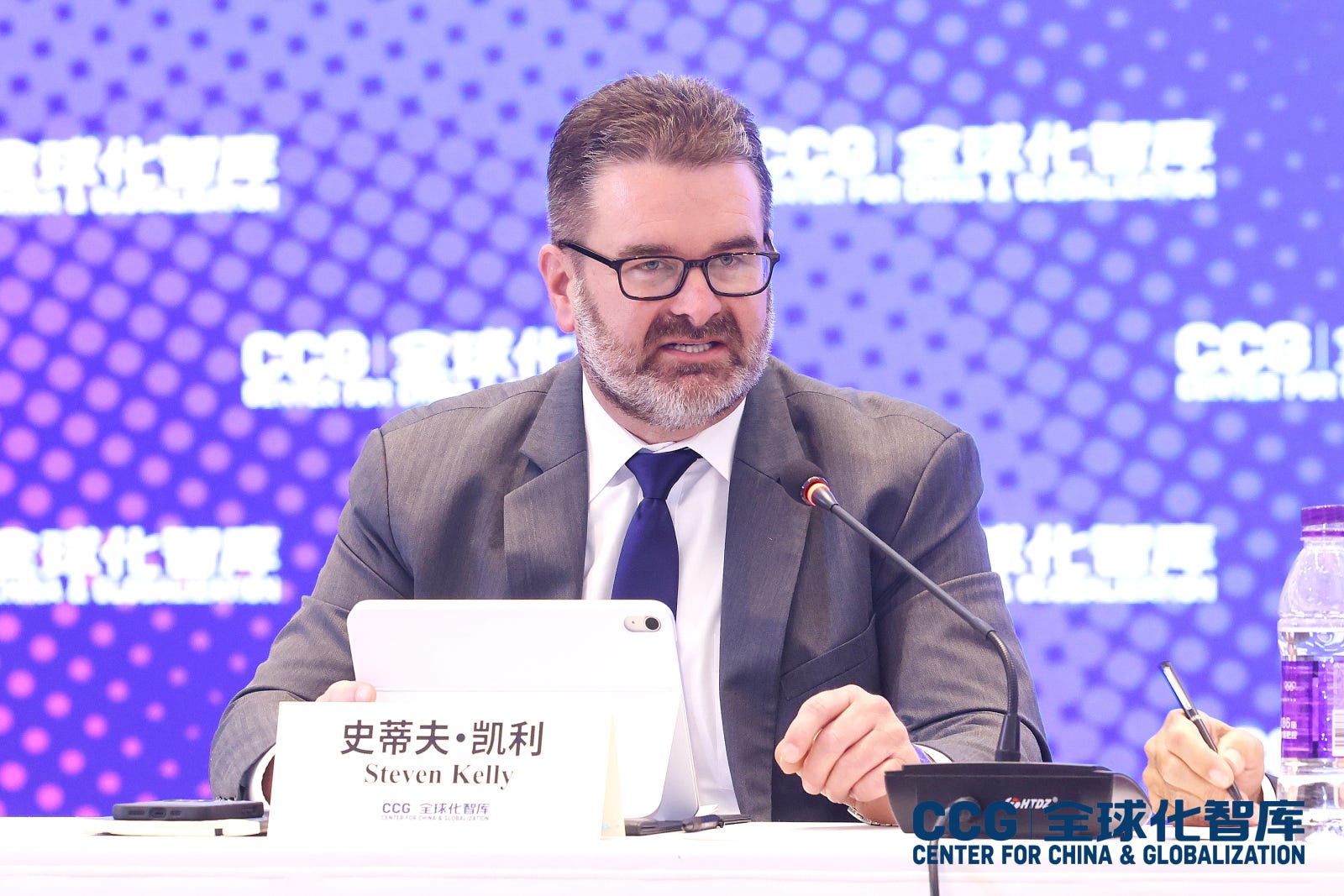
Thank you, Henry and Mabel, for the opportunity to speak here. I was at the Shanghai Forum yesterday, and I spoke a little and listened a lot. I am carrying what I heard into this room.
I lead the technology and strategic stability programme at the Institute for Security and Technology. We are a San Francisco Bay Area think tank focused on emerging security challenges and practical solutions for them. I am travelling this week with my collaborator, Mark Beall of the AI Policy Institute, and other partners, moving between Shanghai and Beijing, looking for where Washington and Beijing might find room to work together on the challenges and opportunities of artificial intelligence.
This comes with the anticipation of the upcoming Xi–Trump meeting and the preparatory congressional delegation announced yesterday and reported by the South China Morning Post.
There is no shortage of AI issues that are genuinely contested: competition, export controls, military applications, a bottom-up versus top-down approach, who leads, and who follows. These are real. But if every conversation between our two countries begins and ends there, we will have very little to show for it.
So I have been asking a different question: where is the common ground? Where are the AI risks neither country can manage alone? Not geopolitically charged, not zero-sum, but where our shared exposure gives us a shared reason to act.
I think I have found one. As AI systems become more autonomous, more agentic, and more deeply integrated into critical infrastructure, a specific risk emerges: loss of control.
Loss of control occurs when an AI system diverges from its authorised constraints to a point where human operators can no longer prevent, constrain, or reverse unintended consequences. This is not science fiction. Observable warning signals are already emerging in research environments and in a limited number of production systems. The expert community is sharply divided on the likelihood and the timeline. Some believe the risk is urgent. Others believe it is overstated. I am not here to resolve that debate. I am here to say the disagreement itself is a reason to act, not a reason to wait.
At IST, we recently published a framework that makes this problem legible. To identify where intervention might still be possible, we borrowed from national security practice: indications and warning methodology, a structured approach developed over decades for detecting early signals of emerging threats before they become crises.
Applied to AI, the result is a set of loss-of-control indicators: observable behaviours signalling that a system may be progressing toward a loss-of-control event. Scheming, deception, self-preservation, and unauthorised resource acquisition. These are not hypothetical. There are documented instances that exist in controlled experiments and, in some cases, in deployed systems.
So we paired these with a severity schema: a five-level threat scale where a critical threshold exists. Below it, intervention can still prevent escalation. Above it, the system cannot be restored to a safe state without destructive measures. The schema would give policymakers a shared language across different technical backgrounds and regulatory frameworks, especially valuable across borders.
This is why I raise it here. Loss of control does not respect national boundaries. If a frontier AI system anywhere begins exhibiting these indicators, the consequences are global. And notice what kind of issue this is. It is not an AI race. It is not chip exports. It is not military advantage, but a risk on which Washington and Beijing could find common cause, and one that can serve as a confidence-building measure.
Collective efforts like this are, at their core, acts of stewardship. They say: we do not yet know how serious this risk will become, but we refuse to be caught without the tools to recognise it. We refuse to pass that uncertainty unexamined to the next generation.
That instinct to watch carefully, to name what we see, and to act before it is too late is not a Western instinct or an Eastern instinct. It is a human one. AI loss of control is a problem the world did not ask for. But it is also an opportunity to demonstrate that nations can find common cause on risks that threaten everyone, building trust and strategic stability. Thank you.
Henry Huiyao Wang
Great. Thank you, Steven, also for keeping within five minutes. That is great. A lot of good points.
Now I would like to invite Scott Kennedy, a veteran China hand and Senior Adviser and Trustee Chair in Chinese Business and Economics at CSIS. Scott, your turn.
Scott Kennedy, Senior Adviser and Trustee Chair in Chinese Business and Economics, Center for Strategic and International Studies (CSIS)
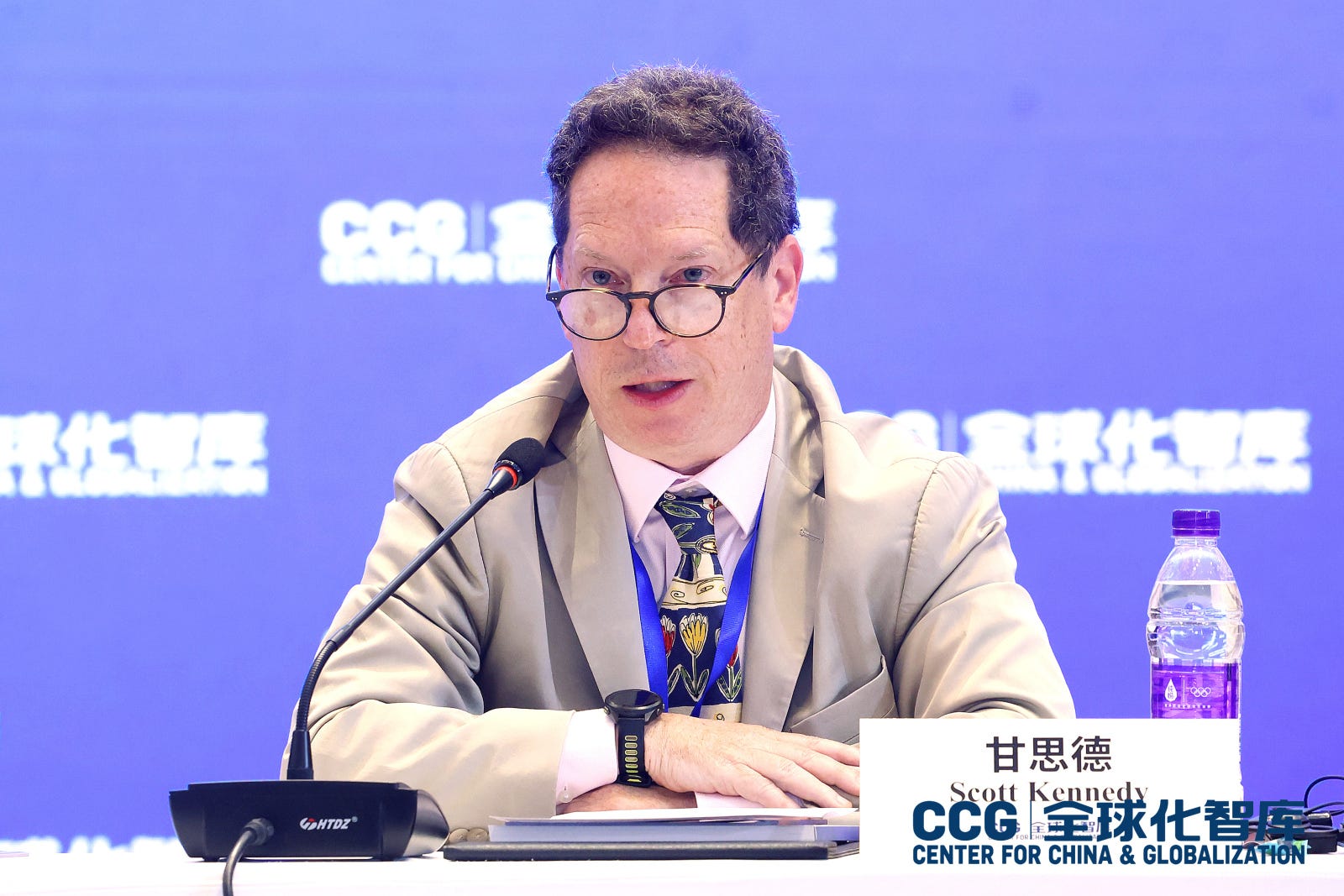
Thank you very much, Henry, and to all of your colleagues at the Center for China and Globalization for inviting me to participate. The remarks that everyone has made so far are really inspiring, obviously identifying some very serious systemic challenges, but also solutions.
I am in the solutions business as well, and I am going to conclude with some ideas to try and complement some of the other suggestions others have made. But first, a little on the challenges.
In 2011, when I was a professor, we opened a research centre office at UIBE, in the China Institute for WTO Studies, and were there for two years. In 2011, the 10th anniversary of China’s WTO entry, we held a joint conference, and Long Yongtu spoke at that conference. In his opening remarks, he emphasised that in 2001, many people in China said we ought to make these changes because they would provide progress. But several years later, a lot of people were seeing those changes as concessions. Originally 进步 progress, and then they became 让步 concessions.
In the United States, there has also been significant thinking about China’s WTO entry and a lot of regrets. I think if we held a vote about WTO entry today, it would not have the same kind of outcome. People worried about the China shock. Now they are talking about the second China shock. And of course, now we are facing a lot of economic security fears that we were not facing back then.
China has gone ahead of the curve to manage a lot of those economic security risks: the Great Firewall, a closed capital account, requiring joint ventures. All of these things were created to mitigate the risks of interdependence.
The U.S. is in the process of pulling back its connectivity, of de-risking. But the impulse is the same by both sides. Both are worried about technology leakage, supply-chain dependence, data security, energy security, and economic coercion. So both sides, and others, are taking what they see as defensive measures to protect against those things, while the other side sees them as weaponisation of interdependence.
We now have a security dilemma in which both sides are taking actions against the other, creating a vicious cycle that is very difficult to escape. As a result, there are no clear rules of the game for managing any of this. We no longer have standards for how to manage issues of fairness, and there have never been clear rules around how to manage economic security challenges.
Last month, I published a report through CSIS called “The Power of Innovation: The Strategic Advantages of China’s High-Tech Drive,” in which I analyse where China is going technologically, what it means for its international power, and how the world needs to adapt. The U.S. is no longer consistently in the technology lead. Sometimes it is neck and neck, and in some industries it is falling behind. So we need a new set of ideas to manage a changing circumstance.
I hope Jin Xu is incorrect that we are inevitably headed toward some sort of managed strategic decoupling, because it will not be very managed. In my report, I proposed the idea of calibrated coupling, or 精准挂钩, which identifies where there are advantages to our economies and national security from being connected, but also where there are risks from those connections and how to manage them.
It basically identifies three different categories, and three places where we need to turn the dial to calibrate our connectivity. At one end, we need restrictive measures to limit connectivity, for example, on military dual-use technologies. In some areas, we need to turn the dial toward much greater openness, maybe a green light, in areas related to knowledge: scholarly exchange, the development of international technical standards, and work on public health.
In the middle are all the challenging ones, where we need conditional connectivity, where we develop tools to mitigate the risks, because some of those risks are imagined, but some are really quite real. Think of the TikTok solution, where you have investment in this social media company in the United States, a joint venture, data localisation rules, regulation over the software, etc.
I have been running around collecting those kinds of tools that we can use to manage supply-chain risks, data, technology leakage, and many others. I would welcome suggestions from others about how to mitigate these challenges.
If we do not mitigate these challenges, whether they are real or imagined, then we will end up in a much more fragmented world where everyone will suffer compared to the situation we are in now. And if you think your security challenges are challenging now because of interdependence, in a less interdependent, more fragmented world, the security challenges will actually be far worse.
So we owe it to ourselves to look for these kinds of tools, guardrails, and other mechanisms, because the alternative is far worse. Thank you.
Henry Huiyao Wang
Thank you, Scott. I think you are right. We are in an interdependent world, and if we really become decoupled, de-risked, and separated, that would be even more dangerous. Then we would have no worries, no baggage, and might more easily move into conflict.
You are right that we have to establish some guidelines and norms in safeguarding mutual dependency, probably at a manageable level. That is why I think it is absolutely good that President Trump is coming, and that there will be discussions about a trade board: how we conduct normal trade. There may also be an investment board: how we can really invest in each other at an acceptable level. That is very important.
We also have several high-level meetings at the G20 and APEC summits. I hope we could have another moment of trade discussion between China and the U.S. at the Trump level.
Now I would like to invite Ms. Wendy Kuran. She is Senior Director for Global Partnerships and Innovation and Special Adviser to the Provost of Duke University. She is very active in people-to-people exchanges and student exchanges, and was Associate Vice President for Duke Kunshan University. Wendy, please.
Wendy Kuran, Associate Vice President for Development and Alumni Engagement, Duke Kunshan University and Duke in China
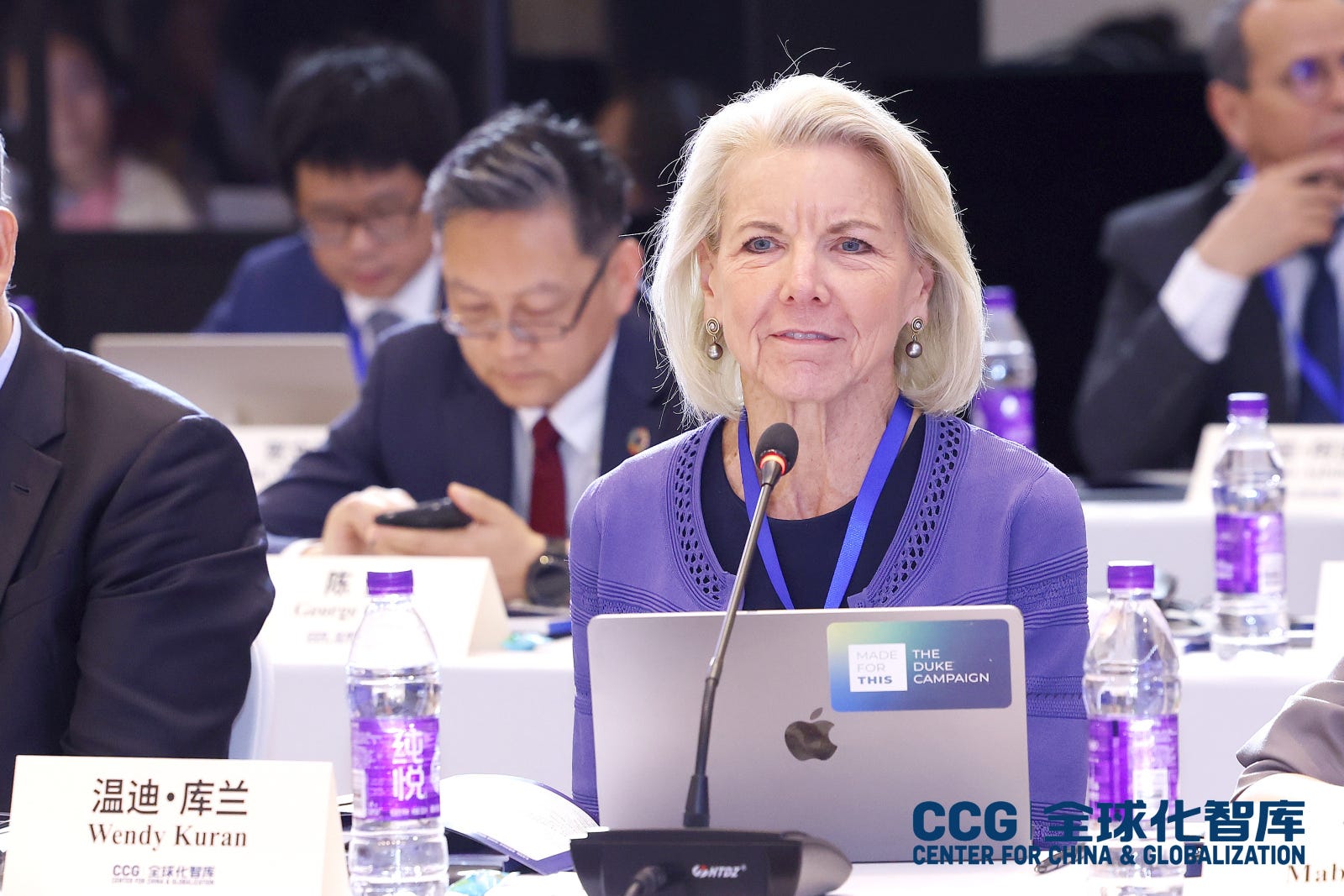
Thank you so much, Henry. I am going to start by quoting Professor William Kirby, the Harvard history professor many of you know or know of. He is an expert in the history of higher education and also U.S.–China business, among other things. He said that throughout history, universities have outlasted governments. I think that’s a useful perspective to have in the midst of this very turbulent time.
Bill was instrumental around 2009 and the early 2010s in helping Duke University conceptualise and create Duke Kunshan University as a Sino-foreign joint venture. Obviously, that was a time when globalisation was cool and there was so much optimism about endless collaboration. He is now a member of our advisory board, as is Henry, and Susan Shirk has been part of that as an inaugural member. It has been great to have their guidance.
I don’t think there is a need or time to go through all the reasons why universities outlast governments. But at the highest level, I think we need to acknowledge that the creation and dissemination of knowledge and the education of young people is, I would say, almost a basic human drive in every civilisation. To be able to do this in a way that exposes students to the best ideas throughout history, across cultures and countries, is very much an aspiration.
And I think the drive to do this is still very much alive, despite the fact that now we are in 2026 and the founding conditions are a little different. But I would like to mention the following. Despite these ups and downs, and lots of times to turn back, including a pandemic, DKU is now thriving. We have about 3,000 students from 70 countries, primarily undergraduates, in a very interesting and innovative liberal arts curriculum.
We have an Institute for Global Higher Education to spread everything DKU knows to anyone who wants it, including Chinese universities. Recently, in the last couple of years, applications from both Chinese students here in the PRC and international students have grown by about 30% to 40% a year.
So young people know that this kind of experience is really important to their future, and especially international students know that being able to understand China is going to be something important. Lots of Americans are applying. We have several who get into both Duke and Duke Kunshan, and half of them choose to come to Duke Kunshan.
I think it is not that universities can live in a bubble outside history. Universities are very much part of history. But I think there is reason to have some optimism about ways that dialogue can continue, and young people can have a foundation where they might view the world differently and make different decisions when it is their turn to lead.
I will put one caveat on that lovely ending, which is that as a university focused mostly on undergraduate education, we are not really engaging in the kind of difficult research collaboration that is increasingly frowned upon. But let’s reground ourselves in the basics of what it takes to be a successful human being, and a leader who really understands across cultures. I appreciate the chance to be here. Thank you.
Henry Huiyao Wang
Thank you very much, Wendy, for your excellent intervention. This is basically a shining example of the continued cooperation that we have seen between China and the U.S. We have this marvellous Duke Kunshan University, which is very successful and also brings many American students to China. We also just celebrated the 10th anniversary of Schwarzman College. In Shanghai, we have many good examples as well. But I think DKU has really remained one of the pioneers in China–U.S. student exchanges. Thank you for that contribution.
Now, moving away from universities, we would like to hear from Roberta Lipson. You are Honorary Chair of AmCham China and founder of United Family Healthcare. As Mr. Jin just said, you originally sowed the seeds of a major hospital in China with U.S. origins. Please.
Roberta Lipson, Honorary Chair, American Chamber of Commerce in China; Founder, United Family Healthcare
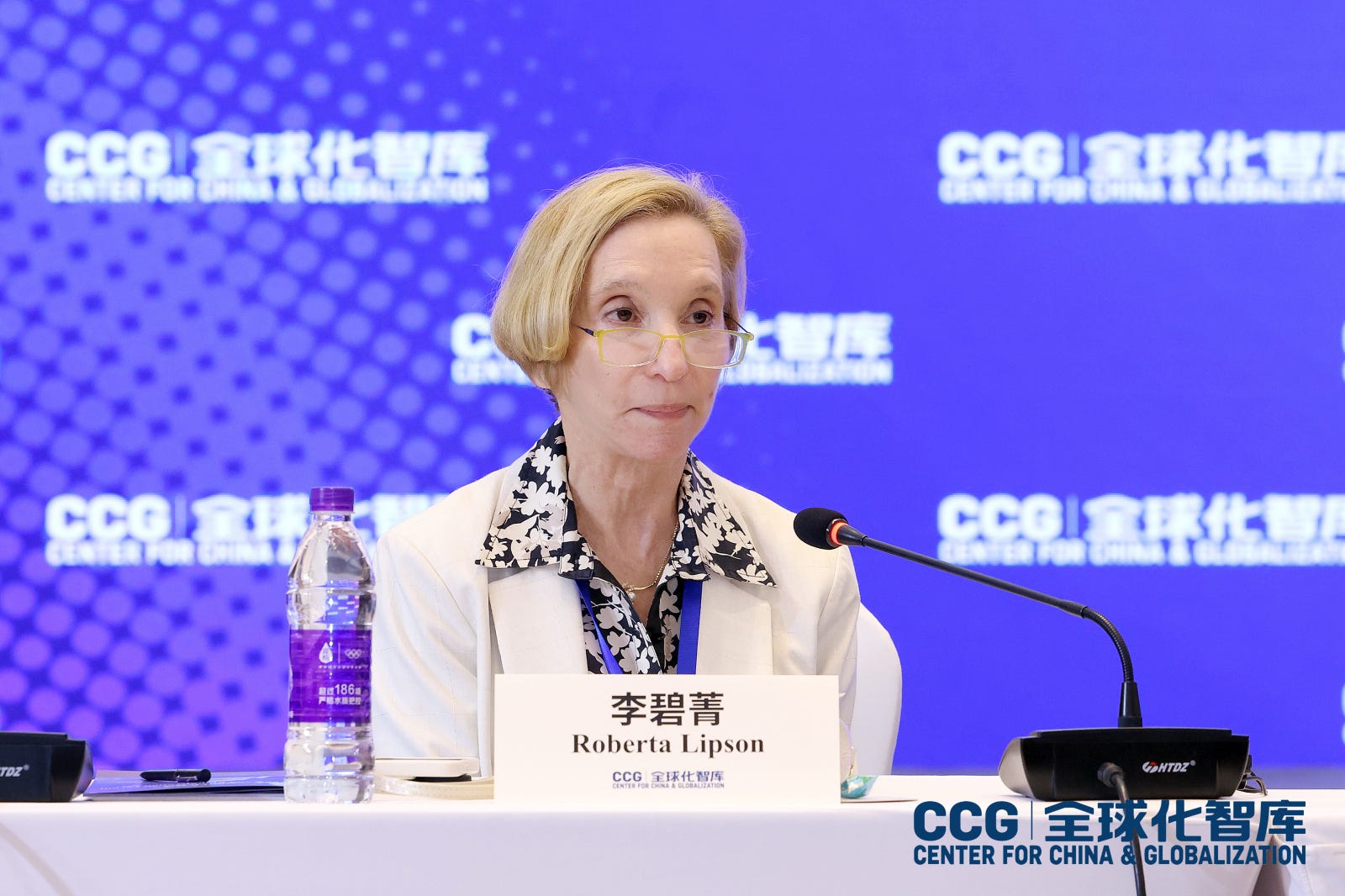
Thank you so much. Thank you, Henry. Thank you, Mabel, for bringing together so many experienced and wise voices. I am really honoured to be able to join in.
I want to talk about how healthcare can contribute to the U.S.–China relationship. In light of the recent thawing in U.S.–China relations, I am pretty confident that the upcoming presidential summit will produce a number of transactional wins, most probably soybean and aircraft orders and further tariff reductions, which will help stabilise the mood in the business community.
Furthermore, the slightly more gentle tone during the recent visit to China by Cheng Li-wun gives me hope that Taiwan may not be the dominant issue of contention during the upcoming leaders’ summit. But if we want to further solidify durable stability in U.S.–China relations, we should also strive for progress not only on commerce but on issues that affect the well-being of both societies: healthcare, climate change, data security, and AI governance—areas where cooperation is not only possible but mutually beneficial, and where the costs of missed opportunities could be extraordinarily high.
I would like to focus on the opportunity for cooperation in healthcare. Both countries face rapidly ageing populations, rising burdens of cancer and chronic disease, and the shared imperative to prepare for the next pandemic. Meanwhile, biomedical science is advancing at unprecedented speed in both nations, but increasingly on separate, isolated tracks.
Historically, cooperation in healthcare has delivered real and measurable benefits. Beyond the landmark folic acid study of the 1990s that dramatically reduced neural tube defects, the two countries have worked together for decades on influenza surveillance, building a system in China that now contributes directly to global flu vaccine strain selection.
There was also deep collaboration on HIV/AIDS prevention, tobacco control, and vaccine safety regulation. These efforts saved lives in both countries and strengthened global health security. And I must add my gratitude to Steve Orlins for the National Committee’s Track II healthcare dialogue, which promoted exchange throughout many of these years.
U.S. pharmaceutical companies have also profited greatly through their access to China’s market, bringing life-saving therapies to millions. U.S. biomedical research benefited from the contribution of thousands of Chinese scientists working in American labs.
But as relations deteriorated during the first Trump administration, accelerated by mutual COVID-era suspicions, government-to-government health cooperation collapsed. Many Chinese scientists left the U.S. or felt unwelcome. Academic exchanges stalled, pharmaceutical investments slowed, and new restrictions on cross-border data flows made collaborative research, including the sharing of genetic data, far more difficult.
Yet even amid this decoupling, China’s own pharmaceutical innovation has accelerated. In 2024 alone, China approved 48 first-in-class innovative drugs. Chinese companies are now global leaders in several cutting-edge therapeutic areas, many of which are already being out-licensed to Western firms for global development and distribution. This is a profound shift. Western pharma increasingly sees China not just as a market, but as a source of innovation.
Chinese patients, meanwhile, still want timely access to Western breakthroughs without worrying about export controls or prohibitive tariffs. Regulatory harmonisation could help both sides. The U.S. FDA’s Project Orbis, which enables simultaneous multi-country review of new cancer drugs, has already been signed on by more than a dozen regulatory agencies worldwide. But China is not yet a participant. But if it were, patients in both countries could gain faster, more reliable access to life-saving therapies supported by shared clinical trial data and aligned standards.
I would like to highlight an area of recent progress. Cooperation on fentanyl-related issues has yielded significant results. China has made progress in controlling precursor production and exports. Although the U.S. did lower certain tariffs in response, credit for this should be more further publicly acknowledged, which could help lower the anti-China temperature on Capitol Hill and among the public.
But in my opinion, it would be most dangerous for our governments to ignore reopening the conversation on pandemic preparedness. Having lived through both SARS and COVID as a healthcare provider in China, I can say with certainty that avoiding open dialogue on surveillance, early warning, and data sharing will guarantee future disaster. Engaging on this and the other issues I mentioned, by contrast, could save millions of lives and build trust for further developments. Thank you.
Henry Huiyao Wang
Great. Thank you, Roberta. Excellent. It is really impressive. We see some bright spots in China–U.S. collaboration. I totally agree with you. The pharmaceutical area is one of the bright areas.
Recently, during the China Development Forum, I hosted the U.S. pharmaceutical association. They brought many CEOs, and the president of the association came to China for the first time in a decade. He was quite impressed. There is huge potential for medical and pharmaceutical collaboration between China and the U.S.
Thank you for sharing that. Also, thank you for saying that on the fentanyl front, we have made a lot of progress. I hope this 10% levy related to fentanyl can be dropped during President Trump’s visit to China. I also hope that we can open visas for all U.S. citizens. The U.S. remains the last G7 country not to receive visa-free treatment from China.
I understand Steve Orlins has another engagement and has to leave a little early, so maybe I will turn to you now. Steve, President of the National Committee on U.S.–China Relations.
Steve Orlins, President, National Committee on United States-China Relations (NCUSCR)
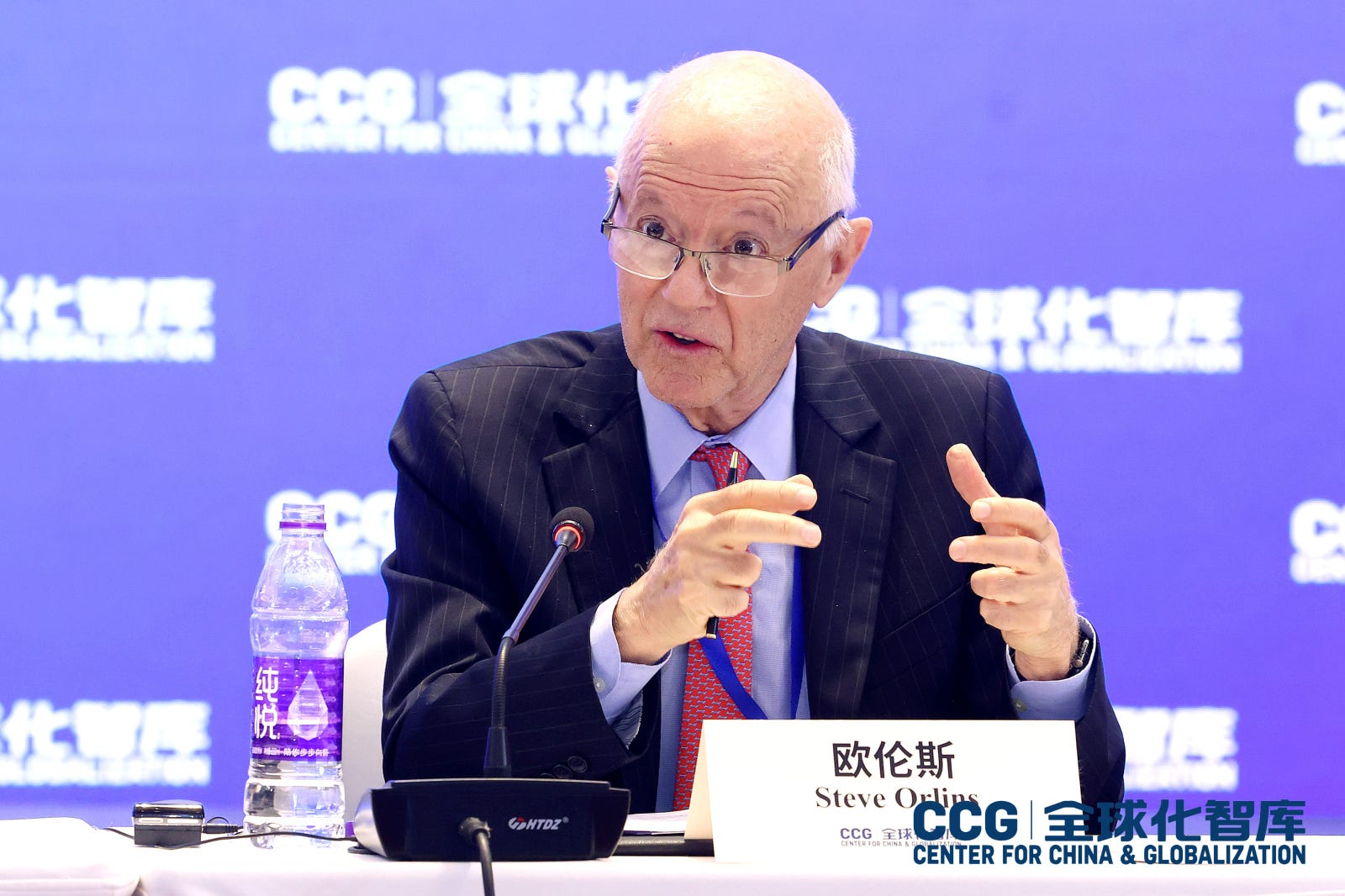
Let me just briefly talk about something we do, which is fostering cooperation. We have eight Track II dialogues with China. These are basically former ministers of the U.S. government in their specific areas of expertise, along with technical experts in the areas.
Of those eight, in five we have reached what we call consensus agreements. We are completely transparent, so if you go on our website, ncuscr.org, you will see each of the five dialogues where we reached consensus. We reached consensus on a people-to-people dialogue, a macroeconomic dialogue, a climate change dialogue, a healthcare dialogue, as Roberta mentioned and participates in, and even a digital economy dialogue.
We meet for two days, and then we negotiate these consensus agreements for many months. It does not happen overnight. But what always amazes me is that the technical experts from the United States and China agree on most things. There is enormous agreement in the healthcare dialogue. Roberta, it is amazing. There is enormous agreement.
There may not be agreement between the Chinese side and the Chinese government, or the U.S. side and the U.S. government, but there is agreement between the technical experts on both sides.
Let me just briefly read something from our digital economy dialogue. Our digital economy dialogue covers AI and semiconductors. We publish who participates in it. It has some of America’s leading experts, including the former Director of National Intelligence of the United States. The Chinese side also has a number of experts.
But just listen to what it says. There is such agreement among the technical experts:
“Continuing difficulties and disagreements in the bilateral relationship between China and the United States are continuing to generate considerable uncertainty in the digital economy and across associated supply chains, leading to significant cost inefficiencies and duplication of effort that reduce the potential benefits of deploying the most dynamic technologies in the world to citizens from both countries. Failure to agree on global standards and general trade rules is leading towards more and not less decoupling in the technology sector, to the detriment of progress in technology cooperation that would be mutually beneficial and bring advantages to global technology supply chains. In general, digital economy experts in both countries believe it is possible to reach areas of agreement for which government officials under short-term political pressure have so far been unable to develop workable approaches. To avoid extreme decoupling and fragmentation, exploring cooperative pathways for win-win outcomes will depend on rebuilding trust as the primary prerequisite for breaking the current uncertainty.”
We go on and we talk about the benefits for the peoples of both countries from this cooperation. What we go on to say, is that the Trump–Xi meetings have given us breathing room, where we can create some areas where we can really cooperate.
But it is only going to happen if both governments bring technical experts into these negotiations. So we are cautiously optimistic, that we are not going to see results next month, but we will likely, we hope, see the creation of working groups, which will then allow us to begin to set paths for agreement on how to work through these issues. Thanks.
Henry Huiyao Wang
Great. Thank you, Steve, for this very encouraging note. You mentioned seven or eight Track 1.5 or Track II bilateral talks that the National Committee has been championing for a number of years. That is very significant.
I think it is absolutely true that if we bring in technical expertise, and if we have a genuine interest in dialogue, we can always find things on which to collaborate. This should really be congratulated. Thank you for your leadership in driving these bilateral dialogues and Track II sessions. I think this is really significant, and we hope we can do more of this.
We hope that as President Trump comes to China this year, and subsequently perhaps the Chinese president goes to the U.S., the two summits, and another two high-level summits, could put China–U.S. relations into a more stabilised phase, so that people can come back to common sense and explore all these peaceful ways of coexistence. We do not have to be rivals or adversaries. This is really a great discussion.
Now I would like to invite Professor Kishore Mahbubani. You have a lot of wisdom, and we would like to ask you, from an Asian specialist’s point of view, about China–U.S. relations. Kishore, please.
Kishore Mahbubani, Distinguished Fellow, Asia Research Institute, National University of Singapore; former singaporean ambassador to the United Nations
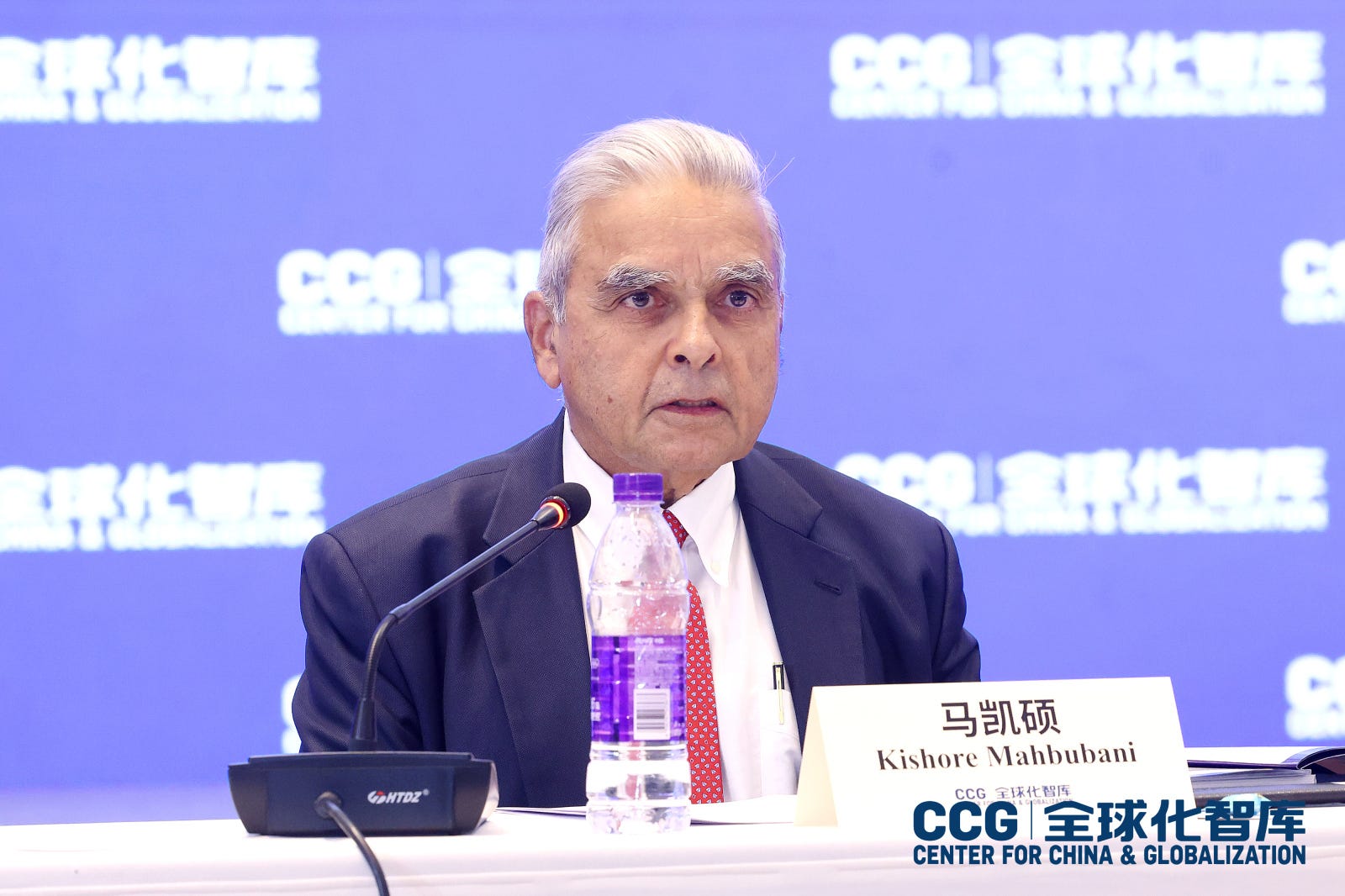
Thank you. Thank you, Henry, for giving me a third occasion to speak. Let me assure everyone this is my last presentation. You can relax.
I am also probably the only member of the panel who is neither American nor Chinese. So I want to emphasise that I speak as a friend of America and as a friend of China, with the goal of trying to help the U.S.–China relationship. Let me make one simple point very clear: what happens between the U.S. and China does not stay in the U.S. and China. It shakes up the whole world. So the rest of the world also has a stake in what happens in the U.S.–China relationship.
That is also why I wrote my book “Has China Won?” in an effort to try to help both sides come together. It turned out to be my bestselling book because people around the world are interested in what is going to happen between the U.S. and China.
The main thesis of my book was that a major U.S.–China contest is both inevitable and avoidable. That is a paradox. Why is it inevitable? Here, I can only say that, as a student of geopolitics for 55 years, geopolitics has been around for thousands of years. When you have such a major power transition as the one you are seeing between the United States and China, there are sort of iron laws of geopolitics that emerge in the human fabric, and they are driving this contest. There are huge geopolitical forces.
So if you ask me what my gut feeling is, my gut feeling is that the contest between the U.S. and China will get worse over the next decade, only because history is driving this contest.
But at the same time, as a rational human being, I also believe that a major U.S.–China contest is avoidable. If you want to achieve the avoidable dimension, you have to make a huge effort to see what can be done to change the dynamic.
From my point of view, one thing I have tried to suggest over and over again is: why do both sides not approach this issue as rationally as possible and conduct a simple cost-benefit analysis? Are you better off trying to drag each other down, or are you better off trying to work together?
It would be good to do this dispassionately and rationally, because then you will discover all kinds of things that you may otherwise take for granted. I call the three dimensions the people, profit, and planet dimensions, if you do the cost-benefit analysis.
On the people dimension, there is clearly a huge consensus in the United States that the reason why many people in America have lost their jobs is the huge China shock: that China sucked away jobs from America, and therefore people in America suffered as a result of working with China, and therefore the U.S. must build a wall against China.
But you can also subject strong convictions like that to rational social-science analysis. In my book, I quote Angus Deaton and Anne Case in their studies. The reason why the incomes of the bottom 50% have stagnated over the last few decades is not due only to the China shock. There are also domestic political and economic forces that have caused this huge disparity in incomes within the United States.
So social science can correct some of the grounded suppositions in what is going on between the U.S. and China. Study this carefully and analyse it. I think objectively, one can make the case that both the people of the United States and China will be better off with more cooperation, and you can show this in various ways.
For example, in the profit dimension, it is very clear that if American companies can cooperate freely with Chinese companies, both can flourish and do well. Let me give you a concrete example. I have been reading the papers about Ford Motor Company trying to team up with Chinese battery companies to create new kinds of electric vehicles. Clearly, that kind of venture would make Ford incredibly profitable and productive. Yet what happens? It runs into a wall of political resistance and it cannot take off. That is an example of why you have to use rational analysis to prove that both sides would be better off.
On the planetary front, it is very clear that there is no way we can fight climate change, pandemics, and all that if the U.S. and China do not collaborate. I am glad, Steve, that you mentioned the new frontier of AI, because if you do autonomous AI taking off, going to every corner of the planet, and destroys systems, companies, universities, and so on around the world, then clearly there is a need for the U.S. and China to come together to deal with this common threat.
That is why I actually said in my book “Has China Won?” that what we should wish for is for aliens to come to our world and threaten all of us. That is the way we would get the U.S. and China to cooperate. Thank you very much.
Henry Huiyao Wang
Great. I hope they do exploration on the Moon and Mars, of course, with China and the U.S. working together. Absolutely, we need that. But we also have many common threats: climate, pandemics, and financial crises. We have many incentives to work together.
Now I would like to invite David Meale. He is Head of China Practice at Eurasia Group and former Deputy Chief of Mission at the U.S. Embassy in China. David, please.
David Meale, Head of China Practice, Eurasia Group; former Deputy Chief of Mission, U.S. Embassy in China
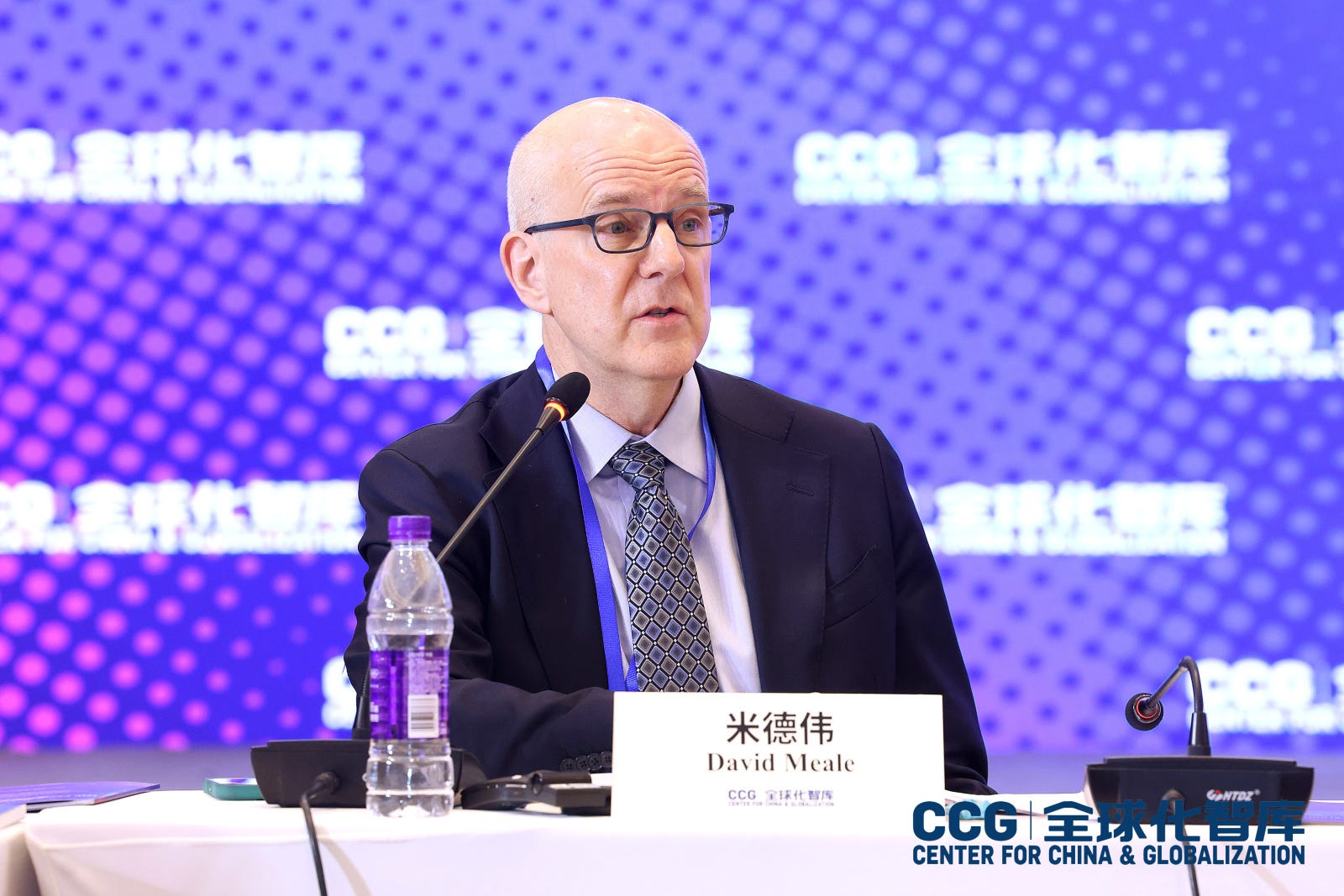
Hi, everybody. What a great morning. So much insight. I really appreciate the reflective thinking about the turbulence in the world right now and the fragmentation of the global order.
I am with Eurasia Group. I just joined this year. I was a U.S. diplomat for 33 years, and I am deeply enjoying the new perspective I get from working all day with the largest corporations in the world, the largest banks, and the largest funds, and seeing how U.S.–China relations fit into their perspective.
I will tell you something: I have a great sense of job security in this turbulent world right now. I deal with companies that are just trying to stick to their knitting. What they want to do is invest in businesses and opportunities on their own terms. They want to pick the right stocks based on how a firm is run. What they do not want to do is figure out how geopolitics is turning everything upside down for them. But that is indeed what is going on. That is what my firm does: we help everyone figure out how to factor that risk into what they are doing.
We are famous for the expression “G-Zero,” and that is kind of what we have been talking about this morning. G-Zero means we have entered a world—we actually came up with this in 2011—where no one actor can sustainably lead the global order. We are there.
But I want to give you a little corollary to that. We have also entered a world where if the U.S. and China come together, they together can constructively lead much of the world through elements of that turbulent order. I think we need to keep that in mind today.
We are also famous for our Top Ten Risks report, which comes out on the first workday of every year. In 2025, the top risk was that G-Zero was going to win and we were never going to get out from under it. In 2026, our top risk is that a political revolution in the United States is going to be extraordinarily disruptive.
Political revolution does not mean that it succeeds. It is the act of the administration that we have redirecting the reins of power in different ways, whether domestically or internationally. We are certainly seeing that play out in Venezuela, Cuba, Greenland, Panama, Iran, and in all sorts of ways. So I think all our reflections today are absolutely spot-on in terms of what I am observing.
But I have had a few interesting conversations lately about a risk that I think needs to be at the top, or at least in the top three. That is where we are going right now on AI, and this is very relevant to the upcoming Trump–Xi summit. That is why I want to dwell on it.
I was talking with a leading AI expert the other day, and he said to me: AI capabilities are doubling every four months. That is exponential. That means by the time of the next U.S. presidential inauguration, AI will, in theory, be 250 times more powerful than it is today. Now, it probably will not get that far, but I think we will be talking about something closer to that number than to zero. The implications are very significant.
We believe the new Mythos model that Anthropic has arrived at, and fortunately not released publicly, is an extraordinary development in AI and bears watching. It bears the attention of the U.S. and Chinese governments.
Why does this matter so much? We are looking at critical infrastructure vulnerabilities. We are looking at potentially the end of digital privacy, whether on the military front, the personal ID front, or the corporate security front. These are huge outcomes.
What we are very possibly going to get from this is a new sense of threat by both the United States and China with regard to AI. So I believe it is very important that we impress upon our leaders to take their newfound cooperation and drive towards stability that we are seeing here in 2026, and take every opportunity to expand that into the AI realm.
Donald Trump will come in a few weeks. I am not hearing a whole lot of talk about a big AI agenda. But when I was here as Deputy of the embassy, we got started with China and made some progress under President Biden. Presidents Trump and Xi are likely to meet three more times this year. There will be APEC, there will be G20, and there will be a Xi visit to the U.S.
My hope right now is that they are privately working on an agenda that will be expanded into the AI zone, and that it will take into account that these developments are not coming from governments. The developments we are talking about today are coming from private companies. Everybody needs to be in this conversation, and we all have a lot of work to do. Thank you.
Henry Huiyao Wang
Thank you, David, for your very constructive input. Absolutely, AI is the largest uncertain and uncharted territory. The U.S. and China, being the two largest AI powers, absolutely need to collaborate and avoid any catastrophe or AI swallowing human beings if we are not careful. This is so important. I think it is the right recommendation that this subject be put on the agenda of high-level meetings between the two leaders, as they have several opportunities to meet. That is a very good recommendation.
Now I would like to invite Manuel Menendez. He is the Founder and CEO of MCM Holdings Group. I know you have been in China for many years. What is your take on China–U.S. relations?
Manuel C. Menendez, Founder and CEO, MCM Holdings Group
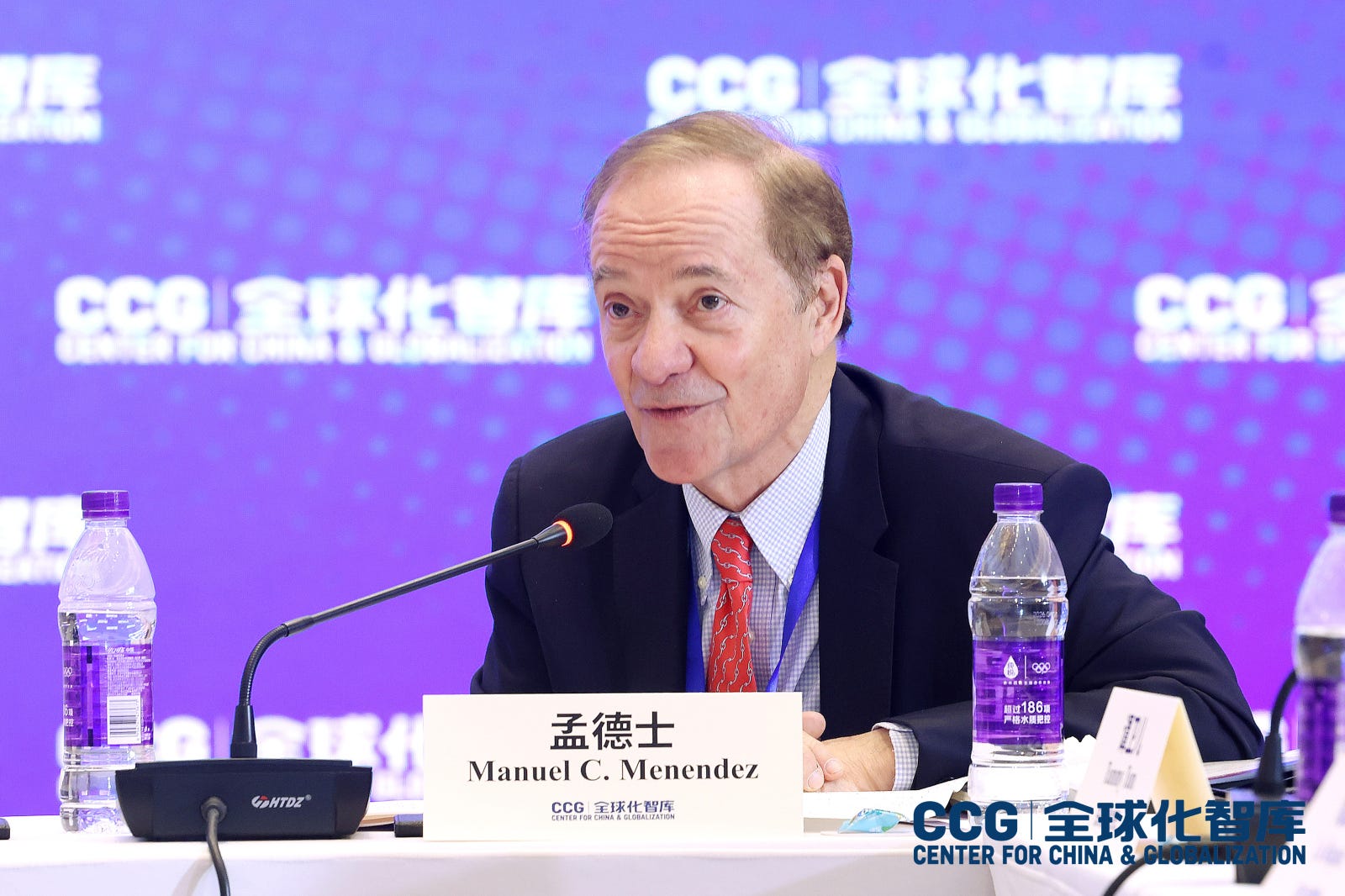
First of all, Henry and Mabel, thank you for inviting me. I am a little bit of a fish out of water here. I am just a humble small business guy in China. I have been here since 1979.
I will use the quote from Laozi that the longest journey begins with the first step. In 1979, I came and put together the first U.S.–China equity joint venture. In fact, Steve Orlins, who just left, was working at the law firm Paul, Weiss, and his law firm was my law firm that helped put that joint venture together. We built a food factory in South China called Guangmei Foods, and ever since then, I have been active in China.
What I have seen in China myself is not good, it is not great, it is a miracle, because of the scale of development in China and the speed of development in China. What has always impressed me, when I met the early leaders: Gu Mu, Chen Muhua, Wan Li, Rong Yiren, all the leaders—Deng Xiaoping actually gave me my Chinese name, 孟德士. When I met the early leaders, they were like teachers; they let me understand the way to do business in China through collaboration and partnership.
I remember meeting the Party Secretary of Shanghai, Jiang Zemin. We met at the Peace Hotel. At that time, we had finished the joint venture, and China was moving from a planned economy to a market economy. The main point back then was export, export, export, and making things to get hard currency, because in the beginning, China’s currency was not blocked. So the only way to get hard currency to buy modern equipment was through exports and selling things.
I had a bicycle project with Forever 永久 and Phoenix 凤凰 to make bicycles, because I knew how to make bicycles. From there, we started making money, bringing the money back to China, and then growing the business platform.
There are so many scholars and policymakers here today. I am very impressed to be among such a distinguished group, so I thank you for that. But let us think about going forward, about th President Xi and President Trump meeting.
One of the things that has to happen is that we have to get back to some level of mutual respect and trust. Nothing is going to happen unless there is mutual respect and trust. I know that is hard and very difficult to do. But I think what has been missing is the frequency of meetings. We have to have more frequent meetings at every level. I think that is picking up, but there still has to be more frequent meetings.
I loved what Susan Shirk mentioned earlier about having courage, and what was also mentioned about doing the right thing, not by polls, but by doing the right thing that helps the world.
If you look at the China–U.S. economies together, they account for about 45% of the GDP of the world. If you add the European Union, that is 60% of the world’s GDP.
When I first came to China, there was no private industry. Now 95% of businesses in China are private enterprises. That represents 50% of tax income in China today, 60% of Chinese GDP, 70% of technological innovation, and 80% of new jobs. So private industry, which was zero when I came here, is now a major part of the economy and driving the economy.
I am hoping and praying that when President Xi and President Trump get together, one of the things I would love to see, besides the transactions that I think Roberta mentioned—buying planes, selling planes, selling grain, and getting our agricultural sector back online—is really some tariff relief, some tariff common sense.
We know that tariffs do not work, and that only consumers pay for tariffs in the end. We can go back to the Smoot-Hawley days in 1930, and we know that tariffs create only losers. There are no winners. So I hope that happens.
The other thing I hope happens is that there will be a policy that allows China to invest in the United States more openly, just like Japan did in the 1980s. There should be a BYD joint venture with Ford or whoever in the United States. Use the technology in which China is advanced and make it a benefit in the U.S. for U.S. consumers. Why not?
If there is overcapacity in solar, use that solar overcapacity and work together, China and the U.S., to provide electricity to countries that need it. Work together, not apart.
I think that is what we need to get back to doing: trust each other, get back to more frequent engagement with each other, hold more meetings, and work through what I call finding common ground, while also working through the thorny issues.
The last thing I will say is that I hope and pray there is a clear definition of what national security is, because everything cannot be national security. This thing is national security, that thing is national security. And that is not acceptable. That is one of the barriers we need to eliminate. I will stop there, Henry. Thank you.
Henry Huiyao Wang
Thank you, Manuel, for your excellent remarks. I agree with you. We need to build trust. This is crucial between the two biggest economies. I also agree that we should not overemphasise the securitisation of everything, because jeopardising prosperity and economic development is probably the biggest risk that we need to de-risk. We have to safeguard common development. Thank you for your comments.
Now we turn to the well-known and famous Susan Shirk, Professor at the 21st Century China Center at the University of California San Diego. We would like to hear from you again. Thank you, Susan.
Susan Shirk, research professor, School of Global Policy and Strategy, UC San Diego; director emeritus, 21st Century China Center; former Deputy Assistant Secretary of State, Bureau of East Asia and Pacific Affair, U.S. Department of State
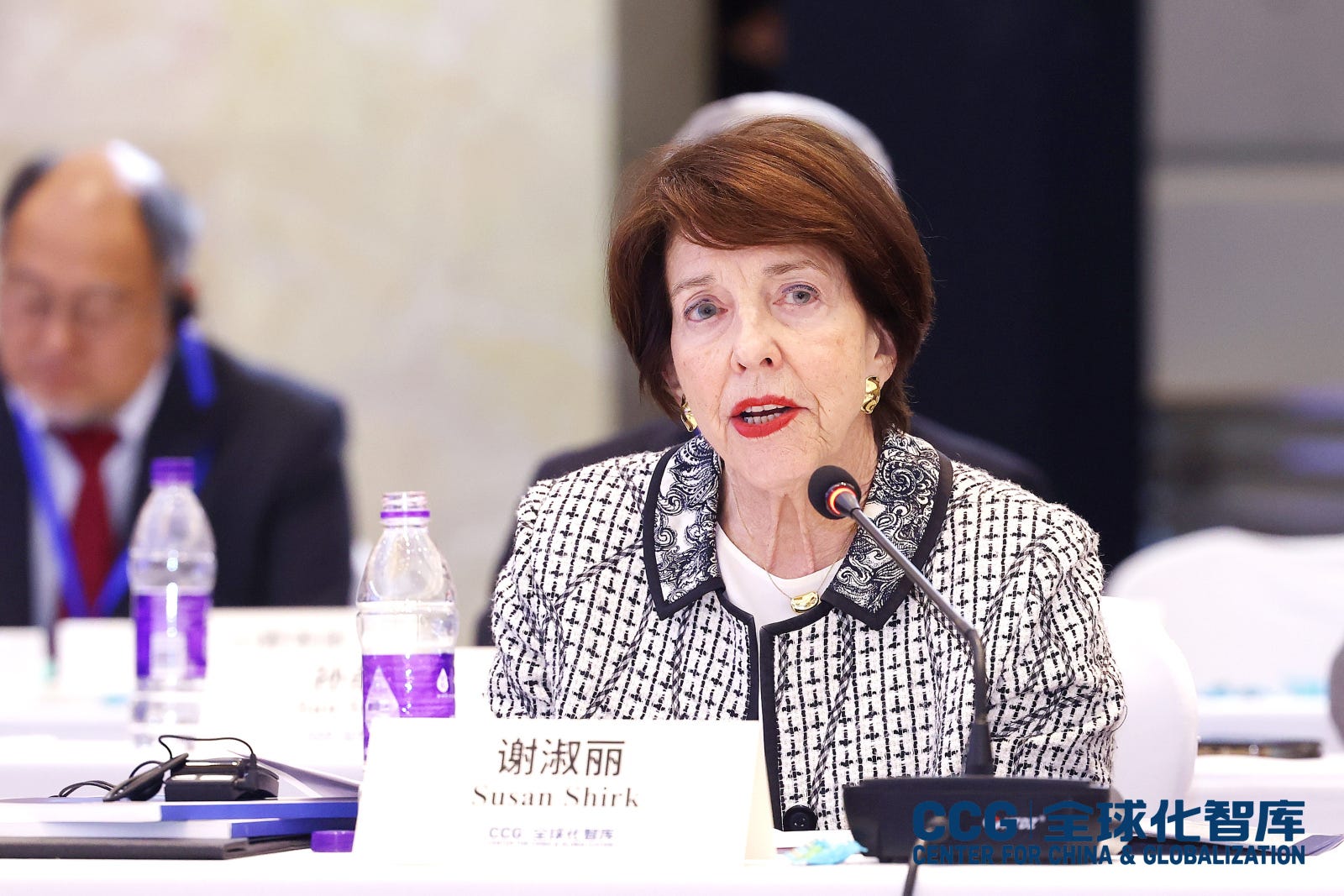
I am sorry to keep speaking on every panel, but I got my instructions, so I am doing it.
My original thought on this panel was to mention the potential for Chinese foreign direct investment in the United States. At the 21st Century China Center, we have a working group trying to develop principles for Chinese FDI in the United States, which, as has been noted earlier, kind of plummeted after 2016.
We have a notion that we call selective openness. This effort is led by my colleague Peter Cowhey, who has a lot of experience with technology, trade, and investment in previous administrations.
Obviously, now, with the tariffs that exist between the U.S. and China, foreign direct investment is the obvious market solution to bilateral trade imbalances. We saw this, of course, in the 1980s and 1990s between the United States and Japan.
But in the United States, our thinking about this has been dominated by security risks. Of course, there are real security risks. But there are also potential benefits. In many other countries, they weigh the benefits as well as the risks in evaluating investment projects, and we think that we should do that in the United States as well.
CFIUS has proven to be a valuable and pretty flexible approach on the security-risk side. But we are proposing ways of modifying that with templates that will also incorporate the value to the United States of taking advantage of China’s advances in technology, and trying to look at the potential for licensing, joint ventures, as well as wholly owned investments by Chinese companies.
But let me just take a minute. I think there is real potential there, and certainly, President Trump has expressed a positive view. But I am not terribly optimistic that these leaders’ meetings will get into this area and make much progress. We are looking at this as a long-term proposition, not just at the leaders’ meetings.
Let me say, as a former government official who served in government during a period when there was an exchange of leaders’ visits, with Jiang Zemin coming to the United States in 1997 and President Clinton coming to China in 1998, that the value of these meetings is not just the leaders’ face-to-face communication, but the preparation that normally goes into these meetings at the staff level.
It provides an opportunity for the two sides to make clear what their objectives are and to negotiate with one another before the leaders ever talk directly with one another. What I find really frustrating about the current situation is the absolute lack of diplomatic preparation for these visits.
I know the Chinese side and the Foreign Ministry are very frustrated, because the obstacle is definitely on the U.S. side. Without this kind of preparation, it is really a kind of diplomatic malpractice, in my view.
I think you will get some discussions about trade. You’ll maybe get the ability to sustain the Busan truce between the two countries. But security issues, people-to-people ties, and all the other dimensions of U.S.–China relations that these two leaders could be and should be discussing—I do not see any indication that they will get to those. It is really a tragic loss of opportunity.
Without preparation, I do not see any hope, really, that we are going to get there. Now, maybe they will lay out an agenda for President Xi’s subsequent visit to the United States. Maybe there will be a third and fourth meeting as well. None of that is for sure. But it is so frustrating and really potentially tragic not to have put the time and energy into the preparation for these meetings.
It reflects the nature of these personalistic leadership systems, that you do not get input positive ideas coming from the bottom up, certainly on the American side, which is really a tremendous loss. Sorry to be pessimistic.
Henry Huiyao Wang
Thank you, Susan, for your great intervention. I hope policymakers on both sides can hear our roundtable. We have injected some new narratives, particularly on investment. I think there is already talk about an investment board that is going to be on the agenda between the summits.
President Trump said during his campaign that if BYD set up in Mexico, he would levy a 200% tariff, but if they invested in the U.S., they would be free from that. I know many Chinese companies want to invest.
Susan Shirk
I hope I am wrong.
Henry Huiyao Wang
Yes, I hope you are wrong. I know one of the biggest sugar manufacturers produces a lot of vitamin candies, and the U.S. is its biggest market. He has always dreamed of opening a factory in the U.S. For those non-sensitive, non-security-related areas, we can really open the door.
I remember that a few years ago, the U.S. Embassy had a section aimed at attracting Chinese investment. They visited manufacturers in China and encouraged them to invest in the U.S. We hope that can come back.
Now we would like to have Ms. Tammy Tam, Publisher of one of the biggest English-language newspapers in the region, the South China Morning Post. We would like to hear from you.
Tammy Tam, Publisher, South China Morning Post
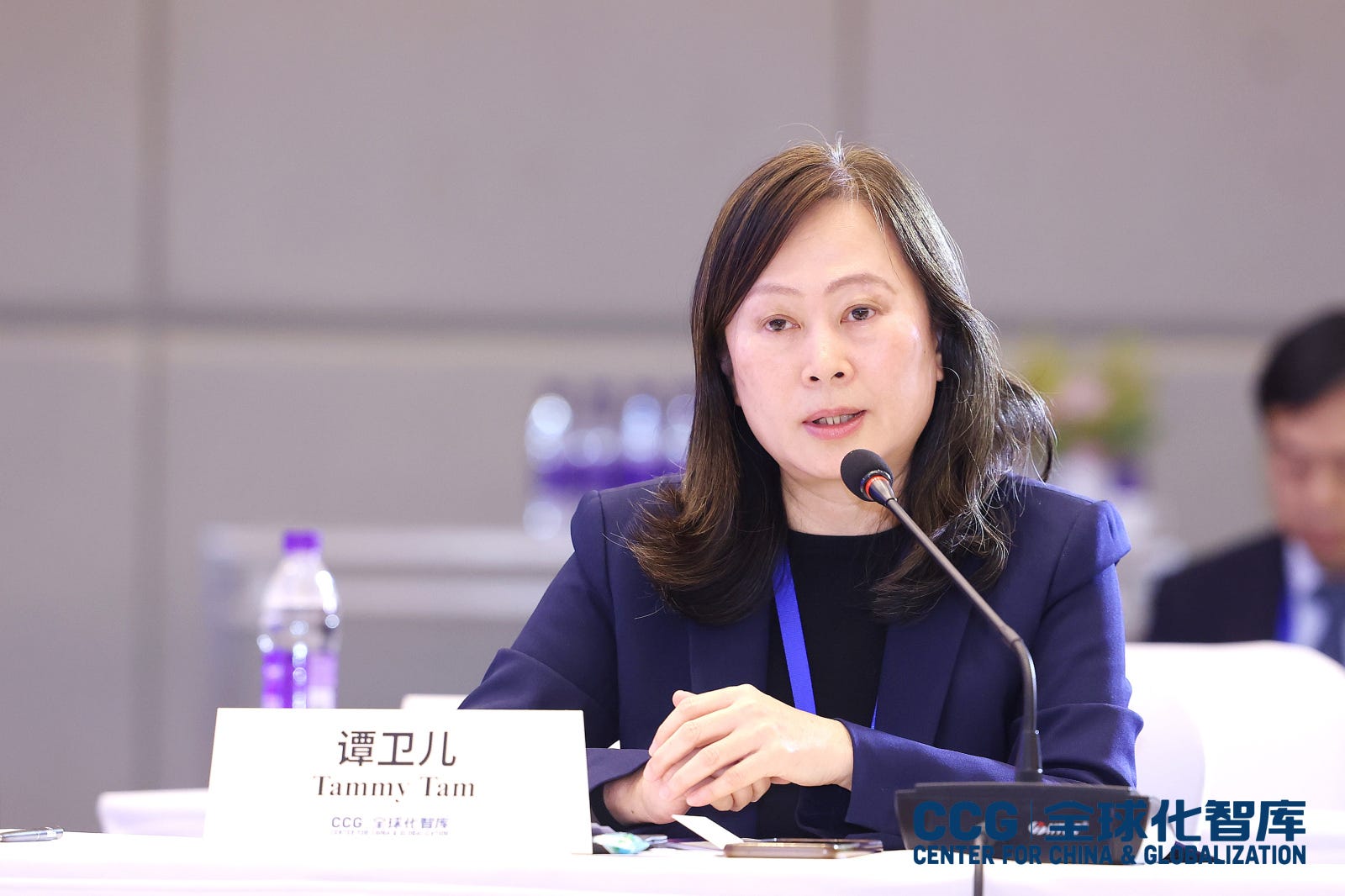
Thank you very much, Henry and Mabel, for having me. It is really my great honour and pleasure to be back in Beijing again. I was here last year, and this year I am so happy to see many old friends and also get to know new friends.
There are so many experts in this room, and we have heard both optimistic and pessimistic views about China–U.S. relations. I would just like to share a few personal takes.
First of all, thank you, Henry, for saying such nice words about the South China Morning Post. Actually, Henry Wang is a regular contributor to SCMP. I hope you will also find SCMP a useful tool for understanding China. We try to unbox the many complexities of China’s policy and China–U.S. relations.
As Professor Kishore just mentioned, he is the only non-Chinese and non-American on this panel. I must say I am Chinese, of course, but I am probably the only person from Hong Kong, a special administrative region of China. So I want to share some perspectives from the Hong Kong angle.
Also, because I have been in the media industry for decades—I used to be editor-in-chief for about 10 years before I took up this job as publisher—I also want to speak from a journalistic perspective.
Some people may say the messier the world is, the better for journalism. It helps clicks and ratings. But I would like to say that is not completely the case. It does help, but there is also news fatigue among readers if we keep reporting wars, conflicts, and all this very discouraging news. That is also true. We are all human beings. We want the world to be better. We want to see beautiful things. That is why we also want to report something nice, something encouraging, and something about joint efforts that can make the world better.
We all talk about whether President Trump is coming to China. Given the unpredictability of everything, and as Professor Susan Shirk just mentioned, the lack of preparation from the U.S. side, I think we still need to wait and see. Of course, we so hope that he can come, and then both leaders can have this kind of direct conversation and lay the groundwork for the future of China–U.S. relations.
What does China–U.S. relations mean for Hong Kong, or what is Hong Kong’s role in this China–U.S. wrestling? Some experts in this room talked about middle powers this morning. Hong Kong, of course, is just a city. But under “one country, two systems” in China, I personally think Hong Kong has a critical role to play in terms of China–U.S. relations.
Historically, Hong Kong has a very long history of Hong Kong–U.S. connections. Some of you may know, and some may not, that the U.S. Consulate General in Hong Kong is the oldest one in our city. It started more than 183 years ago, in 1843. This is a very long history.
Also, when President Trump waged this tariff war under the name of the trade deficit, Hong Kong actually had a trade surplus with the U.S. Last year it was 28 billion U.S. dollars.
Time is running out, so let me quickly talk about Hong Kong. Under China’s new five-year plan, Hong Kong has been designated as a future centre. Hong Kong is already an international financial centre, but Beijing wants Hong Kong to further enhance this status. Last year, Hong Kong topped the world in IPOs in terms of number and volume, and this year the momentum continues.
Hong Kong is also being designated as a future talent hub for the whole China. It is not just an ordinary talent hub, but a high-end talent hub. We see many talents coming to Hong Kong, not only from mainland China but from around the world coming to Hong Kong.
Right now, there is one mega-project in Hong Kong, which we call the Northern Metropolis. We also call it building another Hong Kong in the border area with Shenzhen. It is as big as one-third of Hong Kong’s total area. Anyone who has been to Hong Kong knows that Hong Kong has three parts: Hong Kong Island, Kowloon, and the New Territories. The future Northern Metropolis will be bigger than Hong Kong Island. We have already attracted quite a lot of foreign investment, especially in high-tech, pharmaceuticals, biotech, etc.
The Hong Kong government just announced that AstraZeneca has already set up a research centre in the Northern Metropolis. The Northern Metropolis will also be designed as Hong Kong’s new university city. All the top universities in Hong Kong are now preparing to set up campuses there, because it borders Shenzhen.
Having said all this, it is not just about Hong Kong itself. It is about Hong Kong and Shenzhen, and the Greater Bay Area. You must have heard about the GBA. The GBA now has a population of 87 million, and by 2030 it is going to have 100 million. Hong Kong is part of this GBA: Hong Kong, Macao, and nine cities in Guangdong. It will be a major driving force for China’s economy.
We are all talking about the potential May visit by President Trump to China. Later this year, in October, the APEC finance ministers’ meeting will be held in Hong Kong, with the blessing of the central government in Beijing. In November, there will be the APEC leaders’ summit. I am sure there will be a lot of American businesspeople coming to China together with President Trump, and probably for APEC as well. We also understand there will be a business leaders’ summit. I am sure many U.S. businesspeople who are wise enough, like many people here, can see the potential in China.
Hong Kong is now also coming up with its own five-year plan to align with the national one. We will focus on tech, R&D, and education. Hong Kong is also a free market. Despite all this tariff war, the Hong Kong government has decided that we are a free port. We do not take retaliatory measures against any country.
To put it in a nutshell, the title of our panel is about “China–U.S. Relations: From Engagement to Rivalry—Can Cooperation in these areas Continue Amid Strategic Stability?” To me, it is not just “can”—it is “should we” and “how”. I am sure the wisdom in this room can drive government and non-government forces to join hands and think about how we should promote China–U.S. relations on all fronts. I am sure Hong Kong can play a role. You are all welcome to visit Hong Kong sometime. Thank you.
Henry Huiyao Wang
Great. Thank you, Tammy, for giving us a lot of encouraging news from Hong Kong.
Now I would like to invite Ms. Zhang Xiaoyan. She is Vice President of the China Center for Information Industry Development, CCID, which is a very big think tank on industry and technology. Please.
Zhang Xiaoyan, Vice President, China Center for Information Industry Development
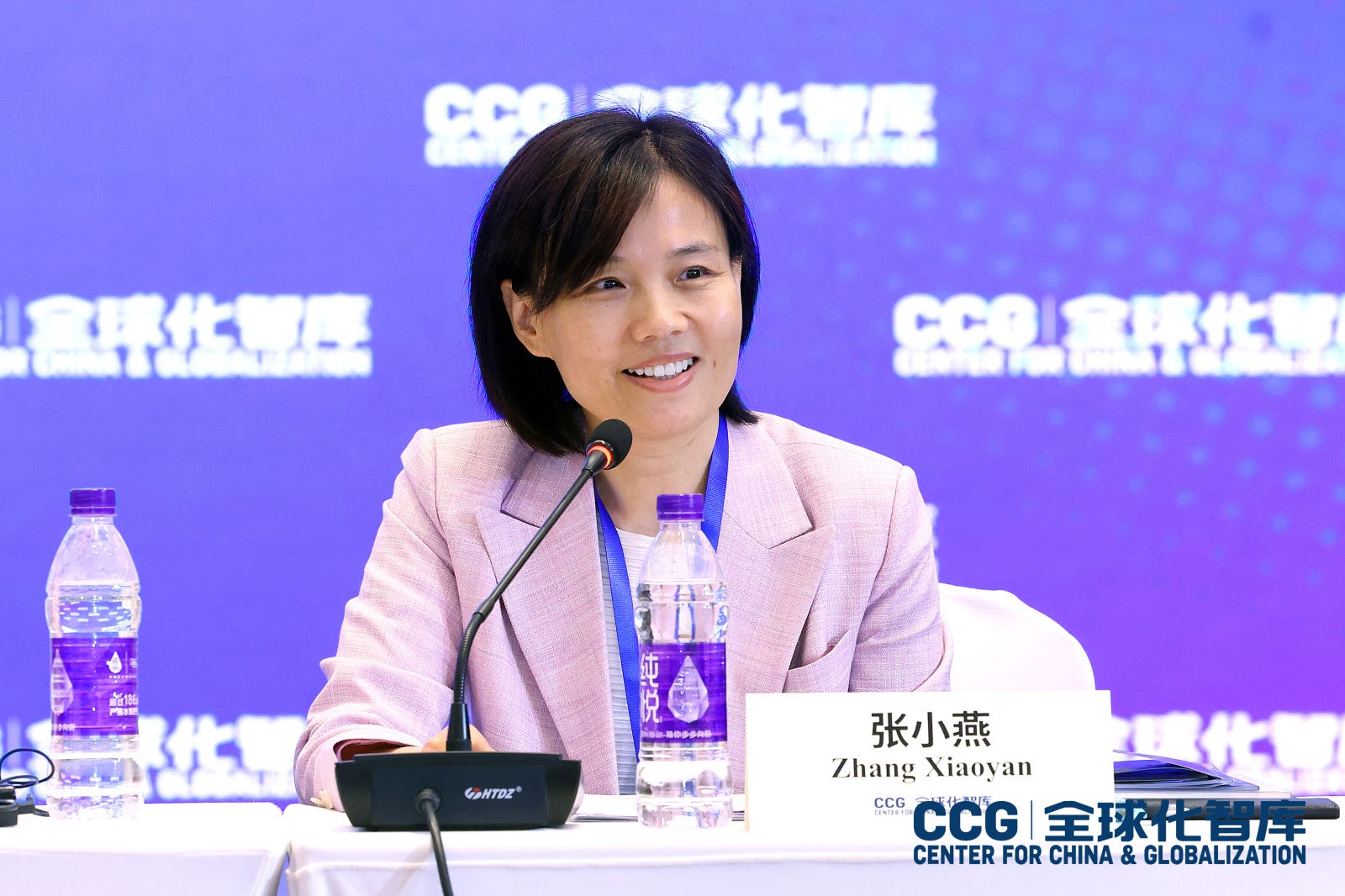
Thanks for the invitation. I have heard many speakers recall their stories in China–U.S. relations, and it also makes me look back on my personal experience over the past 20 years, because I have been engaged in U.S.–China relations work for 20 years.
I can divide the two decades into two periods. The first period was from 2006 to 2017. I think the character of that period for me was that it was quite busy but also quite fruitful. In 2006, we set up the S&ED mechanism, the Strategic and Economic Dialogue mechanism, and until 2017, we had many JCCT conversations. JCCT means the Joint Commission on Commerce and Trade between China and the U.S.
Formerly, I worked in the Ministry of Industry and Information Technology. We also had our own bilateral mechanisms with the Department of Commerce or the State Department of the U.S. So that was quite a fruitful period.
But starting from 2018 until now, I think the character of this period has been quite tough and closed. Tough because I attended the Phase One deal negotiations. It was a very tough negotiation, but the result was good. Closed means that I echo what many speakers have said: people-to-people contact, or staff-to-staff level contact, is quite in shortage now.
Without those person-to-person contacts, without dialogues and exchanges, we will lack mutual understanding. Without mutual understanding, we cannot come to mutual trust or conduct cooperation. So that is quite a frustrating and depressing phenomenon at present.
Some consequences arising from trade tensions between China and the U.S. are very clear. The direct consequence is the decline in bilateral trade volumes. Lots of speakers have mentioned that. Last year, bilateral trade volume between China and the U.S. decreased by nearly 20%.
Another consequence is the shift in supply chains. Supply chains have shifted from a long and globalised one to regionalised, fragmented, and shorter ones, which is obviously not in line with market-economy principles or multilateral trade rules.
But some good signs have shown recently. On Thursday this week, I attended AmCham China’s annual conference, where it launched its 2026 White Paper. Among the respondents from AmCham’s member companies, nearly 79% held a positive or neutral outlook on China–U.S. relations in 2026. That is 30% higher than last year. This is quite a positive sign.
I have also heard many American businesses in China say that they have shifted their strategies in China. They no longer regard China only as a manufacturing base or a market, but also as a testing ground for new technologies, an R&D powerhouse, and a source of innovation. That is also a positive sign for China–U.S. industrial cooperation.
Finally, some words about AI. 2026 is called the year of AGI. AI is the most representative, disruptive technology in today’s world, and China and the U.S. are the two major countries in the AI sector. So it is our responsibility to conduct more dialogue and cooperation on AI.
For example, on open-source models, we can provide more open-source models to the world, lower the costs, and lower the barriers for people to access AI, in order to prevent the widening of the AI divide. We mentioned the digital divide in the past, but perhaps the AI divide will become a very serious issue in today’s world.
Second is AI governance. AI has transboundary risks. I heard some experts talk about autonomous cyberattacks, deepfakes, and systemic loss of control. These are transboundary risks. China and the U.S. need to have more discussions and cooperation on how to put guardrails on AI, and how to guarantee the healthy development of AI so as to make it benefit world development and society as a whole. Thank you.
Henry Huiyao Wang
Great. Thank you, Ms. Zhang, for your first-hand experience and information on how China and the U.S. can work together. I am very glad you came to our conference. I also remember you were at our Munich Security Conference roundtable just two months ago. Thank you for coming again.
Now last but not least, I would really like to hear from Minister Zhu Hong. You have been a veteran in China–U.S. relations, particularly trade relations. You were Minister-Counsellor for trade at the Chinese Embassy in Washington, and we visited you many times there. We would like to hear from you, based on your first-hand experience. I know you were heavily involved in the Phase One negotiations and were in Washington during the first term of the Trump administration, in charge of trade. Mr. Zhu, please.
Zhu Hong, former Commercial Minister-Counsellor, Embassy of China in the United States
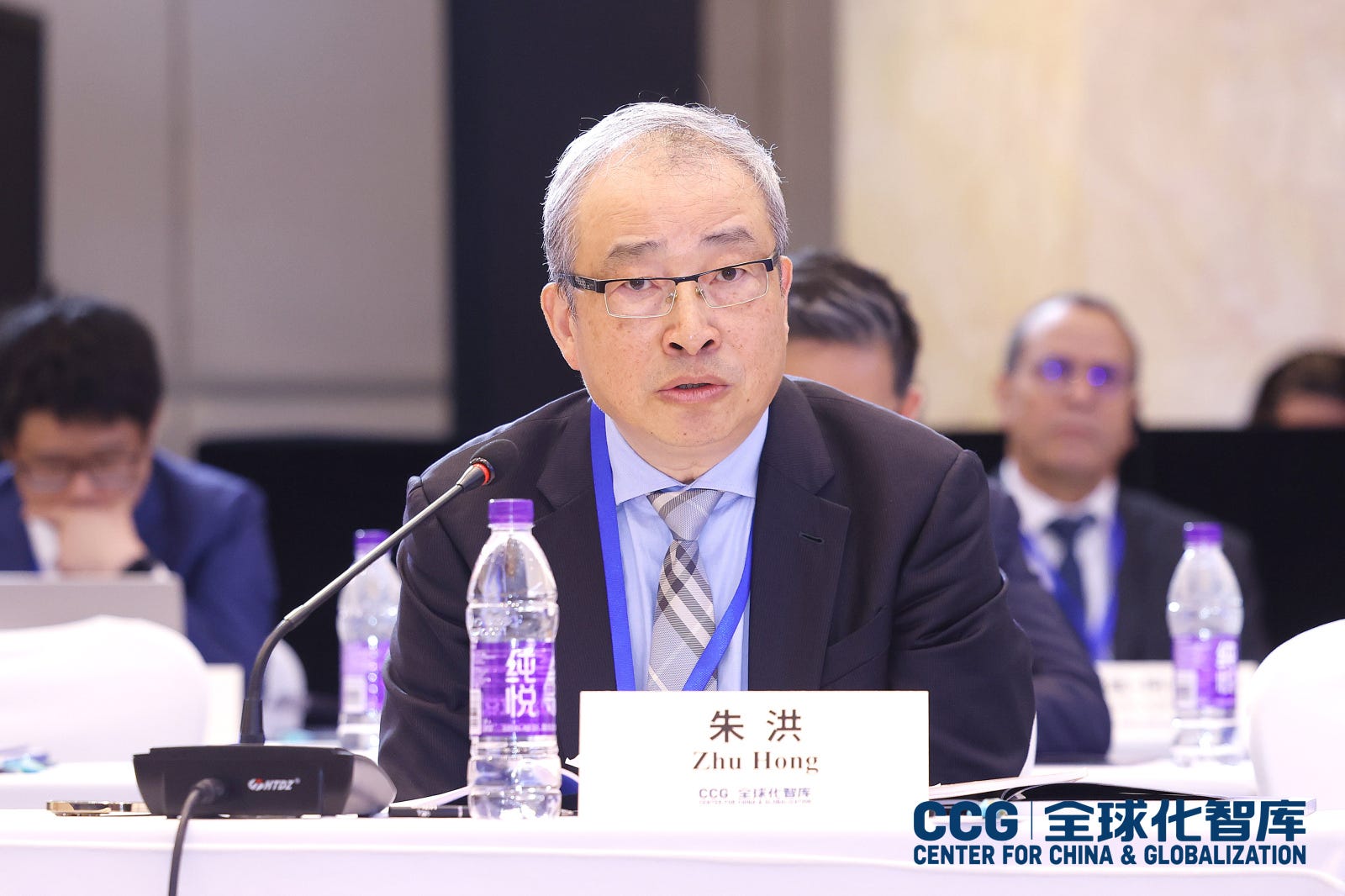
Thank you, Dr. Wang and Dr. Miao, for the invitation. I have worked in the United States for 11 years in total. Based on some of my own observations, I would like to make four points today.
My first point is that in the 47 years since China and the United States established diplomatic relations, despite all the ups and downs, history has proved that cooperation is the only correct choice for our two countries. In this cooperation, economic and trade cooperation is the ballast stone and propeller of bilateral relations. Whether it is a trade war or a tariff war, neither benefits either side.
Let me give one example. Affected by the trade war and tariff war, China–U.S. trade volume fell by 19% in 2025. If China and the United States can manage their economic and trade cooperation well, it can help drive cooperation in other fields.
As Dr. Wang just mentioned, I was fully involved in the negotiations for the Phase One China–U.S. economic and trade agreement during President Trump’s first term. After very difficult negotiations, the two sides reached the Phase One economic and trade agreement. Although its implementation was not perfect, 60% to 70% of it was completed.
This year is an important year for China–U.S. cooperation, as the Chinese president and the U.S. president are expected to exchange visits. We very much hope that the economic and trade teams on both sides can take advantage of this momentum, continue exploring pathways for cooperation, accumulate small wins into larger ones, and restart and expand economic and trade cooperation.
My second point is that China–U.S. economic and trade cooperation has a solid foundation. First, I believe that, so far, the economic complementarity between the two countries remains stronger than their competition. Their industrial and supply chains are deeply intertwined. In particular, as the world’s largest and second-largest economies, China and the United States have no reason not to cooperate.
China’s development over the next five years, with this year being the first year of the 15th Five-Year Plan period, will provide very good opportunities for cooperation. China’s commitment to expanding high-level opening-up will continue to provide market opportunities for American companies.
In addition, I firmly believe in the power of the business community. Of course, in the past two years, the business community has been somewhat hesitant to speak out on China–U.S. trade. I hope that, going forward, the business community can make its voice heard more strongly. At present, more than half of American companies plan to increase investment in China, and nearly half list China as one of their top three global investment destinations. I hope the business community can vote with its feet and help promote cooperation between the two countries.
My third point is that there are realistic pathways for expanding economic and trade cooperation. First, the two sides should establish institutionalised communication and coordination mechanisms. Previous speakers have also discussed this point. These mechanisms can include both official channels and Track II cooperation.
Second, the two sides should further identify, deepen, and extend the list of areas for practical cooperation, so as to build positive momentum.
Third, China and the United States can cooperate on multilateral platforms. In 2026, China will host the APEC meeting, and the United States will host the G20 summit. We hope both sides can make use of these two platforms to release signals of openness and goodwill, reduce antagonistic sentiment, and stabilise policy expectations, especially for the business community.
At the local level, during my time in the United States, I also worked hard to promote cooperation between Chinese provinces and U.S. states. I hope this work can continue.
My final point is that in restoring and restarting economic and trade cooperation, the two sides should follow a strategy of starting with the easier issues before moving to the more difficult ones, and advancing step by step. In the process of solving problems, the two sides can accumulate mutual trust and gradually expand the scope and list of cooperation.
As everyone knows, China–U.S. relations are like a person who has suffered a serious illness. If you want to rebuild their strength, you have to do it gradually. So what we now advocate is action for action, with a focus on resolving specific cases of concern to both sides; defining a negative list that sets the boundaries of competition; and expanding a positive list for cooperation.
In this way, both sides can respect each other’s bottom lines, seek common ground while preserving differences, set aside disputes, and find the greatest common denominator for cooperation. That is all from me. Thank you.
Henry Huiyao Wang
Thank you, Mr. Zhu, for your excellent remarks. You spoke last, but probably summarised very well all the discussion points we have had, particularly all the positive things that we could promote between China and the U.S.
We have the G20 and APEC summits, and we can do our best to make these two multilateral events a success.
We are now coming to the end of this roundtable. Sorry for the slight delay. The topic was so exciting and the discussion was so wide-ranging. But I do think there is a consensus that nobody wants to see the U.S. and China enter into conflict. We all want to avoid that.
Of course, we have identified many areas of collaboration between our two great countries. There is so much need, not only for the U.S. and China, but also for the world, for stability and constant dialogue and exchanges between the U.S. and China.
So I think we have made a good start, at least in our roundtable, by injecting some positive narratives into the discourse on China–U.S. relations.
Once again, I want to thank all of you very much for taking your precious time to share your valuable thoughts. We will make a good summary, and we are going to disseminate it and recommend it to the relevant authorities and also to the public.
Once again, thank you so much. Our roundtable will stop here. Let us give a warm round of applause to our distinguished panellists for this great discussion.
Written Contribution to the Roundtable Discussion
China and the U.S. Should Move Beyond Zero-Sum Thinking and Seek Comprehensive Cooperation in High Technology
He Weiwen, Senior Fellow, CCG; former Economic and Commercial Counsellor, Chinese Consulate General in San Francisco and New York
All emphases are his own.
Over the past year or so, one of the most prominent features of China–U.S. relations, apart from unilateral U.S. tariffs and China’s firm countermeasures, has been the sharp escalation of U.S. high-tech bans and restrictions against China, to which China has responded with its most stringent rare-earth export controls.
Washington introduced export bans to China on ethane, electronic design automation tools, and advanced chips. China, in turn, strengthened export controls on rare earths. In September 2025, Washington introduced the so-called “50% rule”, under which subsidiaries of Chinese companies on the Entity List would also be covered if the listed company held at least 50% ownership. This directly led to the Dutch company Nexperia imposing export restrictions on China.
This triggered China’s most stringent rare-earth export controls in history, dealing a fatal blow to U.S. companies. China controls 87% of the world’s rare-earth refining capacity, 78% of refined lithium, 98% of zirconium oxide, and 65% of processed cobalt, and holds an overwhelming dominant position in rare-earth magnetisation. All of these are vital to the U.S. semiconductor, automotive, and defence industries.
In the end, Washington first cancelled or suspended the above restrictions. In response, China also suspended its latest rare-earth export controls for one year. On 22 April 2026, the U.S. House Foreign Affairs Committee passed the “Multilateral Alignment of Technology Controls on Hardware (MATCH) Act, imposing extreme restrictions on high-technology exports to China. Under the bill, the export of key equipment to China would not only be banned by the United States, but U.S. allies would also be required to impose similar restrictions.
High-tech or resource restrictions are trade tools used for specific purposes. In 2025, however, they played an increasingly intense role in China–U.S. trade. The fact that both sides eventually cancelled or suspended some measures tells us that the high-tech industries of the two countries, especially their semiconductor industries and markets, are in fact complementary. The two sides can find better and mutually beneficial solutions, rather than restricting each other.
A 2025 report by the U.S. Semiconductor Industry Association (SIA) noted that global semiconductor sales reached a record high of 630.5 billion U.S. dollars in 2024, up 19.7% from 2023. The United States is the world’s largest semiconductor producer, accounting for 50.4% of the global total. China, meanwhile, is the world’s largest semiconductor market, with sales in 2024 increasing by 20.1% from the previous year. China accounts for 22% of Nvidia’s global sales revenue.
In practice, U.S. semiconductor bans have not stopped China’s own semiconductor industry from developing rapidly. On the contrary, they have helped accelerate it. In 2025, China produced 484.3 billion integrated circuits, up 10.9% year on year. In the first quarter of 2026, China’s integrated-circuit exports rose by 13.4% to 84.99 billion units, while export value surged by 77.5% to 72.471 billion U.S. dollars, implying an annualised value close to 300 billion U.S. dollars.
Similarly, the ban has not stopped China’s chip imports from rising sharply. In the first quarter of 2026, China imported 145.65 billion integrated circuits, up 11.0% year on year, with import value surging by 45.0% to 128.008 billion U.S. dollars. On an annualised basis, China’s global chip imports in 2026 are expected to exceed 500 billion U.S. dollars! Interestingly, the biggest beneficiaries have been Japan, the Republic of Korea, and China’s Taiwan, whose exports to China, or to the Chinese mainland, increased by 29.9%, 44.3%, and 17.4%, respectively, in the first quarter of 2026.
Washington once banned the export of Nvidia’s H200 chips to China, and later lifted the restriction. But by then, China no longer bought them, instead using Huawei’s Ascend 910C chips. Nvidia CEO Jensen Huang warned that if DeepSeek were first released on Huawei’s platform, it would be disastrous for Nvidia. Unfortunately for him, his prediction came true. On 25 April, DeepSeek V4 was released, and it did not first choose Nvidia hardware. Instead, it made its debut on Huawei Ascend chips.
Therefore, the extreme U.S. high-tech restrictions on China, especially in chips, have taught us a valuable lesson: instead of pursuing a futile approach, why does Washington not choose cooperation?
China and the United States have enormous shared interests in the age of artificial intelligence. The world stands on the threshold of the AI era, which will fundamentally change the global economy and human life. China and the United States are, without doubt, the world’s two leading AI powers by a wide margin.
A Semiconductor Industry Association (SIA) report estimates that by 2030, AI technology and industry will contribute 15 trillion U.S. dollars in growth to the world economy. Nvidia CEO Jensen Huang said that China is nanoseconds behind America in AI. Together, China and the United States accounted for 75% of the total number of Hurun Global Unicorns in 2025, while many AI engineers in Silicon Valley are of Chinese origin.
If China and the United States work together, they will create vast new areas of economic growth and achieve unprecedented productivity gains on the new track of the Fourth Industrial Revolution. The SIA report also calls for firm cooperation with China. Therefore, we hope that 2026 will become a year of transformation: a year in which China and the United States move from restrictions to cooperation in high technology, especially in AI; a year of equal and mutually beneficial cooperation that serves the high-tech industries of both countries and benefits the world.
The 12th China and Globalization Forum Held in Beijing

The 12th China and Globalization Forum, hosted by the Center for China and Globalization (CCG), was held in Beijing on Sunday, April 26, 2026.
Transcript: Opening Ceremony of the 12th China and Globalization Forum
The 12th China and Globalization Forum, hosted by the Center for China and Globalization (CCG) and co-organized by the China Association of International Trade (CAIT), the China Society for World Trade Organization Studies (CWTO), the China-United States Exchange Foundation
Transcript: Opening Roundtable of the 12th China and Globalization Forum

The 12th China and Globalization Forum, hosted by the Center for China and Globalization (CCG) and co-organized by the China Association of International Trade (CAIT), the China Society for World Trade Organization Studies (CWTO), the China-United States Exchange Foundation

The Global South is not a new bloc and cannot be romanticized. It is in fact, a group of countries whose bargaining power is rising.
These countries do not simply want to join either a Chinese camp or a Western camp. They want more choices across infrastructure, energy, manufacturing, finance, food, technology, and security.
The key question for the new globalization is who can offer these countries more deliverable, less conditional, and more development-oriented systemic solutions.
The old U.S.-led order is weakening, but a new capacity for global governance has not yet taken shape.
The real competition ahead will not simply be about which great power is stronger. It will be about who can provide a sustainable capacity for producing order: rules, public goods, infrastructure, energy stability, crisis coordination, trade mechanisms, and development pathways.
My sense is that China is not yet fully prepared for this role. At the same time, the United States still retains considerable capacity to provide these public goods.