


On October 15, 2026, the Center for China and Globalization (CCG), in collaboration with Existential Threats and Risks to All (EXTRA), an initiative of the World Academy of Art and Science (WAAS), hosted a roundtable discussion titled “Global Existential Risk Governance for Human Survival: Chinese Perspectives on Enhancing Cooperation at a Time of Global Turmoil” at CCG’s Beijing office.
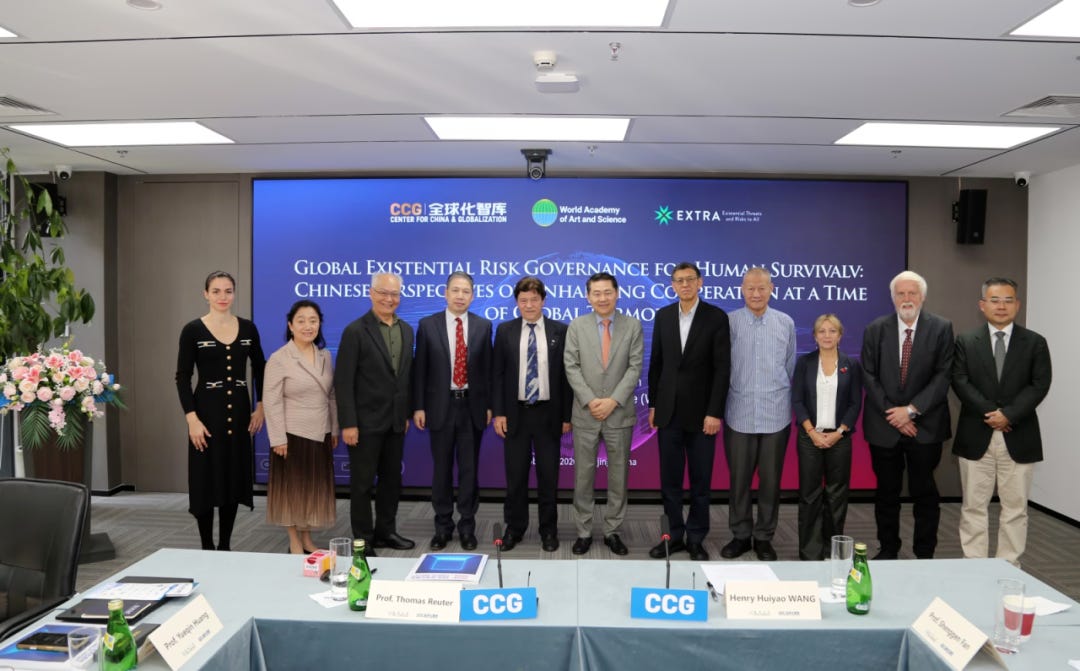
The event brought together:
Dr. Henry Huiyao Wang, Founder and President of CCG;
Prof. Thomas Reuter, Professor, Asia Institute, University of Melbourne; Board and Executive Committee Member, World Academy of Art and Science (WAAS); Chair, EXTRA Initiative;
Prof. Shenggen Fan, Chair Professor, China Agricultural University; Dean, Academy of Global Food Economics and Policy; Former Director General, International Food Policy Research Institute (IFPRI);
Prof. Yueqin Huang, Professor, Peking University Sixth Hospital; Fellow, WAAS;
Dr. Jinfeng Zhou, President, World Academy of Sustainable Development; Fellow, WAAS;
Dr. Yi-Heng Cheng, Member, Club of Rome; Fellow, WAAS; Adjunct Professor, Tongji University;
Prof. Zhi Wang, Professor and Founding Dean, Global Value Chain Institute, University of International Business and Economics (UIBE);
Prof. David Geraint Evans, Professor and Director, Science Popularisation Experiment Centre, Beijing University of Chemical Technology;
Dr. Marta Nešković, Postdoctoral Researcher, Chinese Academy of Sciences; Junior Fellow, WAAS.
The World Academy of Art & Science (WAAS) was founded in 1960 by eminent intellectuals including Robert Oppenheimer, Father of Manhattan Project; Bertrand Russell; Albert Einstein (posthumously); Joseph Needham, co-Founder of UNESCO; Lord Boyd Orr, first Director General of FAO; Brock Chisholm, first Director General of WHO and many others. The Academy serves as a forum for reflective scientists, artists, and scholars dedicated to addressing the pressing challenges confronting humanity today independent of political boundaries or limits, whether spiritual or physical — a forum where these problems can be discussed objectively, scientifically, globally, and free from vested interests or regional attachments to arrive at solutions that affirm universal human rights and serve the common good of all humanity. WAAS is founded on faith in the power of original and creative ideas — Real Ideas with effective power — to change the world.
A number of members of the WAAS community also joined the event via video link.
The full video of the discussion is now available on CCG’s YouTube channel.
This transcript is based on a recording and has not been reviewed by any of the speakers.
Henry Huiyao Wang, Founder & President, Center for China and Globalization (CCG)
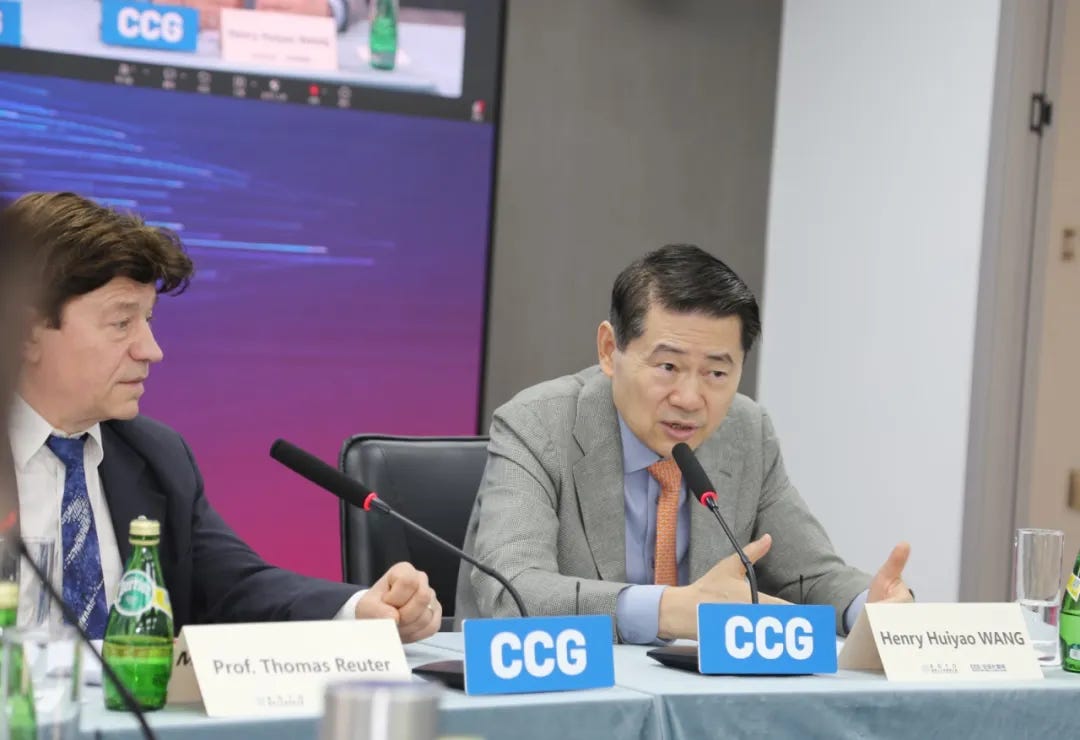
We’ll start our CCG–EXTRA and World Academy of Art and Science roundtable.
First of all, on behalf of CCG, I’d like to extend my warmest welcome to WAAS Fellow and Professor Thomas Reuter, who has made a special trip to Beijing to participate in our event. I’d also like to extend my warmest welcome to all the fellows, professors, colleagues, and, of course, all the CCG fellows here today.
We’ve gathered here at the CCG office today to have this very interesting and stimulating discussion. Tom mentioned to me quite a while ago that he would be in Beijing, and we then organised a roundtable on this subject.
So I think this is very good. That’s why today we have invited distinguished guests from different academic circles, as well as the business community, to talk about this very interesting subject: global existential risk governance for human survival. So that’s a big topic.
We sent out invitations to some people, and they thought it was a very big topic. I also think it’s interesting to hear some Chinese perspectives.
We have a lot of Chinese friends here today, and we hope to enhance cooperation at a time of global turmoil. So this is a very timely subject.
I just want to briefly mention that the Center for China and Globalization is a non-governmental think tank that was established 18 years ago. We have also been ranked among the top 100 global think tanks by the University of Pennsylvania in its Global Go To Think Tank Index for a number of years. We are also the only think tank in China that has been granted special consultative status with the United Nations.
So perhaps Professor Thomas Reuter, you could give an opening introduction to EXTRA and the project you are leading. Then I think we can start the discussion. I’ll follow your introduction, and then we can begin our discussion. So, Tom, please.
Thomas Reuter, Professor, Asia Institute, University of Melbourne; Board and Executive Committee Member, World Academy of Art and Science (WAAS); Chair, EXTRA Initiative
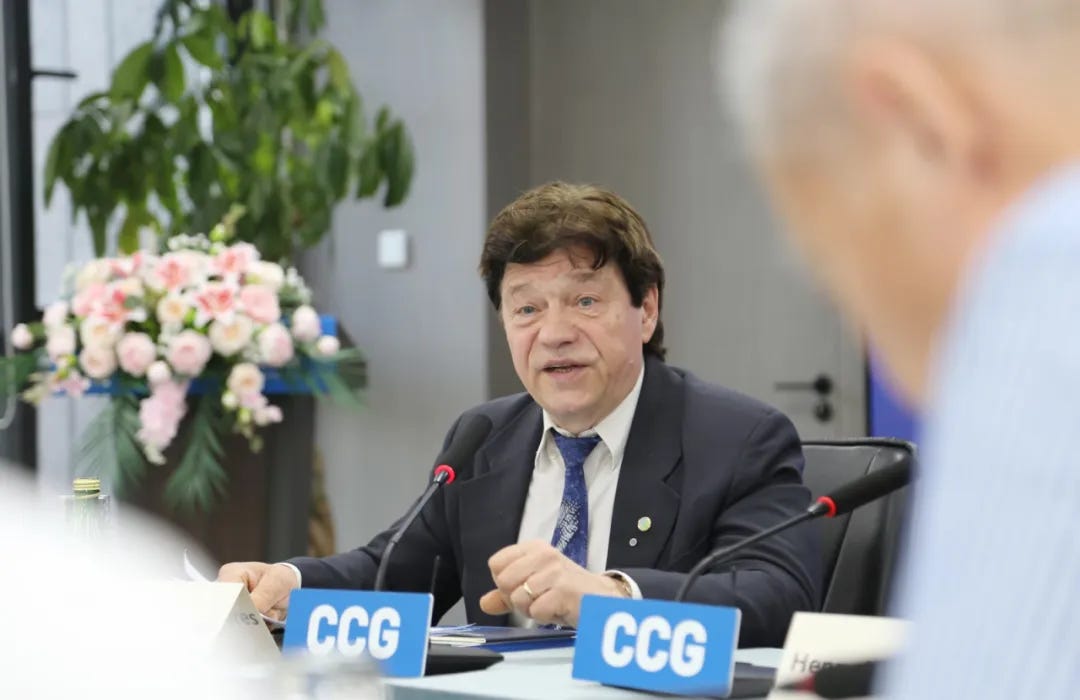
Thank you, Henry, for inviting us to have this historic first gathering of WAAS fellows in China. It’s not something we’ve done before, so it’s something unusual, and we hope, not the last time that we can cooperate.
Let me just say a few things about the World Academy. In this time of turmoil and tension, the World Academy stands for global cooperation, peace and prosperity. It’s working together to solve our differences to find solutions, particularly to the existential challenges that we look at in EXTRA. EXTRA is a team within the World Academy that provides a monthly update on global risks, so the full spectrum of what we call the polycrisis, because existential risks now are interacting. You could have problems, like climate change affecting food security, affecting health, and so everything is interacting.
We talk about global boundaries, and we’ve transgressed many of them. So we provide a monthly update with the latest and best information because there’s so much information out there. There’s about 150 organisations reporting on global risk, so it’s overwhelming, and we try to get some order into it and some focus.
And of course, we have monthly events such as this to discuss key issues now today, and really the thinking behind organising this session is that when you think about global cooperation and finding solutions to these major problems, it is not possible to imagine that without the full participation of China and cooperation with China; that is a big part of what global cooperation is going to be about. So it’s important, and we really very in the work academy generally we are we. See ourselves as neutral and non-partisan, or you might say we only partisan to the whole of humanity.
So we emphasise voices that are not so often heard in the West. So we want to bring in the other perspectives that are perhaps marginalized in our media, and today we’d like to see how these existential risks look from the perspective of China, and as we all know, China is doing quite a lot to address fossil fuel emissions, things like that, and who are leading in many technologies. So I’d like to hear your perspective and from your various fields.
Henry Huiyao Wang
Okay, great. Thank you, Thomas. Very good topic suggestions, and also a very interesting perspective that you would like to hear from China.
So maybe we could start. What I’ll do is start first, and then I’ll ask Professor Shenggen Fan to speak. After that, we’ll probably hear from some Chinese experts, but we would also like to hear from some of our fellows. So, if you could, please just introduce yourself and say a few words about your main area of expertise.
So, I want to start with this subject. First of all, my name is Henry Wang. I’m the Founder and President of the Center for China and Globalization, a think tank based in Beijing. Because I’ve been travelling quite a lot internationally and receiving a lot of international visitors, we organise many international events.
So, what Tom talked about – global existential risk and its related governance, and, of course, human survival – is absolutely crucial in this global time of turmoil.
So I basically would like to talk about my points. I think there are maybe two of the most important areas, which I think you briefly touched upon. First of all, we recently see a lot of AI actually being on the topic.
For example, we’ve always been proposing that we need AI governance and AI dialogue. And then I see that China actually set up a World Artificial Intelligence Cooperation Organization in Shanghai during the World Artificial Intelligence Conference. And, of course, we see that the US also had one, where a number of countries were also present. China had 29 countries, and the US had 21 countries. But we do not want to see the bloc-isation of AI into different camps. I think China and the US, as the two largest AI countries, should really work together for humankind.
So AI is probably the most imminent threat. If we are not careful, we may dig our own grave with AI.
So I’m glad to see that President Xi and President Trump actually reached some consensus that they are going to start AI discussions. We’re expecting a US delegation to come to Beijing next month, so hopefully we can do more on those AI discussions. The US delegation is going to Beijing next month.
Yes. So what I would like to propose is one of the things that I wrote about in a recent article. Since China actually proposed the no-first-use policy on nuclear weapons in the past, could we also agree not to weaponise AI, and adopt a no-first-use policy on AI weapons on a large scale? So that’s number one.
Number two, I think China has developed AI in a more economic way, with more applications, rather than just focusing on frontier models. And I know the US has invested trillions and trillions of dollars in this area, so there’s a huge risk of a bubble there. So it’s vital for China, the US and the rest of the world to make AI models commercialised in a way that can really generate returns and become economically practical. So that is in the interest of both sides.
And thirdly, on AI, I think we need some global governance. So we need to strengthen the UN, or maybe have the US, China, the EU, middle powers and the Global South work together to establish a global AI organisation that can really bring everything together, and even enable businesses to work together. So that’s it for AI.
But also, on climate change, I think it’s another threat that we’ve been seeing. And China is making quite a bit of progress now. So what more can we work on together?
Green technology from China may have become very cheap and cost-effective, but there are still some barriers. There is still some slowing down in this area. So we really have to mitigate these global risks relating to AI and climate change.
And I think China has made huge progress in the last 10 to 15 years. As you have been in Beijing these past few days, you can see that the weather has become clean and clear.
One final point I’d like to make is about world peace, because I think we still need to maintain peace.
I was just in India for the Munich Security Leaders Conference, and there was a lot of discussion about peace and security. I was also in Moscow for the Valdai Forum, where I raised a question to President Putin: When you come to Shenzhen for the APEC summit, could we have a trilateral summit between President Xi, President Trump and President Putin?
President Putin answered me very positively. He really expects that to happen, and he said that China is a great peacemaker and has always had a philosophy of peace. China is now a major power, both economically and militarily.
China certainly can do a lot of good things to help make this peace happen. He even mentioned that he is really looking forward to China setting the agenda for the trilateral summit.
So hopefully, if there is an agreement on the trilateral summit, we could probably push for a UN Security Council resolution. We could send in a peacekeeping force, with European troops and perhaps peacekeeping forces from China, India, Brazil and other BRICS countries. And maybe we could also serve as guarantors to resolve this regional war.
And this is also something we can discuss with India, because India has a huge interest in the Gulf countries and has the largest diaspora there. China and India could also play a big role in ensuring the security of the Gulf, Iran and the wider Middle East.
So those are probably the three points I’d like to make: AI, climate change and peace. We don’t want to see the war continue. So that’s what I’m thinking.
Thomas Reuter
Thank you, Henry. I think I couldn’t agree more. I think what it shows is that the nature of these problems is such that they don’t stop at national borders, and it’s a very strong incentive to overcome a mentality of confrontation because we really cannot afford it any longer.
Maybe at one point we could — when we were, fighting out our differences with swords and bows and arrows. But now that time is past. We really cannot survive because the risks are so extreme, like with AI. The pressure of developing AI for economic and military supremacy is so great that we just edging each other on and heading for a cliff edge. I think we always want to emphasise that here we have a very strong motivation to overcome that history rather than repeat it.
So some people talk about an interregnum, a change in the power structure in the world, but do we really want yet another new structure that’s really has similar features? Can we afford that, or do we really have to have a more negotiated global process that will allow us to work together and put that thinking behind us?
Shenggen Fan, Chair Professor, China Agricultural University; Dean, Academy of Global Food Economics and Policy; Former Director General, International Food Policy Research Institute (IFPRI)
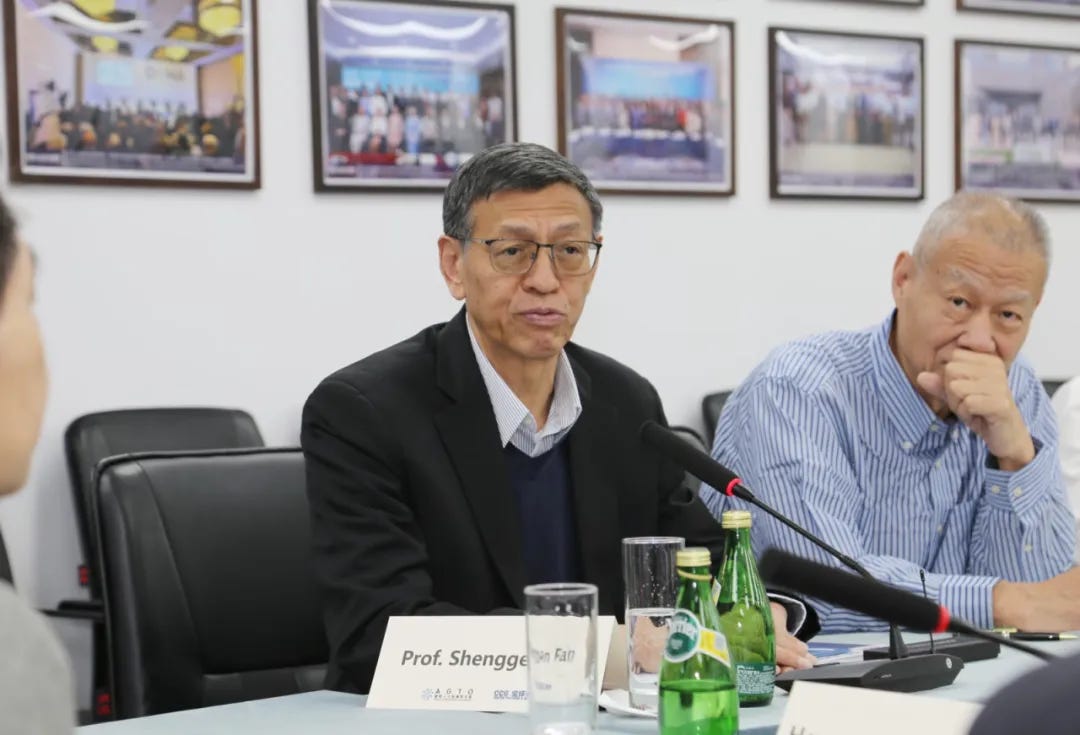
Thank you, Henry, for inviting me to come here to share some of my thoughts with you.
So I’m Shenggen Fan, or Fan Shenggen. I grew up in Jiangsu Province, in a very poor, small fishing village. I studied agricultural economics and entered college in 1978. Then I went to the US in 1985 to study agricultural economics at the University of Minnesota.
Since then, I have worked for international agencies, particularly global agricultural research institutions in the Netherlands and in Washington. I actually worked in Washington for 25 years as the head of the International Food Policy Research Institute (IFPRI), where we really tried to work with countries, not just developed countries but also developing countries, to address some of the global policy issues and guide food supply and so on.
Then I came back to China in 2020, just before COVID. Then I founded the Academy of Global Food Economics and Policy. You can see the name is similar to IFPRI, but we don’t focus on global issues; instead, we have a strong focus on China. So, as I already mentioned in the name of the institution, it is about food security.
I think the topic is about existential risks. I think food security is one of them. Food is essential for human survival. Without food, you will not be able to survive for more than a week.
So I just wanted to make a couple of points following Henry. One is that food security is very critical.
Food security is part of the overall security, whether it’s national security, global security. Unfortunately, now we still have more than 600 million people who suffer from hunger without food, without adequate nutritious food. Now even more worrisome is the lack of nutrition.
So lack of micronutrients, iron, zinc, vitamin A. So they are equally important as the calorie energy, so it’s not just total amount; it’s the quality of food, and there are 5 billion people out of 8 billion people right now who suffer from lack of micronutrients, iron, zinc, vitamin A, and so on. So, as you can see, the food security very critical.
It is food and nutrition security. Good food leads to good nutrition and good health. Without food, as probably 70% of non-communicable diseases come from food insecurity or from the way we eat, whether it is overweight or undernutrition. I just wanted to mention that food security is basic to human survival. I think we must focus on this. So that’s my first point.
The second point is that global food governance is in disarray. It’s very troublesome right now.
There are a couple of reasons for this. One is climate change. Every food system, or what we call the food system, is a victim of climate change. Because of the increase in temperatures, crop yields have suffered. The quality of food has also suffered.
Nutrition has declined, and even more importantly, regional inequality and regional disparities have increased because of climate change. For example, Africa, Latin America, and South Asia suffer much more than countries in the North. So climate change is a big issue affecting food. Well, they are obviously interlinked.
In the meantime, the food system accounts for 1/3 of greenhouse gas emissions. You can see this interlinked relationship between food and climate.
Now, obviously, another important threat to our global food security is the geopolitical divide.
The largest donor to food policy, food security and technology was USAID, the United States Agency for International Development. Two or three years ago, that agency was abolished. Whether we like it or not, that agency really played a very big role.
In the 1950s, the Japanese and Koreans benefited from food aid, and then later on, South Asia and many other countries. Unfortunately, the abolishment of that agency has caused so much trouble in many parts of the world, including Africa, Pacific countries, and so on. They used to depend on USAID for technology, direct food support, and even government functions. That’s gone. As a direct result, many people have fallen into hunger and malnutrition.
In the meantime, because of the Russia-Ukraine conflict, Europeans are beginning to move away from international aid and international development. So Germany, the Netherlands and Belgium have been increasing their defence budgets to 5% of their GDP. The UK is doing the same thing. So you can see that, because of these geopolitical shifts, our global food system has experienced more threats.
Then, the United Nations is also facing some uncertainties right now. This year, we will have a new Secretary-General. The UN Secretary-General used to play a very big role in bringing everybody together to work on food issues. I was part of the advisory group. So the uncertainty is huge. We don’t know who the next Secretary-General will be. Under Ban Ki-moon and the current Secretary-General, they have been very much committed to working with everybody.
So that’s one part of the global governance system: the UN and the FAO, the Food and Agriculture Organization. The current Director-General is the Chinese national Qu Dongyu. Again, his term will finish next June, and who will replace him as the Director-General of the FAO? So this global architecture, the FAO and the United Nations, is facing uncertainty.
In the meantime, the WTO used to work on agricultural trade and food trade. Now it’s dysfunctional because the US is not working at all.
And the World Food Programme, because of the abolition of USAID, they don’t have adequate resources to support the people who are in need in many parts of the world.
So that’s the challenge we’re facing. Now, what is the role of China?
So obviously, China plays a huge role in global food security. One reason is that China accounts for a quarter, or maybe 20%, of the world’s population. China has been able to produce adequate food through modest imports.
So China has been able to shift its food system from hunger to, let’s say, very diverse diets. We have really experienced rapid improvement.
Now, what is the role of China here?
The role of agriculture, the agricultural development pathways, investment in agricultural research and education. I think all the infrastructure and all these lessons can be shared with countries in the Global South through South-South cooperation and by supporting global institutions. So China has a direct role to play in working with others.
Well, it’s not replacing the US, but to some extent, maybe playing a different role from the one the US played before. So that’s one.
The other point is that China can also play an increasingly important role in influencing global food governance. Right now, the United Nations and the FAO, and maybe in the future, the G20 and BRICS countries, could play a much bigger role in global food security. So China could play a more active role in supporting some global institutions.
Thomas Reuter
Could I ask you a very specific question? When I think about food and China, I think about the Himalayas and I think about the fact that the water resources they are shrinking. We’ve seen the disasters in Nepal, the melting glaciers. We’ve got the Hindus, the Ganges, Ramaputra, the Yellow River, the Yangtze, the Mekong, feeding billions of people from that watershed.
How is China preparing to do that? That will immediately impact on food production.
Shenggen Fan
So, as Henry already mentioned, in terms of the application and use of digital and AI technologies, China is probably ahead of anybody, even ahead of the US, in using AI in food and agriculture. If you look at our distribution system here in Beijing, they are all driven by AI. So AI is helping in production, distribution, across the value chain, and even in consumption. For example, at my university, we have an AI restaurant that can tell us what we should eat.
So AI technology can also help us use water more efficiently. You can actually reduce water use by 50%, even 70% or 80%. So that’s one.
Then there is modern biotechnology. We used to do crop selection, then hybrid breeding, and then molecular biotechnology. Now it’s the creation of new varieties. So what do you want in your rice variety? Maybe drought resistance, disease resistance, or better nutrition.
Then you use AI technology to help identify the best genes, simulate outcomes, and then conduct field tests. That accelerates the breeding process by 10 times, even 20 times.
Another important innovation is microbiology. So now you use fermentation to convert waste, whether kitchen waste, even human waste, or any other waste, into single-cell protein. And that single-cell protein can be used as feed, if you don’t want to use it for human consumption, or for direct human consumption.
So basically, innovative technologies will help reshape the global food system and address some of the challenges just mentioned, such as climate change and the melting of glaciers.
Thomas Reuter
I think we would love to interview you another time and speak with you in more depth, because there’s so much there to cover. I have to stop myself, because this is a topic that really interests me, and there’s so much more to discuss, particularly about distribution.
You touched on supply chains. So much of the problem lies in distribution.
Yueqin Huang, Professor, Peking University Sixth Hospital; Fellow, WAAS
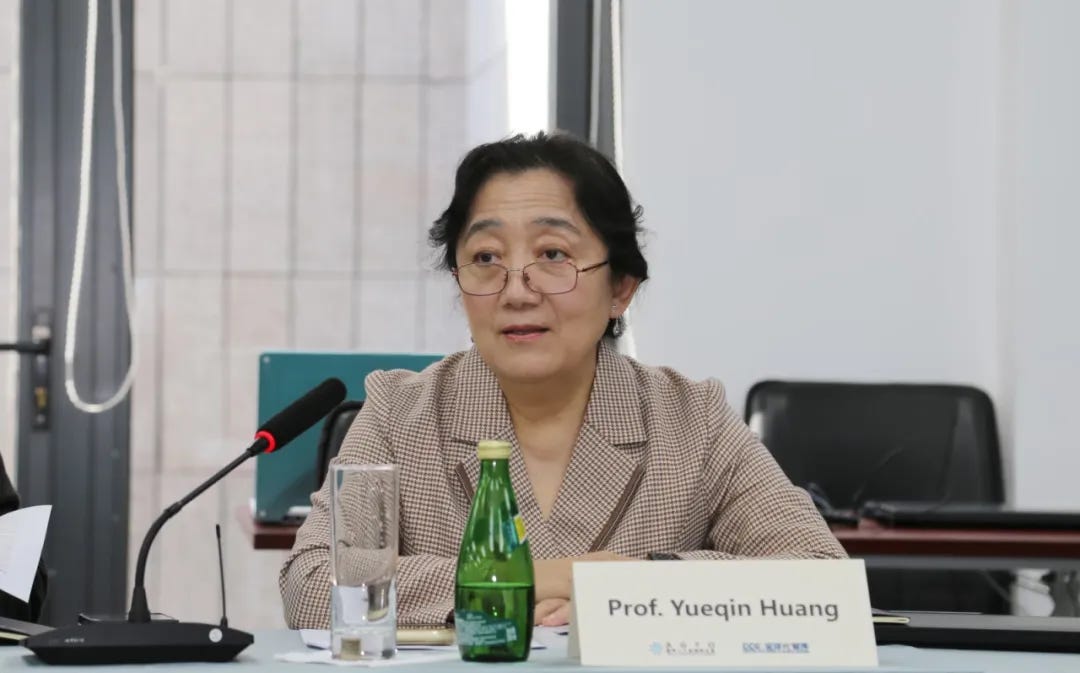
Thank you so much. It’s my honour to be invited to this meeting.
First of all, let me introduce myself. I’m a psychiatrist. I focus on psychiatric epidemiology. I’m from Peking University Sixth Hospital (Institute of Mental Health). Our hospital is a psychiatric hospital affiliated with Peking University.
Our hospital became a WHO Mental Health Collaborating and Training Centre in 1982. So, why am I here? Because I was recommended by Professor Lennart Levi. Do you know him? He used to be the Director of the Department of Stress Research at the Karolinska Institute, and he was also a member of the Swedish Parliament.
So, since the 1980s, in the last century, he visited China many times, and we did a joint project together, focusing on residents living in different types of dwellings. The hypothesis was that there were three types of housing in China: high-rise buildings with elevators, mid-rise buildings without elevators, and pingfang, or simple single-storey houses.
The hypothesis was that people living in different types of housing had different mental health conditions. But at that time, Chinese people were experiencing what we called a housing honeymoon.
So people living in high-rise buildings were very happy. That was in the last century.
Then, at the beginning of this century, there was a big initiative. The PI was Professor Ronald Kessler at Harvard University. So we carried out the World Mental Health Survey. I’m not sure if you’ve heard about it. More than 30 countries participated in this international collaboration, which focused on a cross-sectional study of mental disorders.
After 10 years, we carried out the China Mental Health Survey. I was the PI. So I just want to share some information on how many people with mental disorders there are in China compared with Western countries.
The overall prevalence of mental disorders in China, including the 35 mental disorders we investigated – can you guess how much?
Some might say almost 30%. It’s actually 16.57% for any disorder among the 35 disorders we investigated.
Then I just want to tell you: Have you heard the famous WHO statement, “No health without mental health”? Yeah. I think it was first published in 2004. That means mental health is not only about treating mental disorders, but also about providing mental health services. And the second part, health, means not only physical health but also mental health – both physical and mental health.
Since the beginning of this century, our government has carried out several national projects on mental disorders and mental health promotion. With my major and interest in social psychiatry and behavioural medicine, I always say that many factors influence mental health. So we focus on the environment, because our topic is about the environment.
I just want to, because time is limited, talk about sunshine. Sunshine is very important for mood disorders because we human beings live in sunshine.
Look at the prevalence of depression in European countries like Sweden and Norway. The quality of life is very high, but the prevalence of depression is still high.
Why? Because especially during the winter, there is no sunshine, or the duration of sunshine is rather short. So, people need sunshine because we have serotonin in our brains, and sunshine stimulates serotonin production.
Then, if we don’t get enough sunshine, it’s a big problem.
That’s why nowadays so many people work in the evening and at midnight, changing their lifestyles. Actually, we should sleep in the evening and at night, but we have to work at midnight.
During the daytime, they feel sleepy because they have changed their lifestyles. That’s a big problem.
So that’s what I want to focus on at this conference. We talk about the environment and lifestyle. We talk about what we, as human beings, should do.
That’s what I want to tell you. Thank you.
Thomas Reuter
Yeah, I just wanted to ask you about something specific, and that is the fact that in the West now many people talk about a global mental health epidemic. It’s a growing problem. The statistics are all up, and the use of lots of drugs to try and control these kinds of issues is growing.
And some people say that anxiety about existential threats is part of that problem. Anxiety about climate change and a sense of being powerless to change it and uncertain about the future. Also, AI is now for a lot of young people a huge stress factor. They have absolutely no idea what work environment they will encounter.
So I don’t know how does that do you feel? Do you have that issue in China? Do you witness that?
Yueqin Huang
It’s a hard topic. From the medical perspective, we should maintain a normal lifestyle, but we have to face so much stress and pressure. So how do we find the balance?
It’s very hard. We also tell people this. This afternoon, I was at another meeting where I talked about how to cope with stress and pressure.
So we cannot change the whole environment, but we can change ourselves. It’s very hard. It’s a hard topic.
Thomas Reuter
You cannot cover the whole world in leather, but cover your own feet.
Zhi Wang, Professor and Founding Dean, Global Value Chain Institute, University of International Business and Economics (UIBE)
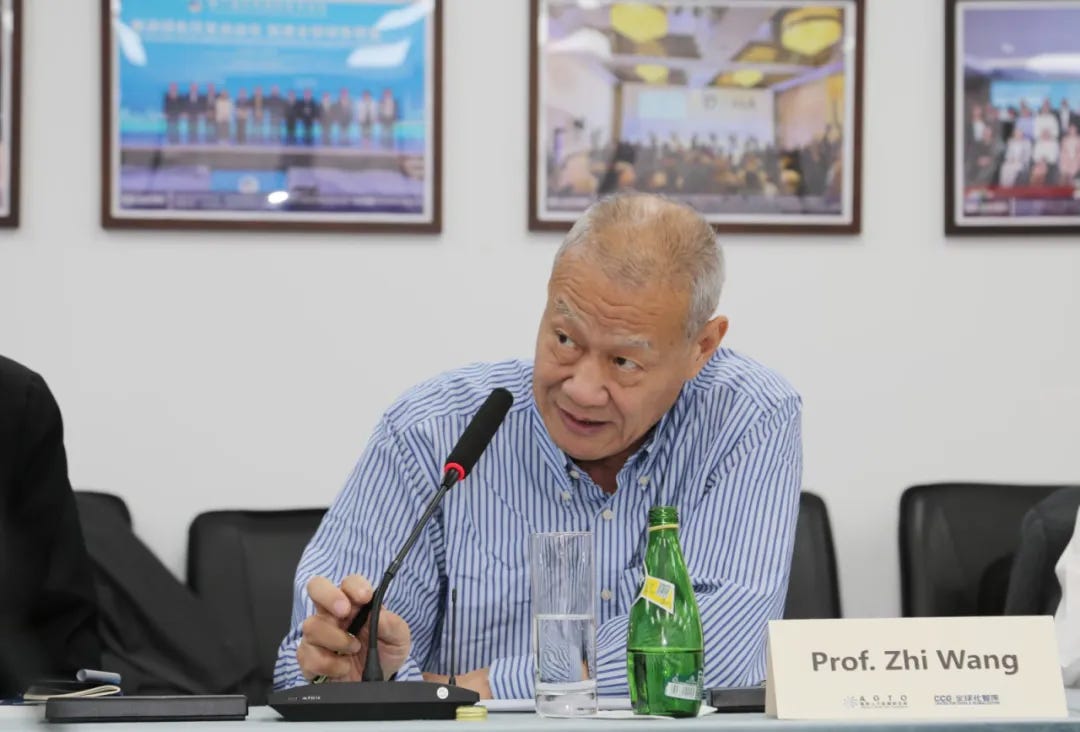
Thank you for organising this important discussion and bringing me here.
When we discuss existential risks, we often focus on artificial superintelligence, catastrophic climate change, major health crises, or military conflict. The consequences of these risks also depend on the systems connecting our societies.
So, basically, Shenggen has drawn on his experience working with the global food system. I will make some points based on my own research experience in global value chains, because global value chains and global supply chains support specialisation, innovation, and economic development. They can also transmit and amplify shocks. Their functioning determines whether countries can obtain the medicines, food, energy, and equipment they need during a crisis.
So my central point is that effective risk governance requires a better understanding of these connections and practical arrangements to manage them, even when political trust is very limited right now.
So I would like to make three points.
First, resilience should not be confused with complete self-sufficiency.
The semiconductor industry illustrates this clearly. You can build a factory at home, but that does not mean you eliminate dependence on foreign equipment, materials, technology, or specialised knowledge, because the whole semiconductor supply chain is global. Modern production rests on the international division of labour.
We therefore need to ask: Who do we depend on? How concentrated are those dependencies? Are suitable substitutes available?
And how quickly could essential production recover after a major disruption?
Attempts to eliminate external dependence can reduce efficiency and innovation without addressing the most important risks. A practical approach is to make interdependence more transparent, more diversified, and more manageable.
That’s my first point. So we have to understand this.
Thomas Reuter
This is incredibly important because so much conversation now about the weaponisation of interdependence. Does that mean we should not have interdependence? Should we localise value chains? Should we maybe to an extent…
Zhi Wang
Because modern society depends on global supply chains to operate. It is a production network. It is not possible for one country to do everything on its own.
So, second, climate change shows why risks and responsibilities cannot be understood only within national borders. Carbon emissions occur in particular locations, but the production generating them often serves consumers elsewhere.
Investment, technology, and ownership also cross borders. In our research, we trace emissions and value added through the full product network, from upstream inputs to final demand. We have a paper published in 2018 in Energy Economics that provides an integrated accounting framework.
Subsequent work distinguishes multinational-owned from domestically owned firms and traces emissions through trade and foreign direct investment (FDI). Our 2023 paper in One Earth distinguishes different forms of responsibility shared through international cooperation and international value chains. Under this GVC-based framework, developing countries’ total responsibility has exceeded that of developed countries since 2012.
That means that, since 2012, Global South countries have emitted more carbon dioxide (CO2) than Northern countries. This does not erase historical responsibility or differences in development needs and capacity to pay. So why should current mitigation not consider the interconnected roles of producers and consumers?
Decarbonisation must reduce emissions across the whole supply chain. Moving carbon-intensive production elsewhere may improve one jurisdiction’s indicators without reducing global emissions. Cooperation should help suppliers adopt clean energy and production technologies. That’s very important.
You cannot simply move production to source countries and assume that the problem is solved, because emissions are global. So, if you look at our paper, you will see that, after 2012, South-South trade became much more capital-intensive.
Third, vulnerability needs to be measured at different levels. Our research distinguishes direct dependence on imports of intermediate goods and capital goods, and dependence on international markets, from broader dependence within the production network.
Import concentration alone does not tell the whole story. Imports can come from different countries whose supplies all rely on the same upstream inputs. Conversely, purchasing mainly from one country may be manageable if other producers can provide suitable substitutes quickly.
A historical analysis of China’s intermediate goods imports in 2018 illustrates that vulnerability is not evenly distributed. The main lesson from this study is that policy should prioritise critical bottlenecks rather than attempt to localise every stage of every supply chain. That’s not possible.
For global governance, these points suggest several priorities. We need comparable indicators of concentration, substitutability, carbon intensity, network dependence, and recovery time. We need cooperation on diversified suppliers, appropriate resources, compatible standards, clean technology, and emergency production capacity.
We also need to recognise China and other Global South countries as producers, markets, technology partners, and contributors to institutional innovation.
Our perfect example is the Global Green Industrialisation Initiative that Xu Yao and I proposed. It connects China’s green manufacturing capacity with international technology, capital, and business networks, as well as the development needs of the Global South. Joint ventures, local software development, and workforce training could help build green industrial ecosystems, supported by suitable financing and capital standards, and compatible standards.
So I have a presentation outline, but I don’t think we have enough time. We can show it. I would welcome a full discussion on financing, risk allocation, and implementation during the open discussion or over the working lunch.
We have a paper in the South China Morning Post on this. So we’re just trying to combine China’s green energy manufacturing capacity with these international networks.
For example, when I was visiting Tsinghua University over the last three years, I basically studied the Chinese EV industry. So you can see that the Chinese EV industry has become one of the leading industries globally right now.
It’s not just about subsidies, and it’s not just about government subsidies. That’s a very small part of the story. So let me move on.
I think for the CCG and EXTRA initiative, a useful next step could be a joint plan focusing on one essential supply chain. For example, researchers and practitioners from different countries could share bottleneck assessments, test disruption scenarios, and propose a few possible cooperation measures.
So many risks are global, while governance remains largely national. That’s the major challenge. Better measurement can identify shared exposure and responsibility. Practical cooperation can turn that knowledge into action that keeps essential systems functioning and supports sustainable development.
Thank you.
Thomas Reuter
Thank you. That raises so many questions. I have about a half a dozen questions I could ask you, but we have to be mindful of the time.
But it’s certainly very true that we have to think in terms of entire value chains. For example, in carbon accounting, we have to think about value chain differentiation for resilience, and oh, there’s so many issues there. It’s a huge part of the background thinking for global governance has to take place exactly there.
Zhi Wang
Huiyao and I suggested a Global Green Industrialisation Initiative that can bring Western, Northern and Southern countries together. You can make use of China’s manufacturing capacity and also its suppliers of capital. So that’s our proposal.
Yi-Heng Cheng, Member, Club of Rome; Fellow, World Academy of Art and Science (WAAS); Adjunct Professor, Tongji University
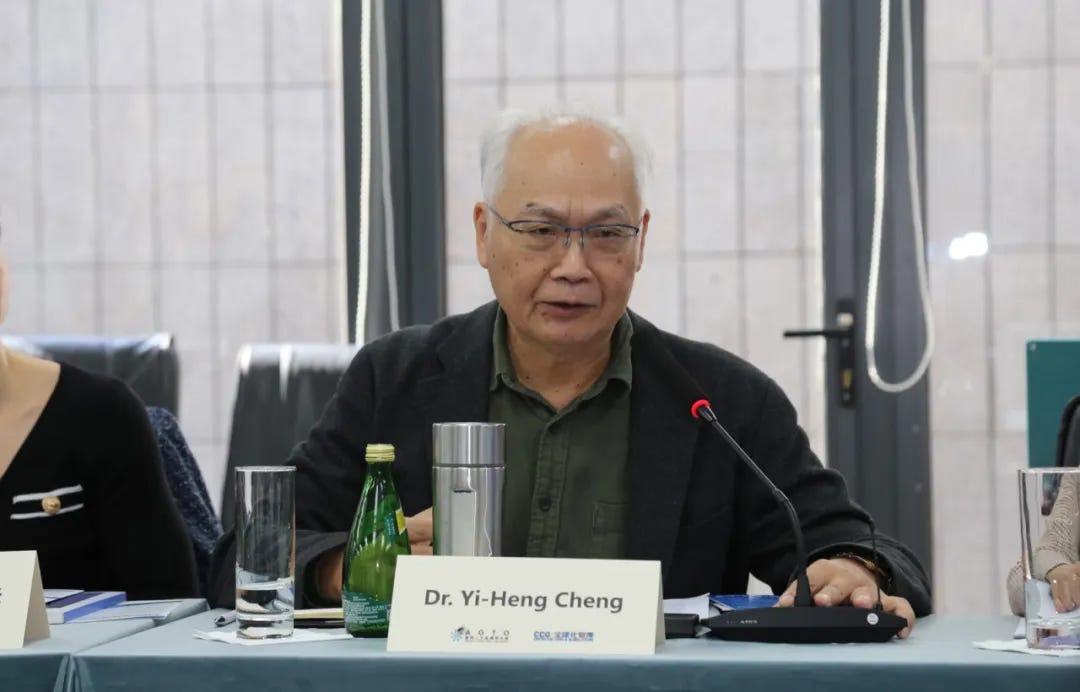
Thank you. My name is Yi-Heng Cheng.
I was born in Taiwan and graduated from the Karlsruhe Institute of Technology in Germany. I’m a chemical engineer. So I’m somewhere between you and Professor Evans, between chemistry and economics. That is actually what I am also doing as an Executive Committee Member of the Club of Rome.
So, what I would like to say is that I’m very pleased to hear what Professor Wang mentioned about this initiative on global governance.
But if we look back 50 years ago, when the Club of Rome started with its first report, The Limits to Growth, we can see that, from that day on, the Club of Rome had already predicted what would happen in 2000, 2020, 2030 and 2050 through these curves. But human beings are still heading towards the same outcomes that were predicted 50 years ago.
And today, when we look back, what has happened in the last 50 years? We can say that some effective measures have been taken. For example, the Dangerous Goods Act or regulations developed in Germany have imposed restrictions on chemicals and all the risks arising from chemicals. Later on, we had Responsible Care, when the chemical industries took the initiative themselves and tried to track the entire production process, as well as the stewardship of products and the use of chemicals, etc. So these are initiatives coming from industry.
What is most effective currently? I have just seen the Institute of ESG or Global Institute here, and ESG is being used by banks and financial institutions to judge whether a company is following global governance principles.
Now, I’m very happy that Professor Wang mentioned this initiative. But what is critical is how to make global governance effective.
I’m very sure about what you just mentioned. When we are standing on the same Earth, there are no newcomers or latecomers. You can accuse developed countries of having polluted the Earth over the previous 100 years, while developing countries only started doing so over the last 20 years, and China perhaps only over the last 10 years.
But we are still standing on the same Earth. There is no difference. Carbon dioxide does not distinguish whether it comes from China, the United States, or anywhere else. So we are all in this world. We have to share that responsibility together. There is no shared responsibility based on origin. There is shared responsibility for the future.
So when we talk about measures, if you look at measures such as carbon trading, of course, this is a very effective measure. But when you come to the actual substance, let’s talk about SAF, sustainable aviation fuel, which comes from biomass.
So what is actually happening in China? China has one of the most successful projects in the world, or perhaps the most successful. The first and largest unit is in China, with a capacity of 100,000 tonnes, in Shanghai.
But all chemical engineers know that whenever you have biomass cracking, you will have difficulties scaling up from 10,000 tonnes to 20,000 tonnes, then to 50,000 tonnes and 100,000 tonnes.
But China has started with 100,000 tonnes. That’s okay. The process itself is one thing that you have to solve, and this has not yet been achieved.
And secondly, you still have to collect all the biomass, and all this biomass has to be treated with hydrogen. And where does the hydrogen come from?
So it is understood that SAF is more expensive than conventional fuel. What is the industry asking? The industry will ask: “You are doing the economics, so when will the carbon dioxide price, the selling price in Europe, reach 150 euros per tonne? Then we will still be able to purchase it. But whenever it goes above 150 euros, we cannot afford it anymore.”
So industry does not move according to the interests of One Earth and the future of humankind. Industry only moves within the economic framework.
So what is wrong? The economic framework is wrong.
So, as a member of the Club of Rome, what I would say is that the fundamental issue is a distorted economic framework. We have to change that in order to address the many questions that Tom has just mentioned. So we have to put the economy back on the right track.
When you talk about this, I fully agree with you. If you have the initiative involving President Xi, President Putin, and President Trump, the only one who can make a decision is Xi. The other two cannot. What can they do? Can they order their whole countries? Trump cannot order his business partners, or Putin cannot order them to stop producing CO2. But the Chinese can, right? But how?
So overcapacity does not mean anything else but overcapacity in CO2 emissions. That link has to somehow be broken.
So my thesis is that scientists and technologists have already developed all the technologies needed by industry, but they have not been implemented because of the distorted economic framework. So we have to change that. Thank you.
Thomas Reuter
About that, it’s very difficult in the political systems in the West, but perhaps also in Russia, to change that system. But there’s really no alternative. What can we do?
It has to be done, and we have to, I guess, also raise consciousness in the industries that’s in their own interest because they’re in the same boat, like you say.
David Geraint Evans, Professor and Director, Science Popularisation Experiment Centre, Beijing University of Chemical Technology
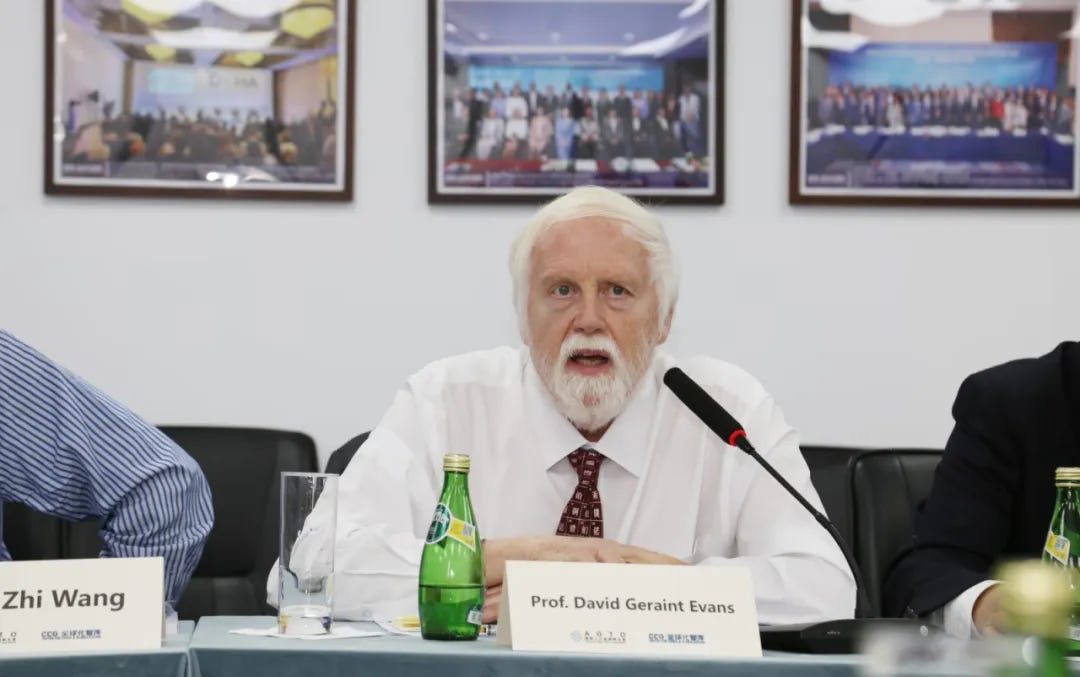
Thank you. So my name is David Evans. I’m originally from the UK, but I’ve been working at Beijing University of Chemical Technology since 1996, so about 30 years now.
Henry has very cleverly arranged to have the chemist and the chemical engineer speaking in sequence. Although strictly speaking, it should be the chemist first and then the chemical engineer. So we go from the test tube to the chemical engineer.
When I told my colleagues in the UK in 1996 that I was moving to China, the more polite one said, “You’re very brave.” The less polite one said, “You’re crazy. What science can you do in China?” I said, “Maybe not much now, but come and see me in a few years’ time.”
And I think this is something that has changed. Previously, international exchange was virtually one-way. You went to the US, and very few people from the US or Europe came to China. But it’s gradually changing, and increasingly, China is attracting young people, postdocs and future researchers to come to China.
So I think international cooperation is essential to solving all of these problems. And the more it becomes a two-way exchange – people coming to China and learning from China, as well as people going to the US and Europe – the more efficient we will become in solving these problems.
So hopefully, more people will come, and certainly in my area, there’s a lot that can be learned. I’m an inorganic materials chemist, and we’ve been able to make new materials in the lab.
They all have a sandwich structure. But just as with sandwiches, if you change the structure of the bread and change the filling, you change the taste. We can change the structure, and we can change the properties of the material.
So I was doing this basic research in the UK, just on a test-tube scale. But after coming to China, we’ve now been able to develop products that are on the market.
For example, one is an additive for agricultural plastic films to keep greenhouse temperatures higher at night. Another one is like a sunscreen.
If you go to Tibet or the west of China, the altitude is high, so ultraviolet radiation is strong. Your skin gets burnt. The new roads, which are essential to boosting the economy of less developed regions, also start to be damaged by ultraviolet radiation.
So we have one of our sandwich materials mixed in with the bitumen, which protects it from UV radiation. We also have another material that removes heavy metal ion pollutants from soil.
So this is all fundamental research that chemists and chemical engineers, with government funding, private industry and venture capital promoted by the government, have been able to bring together and turn test-tube products into marketable products. That’s very hard to do in the West.
So there’s a lot to be learned by scientists and engineers coming to China. Hopefully, more will come, as we have, and then go back and spread the word.
So, if you look at the last century, there was, of course, a massive increase in life expectancy, from something like 30 years or a little more to nearly 80.
And why was that? Two of the reasons Professor Fan and Professor Roy have already touched on. One is the supply of clean water, and also adequate food from fertilisers.
The third one, I think, which we haven’t mentioned, is antibiotics.
A hundred years ago, with most diseases, if you caught a bug, you died because there were no antibiotics. So antibiotics have made a huge contribution.
But what’s happening now? I think antibiotic resistance, which we haven’t mentioned, is a huge problem for the future.
And the main driver is not people. A lot of people seem to think that if you don’t finish a course of antibiotics, then the most resistant bacteria survive, and that builds resistance.
Actually, I think the biggest problem is agriculture. It’s the overuse of antibiotics.
So now, how do we tackle that through science? One way is by using probiotics. So you try to actually crowd out the large and small intestines with helpful bacteria, which prevent dangerous bacteria from growing.
And even further along the line, there is now genetic engineering. There are new techniques like CRISPR-Cas9.
So this is very different from genetically modified organisms (GMOs), where you actually introduce foreign DNA into the DNA of an apple or a potato. Here, you’re actually not introducing any foreign DNA, but you’re tweaking the DNA to introduce the properties that you want, so you don’t need so many drugs or so much fertiliser.
So there are lots of ways in which science can tackle these problems, but I think what will be needed is global standards.
You can see, for example, with GMOs, genetically modified materials, the regulations in Europe and the US are completely different. But as new techniques come online, hopefully there will be some standardisation across different countries.
And then finally, although I said I’m an inorganic materials chemist by training, in the last 10 years or so, I’ve switched most of my work to science popularisation and outreach. So I go into primary schools, middle schools and high schools, not just to get kids interested in science and create the scientists and engineers of the future, but I think probably more importantly, to get young people to start thinking scientifically and develop critical thinking skills.
That’s because they are the leaders of the future. Only 5% are going to become scientists and engineers. The others are going to be the people who will solve the problems we’re facing.
But I think people’s understanding of, say, relative risk and absolute risk, causation and correlation, is in many cases non-existent. And the media, whether traditional media or new media, all want clicks.
So when they report a scientific discovery, it’s all sensational. “Wow, this is going to change the world!” So you need to have a sceptical attitude.
Hopefully, what we’re doing is training people to start thinking critically and to use that knowledge when they come into positions of power and influence.
And then the final point I’d like to make is AI.
People have mentioned how useful it is. I think we have to be careful. I see young people just talking to ChatGPT. You ask them a question, and they’ve lost the ability to think because it’s all on Doubao, it’s all on AI.
So I think this is cognitive submission. Students don’t want to think because they know it’s too easy. They don’t want to solve the question or solve the problem because they just think they can look up the answer on AI. So I think we need to find a way of making them use AI in a useful way.
In the same way, I’m old enough to remember when calculators came into maths lessons. Maths teachers were horrified. “Aha! The students will never learn how to do multiplication!”
But fortunately, schools didn’t say, “We’re never going to let the students use calculators.” There’s a place for calculators, but students need to know how to use them.
So if the screen says the answer is a million, you need to have done a back-of-the-envelope calculation, which should give you about 10. So that can’t be right. But you also need to have lessons where there are no calculators.
So I think what schools need to do is make sure there’s a balance, so that sometimes students are using AI in a useful way, but at other times they’re using their own brains. But that needs to start early, because if it’s left too late, you’re never going to go backwards.
So we did a good job with calculators, and we’ve done a very bad job with mobile phones. How many times have you been in a restaurant and seen a young couple supposedly having a romantic meal together, but they’re not talking to each other, not even looking at each other?
Hopefully, the way we use AI will become more like the way we use calculators, and not the way we use our mobile phones.
Thomas Reuter
I’m very interested in what you have to say, also about some of the solutions coming out of chemistry. And I think there may be solutions to some of the really big problems.
I wanted to put you a little bit on the spot about the problems that are coming, or have been coming, out of chemistry and the chemical industry. I’m thinking about plastics, for example, and forever chemicals.
What can you tell us about what’s going on in China in terms of thinking about how to replace plastics that cannot be recycled?
David Geraint Evans
Yes, so there’s massive investment in biodegradable materials. But as Professor Dr. Tom mentioned, there’s the cost. But you also have to look at the whole life cycle. You can’t just say, “Oh, it’s biodegradable.” You’ve got to look at the carbon footprint and the environmental impact of producing it.
But then, if it degrades and produces methane, that’s a much more potent greenhouse gas, and then that cancels out the benefits.
Thomas Reuter
Exactly what I was thinking. I was thinking that China is great at bringing costs down through optimising manufacturing. And the big obstacle to recycling, certainly in my country, Australia, is the cost.
Virgin material is still cheaper than recycled material, and that is a massive disincentive. It requires political intervention. Basically, otherwise they’re not going to use a lot of recycled material, even if it is actually cheaper.
David Geraint Evans
Yes, yes. So you’ve got to look at the whole life cycle.
It’s the same with electric cars. Well, no emissions, but you’ve got to look at the whole life cycle, from digging the materials out of the ground to make the battery, looking at its carbon footprint and pollution problems, right the way through to when you discard or recycle the battery.
So that’s again one of the points I make about encouraging people to think about problems in a scientific, critical way, rather than saying, “Well, just look at the solution in the middle.” You’ve got to look at the whole picture.
Thomas Reuter
Yeah, that’s right. Like electric cars are wonderful, but batteries, 40 tons of ore has to be your project.
Jinfeng Zhou, President, World Academy of Sustainable Development; Fellow, World Academy of Art and Science (WAAS)
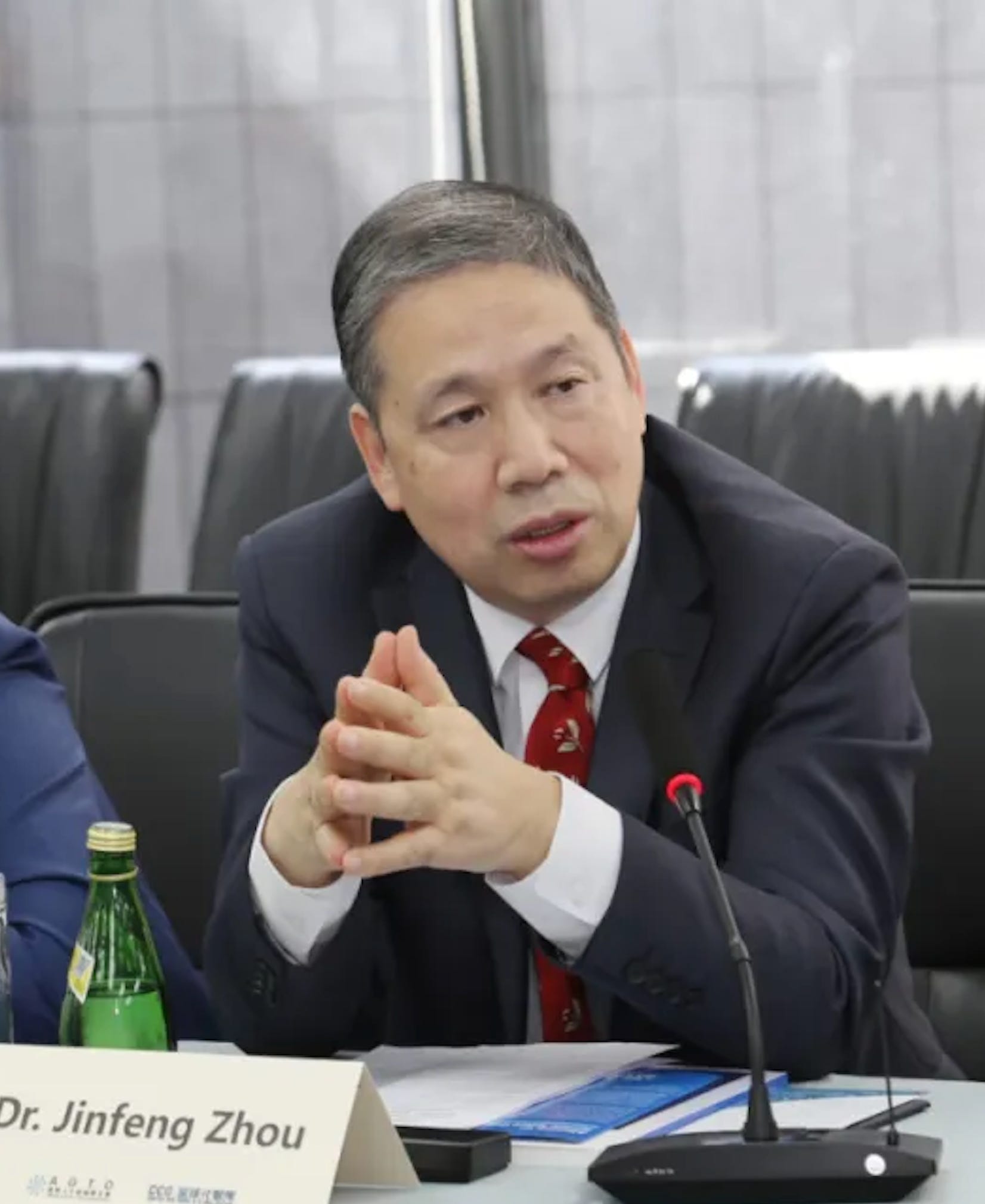
Okay, thank you. I agree with the majority of what has been said. I don’t want to spend much time on those topics, but I would like to emphasise climate change.
We have an initiative called “We Are Equal on Carbon”. Carbon responsibility: everybody is equal in terms of carbon responsibility, the right to use carbon, and the right and ability to participate.
All these problems are caused by human beings. So the only solution is people’s participation. That will be the major factor, especially because of the industrial framework, the legal framework and government intentions. Eventually, they are not going to do much about climate change without pressure from the people, as we can see from what the US is doing today.
So ultimately, the solution is people’s participation at all levels, including civil society and youth. That will be the only solution to today’s problems, including climate change.
I would also like to emphasise biodiversity. We have been working on biodiversity for the past decades, and this will become a more serious issue, especially because of global development.
In the coming years, development in developing countries will cause more serious biodiversity problems because they need more land. They will participate more actively in international exchanges involving natural resources, so they will need more natural and ecological resources. That will cause even greater biodiversity loss in the coming years.
And although China has solved major pollution problems, biodiversity is still a very serious issue because we are building more highways and more cities, and that greatly breaks up natural habitats. We are also going to build more canals and more water networks.
That’s terrible from the biodiversity point of view. And based on that, as the whole world develops, developing countries will follow almost the same path. So biodiversity is going to be a very serious issue.
AI is also a very important issue. We wrote to the UN asking for AI governance, and recently I wrote to the Chinese government. China has initiated a vehicle called the World Artificial Intelligence Cooperation Organization. We call it “WAICO”. I don’t think that is good enough as a governance mechanism or solution for AI.
I think it should be a global organisation. It should include not only governments but also civil society, NGOs, scientific organisations, and especially companies. Something like the IUCN, which is a joint organisation, could be a reasonable solution for AI governance.
AI itself is not necessarily going to be a major risk, but some people using AI could pose a real new threat to fairness, to the world and to people.
And so I recently returned from the UN, where I participated in the IPI, International Panel on Inequality. Inequality will become a more serious risk, especially given the issues we have discussed here today.
What is the fundamental solution? I think number one is people.
So the Club of Rome, together with my academy and the local government, co-organised a science popularisation event in Zhejiang this month. Most of us believe that people are essential. Science popularisation and public awareness are essential to how we deal with these risks.
And if we put it in another way, we need a new civilisation. That means changing everything: changing standards, changing laws, changing politics, changing everything. Even we, the people ourselves, need to change.
We need a new self. Human beings must start building a new civilisation to tackle the existential risks we face. Thank you.
Thomas Reuter
I couldn’t agree more. We really do need a new civilisation, a different way of thinking, and a different way of understanding our own place in the world as human beings and how we relate to the environment.
I’ve done many things. One of the things I’ve done is write about social movements, including religious movements. And there’s a big trend towards eco-spirituality. It is actually happening.
A lot of people are asking these questions and finding answers by thinking of themselves as part of the ecosystem, as part of a whole, and recognising that basically all life is one big family. They find great satisfaction in that. So this is actually happening.
The other thing I wanted to thank you for was bringing up biodiversity. I was a scoping expert for IPBES at one time, so I understand the problem quite well. And at the beginning of November, we have a special session like this for EXTRA, specifically on biodiversity loss, because it’s traumatic.
People don’t realise that we are in the middle of a great extinction event. And it’s not something that is going to happen in the future. It has already happened. We’ve lost 80% of our insects in Europe. This is traumatic.
We are already very late in the process, and yet it’s not receiving much coverage in the public media.
Xiaopeng Yin, Professor, UIBE; Former Dean, Research Institute for Global Value Chains
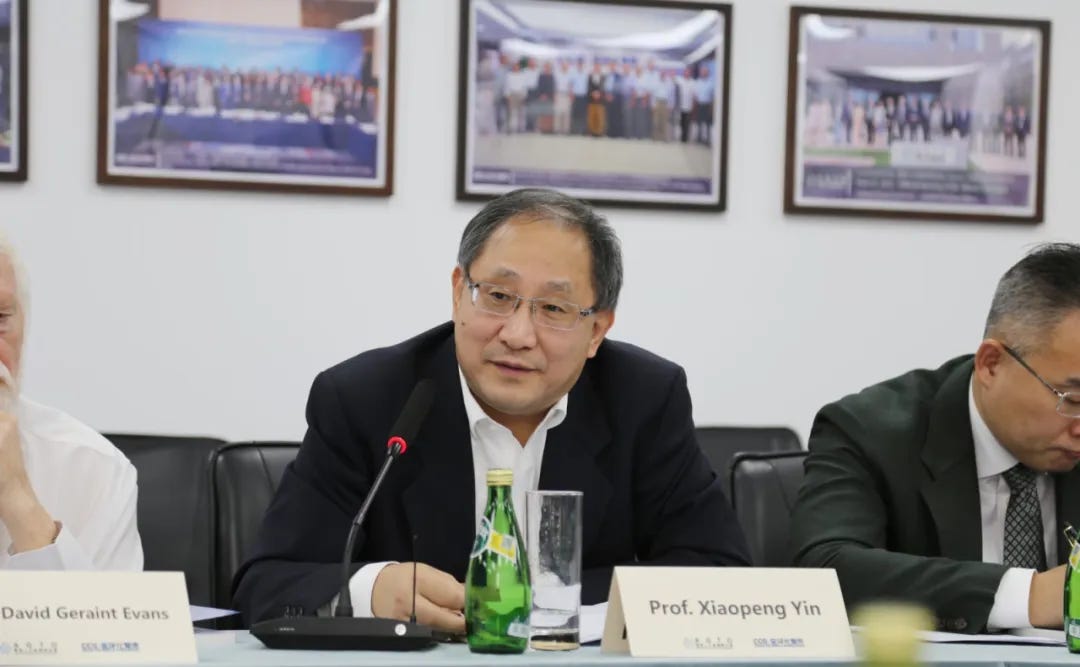
Thank you, Thomas, and thanks to CCG, WAAS and EXTRA for inviting me.
Wow, there are so many topics, and they are all very interesting. As I said, maybe I can focus on one. Shenggen and Zhi Wang have already mentioned some things. I do trade and GVC research, but maybe I can choose one topic. One of the concerns mentioned here is AI.
When we talk more about this, as economists, we are perhaps not technical people. I don’t know too much about the technology itself, but something very interesting to us is also how it concerns trade and global value chains (GVCs).
I really like this term that he used: artificial superintelligence. I guess that’s really superintelligence. That’s a very big concern.
Let’s look at it this way. People talk about AI as an advanced technology all the time. They always talk about it in a positive way, saying it’s our future. I agree, of course. High technology is the future. It has always been the future, and it will be the future for the next 100 years. But there are some concerns that are also very interesting and very important.
In the short term, people would say that AI is attracting a lot of money and investment into just one field, AI. So there are many responses right now. People say that we cannot afford it. This is because it is a crisis that could definitely crash the financial market very directly.
Responses come quickly, but that’s the reality. It’s also a big problem. They invest money, lose money, and then we have to deal with the consequences.
It’s like what we economists call the Dutch disease. It’s like the Netherlands, which discovered natural gas in the 1970s. The Netherlands shared the oil resources with the UK, but the UK had a much stronger economic base. The Netherlands was a relatively small country, so the oil industry boosted that sector but caused other industries to decline. Eventually, GDP went down.
So economists call this the Dutch disease. And people say AI could become the next Dutch disease. AI-related industries will be boosted, but all the other industries will suffer. So that’s one issue concerning money.
Another very important issue, especially for China, is that unemployment could increase dramatically. AI could replace workers. So that’s another concern.
We need to think about which direction we should drive AI, or artificial superintelligence, towards. The direction is very important.
We could have Chinese experts and international experts debate with their counterparts in the US at international conferences to discuss which direction we should take. That’s very interesting.
Maybe some venture capital investors in the US are willing to bear the costs over a longer period. They don’t want to see returns quickly. That could be a good thing, allowing the technology to develop further into the future.
But Chinese AI developers, I would say, are not necessarily focused on creating entirely new technologies. I would say that Chinese industry players may be more focused on getting reasonable returns, or short-term returns, because investors need them. In that way, they have many applications that replace current employees, making this problem more serious.
I like this topic very much. We are talking about human survival. Human survival.
How can we deal with this? We cannot imagine a situation where everybody stays at home and AI makes money for you. Maybe you have a good life, but nobody works. That’s a very serious problem.
This is already quite obvious in some industries in China. For example, there have been protests involving non-human-driven taxis in Wuhan. Thousands of people protested because they were concerned about their jobs. So that’s an interesting example.
Another important concern is that AI development, especially research on what they call large models, is different from other technologies.
With previous technologies, sometimes you could say that we had invested too much, so we could invest less. But with AI, if you don’t do it, you may fall behind. If you want to develop a large model, you need hundreds of millions of dollars, even billions of dollars, and you have to invest that money. If you don’t do it, you fall behind.
I found something very interesting. Some people have discussed this issue. One of them is the author of Sapiens: A Brief History of Humankind, an Israeli guy, Yuval Noah Harari. He mentioned something when he spoke in the UK. He said the UK had three choices.
The first choice was to forget about it and follow the US, totally becoming dependent on the US, like those countries that follow the US in everything. They have a very nice way of putting it.
The second choice was to do it yourself, investing £500 billion. Theoretically, you could do it on your own.
The third choice was to cooperate with the EU, the European Union, to develop it together. But the amount of money required would be the same. So you have to decide whether to do it or not.
Well, he was talking about the UK’s situation, but it seems that we can see that this is a huge amount of money. You cannot divide it up and develop it in small steps, like you can with some other technologies. You cannot necessarily develop it gradually. It’s almost a yes-or-no decision. So that’s one big problem.
And in the long term, there could be another problem. We talk about the Global South. This is a big problem in the long term.
If AI, especially what I like to call artificial superintelligence – I’ll say it again, artificial superintelligence – becomes dominant, can developing countries in the Global South afford it?
If one country develops it, and other countries cannot afford to do so, the technological gap will become huge. They may never be able to catch up, and could remain permanently poor.
You can compare this with how China built its warships before 1956. We didn’t have enough machinery, but we could ask people to do the work. A thousand people could do it by hand. It was tough, but it was still possible.
But with AI, and especially large models, sometimes there is no possibility of doing it that way. I can do it, but you cannot. My robots are very small, and they can work 24 hours a day, while also being plugged in and supplied with energy. You can keep doing this indefinitely.
Nobody can compete with that. So that’s the problem.
We discussed this issue at the WTO Public Forum. What could be one possible solution? Maybe we could ask developed countries, including China – China has a particularly important role here – to consider this.
Once we have this technology, perhaps we could relax intellectual property protection to some extent and share it with developing countries. The world needs to be fair.
So, yeah. Let’s talk about some other things. This is something we have discussed. I’m really going to talk more about international trade, but AI also really disrupts international trade.
Some industries say that trade is about buying something and selling something, exchanging goods. But with AI, you may not be able to sell anything anymore. They are already doing it, and that is a big challenge for us.
There are many aspects to this, but that’s why I wanted to raise these points. Thank you.
Thomas Reuter
You raised some very interesting questions. We keep a close eye on AI developments. Jerome Glenn, one of our World Academy fellows, is the head of the committee that is advising the UN General Assembly on artificial intelligence. So we have some pretty good near to the ground, so to speak.
But what I find interesting is the Chinese perspective. There has been so much discussion about the decline of manufacturing in the US, and more recently in Europe, the vast Rust Belt, the associated political problems, and the decline of major automotive cities like Detroit. China is often blamed for this, but in fact, automation and robotics were also very significant factors.
And now this is going to happen to China. There isn’t a lot of manufacturing left in the US to lose to AI, but here in China, there is a lot to lose. So the political problems you will have to solve could be massive, especially because your approach to AI is very application-oriented.
A lot of it goes into robotics, and that’s going to have a massive impact. You also have an ageing society. Maybe there will be some happy meeting between the two. But what is the thinking about this issue?
Xiaopeng Yin
Well, you’re right. That’s one thing I want to consider in this regard. China, especially, perhaps the government can do something.
One piece of data may illustrate this. The US is currently investing around US$750 billion, while China is investing around US$100 billion. But these are firm-level investments. In the US, investment is entirely at the firm level, whereas in China, there is also some government support.
So the government still provides funding. This means that, as long as the Chinese government provides the funding, it can influence the direction of AI development. That’s something the government can do, right?
So that would probably make the situation better. That could be one potential opportunity.
We could say that there is also a potential opportunity here because the Chinese government is relatively strong, especially in this regard. As long as the private sector does not have enough money, the government can provide support and invest.
So the government can make changes. For example, if companies want to invest in an industry that generates quick returns but also leads to massive unemployment, the government can say, “Hey, I’ll invest in this direction instead. You cannot do it that way.”
So that’s what I’m saying. As long as the government is involved, we can also expect the outcome to be better. But we don’t know how much the government can do, or how much of a factor it can be. Thanks, Tom.
Marta Nešković, Postdoctoral Researcher, Chinese Academy of Sciences; Junior Fellow, WAAS
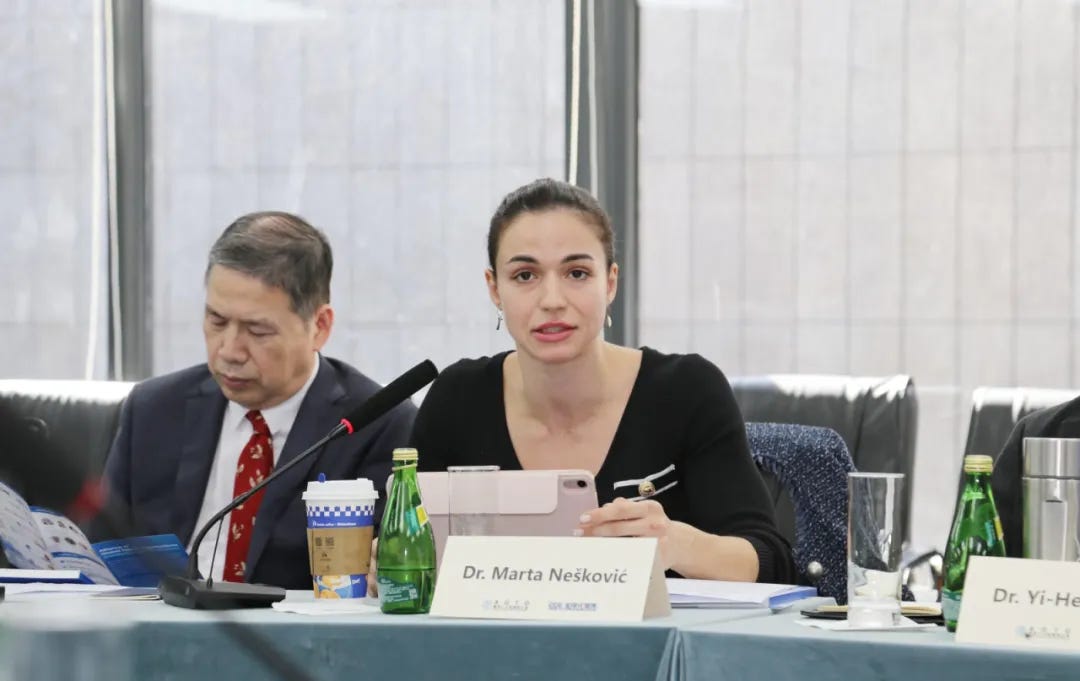
So my name is Marta Nešković. I’m a postdoctoral fellow at CAS, the Chinese Academy of Sciences, and an Associate Fellow of the World Academy of Art and Science.
I would like to address the question of education and point to a fundamental issue which I believe is not addressed or taken into account within public educational institutions worldwide. That is the relationship between the scientific pursuit of knowledge, morality, and mental health.
To explain, I will first address a problem that is as much historical as it is pressing at present.
What understanding of human nature underlies our efforts to address existential risks? Do we proceed from the ideals people profess, from what we believe they could become, or from how they actually live, pursue their aspirations, and organise themselves into groups?
These are different grounds on which to build expectations of cooperation. A commitment to humanity’s survival does not tell us how people will act when it conflicts with what they strive for in their everyday lives, or with their obligations to particular groups they belong to, or feel they belong to. Yet neither should we assume that their existing practices exhaust what human beings are capable of becoming.
When we avoid this question, we risk explaining threats through divisions between good and bad people, good and bad groups, or even nations. Such explanations contribute to alienation and leave our own conduct unexamined.
An impartial approach would ask what people actually strive for and apply the same questions to ourselves as to those we hold responsible. Pointing fingers can otherwise lead to locating the source of danger in others without examining what their conduct might reveal about human tendencies we all share.
My concern is that organising around the survival of humanity does not automatically overcome the divisions through which people exercise power.
Even a group established beyond national boundaries to work for the good of all can position itself as morally superior, treating disagreement as evidence that others are ignorant, irresponsible, or indifferent to humanity’s future.
The question is therefore also how efforts to address existential risks might reproduce alienation and domination within the very forms of cooperation intended to protect us.
Inertia presents a further difficulty.
We speak of aspirations and changing habits, but people need not actively aspire to the outcomes that their everyday lives and conduct help sustain. Conflict, alienation, and consumerism can persist through habitual behaviour and feed on our least admirable tendencies, yet our proposals for overcoming them often rely on our highest capacities.
We therefore risk explaining the problem through one understanding of human nature and proposing a solution that presumes another.
What justifies our expectation that the capacities on which the solution depends will prevail over the tendencies and habits that sustain the problem?
For me, the practical question is whether our responses to existential risks depend on capacities and commitments that people already exercise, or on ones we hope they will develop sometime in the future. If we count on the latter, how do we expect this transformation to occur?
We cannot leave this question to philosophy when our practical proposals depend on an answer.
If education is meant to bring about this change, public education worldwide requires fundamental reconsideration. Who should determine its direction?
Before answering, we need a clear understanding of how scientific inquiry, or the pursuit of knowledge, morality or ethics, and mental health influence one another, and how that understanding should shape what education seeks to cultivate.
We must also ask how learned knowledge becomes embodied, animated, and useful; how it is translated into understanding that shapes daily practices rather than remaining abstract information.
Because knowing that we should behave in a more sustainable way does not mean that we actually retain this concept in our consciousness and practise our lives accordingly.
As we increasingly rely on AI, do we risk bypassing the very process of developing understanding through which knowledge becomes embodied, becoming managers of information, data managers, rather than bearers of animate knowledge and skills?
Thomas Reuter
Thank you, Marta. That’s quite a complicated argument you put forward there. But if I understand you correctly, you’re saying that it’s not good to start with a fixed idea of what we should be doing, but rather to look at human nature, the way we form habits, the difficulties we face in changing them, and our fears about change. These are the kinds of lower tendencies that the world’s religions refer to as our lower nature: fear, aggression, stagnation, laziness, and those kinds of tendencies.
How do we actually address that?
Yes, and I think it’s very important to stress the fact that we can actually create something new. We have this creative power, and we have to learn to trust ourselves again.
It’s as if we’ve reached a point where there is a certain psychological malaise in the world, a sense that we can’t do this or that we don’t believe in ourselves enough. So a bit of courage is needed.
People often say to me, “How can you look at existential risks every day and make that your main preoccupation? Look at all that bad news.”
But I always say that risk is a part of life. It’s nothing new. The risks may be different. Maybe they may be greater, but our means are also greater.
It requires courage to actually look at the truth and face it, and say, “Well, okay, I can pretend it’s not there, but no, I’m a human being. I can face the truth, and I can do something about it. I have the means, and there are other people who will perhaps help me do that.” So it’s about trusting in ourselves and in each other as well.
Henry Huiyao Wang
Dr Xu has a business background and extensive experience in the environmental sector, as well as with state-owned enterprises. He also previously worked with the Ministry of Foreign Affairs in Beijing.
Chengzhi Xu, Global Chief Public Affairs Officer, Windey Energy Technology Group Co., Ltd.
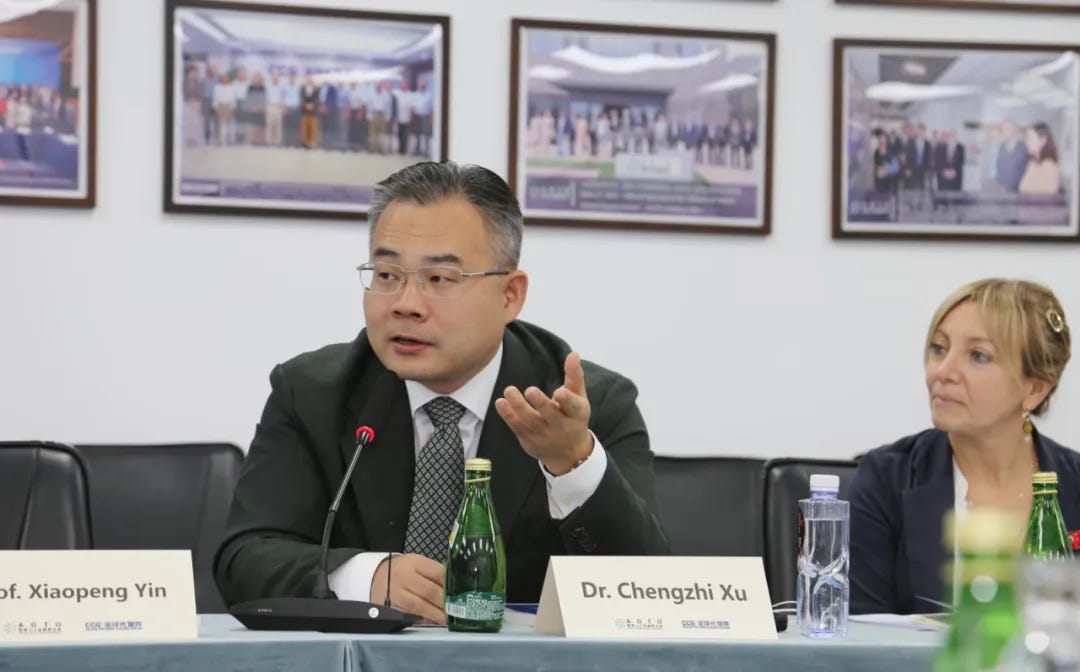
Hello, it’s a great honour to be here and to participate in this panel to share my views on this big topic.
Actually, when I saw this topic, I found it very meaningful at the present time. Obviously, during the past 20 years, especially the past 10 years, I think risks in all aspects have escalated around the world. So right now, we are facing many very serious risks, such as viruses, nuclear proliferation, and wars. Just a few days ago, the international airport in Saudi Arabia was bombed.
For me, this is something I could not have imagined one or two years ago, because our company is also doing business in Saudi Arabia. Now everything has stopped because of this war, and our losses are huge.
Actually, at this time of AI, humanity is more capable than ever before because AI has tremendous power for human beings.
My wife is a top-level mathematician, and she told me very recently that the entire world of mathematics has been challenged by AI and defeated by AI. That’s a problem, and she is very depressed.
So I think humanity is now much more capable than before because of AI as a tool. But I believe we need more progress in other aspects beyond technology right now.
So I fully agree with what Professor Zhou said about the new civilisation. Henry knows me. In recent years, I’ve also been trying my best to promote Chinese traditional culture. This is also at the core of China’s civilisation and its values, and I believe it can help the world a lot during this period, especially in the future.
Human beings need more cooperation and more understanding, more mutual understanding. Unfortunately, we don’t have enough mutual understanding right now.
My company – actually, after leaving the ministry, I received my PhD in economics. Then I worked for international companies for many years, especially in clean energy.
So, from my experience, when we have competition in the world, our Western friends normally understand it as a threat or an enemy.
For example, one piece of equipment has the same functionality, but equipment from Germany is priced at seven times the price of the equivalent Chinese equipment. They sell the same thing, but at seven times the price. So they feel that the rise of China’s industry is terrifying.
So what should we do? Actually, I think this is precisely why we need more communication. Why does this happen?
Ideally, if we have more international trade, there will be an effect of comparative advantage. So if we can produce something at a comparatively lower cost, then we should focus on that field. Other countries can then buy our products and enjoy a better standard of living. They can focus on something else.
But in the real world, unfortunately, because of political and economic rigidities, we face very high transaction costs. Industries and countries cannot transition easily or flexibly from their previous positions.
So, in my opinion, Western countries, let alone the United States, should focus more on their internal reforms. It’s very funny that we cannot do any clean energy business in the United States because the President says, “I don’t like it.” So this is a funny situation.
But basically, what I want to say is that they should focus more on internal reform, rather than complaining and simply wanting to use political instruments to get themselves out of the situation. That’s not the right direction.
We should make the market system more effective. That’s what humanity needs to do, rather than saying that we need to protect ourselves and that you cannot come here.
This is not the way the world has developed over the past century.
But unfortunately, over the past 20 years, as the world has faced more challenges, we have actually moved backwards in many respects, rather than in the right direction. At least in politics and economics, I think we have a lot of problems.
Another issue in international relations is that international law, unfortunately, has not been well respected over the past 20 years either, partly because the United Nations has become weaker and weaker. Why? Because it has no money. It has no military troops.
That’s the reality. If the world focuses only on hard power and discriminates against soft power, justice and values, then humanity will have no future. We will have no future.
So I think this is the time to discuss these issues and take them seriously. More than ever before, we need discussions and frank communication.
As for ideology, I don’t think this is simply a matter of the Western world and China, or East and West, having disagreements. These ideological differences have existed for hundreds of years. Sometimes we need to take a broader perspective and discuss these issues in a more realistic way in the current circumstances. We need to try our best to lead the world towards a better future and in the right direction.
Yeah, that’s what I would say. Thank you.
Thomas Reuter
Thank you very much. There are a couple of things I’d like to pick up on.
The first is competitive advantage, and I think it’s a concept that has been abused a little bit.
I don’t want to name anybody, but in the development model we’ve often had, it meant that, well, you’re very good at growing bananas, or you have very good quarries, like Australia, which is very good at farming for the world. You might achieve some economic growth, but no real development and no diversification.
So I think it has often been used as an excuse to prevent emerging economies from diversifying. And I don’t think the people who invented that system would be very keen on being at the other end of it. So that’s something that has to be negotiated, at least in the interim.
Although I appreciate that if you have a manufacturing country like Germany, where production costs are seven times higher, what’s the production cost? There’s something that clearly needs to be reformed there, because what is happening in China is not magic. It can be done anywhere, really.
The other thing is law. I totally agree with you. I’m an anthropologist. I’ve studied societies, from Indigenous peoples to sophisticated societies. Well, actually, all societies are sophisticated.
And the other thing that all human societies have in common is that they need law. If you are to live together in a community, you have to have an understanding of what is acceptable and what is not acceptable.
If you are an Indigenous person in Australia, growing up means becoming a man of the law. If you cannot do that, you’re not really a grown-up, responsible person.
So law is absolutely essential to human life. And internationally, international law is now really in tatters. You could say that it is in tatters.
We have real problems, as you said. Enforcement depends on the goodwill of the major powers and their cooperation, and we don’t have that.
We have this ongoing crisis in the UN Security Council, and all these problems. So something has to happen there.
And it’s not good to blame the UN. It’s the member states that are responsible for where the UN is heading. I think there has to be some groundswell for reform, a really serious groundswell for reform.
Maria (Marilena) Longobardi, Executive Director and Head of Education, NCCR SPIN, University of Basel
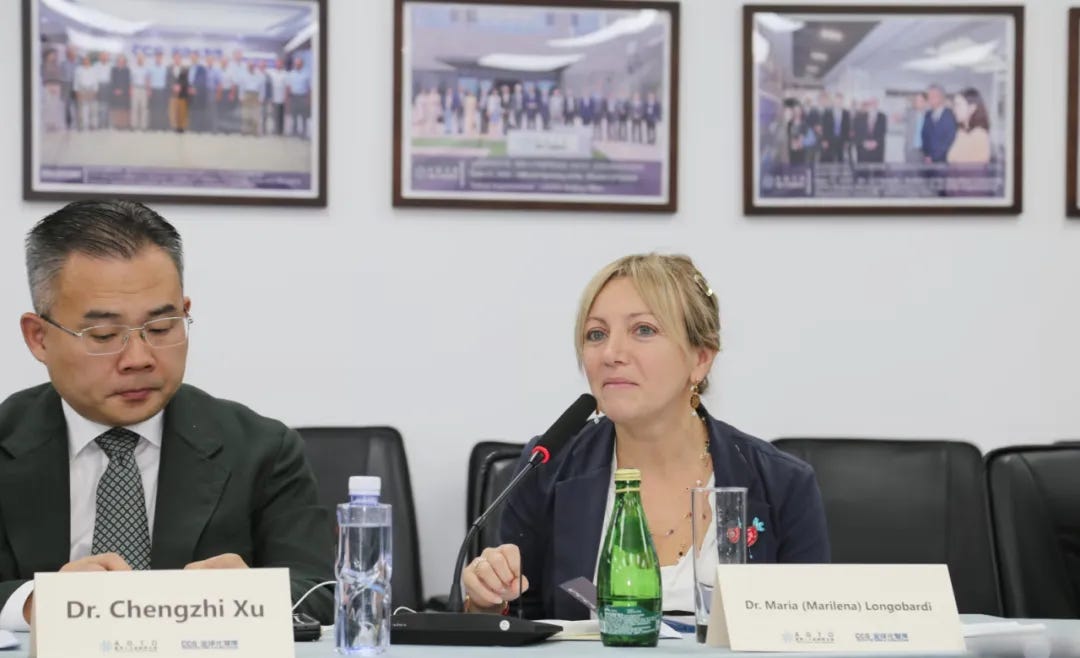
Well, first of all, thank you for the kind invitation. My name is Maria Longobardi. I want to give you my perspective on quantum technology.
I’m from the University of Basel. I’m a quantum physicist, so you have chemists here, and there are also physicists.
Well, I have had the opportunity to work not only in Switzerland and Italy. I’m originally Italian, from Pompeii, but I studied for my PhD in Berkeley, and then I moved to Europe. I also worked in China as the Chief International Officer of BAQIS, the Beijing Academy of Quantum Information Sciences, here in Beijing. So I was the Chief International Officer of BAQIS. I know more or less the international landscape.
Apart from my research, I wear different hats. I’m a science diplomat, which is why I was interested in this meeting. I’m also a member of Pugwash, which is closely associated with the World Academy of Art and Science, and I’m contributing to its Emerging Technologies Group. I’m also involved in many other things.
Anyway, quantum technology was not included in the discussion or in the description, of course. But this is quite usual because quantum technology is not yet perceived as a risk to humanity. Why? Let me give you a very brief overview of quantum technology and the current situation.
Quantum computing and quantum technologies: we don’t have a real quantum computer yet. To be clear, we have some toys that can perform demonstrations.
Even if some of them are on the market and have been commercialised, they are proof-of-concept tools. The more advanced area is quantum sensing, which is now increasingly being used in defence. But let’s leave that aside for the moment.
Anyway, what is a quantum computer? It is not just a very fast or very powerful computer. It is a totally different kind of computer, capable of doing things that cannot be done with current computers.
There is also an increasing interplay between quantum technology and AI. There is now more and more quantum-assisted AI development.
Anyway, quantum technology is not yet perceived as a global threat or risk because it is not yet a mature technology. But I would like to draw an analogy.
When the atomic bomb was developed, the technology was not yet available. There was a theoretical basis for what could be done, but there was immense pressure from governments and so much money was injected into the project that they were able to develop the atomic bomb in a very short time.
With quantum, it is the same. Now everything is under export control. Companies and governments are injecting enormous amounts of money, and there is this race.
So it is not a risk now, but it will be tomorrow.
There are roadmaps. Some are more optimistic, while others are more, let’s say, prudent. But within the next 10 years, we will have a fully capable quantum computer.
So I suggest that we also take this emerging technology into account, because it will become increasingly important in the future. There are also issues related to the quantum divide, talent development, and so on.
I could speak for three days, but time is running out. So thank you again for the opportunity and for the invitation.
Thomas Reuter
That’s certainly one issue that hasn’t been much on our radar until now. So we’ll have to look into that. We’d love to invite you, and indeed everyone here, to continue this conversation in greater depth on different topics.
So I’d love you to stay in touch with me and send me an email so we can stay connected, because I’d like to bring you into our other meetings that are more focused on your particular areas of expertise.
I think that’s the logical next step to take following today’s wonderful opening discussion. Thank you.
Henry Huiyao Wang
Good. Thank you. Thank you, Tom.
I think we’re running out of time, but we can continue the discussion over lunch. We still have an hour, an hour and a half for lunch.
So basically, I think today’s discussion has been very stimulating, informative and constructive. I think it has been very interesting for EXTRA, WAAS and, of course, CCG to collaborate on this roundtable. We have heard from our Chinese experts and from WAAS fellows, who have shared their perspectives on all these different aspects. It has been quite interesting.
We talked about AI. We talked about climate change. We talked about food security. We also talked about health risks and threats, global value chains, chemical science, geopolitics and quantum technology. I don’t know if I’ve missed anything. It has really been a very comprehensive discussion. Biodiversity, absolutely, yeah.
So you can see that these are all very profound subjects. I really congratulate WAAS on its leadership and efforts, and CCG would love to join in to deepen these discussions, raise awareness, and make relevant recommendations to governments, both nationally and internationally. We also hope to build a new narrative for a safer and better future for humankind.
So I think that summarises the discussion we have had today. I really want to thank Professor Reuter for travelling such a long way to join us and for helping organise this event. Thank you, and thanks to all our experts.
Thomas Reuter
Thank you for hosting us.
A good and successful team .