

On 8 April 2026, the Center for China and Globalization (CCG), in partnership with Konrad-Adenauer-Stiftung (KAS), convened the 22nd CCG VIP Luncheon in Beijing under the theme “The Future of Global Governance and the Roles of China and Europe.” The discussion focused on China-Europe economic, trade, and investment cooperation at a time when multilateral institutions are under strain, global supply chains are being restructured, and both sides are seeking practical ways to rebuild trust and expand collaboration.
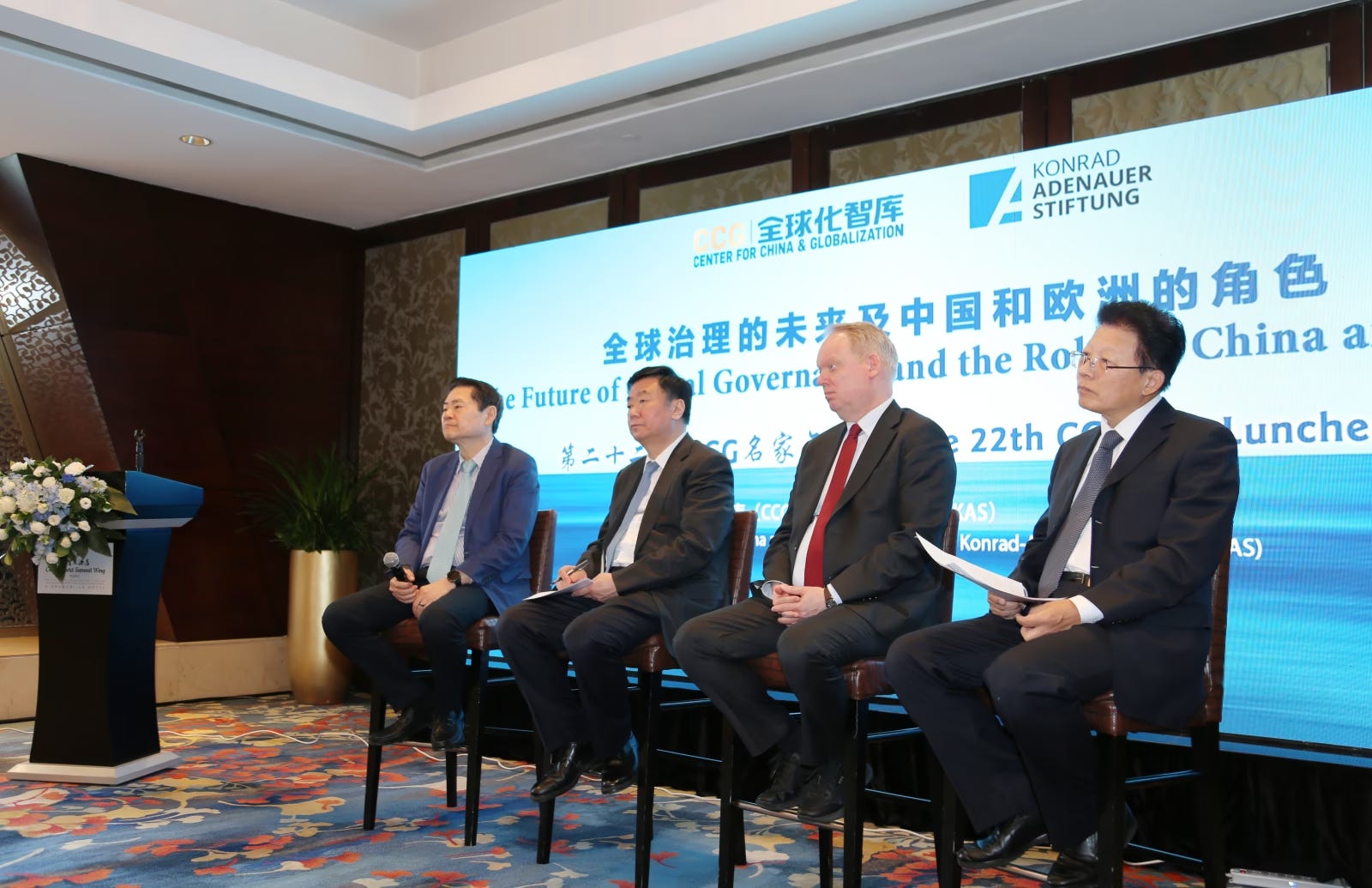
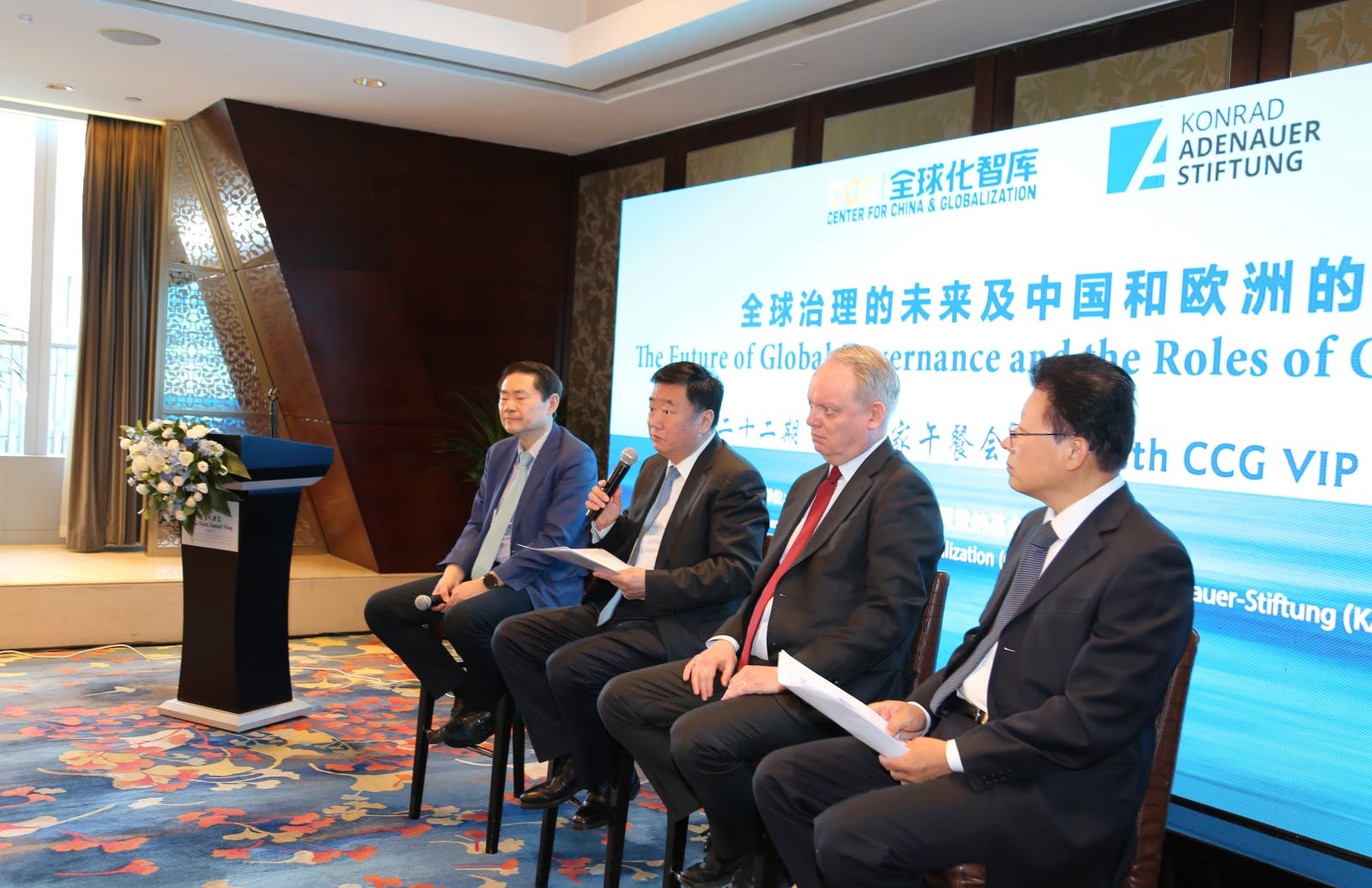
The luncheon was hosted by Mabel Lu Miao, Co-founder and Secretary-General of CCG. The panel discussion was moderated by Henry Huiyao Wang, Founder and President of CCG.
Keynote speakers are:
Ma Jianchun, President of the China Society for World Trade Organization Studies and former Director General of the Ministry of Commerce;
Han Bing, former Deputy Director-General of the Department of European Affairs, Ministry of Commerce;
Jens Eskelund, President of the European Union Chamber of Commerce in China.
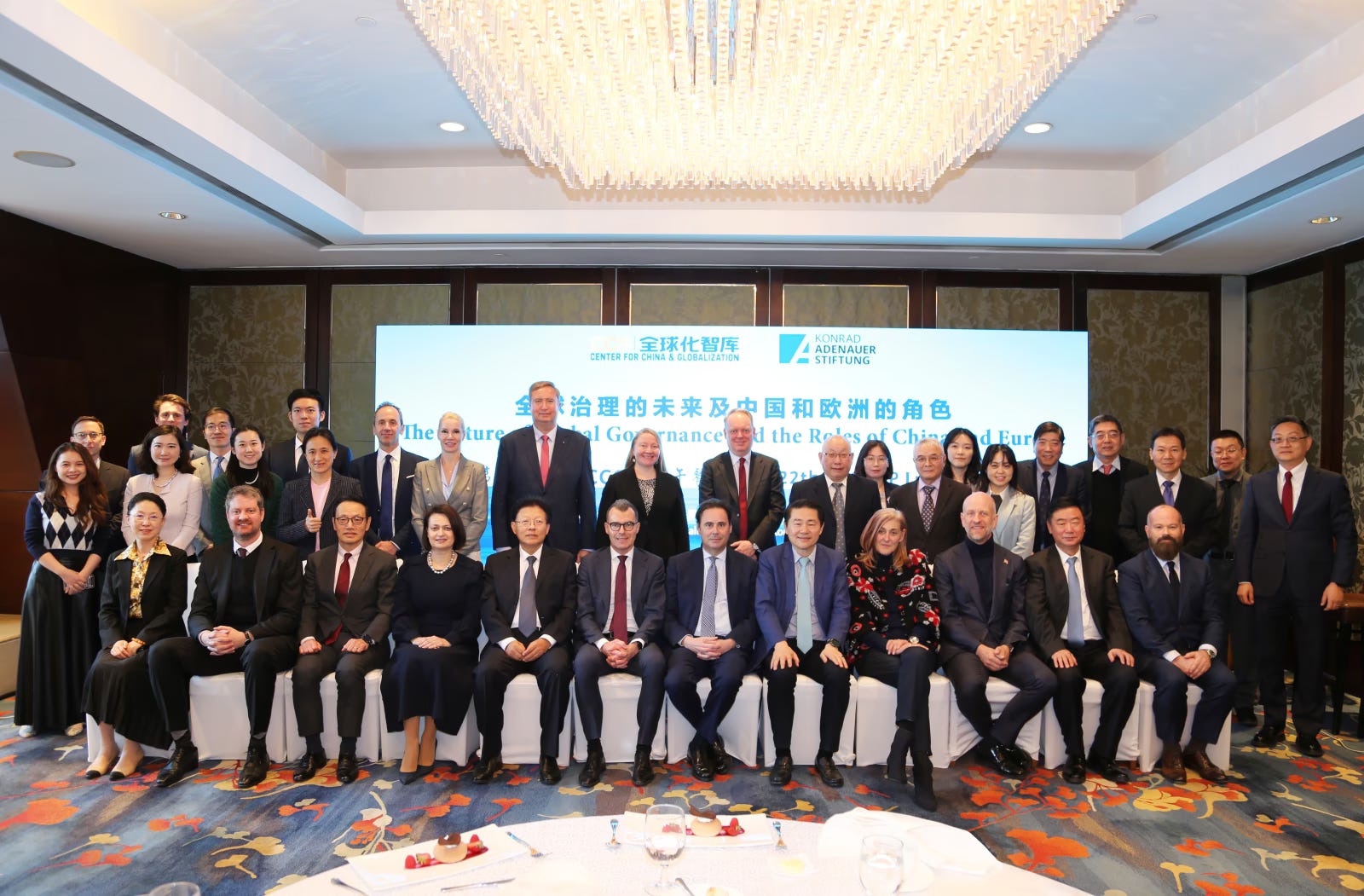
Ambassadors in attendance included Koula Sophianou, Ambassador of Cyprus to China; Jorge Toledo, Ambassador of the European Union to China; Nicholas O’Brien, Ambassador of Ireland to China; Kenji Kanasugi, Ambassador of Japan to China; Rol Reiland, Ambassador of Luxembourg to China; Vebjørn Dysvik, Ambassador of Norway to China; and Marta Betanzos Roig, Ambassador of Spain to China.
Also present were representatives from the Embassy of Estonia, the EU Delegation to China, the Embassy of Finland, the Embassy of South Korea, and the Embassy of Sweden, alongside former Chinese officials, scholars, business representatives, and members of the media.
CCG has broadcast the video recording of this luncheon on Chinese social media platform and has also uploaded it to is official YouTube channel.
This transcript is based on the video recording and has not been reviewed by any of the speakers.
Mabel Lu Miao, Co-founder and Secretary-General, Center for China and Globalization (CCG)
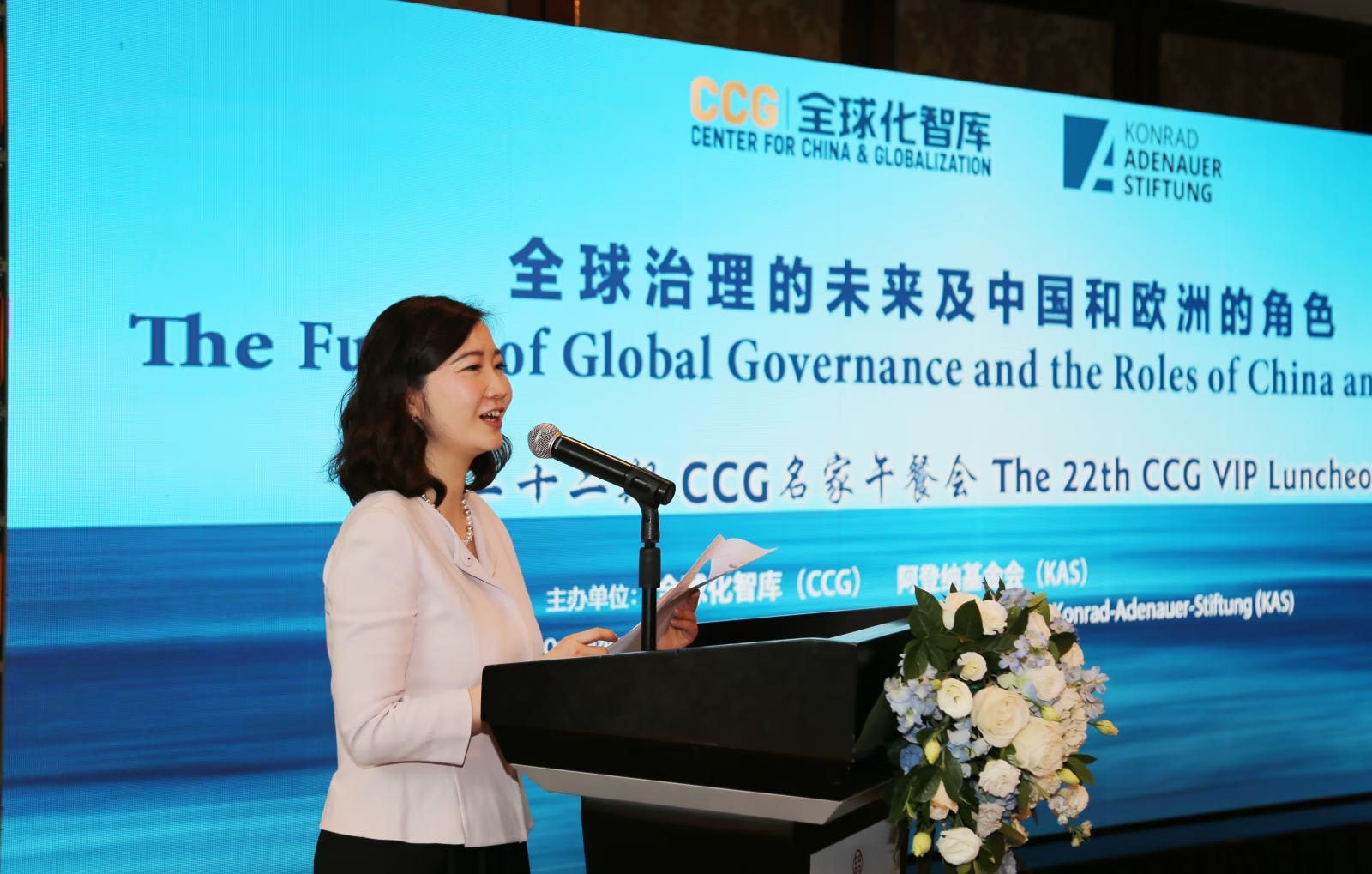
Hello, everyone, distinguished guests, ladies and gentlemen, good afternoon. Thank you all for joining us today at the CCG VIP Luncheon. The CCG VIP Luncheon is a flagship high-level international exchange platform established by the Center for China and Globalization (CCG). It serves as a key bridge connecting global political, business, and academic communities to promote pragmatic cooperation between China and the world.
Since its launch, the luncheon has maintained a China-based, global perspective, closely following China’s opening-up and international cooperation strategies. It has become one of China’s most influential non-government diplomatic and business exchange platforms.
Today’s theme is “The Future of Global Governance and the Roles of China and Europe.” Multilateral institutions are under unprecedented strain from geopolitical divisions, climate challenges, and technological disruption, while global supply chains and trade are being fundamentally restructured. China-Europe economic and trade relations have therefore reached a critical turning point. To address this issue, the Center for China and Globalization and Konrad-Adenauer-Stiftung (KAS) are holding a VIP luncheon on China-Europe economic, trade, and investment cooperation. Senior policymakers, business leaders, and scholars will hold dialogues on opportunities, policies, and industrial-chain cooperation, aiming to build practical solutions and consensus for future bilateral cooperation.
Before we start, let’s take a moment to acknowledge some of our special guests and VIPs who are here. We have invited representatives from host organizations, distinguished diplomats from 12 countries, including seven ambassadors, government authorities, academic institutions, multinational enterprises, and leading media outlets. They are Johann Caspar Fuhrmann, Head of Foreign Office China, Beijing Representative Office, Konrad-Adenauer-Stiftung China. Welcome. Johann, thank you for your kind invitation and cooperation. Tobias Knörich, Policy Advisor, Beijing Representative Office, Konrad-Adenauer-Stiftung China, welcome. Thank you for cooperating on today’s event with Konrad-Adenauer-Stiftung.
Of course, we have several ambassadors. Her Excellency Ms. Koula Sophianou, Ambassador of Cyprus to China, welcome. His Excellency Mr. Jorge Toledo, Ambassador of the European Union to China, welcome, our old friend Ambassador Toledo. His Excellency Mr. Nicholas O’Brien, Ambassador of Ireland to China, welcome. His Excellency Mr. Kenji Kanasugi, Ambassador of Japan to China, welcome, our old friend as well. His Excellency Mr. Rol Reiland, Ambassador of Luxembourg to China, another old friend of CCG.
His Excellency Mr. Vebjørn Dysvik, Ambassador of Norway to China, welcome. Her Excellency Ms. Marta Betanzos Roig, Ambassador of Spain to China. Of course, we have many senior diplomats from embassies, such as the Chargé d’Affaires of Estonia, representatives of the EU Delegation to China, and diplomats from the embassies of Finland, South Korea, and Sweden.
We have invited government agency representatives and experts such as Huang Rengang, former Minister-Counsellor of the Mission of China to the WTO and the Chinese Embassy in Australia; Huo Jianguo, Vice President of the China Society for World Trade Organization Studies; Li Xiaobing, former Minister of the Chinese Embassy in India; Ma She, former Deputy Director-General of the Department of European Affairs, Ministry of Commerce; Tian Deyou, former Minister-Counselor, Economic and Commercial Office, Embassy of China in the United States; Wang Sixiao, Professor, Beijing International Studies University; and Wang Yiwei, Professor of Renmin University of China, also a Senior Fellow of CCG.
We have invited leading multinational companies such as ByteDance, BMW, and Canal Business District, among others. Of course, we have also invited media representatives, including from Global Times, Xinhua News Agency, South China Morning Post, The Economist, The Beijing News, China.org.cn, and 21st Century Business Herald.
And CCG representatives, our president, Henry Huiyao Wang; Deputy Secretary-General LIU Jun; Deputy Secretary-General WANG Zichen; and Mr. ZHANG Wei, who just introduced me. Please allow me to introduce today’s speakers as well.
They are Henry Huiyao Wang, Founder and President, Center for China and Globalization, CCG, our old friend to all of you, I guess, and former Counselor of the State Council of China; Mr. Ma Jianchun, President of the China Society for World Trade Organization Studies (CSWTO), former Director General of the Ministry of Commerce; Mr Han Bing, former Deputy Director-General of the Department of European Affairs, Ministry of Commerce; and our old friend Jens Eskelund, President of the European Union Chamber of Commerce in China.
Welcome. Later, we would like to listen to you as well. Let’s welcome those four speakers with a round of applause. First, we would like to invite Henry Huiyao Wang as the first speaker. Welcome.
Henry Huiyao Wang, Founder and President, Center for China and Globalization (CCG)
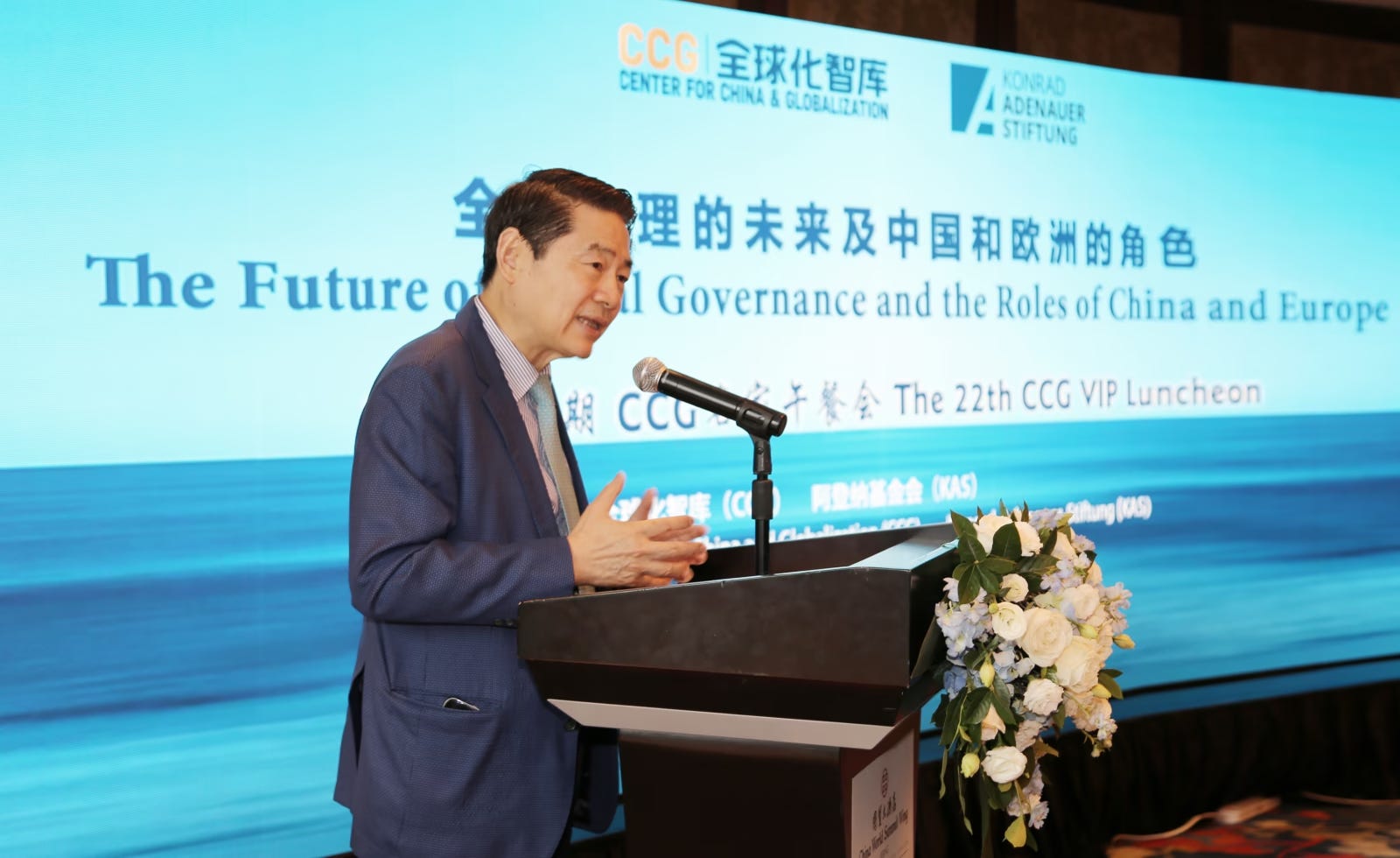
Okay, thank you. Thank you, Mabel, and Excellencies, distinguished guests, and ladies and gentlemen. I’m not really a speaker to begin with. I’m actually here to facilitate. But of course, before we start with the three speakers we invited today, I would like to highlight a bit of the theme we are discussing today. We have so many great friends here — great diplomats, thinkers, multinational representatives, and media leaders too.
So I particularly want to thank Johann from Konrad-Adenauer-Stiftung for co-organizing this great event with us. We find that this is really a productive way of exchange between China and think tanks and foundations from Germany. And particularly, we also have the European Chamber here today.
Basically, as Mabel just said, we are in a very disruptive time. I’m very pleased to hear this morning that, of course, after what happened in Iran, we are going to have a two-week ceasefire. And hopefully there is going to be a talk starting from the 10th of this month. I hope that before President Trump comes to China, we are going to have some kind of arrangement and peace agreement between the United States and Iran. Hopefully, we could see this coming to an end.
But of course, on the larger backdrop of global governance and all those major countries like China, Europe, the EU, the U.S., and all the other Global South countries, we really have to think hard about how we can maintain this global system. I think Ambassador Ma, who is the president of the China Society for World Trade Organization Studies, will share some of the latest developments from the WTO ministerial meeting that just happened in Cameroon—what has been talked about there. I’m sure we’re also going to hear from Jens. You are the president of the European business community in China, the European Union Chamber of Commerce in China.
And of course, we also have Ma She here, former Deputy Director-General of the Department of European Affairs at MOFCOM. So we have a number of former MOFCOM experts here. But what I’m saying is that we need to find a good way to maintain this global system, as the U.S. seems to be abandoning some of them, like President Trump quitting 66 international organizations.
So how should China and Europe really work together to maintain this multilateral system? I think this is one of the themes of the day: with global governance greatly disrupted and damaged, being the two largest economies, China and the EU, how can we really work together to make things work—the WTO, the WHO, climate change, UNESCO, and the UN Conference on Trade and Development, and so on and so forth. These are the key areas that we really need to work on.
And the second theme of today is really cooperation between China and Europe. We have such a long history of cooperation. We are among each other’s largest trading partners, and we have no border issues. We do not have many of the difficulties that we may have with some other countries. So I think there is huge potential for us to work together.
So basically, I want to finally say something about the three great speakers we have today. First, Ma Jianchun. He was also an ambassador from MOFCOM. There are not many ambassadors from MOFCOM, but at one time he was appointed by MOFCOM as ambassador to a foreign country. But now he is the President of the China Society for World Trade Organization Studies, and former Director General of the Department of Foreign Affairs in the Ministry of Commerce of China. He is also a Senior Fellow at the Center for China and Globalization. So he knows a lot about the WTO, global governance, and all those experiences, and he actually handled this kind of affair before while he was in the ministry.
And of course, Mr. HAN Bing is the former Deputy Director-General of the Department of European Affairs, Ministry of Commerce, and also a Special Senior Fellow at the Center for China and Globalization. He worked in the ministry, and he has also been Minister-Counsellor in Egypt, and he also worked in some European countries as well.
And then we are very happy to have invited Jens Eskelund. He is the President of the European Union Chamber of Commerce in China and a core driver of practical and mutually beneficial China-EU business relations, with 20 years of deep engagement in the Chinese market and long-term dedication to China-EU business collaboration and multinational economic and trade rule-making.
So Jens is also a senior executive at a major multinational shipping company. So he knows both China-Europe issues and global issues. Today, we’re going to have a format in which each person speaks for maybe seven or eight minutes, and then we’re going to have a discussion. We’ll open the floor to all ambassadors, experts, and guests gathered at the luncheon today. Of course, we would also like to see whether our co-host, Johann, has anything to add later, so I’ll stop here. Thank you all very, very much.
Mabel Lu Miao
Thank you, Henry. Next, we would like to invite Ambassador Ma Jianchun. Henry has already introduced Ambassador Ma. Ambassador Ma used to be ambassador to Namibia, right? Sorry, Gambia. We would like to invite you to give your speech. Thank you. Welcome.
Ma Jianchun, President of the China Society for World Trade Organization Studies (CSWTO); Former Director General of the Ministry of Commerce
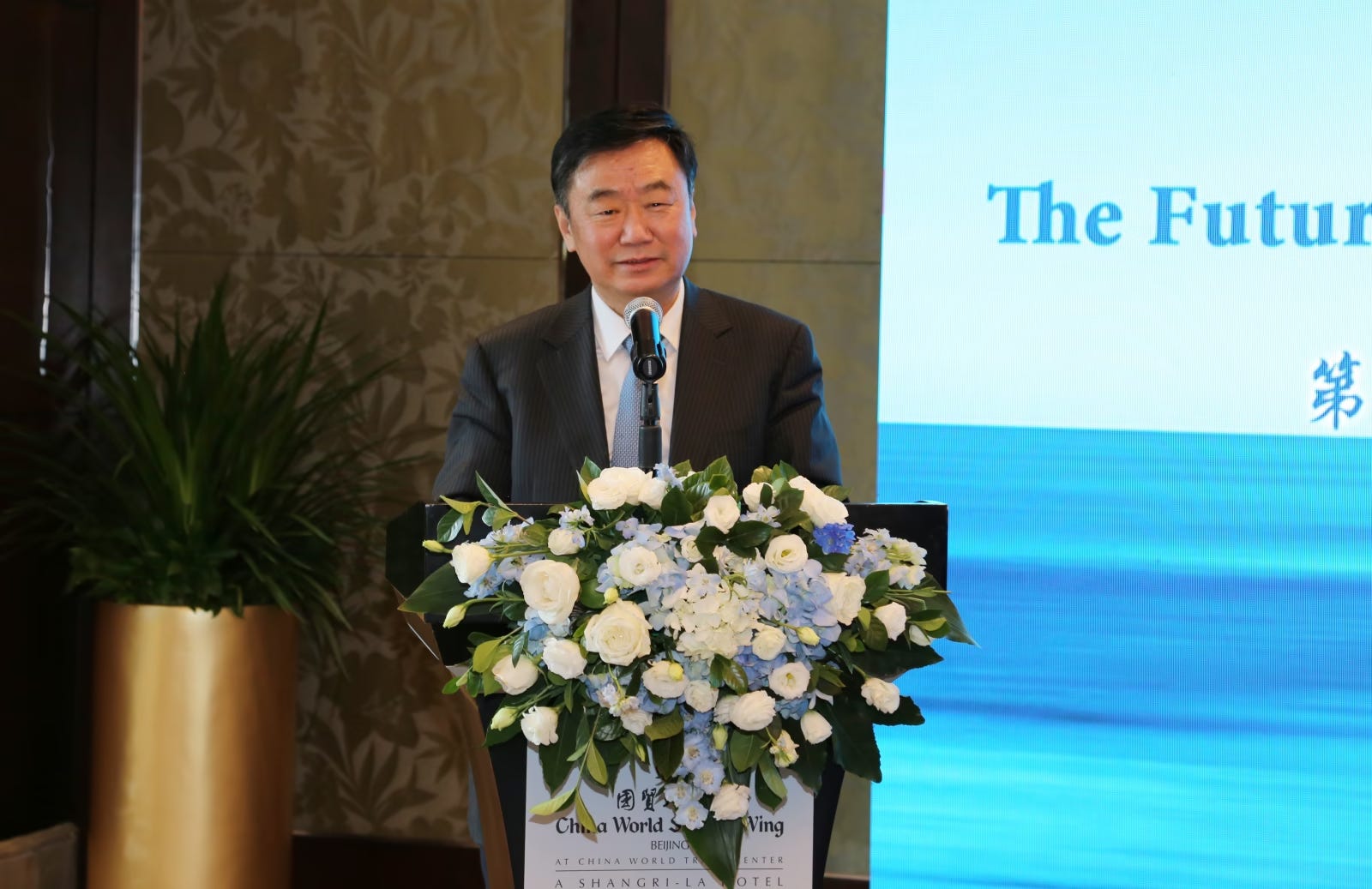
Your Excellencies, ambassadors, dear guests, ladies and gentlemen, good afternoon. It is my great pleasure to be here. I met with old friends, our ambassadors, and also new friends. I’m very happy to meet all of you, and particularly glad to have a chance to meet our colleagues in the Ministry of Commerce, so it is a good occasion. Thank you to Professor Wang for giving me this chance to meet with you and also to share some information.
At the beginning, I would like to say something about our society. Our society is the China Society for World Trade Organization Studies. This is a national association affiliated with the Ministry of Commerce, engaged in the study of the World Trade Organization and related economic and trade issues. Our society works like a think tank. We facilitate some work for professors and experts. We invite them to join us, and we try to discuss some topics, and then we try to share some information, not only with the government, but also with our other friends, our think tanks, and other friends.
So today, Professor Wang suggested that I give a talk. He gave me the topic of global governance and the role of China and Europe. I am very sorry that I am not very professional in European affairs. I used to be an ambassador, but on the African continent and in West Asia. Several of my colleagues who are here are very professional in European countries, particularly my colleague, Mr. Han Bing, who will introduce to you the European relationship and the cooperation between China and European countries.
I am very humbled to have this chance to introduce to you a few things about the WTO. But now, I think all of you know the WTO, so I do not want to say too many words about that. But recently, what has attracted people’s eyeball is the MC14 Ministerial Conference, which was held in Cameroon, in Yaoundé.
You know, this conference finally got some results and achievements. I would like to share some information with you.
The first is the ministerial joint statement on the Agreement on Investment Facilitation for Development. This is the first time the WTO has had this kind of agreement on investment facilitation. Now, 128 members, including China, joined this group to sign this joint statement. It accounts for 77% of the WTO members. So this agreement, we think, is one of the achievements of this ministerial meeting.
Secondly, it is about the e-commerce agreement. This time, they reached a temporary implementation arrangement for implementing this e-commerce agreement. This is also an achievement, I think, of MC14, because this agreement establishes a global framework for digital trade rules, which will effectively promote more inclusive and sustainable development of digital trade. China supports the implementation of this agreement. The Agreement on Electronic Commerce is an important negotiation outcome of the WTO in recent years. Under the current circumstances, it is not easy for WTO members to reach agreements, but this electronic commerce agreement really is one of the achievements of this negotiation.
The third achievement is that ministerial decisions were reached on fisheries subsidies, on small economies, on inspection and quarantine, and on special and differential treatment, as we often mention, S&DT. This time, on these issues, they also reached some agreements.
So this MC14 meeting also formed the Yaoundé Outcome Package around documents close to consensus, such as the WTO reform work plan. This time, the ministers reached a consensus that they would like to push forward the WTO reform work, and also the e-commerce work plan, which they are going to continue pushing forward next time.
So these are the three major achievements that MC14 reached. I also heard some people who were unsatisfied with this meeting. They talked to some of my colleagues, some scholars, and some professors. When we had a talk, they said, “Oh, we should have had more achievements.” So people were a little bit disappointed. But I think that, against the background of world economic development, the successful holding of WTO MC14 is itself one of the big achievements.
Of course, many topics need to be discussed further, and China is ready to continue its efforts to work with WTO members, to push forward WTO reform, and also to implement some agreements that have already been reached.
So I think we should be optimistic about the coming future.
Thank you very much.
Mabel Lu Miao
Thank you, Ambassador Ma, for your very important information-sharing on the WTO. Maybe later we can discuss it further, as another part of our event is the panel discussion after each speaker. Next, we would like to invite Jens Eskelund, President of the European Union Chamber of Commerce in China. Welcome, Jens.
Jens Eskelund, President, European Union Chamber of Commerce in China
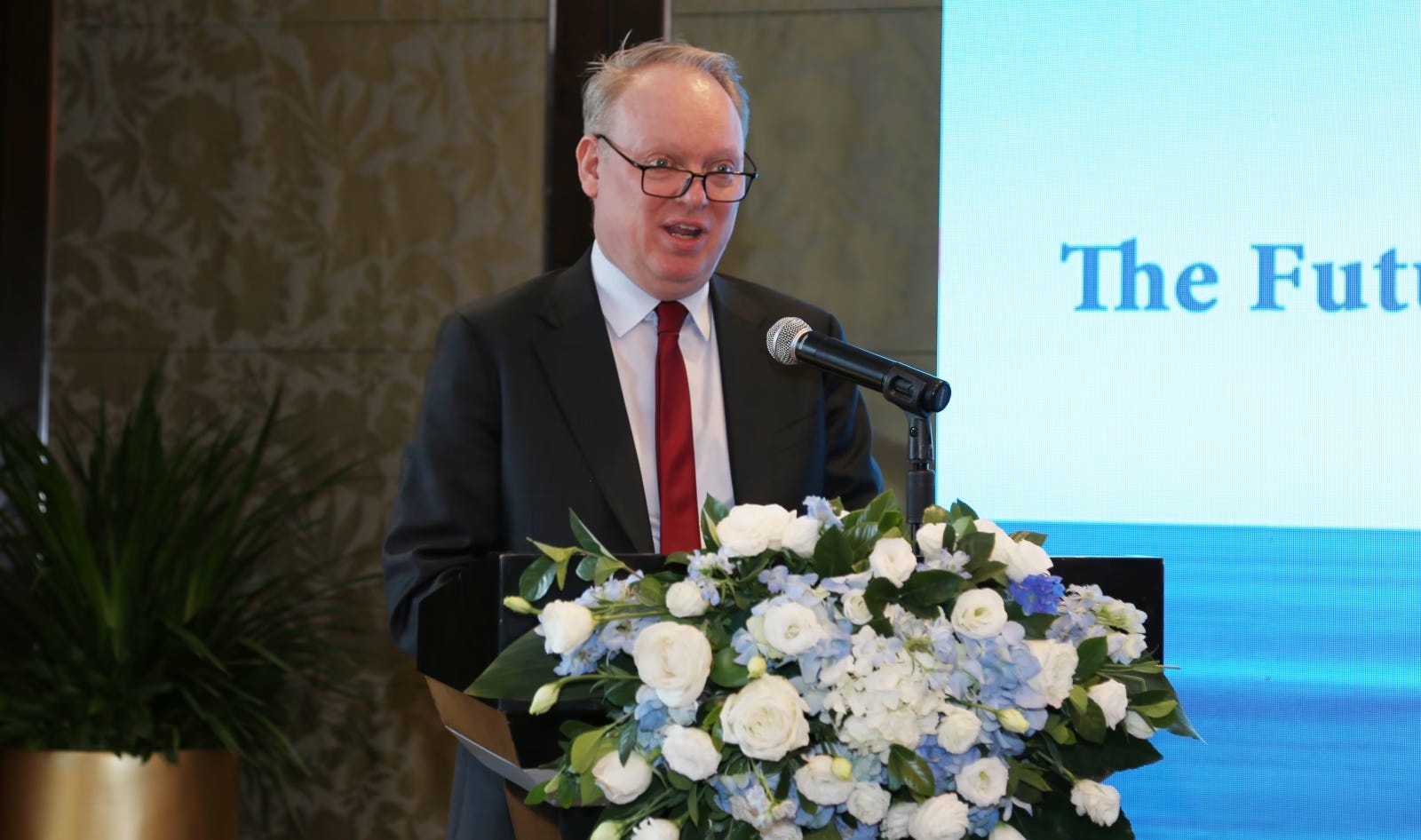
Ladies and gentlemen, dear friends, it’s a pleasure to be here today, and I would like to thank my old friend Henry for the kind invitation, and of course also the support from the Konrad-Adenauer-Stiftung. Europe-China is, of course, something that is very close to my heart.
I think that last year we had the opportunity to celebrate an important anniversary, the establishment of diplomatic relations, and that’s much to celebrate. It has been a relationship that has been creating tremendous value for China, but also for Europe, for European companies, and for European consumers. It has contributed to economic growth in China, and also to the upgrading of Chinese industry. So that is all very good and well, but maybe an anniversary is also the time to reflect on what works and what does not work.
And I would like to share a few steps with you, but maybe first, perhaps a few general observations about global trade. There is a lot of talk, in particular in these unruly times, about deglobalization, friend-shoring, near-shoring, onshoring, and so on. But when you look at the data, there’s nothing that tells us that the world is becoming less globalized. In 2024—and again, my day job is in container shipping, so these are data that I’m familiar with—transport of containers grew by 7 percent. That’s about two times as fast as global economic growth last year. In 2025, in spite of Liberation Day tariffs and what have you not, global container trade grew by 5 percent. That is 50 percent faster than global economic growth. So there’s no way that we can sensibly talk about deglobaliaation when you have trade growth growing much faster than global economic growth.
But here’s the catch, if you look at both 24 and 25, all incremental trade growth in the entire world is due to exports out of China. If you take out China from the equation, the 5% last year, the 7% the year before, that would drop to zero. All growth in global trade over the past two years came out of China. China is doing very well indeed.
Now, if you look specifically at the EU-China relationship, and if you go back to six days, one week before covid started, 31st of December, 2019. At that point in time, every time Europe exported one container to China, China exported 2.5 containers to Europe. Right now, today, that is changed to one to four: every time Europe sends one container to China, China exports four to Europe. But actually Europe is doing a little bit better than the global average. I think right now, if you sort of look at it, on average, China is exporting 4.6 containers for each container that it’s imported.
But I think the data that are really interesting is when you go back to the onset of covid, those six years, I believe that the Chinese economy has probably grown by 35% or so, very high growth. 35% higher GDP today than right before covid. In that period, where the Chinese economy has grown by 35%. The world’s second largest economy has grown by 35%. Tn that same period, the containers exported from Europe to China have declined by 35% how’s that possible? You have 35% growth, and at the same time, European exports are declining by 35%. In that same period where basically we have had zero growth in Europe, Chinese exports have grown by 37%. So I don’t think that China has a problem with Europe. I think Chinese exports to Europe are doing phenomenally well.
And you know, if you look at last year, last year, basically there was zero demand growth in Europe. But even though there was zero demand growth in Europe, China managed to increase its export by 8%. That is a very, very strong performance. So I think we need to keep that in mind. I actually don’t think that China has a problem exporting to Europe, and I bet that unless we go into a recession in Europe, that China will continue to increase its year of global exports.
But it’s not just Europe. If you go back again to the end of 2019, China accounted for 31.9% of all containers exported in the world. It’s already a very, very high proportion, 31.9%. By the end of last year, China’s global market share of exports had increased to 37.5%. In other words, China is growing its global market share of exports by 1% every year. There’s no one like China.
China is by far the strongest exporting manufacturing country on the planet, 37.5%. And I think, of course, we need to congratulate China on that, but I also think that we need to realize that as China is moving closer to a 40% global market here of everything being traded in the world, then I also think we would need, or China would need, to realize that at some point gravity might set in, and trade partners will say, hang on a minute, something is not entirely right here. And I think this is a problem right now, no one, I think, supports WTO more than Europe. We believe in it, and certainly me as a Scandinavian and as a shipping executive, free trade is hard baked into my DNA.
But trade also needs to make sense. There was a study by Goldman Sachs published in November last year that estimates that by 2029, Europe’s trade relationship with China will lead to a negative 0.5% contribution to GDP. And for Germany, it’s even worse. Goldman Sachs estimates that by 2029, trade with China will contribute negative 0.9%. And what’s the problem here?
The problem is that the whole basis of trade, the whole justification of having a great thing like WTO is that when we trade with each other, it creates value. It creates value for both sides. Now, if we are in a situation where a trade relationship creates negative value for one of the parties, the justification for trade falls away. So I think this is the task for China. This is the task for Europe. We need to get back to a place where the relationship creates value for both sides. I don’t think that it needs to be equally distributed, and I don’t think it’s possible, but we need to get back to a place where, at the very least, the relationship is not creating negative value for one of the parties.
And I think this is the task. If it doesn’t create value, there’s no justification for trade. And I think this is very important. I actually think that also Chinese economists, certainly, and Chinese government official understands that needs. We’d like to talk about Win win in China. And I think that’s very important. We need to get back to win win. And I think this is the urgent task.
So what are the solutions? I actually think there are many solutions. I think there are important differences between Europe and United States. And of course, I’m oversimplifying it a little bit, but I think sort of, at least my perception, from from a distance, is that they seem to take a very sort of fundamentalist approach to trade balance in United States: if I import $1, you need to take $1 export from me.
That’s not how the thinking is in Europe. You know, last year, we had a trade deficit with China of about 400 billion euro. That’s an enormous amount of money, and maybe that’s too much. But I actually don’t think that anyone in Europe cares if there is a trade deficit of 100 billion euro, or 200 billion billion euro, because China is just very good at manufacturing, no one does manufacturing better than China.
So probably that’s going to be a trade deficit for as long as the eye can see. That’s not in itself a problem. The problem for Europe is when it begins to affect Europe’s economic security, when it begins to affect European autonomy, we know, and we saw that, for example, with the virus, that if we are not able to produce certain goods, we’re simply not able to make our own autonomous decisions. I’m just back having visitedfFive Capitals in Europe, Madrid, Rome, London, Paris, Berlin, and that was a primary concern, industrial resilience and economic security.
And I actually think that this is very close to the thinking in China. Both in the 14th Five-Year Plan and in the 15th Five-Year Plan, we have seen that there’s a very high focus on resilience, self-reliance. Self-reliance has been a key word in the past and in the present Five-Year Plan. Also there’s a focus on creating what is in China is called complete industrial systems in. These focus areas are based upon a concern about China being master of its own destiny, being truly autonomous, and realizing you can only be truly autonomous if you master and you have on your geography certain industries. Europe share that concern, but I don’t think that Europe will ever go, not even 10% as far in its self-reliance efforts as China.
I think there’s a way forward to find solutions between China and Europe if China tries to understand the European concern and understand that Europe has legitimate concerns about its economic security and Europe’s ability to remain master of its own destiny. So rather than fighting the industrial accelerator act, maybe try to buy into the premise and say, you know, we understand that Europe has these concerns. How can we work with Europe to address some of these concerns about industrial resilience? I think this is the way forward. You know, less confrontation and try to sit down and take a discussion about, what are the real concerns that we have in the this relationship? How can we work together to address them? And I think part of that also needs to be a recognition that there will be certain industries where Europe will need to retain these capacities on European soil, just as is the case in China.
So that is my hope for 2026 that is, we’ll be able to sit down, we’ll talk about, you know, build trust, and have that conversation about economic security, industrial resilience, and then maybe together, be able to find a way forward that will take some of these point of contention out of the bilateral relationship. Thank you very much.
Mabel Lu Miao
Thank you, Jens. You are an old friend. Your speech was very much in line with the purpose of today’s occasion we would like to talk about the real concern, the mutual respect on the true concern from European side and China side. And generally, I think China respected the strategic autonomy or strategic independence of Europe and our European friends. So we can sit down today.
We already sit down to talk about what we can do, the solutions and some solutions potentially offering Next, we would like to invite a Chinese expert, Mr Han Bing, former DDG of the department European Affairs Minister of Commerce. Welcome. Mr Han.
Han Bing, Former Deputy Director-General of the Department of European Affairs, Ministry of Commerce
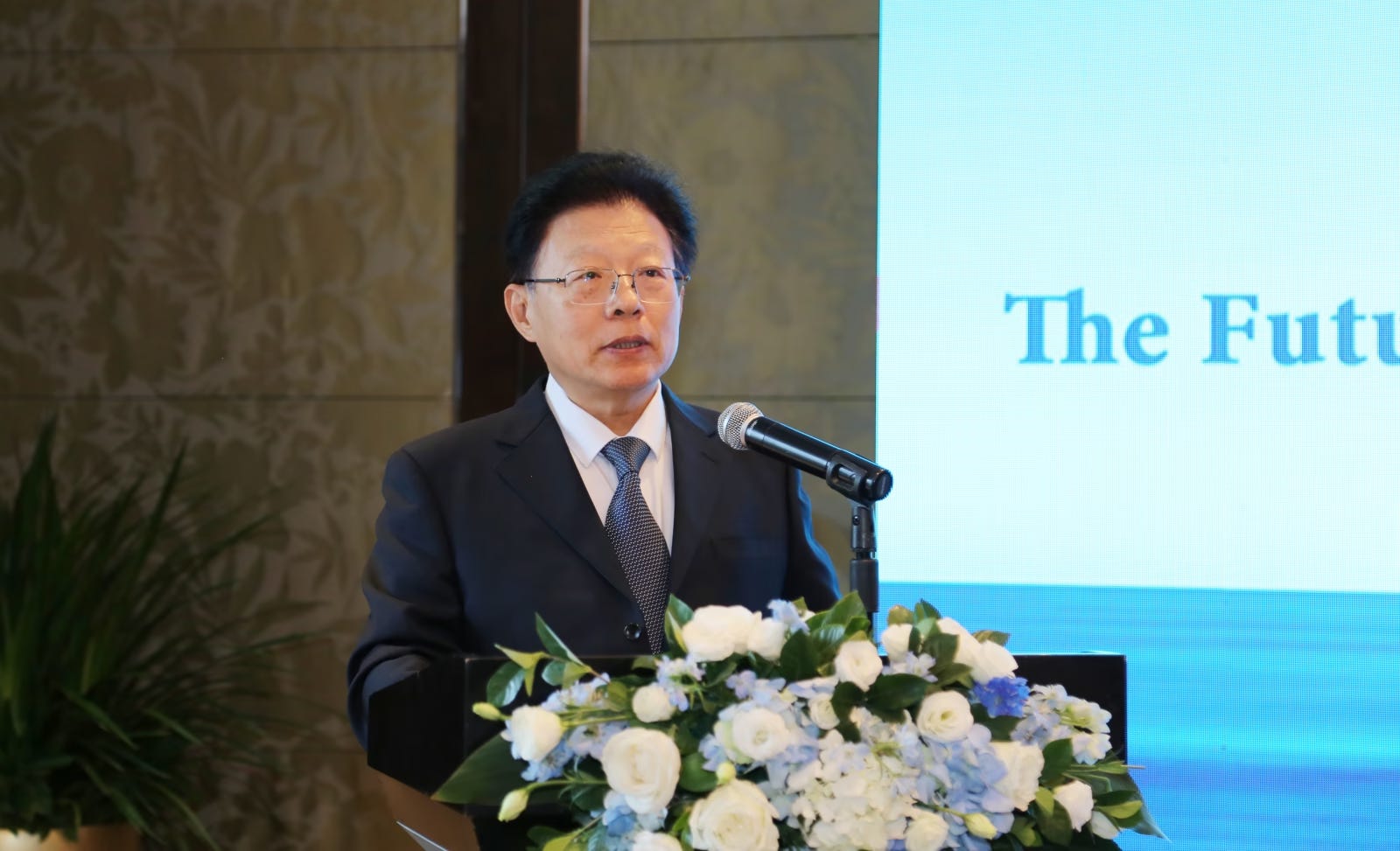
Thank you for inviting me to share with you some my personal thoughts. Your Excellency, the ambassadors and ladies and gentlemen, today, I would like to share with you my thinking about the China-Europe relations.
So first, about our relationship positioning. From China’s perspective, China and Europe are two big men in the international community.
How does our leader, President Xi, position our relationship? He said: we are the two major forces driving multipolarity, the two major markets supporting globalisation, and the two major civilisations advocating diversity. So that is the positioning of China-Europe relations from the Chinese side, and how we view them.
I will also share with you something that, for me, is quite important: the mindset between China and Europe. I think this is important in defining how we can work together in the future to develop our relations.
This year, at the Munich Security Conference, they published the Munich Security Index, as they do every year. They listed 32 major issues, or problems, and collected how people think about these 32 issues. Then they produced the index scores. I will share with you the index scores in the major European countries and in China.
In Germany, people put the top security problem as cyberattacks on your country. The index score is 73. It is very high. In second place, it is rising inequality, with a score of 68. And they put China as a security problem with an index score of 45.
In France, they put the top security problem as radical Islamic terrorism, with an index score of 73. In second place is the economic or financial crisis in your country, also with a score of 73. And they put China as a security risk with a score of 47.
In the UK, they put cyberattacks on your country in first place, with 74, and the economic or financial crisis in your country with 70. And they consider China a security problem with a score of 57.
In Italy, they put extreme weather and forest fires in first place, with a score of 70, and climate change generally in second place, with a score of 68. And they consider China a security problem with a score of 42.
In the U.S., they put political polarisation in first place, with a score of 67, and the economic or financial crisis in your country in second place, with 67. And they consider China a security problem or risk with a score of 58.
Now let us look at China. How does China see the problems? In first place, China puts the U.S. as a security problem, with a score of 38, and in second place, the trade war, with a score of 31. China puts Europe, in this index, at only 20.
So from this, we can see the mindset in Europe and in the U.S. In the first place, they consider security problems with index scores of more than 70, from 70 to 74, and they put China as a security problem with scores from 42 to 57. That means people in Europe have a very strong sense of anxiety, and many regard China as a negative factor.
But in China, we put the top security problem at only 38. So that means Chinese people are less anxious. We are more focused on our own affairs, and we do not regard Europe as a negative matter worthy of attention.
So this is the picture of the mindset between European people and Chinese people. Chinese people are more focused on their own problems, and they are more optimistic. I think optimism is very important for all of us in developing our relations. As the saying goes, I would rather be optimistic and wrong than pessimistic and right. For me, that is what we should be: more optimistic. Once we take optimism into our minds, I think we can cooperate better.
So now, my suggestions for China-Europe relations.
First, we need to intensify mutual visits and exchanges. The ambassadors and diplomats in China know China quite well. There is a saying: if you stay one week in China, you know everything about China; if you stay one year in China, you know something about China; if you stay ten years in China, you know nothing about China. China is changing very fast. So we need to understand each other. We need to intensify visits.
I am very glad that a parliamentary delegation from Europe visited China last week. It is very important, because I think in the past several years, we have faced a lot of misinformation about China. Some of the information or news has even been fake, or I should say lies. Once such information enters very deeply into people’s minds, it can lead to wrong decisions. So that is the first point. In the future, we need to intensify visits and exchanges.
Second, I think we need to adjust our mindset and view China, and understand China, in a realistic and pragmatic manner. The reality is that China’s all-round development will continue. It is irresistible and cannot be stopped by external influence. And it is also a fact that Chinese development in the high-end sector is natural and normal, because we paid a very high price in the past when we did not develop our high-end sectors.
For example, when China had not developed its own telecommunications technology, all telecommunications equipment was imported. We imported from seven countries with eight systems. In China, we had a saying for this, 七国八制. It meant imports from seven countries with eight systems. So we did not have our own telecommunications technology.
At that time, when one component broke down, we asked our foreign partner to fix the problem, and they asked us to buy one small metal plate. They said this metal plate was very important for the equipment, and if we did not take this plate, they could not fix it. That plate cost 100,000 yuan. How could one small metal plate cost 100,000 yuan? When China made a breakthrough in telecommunications technology, they reduced the price of that plate to 200 U.S. dollars. In the end, they even gave such plates free of charge.
So that is why we want to develop our high-end sectors, because we paid too high a price in the past.
Another fact is that Chinese goods are cheap and of high quality, and are produced through full competition in the Chinese market. The Chinese market is very competitive, and Chinese companies do not seek exorbitant profits. They make small profits, while benefiting the whole world economy.
And another fact is that China is willing to share its development dividends with the world. Amid the pandemic and geopolitical conflicts, China’s industrial chain has remained unbroken, stabilising global supply. So China is a stabilising factor in the world.
The third suggestion is that I would like to ask our European friends to take a more active and realistic approach to China, and to formulate policies for the well-being of both sides, especially for the people of Europe.
China regards Europe as a key partner in economic and trade cooperation, a priority partner in scientific and technological cooperation, and a trustworthy partner in industrial chain and supply chain cooperation. That is how we regard Europe: as our partner.
And when we compare with the past, I think now we have more favourable conditions for our cooperation. Before, China was an importer of equipment and technology from Europe. China was the market for Europe, and China was also the recipient of European investment. But now China has already developed very high technology, and we can share it with our European friends. It is no longer only about imports; we can also have two-way cooperation. Chinese markets are now bigger and bigger, and they can absorb various goods from Europe. And China is already an investing country, so we can invest in Europe, not only receive investment from Europe.
So now, I think the conditions for economic cooperation are more favourable, and the potential is bigger than before.
And actually, in the future, there are many advanced concepts in Europe that we need to learn from, for example environmental protection, labour protection, and the risk norms for new technologies. These are all concepts that we need to learn from Europe.
At the end, I will quote the words of President Xi on the relationship between China and Europe. He said: China and Europe are partners rather than rivals, with no fundamental conflicts of interest or geopolitical contradictions, and cooperation outweighs competition while consensus is greater than difference. Those who share the same aspirations and ideas are partners, and those who seek common ground while reserving differences are also partners. Mutual dependence is not a risk, and interwoven interests are not a threat. China-Europe relations do not target any third party, nor are they attached to or controlled by any third party. The essence of China-EU economic and trade relations is complementary advantages and mutual benefit.
Thank you.
Mabel Lu Miao
Thank you, Mr Han.
Later, after this, we would like to move to another part of our event. As invited, we would like to ask all the panellists, all the speakers, to come to the stage for further discussion.
Now I will hand over to Henry.
Henry Huiyao Wang
Okay, so we have Ambassador Ma, Jens, and Mr. Han.
I think we have had a very good warm-up, and now the real Q&A and comments. Please, Ambassador Ma, Jens, and Mr. Han. We have followed the speaking order.
Basically, what I can do is say that I think we have heard a lot of good suggestions. We had Mr Ma talk about how China and the EU can maintain the multilateral system and the WTO. We had Jens talk about how world trade and globalisation are still continuing, of course, and about how China has been growing very fast on the trade side. How can China, on the one hand, contribute 30% of global GDP growth, while on the other hand maintaining high export growth? How can we balance that? It is a good question.
And of course, Mr Han gave a lot of comments. I particularly liked it when he talked about strengthening people-to-people exchanges.
Ambassador Toledo mentioned that European Parliament members had just come. And actually, in the last two weeks, I met the Bundestag spokesperson for the CDU and the Bundestag spokesperson for the Green Party, both from Germany.
So what I can do now is open the floor and invite comments and questions, and then we can have our panellists address them. We also have a lot of trade experts from MOFCOM on the other side, as well as ambassadors, and we also have the Economist bureau chief here among our audience.
So where do we start? We can have another half hour of Q&A. Ambassador, would you like to say a few words? Yes, Ambassador from the European Union.
Jorge Toledo Albinana, Ambassador of the European Union to China
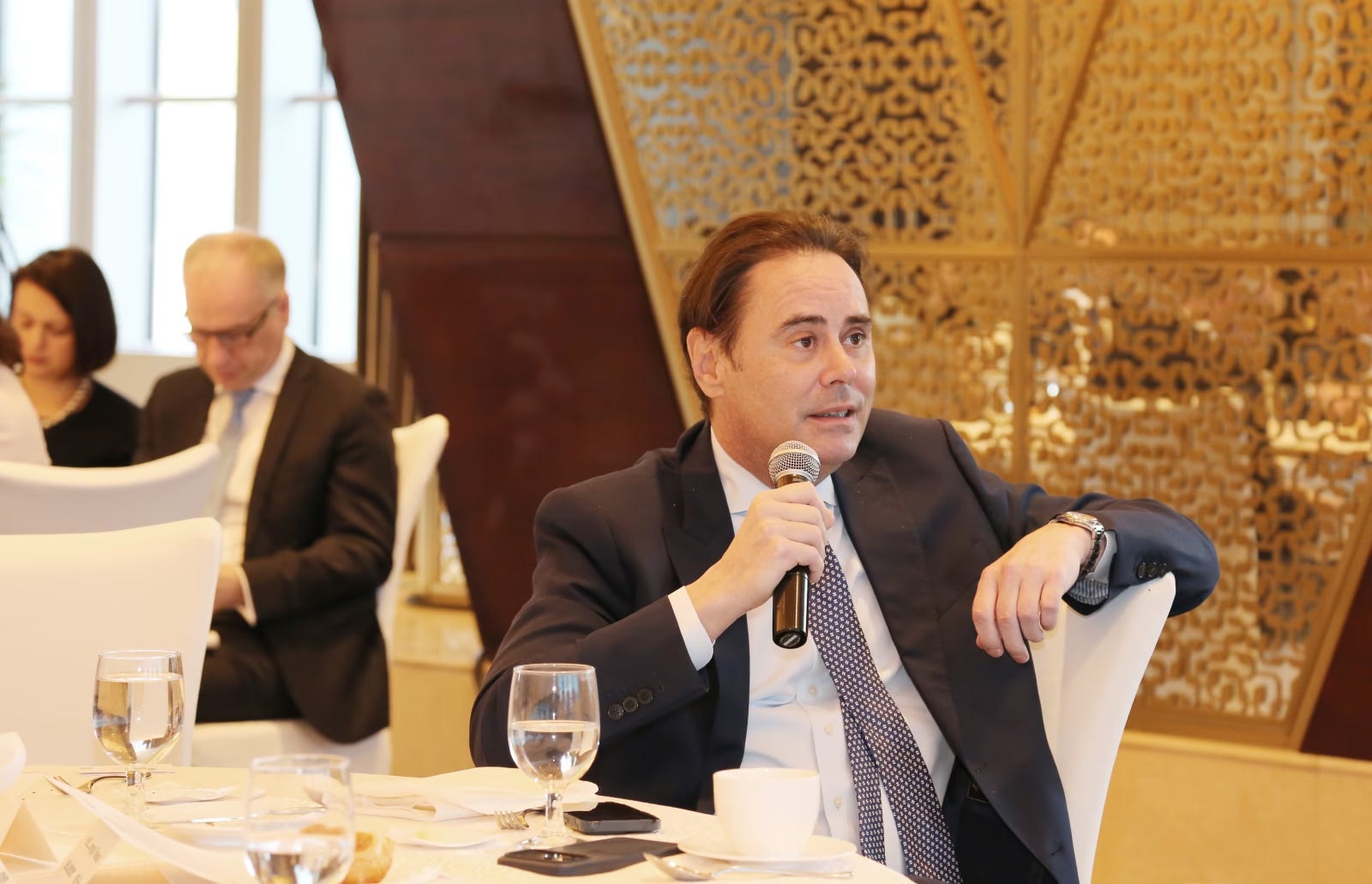
Thank you very much, Henry. As always, these debates are very interesting, and with very distinguished keynote speakers.
I particularly coincide with Jens, because he always comes with very first-hand data on trade, and the picture he paints is quite concerning, not to say very concerning, because of the growing, and I would say unsustainable imbalance. This is caused by many factors, not only by the fact that China has developed an extremely effective manufacturing system and manufactures very good quality products at low prices. There are also some who think that the renminbi is extremely undervalued. That could be another cause.
But I think there is one cause, which is not the cause of the whole imbalance, but is a cause of the degradation of this relationship between China and the European Union in trade and economic relations, and that is the degrading state of the level playing field, meaning the conditions with which European companies are faced in China when exporting or even when investing, compared with the conditions with which Chinese companies are faced in Europe.
Not to talk about the export controls on rare earths, permanent magnets, and technologies which have nothing to do with defence, such as technologies to manufacture batteries or cathodes, which have nothing to do with national security.
But anyway, my point is this is an example I would like our two Chinese friends here, who are specialists in trade, to comment on. It is just an example of this lack of a level playing field and what we can do about it.
About six months ago, China put into law something which was already quite frequent practice in China, but now it is embedded in the law, which is the following: for all public procurement in China, Chinese companies will have a 20% price advantage. So foreign companies will have a 20% price disadvantage. In other words, they will be discriminated against.
So my question is: don’t you not think Europe should do something about it? Does China think that Europe should do nothing, that this is fair? Why is the Chinese government already concerned and complaining, and even threatening action, about a proposal of the Commission which would give some kind of preference to made-in-Europe or made-with-Europe public procurement? Do you not think it is only fair that people level the playing field?
This is one of the examples we should talk about, because there is no way we can accept, and I think this is perfectly understandable, being discriminated against in public procurement in China and doing nothing about it in Europe. Thank you.
Henry Huiyao Wang
Thank you, Ambassador.
I think we will give the speakers a chance to respond later. Of course, we see there has been a lot of action recently from the European Union, and maybe from China as well, so I think we need to talk and find a way.
Now, one by one, we have an expert here, former Minister-Counsellor Huang.
Huang Rengang, Vice President, China Society for World Trade Organization Studies; Former Minister-Counsellor of the Mission of China to the WTO and the Chinese Embassy in Australia
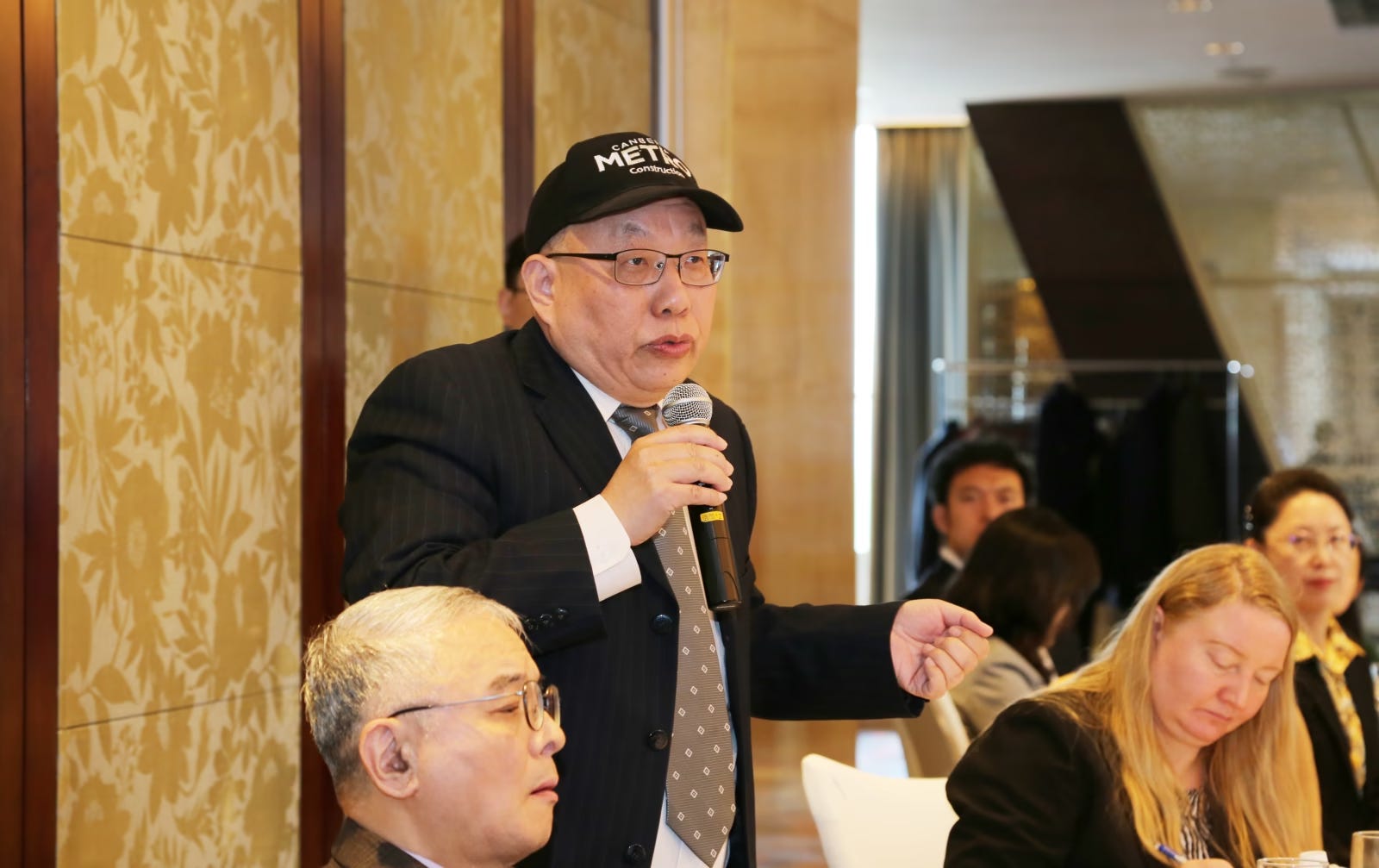
I am the Vice President of the China Society for WTO Studies, a think tank, and my boss, Ambassador Ma, is here. I thank the Ambassador of the EU for his comments and remarks concerning government procurement rules in China.
Actually, as a matter of fact, China is in the process of negotiating accession to the GPA, the Government Procurement Agreement, under the WTO. This process has been going on for the past 15 years, and due to some reasons, its process has slowed down somewhat. I think this is due to the concerns of some WTO members who think that, given China’s competitiveness, it is not be a good idea to let China become a GPA member. So in the past three or four years, the process has slowed down.
But China is willing to become a GPA member under the conditions agreed by all parties.
The question most of you raised is whether China, as a sovereign country, can make its own government procurement regulations or rules, and how its trading partners can interact with China.
Of course, I thank CCG for providing such a forum to give us opportunities to exchange views. China is willing to continue negotiations and discussions with our trade partners about China’s government procurement framework and regulations. That is number one.
Number two: if you look at bilateral trade between China and the EU, last year overall trade was over 800 billion U.S. dollars. The EU is a very important trading partner of China, and we value this relationship. We are willing to work together with the EU and EU members, and with European countries outside the EU as well, such as the UK, if represented here today, to continue improving market access on both sides.
Because if you talk about the lack of a level playing field, I have also heard some Chinese companies complain about the lack of a level playing field in some European countries. For instance, there are higher tariffs on Chinese products such as electric vehicles, solar panels, and some other products. Some Chinese exporters are telling us that they are facing special tariff and non-tariff barriers when trying to export their products to Europe.
On the other side, some Chinese companies are also complaining about a lack of a level playing field in terms of investment. Some types of Chinese investment are highly restricted in certain sectors, industries, and products in Europe.
So my point is that we can sit down and talk together, so that we can try to improve market access on both sides bit by bit.
For instance, some good news: recently, China issued a new regulation on how to improve the process for foreign food products and agricultural products. I think some of you may be aware of these recent regulations issued by China.
So I think the Chinese government’s commitment to further opening up, and to further engagement in globalisation with other trading partners, is very strong and firm. I am willing to see that, by working together, we can improve the future prospects for our cooperation.
Thank you.
Henry Huiyao Wang
Ambassador from Spain—I know you have a question. Oh, Ambassador from Norway first.
Vebjørn Dysvik, Ambassador of Norway to China
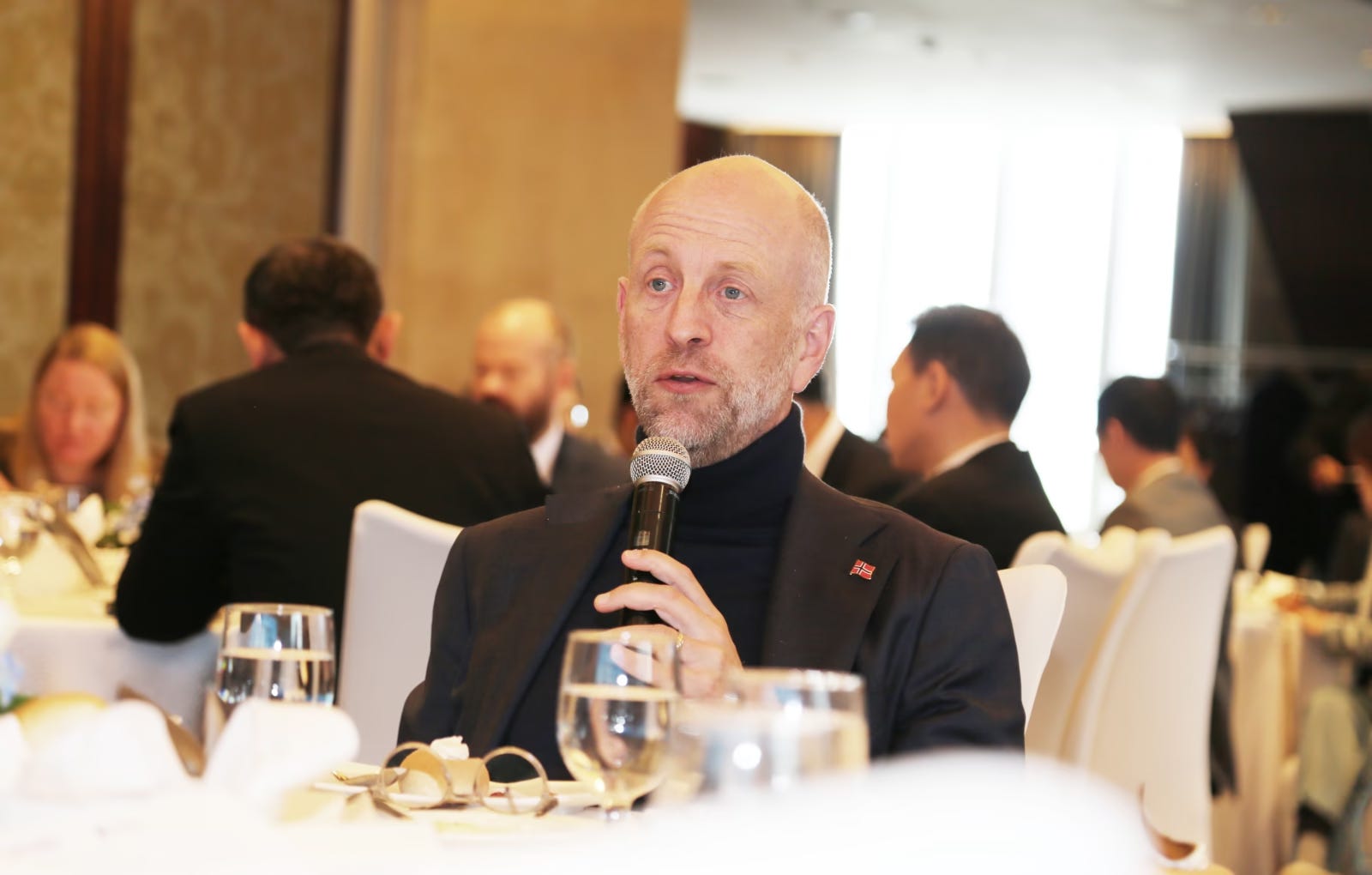
Yes, thank you. And thank you for the very good interventions from all the panellists.
The theme of the luncheon is quite broad. I will just bring up two points. One is WTO reform. I think they showed there is still a lot of work to do, but our position in the work we have done on this, is that it is still possible to move forward, but it will take a lot of good faith from all sides.
We have talked a lot about transparency and the level playing field. It is important that all countries are transparent about their industrial policies, because that will also, I think, make it possible to sort between the things that actually...as Jorge and Jens just said, the competitiveness of China is undisputed, but there is definitely also, as we see from our own examples with Norwegian companies establishing themselves in China, a lot of advantages they have in their Chinese establishments that they do not have when they establish themselves in Norway. This is partially due to our policies, but also due to very favourable industrial policies in China, and openness and transparency about that are important.
On the other hand, and in relation to the last question which talked about transparency from our side, when we make restrictions, when there is a security concern, being open about what those concerns and being restrictive about our restrictions, I think, is very important.
But then I think Jens’s point about this lack of balance is also important. You know, the yin and the yang need to be in balance, and right now we are on our way into a situation of imbalance, and this is due to our policies. We have policies to stimulate demand in our countries. We have liberalised capital markets and convertible currencies. That has consequences for the trading relationship with China. China does not have the same kind of policies to stimulate demand, and does not have a convertible currency in the same way, and that has grave consequences for the competitive environment.
So my question is about the need for balance and harmony between the European Union and China. Is there any sign that this is on the agenda of Chinese decision-makers, and could we see some moves towards trying to establish more harmonious relationships in the future?
Henry Huiyao Wang
Okay, thank you, Ambassador.
I think our colleagues have all talked about dialogue. That is what CCG is doing as well. But I would like to invite another contribution from the Chinese experts’ table. I do not know if Minister Ma or Minister Huo can say something too, or Wang Yiwei, another expert on that table. The former president of the Chinese Academy of International Trade and Economic Cooperation.
Huo Jianguo, Vice President of the China Society for World Trade Organization Studies
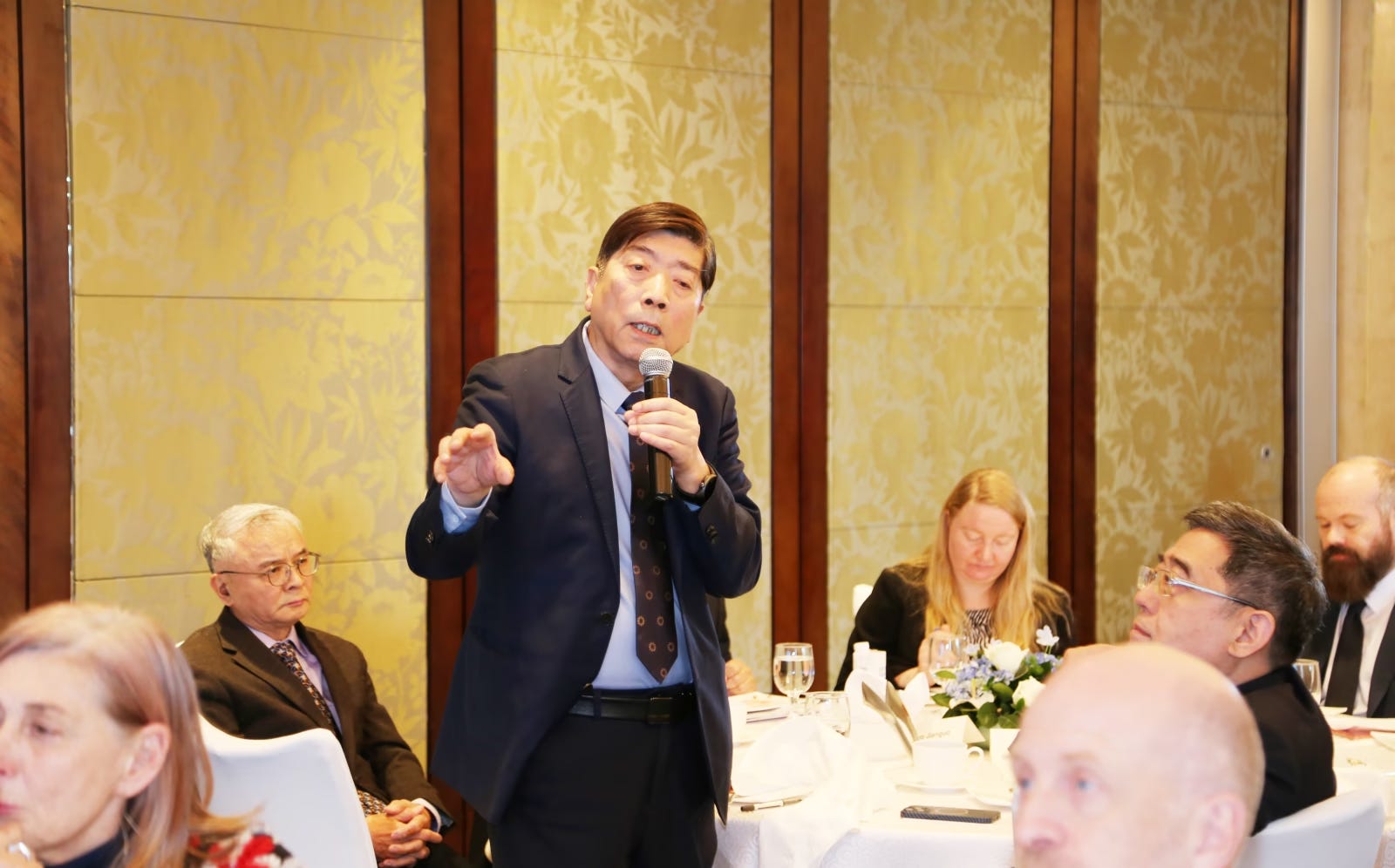
Hello, everyone. I am glad to be here and to listen to some very useful information.
Just now, I noticed one speaker talking about China’s trade surplus. I think this is a very important problem, because China and the EU now have the largest surplus, especially this year. We have noticed it is nearly 290 billion U.S. dollars, nearly 300 billion. So this really deserves special attention if we want to solve it.
I have always studied how to solve trade imbalances, because nowadays trade relations are sometimes interrupted by geopolitics and protectionism. Under such circumstances, it is very difficult to solve trade imbalances.
So I hope China and the EU can try to find more opportunities to cooperate, especially under the current special situation. The world governance needs China and the EU to unite and cooperate with each other, and to put forward useful and valuable suggestions to solve the disorder in the world.
Another thing I want to draw your attention to that under the 15th Five-Year Plan, there are two requirements we should note. One is that China will try to push more balanced trade development. That is one requirement. Another is that China wants to explore bilateral investment rules. I think these two requirements mean that the government has already made special efforts to address trade imbalance, and another way to improve things is through outward investment abroad.
So I think we need some time to solve these problems.
Henry Huiyao Wang
Okay, good. I think one of the suggestions we could have is that I see the European Union now has an FTA with India. Maybe the European Union should have an FTA—free trade agreement—with China. We would love to do that.
But before I go back to our colleagues, I noticed Ambassador of Luxembourg has some comments to make before we have all the panellists respond.
Rol Reiland, Ambassador of Luxembourg to China
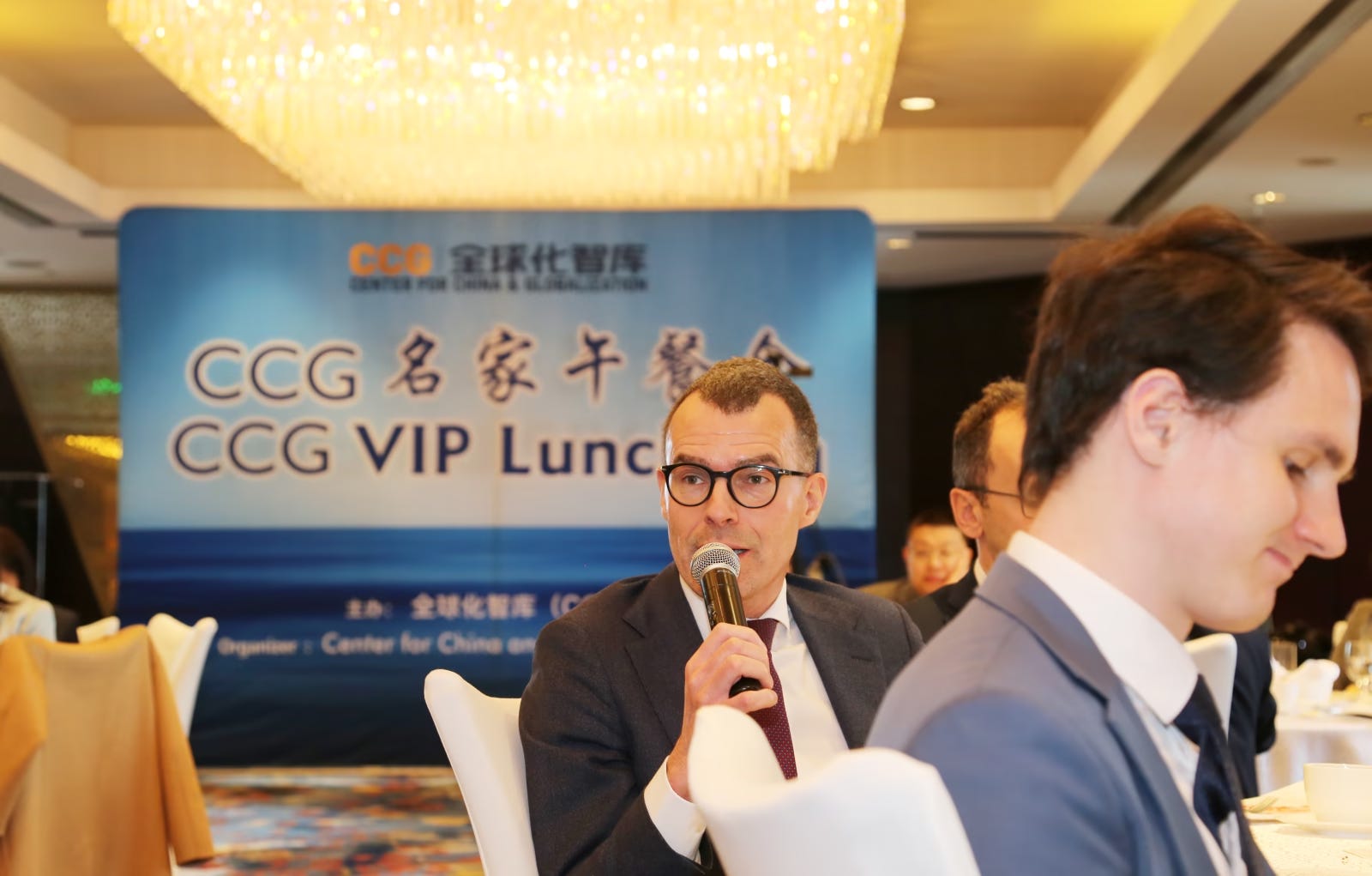
Yes. Thank you very much, Henry and Mabel, and also Konrad-Adenauer-Stiftung, for organising this important event at a very important time. Thank you to the speakers. I would have two questions, or rather one—well, one or two questions, let us say.
My first question would go to Ambassador Ma regarding the WTO and MC14. I was a bit surprised not to hear you say anything about WTO reform. I know there has not been much progress. And also, on trade dispute settlement issue, what are your views? What do you take from MC14 in that respect, and how do you see the way forward?
Secondly, of course, our core issue today is EU-China trade relations. I think Jens showed us very clearly how the imbalance has continued and how the imbalances are further developing.
I would pick up on the recommendation of DG Han for having people-to-people contact, because I agree with you very much. There is a need for us to understand each other better.
On my own end, I have tried to encourage parliamentary delegations from my country, Luxembourg. I had three last year, including the president of our parliament, and each time I told them: open your eyes, try to learn from China.
This would also be my question to the three panellists: what do you think Europeans could learn from China? Obviously, as Europeans, we also have to do some homework back home, maybe in terms of industrial policy, etc, and of course I do not want to exclude trade policy. But what would be your recommendations, from the three of you, very concrete recommendations, on what we Europeans could learn from China to rebalance this trade relationship a little bit more?
Thank you very much.
Henry Huiyao Wang
I know the Ambassador from Spain has a question. We had the Spanish Prime Minister coming, and Spain has a lot of experience in China-Europe relations. So Ambassador from Spain, please.
Marta Betanzos Roig, Ambassador of Spain to China
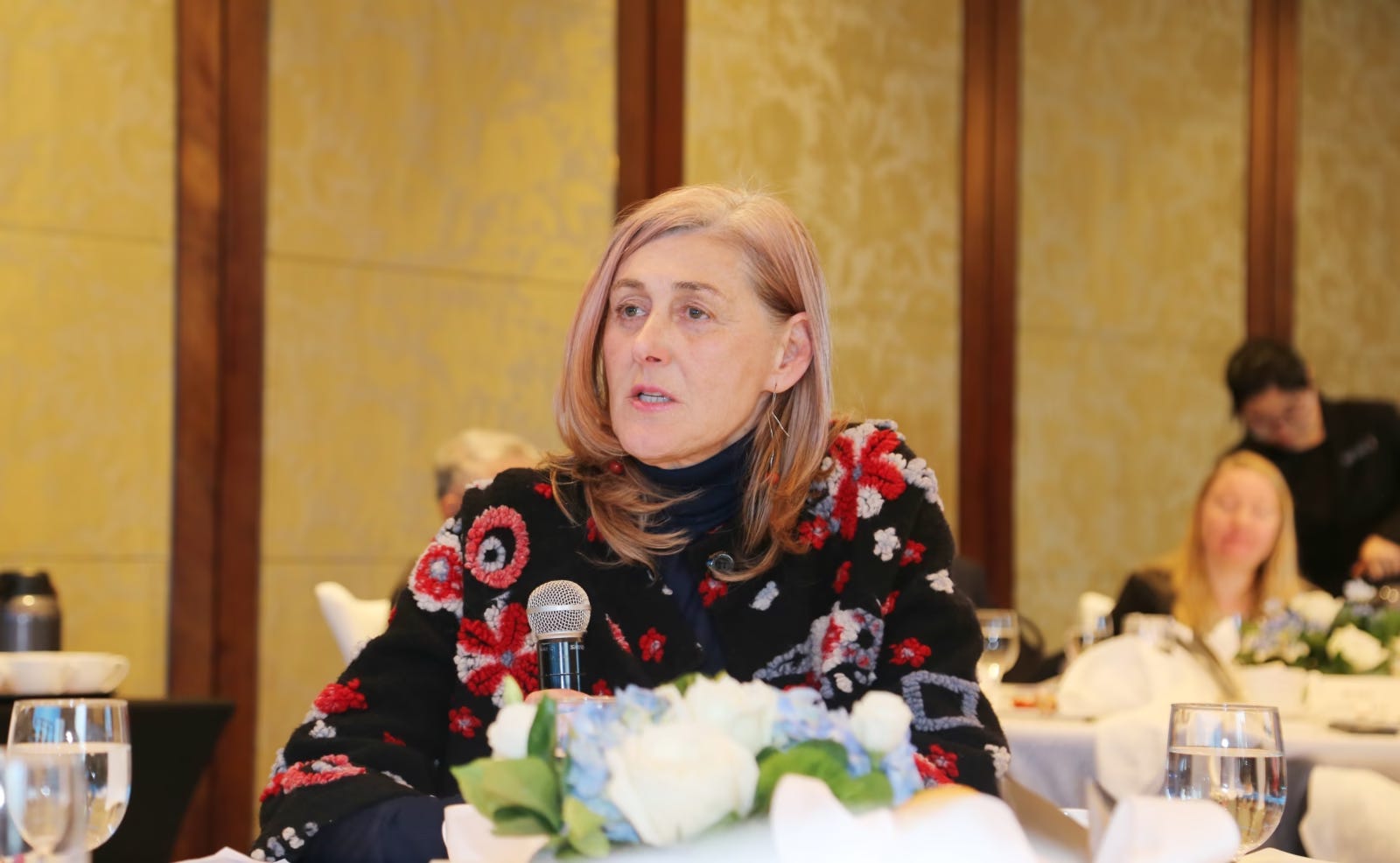
Thank you, Henry. Of course, thank you to everybody, because your remarks have been very [inaudible]. I entirely subscribe to the words expressed by Jorge Toledo. I think he speaks on behalf of all EU countries, and also my colleagues from the other European countries.
Now my question is this. I have recently been reading a report prepared by Roland Berger Advisory on the relations between Chinese and European enterprises, commissioned by the Chinese Chamber of Commerce in Europe. It is very clarifying to me. It has really opened my eyes, because I have seen, in the introduction of this very recent report, that Chinese businesspeople’s concerns and complaints are very much aligned with European concerns. They complain, or express worries, about protectionist measures, an unfair playing field, lack of transparency, and even discrimination against them.
I was very much surprised, because I do not believe that is the feeling in the European business community, at least not in Europe.
So linking this comment with the words that have been expressed by my colleagues, I would be very curious to hear a further comment or analysis from Mr Han Bing. At the beginning of your address, you mentioned the different sense of security, or insecurity, between European countries and the Chinese population. How do you explain this different approach to the perception of security, particularly with regard to China? And why do you think this anxiety that you have said is part of our perception or mindset? And what do you think this anxiety you mentioned is due to?
Thank you very much.
Henry Huiyao Wang
Great. Thank you, Ambassador.
Now we have our panellists to respond. Maybe first Ambassador Ma, then Jens, and then Mr Han. Yes, please.
Ma Jianchun
Thank you very much. Thank you, Excellencies.
I would also like to thank my colleagues and express my appreciation to them. We are here, but in some cases they answered the questions instead of us. So I suggest next time we have a roundtable rather than this kind of panel, because all my colleagues have professional backgrounds in the Ministry of Commerce. For example, my colleague Mr. Huang used to participate in WTO negotiations in Geneva, so he knows the process of our GPA negotiations. Mr. Huo is also a very professional expert in our ministry.
First Ambassador, you mentioned the Government Procurement Agreement. Mr. Huang already expressed China’s willingness. We really would like to participate in this agreement and become a member of it. That is our general position.
But of course, for individual cases, there may be some issues. You mentioned that China gives preferential conditions to Chinese enterprises. I think these issues can be discussed. But I have also noticed some individual cases on the European side. You also have your industrial action plan. When I saw this information, I found that Europe also has this kind of measures to give more preferential conditions to local companies. Am I right? Maybe I am wrong, but I saw some information that such plans give more preferential conditions for local companies to participate in certain projects. It is a proposal? Oh, it is a proposal. Then I am sorry, I should do more study. I have only seen pieces of information about this.
So I think there may be some individual cases that we need to negotiate one by one, to try to reach settlements and solve these kinds of problems. That is one thing.
Second, on the trade balance, Mr. Huo also mentioned that the Chinese government has noticed the huge trade surplus we have, and it cannot last for a long time. We have already acknowledged this, and we are trying to solve the problem.
Chinese governance usually starts from the top leadership, with strategy, and then we push it into action, just like the 15th Five-Year Plan. We put this on the core agenda. We are promoting more balanced trade development. Of course, we still need to see what further steps should be taken. And I think all of us working in government, or in think tanks, try to convince not only the government but also associations and industries to accept this concept.
We are also promoting two-way investment. We are not only attracting foreign investment; we are also encouraging our enterprises to go overseas. Today, we are not only suggesting that they make small investments. We are encouraging them to bring their supply chains, production chains, and value chains to foreign countries.
In Chinese, we used to say “go out 走出去”. Now our wording is changing. We no longer only encourage companies to go out; we also encourage them to stay there 扎根, to become part of the local supply chain and local investment structure. So I think all of this is changing.
Third, and I will be quick, Ambassador, you asked me about WTO reform. You asked which part was successful and which part was unsuccessful. I think the successful part is that almost all WTO members acknowledge that we should push WTO reform. That is already a success, and more and more consensus is being reached.
I can give you one example. By March 28, the European Union, China, and some other members, including Brazil and Japan, had made a suggestion to the WTO Secretariat. We suggested maintaining support for the rules-based multilateral trading system with the WTO at its core. That is one success.
Of course, before MC14, several members submitted their suggestions for WTO reform. From their suggestions, we can see that we still have many differences—different ideas, different suggestions, different evaluations. We need to communicate, and we need to keep communicating.
So I think WTO reform is a long way to go. But without reform, we would lose a very valuable international body.
Thank you very much.
Henry Huiyao Wang
Thank you, Ambassador Ma.
And also, for the Ambassador’s point, I think the European Union has recently proposed some new regulations about local content, though not necessarily excluding Chinese companies. Anyway, it is still a proposal. We hope it does not go through.
Now, Jens, you have been eager to respond already.
Jens Eskelund
Yes, thanks, Henry.
I am a simple businessperson, so I will try to keep this very simple, because I actually think the issue is extremely simple. It is very straightforward. If the world produces more than the world can absorb, then there will be winners and losers.
I think this is the basic issue. When we look at China right now, China accounts for 18% of the global population, but only 13% of global consumption. It accounts for 30% of global manufacturing value added, and 37.5% of global exports in volume terms. What worries us is that, in the new Five-Year Plan, we continue to see a focus on expanding manufacturing output.
What we have seen over the past five years or so is that output is growing much faster than what the domestic market can absorb. That means someone else will need to absorb whatever extra that China is producing that it cannot absorb domestically.
So I think at the most basic level, we need to recognise that if someone that produces more than they can absorb, that cost will need to be absorbed by someone else. And right now, It’s Europe that is taking on that cost.
China likes to say that it is a big market, but in reality, it is the opposite. China is sucking up demand around the world that used to be satisfied by local companies. I am not saying it is bad; I am just stating it as a fact. If more is being produced than the world can absorb, then we have a problem. It is inefficient, and someone will need to take the loss.
So what needs to happen? I think, if I may be so blunt, and provide a recommendation to the Chinese government: we, of course, appreciate that there is a lot of focus on growing demand, but if you do not get the supply side under control, it is not going to work. We need to get to a point where there is a balance, and hopefully, for a number of years, a higher domestic demand growth than supply growth in the Chinese economy. Ultimately, that is what will resolve the problems: that there is a better balance between supply and demand.
And why do we focus so much on China? Because China is unique. There is no other country like China, accounting for 37.5% of all exports. China is in a class of its own. I think it was Stalin who said that at a certain point quantity becomes quality, and I think that is exactly what we see in China, because of China’s scale. You know, I actually think China is not that different from from Korea. I don’t know if there are Koreans here, but I think a lot of the practices that we see here are the same in Korea and other countries, but they’re just so small that, and the world could easily absorb it. But China, because it’s so enormous, when China moves, the whole world is shaking. And that’s just a fact. I know this may be a new experience for China, but that is how it is.
So make sure there is this balance between supply and demand. Hopefully, the best thing China could do for the world would be to have higher demand growth in China than supply growth.
And then, Ambassador Roland, your question about what Europe should do. Before I became a businessman, I studied philosophy, and I think the difference between Europe and China is the difference between Plato and Adam Smith. One thing I have learned in China is that all decision-making, and what makes China so efficient, is guided by the Chinese perception of rational self-interest. That is pure Adam Smith—rational self-interest. Whereas in Europe, we are still living in Plato’s cave of eternal ideas.
That is, for example, what we sometimes see with the WTO. Even though there is a truck coming at us at 100 miles per hour, we are still adhering to the principle of straight ahead.
So again, one thing I have learned philosophically is that if it is a battle between Plato and Adam Smith, Adam Smith wins every time. That may be one thing Europe can learn.
We are all committed to the rules-based order. The WTO is a great thing. It has created enormous value. But I also think there needs to be an Adam Smith smell test. If something is not in the self-interest of Europe or China, maybe we should stop for a moment and ask ourselves: are these the right principles? Do we need to fix something? What needs to change? Do we need to have a discussion about whether supply is growing too much in some geographies compared with demand?
It gives me a bit of optimism, I can see that when I go to Europe, it has become possible to ask openly whether something is in the European interest. It does not mean that Europe is in any way letting go of the principles of free trade, but there needs to be a smell test. Does this work for Europe, yes or no? And if it delivers a negative effect, then it is a completely legitimate question to ask: what would need to change?
Thanks.
Henry Huiyao Wang
Okay, great. Mr Han, please.
Han Bing
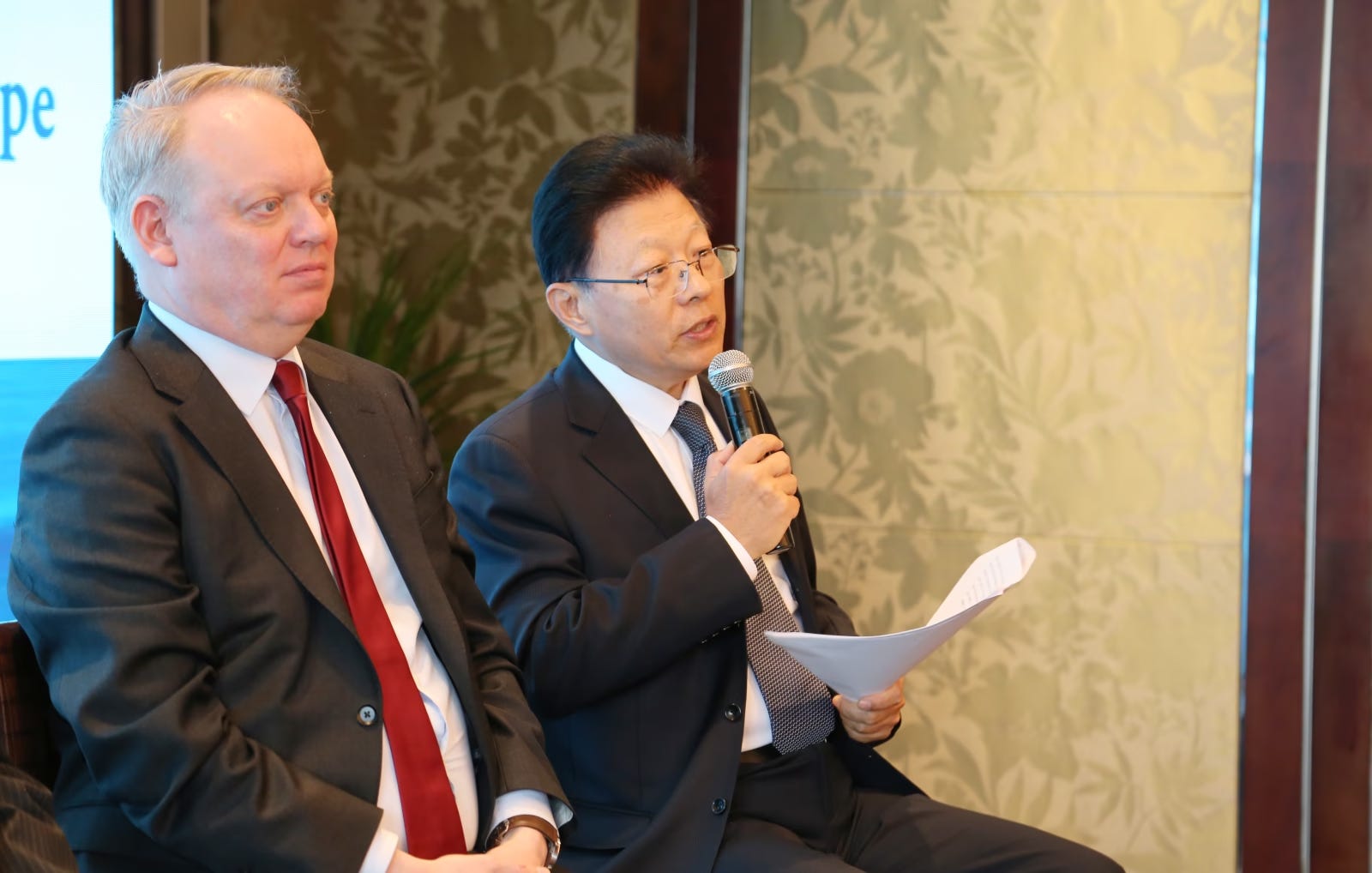
Okay, thank you.
First, I would like to answer Her Excellency’s question about the security index. European people are more anxious, and I think this is partly due to the different character of European people and Chinese people. Chinese people are more focused on their own things. European people think more about the management of the world. So I think that is why they are more anxious. But for Chinese people, we just focus on our own things, so we are less anxious about the world.
Why do European people put China as a security problem with such a high score—more than 40, even over 50? I think this is because of disinformation about China. There has been a whole narrative about a terrible China in the past years. Ordinary European people do not know the reality of China. When we adopted a free-visa policy for some countries, and ordinary people came to China, they were shocked. They were shocked by what China really is, compared with the information they had received from the media, or even from government institutions in the West.
So I would say this is what we need to change: we need to understand reality. Then I think we can change the mindset of ordinary people, even in Europe, and we need to be more optimistic, and not only complain.
I think this is also a problem in China. Sometimes when Europe adopts certain policies or takes certain moves, some people in China also complain. But I think these complaints come more from officials than from companies. Chinese companies are more focused on how to solve the problem.
I will give you an example. In the past, China exported a lot of lighters to Europe, and Europe found that the lighters were not safe for children. Europe considered passing regulations on lighter safety to protect children. Some officials in China complained that this was protectionism from Europe. But the companies did not think that way. Even while the laws or regulations were still under consideration in Europe, Chinese companies had already invented devices for child safety on lighters. That is the difference.
So in the future, we need less complaint and more work. That is what I would like to say.
And in the past, I think Europe was more open-minded towards Chinese goods and technologies. But nowadays, as Mr Huo said, the geopolitical situation is having a very strong impact on our cooperation. We need to discuss how to avoid that.
This morning, I was talking with the president of a Chinese steel plant in the UK. This Chinese company acquired a steel plant in the UK. Now the UK is considering nationalising the plant. I asked him what they would do. He said, “We can do nothing. If the UK government nationalises the plant and does not give us compensation, we have nothing to do.” That is the situation. But the Chinese company did not complain to us.
As for the trade imbalance, I think we need to talk. China is a huge market for European goods, especially high-tech goods. We can buy a lot—a huge amount.
Henry Huiyao Wang
Thank you. Okay, good.
I think we are almost coming to the end, but I would like to add a few observations just to conclude. I think this has been a fascinating discussion. We had experts from the European side, ambassadors, Chinese experts from MOFCOM, and many business representatives here.
I think we do have a few points of consensus.
First, Europe and China should all work together to maintain the multilateral order, reform the WTO, and support the WHO, UNESCO, and all those institutions. I think the WTO is making some progress. We have trade liberalisation, digital e-commerce, and one of the proposals I participated in is to really get rid of plastic pollution in the oceans. I made the opening speech at the WTO Public Forum in 2019, and now that initiative has participation from 70 or 80 countries, and the EU is one of them. So I think we do work together on this multilateral front.
Second, on China-EU relations, I think we had a lot of good discussions, and we are going to make a good summary and submit it to different departments for further discussion. But I have a few proposals to make.
One is that I know the CAI was talked about seven years ago. Is it possible to revive some of the CAI? That would be great. But in any case, let us start FTA talks. If the EU already has an FTA with India, why not with China? We certainly can do that.
Third, now China is entering the stage of outbound investment. So many companies I meet want to go to Europe. But the political environment is not always that friendly for them. For example, we see that 40% of Chinese investment in Europe goes to Hungary, because China has an excellent relationship with Hungary. Recently, we have also had a good relationship with Spain, and investment is now increasing there too. But I really do think we can increase investment in Germany, France, Norway, and Luxembourg as well. Let us maintain good relations, because the momentum is there. We have had a lot of bilateral visits. So that is the third point: we can accelerate Chinese outbound investment to European countries.
Fourth, we can have joint ventures. Germany, France, Italy, and Spain have so many manufacturers. They are top experts. Like Jens, representing a big European company with a great China operation. Why can European companies not team up with Chinese companies? Now Chinese companies want to go to Europe and to third countries. We can form joint ventures with European companies and go together. That would be a really great approach, including in third countries.
The Japanese did this in the 1980s and 1990s. They invested a lot in America and Europe, and that calmed down some of the complaints in those countries. I think Chinese companies can do the same now. We should really facilitate much more investment from China into European countries and third countries.
My fifth point is this: China has opened visa-free entry to twenty-some European countries. Can EU member states issue easier visas, or even visa-free access, for Chinese tourists? Because, for example, Chinese tourists do not need visas to go to Thailand, and 8 million Chinese tourists went there. If European countries open easier visa arrangements, we could have a flood of Chinese tourists spending money and buying luxury goods from Europe. That is my point. Okay, yes, member states, member states—but we do hope to see more relaxed visa arrangements from European member states for Chinese visitors, because every time I hear from many people that applying for visas to European countries is too time-consuming.
My sixth point is that high-level visits are so important. We do need parliament members and government representatives to visit. I am sure the momentum is there now, and I really appreciate that we have had a lot of parliamentary members visiting.
And the final point is business. We should have a Chinese Investment Summit in European member countries, and a European Investment Summit in China. The European Chamber of Commerce is doing something on a small scale, but let us do a larger one. Let us get MOFCOM involved, and everybody involved. The WTO Society will support that. So we can really promote bilateral trade, exchange, and investment.
And finally, now we are in a period when relations among China, Europe, and the U.S. are really under strain. As the Munich Security Conference report showed, with the elephant on the front page, the system is being damaged a lot. So this is a high time for Europe and China to work together.
I do see China playing a big role now in the Iran issue. China is also very closely working with Pakistan, and the peace talks will be held in Pakistan. The Pakistani foreign minister was just in Beijing. And I think when President Trump comes to China, China will work with President Trump on the Russia-Ukraine war as well. So China can take a much more active peacemaking and mediating role, so that we have fewer geopolitical tensions among us. Then we can also change a bit of this perception we have of each other.
And this CCG VIP luncheon, this time working with the Konrad-Adenauer-Stiftung, is one of the ways to do that.
I do not know whether Johann, from our co-organiser, would like to say anything finally. I really appreciate—
Johann Caspar Fuhrmann, Head of Beijing Representative Office, Konrad-Adenauer-Stiftung
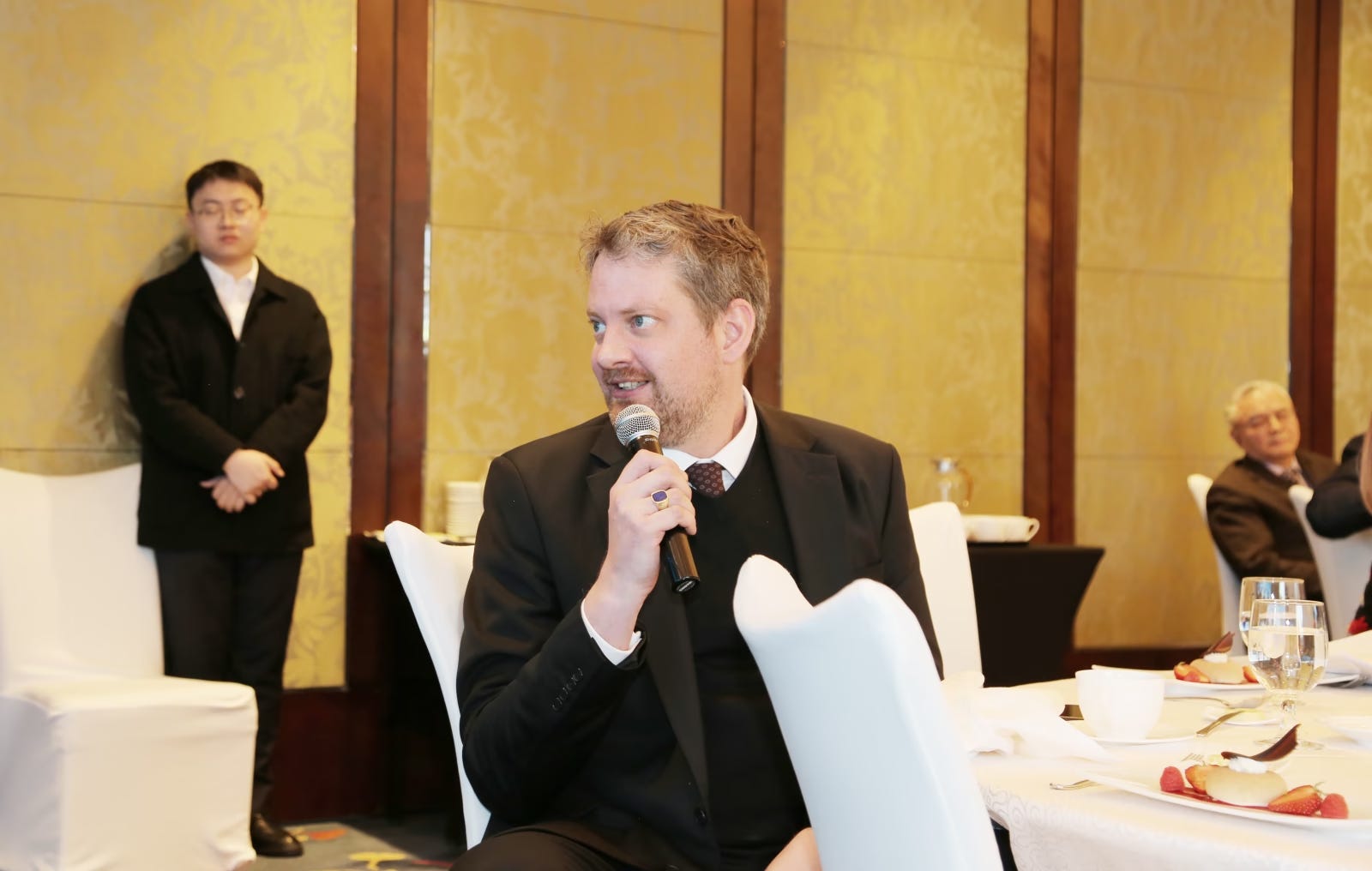
Thank you so much. I would just like to thank all of our panellists, and of course Henry and Mabel, for making this exchange possible.
I believe that everything I would have to add would fire up this place too much, because of course we perceive China as a threat in Germany because of the ongoing political support for Russia. That has really changed the debate in Germany about China a lot. And I still believe that we would hope for China to do more and to put pressure on Putin to bring him to the negotiating table.
At the same time, Henry, you mentioned foreign investment. Of course Germany is very open to Chinese investment. It is an ongoing criticism that German companies and joint ventures create many jobs in China, while China is not creating enough jobs in Germany in comparison. And of course I understand why you invest in the country of Viktor Orbán, because he might be closer to you than the German government, this one or the former one. But still, our hope when it comes to foreign investment is that China could do more and create more jobs in Europe.
Henry Huiyao Wang
Good, good comment. I thank you, Johann.
Basically, what I am saying is that Chinese and German companies have huge potential. We have all the big companies here. They have total value chains here. Let us go back to Germany as well. Even in technology, Chinese EVs now have strong technology. When European companies came in before, it was technology for market, and now we can probably do the same.
But I do see huge potential between China and Europe. Today, we really had a great occasion. We have had so many important experts, ambassadors, and business representatives here.
I want to thank you all very much. We will conclude now, and let us take a photo together.
Thank you very much.