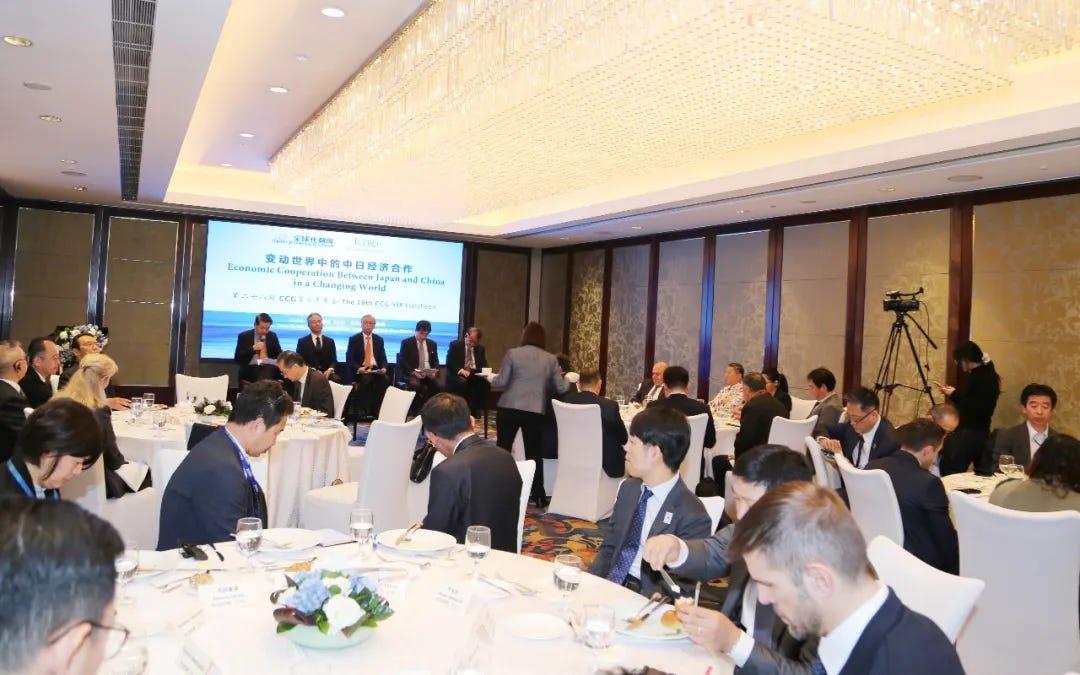
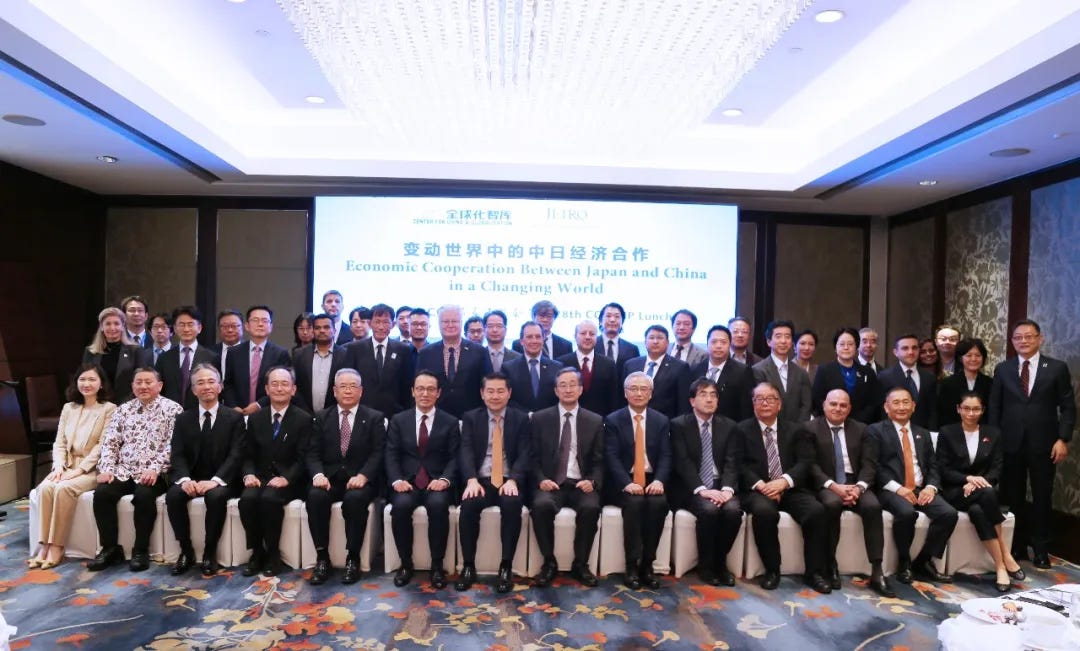
On 28 October 2026, the Center for China and Globalization (CCG) and the Japan External Trade Organization (JETRO) jointly hosted a CCG VIP Luncheon in Beijing, under the theme “Economic Cooperation Between Japan and China in a Changing World”.
The event brought together ambassadors from Japan, Croatia, Fiji, Malta, Portugal and Singapore, as well as the Vice Ambassador of Indonesia. Other diplomatic representatives attended from Azerbaijan, India, Japan, Kazakhstan, Pakistan, Singapore, South Korea, Spain and the United States. Other participants included representatives of international organizations, government agencies, industry associations, academic institutions and businesses.
Opening remarks were delivered by Henry Huiyao Wang, Founder and President of CCG, and Mitsuaki Hoshino, Director General of JETRO’s Beijing Office.
The keynote speech was delivered by Professor Fukunari Kimura, President of the Institute of Developing Economies (IDE), JETRO, and Professor Emeritus and Senior Professor at Keio University.
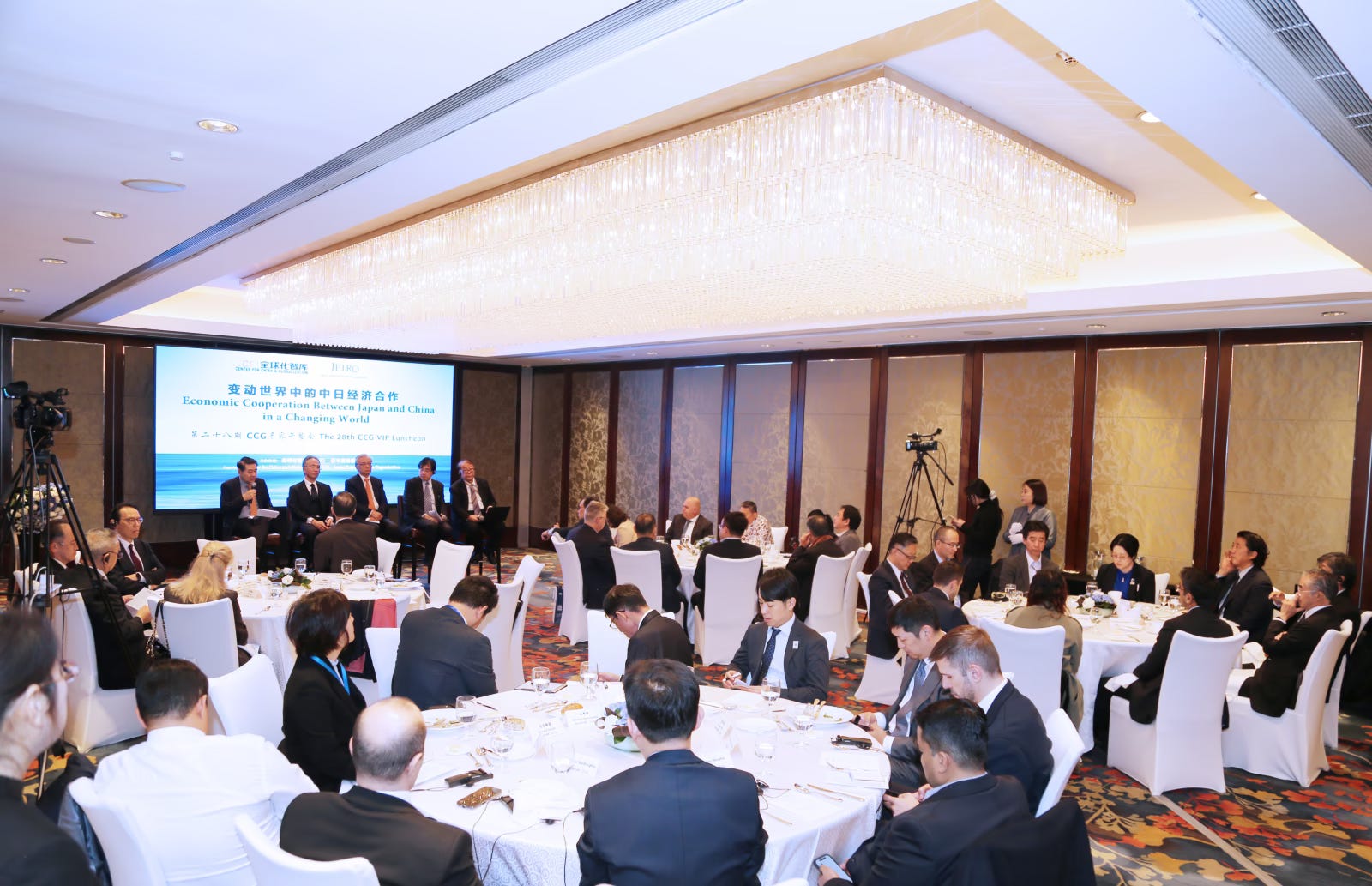
A subsequent panel discussion, moderated by Henry Huiyao Wang, featured
Yusaku Nishimura, Professor at the University of International Business and Economics;
Song Yaoming, former Trade Minister at the Chinese Embassy in Japan;
Takamoto Suzuki, General Manager and Chief Economist of the Economic Research Team at Marubeni (China) Co., Ltd.;
and Zhang Jifeng, former Deputy Director of the Institute of Japanese Studies at the Chinese Academy of Social Sciences.
This transcript is based on a recording and has been lightly edited for clarity. It has not been reviewed by any of the speakers.
Mabel Lu Miao, Co-founder and Secretary General of CCG
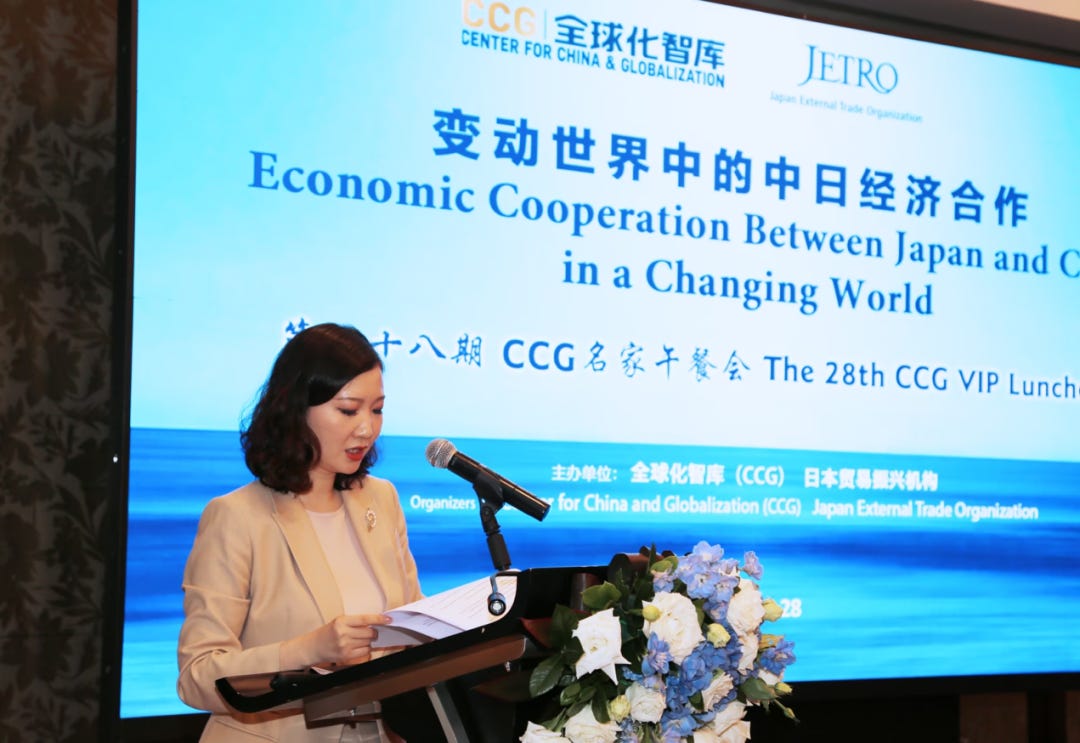
Your Excellencies, ladies and gentlemen, good afternoon.
Good afternoon, Your Excellencies, ladies and gentlemen. Thank you for joining us for today’s CCG VIP Luncheon. I am Mabel Lu Miao, Co-founder and Secretary General of the Center for China and Globalization (CCG). Welcome.
The CCG VIP Luncheon is a flagship high-level international exchange platform created by CCG. It also serves as an important bridge linking political, business and academic communities around the world, dedicated to promoting practical cooperation between China and the rest of the world. The theme of today’s event is “Economic Cooperation Between Japan and China in a Changing World.”
We were deeply saddened to learn of the passing of former Japanese Prime Minister Yasuo Fukuda. President Xi Jinping has conveyed his condolences by telephone. Prime Minister Fukuda was long committed to advancing China-Japan relations and made important contributions to stabilizing bilateral relations and enhancing mutual understanding between the two countries.
China and Japan are located at the heart of Northeast Asia. As two major economies in the region, they share deep historical and cultural ties. Their economies are interdependent, and their relationship has also shown resilience. In 2025, China-Japan bilateral goods trade reached US$322.18 billion, an increase of 4.5 percent year on year. China’s exports to Japan amounted to US$157.35 billion, while its imports from Japan totaled US$164.83 billion. Japanese direct investment in China reached US$3.68 billion, showing a moderate rebound after years of slowdown.
Cooperation between China and Japan has increased in such areas as advanced manufacturing and biotechnology, with investment primarily taking the form of mergers and acquisitions. We hope to build a high-level platform for exchange, promote cooperation and dialogue, and bring together senior officials, industry leaders and academic experts from both countries to explore how economic cooperation can stabilize bilateral relations. We also hope to further mend bilateral ties through innovative people-to-people exchange mechanisms and sustained civil exchanges.
Today’s luncheon includes opening remarks, a keynote speech and a panel discussion. During lunch, guests will have the opportunity to exchange views freely and network. The event will conclude with closing remarks and a group photograph. Before we begin, I would like to introduce the distinguished guests joining us today. They include outstanding diplomats, representatives of international organizations, government departments and industry associations, experts and scholars, business leaders, and members of the media.
Among the ambassadors present are H.E. Mr. Dario Mihelin, Ambassador of Croatia to China; H.E. Robert Lee, Ambassador of Fiji to China; H.E. Kenji Kanasugi, Ambassador of Japan to China; H.E. John Busuttil, Ambassador of Malta to China; H.E. Manuel Carvalho, Ambassador of Portugal to China; H.E. Peter Tan, Ambassador of Singapore to China; and Dr. Irene M. Han, Vice Ambassador of the Republic of Indonesia. Other diplomats are joining us from Azerbaijan, India, Japan, Kazakhstan, Pakistan, Singapore, South Korea, Spain and the United States.
Representatives of international organizations include Olga Dzhumaeva, Head of Delegation of the International Federation of Red Cross and Red Crescent Societies. Representatives of government agencies and associations include Chang Sanghae, Chief Representative of the Korea Trade-Investment Promotion Agency; Hidekazu Chayama, Chief Representative of the Beijing Office of the Science and Technology Agency; Rizaldi Indra Janu, Director of IIPC Beijing; Professor Liu Jiangyong of the School of International Studies at Tsinghua University; and Lv Kejian, Former Director-General of the Department of Asian Affairs, MOFCOM, and Former Minister-Counselor for Economic and Commercial Affairs at the Chinese Embassy in Japan.
We are also joined by Akihiko Noda, Director of The Japan Foundation, Beijing; Emiko Sato, Chief Representative of the Japan National Tourism Organization Beijing Office; Eiichi Sekine, Chief Representative of the Beijing Office of Nomura Institute of Capital Markets Research; Kazuo Takeuchi, Chief Representative of the JICA China Office; and Hideyuki Yamaguchi, Director of the Beijing Office of the Japan Society for the Promotion of Science.
Corporate representatives include 01.AI, Sunshine Asset Management Corporation Limited, the Bank of Japan Representative Office in Beijing, Long Nexus Energy Co., Ltd., Panasonic Corporation of China, Trade Data Monitor, Basilinna, Trina Solar, and China Belt and Road International Trade Company. Media representatives include China.com.cn, TBS Television, The Guardian, Bloomberg and Kyodo News.
Now, please welcome Dr. Henry Huiyao Wang to deliver the opening remarks.
Henry Huiyao Wang, Founder and President of CCG
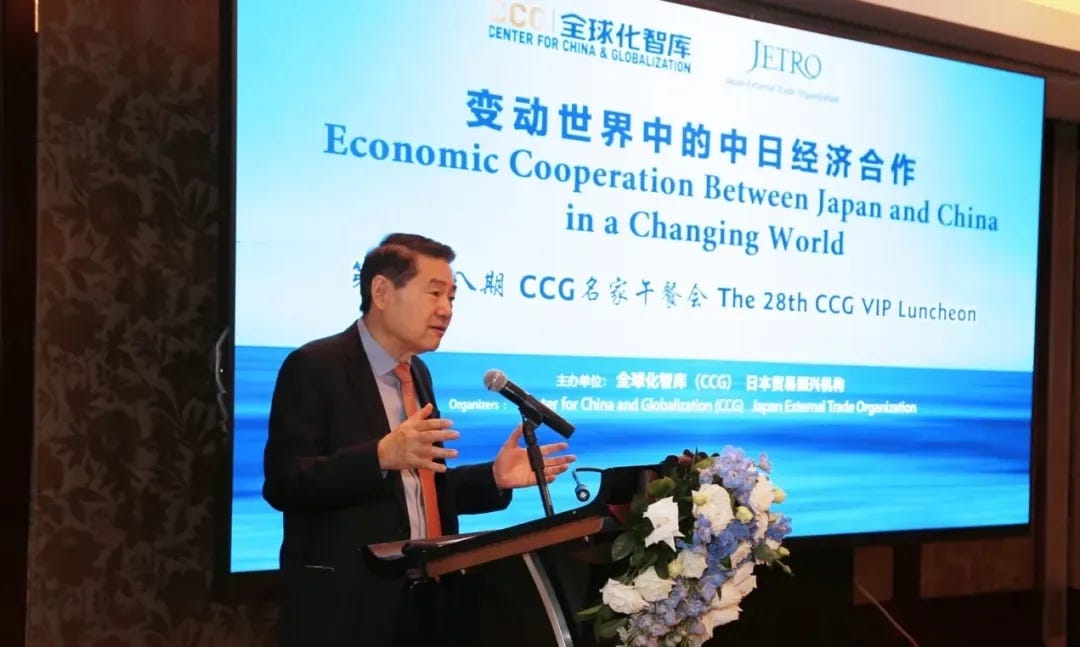
Ambassador Kenji and President Okonoma, Your Excellencies, distinguished guests, ladies and gentlemen, it is a great honour for CCG to host this CCG VIP Luncheon together with JETRO. We are delighted to welcome our friends from Japan. This is a meaningful occasion as we seek to promote bilateral trade and investment relations.
On 29 September, Vice Premier He Lifeng met Takeshi Iwaya, Chairman of the Japan-China Association for the Promotion of International Trade, who led a delegation to China. Vice Premier He stated that China welcomes Japanese enterprises to continue developing in China and to share in the opportunities of the Chinese market.
China and Japan are close neighbours with longstanding business, economic and investment ties. They remain among each other’s largest trading partners. Last year, bilateral trade reached around US$322 billion and continued to grow year on year. China and Japan are also part of the Regional Comprehensive Economic Partnership (RCEP), which has become an important institutional anchor for bilateral trade. In the first eight months of 2026, China-Japan trade grew by 13.4% year on year under the RCEP framework.
RCEP has also created a partial free-trade framework among China, Japan and South Korea, and favourable conditions for ASEAN, Japan, China, Australia, New Zealand and South Korea. It is the world’s largest free-trade agreement. Since its establishment, trade among the participating economies has grown; ASEAN has become a major trading partner for China, and Japan’s trade with China has also increased.
East Asia and Southeast Asia have great potential to become the world’s largest trading region. Asia already accounts for more than half of the world’s population and nearly half of global GDP. By further integrating Asian economies, especially China and Japan, the two largest economies in the region, we can strengthen trade and bilateral relations.
China, Japan and South Korea began discussions on a trilateral free-trade agreement in 2012. I hope they will make further progress, because these are the three largest economies in East Asia and among the region’s most technologically advanced countries. There are good reasons to advance this process.
RCEP is the world’s largest free-trade agreement, while the Comprehensive and Progressive Agreement for Trans-Pacific Partnership (CPTPP) is one of the most advanced regional trade arrangements, led by Japan. Australia is a member, and the UK has joined as well. China applied to join CPTPP in 2021. Trade is a common denominator for our region and an important contribution to the world economy. At a time of unilateralism and trade frictions, we need to strengthen regional trade and multilateralism. RCEP and CPTPP can serve as important pillars.
We would also welcome a revival of the China-Japan-South Korea free-trade agreement process so that it can play a more significant role. Inclusive globalisation, development and prosperity are important for our region’s future security, so we should identify common interests and promote closer economic and bilateral relations.
As Vice Premier He said, it is important to continue strengthening cooperation with our Japanese friends and businesses, encouraging them to continue developing in China. We hope to build better trade and investment ties and strengthen people-to-people exchanges, which have a good tradition between us. Once again, we appreciate all our friends joining us today.
I would now like to introduce our keynote speaker, Fukunari Kimura, President of the Institute of Developing Economies at JETRO, and Professor Emeritus and Senior Professor at Keio University. He has held academic positions at universities in Japan and the United States, as well as leadership and advisory roles at economic research institutions, professional associations and trade-policy committees. He previously served as Chief Economist at the Economic Research Institute for ASEAN and East Asia. His work focuses on international trade, development economics and East Asian economies.
Oh, I should first introduce our co-host. I apologise; we should have the opening remarks first. I would like to welcome Mitsuaki Hoshino, Director General of JETRO’s Beijing Office. I know you only arrived last month, and it is a great honour to co-host this event with JETRO’s Beijing Office.
Mitsuaki Hoshino, Director General, JETRO Beijing Office

(Speaking in Chinese)
Good afternoon, everyone. Thank you for taking time out of your busy schedules to attend today’s VIP luncheon exchange. I am Mitsuaki Hoshino, Director General of JETRO’s Beijing Office. First, please allow me to extend my sincere gratitude to the co-host of this event, Dr. Henry Huiyao Wang, Founder and President of CCG, as well as all of CCG’s colleagues.
The world economy and international order are currently undergoing profound transformation. Against this backdrop, we hope to establish a platform for exchange, bringing together guests from government, business and academia in Japan, China and other countries to explore the future direction of international economic cooperation. CCG and JETRO have therefore jointly planned and organized today’s event.
Today’s world is facing a series of major changes, including shifts in the geopolitical landscape, accelerating technological innovation, supply-chain restructuring, the green transition and digital development. Against this background, the development environments facing Japan and China are also constantly changing. In recent years, Japan-China relations have been the subject of much discussion and many challenges. Yet in the economic sphere, the two countries remain deeply interdependent.
Since China’s reform and opening up, Japan and China have accumulated extensive and substantial achievements in people-to-people exchanges, trade and investment, capital flows, knowledge and innovation. Precisely for this reason, the kind of cooperative relationship the two countries should build amid this changing environment concerns not only their own development, but also the international community. I believe this is an important issue that deserves our joint and in-depth consideration.
Today, we are greatly honored to welcome Professor Fukunari Kimura, a renowned Japanese economist, to deliver the keynote speech. I am confident that Professor Kimura will share many inspiring insights on the role Japan and China should play amid changes in the international environment, as well as on future prospects. Following the keynote speech, we will hold a roundtable discussion with experts and scholars from both Japan and China. Drawing on their respective areas of expertise, they will engage in in-depth discussion of the opportunities and challenges for Japan-China economic cooperation.
In recent years, terms such as “decoupling” and “fragmentation” have appeared frequently in international discussions. Yet economic ties and people-to-people exchanges continue to cross national borders and remain closely interconnected. For this reason, what is needed today is not merely attention to our differences, but greater efforts to identify common interests and space for cooperation, and to promote mutually beneficial development. I sincerely hope that today’s speeches and discussions will provide fresh perspectives and inspiration, and further deepen our reflection on the future of Japan-China economic cooperation and international economic cooperation.
Finally, I wish this event every success, and I wish all guests a pleasant and fruitful exchange. Thank you.
Mabel Lu Miao
Thank you to our co-host, JETRO, and for the opening remarks from Henry Huiyao Wang and Mitsuaki Hoshino. Your Chinese is better than mine—fantastic! Let’s move to the keynote speech. Our distinguished speaker will be Fukunari Kimura, President of IDE. Welcome. The floor is yours.
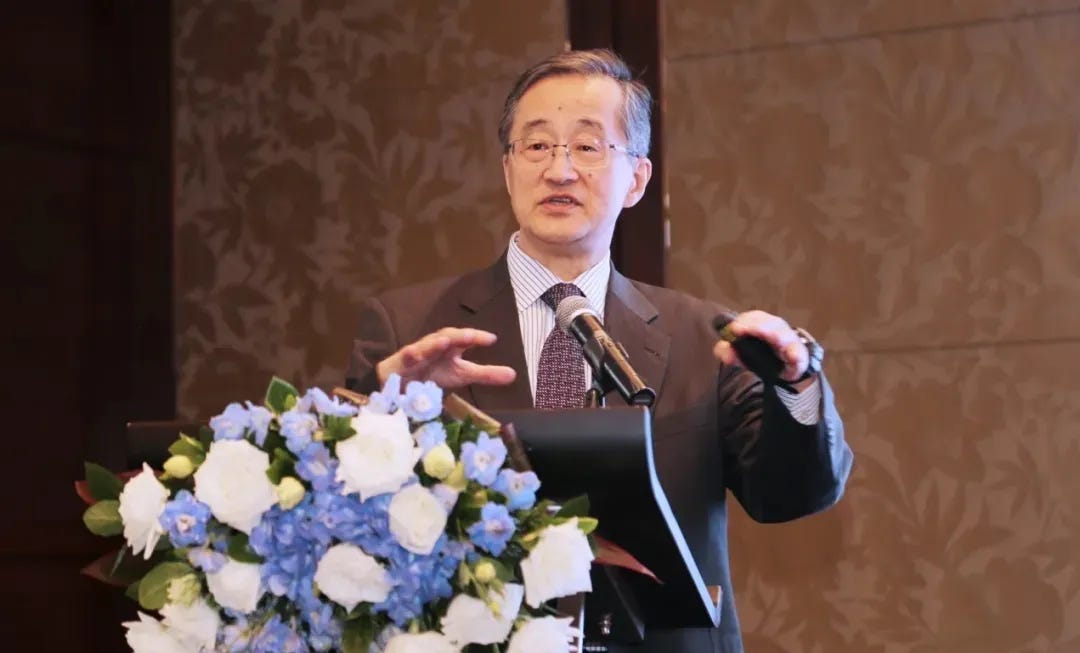
Fukunari Kimura, President, Institute of Developing Economies (IDE), JETRO; Professor Emeritus and Senior Professor, Keio University
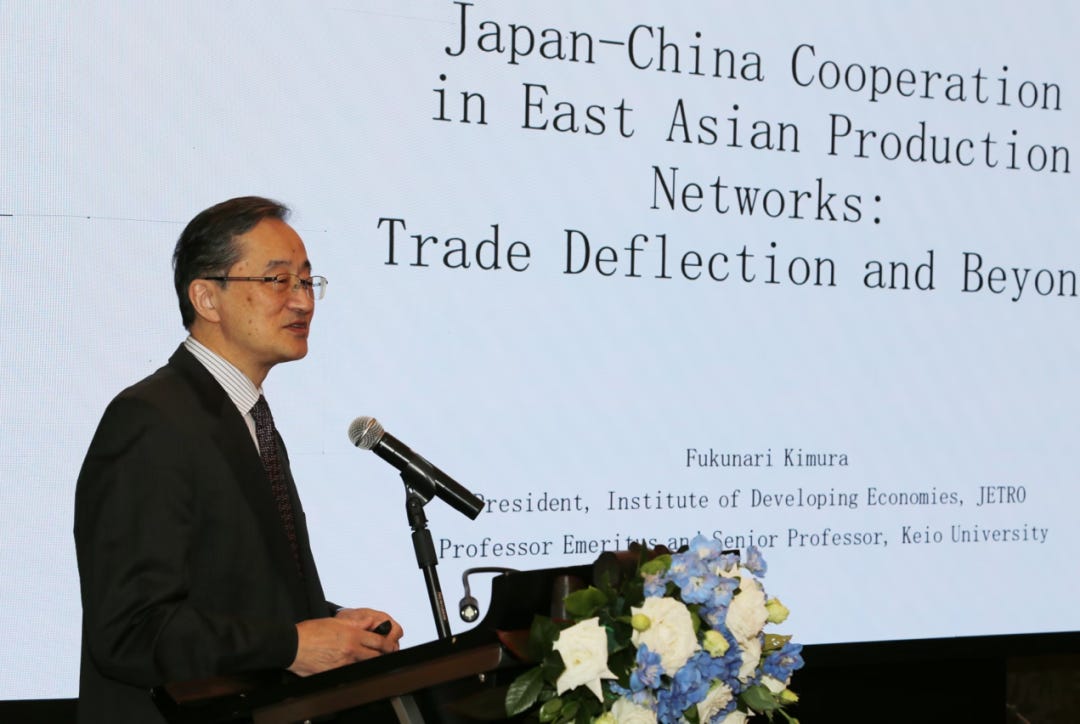
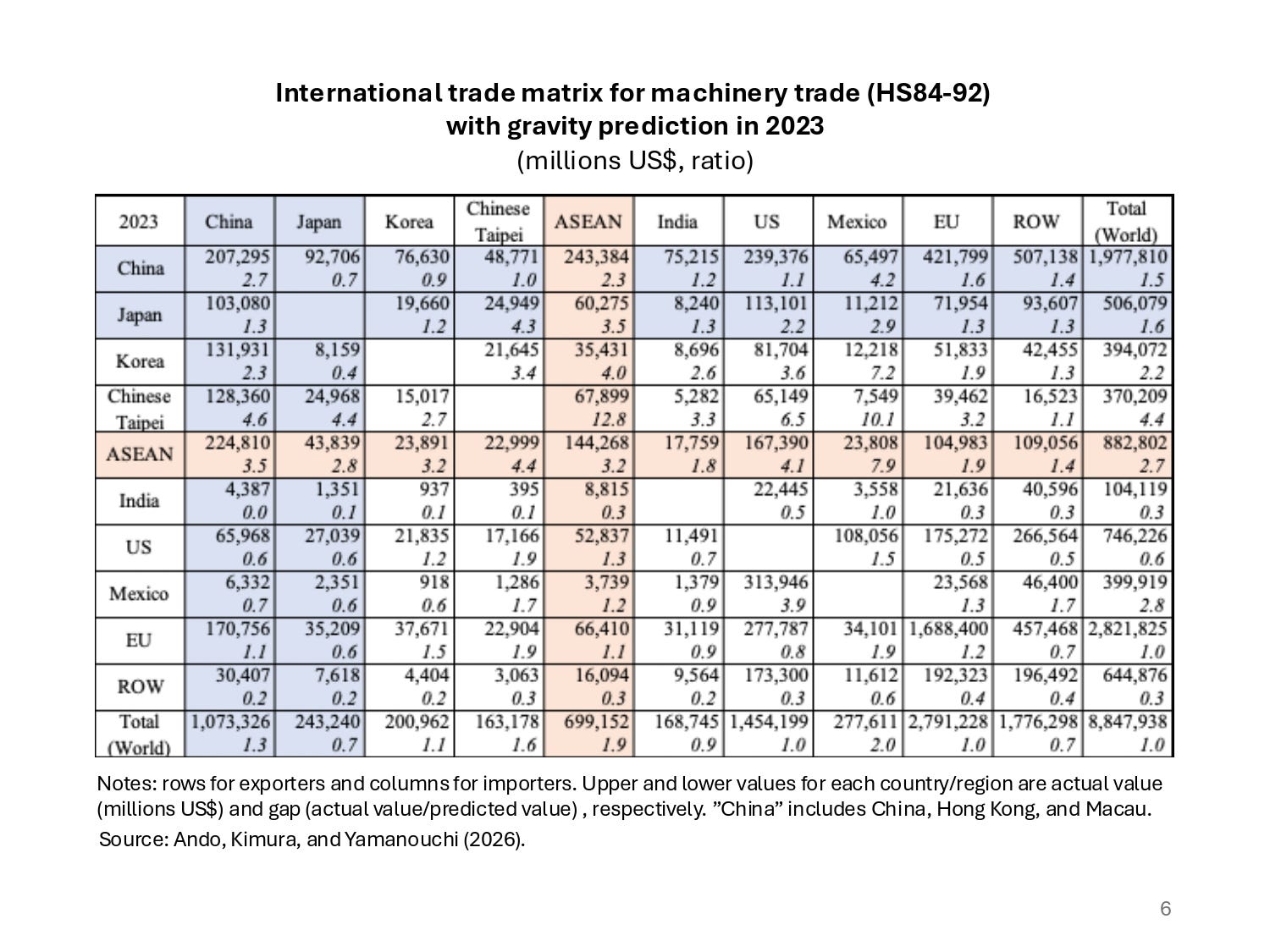
Thank you very much for the invitation. It is a great honour to be here. The title of my talk is “Japan-China Cooperation in East Asian Production Networks: Trade Deflection and Beyond”. I am not an expert on the Chinese economy, but I work on global supply chains and global value chains, which are deeply embedded in Northeast and Southeast Asia. We have sophisticated international production networks in this region, particularly in the machinery industries.
Machinery products consist of many parts and components. For example, an internal-combustion-engine car can have 20,000 to 30,000 parts, that’s really complicated. Electric vehicles are somewhat simpler, but still have around 10,000 components. Computers, I cannot count. But in the case of hard disk drives, 31. This means that a wide range of technologies and materials are used, and many companies are involved in producing specific machines. This industrial structure has generated international production networks: some parts are produced in China or Japan, while others are produced in ASEAN member states. We have very sophisticated production networks in the machinery industry.
Now, we have really bad US policy, honestly speaking. Starting from 2018, and particularly because of US tariff policies, the world economy has been seriously jeopardized. Machinery industries are at the centre of these shocks. Some parts are very high-tech, while others are simpler, but all are extended into the global supply chains. From Trump 1.0 to Trump 2.0 tariffs, things have become more complicated, because the United States has imposed tariffs on almost every country, at different tariff rates. He announces something, sometimes changes his mind before it becomes policy, and then announces something else. We have to check his social media every morning. It was a nightmare. Things seem a little quieter now, but this is not the end of the story.
Another serious problem with Trump’s tariffs is how easily they can be used as a powerful tool. If we forget about trade rules, tariffs become such an easy and powerful means of maybe controlling other countries. That kind of thing can be done by everybody. It is not only the United States: in the steel industry, for example, Canada, Mexico, the European Union and others are also adjusting their policies, according to their own logic.
When trade barriers arise in one part of the world, trade flows change and affect third countries. That is happening right now. In East Asia—by which I mean Northeast and Southeast Asia—trade deflection has been changing international production networks very dramatically, particularly starting from last year. Some production sites in China are moving to Southeast Asia, trade patterns are changing, and foreign direct investment patterns are changing too. Southeast Asia has long been a region where Japanese companies have very extensive production networks. Now, Chinese firms are becoming important players there as well.
How can Japan and China cooperate? Politically, we are facing headwinds, honestly speaking, but the economic relationship remains close. And what sort of cooperation can we think of? [audio unclear] I would like to consider cooperation in third countries, particularly in Southeast Asia. I do not have a specific proposal yet; I want to explain the broader economic context. Despite political headwinds, bilateral trade remain massive. And foreign direct investment, when measured by stocks rather than flows, is huge. A bit less than 10,000 Japanese firms still operate in China. The number is huge even though it’s gradually reducing, but many remain in the Chinese economy. Chinese firms are becoming more competitive, and many Japanese companies are making additional investments in China in order to survive. Chinese firms also have strong incentives to invest in Japan, in high-tech areas, start-ups and advanced SMEs.
Talking about tourism, there are some difficulties for Chinese visitors travelling to Japan, but individual visits are still okay, and large numbers of Chinese tourists continue to visit. I have Chinese graduate and undergraduate students who are eager to study in Japan. We welcome them. They are happy to get master’s degrees or PhDs, and many try to find jobs in Japan. Our relationship remains close. Two major economies sit side by side and naturally have a deep, multilayered relationship. We need to think about how to activate people-to-people exchanges.
My focus is trade deflection caused by US tariffs, which is accelerating the reconfiguration of global supply chains, particularly in East Asia. A new interface between China and Japan is emerging in ASEAN, providing another channel for cooperation. US differential tariffs — I have to emphasize, that’s a very bad policy — are weakening the rules-based trading system. It is a terrible policy, but we have to find ways to survive. They generate the so-called trade deflection.
The consequences for third countries are complicated. In my specialty, we use a great deal of trade data and firm-level data, so we are very focused on figures. I will not go into too much detail, but I will briefly show some tables and figures to explain the nature of trade deflection and how Chinese and Japanese firms are adjusting their behaviour because of that.
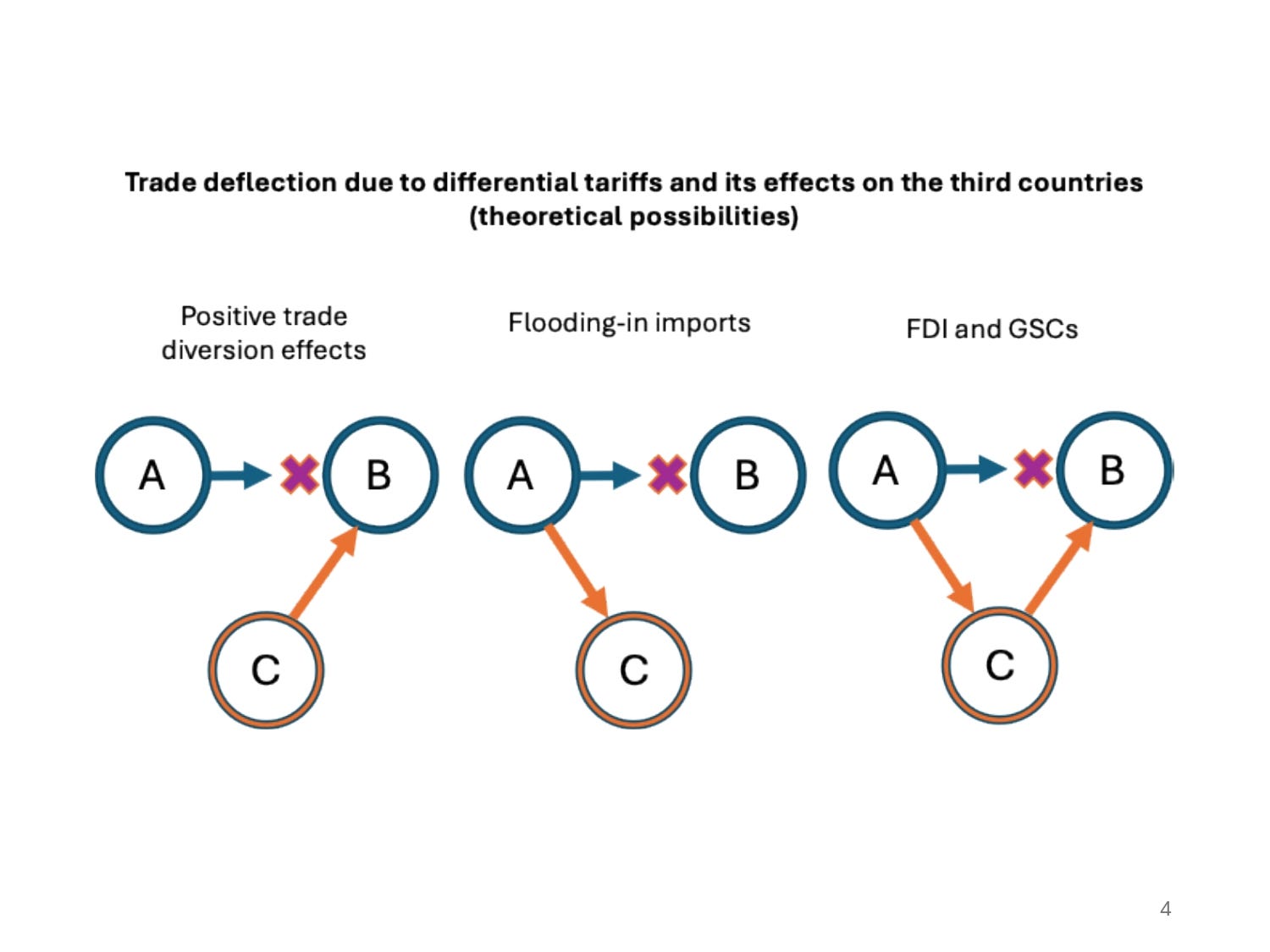
Country A originally exports a large amount to country B. Suddenly, country B imposes a huge tariff, making it difficult for country A to export there. What might happen? First, country C may replace country A and export to country B. This is the so-called positive trade-diversion effect. That is a theoretical possibility, not necessarily what happens in reality. Not every third country can do this, because the products and their quality need to be similar. But some third countries can do that.
Second, if country A can no longer export to country B, it may export to country C instead. From country C’s perspective, this is a so-called flooding-in of imports. Local industries may come under pressure, while consumers may welcome cheaper goods. This has political-economy implications.
Third, country A may export intermediate goods and components to another country, where they are assembled and then exported to country B. This could be done by Japanese, ASEAN or Chinese companies. This could involve country A’s foreign direct investment in country C.
There are theoretical possibilities. Which pattern prevails depends on the specific circumstances and on the standpoint of country C.
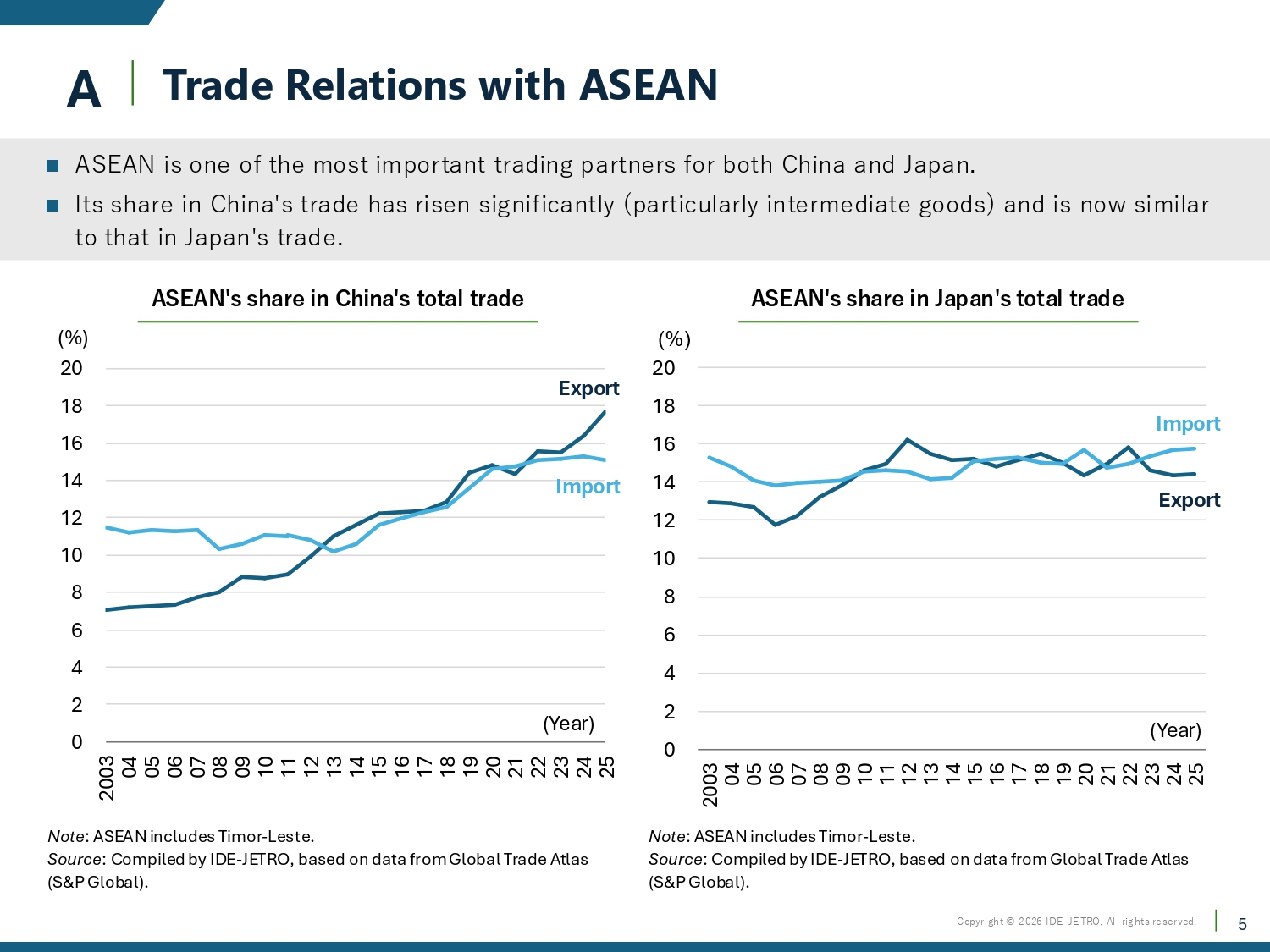
Looking at the data, ASEAN’s share of China’s total trade has been rising, in both exports and imports, since 2018, when Trump 1.0 tariffs began, with a further increase in 2024 to 2025. Chinese exports to ASEAN accelerated from 2024 to 2025, partly because of trade deflection. Japan’s ASEAN share in total trade has been relatively flat, at around 15%, while ASEAN’s share of China’s trade has reached 16–17%. Both economies are becoming more closely linked with ASEAN, and China’s links have deepened over time, partly as a result of US tariff policy.
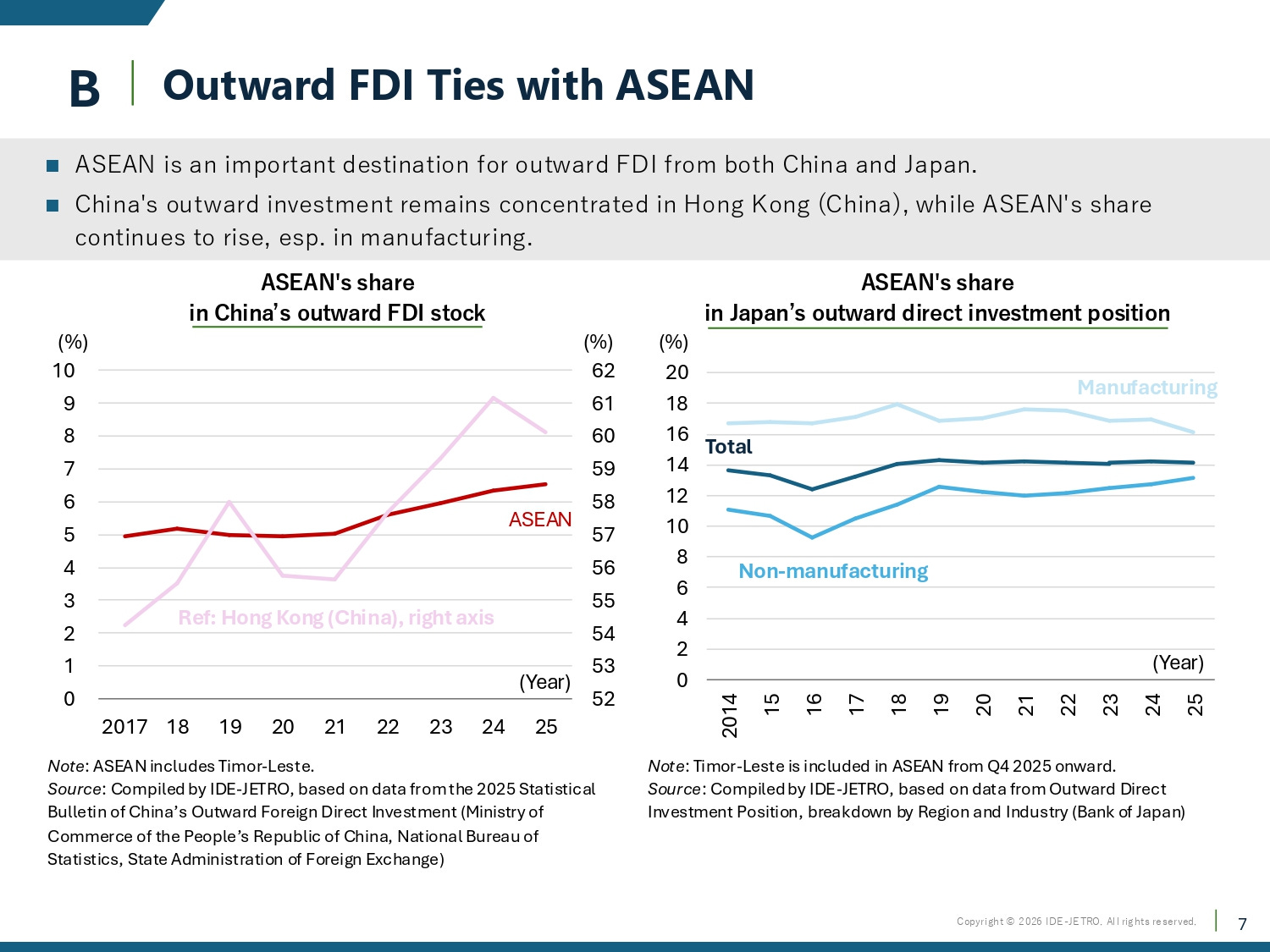
Foreign direct investment statistics are complicated because definitions and source countries differ. This is just one example. In the statistics, a large share of outward FDI from China goes to Hong Kong — almost 60%. Of the remaining 40%, around 6–7% goes to ASEAN, and that share is growing. Japan’s outward FDI to ASEAN is a little below 15%, making ASEAN an important destination for both countries.
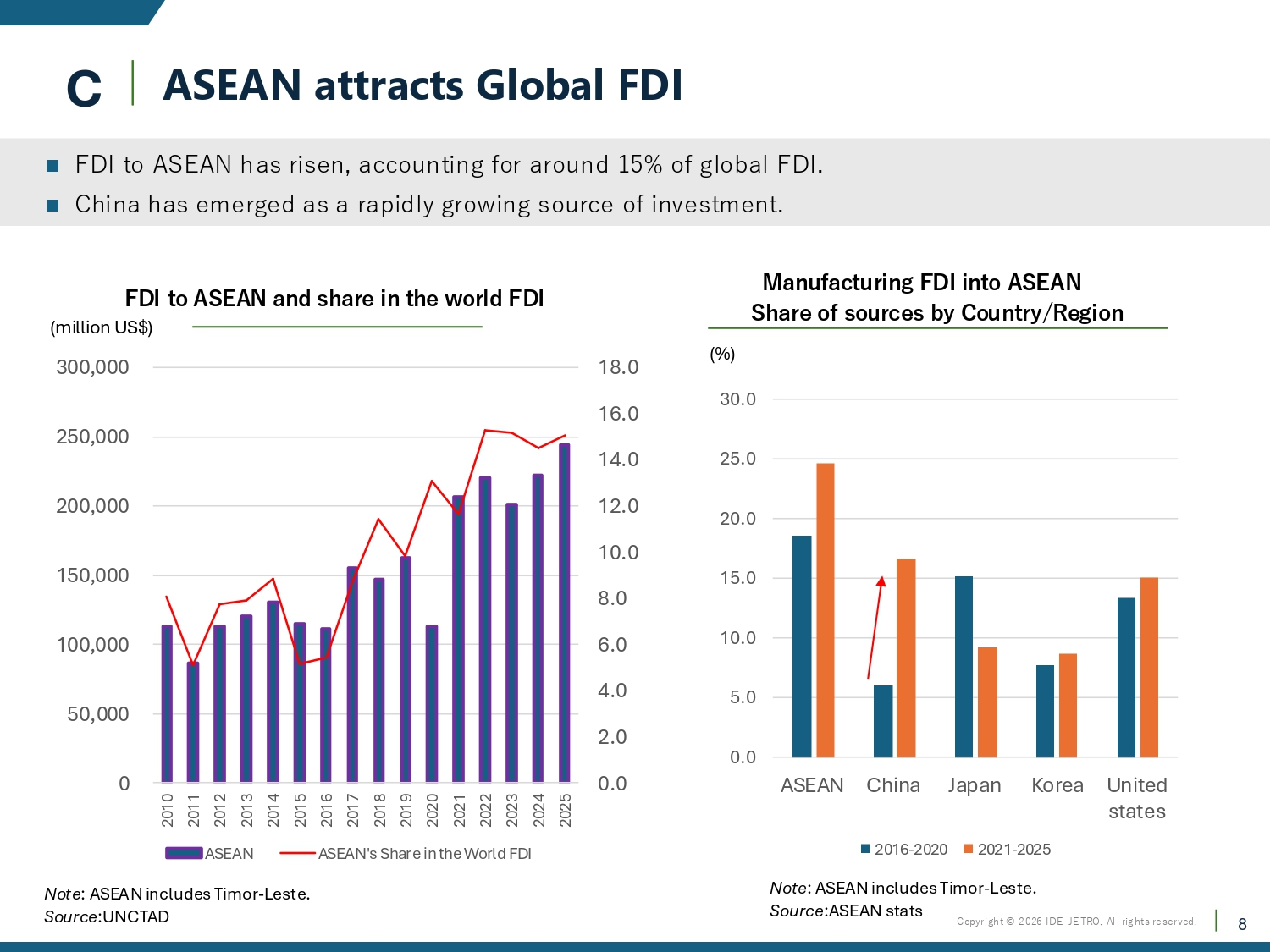
From ASEAN’s viewpoint, ASEAN attracts increasing FDI from all over the world, not only from China and Japan. Its share of global FDI inflows is now about 15%, which is substantial for a group of developing economies.
In manufacturing FDI flows into ASEAN — this is flow data rather than stock data — China’s proportion has increased rapidly since 2021, while Japan’s flow has fallen (but its stock has increased) and the US share has risen. Investment within ASEAN has also increased, including FDI from Singapore, where investors of many nationalities are present; some investment may therefore be indirectly Chinese or Japanese. So both trade and FDI are becoming more active around ASEAN.
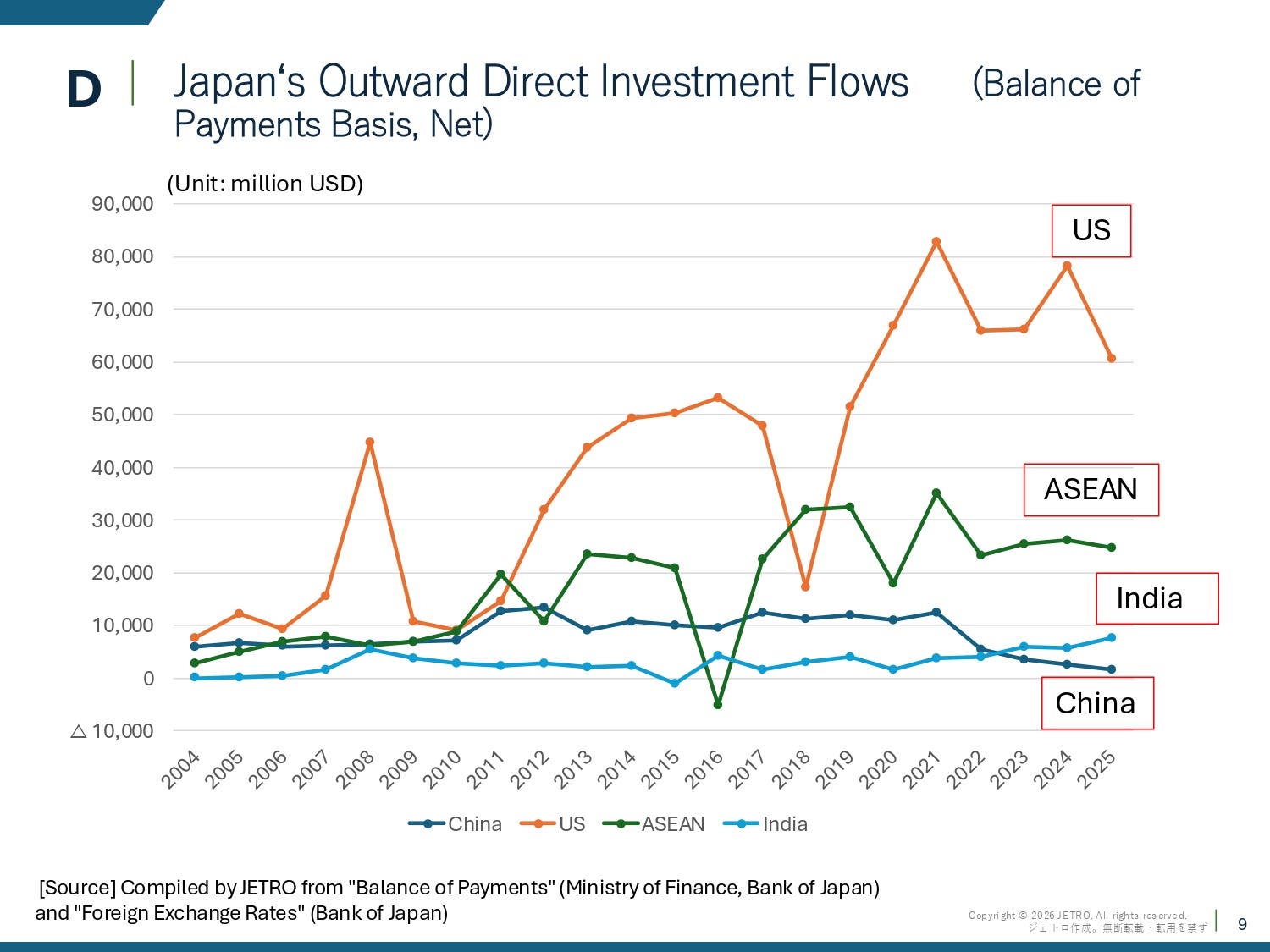
Japanese outward FDI flows are now going to the United States in large amounts after Trump 1.0. [audio unclear] New Japanese investment in China is falling, but recent earnings of Japanese affiliates in China are also being reinvested there. This provides useful background for understanding the effects of trade deflection.
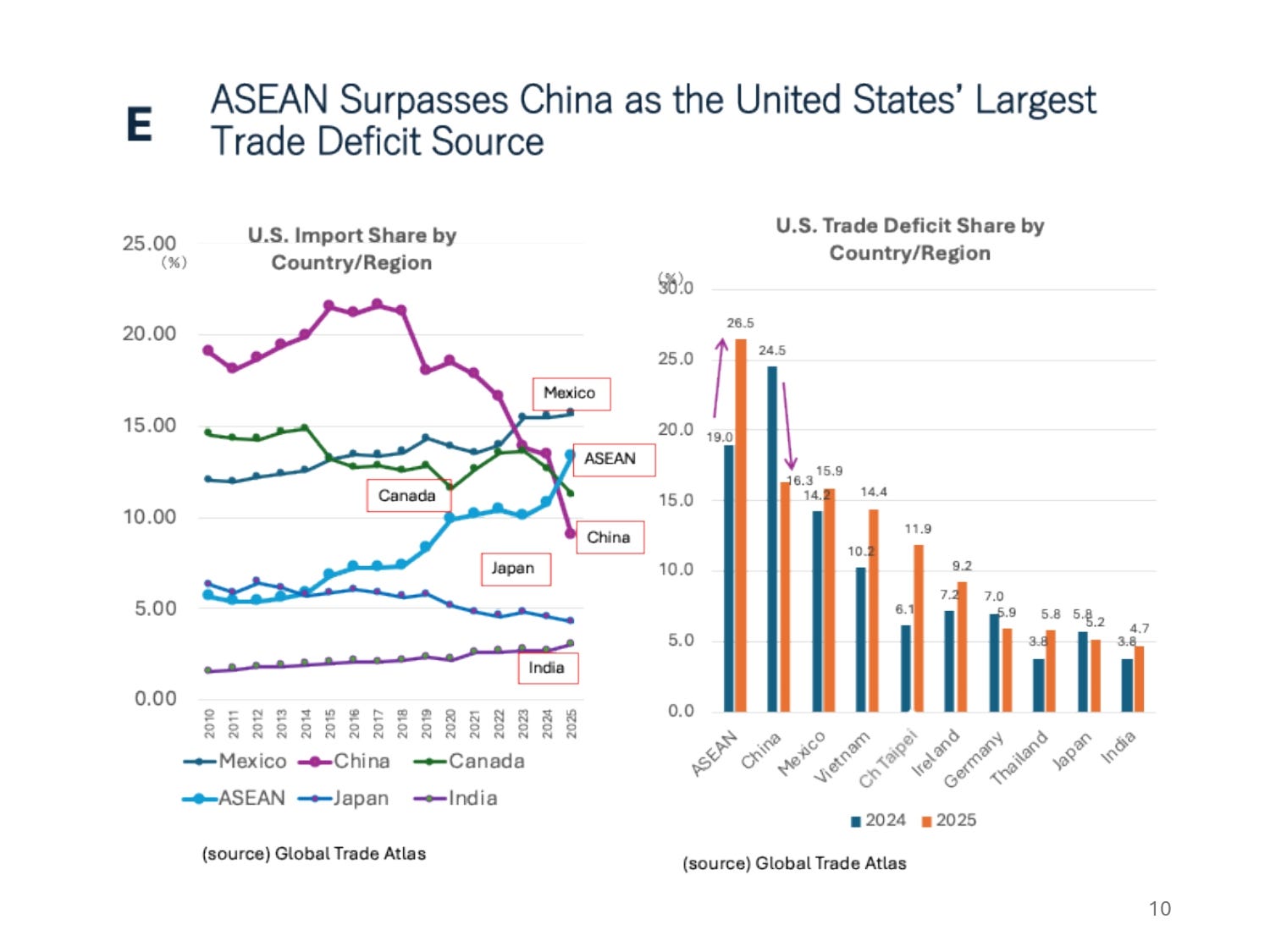
Here is a diagram showing US import shares by region. China’s share once exceeded 20%, but has since fallen. The share for ASEAN-10 has risen and is now above China’s. The share of the US trade deficit accounted for by China fell by almost 30% between 2024 and 2025, while ASEAN’s share increased by around 30%. That’s a really drastic reconfiguration of global supply chains.
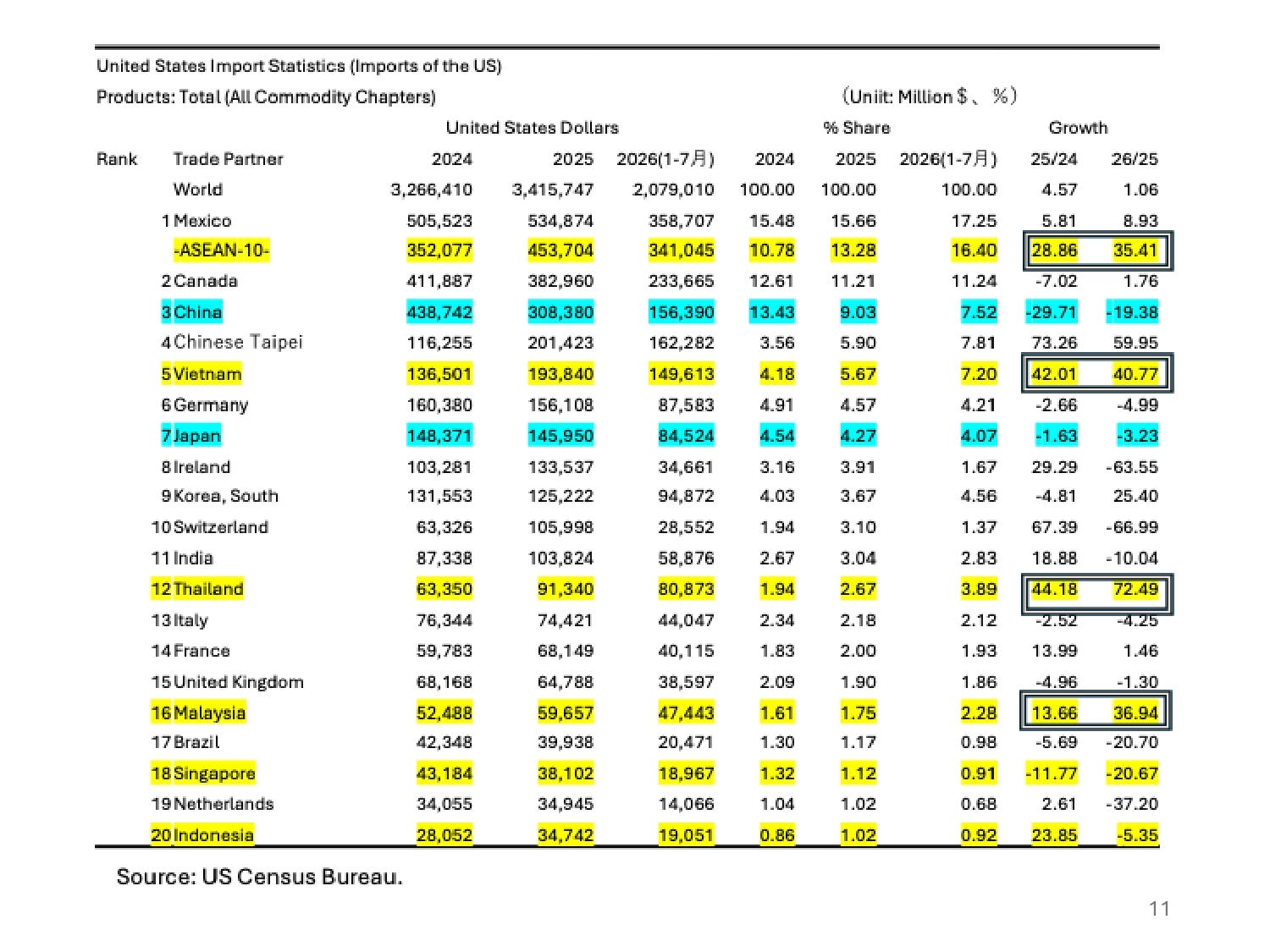
US import statistics show that imports from China fell by 30% year on year last year and were still down 19% through July 2026. By contrast, imports from ASEAN-10 increased by 29% and 35% in the periods shown. Vietnam recorded increases of 42% and 40%, Thailand 44% and 72%, and Malaysia 13% and 37%. A great deal of export activity is moving from China to ASEAN, partly because new Chinese FDI is entering ASEAN, although not all of this production is carried out by Chinese companies. That’s a big change in the importance of ASEAN to China. ASEAN has long been an important region to Japan, but is now crucial for China too.
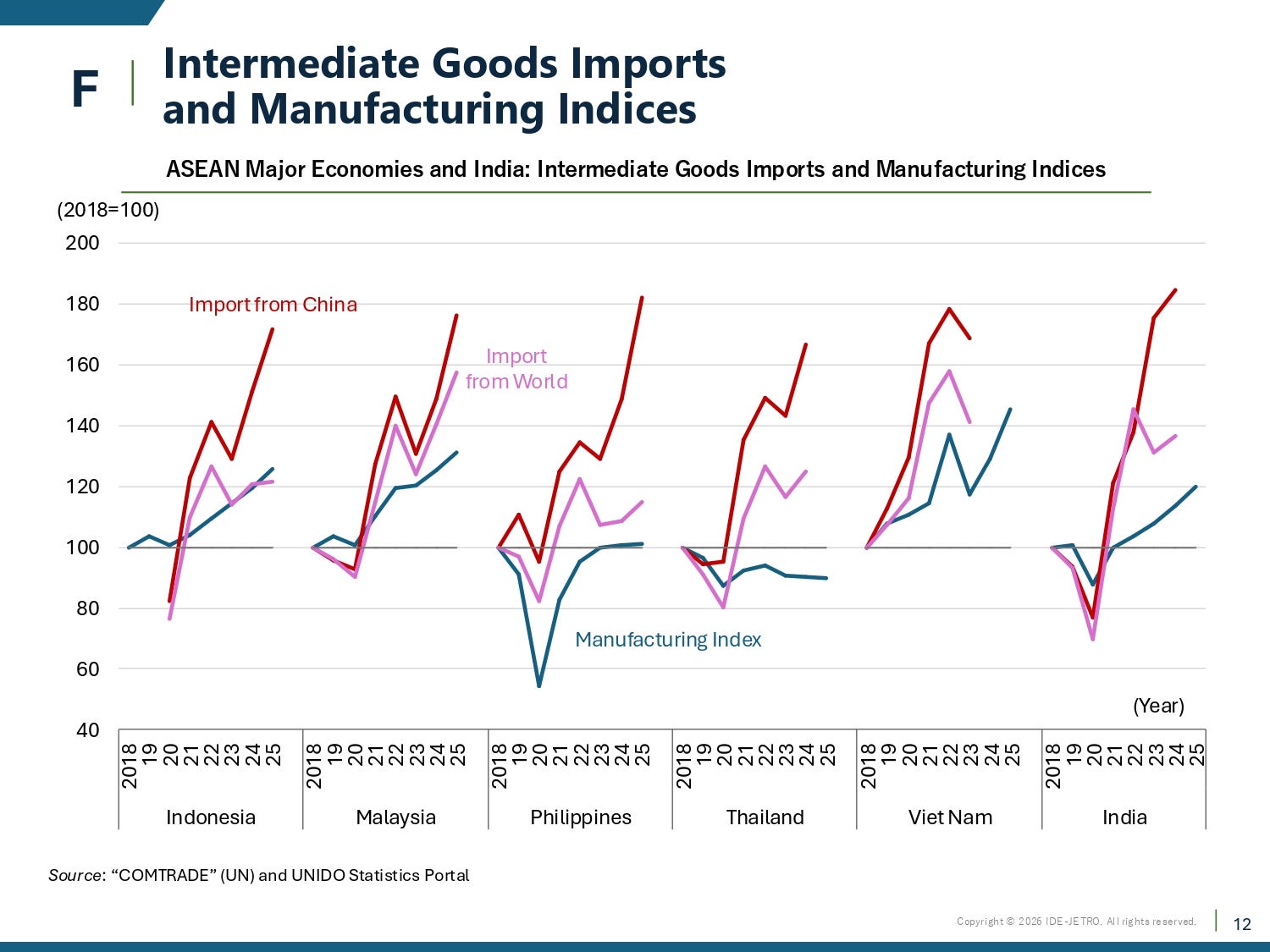
This is the last diagram I want to show. It is an index with 2018 set at 100. The blue line shows each country’s manufacturing production index. Production has not grown much in some economies, while Malaysia, Vietnam and India have grown. Imports from China, shown in red, have risen much faster than manufacturing production, while the pink line shows imports from all countries. Chinese exports are really pushing towards these countries. Some are final goods sold directly to consumers, who benefit from lower prices, while local producers in related industries face greater competition. Other imports are intermediate goods, which benefit downstream producers.
I think we now have a new interface between Japan and China in ASEAN. Chinese companies are entering ASEAN through trade and FDI, increasing competition for Japanese firms. Some Japanese companies think these are really hard times and wonder how they can survive. At the same time, there are incentives to cooperate. For example, Chinese firms can supply intermediate goods, and some Japanese firms may want to develop business relationships with them locally. Both competition and cooperation are visible in ASEAN.
Given the complicated geopolitical environment, we cannot predict the long-term future. But supply chains may accommodate both competition and cooperation rather than becoming completely decoupled. Japanese firms also have an incentive to cooperate with Chinese firms in ASEAN. This is a new interface worth exploring, and we should consider this positive possibility.
First, Japan and China can extend their business relationship in ASEAN through information exchange and business matching. It can be a charming idea for both sides.
ASEAN member states invite FDI for economic development, but they do not want merely to generate employment or remain in labour-intensive activities; they want to upgrade their positions in the global value chains. So we have to have some cooperation with ASEAN member states too.
In the past, China developed strong absorptive capability to gain technology and know-how from others, but ASEAN countries may not yet have the same capacity. So we can think of some cooperation in human-resource development, R&D cooperation, and start-ups. Those are possible areas for a new type of cooperation between Japan and China.
At the same time, the joint initiative for retaining the rules-based trading regime is also important, including through the conclusion of free-trade agreements. This is another important channel of cooperation I can think of.
In conclusion, the economic relationship between Japan and China currently faces a headwind. However, in any case, we must live with both healthy competition and amicable cooperation. Trade deflection and reformulation of global supply chains may become a trigger to extend our relationship, and ASEAN provides a new interface between Japan and China. The multi-layer approach in ASEAN may develop a new economic relationship between Japan and China.
That is the starting point I would like us to consider for the future cooperation. Thank you very much.
Mabel Lu Miao
Thank you very much. That was an inspiring and stimulating speech from Mr Kimura, and I found it very innovative. He has placed ASEAN in a mediating position between Japan and China, bringing new dynamics to the global economy. I think that is very inspiring for all of us. There is more potential for us to work together to strengthen China-Japan trade relations.
Now I would like to invite the panellists to join us for the panel discussion, moderated by Henry Huiyao Wang. The panellists are Yusaku Nishimura, Professor at the University of International Business and Economics; Song Yaoming, former Trade Minister at the Chinese Embassy in Japan; Takamoto Suzuki, General Manager and Chief Economist of the Economic Research Team at Marubeni (China) Co., Ltd.; and Zhang Jifeng, former Deputy Director of the Institute of Japanese Studies at the Chinese Academy of Social Sciences. Please come up to the stage. Welcome.
Henry Huiyao Wang
Okay, great. We are now moving into the panel discussion. Professor Fukunari Kimura has just delivered an excellent keynote, sharing new dynamics, data and phenomena that are beginning to emerge. Since the first trade war between the United States and China, we have seen a substantial increase in China’s exports to regional countries, particularly alongside RCEP. We have also seen direct investment and bilateral trade involving ASEAN and Japan maintained or even increased.
The area Professor Kimura identified is very interesting. There is a great deal of trade in intermediate and semi-finished products between China and these countries. This is not only a phenomenon involving China and Europe. I recently learned that China may have a trade deficit with the European Union of around €1 billion a day, but almost €300 billion of China’s exports to the EU are intermediate goods. The EU, meanwhile, runs a surplus with many other countries. This partly supports your argument that trilateral collaboration involving intermediate goods is an especially interesting phenomenon. Thank you for your insightful keynote.
We have a distinguished panel of leading experts on China-Japan trade, economics and bilateral relations. I will put several general questions to them first and then invite responses from our colleagues. China and Japan are important regional economies with strong economic complementarities. How can the two countries make better use of these complementarities to deepen bilateral trade and industrial cooperation and deliver shared benefits for businesses on both sides? Annual bilateral trade remains strong, at more than US$300 billion.
Second, as Asian supply chains continue to evolve, what innovative cooperation models can Chinese and Japanese companies explore to balance operational efficiency with supply-chain stability? Third, what role can China and Japan jointly play within RCEP, the world’s largest free-trade agreement, to advance regional economic integration and create more open and predictable conditions for regional trade and investment? This involves ASEAN, Australia, New Zealand and South Korea.
From the perspective of regional trade liberalisation, what are the prospects and practical pathways for advancing negotiations on a China-Japan-South Korea free-trade agreement? I see this as a medium-term objective. In the longer term, I very much hope China can join CPTPP and strengthen regional collaboration. APEC will meet in Shenzhen in about two weeks, and there is also the idea of an FTAAP, a Free Trade Area of the Asia-Pacific. We should aim for greater trade liberalisation, with China, Japan and other leading trading economies doing more to promote it.
Beyond direct bilateral cooperation, what promising areas exist for cooperation in third-country markets? China and Japan have previously signed an agreement to cooperate in third countries. How can Chinese and Japanese enterprises explore joint opportunities, and what mechanisms could support such projects?
Finally, on 30 September, Vice Premier He Lifeng met Takeshi Iwaya, President of the Japanese Association for the Promotion of International Trade (JAPIT), who had just visited China. Vice Premier He said China welcomes Japanese enterprises to continue developing in China. I would like to hear the panellists’ comments on that. That is the general framework for our discussion. Perhaps I will start with the guest on my right.
Yusaku Nishimura, Professor, University of International Business and Economics
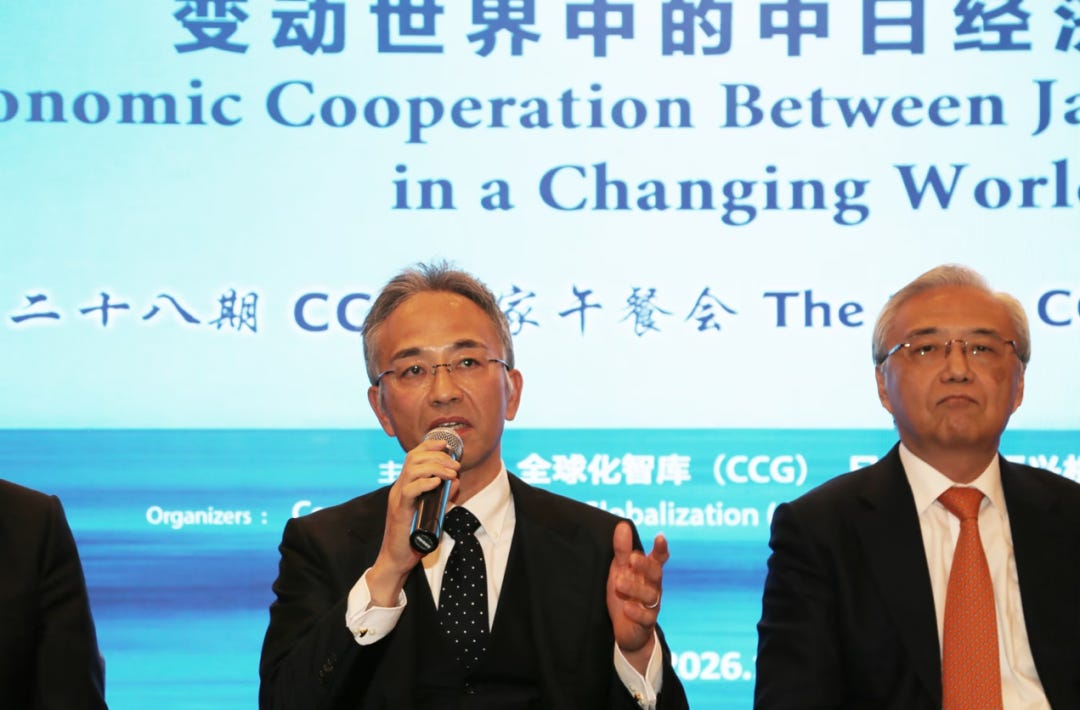
Good afternoon, ladies and gentlemen. My name is Yusaku Nishimura. I have been living in China for over 20 years, so my Chinese is much better than my English. Please let me speak in Chinese.
Henry Huiyao Wang
Professor Nishimura is at the University of International Business and Economics. He has lived in China for a long time and has also been a visiting researcher at the Bank of Japan’s Beijing Office. He is a leading expert. Please, Professor Nishimura.
Yusaku Nishimura
(Speaking in Chinese)
I am very pleased to participate in today’s luncheon. From the perspective of cooperation between Japanese and Chinese enterprises, I would like to briefly share some thoughts and prospects on Japan-China economic cooperation.
In the past, Japan-China economic cooperation was mainly based on a traditional vertical division of labor: Japan provided technology, while China was responsible for production. As China’s economy has developed, Chinese companies have built strong manufacturing capabilities and made rapid progress in digital technology. Against this backdrop, the model of Japan-China economic cooperation has changed substantially in recent years and entered a new stage.
As we all know, more and more Chinese companies are expanding into overseas markets. In Japan, the greatest attention is focused on the country’s largest industry: the automobile industry. Some of you may know that this July, BYD launched a compact vehicle designed specifically for Japan’s kei car market, the BYD Racco, which has attracted broad attention. However, to achieve long-term development in Japan, Chinese companies must still earn the trust of Japanese consumers. In my view, BYD still has some way to go and faces two major challenges.
The first challenge concerns sales and service networks. Japanese consumers care greatly about where they can purchase, repair and inspect their vehicles, and they expect one-stop services. In this respect, compared with local Japanese automakers, BYD still has limited resources.
The second important issue is brand image. Unfortunately, some Japanese consumers continue to have reservations about Chinese brands, especially in an industry such as automobiles, where safety requirements are high. To address this issue, I believe cooperation between Chinese and Japanese companies can be strengthened.
There is a recent case of cooperation worth noting. Some of our Japanese friends may have heard of EMT, or Electric Mobility Technologies. It is a company jointly invested in by five Japanese and Chinese companies, including the Japanese automotive-service company Autobacs Seven and China’s Chery Automobile, and it has launched an electric-vehicle brand specifically for the Japanese market.
I find this case particularly interesting. Chinese companies have accumulated strong technological capabilities in an intensely competitive, so-called “involuted” market. Japanese companies have a better understanding of the Japanese market, while Autobacs has more than 1,200 outlets and has established extensive sales and service networks. The two sides are jointly developing electric vehicles suited to the Japanese market.
A friend of mine joined EMT and frequently comes to China for exchanges and discussions. EMT emphasizes that this is a Japanese brand: its chief technology officer is Japanese, and development is led by a Japanese team.
This model is very interesting. It has moved beyond the traditional model of “Chinese production and Japanese purchase.” The two sides have entered a stage of joint development and joint brand-building, combining resources such as talent, technology and service networks to create new value together.
I believe this model of cooperation could expand into other fields in the future, especially sectors in which Chinese companies possess advanced technology, including emerging industries such as humanoid robots. If both sides can combine their respective strengths, they may be able to follow the EMT model to jointly develop products and build brands in many fields.
Of course, Chinese and Japanese companies will inevitably compete, but competition and cooperation can coexist: they should compete where competition is appropriate and cooperate where cooperation is possible, like it always has been. I believe that future business cooperation should gradually move from the traditional vertical division of labor towards a mutually beneficial and equal horizontal division of labor that leverages the strengths of both sides and creates new value together. Thank you.
Henry Huiyao Wang
Thank you, Professor Nishimura, for that excellent presentation. You made a very good point. In the past, the model may have been Japanese design and Chinese manufacturing, or outsourcing to China. Today, as China’s technological and manufacturing capabilities continue to advance, there is greater room for cooperation between the two sides. We can cooperate in both the Chinese and Japanese markets and jointly explore third-country markets. This will help both sides adapt to new changes in the international economic and trade environment and create new opportunities for Chinese and Japanese companies. Thank you again for your insightful remarks.
Next, I would like to invite Minister Song Yaoming. He is Vice President of the China-Japan Economic Research Association; he previously served as Minister for Commercial Affairs at the Chinese Embassy in Japan, Deputy Director-General of the Department of Asian Affairs at the Ministry of Commerce, and was posted in Singapore for many years. The Ambassador of Singapore is also with us today. Minister Song has long followed developments in Japan and has extensive experience in China-Japan cooperation. Vice Premier He Lifeng recently received a senior economic and trade delegation from Japan. Minister Song, please share your views.
Song Yaoming, Former Trade Minister, Chinese Embassy in Japan
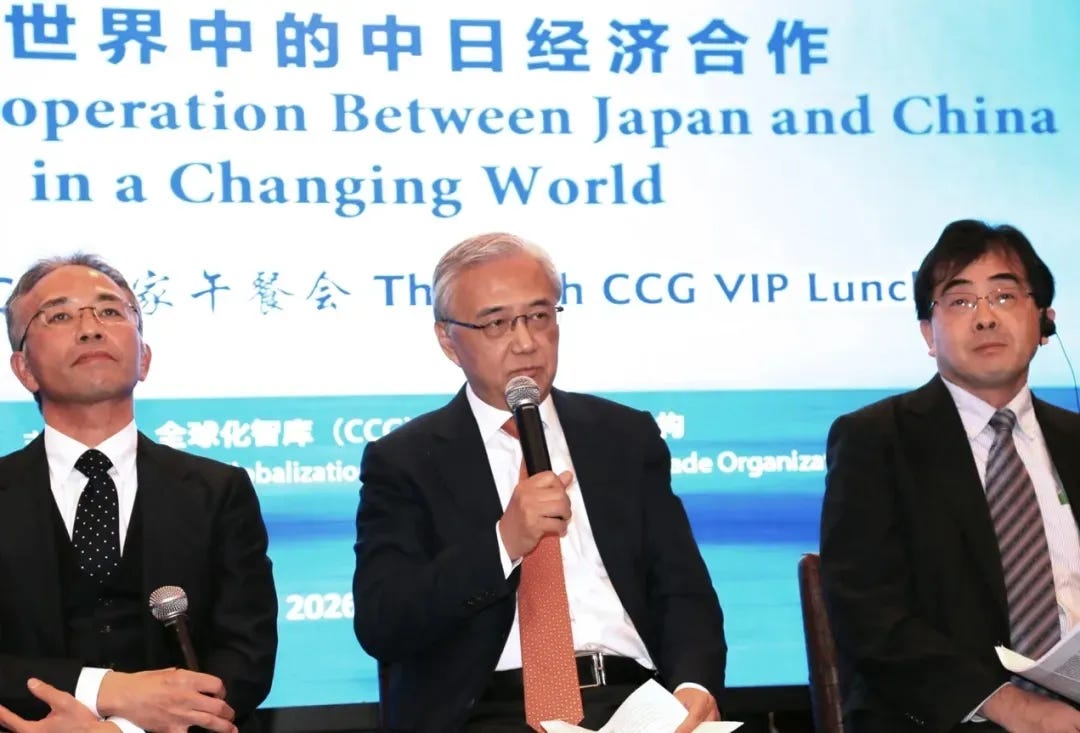
Thank you, Henry, for giving me the opportunity to share my views on China-Japan economic and trade relations. As Henry mentioned, Vice Premier He Lifeng met Takeshi Iwaya about two months ago, the former Japanese foreign minister and now Chairman of the Japan-China Association for the Promotion of International Trade. That was a very positive signal for expanding China-Japan economic relations.
China and Japan are major economies in East Asia and in the world. Strengthening economic and trade relations benefits not only the two countries and their people, but also East Asia and the global economy. In recent years, bilateral trade has remained above US$300 billion annually for several consecutive years, and Japanese direct investment in China has reached about US$130 billion.
There are more than 30,000 Japanese-invested companies operating in China, and about 75% of Japanese companies in China are profitable. That is very encouraging. Of course, the international environment has changed considerably, but in my view, there is still substantial room for China and Japan to work together.
Today, I would like to focus on just one area: artificial intelligence (AI). China and Japan have different but complementary strengths in AI. China has advantages in large AI models and their rapid development across a wide range of application scenarios. Japan, on the other hand, has considerable strengths in precision hardware, industrial expertise, specialised industries, healthcare and eldercare.
Some of the most promising areas for cooperation include industrial AI, AI-powered robotics, healthcare and eldercare, intelligent vehicles, drones and digital products for third-country markets. In particular, robotics and physical AI offer very practical opportunities to combine China’s strengths in algorithms with Japan’s strengths in hardware and industrial expertise.
In other words, there is real potential to develop complementary models that brings together Chinese and Japanese hardware and industrial know-how. I believe there is an area where both sides can explore mutually beneficial cooperation and achieve tangible results.
That is all I would like to share. Thank you very much.
Henry Huiyao Wang
Thank you, Mr Song. Excellent points. You are absolutely right that there is more potential for China and Japan to explore together. You particularly mentioned ageing societies. Japan is ageing, and China is also becoming an ageing society, so we face many common challenges and need to learn from each other. AI can also help us address the challenges of ageing populations.
China and Japan both share a culture of using chopsticks. We value family traditions, respect older people and attach great importance to educating young people. We have much in common in responding to the challenges of ageing, and we can learn from each other and work together in third countries as well. Thank you for those excellent points.
Next, I would like to invite Takamoto Suzuki, General Manager and Chief Economist of the Economic Research Team at Marubeni (China) Co., Ltd. He is an experienced researcher and economist, closely connected with business, and has visited CCG several times. I look forward to hearing his views.
Takamoto Suzuki, GM, Chief Economist of Economic Research Team, Marubeni (China) Co., Ltd.

Hello, everyone. Thank you for giving me the opportunity to speak at such a wonderful meeting. I work as an economist for a trading and investment company, and today I will share some business experience. On the other hand, I am also a little nervous because my remarks may have some influence on our business, so today I will speak with my short paper.
Over the past decade, the world has increasingly been characterised by confrontation over the balance between conflict and cooperation. Typical examples include trade frictions between the United States and the rest of the world, security tensions between the United States and China, trade frictions between Europe and China, the war in Ukraine and the war involving Iran. At the same time, there have been developments in international cooperation, such as the conclusion of RCEP in 2020 and the expansion of BRICS in 2024.
What we can see from this situation is that comprehensive multilateral economic and trade cooperation has become more difficult. In other words, while the United States raises or lowers tariffs, advanced economies create rules suited to their respective security environments, and discriminatory measures are taken against opposing countries.
In other words, while stable international cooperative relations are breaking down, cooperation within broad frameworks has become more difficult in practice.
As a second-best solution, I believe we should expand cooperation within existing frameworks and improve bilateral relations, because bilateral conflicts can be a root cause of problems with global repercussions. In Asia, for example, we could strengthen ASEAN Plus Three, RCEP, APEC and CPTPP. These traditional forms of cooperation still have an important role to play.
A major issue for global economic development, especially in East Asia, is the confrontational relationships between China and the United States, and between China and Japan. Deep-rooted conflicts have grown over a relatively short period. After various twists and turns, China and the United States now have regular opportunities for dialogue within four areas: trade, investment, AI and security. Japan, however, has no such opportunities. In the process, very little economic progress takes place between Japan and China.
During the Abe administration, I was a member of a research team at Japan’s Ministry of Economy, Trade and Industry that worked with China’s Ministry of Commerce on a medium- and long-term vision for Japan-China relations, examining the economic issues the two countries needed to resolve over the following ten years. We concluded that there were no decisive problems between the two economies because they are highly complementary. Their trade balances were nearly even, and there were no major issues. In other words, Japan and China originally had considerable potential for win-win outcomes.
Although minor issues arise concerning the investment environment and cooperation in third countries, we can see that there are deeper problems. Investment from China to Japan is quite limited. Potential mistrust and misunderstanding between the two countries is strong, and security issues are undermining the foundations of free trade and investment. The fundamental problem is that mutual exchanges are not sufficient enough to increase mutual investment, trust and friendship. In other words, the mechanism for improving Japan-China relations is not effective enough.
In this sense, I do not think there is any relationship in which mutual exchange is more important than that between Japan and China. The question before us is: how to deepen economic cooperation further.
In terms of goods trade, there is not much room to improve because Japan-China trade is very balanced. We can do more in services industries and technology industries as two leaders in the Asian economy, which we tried in the past. The obstacle to economic cooperation is mutual misunderstanding.
In Japan, when people talk about China, they frequently preface it by referring China whose economy is declining or suffering from inner problems. China certainly faces some economic problems, but its economy is not in decline. Bias in information, for example, [unclear] to technology and pessimistic economic forecasts, distorts perceptions on the other side and distort behaviour of companies, including my company. We need to address this issue.
We have already achieved the base for win-win industrial cooperation, but both our sound recognition and attitudes are distorted by emotional issues. Thank you. That is my business perspective.
Henry Huiyao Wang
Thank you, Mr Suzuki. Once again, all the panellists have shown the strong trade and economic ties between China and Japan. There is no major trade imbalance; the relationship is broadly balanced, even though Japan has generally run a trade surplus and China a deficit. If tourism is included, the balance is even better than the trade figures alone suggest.
There is considerable scope to work together, including through ASEAN, RCEP and ASEAN Plus Three. How can East Asia and Southeast Asia accelerate economic integration through RCEP and, eventually, CPTPP? That is an important objective. We can also look towards the broader Asia-Pacific framework of FTAAP.
I would now like to invite Professor Zhang Jifeng, former Deputy Director of the Institute of Japanese Studies at the Chinese Academy of Social Sciences and Executive Vice-President of the China-Japan Economic Research Association. He has long studied Japan’s macroeconomy, China-Japan economic relations and Japan’s national development. He is also a recipient of the State Council Special Allowance. Professor Zhang, we look forward to hearing your views.
Zhang Jifeng, Former Deputy Director, Institute of Japanese Studies, Chinese Academy of Social Sciences (CASS)

(Speaking in Chinese)
Thank you, President Wang, and thank you very much for inviting me to take part in this important exchange. Given the limited time, the previous speakers have already made many excellent points, so I will not repeat some of them. I would like to address two issues.
First, the basic understanding of China-Japan economic and trade cooperation. Second, I would like to offer some expectations for Japanese-invested enterprises in China.
First, let me discuss the basic understanding of China-Japan economic and trade cooperation. The reason I brought this up is that political relations between China and Japan are currently relatively tense. Under such circumstances, how should we view economic and trade cooperation between the two countries? Today, we are mainly discussing economic issues. I do not wish to touch on political issues, but only on economic and trade cooperation.
Based on the available data, I believe that China-Japan economic and trade cooperation remains in a sound and stable state. Economic and trade cooperation is an important component of China-Japan relations and also a “ballast stone” of the bilateral relationship. In my view, this ballast stone has not become outdated; it is still playing its role.
Let us first look at bilateral trade. The moderator has already introduced the full-year data for 2025. I would like to add the figures for January through September this year: total China-Japan trade reached US$277.44 billion, up 17 percent year on year. This is a relatively high growth rate for the past decade. If there are no unexpected developments, total trade for 2026 may reach between US$350 billion and US$360 billion. This is the first indicator I wan to mention; it remains stable and has not encountered major problems because of political relations.
The second indicator is investment. In the first three quarters of 2025, Japanese direct investment in China increased by 55 percent, which was a substantial increase. There are no new figures for this year yet, but investment is not as stable as trade. If last year’s 55 percent growth can continue, I personally believe that would already be quite remarkable. Those are roughly the relevant figures.
Mr. Suzuki just mentioned that Chinese investment in Japan has developed relatively slowly. This is not merely a problem of the past one or two years; it has existed for a long time. The most important reason is that Japan’s domestic market is relatively closed. Cross-shareholding among companies and Japanese marketing practices make it difficult for substantial Chinese investment to enter Japan. I believe that JETRO should continue to play a role in addressing this issue. Chinese companies are very willing to invest in Japan, and Japan appears to welcome Chinese investment, but actual progress has been limited. This issue deserves further study.
The third indicator concerns corporate withdrawal and profitability. At present, at least 60 percent, and close to 70 percent, of Japanese-invested enterprises in China remain profitable. According to JETRO statistics, around 12.6 percent of companies intended to withdraw or relocate their investment last year. I do not believe that this proportion is high. Moreover, withdrawal is not necessarily the result of worsening China-Japan relations; it is more often an internal adjustment by companies themselves. If a company can no longer operate profitably in China, withdrawal is a market-based decision and should not all be attributed to political factors.
Looking at trade and investment, I believe that China-Japan economic and trade cooperation is generally stable. Looking further at the trade structure, especially the structure of China’s trade with Japan, it is also continually upgrading. Chinese products exported to Japan now have relatively high added value and technological content, and are already different from the previous model of vertical division of labor that Mr Suziki mentioned.
A horizontal division of labor between China and Japan began to take shape gradually as early as the mid-2000s. Today, the proportion of horizontal specialization is increasing, which may also intensify competition. However, in my view, fair competition represents progress; without fair competition, the economy cannot develop. What we need to guard against is destructive competition, especially competition driven by political motives, over-securitization or over-politicization, as well as practices such as “small yards, high fences” established according to geopolitical logic. These approaches are not appropriate. The basic direction should not change.
Second, the fundamental characteristics of China-Japan economic and trade cooperation have not changed. The first is complementarity. China has an enormous market, both actual and potential. China currently has around 400 million to 500 million middle-income consumers, equivalent to three to four times Japan’s population. In a few years, China’s market may even surpass Europe’s. Therefore, I particularly hope that Japanese-invested enterprises in China will remain confident. China and Japan have long experience in economic exchanges and cooperation, as well as a strong foundation.
So this is my second point. I hope that Japanese-invested enterprises in China can trust China and the Chinese market. Mr. Suzuki just mentioned that some voices in Japan’s media and political circles are pessimistic about China’s economy. I believe that many issues must ultimately be assessed through data.
For a decade, China’s economy once maintained double-digit growth during its period of rapid expansion. After shifting gears, it moved to medium-speed growth of around 6 percent, 5 percent or slightly above 4 percent, and has been around 5 percent in recent years. China’s economic base is very large, so growth at this rate remains considerable. Therefore, we cannot abandon the Chinese market. Although difficulties exist at present, we should take a long-term view. As the poem says, “Take a long view of the landscape; remain calm even as dark clouds sweep by.” Only then can we see “boundless vistas from perilous peaks.”
As for China-Japan relations, we have entered winter, but if winter has arrived, can spring be far behind? Thank you.
Henry Huiyao Wang
Thank you very much, Professor Zhang. That was an excellent presentation. I believe the complementarity between the Chinese and Japanese economies is indeed strong, and the potential is considerable. You mentioned China’s enormous potential market, which represents a very good opportunity for Japanese companies. We should certainly remain confident in the Chinese economy, rather than simply taking a pessimistic view of it. The data you shared were also very interesting: according to Japanese statistics, around 70 percent of Japanese-invested enterprises in China remain profitable.
The number of Japanese companies in China is approximately six times the number of German companies in China. That is remarkable and also demonstrates the enormous potential for cooperation between the two sides. In addition, we have geographical advantages — we are neighbors who cannot move away from one another. With frameworks such as ASEAN Plus Three and RCEP, if we can advance negotiations on a China-Japan-South Korea free-trade agreement and promote China’s accession to CPTPP, there will be significant opportunities for cooperation in the future.
We still have a little time, so I would now like to open the floor to questions from the audience.
Colum Murphy, Senior Reporter, Bloomberg

Thank you very much for the discussion. We just talked about being in the winter that that spring might come. The question is: how soon can we expect the spring to come? Specifically, at APEC in Shenzhen, does the panel expect a meeting between Prime Minister Takaichi and the Chinese President Xi Jinping? Thank you.
Kenji Kanasugi, Ambassador of Japan to China

Henry, thank you very much for organising this event along with JETRO. I am not going to answer Colum’s question; it’s up to the panellists.
Again, thank you for organising this event despite Japan-China relations being at a difficult stage at the moment. Secondly, I have been here for three years, and my conclusion is that, despite the difficult relationship, we must manage our relationship one way or another. In our relationship, we have many elements and areas of cooperation, particularly in the economic areas. Of course, we have competition, and some times confrontation. But at the end of the day, we must coexist in this part of the world. That is my firm conviction.
Thirdly, even before we normalized relations with China in 1972, both in Japan and China, we say that economic interactions encourage political dialogue. It has been the case, and it will continue to be the case in the future.
So again, thank you very much for organising this. This is not a question, but really a comment. Thank you very much.
Henry Huiyao Wang
Thank you, Ambassador. That was a very good comment.
Next, I would like to invite Mr. Lu Kejian. He previously served as Director-General of the Department of Asian Affairs at the Ministry of Commerce and as Minister-Counselor for Economic and Commercial Affairs at the Chinese Embassy in Japan.
Lu Kejian, Former Director-General of the Department of Asian Affairs, MOFCOM; Former Minister-Counselor (Economic and Commercial), Chinese Embassy in Japan

(Speaking in Chinese)
Thank you very much to President Henry Huiyao Wang and Director General Mitsuaki Hoshino for inviting me to today’s exchange luncheon on the theme “Economic Cooperation Between Japan and China in a Changing World.” Although I retired many years ago, I am very pleased to have the opportunity to participate.
I strongly agree with President Wang’s point in his opening remarks: China and Japan are important neighbors to one another. How we overcome the current difficulties and strengthen economic cooperation between the two countries is very important for both sides.
Not long ago, Takeshi Iwaya, President of the Japanese Association for the Promotion of International Trade, led a delegation of around 50 Japanese business representatives to China. Foreign Minister Wang Yi and Vice Premier He Lifeng both met with the delegation and held important exchanges on China-Japan relations and economic cooperation.
I am grateful for the opportunity to attend today’s luncheon. I would also like to respond to several points raised by the experts earlier. Ambassador Kanasugi particularly emphasized that both sides have many ways of dealing with the current situation. Challenges and opportunities coexist; there are always more solutions than difficulties.
When Professor Kimura spoke about strengthening China-Japan cooperation in the new era, he particularly mentioned economic and business cooperation in third-country markets, especially in Southeast Asia. I think this is an excellent suggestion. I do not know whether friends from Mitsubishi Corporation, Sumitomo or Mizuho Bank are here today. In September, I went to Nanning to attend the China-ASEAN Expo. Several years ago, Mitsubishi Corporation not only attended the event but also exhibited there. It even invited the general manager of its Southeast Asian subsidiary and a headquarters official responsible for East Asian affairs to Nanning. The purpose was to explore how Japanese and Chinese companies could work together in areas such as industry and supply chains in Southeast Asian markets.
I think this approach is very good, and it is already being put into practice. For example, they visited Pingxiang, in the China-Vietnam border area, to inspect development zones and industrial parks and explore cooperation in electronic components and other fields. I believe this has opened up a relatively practical path.
Professor Nishimura also spoke just now about cooperation between the two countries. I visited Japan three times last year and saw BYD vehicles on the roads in Tokyo and even in Fukuoka. I heard that they have been well received. After-sales service, as you mentioned, is indeed very important. I have always had one idea: as Chinese companies go global and Chinese products enter international markets, they can first test the Japanese market. If they are welcomed in Japan, I believe they should also be able to succeed in other markets. Director General Hoshino, do you agree with this idea?
Minister Song Yaoming just mentioned areas of cooperation between the two countries, including smart technology, e-commerce, cross-border cooperation, artificial intelligence, the health industry. I do not believe there are fundamental conflicts in these areas. Both sides can draw on their respective strengths and complement one another.
Mr. Suzuki mentioned Marubeni. Marubeni was one of the earlier Japanese companies to enter the Chinese market; it entered China even before the normalization of diplomatic relations between China and Japan. It has long been at the forefront of compensation trade and third-country market cooperation. Marubeni has persisted to this day and has done very well.
Professor Zhang Jifeng spoke about the current state of China-Japan economic cooperation and future prospects, and he particularly mentioned that spring will surely come. I fully agree. Director General Hoshino’s name includes the character for “brightness,” and through the efforts of both sides, we will certainly overcome these difficulties.
In 2018, at the 40th anniversary of China’s reform and opening up, China held a major commemorative event and honored ten foreign friends who had made outstanding contributions to China’s reform and opening up, as well as its economic and social development. Among them were two Japanese friends: Konosuke Matsushita, the founder of Panasonic — I see Panasonic’s representative here as well — and former Prime Minister Masayoshi Ohira. Both made important contributions to China’s reform and opening up and to China-Japan economic development. Today, China-Japan bilateral trade has reached US$300 billion, while Japanese investment in China has exceeded US$130 billion. This is also the result of the joint efforts of both sides.
My conclusion is that no one wishes to return to the situation before the normalization of China-Japan diplomatic relations in 1972. We must work together, overcome difficulties, and fulfill our roles as important neighbors and major economies, contributing to peace, development and mutually beneficial cooperation in Asia and the world. Thank you.
Henry Huiyao Wang

Thank you, Mr. Lu. That was an excellent presentation. Do any of our guests have any further comments? We are almost out of time.
So perhaps I’ll ask each of you to take about one minute to offer a concluding remark. I’ll start. First of all, I think that China-Japan relation is really very important economically. We still have the largest bilateral trade, one of the largest in the world.
So I think that we have so much common interest, and we can really stabilize the regional economy with RCEP, with a potential FTA between China, Japan, and South Korea, and with CPTPP. So let’s really work for the integration of an Asian economic union. So that might be an FTAAP for the Asia-Pacific, and I think China and Japan can play a very important role in the future.
Yusaku Nishimura
(Speaking in Chinese)
To be honest, I hope spring will arrive soon, but we can also prepare well during the winter. I am a university teacher, and university teachers have three responsibilities: teaching students, conducting research, and serving society. For the last responsibility, I will contribute mainly through promoting Japan-China relations and exchanges, especially exchanges among young people. I have contact with many young people, probably more than anyone else here.
I teach economics in Chinese. My students do not have much contact with Japan. They do not understand Japan; some are not interested in it, or may even be resistant to it. Under such circumstances, I do my best to help them engage with Japan. For example, in extracurricular time, I introduce them to Japanese culture, food culture and wine culture, and I sometimes organize exchange activities related to Japan. Going forward, I will continue to prepare for the arrival of spring. Thank you.
Song Yaoming
I would like to add a few words about third-country market cooperation between Chinese and Japanese companies. Mr Suzuki is sitting next to me. He is from Marubeni Corporation, one of Japan’s largest and leading trading companies. Around 15 or 20 years ago, Marubeni and China’s Dongfang Electric Corporation formed a consortium and successfully won a project to build a coal-fired power station in Haiphong, Vietnam. It was a very successful project. They also have an oil-refining project in Kazakhstan, among a lot of other projects.
I also heard that Chinese and Japanese companies, with support from their respective governments, have worked together on a smart-city program in Thailand’s Eastern Economic Corridor (EEC). I hope that this kind of successful cooperation in third-country markets can continue between Chinese and Japanese companies. Thank you very much.
Takamoto Suzuki
My company is now much more focused on animation, manga and, how shall I put it, pharmaceuticals. We are very focused on China’s consumer economy. Marubeni was originally a business-to-business company, but the Chinese market is very large, so we want to expand into the consumer market.
Japanese companies have advantages in animation, manga and such kinds of entertainment. In China, especially in Shanghai, these activities are very popular, but I feel sad that I cannot see these kinds of activities in Beijing because of certain restrictions. So I hope Chinese children will have freer access to Japanese animation and other Japanese content. Perhaps the leaders of China and Japan could visit each other’s countries. I hope that day comes very soon. Thank you.
Zhang Jifeng
(Speaking in Chinese)
I am particularly reminded of something the great leader Mao once said: “In times of difficulty, our comrades must see the achievements we have made and see the bright future ahead.” China-Japan relations are indeed at a difficult stage now, and we should not deny that. But in difficult times, we must first see the light ahead. The light has now appeared, which is a positive sign. I believe spring is not far away.
I would also like to say that complementarity between China and Japan not only existed in the past, but was also an important foundation for the remarkable achievements in China-Japan relations over the past 50 years. I believe this complementary relationship still exists and will continue to exist.
Even though both sides have already achieved a horizontal division of labor, there remains considerable room for cooperation. We jointly face such challenges as population ageing and global climate change. My conclusion is that China and Japan have room for cooperation in every field—not only in artificial intelligence, but in almost all areas. I sincerely hope both sides will seize these opportunities, see the light ahead, and work together toward a brighter future. Thank you.
Henry Huiyao Wang
Thank you, Professor Zhang, for those optimistic concluding remarks. Of course, we still face challenges and difficulties. Even so, our business communities, academic communities, think tanks and people-to-people exchanges will continue to promote mutual understanding and improve bilateral relations.
We share many cultural commonalities and are both influenced by Confucian culture. I believe there is a great deal that brings us together. I hope we will see more cooperation between China and Japan, between China and the rest of Asia, and between China and the world. I think that is all for today’s luncheon. Thank you all very much.