

On 14 September 2026, the Center for China and Globalization (CCG) and Springer Nature jointly hosted a book launch and seminar at CCG’s Beijing headquarters to mark the publication of China and the Next Global Order: Coming Multipolar World and Great-Power Coopetition, a new book by Henry Huiyao Wang, Founder and President of CCG.
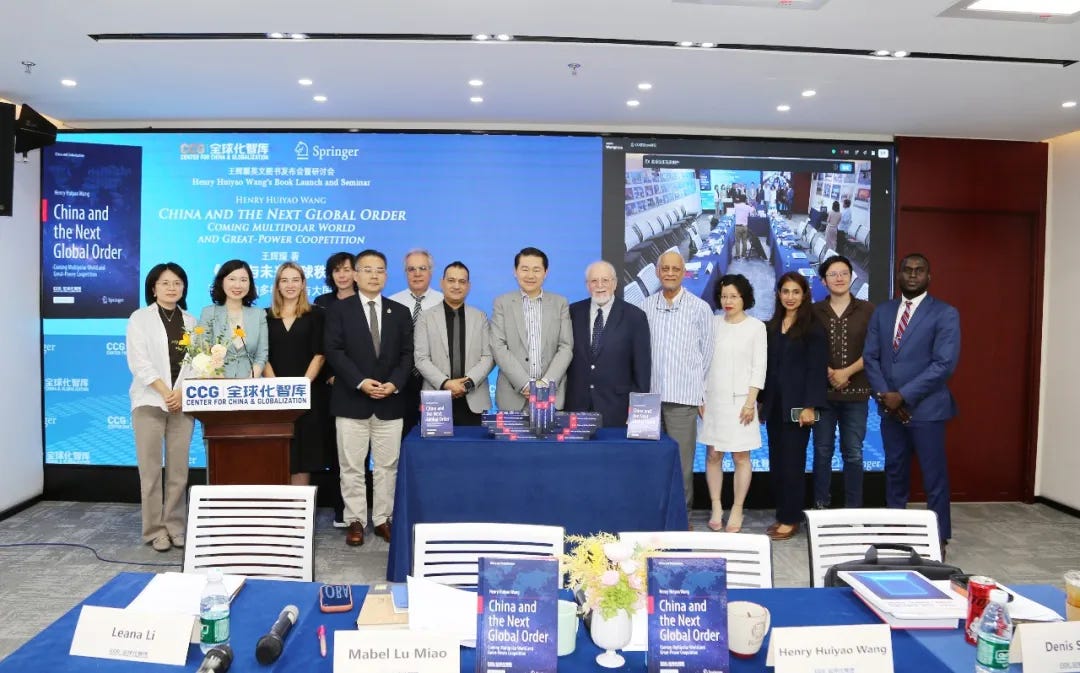
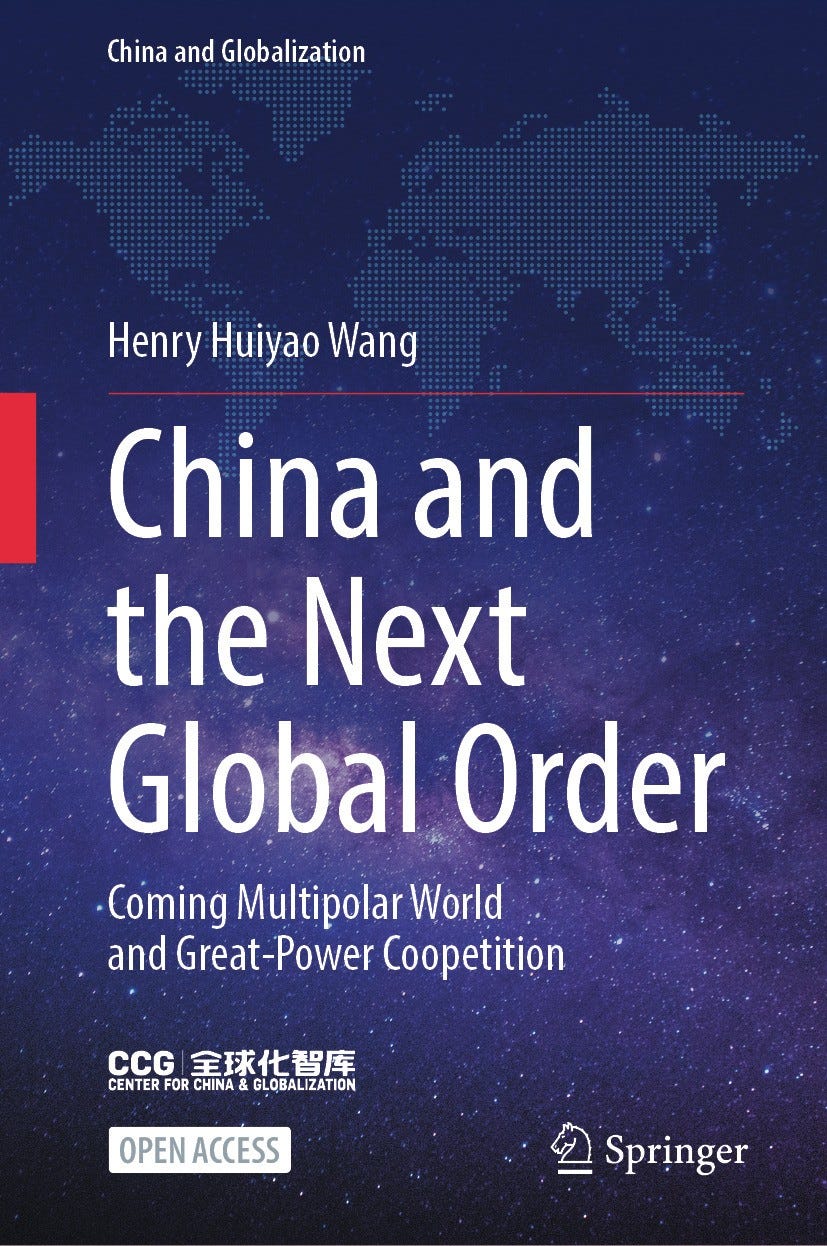
Published by Springer Nature as part of the China and Globalization series, the open-access book presents a curated look into Wang’s latest writings concerning the changing world order, a change widely characterised as one of “world disorder”.
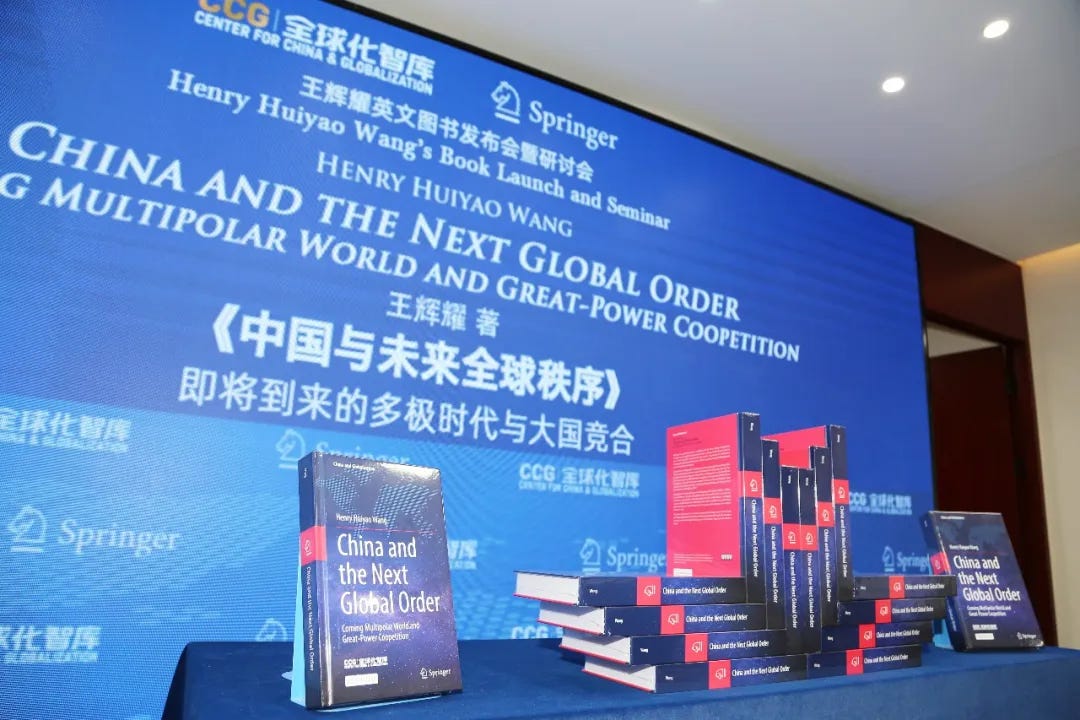
The book is available to download free of charge from Springer Nature.
The following transcript is based on an audio recording of the event and has been lightly edited for clarity. It has not been reviewed by any of the speakers.
Mabel Lu Miao, Co-founder and Secretary-General, Center for China and Globalization (CCG)
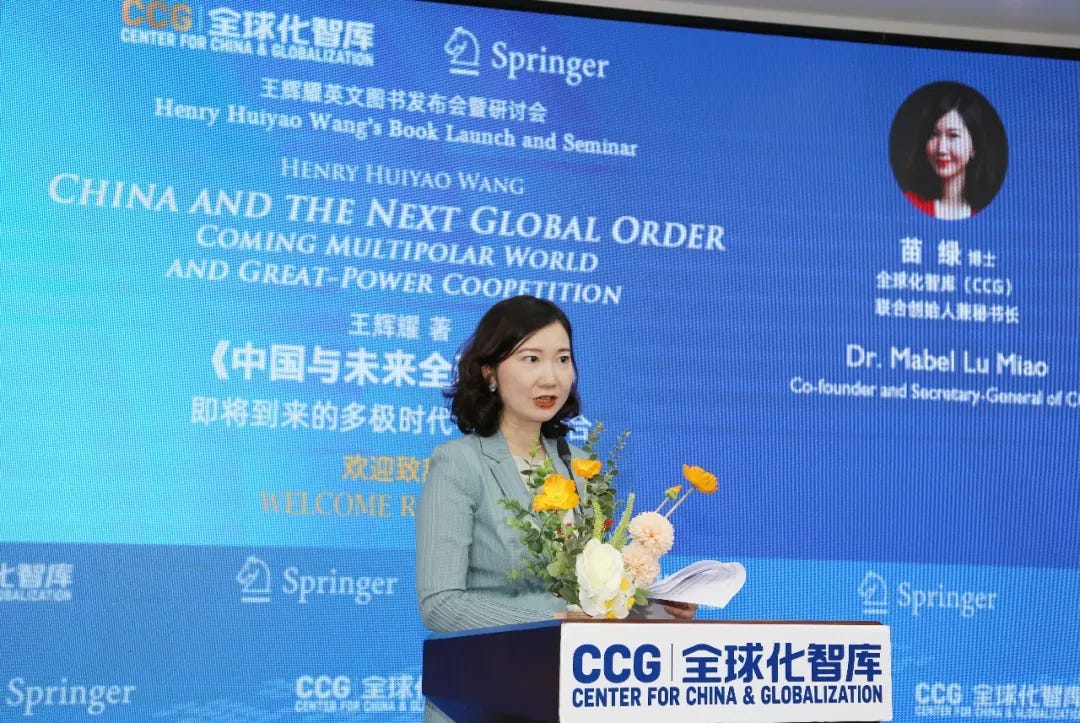
Distinguished guests, ladies and gentlemen, good afternoon. I’m Mabel Miao, Secretary-General of CCG. It gives me great pleasure to welcome you all to today’s book launch and seminar celebrating the release of Henry Huiyao Wang’s latest work, China and the Next Global Order.
Before we begin, allow me to briefly introduce our distinguished author. Henry Huiyao Wang is the founder and president of the Center for China and Globalization (CCG), a global think tank ranked among the top 100 most influential in the world. He was appointed as a counsellor to the State Council of China by the Chinese premier. He is now a distinguished professor at the China Foreign Affairs University and was Dean of the Institute of Development Research at Southwestern University of Finance and Economics. Wang is a leading expert on globalisation, global governance, and Chinese international relations.
Wang has published over 100 books in both Chinese and English, as well as hundreds of articles and papers related to globalisation, global governance, and global migration, China’s international relations, and Chinese outbound investments. He is the Chief Editor of Springer Nature’s “China and Globalization” book series and his latest English books include: China in the Multipolar World: Global Governance in a Post-Hegemonic Era (Springer, forthcoming); China, New Geopolitics and Global Governance: CCG Global Dialogues (Springer, forthcoming); China and the Next Global Order: Coming Multipolar World and Great-Power Coopetition (Springer, 2026); The Ebb and Flow of Globalization: Chinese Perspectives on China’s Development and Role in the World (Springer, 2022); Award winning book Consensus or Conflict: China and Globalization in the 21st Century (Springer, 2021); and Handbook on China and Globalization (Edward Elgar, 2019).
Today’s event is co-hosted by Center for China and Globalization and Springer Nature. We are honoured to be joined by the author, Dr Henry Huiyao Wang, along with the senior scholars, business leaders, media friends, and representatives from the publishing houses. Together, we will mark the release of this important book and explore solutions for the disordered world and suggestions for the next global order.
First, let me introduce our distinguished guests today.
David Blair, Vice President and Senior Economist at CCG and former Chairman of the Economics Department at the Eisenhower School, National Defense University, in Washington, DC. Welcome.
Harvey Dzodin, Senior Fellow at CCG, former Vice President of ABC Television in New York, and Senior Consultant at the National Image Communication Research Center of Tsinghua University. Welcome.
Rebecca Gray, Second Secretary for Political Affairs at the British Embassy in Beijing. Welcome.
Zoon Ahmed Khan, Special Commentator for CGTN and Researcher at the Belt and Road Institute, Tsinghua University. Welcome.
Arvea Marieni, Director of Ecological Transition Engineering Solutions at BEAM CUBE, Senior Adviser to the World Green Design Organization, and Jury Member of the European Innovation Council Accelerator. Welcome.
Yasir Masood, Commentator on International Affairs for CGTN. Welcome.
Omid Motahed, Independent Researcher. Welcome.
Hamid Sharif, President of the Global Think Tank Network, former Managing Director at the Asian Infrastructure Investment Bank (AIIB), and Senior Partner at Samdani Qureshi Aqlaal. Welcome.
And, of course, our friend Denis Simon, Bank of America Visiting Chair in International Finance at Schwarzman College, Tsinghua University, and former Executive Vice Chancellor of Duke Kunshan University. Welcome.
Last but not least, Xu Chengzhi, Global Chief Public Affairs Officer at Windey Energy Technology Group Co., Ltd., and former official with China’s Ministry of Foreign Affairs. Welcome.
We are also joined by our distinguished guests from the publisher: Leana Li, Editorial Director for Humanities & Social Sciences Books and Regional Director for Books for China at Springer Nature Group, and Emily Zhang, Senior Editor for Business, Economics, and Political Science at Springer Nature Group.
Welcome, all of you.
China and the Next Global Order is one of the 16 books in the China and Globalization series published by Springer Nature and co-edited by Henry Huiyao Wang and me. I would like to express my sincere gratitude to Springer Nature for their ongoing partnership. In particular, I would like to thank Leana Li, Editorial Director for Humanities & Social Sciences Books and Regional Director for Books for China at Springer Nature Group, and Emily Zhang, Senior Editor for Business, Economics, and Political Science at Springer Nature. Their support has been invaluable in publishing this book series.
A well, a warm welcome to all our distinguished guests today. We greatly appreciate your presence and look forward to a rich and insightful discussion later. Thank you all. Welcome.
Leana Li, Editorial Director for Humanities & Social Sciences Books and Regional Director for Books for China, Springer Nature Group
Good afternoon, colleagues, friends and authors. I am Leana Li from Springer Nature, and already on this occasion, in this setting, I feel more like a host than a guest, because we have been launching and announcing new books in the China and Globalization series so many times, and every time we gather here to enjoy a very insightful discussion among authors, contributors, policymakers, and scholars on relevant topics.
So today, again, it is a great pleasure to welcome you all, to the launch of China and the Next Global Order: Coming Multipolar World and Great-Power Coopetition. This timely volume explores one of the most important questions of our age: how the global order is evolving in an era of profound geopolitical, economic, and technological change. As just mentioned, this book is the 16th volume published in the China and Globalization series.
Over the years, the series has become an influential platform for advancing international dialogue on globalisation, governance, development, and China’s role in the world. Through the contributions of leading scholars, policymakers, and practitioners, these books have reached audiences across the globe and generated significant impact in both academic and policy areas.
First of all, I would like to extend my warmest congratulations to Henry Wang for the successful publication of this book. This book arrives at a particularly important moment. The world is undergoing historical change. We see shifting power dynamics, growing geopolitical competition, rapid technological innovation, and increasing uncertainty in global governance. At the same time, countries remain deeply interconnected through trade, investment, talent floats, and shared global challenges. Against this backdrop, understanding the emerging international order is more important than ever. How will a more multipolar world function? What role will China play in shaping the future global landscape? And how can major powers manage competition while maintaining cooperation, where cooperation is essential? These are the critical questions that this book seeks to understand.
One of the book’s most valuable contributions is its focus on the idea or the concept of a great power coopetition, the recognition that competition and cooperation must coexist in today’s interconnected world. While countries may compete in certain areas, they also share responsibilities in addressing issues such as climate change, public health, technological governance, and sustainable developments.
Indeed, global challenges do not respect national borders. No single country, regardless of its size or strength, can address these issues alone. The future of international relations will depend not only on how countries compete, but also on how effectively they cooperate when cooperation is necessary. This perspective also resonates strongly with the mission of CCG, which then is reflected in the aim and scope of the China and Globalization book series.
Across its 16 volumes, the series has addressed a wide range of critical topics, including globalisation, economic development, governance, talent mobility, international cooperation, and China’s evolving relationship with the world. Together, these books have contributed to a broader and more nuanced understanding of China’s role in global affairs.
What makes the series particularly valuable is its ability to bring together voices from different countries, disciplines, and professional backgrounds. The resulting dialogue is richer, more balanced, and more relevant. At a time when public discourse sometimes becomes polarised, this commitment to intellectual openness and evidence-based analysis is more important than ever.
As we celebrate the publication of this last volume, we should also recognise the broader importance of scholarly work. Books provide the depth and perspectives needed to understand long-term trends and complex challenges; they help bridge research and policy, and they encourage informed public debate.
Looking ahead, the international landscape will continue to evolve. While we cannot predict every change, we can be certain that dialogue, trust, and cooperation will remain essential foundations for a stable and prosperous future. I hope this book will not only contribute to academic and policy discussions, but also serve as the catalyst for new ideas, deeper engagement, and stronger international collaboration.
Finally, let me once again congratulate CCG and all the authors on these important achievements. The publication of this volume in the China and Globalization series is a testament to intellectual collaboration and a shared commitment to fostering understanding in an increasingly complex world.
Thank you very much, and I look forward to listening to the discussion to follow.
Henry Huiyao Wang, Founder and President, Center for China and Globalization (CCG)
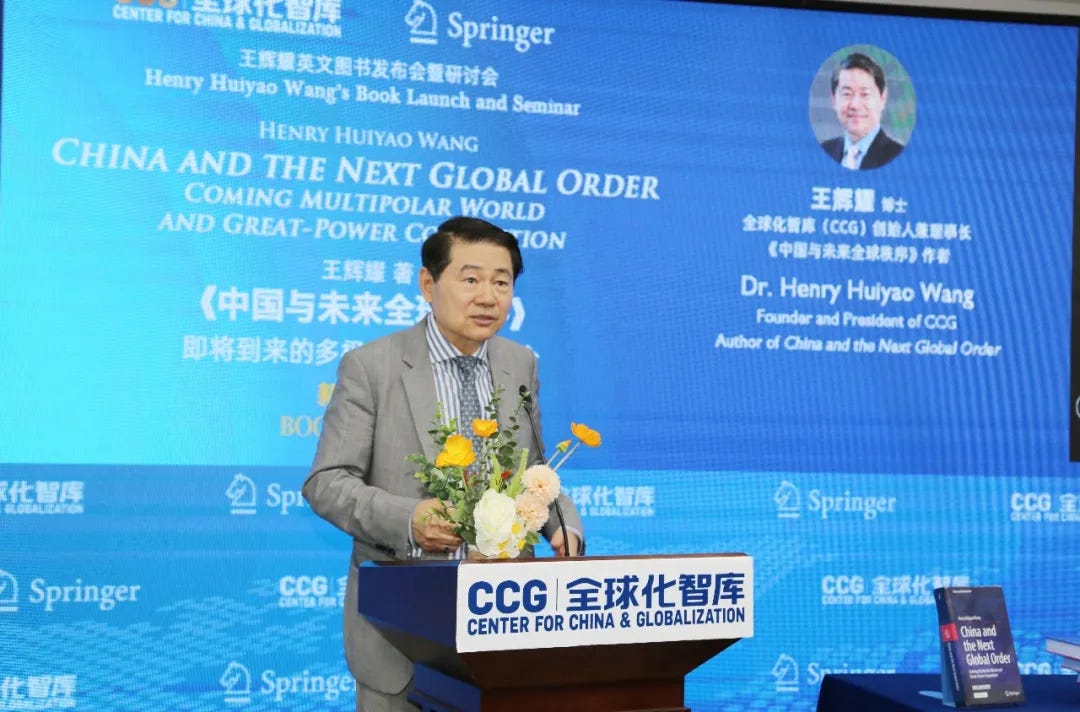
Thank you, Leana Li, and also Emily Zhang from Springer Nature, and our very distinguished and dear friends from different circles of the international community. It’s really a great honour to welcome all of you to CCG today to launch my latest book, China and the Next Global Order: Coming Multipolar World and Great-Power Coopetition.
We are using a management term, “coopetition”. This is a very timely book that we are launching here at CCG. So once again, I really appreciate all of you coming here this afternoon. I’m going to introduce this book, but we’re really looking forward to a good discussion, with comments and ideas on the topics we have.
So basically, this book is one of the books in the China and Globalization series that Miao and I have edited, which has been published by Springer Nature for the last six or seven years. It’s really very important that we have now accumulated 16 books, but there are more to come. We invite many more scholars, including our CCG experts, to continue to contribute.
So basically, this book series already has quite a few authors whose works are available online, and the series is designed to present a wide range of global views on issues related to China and on the growing opportunities and challenges amidst the rise of China. For example, since the launch of this book series, we have had books by Joseph Nye, books by Kishore Mahbubani, and books featuring over 60 ambassadors. We have had books by a number of CEOs, and contributions from over 100 top scholars, representatives of international organisations, former statesmen, and well-known scholars. So this book series is actually probably the largest collection of English-language books on China in the English-language publishing world, and I’m sure it’s going to be the largest because we still have a few in the pipeline.
The book we are adding to this series today is called China and the Next Global Order, which is a very big book that we have just published. This open-access book presents a creative look at my latest writings concerning the changing world order. And of course, we know that we are in a world that has been very chaotic and disruptive. And so, what about China? What about the next global order? How can we safeguard multilateralism and keep the world going as we expected?
Basically, we can see this disrupted world, and it’s also a multipolar world. You know, I would say it’s really a coming multipolar world. A quarter of a century has already passed, and we can see that the unipolar world is probably gone, but the multipolar world is here, and that’s where we are now. So it’s very important that we have some books to analyse this.
This book basically covers my writings over quite a long period, including quite a few years in the past. But basically, all the thoughts I’ve had, my ideas and my views on the changing global landscape and global order have always been there. So it also reflects a lot of my research on the think tank front. This is what we are reflecting in this book.
This book covers many of my original reflections, some of which are recent, while others date back a few years. In particular, we have included material from many well-known news outlets, including The New York Times, Bloomberg, The Economist, the Financial Times, the South China Morning Post, Arab News and many more. We have also included some of the articles I have published at different think tanks, including the Wilson Center, at different economic forums, and also in China Daily, Xinhua, and CGTN. So it’s quite comprehensive. But then we re-edited, reorganised and categorised them into different sections of the book.
We organised the book around three key topics. The first is the shifting nature of global interactions. The second is perspectives on the pursuit of genuine multilateralism and efforts to establish a new global equilibrium. I think establishing a new global equilibrium is really important. We haven’t reached that yet, but we’re in the process of reaching it. And the third is an exploration of the symbiotic relationship between globalisation and economics. So, what about globalisation? What about economics? We still need to continue with both.
At the heart of those themes lies China’s evolving role in global governance and world affairs, particularly in responding to a series of systemic transformations, including the shift of the centre of gravity towards Asia, and partly towards China, as well as a more diversified and more multipolar world.
So I’m not going to go into the details, but basically, in Part One, we talk about interactions and exchanges, re-examining relations in transition. There are delicate relations, and of course, we look at the rise of President Trump and US–China relations during his two terms. We also look at relations under the Biden administration, how to balance China–Europe relations, and, of course, beyond the state, how we can develop more innovative forms of exchange. We also look at China’s bilateral issues, policy issues and relations with countries in different regions, and, of course, particularly at global governance, which we have done a lot of work on.
And then, in the second part, we talk about geopolitics and multilateralism, finding peaceful solutions to geopolitical tensions. We talk about China’s role and the contributions it can make, geopolitical tensions and multilateral relations.
We also talk about globalisation and economics in the third part, where we cover globalisation as a driver of prosperity. Even though globalisation has suffered a huge setback, inclusive globalisation still has momentum. We also look at China as a driver of global growth, explore solutions to the challenges facing globalisation, and share ideas about the power of dialogue. We have held many dialogues, so this book actually collects many dialogues that we have had with well-known writers. And of course, we have included a lot of other writings as well.
Finally, we also discuss how to reach the world with our thinking.
So basically, this book offers forward-looking insights for policymakers, scholars, practitioners, and businesses. It also highlights the indispensable role of international institutions. The revitalisation and reform of the UN are also very important. So I think this is really a very comprehensive book.
We released this book only last month, but we have already had about 23,000 downloads as of today. It’s a free-to-download book, and of course, we have many other books as well. We have recently published quite a few books, including books by two of our authors who are online today, David Blair and Harvey Dzodin. Their books are also in this series.
So I think I’m just starting to warm up the discussion, basically to say that we’ve put a lot of effort into this. As a think tanker and a scholar, I’ve been thinking about all those big issues, the new roles that China can play, and of course, how we can work together amidst great-power competition and cooperation.
So, great-power competition and cooperation — I use the term “great-power coopetition”. I’m sure Denis Simon knows these management terms pretty well. We need to seek cooperation, but of course, we cannot avoid competition. But we don’t want rivalry. We don’t want decoupling and things like that.
So I think this is a book that I’ve been thinking about for quite some time, and it has finally been released. And I really want to thank Springer Nature again, including their head office. We visited Heidelberg in Germany in the summer, where we were very well received. I also want to thank Leana and Emily for their continued support, and of course, our editorial team and our members, and all the scholars and friends who have come today.
So thank you all very much.
Mabel Lu Miao
Ladies and gentlemen, good afternoon, and welcome to our close friends and new friends who have come to the CCG office or joined us online for our new book launch.
And congratulations to Henry on his new book. He has spent a long time working on and contributing to this book. He wanted to bring together his articles and views on global governance. We know CCG has long been committed to global governance, conducting extensive research and activities, and we have published numerous works on similar topics.
Henry’s new book, titled China and the Next Global Order: Coming Multipolar World and Great-Power Coopetition, responds to the fact that global governance is lagging behind reality and seeks to provide a systematic think-tank perspective on China’s role in the transformation of the global order.
In light of the current shifts in the global balance of power and the geopolitical landscape, the new book’s publication could not be more timely. I think, actually, these days we have seen a lot of news. We are seeing news about events such as the BRICS conference, and the declaration issued at the conference is quite impressive, especially regarding the rise of Global South countries as new powers. And of course, a few weeks ago, we heard about the Shanghai Cooperation Organisation summit and so on. A lot of new platforms are being established and evolving for global governance.
Today, we are convening so many dear friends to talk about this topic. We would like to further explore what the global governance situation is right now.
The Global South, as I mentioned, is gradually making its voice heard in global governance. How can China, the United States and, of course, Europe effectively cooperate with the Global South to advance the reform of global governance mechanisms? Additionally, climate change and global artificial intelligence regulation are issues that humanity urgently needs to address. How can existing and emerging powers in a multipolar world be coordinated to build consensus, establish cooperation and drive it forward?
These are some of the questions I just want to pose to all of you and invite our distinguished guests to discuss further.
First of all, I would like to invite David Blair to say a few words on this topic. I know you are joining us from Yunnan, so welcome. The floor is yours, David.
David Blair, Former Chairman of the Economics Department, Eisenhower School, National Defense University
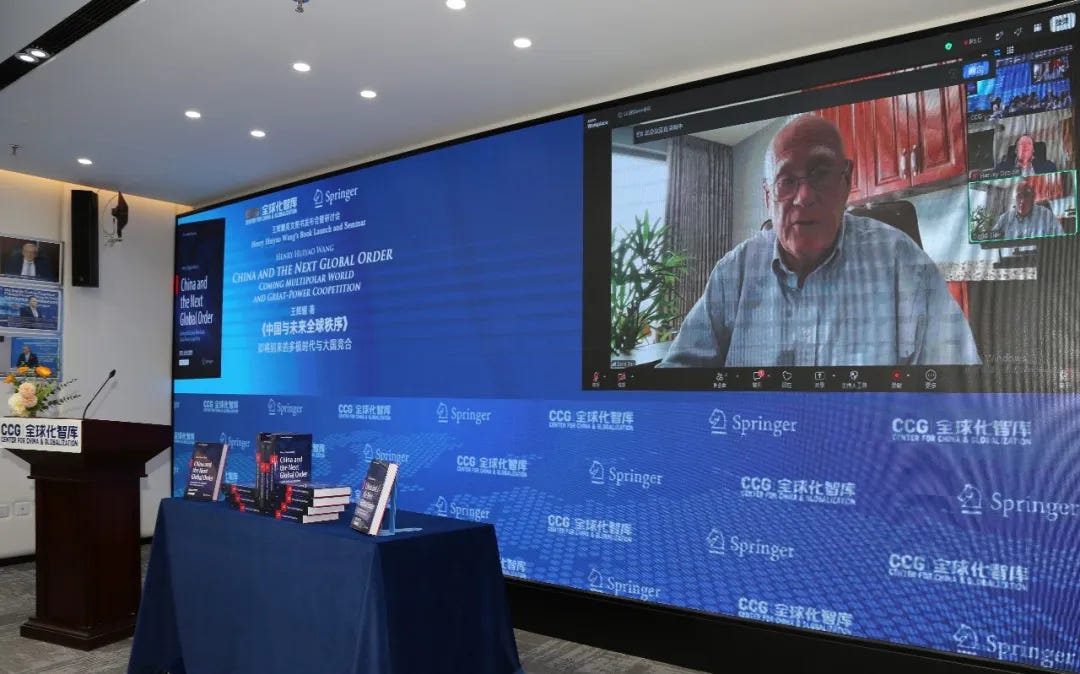
Thank you. I want to congratulate Henry on raising what I think is the important question going forward in the world: what are international relations, international economics and international trade going to look like after the end of the globalisation that we’ve known most of our lifetimes?
So I’d like to raise a few questions. One is: have we ever seen globalisation that is not dominated by an imperial power, or at least by a hegemon? I can think of three primary globalizations in history, and by globalisation I don’t mean just levels of luxury trade. I mean there’s a significant amount of trade that changes average people’s lives and significant international flows of capital, and I think we’ve only had three periods like that in history.
The first is the Roman Empire, and it wasn’t really global; it was only in the Mediterranean Western European region. And the second is the British, the Pax Britannica, up until 1914 or so, and then we’ve had a globalisation period dominated by American hegemony since 1945, and I think that is coming to an end.
And the question Henry is raising is, well, what comes next? And I don’t think we have any very good political parallels and historical parallels to consider in thinking about that. But it’s really an important question.
Just as a note, it’s less important for the United States and for China than for anybody else, because the U.S. and China are both big countries with very large markets and almost autonomous sources of supply. They could be if they had to be, and they’re the gains from trade from a very large country are a lot smaller than the gains from trade for a small country.
So the real issue is whether the United States and China are willing to create a regime that benefits all the other smaller countries, which is basically everybody else, with the possible exception of the European Union.
So I think that’s an issue. I don’t know what the answer is, but I think we’re going to face difficult times trying to establish the next regime.
One issue I think Henry did a good job of bringing up, especially when he’s discussing his own experiences. I especially like the chapter where he was talking about his experiences going to the countryside and how his ability to travel and go to the United States and Canada changed his life, opened up his perspective on the world, and changed his worldview. Essentially, I thought that was very good, and I think that kind of globalisation has been very beneficial.
Although it’s not always that experience with a foreign culture leads to either liking that culture or being peaceful toward that culture, but I think the issue we’re going to have to face is what has been the effect of globalisation on average people.
In China, I think globalisation has been very beneficial for, say, the median worker. Median workers’ salaries have gone up 26 times since Deng Xiaoping’s opening up, and they’ve actually gone up almost nine times since 2000. That’s transformative for people’s lifestyles. My view is China’s standard of living is roughly equal to that of the United States or Western Europe today.
In the United States, on the other hand, average workers have not benefited. U.S. Wages have been constant since 1979. It’s just a coincidence that the year is 1979 because that’s the year we have a data series on median real wages in the United States. It was really in the early ‘70s, maybe mid ‘70s, when U.S. Real wages stagnated.
And now the point I’m trying to make is that it has very little to do with globalisation. In both cases, the reason Chinese average people benefited so much was because of policy decisions made by the Chinese government, in particular to create an economy, a highly competitive economy, and to enforce antitrust law, in my opinion, and to create a financial and banking system that encourages industrial growth. The United States, on the other hand, stopped enforcing antitrust law, reduced the amount of competition, and therefore there was less pressure on that. That means it transfers money to capital, and it also created a financial system based on speculation, basically, and on rapidly increasing asset prices, houses and stocks.
This change in the financial system really started a little bit in the 1980s, but mostly changed through the 1990s, and then during the Obama administration, the quantitative easing program dramatically increased asset prices, transferring money to wealthy people.
So we have to look at the effects on average people, and we have to look at what caused them. And I think what caused them has very little to do with globalisation; it has to do with domestic economic policies.
So, anyway, I’m glad Henry is raising this question because I think it’s going to be just to kind of close. I think American support for the old globalisation, the kind of open system, rules-based so-called system we’ve had in the past, is basically over. I don’t see any support from anybody on the political spectrum for going back to that system, and I don’t know how the world is going to adapt to a United States that’s basically acting in a transactional way, in an attempt to transfer some of the benefit that was taken away from American workers because of the past domestic policy decisions. I don’t think that’s going to change in the foreseeable future, so that I think that needs to be a constant position going forward to think about that. Okay, thank you very much.
Mabel Lu Miao
Thank you, David, for your great remarks. Yes, I think today’s topic, the new wave of globalisation and new global governance, is related to Henry’s book, titled China and the Next Global Order. What comes next is quite important, especially when we look at the history and what happened during different waves of globalisation.
Thank you. Next, we would like to invite our dear friend Harvey Dzodin. The floor is yours, Harvey.
Harvey Dzodin, Former Vice President of ABC Television; Senior Consultant, National Image Communication Research Center, Tsinghua University
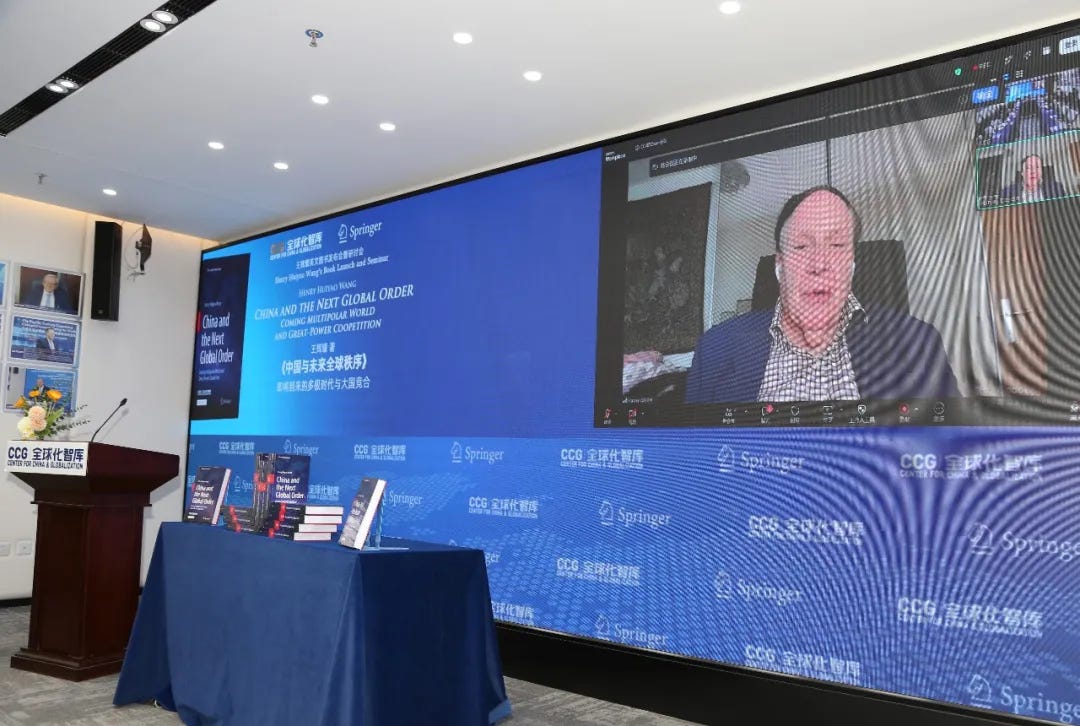
Thanks very much. We’re here to celebrate Henry’s latest book, and it is a very important one. The reprised content from 2022 to earlier this year merits our close attention, and the book does make it easier to find the dispersed gems in a single open-access volume under the auspices of CCG and the respected publisher Springer Nature.
There’s much to learn from the book, but I submit that while the content is current, the title is on the verge of becoming somewhat dated. Why do I say that? Because the world is increasingly moving at warp speed and seems to be changing on a daily basis. That reminds me of the 1960s British musical, “Stop the world! I want to get off.” Well, we can’t get off, but we must try our best to keep calm and to carry on and go forward as best we can. Indeed, the next global order, or at least its outlines, are already very much with us.
The post-World War II rules-based international order is crumbling before our eyes, and is being replaced or supplemented with newer groupings like the Shanghai Cooperation Organization and BRICS, which met recently, together with a multiplicity of NGOs like CCG.
Henry, you clearly see a constructive international order after the U.S.-dominated post-World War II era. You argue that the world is moving towards a more genuinely multipolar system in which China, the U.S., India, and the Global South increasingly share influence. You clearly don’t see a new hegemon replacing the old one, but you see a coopetition in which major powers compete where necessary, at the same time cooperating where their interests converge. Your vision isn’t limited to great-power diplomacy. As the world leader and founder of one of the world’s most highly rated think tanks, you clearly believe in the importance of multilateral institutions, people-to-people exchanges, and innovative forms of international interaction.
Even in this one, in your analysis, you see think tanks, civil society, business, academia, media, and other non-state actors as bridging institutions, as connective tissue between state actors and civil society, keeping dialogue open even at times when official relations become strained.
In this sense, you combine three levels of analysis: a changing distribution of power, new patterns of great power behaviour, and the networks that can connect societies across geopolitical divides. You passionately argue for reforming rather than abandoning multilateralism, so that international institutions better reflect today’s changed distribution of power and the aspirations of the Global South.
Your book isn’t merely an argument for China’s greater role; more fully, it’s a proposal for a world in which multipolarity becomes compatible with cooperation. Competition does not become confrontation, and non-state actors help keep channels of communication open.
Leave it to you, Henry, and to CCG to be so prescient that, like an expert surfer, you can catch and ride the latest big wave, even before it’s fully formed.
As the old saying goes, timing is everything. We can see two other contemporaneous works with which we can compare and contrast your excellent book. Henry serves as an advisor to the Vienna- and Beijing-based think tank Global Neighbors. Its founders, Javanka Porsche and its CEO Sid Chatterjee, argue in the latest edition of the journal Horizons in a monograph entitled “The Architecture of Survival: Why the World Cannot Wait for Governance Alone”, that non-state actors have now taken on a much greater share of the burden of governance. But unlike Henry’s book, in my view, they place too much weight on NGOs and not enough on the centrality of state institutions themselves. For them, these institutions are more than bridges; they’re integral elements of the key governing process itself.
Their outlook, however, is much closer to Henry’s than to Charles Kupchan of Georgetown in the Council on Foreign Relations, whose upcoming October book, Bringing Order to Anarchy: Governing the World to Come, while agreeing that the post-World War II rules-based international order is finished, Kupchan sees the U.S. leading a global concert, and we all know how the concert of Europe ended.
Henry, I think that it would be fascinating to hold a global debate with these authors, as your book underlines the topic of a new world order, and it’s certainly one of the most important on the global agenda. Congratulations on your latest book.
Mabel Lu Miao
Thank you, dear Harvey, and thank you for congratulating Henry on his new book. Next, we would like to invite Professor Denis Simon, an old friend who is also a contributor to another book in our China and Globalization series. So I think you would also like to contribute some of your ideas on this topic. The floor is yours, Denis.
Denis Simon, Bank of America Visiting Chair in International Finance, Schwarzman College, Tsinghua University; Former Executive Vice Chancellor, Duke Kunshan University
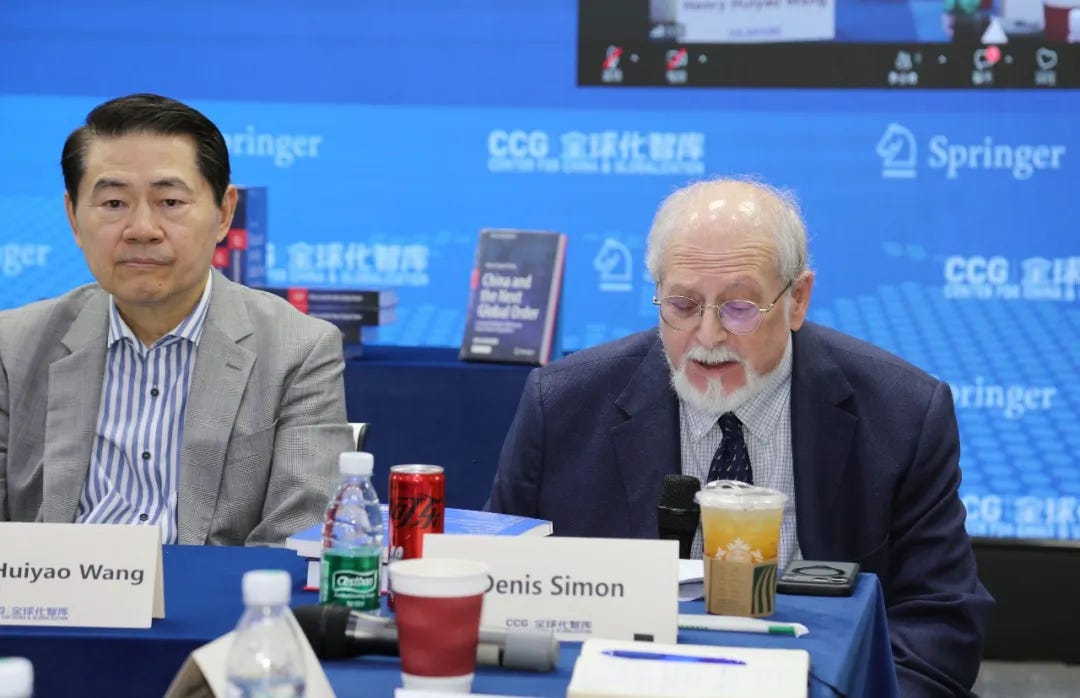
Thanks, Mabel. Thank you. I have five points I want to make. As I was going through Henry’s book over the last week, President Xi Jinping gave a major speech at the BRICS conference, and I kept thinking about that speech. It was almost as if Henry had written this book anticipating that President Xi was going to write and deliver this speech at the major forum, because there’s a very close alignment between what President Xi was articulating, what several of the other countries were saying at that meeting, and the way this book is laid out. As we just heard, timing is everything, and I think it was very important.
So my first point is that I think, after you look at the work, you can clearly see that multipolarity doesn’t have to mean a new Cold War. The central argument of the book is that American primacy, which has dominated since the end of World War II, now necessarily has to give way to a more diffuse distribution of global power, even if the US goes kicking and screaming.
But rather than ending up in some kind of rigid blocs or inevitable US–China conflict, Henry sees a much more fluid situation in which we can have both, as he says, competition and, importantly, deliberate cooperation, not just accidental cooperation. In other words, deliberate cooperation comes from the necessity of addressing the big problems that the world faces, and those problems cannot be ignored in any way, whether it’s climate or trade or, as we have seen over the last few days, the discussion about AI governance and the management of AI development, all of which are now front and centre on the desks of leaders in all the major countries of the world.
The second point has to do with the fact of China’s rise. That China’s rise should itself be understood as pressure to reform the existing international order rather than an effort to overthrow it. This is very important. There’s a tendency in the United States, I think, now to see that the U.S.-China conflict really is a conflict for control and dominance. But I think Henry makes a very convincing argument that China’s effort is really not to overthrow that existing order.
The book basically says that China has been a beneficiary of globalisation, or the international system, and that there is very little reason for China really wanting to destroy that system, and the challenge basically is how do we take the existing institutions and rules of the game to accommodate the growing weight of China to bring global power. That’s why I think President Xi’s speech and this book really just come together and converge at a very good opportunity in our current events agenda.
The third point has to do with globalisation itself. Globalisation and interdependence are not something that has just been created. They have actually evolved in a way that they are now structural realities that bind countries together and also necessarily preclude any kind of comprehensive decoupling.
I know there’s been a lot of discussion about the bifurcation of the world order, with, for example, in the work that I do on science and technology, one part of the world led by China and another part led by the United States. But I think Henry argues persuasively that the integration of technology, supply chains, capital, trade, talent networks, etc., can’t simply be reversed, even by government policy, including President Trump’s tariffs.
The more realistic choice becomes a kind of managed interdependence, away from any kind of destructive fragmentation. It’s not really a contest between globalisation and national autonomy. The structural features of globalisation mean that we can’t allow or accept any kind of zero-sum game being played out, particularly in the case of US–China competition.
The fourth point I want to make is about the Global South. I think what we’re seeing today is really the Global South finally becoming much more of an independent centre of agency in the world, and not simply an arena for the playing out, let’s say, of US–China competition.
I found it really interesting. You may know that, in the last two weeks, the UN has decided to step away from the Mercator projection for how we look at the world. The world map will no longer be using Mercator, and in that new world map, the size of Africa, in particular, increases dramatically. And I wonder, you know, if you’re teaching international relations, I think you can just put that map up and spend a whole semester basically talking about how the world is going to be redefined. And I think it really fits in very nicely with some of the arguments that Henry has offered in this book, which makes the book even more than it seems on the surface.
This is not a new world order in terms of a bipolar world or a tripolar world, but there’s much more of what I would call a flexible geometry of the world order being created, in which middle powers and developing countries can now exercise considerably greater influence over the international rules and the alignments that are being put in place. And so I think I was just listening to the report about this Mercator projection decision by the UN, and it caught my attention. I kept thinking about it. I think there’s a lot to come from this, and it’s a very important symbolic statement by the United Nations.
Frankly, if the book has one shortcoming, it’s a bit optimistic, at least from where I sit, because, in some respects, Henry has to confront the reality that there are still a number of pressing big issues on the global agenda: Taiwan, the South China Sea, economic coercion, cybersecurity, etc. And I think the book ultimately provides a very articulate statement of Chinese internationalism for the coming 50 years. But we still have to figure out, one way or another, how, in the midst of all that, when there is still an intensification of strategic competition, we can transform that strategic competition into a more cooperative, multipolar world order.
And so, Henry gives us sort of the end we want to arrive at, but I would still like to see how we’re going to get there. We need a little bit more discussion, a little bit more debate, and a little bit more effort, obviously, in trying to make that become the reality that we all sense will be better for world peace and world stability in the years ahead.
So, congratulations, Henry! Great timing.
Mabel Lu Miao
Oh, thank you, thank you, Denis Simon. You offered several points that you drew from Henry’s book, especially when you said Henry is optimistic. I think Henry is optimistic, but sometimes I think the world has more positive forces that can make it better. I think this is one of the roles we can play.
And you mentioned the US and China, the Global South, and all those points. I think this book includes those points. It’s quite a comprehensive one. We know that China is going to have a global governance conference very soon in Xiong’an. President Xi proposed that. I think the world is a little bit fragile as well, and turmoil is happening everywhere. I think we need positive forces to encourage more people to talk about how to continue global governance and give more positive signals in that regard. I think China is trying to do that.
People like us, and I think Henry, by contributing this book, would like to send an optimistic signal to the rest of the world that there are still some good people trying to do that. I appreciate your comments.
Next, I would like to invite Xu Chengzhi, who is also a Senior Fellow. Xu is a senior economist. I would like to invite you to say a few words. Thank you.
Xu Chengzhi, Global Chief Public Affairs Officer, Windey Energy Technology Group; Former Official, Chinese Ministry of Foreign Affairs
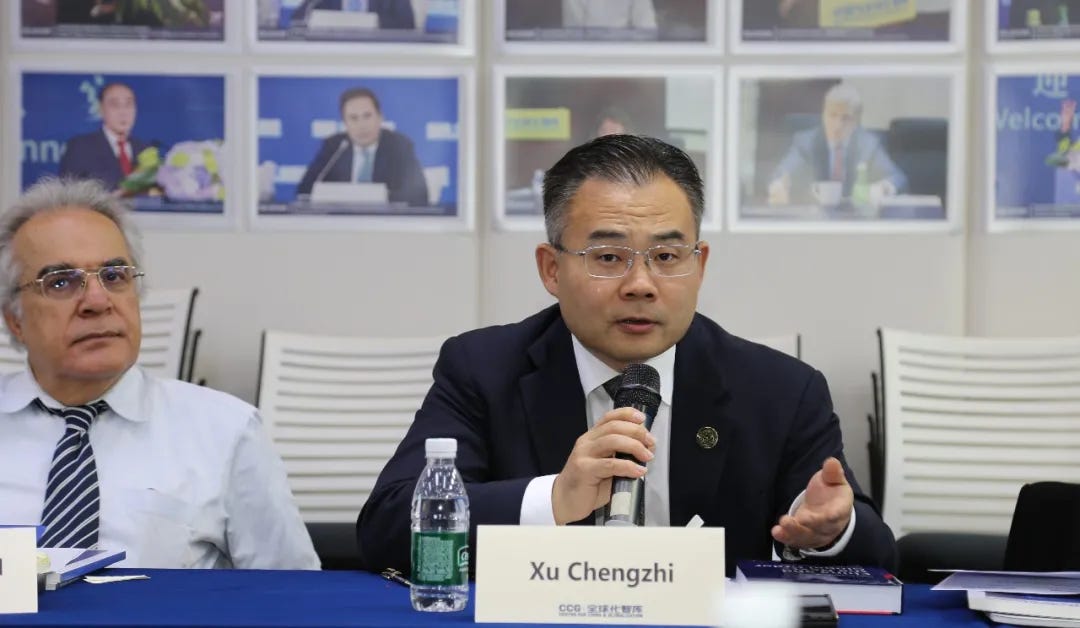
Thank you. First of all, I would like to congratulate Henry on the publication of his new book. Actually, when I look at the title, China and the Next Global Order, from my point of view, this is one of the most important themes in the world today, because the world has been changing a lot since the beginning of the new century. Especially in recent years, the old order has obviously broken down, and the new global order has not yet been established. So everyone is discussing what kind of new order there will be, and I think this is one of the most important issues in the world right now. That’s the reason why this book is really important.
I spent some time over the weekend looking at this book, and I found that it actually has a lot of content, and some of the ideas are very innovative. For example, I found that Henry mentioned that the AIIB could be upgraded to the GIIB. This is very innovative, and some of the ideas are also quite inclusive. I found that Henry mentioned that cooperation between China, Japan and South Korea is very important for Asia. I think these are also very tolerant, inclusive and good ideas.
From my point of view, I want to make a few points. First of all, on globalisation. Actually, I myself think globalisation is good for every country in the long run and in the broader picture. I mean, maybe, as our friend Blair mentioned just now, some people feel that globalisation is bad for workers in some countries. But when such a phenomenon happens during a period of globalisation, it does not mean it is caused by globalisation.
For me, it is mainly caused by, for example, in the United States, perhaps failed monetary policy and public debt, as well as market mechanisms, but not globalisation. For me, globalisation has actually solved many problems. If we didn’t have globalisation, I think the United States would probably have more serious problems.
So the second point I want to mention is that when we look at the world today, especially over the past 20, 30 or 40 years, we can clearly see that many traditionally poor countries and areas, like Africa, South and Southeast Asia, and Eastern Europe, have developed quite well. You go there, and you see they are developing quite well. I was there many years ago, and I visited them again recently. I found that everywhere is full of opportunities and very dynamic. This is the reality right now.
At the same time, we have found that China plays a much more influential role compared with many years ago. China actually has a very positive influence on the development of these areas. Meanwhile, I would say that Western influence has perhaps stagnated. So I think China’s role is the reason why this book has this title. China actually plays a very important role in the development of these areas.
You know, we have the Belt and Road Initiative, and this has also caused a lot of misunderstandings in the outside world. But actually, I think that over the past 30 years, China has indeed helped a lot, whether through our state-owned companies or private companies. We have cooperated with local economies in these areas and contributed a lot to their progress.
That’s why I think, when we look at the world today, it is very complicated. I think it’s more complicated than before. So we must look at these problems in a more comprehensive and inclusive way.
When we look at the future, I think this book actually touches on a very important point, and that is multilateralism. This was also mentioned again by President Xi a few days ago at the BRICS meeting.
At the same time, this book also mentions the United Nations. Its role should be strengthened because, as I said, the Global South plays a more important role than before. So every country needs to be involved. Right now, we have several groups, you know, the G7, G20 and BRICS. These are groups, okay. But we really need a stable forum for all countries to come together, discuss and resolve problems. This is especially important in the age of AI, I think, more important than before.
So the United Nations actually needs to be reformed, of course, but its role definitely needs to be enhanced. We cannot just leave it aside. That’s not smart. That’s not wise.
So these are the points I want to make, and I want to congratulate Henry on the publication of this book, because it mentions several points that we need to think about more deeply when considering the future, based on the perspectives put forward by Henry.
Thank you.
Mabel Lu Miao
Thank you, Xu. You mentioned some of the ideas Henry proposed in this book. I think there are a lot of innovative ideas included in this book, including many op-eds and articles Henry has written this year. So I think this will attract more readers to pay attention to these ideas.
Thank you very much. Next, I would like to invite Arvea Marieni to share her ideas on this topic. Thank you for coming.
Arvea Marieni, Director of Ecological Transition Engineering Solutions, Beam Cube; Senior Adviser, World Green Design Organization
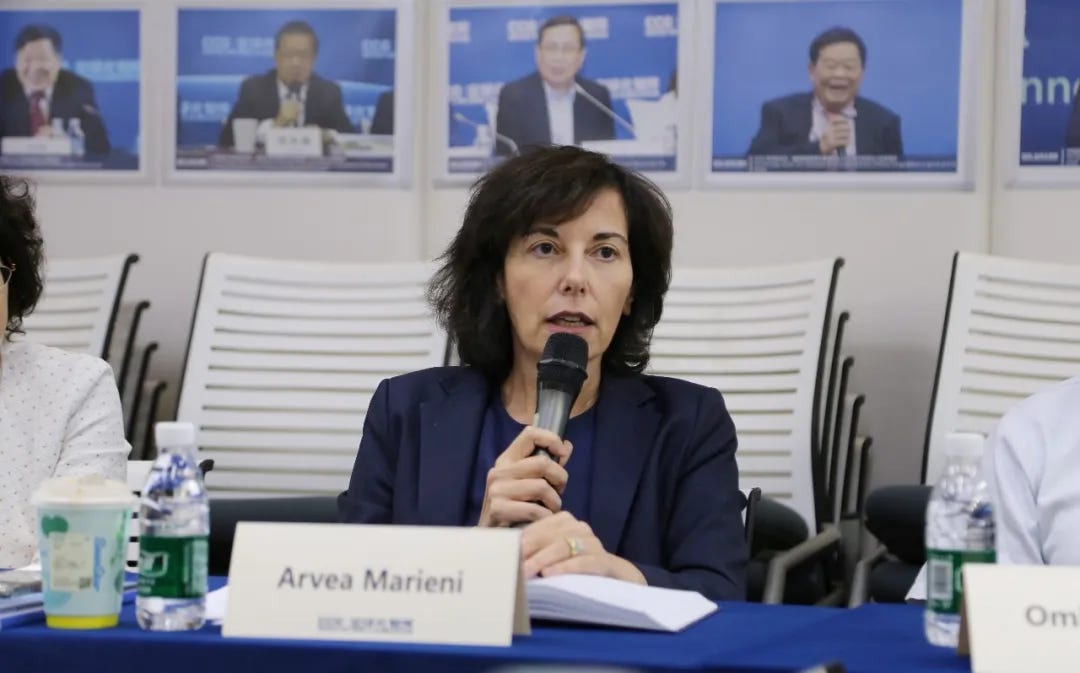
Thank you very much. Actually, I met Henry Huiyao Wang again this week at the UNIDO Forum in Xiamen, and I wasn’t invited to speak, I thought. But I’m happy to be here because I received the book a couple of days ago. I was going through it, and of course, I’ve been following the work that the Centre has been developing for a few years, especially in relation to countries in the European Union.
What I find extremely interesting is the connection and the synergies between different layers of topics and layers of governance. He has an approach which I think is typical of Chinese governance, which is an integrated resilience approach. This means that you consider risk factors, and it’s true, it is optimistic, but you consider risk factors in an integrated manner, taking into account the multicrisis, including the environmental, ecological and climate crises, but also the security crisis.
I’ve done some work in the past with a think tank connected to the German Ministry of Defence, and obviously, since the 1990s, the integration of climate and environmental management has been important. Because it is an engineering discourse, a discourse about resource constraints even before it is an environmental discourse, it has involved analysing the weaknesses and vulnerabilities of different economies in relation to stability and the possibility of maintaining societal operations under these extremely impactful events that we are now seeing unfold in every part of the world.
And in terms of the United States, we were discussing this, I think, also in Xiamen, but even in Shanghai. In terms of its integration into military discourse, we’ve seen, for instance, in the 1990s, the Pentagon considering China more vulnerable and considering that the United States would be a sort of fortress. And that was one of the elements that would push the US government, after the first presidency of Bush, the father, to take a more cautious approach to climate governance. Because, in a way, they thought, we’re growing, our industrial system is based on and very entrenched in oil. There is a very strong link, even a financial connection, after 1973. You know, the dollar-denominated petrodollars are actually managed on the basis of oil.
And they were thinking China would be less able to respond to this crisis because of drought and other vulnerabilities. But nowadays, we have the Colorado River, for instance, with water as a main factor of risk, which is showing not only a resource availability issue but also a governance issue. And FEMA is being weakened, and the United States’ most recent policies are actually weakening it further.
So this is, in my opinion, and in the opinion of some geopolitical analysts in France, one of the elements that is pushing the United States towards a more aggressive perspective in relation to its neighbours, because it is a question of forests and water in Canada. Of course, it is minerals in other parts of the world, but there is also this issue.
And regarding China, what I believe is going to be very important, and is already proving very important, is the systems engineering approach to governance that is redesigning a sufficiency-based economic approach. This is also because China is fundamentally not under, let’s say, the mythology of markets. As Stern, the British economist, would say, climate change is the largest, the greatest market failure ever. Well, if you do not change the pillars of that market design, you will not be able to address it.
And the Chinese system, because of its, I would say, less passionate embrace of markets in the way that we have embraced them, especially in financial development, is able to tackle these issues in a more convincing manner.
Just one last point, because otherwise I will take too long. Everyone is hearing about petrostates and electrostates. This is becoming a sort of refrain. I would say that, again, geopolitical analysis in France has been considering these issues from a securitisation and resilience approach.
Chimerica, Niall Ferguson, again a British scholar, the integration between China and the United States, America and China, as the basis and the driver of the second wave of globalisation, but also what the French call the deregulation of planetary systems, and this entrenchment between the US and China.
I remember, for instance, the congressional hearing in 1985. I mean, I don’t remember it personally, but I watched Carl Sagan, the astrophysicist, talking to Congress, and he was anticipating exactly what was going to happen in terms of physics, in terms of warming, in terms of resources, in terms of coal utilisation and the breakdown of planetary systems, in front of the US Congress.
And we see it. We see that the Chinese have been producing goods, but also receiving the emissions. I mean, we have consumed goods whose emissions were delocalised here years ago. Environmental impacts were delocalised here, and that is the reason why our costs went down. And this has been pushing consumption and the consumption model of the United States since the 1990s, until China became stronger in its industrial base, and its emissions started increasing more around 2004.
Before that, the US was the largest emitter, but you always have to consider that China was subsidising our consumption. And at the same time, and I’ll close here, China was also subsidising the United States in terms of monetary flows because it was buying Treasury bonds.
And as a way to react to American pressure nowadays, well, Mark Carney is a former banker. We can, as Europeans, as other countries, the middle powers, decide, for instance, to offload some of these Treasury bonds.
Mabel Lu Miao
Wonderful. Thank you, Arvea. I think you gave a very good speech, including your point about subsidies for consumption. I think this is also what China is doing right now for the green transition and green development. We call it green globalisation as well.
Thank you. Next, we would like to invite Hamid Sharif. Yes, the floor is yours.
Hamid Sharif, President, Global Think Tank Network; Former Managing Director, Asian Infrastructure Investment Bank
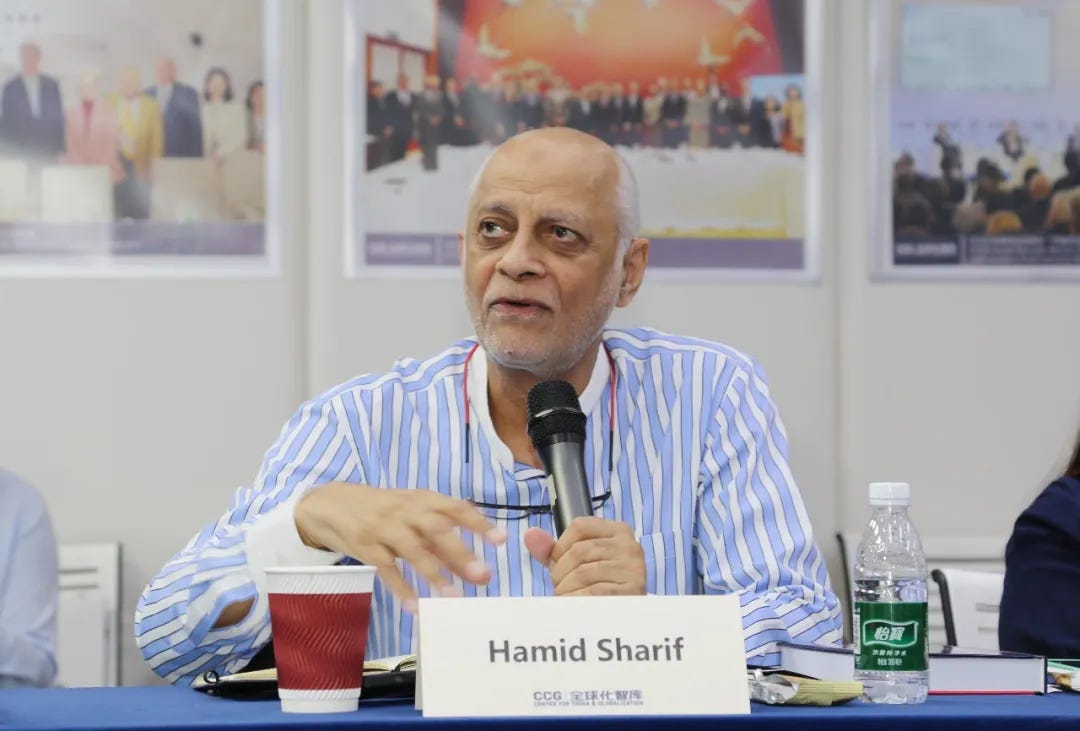
Thank you. Like Arvea, I was also asked to participate at the last minute, but I’m very pleased. I was visiting Beijing from Islamabad, and I happened to be here, so I’m very happy to be with colleagues. I’ve been following your work for quite some time.
I think the title is really interesting because it clearly indicates that we’re on the cusp of a new global order, or disorder, or chaos. I think that keeps a lot of people awake. A lot of people around the world are worried, especially after what happened in Venezuela, because that was a coup, if you like, against what we understand. And that was followed very soon by, you know... So this is an extremely worrying time. There’s a lot of thinking going on around the world. I know some people who are actually depressed. They worry so much.
So I think, in that context, it’s very important for the world to understand, and I think your book makes a great contribution in this respect: what are the intentions of one of the biggest players in the game? I think your book helps us to understand. Well, you don’t speak for China, but you can help us understand how China operates, how China thinks, and that’s important because the sources of information about China, unfortunately, continue to be Western. Even in a country like Pakistan, where you have a great relationship with China, ordinary people’s knowledge of China comes from Western sources.
And Western writers, for their own reasons, perhaps quite innocently, transpose their own experience onto China. They went out to dominate. They colonised, killed people and conquered continents. They destroyed the environment, went ahead with industrialisation and destroyed most of Europe’s forests.
And they expect that China will do pretty much the same. Because for them, the way they look at history is that history is sort of, you know, progressive. It’s not circular like the Chinese view. You know, they’re now at the top; everyone else is behind them. And because they’re behind them, they’re going to behave just like the leader.
So I think that, for me, is why it’s very important. I just want to make a few points. I mean, you cover so much, but I just want to focus on a couple of things.
I think multilateralism is very important. I was employee number 36 at the AIIB, and I was there again this morning. In a matter of 10 years, lending has really progressed well. Now, that is important, not just for the AIIB, but, you know, hopefully with your bank as well. It’s very important to break hegemony.
For so many years, developing countries had to rely on the West for any meaningful amount of money. Western countries have tended to be—I mean, they’ve been generous. I don’t want to take away from the generosity of some of those countries. But when the chips have been down, they’ve also been quite dictatorial. So there is a lot of space for change.
I think it’s very encouraging to see multilateralism developing, along with new institutions like the SCO. The G20 emerged out of the global financial crisis. Well, I don’t call it the global financial crisis. That was capitalism’s financial crisis. After that, the emergence of the G20 was very relevant.
And in that context, you know, the US–China rivalry and how developing countries manage that—that’s a huge debate in itself, and I don’t want to dwell on it. But I think reading your book can help those countries understand at least China’s intentions, help them navigate the situation, engage in dialogue better with China, and make China understand their point of view. I think that would be immensely helpful.
And of course, in this process, I think what’s very important is that we’re beginning to see something new. I see it at a micro level, even with the World Bank. I see a major policy, which I used to deal with at the AIIB, undergoing reform because of developing countries—not because of the developed world, but because developing-country members are saying, “Hey, that’s...”
So I think the dynamics have changed. Rather than being recipients of norms, we can now interact with those norms and begin to shape them. I don’t think it’s a disruptive process because the good thing, as the AIIB demonstrates, is that 90 per cent of the AIIB’s policies, maybe even more, are aligned with those of the World Bank. So it doesn’t have to be a disruptive process. At the margins, it innovates, and we did introduce some innovations.
And I’m so happy when they imitate us because imitation is the sincerest form of flattery, as they say. So it’s good to see that when we do something good, other banks follow.
And very lastly, I think climate change needs attention. I was just in Pakistan, and I was saying that, with what’s happened in Nepal recently, we do not have the necessary scientific capacity. We’re trying to create that sort of scientific capacity, but frankly, we just don’t have it.
And I would like to see urgent efforts, with China in the lead, concerning the Himalayas. Pakistan and India have to work together. Those countries have got to wake up. This traditional rivalry between India and Pakistan is killing South Asia, killing the whole Himalayan region, and I would love to see some initiative on that.
Because China actually has some very interesting technology for addressing this. It’s actually covering some of the glaciers with material so that it stops the melting. Now, that’s a very expensive solution, and there are people who question it. But it’s the beginning of a dialogue, a collective dialogue with top-notch Chinese scientists and others who can contribute.
I congratulate you on producing a book which I think will be immensely helpful.
Mabel Lu Miao
Thank you, Hamid. Yes, you mentioned multilateralism, which is very interesting. We are going to the WTO this evening for the WTO’s annual Public Forum. CCG has a session on the WTO agenda. The session is titled “Unilateralism Undermines Multilateral Trading System. I think it’s echoing what you said. Thank you very much. And next, we would like to invite Miss Rebecca Gray, who’s from the UK Embassy.
Rebecca Gray, Second Secretary, Political Section, British Embassy in Beijing

Thank you very much. Like a few others around the table, I think I was a very last-minute addition, so I won’t pretend to have read the book. But thank you for giving me lots of Golden Week reading.
I just want to say congratulations as well, and thank you very much, colleagues, for an interesting discussion today. I don’t want to repeat what’s already been said, but I think it’s very clear that multilateralism is vital to help us tackle some of the cross-border issues that have already been raised: climate change and the impacts of it, as we saw just a couple of weeks ago in Tibet and Nepal; the insanely impressive rate at which AI is developing; and health cooperation. We don’t want to see another COVID pandemic.
So it’s clear that multilateralism is important, and this conversation is extremely relevant this week, given what’s just happened at BRICS over the weekend, what’s coming up at the UNGA, and the big President Xi–Trump summit coming up in September also.
So what’s interesting about this topic is that while multilateralism is so important, it’s clear that the current order is being challenged, with some countries stepping back and the Global South looking for a more representative and equitable system. We don’t really know what comes next, and we’re seeing a rise in regional multilateralism.
And China has been very active in putting forward their vision of multilateralism, including through the global initiatives. But while we have this series of visions, there’s not really one agreed-on vision or clear steps on how we get there.
So it’s a very interesting book at a very interesting time. Thank you very much.
Mabel Lu Miao
Thank you, Rebecca. Next, we would like to invite Mr Ovid Motahari. The floor is yours.
Ovid Motahari, Independent Researcher
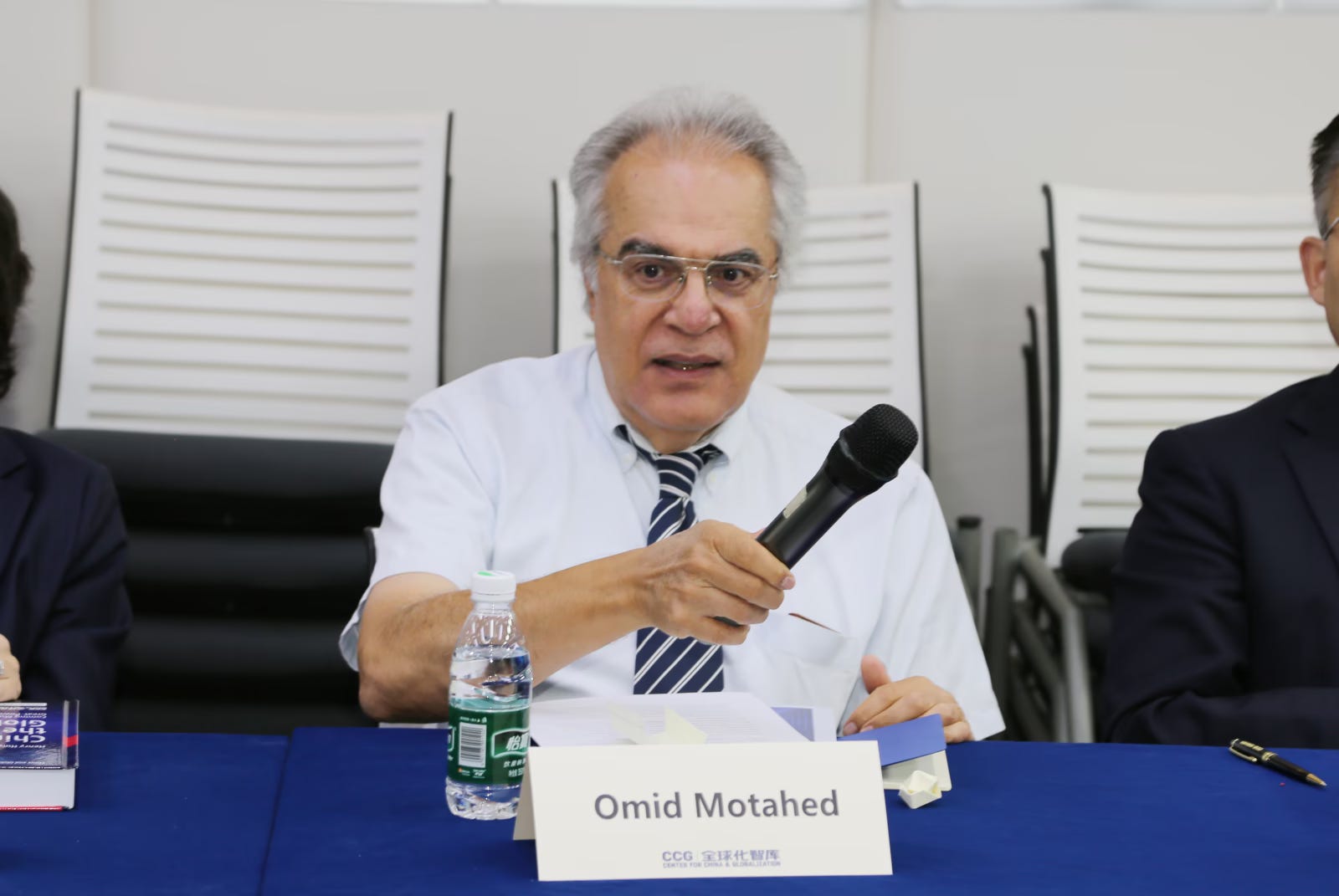
Well, I just want to thank you for inviting me here, and I want to thank also Henry. I saw him in United Family, and he invited me. He added me to his WeChat, so I wish him the best of luck, and I will study this book for sure. Okay, so thank you again very much for inviting me.
Mabel Lu Miao
No problem. So maybe we hand over to Yasir Masood.
Yasir Masood, International Affairs Commentator, CGTN
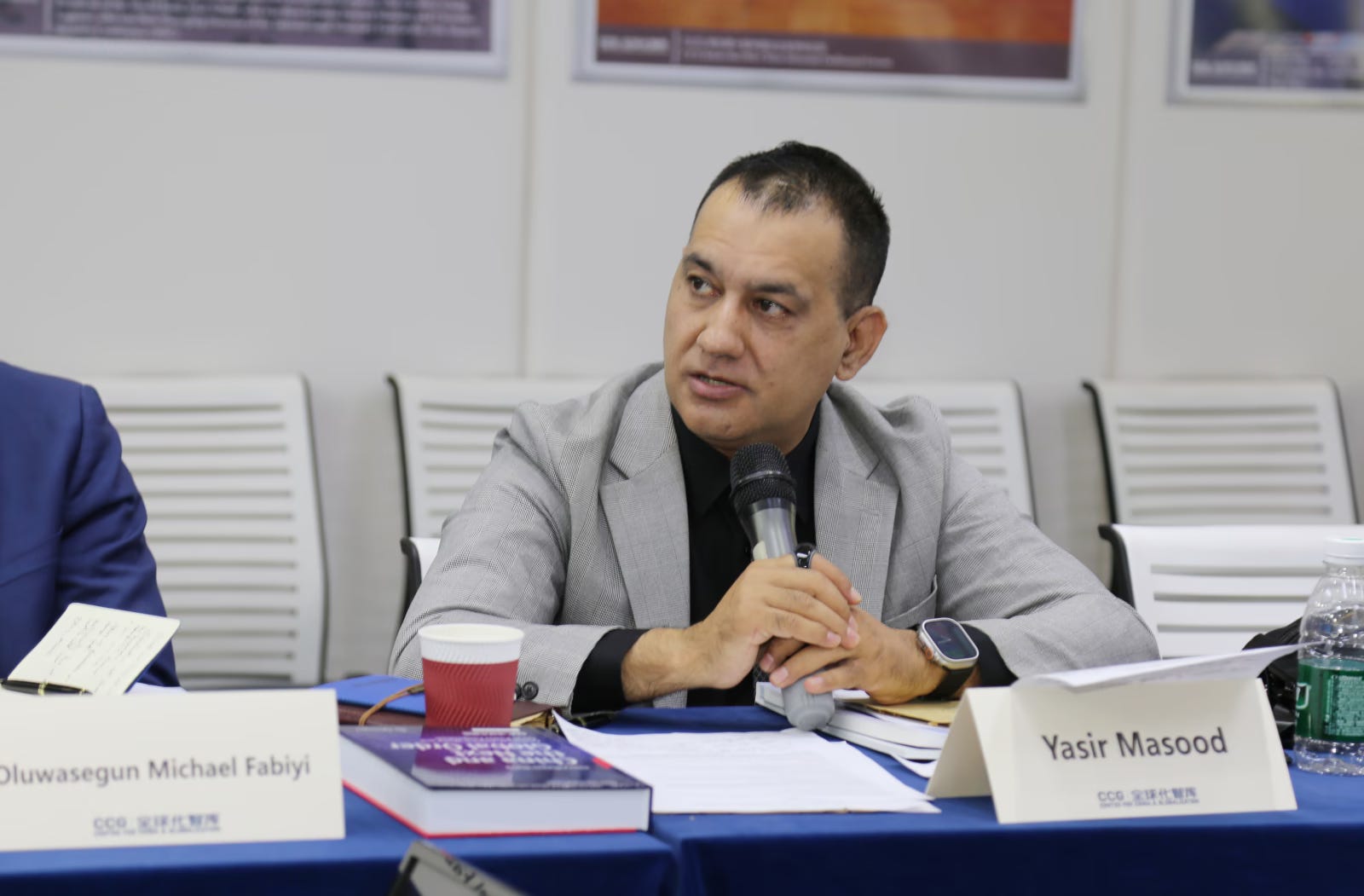
Good afternoon, everybody, and thank you very much, Mabel, and thank you, Henry. I had a very good chat with you last week, which was wonderful, and all the comments have been very enlightening. So I will try to add something different from what I perceive of the book.
When I think about this book, I have to turn the clock back to the close of the 20th century, when a book called The Clash of Civilizations was very popular, in which it was clearly defined what the future held for humanity. And at the cusp, at the dawn of this century, with the rise of China, I would like to reiterate the fact that President Hu Jintao, in 2006, first used the concept of a community of shared future, a community of shared destiny, to improve relations internally, including with Taiwan, and with other countries as well.
When we talk about China’s foreign policy and peaceful coexistence, which have been the main pillars of Chinese policy for a very long time, this is really a vision that the world needs. Why? Let me give you a few glimpses.
My friend Xu Chengzhi mentioned how China is making inroads in terms of its development in the African continent. Let me come up with a few figures. Even today, there are more than 50 interstate conflicts raging in Africa alone. So this is the kind of international system we have. Even in Africa alone, they are miles away from the basic concepts and functioning of democracy and development. The whole Global South, which you have extensively mentioned in your book, is still burdened with 90 per cent of the debt.
And of course, there are mushrooming issues and problems pertaining to the international system. That is why I see this as an epic, a very important contribution to the existing corpus of knowledge. The world needs to understand how we can make this world a better place. It’s not about China alone. It’s about the entirety of humanity, because the system through which we are living has brought a lot of destruction to humanity for far too long. And I think there is an immense, dire need to look towards alternatives.
I would briefly make a few comments on your book. When we talk about multipolarity, is the world really becoming a multipolar world? And if so, this brings me to my next question: what is actually the driving mechanism of multipolarity? Because what I believe and perceive is that there is a difference between a multipolar world and a multipolar world order. They are two different things. And why do I say this?
Because multiple powers can still interact. So only a new distribution of wealth or resources will not solve the problem unless we develop some sort of workable mechanism. By calling it a multipolar world, we raise the next question: how is it going to work? How will it make the world fairer and more just? This is my first point.
The second one, as mentioned in your title, is coopetition. It’s extremely interesting because there are two sides to this concept, or two layers. Of course, one is cooperation, and the other is competition. Competition is not going anywhere. It will still be there, but that doesn’t mean cooperation will erode as well, because states are still interdependent in terms of technology and economic weight. So they are more or less interdependent on each other.
But this also brings another layer of questions: what if this cooperation itself, or interdependence itself, becomes a source of rivalry? So how are we going to manage that? In one of my recent articles, I explained US–China relations as more of a multi-vector, managed sort of competition, and that is what is actually happening. States are trying to manage it so that they can prevent it from turning into fragmentation or rivalry.
So this is another question, a probing question: what if interdependence itself becomes a mechanism for rivalry?
The third point, which I see as very important and which is very close to my own interests, is agency. What about the agency of the Global South, middle powers, and developing states? I see three perspectives here: middle powers have access in a multipolar world order; middle powers have relevace; and middle powers have [inaudible].
Access is needed, of course, because it enhances their strategic leverage, and states want to have a better share and engage with others. But do they really have the capacity and capability to be autonomous? Do they have this kind of manoeuvrability so that they can decide their own course freely?
The best example is what I call, in one of my articles, a constrained bridge state or a swing state. Pakistan has good relations with multiple actors, but it does not have the capacity or capability to manoeuvre freely, even in a multipolar world. So how much share can developing states have, what kind of agency can they exercise, and how can this be worked out?
Before I take any more time, the last point you mentioned is about China’s role in reaching out to the world. And that’s where, personally, this becomes very interesting to me because I’m at the intersection of geopolitics, being a student and practitioner of international relations.
International media has remained very relevant in marrative-making. I think this is very important because empowerment and influence without meaning are not useful.
So in today’s world, how do we interpret and how do we communicate? This is also extremely important. And since China now wants to have better relationships with the wider region and the wider world, I think legitimacy and communication are extremely important.
And in the end, I think I would conclude with this: perhaps the most important question raised by China and the Next Global Order is not simply how many poles emerge, but what possibilities for meaningful action exist around those poles.
Thank you.
Mabel Lu Miao
Very interesting comments. And you proposed some questions, but your ideas were also included in your questions. Thank you very much.
Next, we would like to invite Zoon Ahmed Khan. Thank you.
Zoon Ahmed Khan, Special Commentator for CGTN; Researcher, Belt and Road Institute, Tsinghua University
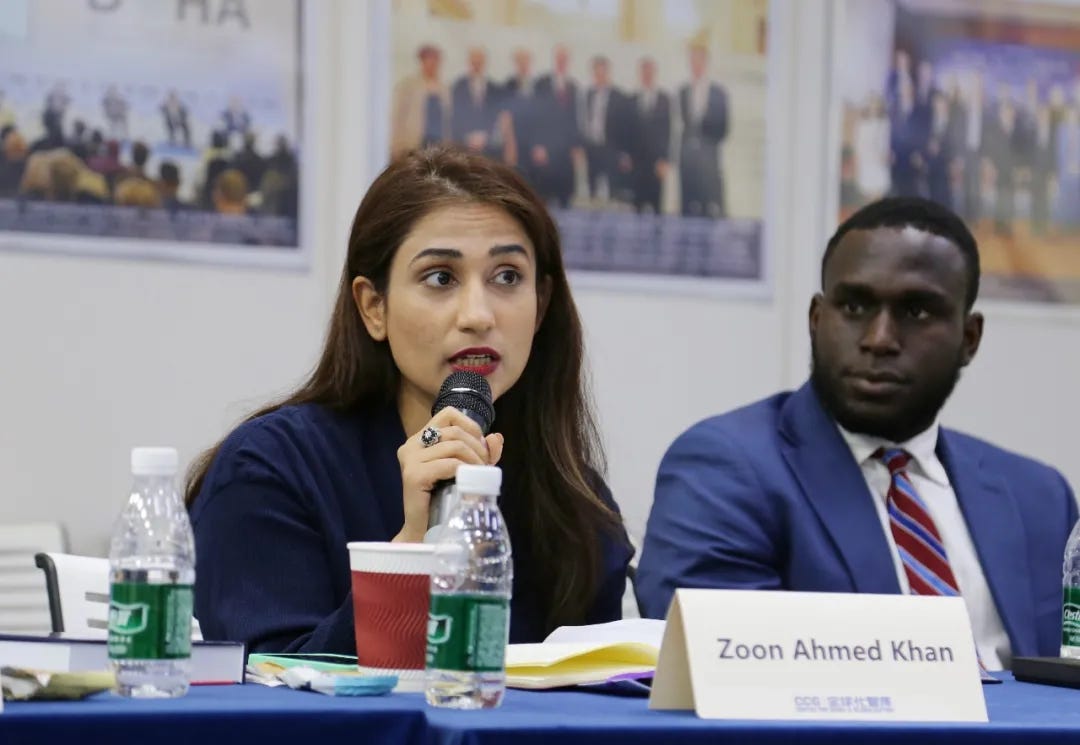
Thank you so much. Firstly, congratulations to Henry on the book, and to CCG. I’ve been in Beijing for 11 years. I came in 2014 with the question: what would Chinese leadership look like? You know, how could it be different from the kind of leadership or hegemony that we had been experiencing? And especially for West Asia, for certain parts of the world, the manifestation of that hegemony was quite harsh.
So anyway, what I felt back in 2014 was that there was a lack of understanding of how China sees the world; what are Chinese solutions to the problems that we face? And increasingly, over these 11 years, we’ve seen that a lot of that gap in understanding China’s perspective — how China approaches different issues, including conflicts, and the global initiatives that have been announced — has been addressed. That creates a window of opportunity for the world to understand what new leadership can look like.
But I’m going to be very quick. I’m going to answer two questions that I feel everyone can sort of relate to.
I was on a panel recently where the host asked me how China’s approach to development or addressing poverty differs from that of the West. And I said, I don’t think there is a targeted approach right now, domestically, in certain very developed countries to address poverty and tackle challenges.
And that’s the first question that we are looking at when we talk about an international order, because an international order is not just about the status quo. We talk about a bipolar order, a unipolar world order and, increasingly, a multipolar world order. But when we talk about the international legal order, we are essentially talking about the UN system, which has deliverables.
And then China is a country with increasing functional capacity to address those issues, such as the SDGs and, with the announcement of the IOM as well, possible mediation. These are real issues and challenges that the international order is mandated to address. And now China is increasingly playing a proactive role in bridging that gap between aspiration and reality.
So I feel this book also goes into the nitty-gritty, into the details of the different aspects of challenges that the world is essentially facing, whether it’s finance, whether it’s peace, whether it’s development or whether it’s poverty. What is a Chinese perspective on addressing those challenges? And I think that’s essentially what the world is looking for.
I know that Denis Simon was the first person to mention that it’s an optimistic book. My own view is that aspiration is the key to guiding a changing, and inevitably changing, global order in a direction that we want. And the Global South, the global majority, the world at large, has been aspirational.
And the second point I’ll mention is that, not long ago, a very respected scholar from Europe said, you know, the SCO is imagined. And I said, well, everything, every organisation, every such grouping, is first of all imagined, and then you work towards building the institutions, the understanding, the dialogue and the capability to create some kind of synergy.
And I think that is what the growing Global South and its growing weight in decision-making are also about. When Africa was mentioned, one of the reasons that Africa today is dynamic is because the African Union has built this continental-scale identity that every African country is working towards. And we need more of that.
So aspiration is what we really need to know what direction we’re going in. Nobody in a developing country, no government sitting in the Global South, ever says that we want to walk out of the international order. They say we want it strengthened. We want to be better represented. We want to be part of the solutions to the problems that we face. And what we really want is a UN system, a UN-centred international legal order where no country can go to war with absolute impunity. Venezuela was mentioned. These are the issues that we want to tackle.
So I think, I mean, I’ve gone through the book. I will read it in much more detail as well. This is the kind of voice that the world needs. There has been a big gap between what China is creating versus what people know about it. The issue of Orientalism was also mentioned, and I think, increasingly.
The last point I’ll mention is that we often try to compare this changing world order with some moment in history, but there is no comparison because today there is a true democratisation, so to speak, where countries in different parts of the world are speaking with each other.
Anyone sitting in Uganda or Chile or Peru can download this book and read what a Chinese perspective is like. So China’s growing global role is also not just about convincing the status quo powers that I am capable. It’s about showcasing its capabilities within the international order and delivering actual results to developing countries to prove that I am a leader that is following a direction that most of us have been wanting to move towards.
So we’re in a very different moment in history. And I think the contributions you’re making are very valuable in increasing synergy.
Mabel Lu Miao
Thank you, Zoon, for your great comments. Next, we would like to invite Michael Fabiyi, who is a PhD candidate at Tsinghua University. Please.
Oluwasegun Michael Fabiyi, PhD Candidate, Tsinghua University

Thank you so much. First and foremost, I want to say a very big congratulations to Dr Henry Wang on this wonderful publication.
I’ve not been able to read everything, of course, but I was very much struck by your conversation with Graham Allison, especially about escaping the Thucydides Trap, in terms of China and the US.
And I’m very impressed by what everyone has said concerning developing countries. And as someone coming from Africa, of course, having lived in Africa almost all my life, I can attest to some of these things. First of all, what the West was doing in Africa, and now what China is doing in Africa.
But I’m always very curious about something that you have said, and that President Xi has said, which is about not leaving anyone behind. And I’m always very curious about what China is going to be doing, even as the next global order emerges, to ensure that it is not leaving some of our developing brothers and sisters behind.
And of course, I will say that not just this particular book, but even your previous publications, are usually very wonderful, very brilliant. And I’m always very curious about what you think China should do in terms of not leaving anyone behind.
Of course, once again, congratulations.
Mabel Lu Miao
So maybe I would like to invite Emily from Springer Nature to say a few words.
Emily Zhang, Senior Editor for Business, Economics, and Political Science, Springer Nature
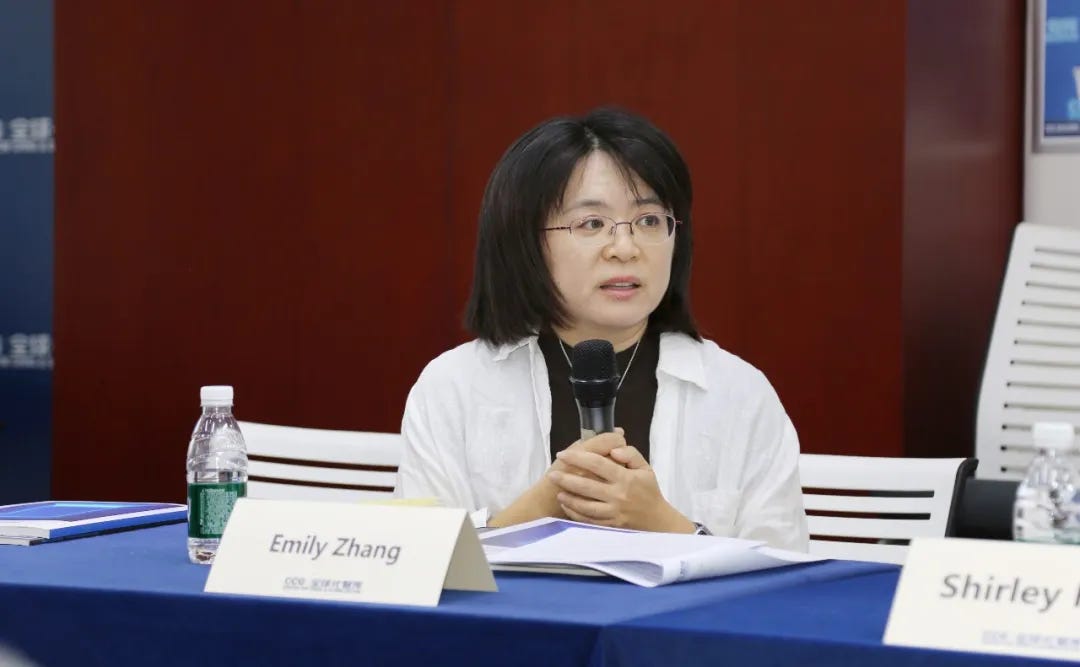
Thank you, Mabel. I’m so glad to be here on behalf of the publisher to offer some comments on this newly launched and very timely book authored by Henry. And we have had a very long period of cooperation with CCG, including Shirley, Henry, and Mabel. Thanks so much.
And I would like to share some of my comments on this book after reading some chapters of it.
I’d like to address two themes of the book. One is, I think, the arrival of a multipolar world. I think whether one agrees with every argument of the author or not, the fact is that a multipolar world is coming. And yes, I think the voice of a Chinese scholar is very important on this timely topic.
And the second theme is the power of dialogue. I think the book is also most valuable from that point of view. As a publisher, we want to build a bridge for authors and readers to share their comments on this very important and timely topic.
So that’s all. And yes, we look forward to another success for this book and the forthcoming titles in this series.
Thank you so much.
Mabel Lu Miao
Thank you, Emily. I appreciate all the cooperation between CCG and Springer Nature. We have had productive results. I look forward to this book having more influence on global governance.
And I know there are some journalists here as well, from CNN. Simone? If you have a question, the floor is open.
Simone McCarthy, Senior China Reporter, CNN International
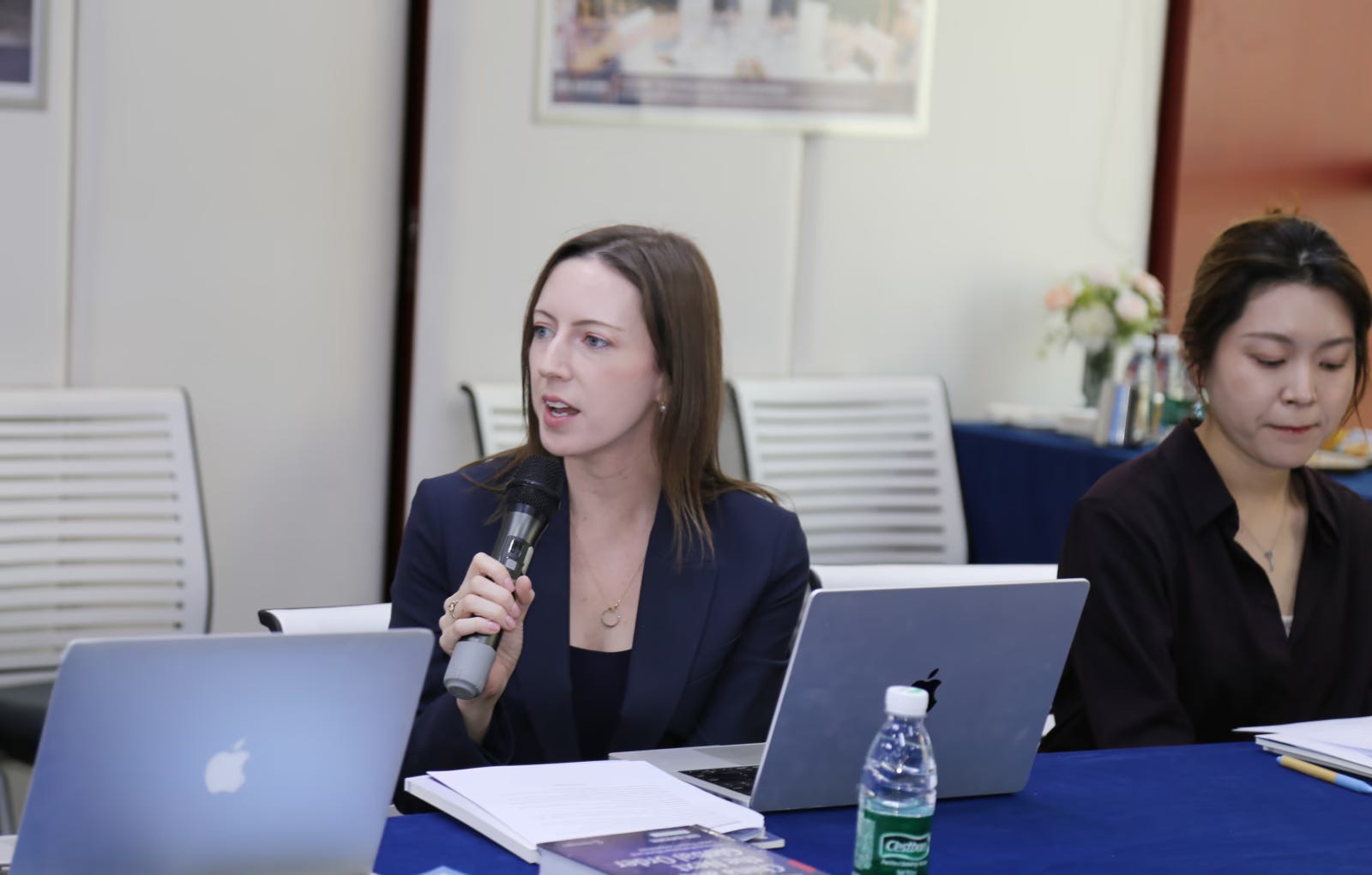
Thank you so much. Such an interesting talk, and I look forward to reading the book.
You know, today, one of the big items in the news is conversation, especially among US tech companies, about AI and whether or not there should be more guardrails and a slowing down of AI development due to major AI risks or even a potential existential threat.
And I think it’s an interesting example when we have this conversation about multilateralism, but then there’s also the reality that the US and China are the two countries which are the most advanced in the technologies. And so how the two navigate putting those guardrails in place and working together on those kinds of global regulations, will be very important, despite the fact that we’ve also seen Chinese leader Xi Jinping repeatedly speaking about the need for global AI governance.
And so I was wondering if you could talk a little bit more about how the bilateral relationship between these two countries fits into that broader picture of AI global governance. How do we sort of think about those two things working together, or are they entirely separate?
And then perhaps, of course, I’d be very curious, Dr Wng, to hear your view on the extent to which the two countries, especially in the coming days as we see President Xi travelling to the United States. Will they be able to reach some sort of agreement on these guardrails? Thank you so much.
Henry Huiyao Wang
So first of all, I would like to thank all the distinguished panellists and roundtable participants, and also Springer Nature, for attending this afternoon’s new book launch.
I think there have been a lot of questions raised in the process, but I’m also very grateful for all the positive comments and encouragement that we’ve had from this roundtable.
And of course, the book talks about China and the next global order. Actually, the next global order is still taking shape. I don’t mean that it’s already there, but it’s in the process of taking shape. So that’s one point.
And the other point, I mean, our friend asked about the multipolar world and the multipolar order. I think, you know, it’s all interdependent. It’s all intertwined.
We currently see a lot of multipolarity at the regional level. You know, for example, particularly in the economic area, we have RCEP and CPTPP, which are also driven by the middle powers. And we also see the European Union and ASEAN, and the SCO and BRICS. So there’s a variety of international, regional and geopolitical organisations taking shape.
But in that process, I agree that we actually need a UN-based, global consensus. As I discuss in my book, how about we do more with the G20, which is more inclusive. You’ve got ten Global South countries and ten Global North countries, representing 85 per cent of global GDP. So how could we use that to reform the UN, including the UN Security Council? I have a long article in the book about that. So I think those are interesting points.
Regarding our friend from CNN, I think you raised a very good question. Exactly. You know, AI has become so dangerous and so alarming. I’m also pleased to see three CEOs from the United States, from three of the largest AI companies, come out and say, “Okay, guys, let’s slow down. Let’s not really rush to accelerate the speed of AI development.”
So I think it’s extremely important for human beings to be very careful not to be overtaken by AI or swallowed by AI. Otherwise, we could basically end up wiping ourselves out with our own product.
So, as for how to do that, I see this upcoming visit by President Xi to the United States to meet President Trump as very important. And I know that there’s a lot of discussion, and great importance has been attached to AI.
I remember, in May, when President Trump visited China, he brought the Fox News crew, which did an on-site interview with President Trump in Beijing. But then the Fox crew actually came to my office, to this office. We did quite a lot of interviews. They just wanted to know about AI. They wanted to talk about AI. We gave our assessment.
So what I think is important is that both leaders realise the importance of AI. I’m sure AI will be talked about during the upcoming visit.
And actually, I even have a proposal, which is that we should really treat AI as a potential weapon of mass destruction. And we should have limits on that. So let’s say, how about we agree not to weaponise AI between China and the US?
Or maybe even further, let’s say we’re not going to be the first to use AI weapons, just as China has proposed not to be the first to use nuclear weapons. Can the US say, “Okay, we’re not going to be the first to use AI weapons”?
So something like that, I think, can be discussed. I think AI is probably a more urgent, more important global governance issue.
We have Pax Silica, which the US has launched, and China has launched the World Artificial Intelligence Cooperation Organisation. But then the problem is that the US is very exclusive. The US is saying, “Look, you can’t join this World AI Organisation launched by China.” Whereas China hasn’t said that members cannot join the US organisation. So I think there’s a question of openness here. We need to have a unified organisation.
I really hope that during this high-level visit between China and the US, President Xi is going to bring some business leaders there. So why not have Chinese AI company leaders and US AI company leaders hold industry talks? You know, let’s get the top ten AI companies from both China and the US to sit down and talk as well.
So I would think that if we have more dialogue like this and more exchanges like this, we will realise how important it is to recognise the dangers of AI. AI can bring benefits, but it can also bring dangers to us.
But I think what China is doing is important as well, because the US has a lot of top research on AI and how it can really disrupt the whole world, whereas China is researching AI and how to use it, how to apply it to practical daily life. Sixty per cent of users in China have already signed up to AI. There’s no big opposition in China to the positive benefits of AI.
So I think there’s quite a difference in mentality and acceptance of AI, and China has all that infrastructure, power and electricity for AI development.
So I think China and the US, if they combine their efforts, can create huge wealth for human beings around the world. And then they can really limit the dangers. So that’s why we pin such high hopes on the China–US summit this month.
So I really appreciate all of you giving us your time today. I think we’re probably going to stop here. I really thank all of you for coming. But I think this book is just starting to reach readers. You can download it. It’s free and very accessible. So I hope that we can have more discussions in the days to come.
So in the meantime, let’s have a break now and have more exchanges among our colleagues, have some coffee and have some exchanges.
Thank you very much.
New Open-Access Book: China and the Next Global Order

CCG Update is pleased to share the publication of China and the Next Global Order: Coming Multipolar World and Great-Power Coopetition, the latest book by Henry Huiyao Wang, Founder and President of the Center for China and Globalization (CCG).