

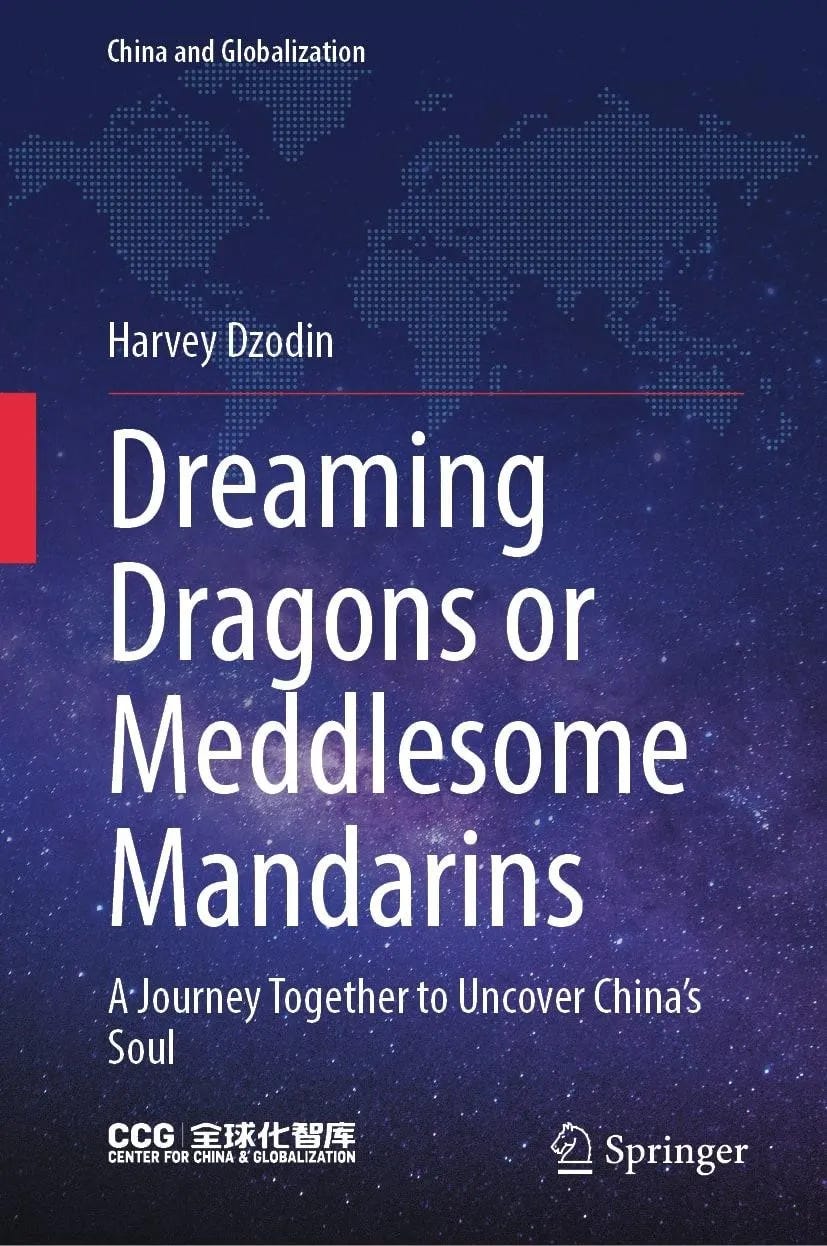
On 17 March 2026, the Center for China and Globalization (CCG) and Springer Nature co-hosted a roundtable in Beijing to launch CCG Senior Fellow and former ABC Television vice-president Harvey Dzodin’s new book, Dreaming Dragons or Meddlesome Mandarins: A Journey Together to Uncover China’s Soul.
Published by Springer Nature, the book is part of the China and Globalization Series, edited by CCG President Henry Huiyao Wang and Secretary-General Mabel Lu Miao.
Miao delivered welcome remarks. Emily Zhang, Senior Editor for Business, Economics, and Political Science at Springer Nature, and Wang talked about the book’s significance. Dzodin then shared reflections drawn from nearly two decades of observing China.
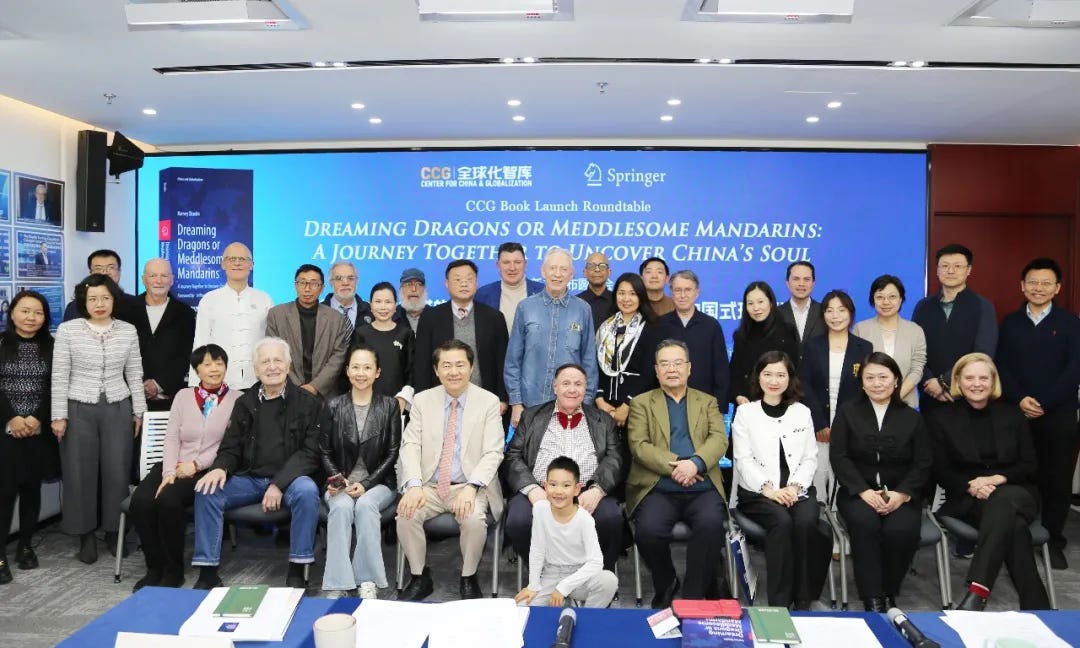
The event also featured remarks from:
Uwe Kräuter, Writer and Filmmaker
Lu Yonghua, former Chinese Ambassador to Austria
Fan Hong, Professor, School of Journalism and Communication, Tsinghua University
Gilbert Van Kerckhove, Rotating Chairman, UWEE Group; Recipient of the Chinese Government Friendship Award
Mark Levine, Chief Expert, Dao Zhonghua Mark Levine Studio; Professor, Minzu University of China; Recipient of the Chinese Government Friendship Award
Jens Schindelholz, Board Member, China Switzerland Connection
Gaobo Luo, Urbanisation and Real Estate Researcher
Michael Herman, Chief Representative, Federation for Associations Connected to the International Humana People to People Movement (Switzerland), Yunnan & Chongqing Representative Offices
Clare Pearson, International Development Director, Asia, DLA Piper; former Chair, British Chamber of Commerce in China
Peter Wayne Lewis, Professor Emeritus, Massachusetts College of Art and Design; Director, Oasis Gallery-Beijing
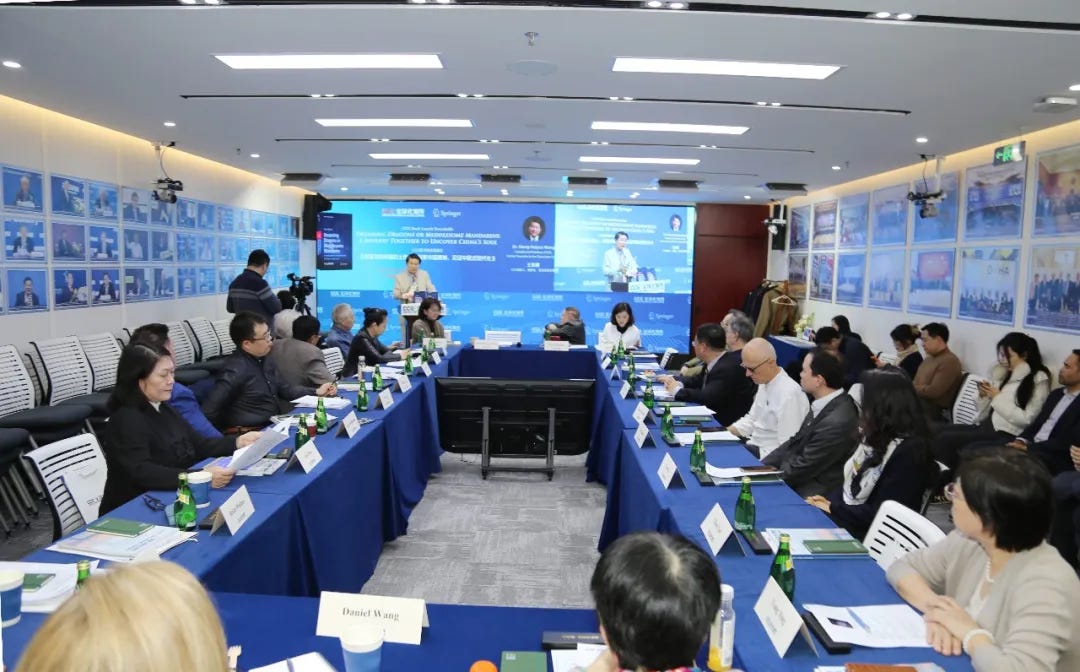
This transcript is based on a video recording and has not been reviewed by any of the speakers.
Mabel Lu Miao, Co-founder and Secretary-General, CCG
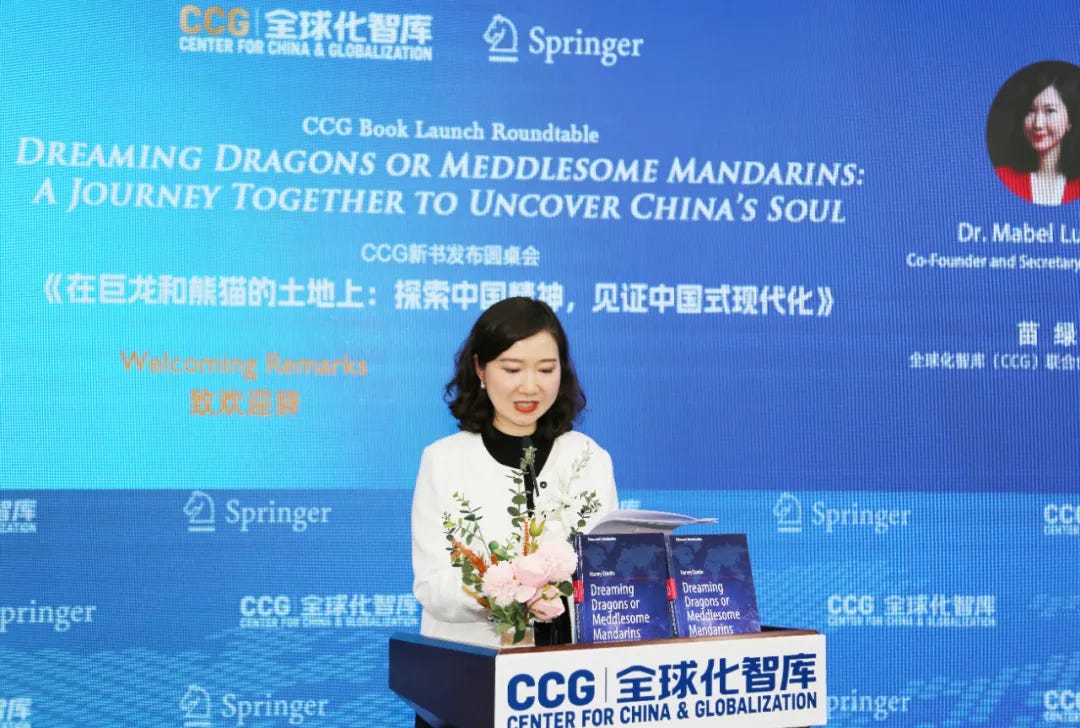
Distinguished guests, ladies and gentlemen, good afternoon. I’m Mabel Lu Miao, Secretary-General and Co-founder of the Center for China and Globalization. Welcome, all of you.
It is my great honour and pleasure to welcome you to today’s book launch and roundtable event celebrating the release of Dr Harvey Dzodin’s new book, Dreaming Dragons or Meddlesome Mandarins: A Journey Together to Uncover China’s Soul. Dr Dzodin is a long-standing friend of the Center for China and Globalization, and we are delighted to see his work come to life.
Before we begin, allow me to briefly introduce our distinguished author. Dr Harvey Dzodin was a director and vice president at ABC Television Network in New York for over two decades. During this time, he was actively involved with the Council on Foreign Relations and the Carnegie Council on Ethics and International Affairs. He was appointed by U.S. President Jimmy Carter as a lawyer on a presidential committee. Later, following nominations from the White House and the U.S. Department of State, he served at the United Nations Office in Vienna.
He is currently a Senior Fellow at the Center for China and Globalization, and also serves as chairman of the Austria-based Earthcare Culture Association. He is a prolific columnist and commentator for China Daily, CGTN, and other international media outlets. His writing covers international affairs, Sino-U.S. relations, the Belt and Road Initiative, and art and culture. In recognition of his contributions, the American Biography Institute has named him one of the Great Thinkers of the 21st Century.
Today’s event is co-hosted by CCG and Springer Nature. We are honoured to be joined by the author, along with ambassadors to China, business leaders, and representatives from universities, think tanks, the cultural and media sectors, NGOs, and publishing houses. Together, we will mark the release of this important book and explore diverse perspectives on China and modernisation.
First, let me introduce our distinguished guests. His Excellency Dario Mihelin, Croatian Ambassador to China, is on the way. His Excellency Ambassador Lu Yonghua, former Chinese Ambassador to Austria, welcome. Mr Gilbert Van Kerckhove, recipient of the Chinese Government Friendship Award, welcome. Professor Fan Hong from the School of Journalism and Communication at Tsinghua University, welcome. Mr Jack Haskock, former Asia bureau chief for ABC and CBS News, welcome. Mr Gaobo Luo, author of China’s New Real Estate Development Paradigm and researcher on urbanisation and real estate, welcome. Mr Michael Herman, Chief Representative of the Federation for Associations Connected to the International Humana People to People Movement (Switzerland) Yunnan and Chongqing Representative Offices, welcome. Mr Wang Liwei, CEO of China Development Foundation and Charity Media, welcome. Ms Carli Beeli, founder of the China and Switzerland Connection, welcome. Mr Uwe Kräuter, writer and filmmaker from Germany and a Beijing resident since 1974, welcome. Mr Cindy Li from the Liechtenstein National Museum, welcome.
We are also joined by our distinguished guest from the publisher, Emily Zhang, Senior Editor for Business, Economics, and Political Science at Springer Nature. Welcome, Emily.
I would like to extend my sincere gratitude to Springer Nature for its continued partnership, and in particular to Leana Li, Editorial Director for Books in China, and Emily Zhang, Senior Editor for Business, Economics, and Political Science. Their support has been invaluable to the publication of this book.
A warm welcome to all our distinguished guests today. We greatly appreciate your presence and look forward to a rich and insightful discussion later. Welcome, all of you. Thank you.
Emily Zhang, Senior Editor for Business, Economics, and Political Science, Springer Nature
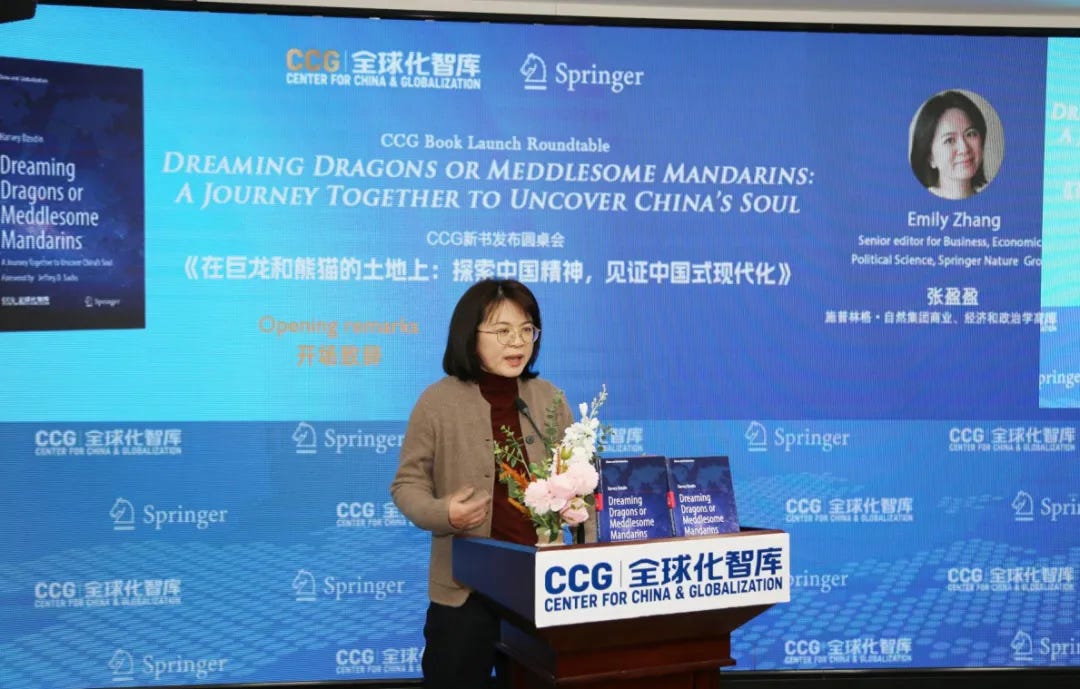
Dear Dr Wang, dear Harvey, ladies and gentlemen, good afternoon. My name is Emily Zhang, Senior Book Editor based in Springer Nature’s Beijing office. It is a great pleasure for me to celebrate the launch of Dreaming Dragons or Meddlesome Mandarins: A Journey Together to Uncover China’s Soul, published by Springer as part of the China and Globalization series.
Let me begin by acknowledging our partners at CCG, including Dr Wang and Dr Miao, the series editors. Together, we have built a platform that convenes diverse global perspectives on China’s role in the world, spanning international relations, global governance, economic development, and security. By bringing multiple viewpoints into one curated space, the series helps readers access evolving dynamics with context and proportion.
The series was launched five years ago, back in 2021, and there are now 14 book titles published or in the pipeline, including several high-impact ones, which is a remarkable achievement. Within this context, Dreaming Dragons or Meddlesome Mandarins marks a clear contribution. The book sets out to examine how China is understood and portrayed, and how that compares with historical experience and contemporary realities. It situates China within thousands of years of world history and traces major dynastic and institutional developments. It assesses China’s reform and opening up, governance system, and policy concepts in concise terms for a global audience’s easy understanding. The key topics include China’s participation in international organisations and initiatives, as well as shared challenges such as sustainability and demographic shifts, which are reviewed and discussed in the book as well.
I believe many of you were impressed by the title, just as I was when I first saw it. Dreaming Dragons and Meddlesome Mandarins are used as a device to question simplified framings and encourage readers to evaluate the evidence for themselves. Please allow me to quote the author here: “To understand its soul together, we must examine China’s dreams and its realities, past, present and future. Dragons represent China’s aspirations and its sense of destiny. Mandarins remind us of the long tradition of learning, debate, and sometimes meddlesome governance that has shaped everyday life in China and globally.”
I would say the author brings a distinctive background to this work. His unique career combination—public service, international organisations, global media, and extended on-the-ground experience in China—provides the book with depth and credibility.
As a global academic publisher, Springer Nature’s mission is to advance discovery and support the communities that shape our understanding of complex issues. In an environment marked by information overload and polarisation, we see our role as providing reliable, well-curated platforms for knowledge and debate, just as we have done through this book’s publication.
Let me conclude by thanking CCG for its partnership and leadership, and by congratulating Dr Dzodin on the publication of this timely and carefully argued work. I would also like to acknowledge the dedicated work of Shirley and all involved members from CCG and Springer, whose professionalism, coordination, and support have been essential to the realisation of this publication.
We hope it will be read widely by scholars and students, policymakers and practitioners, and by all readers who seek a clearer understanding of China in a global context. This book is an invitation letter: read it, and join the journey. Thank you.
Henry Huiyao Wang, Founder & President, CCG
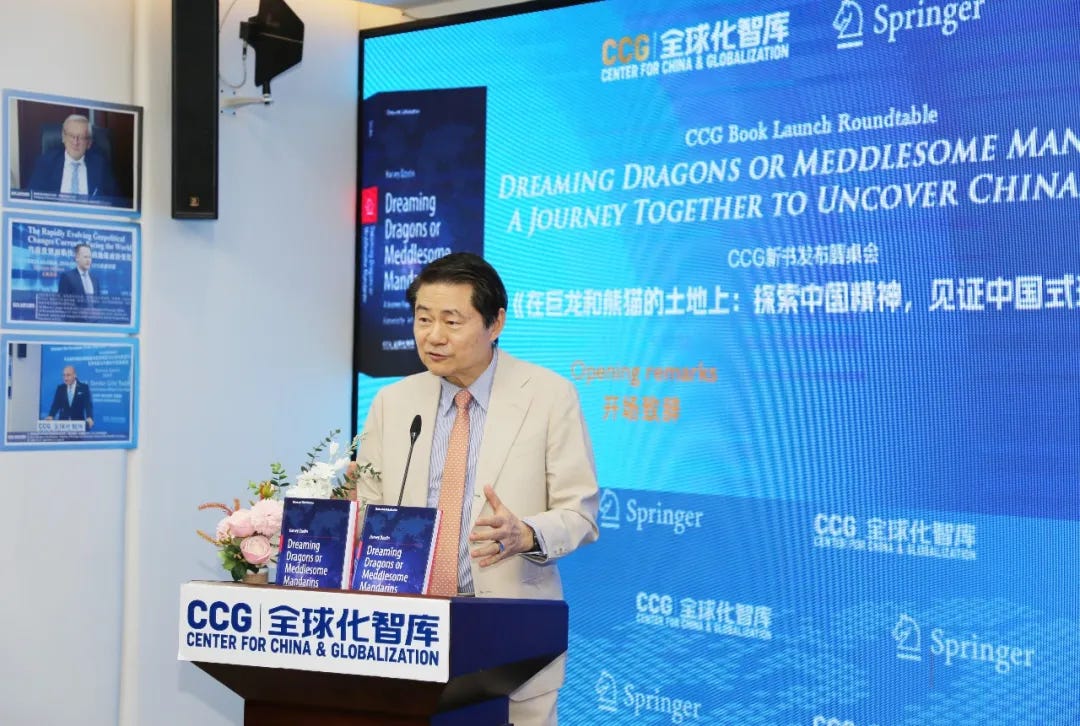
Thank you. Your Excellencies, dear friends and colleagues, and also my friend Harvey.
I know you flew especially from Vienna to attend this book event at CCG. We already had a book talk before, but this is a more official gathering of friends—friends of CCG, friends of Harvey, and friends from China—to join us this afternoon. We have a full house today.
First of all, I would like to extend my warmest welcome to all of you for coming to CCG. As you know, CCG is a non-governmental think tank, but we have worked very hard to be a bridge connecting China and the outside world. To give you a sense of how busy these days have been: Harvey also knows that we just concluded a luncheon briefing on the Two Sessions this noon, so a large group just left this room. Yesterday, we had more than 30 British officials from different government departments responsible for China visiting us. We are also going to host Pascal Lamy in a few days, and Jeffrey Sachs is coming here on the 23rd, also this week, to give us a talk. So we are crammed with meetings around the China Development Forum.
This is a busy time, but we are very pleased, as Harvey knows, to host this event together with Springer Nature, one of the best publishers in the world, very well known in academia and across the broader world of publishing. We have worked with Springer for at least the last ten years, probably even longer, and have published many books with them. So we are very honoured to have this joint event with Springer Nature for Harvey’s latest book.
The book Dreaming Dragons or Meddlesome Mandarins, as Emily mentioned, is one of the key books in our 14-volume series published by Springer Nature. Dr Miao and I both serve as series editors, and we are very pleased to include Harvey’s book in this series. It is a very interesting book because it draws on his experience, observations, insights, and discoveries about China and its connections with the wider world.
Many of you here are highly knowledgeable about China, international relations, China’s role, and China’s relations with the outside world. That is why we also want to hear from you later in this roundtable after the book launch, so that you can share your experience. We can then record and publicise those perspectives as well.
The China and Globalization series—I hope that any of you interested could also contribute in the future—published by Springer Nature, aims to provide a balanced global perspective by gathering the views of highly influential scholars, politicians, statesmen, and global opinion leaders from around the world. So far, more than 200 people have contributed to this series. For example, we have published two books on views from ambassadors to China. It’s all open source. You can download from the series link. They included contributions from more than 50 ambassadors in China. Another book, Consensus or Conflict, included contributions from more than 30 well-known global scholars and thinkers, including Joseph Nye, Thomas Friedman, Graham Allison, Martin Wolf, and many others.
If you look at the wall here, you can see how many people have spoken at CCG or taken part in our events. You are now in CCG’s CBD office. We also have another office in Tongzhou, and another CCG Academy near the Communication University of China. We really want to expand our connections, engage in more dialogue, and deepen understanding. Publishing books in English is one way to do that.
As you can see, CCG has published nearly 40 English-language books with different publishers, mostly with Springer Nature, over the past 18 years since CCG was established. We are very honoured and appreciative of all your support and attention.
We have also been very active in China and have been ranked among the world’s top 100 think tanks and top 50 independent think tanks by the University of Pennsylvania for a number of years. CCG is also the only think tank in China that has been granted special consultative status by the United Nations.
So we are very much looking forward to working with all of you. CCG also has three newsletters: Pekingnology, The East is Read, and CCG Update.
Again, I want to thank Harvey for his great book. It enriches our dialogue, enriches our thinking, and enriches Western observers’ understanding of China. We have not really seen many recent Western observers who have lived in China, worked in China, and written firsthand observations based on their own experience. This is a new addition and, I think, a good example for all of us to pursue more objective, more firsthand, and deeper analysis of China and its relationship with the outside world. How to decode China—sometimes people outside can see certain things more clearly than people inside. So I truly appreciate that.
I will stop here. Again, I want to welcome all of you and thank you for spending your time with us. We would like to hear from you later in the discussion. Thank you all very much, and thank you, Harvey and Emily, for coming as well.
Harvey Dzodin, Author; Senior Fellow, CCG; former Vice President, ABC Television
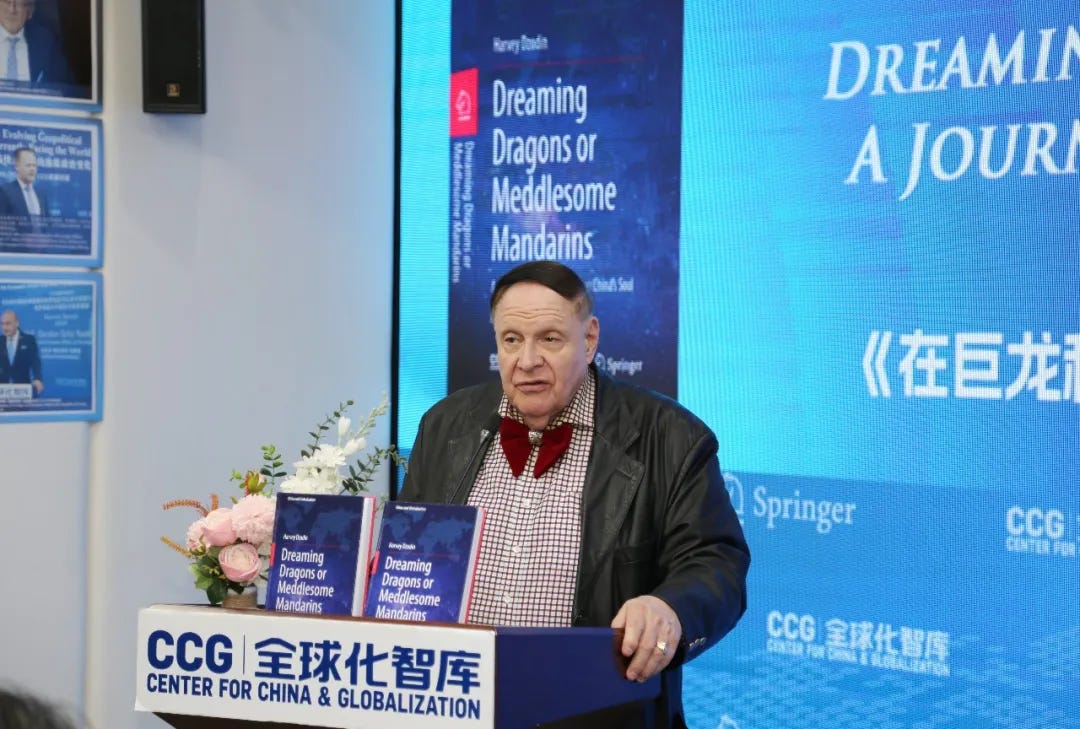
Thank you all for coming. I like the saying that there are no strangers here, only friends who haven’t met yet. So I hope that by the time you leave the room, you will have renewed acquaintances and also made some new friends. There are some remarkable people in this room. Discover them on your own, and your life is going to be enriched by them, as my life has been enriched by them. So please make new friends today.
Henry and Mabel, I owe you and the CCG staff a big thanks for encouraging me to write this book. A big thanks also goes to the very able Shirley Ren and her staff, including intern Sonny, and to Springer. Now, “Springer”—this is the German pronunciation. I like it because it has so much energy. You can see the spring bouncing out. So it is a publishing house with high energy.
I know today is a book launch, but I also see it as a prelude to my almost a decade of association with CCG. Back then, CCG was still on a very steep ascent to where it is today. Mabel and Henry had their own Chinese dream, and have largely achieved it as a consequence of their and the CCG staff’s tireless efforts. As my book points out, CCG has become one of the most highly rated and respected think tanks not only in China, not only in Asia, but in the world.
I remember that back then that you used to ask me to introduce this or that ambassador or influential foreigner. Now I call you, because CCG is known by influencers the world over. And yet I know that for CCG, as for China, the best is yet to come.
Emily told you a little bit about the title. I paired Dreaming Dragons and Meddlesome Mandarins after thinking long and hard about the title. I think it does represent ancient, modern, and future China, and that is why I chose this title. I hope people will like it. The “Mandarin” part represents the great ancient tradition of China: leaders who were supposed to be, and in most cases were, ethical, proactive, and serving the people. It was an early case of social opportunity, because the exam that chose the mandarins was open to all men at that time—of course, men. Like the gaokao, it gave an opportunity to people regardless of their economic background they come from. It was quite an unusual exam and tradition.
That is why I chose these titles and why I paired dragons and mandarins, because I believe that to understand China’s soul, we must examine China’s dreams and China’s realities—past, present, and future. Dragons represent China’s aspirations and its sense of destiny. Mandarins remind us of the long tradition of learning, debate, and occasional meddlesome governance that has shaped everyday life in China.
I wrote this book because I’m pissed off. I’m pissed off that much of the Western media, of which I was a part, has not portrayed China accurately. Based on my nearly two decades living here, the bias helps fuel the anti-China animosity I felt while living in Vienna since 2020. A few weeks ago, one Austrian friend was even expelled from the Austrian Journalists’ Club for the sole reason that he was pro-Chinese. You feel this a lot in Europe and, I think, America.
We, the world, face too many shared existential threats, like environmental apocalypse, nuclear extinction, another pandemic, and runaway AI, that we shouldn’t be wasting precious time relitigating the Cold War, or conducting any war for that matter. But we are doing that.
I wrote this book especially with the aim of connecting with young people, because they are not only our future, but they also have a more open mind. Many of them, even recently, are becoming Chinese on TikTok and other social media. To me, that represents the fact that China’s soft power has actually kicked in in a major way.
In Part One of the book, “What’s Past Is Prologue”, we go on a journey to uncover China’s essence and how its past presages its rich present and future. We begin by briefly exploring some of China’s 83 dynasties and 559 emperors over a remarkable 4,000-year period that spawned unparalleled economic success and national wealth, something completely unknown to most Westerners. We explore competing visions for a new China and the traumas and experiments of the twentieth century that set the stage for reform and opening up, and later the evolution of China’s leadership from Mao to Deng to Jiang, Hu, and Xi.
In Part Two, “New China, Take Two”, we focus on China’s opening up and engagement with the world through economics, charting China’s return to the world stage, to the UN, Sino-U.S. normalisation, WTO accession, and the pursuit of moderate prosperity as China became the world’s factory. The book unpacks ideologies—communism, Marxism, socialism—and their adaptations by various Chinese leaders, and contrasts ideals with pragmatic governance, even using the Israeli kibbutz as a real-world case of why pure Marxian communism is a chimaera.
Part Three, “The China Experiment”, reflects my view of how SOEs and later hybridised planning-market mechanisms actually function. We discuss national champions like Huawei. I explain my view of how the party-state works in practice, with the whole-process people’s democracy that we have seen in action over the last couple of weeks. We also discuss how surprisingly well it delivers results thanks to its management tool of five-year plans and a system that rewards achievements rather than blah, blah, blah.
I also explore China’s overarching centenary goals, which were beyond aspirational when first proposed in 1997 at the 15th Party Congress, and Xi Jinping’s Chinese Dream, his four global initiatives, and his community with a shared future for mankind, all of which have led to China’s growing leadership in global governance.
I turn to global crises that I care deeply about in Part Four, “Perceptions and Reality”. There, I discuss globalisation, climate, and environmental stress, China’s leadership in renewables and electric vehicles, and the demographic burdens and opportunities created by past population policies. I devote a chapter to perceptions and misconceptions of China, and to the mixed record of China’s soft-power efforts via Confucius Institutes, foreign-language state media, some representatives of which are here today, and cultural diplomacy. I also try to explain why think tanks, exemplified by CCG, are important transnational vehicles for diplomacy and policy dialogue that, in fact, are at times even more effective.
I resurrect the concept of what China’s able and Premier’s Premier Zhou Enlai called “folk diplomacy”, today what we call people-to-people diplomacy, and ask why, with so many talented and educated young people and so many educated and experienced older ones, China does not have a volunteer corps, or what I call a “Panda Corps”, especially at a time when ugly Americans have had a resurgence in Washington and elsewhere.
I ask my readers, whether newcomers or seasoned China hands, to travel with me and form their own opinions and judgments about this complex, evolving country rather than accepting false, misleading, and deceptive narratives.
But I can tell you the book’s bottom line: that all countries are a changing mixture of good, bad, and ugly at any given point in time, but China has uniquely lifted more people out of extreme poverty than any other country, and continues to serve its people well. In fact, Chinese people, in international surveys after survey, rate the performance of their own government, led by the Communist Party of China, more highly than others rate their own governments’ performance.
Cicero, the great Roman statesman, scholar, and philosopher, said, “The welfare of the people shall be the supreme law.” Two thousand years later, Chairman Mao said it more concisely: “Serve the people.” Westerners, though, find it hard to believe this truth, given all the propaganda and falsehoods to which they are subjected and exposed on a constant basis.
I even point out that the Democracy Perception Index, published by an NGO headed by a former Danish prime minister and NATO secretary-general, found that respondents in China have very positive opinions about their own political system. Ninety-two per cent say that democracy is important to them. Ninety-one per cent of the Chinese say that their government serves the interests of most people rather than a few. Eighty-five per cent say all people have equal rights before the law, and 79 per cent say China is democratic. Moreover, in this index, Chinese respondents are more positive than those in the U.S. and in most European countries on these points. Chinese respondents, in fact, had some of the most positive results globally.
In the book, I tell my readers about Sir Thomas More, Henry VIII’s able and respected Lord Chancellor, who wrote the book Utopia, which means “nowhere” in Greek, because no country is perfect, and he did not live in a utopia. More was beheaded by King Henry VIII. I am not asking my readers to believe me or anyone who talks about China, because seeing is believing. The only way to know China is to see it in person, now that it has never been easier to do. My goal is to whet readers’ appetites to do so and to make their own judgments with their own eyes.
I’ve had opportunities to preview the book’s content in Vienna and Zurich. Audiences there know that China is an old country, but they seem to think China has always been poor, when in fact, as we discuss in the book, except for the century of humiliation, China was THE or a global economic superpower. Some even found this fact astounding. In the West, people misconceive China because they are not taught that Chinese civilisation preceded ancient Greece and Rome by thousands of years; that over 9,000 years ago, China was an organised society engaging in agriculture; that its written history dates back 3,500 years; and that dynastic China roughly began four millennia ago.
People are obviously still not taught about how high-tech ancient China was. For example, the compass, dating back to the fourth century BCE, appeared in Europe 1,600 years later; paper-making, invented here in the second century CE, came to Europe 900 years later; gunpowder, invented here in the ninth century, came to Europe four centuries later; and movable type was invented in China in the eleventh century. Gutenberg, famously, as we know, was miscredited with its invention, but he didn’t even do so until four centuries later.
Any of you who know me know well that I am merely a very ordinary person privileged to live an extraordinary life of rich experiences. One of those was taking pleasure in examining Hong Kong’s return to China in 1997, marking the end of China’s more than a century of humiliation. I revisit playing the part of British Prime Minister James Callaghan in the 2014 CCTV documentary series Deng Xiaoping at History’s Crossroads, where the British governor-general of Hong Kong tells me, as Callaghan, that China would certainly renew the 99-year lease forced on it at gunpoint in 1898 because 1980s China still desperately needed advanced British technology. It was shocking that the British Foreign Office, after all these decades of dealing and duelling with China, still did not get it, and, in fact, was clueless about Chinese culture. They should have known that the loss of face inflicted on China in the nineteenth century was a festering wound that had stung deeply for a century, and that China would stop at nothing to restore its honour and its position at the earliest opportunity.
So it is no surprise, really, that ordinary people are equally clueless about today’s China. The redress I personally seek to do is to rebalance that lack of knowledge with knowledge. But don’t believe me; maybe take the word of someone more famous, Jeffrey Sachs, who wrote the foreword, in which he says, in part: what Harvey tells you in this book, with which I concur based on my observations and studies, is that China’s successes were the result of decades of hard work, high saving rates, good governance, skillful planning, and remarkable entrepreneurship. With Harvey as their guide, readers will come to appreciate the riches of a great civilisation that is keen to recover from the mishaps of the nineteenth and twentieth centuries, notably from the violence unleashed on China by Western powers and later by Japan. They will come to appreciate China’s great civilisational wisdom and, like Harvey and I, root for China’s continued successes, confident that China’s successes will indeed benefit all the world.
I merely urge my readers not to believe Jeffrey Sachs or even me, but to go and see for themselves that China’s leadership and its 1.4 billion people are in fact dreaming dragons and not meddlesome mandarins.
Thank you very much for coming today, both old and new friends. Thanks a lot.
Mabel Lu Miao
Thank you, Harvey. I am really deeply moved by your speech. I am always touched by Harvey’s values—his love for China, his knowledge of China, his understanding of China, and his desire to deliver this message to the rest of the world. You do not just think about China, or one country, or one culture. You think about human beings. You think about civilisation—how to affect more people and make the human world better. So I am really moved by what you said.
Of course, the topic of this book is wonderful. A lot of people ask me about the Chinese and English titles, which themselves tell about the values in the book—what China is doing and what China has done.
Without further ado, I would like to invite more people. We have so many distinguished guests here—your friends, people who share these values with you, and also people who know China and would like to deliver more messages to the rest of the world. So I would like to invite more people to discuss your book and the spirit of your book.
Because time is limited, I would invite everyone to share for one or two minutes, briefly, on a few questions. In your book and in your view, what is the core of the Chinese spirit, and how has it been sustained, transformed, or even reshaped in the process of modernisation? In the context of a global civilisational dialogue, can the Chinese spirit serve as a resource for what you call “empathy power”? It is a very new and innovative concept. I remember that in your book, you discuss how empathy power may matter even more than soft power itself. You also mention what Chinese modernisation can offer to the rest of the world, not just to our own country. And you mention understanding each other through people-to-people diplomacy, including the idea of serving the people—a classic ethic, but also a very important transnational public good for the world. Finally, you discuss how people-to-people diplomacy, through individual experience, can shape national impressions in the eyes of the world.
Harvey, maybe you know all these friends more than I do, and perhaps you can invite some people to join the discussion. So I hand over the microphone to you.
Harvey Dzodin
Yes, I’m happy that my old and new friends will have some opportunity to discuss these issues today, and I thank everybody again for coming. Even those who came so far across town from CGTN Radio—which to me is the other side of the earth from where I came from—thank you for coming.
Everybody here is fascinating. To me, everyone is not a VIP but a VIR—a very important reader. So thank you. You’re all VIP/VIRs.
Uwe, can I put you on the spot? You have lived here for such a long time and seen all the changes. What changes have you seen since you came here so many decades ago that impress you, and why?
Uwe Kräuter, Writer and Filmmaker
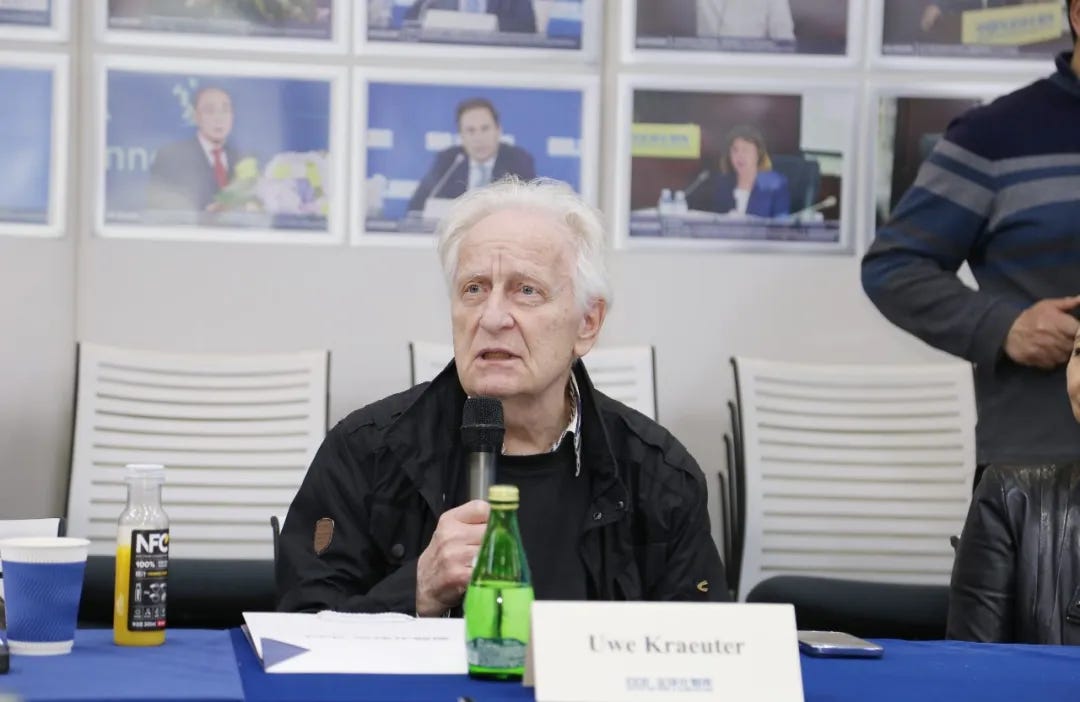
My goodness—embarrassed, unbelievable, unprepared.
Well, I came in 1974. Many of you had not yet been born. At that time, in 1974, I was 28 years old. I was a student in Germany, in the city of Heidelberg. China was very different then, but I was invited here by the Foreign Languages Press, and it was also the time of the Vietnam War. We young people all hated it and went into the streets demonstrating many, many times. So when I was invited to China to work in that publishing house, of course, I accepted. I was proud.
There is one question I still do not understand until now. Among all those friends in Germany, in Heidelberg, who were demonstrating together with me, none of them at that time asked me, “Can I also go there?” I don’t understand that until now. Those people were courageous and, in many ways, outstanding people.
Then I came here. The original contract was for two years, but a few months later, the six of us in the front row of an anti-imperialist, anti-war demonstration against the Vietnam War were all supposed, by law, to go to prison. The other five people who were in Germany all went to prison. In fact, we hadn’t done anything wrong, but the accusation was that we were in the front row of that demonstration. Germany wanted me to come back. I was thinking, well, prison might also be interesting, but Beijing was much more interesting. So I stayed on here.
After six years, I could go back, and when I did, I had organised the outstanding Chinese drama Teahouse to go to Germany, France, and Switzerland. For Germany and Switzerland, I was the simultaneous translator for all those more than 60 roles. The success of this drama was unbelievable. It was the first time a Chinese drama had gone to Germany, and people were amazed. “Ah, Chinese people are like us. They are human beings.” China was so far away.
I feel that until now it is still quite far away. But the fact that we can sit here, and that many foreign students now come here to study the language and other things—I am amazed, and I am proud.
One reason that I stayed here is also that I got married. Chinese ladies are outstanding, and I had the chance to marry a wonderful lady. That was also a reason why I stayed on here. I am happy to be here, and thank you very much.
Mabel Lu Miao
Thank you very much for sharing your experience of China and life in China. It is very interesting, and I think many people would like to hear more.
I know we also have a distinguished ambassador here today. Ambassador Lu is a former Chinese Ambassador to Austria. Harvey, right now, you are in Austria, and you made a lot of Chinese friends, including the senior Chinese diplomats like Ambassador Lu. I would like to invite Ambassador Lu to say a few words.
Lu Yonghua, former Chinese Ambassador to Austria
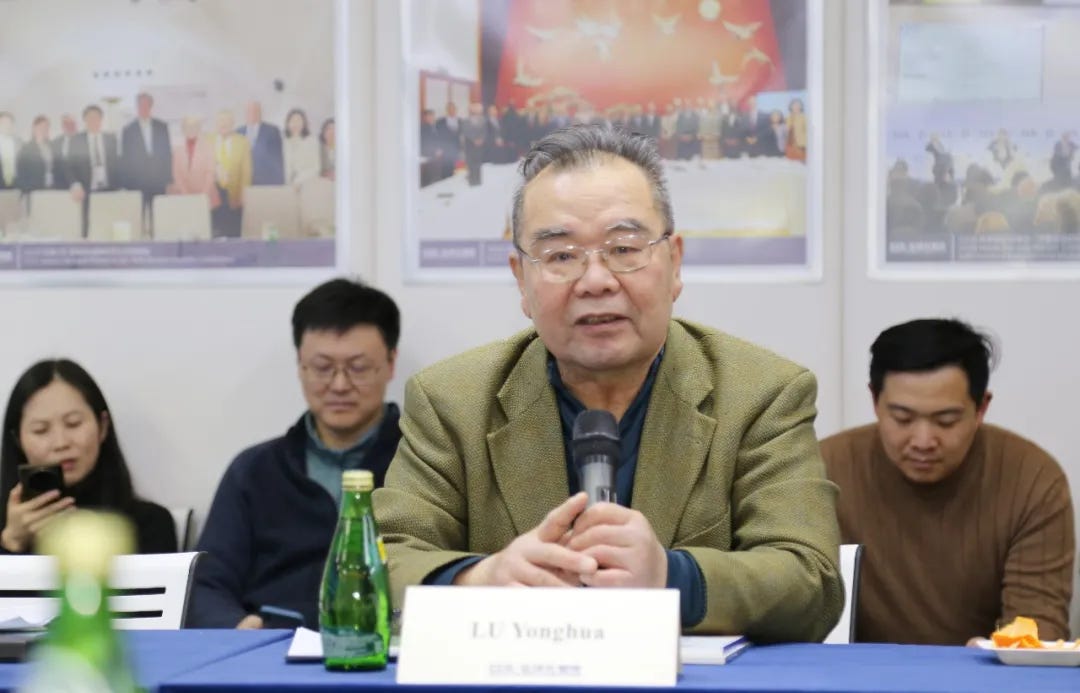
[speaks in German]
Mabel Lu Miao
Although I could not fully understand, I know that you have played many distinguished roles and have frequently appeared on television and in the news, introducing your experience of China and life in China. Thank you very much.
Maybe now we would like to invite Professor Fan Hong, our good friend from Tsinghua University, to share a few points. Professor Fan is a well-known scholar of international communication. This book is also closely related to international communication and empathy. So I would like to invite you to say a few words.
Fan Hong, Professor, School of Journalism and Communication, Tsinghua University

Thank you very much. Thank you, Mabel.
I am very happy to be here this afternoon to meet many old friends and new friends. Of course, I am very happy to see Harvey back again. Harvey has been my friend for, I think, almost 20 years. Harvey is not only a family friend, but also a professional friend for me at my work.
I am the director of the National Image Research Center at Tsinghua, and also a professor of communication studies. So I work on cross-cultural communication at Tsinghua. I think Harvey has done excellent work in cross-cultural communication, even though he does not speak much Chinese. I think people understanding each other is not so difficult if you put your heart into it. Harvey is that kind of person.
Every time I have met Harvey—sometimes with my family, sometimes by myself, sometimes with his family, sometimes among my students and colleagues—he is always resourceful, kind-hearted, always willing to listen, always trying to learn and to share, not to judge and not to force his ideas into other people’s heads. So I really like Harvey in many ways. He is very friendly, very genuine, and very down to earth. I think this is the attitude people need when they want to understand each other and make friends with people from different cultural backgrounds. So Harvey is this kind of friend to me.
I have one query. I do not want to speak too much, because I am very close to Harvey. My question concerns the book title. I know you explained it at the beginning and again at the end. I have learned English for a long time, and when Harvey told me two years ago that he was going to write this book, I knew it would be about his experience in China. I know his experience is profound and rich. As he said, he is ordinary, but his experience is extraordinary.
Still, I do not quite catch “Meddlesome Mandarins”. I know in the end you said it is framed as a question, and that your conclusion is that China is not meddlesome mandarins. But I think for many people it is hard to get that only from looking at the title, and the Chinese translation also adds another layer of complexity. So I feel a little confused by the English and Chinese titles. I think there may be some way to make the title softer and more acceptable in the Chinese context—not through direct translation, but perhaps through another formulation. But right now, putting the two titles together confuses me a little. That is my query.
I am very happy to be with you today, and I would also like to thank CCG. I respect CCG very much. My centre at Tsinghua is also a think tank, but we have not done as much as CCG, so I respect Mr Wang and Mabel very much. I would like to participate more in CCG’s activities in the future. Thank you very much.
Mabel Lu Miao
Thank you, Professor Fan. Professor Fan is a respected scholar in international communication.
From my own understanding, the title Meddlesome Mandarins—in the Chinese context, we do not really use the word “mandarin” in mainland China. It is used more in historical writing and more often outside China. But we can also relate it to meritocracy. In Chinese governance, these officials were the elite of bureaucracy, well educated and ambitious to make the government, the country, and the nation better than before. This is part of the secret of our governance. I think Harvey has already begun to reveal that secret to the rest of the world.
Maybe you can explain more later about why you used that term. But before that, perhaps we can invite more speakers and friends to share a few words.
Harvey Dzodin
Maybe I can respond through another question.
I want to ask two or three people the same question, because the people I’m going to ask the question to were intimately associated with the 2008 Olympics. The theme of that Olympics was “One World, One Dream”. My question is: since 2008, have we come closer, or have we moved farther away from that?
I am very curious to know your opinions. Gilbert, Jens—what do you want to say about that?
Gilbert Van Kerckhove, Rotating Chairman, UWEE Group; Recipient of the Chinese Government Friendship Award
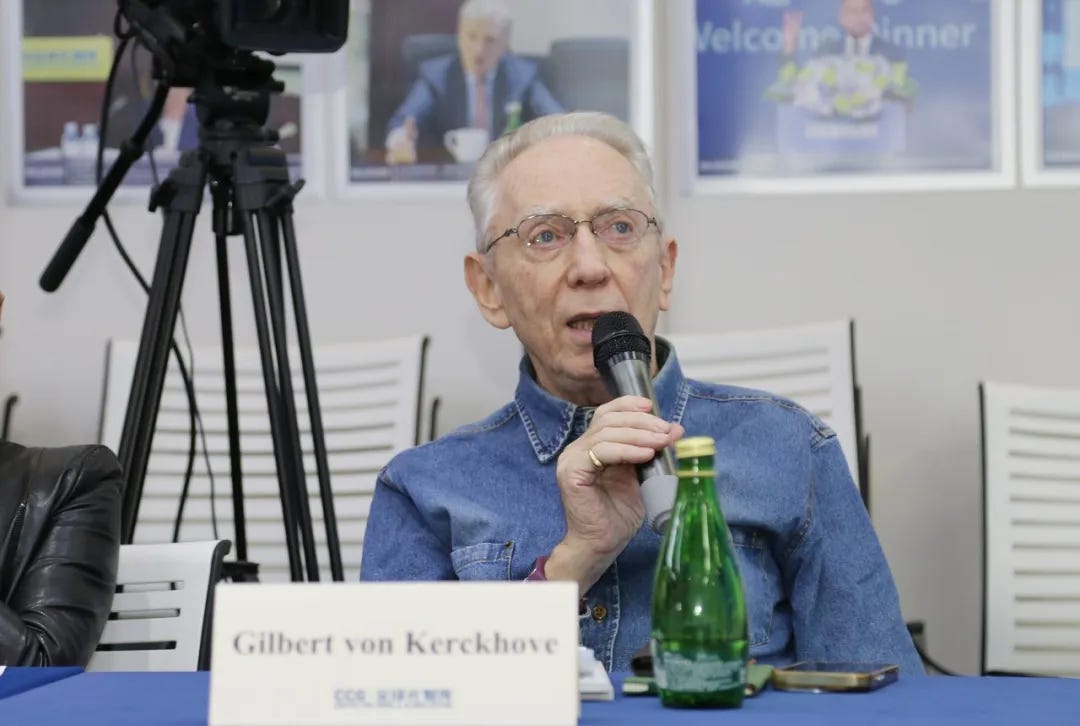
Harvey is always coming with very difficult questions.
I have also known Harvey for a long time. I do not even know how long, but it is, I think, several decades. Harvey has been a very close friend and also worked with me as one of the foreign experts of a group that I headed. We visited places like Shandong together and had many very interesting trips.
I have not been here as long as our friend Uwe—I have only been here 45 years, since 1980—but I have also seen tremendous changes.
First of all, we need more Harveys, because, like he said very correctly, there is a very big misunderstanding in our Western world about China. You mentioned the journalist in Austria; I can also mention Belgium. I am from Belgium, and we have the same problem. People have been expelled from radio and television because they were too pro-China. One of the groups that worked in television talking about China has now been discontinued. There was also a journalist here last week, Tom Van de Weghe, who wrote a book about China, trying to explain to the outside world what China is.
I have been here 45 years. I am not sugar-coating China. I see the good points and the bad points, but when I talk about the bad points, it is constructive criticism—to help China correct maybe what they are doing in their strategy.
If we need Harveys, it is also because our Chinese friends are not always very good at promoting their own country. So we need an independent voice like you.
You mentioned the Olympics. I worked very, very closely on many things for the Olympics, and one of the tasks I often had was to explain to visiting foreigners what was really going on with the Olympics, what the real investment was, and what the government’s policy was. I always had to correct what the Beijing government was saying about the Olympics. And I said to them, you’re really doing everything wrong because you’re giving the wrong figures of the expenditure of the Olympics. In fact, Beijing spent much, much less on the Olympics than, for example, Tokyo did. Nobody talks about that. So there are so many misunderstandings. I try to talk about it.
Are we now closer to One World, One Dream? Of course, times have been very challenging in the past 20 years. Since the Olympics, a lot of things have changed. We all really have to work together to make One World, One Dream a reality. And for that, as I said, we need more Harveys to do the job.
Thank you, Harvey, for your contribution and for being a bridge between China and the world. Thank you very much.
Mabel Lu Miao
Thank you. Thank you very much for your comment on Harvey’s great work. You are not just the bridge. You are the ambassador, the folk ambassador, the civilian ambassador to the rest of the world, bridging China and the rest of the world, the East and the West. So maybe we can invite more friends.
Mark Levine, Chief Expert, Dao Zhonghua Mark Levine Studio; Professor, Minzu University of China; Recipient of the Chinese Government Friendship Award
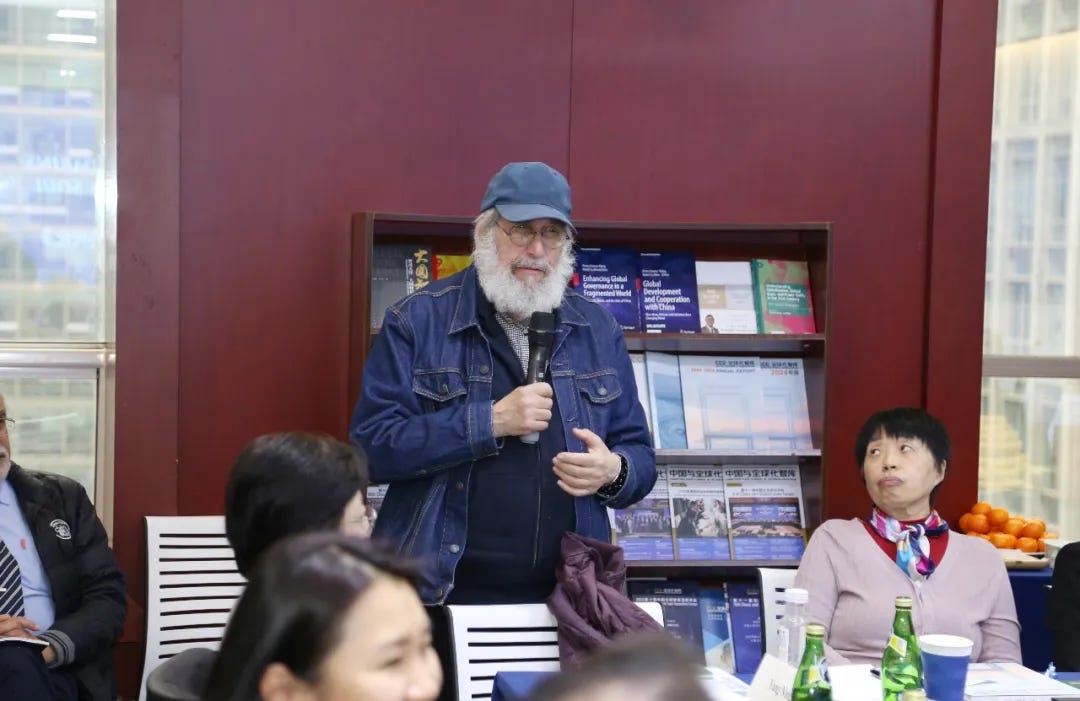
Okay, Harvey, I don’t know if you realise it, but this is an important reunion, because I first met you, Gilbert, and Uwe on the same day, at the same activity here in Beijing. I believe it was 2008. It was a Beijing Salon event run by the Beijing municipal government. I think I met either you or Gilbert first, and then whoever I met first introduced me to the other two of you. So it’s a very important reunion from my perspective.
But most importantly, I have been in China for 20 years. I am a professor at Minzu University of China. I have written two books myself about my experience in China, and Harvey and Gilbert were two of my biggest music fans when I was performing, because I have written dozens and dozens of songs about China.
But the most important thing I want to say, Harvey, is that very few things thrill me as much as when I get to meet another American who shares my views about China. So thank you very much.
Jens Schindelholz, Board Member, China Switzerland Connection

Good afternoon, everybody. First, thank you, Harvey, for the invitation, and thank you, Mr Wang and Mabel, for the organisation.
I absolutely agree, Gilbert, that this is a really difficult question. Speaking of the Olympics, I was one of the lucky guys who will never forget the date 8 August 2008, at eight o’clock in the evening, in the stadium. Why? Because I had the luck to work for the Swiss Embassy for six months, and that was my first trip to China.
But it is still true now, just as it was then: if you do not visit China, you will never understand it. I have invited a lot of friends from Europe to come with me to China, and really, nobody, nobody, came back with a negative or bad view. For me, it is always very comfortable to travel with guests, because when I come home with them, they talk the whole day, and I do not have to say anything about China, because they have had such good experiences.
Maybe this is not written in your book, but you did say something about it. Why is it so difficult for the rest of the world? Why is there such a distance from China? Because I’m thinking, we have lost something. Our political guys, they have lost something in their work in the last few years. Maybe, as Peter said before, maybe it’s BC or AC—before Covid and after Covid. AC Covid, they lost it. They have lost vision, mission, and objective.
In Europe today, when I look at our leaders, they are working day by day. Actually, if you read the news today, they are just reacting day by day to what the huge president on the other side of the world is doing. But then I look at Chinese leaders, and they have a clear vision, a clear mission, and clear objectives, and they move step by step through their five-year plans for their population. That is something we have lost, and I think that is one point that’s making people in Europe afraid—no vision, no mission, and no objective. Thank you very much.
Gaobo Luo, Urbanisation and Real Estate Researcher
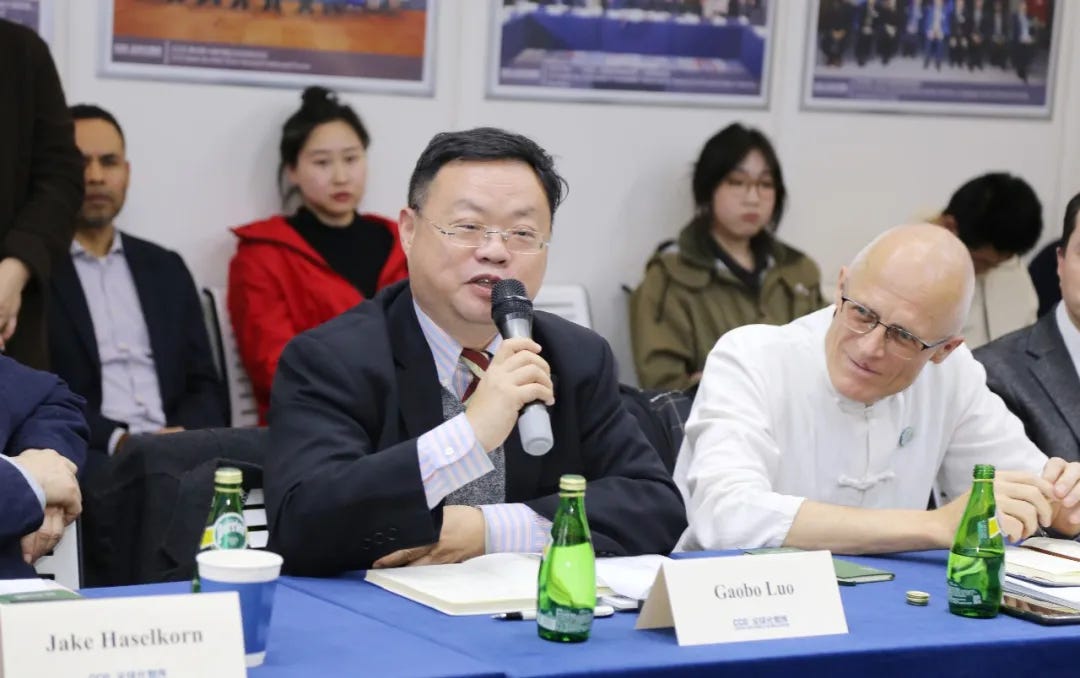
Hi, Harvey. I have known Harvey for about ten years. We met at a conference and then stayed friends. Last year, when I published my second book, I asked Harvey to write the preface for my new book, China’s Real Estate Development Paradigm. Of course, there is no English version, so I thought: how can Harvey write the preface without reading the whole book? I simply asked him some questions and gave him some descriptions myself. But eventually he did a great job—a fantastic one. I did not know how he could do it. I thought perhaps he asked his wife, since she knows Chinese. But today I know the answer, because he is doing the same job on a much broader and more professional scale in his own book: exploring the Chinese spirit and witnessing Chinese modernisation. My own field is only one part—real estate—, but he can do this across the wider picture.
I would also like to give a conclusion to the earlier question. The best way to predict the future is to create it. This is my understanding of your question. For “One World, One Dream”, maybe in the short term, the world is becoming a mess. But when more and more outstanding and persevering people like Harvey share their experience and professionalism with the world, I think the world will eventually move toward One World, One Future. Thank you.
Michael Herman, Chief Representative, Federation for Associations Connected to the International Humana People to People Movement (Switzerland), Yunnan & Chongqing Representative Offices
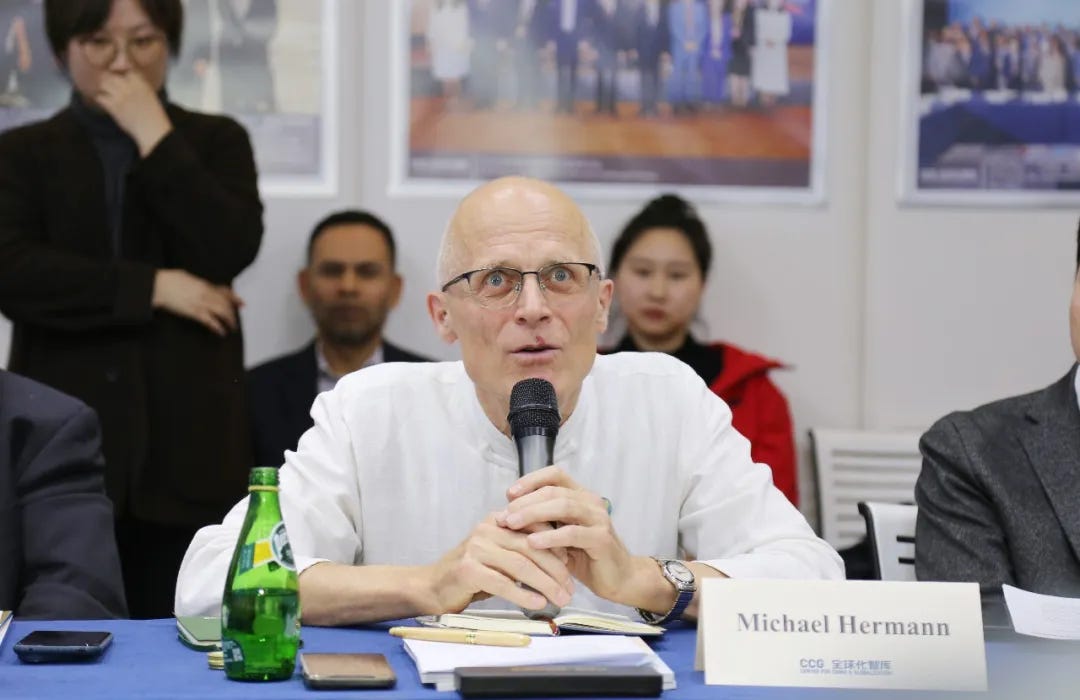
Yes, please. Hi, everybody. I am a very new friend here. I am a young Chinese. I am only 22 years in China, so I cannot compete with my seniors here. And I usually do not talk in Beijing, but I talk in villages in Yunnan, in our mountains.
In these 20 years of doing social work, we have supported more than 4 million people on HIV/AIDS, TB, and malaria. We have 90,000 kids in our village preschools because government funding does not reach all the way to these small, tiny hamlets.
Shirley asked me: What is typical of Chinese culture? I thought, Wow, how can I answer such a big question? I lived 12 years in Denmark, six years in the U.S., two years in Ecuador, five years in Zimbabwe, and two years in India. I have seen a lot.
Let me say something. There is no place on this planet where you have so many people having a similar cultural tapestry. The Chinese state has existed for 4,000 years. The Persian state existed for 2,700 years. They are a very solid society.
Germany — I think the first so-called Roman-German emperor was 1,000 years ago — so we are very young, you know.
And the second thing: out of 1.4 billion people, more or less 100 million are organised in the Party. Seventy million are in the Youth League. Think about it. In Germany, we are ruled by a party of 400,000 party members. So there is no place on this planet which is as united and organised as the Chinese.
And then you say, Oh, what does a coal miner in Shanxi have in common with the investment banker on the Bund in Shanghai, and the fisherman in Hainan? What does he have in common with the ayi from my place who is working in a massage salon in Beijing? But you still can see it. I mean, Chinese characters unite this country.
I think I once read in China Daily that the national government says there are 139 languages in China. And I think UNESCO says something like 400, and the Guomindang said there were 400 minorities. And the Communist Party condensed them to 55. So anyhow, 139 languages. I had a lady from Foshan working in my office. She called home. I could not understand one word, but they can communicate in characters.
Filial piety, respect for those before you, for the elders. I think one very basic thing is that the unit in this country is not you; the unit is the family. I was once stuck in some very idiotic COVID treatment. I wasted a lot of money. I was angry like hell and shouted at my police officer. And then she said, “Michael, just relax. In special times, my small individual has to serve my bigger family.” A German police officer would never say that, I’m sorry. They just cannot grasp this idea of being together.
And then, you know, I was here in ‘85, ‘87. I studied Mandarin at the language school of Fudan. Then I visited one of our classmates in Henan. I forgot whether it was Kaifeng or Zhengzhou. We were walking beside the Yellow River dikes, and the dike is 12 metres high where you are walking. And then he told me, “You know where the water bottom is?” “No.” “Eight metres above you. The river bottom is eight metres above you.” And then I read, I think it was in ‘43, Chiang Kai-shek exploded these dikes, and 1 million people died, and 5 million were displaced. And he said it was against the Japanese, and Mao said it was against the Communists.
I mean, there is no place on this planet which is so actually harder to govern than China. You have 70% mountains. You fly from Beijing to Kunming—mountains, mountains, mountains, mountains, mountains. You do not know why there are so many people. And just to understand that it is the Gobi Desert and the Loess Plateau which forced the Chinese people to build a strong central government to protect the nation against the floods. I mean, there is no river in the world like the Yellow River, 500 kilometres from the north to 500 kilometres to the south. This river changed its course dramatically 36 times. The Rhine River never did. The Danube never did.
So there are so many things we do not grasp unless we go back 4,000 years and see nature, and see people organising to be part of it. I mean, the Bible says, “Subdue the earth, make yourself the emperor.” The Chinese never had this idea. Even though they are the best engineers in the world today, and they do tremendous things, they do not have the idea that they are here to conquer nature. They always know we have to live with this nature. We are just part of the cycle. There is no nation that has this cycle: 12 animals in the zodiac, five elements, a 60-year cycle, and the Mandate of Heaven. The Son of Heaven must serve the nation. Otherwise, you are allowed to change the Son of Heaven.
I lived two years in India, and no Indian would ever dream to make a revolution, because: “I am bad. I am living in the slums of Mumbai because in my previous life, I did some bad things. So now I had better listen, and in the next life, after I expire, maybe I become a rich middle-class person.” So this idea of change is in China. It is not in so many other countries.
And the division that the state is not run by religion is very, very smart. You have, like, three belief systems: you have Taoism, you have Buddhism, you have Confucianism. And people enjoy a dream, a vision, and they are united.
And to answer you, imperialism is a paper tiger. It might take time. This world now is crazy. When I was born in ‘57, I thought the world would just get better. I have changed my idea about that. But it is a phase. It is a phase in the long term. There is no country in the world that can make a 100-year plan. Only China. Et cetera, et cetera.
So we just have to be patient. Like this gentleman just said, we create the future. We create peace. And we need to keep on, regardless of how crazy some mad dogs are running around and killing and bombing and doing whatever is needed.
So thank you very much. I am looking forward to reading your book. You are my qianbei, xianbei, okay.
Clare Pearson, International Development Director, Asia, DLA Piper; former Chair, British Chamber of Commerce in China
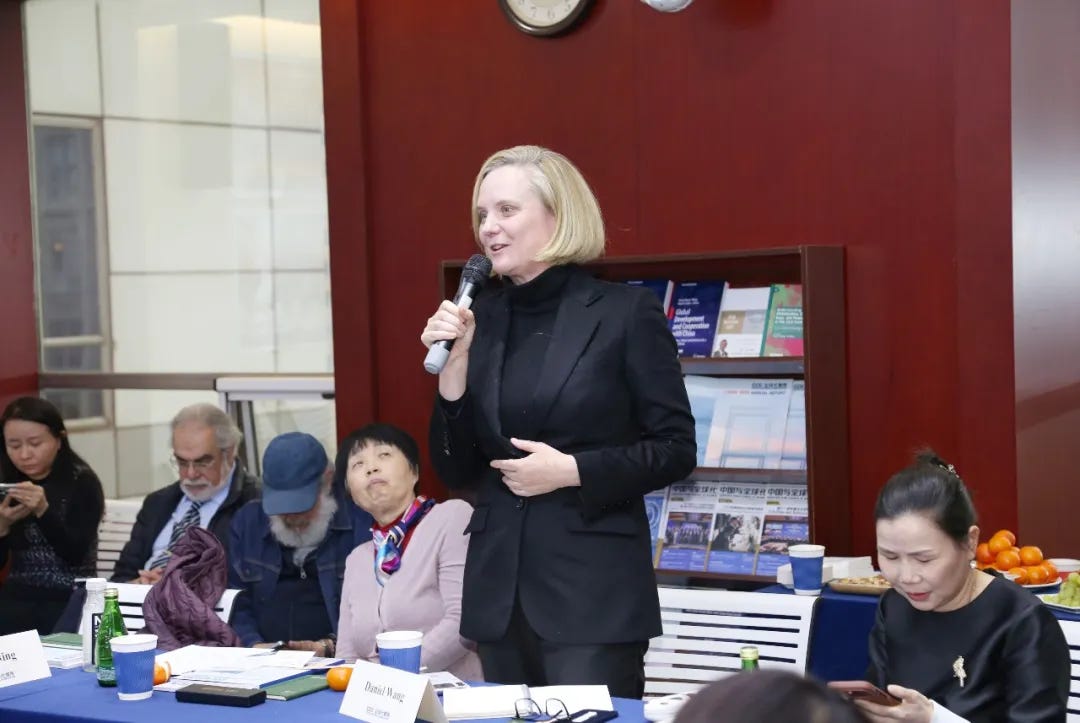
Well, thank you very much for having us today, Henry and Mabel. I think CCG, that is a Chinese dream. And I think Harvey has been somebody who has not just helped you fulfil your Chinese dream, but certainly helped me. It was a real honour to meet you, Harvey, about—I can’t see how many years ago—about 20, but we’ve known each other pretty well. And I remember you said, “Oh, I’ve got this guy I want you to meet in Starbucks.” I thought, Harvey, I’m a busy lawyer, I don’t have time for that. And you introduced me to Wang Liwei. And, you know, together, we’ve been working ever since you introduced us, about 15 years ago.
So, Harvey, I don’t think you’re good at cross-cultural relations. Can I just say that? I think you’re very good at cheerful cultural relations, because Harvey takes the anger out of cross-cultural relations, and at the moment, it is so cross. I loved what you said, Harvey. I came here today—I was pissed off. I’m pissed off. So I really liked what you said. You know, 4,000 people have died in the last 10 days. Is this a good time? It is a terrible time. And that’s exactly why I’m so optimistic coming here today.
I’ve been in Shanghai for the last week. I was at a meeting. The bankers said, “Can I have your WeChat?” And the other guy swiped it out of the way, because we have the Beijing taint. The 15 years in Beijing—they don’t trust us. So I love the stories that are coming in today. I love the story about the Austrian. I liked your story about Henry more. You know, Henry VIII wanted to hang, draw, and quarter him, but instead he was just beheaded. There are a few of us here who are heading for a beheading, but let the heads roll together, because when the heads come together, then there’s opportunity for collective action.
And that’s one thing I’ve learned in Communism. Capitalism has made us very selfish for very long, and as Václav Havel says, when you lose empathy, you are close to totalitarianism. I was born in Zambia in 1971. Six out of eight of my friends are dead of AIDS. Today, the U.S. said, unless Zambia gives us their copper, we are not continuing their AIDS programme. The total vacuum of empathy that we are witnessing in the U.S. needs a countervoice, and that countervoice can come from the collective action that you can convene in this room.
It is not okay to be doing what is going on in the Middle East. Our refugee friends arrive from Bahrain, from Pakistan, and from Saudi this Sunday, and we will enjoy that conversation in the basin, in the crucible, in the cosmopolitan, collective, empathetic environment that people like Harvey Dzodin—because he’s from a kibbutz, because Xi Jinping understands a community of common destiny, because I grew up in Corrymeela, which is a peace group between Ireland and England, because I’m Irish-English—people who have already crossed the lines know that the U.S. has really crossed the line. But there are lions here who know when people are crossing the lines and how to make them accountable.
And, Harvey, I hope you use your media voice, your book, to inspire the next generation to understand that when there’s an empathy vacuum in one country, there’s an opportunity for the empathetic in another. So thank you for your book, Harvey. Thank you for the good times you gave us when you were in Beijing. And it’s great to see you back.
Peter Wayne Lewis, Professor Emeritus, Massachusetts College of Art and Design; Director, Oasis Gallery-Beijing
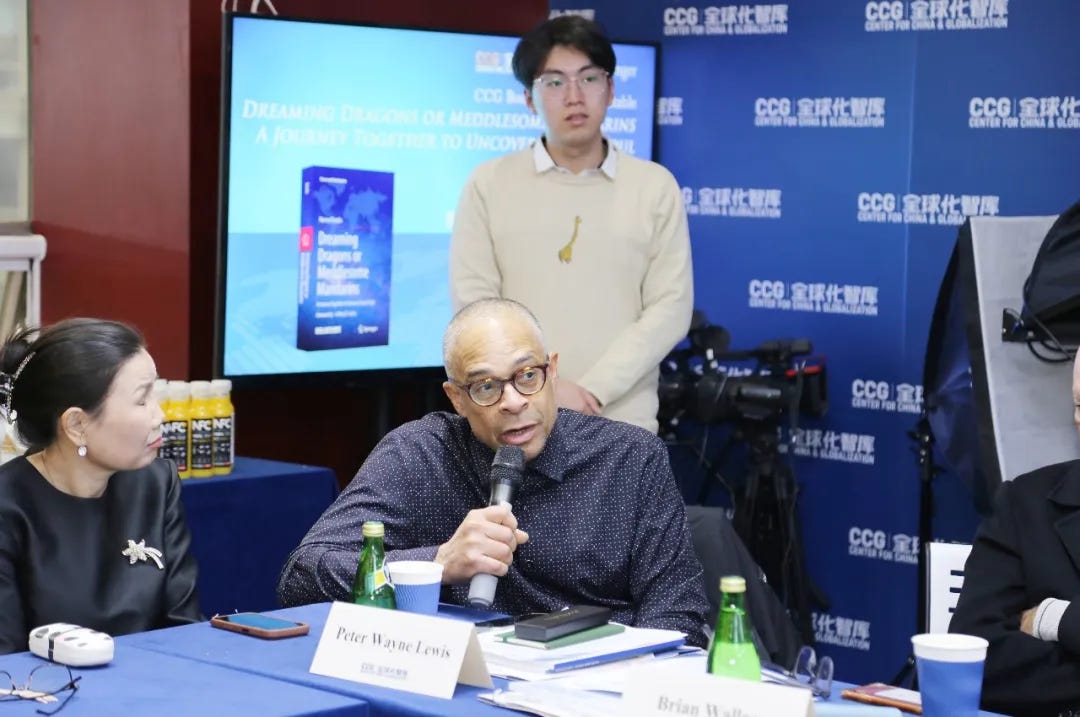
Good afternoon. I am Professor Peter Wayne Lewis, emeritus from Massachusetts College of Art and Design in Boston. We are the oldest public art college in the United States. For us, 160 years is quite long — not quite as long as the 6,000 years of China. But I think, you know, we’re doing okay.
I want to thank Harvey for inviting me to be here this afternoon. I met Harvey actually here in Beijing, China, but I’ve also spent time with Harvey in Boston. He is a graduate of Harvard, which is just across the river from where I taught. I’m retired now from teaching. I go to the teaching component because, in fact, at Mass College of Art, we had an exchange programme with CAFA, Tsinghua, for about 30 years, and my first trip to China was in 2004 with students. Part of their education was always geared towards international travel, to round them out as human beings.
So, on our first trip, we brought about 15 students. In the early days of our travel, we would visit Japan first—Osaka, Kyoto, Tokyo—then Shanghai, Suzhou, Xi’an. We would end in Beijing, and it was really a remarkable thing to have these young Bostonians come to China. And typically, at the end of this trip, they were all in tears because they were really moved by their experience of being in China and getting out of the I-95 belt. Most of these kids had never really travelled, even to somewhere like New York. So, coming to China really expanded their horizons and gave them a sense of being the other.
Respectfully, a large part of my students are white Europeans. I am a product of the African diaspora. I’ll speak a little bit about that. But these kids, being in a culture where they’re not the dominant population, it changes you. And I think it’s a really remarkable thing that our college basically demanded that our students have this experience of travel.
So in 2004, after that first trip, I saw what was going on. I am an educator. I was the teacher of Fine Arts in the MFA programme, the graduate painting programme. I co-directed that. I was chairman of our art department for years, also. So when I came to Beijing and actually saw the contemporary Chinese art scene—how explosive it was—it was remarkable.
I met this young man, Brian Wallace, I think, on my first trip. And he’s the founder of Red Gate Gallery, which has been in China for 35 years or so, the first contemporary art gallery in China, as I understand it. So with my students, meeting Brian, seeing what was going on, I actually built a studio, and I had been painting, working as an artist in China for 20 years.
Harvey’s been in my studio here in Beijing. And over the years, when the students would come from New England, I would have a barbecue at the studio, then we’d go have ice cream and drink a little baijiu, a little baijiu, some pijiu, right.
It was great in terms of the dream in Jamaica, which is my birth country. I am Jamaican by birth, American by choice, which right now is a little bit tragic to even use that word. I absolutely agree with everything you’ve said about the horrors that are going on right now in the United States, the Middle East, and around the world.
In the United States, we had Dr Martin Luther King. He had a dream. I think China has a dream also. For me, I think it’s a dream for all of humanity, all human beings. In Jamaica, it’s out of many people come one. I think this should be a global imperative: out of one humanity, one human being, we become one.
At the heart of it, it’s a keyword. It’s called racism, okay? And the idea of just being the other—and I’m not going to go into all the various laws that were instituted in the United States, or around the world—but the idea of the skin game, it’s a kind of horror. But I’m not going to dive into that so much. I think the saving grace for all of us is the finer arts and the greatest things that we invented as human beings, which are literature, poetry, dance, the visual arts. And I think if we just keep promoting the arts, that becomes a real bridge between all of us.
And it’s really miraculous to sit here, to hear everyone speak about these particular things. In terms of Jamaica, the 2008 Olympics—I was here. For me, in terms of the finer arts, at 798, and I was working with the Jamaican government, which I still do as an artist, we took over what was called CJW, Cigar, Jazz and Wine, in The Place, which has a big TV screen. And in that mall, we had the club, and this is where we hosted the Jamaican team.
I was there when Usain Bolt walked into the room before he broke the record, and Asafa Powell—the whole Jamaican team was there, along with the Jamaican ambassador at the time, Wayne McCook. So I was in Beijing in 2004, leading up to the Olympics of 2008, and with the Jamaican team. My wife was here. My son was here. They were in the Bird’s Nest. I was working in 798. I didn’t get into the Bird’s Nest, but we were at CJW the day that Usain Bolt broke the 100. Jamaicans are involved in showbiz a little bit. We’re a little bit loud sometimes. But Mr Bolt, his encounter with China, and what he did for the country of Jamaica—it’s quite astonishing. He’s one of the greatest athletes that’s ever lived. And to be in Beijing at the time of the Olympics, it was a miraculous time. And 798, about the finer arts, was really going on, was really amazing. It was a really great time. And I just wanted to speak briefly about that.
I think the dream is still alive, as long as human beings are alive. And with the evolution of human consciousness, I think we have a chance to survive, because I believe in us. I believe in the better nature of the human being. What Harvey did—he wrote a book—and I’m looking forward to reading this book, because I adore this man. Maybe I shouldn’t say that. I mean, in a manly way. He’s a great cat, and I’m looking forward to the insightful things that are really located in that book.
I could talk for five more years, but I’m going to stop. Thank you very much for having me.
Mabel Lu Miao
Thank you all. Actually, all your words inspired me a lot. I think today, around the table, are like-minded experts on China and communication. This week, unfortunately, the very well-known and greatest philosopher of the last century, the German philosopher Habermas, just passed away. His passing reminded me how important the communicative action and rationality that he put forward throughout his whole life are for human beings, especially in the current context for humanity.
So that’s why I appreciate what you have done, Harvey. In this book, you already told us the exact stories and your insightful opinions on how to bring more empathetic power to the rest of the world, and to call for more of that kind of spirit for humankind in this current context.
So I think all the people here are like-minded people, trying to promote communication among human beings, to make the world better and more prosperous. So I really appreciate what you have done, and your view is not just on one country. As I mentioned, it is on the whole of humankind. China has put forward the idea of a human community with a shared future. I think it means promoting people-to-people understanding and deepening that spirit of mutual understanding.
So I appreciate that very much. Any concluding words you can say, Harvey, maybe?
Harvey Dzodin
I just want to thank everybody, new friends and old friends, who came today. I’m very touched to see you all. And Mabel, Henry, I thank you for one other thing, and that is your Global Young Leaders Dialogue, trying to bring up a next generation of global citizens to leadership positions. I think it’s completely right on. And talking about one world, one dream, I think that you’ve made a difference already, and those people are going to grow up to be leaders, and they’re going to help us improve the world.
So thanks, everybody, old friends and new friends, and thank you very much for spending the afternoon with us. And I hope we have a few minutes to talk after, unless you have another programme at 5:30. I’m happy to say hello to people today, because I didn’t get a chance before. Thank you. Thank you for hosting this. Thank you for helping me by suggesting the book. And I’m very appreciative.
Henry Huiyao Wang
I’ll just say a few concluding remarks. So first of all, I want to thank Harvey and all of you again for coming here this afternoon to share all your very insightful and very unique stories. And I really appreciate the empathy that we have found as a theme of this afternoon. I think, particularly for our turbulent world, we really need empathy. And it also reminds me of what Confucius said: “Do not do to others what you do not want done to yourself.”
So I really think that this is a great roundtable. We’re going to document this. But also, I would like to ask, if you have a future book—I notice quite a few writers here—we would like to put this into the China and Globalization series, following Harvey. We already have 14 books in the series. We could add more, and we welcome any new books to be added to this series.
So again, this is a great occasion. Spring is coming. We are still in the first month of the year of the horse. We can still say Happy New Year of the Horse. And I really wish everybody a prosperous, healthy, and very glorious year ahead. Thank you all very much. And we can talk again.
CCG New Book: Dreaming Dragons or Meddlesome Mandarins

CCG Update proudly presents Dreaming Dragons or Meddlesome Mandarins: A Journey Together to Uncover China’s Soul, a new book by CCG Senior Fellow Harvey Dzodin, published by Springer Nature.