

Henry Huiyao Wang,Founder and President of CCG
Henry Huiyao Wang’s appearance on BBC World Service’s Business Daily, 25 Sep 2026
Henry Huiyao Wang joined Business Daily for its post-summit episode, Taking stock: Trump and Xi face the trade test. The 17-minute programme examined what came next for trade, tariffs and AI after the White House meeting, whether bilateral tensions were easing, and the implications for technology, business and global trade. Wang appeared alongside AI researcher and author Stephanie Hare.
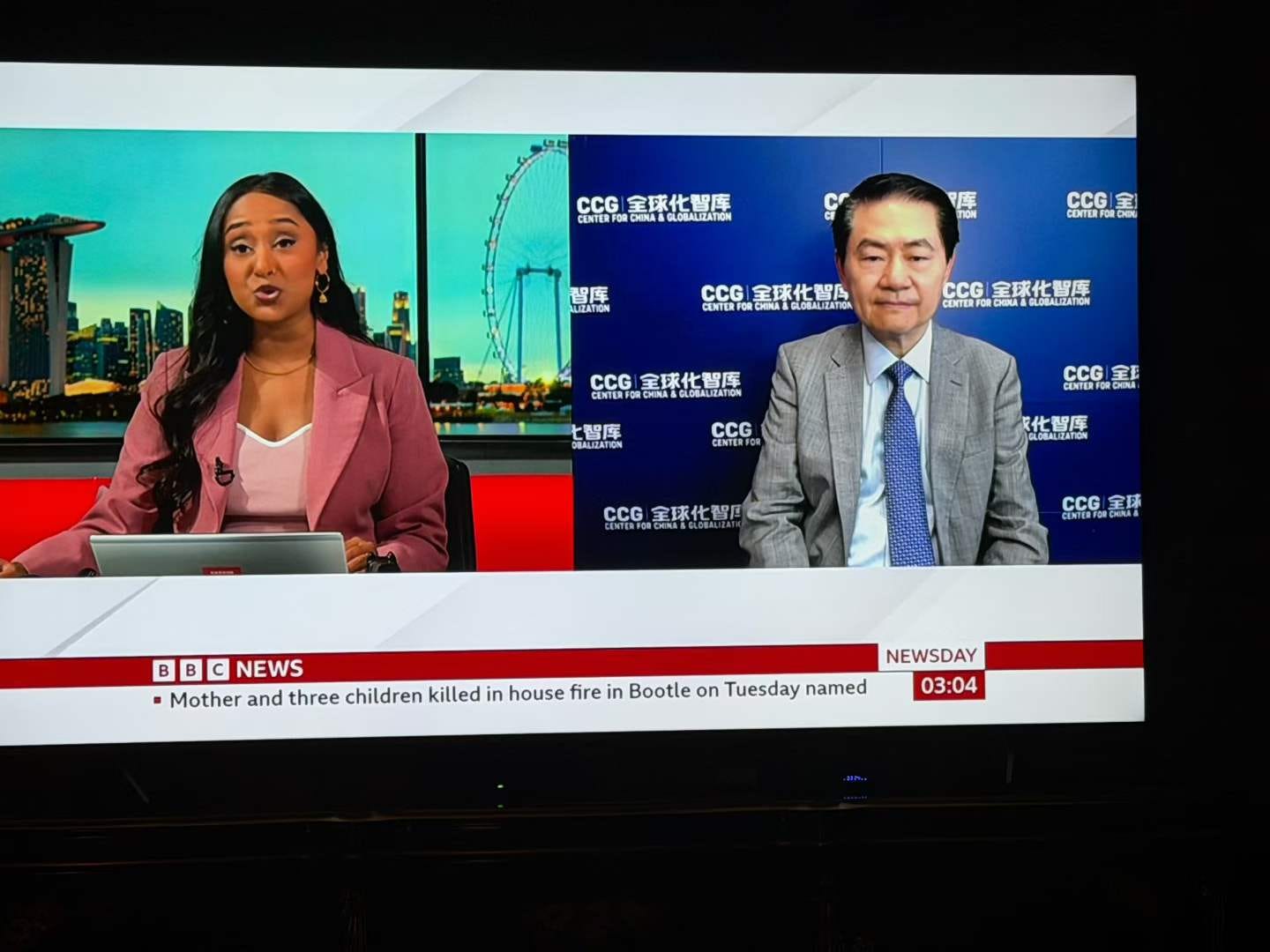
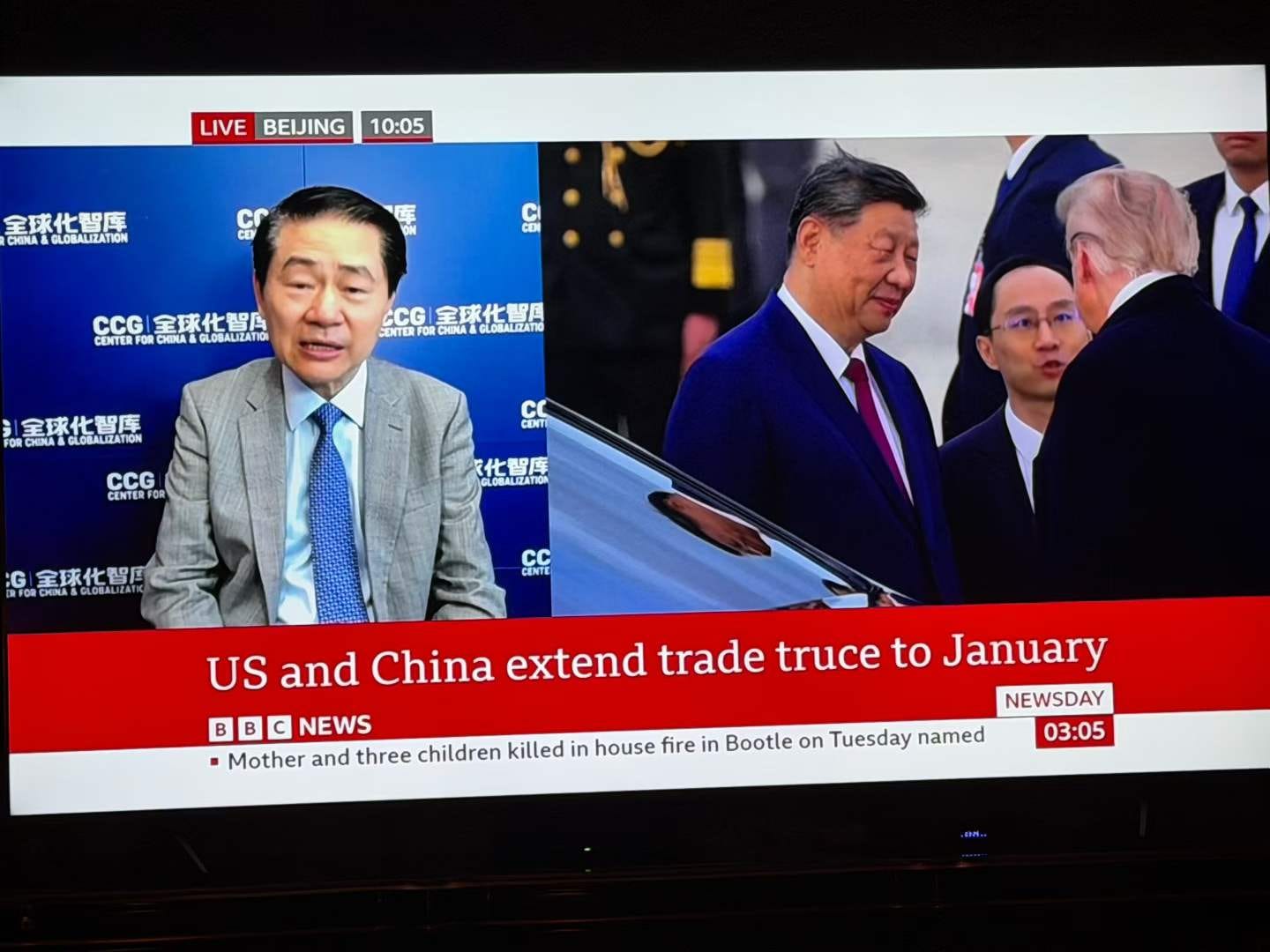
Henry Huiyao Wang appeared in BBC World Service, 26 Sep 2026
Henry Huiyao Wang’s quote in The Atlantic, 15 May 2026
From Beijing’s perspective, Trump is simply bowing to the global shift in power. “It’s the reality of the world that China is rising, and the U.S. has to accept that,” Wang Huiyao, the president of the Center for China and Globalization, a Beijing-based think tank, told me. “We have to coexist, compromise, accommodate each other. That’s what Trump is doing.”
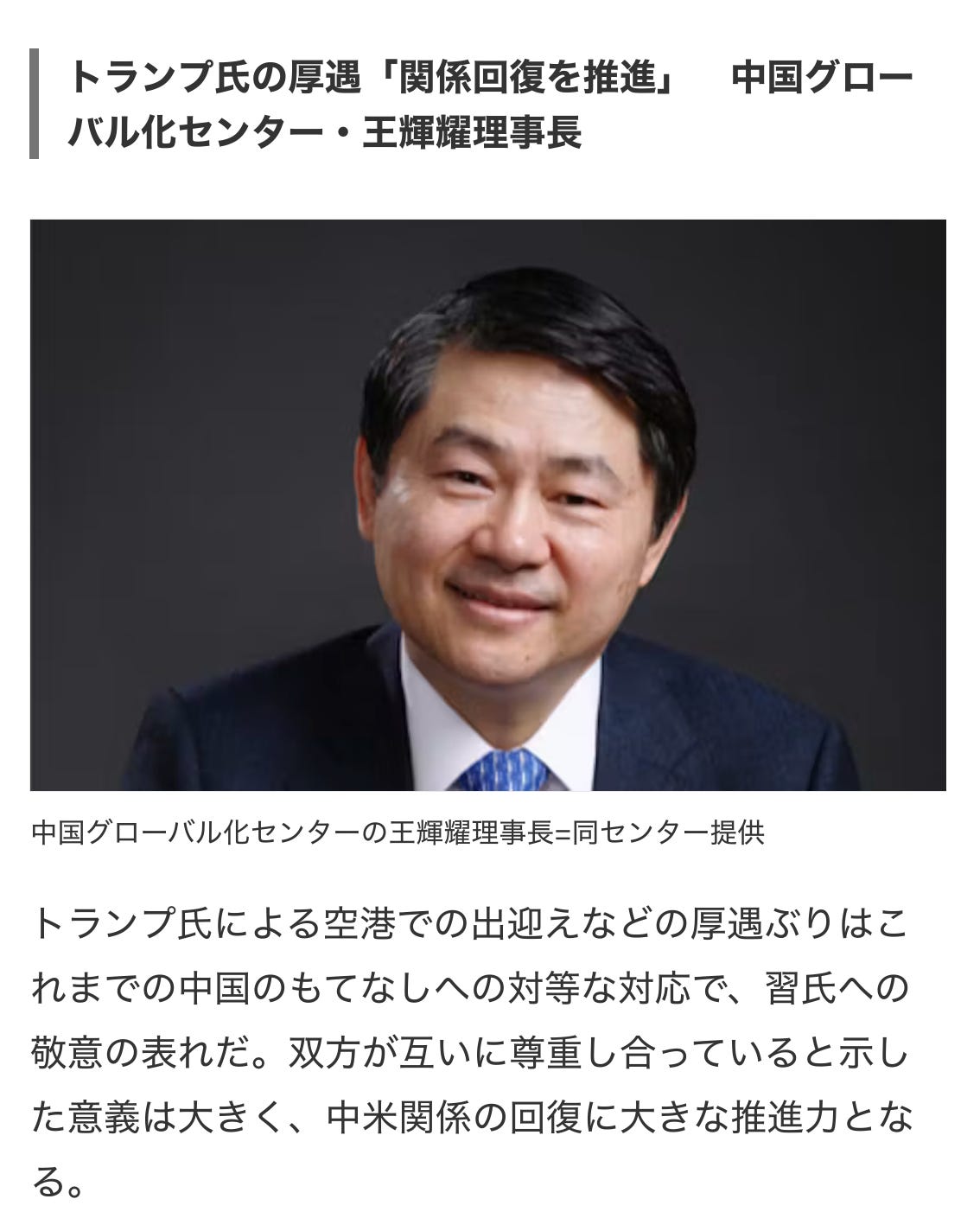
Henry Huiyao Wang’s appearance in Nikkei, 26 Sep 2026
Henry Huiyao Wang was featured by Nikkei following the Xi–Trump summit.
Henry Huiyao Wang’s appearance on LBC, 26 Sep 2026
Henry Huiyao Wang’s quote in TRT World, 23 Sep 2026
"I see the visit as an anchor — a real bedrock — for further US-China relations," Henry Huiyao Wang, founder and director of the Beijing-based Center for China and Globalization and a former Counselor to China’s State Council, told TRT World.
……
Henry Wang said the leaders' diplomacy provides a "guiding compass" for the relationship, while Chinese geopolitical analyst Gao Jian said Beijing wants to consolidate the "constructive strategic stability relationship" agreed in May through more predictable communication and mechanisms to manage differences.
……
Henry Wang said this proposed mechanism for tariff-free imports from each side could provide a starting point. "$30 billion tariff-free imports for each side would be a good start," he said, suggesting it could eventually expand.
……
Henry Wang puts it more bluntly: "We do not need an AI arms race; we need global AI governance."
……
"China is the biggest guarantor, supporter and stabiliser that Trump can have," CCG’s Henry Wang said, pointing to Beijing's relationships with Iran and Gulf states.
……
Henry Wang said Beijing could welcome Trump's earlier statements opposing Taiwan independence and expressing reluctance to station US forces thousands of miles from the US.
Henry Huiyao Wang’s quote in TRT World, 21 Sep 2026
"We do not need an AI arms race; we need global AI governance," Henry Huiyao Wang, founder and director of the Center for China and Globalization (CCG) and a former Counselor to China’s State Council, told TRT World, describing AI as one of the most important issues likely to feature in the evolving US-China relationship.
……
For CCG’s Henry Wang, the answer lies in separating competition from the management of risks created by the technology itself.
The United States and China, he said, have different strengths. The US remains strong in advanced AI models, modelling and computing, while China has a vast application market, extensive data-centre capacity and large-scale deployment potential.
Rather than attempting to eliminate that competition, Wang believes the two countries could work towards an international framework governing AI.
Henry Huiyao Wang’s appearance on Doha Debates, 22 Sep 2026
Wang joined Isabel Hilton, Renata Ávila and Arnaud Bertrand for the season premiere of the Doha Debates Podcast, Will China or the West lead the world into the future? The 131-minute discussion examined China’s rise, the future of the Western-led order, Taiwan, Ukraine, AI competition and whether major powers could find a sustainable form of coexistence. The programme page does not provide a transcript.
Henry Huiyao Wang’s appearance on WPIC’s The Negotiation, 25 Sep 2026
WPIC CEO Jacob Cooke interviewed Wang in a special 31-minute post-summit episode on the immediate implications of the meeting for China–U.S. relations and trade stability. The discussion devoted particular attention to AI: Wang set out his proposal for a global no-first-use principle covering AI-enabled autonomous weapons, discussed risks associated with the U.S. AI investment boom, and considered what an effective U.S.–China AI-governance framework might look like.
Henry Huiyao Wang’s appearance on Hong Kong’s Now News, 25 Sep 2026
Now News interviewed Wang about Trump’s unusually high-profile reception for Xi and what it suggested about Washington’s evolving approach to Beijing.
“他都意識到中國必須跟美國合作。”
Wang pointed to Trump personally receiving Xi at Joint Base Andrews, the White House welcoming ceremony and the state dinner as signs that Washington increasingly recognised the need to work with China amid a changing strategic balance.
Henry Huiyao Wang’s interview with Italy’s La Stampa, 24 Sep 2026
In a substantial interview with La Stampa, Wang discussed trade, investment, Taiwan, Iran and the broader strategic significance of Xi’s Washington visit.
“Già il fatto che Xi Jinping e Donald Trump si parlino per la seconda volta in pochi mesi è un successo.”
He argued that a second leaders’ meeting within four months was itself significant, particularly given the two countries’ rivalry. Wang also cited Trump’s personal airport welcome for Xi as a signal of unusually high-level treatment and said there was momentum for further trade and investment liberalisation.
Henry Huiyao Wang’s interview with Sweden’s Sveriges Radio, 24 Sep 2026
Wang spoke to Ekot, the news service of Sweden’s national public broadcaster Sveriges Radio, about Taiwan and what Beijing might seek from Trump during the Washington summit.
“Efter att Donald Trump var i Peking i våras sa han att han inte vill skicka soldater till Taiwan.”
The report said Wang believed Beijing saw an opportunity during Trump’s term to seek greater U.S. restraint over Taiwan, including on a paused U.S. arms package.
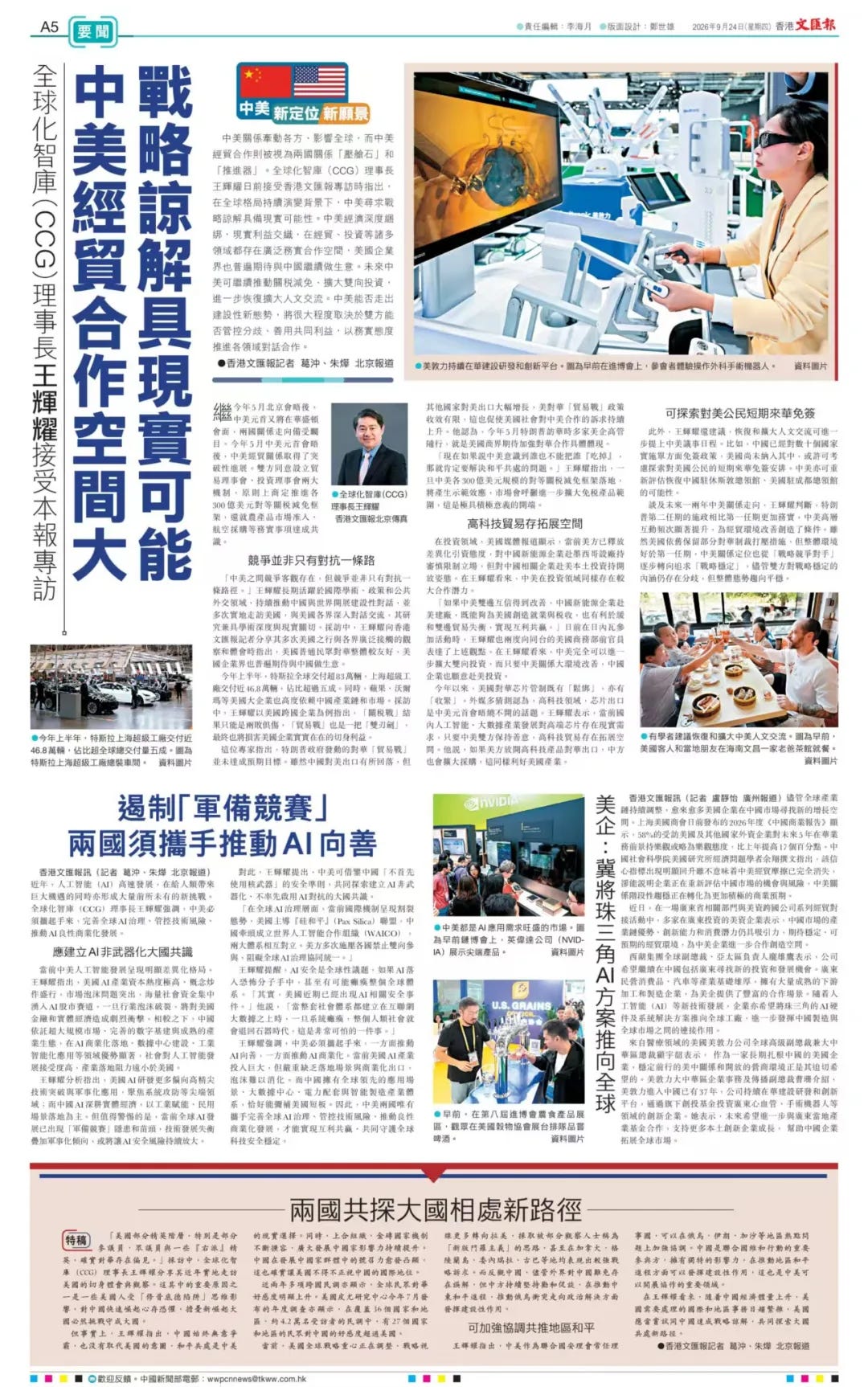
Henry Huiyao Wang’s interview with Hong Kong Wen Wei Po, 24 Sep 2026
In an extensive interview, Wang argued that deep economic interdependence left substantial room for pragmatic China–U.S. cooperation on tariffs, investment, high-tech trade and people-to-people exchanges.
“中美之間競爭客觀存在,但競爭並非只有對抗一條路徑。”
He argued that tariff and trade confrontation would hurt companies on both sides, advocated greater two-way investment and high-tech trade, and suggested that China could explore short-term visa-free entry for U.S. citizens as part of rebuilding people-to-people ties.
Henry Huiyao Wang on China–U.S. AI cooperation in Wen Wei Po, 24 Sep 2026
A separate article from the same interview focused on artificial intelligence and the danger of an emerging AI arms race.
“中美必須攜起手來,完善全球AI治理、管控技術風險、推動AI良性商業化發展。”
Wang contrasted U.S. strengths in frontier technological development with China’s strengths in commercial deployment and industrial applications. He proposed that the two countries explore understandings on the non-weaponisation of AI and on avoiding first use of AI in confrontation.
Henry Huiyao Wang on major-power coexistence in Wen Wei Po, 24 Sep 2026
Another Wen Wei Po article focused on the strategic relationship and Wang’s argument that the two countries should search for a more sustainable framework for coexistence.
“美國應當嘗試同中國達成戰略諒解,共同探索大國共處新路徑。”
Wang said China and the United States, as permanent members of the UN Security Council, could strengthen coordination on conflicts including Ukraine, Iran and Gaza, while recognising that the two powers would continue to have substantial differences.
Henry Huiyao Wang’s appearance on Italy’s Chora Media’s Black Box, 24 Sep 2026
Italian journalist Silvia Berzoni interviewed Wang for the 16-minute Black Box – La scatola nera della finanza episode Il summit Trump-Xi visto da Pechino. The programme examined the Washington meeting from Beijing’s perspective, with trade, rare earths, international conflicts and especially artificial intelligence among the principal topics. No transcript is provided on the episode page.
Henry Huiyao Wang’s interview with Italy’s Krisis, 16 Sep 2026
In a lengthy pre-visit interview, Wang discussed the structural nature of China–U.S. competition, the approaching U.S. midterm elections, Xi’s Washington visit, the changing international order, Ukraine and the Middle East, economic interdependence and AI governance.
“A prescindere dal verdetto elettorale, penso che esista una questione strutturale.”
Wang argued that deep economic interdependence made complete decoupling increasingly unrealistic and that the two powers would need to find some form of coexistence even as structural competition persisted.
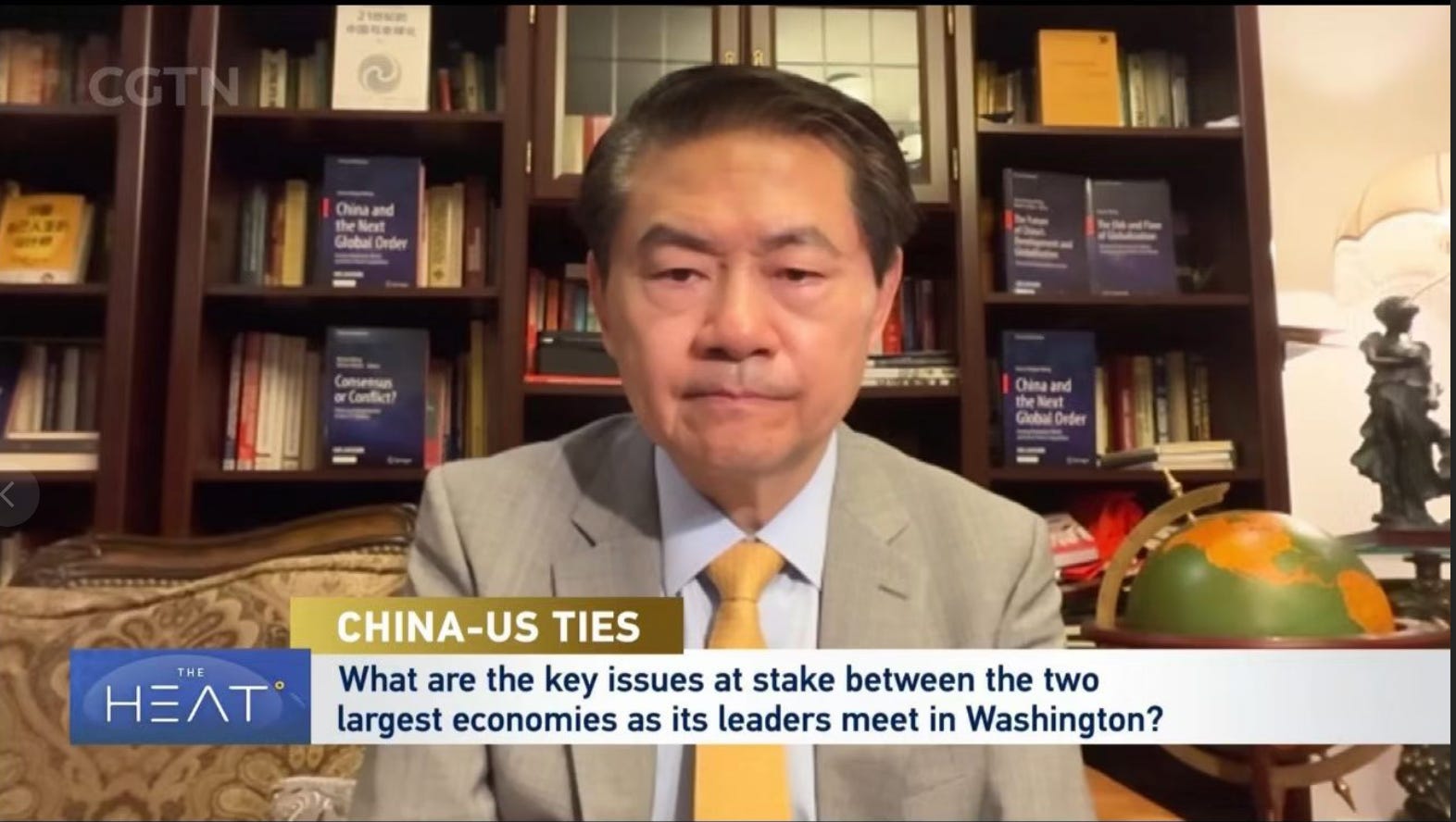
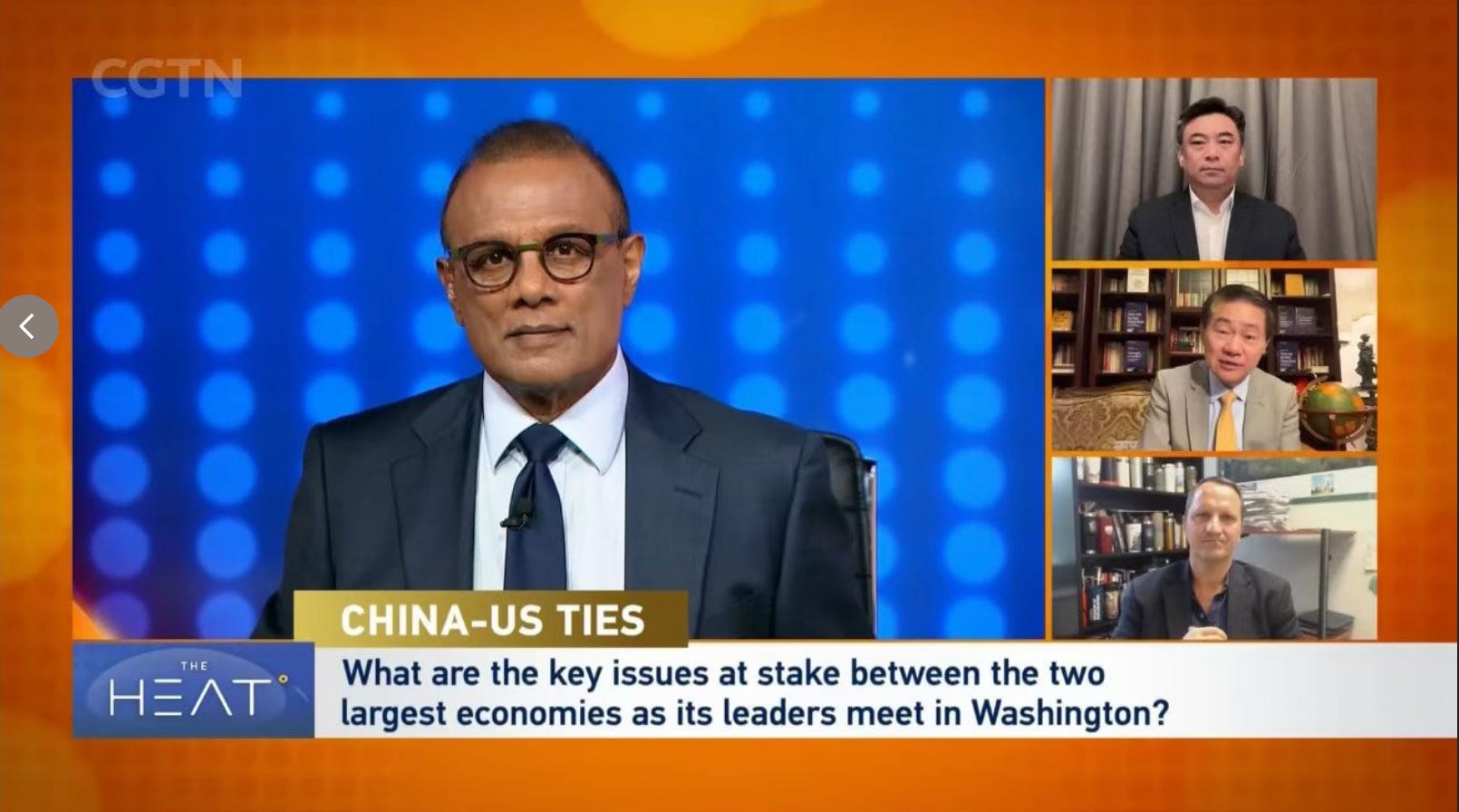
Henry Huiyao Wang on The Heat by CGTN on 26, Sep 2026
Zichen Wang, Deputy Secretary-General of CCG, in BBC, The Washington Post, Associated Press (twice), The Times (of London), and Channel News Asia
Zichen Wang’s appearance on BBC Radio 4’s Today programme, Sep 2026
Zichen Wang appeared on BBC Radio 4’s flagship Today programme at its legendary 8.10 am interview slot during Xi Jinping’s U.S. visit to discuss the summit and China–U.S. relations.
Zichen Wang’s quote in The Washington Post, 25 Sep 2026
“In the public policy discussion, virtually all categories of AI risk are present. My impression is that political and social-stability risks receive greater attention than existential risk in the Silicon Valley sense,” said Zichen Wang, deputy secretary general of the Center for China and Globalization, a thinktank based in Beijing, referring to recent debates in the U.S. about whether AI could threaten humanity.
“But technical loss of control is definitely on the radar” in China, said Wang, who writes the Pekingnology newsletter.
Zichen Wang’s quote in Associated Press, 26 Sep 2026
Although the summit did not resolve the countries’ fundamental differences, analysts said the incremental progress was noteworthy.
“Personal diplomacy between the two leaders is important, but the emphasis on working-level engagement, military-to-military dialogue and crisis-management mechanisms suggests an effort to make that stability more durable and institutionalized,” said Wang Zichen, deputy secretary-general of the Beijing-based Center for China and Globalization.
Zichen Wang’s quote in Associated Press, 26 Sep 2026
Wang Zichen, deputy secretary-general of the Beijing-based think tank Center for China and Globalization, said there has never been “a convention” requiring the Chinese president to attend the U.N. General Assembly. Xi’s predecessors, including Jiang Zemin and Hu Jintao, attended major U.N. meetings only selectively, and Xi himself last addressed the body virtually during the pandemic in 2021.
Last year, Premier Li Qiang represented China. Senior diplomat Wang Yi has also spoken several time in recent years in various capacities; he was accompanying Xi this year on the Washington trip. And Han spoke in 2023.
“Both the premier and the vice president are sufficiently senior representatives that I would be cautious about interpreting the choice between them as a diplomatic signal in itself,” Wang Zichen said.
He added that China portrays the U.N. as an important global institution, so “it would be difficult to argue from the level of representation alone that China is becoming less interested in the U.N.”
Zichen Wang’s quote in The Times (of London), Sep 2026
“There is greater confidence in Beijing than there was a few years ago,” said Wang Zichen, from the Beijing think tank the Centre for China and Globalisation. “There is a sense that China has weathered considerable pressure from Washington, and that the United States has its own constraints and vulnerabilities.”
……
“I have not seen any discussion suggesting that this is somehow the moment when global leadership passes from the United States to China,” Wang, the analyst, said. “Beijing still sees the United States as extraordinarily powerful, and the overriding objective at the moment is stability, not triumph.”
Zichen Wang’s quote on Channel News Asia, 25 Sep 2026
“Personal diplomacy between the two leaders is important but the emphasis on working-level contacts, military dialogue and crisis-management mechanisms also suggests an effort to make that stability more durable and institutionalised,” said Wang Zichen, deputy secretary-general at the Center for China and Globalization, a Beijing-based think-tank.
……
Xi has called for more regular contact between government departments and the two militaries, as well as stronger crisis communication and continued dialogue on artificial intelligence.
He also said that the US and China should cooperate with sincerity and share a responsibility to ensure AI remains under human control and serves the well-being of people.
AI was a particularly revealing example, said Wang.
“Beijing does not want the AI relationship to be framed solely around containment, security or preventing worst-case scenarios, but also around what the two countries can constructively achieve together,” he said.
Zichen Wang’s quote on CNA, 23 Sep 2026
“I think from Beijing’s perspective, this visit is not about restoring the kind of relationship China and the US had in, for example, 2015,” said Zichen Wang, deputy secretary-general of the non-government think tank Centre for China and Globalization.
“That era is over. The more realistic objective is to consolidate a framework of strategic stability,” said Wang, who is also the founder of the newsletter Pekingnology.