

At the 2026 China Outbound Investment Forum, hosted by the Center for China and Globalization (CCG), Dr. Kai-Fu Lee, Founder and CEO of 01.AI and Chairman of Sinovation Ventures, delivered a keynote titled “Globalization in the AI Era: From Exporting Products to Co-Creating Capabilities.” He explored how Chinese companies can build new global advantages by applying AI to the industrial expertise they have developed over decades.
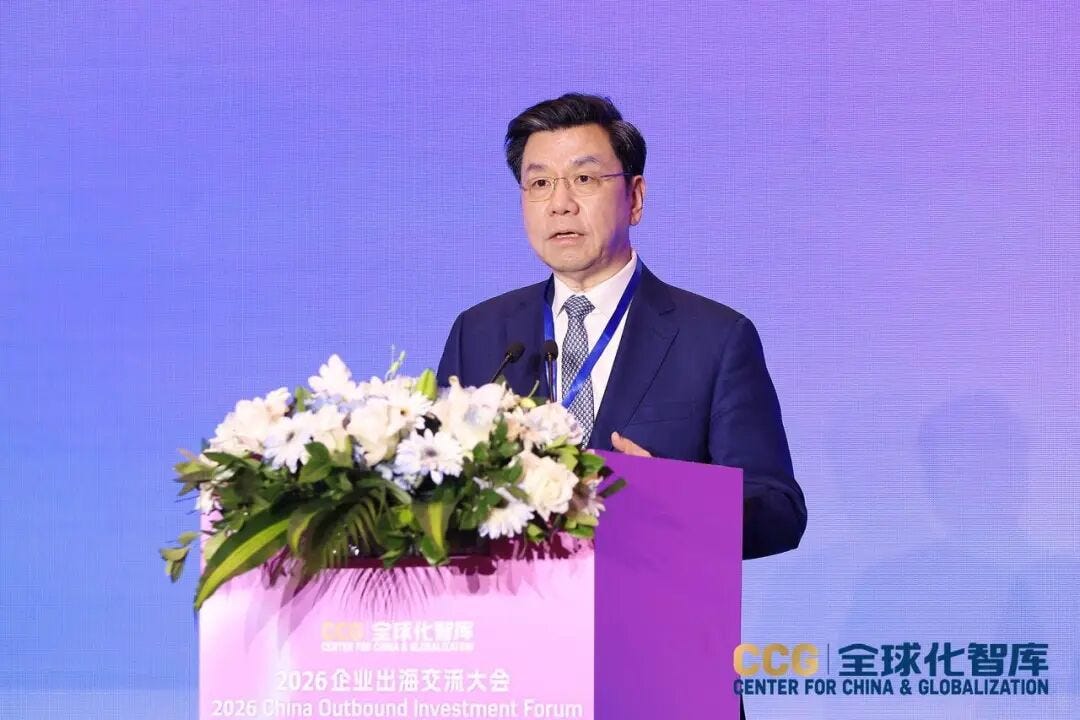
AI is approaching a pivotal turning point: its capabilities are advancing rapidly as its cost drops. Knowledge and industrial expertise once tied to individual engineers, managers, and organizations can increasingly be translated into reusable, scalable AI capabilities. Lee said this could create a new source of competitiveness for Chinese companies expanding overseas.
In the AI era, globalization should mean more than exporting products and technology. It should also mean turning China’s industrial experience into productive capabilities that take root locally. By combining that experience with local talent, knowledge, and business needs, Chinese companies can help partners build sustainable AI capabilities and create value together.
Drawing on 01.AI’s work in business operations, industrial production, and AI education overseas, Lee discussed three priorities: bringing AI into core business functions under CEO leadership, measuring transformation by business results, and building sovereign AI partnerships that support long-term local development.
1. China’s New Competitive Edge: Turning Industrial Expertise into a Source of Global Productivity
Globalization has long been driven by the cross-border movement of goods, capital, production capacity, and talent. AI adds another dimension: specialized knowledge and the ability to perform complex tasks can also cross borders and be applied at scale.
Consider an engineer’s understanding of equipment, a sales manager’s judgment about customers, a factory manager’s knowledge of production optimization, or a CEO’s experience running a business. These capabilities are hard-won competitive advantages. But because they often reside in individuals and depend on close organizational collaboration, they can be difficult and costly to reproduce across teams and markets.
AI is beginning to change that.
As models improve and operating costs fall, AI agents are moving beyond answering questions to planning and carrying out complex tasks. Individuals and organizations can increasingly translate expertise into reusable AI capabilities and deploy them at scale.
This creates a way to make expertise that once resided mainly in the minds of engineers and managers available to a much wider range of people and operations.
However, simply deploying a few AI agents will not reproduce a company’s competitive advantage.
AI must understand how the business actually works. By connecting data, knowledge, and workflows into a dynamic context for business operations, companies can help agents understand business entities and their relationships, use tools, contribute to tasks, and continually test and improve their performance in real-world settings. Only then can professional expertise translate into measurable productivity gains.
By making expertise accessible beyond a small group or a single organization, AI gives Chinese companies a chance to turn decades of industrial experience into a new source of global competitiveness.
This marks a new phase of globalization: one that goes beyond exporting products and relocating production to building local teams, brands, and distribution networks.
The opportunity is not simply to bring Chinese products to the world, but to make China’s industrial experience a source of productivity worldwide.
Chinese companies can bring that experience together with local talent, knowledge, and business needs to help partners build capabilities that create lasting value. The shift is from taking products abroad to developing capabilities together.
But transferring expertise alone does not guarantee results. The challenge is embedding AI in real business operations, improving performance, and building capabilities local teams can sustain.
2. Enterprise AI’s Next Stage: From Knowledge Gains to Business Results
Sales teams use AI to prepare proposals, R&D teams to write code, finance teams to analyze reports, and customer service teams to deploy agents. These tools can help individuals work more efficiently, but the bigger question is whether they improve company performance.
McKinsey’s 2026 Global State of AI survey found that 80% of respondents said AI had increased their personal productivity, while only 37% reported a positive effect on their company’s earnings before interest and taxes (EBIT).
The gap highlights a central challenge of enterprise AI: individual productivity gains do not automatically translate into better business outcomes.
Success is not measured by how much AI a company deploys, but by whether it improves its results.
As AI becomes more capable and less expensive, Lee said, the competitive question is shifting from whether a company uses AI to how deeply it integrates AI into core operations and management decisions. AI must do more than accelerate individual tasks; it must understand how the business operates and creates value, and contribute to analysis, decision support, and execution.
Enterprise AI is therefore moving beyond task-level efficiency toward decision-making systems designed to improve business results.
To support this shift, 01.AI developed TrueNorth, an enterprise AI decision hub that helps AI interpret business operations and turn insights into actionable steps whose progress can be tracked.
TrueNorth begins with a company’s objectives and uses ontology modeling to create a structured map of the business. By connecting data, knowledge, business entities, and their relationships, it helps AI understand how the organization works. Multi-agent collaboration and simulation support business analysis, scenario evaluation, and task execution, while ongoing tracking links insight and decisions to execution and feedback.
Technology alone, however, cannot deliver transformation. Organizations must change as well.
Lee said becoming AI-native requires CEOs to rethink how they manage. Rather than relying mainly on reports to understand performance, they should organize around directly responsible individuals (DRIs), make accountability clear, align execution with business objectives, and measure whether actions produce tangible improvements.
In practice, CEO-led AI transformation means the CEO must personally drive AI adoption across core operations, redesign workflows and collaboration around business goals, and assign a DRI to each task. Decisions need owners, actions need follow-through, and investments need to be assessed by their business impact.
Building on TrueNorth, 01.AI developed Boss AI to bring this CEO-led approach into everyday management.
Boss AI acts as an AI chief of staff for the CEO, helping managers spot operational risks and track key issues. It supports preparation before meetings, decision-making during them, and follow-up afterward. The goal is to shift managers from passively reviewing reports to identifying problems early, making informed decisions, and ensuring execution—with value measured by business results.
The essential shift is from helping employees work faster to helping the company perform better.
The same principle applies on the industrial front line.
01.AI is working with one of the world’s five largest iron ore producers on an enterprise AI project to give decision-makers a more complete view of operations and help them make better-informed choices.
Mining operations are tightly interconnected: equipment, materials, processing, transportation, and production planning all affect one another. AI must interpret real-time operating conditions, identify output constraints, assess how alternatives could affect overall production, and recommend practical improvements that meet safety, quality, and operational requirements. The results must then be checked against actual production data.
Whether supporting executive decisions or optimizing production, AI’s value depends not on how many recommendations it produces, but on whether those recommendations improve results.
3. The Next Frontier of AI Globalization: Building Productivity Locally
Scenario analysis in the World Trade Organization’s *World Trade Report 2025* suggests that, by 2040, AI could increase global trade by 34%–37% and global GDP by 12%–13% compared with the baseline scenario.
As AI makes specialized expertise less costly to deploy across borders, it could reshape global value chains and broaden access to high-quality resources that have traditionally been concentrated in a small number of companies and regions.
01.AI’s AI education initiative in Kazakhstan offers one example of this potential.
In September 2026, 01.AI partnered with Kazakhstan’s Ministry of Education and Q.AI to pilot a national AI education platform in 10 rural schools, with plans to expand the program in 2027.
The project is testing an AI-supported, dual-teacher classroom model that draws on large language models’ ability to understand language, support knowledge-based interaction, and personalize learning. Excellent teachers based in cities teach remotely, while local teachers support students in person. AI assists throughout the process—from lesson preparation and classroom interaction to assessment and post-class feedback—helping teachers identify individual learning needs and tailor their guidance.
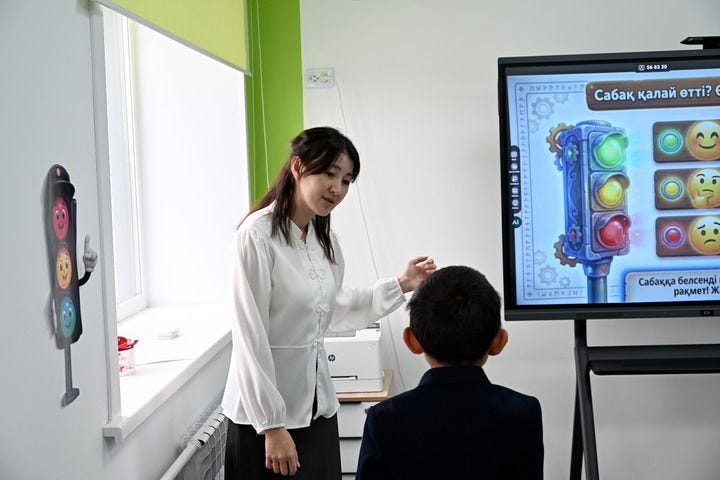
The goal is not only to narrow the urban-rural gap in access to quality education, but also to give more children learning experiences tailored to their individual needs.
As the program grows from 10 pilot schools toward a planned 500, it will require curriculum knowledge bases, support for local languages, teacher training, and an education data platform. Just as important, local teams need the skills to develop, deploy, and improve the products themselves, ensuring the program can be sustained over time.
As Lee emphasized, technology can cross borders, but capabilities must take root locally.
Through its work with Kazakhstan on Q.AI, 01.AI is providing AI technology while investing in local research and development, engineering and deployment, product adaptation, and talent development. By bringing Chinese technology and industrial experience together with local languages, data, knowledge, and talent, the partnership aims to help Kazakhstan build sovereign AI capabilities it can develop and sustain independently.
The experience points to a broader opportunity for Chinese companies in the AI era: to move beyond exporting products and technology and instead share expertise while building local capabilities with partners.
Chinese companies can contribute AI technology and industrial experience; overseas partners can bring knowledge of local markets and needs; and financial institutions, professional service providers, and international organizations can provide support. Together, they can embed AI in real-world operations and create lasting value.
01.AI aims to be a long-term partner in this process—not only helping customers solve immediate problems, but also working with local partners to build products, teams, and technical expertise so that AI can support industrial development and economic growth.
In the past, Chinese companies took products, production capacity, and supply chains abroad. In the AI era, they can bring decades of industrial experience abroad and turn it into AI capabilities that create new sources of productivity with partners worldwide.
2026 China Outbound Investment Forum Held in Beijing

The 2026 China Outbound Investment Forum, hosted by the Center for China and Globalization (CCG), was held in Beijing on Saturday, October 17.