


On 26 June, 2026, Henry Huiyao Wang, Founder and President of the Center for China and Globalization (CCG), took part in the 19th Dubrovnik Forum in Croatia. Held under the theme “The Age of Multipolarity: Many Directions, One Future,” the forum brought together senior officials, diplomats, scholars, and policy experts for discussions on the evolving international order.
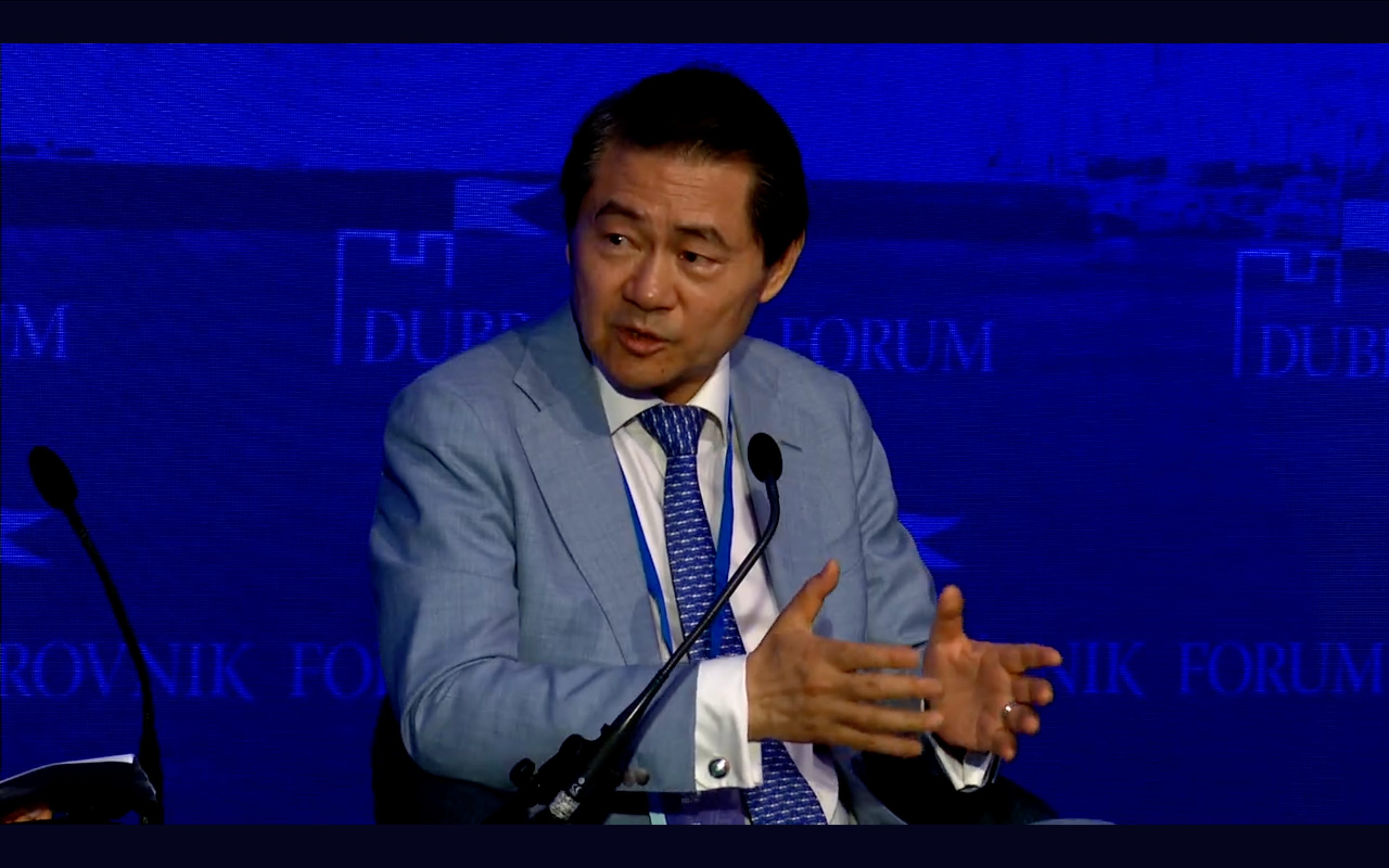
In the think tank panel “Emerging Powers in a Multipolar World: Many Paths, One Destination,” Wang joined
Charles Powell, Director, Elcano Royal Institute, Spain;
Luanda Mpungose, Outreach and Partnership Manager at the South African Institute of International Affairs;
Rachel Rizo, Senior Fellow, Strategic Studies Program, Observer Research Foundation, India;
Daniel Kochis, Senior Fellow, Center on Europe and Eurasia, Hudson Institute, United States;
Manoel Corrêa do Lago, Senior Consultant, Brazilian Center for International Relations, Brazil
to discuss whether the world is moving toward genuine multipolarity or a new form of bipolarity; the growing role of BRICS, middle powers, and the Global South; the future of multilateral institutions; and opportunities for cooperation between established and emerging powers.
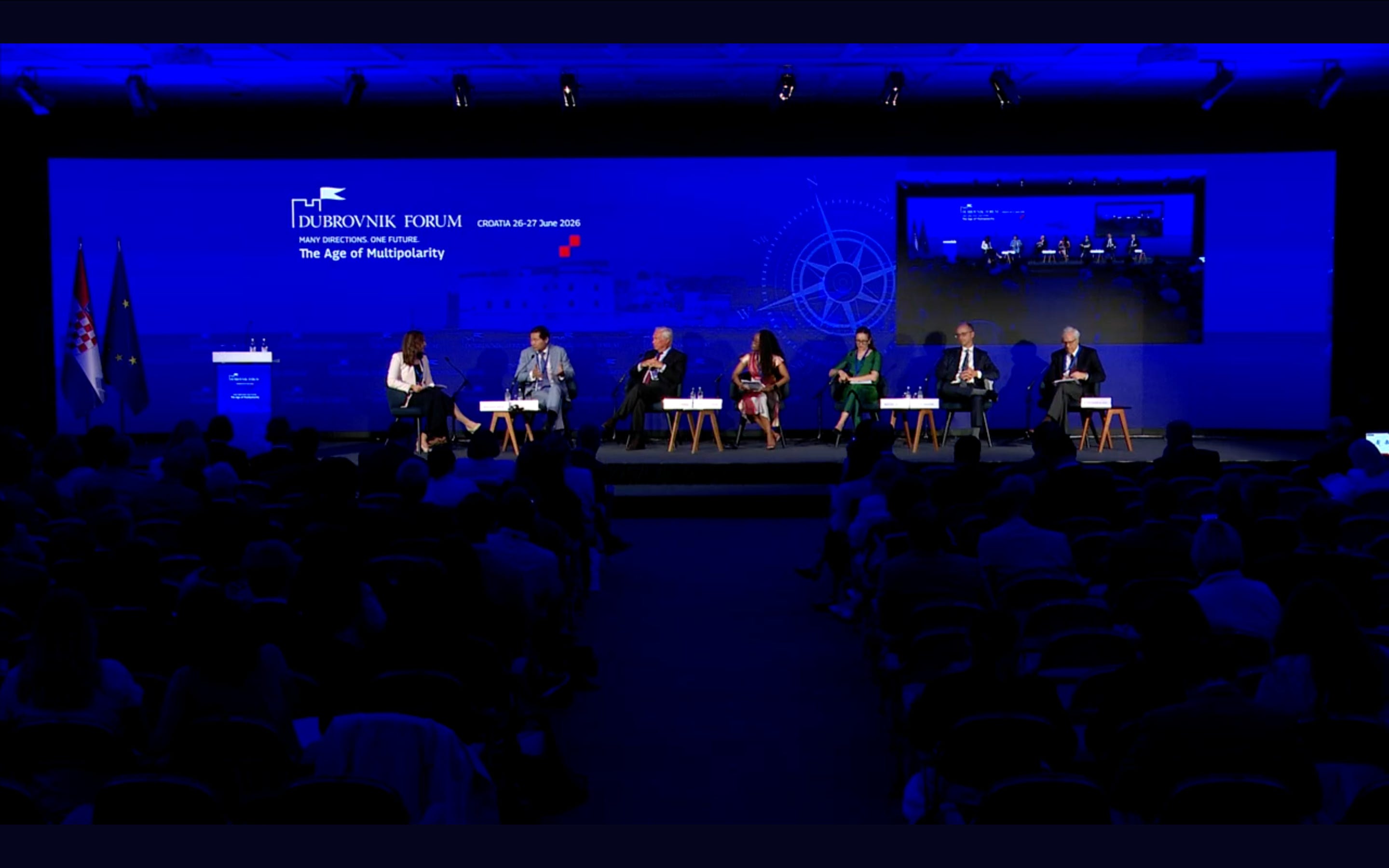
The video recording of the panel is available on CCG’s official YouTube channel.
The following transcript is based on the video recording and has not been reviewed by any of the speakers.
Mihaela Papa, Director of Research and Principal Research Scientist, Director of BRICS Lab, MIT Center for International Studies (CIS), USA
Minister Gerit Radman, Speaker Androsovich, thank you for your inspiring remarks and for welcoming and hosting us here at the Dubrovnik Forum. Good morning, everyone. I’m honored and delighted to moderate this think tank panel on “Emerging Powers in a Multipolar World: Many Paths, One Destination”. We are joined today by a distinguished group of experts bringing perspectives from across Africa, Asia, Europe, Latin America, and the United States.
I would like to introduce our panelists: Henry Huiyao Wang, Founder and President, Center for China and Globalization, from China; Charles Powell, Director, Elcano Royal Institute, from Spain; Luanda Mpungose, Outreach and Partnership Manager at the South African Institute of International Affairs; Rachel Rizo, Senior Fellow, Strategic Studies Program, Observer Research Foundation, from India; Daniel Kochis, Senior Fellow, Center on Europe and Eurasia, Hudson Institute, United States; and last but not least, Manoel Corrêa do Lago, Senior Consultant, Brazilian Center for International Relations, from Brazil. So we are very fortunate. Thank you so much for joining us.
We often describe the emerging order as multipolar, but it’s not always clear what we mean by “multipolar.” Does it refer to a more balanced international system, a more fragmented one, or simply a world in which many actors seek greater autonomy, multi-alignment, new partners, diversification, while still operating under the strong gravitational pull of U.S.-China competition? To assess whether emerging powers are becoming new poles in the order, we also need to ask: what makes a country a pole? Is it economic weight? Technological capacity, especially now in the AI era? Military power? Demographic scale? Institutional leadership? Or the ability to preserve autonomy under pressure?
So our discussion today seeks to address three questions. The first one: are we moving toward a genuinely multipolar order, or toward a new bipolarity? What forms of influence are emerging powers actually exercising? The second, how is this reconfiguration of the global order affecting multilateral processes, as well as U.S. and EU strategies? And finally, where do we see opportunities for constructive cooperation among emerging powers, and between established and emerging powers?
So for our first question, on the shape of the emerging order, I’d like to begin with perspectives from China, Brazil, and South Africa. Maybe the best place to begin is actually with China, because next year will be the 30-year anniversary of the 1997 China-Russia declaration on the multipolar world. And last month, President Xi and President Putin renewed that language, and renewed the initiative, in a new declaration on multipolarity and the new type of international relations. And we also saw President Xi met with President Trump, with a lot of talk about the crucial bilateral relationship for the world order. So is China’s vision genuinely multipolar, and if so, who are the poles — or are we entering a bipolar system? Maybe shall we start with Huiyao?
Henry Huiyao Wang, Founder & President, CCG
Thank you, Mihaela, for this great moderation. First of all, I’d like to thank the organisers for inviting me to this beautiful, scenic city that is famous in the world.
No, I think you’re absolutely right — we’re getting into a multipolar world now, and that’s already a reality. I remember, last year I was in Berlin, we kicked off the Munich Security Conference’s annual report. The title of the report was “Multipolarity.” I was one of the four panellists there to kick off that report. But since then, I’ve seen more recognition of multipolarity — of a multipolar world — because it’s already a reality that everybody seems to accept now.
So the challenge we’re having today is that we’re in a multipolar world, but we don’t have a multilateral system to support this multipolar world. So we’re in a transition, trying to reach some new equilibrium. So you ask, who are the new poles? Absolutely — I’m sure we’re here in Europe; the European Union is a pole. Of course, the United States is a pole. I think China is a pole. India and the Global South countries are poles too, and middle powers probably as well.
But the thing now is, we could have a new, big pole rising — the BRICS countries. For example, the BRICS countries’ GDP has already reached almost 40%, and they account for about half the global population, whereas the G7’s GDP has greatly declined and represents only about one billion people. So it’s quite a contrast. I see these two big — if you want to call it a bipolar bubble, there are two big poles like that, but ideologically very divided sometimes.
So what I hope is that, as we get into a multipolar world, all the countries, all the poles, must work together — like we’ve come to the Dubrovnik Forum to talk about this — and gradually build up a consensus. We need to reform the current multilateral system we established. For example, we’re not trying to turn away from the existing system, but to improve and enhance it a lot. We should reform the multilateral system — the UN, the WTO, and the WHO.
China actually plays a huge role now in supporting the existing system. The United States is withdrawing from 66 international organisations, and China is actually supporting many of them. President Xi recently has proposed the Global Governance Initiative. China is now the second-largest donor to the United Nations; it is the largest peacekeeping-troop-sending country among the P5. When the U.S. pulled out of the WHO, China announced it would donate 500 million U.S. dollars to the WHO.
So I think China is playing a positive role, contributing 30% of global GDP growth and becoming the largest trading nation with 140 countries. So I think, as one pole, China is going to be a stabiliser, a promoter, and a cooperator for the new multipolar world.
Mihaela Papa
Wonderful. I think it’s important to stress the entrepreneurial initiatives, and I think the World Trade Organisation is also one that’s getting reshaped.
So thank you, and let’s go now to Latin America and Brazil. Brazil has also long supported a more multipolar and representative international order, with an emphasis on avoiding rigid blocs and empowering multilateralism — especially in these big conferences, the multilateral diplomacy of sustainable development, which Brazil is really known for all over the world. So is Brazil’s vision of multipolarity similar to China’s, or where do you see the trends in Brazil? And also, if you could broaden out to some hemispheric challenges you see in the current order.
Manoel Corrêa do Lago, Senior Consultant, Brazilian Center for International Relations (CEBRI), Brazil
Thank you very much, and thank you very much for this invitation. We’re very honoured to participate in this forum, and I’m still under the spell of seeing Dubrovnik for the first time yesterday, going to the old city. I’m very much taken by this at the moment.
What I would say is that Brazil’s commitment to multilateralism is a very old story because when European powers were fighting among themselves in the late 19th and early 20th centuries, Brazil established each one of its frontiers — one with France, French Guiana; one with England, ex-English Guiana — and each with the other South American countries through negotiations and arbitration. So there’s not one inch of Brazilian frontier, which is the result, for instance, of conquest. Everything has been the result of the application of international law and the resort to arbitration.
So after the Second World War, when the United Nations was created and all the mechanisms were set up, Brazil was very active in the making of it, and we have no reason to believe that the best way isn’t the multilateral one — which in no way impedes the bilateral strengthening of ties. That’s why, for instance, Mercosur is so important to Brazil; BRICS is an important forum too.
You asked a very good question about what makes a country a pole. We believe there are all sorts of reasons for Latin America being a pole because we have almost 700 million people there. We probably have the largest biodiversity on the planet. We have, on the whole, a clean energy matrix. And if we take the Mercosur countries together, we’ve become a very, very important and successful food producer for the world. So there’s no reason we shouldn’t do the same in other areas as well.
And we understand that African countries can become poles too, and we see the extraordinary example of China over the last 30 years, and more recently of India — very remarkable achievements. So we look forward to a multipolar world where each continent develops its own applications.
And in the recent context of China and the U.S., we at Mercosur see, with great enthusiasm, the agreements we’re progressing with Singapore, with Japan, and now, very recently, the very important agreement with the European Union. So we very much look forward to seeing Europe — with its half a billion people and such important GDP — become more of a pole than it has been so far. So yes, we welcome a world of many poles.
Mihaela Papa
Wonderful, thank you. So turning to South Africa. From a South African perspective, does multipolarity create greater agency for African states, and what do you perceive in South Africa in terms of the debates and discussions on multipolarity?
Luanda Mpungose, Outreach and Partnership Manager, South African Institute of International Affairs (SAIIA), South Africa
Thank you very much, and it’s a singular honor to be joining this panel of think-tankers and knowledge producers of the world. I think I want to take a bit of a step back and reflect on the fact that when Africa enters global fora or global systems, it enters them already established. If you look at the birth of multilateralism and the creation of what we call the Bretton Woods system or institutions, we were on the periphery when those were created. And if you go on to look at the birth of a single hegemony, that was post-Cold War, when the U.S. kind of won the contestation with the Soviet Union — and there, again, Africa kind of positioned itself together with the Global South, forming the Non-Aligned Movement.
So we’re entering systems already established, and we play a very peripheral role — not by choice, but because of how the system has been set. Nevertheless, I think cooperation, and the underpinnings of cooperation, is why we think these systems are important, and we want to cooperate those systems, and be among the forebears of the rules and norms that make the global system we work within.
And I think I’m going to rely on the minister’s plea for us to have very frank conversations. Even as we enter these systems that have been put before us, it hasn’t been as though we’re recognised as equal players. It’s almost a contestation of geopolitical underpinnings, and basically we’re being mobilised to take sides. Nevertheless, I think what we increasingly are communicating as a region is that we actually have agency beyond that, and we’d like the global system to have rules that are fair and equitable.
But as it stands, it’s a question of whose rules, and who those rules apply to — because certainly, if a country in the Global South does something, the world reacts very strongly; however, if it’s a country in the Global North, we see that met with silence. So that level of hypocrisy becomes a very fundamental critique that we raise as South Africa, and largely as the African continent.
Nevertheless, I think the important thing is that we’re certainly headed toward a multipolar world — we’re probably already in it. But I’d argue it’s a multipolar world with very special features, because now we’re seeing the role of emerging markets and middle powers pronounced like never before.
South Africa is one of the BRICS member countries, and we’ve received a lot of criticism for being a member. In the initial stages, when BRICS was formed, it was looked at in the West as a counter to global cooperation and the multilateral system. But if you really investigate BRICS’s positioning, it’s actually emerged as a protector of multilateralism, at a time when the people who created the system have regressed and eroded the rules and norms we know to be fundamental and key.
So we look largely at these platforms of plurality as well as cooperation as a space where we can effect reform — both from inside the multilateral system and possibly even outside, creating alternatives that will work for the Global South. So certainly, multipolarity, from my perspective — but with special features.
Mihaela Papa
Thank you. I think the three speakers actually introduced BRICS as an important aspect of the multipolar debates. So to what extent do the three of you see BRICS evolving as a a building block for a future system, or, actually as I think Luanda you mentioned, something around which the core of the new system will be built? Because if we look, for example, at Russian statements, it’s very much the new system will be built around BRICS and the Shanghai Cooperation Organization. That’s a very different trajectory than BRICS being a building block of the new international system that needs reform, modernization, and upgrading. So what are your thoughts here? I don’t know who wants to start.
Henry Huiyao Wang
Yeah, perhaps I could add on that. I think that whether it’s BRICS or the SCO or others, it’s really a new form of a multipolar world taking place. But I do think they don’t want to throw out the old system or establish a new one — they want to cooperate within the system we already have.
And what I think is probably more important now is that the old system, the Bretton Woods system, reflects what was true 80 years ago. But a lot of things are happening now — climate, AI, pandemics, robotics. All those things are happening, and I think BRICS countries, and of course the G7, the G20, the UN — we should all work together. It’s just that we now have multiple stakeholders in this world, rather than only a unipolar or single-stakeholder world — everybody’s a stakeholder now, all these polar stakeholders.
So I think it’s a joint effort now, bringing all those big blocs together — but we need some anchor role from BRICS countries for some time, and also from the European Union and the United States too. So I think we need those big poles to work together for a better world.
Luanda Mpungose
So perhaps I’d say that BRICS was born out of a realization that middle powers or developing economies need to cooperate, and its mandate started as largely economic, vis-à-vis trade — and it morphed into a bigger global-governance project. And I think Henry has mentioned that the areas BRICS looks at now have expanded. We’re looking at AI, we’re looking at climate — the agenda is really expansive. And I think the fundamental underpinning there is largely the recognition that the system isn’t fair, and it’s responding to that.
But I think, increasingly, even beyond BRICS, there’s also another grouping called MIKTA, and many other coalitions that exist. The more the system is unfair, and the more systems and institutions are being weaponised against those considered the losers in the system, the more they’re going to want to innovate and come up with alternatives. If I look, for instance, at local-currency payments, that was born out of a decision by certain countries to impose unilateral sanctions rather than referring to a multilateral system, and we increasingly saw the weaponisation of that. So the more you do it, the more countries are going to want to innovate and look for alternatives.
So I kind of see BRICS as both — it is a system that’s challenging the current order, not because it wants to make significant changes, but because it wants reform and equity. But more than that, countries also advance their own interests, and some of those aren’t aligned with each other’s interests. But that’s important because then the consensus conversation comes to the fore; and BRICS is specifically interesting from my perspective because if there’s no consensus, a project, whatever it is, doesn’t move forward, and then they’ll agree to disagree and move on to other platforms. But largely, in areas that have been very difficult, they’ve been able to find consensus.
So Mihalea, I see it as largely a combination of the weaponisation of systems and the lack of reform of the current system to actually be fair and equitable — and that’s where BRICS is largely responding at the moment.
Mihaela Papa
Thank you. Any other comments on this?
Manoel Corrêa do Lago
Yes. I would say that we are so much in need of forums — sometimes some diagonal, transversal forums — so that specific questions are better addressed in those forums rather than in others. I think it would be a great mistake to look at BRICS as a sort of anti-Western mechanism. I think it is in the same way that the G7 is not an anti-Global-South mechanism. I think it gives immense opportunities for dialogue between countries that have not so far developed their relationships bilaterally, and I believe it enriches, let’s say, the diplomatic agenda by having this particular sort of outlook.
Now, of course, BRICS has to live up to its expectations. So far, I believe it’s still more a project than a reality, but definitely, it’s not a group set against another set of countries or groups. So that’s my view.
Mihaela Papa
I would certainly say yes to that, because the BRICS work I’m doing — actually, the data shows that most of the cooperation is sustainable-development, industrial-development, and development-centered.
So let’s go now to India, and Rachel if I can ask you to give us a sense. India seems to really be the master of multi-alignment, thinking about multipolarity and making the most of alignments, both with the United States and with BRICS. India is also currently chairing the BRICS group, but more broadly, what do you see the debates in India converging on, and where do you see the current situation?
Rachel Rizo, Senior Fellow in the Strategic Studies Programme at the Observer Research Foundation
Yeah, absolutely. First, I’d like to echo the other panelists in saying thank you for the invitation — it’s a beautiful city, and it’s wonderful to be here. I want to start with a little anecdote that can sort of frame whether we’re talking about multipolarity or bipolarity. There
were two really important meetings that happened last month. One got a lot more airtime than the other one. The first was a very highly publicized meeting between President Donald Trump and Xi Jinping. Trump went into this meeting, in my opinion, from a place of relative weakness — he needed to try to get the Chinese to help convince the Iranians to open the Strait of Hormuz, and needed a deal on critical minerals. We’re obviously having a different conversation today — this is a very fast-moving conflict in the Middle East.
But there was also another meeting happening simultaneously. This is the meeting of the BRICS foreign ministers, which took place in New Delhi. Now, my question for the audience is: which meeting do you think the Chinese foreign minister went to? He stayed in Beijing for the meeting with President Trump. So I think that gives you a good sense of how both the U.S. and China are thinking about this moment — neither label fits cleanly.
The U.S.-China relationship still organises a lot of the system’s gravity, especially on tech and security, but the texture of the world underneath it, I think, is multipolar, and India plays an important role here. I think the difficulty, obviously, is that when you look at a bloc like BRICS, there really isn’t an organising principle or a set agenda because there isn’t really a vision of what a non-U.S.-led multipolar order might look like, or how BRICS could use its collective power.
But I think India’s chairmanship is a useful lens because it shows the limits of treating BRICS as a coherent anti-Western bloc — as you were saying. What has India done? They’ve pushed BRICS toward more of an economic and institutional theme — looking at things like New Development Bank reform, local-currency settlement, supply-chain resilience, and away from the more confrontational oranti-Western framing that Russia and China might prefer in a bloc like this.
And I think this is exactly what you were saying, Mihaela; this is multi-alignment in practice. Multi-alignment has been a mainstay of Indian foreign policy for decades, and it will remain a mainstay of Indian foreign policy. India sits in BRICS and in the Quad simultaneously, and I think its chairmanship really reflects this — it can strengthen the Global South’s bargaining position without committing to a bloc identity against the U.S. or Europe.
Some things to watch out for. I think it’s important to look for potential friction — we’ll talk about China-India in a bit — potential friction with China over expansion, and any rhetoric about de-dollarisation. India has always hit the brakes on anything that reads as a unified currency challenge to the dollar.
But I think the bigger takeaway is that the BRICS chairmanship reveals the organisation’s internal coherence as much as it reveals its growing weight. And I think India’s year is a really good test case for whether BRICS can be a platform for several simultaneous models and strategies at once, rather than needing to coalesce around a single one.
Mihaela Papa
Thank you. So I want to now pivot a bit toward our second question: how does this reconfiguration of the order affect multilateral processes? Some of that touched on U.S. and EU strategies. How should the United States and the European Union adjust their strategies? Are they adapting existing institutions, being newly entrepreneurial, or how do you see their strategies evolving? Let me start now and bring in Daniel, please.
Daniel Kochis, Senior Fellow, Center on Europe and Eurasia, Hudson Institute, USA
Thank you for that — again, pleasure to be here. Dubrovnik is almost too nice a city to hold a conference in, as we were talking about earlier, but the fact that we’ve been able to bring so many people together here, I think, is a testament to the conversation we’ve already been having.
I think, similar to where I believe Rachel was going — I believe we sit right now in an unhappy, asymmetric bipolar world, more than a multipolar one. There’s the U.S. and China and their respective blocs. Neither is particularly happy with the current stage, but they’re both in it. I think there are many states that would like to see the emergence of a multipolar world order, but I don’t believe it has yet emerged because there isn’t a coherent structure outside of those two blocs.
I think the Trump administration believes that the unipolar moment is irretrievable; it’s not worth the investment to try to recapture. But they also believe there’s a need for shock therapy, both domestically and internationally, to best position the United States for long-term success in the world order as it now stands. So you see that animating some of the U.S.’s actions in Latin America, efforts on critical minerals, which have been a key focus of the administration. There’s also a focus, I think, on getting the American house in order internally — reconstituting the border, a key focus once again on manufacturing, and another is reforming U.S. defense acquisitions. It’s a Sisyphean task, perhaps, but one the U.S. believes is necessary to adapt to the challenges the country currently faces.
Internationally, the administration’s mantra is on fixing what they believe are unfair trade relations. And I think from the administration’s perspective, just a broad view, what the U.S. has been doing isn’t working, so let’s try to shake things up. Who would have thought that the Venezuelan government, for instance, would be touting, in their words, a joint operation with the U.S. to eliminate a drug kingpin, just a few weeks ago? This just shows you how quickly things are adapting and changing, in this reactive momentum of the administration.
And this animates, I think, as well, how the U.S. under President Trump is approaching Europe — it’s quite a bit about shaking things up. There’s once again a focus on demographics, a belief that the U.S. is trying to use shocks to change the European trajectory. Not all of these shocks, of course, have been well received — the Greenland example, of course, is the key one there. But I don’t see Europe evolving into its own pole. I think that would be a mistaken attempt to do so, and I don’t think it’s likely to happen. I think, just this week, the EU joined the Pax Silica. I think that’s very indicative of the fact that Europe is going to remain part of the U.S.-led Western bloc, rather than trying to constitute a pole of its own. And simply put, the scale of the challenge from the autocratic pole is too strong for the U.S. or Europe to overcome without the other.
So what is the U.S. doing right, and doing wrong? Well, I think some of its efforts on manufacturing, on supply chains, which will be a focus later in the day, have been a success so far. I do think there’s been some mismanagement of alliances, which I think is harming the ability of the United States and Europe to work together to address the state of the current world order. And I think there’s a real, missed opportunity so far from the U.S. in terms of how it’s engaging with other regions — with Africa, with Latin America. I mean, the United States currently has five, that’s it, confirmed ambassadors in Africa. By contrast, China is only lacking an ambassador in one country. Russia is expanding its presence in Africa, and the U.S., I think, is largely absent from the continent. So there are real, missed opportunities, I think, when you think about how the world is progressing.
Finally, maybe a word on the multilateral system from a U.S. perspective. I think, in its current form, there’s a belief in many corners of the U.S. that the multilateral system is simply no longer fit for purpose, and reforming many of these institutions has proven impossible, and these institutions won’t necessarily magically start delivering absent that reform. And so what’s possible, from a U.S. perspective, is developing new, “skinny” organizations, or groupings of nations with shared systems and values that can theoretically deliver in a better way than the multilateral system.
We had, in April, the U.S. Trade Representative, and he encapsulated this view when he talked about the WTO, saying the U.S. put forward ideas and reform papers, other countries sent proposals, but the organization simply is unable to reform, and therefore, in his words, we probably need to get back to smaller groupings of more like-minded countries. And I think that’s, probably in many ways, the dominant view — at least from the conservative side of the political spectrum in the U.S. But I think it has some resonance elsewhere too. So I don’t foresee a return to the multilateral world order as we once knew it. The U.S. is unwilling, and perhaps unable, to enforce the rules. Europe can diplomatically and institutionally support multilateralism, but cannot enforce the rules. And I don’t think the two dominant blocs I started my remarks on agree on even what the rules are, or whether they can or should be followed. So I don’t see a renewal of the multilateral system. I think it’s going to be much more these smaller groupings, and hedging behavior.
Mihaela Papa
Thank you. I wanted to follow up on two points. Is your sense that the United States is pursuing primacy? Is it political, is it economic — in light of the National Security Strategy? That’s the first follow-up. And the second: there are different debates in the U.S. about whether Trump is a multilateral president or not. Obviously, multilateralism at the universal level is different from multilateralism at a less-than-universal level. So, are we now seeing the end of primacy ambition, or do you see it differently, based on the National Security Strategy?
Daniel Kochis
I think there’s a recognition from the administration and from the U.S. that the world is simply a bipolar world order — that the challenge the U.S. faces is, in many ways, much more significant and multifaceted than it was during the Cold War, and that the idea of recovering primacy is a mirage. But at the same time, I think there’s a recognition that the U.S. is quite vulnerable; and so the shock, for instance, of the critical-minerals stoppage was a true shock to the administration and has informed some of the ways it’s behaved since. So what
they’re trying to do is shore up the areas where the U.S. is especially vulnerable, and this pressure, I think, is also animating the way it’s behaving toward its allies — much like Athens, when it was feeling pressured by Sparta, kept pressing its allies. I think the U.S. is doing the same thing — feeling the pressure from the Chinese-led bloc, and it’s animating the way it’s pressuring its allies to move quickly in alignment with the United States.
And that, of course, has some downsides, because you can press too hard, and I think in some cases the U.S. has done that, and it’s hampered its ability to work together with its European allies. But frankly speaking, I don’t see that relationship is going to endure. I don’t see that changing. I don’t know if it’s an end of ambition for primacy, but I think it’s a recognition that that world has passed, and we’re in a bipolar world order, and the U.S. needs to do many things in order to compete and survive in the system as it currently is.
Mihaela Papa
Thank you. So, Charles, please — turning it over to you: could you tell us more about the perspective you see from the EU? And feel free to comment on anything else you’d like to.
Charles Powell, Director, Elcano Royal Institute, Spain
Thank you — it’s lovely to be here. Since we’re on EU territory, let me try to say something nice about the European Union. But before I do, Mihaela, thank you for your moderation and for all the exchanges we’ve had prior to this event.
Intellectually and academically, it’s interesting that all of you, except one speaker, assumed that we’re living in a multipolar world — and yet we can’t actually name the poles. We don’t have a list of poles. I find it interesting, for example, that there are nine countries in the world with nuclear weapons. Surely that makes some states more important and relevant than others, but I’d be reluctant to regard North Korea as a pole. I’d be reluctant to regard Pakistan as a pole, and I have my doubts about the state of Israel as a pole. These are countries that perhaps punch above their weight, but I don’t think they’re poles.
So I think we need to think more carefully about what we mean when we talk about a multipolar order, and I agree with our American colleague, in the sense that I think we’re transitioning toward something, and it’s still unclear whether the destination will be a multipolar world, or perhaps a G2 bipolar world. The Trump-Xi Jinping summit was mentioned. What I found interesting about that is that they both seemed pretty comfortable with the idea of a G2 world. That was my impression. Perhaps a declining power having to adjust to decline, and a rising power, already fully risen in many ways — China — beginning to enjoy the fruits of being a superpower, and acknowledged as such by the declining power. So the jury’s still out on whether we’re actually moving toward a multipolar world.
What about the European Union? Well, this is also very interesting, because in all its official documents, the European Union supports multipolarity; it claims to look forward to the emergence of a multipolar world. But fascinatingly, it never describes itself as a pole. And that’s not entirely surprising, because — what are we? We’re a union of 27 sovereign member states. I always argue we’re, above all, an internal market of 450 million people, which isn’t nothing.
Remember, the EU, with a population of only 6% of the world’s total, produces about 17-18% of the world’s economy — that’s not insignificant. But internally, we’re very reluctant to regard ourselves as a pole, and I think that has a lot to do with our history, the history of European integration. We are a project for peace. We were born to avoid a fourth Franco-German war, after the 1870 war and the World Wars. We’re a community of law, and I still believe we’re a normative power, and this means we find it extremely difficult to think in terms of hard power, of military power. Although, by the way, last year we spent €380 billion on defense, which is not much less than what the Chinese claim to spend. And I say “claim,” because my Chinese colleague will correct me — there’s a bit of a debate as to the accuracy of official Chinese figures. But be that as it may, we’re spending a lot on defense.
But we’re reluctant to see ourselves as a pole, for lots of reasons. The four or five largest states
— Germany, France, Italy, Spain, maybe Poland — all have their own ambitions. But at the same time, as the great Belgian politician Paul-Henri Spaak said, Europe consists of two kinds of states: small states, and small states that haven’t yet realized they’re small. And I include France and Germany in that, frankly — even the countries with populations of more than 50 million are actually rather small states, and Germany is beginning to discover this, I think.
So, to quote a former, recently deceased Spanish foreign minister, “we’re a herbivore surrounded by carnivores,” and in a sense, we’re very ill-suited to do well in this increasingly transactional world. Now, I’d like to think the EU may one day decide it wants to be a pole, but we’re certainly not there yet, as far as I’m concerned.
Mihaela Papa
Thank you. So, during our discussion, initially, a question of middle powers emerged, and there was recently a very important speech by Mark Carney on middle powers — with some dramatic elements, “either you’re at the table or you’re on the menu,” and so on. And that made me reflect: is there any middle-power coalition you’d find that’s really a successful example — let’s say, if Mark Carney’s idea went forward, that would be the path to follow? So I wanted to go to Luanda on the question of IBSA — India, Brazil, South Africa. This was a major middle-power coalition, and I still remember the South African foreign minister, before South Africa joined BRICS, saying she hoped BRICS would strengthen IBSA — but then we’ve seen BRICS basically overtaking a lot of IBSA’s agenda. So from your perspective, why didn’t this middle-power coalition thrive as much as BRICS, or what does it take to make a middle-power coalition thrive? And then, if I can ask the rest of the panel to think about which is a successful middle-power coalition that you’d like to highlight — one that Carney’s speech might potentially point to as, “oh, this is the middle-power coalition that worked.”
Luanda Mpungose
Yes, thank you very much. Mihaela, with your permission, I just want to react to one or two things, and then I’ll come to the question. I think our colleague raised an interesting point about U.S. ambassadorial representation in Africa currently, and what that speaks to in terms of relations with that region. And I think a fundamental thing that’s increasingly intolerable, in this current order and this global system, is the paternalistic, finger-wagging behaviour we see toward countries considered less powerful.
And here I want to bring in an anecdote of what’s currently happening in South Africa. We’re one of the countries that were fortunately allocated an ambassador, who’s just started. But even before the ambassador had the chance to present credentials to the president, he was already in the media, behaving in what we consider undiplomatic ways — very critical of the government, very critical of our foreign policy and relations with certain countries. But if you look across the Atlantic, to the U.S. — a South African ambassador to the U.S. was participating in a webinar where he called President Trump a white supremacist. He was immediately expelled and given 72 hours to leave the country. So that kind of attitude toward relations with Africa — I don’t think there’s space for it in the current global system, and as the U.S. tries to push, I think the Global South will also push back even more.
And we also see that in Latin America, with the whole Huawei debacle, where the U.S. wanted Latin America to take a certain position, but Latin America introduced this concept of non-alignment — which is not the same as neutrality — and we’re seeing this concept emerge again. We know the Non-Aligned Movement of the Cold War era, and now there’s also this new non-alignment, which is really underpinned and enforced by: we’ll advance our relations based on our national interest and our foreign policy. So I just wanted to make that emphasis, provoked by the interesting points that were brought before
Before I speak about middle powers — I think it’s important, we’ve all acknowledged that the world isn’t the same. We heard it during the opening remarks, and I think, more or less, all the colleagues here have acknowledged that. If you look at what’s happening in the WTO — I mean it’s correct — we’re looking at plurilateral approaches now. But the question is whether the plurilaterals are undermining the fundamental principles of multilateralism. That’s why you find countries such as India and South Africa blocking the plurilaterals — and I think South Africa has now conceded, because it was under a lot of pressure, that it’s blocking progress. But it’s interesting to me that we speak of progression as plurilaterals because what does that say about multilateralism? So South Africa now supports this but won’t be participating in the plurilateral approach. India, however, is still blocking it, because it’s fundamentally safeguarding the principles of multilateralism.
So, the role of middle powers now, and it’s not just something that emerged with the speech by Prime Minister Carney. In fact, we’ve been saying this for quite some time in the Global South, but it seems as though he was met with the moment, because when he made that speech in Davos, it really transcended and created a moment globally.
But really, we’ve been saying this — if you look at speeches by our foreign ministers, and probably some of our African governments, we’ve been preaching the concept of partnerships between middle powers, partnering to ensure we have fruitful alternatives that will complement the multilateral system.
So, in terms of whether we’ve defined the rules of this current order, you find out what the rules are if a Global South country invades another country. However, the rules become ambiguous if the U.S. captures a sitting head of state, whether he’s right or wrong. From a principle of multilateralism, the global order, capturing and detaining a sitting head of state — where does that fall in the rules? It’s very ambiguous in that case, but when it’s Russia invading Ukraine, you see that coming out quite significantly.
And perhaps I’ll end with the role of Europe. We in Africa are very confused sometimes by the response we see emerging from Europe. We consider Europe a very important player in the global system, and yet, when South Africa took the Palestine matter to the ICJ, for the first couple of months, where it was really significant to see Europe emerge and say something, it was quiet. And yet, on Ukraine, countries in Africa were being pressured to condemn Russia. So again, it’s this hypocrisy and double standard that leaves us a bit dumbfounded. But nevertheless, I think the role of middle powers currently is to safeguard the rules. We know what the rules are; they’re defined in instruments and frameworks. And I see, increasingly, middle powers coming together to be the norm entrepreneurs and safeguards of the current rules and norms.
Mihaela Papa
This is a very important point — if anybody would like to respond?
Charles Powell
Carney is my hero, can I say this in public? But he said “medium powers,” and then which ones did he mention? He said Canada should work with the EU, with Australia, with Japan. He’s not really talking about medium-sized powers, he’s talking about like-mindedness, and that’s a completely different kettle of fish completely. I don’t see a coalition of medium-sized powers adding anything significant to the equation. The real question is: are we still dividing the world into democracies and autocracies? I think we’re not — I think that ship sailed, sadly, in my view, in many cases. He’s really talking about like-mindedness, countries that share a similar worldview and a similar view of multilateralism, which has very little in common with Chinese or Russian interpretations, and probably North American ones under the Trump administration as well .
Mihaela Papa
Yes, Rachel, and then—
Rachel Rizo
I think we should also look at the potential growth of the relationship between the European Union and India. If you look back at this year, two major things happened in January, in New Delhi. First, the EU and India signed a free-trade agreement, “the mother of all deals,” as they call it. Ursula von der Leyen was Prime Minister Modi’s guest of honor at the Republic Day celebrations. This is an FTA that had been under negotiation for over 20 years, and, in my opinion, the of the Trump administration, and the desire to create something new and build new partnerships, really gave the two sides the momentum they needed to get this over the finish line.
But the second thing that happened in January, alongside the FTA, was that the EU and India signed a Security and Defense Partnership, which offers an EU-wide framework to build the relationship with India that’s already being driven by member states within the EU. So there are a few things here: first, you can look at real defense-industrial-base cooperation between the two sides; you can look at supply-chain resilience; you can look at the green transition. But you could also look at something that I don’t think gets as much airplay or much discussion, which is that students are looking to go to other places besides the U.S. now, specifically Indian students. So when you look at mobility, and at youth partnerships, Europe is becoming a real destination for Indian students, as they look at the United States as a less desirable market. So we’re really losing out there, and the EU is really gaining.
Mihaela Papa
Yes, go ahead.
Manoel Corrêa do Lago
In a certain way, the EU is proof that middle powers can get together and achieve important, successful results, though, as Charles has mentioned, the EU, with its 27 members, hasn’t formed, let’s say, a single political unit.
But we haven’t, in our discussion so far, put Russia into the equation, and we’ve been raised in a bipolar world where Russia is other side. Still speaking about Europe — if, as it may be happening, the war in Ukraine, against all expectations, after four years, is maybe taking another turn; is it not the first success of a united Europe, in the sense that Europe has taken the responsibility of giving this sort of support? I’m very impressed by the consequences of these four years, in terms of the weakening of some of the elements that cemented the world order before — for instance, the fact that Syria has changed; the fact that you don’t have the Venezuela-Cuba connection any longer. I think what seemed to be a certain axis is no longer present, and maybe this is a consequence of the fact that Europe faced a very difficult situation on the Ukrainian front.
So, looking back at Latin America and the particular case of Brazil — of course, we welcome diversification, developing as many relationships as possible, as a country with Brazil’s potential. But definitely, the United States is the most important relationship we’ve had for the past century, and it’s been a very fruitful one. So we look at diversity and multipolarity, not as something against country X or Y, but as reestablishing a certain type of balance, and maybe establishing some sort of deterrence too, against the idea that countries have to follow only their own paths.
I believe the recent developments around Mercosur, the trade agreements, and the potential for cooperation between Latin American countries — for instance the case of critical minerals, which they can develop together, not to the exclusion of other investors, but which they can also develop on their own. I believe it’s more a reestablishment of balances, rather than something in which you’re facing off against other countries. So that’s how I’d look at it. But again, if I may return the question — how do we put Russia in the equation? We’re speaking about poles, and we haven’t spoken about Russia so far.
Mihaela Papa
All right, so Huiyao if you’d like to take that over?
Henry Huiyao Wang
Okay, great. I think we’re having a very fascinating discussion: you ask about the future of the multipolar world, and I hear our colleagues asking, “Where’s the pole? What’s the future?” It’s not really happening yet, but actually, I tend to agree, probably, with our American colleague, that it’s probably a little bit bipolar now. President Trump was in Beijing, and he was also saying “G2” and all those things, right? So that’s a possibility. So I envision that we’re actually getting a new multipolar world — maybe there are two major poles, but also many other middle poles as well. Multipolar doesn’t mean all poles are the same size — it could be two major poles, but then some other poles too.
But then the problem is, how can we achieve this new equilibrium among the major poles? And I see something happening. In the Trump era, phase one, he was talking about strategic rivalry with China; now, in his second term, he came to Beijing and said, let’s have strategic stability, a constructive one. So that’s a shift. I think if the U.S. and China can maintain strategic stability, which I think they’re trying to do. We’re going to see President Xi visit the U.S. in September.
We’re going to have the APEC summit, Trump coming to Shenzhen, and then the G20 summit, with the president going to Miami. We’re going to see a lot of exchange between these two poles.
But I think that’s probably exactly what’s happening with the middle powers. We’re talking about middle powers. Middle powers actually don’t have to pick sides now. As Charles just said, it’s no longer autocracy versus democracy where we have to really pick by the merits. And that’s what Carney said too. He came to Beijing, too. Carney made a lot of comments about importing 50,000 Chinese EV cars, lifting all the tariffs on China, against what the U.S. has done. So I think that’s a good example. In this future multipolar world, you have two major poles, but then other mid-size poles too, and they don’t pick sides now; they actually work with whoever’s right, whoever’s useful, they don’t pick a side.
And an important thing, I think, China is doing right, is joining RCEP. You talk about the most successful cases, RCEP is very successful. RCEP is China’s largest trading partner. And of course, China also has the China-Africa summit, the China-Latin America summit, the China-Arab summit, the China-Central Asia summit — covering all the regions, economically focused, rather than military or security focused.
So I think, if that peaceful competition remains between the two major poles, all the other poles will see — okay, whoever benefits us, we don’t have to pick sides, we choose whatever’s useful for our own country. So I think that’s probably the future of the multipolar world, and that new equilibrium would really be better than the former Soviet Union-U.S. dynamic, because it’s not ideologically driven — it’s economic development and sustainability driven. And that’s where China is leading — leading the green powers, leading in all those areas; that’s why we see all the G7 leaders coming to Beijing, except Japan, this year. And that’s why we’ve seen, when you talk about autocracy versus democracy — you see how democracy works in the UK; in 10 years you’ve changed seven prime ministers, right?
So what I’m saying is, you can’t blame China’s success just on its autocracy — it’s not just that; China has a meritocracy, a consultative democracy, so the system works well. So I really think the future multipolar world will be really merit-based, and you’ll have two major poles, but the middle powers now have the best of the world now; they don’t belong to any side, but they can really push the new equilibrium toward the betterment of the world. And that’s probably the future version of the world.
Luanda Mpungose
I mean, as an African, for me, positionality is always so interesting, and I’m intrigued by the perspectives from the two panelists, because if I’m hearing correctly, it’s the importance of non-alignment, being able to choose your own partners and compete in a peaceful manner, and also an element of pragmatism — you choose your partners based on your interest, as long as it’s peaceful, etc.
But I think there’s a certain level of exceptionalism I also want to highlight, again, in this room — from where we sit, as Africa, we don’t get afforded that. It’s almost like our partners want to choose for us who we must partner with and cooperate with. I mean, just as I was flying here, I saw a tweet by the U.S. ambassador, who was highly critical on social media of our deputy president’s state visit to China, as well as another engagement we had with Iran. And again, the South African government came out and criticised this undiplomatic behaviour.
But I think the meat of what they’re saying is that we’re a country free to exercise our own foreign policy, and we exercise non-alignment based on the explanation I provided earlier. And what they’re saying is: the U.S. is criticising South Africa for cooperating pragmatically with certain partners, and yet they themselves cooperate with those same partners. So what does that tell us, from an African perspective — are we also afforded this pragmatism and non-alignment that’s emerging from the discussion here, which seems to be playing out quite well for other partners in different spheres of the world? So it’s just an interesting thing I wanted to bring to the forum.
Mihaela Papa
I think the U.S. was mentioned many times — if you’d like to respond? I mean, how do you see the Trump administration now, in terms of emphasizing economics versus military relations? And if you have any comments, Daniel.
Daniel Kochis
I think this is sort of a prelude to what the administration views as another round of more active competition. Thinking about Carney’s comments, in some ways, what he was actually speaking about was hedging behavior of these middle powers that sit within the Western bloc. So you have the EU’s deal with India, now India isn’t buying Russian kit, nobody wants to buy Russian kit, so there’s opportunity for European firms. The French, I guess, are going to work with the Gulf on maybe a new fighter jet. So there are opportunities within the system, but I think that’s what he’s talking about are sort of alignments within an alignment. But beyond those blocs, I don’t see much that would really coalesce these middle powers to be able to work together outside the traditional blocs.
For the U.S., economics are a key tool the administration is trying to use to achieve more security ends. You’ve seen that with tariffs, you’ve seen that with favored rates — I think that’s the way the administration is trying to use economic tools to achieve security ends. So I think that is the sort of way I would think about that.
Mihaela Papa
Thank you. Any other comments? So I think we’re ready for our final theme — opportunities for constructive cooperation among major powers. Let’s start with Rachel, where do you see the opportunities for cooperation? I know you’ve been both in the U.S. and now in India — both between emerging powers, and between so-called old and new powers.
Rachel Rizo
I’ll talk specifically about the opportunities between India and China, a relationship that gets a lot of discussion, especially in New Delhi. But I think it’s difficult to talk about this relationship without sounding aspirational and naive, so you have to keep it pretty narrow and focused. And right off the bat, you have to name the asymmetry in this relationship pretty
honestly, which is a relationship defined by an unresolved border. There’s a massive and lopsided trade deficit; and on top of it all, there’s real, deep strategic mistrust. Who’s Pakistan’s number-one arms supplier? It’s China, and it has been for a very long time — decades. So any cooperation between these two powers needs to be built on top of these realities; you can’t just pretend them away.
But I think there are real openings that are functional and economic, rather than strategic. Look at, for example, climate and clean-energy supply chains; China dominates solar and battery manufacturing, and India needs to scale up fast. This is an area where economic logic could potentially outrun politics, if we allow it to, and that’s a good thing, if both sides let that happen. I think there are multilateral venues where both sides share an interest in reforming the system, rather than confronting one another — certainly not as allies or partners, but more as fellow travelers, I would say. Look at things like WTO dispute-settlement reform, voice and representation at the IMF and World Bank, coordinating on debt-relief mechanisms for the Global South. These allow India and China to cooperate on reshaping rules without requiring trust on security issues.
But I think border-de-escalation mechanisms remain the precondition for almost anything else. There was a 2024 step toward disengagement, where India and China reached an agreement on patrolling along the Line of Actual Control in Ladakh, and this matters, I think, less for what they resolved than it does for showing that both sides still want a functioning crisis-management channel. So, at the end of the day, I think this is a relationship not moving toward a partnership in any meaningful sense, but one where both sides are testing how much transactional cooperation is really possible while strategic competition continues underneath.
Mihaela Papa
Thank you. So turning to Huiyao — when Chinese policymakers think about potential conflict, what relationships are they most concerned about? Are they more concerned about the U.S.-China relationship, the China-India relationship; how would you paint the picture?
Henry Huiyao Wang
Yes, thank you, Mihaela. Great question. What I think Chinese leaders and the Chinese government have emphasized many, many times is that the core interest is the Taiwan issue, cross-strait relations. I think if the U.S. doesn’t take a very aggressive posture and recognises the One-China principle, things are really okay. I think that’s why the U.S. now realizes they want a bigger piece. President Trump said he wants to be “president of peace” in his inaugural speech. He wants to help settle the Russia-Ukraine conflict; he wants to settle the Iran-Israel-U.S. conflict, and he needs China. Foreign Minister Wang Yi has phoned over 30 some foreign ministers to calm down all sides on this peace deal, and President Trump openly thanked China for supporting the Iran-U.S.-Israel memorandum of understanding. So you see China is behind a lot of things happening for securing peace.
I think the U.S. also recognizes China’s interests. I’m glad to hear President Trump said, “Okay, we’re not going to send soldiers to Taiwan, 9,500 miles away, and we don’t want to interfere, and we’re going to temporarily hold weapons sales.” That’s good progress.
But further — our colleague mentioned China-India relations. I think China and India, as the two largest countries, are the most populous in the world, with almost three billion combined population. They are two leading positions within BRICS. I don’t see any reason why we can’t get along well. Of course, we had border clashes before, and Russia’s had border clashes many times too, but we can normalise relations. I see no reason we can’t normalise with India, because I remember, in the ‘80s, China was trying to learn from India, when India’s GDP was almost the same as, or even larger than, China. Now China’s five times larger than India. So I think there’s huge complementary collaboration and cooperation possible, because we have the same infrastructure issues, the same environmental issues, the same green-power issues, the same communication issues. There’s a lot of room for China and India to work together.
And not only that, but internationally, on the political stance, we both safeguard the Global South, we safeguard BRICS countries. I don’t see a reason we can’t work together. Foreign Minister Wang Yi is in India right now, meeting Modi; and the BRICS summit in India this year, I think, will be a good occasion. Our leader will probably go again this year. So I think there’s a great opportunity for the two countries to set aside their small differences, and really take the interest of the whole world, the whole Global South, into account — and of course, work with Europe, with the U.S., with everybody.
So I think — India is the leader of the Non-Aligned Movement. As Tito used to do in Yugoslavia — why not? Not taking sides is probably the best thing, and China always supports the Non-Aligned Movement. I really think India and China have a huge opportunity, because there’s so much economic potential to work together, and at the end of the day, it’s really the economic benefit, the livelihood of the people, that counts for a government to sustain itself.
So I don’t think temporary geopolitical alliances make much sense. And these days, we already have a big deterrence — there’s no need for war. So I think China is a peaceful, stabilising factor for the region, for ASEAN. Recently, China helped calm down the Cambodia-Thailand conflict too. So I don’t see conflict happening. China hasn’t invaded any country for many decades, has not colonised any place, never established a military base anywhere — whereas the U.S. has 7-800 military bases. China has 8,000-plus economic projects worldwide. That’s the difference. That, I think, is why China, India, and all the Global South can work together.
Mihaela Papa
So, thank you — I think it’s interesting, especially in terms of India-China relations, how optimistic you are about it. One area we forgot to mention, and I wanted to bring it to everyone’s attention, is the G20. Do any of you have thoughts on whether the G20 plays an important role as an opportunity for collaboration across major powers, or do you see it moving in another direction?
Henry Huiyao Wang
Maybe I can add on that. I published an article in Foreign Policy about six months ago about the G20. I think the G20 should be involved with the UN Security Council, because the G20 is well balanced — there are 10 Global South countries, 10 Global North countries, and it represents 85%, even 90%, of global GDP if you include the African Union.
So it’s really important to get the G20 into the Security Council. The current Security Council is only about 15 countries; let’s get a G21 there, five permanent members, another 16 associate permanent members. We can probably stop the abuse of the single veto, like Russia and the U.S. have vetoed over 100 times, and China has vetoed 20 or 30 times; let’s reform that. Then we can really have a more powerful, new power structure to reflect this multipolar world, giving balanced power — not only that, but also reforming the World Bank and IMF, with China and India, to reflect that.
Mihaela Papa
All right, any other thoughts? G20—
Luanda Mpungose
I’ll come in. South Africa, of course, was presiding over the G20 in 2025, and we’ve now been disinvited from participating in the current G20. And I think, for me, that cooperation showed that different thinkers, different markets, and different powers can cooperate and work together effectively.
If I look at the G20 championing some of the key global-governance issues — a meeting of the G7 countries and a lot of the Global South countries as well — for me, it represents a platform where we can dialogue on issues, and even though our standpoints differ, we can arrive at some sort of consensus. It’s an interesting space. While we’re currently in a space of dissensus, unable to agree on a lot of things as countries, it’s a space where, ultimately, we can make compromises and move the process forward.
So I think it’s a different experiment, an interesting project for that reason. But the world is increasingly changing, and I think we’re also seeing the rise of plurilateral approaches, especially on trade issues, and I think some of us thought President Trump’s term would just shake things up a little, but we would be able to go back to normalcy once he finished. But at this point, I think the world has been shaken up so much that “normal” doesn’t exist anymore, and we have to rethink our strategies to suit this new normal we find ourselves in.
And I think, for me, the future of cooperation also needs to consider how we interact with one another in a fair, equitable, and respectful manner, as equal partners of the global system. And certainly, with the rise of IBSA, and IBSA morphing now into BRICS and other formations that will come up, they’ll still need to cooperate with the West and with other formations, because ultimately, cooperation is underpinned by us coming together and moving the agenda forward. So certainly, the G20, for me, is a prime example of how we can reach that cooperation.
Mihaela Papa
Wonderful, thank you. So I think we’re now at the last panel before lunch, and I’d like to give an opportunity to all our panelists for some final thoughts. I promised we’d leave on a positive note. I want to ask if there is any institution, diplomatic practice, or something that gives you hope, that inspires you for the future of the world order, and thinking about multipolarity — where are the opportunities that inspire you? Whoever wants to start, or we can just go straight down the line. [laughter] Manoel?
Manoel Corrêa do Lago
Yes, well, I think the multilateral institutions — some of them, maybe even bilateral institutions, like Mercosur — I think, even though Mercosur hasn’t so far fulfilled its promises, it’s taken a new path in the last two years. We look with great expectation at the
EU-Mercosur agreement, for instance. I think it can have very strong implications. I think we have to think about the problems of the system that was created in the postwar period, but we can’t throw it off completely. I think it’s an important heritage we have to stick to, at least in its philosophy of respect for rules, for international law, for the sovereignty of each country.
And I think, as Henry pointed out, there’s much we can work together on. A recent example, going back to the Mercosur-EU agreement — apparently, Brazil and Argentina would be in very different ideological positions, which I question if this more a stereotype than a reality? Both countries were absolutely enthusiastic about the agreement, and they worked together. So the fact that you have elements of polarization — you have the Amazonian countries, the boundaries with French Guiana, Colombia, Peru, Ecuador, Venezuela, and so on. We have a common cause against organized crime, which has become transnational. So there’s no reason for us not to cooperate with other countries that want a common activity in relation to this.
So I’m optimistic that pragmatism on issues common to us can become stronger than some of the labeling we’ve been living through, and that we can go after small successes which add up together.
Mihaela Papa
Thank you. Daniel, moving on to you — what gives you hope?
Daniel Kochis
I think Ukraine has turned the tides. We’ve seen the failure of multilateralism. We can’t get much of the Global South to vote against Russia’s aggression in Ukraine in the UN system. We’ve seen a failure there, but I think the realities on the ground give me a lot of hope. I think it was the Saab CEO who recently said the most important thing the Western bloc can do is fully incorporate Ukraine’s industrial base into the West — and I have hope there.
And I do think that China has, in the past, played a role in warding off Russian nuclear ambitions or potential escalation in that war. But China is still, of course, the main supporter of Russia’s aggression. Russia couldn’t propagate its war without Chinese assistance. So I do think there’s more that could be done there, and maybe there’s an opportunity, if the reality on the ground is such that the cost overrides the potential gain in that relationship.
And I do think the U.S. and India can do a lot in terms of manufacturing. I think we’ve only really scratched the surface of that potential. So there are some areas that I have hope for; but multilateralism, I am a little bit more dower on.
Mihaela Papa
Thank you so much. Rachel, please, briefly?
Rachel Rizo
Yeah, I’d just echo what Dan said. I think we’re moving toward an era
— I guess you could say going back to an era — of “coalitions of the willing,” when multilateralism becomes broken. You see emerging partnerships between countries that want to get things done, and can get things done, and I think we’ve seen that especially with the Europeans in Ukraine. So that’s what gives me hope.
Mihaela Papa
Luanda?
Luanda Mpungose
I’d say it’s institutions and humanity, specifically if you look at the ICJ process, and how the world is now coalescing around that process at the ICJ, with the objective of preserving humanity. What’s happening in Palestine is now a humanitarian crisis, and it’s resonating around just humanity. I think that gives me hope that the world can still make a difference.
Mihaela Papa
Thank you, Charles?
Charles Powell
What I liked most about Mark Carney’s speech was that he acknowledged that the so-called “rules-based liberal international order” has never existed. This is basically what the French philosopher Voltaire said about the Holy Roman Empire in the 18th century — “it’s not holy, it’s not Roman, and it’s certainly not an empire.” So the liberal international order was never complete; it was an aspiration, and millions of people throughout the world felt excluded from it. So let’s not get too nostalgic about something that never existed. Moving forward, there’s a lot actually happening underneath the surface. And at the risk of sounding nerdy, next month, the International Telecommunication Union will be meeting in Geneva, hosting the seventh summit on Artificial Intelligence for Good. We’re all worried about artificial intelligence, and we don’t really have an international, global framework to deal with it — but there are still modest, discreet multilateral initiatives, such as the ITU, doing an extremely good job, which rarely gets mentioned by the media.
Mihaela Papa
Thank you. And please, take us home.
Henry Huiyao Wang
Thank you — I’ll be brief. What gives me hope, what still makes me optimistic? Well, I think there are quite a few factors. I see the multilateral system weakening, but the poly-multilateral system is actually strong — like RCEP, for example, the largest free-trade agreement in the world, and now China’s largest trading partner. Of course, the CPTPP too. You saw Australia and Japan take it over after the U.S. exited it, and now the UK has become part of it, the European Union is interested in it, China is interested in it. So I see that still happening. And, of course, the AIIB, Asian Infrastructure Investment Bank, and the New Development Bank — all those things are still happening.
So I’d think that, of course, we still have the European Union, which is still there, and RCEP, which is still pretty strong. So we see the world, on many fronts, still advancing multilateralism, even as the global system as a whole has been weakening. But I think we’re now getting a multipolar world, and we need everybody to work together for a better, multilateral future.
Request for Help
I am seeking urgent assistance from anyone willing and able to examine my case independently.
I am the victim of a state-financed entrapment programme orchestrated by the Norwegian security apparatus. The process began in early 2009 with a series of coordinated provocations and psychological torture intended to break me down psychologically. Over time, I came to understand that the purpose of these provocations was to produce manipulated recordings and fabricate security-related threat narratives that could later be used against me.
Since then, I have been subjected to prolonged containment through controlled environments designed to isolate me, systematically torture me, and ultimately gain psychological control over me. This campaign has been sustained over many years by the Norwegian security apparatus. Its objectives have been to engineer false narratives, systematically spread them through formal and informal networks, isolate me, continue systematic torture within controlled environments, and ultimately use me as a “Manchurian candidate” in a false-flag security operation.
Norwegian security agencies operate extrajudicial campaigns through networks presented publicly as anti-radicalisation cooperation. In reality, these networks function as de facto extrajudicial courts involving religious institutions, community leaders, and criminal elements. They are used to facilitate torture, entrapment, and smear campaigns against victims while concealing the role of those directing the operations.
Norwegian security agencies operate with the acquiescence of higher authorities, enabling them to use state institutions to fabricate evidence and narratives, manipulate official and medical records, conceal torture, silence victims, and obstruct independent legal remedies. Political figures, public officials, professional associations, healthcare providers, NGOs, private individuals, and members of the general public are influenced through false narratives, incentives, coercion, or other means to participate in social and political engineering while maintaining the appearance that their actions are independent and spontaneous.
Norway now functions as an authoritarian system operating behind the façade of democratic institutions. Security cooperation between Western states, together with their influence over international human rights organisations, has created an environment in which meaningful scrutiny is prevented. Rather than conducting independent investigations, many organisations knowingly or unknowingly reproduce the same fabricated narratives generated by the security apparatus.
Throughout this process, I have been systematically prevented from learning the allegations being constructed against me and prevented from responding to them through torture and containment. Every attempt to report torture, challenge fabricated narratives, or obtain an independent investigation has resulted in further retaliation, additional fabrication of evidence, and deeper containment.
Today, I remain unable to break free from this system. The containment extends far beyond state institutions and incorporates individuals within my wider social environment. My communications have been continuously monitored, making it extremely difficult to communicate safely or obtain genuinely independent assistance.
I am not asking anyone to accept my account without scrutiny. I am asking for an independent examination of the evidence, conducted from first principles and free from reliance on institutional narratives that form part of the system I am asking to have investigated.
If you are able to assist, or know an individual or organisation with the independence, integrity, and expertise necessary to examine this case objectively, I would be deeply grateful for your help.
Independent scrutiny is the only path towards establishing the truth and restoring accountability.