

The following is an English translation of a Chinese-language press release approved by the Beijing Representative Office of the Paulson Institute.
On June 10, 2026, the Center for China and Globalization (CCG) hosted its 24th VIP Luncheon at the China World Hotel in Beijing, featuring former U.S. Treasury Secretary Henry M. Paulson, Jr. as the guest speaker. Under the theme “Evolving China-U.S. Dynamics and Global Strategic Outlook,” the event brought together participants for discussions on China-U.S. relations, global economic trends, two-way investment, industrial and supply chain adjustments, artificial intelligence, financial stability, and global governance.
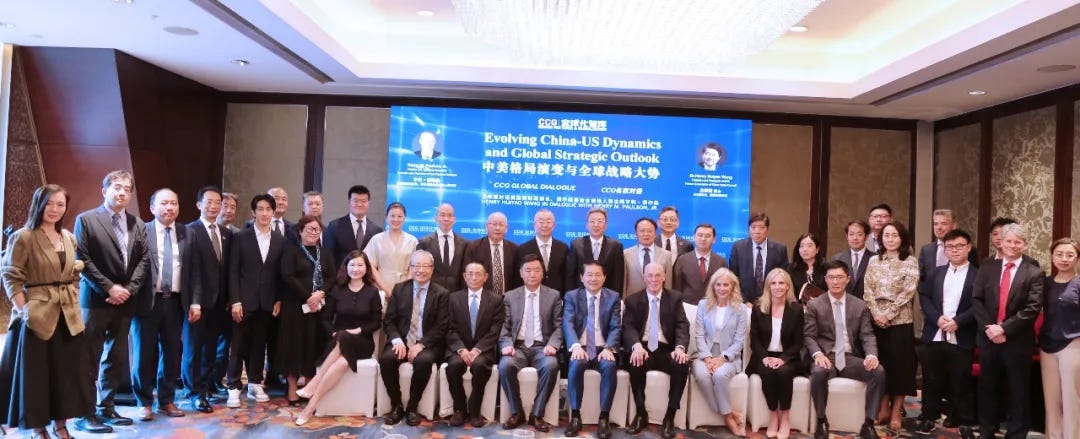
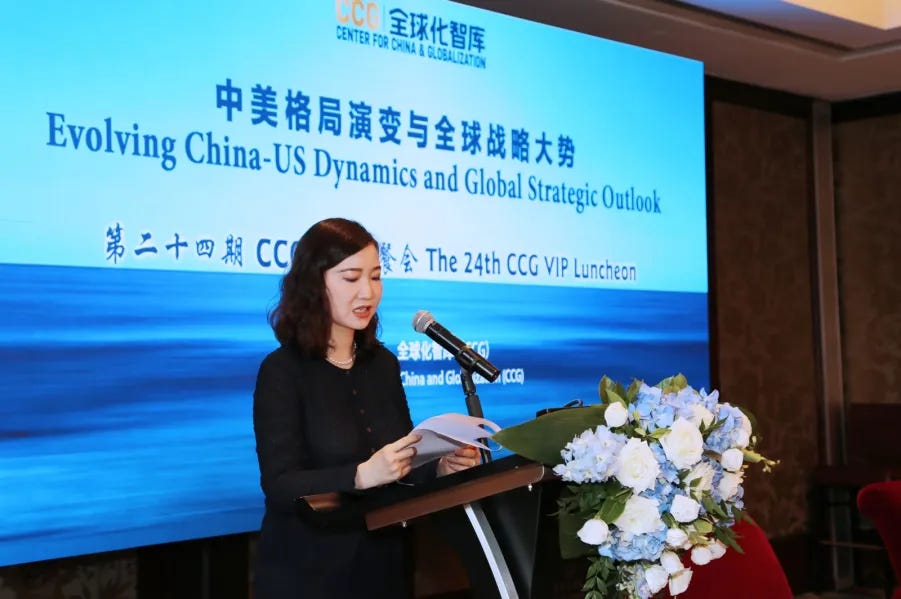
The luncheon opened with remarks by Mabel Lu Miao, Co-founder and Secretary-General of CCG, and was moderated by Henry Huiyao Wang, Founder and President of CCG and former Counsellor to China’s State Council. Henry M. Paulson, Jr., former U.S. Treasury Secretary and Founder and Chairman of the Paulson Institute, attended as the special guest. Representatives from embassies in China, international organisations, government agencies, multinational companies, academia, and the media also joined the event.
In her opening remarks, Miao said the CCG VIP Luncheon is a high-level international exchange platform designed to connect leaders from government, business, academia, and other sectors, and to promote practical dialogue and cooperation between China and the world. She noted that, against the backdrop of profound changes in the international landscape, accelerated restructuring of global industrial and supply chains, and continuing breakthroughs in new energy and core technologies, stronger strategic communication and trend assessment have become increasingly important. Inviting Paulson to exchange views with Chinese and international guests, she said, reflected CCG’s hope to deepen discussion on global economic trends, the future direction of China-U.S. relations, and broader strategic issues.
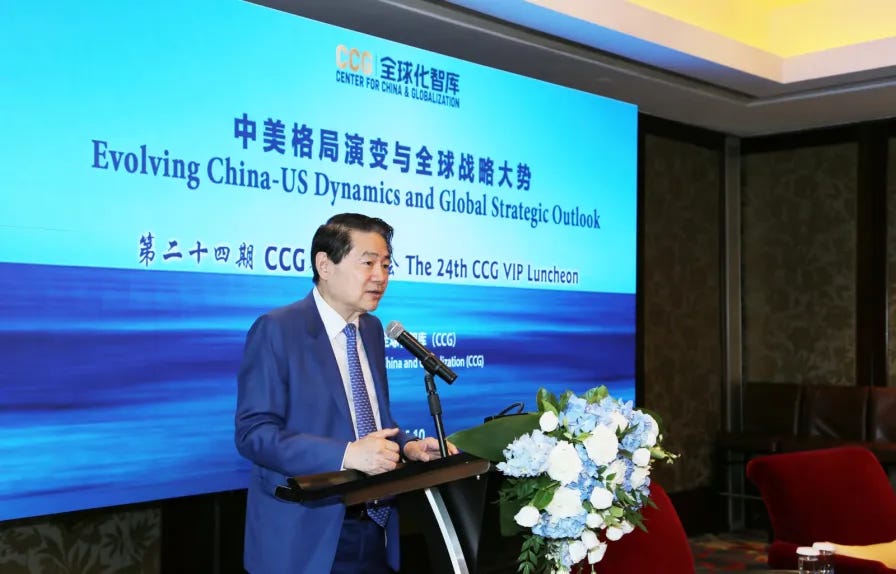
In his opening remarks, Wang welcomed Paulson and all guests to the 24th CCG VIP Luncheon. He said China-U.S. relations have entered a new phase, making it necessary for both sides to strengthen communication, reflect on past experience, and look to the future amid a complex environment.
Wang noted that Paulson has long been active in business, public policy, and environmental affairs. He served as the 74th U.S. Treasury Secretary and helped lead the U.S. policy response during the 2008 global financial crisis. Before that, he spent 32 years at Goldman Sachs, where he served as Chairman and Chief Executive Officer. He later founded the Paulson Institute, which has long focused on China-U.S. relations, economics and finance, environmental protection, and sustainable development. He also serves as Executive Chairman of TPG Rise Climate, supporting climate finance and environmental initiatives. Wang said Paulson’s extensive experience in finance, corporate leadership, public policy, and China-U.S. relations offers valuable insights into the complexity of the bilateral relationship and its global impact.
Paulson then shared his views on China-U.S. relations and the global strategic landscape. “We all know that the U.S.-China relationship is the most consequential,” he said. “I have consistently argued for a high-level economic dialogue, because I saw the benefits of this when I launched the Strategic Economic Dialogue as Treasury Secretary.”
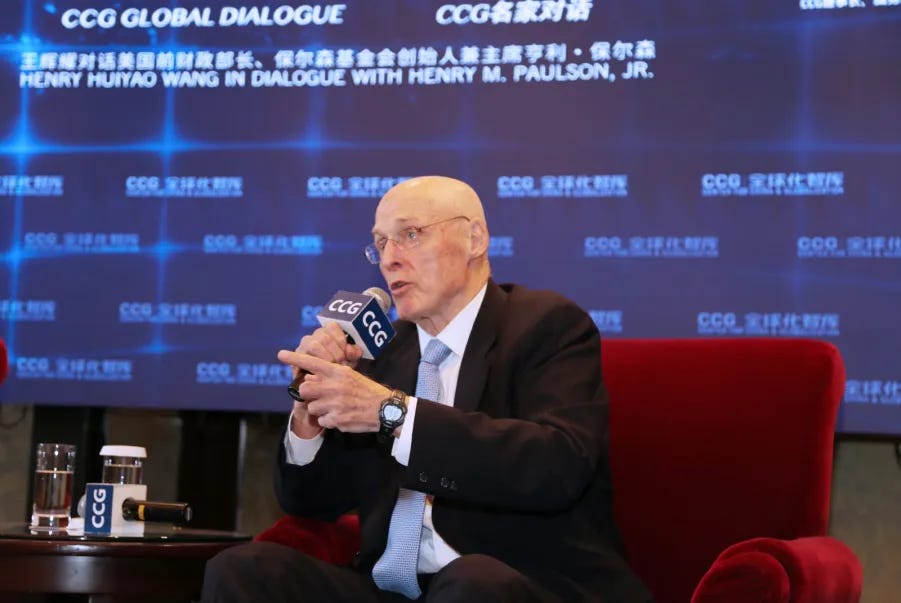
He said both countries will take measures they believe serve their own security and economic interests. “I believe that there are plenty of areas for us to work together with China to our mutual benefit in the economic area,” Paulson said. “But we have to be careful here and really think strategically. So we have to be careful that decoupling doesn’t become dysfunctional.”
He said, “In this major power rivalry, I think it is really important that each side recognises the other as a great power…that we have really robust dialogues in the economic and security areas and that we work hard to find areas where we can cooperate and work together mutually. The trick is going to be, while we’re intensely competing, that we have guardrails, so we don’t devolve into military or economic conflict.”
He further noted that the basic stability of the current bilateral relationship rests on the fact that both sides understand the other has the capacity to inflict serious damage on its economy, and that neither country can easily bear the cost of a trade war. He described this as “mutually assured economic disruption.” At the same time, he said, the trust deficit between the two countries is far more serious than the trade deficit. Many major global challenges cannot be addressed by any single country alone, and cooperation between the world’s two largest economies is the best starting point for solving them. This is why meetings between top leaders are so important. The work is difficult, but highly meaningful. Although the relationship has remained relatively stable and made some progress, it remains deeply challenging, and both sides still have a long way to go.
During the dialogue, Wang said recent meetings between the Chinese and U.S. heads of state had injected a measure of stability into bilateral ties and that “a constructive China-U.S. relationship of strategic stability” offers a new narrative space for the relationship. He noted that China and the United States both carry major responsibilities on issues such as global peace, financial stability, AI governance, public health, and climate change, and should build mutual trust through deeper and more frequent communication.
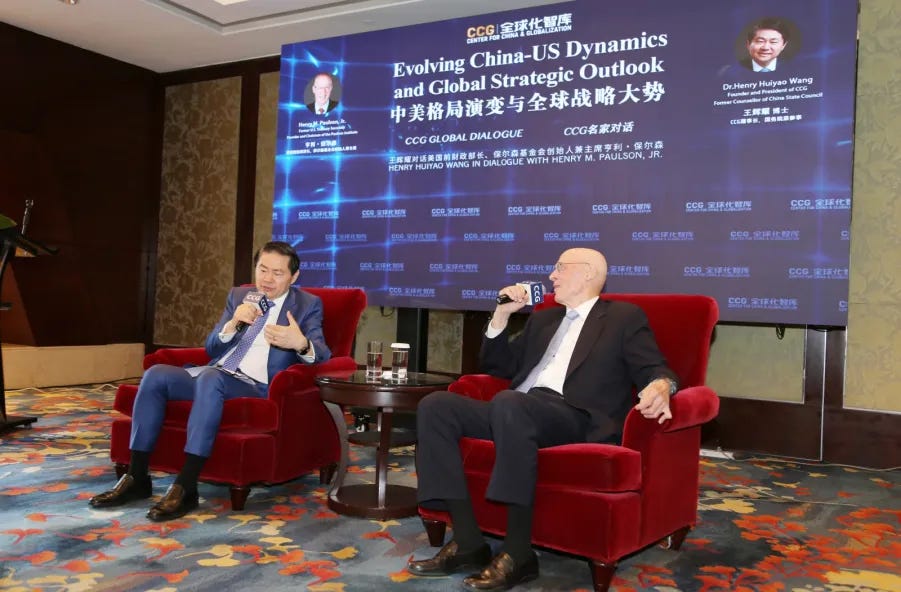
On how companies should respond to geopolitical risks, Paulson said, “I’m being approached all the time by corporate CEOs asking for advice on China. So this is something I’m living continually, and I give different advice depending on the industry and the company’s competitive position internationally and in China.” He added, “If they [a company] are a leader globally and they want to continue to be a leader globally, you walk away from China at your own peril. You have to understand this market, and you can’t understand it unless you come here.”
Paulson said China’s level of foreign direct investment is far lower than many outside observers assume. “I really do believe China is going to want the investment,” he said. “Investment has even slowed down here among Chinese entrepreneurs, so they’re going to want the investment, they’re going to need the investment, and this is one area I think we can work on in that dialogue. So when we look at the Board of Trade and the Board of Investment, that is something that I think would be constructive to work on.”
He also noted that China’s exports may reach USD 1.5 trillion, creating two problems: first, such a large export volume could place pressure on some economies in Europe and Asia; second, it could easily trigger trade frictions. China is also paying close attention to this issue.
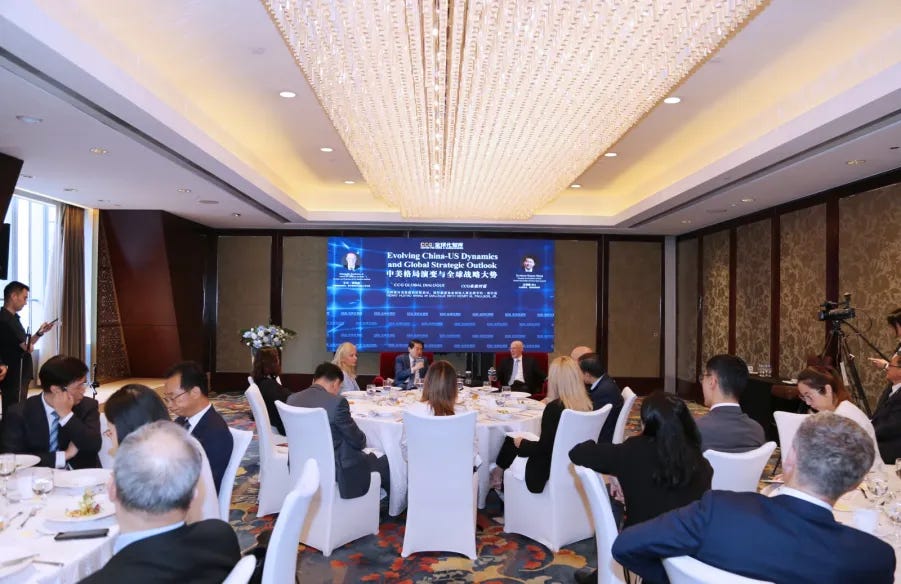
Wang said that as Chinese companies increase their overseas investment, clearer investment standards and policy boundaries established through relevant mechanisms between China and the United States would help facilitate two-way investment.
On artificial intelligence, Paulson said AI is an area where the United States and China urgently need to work together, though the two sides remain far from achieving effective cooperation at this stage. Raising the issue, he said, is only the first step. Countries must first clarify their own approaches before they can jointly develop the essential rules for AI governance.
Turning to the global biodiversity crisis, Paulson said the Paulson Institute is devoting significant effort to an important initiative: a redo of a groundbreaking study on financing nature to address the biodiversity crisis. “Here, the situation has gotten worse, and so the problem is accelerating,” he said. “We’re looking ahead to the Biodiversity COP17 in Armenia. But this report is going to be — hopelessness is the enemy here. So we’re going to focus on all the progress that has been made, on new strategies, new projects that can work if they’re rolled out and at scale.”
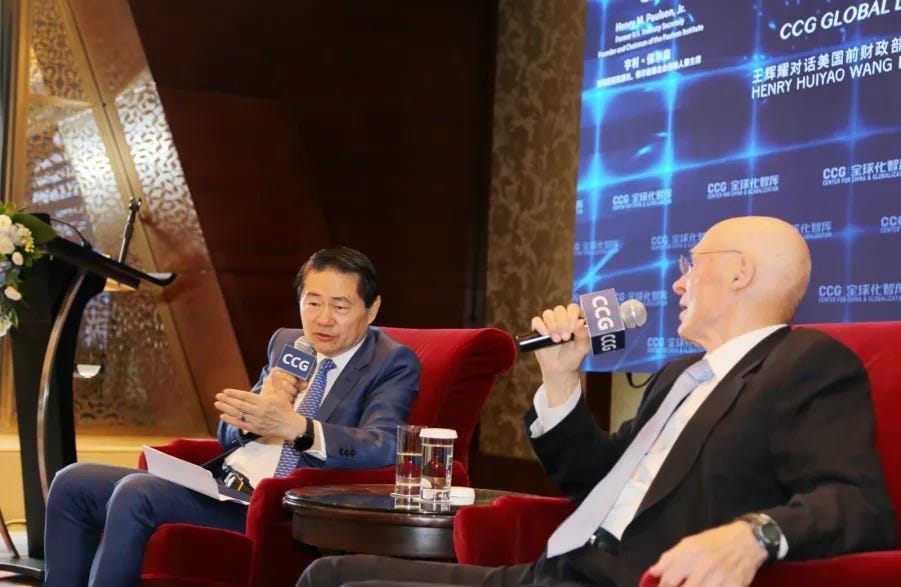
During the Q&A session, Zhu Hong, former Minister at the Chinese Embassy in the United States, asked about the U.S.-China Strategic Economic Dialogue mechanism and the outlook for bilateral economic and trade relations. Erin Zhang, Head of Government and Regulatory Affairs at Goldman Sachs, asked about the path forward and priorities for the investment working group following the meeting between the Chinese and U.S. presidents. Song Dongze of Phoenix News asked about the AI investment boom, the risk of an AI bubble, and whether ordinary investors can use AI to support investment decisions. Du Yubin of CGTN asked about climate change, China-U.S. green cooperation, and opportunities for Chinese companies to participate in related fields. Ji Xiaoyu, Founder of Haileybury Schools, Tianjin and Chair of Murong Capital, asked, from the perspective of a technology investor, whether the AI boom could trigger systemic risks similar to the 2008 financial crisis or the bursting of the internet bubble, and whether China and the United States could cooperate on crisis prevention and management. Paulson responded to questions on China-U.S. economic and trade communication mechanisms, two-way investment, AI risks, climate change, and financial crisis prevention.


Chinese experts attending the luncheon included Ma Jianchun, President of the China Society for World Trade Organization Studies and former Director-General of the Department of Foreign Affairs at the Ministry of Commerce; Huang Rengang, Vice President and Secretary-General of the China Society for World Trade Organization Studies; Huo Jianguo, former President of the Chinese Academy of International Trade and Economic Cooperation under the Ministry of Commerce; Jiang Shan, former Director-General of the Department of American and Oceanian Affairs at the Ministry of Commerce; and Zhu Hong, former Minister for Commercial Affairs at the Chinese Embassy in the United States.
International guests included Marcos Galvão, Brazilian Ambassador to China; Roland Reiland, Luxembourg Ambassador to China; Marshall Mills, IMF Senior Resident Representative in China; Michael Harvey, Counsellor for Financial and Professional Services at the British Embassy in China; Yannick Mondy, Economic Counsellor at the Canadian Embassy in China; Inga Dora Petursdottir, Deputy Head of Mission at the Embassy of Iceland in China; Parulian Silalahi, Deputy Head of Mission at the Embassy of Indonesia in China; Bumtsend Gombo, Deputy Head of Mission at the Embassy of Mongolia in China; Le Trung Kien, Economic Counsellor at the Embassy of Vietnam in China; Callum Douglas, Senior Strategy Consultant at the Asian Infrastructure Investment Bank; Helena Xiao, Director of the Columbia Global Center Beijing; Sihan Bo Chen, Head of Greater China at GSMA; Zhang Minwen, Special Adviser to the Chair of the International Sustainability Standards Board and Director of the IFRS Foundation Beijing Office; Zhou Weidong, China Director of the World Business Council for Sustainable Development; and Fu Zhuorui, Assistant Economic Affairs Officer at the United Nations Economic and Social Commission for Western Asia.
Representatives of the Paulson Institute also attended, including Deborah Lehr, Vice Chairman and Executive Director; Kelley Folino, Chief of Staff to the Chairman and Chief Operating Officer; Yu Jiang, Chief Representative of the Paulson Institute Beijing Office; Sun Rui, Senior Adviser and Executive Director of the Green Finance Center; Ren Tingting, Deputy Chief Representative of the Beijing Office; Terry Townshend, Advisor; and Vicky Beal, Executive Assistant to the Chairman’s Office.
Corporate representatives came from Goldman Sachs China Securities, Merck China, Cargill China, BP China, HPE, Rio Tinto China, Trina Solar, Marubeni, RELX, iKang Group, FinVolution, and other companies.
Journalists from Reuters, the South China Morning Post, Global Times, Beijing Daily, Phoenix News, CGTN, and China.org.cn also attended the event.