

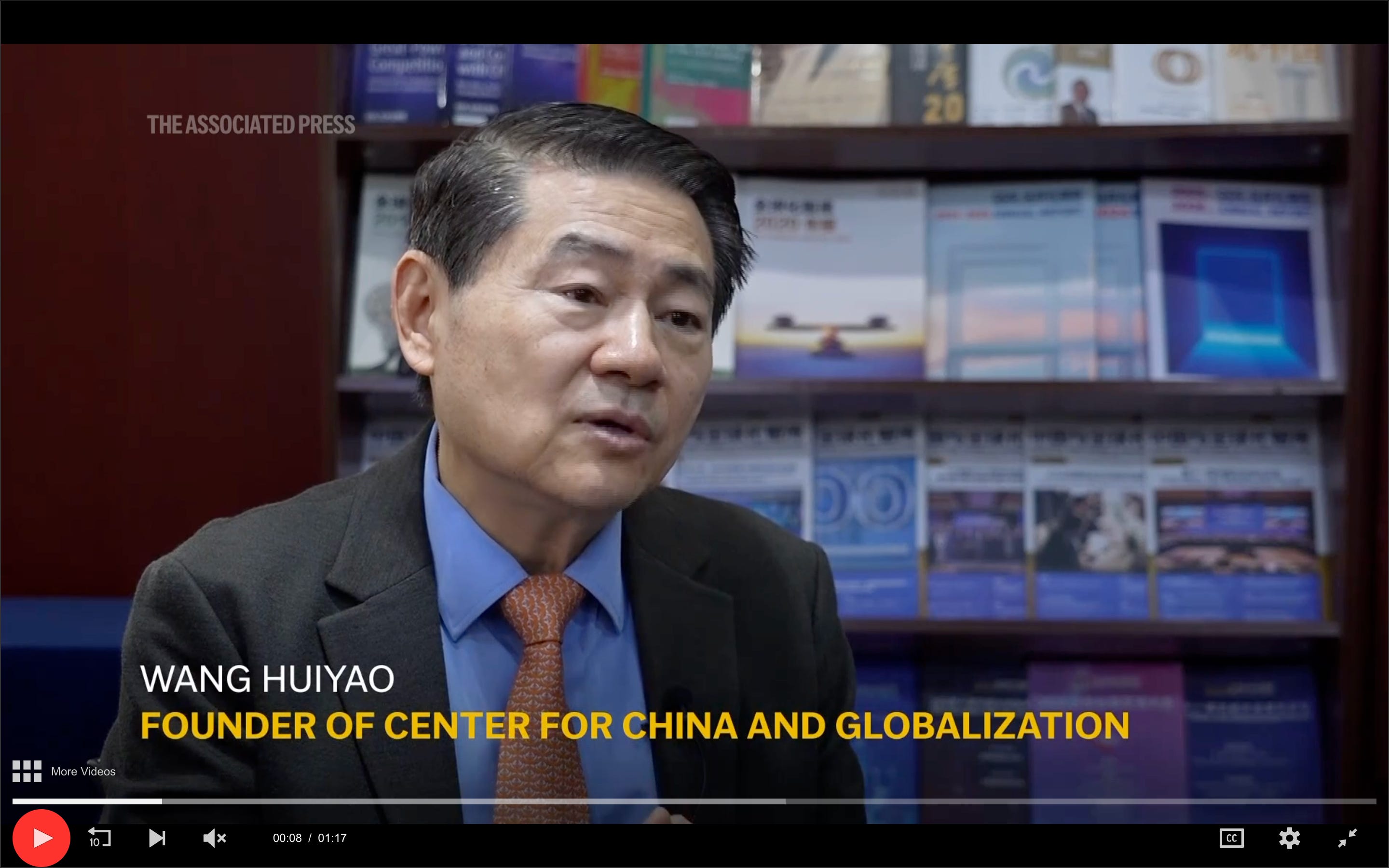
In an interview with Associated Press (AP), Henry Huiyao Wang, Founder and President of the Center for China and Globalization (CCG), discussed the significance of the upcoming APEC Economic Leaders’ Meeting in Shenzhen and its potential role in strengthening regional cooperation and global stability.
Video footage featuring Wang is also included in two AP reports: “Experts hope first China, US, Russia summit will carry significance beyond Asia-Pacific region” and “APEC host city Shenzhen offers a window into China’s technological ambitions”.
On October 1, 2026, at Valdai Discussion Club in Russia, Wang raised the possibility of a trilateral meeting between Chinese President Xi Jinping, U.S. President Donald Trump and Russian President Vladimir Putin directly with Putin during a televised plenary session. He also asked what role China could play in promoting peace, facilitating negotiations and potentially supporting peacekeeping efforts. Putin responded that such a meeting was possible, adding that its prospects would depend largely on China as the host and on the three countries agreeing on an agenda. CCG Update reported the exchange, and Putin's response subsequently received coverage from Reuters, Wall Street Journal, and other international media outlets.
The proposal gained further momentum in the weeks that followed. After the White House and the Kremlin confirmed plans for the meeting, China officially announced on November 16 that Xi, Trump and Putin would hold a trilateral meeting in Shenzhen on November 19, on the sidelines of the APEC summit. The meeting, now set to take place tomorrow, will mark the first trilateral gathering of the three leaders.
The following transcript is based on a recording and has been lightly edited for clarity. It has not been reviewed by the speakers.
AP
So first of all, as a platform, APEC has experienced many global and regional changes since its establishment. Against the current backdrop of the international situation, what role can APEC, as a platform, still play in maintaining regional stability and cooperation?
Henry Huiyao Wang
Yes, I think APEC has been established for a long time, right? It used to be a very effective platform and mechanism because the Asia-Pacific region accounts for over 60 percent of global GDP. It brings together countries around the Pacific Rim, including the largest economies, like the United States and China. You also have Canada, Australia, Japan, New Zealand, Chile and Mexico. All these major Pacific Rim countries are represented. So I think it was really a great platform.
However, over the past few years, there has been quite a bit of slowdown, particularly because of the U.S. The Asia-Pacific framework itself is mainly an economic platform to promote regional integration among Pacific Rim countries. But since Trump’s first term, he has not attended quite a few APEC summits, and the U.S. also proposed the Indo-Pacific concept. So there has been a bit of confusion between these economic platforms. The Indo-Pacific sounds more like a geopolitical alliance. As a result, the Asia-Pacific framework has been diluted quite a bit.
But this time, things are different. I think, for the first time in a number of years, all 21 economies will be represented by their leaders at the Shenzhen APEC summit. That’s enormous because it includes President Trump, of course, and President Putin. President Putin hasn’t attended a global summit with Western leaders for at least five years. So this time, he’ll come. He’ll be meeting leaders from Western countries like Japan, Canada, Australia and, of course, the U.S.
I also think this is the first time in a decade that China has hosted such a major summit involving Western leaders. The last major summit we had was in Hangzhou in 2016, about a decade ago. Now, 10 years later, China is hosting the APEC summit in Shenzhen.
So this is a really great opportunity to revitalize and innovate the APEC platform, and to really strengthen it as the largest economic integration platform in the world. I think this summit has great significance. First, it’s going to revitalize APEC.
Second, it’s going to put more emphasis on economic cooperation, investment and economic activities against the background of trade protectionism, trade wars and tariff wars.
And thirdly, for the first time in many years, the U.S., Chinese and Russian leaders will gather together. They’re going to have a meeting on the sidelines, probably for the first time since Cairo, more than 80 years ago, that the leaders of China, Russia and the U.S. have had a joint meeting. This is very, very significant.
AP
So, about this year’s leaders’ meeting: What do you think this year’s meeting can realistically achieve, in substance? Considering the differences among APEC economies in their economic interests, strategic priorities and geopolitical considerations, what do you think it might achieve?
Henry Huiyao Wang
I think there are quite a few things we can probably look for.
First of all, I think they’re going to re-emphasize economic cooperation among Asia-Pacific countries. So far, we have already had many ministerial meetings: meetings of finance ministers, foreign ministers, trade ministers and forestry ministers. Many ministerial meetings have been conducted throughout China’s host year. So I think a lot of consensus has been built in terms of strengthening the global economy and the trading system.
You can see that President Trump has just suffered a major setback in the midterm elections. I think the Democratic-controlled Congress and Senate will push him more towards reducing trade frictions and trade wars. So that will probably be reflected in this APEC summit as well.
Thirdly, I think free trade has always been the long-term objective of the Asia-Pacific region. At one time, the U.S. and many other countries proposed a Free Trade Area of the Asia-Pacific, or FTAAP. Even though that is a very long-term objective, I think people still want to see how they can collaborate. Of course, I think they’re going to work towards more general consensus on how to strengthen the multilateral trading system and coordination among APEC economies. They may also reach agreements on some specific issues.
So I’m quite optimistic that the APEC summit in China will be very successful.
On top of that, there could also be a role to play on some geopolitical issues. For example, how to develop global measures to contain inflation, how to control energy prices and how to calm down geopolitical conflicts. I think there are particularly high hopes for this summit in that regard.
I was actually in Moscow last month. I raised a question to President Putin when we had a Valdai Club meeting there. I asked him what he thought about the prospects for APEC, whether it would be possible to have a trilateral leaders’ meeting between China, the U.S. and Russia, and what he thought about China’s role in promoting peace, mediating conflicts and peacekeeping.
He gave me a very positive answer. He’s really looking forward to the APEC summit, and he will come personally. He’s looking forward to a China-U.S.-Russia trilateral summit on the sidelines of the APEC summit. He also warmly welcomes any efforts by China to promote peace, mediate conflicts or even engage in peacekeeping.
So the Shenzhen APEC summit, with this trilateral meeting, but not limited to that, could also provide an opportunity for many other leaders’ meetings to play a role in this turbulent world. This includes addressing the terrible wars happening between Russia and Ukraine, and between the U.S., Israel and Iran.
So I think the APEC summit could become a more stabilizing factor in promoting global peace, development and prosperity.
AP
Regarding this possible trilateral meeting that you have just mentioned, what do you think are the chances of it happening in Shenzhen this time? If it happens, what do you think its significance will be for global and regional stability?
Henry Huiyao Wang
Yes, it’s very significant. This trilateral meeting between the three leaders of China, the U.S. and Russia is very important. First of all, Russia has confirmed that it is going to happen. The Foreign Ministry has spoken about it quite a few times. U.S. President Trump has also confirmed it and mentioned it a few times.
Rubio, the Secretary of State, also said that it is very natural for the three largest nuclear powers to get together.
I think this is also important for another reason. The last time the Chinese, U.S. and Russian leaders got together was more than 80 years ago. That was at Cairo, right? That was really quite a long time ago. Now we are at another turning point. We are in a more fragmented world, moving towards a multipolar world, and the world lacks strong direction.
So I think the meeting in Shenzhen, this trilateral summit, is not just about peace. There are many other issues. Of course, peace would probably be the number-one priority.
You can see that China has recently been making many active efforts. Chinese envoys for the Middle East, Europe and Ukrainian and Russian affairs, as well as the envoy for Africa, are all travelling now. Foreign Minister Wang Yi has met with the Russian Foreign Minister, and President Trump actually phoned President Putin for an hour and a half. There is also another triangular meeting taking place involving the EU, Ukraine, the U.S. and Russia.
So you can see that, before the Shenzhen summit, particularly before this trilateral meeting among the three leaders, a lot of things have already been going on in different parts of the world.
China is also holding its own meetings. China recently received the North Korean leader at the border between China and North Korea, and one of Iran’s senior leaders just visited Beijing, I think earlier this week. So you can see that China is also trying to find out what is going on in all those places and be prepared.
The U.S. is also accelerating its mediation efforts between Ukraine and Russia. They are having a meeting in Abu Dhabi just before the APEC summit. European leaders are also engaging with China. The president of Germany was just in Beijing and was also trying to have some dialogue with Chinese leaders.
So you can see there is a lot of work going on before the APEC summit and before the three leaders’ meeting in Shenzhen.
I think this is a really good sign. This leaders’ meeting could kick off some consensus on peace, which could then be further strengthened at the UN Security Council, together with other members, and even with the European Union and Ukraine. This could lead to a peace summit at the UN sometime in the future.
Hopefully, if things go smoothly, there could be even more progress towards a ceasefire between Russia and Ukraine at the G20 next month. So I would say that this is quite a possible trajectory.
But there are more issues than just the war between Ukraine and Russia. Of course, there is also the war in the Middle East. You can see that the midterm election has been very heated. The U.S. public has already identified Iran as the number-one reason why they did not vote for President Trump. I think that message is very strong and very loud, and they really have to calm the situation down.
China previously helped broker peace between Iran and Saudi Arabia. Now perhaps China can play a greater role in guaranteeing or promoting an end to the war involving Iran, and in mediating between the Gulf countries, Iran, the U.S. and many others. So I think that’s another possibility.
Furthermore, I think there are many other issues to discuss. The three largest military powers in the world need to reach some consensus, whether on nuclear weapons or AI. So I would think that this summit of the three largest military powers is very important.
Of course, APEC itself is also very significant. It brings together the leaders of 21 major economies. So I’m expecting a very fruitful APEC summit in Shenzhen.
AP
Just now you mentioned that the trilateral summit of China, the U.S. and Russia is expected to produce some kind of consensus on peace. When you said that, did you mean peace in Ukraine, or peace in a broader sense?
Henry Huiyao Wang
What I’m saying is that, based on all their extensive activities, including the talks among the U.S., Russia, European countries and Ukraine in Abu Dhabi, the U.S. midterm elections and public opposition to the war in Iran, as well as the concerns global leaders have about inflation, AI, nuclear proliferation and North Korea, I think there is an opportunity for the three leaders to reach some kind of joint consensus.
If they can reach a consensus based on the extensive groundwork their respective countries have already undertaken ahead of this summit, that would be very good. The consensus could perhaps also be formalized at the UN Security Council.
For example, how can a ceasefire be achieved in the Russia-Ukraine conflict? If a consensus is reached, it would then be easier to bring the issue to the UN Security Council, together with other members, as well as the European Union and Ukraine, and discuss how to guarantee a ceasefire.
What about the UN sending peacekeeping forces? These forces would not necessarily be limited to European countries. Perhaps BRICS countries could also contribute, including China, India, Brazil, South Africa or Pakistan. That could really pave the way for a very important peace process.
What I’m saying is that the world cannot achieve all these major outcomes without China playing a positive role. I think we are reaching that stage. China is the world’s second-largest economy and probably the second-largest military power. China could also serve as a guarantor and play an active role. Countries are coming to China for help, so it is time for China to engage more actively in global affairs and global governance.
This is part of the global governance agenda, and I think the meeting in Shenzhen would be very useful.
AP
I think you have already answered part of the next question: what does China hope to achieve diplomatically and economically by hosting the APEC leaders meeting this year?
Henry Huiyao Wang
Yes, the APEC leaders’ meeting is somewhat different from the trilateral meeting. There are many more participants at the APEC meeting.
There is another thing I think we haven’t really talked about: the reason they chose Shenzhen as the host city for APEC is very significant. Shenzhen is a showcase of China. It’s a good example of how China has transformed beyond recognition over the past 40-some years.
More than 40 years ago, Shenzhen was a fishing village and a small town. Now it has become a major cosmopolitan city with a population of over 20 million and an area of more than 2,000 square kilometres. That’s enormous. It’s really a modern Chinese city. It’s situated in the Greater Bay Area and is one of its core cities.
It has AI and manufacturing industries. It is the Silicon Valley of China. Most leaders haven’t really been to Shenzhen; they always come to Beijing or Shanghai. So this will be their first time visiting a southern Chinese city. When they see such a huge city with a population of 20 million, developed in just 40-some years, it will be astonishing. It would be a really good case to show the progress China has achieved through reform and opening up.
Shenzhen is also very green. I’ve just been there recently. It’s an ecological city. Shenzhen established the first International Mangrove Center. It’s an enormous, very ecological, green and convenient city. Electric vehicles probably account for 60 to 70 percent of the cars. It’s a very clean city now.
So, by holding the summit in Shenzhen, people can see for themselves. Seeing is believing. Without having to say much, people can see that this is probably one of the best examples of how China has achieved harmony between development and the environment, as well as its industrial achievements. It’s also an example of China’s success that can be showcased to the world.
AP
And also, it is like China would try to promote Shenzhen’s image as an innovation center of China. When you were there? Do you did you really have a feeling that okay, this is like China’s like Silicon Valley or it’s special kind of innovation?
Henry Huiyao Wang
Absolutely. Shenzhen has become an enormous centre of industrial innovation. You’ve got BYD there, Tencent, TCL, Huawei and China Merchants Bank. All these major Chinese companies have their headquarters in Shenzhen.
It’s connected to Hong Kong and the wider Guangdong region, and one of the world’s biggest innovation centres is emerging there, in China.
You also have DJI and all those drone manufacturers there. There are so many things for people to see. I doubt that the leaders will have time to see them all. But journalists and other people who are attracted to that part of the world will be attending.
There is also an industrial and commercial summit associated with the APEC summit. So this is a great way to demonstrate China’s very unique and innovative, but also well-balanced, development.
AP
Okay, so you have mentioned that President Trump has been absent in the last couple of APEC leaders' meetings, which shows his lack of interest in this kind of multilateral platform. But this year he will show up, so what is Washington’s interest, or what is Donald Trump’s interest, in participating in this year’s meeting, for Donald Trump, especially after the major setback in the midterm. So, what is U.S. interest, and what is Donald Trump’s interest?
Henry Huiyao Wang
Yes. I think it’s very important for President Trump to come to Shenzhen. He is expected to come, and he has promised to come. Now there is even more reason for him to do so.
I think he needs to come after his setback in the midterm elections. But still, even though he has lost control of both houses of Congress, he is still in charge of the White House. The White House is the executive power of the U.S. government. It still has a considerable degree of control over international affairs, diplomacy and international cooperation. It is responsible for setting the international agenda, so the U.S. government is still very much under President Trump’s control in these areas.
So, after all these setbacks for President Trump, if he shows up two weeks later on a major international stage hosted by China, alongside all the APEC leaders, that would be good for him. It would give him an opportunity to reflect and revitalize his message to the world.
I’m sure he will probably be more reflective, more realistic and pragmatic, and he will probably continue seeking strategic stability with China. He will also probably want to emphasize peace more now. In his inaugural speech, when he became president, he said he wanted to be a president of peace. Now it’s time for him to be that president of peace.
I think his legacy is at stake. He has already suffered a major setback. But if he wants to be remembered successfully by people as a U.S. president, his biggest achievement would probably be peace. Now he will have to end the wars. He has already ended the war in Gaza. If he can end the war between Russia and Ukraine, and if he can end the war involving Iran, the Houthis and all the Gulf states, he will probably still be remembered as a president who tried to achieve peace.
Even though he made a big mistake by launching this war with Iran, if he can really turn things around and change course, I think he will still be credited for making peace.
So I think the platform in Shenzhen, and subsequently the G20 in Miami next month, would be a great opportunity for him to promote peace. He will probably also change some aspects of his Latin American policy. He has done something on Venezuela, but perhaps he will be more careful about Cuba and other issues. The UN has just recently passed a major resolution calling for the lifting of sanctions on Cuba.
So you can see that I think he has to reflect on what kind of legacy he wants to leave.
The trade war does not seem to be successful. It has driven up inflation, and there have been complaints from the public. Now peace is probably the biggest low-hanging fruit that he could achieve. If he wants to do that, he absolutely needs China’s help. He needs China to be on the same wavelength and to endorse what he is doing.
That’s why, when President Xi visited Washington, President Trump actually asked China to come out and make the same statements, such as that Iran should not have nuclear weapons, the Strait of Hormuz should not be blocked, and no tolls should be charged.
So he needs China to be on the same platform and endorse a lot of good peace initiatives. I think China is a major country and can certainly contribute to global peace together with the U.S. and other countries.
AP
Apart from the multilateral leaders’ meeting, the APEC summit, and the planned trilateral summit, we also expect a bilateral meeting between President Xi and President Trump. The two leaders have already met several times this year, and they will meet again in Shenzhen.
What do you think we should expect them to achieve at this summit? Will they focus on further discussing the implementation of the outcomes of their previous meetings, or should we expect some kind of new deal from this upcoming bilateral meeting in Shenzhen?
Henry Huiyao Wang
Yes, no, I think that’s absolutely right. There is a highly anticipated bilateral summit between President Xi and President Trump, and I think that’s exactly what President Trump needs now, since he has suffered a major setback in the midterm elections.
I think the bilateral issues are quite obvious. Almost 10 years have passed since Trump’s first term began in 2017. During this period, China’s GDP has doubled, and China has become a very resilient and strong country in the world.
You can see that there is unrest in many parts of the world, with wars going on. But China is quite stable and is still maintaining GDP growth of about 4.5 percent this year. It is also successfully implementing its first five-year plan.
Although there was a trade war and sanctions initially imposed by President Trump last year, they weren’t getting anywhere. I think Trump’s second term has become more pragmatic and realistic, shifting from the strategic rivalry of his first term to strategic stability with China in his second term. That’s very important.
I’m sure this pursuit of strategic stability will continue at the bilateral summit. Both countries are seeking that. China’s Foreign Ministry spokesperson mentioned just after the midterm elections that China is also willing to support fair and reciprocal strategic stability, with strong efforts from both sides. So I think that message will continue.
Furthermore, I think they could achieve some progress on issues such as U.S.-China support for peace initiatives and peace efforts. China can contribute to that. Both countries are also the world’s largest economies, so they could issue a statement on stabilizing the global economy, energy markets and other areas.
Another very important issue is AI. China and the U.S. are the two largest AI countries in the world. You can see what is happening with AI companies: the market has come down quite a lot. There are a lot of bubbles surrounding the trillions of dollars invested by U.S. AI companies. That could be devastating not only for the U.S. economy but also for the global economy.
By contrast, China has used only a fraction of U.S. AI expenditure, but it has developed very viable commercial models. China has lots of robots, many EVs and all those automated operating systems that are making AI-plus-industry, AI-plus-healthcare and AI-plus-education, among other applications, very successful.
So I think AI could be a subject for discussion, including global AI governance. How can the two countries work together? How can they make AI commercially viable and avoid a financial crisis?
On top of that, there’s the North Korea issue. The U.S. and South Korea have conducted major military exercises, and North Korea is launching missiles again. So how can we contain tensions in East Asia? There are many issues like that.
Of course, there are still trade issues. What about next January, when the current trade truce is due to expire? Should we continue it? What about the $30 billion in exemptions on each side, $60 billion altogether? And how can we expand those exemptions?
So there are many issues. But the main ones on my mind are peace, stability, AI and trade, and, more broadly, the provision of global public goods by the U.S. and China.
AP
Now, speaking of Russia and President Putin, is this the first time for President Putin to attend this kind of multilateral leaders’ summit since the outbreak of the war in Ukraine and the imposition of sanctions on Russia? What does it mean for him to appear at a gathering of leaders that includes many Western countries that have imposed very strict sanctions on Russia and on Putin because of the war in Ukraine? What signal would his shaking hands with Western leaders at APEC send to the world, and what impact might it have?
Henry Huiyao Wang
I think the timing is probably very good.
First of all, President Putin was isolated from the world, particularly in terms of summits involving Western leaders. He hasn’t been attending any of those, right? APEC or G20 or whatever. Now, with China providing this more public forum, he is able to come. That’s progress, number one.
Number two, it gives him an incentive to really finish the war or to settle the war as quickly as possible. He has already started talks with the U.S., with Ukraine and with European countries. That’s great. So whatever China has achieved, China could endorse, improve, or move things forward. That would be really good for this meeting to take place in Shenzhen with the U.S. President as well.
And then finally, it’s also important for President Trump. I think Putin has suffered quite a lot because of this war with Ukraine. Of course, Ukraine has also suffered quite a lot, too. But President Trump has also suffered quite a lot from this midterm setback.
And then the only country that is stable, predictable and very prosperous is China. So it really provides a great opportunity for China to be more actively involved in global affairs, to be an anchor of the global economy, to be a stabilizer of global peace, and to be a supporter of global prosperity.
So I think that’s why it’s so important that China is having this APEC summit, having this trilateral summit. I’m glad I raised this question to President Putin to propose this trilateral summit, and that is happening now.
And so that would be really good to pave the way for even UN reform. Also, we’re going to pick a UN Secretary-General by the end of this year. So the three Security Council members and others should really consult each other more.
And it’s great that they meet again. President Xi and President Trump are going to meet probably four times this year. They already met twice through bilateral state visits. Now, the third time in APEC in Shenzhen, and then the fourth time at the G20 in Miami.
So we’re going to expect a lot of state leaders of big powers to really sit down and think about how to constructively address global issues.
AP
You have talked a lot about what the major powers will do during APEC, and I believe most of the spotlight will be focused on them. However, there are other very important APEC economies, such as ASEAN, Japan, South Korea and Australia. Are these regional economies increasingly concerned about being caught between the major powers as their competition becomes more and more intense?
Henry Huiyao Wang
I’m sure they are. They are concerned about great-power rivalry and great-power competition, and they don’t want to pick sides. That’s very obvious.
So it’s actually a very good opportunity for them to come to Shenzhen. ASEAN countries, Canada, Australia, Japan, New Zealand, Indonesia and many other countries will be there. They can engage with the leaders of both the U.S. and China.
APEC could be regarded as one big family, right? If they still adhere to the concept of an Asia-Pacific Economic Community, this is really a golden opportunity for all the middle powers, all ASEAN leaders and other Pacific and Latin American leaders to come to Shenzhen and engage with the leaders of China and the U.S.
Whatever views they have can be reflected in the joint statement or communicated through the APEC summit.
I’m sure there will be normal competition, but we don’t want to turn that into rivalry, into a deadly rivalry. A lot of ASEAN countries and middle-power countries are really concerned about this.
For example, Canada is a very good representative of a middle power. It has now become a bit more neutral, which is great. That can be a good example of how to handle relations with major powers.
So I think, from that point of view, middle powers and ASEAN countries could act as mediators, facilitators and stabilizers of relations between major powers. If they do not pick sides, they could be a majority. They could really get the best of both worlds, and they can be good promoters of friendly relations between the major powers.
AP
Okay, last question: What do you think would constitute a meaningful outcome from this year’s summit and make this year’s APEC a success? Apart from the usual declarations or commitments, what do you think would make this year’s summit a success?
Henry Huiyao Wang
No, I think the biggest success of this year’s summit will certainly be that, after a number of years in which APEC could not bring all its leaders together, this will be the first time in several years that all the leaders are represented at the summit.
So this is a very big success. Having all the major-power leaders, all the ASEAN leaders and leaders from Latin America, Japan, Australia, Canada and other countries present in Shenzhen will be very important. When they take the family photo together, that will be really significant.
Furthermore, I think they represent over 60 percent of global GDP, so they can discuss many global issues. They also represent the world’s most powerful military powers. All the largest military powers are among the APEC economies, so they can also send messages about peace. The three largest nuclear powers are also among the APEC economies, and they can endorse peace and nuclear non-proliferation. All the major AI powers are also among the APEC economies, so it is important for China and the U.S. to reach some consensus on this as well.
I think there are many important issues they can discuss. They can consult with each other, build consensus and take collective action. They can also issue statements on the global economy, inflation, military conflicts, the multilateral system, the UN Secretary-General and many other issues.
I think this kind of annual gathering can prove to be very, very effective and useful.
You remember the last time we had the G20, the U.S. was not happy. This year’s G20, South Korea and South Africa were not going to be there. So there were many imperfections like that.
But at this APEC summit, all 21 leaders will come. It would be really great to see this big Asia-Pacific community come together to discuss major global issues and build consensus.
The mere picture of them standing together in the same room and having the same dialogue sends a message to the world. So it’s a huge message that will come out of this APEC summit.
AP
One more thing I’d like to ask. We have heard some rumours that DPRK leader Kim Jong Un might come to the APEC summit. How possible do you think that is? We have seen that the head of the Workers’ Party’s International Department recently visited China and talked with Foreign Minister Wang Yi. Do you think Kim Jong Un might come?
Henry Huiyao Wang
Well, I’m not an expert on that, but I do think there is an original consensus among APEC economies about which countries constitute APEC. If they’re going to add a new member, then there may be some processes and procedures to go through.
But I do think extensive consultations between China and North Korea are already taking place. Certainly, for any summit, peace plan or dialogue, their interests will be reflected, and their messages have probably been conveyed.
I would say that when global leaders talk about global peace, even though Iran is not there, they will have to talk about Iran and how to address that crisis. Ukraine is not at APEC, but we also have to talk about what is going to happen with Ukraine. North Korea is not there either, but that issue cannot be avoided.
So I’m not saying that these countries have to be present for leaders to discuss those global issues. Of course, when we subsequently develop concrete plans and peace settlements, we absolutely need to involve them.
But at the level of general principles, if the major powers agree that there should not be a war and that we should really seek peace, that would already be a strong statement. And that’s where China can play a facilitating role.
AP
Do you think China will facilitate an opportunity for Kim to meet with Trump outside the APEC summit while Trump is in China?
Henry Huiyao Wang
No, I don’t think President Trump has requested that. Trump has a direct channel to talk to Kim Jong Un. They already met twice during his first term.
So I don’t think the U.S. would need China to arrange a meeting if Trump really wanted to meet Kim Jong Un. They could do something by themselves.
But, of course, I cannot say that with absolute certainty, because who knows? Something could happen.
AP
Yeah, but both sides would have some motivation to meet, wouldn’t they?
Henry Huiyao Wang
They can, of course, if they want to. But I think APEC is already very busy for all the leaders. I don’t think they’re going to add another major meeting there.