

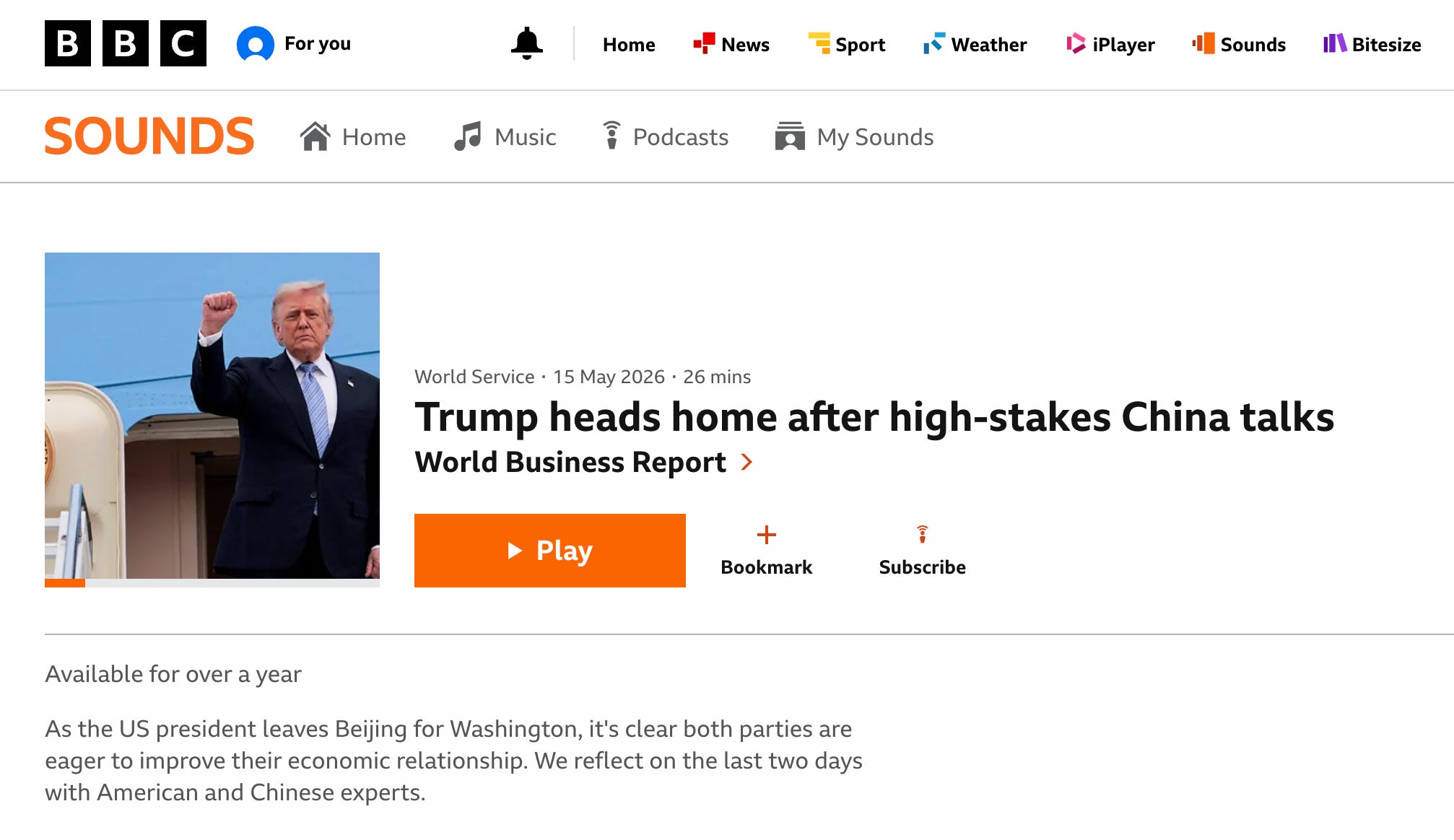
This is Henry Huiyao Wang’s interview with the World Business Report on the BBC World Service, broadcast 15 May 2026. Joining him also was Chris Low, Chief Economist at Ftn Financil. The programme remains available on BBC Sounds.
BBC World Service
And here in the studio with me tonight, Henry Wang. If you’re a regular listener to our Business Matters program, you may well remember that Henry is normally joining us from Beijing, but you’ve broken away from a party in London tonight, Henry, to come and join us. And you’re looking very dapper, I should say, as well, in the studio. Thanks for coming in. Thank you. How was the party, first of all?
Henry Huiyao Wang
That’s good. It’s very impressive.
BBC World Service
I could do. And you’re here for business as well as part of your work as the President of the Center for China and Globalization.
Henry Huiyao Wang
Yes, I’m also here for quite a few recordings and programmes.
BBC World Service
Well, tell us your takeaway then. What we’ve been talking about most nights this week is the, as the trip’s gone on. And you and I were just chatting before we came on air then. You’re actually a little bit more positive, perhaps, than some of the clips that we heard there about what’s been achieved this week. Why?
Henry Huiyao Wang
Yeah, I’m actually quite positive this time. First of all, it has been nine years since the last state visit by President Trump. Also, if you remember, during Trump’s first term, the U.S. National Security Strategy defined the China–U.S. relationship as a strategic rivalry. This time, however, both President Xi and President Trump have framed their positions differently. They now view the U.S.–China relationship as moving toward strategic stability—a constructive strategic stability. I think that’s a really positive start.
BBC World Service
What does that tell you? Does that tell you that America’s perspective has changed or that China perhaps felt that it was perhaps being too deferential last time around?
Henry Huiyao Wang
I think, after almost ten years, especially during Trump’s first term, the U.S. tried everything with China. We had a strategic rivalry, adversarial relations. There was the trade war, sanctions, “high fence, small yard” policies. But the current administration now seems to realise: we cannot fully decouple; we have to work together.
That’s why I’m very impressed with President Trump. He brought seventeen of the biggest U.S. companies to attend, and they were all very bullish. They expressed a lot of positive views—from Elon Musk to Tim Cook to Jensen Huang, all of them really positive and highly optimistic. So I think this is a good start, especially given that President Trump announced at the Great Hall that President Xi is going to visit the United States on September 24, and Wang Yi has now confirmed that the visit will indeed take place.
We are now in a full round of talks and summits. We finished the first round, and there will be a round in September, a round in November in China in Shenzhen, and a round in December in Miami for the G20. So, we have to carefully build on the progress and gradually improve. But already, we have seen quite significant improvement, and I’m sure we’ll hear more positive news in the coming months.
BBC World Service
Chris, what was your overall takeaway from the week?
Chris Low
Look, I think Henry nails it when he talks about the business executives who are on this trip. That’s what this trip was about. This was framed in the U.S. press as a summit on geopolitical issues, but it really wasn’t. It was a trade trip, and it wasn’t just top U.S. CEOs; it was top Chinese CEOs who were in these meetings as well. And I think. Both sides are beginning to realise there’s a lot to gain from mutual trade.
BBC World Service
I was interested that Henry kind of mentioned about this inability to actually decouple from each other. From an American perspective, Chris, does it feel like that realisation is coming around? Because there have certainly been attempts, and that is far from being just the Trump administration, has it? Henry mentioned about the Biden administration, too. This is the U.S. policy for a long time to properly decouple. Is that shifting now then in a business sense?
Chris Low
I think it’s shifting primarily as an economist travelling around the country and talking to people who are in U.S. manufacturing, agriculture, construction, all of them talk about the necessity of trade with China. Farmers, it’s because they sell goods there. Manufacturers, construction workers, it’s because they need Chinese products in order to manufacture their products in order to build their buildings. That interdependence runs deep. You know, I think complete decoupling, not only is it impractical from an economic standpoint, it’s effectively impossible.
BBC World Service
Where’s that element of need for Chinese companies these days, Henry?
Henry Huiyao Wang
I think there’s a strong need for that, because I saw quite a lot of Chinese CEOs at the welcome banquet talking with their U.S. counterparts. For example, the founder of Xiaomi was taking a selfie with Elon Musk. I think Chinese companies have a huge interest in investing in the United States. Previously, the political environment was very negative, which limited opportunities—issues like the Huawei sanctions or TikTok’s regulatory challenges created uncertainty.
But there is clearly a strong interest from Chinese companies to invest overseas. They are not just relying on trade; they can also create jobs, generate local tax revenue, and contribute more broadly. So, by addressing political barriers and providing clarity, we should expect more investment from both sides.
BBC World Service
Have you touched on the area where perhaps there is still gonna be ongoing tension? My good colleague, Michelle Fleury, our North America business correspondent, has been writing out this in her newsletter this week. She’s called the race in AI between the two countries as the new Cold War.
Henry Huiyao Wang
Yeah, absolutely. I was in Beijing before coming here to London, and I did an interview with Fox. They had a big crew there to interview Trump, and basically, they were asking the same question. AI is one of the most uncertain developments affecting humanity—we don’t know where it will lead. But absolutely, China and the U.S. have to work together to address that threat.
Thomas Friedman also said that AI is a common challenge for both China and the U.S., so we need to cooperate. There are so many uncertainties; we cannot just fight on our own or fight among ourselves. We really need to work together.
On top of that, there are ongoing wars in Iran, in Ukraine. I think China and the U.S. have to…
BBC World Service
Yeah, we haven’t touched on some of the geopolitics of the being covered, well covered on the news programs on the World Service. Chris, on AI specifically, are American companies ready to do that, to collaborate? I mean, they’re not seemingly that willing to collaborate with each other right now, full stop. Are they on issues around safety? We’ve seen that schism between OpenAI and Anthropic, for example.
Chris Low
I think the answer here has got to be at the government level in terms of supervision, regulation, etc. It’s a brand new industry. Global finance works because globally we have consistent regulations between countries and consistent supervision. And it’s got to be something similar to that where the adults in the room make the rules, enforce the rules, and work together.
BBC World Service
What are the next steps, then, you think, to building on that? Chris first, and then Henry?
Chris Low
Well, we already have here in the U.S. regulators who oversee tech and are getting involved with AI. In Europe, of course, you have the same, but we have very different rules. They’ve got to come together. China, too, has regulators who are involved in the internet and will evolve to working with the AI companies. But they also need to come together. This has to be an international effort because we have to have consistent standard policies.
Henry Huiyao Wang
Yes, absolutely. I think this is the biggest threat we’re facing right now. China and the U.S. are the two largest AI powers in the world, and we need to find a way for AI to benefit not only both countries but the entire world. China has its own AI systems and is making progress, but we need global AI governance, as well as global AI dialogues and global AI company summits—mechanisms we currently lack. Geopolitical, ideological, and other divisions are preventing this. So we need to find ways to make AI truly beneficial for humanity, and China and the U.S., as the two largest AI nations, should set a good example and work together.
BBC World Service
Clearly, I mean, top of the agenda, isn’t it? I think in that September meeting, when President Xi goes to the United States. You’re listening to World Business Report on the BBC World Service.