

China released a new white paper laying out its vision for global governance reform last Wednesday, introducing China’s principles, proposals and actions in global governance. The paper, titled More Just and Equitable Global Governance: China’s Principles, Proposals and Actions, was issued by the State Council Information Office, with Foreign Minister Wang Yi appearing at the launch press conference.
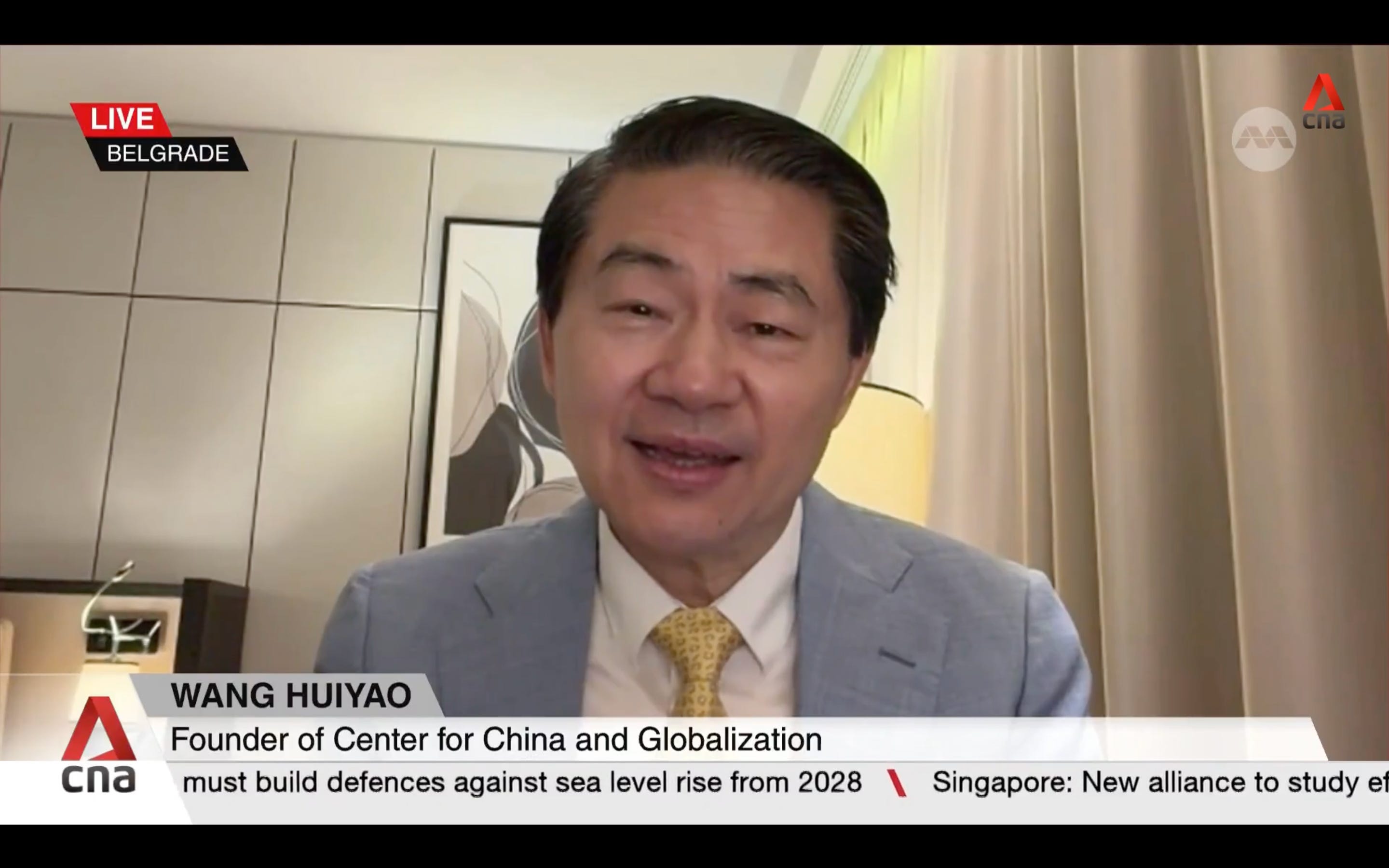
Later that day, Henry Huiyao Wang, founder and president of the Center for China and Globalization, discussed the white paper with Otelli Edwards from CNA, addressing its timing, China’s call for greater Global South representation, and the implicit message to countries retreating from international institutions.
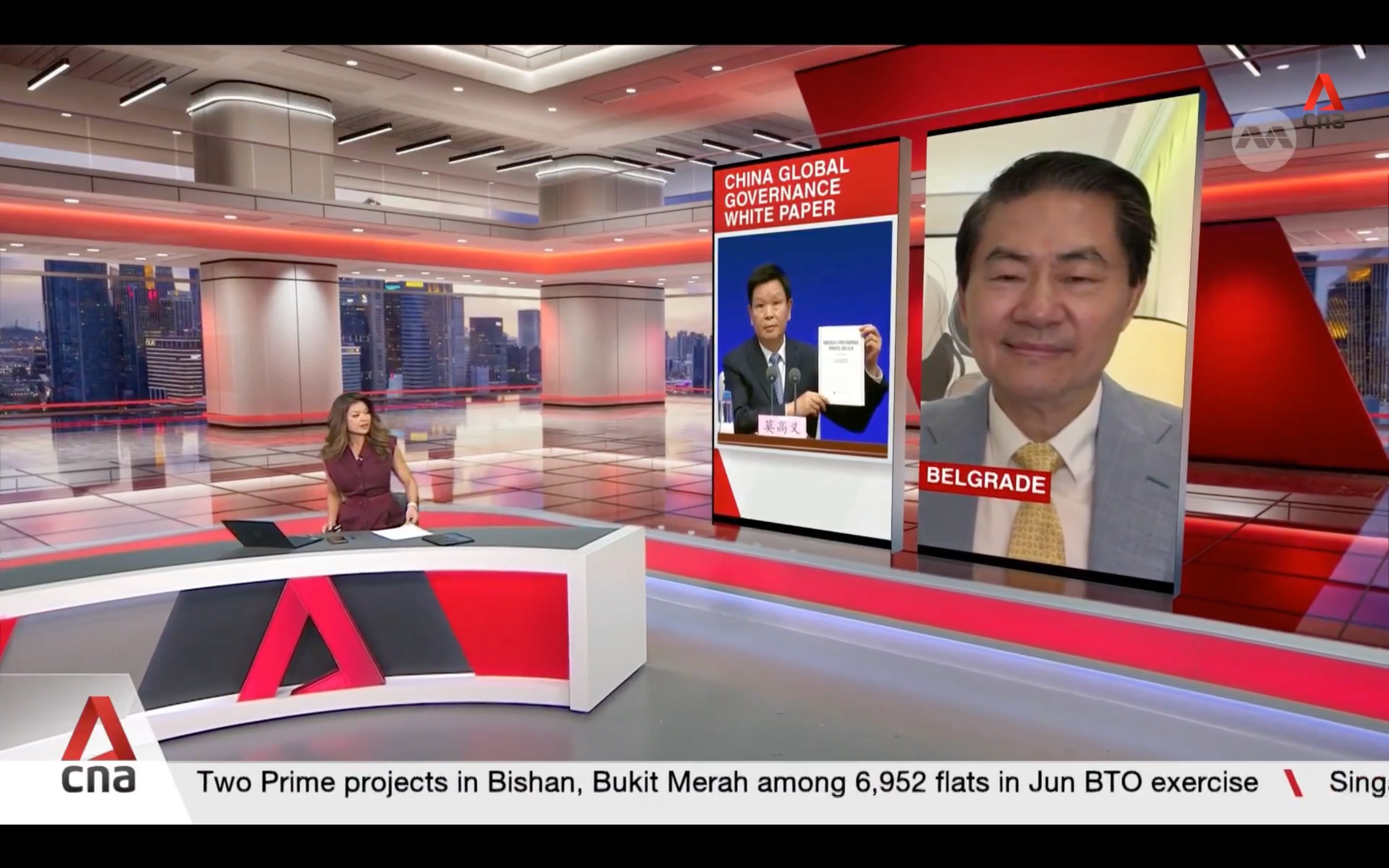
The transcript below has been prepared from the programme recording and has not been reviewed by any of the speakers.
Otelli Edwards, CNA Presenter
You’re joined now by Wang Huiyao, founder of the Center for China and Globalization and former counsellor to China’s State Council. Well, thanks for joining us this evening, Wang. Let’s talk first about the timing of this report, coming at a time when the G7 is happening and also when we’re seeing significant developments in the Middle East. What do you think Beijing is trying to signal here by releasing this report now?
Henry Huiyao Wang, Founder & President, CCG
Yes. As the programme just said, we are at the crossroads of global geopolitics and all the things happening. And as you said, the G7 has just finished now.
And also this Friday, we are going to have this new MOU to be signed between the U.S. and Iran on the Iranian issue, which is just the beginning of this settlement. But also, the UN is actually going to elect a new Secretary-General by the end of this year. We’re going to have the APEC summit coming up in China, the G20 summit coming up in Miami in the U.S. So there are a lot of global governance issues on the table in the next few months.
So I think, at this time, China has raised concerns systematically and gone all out to put forward this global governance initiative. The white paper is really timely and demonstrates China’s position and China’s call for a more inclusive, constructive and more forward-looking reform of global governance. I think being a big country like China, to really take initiative, calling for actions and calling for a new narrative on this global governance, is really important and very timely. Minister Wang Yi attending this press briefing also shows the importance that China attaches to this great issue of global affairs.
Otelli Edwards
Yeah, perhaps you can elaborate a little bit more on that, because Foreign Minister Wang Yi played a visible role around the release of this report. What does that tell us in terms of where global governance now sits within China’s foreign policy priorities and agenda?
Henry Huiyao Wang
I think from this news conference, we can see that this issue is highly prioritised. Not only did Minister Wang Yi attend, but Vice Minister Miao Deyu, Vice Minister Jin from the Party Liaison Department, and officials from the NDRC were also there. The head of China’s development aid agency was also present, so the representation was quite comprehensive.
Basically, over the past several years, China has proposed the Global Development Initiative, the Global Security Initiative, the Global Civilisation Initiative, and now the Global Governance Initiative as the latest one. These initiatives are consistent with one another and, taken together, cover a broad range of areas.
For example, Minister Wang Yi mentioned at the news conference, which I was also attending, that China is now the second-largest contributor to the U.N. peacekeeping budget and the largest peacekeeping troop-contributing country among the P5. China has participated in peacekeeping missions in many countries and has accumulated substantial, tangible standby peacekeeping capabilities. Given the turmoil in today’s world, I think China is ready to further reinforce the UN and contribute to peacekeeping, whether in Ukraine or the Middle East, if needed. China wants to make sure it is an active player.
Beyond that, China is also calling for greater representation of the Global South, as was mentioned at the conference. This applies not only to financial institutions such as the World Bank and the IMF, but also to the UN and even the Security Council. There needs to be more Global South voices. Those are concrete suggestions that China wants to inject into global governance reform and this broader initiative.
Furthermore, China has been putting forward this Global Governance Initiative at a time when it is gaining momentum. It has already attracted interest from 160 countries, and 60 countries have joined the Friends Group of Global Governance. So I think it is gaining momentum and drawing growing interest. China is also seeking to bring the voice of the Global South into global governance reform.
Given what has happened, there will also be several important summits involving China and the U.S. Beyond APEC, there is the G20, and the timing now falls between the G7 meeting and the signing of a new memorandum between Iran and the U.S. So China’s voice at this moment is very timely. It also demonstrates China’s determination and strong will to help avoid a “law of the jungle” situation.
Otelli Edwards
I just want to highlight here what might say, you know, the message between the lines, if you could just read for us. Because it doesn’t explicitly name the U.S., but obviously there are references to tariffs and unilateral measures, about countries stepping back from international institutions. How should we interpret that message there?
Henry Huiyao Wang
Yeah, I think that is what the white paper says at the beginning. The world has entered a period of turmoil. We are living in a turbulent world with multiple crises, including what is happening in Iran, Ukraine, and many other countries. The world has rarely seen such a chaotic situation, and global governance is faltering.
Of course, we are now embracing a multipolar world, but the multilateral system needed for this multipolar world is not yet in place. That is why China has reemphasised the importance of the UN and the need to strengthen it. It has particularly singled out that the law of the jungle and unilateralism will not work.
I think we also need to avoid the Kindleberger Trap, in which an existing power steps back from providing global public goods and participating in global governance. China can step in to help fill some of the vacuums that have been left behind. For example, China recently donated 500 million U.S. dollars to the WHO at a time when the U.S. is pulling out. So I think the message is clear: we need to avoid a vacuum in global governance, and all countries, including the Global South, which is rising economically and politically, should take a greater part in the global governance system.
Of course, even though China did not mention the U.S., some unilateral behaviour by the U.S. is obviously implied. China still wants to work with all countries and all stakeholders, particularly the Global South, to put forward a more adaptable and more equitable global system that every country is looking forward to. I think China is demonstrating timely leadership and offering a new, forward-looking direction on global governance.
Otelli Edwards
Well, thanks, Wang, for joining us all the way from Belgrade, Serbia. Wang Huiyao there, founder of the Center for China and Globalization and also former counsellor to China’s State Council.