

On 8 July 2026, Henry Huiyao Wang, founder and president of the Center for China and Globalization (CCG), participated in a plenary session at the 2026 Horasis Asia Meeting in Hengqin and Macau.
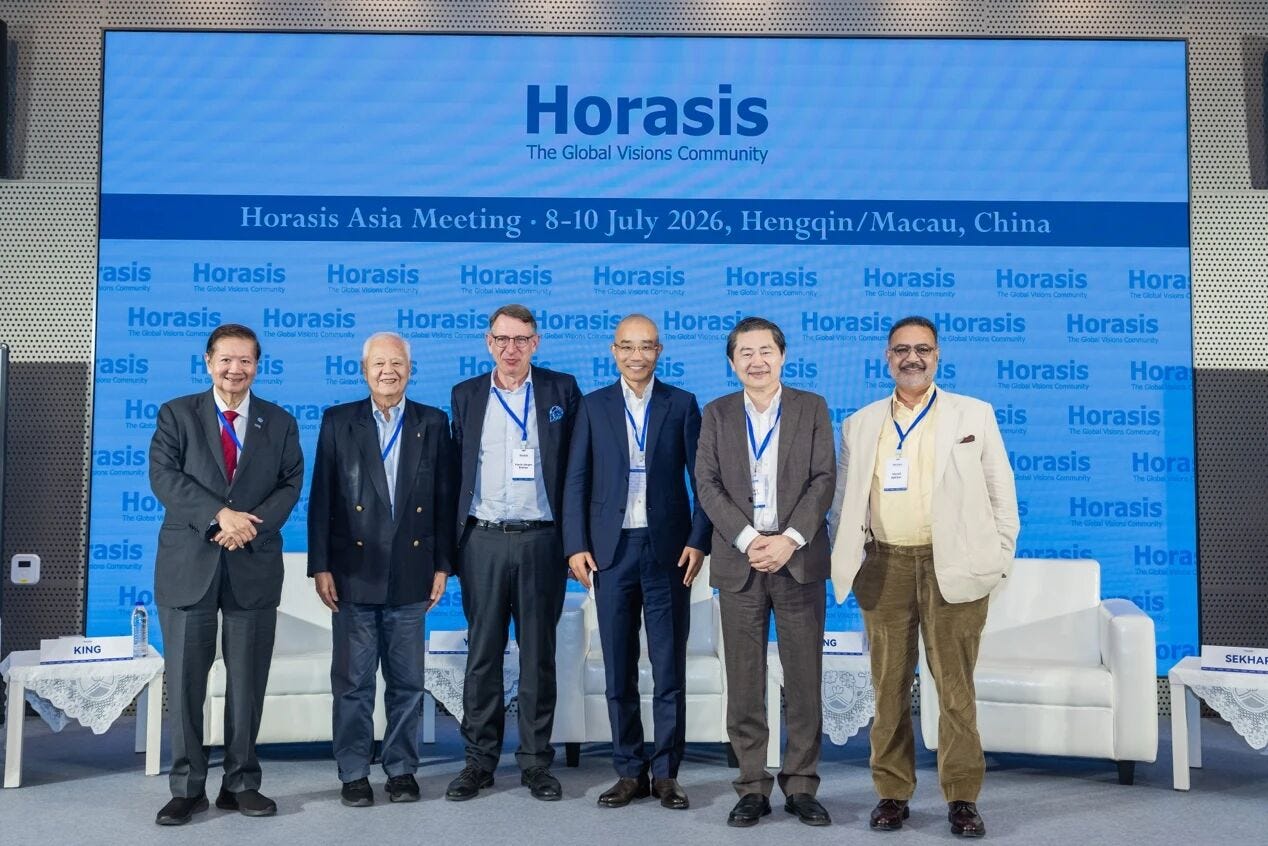
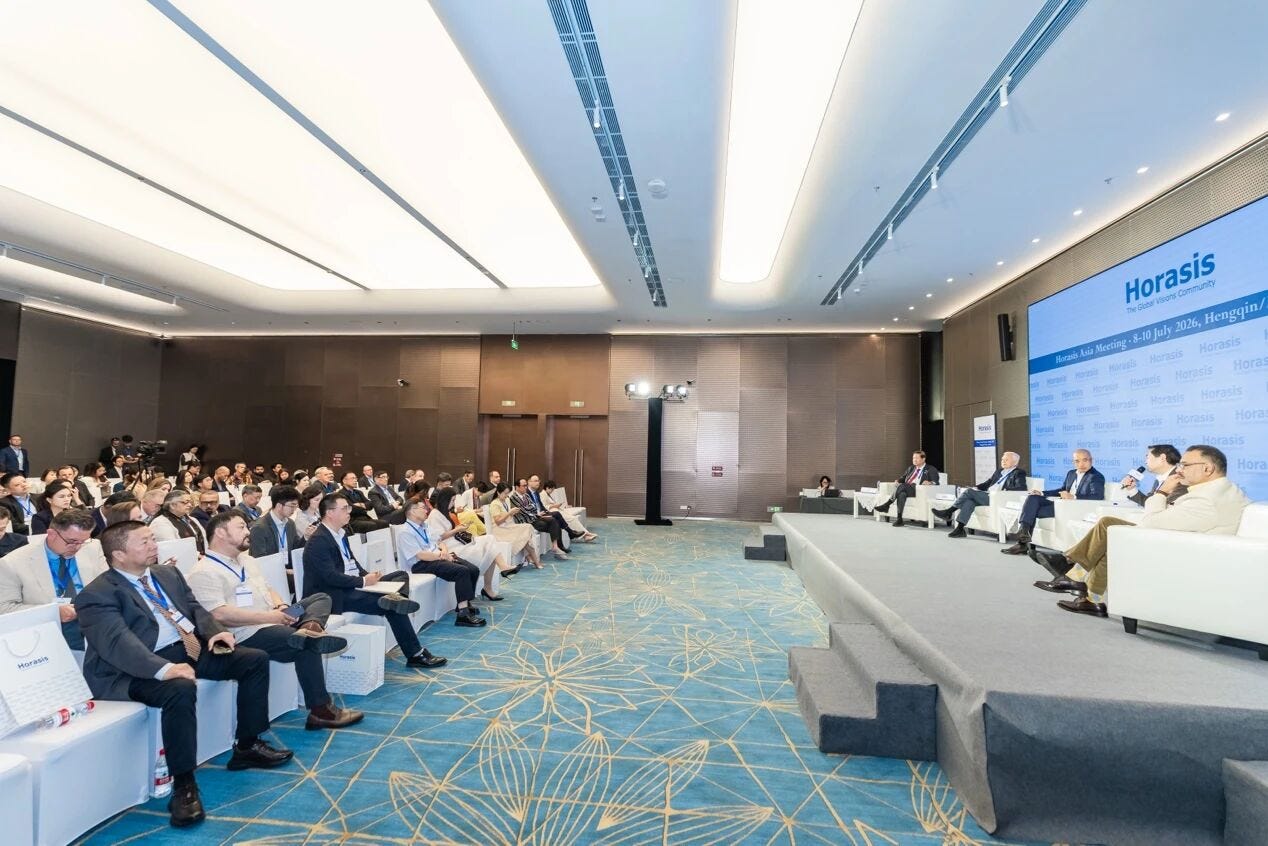
Titled “Reimagining Globalization: Asia’s Vision for an Open World,” the session was chaired by Jake Yu, Global Managing Partner of Peregrine Ventures, USA.
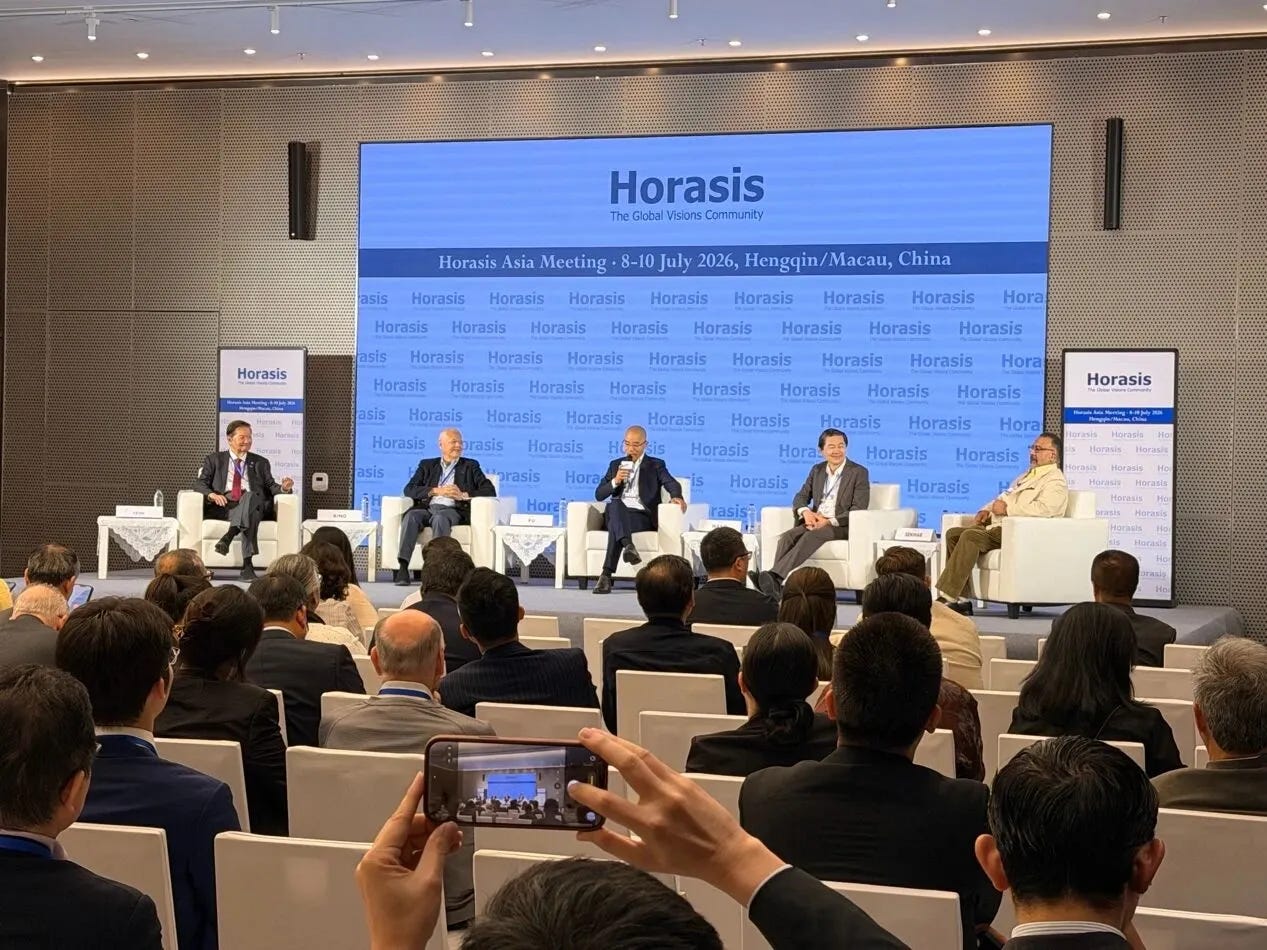
Other panellists included Roger King, Founder and Chairman of ODS Holdings Inc., Hong Kong; Vinod Sekhar, Chairman of Petra Group, Malaysia; and Michael Yeoh, President of the KSI Strategic Institute for Asia Pacific, Malaysia.
Wang observed that China’s growing economic weight gives it both the opportunity and the responsibility to help sustain a rules-based global trading order — one reshaped for a more multipolar world rather than built around a single centre.
Mabel Lu Miao, co-founder and secretary-general of CCG, was also invited to attend the forum and speak at the session “Asia 2076: Eastern Wisdom, New Productive Forces,” held on the afternoon of 9 July.
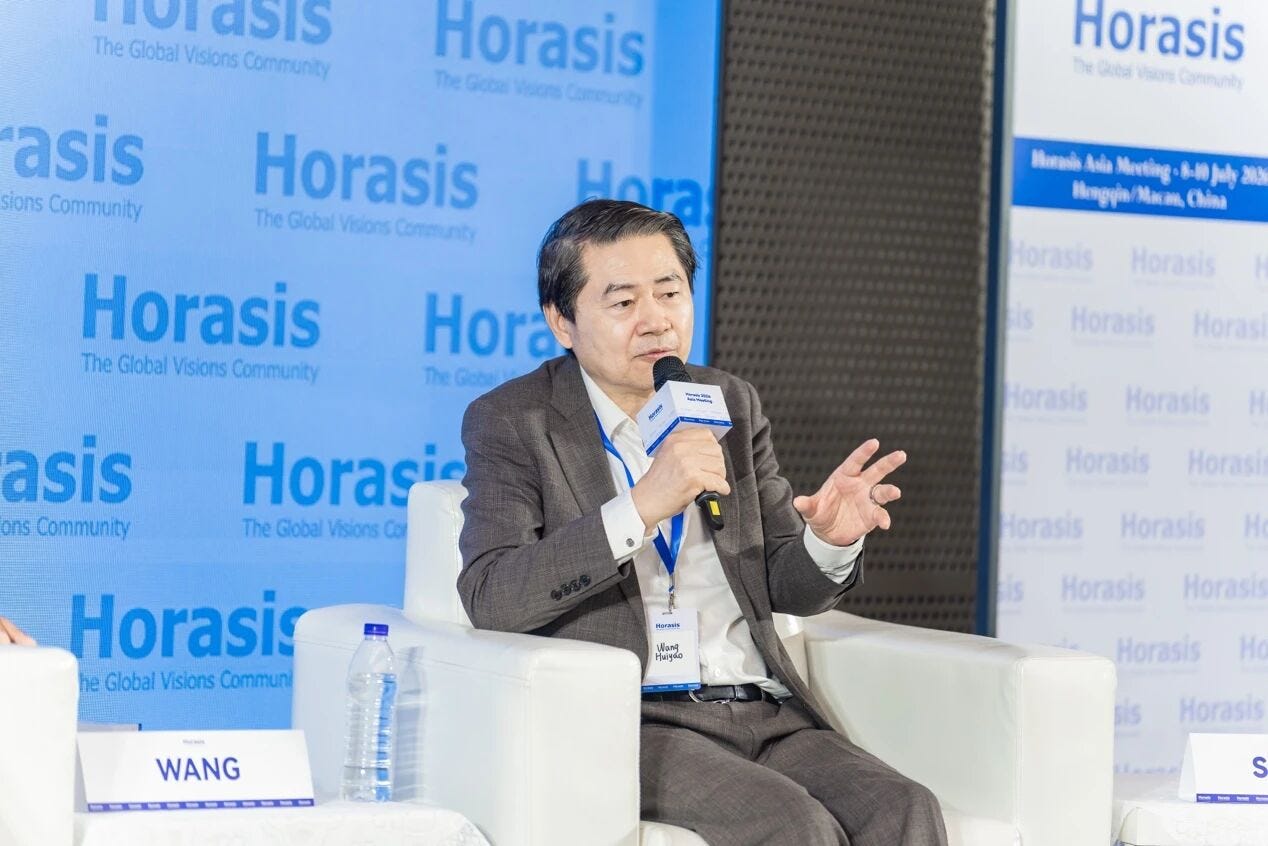
The following article has been compiled from Wang’s remarks during the panel discussion and lightly edited and connected for clarity.
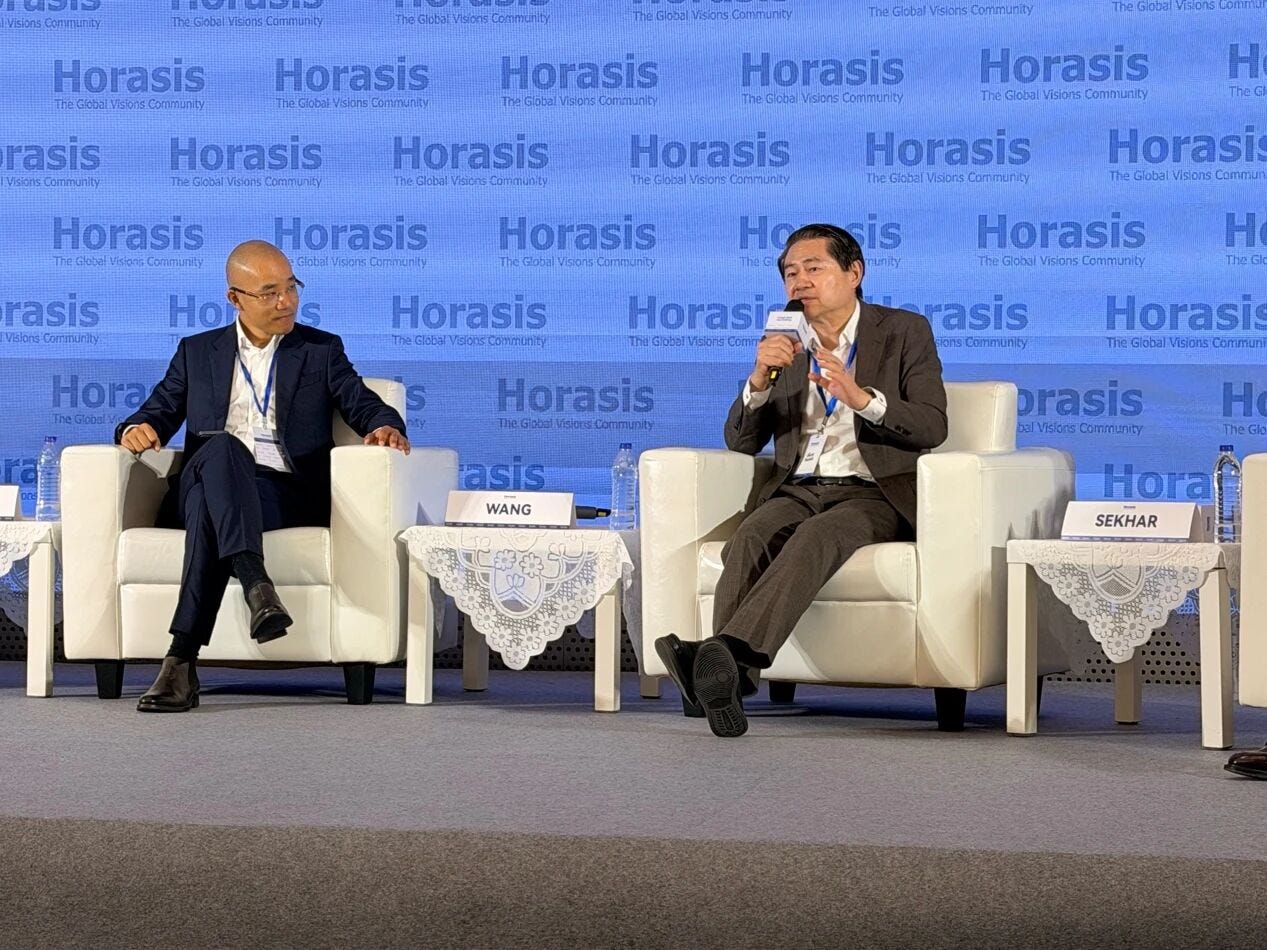
I want to thank Frank for inviting me and congratulate Horasis on the tenth anniversary of the Horasis Asia Meeting. This is great. We have all the Asian leaders and Asian elites sitting in this room, and I have really enjoyed the discussion we have had so far.
The topic is globalisation. I think globalisation itself, as a system for the greater good over the last 81 years, needs to be upgraded, improved and enhanced. I am not saying globalisation is dead. I think we need to reform the system. That is probably what we need to do.
I would like to share a few of my thoughts about the megatrends that we are going to see.
Asia’s emerging role
First of all, Asia is going to become the biggest leading economy in the world. We already have over half of the world’s population. We are already getting close to 50 per cent of global GDP. Most of all, we have no wars right now here in the Far East. I mean, it is incredible.
China is still growing, maintaining around 5 per cent GDP growth and contributing over 30 per cent of global GDP growth.
I think Asia is going to become an anchor of the world economy for the foreseeable future — the next 25 or even 50 years. I think that trend is a megatrend that will continue. That is the number one trend I am seeing.
The second trend I am seeing is that Asia is also going to be a new saviour of globalisation. We see that globalisation has had all the bumps and setbacks, as well as deglobalisation.
The WTO is under enormous threat. The United States has pulled out of the WTO Appellate Body, and we also see the United States pulling out of 66 international organisations.
But in Asia, regional governance and multilateralism remain very strong.
Michael just mentioned RCEP, the largest free trade agreement in the world. We also talk about the CPTPP. Japan and Australia are really making the CPTPP more attractive. China wants to join it, and the UK has just joined it as well.
As a new set of rules and a new trade scheme for the world, Asia is really providing a lot for the people in this partnership. In that sense, Asia is setting a new trend for the future of the trading system.
Trade is still the most booming and active area of Asia. ASEAN is China’s largest trading partner. It used to be the United States, but ASEAN has since taken over. You can see how strong this area is.
That is my second trend: Asia is making new schemes, conducting new experiments and pursuing new reforms to really push for globalisation.
Number three is that Asia is also a major source of support and a main component of the BRICS countries. China and India are the two largest Global South countries and are enormously important.
The GDP of the BRICS countries is already larger than that of the G7. Newly thriving nations such as the BRICS countries are taking new shapes and forms, and China and India are really making a huge contribution there.
I would say that this is also, again, coming out of Asia.
The fourth megatrend I can see concerns the Asia-Pacific. Shenzhen is going to host the APEC summit this year. President Trump is coming. He will show off his new Air Force One. He said he is going to fly it to Shenzhen. We will see what comes out of that.
What I am saying is that the Asia-Pacific will probably become more stable. I see China–US relations moving from strategic rivalry under Trump 1.0 to strategic stability under Trump 2.0. That is going to move the Asia-Pacific towards greater strategic stability. I think that is great.
Number five is that the United States is actually pulling back quite a bit. The United States is pivoting towards Latin America and really concentrating on the Western Hemisphere.
In the Asia-Pacific, and Asia in particular, I see more room for movement. China will play a more active role. The Pacific is big enough to accommodate both United States and China.
You talked about global governance. China is proposing a lot of new schemes, such as the recent establishment of the international mediation centre in Hong Kong. China will host an AI summit next month in Shanghai. I am going to propose setting up an international AI organization. China has also just set up an international World Data Organization, or WDO.
I think there are a lot of new reforms coming up to really push globalisation forward.
The final trend I can predict is that the integration of Asia is going to be central to this new globalisation.
ASEAN, as Michael mentioned, is such a great model. It is a little bit different from the European Union. In the European Union, all 27 members have a veto. You cannot just do things. But ASEAN works by consensus, which is really great.
Can we really start from ASEAN? Can we have an Asian Union? Mahathir Mohamad and Lee Kuan Yew mentioned this many years ago. Let us get China into this. Let us get India, Japan and South Korea into this. I see Asia gradually becoming an economic magnet.
Basically, these are two different philosophies that China and the United States are pursuing. The United States really has securitization, with 800 military bases around the world. China does not really have many military bases—basically none. But China is developing economically based organizations, starting from Asia.
We have the China–Africa Summit, the China–Latin America Summit, the China–Central Asia Summit, the China–Arab States Summit and the China–Europe Summit. There is a lot of collaboration that China can pursue to push for economic globalisation.
Asia itself is going to be a big magnet and a big driving force for globalisation over the next quarter-century.
In that sense, China has proposed more economically centred global governance.
As the United States pulls out of the WHO, China has announced that it will donate US$500 million to the WHO. China also supports the United Nations. Twenty per cent of its budget comes from China, while the United States has not paid on time.
China has almost become the largest contributor. China is also the largest peacekeeping-contributing country among the five permanent members of the UN Security Council.
I can see China and Asia also pivoting towards the wider world. Things are really becoming very significant. We need new global governance to reform the existing system.
I really appreciate President Trump’s visit and the movement in China–US relations from strategic rivalry to strategic stability.
We will probably have two major powers, but all the other countries do not have to pick sides now. They will just choose on the merits. Who is going to provide benefits? Who is going to bring more economic benefits?
We are entering a very interesting world, and Asia will make the difference.
A proposal for an Asia summit
In terms of the most important thing to do over the next 12 months, I would like to make a proposal out of this meeting.
We are having the 2026 Horasis Asia Meeting. In the next 12 months, we should have an Asia summit.
We have an African summit involving 54 countries. We have a Latin American summit. We have an EU summit. We do not have an Asia summit.
Let us get all the Asian leaders together. Let us come to Hong Kong or go somewhere else. Let us have an Asia summit.
That will probably be the most important thing, at least for Asian leaders to build up trust, have face-to-face dialogue and really come to the table—to have a big round table of all the Asian leaders.
Asia is the engine. It is the future growth of the world. It also needs to work with all the other continents.
I think we really need some critical new thinking over the next 12 months. I think it is clear.
A proposal for an “AI20”
I also have a proposal concerning artificial intelligence.
We are going to have a G20 summit in Miami in December this year. But we see that the world is becoming more and more dangerous.
Why can we not have an “AI20”?
Let us get the 20 largest AI companies to sit together and talk about the pros and cons, the dangers, the risks that we may face, and how we can work together.
Rather than remaining divided and having an AI arms race, we need to recognize that we could be creating a disaster. AI could be more dangerous than nuclear bombs. Humanity could be wiped out by AI.
Alongside the G20, let us have the AI20. Let us get the 20 largest AI companies in the world to sit together and talk about how we can really build a better world and how AI can serve humanity.
The balance between the market and government
There is always a swing back and forth. We talk about small government and a big market. The Third Plenum document of the Communist Party of China also said that the market should play a decisive role.
But as the world becomes more complicated and globalisation deepens, I think there needs to be a balance between the market and government.
For example, we saw the financial crisis. It was all left to the market, and then the market crashed.
China combined the market reforms introduced by Deng Xiaoping with government planning, including five-year plans. That produced the miracle.
I think the United States is actually learning some of that. The CHIPS Act and other government interventions are examples. Government intervention in Europe has also been speeded up.
The way forward is to strike the right balance, as China is trying to do.
For example, China’s private sector contributes more than 50 per cent of tax revenue, more than 60 per cent of GDP, 70 per cent of innovation, 80 per cent of employment and 90 per cent of enterprises.
Then another part of the economy consists of SOEs, which do all the difficult jobs in key sectors, including disaster relief, earthquake relief and high-speed railways. These can be losing businesses, but they provide public goods.
Then there are multinational companies. They employ 40 million Chinese employees and account for 40 per cent of China’s exports.
We all talk about the overcapacity of China’s electric vehicles, but 20 per cent of those vehicles are made by multinational companies, including Tesla, BMW and many others.
This hybrid system that China has right now has supported the fastest-growing economy over the last four decades. That is probably the right balance.
You have a large private sector. You have some multinational companies. You have some SOEs.
Government and market forces have to really find a compromise. That right balance is something everybody is in search of, and I think China is conducting a big experiment.