


The EU-funded EU-China Think-Tank Exchanges project has just released its latest compendium, “EU–China relations at a crossroads, Vol. IV: Fifty-Fifty.” The project is coordinated by the European Policy Centre (EPC), and the compendium was published on Wednesday December 17, 2025, on the EPC website.
As the only China-based co-beneficiary in the project consortium and one of the core contributing organisations, CCG is pleased to share this new compendium with readers and partners.

Foreword
Jorge Toledo Albiñana, Ambassador of the European Union to China
Beijing, December 2025
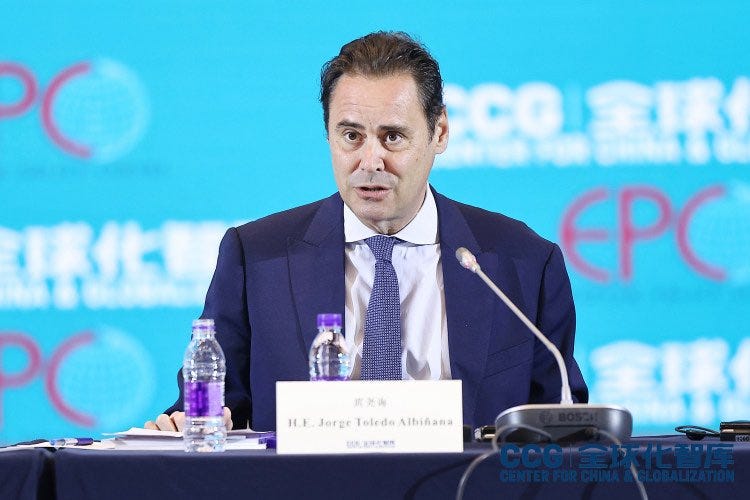
It is with great pleasure that I introduce the fourth compendium of the EU & China Think Tank Exchanges project, entitled Fifty-Fifty. The compendium is published in the year of the 50th anniversary of EU–China relations, a significant time to reflect on how the relationship has evolved and how to address the challenges of today.
Over 50 years, the scale of EU–China trade and cooperation has grown immensely, but so have imbalances, which urgently need to be addressed. The breadth and complexity of issues involved in EU–China relations has also multiplied. The papers included in this compendium make an important contribution to our reflection, ranging from broad assessments of postsummit relations to focused explorations of economic security and AI regulation.
Now in its second phase, the EU-funded Think Tank Exchanges project continues to serve as a valued platform for dialogue and cooperation among experts in the EU and China. Such sustained connections are essential for strengthening mutual understanding and translating the outcomes of think tank and academic exchanges into practical ideas.
As you read this volume, I encourage you to consider both the challenges and the opportunities presented in these pages. The analyses contained here are not simply the results of an academic exercise, but contribute to an ongoing conversation intended to put forward practical insights and recommendations. Let us reflect on their implications for decision-making, in support of defining a more sustainable, mutually beneficial EU–China relationship for the next 50 years.
Preface
Ivano di Carlo, Senior Policy Analyst, European Policy Centre

The publication of this fourth volume in our compendium series coincides with a symbolic year: the 50th anniversary of EU–China diplomatic relations. Half a century on, the relationship continues to evolve at a remarkable and often unpredictable pace.
This anniversary also marks the beginning of a new project cycle for the EU-funded EU & China Think Tank Exchanges project, now engaging a larger network of leading think tanks and research organisations across the EU and China. This expanded collaboration provides fresh opportunities for dialogue and joint reflection on how to address the challenges – and seize the opportunities – shaping the bilateral relationship. Special thanks go to the co-beneficiaries – the Center for China and Globalization (CCG), EGMONT – The Royal Institute for International Relations and the Elcano Royal Institute, – as well as to the core group of contributing organisations: the Instituto Affari Internazionali (IAI), Mercator Institute for China Studies (MERICS), the Institute of European Studies – Chinese Academy of Social Sciences (IES-CASS), China Institute of International Studies (CIIS), Shanghai Institutes of International Studies (SIIS), the Center for China-Europe Relations (CCER), Fudan University, and Zhejiang University.
This volume also arrives at a time of persistent uncertainty and rapid transformation of the post-WWII global order. The lines between competition and cooperation are increasingly blurred, with the future often obscured by a dense fog of geopolitical unpredictability. Against this backdrop, the 12 input papers from leading European and Chinese experts included in this compendium help shed light on what both European and Chinese experts consider pressing issues in the bilateral relationship. Readers may gain insights not only from the opinions and policy recommendations presented, but also from what is left unaddressed.
To that end, the contributions are presented as independent expert views, closer in spirit to op-eds than to coordinated policy papers. They reflect the diversity of analytical traditions and systems in which European and Chinese scholars work, and for this reason received minimal editorial intervention. In some cases, this results in differences of terminology or emphasis. These variations are not edited out; rather, they are retained to reflect the spectrum of viewpoints and the realities of conducting research and dialogue across contexts.
While the EU & China Think Tank Exchanges project has remained a consistent fixture over the years, (we just recently held our 30th event) the world around us has been anything but static. Geopolitical realignments, global economic uncertainty, ongoing wars and conflicts, and intense technological competition continue to shape the environment in which Europe and China operate.
Launched during a challenging period for the bilateral relationship, the EU & China Think Tank Exchanges have nonetheless succeeded in establishing a stable platform for dialogue, enabling meaningful conversations even when official channels are strained.
It would be naïve to suggest that the path ahead is straightforward, especially since geopolitical fault lines continue to constrain academic exchanges and policy dialogues. Yet, this project has always rested on a simple premise: when relations are strained, dialogue becomes not only valuable but urgent. These exchanges do not – and will never – claim to resolve disagreements overnight, but they offer a rare venue in which different perspectives can be expressed directly, without intermediaries or the illusions of immediate breakthroughs.
The title of this volume, Fifty-Fifty, captures both a historical milestone and a guiding principle. It reflects how far the EU–China relationship has come, while pointing to the broader challenges that lie ahead. At a time when mutual trust is fragile and misunderstandings are easily amplified, progress depends on the ability to find a balance – to navigate the middle ground even when common interests are difficult to find. It is a reminder that neither side can advance the relationship alone; attempting to do so would come at a cost not just for the parties involved, but for the wider world.
In this sense, Fifty–Fifty is not merely a reference to the past but an aspiration for the future of dialogue. It signals not a naïve expectation of perfect parity, but an effort to seek equilibrium in a relationship at risk of becoming defined solely by competition or distrust. Ultimately, it highlights a simple truth: the future of EU–China engagement may hinge on our ability to recognise areas of alignment, even when they are difficult to find and sometimes appear unimaginable to reach.
EU Ambassador Jorge Toledo's speech at EU-China Think Tank Exchanges in Beijing

On Saturday, May 25, 2024, the "EU-China think tank exchange: EU-China relations: Navigating uncertainty," part of the EU-China think tank exchanges, took place in Beijing.
Transcript Part One: Top China, EU experts on "EU-China Relations: Review and Outlook" in Beijing

The following is the transcript of the discussion on "EU-China Relations: Review and Outlook" at the October 24, 2023, EU & China Think Tank Exchanges, co-organized by the European Policy Centre (EPC) and the Center for China and Globalization (CCG) and funded by the European Union, in Beijing.
Really appreciate how the 'Fifty-Fifty' framing goes beyond just marking an anniversary. The point about dialogue becoming urgent when relations are strained is spot-on, I've watched similar track-two mechanisms keep channels open during tense moments in other geopolitical contexts and they end up being invaluable when official diplomacy freezes. The compendium's minimal editorial approach that preserves diferent analytical traditions is smart policy, lets the actual divergences show rather than papering them over.