

CCG Update proudly presents Dreaming Dragons or Meddlesome Mandarins: A Journey Together to Uncover China’s Soul, a new book by CCG Senior Fellow Harvey Dzodin, published by Springer Nature.
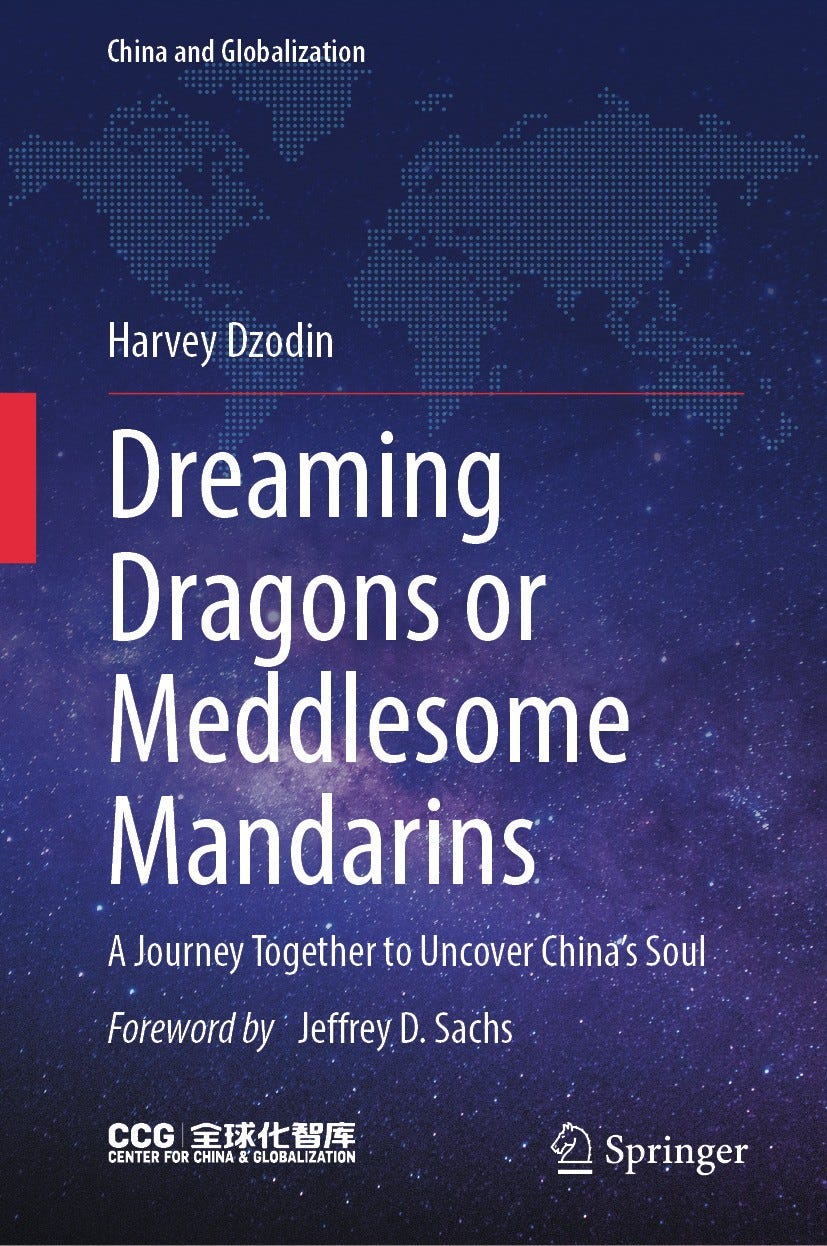
Author: Harvey Dzodin
ISBN: 978-981-95-1552-3
Published in January, 2026
Published by Springer Nature
Access to the book: https://link.springer.com/book/10.1007/978-981-95-1553-0
Beyond the Headlines
A Veteran Media Professional’s Story of China
Even before he became a teenager, Harvey Dzodin was fascinated listening to his shortwave radio in Detroit, and was especially captivated by far-off China. This book is the culmination of the decades of interactions and experiences that Dr. Harvey Dzodin, former ABC executive, presidential appointee and avid commentator on everything global, has had with China and its people. His raw, personal, and sometimes impassioned insights into China’s history, its people, culture and even its current rise on the global stage, give a fresh perspective on perhaps the most consequential country of the twenty-first century. Suitable for both the experienced China hand as well as those with only a cursory knowledge of the Middle Kingdom, Harvey encourages the reader to make their own judgements on China and come to their own conclusion. It is his hope that this book will contribute, in some part, to the sharing of knowledge and the furthering of communication, thus helping to overcome barriers to mutual understanding and informed decision making that plague the world today.
Drawing on the author’s unique experiences in the media, government, education and global governance, this book offers a comprehensive and balanced perspective on China’s place in the world. It provides readers with a refreshing and relaxed reading experience on China and its relations with other countries.
This book is the latest volume of China and Globalization series edited by Henry Huiyao Wang, founder and president of Center for China and Globalization (CCG) and Mabel Lu Miao, Secretary-General of CCG. This series is designed to have a wide range of global views on issues related to China and Globalization, opportunities and challenges on China’s rise to the world and China’s roles in global governance, global economy, global development and global security. It outlines China’s international relations with major global powers and the rest of the world and it contains recommendations and proposals for the future of sustainable development, prospects of China’s further capital and market liberalization, and China’s globalizing trajectories as experienced by the world.
The first of its kind to publish the works of over two hundred contributors internationally, this book series seeks to create a balanced global perspective by gathering the views of highly influential global opinion leaders, former statesmen, ambassadors, well known academics and think tank experts, multinational CEOs and foreign chambers of commerce from China and around the world.
About the Author

Dr. Harvey Dzodin is a Senior Fellow of the Center for China and Globalization, as well as Vienna-based freelance columnist and commentator for China Daily, CGTN TV and CGTN Radio, and other global media. He is the Chairman of the Austria-based Earthcare Culture Association.
Dr. Dzodin was appointed by the 39th US President Jimmy Carter as his lawyer on a presidential committee. Later, after being nominated by the White House and the US Department of State, he worked at the United Nations Office in Vienna. He also served as a director and vice president of the ABC-TV Network in NewYork for more than 20 years during which time he avidly participated in the activities of the Council on Foreign Relations and the Carnegie Council on Ethics and International Affairs.
He has published over 400 op-eds, focusing on international affairs, Sino-US relations, the Belt and Road Initiative, and arts and culture. He’s a sought after speaker and consultant in China and abroad. The American Biography Institute named Dr. Dzodin one of the “Great Thinkers of the twenty-first Century”.
Contents
Foreword by Jeffrey D. Sachs
Preface
A Very Personal Introduction
Part I What’s Past is Prologue
1 Old China: A Summary of an Historical Black Hole That Spans Thousands of Years
1.1 Thousands of Years of World History with China Mostly in the Middle of It
1.2 An Unbroken Dynastic Cycle
1.2.1 China’s History
1.2.2 Xia (2100–1600 BCE)
1.2.3 Shang (1600–1046 BCE)
1.2.4 Zhou (1046–256 BCE)
1.2.5 Qin (221–206 BCE)
1.2.6 Han (206 BCE–220 CE)
1.2.7 Tang (618–907)
1.2.8 Song (960–1279)
1.2.9 Yuan (1271–1368)
1.2.10 Ming (1368–1644)
1.2.11 Qing (1644–1912)
1.3 A Period of Difficult Transition
References
2 Moving Toward Modernity and a New China
2.1 Different Visions of a New Era
2.2 A Rough Road Ahead for “New China”
2.3 The Bandung Declaration
2.4 Zhou Enlai’s Brush with Death
2.5 Down the Rabbit Hole
References
3 Opening up and New Generations of Leadership
3.1 Portents of Change
3.2 An Era of Reform and Opening
3.3 Understanding Chinese Leadership—Jiang to Xi
3.3.1 Jiang Zemin
3.3.2 Hu Jintao
References
Part II New China: Take Two
4 Opening Up: Engaging the World Through Economics
4.1 A New Approach—Economics First, Politics and Ideology Second
4.2 Lessons from History
4.3 Key Events in China’s Return to the World Stage
4.3.1 China’s Return to the United Nations
4.3.2 The Road to Official US-China Relations
4.3.3 Accession to the WTO
4.4 Different Paths to “Moderate Prosperity”
4.5 Becoming the “World’s Factory”
4.6 The Secret of China’s Success—Adaptation
References
5 Thoughts on Ideology
5.1 Beware the Power of Words
5.2 Communism, Marxism, and Socialism
5.2.1 Communism
5.2.2 Marxism, Leninism, and Marxism-Leninism
5.2.3 Socialism
5.3 How Communism Made Its Way from Europe to China
5.4 Communism as Defined by Key Chinese Leaders
5.4.1 Mao Zedong Thought
5.4.2 Deng Xiaoping Thought
5.4.3 Xi Jinping Thought
5.5 Balancing Between Ideological Purity and Practical Reality
5.6 The Kibbutz—From Pure Marxist Idealism to Human Reality?
References
Part III The China Experiment
6 SOEs, Danweis and National Champions
6.1 Evolution and Adaptation of SOEs
6.2 Enter the State-Owned Enterprise
6.3 The Five-Year Plans
6.4 The “Work Unit” Danwei System
6.5 The Coming Change—SOEs Adapt to a New World of Competition
6.6 China’s National Champions
6.7 Bouncing Back and New Horizons
6.8 DeepSeek
6.9 Dreaming Dragons or Meddlesome Mandarins?
References
7 Just How Does China Work? (Government in a Nutshell)
7.1 A (Very) Long Tradition of Centralized Control
7.2 Governmental Structure—Party-Government Synergy
7.3 China’s Unique Consultative Democratic Model: Whole-Process People’s Democracy
7.4 China’s Personnel System
7.5 China’s Five-Year Plans and Central Control
7.6 Vox Populi—China’s 1.4 Billion People Speak
7.7 Conclusion—On Whether China Is a Democracy
References
8 China’s Lofty Goals
8.1 The Chinese Dream
8.2 China’s Two Centenary Goals
8.3 A Community with a Shared Future for Mankind
8.4 Bumps in the Road
8.5 Income Inequality
8.6 Conclusion
References
9 China on the Global Stage
9.1 Tenuous Early Days
9.2 Bold and Confident China
9.3 China’s Role in International Organizations
9.3.1 The United Nations
9.3.2 APEC
9.3.3 ASEAN
9.3.4 BRI
9.3.5 BRICS
9.3.6 FOCAC
9.3.7 G20
9.3.8 RCEP
9.3.9 SCO
References
Part IV Perceptions and Reality
10 Facing Global Challenges
10.1 Globalization
10.2 Environmental Challenges
10.3 China’s Global Leadership in Renewable Energy
10.4 China’s Global Leadership in EVs and IEVs
10.5 A Note of Caution
10.6 Conclusion
References
11 Demographics in China: Burden and Boon
11.1 Chairman Mao and People Power
11.2 Damage Control and Managing a Ballooning Population
11.3 Population Policy Fallout and the Future
11.4 Opportunities Amidst the Challenges
11.5 Conclusion
References
12 Perceptions and Misconceptions of China
12.1 China Power—Both Hard and Soft—and Its Uphill Battle
12.2 The Impact of American “Color Phobias”
12.3 The Orange Scare?
12.4 China’s Soft Power Hits and Misses
12.4.1 Confucius Institutes and Chinese Cultural Centers
12.4.2 Chinese Foreign Language Media
12.5 Next Steps in China’s Soft Power Initiative
References
13 The Think Tank Connection
13.1 What Makes a Think Tank?
13.2 Origins of Think Tanks
13.3 My Experiences with Think Tanks
13.4 The Center for China and Globalization
13.5 Track Two Diplomacy
13.6 Typical CCG Initiatives Are as Impressive Substantively as They Are Logistically
13.7 Conclusion
References
14 China Today—Impressions from My Most Recent Trips
References
Conclusion
Afterword: A Few of My Favorite Places and Things (About China)
Author’s Epilogue
Index
CCG Book Catalogue 2025

In 2025, CCG facilitated the publication of 10 books—3 in English, 5 in simplified Chinese, and 2 in traditional Chinese. These publications are meant to offer the world a China-based lens, and to bring global perspectives to Chinese readers. As always, CCG’s mission is to strengthen mutual understanding and work with partners to explore practical paths…
What to read on China and globalization in 2026: CCG's “China and Globalization” series

As year-end reading lists take shape, CCG Update is highlighting the Springer-published “China and Globalization” series as a compact way to navigate a crowded debate. Since 2021, the series has grown into a practical reference set for readers tracking China’s evolving role in a more fragmented world. Many volumes are available open access, making the s…
CCG Marks 150th Book Milestone with Seminar on Its Publishing Journey

On January 28, 2026, the Center for China and Globalization (CCG) and the Winner Book Club, a Chinese entrepreneurs’ reading programme, hosted a seminar at the CCG Beijing Academy on CCG’s publishing work. Participants reviewed nearly three decades of publications by CCG founder and president Henry Huiyao Wang and secretary-general Mabel Lu Miao.