

Former Spanish ambassador to China and advisor to the Club de Madrid Rafael Dezcallar visited the Center for China and Globalization (CCG) in Beijing on December 4.
Dezcallar served as Spain’s ambassador to China from 2018 to 2024, and previously as ambassador to Germany and Ethiopia, as well as Director-General for Foreign Policy and Deputy Director-General for United Nations Affairs at the Spanish Ministry of Foreign Affairs. He is currently an advisor to the Club de Madrid and chairman of the board of the Fundación Ayuda en Acción.
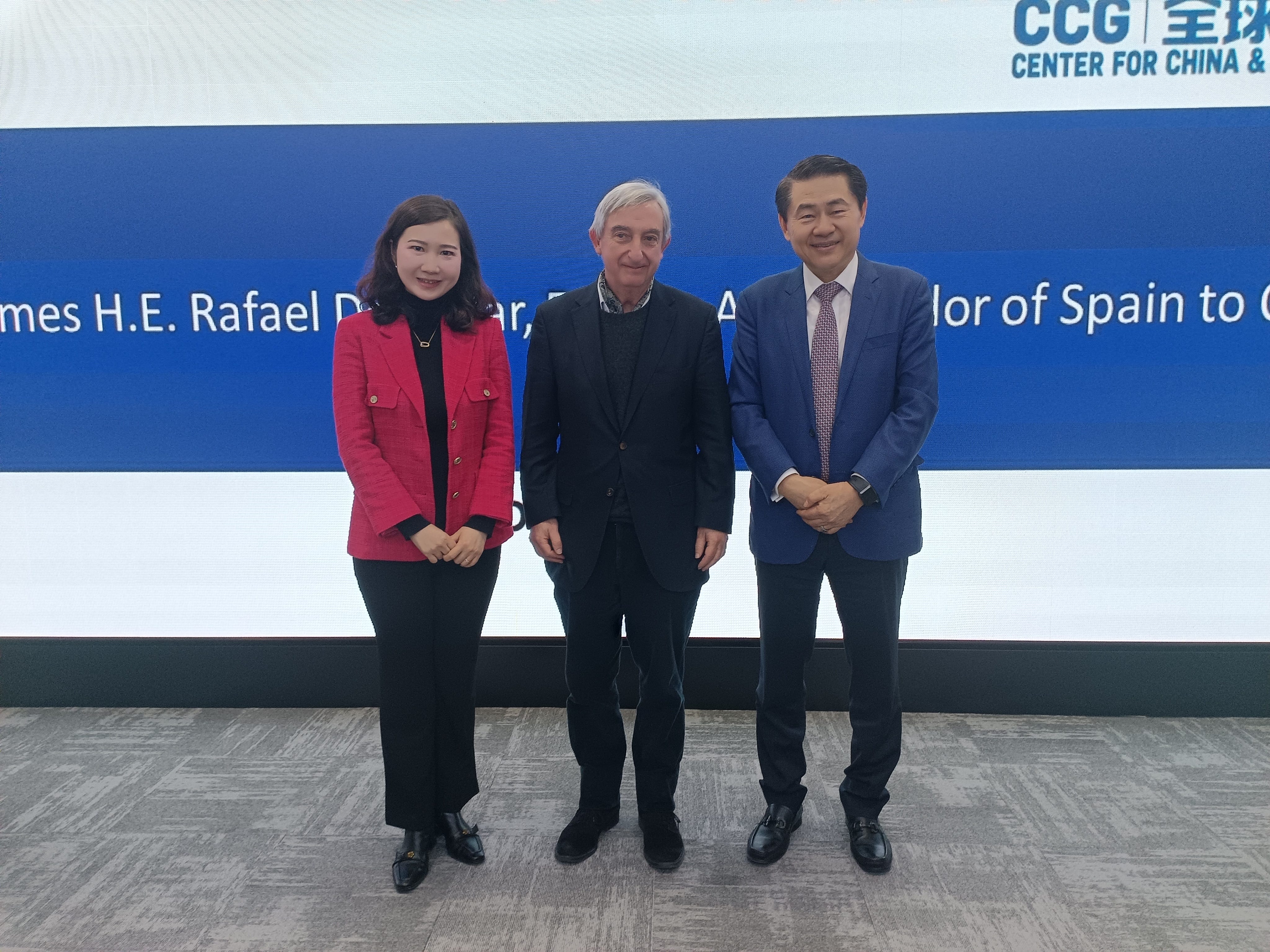
CCG and Dezcallar have maintained friendly ties over the years. He has spoken at CCG’s China and Globalization Forum and ambassadors’ roundtables. He also contributed a chapter, “For a Useful Dialogue Between Spain and China,” to CCG’s recent open-access volume The Future of China’s Development and Globalization: Views from Ambassadors to China, edited by CCG President Henry Huiyao Wang and CCG Secretary-General Mabel Lu Miao and published by Springer.
Below is the English-language summary of Dezcallar’s recent Spanish-language book, The Rise of China: A Look at the New Great Power (original Spanish title: El ascenso de China: Una mirada a la otra gran potencia), as provided to CCG by him.
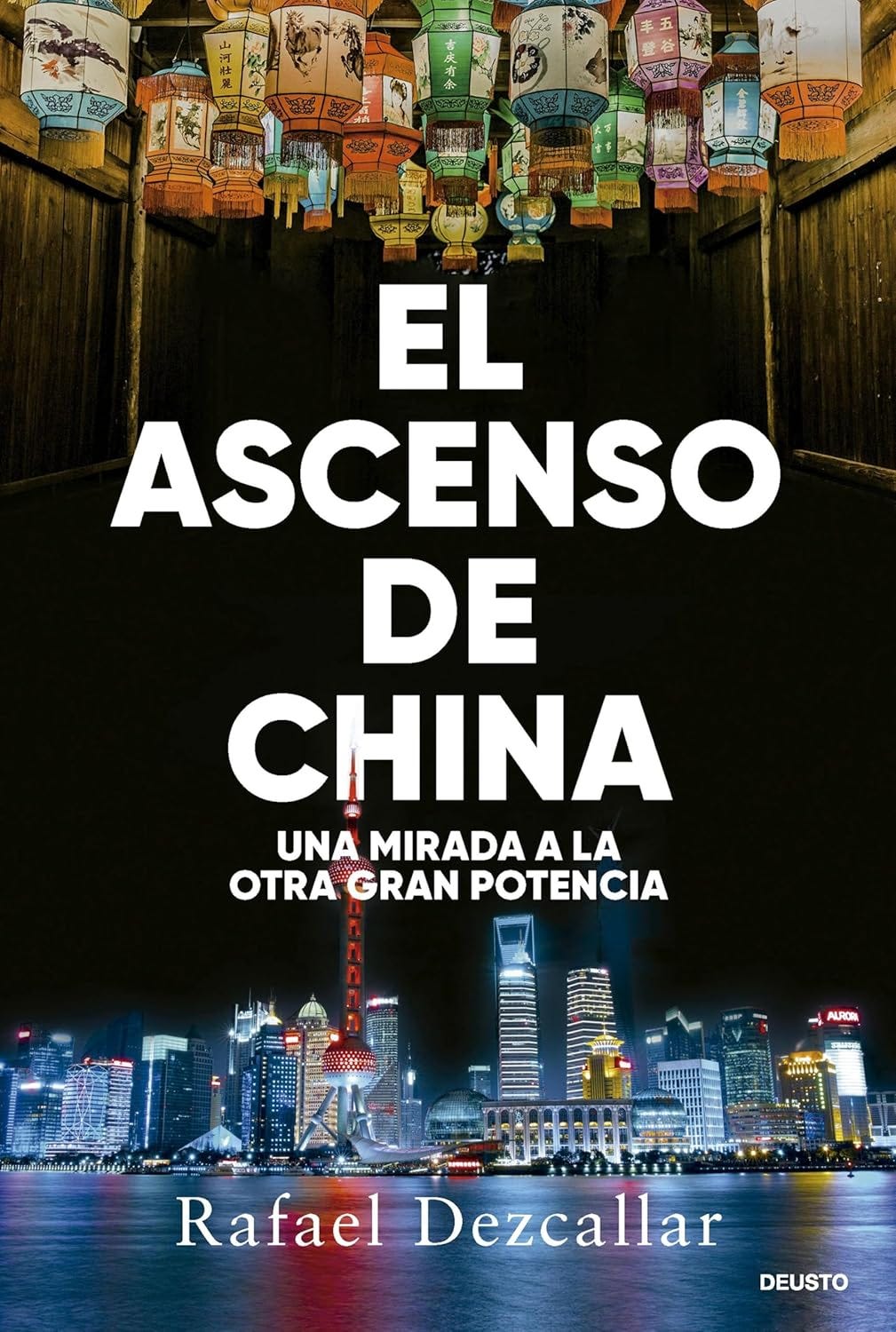
SUMMARY
This book tries to explain how China, a backward country forty years ago, is now the world’s second-largest economy. It also seeks to describe its current competition with the United States for global hegemony.
When Deng Xiaoping came to power in 1978, China’s GDP was similar to Italy’s. Deng was convinced that China’s decline since the Opium Wars was due to its economic backwardness. China had to develop, but that was not possible with a communist economic system. He introduced a number of reforms that turned the Chinese economy into a capitalist one.
This was a heresy for Marxist orthodoxy, but Deng was a supreme pragmatist. But he was also a communist, so he maintained the party’s monopoly on political power. Thus, the system created by Deng is a capitalist-leninist system. The economic model is capitalist, while the political model is leninist.
Capitalism gives individuals economic freedom from the state, which could lead them to also demand political freedoms. That is exactly what happened in Tiananmen in 1989. The capitalist system can also cause inequality, corruption, or environmental damage. All of this occurred in China during the years of runaway growth under the administrations of Jiang Zemin and Hu Jintao, between 1990 and 2012.
When Xi Jinping came to power in 2012, he feared that if those tensions were not addressed, Chinese society would gradually slip away from the party’s control. He launched an anti-corruption campaign. He tried to reduce inequalities and proclaimed the elimination of extreme poverty, (although China’s Gini coefficient remains relatively high). He also tried to fight against urban pollution. Still, China is today the world’s leading polluter, responsible for 27% of CO2 global emissions. Xi also increased state intervention in the economy, reining in large technology companies, and creating party committees in all Chinese companies.
Xi also felt that power under his predecessors had been too dispersed, causing in some cases paralysis and weakening the party. He decided to concéntrate all power in the party, and specifically in the hands of its leader. He also placed security considerations at the center of his policies. Repression and censorship intensified. He also launched an ideological campaign in order to strengthen the legitimacy of the Chinese political system and the role of the party.
There is an inevitable tensión between a capitalism and leninism. The role of the communist party is to keep that tensión under control. The party controls everything in China. It is a remarkable power machine, much more effective than the communist parties of the Soviet era. The book examines the way this power machine works.
One of Xi’s key goals is to turn China into a great power. China should take its rightful place among nations, a place commensurate with its new economic power and the importance of the Chinese Empire in past centuries. The principle established by Deng Xiaoping—”Hide your strength, bide your moment”—no longer applies. For Xi, China’s moment has arrived.
Accordingly, Xi Jinping has implemented a more aggresive foreign policy. He stressed the goal of reunification with Taiwan, if posible by peaceful means, but without excluding other means. He claimed sovereignity over the majority of the South China Sea. China seeks to become the leader of the Global South. It created the Belt and Road Initiative and a radial system of summits with all regions of the world. China is the main trading partner of 120 countries. Xi put an end to the “One Country, Two Systems” principle in Hong Kong, clashed with India in the Himalayas, and applied economic sanctions to countries with which he had political disagreements, such as Norway, South Korea, Canada, and Lithuania.
This new China provoked a reaction from the United States and Europe. Trump began a trade war during his first term. Biden added severe restrictions to the sale of advanced technology. The COVID-19 pandemic deepened the rift between China and the West.
One of the goals of China’s foreign policy is to change the international order. Beijing argues that the current one was created by the West in 1945 and 1989, but the balance of power has since shifted. In China’s model of international order there would be no universal values. Each country would be free to choose its own path, including its own visión of human rights. Without universal values, each country could decide what best suits its interests. Therefore China’s model of international system could be profoundly unequal and would favor the creation of areas of interest.
China’s rise created a power competition with the United States. This rivalry plays out on different fields.
On the political field, both countries clash over crisis situations. The book analyses some of them, including Taiwan, the South China Sea and Ukraine.
There is also a military rivalry. China does not intend to compete with the United States globally, but it does wish to achieve a position of superiority around Taiwan and the South China Sea. Its rearmament process is aimed at strengthen its capabilities in that area.
The economic rivalry is focussed on trade. Both the United States and Europe consider China’s trade policy unfair. It takes advantage of the opening of foreign markets while keeping its own market much more closed. In his first term Trump launched a trade war, and he has done the same in his second term. The EU has also imposed new tariffs on Chinese electric vehicles. This is also due to the excess capacity of key Chinese industries, which flood the world markets with subsidized goods.
The technological rivalry has strong economic, political and military implications. China’s progress has been very fast, and Washington does not want it to overtake the US in this field. The US has established a number of restrictions to the sale of high-tech products to China, especially semiconductors. China has replied limiting the exports of rare earths. Artificial intelligence and quantum computing are two of the most relevant areas of competition.
Finally, there is an ideological rivalry, a battle of ideas between China and the West. China, criticizes the shortcomings of democratic political systems (slower economic growth, racism, violence, inequality) and maintains that its own political system works much better. Western countries point out that liberal democracy has allowed them to achieve the highest levels of prosperity and stability. China offers the countries of the Global South an alternative path to develpoment: a model of modernization without Westernization.
The book concludes by raising the question of whether China’s growth is unstoppable, or if there are limits to its model.
China is now experiencing some economic difficulties, like the real estate bubble, declining demographics, local government debt, and weak consumption. There is a confidence problem in the Chinese economy, both internal and external.
For Beijing, economics are politics. It is not enough to simply grow. It seeks quality growth that will allow China to catch up with the United States as an economic, technological and political power. Climbing in the international value ladder requires a leap in productivity, technological advance, know-how and innovation. The question is whether the increased party intervention in the economy during the Xi Jinping era is compatible with the liberalization of talent and entrepreneurial capacity that is needed to achieve that goal.
Regarding politics, the insistence on ideological orthodoxy, the concentration of power at the top of the party, and the demand for absolute loyalty to the supreme leader have narrowed the scope for internal discussion within the party, which its ideologues have always considered key to its good governance. The propaganda apparatus adapts reality to the party’s political objectives, yet nothing solid can be built on the manipulation of truth. Inequality remains high and is of particular concern to the party leadership. The concentration of power in Xi’s hands could complicate his succession.
China’s friends around the world are mostly driven by economic or political interest, rather than by a feeling of closeness to its political system. Being a great power not only entails greater influence, it also entails greater responsibilities. But China is failing to live up to these responsibilities. It has not contributed substantially to resolving conflicts in areas of the world where its influence is significant, such as Africa, the Middle East or Afghanistan, let alone Ukraine. But Trump’s tariff policiy and his pressures on other countries -including allies- is opening political space for China. The gathering at the Shanghai Cooperation Organization Summit in August 2025 of more than twenty world leaders (including China, Russia, India Turkey, Egypt or Iran) suggests that China may be occupying that space.
The book concludes with a short chapter on what is to be done with China. We cannot fool ourselves. China is a formidable adversary for democratic countries. They will have to confront a great power that has a fundamentally different view on fundamental issues. Democracies must resolutely oppose China in order to defend their fundamental values and interests. But they must also cooperate with Beijing whenever they can find common ground, like in the fight against climate change, international trade, or even some international crises.
For Western countries, it is essential to do things right, both at home and abroad. If China does things better than us, it will gain an advantage.
Every effort must be made for instance to neutralize China’s advantage in long-term planning. The main political parties in our countries should agree on a number of national goals that should be protected from political ups and downs. Should we fail to do it, we will pay a high price.
We also need a different approach to the Global South. The EU, for example, is Africa’s main trading partner, its top investor, and the largest donor of development aid. Yet the continent seems much more oriented towards China than towards Europe. Latin America is the only region of the developing world that shares fundamental political values with Western countries, but both the US and Europe have neglected it for many years, leaving the field open to China.
Finally, we must make an effort to understand China better. We must overcome stereotypes, prejudices, and lack of information. China-bashing leads nowhere. We need to know its strengths and its weaknesses. That is essential to defend ourselves from China when necessary, and to seek areas of collaboration when possible. China will change in the future, just as it has changed until now. But it will change within the framework of its own categories, not ours. In a way that is consistent with its worldview, not with ours.
CONTENTS
Introduction
1. The Transformation of China
2. Xi Jinping’s China
3. The Emphasis on Security
4. An Ideological Rearmament
5. A Power Machine
6. All Power to the Party
7. A More Ambitious Foreign Policy
8. A New International Order
9. The United States’ Reaction
10. The COVID-19 Pandemic
11. The China-US Rivalry
12. The political Rivalry: Crisis Situations
13. The political Rivalry: Friends of China
14. The political Rivalry: Friends of the United States
15. The military Rivalry
16. The economic Rivalry
17. The technological Rivalry
18. The ideological Rivalry
19. The limits of the Chinese Model: The Economy
20. The limits of the Chinese Model: Politics
21. The limits of the Chinese Model: Foreign Relations
22. What is to be done with China
Bibliography
Readers interested in Dezcallar’s analysis may click to purchase The Rise of China: A Look at the New Great Power online.