

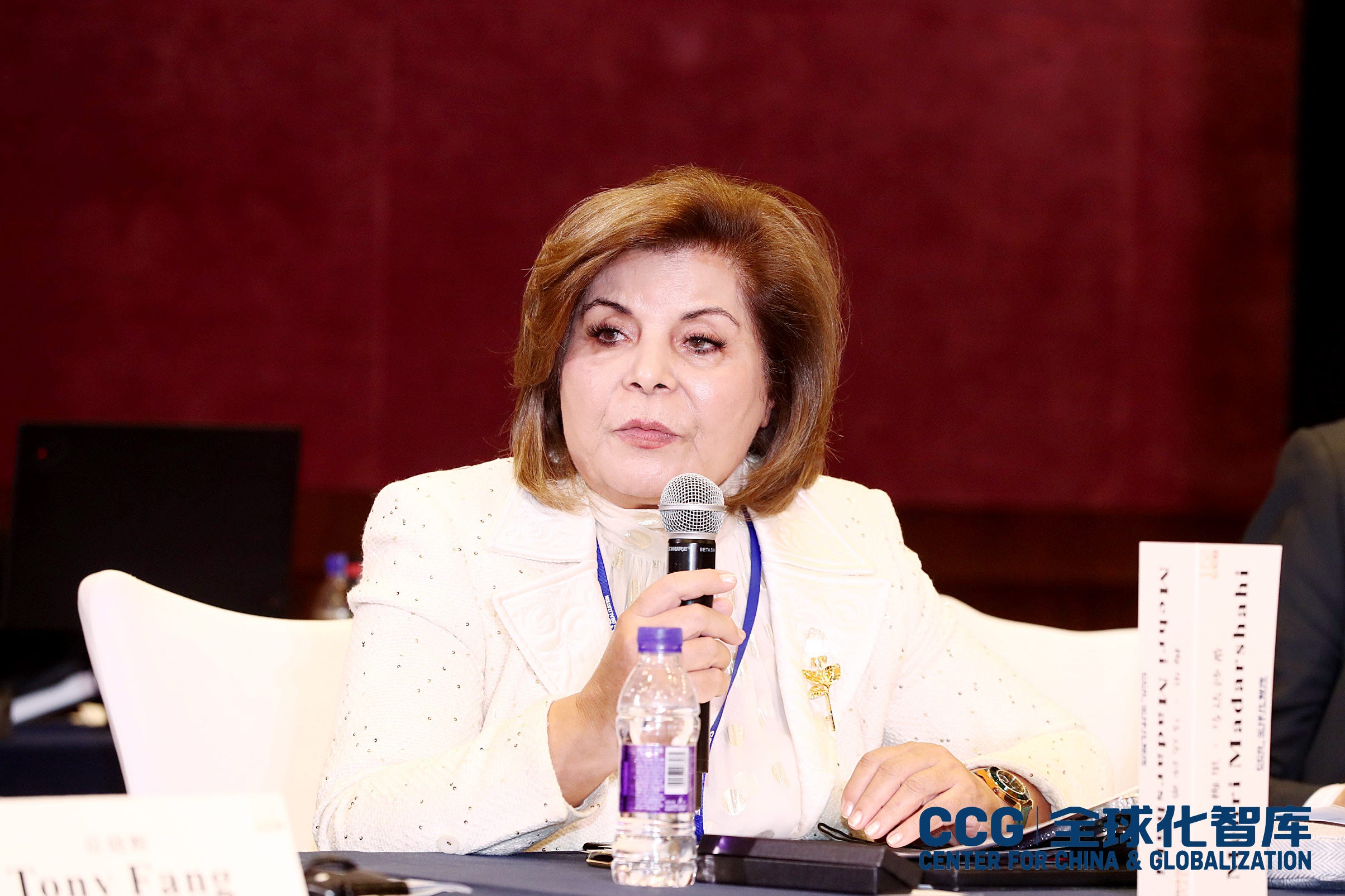
Below is the latest article by Mehri Madarshahi, Member of the Advisory Committee of the Center for Creativity and Sustainable Development under the auspicious of UNESCO and CCG Nonresident Senior Fellow, which looks at how 2025 has become a “hinge year” where the world’s political, climate, and technology “maps” no longer align.
2025: The Future in a Year of Fractured Maps
By: Professor Mehri Madarshahi
Mehri Madarshahi retired as a Senior Economist after 26 years at the United Nations Secretariat in New York. In Paris, she became the European Correspondent of Maxims News and the United Nations Diplomatic (UNDIP) newspapers and was elected as a Member of the Supervisory Board of the AMFIE credit union bank in Luxembourg.
In partnership with UNESCO, she founded the “Melody for Dialogue among Civilizations” Association and produced major multicultural concerts promoting sustainable development, education, and social advocacy, in collaboration with organisations including UNESCO, UNEP, UN-Habitat, CERN, and universities in the U.S. and Europe. She later founded Global Cultural Networks (GCN) and the Shenzhen-Qianhai Global Cultural Consulting company (MAH), and has been a Visiting Professor at several Chinese universities.
Her work spans environmental sustainability, the circular economy, urban reconstruction, technological innovation and the SDGs, and outer-space scientific developments, and she has received multiple recognitions for cultural diplomacy, including UNESCO’s 60th Anniversary medal and the Aspen Institute for Diplomacy’s “Cultural Diplomacy Award”.
Introduction
When the World’s Maps No Longer Align
The year 2025 marks neither a dramatic collapse nor a triumphant renewal of the international order. Its significance lies elsewhere: in the growing recognition that the conceptual, political, and spatial maps through which the world has been governed no longer coincide. Power, legitimacy, territory, climate risk, and technological capacity now follow diverging logics. What once appeared as a single navigable global landscape has fragmented into overlapping, sometimes contradictory cartographies. Cold War aside, I have never experienced a year quite as worrying as 2025- not just because several major conflicts are raging but because it is becoming clear that one of them has geopolitical implications of unparalleled importance.
Nato governments are on high alert for any signs that the undersea cables carrying electronic traffic may be cut or the drones are testing the weakness of their defence system. Already hackers develop ways of putting governmental institutions and emergency systems out of operations.
The year 2025 has been marked by three very different wars. There is Ukraine with 14 thousands casualties, Gaza with 70,000 killed including 30,000 women and children and the ferocious civil war between two military factions in Sudan.
Looking ahead to 2026, Russia appears ready—and willing—to push for significantly greater territorial dominance. This confidence stems in part from what Moscow perceives as a waning interest by the American president in Europe. The year 2025 revealed, perhaps for the first time since World War II, the possibility that a U.S. president might turn his back on the transatlantic strategic system that has long underpinned European security. At the same time, Washington now seems increasingly disapproving of the political and strategic direction Europe itself is taking. This startling shift became explicit in the new U.S. National Security Strategy, which argues that Europe now faces a “stark prospect of civilisational erasure”.
2025 may come to be remembered not as a single moment of collapse, but as a hinge year, when strategic rivalry, political fragmentation, trade securitisation, and institutional fatigue converged, transforming crisis from an exception into a governing condition of international relations.
This distinction matters. Because a world that experiences a crisis is very different from a world that begins to govern through crisis.
This fragmentation is not episodic. It is structural. The institutions, norms, and assumptions inherited from the late twentieth century persist, yet the conditions that sustained them have eroded. In 2025, the world is still governed but increasingly without a shared compass. The result is not chaos alone, but misalignment: between problems and solutions, responsibility and capacity, global ambition and local reality.
I am trying to argue that 2025 should be understood as a threshold year: a moment when the future decisively stops resembling an extension of the recent past. To grasp its meaning, one must read the fractures geopolitical, climatic, urban, and institutional not as isolated crises, but as expressions of a deeper reordering of how the world is organised and governed.
A Fractured World Order: Authority Without Direction
At the geopolitical level, 2025 exposes a paradox at the heart of global leadership. The international system remains densely institutionalised, yet increasingly incapable of producing collective direction. Established powers retain influence but face internal polarisation and declining consensus. Emerging powers assert strategic autonomy but often resist the burdens associated with global stewardship. The result is authority without coordination.
Multilateral institutions continued function procedurally, but their normative gravitational pull has weakened. Consensus has become thinner, negotiation more defensive, and ambition frequently postponed. While this may not signal the end of multilateralism, but it could lead its transformation into a more transactional, fragmented practice. Governance persists, but it is selective - robust in some domains- fragile in others.
In 2025, migration pressures, informal urbanisation, coastal degradation, and food insecurity intersect across regions that cut through conventional distinctions between North and South. Risk is no longer confined to specific countries; it clusters around deltas, coastlines, megacities, and neglected peripheries.
These transformative processes affect security, finance, and strategic alliances with different structures, while , by contrast, climate adaptation, urban inequality, and environmental resilience, that are often relegated with voluntary frameworks will be vulnerable. This asymmetry produces a new geography of responsibility: risks are globalised, while responses are localised.
A world re-arming, re-aligning, and hedging
Look around the world in 2025, and one pattern is impossible to ignore: major powers are preparing for long-term confrontation, even while insisting they want stability.
Global military spending has now surpassed $2.4 trillion annually, the highest level since World War II. Defence budgets are rising not just in one region, but everywhere — in the United States, Europe, East Asia, and the Middle East.The US is modernising its nuclear triad and expanding its defence-industrial base. China continues its rapid military and naval expansion, now possessing the world’s largest navy by ship count. Russia has fully shifted to a war economy. European states, after decades of underinvestment, are rearming at speed, with defence spending across NATO rising by double digits in real terms. At the same time, alliances are tightening, but they are also hedging. States are committing publicly while quietly diversifying partners, supply chains, and security guarantees. Trust exists, but it is no longer blind.
During the Cold War, deterrence was terrifying, but it was also structured. There were red lines, hotlines, doctrines, and shared understandings of catastrophe.In 2025, deterrence feels thinner. Escalation risks are higher, not because leaders are reckless, but because more domains, more actors, and more technologies are involved. A cyberattack, a satellite disruption, or a supply-chain shock can now have strategic consequences, without ever firing a missile.
Crisis-management mechanisms still exist, but trust in them has eroded. Communication is noisier. Information is contested. Leaders must act faster, with less certainty, under constant domestic pressure.
The danger today is not deliberate war, it is miscalculation under stress.
This is not preparation for a single war. It is preparation for a long era of danger
Security in 2025 is no longer confined to tanks, troops, or aircraft carriers.
It now includes:
• Cyber space, where attacks can paralyse hospitals, ports, or elections
• Space, where satellites underpin communications, navigation, and finance
• Energy, where chokepoints and price shocks can destabilise governments
• Data and semiconductors, where control means economic and military advantage
• Supply chains, where disruption can cripple entire industries
These new categories give rise to logic of expanded national security and it is reshaping everything it touches including trade which is now treated as weapon instead of a tool for creating stability.
Tariffs, export controls, sanctions, and industrial subsidies are no longer emergency tools, they are routine instruments of power. Strategic industries are protected. Technology flows are restricted. Dependencies are treated as vulnerabilities.
It worth clarifying that while the global trading system will continue to exist in 2026, but it is fractured. The age of trade driven primarily by efficiency has given way to trade driven by security. Supply chains will be scrutinised, dependencies will be reclassified as vulnerabilities, and economic instruments will openly be used for strategic leverage. Global trade volumes may not have collapsed, but trust in trade has. Globalisation will be redesigned. Interdependence no longer guarantees stability. In many cases, it generates anxiety.
Climate Governance as a Mirror of Global Fragmentation
Climate governance offers perhaps the clearest illustration of this fractured order. By 2026, scientific uncertainty is no longer the obstacle. The central challenge will be political and institutional capacity: the ability to translate shared diagnosis into coordinated action.
An important issue which never made the headlines but still remained as one of the most consequential dynamics shaping global climate inaction in 2025 was the strategic use of unilateral territorial interventions as instruments of intimidation. These actions whether through overt military presence, de facto annexation, or coercive control of contested spaces extend beyond questions of sovereignty. They generated a climate of uncertainty that reorders national priorities, often to the detriment of long-term environmental commitments. For many states, particularly middle- and small-income countries, territorial instability signaled a return to a world where security is no longer collectively guaranteed. In such an environment, climate mitigation and adaptation—by definition cooperative, future-oriented, and resource-intensive, appear increasingly vulnerable to political reprioritisation. Governments facing strategic pressure were and are more likely to divert fiscal capacity toward defence, energy security, and border control, framing climate action as a secondary or even negotiable concern.
Climate agreements, which rely on trust, reciprocity, and long time horizons, are particularly exposed to this erosion of normative confidence. Why incur near-term costs for emissions reductions if the international order that underwrites cooperation appears increasingly fragile?
At the multilateral level, this erosion manifested itself as strategic minimalism. States remained formally engaged in climate negotiations, yet adopted cautious positions that prioritise flexibility over ambition. Pledges became conditional, timelines extended, and implementation was deferred. Probably, this could be interpreted not as climate denial, but climate hesitation, rooted in the perception that the geopolitical ground is shifting faster than the climate regime can stabilise.
In that light, processes such as COP30 could symbolise both continuity and strain. They reaffirm the persistence of multilateral engagement, yet simultaneously reveal its limits. Commitments proliferate, but implementation remains uneven. Adaptation has risen to prominence, signaling an implicit acknowledgment that mitigation alone will not avert severe disruption.
This shift marks a critical psychological and political transition. Climate governance is no longer framed solely around preventing catastrophe, but around managing its consequences. Responsibility is recognised in principle, yet dispersed in practice. The global climate map, like the geopolitical one, reflects compromise more than coherence.
The danger is not failure alone, but normalisation of inadequacy: a world in which incremental progress coexists with escalating risk, and ambition is continuously recalibrated downward to match political feasibility rather than planetary necessity.
International institutions were designed for cooperation in good faith. In 2025, good faith is in short supply.
Rules are applied selectively. Forums are bypassed when inconvenient. Multilateralism survives, but increasingly as a toolbox rather than a shared project.
This is not institutional failure in a dramatic sense. It is something quieter and more dangerous: institutional exhaustion.
The legacy: a world governed through crisis
The legacy of 2025 will not be one dramatic memory, but a lasting mindset. A year that stability was no longer assumed but, it was managed, rationed, and negotiated daily
So why does 2025 matter more than the years before it? Because by this year, a subtle but decisive shift occurs. States stop behaving as though they are navigating temporary turbulence, and begin governing as though turbulence is permanent.Defence postures harden. Trade restrictions become normalised. Alliances hedged rather than trusted. Crisis tools turn into default instruments and emergency measures became long-term strategies, exceptional policies became normal and, crisis language became everyday language.
If historians look back, they may say:2025 was the year the world did not break, but the year it accepted that it would not easily be repaired.
This is the essence of a hinge year. Not the start of instability, but the moment when instability becomes embedded.
2025 as a Threshold Year
What makes 2025 distinctive is not that it resolves these tensions, but that it renders them unavoidable. The illusion of a return to stable, unified global maps has faded. What replaces it is not necessarily pessimism, but responsibility: the responsibility to govern complexity rather than deny it.
The belief that the world can return to a stable, unified order governed by a single set of rules has faded. In its place emerges a more demanding task: governing plurality without fragmentation, diversity without disintegration.
The future emerging from 2025 is likely to be plural, uneven, and contested. Progress will occur in pockets, setbacks elsewhere. Governance will be hybrid, combining formal institutions with informal networks, cities with states, public authority with civic innovation.
In this landscape, the task is not to redraw a single global map, but to learn how to navigate multiple, overlapping ones, to build bridges between fragmented spaces, align short-term adaptation with long-term transformation, and recover legitimacy through effectiveness rather than rhetoric.The challenge is not to redraw a single global map, but to learn how to navigate multiple overlapping ones <fractured map> aligning short-term adaptation with long-term transformation, restoring legitimacy through effectiveness rather than rhetoric, and reconnecting power with responsibility.
Fractured maps are not only metaphorical. They manifest physically in the uneven distribution of risk. Climate exposure, economic vulnerability, and political instability increasingly overlap spatially, reinforcing cycles of fragility.
This spatial complexity challenges governance frameworks that remain largely state-centric and territorial. Policies designed for bounded national spaces struggle to address risks that are systemic, mobile, and transboundary. The result is frequent misalignment: technically sophisticated interventions that fail to engage social realities.
Understanding 2025 thus requires a multi-scale lens, capable of reading global systems, national policies, and local experiences simultaneously. Without such an approach, fractured maps become not only descriptive, but prescriptive, reinforcing fragmentation rather than addressing it.
Conclusion:
Learning to Govern a World of Fractured Maps
And that leaves us with a final question.Is the legacy of 2025, likely to be long-lasting?
The future in a year of fractured maps, is not an obituary for global governance, but a diagnosis of transition. The world is not ungovernable; it is differently governable. The difficulty lies in adjusting institutions, mental models, and political incentives to match the complexity of contemporary reality. This needs a paradigm shift to accept that what was once extraordinary to become routine. Adjusted to rivalry without clear guardrails, adjusted to politics that travel faster than diplomacy, adjusted to economics shaped by fear as much as opportunity, adjusted to institutions that persist, but no longer command consensus, adjust to decisions made under crisis conditions that tend to endure, even after the original justification fades, adjust to exceptions to multiply until they redefine the rule, adjust to downward expectations from optimism about order to endurance within disorder.
This is how international systems change-not overnight- but through quiet recalibration. In that sense, 2025 may be remembered as the year crisis ceased to be an exception, and became a condition.
If earlier eras sought unity through uniformity, the post-2025 world will require coherence through diversity. Cities, climate governance, and evolving forms of leadership will not converge neatly, but they can be made to resonate. The future depends less on restoring old maps than on cultivating the capacity to read new ones carefully, ethically, and collectively.
2025 could very well be remembered as a year of compounded crisis, and more importantly not the year crisis arrived but the year the world accepted that crisis was here to stay: A year whose choices, constraints, and recalibrations shaped the international system for years afterward
And what comes next depends on whether adaptation turns into renewal or resignation.