

As part of the Doha Forum 2025, the Center for China and Globalization (CCG), in partnership with the Doha Forum, convened a session titled “U.S.–China Relations: Navigating the Risks and Opportunities of a Changing Global Order.”
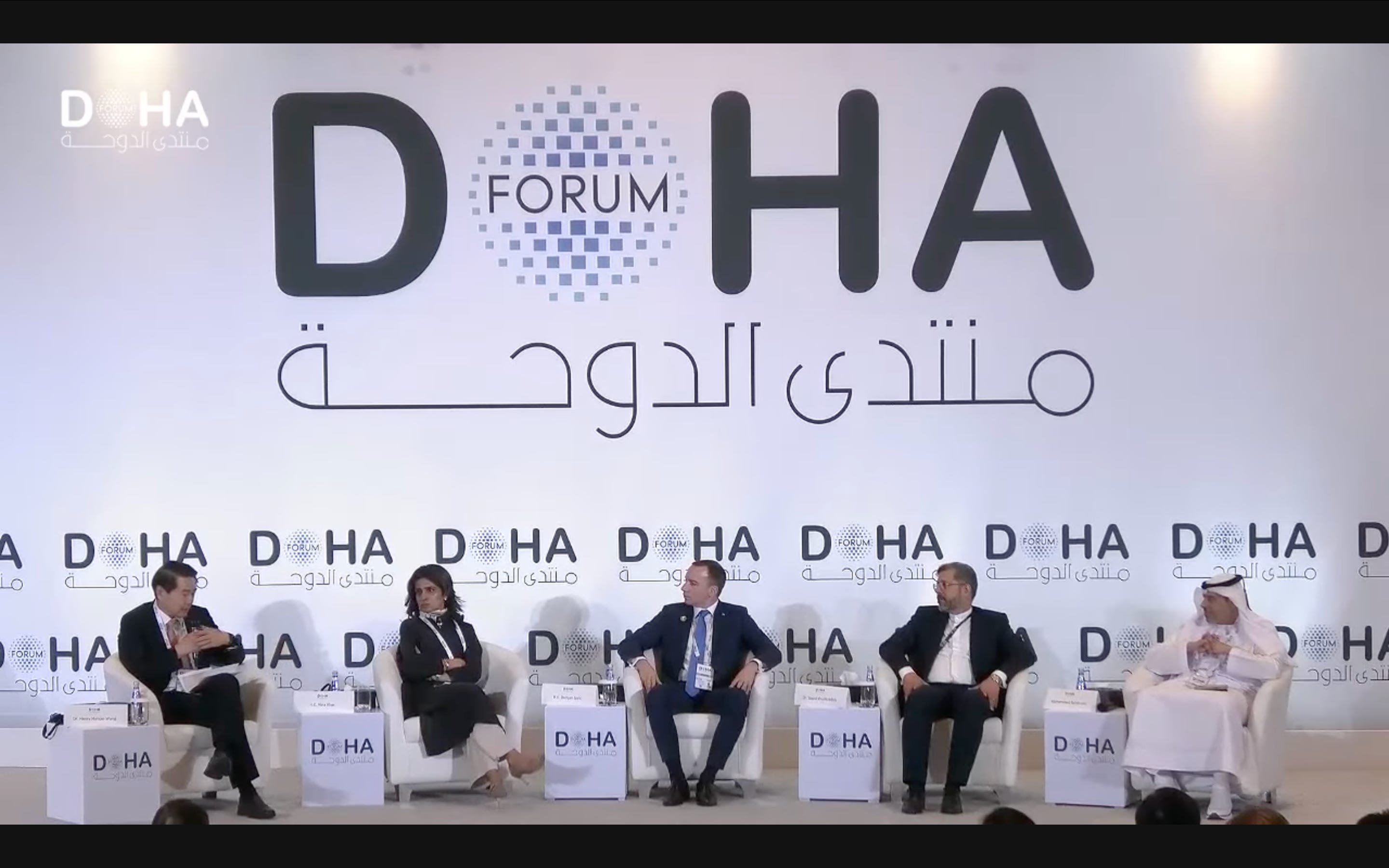
The session was moderated by Henry Huiyao Wang, Founder and President of CCG, and brought together a panel including
Hina Rabbani Khar, Chairperson, Standing Committee of the National Assembly on Foreign Affairs, National Assembly of Pakistan; Pakistan’s 26th Foreign Minister (2022-2023)
Saeed Khatibzadeh, Deputy Foreign Minister, Islamic Republic of Iran; President, Institute for Political and International Studies (IPIS)
Mohammed Baharoon, Director General, Dubai Public Policy Research Center
Damjan Jovic, State Secretary in the Ministry of Foreign Affairs, Republic of Serbia
Building on CCG’s collaboration with the Doha Forum, including co-hosting two sessions at Doha Forum 2023 and one at Doha Forum 2024, this year’s session explored how evolving U.S.–China dynamics are reshaping the global order and their implications for regions such as the Middle East, Europe, and South Asia.
The video recording of this session is available on Doha Forum’s official YouTube channel.
The following transcript is based on the video recording and has not been reviewed by the speakers.
Henry Huiyao Wang, Founder and President of the Center for China & Globalization (CCG)
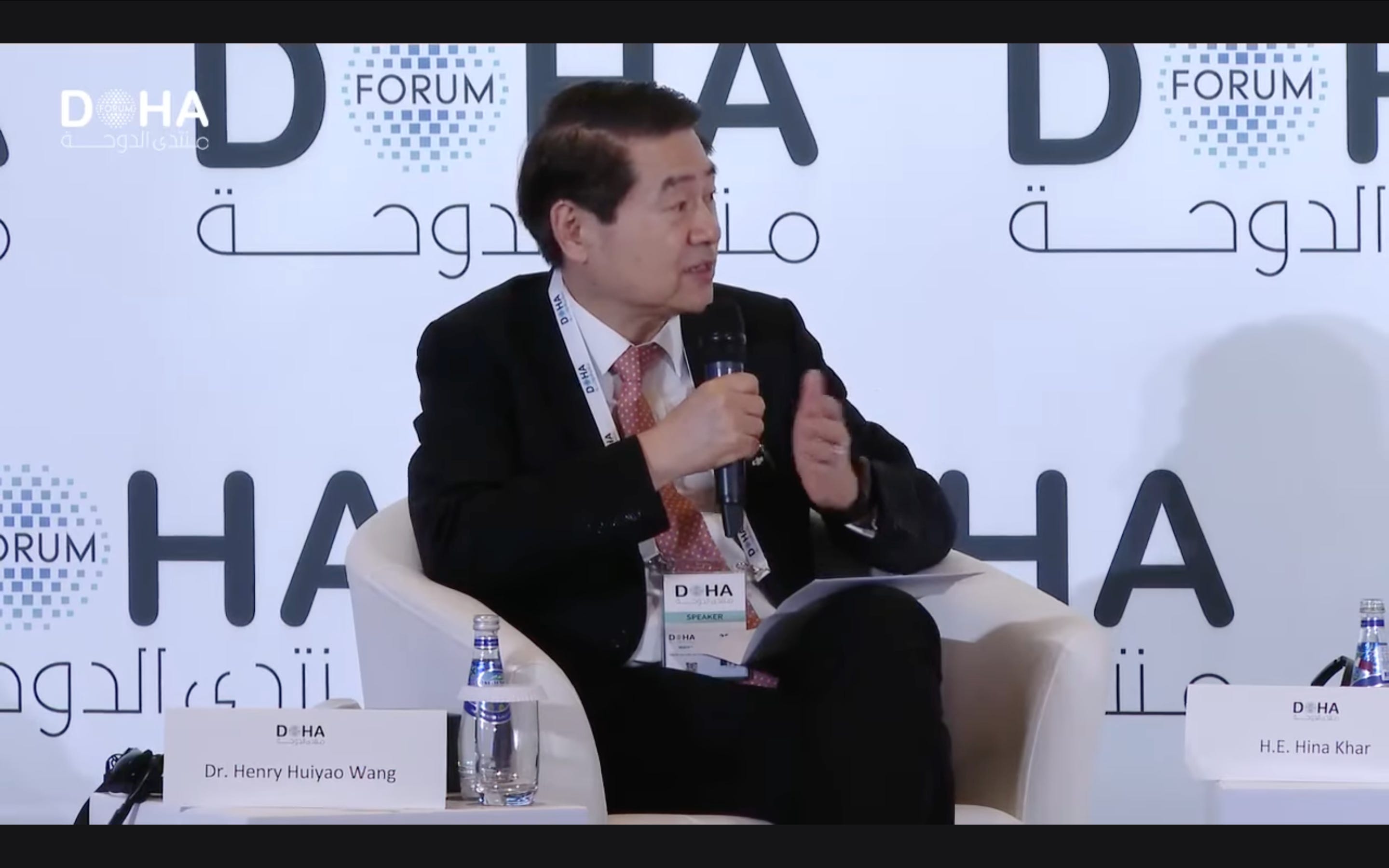
Excellencies, good afternoon. We are really pleased today to have this great session at the Doha Forum, and we already have almost a full house. Let’s start this very exciting panel that we have gathered here this afternoon, and I would like to introduce them for discussion.
We have
Damjan Jovic, State Secretary in the Ministry of Foreign Affairs, Republic of Serbia
Hina Rabbani Khar, Chairperson, Standing Committee of the National Assembly on Foreign Affairs, National Assembly of Pakistan
Saeed Khatibzadeh: Deputy Foreign Minister, Islamic Republic of Iran; President, Institute for Political and International Studies (IPIS)
Mohammed Baharoon: Director General, Dubai Public Policy Research Center
We have gathered a very impressive panel for all of us.
So basically, what we’re talking about today is a very timely topic: China–U.S. relations and the opportunities and risks they present for the world we are living in. We know that just recently, there was a meeting between President Xi and President Trump in Busan last month, and this was really a significant meeting. President Xi and President Trump agreed to meet again next April, so President Trump will come again. This is probably the most consequential and most influential bilateral relationship in the world today, and it is really affecting all countries.
I also noticed that yesterday the U.S. announced a new National Security Strategy, which involves quite a few adjustments to its previous approach. It puts more emphasis on the Western Hemisphere and places greater focus on economic issues and rebalancing in the Indo-Pacific. It also contains stronger calls for Europeans to become more strategically independent. So I see that the U.S. is, to some extent, changing its posture.
So what I would like our panel to discuss is this: since the U.S. and China, as the largest and second-largest economies in the world, have a great deal of influence and their relationship affects many others, how do you see the impact and implications of this relationship? How would you like to see this relationship evolve going forward, and what is your assessment of it? So maybe I’ll start with our friend from Pakistan.
Hina Rabbani Khar, Chairperson, Standing Committee of the National Assembly on Foreign Affairs, National Assembly of Pakistan; Pakistan’s 26th Foreign Minister (2022-2023)
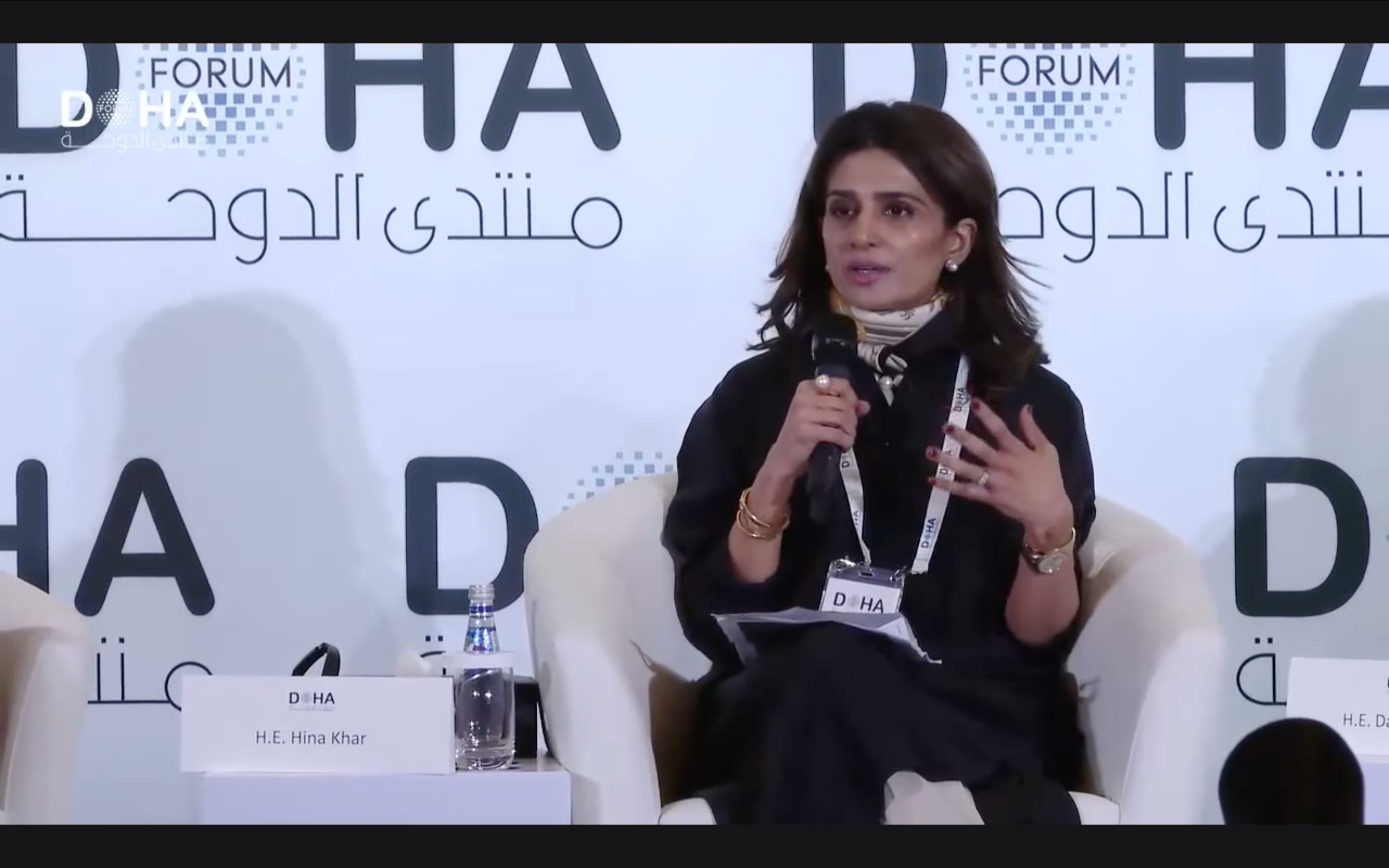
I think that the panel was called “U.S.–China relations: Navigating the Risks and Opportunities of a Changing Global Order.” So in some ways we’re here to talk about the changing global order, whether the change is and what is the change going to be, too, right? And I think what you see is at a very, very broad level — because you have to look at things at a broad level, at a strategic level, and then come down to really analyze what’s happening—because a lot of the stuff that we keep on talking about is tactical reaction to this strategic stuff that is happening above ground, right?
And what is that? So we all agree, I guess, I hope, and I wish we all agree that the only constant in life is change. You know, whether it’s in personal lives or political lives or you know the world, and we are currently going through the throes of a changing world, which will probably, obviously, create the need for the order to change, if it hasn’t already changed.
And there are forces of resistance which want the order or the basis of the order, the instruments or the institutions of the order to remain the same, because they affect some people more nicely than others, and others who see the world to have changed and thus feel that the institutions of the world, the instruments of the order, must also change accordingly.
But interestingly, what you see over here is in some ways you could say that there’s a fight for the retention of hegemonic power or the sole superpower status and its Western allies; and there is an emerging group of countries and one country in specific, which is coming in with a different paradigm in some ways.
But interestingly, what is actually unique about this moment is that those countries which have benefited the most from this order are the ones who have actually attacked it the most, as is in some ways representative of the security strategy paper which has recently been released, which is talking about Western democracies and the ills of Western democracies. Okay?
And whatever has happened in the world is, you know, let’s fast forward: post-1945 order is what we are evidently living through. Now, if you look around the world, whether you look at the social contract between citizens and the state, whether you look at technology, whether you look at economic power, whether you look at technological power, whether you look at… everything’s changed. Everything’s changed, and yet we want to continue to govern the world, which is a remnant of an order which reflected the power structure of that time.
So when power structures change, when economic realities change, the institutions that are required to address that must be flexible.
But as I said before, what is interesting in this is that the very architects of the order have actually demonstrated its weakness the most, because there was a time till the far-east Asian—you remember the time of the Asian tigers—democracy was working for everyone, the liberal economic order was working for everyone, and then it stopped working.
Now you can ask yourself the question: why did it stop working? Did democracies become too, you know, full of their own contradictions? To me, one of the major reasons why the value or the soft power of the liberal democratic economic order stopped being there for the rest of the world was when it started using exceptions and not universally applying rules to everyone.
So Israel is the friend. We will have no rules. It can go and massacre 70,000 people, children dead, put everything down, and we will not put any sanctions. But another country in Africa or somewhere in Asia will break one rule, and there will be economic sanctions, and their people will be left towards starvation. It doesn’t matter because what we believe in is human rights, etc.
When you stop espousing those rights, those values, for everyone, then the soft power sort of decreases. And within that context, I think one more perhaps important point, other than the credibility gap that I at least tried to talk about, is the weaponisation of the instruments of order.
And what do I mean when I say that? Economic sanctions, human rights sanctions: when you start weaponising what are supposed to be the instruments of order and not do it universally, it breaks the entire…
And lastly, I think what is also very important is that the proponents and propagators of that order and the foundations on which it was built—it was supposed to look after the world order or universal challenges to humanity. So when you look at climate change and see: okay, which countries are consistent in coming up with technology which is facing the threat of climate change, which are going into the agreements, remaining in the agreements, trying to do more, and which countries are in and out—all of that is a lot to say.
Same with AI. Same with pandemics.
So I think I’m going to end my first interjection by saying that let’s not kid ourselves. There’s no fight for leadership of the world. There’s a fight for hegemonic power retention or taking of that, which currently the chaos that we’re seeing in the world in any way is a result of.
Henry Huiyao Wang
Thank you, Minister Khar, and you’re probably right. You know, the world is really facing a lot of hard choices now, because the world we were used to is gradually giving way to a more multipolar order, and at the same time, the U.S. is stepping back from many of its international commitments. So we really have to see what the next global order is going to look like and how it will be shaped.
For example, the U.S. has quit the WHO, and China has announced a donation of 500 million U.S. dollars to support it. So there are many developments that, I think, are giving rise to this new—as President Trump put it—“G2” notion. China itself has not really accepted that label, but it does mean that both the U.S. and China now have much greater moral responsibility for the world.
So what does that mean for other countries? Because, in this new equilibrium—as it is described in the strategic report, with the “near-peer” status of China and the U.S.—we really need to think about how other countries can sustain the global order and make their own contributions, without being forced into or disrupted by this new balance that we are seeing.
So I’d like to invite Minister Damjan Jovic from Serbia. You have been quite knowledgeable about these issues, and you have experience in both the U.S. and China. So I’d like to hear from you as well, Minister Jovic.
Damjan Jovic, State Secretary in the Ministry of Foreign Affairs, Republic of Serbia
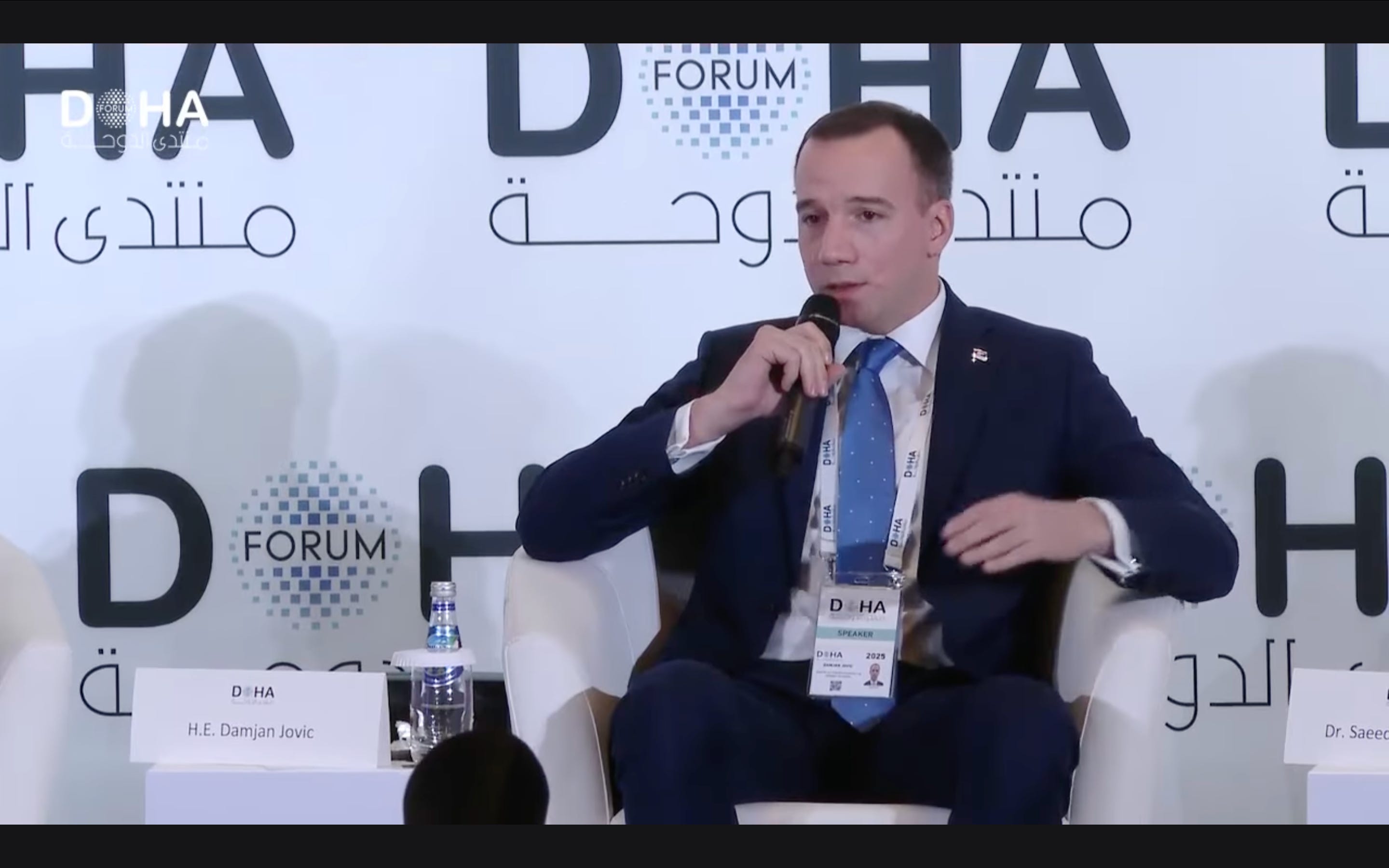
Thank you. Speaking from the point of view of a relatively small country from Southeast Europe, a country that is a candidate for membership in the European Union but at the same time has the highest level of strategic partnership with the People’s Republic of China and traditionally close relations with the Russian Federation but at the same time with Ukraine, and a country that was among the founders of the Non-Aligned Movement at the time—and we are still building on the same traditions—and a country that is expecting to open strategic dialogue with the U.S. in the next couple of months, I have to say that unfortunately, very often we are required to pay a high price for this kind of positioning, trying to preserve decent relations with all major actors in the international arena, and it shouldn’t be like this.
Speaking about the U.S.–China relations, I think we need both the U.S. and China because both countries have a lot to offer to the world, and especially if they are working together. We don’t need actually the U.S. and China to divide us and to create two separate worlds. We need the U.S. and China to coexist as two different civilisations in one world that belongs to them equally, as it belongs to many smaller peoples and nations all around the world.
We still remember and even feel the consequences of the Cold War and how the Cold War brought us insecurity, problems and a way of thinking that is still even nowadays present, and I believe that we definitely do not need a new Cold War between the U.S. and China.
There is a lot of hypocrisy in the world today, also. We are very often criticised for doing business with China from some of the Western partners. But actually, most of them who are criticising us for doing business with China are doing much more business with China than we do. I must say that we believe that if you’re negotiating in a responsible way, you can get a good deal for your country in doing business with China.
By the way, only 5% of our foreign debt goes to China, and we are still criticised by the countries that are much more in debt in their relations with China.
What worries us, of course, is when there is this situation that competition between the U.S. and China is gradually transforming into a confrontation that doesn’t actually take much into account the interests of smaller countries. And this is a situation that we should all aim to avoid because it doesn’t work, I believe so, not even for the U.S. and China, but for sure not for the rest of the world. Thank you.
Henry Huiyao Wang
Thank you, Secretary. Absolutely, I think for countries like Serbia and others, you don’t need to pick a side. You can really maintain good relations with both the U.S. and China. And from what I can see, we have very good relations with Serbia as a country, and there is a lot of investment actually coming from China as well. So we hope that we can continue this good relationship and, at the same time, China would like to have good relations with all countries in the world.
Now I’d like to turn to Saeed Khatibzadeh, the Deputy Foreign Minister of the Islamic Republic of Iran and also President of the Institute for Political and International Studies (IPIS). So what is your view? For example, China has been playing a very active role: a few years ago, China helped broker peace between Iran and Saudi Arabia, and of course, in the early days of the seven-party agreement, China was also participating.
Now we see that there is a lot of tension between Iran and the U.S., so in this context, how do you see the influence of China–U.S. relations on Iran, and how can we really help in this process?
Saeed Khatibzadeh: Deputy Foreign Minister, Islamic Republic of Iran; President, Institute for Political and International Studies (IPIS)
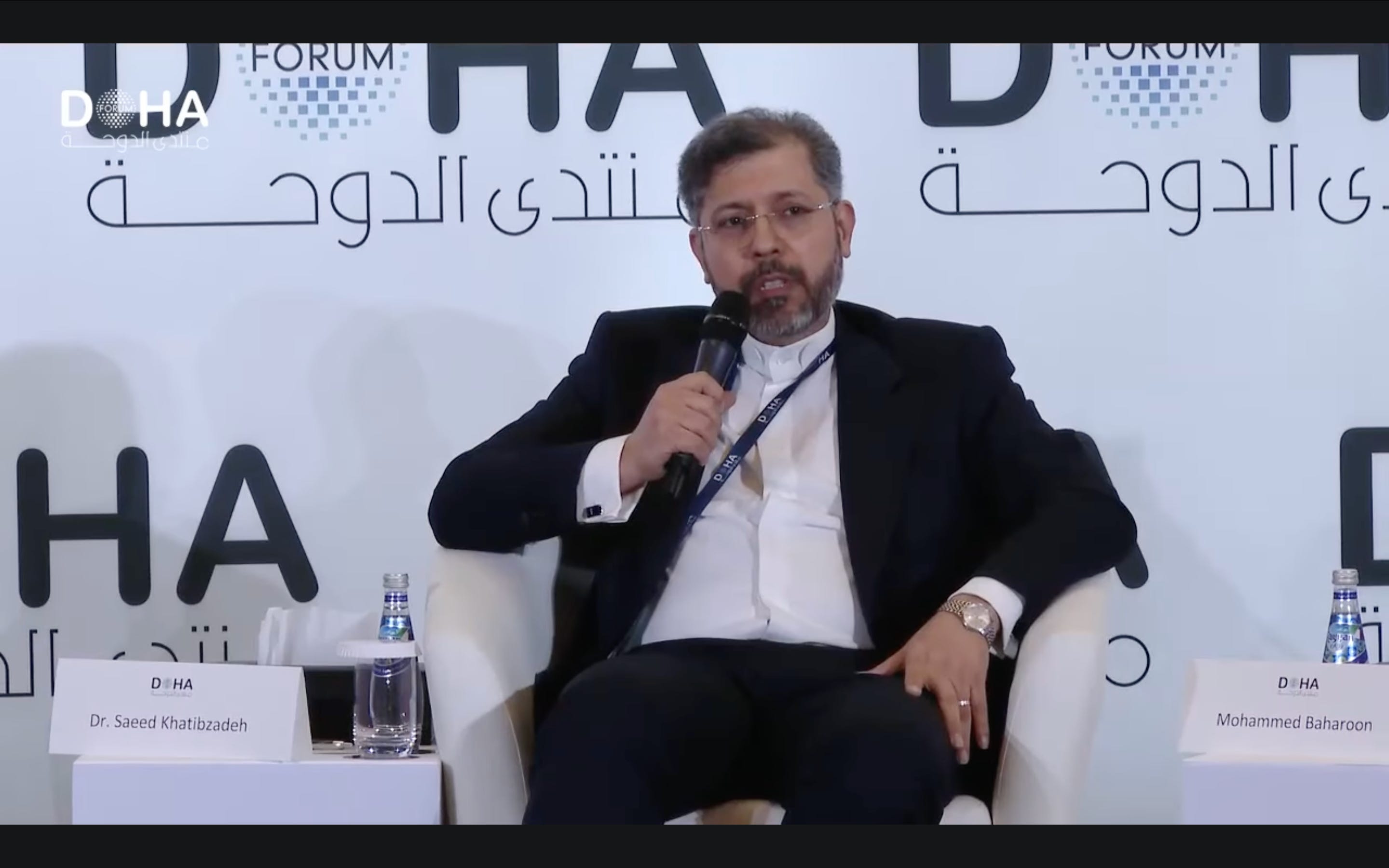
Thank you very much. I think what you said that relates Iran to the situation between the United States and China is valid, and our question at hand.
But let me first just raise a few points that are important for our understanding of what’s going on. I think my colleagues were quite clear in terms of defining changes which are happening in international relations. But they are not all changes. We are also seeing elements of continuity. So there are combinations of continuity and changes.
Among these continuity and changes, what is very important is that the relation between the United States and China is going to remain a defining factor in international politics. And this is very important for everybody to understand, that what is happening between the United States and China and what the equilibrium between these two powers is also going to define other factors in international politics. This is why everybody is so vigilant about Beijing and Washington, and everybody is just following very closely such initiatives or meetings, which you also referred to in Busan and other initiatives.
What is happening in international politics: one thing is going to remain unchanged, and that is that the hegemony and the time of hegemonic power is way gone. So the United States either has understood up until now or soon will be understanding this very point, that the time of the hegemonic posture has gone, and more importantly, nobody can ignore China anymore. And this is a fact. It is not just a voice from the Global South or an alternative voice. This is what is happening in mainstream international politics.
We are seeing changes, profound changes. There are two—at least two if not a few—major projects which are happening. One major project is the United States’ project, which is based on hegemony. The doctrine of “peace through strength” that everybody was hearing from President Trump is very much translated into this hegemony through the use of naked force. This is one project which very much has implications for every single issue in international relations. What is happening right now in the Middle East, what is happening between Iran and the United States could very be understood in this framework.
Also, there is another project which is more of an inclusive project based on coupling, on trying to be more inclusive, as President Xi’s four major plans are just trying to advocate. To what extent it will be embraced by the other side of the Atlantic, I am not quite yet assured that they would understand the importance of these sorts of initiatives.
But what I am seeing, reading the 2017 United States national security document during the first President Trump administration, in which President Trump’s administration actually in 2017, if I’m not mistaken, just “identified Russia and China as revisionist states,” which means more of confrontation rather than rapprochement, and on the other side in Beijing, the tendency to prevent confrontation.
So on the other side, there are those who are trying to contain China as soon as possible—maybe tomorrow is too late from their point of view—and in Beijing, what we are seeing is this tendency of preventing this confrontation. Busan is promising, but we are not sure to what extent it actually is going to last, given this de facto recognition of the two sides’ position, which I hope, as my colleague, the Deputy Foreign Minister of Serbia, said, does not end in a new Cold War that our world cannot tolerate.
Henry Huiyao Wang
Thank you, Minister. I think you’re probably right that the new National Security Strategy report, which was just published yesterday, is a bit milder than the one released in 2017. I think that, because of this, as President Trump said in that report, the “near-peer” status between China and the U.S.—and what he called the “G2”—actually offers both China and the U.S. a better opportunity to really support the multilateral system, where I think China is now really starting to stand up.
For example, in the context of the trade war and unilateral measures, China has been very resilient. It has stood up against the trade war and, at times, pushed back. So I think it is important for China to provide support for the multilateral system, and I see that happening more and more now.
Of course, I also hope that the U.S. will come back to that system, rather than becoming so focused on unilateralism.
Now I’d like to bring in Mohammed Baharoon, Director General of the Dubai Public Policy Research Center. You are from this part of the world, which is becoming very, very important, and I see that the U.S. President is coming here, and China has also held a China–Arab summit. So what’s your take on this trilateral relationship?
Mohammed Baharoon: Director General, Dubai Public Policy Research Center
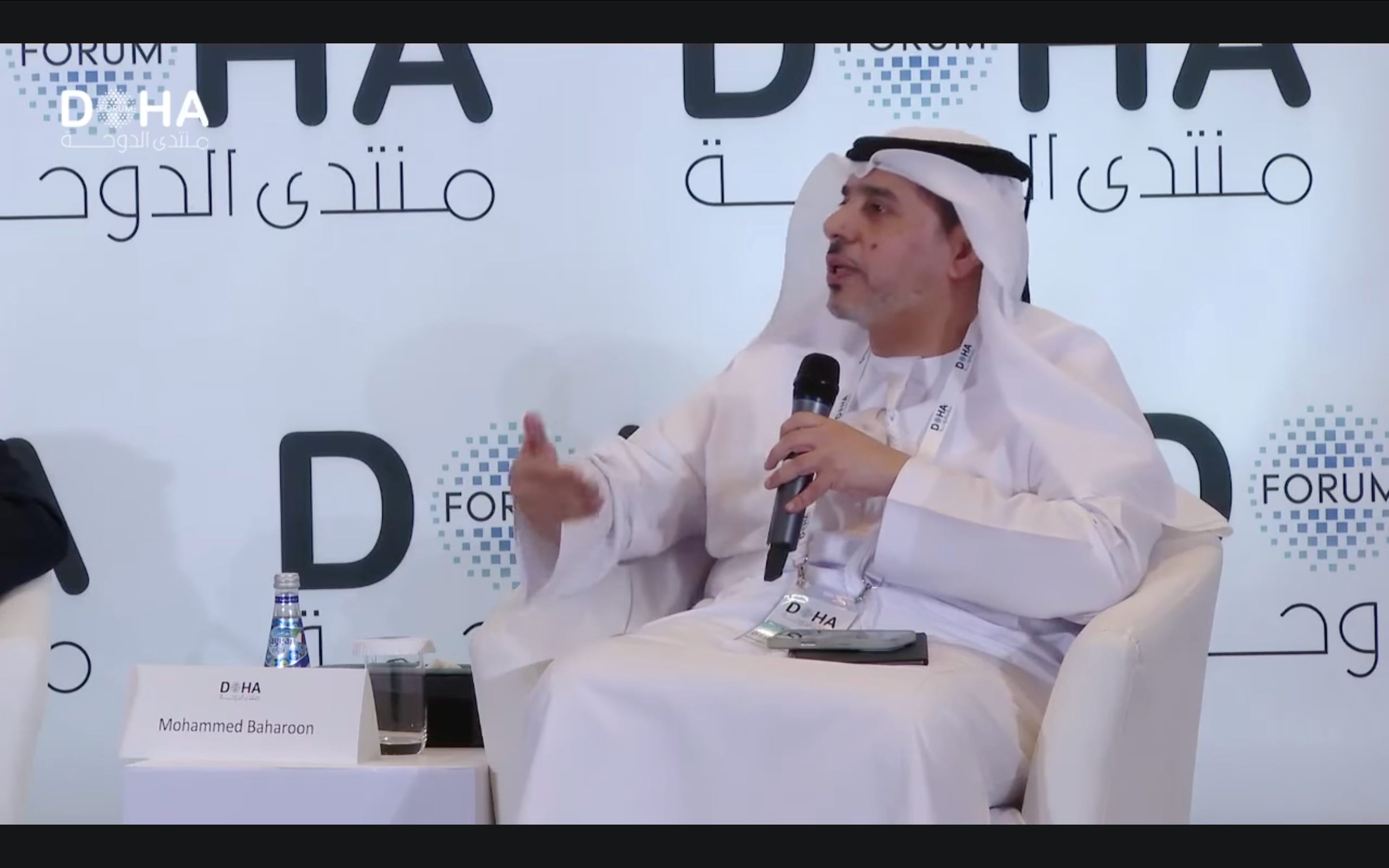
Good afternoon, Dr Wang. Thank you for having me here, and of course, thank you to Doha Forum for bringing all of us.
I think this idea of competition, the way we look at it, is outdated. It’s analogous when we are in a digital world. And the problem is that at least from the U.S. point of view, if they’re looking at China, they’re looking at China, but they’re seeing Russia. So they’re using old tools of the Cold War.
So the deployment of—or not deployment, but the concept of a nuclear umbrella in the South China Sea is problematic. It’s reminiscent of the Cuban Missile issue. Again, moving troops or assets from this region to the South China Sea—that was the whole thing that President Obama brought in—was again looking at it in the same way as the Cold War, dealing with China as if China is Russia.
But China is much closer to America than it is right now. And the idea of superpower…I don’t think China is a superpower today as much as it’s super relevant. It’s relevant to everybody’s life. And if you look at a U.S. household, between 70 to 90% of appliances, clothes, furniture, and toys are made in China. So China is very relevant to everyone in the region.
Relevance now is more important than military power. And that’s the digital formation in which we look at China. That’s why this idea of competition, in the way we see it, is actually hindering; it’s bringing us back to an old world rather than a new world.
Do we have a new world order? I don’t think so. But it is actually shaping. So Her Excellency mentioned the weaponisation of governance tools such as the monetary system, sanctions. This is very true. And when we look at it, we look at it as a clot in an artery. How do you deal with a clot in an artery? Either through an angiogram or through a bypass. So if it continues, we will see bypasses.
We’ll see new ways of dealing with the world’s requirements when it comes to the supply chain, monetary issues, transactions... We will have to find new types of words. And right now, digital currencies are becoming a new way of expanding or exchanging, and they will possibly not be subjected to the same type of old regulatory frameworks. New regulatory frameworks would come in with values of… these are things like air, we need to breathe all the time, everyone, regardless of whether you like them or not. So they will have to be protected.
And I think this is the way competition is either going to change in the U.S.—and I think President Trump is different, just maybe because of his background as a businessman, and I think he possibly sees things differently. So we might see more cooperation rather than competition, and there are a lot of areas where that cooperation can help.
Iran is one of them. This is how we’re looking at Iran. We’re looking at Iran not through its power but through its relevance to our region. It’s a huge power if Iran thinks about it, but it would require it to look at it through the prism of competition rather than cooperation. So this is one way.
If not, then we will find people using an old system, an analogue system, and others moving into a new digital system.
Henry Huiyao Wang
Okay, good. Absolutely. I think we all agree that the world order is going to be affected. How we can improve it, enhance it, and expand it is really up to all our countries. But I do think that the U.S. and China, for example—with President Trump coming to Beijing next April, and President Trump probably coming again for the APEC summit, so that President Trump may visit China twice—and then President Xi going to the G20 in Miami, means there will probably be three meetings between them next year.
So I see some stability there. There could be competition, but also a situation where they compete and cooperate at the same time. I was also encouraged by this national security report that was just published yesterday, which talks more about economic rebalancing with China, rather than, as in the 2017 report, putting China as the number one strategic rival, even before Russia. This time, they did not mention “strategic rivalry,” and I also heard Secretary Rubio saying that China and the U.S. should maintain strategic stability, which is really right.
But I have one round of quick questions, and I hope we can have quick answers. For China, basically over the last 40 years or so, since opening up, it has pursued economic liberalisation and an opening-up strategy. China is now the largest trading partner of 150 countries, including all of the countries represented here, and it is also pursuing a lot of regional cooperation — for example, RCEP, as well as China–Africa, China–Arab, China–Central Asia, China–Latin America, China–Eastern Europe and all those frameworks.
So how do we compare that with what we see now? If we really move into a more U.S.-led, security-heavy approach, where security is over-emphasised, and everyone drives up the military budget, that will take away our basic bread and butter. So what do you think? Should we continue to push for economic cooperation and economic globalisation, and are we now putting so much into security that it is actually reducing our living standards?
So that will be my quick question to ask all panellists, one by one. Yeah.
Hina Rabbani Khar
Okay. So I think what is happening in the world right now is a lot of preemptive—it’s almost like preemptive striking. You assume, if you go into, for instance, Professor Mearsheimer’s view of what offensive realism is about, that if a country is to emerge as an economic strength, it will be a matter of not “if” but a matter of “when” it emerges as a military and strategic threat. Right?
I do not ascribe to that. I absolutely adore him as a strategist and read all his books and learn a lot from him, simply because I think what we’re looking at is, I think, what Mohammed Baharoon said: that we are superimposing a past paradigm on the current times.
So if you were to, for instance, give us the benefit of the doubt and say for a moment that as an emerging economic power, it is not in China’s interest to have instability, war, military warfare, etc., etc., that we could be in fact looking at a different coexistence, and there is absolutely no… You know, can you imagine we were living in a world where it was proposed that we could decouple the world? It could not have been imagined 15 years back, right? Because the risk or the threat which seemed to be emanating from China, because of its rise in technology, as an economic power, etc., is so huge that it is seen to be a matter of time.
So if we were to change that paradigm and think that the coexistence of everyone is possible according to the same even world order, everyone playing according to the same rules, that would be perfectly legitimate.
And just to add that militarily, because everyone who tries to roll the drum of war and what China is able to do, I mean, militarily, currently the U.S. is spending more than the next 11 countries, right? So, where is this threat perception coming from other than the head? So it’s preemptive threat perception which has now put the world into a circle of, in some cases, chaos, and who knows, violence.
Damjan Jovic
I’ll again speak from the point of view of a relatively small or medium-sized country that is militarily neutral, because I think most of the countries in the world fit into this category. As I already said, you know, we need decent relations with both the U.S. and China because we need reliable alternatives for developing our countries and our societies, and we don’t want to side with any of the powers. We want to develop in peace and stability our relations with all major actors. That’s unfortunately not an easy task for any country in the world.
From our experience, we have some really great investments from China that worked well for our people and our country. We also attracted a lot of investments from the U.S., especially in the tech sector, and this is the way of operating that we would like to see continue.
We regard President Xi Jinping as a great and sincere friend of our country, of Serbia. But at the same time, President Trump is by far the most popular leader in public polls in Serbia, with approval rates of an unbelievable 76% at the moment. And we don’t want to be a part of confrontation. As I said, competition is always welcomed, and it brought good to my country and my people, and I think this is something that would be most welcome by most of the countries in the world.
What we need to avoid is confrontation that doesn’t take into account the interests of smaller partners in the international arena.
Saeed Khatibzadeh
If you are going to suggest that in the times of high politics, low politics matters—yes, low politics matters. We can consider economic cooperation as a way of convergence rather than divergence. But if you are going to suggest that low politics in times of high politics can change the paradigm, I doubt that, very honest and very frank with you.
What we are seeing is militarisation at its peak. Securitisation also. What we are seeing is more of a mess, and unfortunately, what we are not seeing is a genuine move toward peace. Lack of conflict doesn’t mean peace and stability.
And what we are seeing is not any move toward less weaponisation. On average, 10% of the annual budgets of different countries in this region and beyond this region are allocated to military expenditure. Around four to five per cent of the average GDP of the major world powers is allocated to military expenditure. These are all unprecedented post-Second World War.
The law-based international order is not anymore in place. Even there is a move from a rule-based international order to a more force-based international order, as we are seeing. I’m not alarming; I’m just telling you that what we are seeing, the trends are not very much promising.
What is important is that this is becoming. Global trends are becoming. Still, it is not settled, so we have to be very careful while we are trying to work with each other. At the same time, we have to prevent those spoilers and those who are trying to sabotage and manipulate, actually artificially trying to make a new order in which there will be fewer beneficiaries of the upcoming.
I have to add, though, because in the previous question you asked how Iran is related to this—let’s call it, you know, interaction. I don’t want to call it competition because there are signs of cooperation in some low-political issues, such as the economy, as you said, and also huge competition, I can say, on a strategic level between the United States and China.
And one of the issues is Iran–Saudi Arabia relations. You mentioned that, and China showed to everybody that now it is a Middle Eastern power. China used to be a little bit distancing itself from the Middle East. And you know, what happened between Iran and Saudi Arabia happened in the full absence of America, and also Europe, and it shows to what extent, regardless of all the changes, Iran–China relations are very genuine, and this is because of civilizational, cultural, economic, and many, many other issues.
So, just to encapsulate what I would like to say is that while we have no option but to work on low-political issues, we have to be vigilant about high politics.
Mohammed Baharoon
I think if you’re talking about security, also security has kind of transitioned from analogue to digital. I mean, if we look at this mediation between China and Iran and Saudi Arabia, frankly, if China were thinking in the analogous way, it would say: look, the U.S. President—President Obama, particularly—signed the JCPOA with Iran. He had this whole idea or concept of reducing the footprint.
The whole idea was to move assets all the way to areas that are very interesting, particularly in the South China Sea. And their best interest is not to reduce the tension between Iran and the GCC, but actually increase it and force more assets to be stationed in these places and away from the South China Sea. But frankly, China didn’t think so, and that’s not what it did.
I think since possibly COVID, we started to realise there is far more to security than just hardcore security, from health security all the way to energy security to environmental security. This cannot be solved except with cooperation. So we cannot revert back and say we can secure our own parameter, build a wall around us, and then we will be safe. That is not security anymore.
And in this way, there is far more need for cooperation between China and the U.S., and I’ll give you one final example: this concept of rare earth minerals. Today, the U.S. is accusing China of having a hegemony over the production of rare earth minerals. And frankly, China does have the majority of refinement capability.
Now, China could use this as a means of influence, leverage, power, or could look at it from the point of view of supply chain: that we need far more of it, and now we’ll need to cooperate with the U.S. rather than compete with the U.S., because if we don’t do that, there will be a block in all of this AI direction.
Henry Huiyao Wang
Okay, great, thank you. So, probably we do have to wrap up now, much as I hate to bring this to a close. But what I can see is that we’ve had a very good panel discussion, and I do think the U.S. and China are going to reach a new equilibrium, and that this new equilibrium is already generating many positive dynamics.
You mentioned, for example, China’s use of rare earths. But that only came about eight years after the U.S. had already used chip sanctions, decoupling, “small yards, high fences,” high-tech restrictions, and all those measures. Eight years later, China started to respond in some of these areas. But as President Xi said during his meeting with President Trump, “Let’s get out of this vicious cycle of sanctioning each other,” right? So we are still trying to set a good example in that regard.
So I do hope that the ceasefire that China and the U.S., which has reached this one-year pause, will continue, especially since there are going to be three high-level visits and then further exchanges. I also hope that with this new U.S. national security report, there will be a stronger focus on economic issues and less on strategic security than in the previous one.
I do think that the U.S. and China reaching a degree of strategic stability is possible, and that this will benefit all other countries. I’m sure that would be warmly welcomed by the rest of the world. Moving from strategic rivalry to strategic stability—I think this is the new equilibrium that, after eight years of China–U.S. trade war and frictions, we are starting to see. I hope it can be maintained, further improved, and bring the whole world along.
And of course, this kind of “Olympic-style” competition between the U.S. and China is also healthy—but not sanctions, trade wars, unilateralism, or the law of the jungle. I think China’s role today is precisely to help ensure that we do not go down that path, and that we instead have a more balanced, stable world for all countries.
So, on behalf of the Center for China and Globalization and also the Doha Forum for organising this session, we have to stop here. But we can continue our conversations afterwards. Let me thank our four distinguished panellists. Let’s give them a warm round of applause. Thank you all. Thank you very much.
Join us in Beijing: Indonesia–China at 75 and the way forward (agenda inside)

This year marks the 75th Anniversary of the Establishment of Diplomatic Relations between the Republic of Indonesia and the People’s Republic of China. The peak of the relationship between the two countries is symbolised by the establishment of a Comprehensive Strategic Partnership (CSP) in 2013, encompassing cooperation across the five main pillars, na…
Transcript: Henry Huiyao Wang, Pascal Lamy, Long Yongtu, and Xu Xiaofeng on Green Trade Liberalisation and the Global Green Transition

On November 6, 2025, during the 8th China International Import Expo (CIIE) and the Hongqiao International Economic Forum in Shanghai, a parallel session on “Promoting Green Trade Liberalisation and Accelerating the Global Green Transition” was hosted by China’s Ministry of Commerce and organised by the Center for China and Globalization (CCG), where spe…
CCG attended Doha Forum 2024

A team of CCG experts engaged in a wide range of activities, including debates, keynote addresses, panel discussions, and networking dinners, in the 2024 Doha Forum, held on December 7-8.